

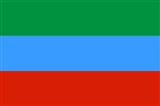
Dagestan

Encyclopedia
The Republic of Dagestan (icon or d; , Respublika Dagestan; also spelled Daghestan) is a federal subject
(a republic
) of Russia
, located in the North Caucasus
region. Its capital and the largest city is Makhachkala
, located at the center of Dagestan on the Caspian Sea
. Population:
Dagestan is ethnically very diverse, with several dozen ethnic groups and subgroups inhabiting the republic, most of which speak either Caucasian, Turkic
, or Iranian languages
. Largest among these ethnic groups are the Avar
, Dargin
, Kumyk
, Lezgin
, and Laks
. While Russians
form only a small proportion (4.7%) of the population, Russian
remains the primary official language.
Dagestan has been a scene of low-level Islamic insurgency, occasional outbreaks of separatism, ethnic tensions and terrorism since the 1990s. According to International Crisis Group
, the militant Islamist organization Shariat Jamaat
is responsible for much of the violence. Much of the tension is rooted in an internal Islamic conflict between traditional Sufi groups advocating secular government and more recently introduced Salafist teachers preaching the implementation of Sharia
law in Dagestan.
, Avaria, and Tarkov at various times.
.
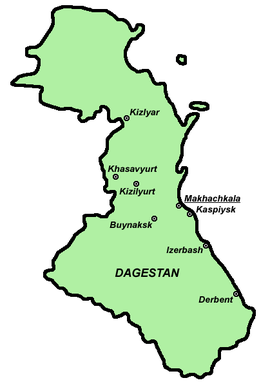 There are over 1,800 rivers in the republic. Major rivers include:
covering the south. The highest point is the Bazardyuzi peak at 4,466 m.
, natural gas
, coal
, and many other minerals.
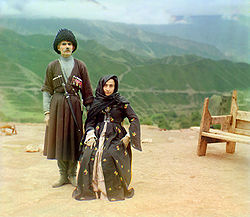 Because its mountainous terrain impedes travel and communication, Dagestan is unusually ethnically diverse, and still largely tribal. It is Russia's most heterogeneous republic. Unlike most other parts of Russia, Dagestan's population is rapidly growing.
, Northeast Caucasians (including Avars
, Dargins, Tabasarans
and Lezgins
) make up almost 75% of the population of Dagestan. Turkic peoples, Kumyks
, Nogais and Azeris
make up 19%, and Russians
4% . Other ethnic groups each account for less than 0.5% of the total population.
It should be noted that such groups as the Botlikh
, the Andi, the Akhvakhs, the Tsez
and about ten other groups were reclassified as Avars between the 1926 and 1939 censuses.
The indigenous ethnic groups of Dagestan are bolded.
There are also forty or so tiny groups such as the Hinukh, numbering 200, or the Akhvakhs, who are members of a complex family of indigenous Caucasians. Notable are also the Hunzib or Khunzal people who live in only four towns in the interior.
Over thirty local languages are commonly spoken, most belonging to the North-East Caucasian language family. The lingua franca
in Dagestan is Russian
.
, chemicals
, machine building, textile manufacturing
, food processing
, and the timber. Oil deposits are located in the narrow coastal region. The Dagestani oil is of high quality, and is delivered to other regions. Dagestan's natural gas production goes mostly to satisfy local needs. Agriculture
is varied and includes grain-farming, viticulture
and wine-making, sheep-farming, and dairying. The engineering and metalworking
industries own 20% of the republic's industrial production assets and employ 25% of all industrial workers. Dagestan's hydroelectric power industry is developing rapidly. There are five power plants on the Sulak River
providing hydroelectric power. It has been estimated that Dagestan's total potential hydroelectric power resources are 4.4 billion kW. Dagestan has a well-developed transportation system. Railways connect the capital Makhachkala
to Moscow
, Astrakhan
, and the Azerbaijani capital, Baku
. The Moscow-Baku highway also passes through Dagestan, and there are air links with major cities.
Conditions for economic development are favorable in Dagestan, but – as of 2006 – the republic's low starting level for a successful transition to market relations, in addition to rampant corruption, has made the region highly dependent on its underground economy
and the subsidies coming from the central Russian government. Corruption in Dagestan is more severe than in other regions of the former Soviet Union
, and is coupled with a flourishing black market and clan-based economic system.
In 2011 Rostelecom
started implementation of WDM
-based equipment on the backbone network for data transmission in the Republic of Dagestan. Due to WDM introduction the fiber-optic communication lines bandwidth increased to 2.5 Gbps. Rostelecom invested about 48 million rubles in the project.
, with Christians
accounting for much of the remaining 9.4%.
Dagestanis are largely Sunni Muslims, of the Shafii rites, that has been in place for centuries. On the Caspian coast, particularly in and around the port city of Derbent
, the population (primarily made of the Azeris) is Shia.
A relatively large number of native Tati speaking Jews
, designated by the Soviet state censuses as the "Mountain Jews" were also present in this same coastal areas, but since 1991 and the collapse of the Soviet Union
they have migrated to Israel and the United States. These were an extension of much larger Jewish community across the border in Azerbaijan
(districts of Quba
and Shimakha).
The appearance of Sufi mysticism
in Dagestan dates back to the 14th century. The two Sufi tariqas that spread in the North Caucasus were the Naqshbandiya and the Qadiriya. The mystic Tariqas preached tolerance and coexistence between the diverse people in the region. In fact, from the middle of the 19th century, the national liberation movement against the Russian takeover was led by a Sufi/Tariqa leader, the famed Imam Shamil
. The Communist total intolerance for any religion after the Communist Revolution of 1917 also suppressed the Sufi movements. Shaykh Said Afandi al-Chirkawi
is prominent scholar, spiritual leader and murshid
of Naqshbandi
and Shadhili
tariqahs in Dagestan.
After the Russian occupation of Dagestan from Persia in 1813 (see Russo-Persian Wars), and the gradual decline of native values in the region, Islam became a rallying point for all those who wished to preserve their native identity. Rasul Magomedov, a contemporary writer of Dagestan, writes about the unifying role of Islam:
The number of Christians among the non-Slavic indigenous population is very low, with estimates between 2,000 and 2,500. Most of these are Pentecostal Christians from the Lak ethnic group. The largest congregation is Osanna Evangelical Christian Church (Pentecostal) in Makhachkala, with more than 1,000 members.
of Caucasian Albania
in the south, with its capital at Derbent
and other important centres at Chola, Toprakh Qala, and Urtseki. The northern parts were held by a confederation
of Dagestani tribes. In the first few centuries AD, Caucasian Albania continued to rule over what is present day Azerbaijan
and mountains of Dagestan. It was fought over in classical times by Rome
and the Persian Sassanids and was early converted to Christianity
.
In the 5th century AD, the Sassanids gained the upper hand and constructed a strong citadel at Derbent
, known henceforward as the Caspian Gates, while the northern part of Dagestan was overrun by the Huns
, followed by the Caucasian Avars
. It is not clear whether the latter were instrumental in the rise of the Christian kingdom in the Central Dagestan highlands. Known as Sarir
, this Avar
-dominated state maintained a precarious existence in the shadow of Khazaria and the Caliphate
until the 9th century, when it managed to assert its supremacy in the region.
In 664, the Persians were succeeded in Derbent by the Arabs who clashed with the Khazars. Although the local population rose against the Arabs of Derbent in 905 and 913, Islam
was eventually adopted in urban centres, such as Samandar
and Kubachi (Zerechgeran), from where it steadily penetrated into the highlands. By the 15th century, Albanian Christianity had died away, leaving a tenth-century church at Datuna as the sole monument to its existence.
Due to Muslim pressure and internal disunity, Sarir disintegrated in the early 12th century, giving way to the Khanate of Avaristan, a long-lived Muslim state that braved the devastating Mongol invasions
of 1222 and 1239, followed by Tamerlane's raid in 1389.
As the Mongol authority gradually eroded, new centres of power emerged in Kaitagi and Tarki
. In the sixteenth and 17th centuries, legal traditions were codified, mountainous communities (djamaats) obtained a considerable degree of autonomy, while the Kumyk
potentates (shamhals) asked for the Tsar's protection. Russians intensified their hold in the region in the 18th century, when Peter the Great annexed maritime Dagestan in the course of the First Russo-Persian War. Although the territories were returned to Persia in 1735, the next bout of hostilities
resulted in the Russian capture of Derbent in 1796.
The 18th century also saw the resurgence of the Khanate of Avaristan, which managed to repulse the attacks of Nadir Shah of Persia and impose tribute on Shirvan
and Georgia
. In 1803 the khanate voluntarily submitted to Russian authority, but it took Persia a decade to recognize all of Dagestan as the Russian possession (Treaty of Gulistan).
The Russian administration, however, disappointed and embittered the highlanders. The institution of heavy taxation, coupled with the expropriation of estates and the construction of fortresses (including Makhachkala), electrified highlanders into rising under the aegis of the Muslim Imamate of Dagestan
, led by Ghazi Mohammed (1828–32), Gamzat-bek
(1832–34) and Shamil
(1834–59). This Caucasian War
raged until 1864, when Shamil was captured and the Khanate of Avaristan was abolished.
Dagestan and Chechnya profited from the Russo-Turkish War, 1877-1878, to rise together against Imperial Russia for the last time (Chechnya rose again various times throughout the late 19th and 20th centuries).
After the Bolshevik Revolution, Ottoman
armies liberated Azerbaijan
and Dagestan and the region became part of the short-lived Mountainous Republic of the Northern Caucasus
. After more than three years of fighting White movement
reactionaries and local nationalists, the Bolsheviks achieved victory and the Dagestan Autonomous Soviet Socialist Republic
was proclaimed on 20 January 1921. Nevertheless, Stalin
's industrialization largely bypassed Dagestan and the economy stagnated, making the republic the poorest region in Russia.
As with its neighbors Georgia, Azerbaijan and Chechnya, Dagestan developed a renewed nationalist movement in the late 1980s. Dagestani nationalism, however, rested on very unstable foundations, as the republic was (and is) extremely multiethnic, with many of its regions being recent additions, and even the existence of a unified Dagestan was relatively new with little historical context (previously, Avaria had been a separate entity, and most areas were completely unrelated to any sort of centralizing government). Dagestan's new elite, composed overwhelmingly of Avars, Dargins and Russians founded and consolidated its power. To this day, Dagestan is a very troubled region. There are various underground Wahhabist/Islamist movements (some more moderate than others, there was also a constitutional Islamizationist party before it was banned), originating as early as the late 80s.
Dagestan's poor population, often displeased with the "official" clergy (who they deem as government puppets, either of the Dagestani government or of Russia), is occasionally drawn to these groups as a form or reaction against the government (not in the least because of the unifying power of the common Muslim religion in a highly multiethnic area paired with the promises of the Islamists to "end inequality, patriarchalism and corruptions of the true faith" paired with their occasional assistance to poor communities). However, attraction to Islamism varies between sectors of the population. People from Southern Dagestan, poorer people, people with a lower education level and people from certain ethnic groups are more inclined to support Islamist tendencies. Whilst people from Northern Dagestan, Russians (who are not Muslim), Turkic peoples (who are often highly syncretic in their practice and often drawn instead to Turkic nationalism
as a revolt against the authorities), more wealthy people, people from the hundred-or-so "governmental families", people with a higher education, and groups who are officially "not-native" to Dagestan (Russians, Azeris, Chechens, etc., regardless of actual nativeness they are not "titular groups") are less inclined. Separatism is also prominent: various groups resent the dominance of Dargins, Avars and Russians in government and revolt against this by calling Dagestan an artificial nation and demanding higher self-determination (i.e. secessionism). This is most noticeable among the Kumyks.
In 1999, a group of Muslim fundamentalists from Chechnya
, led by warlords Shamil Basayev
and Ibn Al-Khattab
, launched a military invasion of Dagestan, with the aim of creating an "independent Islamic State of Dagestan". Although Basayev and Khattab had expected that they would be welcomed as liberators, the Dagestanis instead saw them as occupiers and unwelcome religious fanatics, and the initial resistance against the invasion was provided by the Dagestani police, spontaneous militias and villagers. Once Russian military help arrived, the invaders were beaten and driven back to Chechnya. As a retaliation, Russian forces subsequently reinvaded Chechnya later that year
.
More recently, among other incidents:
of Dagestan is the People's Assembly
, consisting of 72 deputees elected for a four year term. The People's Assembly is the highest executive and legislative body of the republic.
The Constitution of Dagestan was adopted on July 10, 2003. According to it, the highest executive authority lies with the State Council, comprising representatives of fourteen ethnicities. The members of the State Council are appointed by the Constitutional Assembly of Dagestan for a term of four years. The State Council appoints the members of the Government.
The ethnicities represented in the State Council are Aguls
, Avars
, Azeris, Chechens, Dargins, Kumyks
, Laks
, Lezgins
, Russians
, Rutuls
, Tabasarans
, Tats
, and Tsakhurs.
Formerly, the Chairman of the State Council was the highest executive post in the republic, held by Magomedali Magomedovich Magomedov
until 2006. On February 20, 2006, the People's Assembly passed a resolution terminating this post and disbanding the State Council. Russian President Vladimir Putin
offered the People's Assembly the candidature of Mukhu Aliyev
for the newly established post of the President of Dagestan
. The nomination was accepted by the People's Assembly, and Mukhu Aliyev became the first President of Dagestan.But today the President of Dagestan is Magomedsalam Magomedov(http://carnegie.ru/publications/?fa=40590)
Federal subjects of Russia
Russia is a federation which, since March 1, 2008, consists of 83 federal subjects . In 1993, when the Constitution was adopted, there were 89 federal subjects listed...
(a republic
Republics of Russia
The Russian Federation is divided into 83 federal subjects , 21 of which are republics. The republics represent areas of non-Russian ethnicity. The indigenous ethnic group of a republic that gives it its name is referred to as the "titular nationality"...
) of Russia
Russia
Russia or , officially known as both Russia and the Russian Federation , is a country in northern Eurasia. It is a federal semi-presidential republic, comprising 83 federal subjects...
, located in the North Caucasus
North Caucasus
The North Caucasus is the northern part of the Caucasus region between the Black and Caspian Seas and within European Russia. The term is also used as a synonym for the North Caucasus economic region of Russia....
region. Its capital and the largest city is Makhachkala
Makhachkala
-Twin towns/sister cities:Makhachkala is twinned with: Sfax, Tunisia Siping, China Spokane, United States Vladikavkaz, Russia Yalova, Turkey Ndola, Zambia-See also:*...
, located at the center of Dagestan on the Caspian Sea
Caspian Sea
The Caspian Sea is the largest enclosed body of water on Earth by area, variously classed as the world's largest lake or a full-fledged sea. The sea has a surface area of and a volume of...
. Population:
Dagestan is ethnically very diverse, with several dozen ethnic groups and subgroups inhabiting the republic, most of which speak either Caucasian, Turkic
Turkic languages
The Turkic languages constitute a language family of at least thirty five languages, spoken by Turkic peoples across a vast area from Eastern Europe and the Mediterranean to Siberia and Western China, and are considered to be part of the proposed Altaic language family.Turkic languages are spoken...
, or Iranian languages
Iranian languages
The Iranian languages form a subfamily of the Indo-Iranian languages which in turn is a subgroup of Indo-European language family. They have been and are spoken by Iranian peoples....
. Largest among these ethnic groups are the Avar
Caucasian Avars
Avars or Caucasian Avars are a modern people of Caucasus, mainly of Dagestan, in which they are the predominant group. The Caucasian Avar language belongs to the Northeast Caucasian language family ....
, Dargin
Dargin people
The Dargwa or Dargin people are a Northeast Caucasian ethnic group of the Caucasus who live mainly in the Russian republic of Dagestan. They speak the Dargwa language...
, Kumyk
Kumyks
Kumyks are a Turkic people occupying the Kumyk plateau in north Dagestan and south Terek, and the lands bordering the Caspian Sea. They comprise 14% of the population of the Russian republic of Dagestan. They speak the Kumyk language...
, Lezgin
Lezgins
The Lezgians are an ethnic group living predominantly in southern Dagestan and northeastern Azerbaijan and who speak the Lezgian language.- Historical concept :While ancient Greek historians, including Herodotus, Strabo, and Pliny the Elder, referred...
, and Laks
Lak people (Dagestan)
The Laks, self-designation Lak, are an indigenous people of Dagestan, speaking the Lak language. There are about 170,000 ethnic Laks.-History:An ancient polity on the Lak territory was the principality of Gumik...
. While Russians
Russians
The Russian people are an East Slavic ethnic group native to Russia, speaking the Russian language and primarily living in Russia and neighboring countries....
form only a small proportion (4.7%) of the population, Russian
Russian language
Russian is a Slavic language used primarily in Russia, Belarus, Uzbekistan, Kazakhstan, Tajikistan and Kyrgyzstan. It is an unofficial but widely spoken language in Ukraine, Moldova, Latvia, Turkmenistan and Estonia and, to a lesser extent, the other countries that were once constituent republics...
remains the primary official language.
Dagestan has been a scene of low-level Islamic insurgency, occasional outbreaks of separatism, ethnic tensions and terrorism since the 1990s. According to International Crisis Group
International Crisis Group
The International Crisis Group is an international, non-profit, non-governmental organization whose mission is to prevent and resolve deadly conflicts around the world through field-based analyses and high-level advocacy.-History:...
, the militant Islamist organization Shariat Jamaat
Shariat Jamaat
Jamaat Shariat, officially the Islamic Jamaat of Dagestan "Shariat" and also known as Shari’ah Jamaat, is the largest Islamist militant organization in the Russian republic of Dagestan, North Caucasus...
is responsible for much of the violence. Much of the tension is rooted in an internal Islamic conflict between traditional Sufi groups advocating secular government and more recently introduced Salafist teachers preaching the implementation of Sharia
Sharia
Sharia law, is the moral code and religious law of Islam. Sharia is derived from two primary sources of Islamic law: the precepts set forth in the Quran, and the example set by the Islamic prophet Muhammad in the Sunnah. Fiqh jurisprudence interprets and extends the application of sharia to...
law in Dagestan.
Toponymy
The word Dagestan is of Turkic origin. Dag means 'mountain' and -stan is a Persian suffix meaning 'land'. The word Dagestan therefore means "the land of mountains". Some areas of Dagestan were known as AlbaniaCaucasian Albania
Albania is a name for the historical region of the eastern Caucasus, that existed on the territory of present-day republic of...
, Avaria, and Tarkov at various times.
Names for Dagestan
- Avar - Дагъистаналъул Республика (Dağistanal‘ul Respublika)
- Dargin - Дагъистанес Республика (Dağistanes Respublika)
- Kumyk - Дагъыстан Республикасы (Dağıstan Respublikası)
- Lezgian - Дагъустандин Республика (Dağustandin Respublika)
- Lak - Дагъустаннал Республика (Dağustannal Respublika)
- Tabasaran - Дагъустан Республика (Dağustan Respublika)
- Turkish - Dağıstan Cumhuriyeti
- Azerbaijani - Dağıstan Respublikası
- Chechen - Dexasta-çö.
Geography
The republic is situated in the North Caucasus mountains. It is the southernmost part of Russia, and is bordered on its eastern side by the Caspian SeaCaspian Sea
The Caspian Sea is the largest enclosed body of water on Earth by area, variously classed as the world's largest lake or a full-fledged sea. The sea has a surface area of and a volume of...
.
- Area: 50300 square kilometres (19,420.9 sq mi)
- Borders:
- internal: Republic of Kalmykia (N), Chechen Republic (W), and Stavropol KraiStavropol KraiStavropol Krai is a federal subject of Russia . Its administrative center is the city of Stavropol. Population: -Geography:Stavropol Krai encompasses the central part of the Fore-Caucasus and most of the northern slopes of Caucasus Major...
(NW) - international: AzerbaijanAzerbaijanAzerbaijan , officially the Republic of Azerbaijan is the largest country in the Caucasus region of Eurasia. Located at the crossroads of Western Asia and Eastern Europe, it is bounded by the Caspian Sea to the east, Russia to the north, Georgia to the northwest, Armenia to the west, and Iran to...
(S), GeorgiaGeorgia (country)Georgia is a sovereign state in the Caucasus region of Eurasia. Located at the crossroads of Western Asia and Eastern Europe, it is bounded to the west by the Black Sea, to the north by Russia, to the southwest by Turkey, to the south by Armenia, and to the southeast by Azerbaijan. The capital of...
(SW) - water: Caspian SeaCaspian SeaThe Caspian Sea is the largest enclosed body of water on Earth by area, variously classed as the world's largest lake or a full-fledged sea. The sea has a surface area of and a volume of...
(E)
- internal: Republic of Kalmykia (N), Chechen Republic (W), and Stavropol Krai
- Highest point: Bazardyuzi Mountain (4,466 m)
- Maximum north-south distance: 400 kilometres (248.5 mi)
- Maximum east-west distance: 200 kilometres (124.3 mi)
Rivers
- Sulak RiverSulak RiverThe Sulak is a river in Dagestan, Russia. It starts at the confluence of the Avar Koisu and the Andi Koisu rivers. It comes down the Main Sulak Canyon and the Akhetl and Chirkei gorges and the Minor Sulak Canyon...
- Samur RiverSamur RiverSamur is a river in Russia's Dagestan Republic, partially flowing throughAzerbaijan.-Overview:Samur river made from glaciers and mountain springs starts in the Greater Caucasus mountains. It originates in the northeastern part of Guton Mount at elevation . Descending from the mountains for , the...
- Terek River
- Rubas River
- Avar Koisu
Mountains
Most of the Republic is mountainous, with the Greater Caucasus MountainsCaucasus Mountains
The Caucasus Mountains is a mountain system in Eurasia between the Black Sea and the Caspian Sea in the Caucasus region .The Caucasus Mountains includes:* the Greater Caucasus Mountain Range and* the Lesser Caucasus Mountains....
covering the south. The highest point is the Bazardyuzi peak at 4,466 m.
Natural resources
Dagestan is rich in oilPetroleum
Petroleum or crude oil is a naturally occurring, flammable liquid consisting of a complex mixture of hydrocarbons of various molecular weights and other liquid organic compounds, that are found in geologic formations beneath the Earth's surface. Petroleum is recovered mostly through oil drilling...
, natural gas
Natural gas
Natural gas is a naturally occurring gas mixture consisting primarily of methane, typically with 0–20% higher hydrocarbons . It is found associated with other hydrocarbon fuel, in coal beds, as methane clathrates, and is an important fuel source and a major feedstock for fertilizers.Most natural...
, coal
Coal
Coal is a combustible black or brownish-black sedimentary rock usually occurring in rock strata in layers or veins called coal beds or coal seams. The harder forms, such as anthracite coal, can be regarded as metamorphic rock because of later exposure to elevated temperature and pressure...
, and many other minerals.
Climate
The climate is hot and dry in the summer but the winters are hard in the mountain areas.- Average January temperature: 2 °C (35.6 °F)
- Average July temperature: 26 °C (78.8 °F)
- Average annual precipitationPrecipitation (meteorology)In meteorology, precipitation In meteorology, precipitation In meteorology, precipitation (also known as one of the classes of hydrometeors, which are atmospheric water phenomena is any product of the condensation of atmospheric water vapor that falls under gravity. The main forms of precipitation...
: 250 (northern plains) to 800 mm (in the mountains).
Demographics
- Population: 2,576,531 (2002)
- Urban: 1,102,577 (42.8%)
- Rural: 1,473,954 (57.2%)
- Male: 1,242,437 (48.2%)
- Female: 1,334,094 (51.8%)
- Females per 1000 males: 1,074
- Average age: 25.2 years
- Urban: 25.1 years
- Rural: 25.2 years
- Male: 24.0 years
- Female: 26.3 years
- Number of households: 570,036 (with 2,559,499 people)
- Urban: 239,338 (with 1,088,814 people)
- Rural: 330,698 (with 1,470,685 people)
- Vital statistics
- Source: Russian Federal State Statistics Service
| Births | Deaths | Birth rate | Death rate | |
|---|---|---|---|---|
| 1970 | 41,381 | 9,543 | 28.8 | 6.6 |
| 1975 | 42,098 | 10,292 | 27.3 | 6.7 |
| 1980 | 44,088 | 11,188 | 26.6 | 6.8 |
| 1985 | 50,053 | 12,010 | 28.7 | 6.9 |
| 1990 | 48,209 | 11,482 | 26.1 | 6.2 |
| 1991 | 47,461 | 12,062 | 24.9 | 6.3 |
| 1992 | 44,986 | 12,984 | 22.9 | 6.6 |
| 1993 | 41,863 | 14,777 | 20.8 | 7.3 |
| 1994 | 44,472 | 15,253 | 21.0 | 7.2 |
| 1995 | 45,680 | 15,700 | 20.7 | 7.1 |
| 1996 | 42,282 | 15,565 | 18.8 | 6.9 |
| 1997 | 41,225 | 15,662 | 17.9 | 6.8 |
| 1998 | 41,164 | 15,793 | 17.4 | 6.7 |
| 1999 | 38,281 | 16,020 | 15.8 | 6.6 |
| 2000 | 38,229 | 16,108 | 15.5 | 6.5 |
| 2001 | 38,480 | 15,293 | 15.3 | 6.1 |
| 2002 | 41,204 | 15,887 | 16.1 | 6.2 |
| 2003 | 41,490 | 15,929 | 16.0 | 6.1 |
| 2004 | 41,573 | 15,724 | 15.9 | 6.0 |
| 2005 | 40,814 | 15,585 | 15.5 | 5.9 |
| 2006 | 40,646 | 15,939 | 15.3 | 6.0 |
| 2007 | 45,470 | 15,357 | 17.0 | 5.7 |
| 2008 | 49,465 | 15,794 | 18.3 | 5.9 |
Ethnic groups
The people of Dagestan include a large variety of ethnic groups. According to the 2002 CensusRussian Census (2002)
Russian Census of 2002 was the first census of the Russian Federation carried out on October 9 through October 16, 2002. It was carried out by the Russian Federal Service of State Statistics .-Resident population:...
, Northeast Caucasians (including Avars
Caucasian Avars
Avars or Caucasian Avars are a modern people of Caucasus, mainly of Dagestan, in which they are the predominant group. The Caucasian Avar language belongs to the Northeast Caucasian language family ....
, Dargins, Tabasarans
Tabasaran people
The Tabasarans are an ethnic group who live mostly in Dagestan, Russia. Their population in Russia is about 200,000. They speak the Tabasaran language. They are mainly Sunni Muslims. Russian pole vaulter Yelena Isinbayeva is half Tabasaran....
and Lezgins
Lezgins
The Lezgians are an ethnic group living predominantly in southern Dagestan and northeastern Azerbaijan and who speak the Lezgian language.- Historical concept :While ancient Greek historians, including Herodotus, Strabo, and Pliny the Elder, referred...
) make up almost 75% of the population of Dagestan. Turkic peoples, Kumyks
Kumyks
Kumyks are a Turkic people occupying the Kumyk plateau in north Dagestan and south Terek, and the lands bordering the Caspian Sea. They comprise 14% of the population of the Russian republic of Dagestan. They speak the Kumyk language...
, Nogais and Azeris
Azeris in Russia
Aside from the large Azeri community native to Russia's Dagestan Republic, the majority of Azeris in Russia are fairly recent immigrants. Azeris started settling in Russia around the late 19th century, but their migration became intensive after World War II. It rapidly increased with the collapse...
make up 19%, and Russians
Russians
The Russian people are an East Slavic ethnic group native to Russia, speaking the Russian language and primarily living in Russia and neighboring countries....
4% . Other ethnic groups each account for less than 0.5% of the total population.
It should be noted that such groups as the Botlikh
Botlikh people
The Botlikh people are one of the Andi-Dido peoples of Dagestan. Until the 1930s they were considered a distinct people...
, the Andi, the Akhvakhs, the Tsez
Tsez people
The Tsez are an indigenous people of the North Caucasus, also known as the Dido or the Didoi. Their unwritten language, also called Tsez or Dido, belongs to the Northeast Caucasian group with some 15,354 speakers. For demographic purposes, today they are classified with the Avars with whom the...
and about ten other groups were reclassified as Avars between the 1926 and 1939 censuses.
| census 1926 | census 1939 | census 1959 | census 1970 | census 1979 | census 1989 | census 2002 | |
|---|---|---|---|---|---|---|---|
| Avars Caucasian Avars Avars or Caucasian Avars are a modern people of Caucasus, mainly of Dagestan, in which they are the predominant group. The Caucasian Avar language belongs to the Northeast Caucasian language family .... |
177,189 (22.5%) | 230,488 (24.8%) | 239,373 (22.5%) | 349,304 (24.5%) | 418,634 (25.7%) | 496,077 (27.5%) | 758,438 (29.4%) |
| Dargins Dargin people The Dargwa or Dargin people are a Northeast Caucasian ethnic group of the Caucasus who live mainly in the Russian republic of Dagestan. They speak the Dargwa language... |
125,707 (16.0%) | 150,421 (16.2%) | 148,194 (13.9%) | 207,776 (14.5%) | 246,854 (15.2%) | 280,431 (15.6%) | 425,526 (16.5%) |
| Kumyks Kumyks Kumyks are a Turkic people occupying the Kumyk plateau in north Dagestan and south Terek, and the lands bordering the Caspian Sea. They comprise 14% of the population of the Russian republic of Dagestan. They speak the Kumyk language... |
87,960 (11.2%) | 100,053 (10.8%) | 120,859 (11.4%) | 169,019 (11.8%) | 202,297 (12.4%) | 231,805 (12.9%) | 365,804 (14.2%) |
| Lezgins Lezgins The Lezgians are an ethnic group living predominantly in southern Dagestan and northeastern Azerbaijan and who speak the Lezgian language.- Historical concept :While ancient Greek historians, including Herodotus, Strabo, and Pliny the Elder, referred... |
90,509 (11.5%) | 96,723 (10.4%) | 108,615 (10.2%) | 162,721 (11.4%) | 188,804 (11.6%) | 204,370 (11.3%) | 336,698 (13.1%) |
| Laks Lak people (Dagestan) The Laks, self-designation Lak, are an indigenous people of Dagestan, speaking the Lak language. There are about 170,000 ethnic Laks.-History:An ancient polity on the Lak territory was the principality of Gumik... |
39,878 (5.1%) | 51,671 (5.6%) | 53,451 (5.0%) | 72,240 (5.1%) | 83,457 (5.1%) | 91,682 (5.1%) | 139,732 (5.4%) |
| Tabasarans | 31,915 (4.0%) | 33,432 (3.6%) | 33,548 (3.2%) | 53,253 (3.7%) | 71,722 (4.4%) | 78,196 (4.6%) | 111,152 (4.3%) |
| Nogais Nogais The Nogai people are a Turkic ethnic group in Southern Russia: northern Dagestan and Stavropol Krai, as well as in Karachay-Cherkessia and the Astrakhan Oblast; undefined number live in Chechnya... |
26,086 (3.3%) | 4,677 (0.5%) | 14,939 (1.4%) | 21,750 (1.5%) | 24,977 (1.5%) | 28,294 (1.6%) | 38,168 (1.5%) |
| Rutuls Rutuls Rutuls are an ethnic group in Dagestan and some parts of Azerbaijan. According to the 2002 Russian Census, there were 29,929 Rutuls in Russia . In Azerbaijan there are more than 45.000 Rutuls. Today, total population of rutuls in the world - more than 97 500 people... |
10,333 (1.3%) | 20,408 (2.2%) | 6,566 (0.6%) | 11,799 (0.8%) | 14,288 (0.9%) | 14,955 (0.8%) | 24,298 (0.9%) |
| Aguls Aguls Aguls are a people in Dagestan, Russia. According to the 2002 census, there were 28,297 Aguls in Russia . The Aghul language belongs to the Lezgian language family, a group of the Northeast Caucasian family. Ethnically, the Aguls are close to the Lezgins... |
7,653 (1.0%) | 6,378 (0.6%) | 8,644 (0.6%) | 11,459 (0.7%) | 13,791 (0.8%) | 23,314 (0.9%) | |
| Tsakhurs | 3,531 (0.4%) | 4,278 (0.4%) | 4,309 (0.3%) | 4,560 (0.3%) | 5,194 (0.3%) | 8,168 (0.3%) | |
| Russians Russians The Russian people are an East Slavic ethnic group native to Russia, speaking the Russian language and primarily living in Russia and neighboring countries.... |
98,197 (12.5%) | 132,952 (14.3%) | 213,754 (20.1%) | 209,570 (14.7%) | 189,474 (11.6%) | 165,940 (9.2%) | 110,875 (4.7%) |
| Azeris Azeris in Russia Aside from the large Azeri community native to Russia's Dagestan Republic, the majority of Azeris in Russia are fairly recent immigrants. Azeris started settling in Russia around the late 19th century, but their migration became intensive after World War II. It rapidly increased with the collapse... |
23,428 (3.0%) | 31,141 (3.3%) | 38,224 (3.6%) | 54,403 (3.8%) | 64,514 (4.0%) | 75,463 (4.2%) | 111,656 (4.3%) |
| Chechens | 21,851 (2.8%) | 26,419 (2.8%) | 12,798 (1.2%) | 39,965 (2.8%) | 49,227 (3.0%) | 57,877 (3.2%) | 87,867 (3.4%) |
| Others | 43,861 (5.6%) | 52,031 (5.6%) | 61,495 (5.8%) | 63,787 (4.5%) | 57,892 (3.6%) | 58,113 (3.2%) | 25,835 (1.0%) |
The indigenous ethnic groups of Dagestan are bolded.
There are also forty or so tiny groups such as the Hinukh, numbering 200, or the Akhvakhs, who are members of a complex family of indigenous Caucasians. Notable are also the Hunzib or Khunzal people who live in only four towns in the interior.
Over thirty local languages are commonly spoken, most belonging to the North-East Caucasian language family. The lingua franca
Lingua franca
A lingua franca is a language systematically used to make communication possible between people not sharing a mother tongue, in particular when it is a third language, distinct from both mother tongues.-Characteristics:"Lingua franca" is a functionally defined term, independent of the linguistic...
in Dagestan is Russian
Russian language
Russian is a Slavic language used primarily in Russia, Belarus, Uzbekistan, Kazakhstan, Tajikistan and Kyrgyzstan. It is an unofficial but widely spoken language in Ukraine, Moldova, Latvia, Turkmenistan and Estonia and, to a lesser extent, the other countries that were once constituent republics...
.
Economy
The major industries in Dagestan include oil production, engineeringEngineering
Engineering is the discipline, art, skill and profession of acquiring and applying scientific, mathematical, economic, social, and practical knowledge, in order to design and build structures, machines, devices, systems, materials and processes that safely realize improvements to the lives of...
, chemicals
Chemical industry
The chemical industry comprises the companies that produce industrial chemicals. Central to the modern world economy, it converts raw materials into more than 70,000 different products.-Products:...
, machine building, textile manufacturing
Textile manufacturing
Textile manufacturing is a major industry. It is based in the conversion of three types of fibre into yarn, then fabric, then textiles. These are then fabricated into clothes or other artifacts. Cotton remains the most important natural fibre, so is treated in depth...
, food processing
Food processing
Food processing is the set of methods and techniques used to transform raw ingredients into food or to transform food into other forms for consumption by humans or animals either in the home or by the food processing industry...
, and the timber. Oil deposits are located in the narrow coastal region. The Dagestani oil is of high quality, and is delivered to other regions. Dagestan's natural gas production goes mostly to satisfy local needs. Agriculture
Agriculture
Agriculture is the cultivation of animals, plants, fungi and other life forms for food, fiber, and other products used to sustain life. Agriculture was the key implement in the rise of sedentary human civilization, whereby farming of domesticated species created food surpluses that nurtured the...
is varied and includes grain-farming, viticulture
Viticulture
Viticulture is the science, production and study of grapes which deals with the series of events that occur in the vineyard. When the grapes are used for winemaking, it is also known as viniculture...
and wine-making, sheep-farming, and dairying. The engineering and metalworking
Metalworking
Metalworking is the process of working with metals to create individual parts, assemblies, or large scale structures. The term covers a wide range of work from large ships and bridges to precise engine parts and delicate jewelry. It therefore includes a correspondingly wide range of skills,...
industries own 20% of the republic's industrial production assets and employ 25% of all industrial workers. Dagestan's hydroelectric power industry is developing rapidly. There are five power plants on the Sulak River
Sulak River
The Sulak is a river in Dagestan, Russia. It starts at the confluence of the Avar Koisu and the Andi Koisu rivers. It comes down the Main Sulak Canyon and the Akhetl and Chirkei gorges and the Minor Sulak Canyon...
providing hydroelectric power. It has been estimated that Dagestan's total potential hydroelectric power resources are 4.4 billion kW. Dagestan has a well-developed transportation system. Railways connect the capital Makhachkala
Makhachkala
-Twin towns/sister cities:Makhachkala is twinned with: Sfax, Tunisia Siping, China Spokane, United States Vladikavkaz, Russia Yalova, Turkey Ndola, Zambia-See also:*...
to Moscow
Moscow
Moscow is the capital, the most populous city, and the most populous federal subject of Russia. The city is a major political, economic, cultural, scientific, religious, financial, educational, and transportation centre of Russia and the continent...
, Astrakhan
Astrakhan
Astrakhan is a major city in southern European Russia and the administrative center of Astrakhan Oblast. The city lies on the left bank of the Volga River, close to where it discharges into the Caspian Sea at an altitude of below the sea level. Population:...
, and the Azerbaijani capital, Baku
Baku
Baku , sometimes spelled as Baki or Bakou, is the capital and largest city of Azerbaijan, as well as the largest city on the Caspian Sea and of the Caucasus region. It is located on the southern shore of the Absheron Peninsula, which projects into the Caspian Sea. The city consists of two principal...
. The Moscow-Baku highway also passes through Dagestan, and there are air links with major cities.
Conditions for economic development are favorable in Dagestan, but – as of 2006 – the republic's low starting level for a successful transition to market relations, in addition to rampant corruption, has made the region highly dependent on its underground economy
Underground economy
A black market or underground economy is a market in goods or services which operates outside the formal one supported by established state power. Typically the totality of such activity is referred to with the definite article as a complement to the official economies, by market for such goods and...
and the subsidies coming from the central Russian government. Corruption in Dagestan is more severe than in other regions of the former Soviet Union
Soviet Union
The Soviet Union , officially the Union of Soviet Socialist Republics , was a constitutionally socialist state that existed in Eurasia between 1922 and 1991....
, and is coupled with a flourishing black market and clan-based economic system.
In 2011 Rostelecom
Rostelecom
Rostelecom network, which as of August 2006, covered Rostov-on-Don, Krasnodar, Volgograd, Stavropol, and planned to cover the whole of Russia by the end of 2006.-Satellite network:...
started implementation of WDM
Wavelength-division multiplexing
In fiber-optic communications, wavelength-division multiplexing is a technology which multiplexes a number of optical carrier signals onto a single optical fiber by using different wavelengths of laser light...
-based equipment on the backbone network for data transmission in the Republic of Dagestan. Due to WDM introduction the fiber-optic communication lines bandwidth increased to 2.5 Gbps. Rostelecom invested about 48 million rubles in the project.
Religion
90.6% percent of Dagestan's population is MuslimMuslim
A Muslim, also spelled Moslem, is an adherent of Islam, a monotheistic, Abrahamic religion based on the Quran, which Muslims consider the verbatim word of God as revealed to prophet Muhammad. "Muslim" is the Arabic term for "submitter" .Muslims believe that God is one and incomparable...
, with Christians
Christianity
Christianity is a monotheistic religion based on the life and teachings of Jesus as presented in canonical gospels and other New Testament writings...
accounting for much of the remaining 9.4%.
Dagestanis are largely Sunni Muslims, of the Shafii rites, that has been in place for centuries. On the Caspian coast, particularly in and around the port city of Derbent
Derbent
Derbent |Lak]]: Чурул, Churul; Persian: دربند; Judæo-Tat: דארבּאנד/Дэрбэнд/Dərbənd) is a city in the Republic of Dagestan, Russia, close to the Azerbaijani border. It is the southernmost city in Russia, and it is the second most important city of Dagestan...
, the population (primarily made of the Azeris) is Shia.
A relatively large number of native Tati speaking Jews
Jews
The Jews , also known as the Jewish people, are a nation and ethnoreligious group originating in the Israelites or Hebrews of the Ancient Near East. The Jewish ethnicity, nationality, and religion are strongly interrelated, as Judaism is the traditional faith of the Jewish nation...
, designated by the Soviet state censuses as the "Mountain Jews" were also present in this same coastal areas, but since 1991 and the collapse of the Soviet Union
Soviet Union
The Soviet Union , officially the Union of Soviet Socialist Republics , was a constitutionally socialist state that existed in Eurasia between 1922 and 1991....
they have migrated to Israel and the United States. These were an extension of much larger Jewish community across the border in Azerbaijan
Azerbaijan
Azerbaijan , officially the Republic of Azerbaijan is the largest country in the Caucasus region of Eurasia. Located at the crossroads of Western Asia and Eastern Europe, it is bounded by the Caspian Sea to the east, Russia to the north, Georgia to the northwest, Armenia to the west, and Iran to...
(districts of Quba
Quba
Quba is a rayon in northeastern Azerbaijan. The capital is located on the Kudyal River at 41.37°N, 48.50°E....
and Shimakha).
The appearance of Sufi mysticism
Mysticism
Mysticism is the knowledge of, and especially the personal experience of, states of consciousness, i.e. levels of being, beyond normal human perception, including experience and even communion with a supreme being.-Classical origins:...
in Dagestan dates back to the 14th century. The two Sufi tariqas that spread in the North Caucasus were the Naqshbandiya and the Qadiriya. The mystic Tariqas preached tolerance and coexistence between the diverse people in the region. In fact, from the middle of the 19th century, the national liberation movement against the Russian takeover was led by a Sufi/Tariqa leader, the famed Imam Shamil
Imam Shamil
Imam Shamil also spelled Shamyl, Schamil, Schamyl or Shameel was an Avar political and religious leader of the Muslim tribes of the Northern Caucasus...
. The Communist total intolerance for any religion after the Communist Revolution of 1917 also suppressed the Sufi movements. Shaykh Said Afandi al-Chirkawi
Shaykh Said Afandi al-Chirkawi
Said Afandi al-Chirkawi , 21 October 1937, Chirkey, Dagestan — scholar in Shafii mazhab, spiritual master.- Biography :He was born in 1937 in the village of Chirkey, Buynaksky District, Republic of Dagestan...
is prominent scholar, spiritual leader and murshid
Murshid
Murshid is Arabic for "guide" or "teacher". Particularly in Sufism it refers to a Sufi teacher. The term is used by other branches of Islam as well, e.g. by the Nizaris, the main school of Ismā‘īlī Shiites....
of Naqshbandi
Naqshbandi
Naqshbandi is one of the major Sufi spiritual orders of Sufi Islam. It is considered to be a "Potent" order.The Naqshbandi order is over 1,300 years old, and is active today...
and Shadhili
Shadhili
The Shadhili Tariqa is a Sufi order of Sunni Islam founded by Abul Hasan Ali ash-Shadhili. Followers of the Shadhiliya are known as Shadhilis....
tariqahs in Dagestan.
After the Russian occupation of Dagestan from Persia in 1813 (see Russo-Persian Wars), and the gradual decline of native values in the region, Islam became a rallying point for all those who wished to preserve their native identity. Rasul Magomedov, a contemporary writer of Dagestan, writes about the unifying role of Islam:
- Before Islam, all Dagestani tribes were divided in respect of language, religion, ethnic structure and geography like all other Caucasian peoples. This situation caused severe hostility and conflicts. After all native tribes became Muslims, a unity in belief could be sustained among Dagestani tribes which also stopped ethnic conflicts among them. If these conflicts continued, our homeland would face great disasters. This unity could only be established by medressehs spread out all the country. The scientists, scholars, imams graduated from these medressehs had an important role in stopping these conflicts in this multinational region and they helped tribes to establish friendly relations. Islam should also serve such a goal today.
The number of Christians among the non-Slavic indigenous population is very low, with estimates between 2,000 and 2,500. Most of these are Pentecostal Christians from the Lak ethnic group. The largest congregation is Osanna Evangelical Christian Church (Pentecostal) in Makhachkala, with more than 1,000 members.
History
The oldest records about the region refer to the stateSovereign state
A sovereign state, or simply, state, is a state with a defined territory on which it exercises internal and external sovereignty, a permanent population, a government, and the capacity to enter into relations with other sovereign states. It is also normally understood to be a state which is neither...
of Caucasian Albania
Caucasian Albania
Albania is a name for the historical region of the eastern Caucasus, that existed on the territory of present-day republic of...
in the south, with its capital at Derbent
Derbent
Derbent |Lak]]: Чурул, Churul; Persian: دربند; Judæo-Tat: דארבּאנד/Дэрбэнд/Dərbənd) is a city in the Republic of Dagestan, Russia, close to the Azerbaijani border. It is the southernmost city in Russia, and it is the second most important city of Dagestan...
and other important centres at Chola, Toprakh Qala, and Urtseki. The northern parts were held by a confederation
Confederation
A confederation in modern political terms is a permanent union of political units for common action in relation to other units. Usually created by treaty but often later adopting a common constitution, confederations tend to be established for dealing with critical issues such as defense, foreign...
of Dagestani tribes. In the first few centuries AD, Caucasian Albania continued to rule over what is present day Azerbaijan
Azerbaijan
Azerbaijan , officially the Republic of Azerbaijan is the largest country in the Caucasus region of Eurasia. Located at the crossroads of Western Asia and Eastern Europe, it is bounded by the Caspian Sea to the east, Russia to the north, Georgia to the northwest, Armenia to the west, and Iran to...
and mountains of Dagestan. It was fought over in classical times by Rome
Rome
Rome is the capital of Italy and the country's largest and most populated city and comune, with over 2.7 million residents in . The city is located in the central-western portion of the Italian Peninsula, on the Tiber River within the Lazio region of Italy.Rome's history spans two and a half...
and the Persian Sassanids and was early converted to Christianity
Christianity
Christianity is a monotheistic religion based on the life and teachings of Jesus as presented in canonical gospels and other New Testament writings...
.
In the 5th century AD, the Sassanids gained the upper hand and constructed a strong citadel at Derbent
Derbent
Derbent |Lak]]: Чурул, Churul; Persian: دربند; Judæo-Tat: דארבּאנד/Дэрбэнд/Dərbənd) is a city in the Republic of Dagestan, Russia, close to the Azerbaijani border. It is the southernmost city in Russia, and it is the second most important city of Dagestan...
, known henceforward as the Caspian Gates, while the northern part of Dagestan was overrun by the Huns
Huns
The Huns were a group of nomadic people who, appearing from east of the Volga River, migrated into Europe c. AD 370 and established the vast Hunnic Empire there. Since de Guignes linked them with the Xiongnu, who had been northern neighbours of China 300 years prior to the emergence of the Huns,...
, followed by the Caucasian Avars
Caucasian Avars
Avars or Caucasian Avars are a modern people of Caucasus, mainly of Dagestan, in which they are the predominant group. The Caucasian Avar language belongs to the Northeast Caucasian language family ....
. It is not clear whether the latter were instrumental in the rise of the Christian kingdom in the Central Dagestan highlands. Known as Sarir
Sarir
Sarir or Serir was a medieval Christian state lasting from the 5th century to the 12th century in the mountainous regions of modern-day Dagestan. Its name is derived from the Arabic word for "throne" and refers to a golden throne which was viewed as a symbol of royal authority.- Origin :Sarir was...
, this Avar
Caucasian Avars
Avars or Caucasian Avars are a modern people of Caucasus, mainly of Dagestan, in which they are the predominant group. The Caucasian Avar language belongs to the Northeast Caucasian language family ....
-dominated state maintained a precarious existence in the shadow of Khazaria and the Caliphate
Caliphate
The term caliphate, "dominion of a caliph " , refers to the first system of government established in Islam and represented the political unity of the Muslim Ummah...
until the 9th century, when it managed to assert its supremacy in the region.
In 664, the Persians were succeeded in Derbent by the Arabs who clashed with the Khazars. Although the local population rose against the Arabs of Derbent in 905 and 913, Islam
Islam
Islam . The most common are and . : Arabic pronunciation varies regionally. The first vowel ranges from ~~. The second vowel ranges from ~~~...
was eventually adopted in urban centres, such as Samandar
Samandar (city)
Samandar was a city in Khazaria on the western shore of the Caspian Sea, south of the city of Atil, in the North Caucasus. The exact location of the city is unknown, but most likely, it was situated on the Terek river near the present-day city of Kizlyar, which, like Samandar, is noted for its...
and Kubachi (Zerechgeran), from where it steadily penetrated into the highlands. By the 15th century, Albanian Christianity had died away, leaving a tenth-century church at Datuna as the sole monument to its existence.
Due to Muslim pressure and internal disunity, Sarir disintegrated in the early 12th century, giving way to the Khanate of Avaristan, a long-lived Muslim state that braved the devastating Mongol invasions
Mongol invasions
Mongol invasions progressed throughout the 13th century, resulting in the vast Mongol Empire which covered much of Asia and Eastern Europe by 1300....
of 1222 and 1239, followed by Tamerlane's raid in 1389.
As the Mongol authority gradually eroded, new centres of power emerged in Kaitagi and Tarki
Tarki
Tarki is an urban locality under the administrative jurisdiction of Sovetsky City District of the city of Makhachkala in the Republic of Dagestan, Russia, situated on the Tarkitau Mountain. Population:...
. In the sixteenth and 17th centuries, legal traditions were codified, mountainous communities (djamaats) obtained a considerable degree of autonomy, while the Kumyk
Kumyks
Kumyks are a Turkic people occupying the Kumyk plateau in north Dagestan and south Terek, and the lands bordering the Caspian Sea. They comprise 14% of the population of the Russian republic of Dagestan. They speak the Kumyk language...
potentates (shamhals) asked for the Tsar's protection. Russians intensified their hold in the region in the 18th century, when Peter the Great annexed maritime Dagestan in the course of the First Russo-Persian War. Although the territories were returned to Persia in 1735, the next bout of hostilities
Persian Expedition of 1796
The Persian Expedition of Catherine the Great, alongside the Persian Expedition of Peter the Great, was one of the Russo-Persian Wars of the 18th century which did not entail any lasting consequences for either belligerent....
resulted in the Russian capture of Derbent in 1796.
The 18th century also saw the resurgence of the Khanate of Avaristan, which managed to repulse the attacks of Nadir Shah of Persia and impose tribute on Shirvan
Shirvan
Shirvan , also spelled as Shirwan, Shervan, Sherwan and Šervān, is a historical region in the eastern Caucasus, known by this name in both Islamic and modern times...
and Georgia
Georgia (country)
Georgia is a sovereign state in the Caucasus region of Eurasia. Located at the crossroads of Western Asia and Eastern Europe, it is bounded to the west by the Black Sea, to the north by Russia, to the southwest by Turkey, to the south by Armenia, and to the southeast by Azerbaijan. The capital of...
. In 1803 the khanate voluntarily submitted to Russian authority, but it took Persia a decade to recognize all of Dagestan as the Russian possession (Treaty of Gulistan).
The Russian administration, however, disappointed and embittered the highlanders. The institution of heavy taxation, coupled with the expropriation of estates and the construction of fortresses (including Makhachkala), electrified highlanders into rising under the aegis of the Muslim Imamate of Dagestan
Imamate of Dagestan
The Caucasian Imamate also known as the Caucasus Imamate was the state established by the imams in Dagestan and Chechnya during the early and middle of the 19th century in the Northern Caucasus, to fight against the Russian Empire during the Caucasian War, where Russia sought to conquer the...
, led by Ghazi Mohammed (1828–32), Gamzat-bek
Gamzat-bek
Gamzat-bek , Hamza-Bek, was the second imam of the Caucasian Imamate, who succeeded Ghazi Mollah upon his death in 1832.Gamzat-bek was a son of one of the Avar beks...
(1832–34) and Shamil
Imam Shamil
Imam Shamil also spelled Shamyl, Schamil, Schamyl or Shameel was an Avar political and religious leader of the Muslim tribes of the Northern Caucasus...
(1834–59). This Caucasian War
Caucasian War
The Caucasian War of 1817–1864, also known as the Russian conquest of the Caucasus was an invasion of the Caucasus by the Russian Empire which ended with the annexation of the areas of the North Caucasus to Russia...
raged until 1864, when Shamil was captured and the Khanate of Avaristan was abolished.
Dagestan and Chechnya profited from the Russo-Turkish War, 1877-1878, to rise together against Imperial Russia for the last time (Chechnya rose again various times throughout the late 19th and 20th centuries).
After the Bolshevik Revolution, Ottoman
Ottoman Empire
The Ottoman EmpireIt was usually referred to as the "Ottoman Empire", the "Turkish Empire", the "Ottoman Caliphate" or more commonly "Turkey" by its contemporaries...
armies liberated Azerbaijan
Azerbaijan
Azerbaijan , officially the Republic of Azerbaijan is the largest country in the Caucasus region of Eurasia. Located at the crossroads of Western Asia and Eastern Europe, it is bounded by the Caspian Sea to the east, Russia to the north, Georgia to the northwest, Armenia to the west, and Iran to...
and Dagestan and the region became part of the short-lived Mountainous Republic of the Northern Caucasus
Mountainous Republic of the Northern Caucasus
The Mountainous Republic of the Northern Caucasus was a short-lived state situated in the Northern Caucasus...
. After more than three years of fighting White movement
White movement
The White movement and its military arm the White Army - known as the White Guard or the Whites - was a loose confederation of Anti-Communist forces.The movement comprised one of the politico-military Russian forces who fought...
reactionaries and local nationalists, the Bolsheviks achieved victory and the Dagestan Autonomous Soviet Socialist Republic
Dagestan Autonomous Soviet Socialist Republic
The Dagestan Autonomous Soviet Socialist Republic was an autonomous Soviet Socialist Republic in the former Soviet Union. This "Land of Mountains" was known also for having a "mountain of peoples," with more than 30 nationalities or ethnic groups indigenous to the territory...
was proclaimed on 20 January 1921. Nevertheless, Stalin
Joseph Stalin
Joseph Vissarionovich Stalin was the Premier of the Soviet Union from 6 May 1941 to 5 March 1953. He was among the Bolshevik revolutionaries who brought about the October Revolution and had held the position of first General Secretary of the Communist Party of the Soviet Union's Central Committee...
's industrialization largely bypassed Dagestan and the economy stagnated, making the republic the poorest region in Russia.
As with its neighbors Georgia, Azerbaijan and Chechnya, Dagestan developed a renewed nationalist movement in the late 1980s. Dagestani nationalism, however, rested on very unstable foundations, as the republic was (and is) extremely multiethnic, with many of its regions being recent additions, and even the existence of a unified Dagestan was relatively new with little historical context (previously, Avaria had been a separate entity, and most areas were completely unrelated to any sort of centralizing government). Dagestan's new elite, composed overwhelmingly of Avars, Dargins and Russians founded and consolidated its power. To this day, Dagestan is a very troubled region. There are various underground Wahhabist/Islamist movements (some more moderate than others, there was also a constitutional Islamizationist party before it was banned), originating as early as the late 80s.
Dagestan's poor population, often displeased with the "official" clergy (who they deem as government puppets, either of the Dagestani government or of Russia), is occasionally drawn to these groups as a form or reaction against the government (not in the least because of the unifying power of the common Muslim religion in a highly multiethnic area paired with the promises of the Islamists to "end inequality, patriarchalism and corruptions of the true faith" paired with their occasional assistance to poor communities). However, attraction to Islamism varies between sectors of the population. People from Southern Dagestan, poorer people, people with a lower education level and people from certain ethnic groups are more inclined to support Islamist tendencies. Whilst people from Northern Dagestan, Russians (who are not Muslim), Turkic peoples (who are often highly syncretic in their practice and often drawn instead to Turkic nationalism
Turkish nationalism
Turkish nationalism is a political ideology that promotes and glorifies the Turkish people, as either a national, ethnic or linguistic group and puts the interests of the state over other influences, including religious ones.-Pan-Turkism:...
as a revolt against the authorities), more wealthy people, people from the hundred-or-so "governmental families", people with a higher education, and groups who are officially "not-native" to Dagestan (Russians, Azeris, Chechens, etc., regardless of actual nativeness they are not "titular groups") are less inclined. Separatism is also prominent: various groups resent the dominance of Dargins, Avars and Russians in government and revolt against this by calling Dagestan an artificial nation and demanding higher self-determination (i.e. secessionism). This is most noticeable among the Kumyks.
In 1999, a group of Muslim fundamentalists from Chechnya
Chechnya
The Chechen Republic , commonly referred to as Chechnya , also spelled Chechnia or Chechenia, sometimes referred to as Ichkeria , is a federal subject of Russia . It is located in the southeastern part of Europe in the Northern Caucasus mountains. The capital of the republic is the city of Grozny...
, led by warlords Shamil Basayev
Shamil Basayev
Shamil Salmanovich Basayev was a Chechen militant Islamist and a leader of the Chechen rebel movement.Starting as a field commander in the Transcaucasus, Basayev led guerrilla campaigns against the Russian troops for years, as well as launching mass-hostage takings of civilians, with his goal...
and Ibn Al-Khattab
Ibn al-Khattab
Samir Saleh Abdullah Al-Suwailem , more commonly known as Emir Khattab meaning Commander Khattab, or Leader Khattab, and also known as Habib Abdul Rahman, was a Muslim guerilla fighter and financier working with Chechen Mujahideen in the First Chechen War...
, launched a military invasion of Dagestan, with the aim of creating an "independent Islamic State of Dagestan". Although Basayev and Khattab had expected that they would be welcomed as liberators, the Dagestanis instead saw them as occupiers and unwelcome religious fanatics, and the initial resistance against the invasion was provided by the Dagestani police, spontaneous militias and villagers. Once Russian military help arrived, the invaders were beaten and driven back to Chechnya. As a retaliation, Russian forces subsequently reinvaded Chechnya later that year
Second Chechen War
The Second Chechen War, in a later phase better known as the War in the North Caucasus, was launched by the Russian Federation starting 26 August 1999, in response to the Invasion of Dagestan by the Islamic International Peacekeeping Brigade ....
.
Dagestani conflict
Since 2000, Dagestan has been the venue of a low-level guerilla war, bleeding over from Chechnya; the fighting has claimed the lives of hundreds of federal servicemen and officials – mostly members of local police forces – as well as many Dagestani national rebels and civilians.More recently, among other incidents:
- On May 15, 2008, two MVD officers were killed and one police officer heavily wounded during an ambush on their vehicle in Gubden.
- On September 8, 2008, Abdul Madzhid and several rebels were killed in an ambush by Russian special forces.
- On October 21, 2008, rebels ambushed a Russian military truck, killing five troops and wounding nine others.
- On January 6, 2010, a suicide bomber attempted to blow up a police station in Makhachkala, killing six officers and wounding 14 others.
- On March 31, 2010, 12 people were killed and 18 wounded by two suicide bombings2010 Kizlyar bombingsThe 2010 Kizlyar bombings were double suicide attacks that occurred on March 31, 2010 in Kizlyar, in Russia's North Caucasus republic of Dagestan. 12 people were killed and another 18 injured.-Background:...
in the town of KizlyarKizlyarKizlyar is a town in the Republic of Dagestan, Russia, located in the delta of the Terek River northwest of Makhachkala. Population: 30,000 ....
outside the offices of the local interior ministry and the FSBFSB (Russia)The Federal Security Service of the Russian Federation is the main domestic security agency of the Russian Federation and the main successor agency of the Soviet Committee of State Security . Its main responsibilities are counter-intelligence, internal and border security, counter-terrorism, and...
security agency. The second bomb went off twenty minutes after the first, as a crowd had gathered. In the early hours of the next morning two people died as a bomb went off in their car, apparently prematurely, near the village of Toturbiikala. - On July 15, 2010, PastorPastorThe word pastor usually refers to an ordained leader of a Christian congregation. When used as an ecclesiastical styling or title, this role may be abbreviated to "Pr." or often "Ps"....
Artur Suleimanov, a Muslim convert to Christianity, was murdered by a gunman. The pastor was killed in his car as he was leaving the Hosanna House of Prayer in MakhachkalaMakhachkala-Twin towns/sister cities:Makhachkala is twinned with: Sfax, Tunisia Siping, China Spokane, United States Vladikavkaz, Russia Yalova, Turkey Ndola, Zambia-See also:*...
, Dagestan in the North CaucasusNorth CaucasusThe North Caucasus is the northern part of the Caucasus region between the Black and Caspian Seas and within European Russia. The term is also used as a synonym for the North Caucasus economic region of Russia....
region, according to a religious persecutionReligious persecutionReligious persecution is the systematic mistreatment of an individual or group of individuals as a response to their religious beliefs or affiliations or lack thereof....
watchdog group, Voice of the MartyrsVoice of the MartyrsThe Voice of the Martyrs is the name of several related Christian organizations founded through the influence of Pastor Richard Wurmbrand in such countries as Australia, Canada, New Zealand, and the United States. These VOM missions aim to raise awareness about the many thousands of Christians...
, report. Pastor Suleimanov's church is one of the largest Protestant churches in Dagestan. Christians in the Russian Republic of Dagestan, which borders ChechnyaChechnyaThe Chechen Republic , commonly referred to as Chechnya , also spelled Chechnia or Chechenia, sometimes referred to as Ichkeria , is a federal subject of Russia . It is located in the southeastern part of Europe in the Northern Caucasus mountains. The capital of the republic is the city of Grozny...
, face harassment and intimidation from various groups. Pastor Suleimanov's life had been threatened on several previous occasions. - On September 23, 2011, Magomed Murtuzaliyev, a high-level law enforcement official, was shot and killed by gunmen.
- On September 28, 2011, 7 civilians and a police officer were killed by a car bomb in the village of Hajjalmakhi.
Politics
The ParliamentParliament
A parliament is a legislature, especially in those countries whose system of government is based on the Westminster system modeled after that of the United Kingdom. The name is derived from the French , the action of parler : a parlement is a discussion. The term came to mean a meeting at which...
of Dagestan is the People's Assembly
People's Assembly of Dagestan
The People's Assembly of Dagestan is the legislature of the Republic of Dagestan. It succeeded the Supreme Soviet in 1995.The People's Assembly comprises 121 deputies. They are elected for four years by secret ballot and universal suffrage. The Chairman of the Council of Ministers is appointed by...
, consisting of 72 deputees elected for a four year term. The People's Assembly is the highest executive and legislative body of the republic.
The Constitution of Dagestan was adopted on July 10, 2003. According to it, the highest executive authority lies with the State Council, comprising representatives of fourteen ethnicities. The members of the State Council are appointed by the Constitutional Assembly of Dagestan for a term of four years. The State Council appoints the members of the Government.
The ethnicities represented in the State Council are Aguls
Aguls
Aguls are a people in Dagestan, Russia. According to the 2002 census, there were 28,297 Aguls in Russia . The Aghul language belongs to the Lezgian language family, a group of the Northeast Caucasian family. Ethnically, the Aguls are close to the Lezgins...
, Avars
Caucasian Avars
Avars or Caucasian Avars are a modern people of Caucasus, mainly of Dagestan, in which they are the predominant group. The Caucasian Avar language belongs to the Northeast Caucasian language family ....
, Azeris, Chechens, Dargins, Kumyks
Kumyks
Kumyks are a Turkic people occupying the Kumyk plateau in north Dagestan and south Terek, and the lands bordering the Caspian Sea. They comprise 14% of the population of the Russian republic of Dagestan. They speak the Kumyk language...
, Laks
Lak people (Dagestan)
The Laks, self-designation Lak, are an indigenous people of Dagestan, speaking the Lak language. There are about 170,000 ethnic Laks.-History:An ancient polity on the Lak territory was the principality of Gumik...
, Lezgins
Lezgins
The Lezgians are an ethnic group living predominantly in southern Dagestan and northeastern Azerbaijan and who speak the Lezgian language.- Historical concept :While ancient Greek historians, including Herodotus, Strabo, and Pliny the Elder, referred...
, Russians
Russians
The Russian people are an East Slavic ethnic group native to Russia, speaking the Russian language and primarily living in Russia and neighboring countries....
, Rutuls
Rutuls
Rutuls are an ethnic group in Dagestan and some parts of Azerbaijan. According to the 2002 Russian Census, there were 29,929 Rutuls in Russia . In Azerbaijan there are more than 45.000 Rutuls. Today, total population of rutuls in the world - more than 97 500 people...
, Tabasarans
Tabasaran people
The Tabasarans are an ethnic group who live mostly in Dagestan, Russia. Their population in Russia is about 200,000. They speak the Tabasaran language. They are mainly Sunni Muslims. Russian pole vaulter Yelena Isinbayeva is half Tabasaran....
, Tats
Tats
Tats are an Iranian people, presently living within Azerbaijan, Armenia, and Russia ....
, and Tsakhurs.
Formerly, the Chairman of the State Council was the highest executive post in the republic, held by Magomedali Magomedovich Magomedov
Magomedali Magomedov
Magomedali Magomedovich Magomedov was chairman of the State Council of the Republic of Dagestan from 1987 to 2006.- Biography :He was born on June 15, 1930 in Levashi, Levashinsky district, Republic of Dagestan....
until 2006. On February 20, 2006, the People's Assembly passed a resolution terminating this post and disbanding the State Council. Russian President Vladimir Putin
Vladimir Putin
Vladimir Vladimirovich Putin served as the second President of the Russian Federation and is the current Prime Minister of Russia, as well as chairman of United Russia and Chairman of the Council of Ministers of the Union of Russia and Belarus. He became acting President on 31 December 1999, when...
offered the People's Assembly the candidature of Mukhu Aliyev
Mukhu Aliyev
Mukhu Gimbatovich Aliyev was the President of the Republic of Dagestan, a federal subject of Russia. He was born in the village of Tanusi, Khunzakhsky District, Dagestan ASSR, Russian SFSR, Soviet Union. Ethnically, he is Avar...
for the newly established post of the President of Dagestan
President of Dagestan
The President of Dagestan is the federal official appointed by the Kremlin who serves as the head of state of Dagestan Republic. Since the fall of the Soviet Union, two people have served as Heads of the Republic.-Chairman of the Supreme Council:...
. The nomination was accepted by the People's Assembly, and Mukhu Aliyev became the first President of Dagestan.But today the President of Dagestan is Magomedsalam Magomedov(http://carnegie.ru/publications/?fa=40590)
See also
- Insurgency in the North Caucasus
- List of clashes in the North Caucasus
- Former countries in Europe after 1815Former countries in Europe after 1815This article gives a detailed listing of all the countries, , that have existed in Europe since the Congress of Vienna in 1815 to the present day...
- Music of DagestanMusic of DagestanThe music of Dagestan includes both the Dagestani Philharmonic Orchestra and the State Academic Dance Ensemble. Gotfrid Hasanov, said to be the first professional composer from Dagestan, wrote Khochbar, the first Dagestani opera, in 1945....
External links
Official governmental website of Dagestan- History of Islam in Russia
- "The North Caucasus," Russian Analytical Digest No. 22 (5 June 2007)
- BBC Country Report on Dagestan
- University of Texas maps of the Dagestan region
- Radio Free Europe discusses religious tension in Dagestan
- ISN Case Study: The North Caucasus on the Brink (August 2006)
- Articles on Dagestan, reports from research, photos
- Dagestan in Pictures
- Daghestan's Kaitag Embroideries - and Henri Matisse? Dagestan Republic News Portal
Further reading
- Kaziev, ShapiKaziev ShapiShapi Magomedovitch Kaziev, is a Russian writer, playwright and script writer. He is the author of historical novels and other books.-Life and career:...
. Imam Shamil. "Molodaya Gvardiya" publishers. Moscow, 2001, 2003, 2006, 2010 - Kaziev, ShapiKaziev ShapiShapi Magomedovitch Kaziev, is a Russian writer, playwright and script writer. He is the author of historical novels and other books.-Life and career:...
. AkhoulgoSiege of AkhoulgoThe siege of Akhoulgo took place in June–August 1839 during the Caucasian War, when the Imperial Russian army under the command of Generals Yevgeny Golovin and Pavel Grabbe surrounded Imam Shamil and his followers, numbering about 5,000 men, in their mountain stronghold of Akhoulgo, nestled in the...
. Caucasian War of XIX-th centuryCaucasian WarThe Caucasian War of 1817–1864, also known as the Russian conquest of the Caucasus was an invasion of the Caucasus by the Russian Empire which ended with the annexation of the areas of the North Caucasus to Russia...
. The historical novel. "Epoch", Publishing house. Makhachkala, 2008. ISBN 978-5-98390-047-9 - Kaziev, ShapiKaziev ShapiShapi Magomedovitch Kaziev, is a Russian writer, playwright and script writer. He is the author of historical novels and other books.-Life and career:...
. Caucasian highlandersNorth CaucasusThe North Caucasus is the northern part of the Caucasus region between the Black and Caspian Seas and within European Russia. The term is also used as a synonym for the North Caucasus economic region of Russia....
. Everyday life of the Caucasian highlanders. 19-th century (In the co-authorship with I.Karpeev). "Molodaya Gvardiy" publishers. Moscow, 2003. ISBN 5-235-02585-7 - Kaziev, ShapiKaziev ShapiShapi Magomedovitch Kaziev, is a Russian writer, playwright and script writer. He is the author of historical novels and other books.-Life and career:...
. Crash of tyrant. Nadir Shah (Крах тирана). The historical novel about Nadir Shah. "Epoch", Publishing house. Makhachkala, 2009. ISBN 978-5-98390-066-0