


Goidelic languages

Encyclopedia
The Goidelic languages or Gaelic languages are one of the two branches of the Insular Celtic languages
, the other consisting of the Brythonic languages
. Goidelic languages historically formed a dialect continuum
stretching from the south of Ireland
through the Isle of Man
to the north of Scotland
. There are three modern Goidelic languages: Irish
(Gaeilge), Scottish Gaelic
(Gàidhlig) and Manx
(Gaelg).
The Goidelic languages are part of the Q-Celtic
branch of the Celtic languages
.
has come to refer to a Germanic language
, and therefore "Scottish" can refer to things not at all Gaelic. The word Gaelic by itself is sometimes used to refer to Scottish Gaelic and is thus ambiguous.
The names used in the languages themselves (Gaeilge/Gaolainn/Gaelic in Irish, Gaelg/Gailck in Manx, and Gàidhlig in Scottish Gaelic) are derived from Old Irish Goídelc, which comes from Old Welsh
Guoidel meaning "pirate, raider".
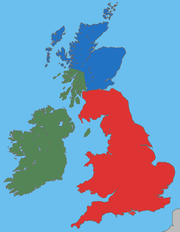 Goidelic was once restricted to Ireland
, but sometime between the 3rd and 6th centuries groups of Irish, called by the Romans by the general term Scoti
, began migrating from Ireland to what is now Cornwall, Wales and Scotland. Those who settled in Cornwall and Wales made little long-term impact. However, the Dál Riada settlers in Scotland eventually assimilated the Picts
(a group of peoples who may have spoken a Brythonic language
) who lived throughout Scotland
. Manx, the Gaelic language of the Isle of Man
, is closely akin to the Irish spoken in northeast and eastern Ireland and the now extinct Gaelic
of Galloway
(in southwest Scotland), with some influence from Old Norse through the Viking
invasions and from the previous British inhabitants.
The oldest written Goidelic language is Primitive Irish, which is attested in Ogham
inscriptions up to about the 4th century. The forms of this speech are very close, and often identical, to the forms of Gaulish
recorded before and during the Roman Empire. The next stage, Old Irish, is found in the margins of Latin
religious manuscript
s from the 6th to the 10th century, as well as in archaic texts copied/recorded in Middle Irish texts. Middle Irish, the immediate predecessor of the modern Goidelic languages, is the term for the language as recorded from the 10th to the 12th century: a great deal of literature survives in it, including the early Irish law texts.
Classical Gaelic
, otherwise known as Early Modern Irish, covers the period from the 13th to the 18th century, during which time it was used as a literary language in Ireland and Scotland. This is often called Classical Irish, while Ethnologue
gives the name "Hiberno-Scottish Gaelic" to this standardised written language. As long as this written language was the norm, Ireland was considered the Gaelic homeland to the Scottish literati
.
Later orthographic
divergence has resulted in standardised pluricentristic
orthographies. Manx orthography, which was introduced in the 16th and 17th centuries, was based on English and Welsh practice and so never formed part of this literary standard.
). Historically the predominant language of the island, it is now a minority language in most parts, although Irish-speaking areas still exist in parts of the south, west, and northwest of Ireland. The legally defined Irish-speaking areas are called the Gaeltacht
; all government institutions of the Republic of Ireland
(in particular, the parliament
(Oireachtas), its upper house
(Seanad) and lower house
(Dáil), and the prime minister
(Taoiseach) are officially named in this language, even in English. At present, the Gaeltachtaí are primarily found in Counties Cork
, Donegal
, Mayo
, Galway
, Kerry
, and, to a lesser extent, in Waterford
and Meath
. 1,656,790 (41.9% of the total population aged three years and over) regard themselves as able to speak Irish. Of these, 538,283 (32.5%) speak Irish on a daily basis. Irish
is also undergoing a revival in Northern Ireland
and has been accorded some legal status there under the 1998 Belfast Agreement
. The 2001 census in Northern Ireland
showed that 167,487 (10.4%) people "had some knowledge of Irish". Combined, this means that around one in three people (~1.8 million) on the island of Ireland
can understand Irish to some extent, although a large percentage of these do not speak it fluently. The census figures do not take into account those Irish who have emigrated, and it has been estimated (rightly or wrongly) that there are more native speakers of Irish in Britain, the US, Australia, and other parts of the world than there are in Ireland itself.
Before the period of the Great Famine of the 1840s, the language was spoken by the vast majority of the population, but the famine and emigration led to a decline which has begun to reverse only very recently.
as well as the general assumption by the English and Anglicised ruling classes following the Flight of the Earls
and disappearance of much of the Gaelic aristocracy that Irish was a language spoken by ignorant peasants,
The Irish language has been officially recognised as a working language by the European Union
. Ireland's national language is the twenty-first to be given such recognition by the EU and previously had the status of a treaty language.
still speak Scottish Gaelic, but the language has been in decline. There are now believed to be approximately 1,000 native speakers of Scottish Gaelic in Nova Scotia
and 60,000 in Scotland
.
Its historical range was much larger. For example, it was the everyday language of most of the rest of the Highlands until little more than a century ago. Galloway
was once also a Gaelic-speaking region, but the Galwegian dialect
has been extinct there for approximately three centuries. It is believed to have been home to dialects that were transitional between Scottish Gaelic and the two other Goidelic languages. While Gaelic was spoken across the Scottish Borders
and Lothian
during the early High Middle Ages
it doesn’t seem to have been spoken by the majority and was likely the language of the ruling elite, land owners and religious clerics. Some other parts of the Lowlands
spoke forms of British, and others Scots Inglis, the only exceptions being the northern isles of Orkney and Shetland where Norse was spoken.
Scotland takes its name from the Latin word for a Gael, Scotus (of uncertain etymology). Scotland originally meant Land of the Gaels in a cultural and social sense. Until late in the 15th century, Scottis in Scots English was used to refer only to Gaelic, and the speakers of this language who were identified as Scots. As the ruling elite became Scots Inglis/English-speaking, Scottis was gradually associated with the land rather than the people, and the word Erse Irish was gradually used more and more as an act of culturo-political disassociation with an overt implication that the language was not really Scottish, and therefore foreign.
In the early 16th century the dialects of northern Middle English
, also known as Early Scots
, which had developed in Lothian and had come to be spoken elsewhere in the Kingdom of Scotland themselves later appropriated the name Scots
. By the 17th century Gaelic speakers were restricted largely to the Highlands
and the Hebrides
. Furthermore, the culturally repressive measures taken against the rebellious Highland communities by the British crown following the 2nd Jacobite Rebellion of 1746 caused still further decline in the language's use – to a large extent by enforced emigration. Even more decline followed in the 19th and early 20th centuries.
The Scottish Parliament
has afforded the language a secure statutory status and equal respect (but not full equality in legal status within Scots Law http://news.bbc.co.uk/2/hi/uk_news/scotland/4467769.stm) with English, sparking hopes that Scottish Gaelic can be saved from extinction and perhaps even revived.
and Centre for Manx Studies
.
Shelta language
is sometimes thought to be a Goidelic language, but is in fact a cant
based on Irish and English
, with a primarily English-based syntax
.
The Bungee language
in Canada
is an English dialect spoken by Métis
that was influenced by Orkney English, Scots English, Cree
, Ojibwe, and Scottish Gaelic.
Insular Celtic languages
Insular Celtic languages are those Celtic languages that originated in the British Isles, in contrast to the Continental Celtic languages of mainland Europe and Anatolia. All surviving Celtic languages are from the Insular Celtic group; the Continental Celtic languages are extinct...
, the other consisting of the Brythonic languages
Brythonic languages
The Brythonic or Brittonic languages form one of the two branches of the Insular Celtic language family, the other being Goidelic. The name Brythonic was derived by Welsh Celticist John Rhys from the Welsh word Brython, meaning an indigenous Briton as opposed to an Anglo-Saxon or Gael...
. Goidelic languages historically formed a dialect continuum
Dialect continuum
A dialect continuum, or dialect area, was defined by Leonard Bloomfield as a range of dialects spoken across some geographical area that differ only slightly between neighboring areas, but as one travels in any direction, these differences accumulate such that speakers from opposite ends of the...
stretching from the south of Ireland
Ireland
Ireland is an island to the northwest of continental Europe. It is the third-largest island in Europe and the twentieth-largest island on Earth...
through the Isle of Man
Isle of Man
The Isle of Man , otherwise known simply as Mann , is a self-governing British Crown Dependency, located in the Irish Sea between the islands of Great Britain and Ireland, within the British Isles. The head of state is Queen Elizabeth II, who holds the title of Lord of Mann. The Lord of Mann is...
to the north of Scotland
Scotland
Scotland is a country that is part of the United Kingdom. Occupying the northern third of the island of Great Britain, it shares a border with England to the south and is bounded by the North Sea to the east, the Atlantic Ocean to the north and west, and the North Channel and Irish Sea to the...
. There are three modern Goidelic languages: Irish
Irish language
Irish , also known as Irish Gaelic, is a Goidelic language of the Indo-European language family, originating in Ireland and historically spoken by the Irish people. Irish is now spoken as a first language by a minority of Irish people, as well as being a second language of a larger proportion of...
(Gaeilge), Scottish Gaelic
Scottish Gaelic language
Scottish Gaelic is a Celtic language native to Scotland. A member of the Goidelic branch of the Celtic languages, Scottish Gaelic, like Modern Irish and Manx, developed out of Middle Irish, and thus descends ultimately from Primitive Irish....
(Gàidhlig) and Manx
Manx language
Manx , also known as Manx Gaelic, and as the Manks language, is a Goidelic language of the Indo-European language family, historically spoken by the Manx people. Only a small minority of the Island's population is fluent in the language, but a larger minority has some knowledge of it...
(Gaelg).
The Goidelic languages are part of the Q-Celtic
P-Celtic and Q-Celtic
There are two main competing schemata of categorisation of Celtic languages. The older P-Celtic/Q-Celtic hypothesis links Gaulish with Brythonic as P-Celtic and links Goidelic with Celtiberian as Q-Celtic. The difference between P and Q languages is the treatment of Proto-Celtic *kw, which became...
branch of the Celtic languages
Celtic languages
The Celtic languages are descended from Proto-Celtic, or "Common Celtic"; a branch of the greater Indo-European language family...
.
Nomenclature
Although Irish and Manx are often referred to as Irish Gaelic and Manx Gaelic (as they are Goidelic or Gaelic languages), the use of the word Gaelic is unnecessary because the terms Irish and Manx, when referring to language, only ever refer to these languages, whereas ScotsScots language
Scots is the Germanic language variety spoken in Lowland Scotland and parts of Ulster . It is sometimes called Lowland Scots to distinguish it from Scottish Gaelic, the Celtic language variety spoken in most of the western Highlands and in the Hebrides.Since there are no universally accepted...
has come to refer to a Germanic language
Germanic languages
The Germanic languages constitute a sub-branch of the Indo-European language family. The common ancestor of all of the languages in this branch is called Proto-Germanic , which was spoken in approximately the mid-1st millennium BC in Iron Age northern Europe...
, and therefore "Scottish" can refer to things not at all Gaelic. The word Gaelic by itself is sometimes used to refer to Scottish Gaelic and is thus ambiguous.
The names used in the languages themselves (Gaeilge/Gaolainn/Gaelic in Irish, Gaelg/Gailck in Manx, and Gàidhlig in Scottish Gaelic) are derived from Old Irish Goídelc, which comes from Old Welsh
Old Welsh language
Old Welsh is the label attached to the Welsh language from about 800 AD until the early 12th century when it developed into Middle Welsh. The preceding period, from the time Welsh became distinct from the British language around 550, has been called "Primitive Welsh".Many poems and some prose...
Guoidel meaning "pirate, raider".
Classification
The family tree of the Goidelic languages is as follows:- Insular CelticInsular Celtic languagesInsular Celtic languages are those Celtic languages that originated in the British Isles, in contrast to the Continental Celtic languages of mainland Europe and Anatolia. All surviving Celtic languages are from the Insular Celtic group; the Continental Celtic languages are extinct...
- Primitive Irish
- Old Irish
- Middle Irish
- Modern IrishIrish languageIrish , also known as Irish Gaelic, is a Goidelic language of the Indo-European language family, originating in Ireland and historically spoken by the Irish people. Irish is now spoken as a first language by a minority of Irish people, as well as being a second language of a larger proportion of...
- Scottish GaelicScottish Gaelic languageScottish Gaelic is a Celtic language native to Scotland. A member of the Goidelic branch of the Celtic languages, Scottish Gaelic, like Modern Irish and Manx, developed out of Middle Irish, and thus descends ultimately from Primitive Irish....
- ManxManx languageManx , also known as Manx Gaelic, and as the Manks language, is a Goidelic language of the Indo-European language family, historically spoken by the Manx people. Only a small minority of the Island's population is fluent in the language, but a larger minority has some knowledge of it...
- Modern Irish
- Middle Irish
- Old Irish
- Primitive Irish
History and range
Ireland
Ireland is an island to the northwest of continental Europe. It is the third-largest island in Europe and the twentieth-largest island on Earth...
, but sometime between the 3rd and 6th centuries groups of Irish, called by the Romans by the general term Scoti
Scoti
Scoti or Scotti was the generic name used by the Romans to describe those who sailed from Ireland to conduct raids on Roman Britain. It was thus synonymous with the modern term Gaels...
, began migrating from Ireland to what is now Cornwall, Wales and Scotland. Those who settled in Cornwall and Wales made little long-term impact. However, the Dál Riada settlers in Scotland eventually assimilated the Picts
Picts
The Picts were a group of Late Iron Age and Early Mediaeval people living in what is now eastern and northern Scotland. There is an association with the distribution of brochs, place names beginning 'Pit-', for instance Pitlochry, and Pictish stones. They are recorded from before the Roman conquest...
(a group of peoples who may have spoken a Brythonic language
Pictish language
Pictish is a term used for the extinct language or languages thought to have been spoken by the Picts, the people of northern and central Scotland in the Early Middle Ages...
) who lived throughout Scotland
History of Scotland
The history of Scotland begins around 10,000 years ago, when humans first began to inhabit what is now Scotland after the end of the Devensian glaciation, the last ice age...
. Manx, the Gaelic language of the Isle of Man
Isle of Man
The Isle of Man , otherwise known simply as Mann , is a self-governing British Crown Dependency, located in the Irish Sea between the islands of Great Britain and Ireland, within the British Isles. The head of state is Queen Elizabeth II, who holds the title of Lord of Mann. The Lord of Mann is...
, is closely akin to the Irish spoken in northeast and eastern Ireland and the now extinct Gaelic
Galwegian Gaelic
Galwegian Gaelic is an extinct dialect of Scottish Gaelic formerly spoken in southwest Scotland. It was spoken by the independent kings of Galloway in their time, and by the people of Galloway and Carrick until the early modern period. It was once spoken in Annandale and Strathnith...
of Galloway
Galloway
Galloway is an area in southwestern Scotland. It usually refers to the former counties of Wigtownshire and Kirkcudbrightshire...
(in southwest Scotland), with some influence from Old Norse through the Viking
Viking
The term Viking is customarily used to refer to the Norse explorers, warriors, merchants, and pirates who raided, traded, explored and settled in wide areas of Europe, Asia and the North Atlantic islands from the late 8th to the mid-11th century.These Norsemen used their famed longships to...
invasions and from the previous British inhabitants.
The oldest written Goidelic language is Primitive Irish, which is attested in Ogham
Ogham
Ogham is an Early Medieval alphabet used primarily to write the Old Irish language, and occasionally the Brythonic language. Ogham is sometimes called the "Celtic Tree Alphabet", based on a High Medieval Bríatharogam tradition ascribing names of trees to the individual letters.There are roughly...
inscriptions up to about the 4th century. The forms of this speech are very close, and often identical, to the forms of Gaulish
Gaulish language
The Gaulish language is an extinct Celtic language that was spoken by the Gauls, a people who inhabited the region known as Gaul from the Iron Age through the Roman period...
recorded before and during the Roman Empire. The next stage, Old Irish, is found in the margins of Latin
Latin
Latin is an Italic language originally spoken in Latium and Ancient Rome. It, along with most European languages, is a descendant of the ancient Proto-Indo-European language. Although it is considered a dead language, a number of scholars and members of the Christian clergy speak it fluently, and...
religious manuscript
Manuscript
A manuscript or handwrite is written information that has been manually created by someone or some people, such as a hand-written letter, as opposed to being printed or reproduced some other way...
s from the 6th to the 10th century, as well as in archaic texts copied/recorded in Middle Irish texts. Middle Irish, the immediate predecessor of the modern Goidelic languages, is the term for the language as recorded from the 10th to the 12th century: a great deal of literature survives in it, including the early Irish law texts.
Classical Gaelic
Classical Gaelic
Classical Gaelic is the term used in Scotland for the shared literary form that was in use in Scotland and Ireland 13th to the 18th century. The language is that of Early Modern Irish...
, otherwise known as Early Modern Irish, covers the period from the 13th to the 18th century, during which time it was used as a literary language in Ireland and Scotland. This is often called Classical Irish, while Ethnologue
Ethnologue
Ethnologue: Languages of the World is a web and print publication of SIL International , a Christian linguistic service organization, which studies lesser-known languages, to provide the speakers with Bibles in their native language and support their efforts in language development.The Ethnologue...
gives the name "Hiberno-Scottish Gaelic" to this standardised written language. As long as this written language was the norm, Ireland was considered the Gaelic homeland to the Scottish literati
Literati
Literati may refer to:*Intellectuals or those who read and comment on literature*The scholar-bureaucrats or literati of imperial China**Literati painting, also known as the Southern School of painting, developed by Chinese literati...
.
Later orthographic
Orthography
The orthography of a language specifies a standardized way of using a specific writing system to write the language. Where more than one writing system is used for a language, for example Kurdish, Uyghur, Serbian or Inuktitut, there can be more than one orthography...
divergence has resulted in standardised pluricentristic
Pluricentric language
A pluricentric language is a language with several standard versions, both in spoken and in written forms. This situation usually arises when language and the national identity of its native speakers do not, or did not, coincide.-English:...
orthographies. Manx orthography, which was introduced in the 16th and 17th centuries, was based on English and Welsh practice and so never formed part of this literary standard.
Irish
Irish is one of Ireland's two official languages (along with EnglishEnglish language
English is a West Germanic language that arose in the Anglo-Saxon kingdoms of England and spread into what was to become south-east Scotland under the influence of the Anglian medieval kingdom of Northumbria...
). Historically the predominant language of the island, it is now a minority language in most parts, although Irish-speaking areas still exist in parts of the south, west, and northwest of Ireland. The legally defined Irish-speaking areas are called the Gaeltacht
Gaeltacht
is the Irish language word meaning an Irish-speaking region. In Ireland, the Gaeltacht, or an Ghaeltacht, refers individually to any, or collectively to all, of the districts where the government recognises that the Irish language is the predominant language, that is, the vernacular spoken at home...
; all government institutions of the Republic of Ireland
Republic of Ireland
Ireland , described as the Republic of Ireland , is a sovereign state in Europe occupying approximately five-sixths of the island of the same name. Its capital is Dublin. Ireland, which had a population of 4.58 million in 2011, is a constitutional republic governed as a parliamentary democracy,...
(in particular, the parliament
Oireachtas
The Oireachtas , sometimes referred to as Oireachtas Éireann, is the "national parliament" or legislature of Ireland. The Oireachtas consists of:*The President of Ireland*The two Houses of the Oireachtas :**Dáil Éireann...
(Oireachtas), its upper house
Seanad Éireann
Seanad Éireann is the upper house of the Oireachtas , which also comprises the President of Ireland and Dáil Éireann . It is commonly called the Seanad or Senate and its members Senators or Seanadóirí . Unlike Dáil Éireann, it is not directly elected but consists of a mixture of members chosen by...
(Seanad) and lower house
Dáil Éireann
Dáil Éireann is the lower house, but principal chamber, of the Oireachtas , which also includes the President of Ireland and Seanad Éireann . It is directly elected at least once in every five years under the system of proportional representation by means of the single transferable vote...
(Dáil), and the prime minister
Taoiseach
The Taoiseach is the head of government or prime minister of Ireland. The Taoiseach is appointed by the President upon the nomination of Dáil Éireann, the lower house of the Oireachtas , and must, in order to remain in office, retain the support of a majority in the Dáil.The current Taoiseach is...
(Taoiseach) are officially named in this language, even in English. At present, the Gaeltachtaí are primarily found in Counties Cork
County Cork
County Cork is a county in Ireland. It is located in the South-West Region and is also part of the province of Munster. It is named after the city of Cork . Cork County Council is the local authority for the county...
, Donegal
County Donegal
County Donegal is a county in Ireland. It is part of the Border Region and is also located in the province of Ulster. It is named after the town of Donegal. Donegal County Council is the local authority for the county...
, Mayo
County Mayo
County Mayo is a county in Ireland. It is located in the West Region and is also part of the province of Connacht. It is named after the village of Mayo, which is now generally known as Mayo Abbey. Mayo County Council is the local authority for the county. The population of the county is 130,552...
, Galway
County Galway
County Galway is a county in Ireland. It is located in the West Region and is also part of the province of Connacht. It is named after the city of Galway. Galway County Council is the local authority for the county. There are several strongly Irish-speaking areas in the west of the county...
, Kerry
County Kerry
Kerry means the "people of Ciar" which was the name of the pre-Gaelic tribe who lived in part of the present county. The legendary founder of the tribe was Ciar, son of Fergus mac Róich. In Old Irish "Ciar" meant black or dark brown, and the word continues in use in modern Irish as an adjective...
, and, to a lesser extent, in Waterford
County Waterford
*Abbeyside, Affane, Aglish, Annestown, An Rinn, Ardmore*Ballinacourty, Ballinameela, Ballinamult, Ballinroad, Ballybeg, Ballybricken, Ballyduff Lower, Ballyduff Upper, Ballydurn, Ballygunner, Ballylaneen, Ballymacarbry, Ballymacart, Ballynaneashagh, Ballysaggart, Ballytruckle, Bilberry, Bunmahon,...
and Meath
County Meath
County Meath is a county in Ireland. It is part of the Mid-East Region and is also located in the province of Leinster. It is named after the ancient Kingdom of Mide . Meath County Council is the local authority for the county...
. 1,656,790 (41.9% of the total population aged three years and over) regard themselves as able to speak Irish. Of these, 538,283 (32.5%) speak Irish on a daily basis. Irish
Irish language
Irish , also known as Irish Gaelic, is a Goidelic language of the Indo-European language family, originating in Ireland and historically spoken by the Irish people. Irish is now spoken as a first language by a minority of Irish people, as well as being a second language of a larger proportion of...
is also undergoing a revival in Northern Ireland
Northern Ireland
Northern Ireland is one of the four countries of the United Kingdom. Situated in the north-east of the island of Ireland, it shares a border with the Republic of Ireland to the south and west...
and has been accorded some legal status there under the 1998 Belfast Agreement
Belfast Agreement
The Good Friday Agreement or Belfast Agreement , sometimes called the Stormont Agreement, was a major political development in the Northern Ireland peace process...
. The 2001 census in Northern Ireland
Irish language in Northern Ireland
The Irish language is a minority language in Northern Ireland. The dialect spoken there is known as Ulster Irish....
showed that 167,487 (10.4%) people "had some knowledge of Irish". Combined, this means that around one in three people (~1.8 million) on the island of Ireland
Ireland
Ireland is an island to the northwest of continental Europe. It is the third-largest island in Europe and the twentieth-largest island on Earth...
can understand Irish to some extent, although a large percentage of these do not speak it fluently. The census figures do not take into account those Irish who have emigrated, and it has been estimated (rightly or wrongly) that there are more native speakers of Irish in Britain, the US, Australia, and other parts of the world than there are in Ireland itself.
Before the period of the Great Famine of the 1840s, the language was spoken by the vast majority of the population, but the famine and emigration led to a decline which has begun to reverse only very recently.
as well as the general assumption by the English and Anglicised ruling classes following the Flight of the Earls
Flight of the Earls
The Flight of the Earls took place on 14 September 1607, when Hugh Ó Neill of Tír Eóghain, Rory Ó Donnell of Tír Chonaill and about ninety followers left Ireland for mainland Europe.-Background to the exile:...
and disappearance of much of the Gaelic aristocracy that Irish was a language spoken by ignorant peasants,
The Irish language has been officially recognised as a working language by the European Union
European Union
The European Union is an economic and political union of 27 independent member states which are located primarily in Europe. The EU traces its origins from the European Coal and Steel Community and the European Economic Community , formed by six countries in 1958...
. Ireland's national language is the twenty-first to be given such recognition by the EU and previously had the status of a treaty language.
Scottish Gaelic
Some people in the north and west of mainland Scotland and most people in the HebridesHebrides
The Hebrides comprise a widespread and diverse archipelago off the west coast of Scotland. There are two main groups: the Inner and Outer Hebrides. These islands have a long history of occupation dating back to the Mesolithic and the culture of the residents has been affected by the successive...
still speak Scottish Gaelic, but the language has been in decline. There are now believed to be approximately 1,000 native speakers of Scottish Gaelic in Nova Scotia
Nova Scotia
Nova Scotia is one of Canada's three Maritime provinces and is the most populous province in Atlantic Canada. The name of the province is Latin for "New Scotland," but "Nova Scotia" is the recognized, English-language name of the province. The provincial capital is Halifax. Nova Scotia is the...
and 60,000 in Scotland
Scotland
Scotland is a country that is part of the United Kingdom. Occupying the northern third of the island of Great Britain, it shares a border with England to the south and is bounded by the North Sea to the east, the Atlantic Ocean to the north and west, and the North Channel and Irish Sea to the...
.
Its historical range was much larger. For example, it was the everyday language of most of the rest of the Highlands until little more than a century ago. Galloway
Galloway
Galloway is an area in southwestern Scotland. It usually refers to the former counties of Wigtownshire and Kirkcudbrightshire...
was once also a Gaelic-speaking region, but the Galwegian dialect
Galwegian Gaelic
Galwegian Gaelic is an extinct dialect of Scottish Gaelic formerly spoken in southwest Scotland. It was spoken by the independent kings of Galloway in their time, and by the people of Galloway and Carrick until the early modern period. It was once spoken in Annandale and Strathnith...
has been extinct there for approximately three centuries. It is believed to have been home to dialects that were transitional between Scottish Gaelic and the two other Goidelic languages. While Gaelic was spoken across the Scottish Borders
Scottish Borders
The Scottish Borders is one of 32 local government council areas of Scotland. It is bordered by Dumfries and Galloway in the west, South Lanarkshire and West Lothian in the north west, City of Edinburgh, East Lothian, Midlothian to the north; and the non-metropolitan counties of Northumberland...
and Lothian
Lothian
Lothian forms a traditional region of Scotland, lying between the southern shore of the Firth of Forth and the Lammermuir Hills....
during the early High Middle Ages
Scotland in the High Middle Ages
The High Middle Ages of Scotland encompass Scotland in the era between the death of Domnall II in 900 AD and the death of king Alexander III in 1286...
it doesn’t seem to have been spoken by the majority and was likely the language of the ruling elite, land owners and religious clerics. Some other parts of the Lowlands
Scottish Lowlands
The Scottish Lowlands is a name given to the Southern half of Scotland.The area is called a' Ghalldachd in Scottish Gaelic, and the Lawlands ....
spoke forms of British, and others Scots Inglis, the only exceptions being the northern isles of Orkney and Shetland where Norse was spoken.
Scotland takes its name from the Latin word for a Gael, Scotus (of uncertain etymology). Scotland originally meant Land of the Gaels in a cultural and social sense. Until late in the 15th century, Scottis in Scots English was used to refer only to Gaelic, and the speakers of this language who were identified as Scots. As the ruling elite became Scots Inglis/English-speaking, Scottis was gradually associated with the land rather than the people, and the word Erse Irish was gradually used more and more as an act of culturo-political disassociation with an overt implication that the language was not really Scottish, and therefore foreign.
In the early 16th century the dialects of northern Middle English
Middle English
Middle English is the stage in the history of the English language during the High and Late Middle Ages, or roughly during the four centuries between the late 11th and the late 15th century....
, also known as Early Scots
Early Scots
Early Scots describes the emerging literary language of the Northern Middle English speaking parts of Scotland in the period before 1450. The northern forms of Middle English descended from Northumbrian Old English...
, which had developed in Lothian and had come to be spoken elsewhere in the Kingdom of Scotland themselves later appropriated the name Scots
Scots language
Scots is the Germanic language variety spoken in Lowland Scotland and parts of Ulster . It is sometimes called Lowland Scots to distinguish it from Scottish Gaelic, the Celtic language variety spoken in most of the western Highlands and in the Hebrides.Since there are no universally accepted...
. By the 17th century Gaelic speakers were restricted largely to the Highlands
Scottish Highlands
The Highlands is an historic region of Scotland. The area is sometimes referred to as the "Scottish Highlands". It was culturally distinguishable from the Lowlands from the later Middle Ages into the modern period, when Lowland Scots replaced Scottish Gaelic throughout most of the Lowlands...
and the Hebrides
Hebrides
The Hebrides comprise a widespread and diverse archipelago off the west coast of Scotland. There are two main groups: the Inner and Outer Hebrides. These islands have a long history of occupation dating back to the Mesolithic and the culture of the residents has been affected by the successive...
. Furthermore, the culturally repressive measures taken against the rebellious Highland communities by the British crown following the 2nd Jacobite Rebellion of 1746 caused still further decline in the language's use – to a large extent by enforced emigration. Even more decline followed in the 19th and early 20th centuries.
The Scottish Parliament
Scottish Parliament
The Scottish Parliament is the devolved national, unicameral legislature of Scotland, located in the Holyrood area of the capital, Edinburgh. The Parliament, informally referred to as "Holyrood", is a democratically elected body comprising 129 members known as Members of the Scottish Parliament...
has afforded the language a secure statutory status and equal respect (but not full equality in legal status within Scots Law http://news.bbc.co.uk/2/hi/uk_news/scotland/4467769.stm) with English, sparking hopes that Scottish Gaelic can be saved from extinction and perhaps even revived.
Manx
Today Manx is used as the sole medium for teaching at five of the island's pre-schools by a company named , which also operates the sole Manx primary school—the . Manx is taught as a second language at all of the Island's primary and secondary schools and also at the Isle of Man CollegeIsle of Man College
The Isle of Man College is the primary centre for tertiary and vocational education on the Isle of Man.-External links:*...
and Centre for Manx Studies
Centre for Manx Studies
The Centre for Manx Studies is the main centre on the Isle of Man for the study of the Isle of Man, the Manx language, and Manx culture and history.Founded in 1992, the Centre is part of the in the University of Liverpool...
.
Numbers
| # | Irish | Scottish Gaelic | Manx |
|---|---|---|---|
| 1 | aon | aon | un, nane |
| 2 | dó | dà | daa |
| 3 | trí | trì | tree |
| 4 | ceathair | ceithir | kiare |
| 5 | cúig | còig | queig |
| 6 | sé | sia | shey |
| 7 | seacht | seachd | shiaght |
| 8 | ocht | ochd | hoght |
| 9 | naoi | naoi | nuy |
| 10 | deich | deich | jeih |
| 11 | aon déag | aon deug | nane jeig |
| 12 | dó dhéag | dà dheug | daa yeig |
| 20 | fiche | fichead | feeid |
| 100 | céad | ceud | keead |
Common phrases
| Irish | Scottish Gaelic | Manx | English |
|---|---|---|---|
| Fáilte romhat | Fàilte | Failt | Welcome |
| Ulster: Cad é mar atá tú? Connacht: Cén chaoi a bhfuil tú? Munster: Conas atá tú? |
Ciamar a tha thu? | Kys t'ou? | How are you? |
| Ulster: Cad é an t-ainm atá ort? Connacht: Cén t-ainm atá ort? Munster: Cad is ainm duit? |
Dè an t-ainm a tha ort? | Cre'n ennym t'ort? | What is your name? |
| Is mise... | 'S mise... | Mish... | I am... |
| Lá maith | Latha math | Laa mie | A good day |
| Maidin mhaith | Madainn mhath | Moghrey mie | A good morning |
| Trathnóna maith | Feasgar math | Fastyr mie | A good afternoon |
| Oíche mhaith | Oidhche mhath | Oie vie | Good night |
| Go raibh maith agat | Tapadh leat | Gura mie ayd | Thank you |
| Slán leat | Slàn leat / Mar sin leat | Slane lhiat | Goodbye |
| Sláinte Slàinte Sláinte is a word literally translating as "health" and is commonly used as a drinking toast in Ireland, Scotland and the Isle of Man.-Variations:... |
Slàinte | Slaynt | Health (used as a toast [cf. English "cheers"]) |
Influence on other languages
There are two languages that show Goidelic influence, although they are not Goidelic languages themselves.Shelta language
Shelta language
Shelta is a language spoken by travelling communities, particularly in Ireland, but also parts of Great Britain. It is widely known as the Cant, to its native speakers in Ireland as Gammon and to the linguistic community as Shelta...
is sometimes thought to be a Goidelic language, but is in fact a cant
Cant (language)
A Cant is the jargon or argot of a group, often implying its use to exclude or mislead people outside the group.-Derivation in Celtic linguistics:...
based on Irish and English
English language
English is a West Germanic language that arose in the Anglo-Saxon kingdoms of England and spread into what was to become south-east Scotland under the influence of the Anglian medieval kingdom of Northumbria...
, with a primarily English-based syntax
Syntax
In linguistics, syntax is the study of the principles and rules for constructing phrases and sentences in natural languages....
.
The Bungee language
Bungee language
Bungi is a creole of Scottish English strongly influenced by Orcadian, Gaelic, Cree and Ojibwe, and spoken by the Red River Métis in present-day Manitoba, Canada...
in Canada
Canada
Canada is a North American country consisting of ten provinces and three territories. Located in the northern part of the continent, it extends from the Atlantic Ocean in the east to the Pacific Ocean in the west, and northward into the Arctic Ocean...
is an English dialect spoken by Métis
Métis people (Canada)
The Métis are one of the Aboriginal peoples in Canada who trace their descent to mixed First Nations parentage. The term was historically a catch-all describing the offspring of any such union, but within generations the culture syncretised into what is today a distinct aboriginal group, with...
that was influenced by Orkney English, Scots English, Cree
Cree language
Cree is an Algonquian language spoken by approximately 117,000 people across Canada, from the Northwest Territories and Alberta to Labrador, making it the aboriginal language with the highest number of speakers in Canada. It is also spoken in the U.S. state of Montana...
, Ojibwe, and Scottish Gaelic.
See also
- Differences between Scottish Gaelic and IrishDifferences between Scottish Gaelic and IrishScottish Gaelic is closely related to Irish. Most dialects are not immediately mutually comprehensible, though many individual words and phrases are, and speakers of the two languages can rapidly develop mutual intelligibility....
- Connacht IrishConnacht IrishConnacht Irish is the dialect of the Irish language spoken in the province of Connacht. Gaeltacht regions in Connacht are found in Counties Mayo and Galway...
- Ulster IrishUlster IrishUlster Irish is the dialect of the Irish language spoken in the Province of Ulster. The largest Gaeltacht region today is in County Donegal, so that the term Donegal Irish is often used synonymously. Nevertheless, records of the language as it was spoken in other counties do exist, and help provide...
- Munster IrishMunster IrishMunster Irish is the dialect of the Irish language spoken in the province of Munster. Gaeltacht regions in Munster are found in the Dingle Peninsula Gaeltacht of west Kerry, in the Iveragh Peninsula in south Kerry, in Cape Clear Island off the coast of west Cork, in West Muskerry; Coolea,...
- Newfoundland IrishNewfoundland IrishNewfoundland Irish is an extinct dialect of the Irish language specific to the island of Newfoundland, Canada. It was very similar to Munster Irish, as spoken in the southeast of Ireland, due to mass immigration from the counties Waterford, Wexford, Kilkenny, Tipperary, and Cork.-Irish settlement...
- Canadian Gaelic
- Galwegian GaelicGalwegian GaelicGalwegian Gaelic is an extinct dialect of Scottish Gaelic formerly spoken in southwest Scotland. It was spoken by the independent kings of Galloway in their time, and by the people of Galloway and Carrick until the early modern period. It was once spoken in Annandale and Strathnith...
- Goidelic substrate hypothesis
- Proto-Celtic
- ÉireÉireis the Irish name for the island of Ireland and the sovereign state of the same name.- Etymology :The modern Irish Éire evolved from the Old Irish word Ériu, which was the name of a Gaelic goddess. Ériu is generally believed to have been the matron goddess of Ireland, a goddess of sovereignty, or...
External links
- Ethnologue file on Goidelic languages
- Scottish Gaelic Wikipedia
- Irish language Wikipedia
- Manx Wikipedia
- Comparison of Irish and Scottish Gaelic