Northeast Caucasian languages

Encyclopedia
The Northeast Caucasian languages constitute a language family
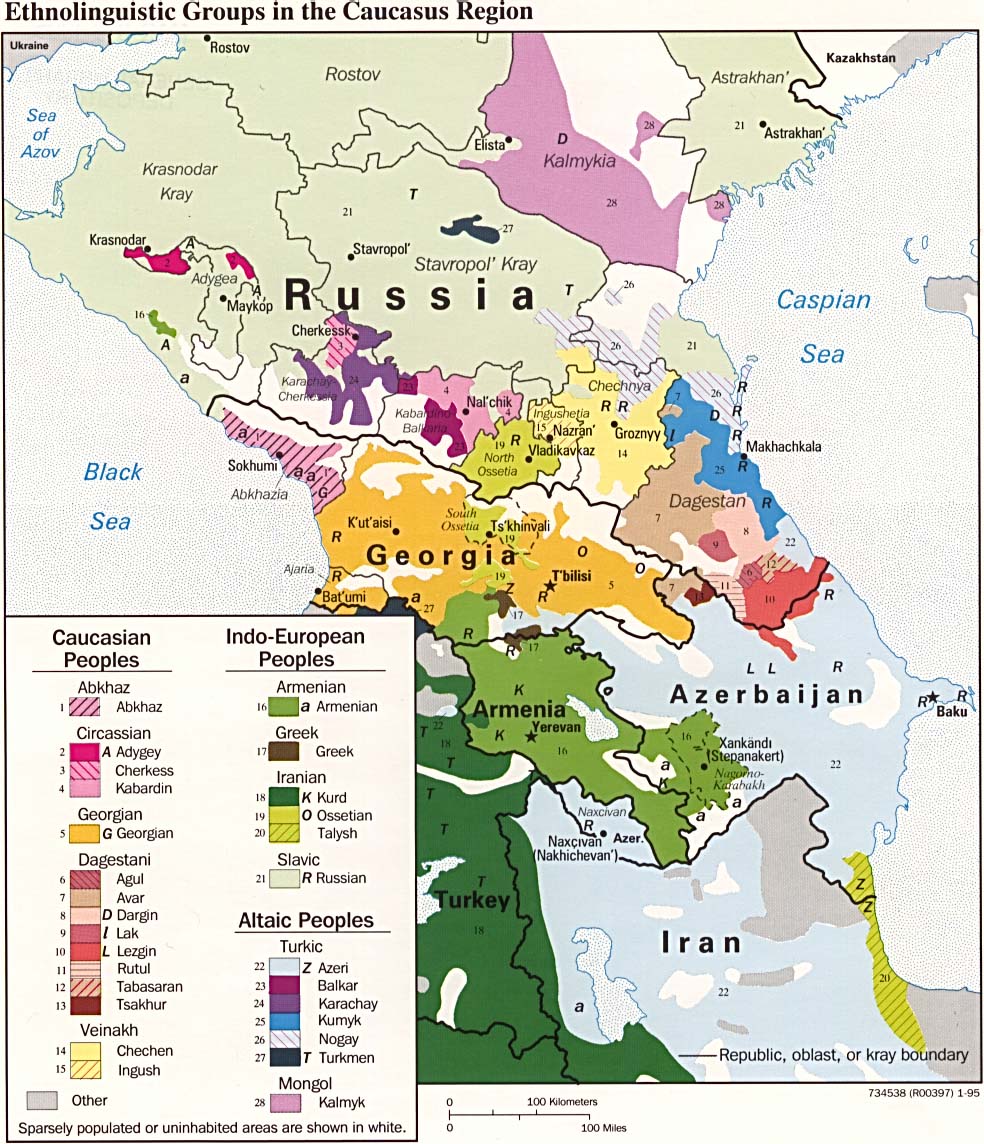
spoken in the Russia
n republics of Dagestan
, Chechnya
, Ingushetia
, northern Azerbaijan
, and in northeastern Georgia
, as well as in diaspora populations in Russia, Turkey, and the Middle East. They are also called Nakho-Dagestanian / Nakh–Dagestanian or just Dagestanian (Daghestanian), or sometimes Caspian, as opposed to Pontic for the Northwest Caucasian languages
.
, and South Caucasian (Kartvelian). This may be shortened to East Caucasian, especially by those linguists who accept the North Caucasian languages
as a language family. The older term Nakho-Dagestanian reflected an erstwhile primary division of the family into Nakh and Dagestanian branches, a view which is no longer widely accepted. The rare term Caspian (that is, bordering the Caspian Sea
) is only used in opposition to Pontic (that is, bordering the Black Sea
) for the Northwest Caucasian languages.
s or up to 30 vowel
s in some languages). Most languages in this family contrast tense and weak consonants
. Tense consonants are characterized by the intensiveness of articulation, which naturally leads to a lengthening of these consonants.
al agglutination
. Weak tendencies towards inflexion may be noted as well. Noun
s display covert nominal classification
, but partially overt cases of secondary origin can be observed too; classes in individual languages range from two up to eight. As to the grammatical number
, opposition between the singular and plural
(which can be classifying to some extent) and, sometimes, the collective
is seen. Many languages distinguish local versus functional cases, to some degree also casus rectus
versus casus obliquus
. The inflexional paradigms are often based on, partially-classifying, productive stem
extensions (absolutive, oblique
, ergative
, and genitive flexion). Localization is mostly conveyed by
postpositions, but it can be also partly based on preverb
s. Noun phrase
s exhibit incomplete class agreement
, group inflexion (on the noun) with partial attributive
oblique marking, which may, in turn, carry a partially determining function.
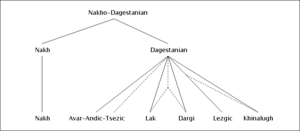
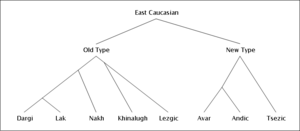
A long-time classification divided the family into Nakh and Dagestanian branches, whence the term Nakho-Dagestanian. However, attempts at reconstructing the protolanguage suggest that the Nakh languages are no more divergent from Dagestanian than the various branches of Dagestanian are from each other, although this is still not universally accepted. The following outline, based on the work of linguist Bernard Comrie
and others, has been adopted by Ethnologue
. Population data is from Ethnologue 16th ed.
, Ingushetia
, and Georgia
. Chechen and Ingush are official languages of their respective republics.
, and the only literary language.
Schulze (2009) gives the following family tree for the Avar–Andic languages:
Figures retrieved from Ethnologue.
.
highlands and in Northern Azerbaijan
. The Lezgian language or, as the Lezgins
themselves call it, Лезги чlал (lezgi ch'al), is the biggest, in terms of the number of native speakers, of all the languages of the Lezgic group (other languages from this group include Tabasaran, Udi, Tsakhur, and Rutul – Tabasaran was once thought to be the language with the largest number of grammatical cases at 54, which could, depending on the analysis, instead be the Tsez language
with 64). The Lezgic family along with a couple of other families (Avar–Andic, Tsezic, Lak, Dargin, and Khinalug) forms the Daghestanian part of the Nakh–Daghestanian language family (the Nakh part is constituted by Chechen, Ingush and related small languages).
Lezgian and Tabasaran are literary languages.
should be joined into a putative North Caucasian
family, sometimes called Caucasic or Caucasian (even though it is not meant to include the South Caucasian (Kartvelian)
family). However, this hypothesis is not well demonstrated.
— also see similarities between the Northeast Caucasian family and the extinct languages Hurrian
and Urartian
.
Hurrian was spoken in various parts of the Fertile Crescent
in the 3rd and 2nd millennia BC. Urartian was the language of Urartu
, a powerful state centered in the area of Lake Van
in Turkey
, that existed between 1000 BC or earlier and 585 BC.
The two extinct languages have been grouped into the Hurro-Urartian
family. Diakonoff proposed the name Alarodian
for the union of Hurro-Urartian and Northeast Caucasian.
, and Johanna Nichols
has suggested that its speakers may have been involved in the development of agriculture in the Fertile Crescent
. They had words for concepts such as yoke
, as well as fruit trees such as apple
and pear
that suggest agriculture was already well developed when the proto-language broke up.
Language family
A language family is a group of languages related through descent from a common ancestor, called the proto-language of that family. The term 'family' comes from the tree model of language origination in historical linguistics, which makes use of a metaphor comparing languages to people in a...
spoken in the Russia
Russia
Russia or , officially known as both Russia and the Russian Federation , is a country in northern Eurasia. It is a federal semi-presidential republic, comprising 83 federal subjects...
n republics of Dagestan
Dagestan
The Republic of Dagestan is a federal subject of Russia, located in the North Caucasus region. Its capital and the largest city is Makhachkala, located at the center of Dagestan on the Caspian Sea...
, Chechnya
Chechnya
The Chechen Republic , commonly referred to as Chechnya , also spelled Chechnia or Chechenia, sometimes referred to as Ichkeria , is a federal subject of Russia . It is located in the southeastern part of Europe in the Northern Caucasus mountains. The capital of the republic is the city of Grozny...
, Ingushetia
Ingushetia
The Republic of Ingushetia is a federal subject of Russia , located in the North Caucasus region with its capital at Magas. In terms of area, the republic is the smallest of Russia's federal subjects except for the two federal cities, Moscow and Saint Petersburg...
, northern Azerbaijan
Azerbaijan
Azerbaijan , officially the Republic of Azerbaijan is the largest country in the Caucasus region of Eurasia. Located at the crossroads of Western Asia and Eastern Europe, it is bounded by the Caspian Sea to the east, Russia to the north, Georgia to the northwest, Armenia to the west, and Iran to...
, and in northeastern Georgia
Georgia (country)
Georgia is a sovereign state in the Caucasus region of Eurasia. Located at the crossroads of Western Asia and Eastern Europe, it is bounded to the west by the Black Sea, to the north by Russia, to the southwest by Turkey, to the south by Armenia, and to the southeast by Azerbaijan. The capital of...
, as well as in diaspora populations in Russia, Turkey, and the Middle East. They are also called Nakho-Dagestanian / Nakh–Dagestanian or just Dagestanian (Daghestanian), or sometimes Caspian, as opposed to Pontic for the Northwest Caucasian languages
Northwest Caucasian languages
The Northwest Caucasian languages, also called Abkhazo-Adyghean, or sometimes Pontic as opposed to Caspian for the Northeast Caucasian languages, are a group of languages spoken in the Caucasus region, chiefly in Russia , the disputed territory of Abkhazia, and Turkey, with smaller communities...
.
Name of the family
Several names have been in use for this family. The most common term, Northeast Caucasian, contrasts the three established families of the Caucasus language area: Northeast Caucasian, Northwest CaucasianNorthwest Caucasian languages
The Northwest Caucasian languages, also called Abkhazo-Adyghean, or sometimes Pontic as opposed to Caspian for the Northeast Caucasian languages, are a group of languages spoken in the Caucasus region, chiefly in Russia , the disputed territory of Abkhazia, and Turkey, with smaller communities...
, and South Caucasian (Kartvelian). This may be shortened to East Caucasian, especially by those linguists who accept the North Caucasian languages
North Caucasian languages
North Caucasian languages is a blanket term for two language phyla spoken chiefly in the north Caucasus and Turkey: the Northwest Caucasian family and the Northeast Caucasian family North Caucasian languages (sometimes called simply Caucasic as opposed to Kartvelian, and to avoid confusion with...
as a language family. The older term Nakho-Dagestanian reflected an erstwhile primary division of the family into Nakh and Dagestanian branches, a view which is no longer widely accepted. The rare term Caspian (that is, bordering the Caspian Sea
Caspian Sea
The Caspian Sea is the largest enclosed body of water on Earth by area, variously classed as the world's largest lake or a full-fledged sea. The sea has a surface area of and a volume of...
) is only used in opposition to Pontic (that is, bordering the Black Sea
Black Sea
The Black Sea is bounded by Europe, Anatolia and the Caucasus and is ultimately connected to the Atlantic Ocean via the Mediterranean and the Aegean seas and various straits. The Bosphorus strait connects it to the Sea of Marmara, and the strait of the Dardanelles connects that sea to the Aegean...
) for the Northwest Caucasian languages.
Phonology
This family is known for the complex phonology (70+ consonantConsonant
In articulatory phonetics, a consonant is a speech sound that is articulated with complete or partial closure of the vocal tract. Examples are , pronounced with the lips; , pronounced with the front of the tongue; , pronounced with the back of the tongue; , pronounced in the throat; and ,...
s or up to 30 vowel
Vowel
In phonetics, a vowel is a sound in spoken language, such as English ah! or oh! , pronounced with an open vocal tract so that there is no build-up of air pressure at any point above the glottis. This contrasts with consonants, such as English sh! , where there is a constriction or closure at some...
s in some languages). Most languages in this family contrast tense and weak consonants
Fortis and lenis
In linguistics, fortis and lenis are terms generally used to refer to groups of consonants that are produced with greater and lesser energy, respectively, such as in energy applied, articulation, etc....
. Tense consonants are characterized by the intensiveness of articulation, which naturally leads to a lengthening of these consonants.
Morphology
These languages can be characterized by strong suffixSuffix
In linguistics, a suffix is an affix which is placed after the stem of a word. Common examples are case endings, which indicate the grammatical case of nouns or adjectives, and verb endings, which form the conjugation of verbs...
al agglutination
Agglutination
In contemporary linguistics, agglutination usually refers to the kind of morphological derivation in which there is a one-to-one correspondence between affixes and syntactical categories. Languages that use agglutination widely are called agglutinative languages...
. Weak tendencies towards inflexion may be noted as well. Noun
Noun
In linguistics, a noun is a member of a large, open lexical category whose members can occur as the main word in the subject of a clause, the object of a verb, or the object of a preposition .Lexical categories are defined in terms of how their members combine with other kinds of...
s display covert nominal classification
Noun class
In linguistics, the term noun class refers to a system of categorizing nouns. A noun may belong to a given class because of characteristic features of its referent, such as sex, animacy, shape, but counting a given noun among nouns of such or another class is often clearly conventional...
, but partially overt cases of secondary origin can be observed too; classes in individual languages range from two up to eight. As to the grammatical number
Grammatical number
In linguistics, grammatical number is a grammatical category of nouns, pronouns, and adjective and verb agreement that expresses count distinctions ....
, opposition between the singular and plural
Plural
In linguistics, plurality or [a] plural is a concept of quantity representing a value of more-than-one. Typically applied to nouns, a plural word or marker is used to distinguish a value other than the default quantity of a noun, which is typically one...
(which can be classifying to some extent) and, sometimes, the collective
Collective number
In linguistics, singulative number and collective number are terms used when the grammatical number for multiple items is the unmarked form of a noun, and the noun is specially marked to indicate a single item...
is seen. Many languages distinguish local versus functional cases, to some degree also casus rectus
Nominative case
The nominative case is one of the grammatical cases of a noun or other part of speech, which generally marks the subject of a verb or the predicate noun or predicate adjective, as opposed to its object or other verb arguments...
versus casus obliquus
Oblique case
An oblique case in linguistics is a noun case of synthetic languages that is used generally when a noun is the object of a verb or a preposition...
. The inflexional paradigms are often based on, partially-classifying, productive stem
Word stem
In linguistics, a stem is a part of a word. The term is used with slightly different meanings.In one usage, a stem is a form to which affixes can be attached. Thus, in this usage, the English word friendships contains the stem friend, to which the derivational suffix -ship is attached to form a new...
extensions (absolutive, oblique
Oblique case
An oblique case in linguistics is a noun case of synthetic languages that is used generally when a noun is the object of a verb or a preposition...
, ergative
Ergative
The term ergative is used in grammar in three different meanings:* Ergative case* Ergative-absolutive language* Ergative verb...
, and genitive flexion). Localization is mostly conveyed by
postpositions, but it can be also partly based on preverb
Preverb
Although not widely accepted in linguistics, the term preverb is used in Caucasian , Caddoan, Athabaskan, and Algonquian linguistics to describe certain elements prefixed to verbs.Theoretically, any prefix could be called a preverbal element...
s. Noun phrase
Noun phrase
In grammar, a noun phrase, nominal phrase, or nominal group is a phrase based on a noun, pronoun, or other noun-like word optionally accompanied by modifiers such as adjectives....
s exhibit incomplete class agreement
Agreement (linguistics)
In languages, agreement or concord is a form of cross-reference between different parts of a sentence or phrase. Agreement happens when a word changes form depending on the other words to which it relates....
, group inflexion (on the noun) with partial attributive
Noun adjunct
In grammar, a noun adjunct or attributive noun or noun premodifier is a noun that modifies another noun and is optional — meaning that it can be removed without changing the grammar of the sentence; it is a noun functioning as an adjective. For example, in the phrase "chicken soup" the noun adjunct...
oblique marking, which may, in turn, carry a partially determining function.
Language classification
 |
 |
 |
A long-time classification divided the family into Nakh and Dagestanian branches, whence the term Nakho-Dagestanian. However, attempts at reconstructing the protolanguage suggest that the Nakh languages are no more divergent from Dagestanian than the various branches of Dagestanian are from each other, although this is still not universally accepted. The following outline, based on the work of linguist Bernard Comrie
Bernard Comrie
Bernard Comrie is a British-born linguist. Comrie is a specialist in linguistic typology and linguistic universals, and on Caucasian languages....
and others, has been adopted by Ethnologue
Ethnologue
Ethnologue: Languages of the World is a web and print publication of SIL International , a Christian linguistic service organization, which studies lesser-known languages, to provide the speakers with Bibles in their native language and support their efforts in language development.The Ethnologue...
. Population data is from Ethnologue 16th ed.
Nakh family
Spoken in ChechnyaChechnya
The Chechen Republic , commonly referred to as Chechnya , also spelled Chechnia or Chechenia, sometimes referred to as Ichkeria , is a federal subject of Russia . It is located in the southeastern part of Europe in the Northern Caucasus mountains. The capital of the republic is the city of Grozny...
, Ingushetia
Ingushetia
The Republic of Ingushetia is a federal subject of Russia , located in the North Caucasus region with its capital at Magas. In terms of area, the republic is the smallest of Russia's federal subjects except for the two federal cities, Moscow and Saint Petersburg...
, and Georgia
Georgia (country)
Georgia is a sovereign state in the Caucasus region of Eurasia. Located at the crossroads of Western Asia and Eastern Europe, it is bounded to the west by the Black Sea, to the north by Russia, to the southwest by Turkey, to the south by Armenia, and to the southeast by Azerbaijan. The capital of...
. Chechen and Ingush are official languages of their respective republics.
- Batsbi (Bats)Bats languageBats is the language of the Bats people, a Caucasian minority group, and is part of the Nakh family of Caucasian languages. It had 2,500 to 3,000 speakers in 1975....
(3,420 speakers in Georgia in 2000) - Vainakh languagesVainakh languagesThe Vainakh languages consist of the dialect continuum between the Chechen and Ingush languages, mainly spoken in the Russian republics of Chechnya and Ingushetia, as well as in the Chechen diaspora. Together with Bats it forms the Nakh branch of the Northeast Caucasian languages family....
- ChechenChechen languageThe Chechen language is spoken by more than 1.5 million people, mostly in Chechnya and by Chechen people elsewhere. It is a member of the Northeast Caucasian languages.-Classification:...
(1,330,000 in Russia in 2002) - IngushIngush languageIngush is a language spoken by about 413,000 people , known as the Ingush, across a region covering Ingushetia, Chechnya, Kazakhstan and Russia. In Ingush, the language is called ГІалгІай Ğalğaj .-Classification:...
(413,000 in Russia in 2002)
- Chechen
Avar–Andic family
Spoken in the Northwest Dagestan highlands and western Dagestan. Avar is the lingua franca for these and the Tsezic languagesTsezic languages
The Tsezic languages form one of the seven main branches of Northeast Caucasian language family. It branches into Tsez–Hinukh and Bezhta–Hunzib–Khwarshi, according to the latest research...
, and the only literary language.
Schulze (2009) gives the following family tree for the Avar–Andic languages:
- AvarAvar languageThe modern Avar language belongs to the Avar–Andic group of the Northeast Caucasian language family....
(788,960) - Andic languagesAndic languagesThe Andic languages are a branch of the Northeast Caucasian language family. They are often grouped together with the Avar language and with the Tsezic languages to form an Avar–Andic branch of that family....
- Andi (Qwannab)Andi languageThe Andi language is part of the Avar–Andic branch of the Northeast Caucasian languages. The Andi population was about 8,000 in 1926. In 2002 approximately 21,800 speakers were identified. There are four dialects, Munin, Rikvani, Kvanxidatl, and Gagatl, which appear quite divergent. Speakers...
(21,800) - Akhvakh–Tindi
- AkhvakhAkhvakh languageThe Akhvakh language is a Northeast Caucasian language from the Avar–Andic branch. Ethnologue lists 6500 speakers, but Magomedova and Abulaeva list 20,000 speakers of the language. Akhvakh has several dialects, though sources do not agree on the number...
(6500) - Karata–Tindi
- Karata (Kirdi)Karata languageKarata is an Andic language of the Northeast Caucasian language family spoken in southern Dagestan, Russia by approximately 5,000 people in 1990 according to the survey of A. Kibrik and by 6,400 people in 2006 according to the survey of Koryakov. It has two dialects, Karatin and Tokitin, which are...
(6400) - Botlikh–Tindi
- BotlikhBotlikh languageBotlikh is an Andic language of the Northeast Caucasian language family spoken by the Botlikhs in the Buikhe and Ashino villages in southwestern Dagestan, Russia by approximately 5,500 people, according to a survey by Koryakov in 2006.-External links:*...
(5500) - GodoberiGodoberi languageGodoberi is an Andic language of the Northeast Caucasian language family spoken by the Godoberi in southwestern Dagestan, Russia. It is spoken by approximately 3,000 people.-External links:*...
(3000) - ChamalalChamalal languageChamalal is an Andic language of the Northeast Caucasian language family spoken in southwestern Dagestan, Russia by approximately 5,000 people, the Chamalals. It has three quite distinct dialects, Gadyri, Gakvari, and Gigatl.-External links:*...
(5000) - Bagvalal–Tindi
- BagvalalBagvalal languageThe Bagvalal language is an Avar–Andic language spoken by the Bagvalals in southwestern Dagestan, Russia, along the right bank of the river Andi-Koisu and the surrounding hills, near the Georgian border. It is fairly similar to Tindi, its closest relative...
(6500) - TindiTindi languageTindi is an Northeast Caucasian language spoken in the Russian republic of Dagestan. It is only an oral language; Avar or Russian are used in written communication instead. It has approximately 5000 speakers.-External links:*...
(5000)
- Bagvalal
- Botlikh
- Karata (Kirdi)
- Akhvakh
- Andi (Qwannab)
Figures retrieved from Ethnologue.
Tsezic (Didoic) family
Spoken mostly in Southwest Dagestan. None are literary languages. Formerly classified geographically as East Tsezic (Hinukh, Bezta) and West Tsezic (Tsez, Khwarshi, Hunzib), these languages may actually form different subgroupings according to the latest research by Schulze (2009):- Tsez–Hinukh
- Tsez (Dido)Tsez languageTsez, also known as Dido is a Northeast Caucasian language with about 15,354 speakers spoken by the Tsez, a Muslim people in the mountainous Tsunta district of southern and western Dagestan in Russia. The name is said to derive from the Tsez word for "eagle", which is most likely a folk etymology...
(15,000) - Hinukh (Hinux, Ginukh)Hinukh languageThe Hinukh language is a Northeast Caucasian language of the Tsezic subgroup. It is spoken by about 200 to 500 people, the Hinukhs, in the Tsunta district of southwestern Dagestan, mainly in the village of Genukh...
(200 speakers)
- Tsez (Dido)
- Bezhta–Hunzib–Khwarshi
- Bezhta (Kapucha)Bezhta languageThe Bezhta language , also known as Kapucha , belongs to the Tsezic group of the North Caucasian language family...
(5,000) - Hunzib (Gunzib)Hunzib languageHunzib is a Northeast Caucasian language spoken by about 1840 people in southern Dagestan, near the Russian border with Georgia.-Classification:...
(2,000) - Khwarshi (Khvarshi)Khwarshi languageKhwarshi, also spelled Khvarshi, is a Northeast Caucasian language spoken in the Tsumadinsky-, Kizilyurtovsky- and Khasavyurtovsky districts of Dagestan by the Khwarshi people. The exact number of speakers is not known, but the linguist Zaira Khalilova, who has carried out fieldwork in the period...
(8,500)
- Bezhta (Kapucha)
Lak isolate
Spoken in the Central Dagestan highlands. Lak is a literary language.- LakLak languageThe Lak language is a Northeast Caucasian language forming its own branch within this family. It is the language of the Lak people from the Russian autonomous republic of Dagestan, where it is one of six standardized languages...
(120,000 speakers)
Dargi (Dargin) dialect continuum
Spoken by 370,000 in the Central Dagestan highlands. Dargwa proper is a literary language.- Dargwa (Dargva)Dargwa languageThe Dargwa or Dargin language is spoken by the Dargin people of Dagestan. It is the literary and main dialect of the dialect continuum constituting the Dargin languages. The four other languages in this dialect continuum are often considered variants of Dargwa...
- KajtakKajtak languageKajtak is a language from the Dargin dialect continuum spoken in Dagestan, Russia. It is often considered a divergent dialect of Dargwa. The Ethnologue lists it under the dialects of Dargwa, but recognizes that it may be a separate language....
- KubachiKubachi languageKubachi is a language from the Dargin dialect continuum spoken in Dagestan, Russia. It is often considered a divergent dialect of Dargwa...
- ItsariItsari languageItsari is a language from the Dargin dialect continuum spoken in Dagestan, Russia spoken in the village Icari by about 2,000 people. It is often considered a divergent dialect of Dargwa. The Ethnologue lists it under the dialects of Dargwa, but recognizes that it may be a separate language.-Further...
- ChiragChirag languageChirag is a language from the Dargin dialect continuum spoken in Dagestan, Russia. It is often considered a divergent dialect of Dargwa. The Ethnologue lists it under the dialects of Dargwa, but recognizes that it may be a separate language....
Khinalug (Xinalug) isolate
Spoken in northern AzerbaijanAzerbaijan
Azerbaijan , officially the Republic of Azerbaijan is the largest country in the Caucasus region of Eurasia. Located at the crossroads of Western Asia and Eastern Europe, it is bounded by the Caspian Sea to the east, Russia to the north, Georgia to the northwest, Armenia to the west, and Iran to...
.
- Khinalug (Xinalug)Khinalug languageKhinalug is a Northeast Caucasian language spoken by about 1,500 people in the villages of Khinalug and Gülüstan in the mountains of Quba Rayon, northern Azerbaijan...
(2000 speakers)
Lezgic family
Spoken in the Southeast DagestanDagestan
The Republic of Dagestan is a federal subject of Russia, located in the North Caucasus region. Its capital and the largest city is Makhachkala, located at the center of Dagestan on the Caspian Sea...
highlands and in Northern Azerbaijan
Azerbaijan
Azerbaijan , officially the Republic of Azerbaijan is the largest country in the Caucasus region of Eurasia. Located at the crossroads of Western Asia and Eastern Europe, it is bounded by the Caspian Sea to the east, Russia to the north, Georgia to the northwest, Armenia to the west, and Iran to...
. The Lezgian language or, as the Lezgins
Lezgins
The Lezgians are an ethnic group living predominantly in southern Dagestan and northeastern Azerbaijan and who speak the Lezgian language.- Historical concept :While ancient Greek historians, including Herodotus, Strabo, and Pliny the Elder, referred...
themselves call it, Лезги чlал (lezgi ch'al), is the biggest, in terms of the number of native speakers, of all the languages of the Lezgic group (other languages from this group include Tabasaran, Udi, Tsakhur, and Rutul – Tabasaran was once thought to be the language with the largest number of grammatical cases at 54, which could, depending on the analysis, instead be the Tsez language
Tsez language
Tsez, also known as Dido is a Northeast Caucasian language with about 15,354 speakers spoken by the Tsez, a Muslim people in the mountainous Tsunta district of southern and western Dagestan in Russia. The name is said to derive from the Tsez word for "eagle", which is most likely a folk etymology...
with 64). The Lezgic family along with a couple of other families (Avar–Andic, Tsezic, Lak, Dargin, and Khinalug) forms the Daghestanian part of the Nakh–Daghestanian language family (the Nakh part is constituted by Chechen, Ingush and related small languages).
Lezgian and Tabasaran are literary languages.
Lezgic family tree
- Peripheral: ArchiArchi languageArchi is a Northeast Caucasian language spoken by the 1,200 Archis in the village of Archib, southern Dagestan, Russia and the six surrounding smaller villages...
(1200 speakers) - SamurSamur languagesThe Samur languages are the principal component of the Lezgic branch of the Northeast Caucasian languages. Lezgian and Tabasaran are literary languages.-Internal branching:* Eastern Samur** Udi – 5700 speakers...
(or Nuclear Lezgian)- Eastern Samur
- TabasaranTabasaran languageTabasaran is a Northeast Caucasian language of the Lezgic branch. It is spoken by the Tabasaran people in southern part of the Russian Republic of Dagestan. There are two main dialects: North and South Tabasaran. It has a literary language based on the Southern dialect, one of six in the Dagestan...
(128,900) - Lezgian (450,000)
- AghulAghul languageAghul, also spelled Agul, is a language spoken by the Aguls who live in southern Dagestan, Russia and in Azerbaijan. It is spoken by about 28,300 people .-Classification:...
(17,400) - UdiUdi languageThe Udi language, spoken by the Udi people, is a member of the Lezgic branch of the Northeast Caucasian language family. It is believed an earlier form of it was the main language of Caucasian Albania, which stretched from south Dagestan to current day Azerbaijan.The language is spoken by about...
(5700)
- Tabasaran
- Southern Samur
- KrytsKryts languageKryts , or Jek , is a Samur language of the Northeast Caucasian language family spoken in parts of the Quba Rayon of Azerbaijan by 6,000 people in 1975....
(6000 in 1975) - BudukhBudukh languageBudukh or Budugh is a Samur language of the Northeast Caucasian language family spoken in parts of the Quba Rayon of Azerbaijan. It was reportedly spoken by approximately 1,000 Budukhs in 1990, but Authier reports at most 200 speakers....
(1000)
- Kryts
- Western Samur
- RutulRutul languageRutul is a language spoken by the Rutuls, an ethnic group living in Dagestan and some parts of Azerbaijan. It is spoken by 29,400 people in Dagestan and the remaining 110 in Azerbaijan...
(20,000) - TsakhurTsakhur languageTsakhur is a language spoken by the Tsakhurs, an ethnic group, which populates northern Azerbaijan and southwestern Dagestan . It is spoken by about 13,000 people in Azerbaijan and by about 9,770 people in Dagestan...
(20,073)
- Rutul
- Eastern Samur
North Caucasian family
Many linguists think that the Northeast and Northwest Caucasian languagesNorthwest Caucasian languages
The Northwest Caucasian languages, also called Abkhazo-Adyghean, or sometimes Pontic as opposed to Caspian for the Northeast Caucasian languages, are a group of languages spoken in the Caucasus region, chiefly in Russia , the disputed territory of Abkhazia, and Turkey, with smaller communities...
should be joined into a putative North Caucasian
North Caucasian languages
North Caucasian languages is a blanket term for two language phyla spoken chiefly in the north Caucasus and Turkey: the Northwest Caucasian family and the Northeast Caucasian family North Caucasian languages (sometimes called simply Caucasic as opposed to Kartvelian, and to avoid confusion with...
family, sometimes called Caucasic or Caucasian (even though it is not meant to include the South Caucasian (Kartvelian)
South Caucasian languages
The Kartvelian languages are spoken primarily in Georgia, with a large group of ethnic Georgian speakers in Russia, the United States, the European Union, and northeastern parts of Turkey. There are approximately 5.2 million speakers of this language family worldwide.It is not known to be related...
family). However, this hypothesis is not well demonstrated.
Connections to Hurrian and Urartian
Some linguists — notably I. M. Diakonoff and S. StarostinSergei Starostin
Dr. Sergei Anatolyevich Starostin was a Russian historical linguist and scholar, best known for his work with hypothetical proto-languages, including his work on the reconstruction of the Proto-Borean language, the controversial theory of Altaic languages and the formulation of the Dené–Caucasian...
— also see similarities between the Northeast Caucasian family and the extinct languages Hurrian
Hurrian language
Hurrian is a conventional name for the language of the Hurrians , a people who entered northern Mesopotamia around 2300 BC and had mostly vanished by 1000 BC. Hurrian was the language of the Mitanni kingdom in northern Mesopotamia, and was likely spoken at least initially in Hurrian settlements in...
and Urartian
Urartian language
Urartian, Vannic, and Chaldean are conventional names for the language spoken by the inhabitants of the ancient kingdom of Urartu that was located in the region of Lake Van, with its capital near the site of the modern town of Van, in the Armenian Highland, modern-day Eastern Anatolia region of...
.
Hurrian was spoken in various parts of the Fertile Crescent
Fertile Crescent
The Fertile Crescent, nicknamed "The Cradle of Civilization" for the fact the first civilizations started there, is a crescent-shaped region containing the comparatively moist and fertile land of otherwise arid and semi-arid Western Asia. The term was first used by University of Chicago...
in the 3rd and 2nd millennia BC. Urartian was the language of Urartu
Urartu
Urartu , corresponding to Ararat or Kingdom of Van was an Iron Age kingdom centered around Lake Van in the Armenian Highland....
, a powerful state centered in the area of Lake Van
Lake Van
Lake Van is the largest lake in Turkey, located in the far east of the country in Van district. It is a saline and soda lake, receiving water from numerous small streams that descend from the surrounding mountains. Lake Van is one of the world's largest endorheic lakes . The original outlet from...
in Turkey
Turkey
Turkey , known officially as the Republic of Turkey , is a Eurasian country located in Western Asia and in East Thrace in Southeastern Europe...
, that existed between 1000 BC or earlier and 585 BC.
The two extinct languages have been grouped into the Hurro-Urartian
Hurro-Urartian languages
The Hurro-Urartian languages are an extinct language family of the Ancient Near East, comprising only two known languages: Hurrian and Urartian, both of which were spoken in the Taurus mountains area.-Classification:...
family. Diakonoff proposed the name Alarodian
Alarodian languages
The Alarodian languages are a proposed language family that encompasses the Northeast Caucasian languages and the extinct Hurro-Urartian languages.- History of the concept :...
for the union of Hurro-Urartian and Northeast Caucasian.
Agricultural vocabulary
The Proto-Northeast Caucasian language had many terms for agricultureAgriculture
Agriculture is the cultivation of animals, plants, fungi and other life forms for food, fiber, and other products used to sustain life. Agriculture was the key implement in the rise of sedentary human civilization, whereby farming of domesticated species created food surpluses that nurtured the...
, and Johanna Nichols
Johanna Nichols
Linguist Johanna Nichols is a professor emerita on active duty in the Department of Slavic Languages and Literatures at the University of California, Berkeley. Her research interests include the Slavic languages, the linguistic prehistory of northern Eurasia, language typology, ancient linguistic...
has suggested that its speakers may have been involved in the development of agriculture in the Fertile Crescent
Fertile Crescent
The Fertile Crescent, nicknamed "The Cradle of Civilization" for the fact the first civilizations started there, is a crescent-shaped region containing the comparatively moist and fertile land of otherwise arid and semi-arid Western Asia. The term was first used by University of Chicago...
. They had words for concepts such as yoke
Yoke
A yoke is a wooden beam, normally used between a pair of oxen or other animals to enable them to pull together on a load when working in pairs, as oxen usually do; some yokes are fitted to individual animals. There are several types of yoke, used in different cultures, and for different types of oxen...
, as well as fruit trees such as apple
Apple
The apple is the pomaceous fruit of the apple tree, species Malus domestica in the rose family . It is one of the most widely cultivated tree fruits, and the most widely known of the many members of genus Malus that are used by humans. Apple grow on small, deciduous trees that blossom in the spring...
and pear
Pear
The pear is any of several tree species of genus Pyrus and also the name of the pomaceous fruit of these trees. Several species of pear are valued by humans for their edible fruit, but the fruit of other species is small, hard, and astringent....
that suggest agriculture was already well developed when the proto-language broke up.
See also
- Languages of the CaucasusLanguages of the CaucasusThe languages of the Caucasus are a large and extremely varied array of languages spoken by more than ten million people in and around the Caucasus Mountains, which lie between the Black Sea and the Caspian Sea....
- Swadesh list of Avar–Andic languages
- Swadesh list of Lezgic languagesSwadesh list of Lezgic languagesThe Lezgic languages are one of seven main branches of the Northeast Caucasian language family.The Swadesh word list, developed by the linguist Morris Swadesh, is used as a tool to study the evolution of languages via comparison. It contains a set of 207 basic words which can be found in every...
External links
- Various Northeast Caucasian language dictionaries online from IDS (select simple or advanced browsing)
- A nice map depicting all the languages in the Caucasus: http://www.hunmagyar.org/turan/caucasus/index.html
- CIA linguistic map of the Caucasus
- MultiTree Page for Northeast Caucasian languages
- Ethnologue: North Caucasian, Northeast