
Encyclopedia
Czech is one of the
West Slavic languages, along with Slovak, Polish,
Pomeranian , and Lusatian
Sorbian. It is spoken by most people in the
Czech Republic and by Czechs all over the world . Czech is very close to Slovak and, to a lesser degree, to Polish. Czech and Slovak are usually mutually intelligible, however people born after ~1985 may have difficulty understanding the few words that differ significantly, or understanding fast spoken language. Most adult Czechs and Slovaks are able to understand each other without difficulty as they were routinely exposed to both languages on
Czechoslovak national TV and radio until the dissolution of Czechoslovakia in 1993.
As in most Slavic languages , many words have many forms . In this regard, Czech and the Slavic languages are closer to their
Indo-European origins than other languages in the same family that have lost much inflection. Moreover, in Czech the rules of morphology are extremely irregular and many forms have official, colloquial and sometimes semi-official variants. The word order serves similar function as emphasis and articles in English. Often all the permutations of words in a clause are possible. While the permutations mostly share the same meaning, it is nevertheless different, because the permutations differ in the topic-focus articulation. As an example we can show:
Ceši udelali revoluci,
Revoluci udelali Ceši , and
Ceši revoluci udelali .
The
phonology of Czech may also be very difficult for speakers of other languages. For example, some words do not appear to have
vowels:
zmrzl ,
ztvrdl ,
scvrkl ,
ctvrthrst ,
blb ,
vlk , and
smrt . A popular example of this is the phrase "
strc prst skrz krk" meaning "stick a finger through your throat" or "
Smrž pln skvrn zvlhl z mlh." meaning "
Morel full of spots wetted from fogs". The consonants
l and
r, however, function as sonorants and thus fulfill the role of a vowel . It also features the consonant
r, a phoneme that is said to be unique to Czech and quite difficult for foreigners to pronounce. To a foreign ear, it sounds very similar to
zh, though a better approximation could be rolled
r combined with
zh, which was incidentally sometimes used as an orthography for this sound for example in the royal charter of
Rudolf II, Holy Roman Emperor from 1609. The phonetic description of the sound is "a raised alveolar non-sonorant vibrant" which can be either voiceless or voiced , the IPA transcription being [], however this is contested as not representing the r sound properly.
Phonology
Vowels
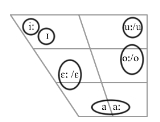
There are 10
vowels in Czech which are regarded as individual phonemes. There are 5 short and 5 long vowels.
Long vowels are indicated by an acute or a ring.
- is represented by letters í and ý
- is represented by letters ú and u
- is represented by letter é
- is represented by letter á
- is represented by letter ó
Short vowels- is represented by letters i and y
- is represented by letter u
- is represented by letter e
- is represented by letter a
- is represented by letter o
There have been some disputes as to whether there are really ten or only five vowels in Czech. These can however be settled by a simple list of minimal pairs:
- sad ~ sát
- bal ~ bál
- kaž ~ káš
- lek ~ lék
- len ~ lén
- sled ~ slét'
- bor ~ bór
- chor ~ chór
- mot ~ mód
- sir ~ sýr
- Žid ~ žít
- kil ~ kýl
- dul ~ dul
- nuž ~ nuž
- ruš ~ ruž
and can be syllabic, i.e. they can take the vowel's role as the nucleus of a
syllable, e.g.
vlk .
Diphthongs
There are three diphthongs in Czech:
- represented by au
- represented by eu
- represented by ou
Vowel groups
ia, ie, ii, io, and
iu in foreign words are not regarded as diphthongs, they are pronounced with between the vowels .
Consonants
* [] is a specific raised alveolar non-sonorant trill which can be pronounced both voiced and voiceless .
Consonants in the parentheses are regarded as allophones of other consonants:
- is an allophone of preceding labiodental consonants .
- is an allophone of preceding velar consonant
...
s.
- is a voiced allophone of preceding a voiced consonant
- is an allophone of preceding a voiceless consonant
Glottal stop is not regarded as an individual phoneme.
There are also 4 affricates:
| | voiceless alveolar affricate |
| | voiced alveolar affricate |
| | voiceless postalveolar affricate |
| | voiced postalveolar affricate |
- is represented by letter š
- is represented by letter ž
- is represented by letter n
- is represented by letter t
- is represented by letter d
- is represented by letter h
- is represented by digraph ch
- is represented by letter c
- is represented by digraph dz
- is represented by letter c
- is represented by digraph dž
- is represented by letter r
Other consonants are represented by the same characters as in
IPA.
Stress
The primary stress is always fixed to the first
syllable of a stressed unit which is usually identical to a word. The exceptions are:
- One-syllabic prepositions form a unit with following words . The stress is placed on the preposition then: e.g. Praha --> do Prahy . This does not apply to long words, e.g. na kolonáde .
- Some one-syllabic words are not stressed and form a unit with preceding words, therefore they cannot be the first words in sentences. Example: Napsal jsem ti ten dopis, I have written the letter to you.
Long words have the secondary stress which is usually placed on every odd syllable, e.g.
nej.krás.
nej.ší .
The stress has no lexical or phonological function, it denotes boundaries between words but does not distinguish word meanings. It has also no influence on the quality or quantity of vowels, i.e. the vowels are not reduced in unstressed syllables and can be both short and long regardless the stress.
Basic Greetings
- Dobré ráno - Good morning
- Dobrý vecer - Good evening
- Na shledanou - Good bye/See you later
- Jak se máš? - How are you?
Morphology
Parts of speech
- Noun
- Adjective
- Pronoun
- Numeral
- Verb
- Adverb
- Preposition
- Conjunction
- Particle
- Interjection
Nouns, adjectives, pronouns and numbers are declined and verbs are conjugated; the other parts of speech are not inflected .
Dialects
In the Czech Republic three distinct koine, or interdialects can be found, all corresponding more or less to geographic areas within the country. They differ from standard Czech, creating some form of diglossia. The first, and most widely used, is "Common Czech", spoken in
Bohemia. It has some grammatical differences from "standard" Czech, along with some differences in pronunciation. The most common pronunciation changes include
-ý becoming
-ej in some circumstances,
-é becoming
-ý- in some circumstances , and the insertion of prothetic
v- at the beginning of some words starting with
o-. Also, noun declension is changed, most notably the instrumental case. Instead of having various endings in the instrumental, Bohemians will just put
-ama or
-ma at the end of all plural instrumental declensions. Also pronunciation changes slightly, as the Bohemians tend to have more open vowels than Moravians. This is said to be especially prevalent among people from Prague.
The second major interdialect is spoken in
Moravia. This dialect has some totally different words from standard Czech. Unlike in Bohemia, Moravia tends to have more local dialects varying from town to town. For example in Brno,
tramvaj is
šalina . Everyday spoken form in Moravia would be a mixture of given interdialect, remnants of old local dialect, some Standard Czech forms and sometimes also Common Czech. The most notable difference is a shift in used prepositions and case of noun, for example
k jídlu becomes
na jídlo . It is a common misconception that the use of Standard Czech in everyday situations is more frequent than in Bohemia. The Standard Czech became de-facto standardized with a new translation of the Bible using an older variant of the then-current language . These older forms are still prevalent in Moravia. Moravians, however, tend to say that they use "proper" language, unlike their Bohemian brothers.
The third major dialect - Teshen Silesian - is spoken in
Silesia, centered around the city
Ostrava. This dialect, too, is grammatically sound and closer to Standard Czech, but in this dialect people speak very quickly, and the long vowels become the same as their short counterparts. These shortened vowels are also sometimes emphasised, as opposed to emphasising the initial syllable as common in all other variants of Czech.
It should be noted that some south Moravian dialects are considered to be actually the dialects of the Slovak languages, what has it roots to the Moravian empire when Slovaks and Moravians were one nations with one language. Those dialects still have the same suffixes as Slovak.
Declension
The noun cases are typically referred to by number, and learned by means of the question to which they are the answer. When learning a new word, children recite the cases using a set of example phrases, shown as follows:
| 1. | kdo/co? | nominative |
| 2. | bez koho/ceho? | genitive |
| 3. | komu/cemu? | dative |
| 4. | vidím koho/co? | accusative |
| 5. | volám | vocative |
| 6. | o kom/cem? | locative |
| 7. | s kým/cím? | instrumental |
The case used depends on a number of variables, and for foreigners can be very confusing.
Prepositions with certain cases
The simplest of the rules governing noun declension is the use of prepositions . Excepting expressions and common phrases, each preposition is matched with a certain noun declension case depending on use. The following are basic examples of common prepositions and their corresponding noun cases .
- Genitive: behem , podle/dle , vedle , kolem , okolo , do , od , z , bez , místo .
- Dative: k , proti , díky , naproti .
- Accusative: skrz , pro , na .
- Locative/Prepositional: o , na , pri , v , po .
- Instrumental: za , pred , mezi , pod , s , nad .
Many of the above prepositions are used in different circumstances. For instance, when motion or a change of position is expressed, prepositions like
nad, mezi, na, pod, etc. are used with the accusative case.
The second factor affecting noun declension is the verb used. In Czech grammar, the accusative case serves as the direct object, and the dative case serves as the indirect object. Some verbs require the genitive case to be used. For example, the verb "zeptat se" requires that the person being asked the question be in the genitive case , and that the thing being asked about follow the preposition "na" and be in the accusative case .
Counting and declension
The third factor affecting noun declension is number. The Czech language has a very complex counting system, explained as follows with the example masculine animate noun
muž :
- For the number one, the singular number is of course used: jeden muž.
- For the numbers 2, 3, and 4, any case may be used, depending on the function of the noun in the sentence: dva muži . "Vidím dva muže" .
- For all numbers from 5 to infinity, the genitive plural is used when the noun would normally be in the nominative, accusative or vocative case: pet mužu. "Pet mužu je tam." Five men are over there. "Vidím pet mužu." I see five men. For other cases, however, the noun is not placed in the genitive. "Nad peti muži." Above the five men .
Numbers also have declension patterns in Czech. The number two, for instance, declines as follows:
| Nominative | dva/dve |
| Genitive | dvou |
| Dative | dvema |
| Accusative | dva/dve |
>| Locative | dvou |
| Instrumental | dvema |
The numbers are singular , plural , and remains of dual. The dual number is used for only several parts of the human body, of which each person has two: hands, shoulders, eyes, ears, knees, legs, breasts. In all but two of the above body parts the dual number is only vestigial and affects very few aspects of declension .
Gender
The genders are masculine animate, masculine inanimate, feminine, and neuter. Masculine animate is used only to describe living things . Strangely enough, there are hundreds of words for living things that are not masculine words .
Tenses and conditionals
Compared to
Romance languages, Czech has a very simple set of tenses. They are present, past, and
future.
Past is used in almost all instances of past action, and replaces every past tense in English . The past tense is usually formed by affixing an -l- on the end of the verb, sometimes with a minor stem change. After adding the -l-, letters are added in order to agree with the subject .
The present tense is precisely the same as in English. It is also used in cases where one would say, for instance, "I have been doing this for three hours". In Czech, the present indicative is used and is directly translated as "I do this for three hours".
There are also sometimes second forms of certain verbs that indicate a habitual or repeated action. These are known as iterative forms. For instance, the verb jít has the iterative form chodit .
There is also no tense shifting . E.g. "He loves her" -> "He said he loved her", the time is shifted from present to past. In Czech it is "Má ji rád" -> "Rekl, že ji ma rád". The "má rád" implies present tense in both cases.
The conditional is something of an oddity, with no real indication of time. It is the same regardless of whether the action discussed is a future, present, or past action. The conditional is formed by using the auxiliary "conditional marker" and the past tense of the root verb. The condition marker appears as follows:
- I would have: bych
- you would have: bys
- he would have: by
- she would have: by
- we would have: bychom
- you would have: byste
- they would have: by
So, "I would have gone" would be translated as "Já bych šel."
The future tense is another fickle part of Czech grammar. Often, verbs that appear to be present tense are actually future tense. For instance, the verb vyhodit appears like a normal present tense, but actually indicates a future action. The true present tense form of this verb is vyházet. Often, when prefixes are added to verbs, they become one of these "perfect" future verbs. They then undergo a stem change to create a true present tense verb.
See also
- Czech alphabet
- Czech declension
- Czech orthography
- Czech verb
- Hácek
- Czech name
- Swadesh list of Czech words
External links
Dictionaries
- – multilingual dictionary
- – free Czech dictionaries
- – multilingual dictionary
- – transliterated Czech
Online courses and phrasebooks
Diacritics
Other
-
- – for all people somehow interested in the Czech Republic
-
-