

Low Franconian languages

Encyclopedia
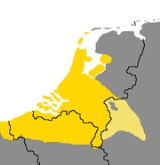
Low Franconian, Low Frankish, or Istvaeonic, is a group of several West Germanic language
s spoken in the Netherlands
, northern Belgium
(Flanders
), in the northern department of France
, in western Germany (Lower Rhine
), as well as in Suriname
, South Africa
and Namibia
that originally descended from Old Frankish
.
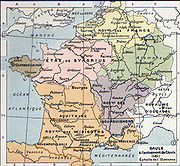 The Frankish language, also Old Frankish
, was the language of the Franks
. Classified as a West Germanic language, it was spoken in Merovingian times, preceding the 7th century. Austrasia
formed the north-eastern portion of the Kingdom of the Merovingian Franks, comprising parts of the territory of present-day western Germany, eastern and northern France, Luxembourg, Belgium, and the Netherlands. The Franks first established themselves in the Netherlands and Flanders before they started to fight their way down south and east. The language had a significant impact on Old French
. It evolved into Old Low Franconian in the north and it was replaced step by step by Langue d'oïl in the south.
Old Frankish is not directly attested except in glosses and small phrases. It has been reconstructed from loanword
s in Old French and from Old Dutch
(see also Comparative method
). One known phrase in Old Frankish is found in the Salic law
of the early sixth century, and is used to free a serf
:
Old Low Franconian (also Old Low Frankish) was a group of dialects spoken in the Low countries. It was a daughter language
of the Old Frankish language.
Regardless of this difference in interpretation, East Low Franconian was eventually "absorbed" into Dutch
as it became the dominant form of Low Franconian, although it remains a noticeable substrate within Limburgish.
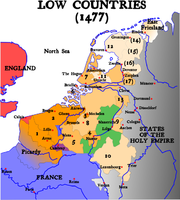
Dutch, like other Germanic languages, is conventionally divided into three phases. In the development of Dutch these phases were:
Low-Franconian varieties are also spoken in the German area along the Rhine between Cologne and the border between Germany and the Netherlands. During the 19th and 20th centuries these dialects have partly and gradually been replaced by today's Standard German.
Sometimes, Low Franconian is grouped together with Low German
. However, since this grouping is not based on common linguistic innovations, but rather on the absence of the High German consonant shift
and Anglo-Frisian
features, modern linguistic reference books do not group them together.
, part of High German
. This difference is caused by a difference in definition: the latter stance defines a High German variety as one that has taken part in any of the first three phases of the High German consonant shift
. Limburgish is also spoken in a considerable part of the German Lower Rhine area, in what could be called German-administered Limburg: from the border regions of Kleve, Aachen, Viersen, Heinsberg stretching out to the Rhine river. At the Rhine near Duisburg
, it adjoins a smaller strip of other Low Franconian varieties called Bergisch. Depending on the city in Germany, 50% to 90% of the population speak it (A. Schunck 2001).
Together these distinct varieties, now often combined with the Kleve dialects (Kleverländisch) as Meuse-Rhenish
('Rheinmaasländisch'), belong to the greater Low Franconian area between the rivers Meuse and Rhine (A. Welschen 2002). Limburgish straddles the borderline between 'Low Franconian' and 'Middle Franconian' varieties. They are more-or-less mutually intelligible with the Ripuarian dialects, but show fewer 'High German shifts' (R. Hahn 2001). In a number of towns and villages in the north-east of the Belgian province of Liege
, such as Homburg
, Welkenraedt
, and Eupen
, a transitional Limburgish-Ripuarian
dialect is spoken, called Low Dietsch
(Dutch: Platdiets, Limburgish: Platduutsj, French: Thiois or Platdutch).
is an Indo-European language, derived from Dutch and classified as Low Franconian Germanic, mainly spoken in South Africa
and Namibia
, with smaller numbers of speakers in Botswana, Angola, Swaziland, Zimbabwe, Togo, and Zambia.
Afrikaans originated from the Dutch language. The dialect became known as "Cape Dutch". Later, Afrikaans was sometimes also referred to as "African Dutch" or "Kitchen Dutch", although these terms were mainly pejorative. Afrikaans was considered a Dutch dialect until the late 19th century, when it began to be recognised as a distinct language, and it gained equal status with Dutch and English as an official language in South Africa in 1925. Dutch remained an official language until the new 1961 constitution finally stipulated the two official languages in South Africa to be Afrikaans and English (although, curiously, the 1961 constitution still had a sub-clause stipulating that the word "Afrikaans" was also meant to be referring to the Dutch language). It is the only Indo-European language of significance that underwent distinct development on the African continent.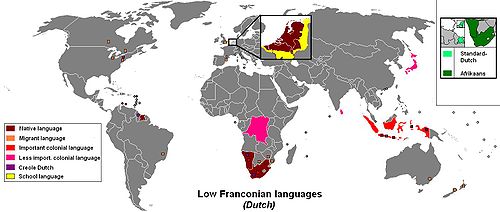
Language
Language may refer either to the specifically human capacity for acquiring and using complex systems of communication, or to a specific instance of such a system of complex communication...
s spoken in the Netherlands
Netherlands
The Netherlands is a constituent country of the Kingdom of the Netherlands, located mainly in North-West Europe and with several islands in the Caribbean. Mainland Netherlands borders the North Sea to the north and west, Belgium to the south, and Germany to the east, and shares maritime borders...
, northern Belgium
Belgium
Belgium , officially the Kingdom of Belgium, is a federal state in Western Europe. It is a founding member of the European Union and hosts the EU's headquarters, and those of several other major international organisations such as NATO.Belgium is also a member of, or affiliated to, many...
(Flanders
Flanders
Flanders is the community of the Flemings but also one of the institutions in Belgium, and a geographical region located in parts of present-day Belgium, France and the Netherlands. "Flanders" can also refer to the northern part of Belgium that contains Brussels, Bruges, Ghent and Antwerp...
), in the northern department of France
France
The French Republic , The French Republic , The French Republic , (commonly known as France , is a unitary semi-presidential republic in Western Europe with several overseas territories and islands located on other continents and in the Indian, Pacific, and Atlantic oceans. Metropolitan France...
, in western Germany (Lower Rhine
Lower Rhine
The Lower Rhine flows from Bonn, Germany, to the North Sea at Hoek van Holland, Netherlands.Almost immediately after entering the Netherlands, the Rhine splits into many branches. The main branch is called the Waal which flows from Nijmegen to meet the river Meuse; after which it is called Merwede...
), as well as in Suriname
Suriname
Suriname , officially the Republic of Suriname , is a country in northern South America. It borders French Guiana to the east, Guyana to the west, Brazil to the south, and on the north by the Atlantic Ocean. Suriname was a former colony of the British and of the Dutch, and was previously known as...
, South Africa
South Africa
The Republic of South Africa is a country in southern Africa. Located at the southern tip of Africa, it is divided into nine provinces, with of coastline on the Atlantic and Indian oceans...
and Namibia
Namibia
Namibia, officially the Republic of Namibia , is a country in southern Africa whose western border is the Atlantic Ocean. It shares land borders with Angola and Zambia to the north, Botswana to the east and South Africa to the south and east. It gained independence from South Africa on 21 March...
that originally descended from Old Frankish
Old Frankish
Old Frankish is an extinct West Germanic language, once spoken by the Franks. It is the parent language of the Franconian languages, of which Dutch and Afrikaans are the most known descendants...
.
The Frankish language
Old Frankish
Old Frankish is an extinct West Germanic language, once spoken by the Franks. It is the parent language of the Franconian languages, of which Dutch and Afrikaans are the most known descendants...
, was the language of the Franks
Franks
The Franks were a confederation of Germanic tribes first attested in the third century AD as living north and east of the Lower Rhine River. From the third to fifth centuries some Franks raided Roman territory while other Franks joined the Roman troops in Gaul. Only the Salian Franks formed a...
. Classified as a West Germanic language, it was spoken in Merovingian times, preceding the 7th century. Austrasia
Austrasia
Austrasia formed the northeastern portion of the Kingdom of the Merovingian Franks, comprising parts of the territory of present-day eastern France, western Germany, Belgium, Luxembourg and the Netherlands. Metz served as its capital, although some Austrasian kings ruled from Rheims, Trier, and...
formed the north-eastern portion of the Kingdom of the Merovingian Franks, comprising parts of the territory of present-day western Germany, eastern and northern France, Luxembourg, Belgium, and the Netherlands. The Franks first established themselves in the Netherlands and Flanders before they started to fight their way down south and east. The language had a significant impact on Old French
Old French
Old French was the Romance dialect continuum spoken in territories that span roughly the northern half of modern France and parts of modern Belgium and Switzerland from the 9th century to the 14th century...
. It evolved into Old Low Franconian in the north and it was replaced step by step by Langue d'oïl in the south.
Old Frankish is not directly attested except in glosses and small phrases. It has been reconstructed from loanword
Loanword
A loanword is a word borrowed from a donor language and incorporated into a recipient language. By contrast, a calque or loan translation is a related concept where the meaning or idiom is borrowed rather than the lexical item itself. The word loanword is itself a calque of the German Lehnwort,...
s in Old French and from Old Dutch
Old Dutch
In linguistics, Old Dutch denotes the forms of West Franconian spoken and written in the Netherlands and present-day northern Belgium during the Early Middle Ages. It is regarded as the primary stage in the development of a separate Dutch language...
(see also Comparative method
Comparative method
In linguistics, the comparative method is a technique for studying the development of languages by performing a feature-by-feature comparison of two or more languages with common descent from a shared ancestor, as opposed to the method of internal reconstruction, which analyzes the internal...
). One known phrase in Old Frankish is found in the Salic law
Salic law
Salic law was a body of traditional law codified for governing the Salian Franks in the early Middle Ages during the reign of King Clovis I in the 6th century...
of the early sixth century, and is used to free a serf
SERF
A spin exchange relaxation-free magnetometer is a type of magnetometer developed at Princeton University in the early 2000s. SERF magnetometers measure magnetic fields by using lasers to detect the interaction between alkali metal atoms in a vapor and the magnetic field.The name for the technique...
:
- Maltho thi afrio lito.
- I say to you, I free you, half-free.
Old Low Franconian (also Old Low Frankish) was a group of dialects spoken in the Low countries. It was a daughter language
Daughter language
In historical linguistics, a daughter language is a language descended from another language through a process of genetic descent.-Examples:*English is a daughter language of Proto-Germanic, which is a daughter language of Proto-Indo-European....
of the Old Frankish language.
Development
Old Low Franconian is sometimes divided in two groups, Old Dutch (also Old West Low Franconian) and Old East Low Franconian. Because the two groups were so similar it is often very hard to determine whether a text is Old Dutch or Old East Low Franconian, and so most linguists will generally use Old Dutch synonymously with Old Low Franconian and most of the time do not differentiate.Regardless of this difference in interpretation, East Low Franconian was eventually "absorbed" into Dutch
Dutch language
Dutch is a West Germanic language and the native language of the majority of the population of the Netherlands, Belgium, and Suriname, the three member states of the Dutch Language Union. Most speakers live in the European Union, where it is a first language for about 23 million and a second...
as it became the dominant form of Low Franconian, although it remains a noticeable substrate within Limburgish.
Development of Dutch
Dutch, like other Germanic languages, is conventionally divided into three phases. In the development of Dutch these phases were:
- 600/650–1150: Old DutchOld DutchIn linguistics, Old Dutch denotes the forms of West Franconian spoken and written in the Netherlands and present-day northern Belgium during the Early Middle Ages. It is regarded as the primary stage in the development of a separate Dutch language...
- 1150–1500: Middle DutchMiddle DutchMiddle Dutch is a collective name for a number of closely related West Germanic dialects which were spoken and written between 1150 and 1500...
(also called DietschDietsch-Languages:*German *Middle Dutch*Low German including Dutch*Low German excluding Dutch by definition*Low Dietsch, transitional Limburgish-Ripuarian dialects-People:* John Dietsch, author on the subject of fly fishing...
in popular use, though not by linguists) - 1500–present: Modern Dutch (saw the creation of the Dutch standard language and includes contemporary Dutch)
Low-Franconian varieties are also spoken in the German area along the Rhine between Cologne and the border between Germany and the Netherlands. During the 19th and 20th centuries these dialects have partly and gradually been replaced by today's Standard German.
Sometimes, Low Franconian is grouped together with Low German
Low German
Low German or Low Saxon is an Ingvaeonic West Germanic language spoken mainly in northern Germany and the eastern part of the Netherlands...
. However, since this grouping is not based on common linguistic innovations, but rather on the absence of the High German consonant shift
High German consonant shift
In historical linguistics, the High German consonant shift or second Germanic consonant shift is a phonological development that took place in the southern parts of the West Germanic dialect continuum in several phases, probably beginning between the 3rd and 5th centuries AD, and was almost...
and Anglo-Frisian
Anglo-Frisian languages
The Anglo-Frisian languages form a group of West Germanic languages consisting of Old English, Old Frisian, and their descendants...
features, modern linguistic reference books do not group them together.
Meuse-Rhenish
It is common to consider the Limburgish varieties as belonging to the Low Franconian languages; in the past, however, all these Limburgish dialects were sometimes seen as West Central GermanWest Central German
West Central German belongs to the Central, High German dialect family in the German language. Its dialects are thoroughly Franconian including the following sub-families:* Central Franconian...
, part of High German
High German languages
The High German languages or the High German dialects are any of the varieties of standard German, Luxembourgish and Yiddish, as well as the local German dialects spoken in central and southern Germany, Austria, Liechtenstein, Switzerland, Luxembourg and in neighboring portions of Belgium and the...
. This difference is caused by a difference in definition: the latter stance defines a High German variety as one that has taken part in any of the first three phases of the High German consonant shift
High German consonant shift
In historical linguistics, the High German consonant shift or second Germanic consonant shift is a phonological development that took place in the southern parts of the West Germanic dialect continuum in several phases, probably beginning between the 3rd and 5th centuries AD, and was almost...
. Limburgish is also spoken in a considerable part of the German Lower Rhine area, in what could be called German-administered Limburg: from the border regions of Kleve, Aachen, Viersen, Heinsberg stretching out to the Rhine river. At the Rhine near Duisburg
Duisburg
- History :A legend recorded by Johannes Aventinus holds that Duisburg, was built by the eponymous Tuisto, mythical progenitor of Germans, ca. 2395 BC...
, it adjoins a smaller strip of other Low Franconian varieties called Bergisch. Depending on the city in Germany, 50% to 90% of the population speak it (A. Schunck 2001).
Together these distinct varieties, now often combined with the Kleve dialects (Kleverländisch) as Meuse-Rhenish
Meuse-Rhenish
Meuse-Rhenish or Rheinmaasländisch is a modern term that geographically refers to the literature written in mediæval times in the greater Meuse-Rhine area. This area stretches in the northern triangle roughly between the rivers Meuse and Rhine...
('Rheinmaasländisch'), belong to the greater Low Franconian area between the rivers Meuse and Rhine (A. Welschen 2002). Limburgish straddles the borderline between 'Low Franconian' and 'Middle Franconian' varieties. They are more-or-less mutually intelligible with the Ripuarian dialects, but show fewer 'High German shifts' (R. Hahn 2001). In a number of towns and villages in the north-east of the Belgian province of Liege
Liège (province)
Liège is the easternmost province of Belgium and belongs to the Walloon Region. It is an area of French and German ethnicity. It borders on the Netherlands, Germany, Luxembourg, and in Belgium the provinces of Luxembourg, Namur, Walloon Brabant , and those of Flemish Brabant and Limburg . Its...
, such as Homburg
Homburg
-In Germany:* Homburg, Saarland, capital of the Saarpfalz district of Saarland* Bad Homburg, town and spa in Hesse* Homburg Forest, a hill range in Lower Saxony* Homburg, a quarter of Triefenstein, Bavaria...
, Welkenraedt
Welkenraedt
Welkenraedt is a Walloon municipality located in the province of Liège, Belgium. On January 1, 2006, Welkenraedt had a total population of 9,163. The total area is 24.47 km² which gives a population density of 374 inhabitants per km²....
, and Eupen
Eupen
Eupen is a municipality in the Belgian province of Liège, from the German border , from the Dutch border and from the "High Fens" nature reserve...
, a transitional Limburgish-Ripuarian
Ripuarian
Ripuarian is a German dialect group, part of the West Central German language group....
dialect is spoken, called Low Dietsch
Low Dietsch
Low Dietsch is a term mainly used within the Flemish terminology for the transitional Limburgish–Ripuarian dialects of a number of towns and villages in the north-east of the Belgian province of Liege, such as Gemmenich, Homburg, Montzen and Welkenraedt....
(Dutch: Platdiets, Limburgish: Platduutsj, French: Thiois or Platdutch).
Modern Low Franconian languages
The modern Low Franconian languages are:- Afrikaans
- Standard DutchDutch languageDutch is a West Germanic language and the native language of the majority of the population of the Netherlands, Belgium, and Suriname, the three member states of the Dutch Language Union. Most speakers live in the European Union, where it is a first language for about 23 million and a second...
Dutch
The main dialects are:- BrabantianBrabantianBrabantian or Brabantish, also Brabantic , is a dialect group of the Dutch language. It is named after the historical Duchy of Brabant which corresponded mainly to the Dutch province of North Brabant, the Belgian provinces of Antwerp and Flemish Brabant, as well as the institutional Region of...
- East FlemishEast FlemishEast Flemish is a group of dialects of the Dutch language, which is a Low Franconian language. It is spoken in the province of East Flanders in Belgium, but also spoken in Zeeuws-Vlaanderen in the Netherlands.-Brabantic Expansion:...
- HollandicHollandicHollandic or Hollandish is, together with Brabantian, the most frequently used dialect of the Dutch language. Other important Low Franconian language varieties spoken in the same area are Zeelandic, East Flemish, West Flemish and Limburgish....
- Limburgian
- Zealandic
- West FlemishWest FlemishWest Flemish , , , Fransch vlaemsch in French Flemish) is a group of dialects or regional language related to Dutch spoken in parts of the Netherlands, Belgium, and France....
- South GuelderishSouth GuelderishSouth Guelderish refers to a group of dialects of the Dutch language which are spoken along the Nederrijn in the Netherlands and around the city of Cleves in Germany...
(also called Kleverlandish or Clevian)
Afrikaans
AfrikaansAfrikaans
Afrikaans is a West Germanic language, spoken natively in South Africa and Namibia. It is a daughter language of Dutch, originating in its 17th century dialects, collectively referred to as Cape Dutch .Afrikaans is a daughter language of Dutch; see , , , , , .Afrikaans was historically called Cape...
is an Indo-European language, derived from Dutch and classified as Low Franconian Germanic, mainly spoken in South Africa
South Africa
The Republic of South Africa is a country in southern Africa. Located at the southern tip of Africa, it is divided into nine provinces, with of coastline on the Atlantic and Indian oceans...
and Namibia
Namibia
Namibia, officially the Republic of Namibia , is a country in southern Africa whose western border is the Atlantic Ocean. It shares land borders with Angola and Zambia to the north, Botswana to the east and South Africa to the south and east. It gained independence from South Africa on 21 March...
, with smaller numbers of speakers in Botswana, Angola, Swaziland, Zimbabwe, Togo, and Zambia.
Afrikaans originated from the Dutch language. The dialect became known as "Cape Dutch". Later, Afrikaans was sometimes also referred to as "African Dutch" or "Kitchen Dutch", although these terms were mainly pejorative. Afrikaans was considered a Dutch dialect until the late 19th century, when it began to be recognised as a distinct language, and it gained equal status with Dutch and English as an official language in South Africa in 1925. Dutch remained an official language until the new 1961 constitution finally stipulated the two official languages in South Africa to be Afrikaans and English (although, curiously, the 1961 constitution still had a sub-clause stipulating that the word "Afrikaans" was also meant to be referring to the Dutch language). It is the only Indo-European language of significance that underwent distinct development on the African continent.
See also
- AfrikaansAfrikaansAfrikaans is a West Germanic language, spoken natively in South Africa and Namibia. It is a daughter language of Dutch, originating in its 17th century dialects, collectively referred to as Cape Dutch .Afrikaans is a daughter language of Dutch; see , , , , , .Afrikaans was historically called Cape...
- Dutch dialectsDutch dialectsDutch dialects are primarily the dialects that are both cognate with the Dutch language and are spoken in the same language area as the Dutch standard language. Dutch dialects are remarkably diverse and are found in the Netherlands and northern Belgium....
- Dutch languageDutch languageDutch is a West Germanic language and the native language of the majority of the population of the Netherlands, Belgium, and Suriname, the three member states of the Dutch Language Union. Most speakers live in the European Union, where it is a first language for about 23 million and a second...
- Franconian languagesFranconian languagesFranconian refers to a West Germanic dialect continuum spoken in the Rhineland, including Dutch at one end and all the transitional dialects between Dutch and standard German which do not fully participate in the High German consonant shift or German diphthongization of long vowels...
- IstvaeonesIstvaeonesThe Istvaeones, also called Istaevones, Istriaones, Istriones, Sthraones, Thracones, Rhine Germans and Weser-Rhine Germans , were a West Germanic cultural group or proto-tribe...
- History of DutchHistory of DutchDutch is a West Germanic language, that originated from the Old Frankish dialects.Among the words with which Dutch has enriched the English vocabulary are: brandy, cole slaw, cookie, cruiser, dock, easel, freight, landscape, spook, stoop, and yacht...
- Low DietschLow DietschLow Dietsch is a term mainly used within the Flemish terminology for the transitional Limburgish–Ripuarian dialects of a number of towns and villages in the north-east of the Belgian province of Liege, such as Gemmenich, Homburg, Montzen and Welkenraedt....
- Meuse-RhenishMeuse-RhenishMeuse-Rhenish or Rheinmaasländisch is a modern term that geographically refers to the literature written in mediæval times in the greater Meuse-Rhine area. This area stretches in the northern triangle roughly between the rivers Meuse and Rhine...
- Middle DutchMiddle DutchMiddle Dutch is a collective name for a number of closely related West Germanic dialects which were spoken and written between 1150 and 1500...
Further reading
- Friedrich Maurer (1942), Nordgermanen und Alemannen: Studien zur germanischen und frühdeutschen Sprachgeschichte, Stammes- und Volkskunde, Bern: Francke Verlag.