

Brythonic languages

Encyclopedia
The Brythonic or Brittonic languages form one of the two branches of the Insular Celtic
language family, the other being Goidelic. The name Brythonic was derived by Welsh
Celticist
John Rhys
from the Welsh
word Brython, meaning an indigenous Briton
as opposed to an Anglo-Saxon
or Gael
. The name Brittonic derives ultimately from the name Prettanike, recorded by Greek authors for the British Isles
. Some authors reserve the term Brittonic for the modified later Brythonic languages after about AD 600.
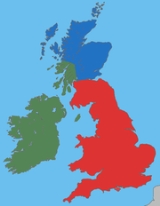
The Brythonic languages derive from the British language, spoken throughout Britain south of the Firth of Forth
during the Iron Age
and Roman period
. North of the Forth, the Pictish language
is considered to be related; it is possible it was a Brythonic language, but it may have been a sister language. In the 4th and 5th centuries emigrating Britons also took Brythonic speech to the continent, most significantly in Brittany
. During the next few centuries the language began to split into several dialects, eventually evolving into Welsh
, Cornish
, Breton
, and Cumbric
. Welsh and Breton continue to be spoken as native languages, while a revival in Cornish has led to an increase in speakers of that language. Cumbric is extinct, having been replaced by Goidelic
and English
speech. The Isle of Man
may also have had a Brythonic language that was replaced with a Goidelic one. By emigration there are also communities of Brythonic language speakers in England
, France
, and Y Wladfa, the Welsh settlement in Patagonia
.
hypothesis rather than the Insular Celtic hypothesis (for a discussion, see Celtic languages
).
Other major characteristics include:
Brythonic languages in use today are Welsh
, Cornish
and Breton
. Welsh and Breton have been spoken continuously since they formed. Cornish nearly died out during the 19th and 20th centuries, retained only by a few elderly people and some families as a language of the home, but a process of revitalisation since 1904 has seen numbers of natural speakers increase. Also notable are the extinct language Cumbric
, and possibly the extinct Pictish
although this may be best considered to be a sister of the Brythonic languages. The late Kenneth H. Jackson
argued during the 1950s, from some of the few remaining examples of stone inscriptions, that the Picts may have also used a non-Indo-European
language, but some modern scholars of Pictish do not agree.
 The modern Brythonic languages are generally considered to all derive from a common ancestral language termed Brittonic, British, Common Brythonic, Old Brythonic or Proto-Brythonic, which is thought to have developed from Proto-Celtic or early Insular Celtic by the 6th century BC.
There are a number of alternative hypotheses, none of which has found wide acceptance. Mario Alinei
denies the existence of a pre-Celtic language and says that Celtic languages arrived in the Paleolithic. Stephen Oppenheimer
has suggested that Belgic invasions in the 1st century BC could have brought a Germanic language to Britain.
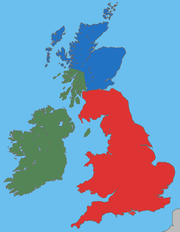
Brythonic languages were probably spoken prior to the Roman invasion at least in the majority of Great Britain
south of the rivers Forth
and Clyde
, though the Isle of Man
later had a Goidelic language, Manx
. Northern Scotland mainly spoke Pritennic, which became Pictish, that may have been a Brythonic language. The theory has been advanced (notably by T. F. O'Rahilly
) that part of Ireland
spoke a Brythonic language, usually termed Ivernic, before it was displaced by the Q-Celtic Irish language
, although the authors Dillon and Chadwick reject this theory as being implausible.
During the period of the Roman occupation of Southern Britain (AD 43 to c. 410), Common Brythonic borrowed a large stock of Latin
words, both for concepts unfamiliar in the pre-urban society of Celtic Britain, such as urbanisation and tactics of warfare, and for rather more mundane words which displaced native terms (most notably, the word for "fish" in all the Brythonic languages derives from the Latin piscis rather than the native *ēskos, which may survive, however, in the Welsh name of the River Usk
). Approximately 800 of these Latin loan-words have survived in the three modern Brythonic languages. Romano-British is the name for the Latinised form of the language used by Roman authors.
It is probable that at the start of the Post-Roman period Common Brythonic was differentiated into at least two major dialect groups – Southwestern and Western (in addition we may posit additional dialects, such as Eastern Brythonic, spoken in what is now Eastern England, which have left little or no evidence). Between the end of the Roman occupation and the mid 6th century the two dialects began to diverge into recognisably separate languages, the Western into Cumbric and Welsh, and the Southwestern into Cornish
and its closely related sister language Breton
, which was carried from the south west of Great Britain to continental Armorica
. Jackson showed that a few of the dialect distinctions between West and Southwest Brythonic go back a long way. New divergencies began around AD 500 but other changes which were shared occurred in the 6th century. Other common changes occurred in the 7th century onward and are possibly due to inherent tendencies. Thus the concept of a common Brythonic language ends by AD 600. It is thought that substantial numbers of Britons remained in the expanding area controlled by Anglo-Saxon
s , but the only information on their language may be obtained from place names. Over time it is thought they gradually adopted the English language
.
The Brythonic languages spoken in what is now Scotland
, the Isle of Man
and what is now England
began to be displaced in the 5th century through the influence of Irish
(Scots
), Norse
and Germanic
invaders. The displacement of the languages of Brythonic descent was probably complete in all of this territory, (except Cornwall
and the English counties bordering Wales), by the 11th century (date of extinction in various parts of the territory is debated).
The regular consonant
al sound change
s from Proto-Celtic to the Welsh language
and Cornish language
may be summarised in the following table. Where the Welsh and Cornish graphemes have a different value from the corresponding IPA symbols, the IPA equivalent is indicated between slashes. V represents a vowel; C represents a consonant.
, Penicuik
, Perth
, Aberdeen
, York
, Dorchester, Dover
and Colchester
. Brythonic elements found in England include bre- and bal- for hills, and carr for a high rocky place, while some such as combe or coomb(e)
for a small deep valley and tor for a hill are examples of Brythonic words that were borrowed into English. Others reflect the presence of Brythons, such as Dumbarton – from the Scottish Gaelic Dùn Breatainn meaning "Fort of the Britons", or Walton (several) meaning a 'tun' or settlement where 'walha
' (Welsh/Brythons) still lived.
The number of Celtic river names in England generally increases from east to west, a map showing these being given by Jackson. These names include ones such as Avon, Chew, Frome, Axe, Brue and Exe.
Also river names containing the roots " der- / dar- / dur- " and " -went " e.g. " Derwent, Darwen, Dart, Deer, Adur, Dour, Darent, Went ". The Celtic origins seem likely, the meanings more controversial:
Some associate " Der- / Dar- " with the Brythonic word for " oak(s) " (" derv / dervenn " in Breton, " derow / derowenn " in Cornish, " derw / derwen " in Welsh). As to " -went " some claim this to be a word for " valley " or associated with the Celtic word " nant " for river ( like in Welsh ). This seems a very unlikely derivation, as there is no known initial consonantal changes from " n- " to " w- ". More likely is that the " Der- / Dar- / Dur- " means " water " [ c.f. " Dour " in Breton, " Dowr " in Cornish, " Dŵr " in Welsh] and " -(g)wen(n)(t) " means white / pure.
, bucket
, crock, noggin, gob (cf. Gaelic gob), nook; and the dialectal term for a badger
, i.e. brock (cf. Welsh broch, and Gaelic broc). Another legacy may be the sheep-counting system Yan Tan Tethera
in the west, in the traditionally Celtic areas of England such as Cumbria
. Several Cornish mining words are still in use in English language mining terminology, such as costean
, gunnies
, and vug
.
Those who argue against the theory of a Brythonic substratum and heavy influence point out that many toponyms have no semantic continuation from the Brythonic language. A notable example is "Avon" which comes from the Welsh term for river abona but was used by the English as a personal name. Likewise the River Ouse, Yorkshire
contains the word usa which merely means water and the name of the river Trent simply comes from the Welsh word for a trepasser (an over-flowing river)
It has been argued that the use of periphrastic constructions (using auxiliary verb
s like do and be) in the English verb
(which is more widespread than in the other Germanic languages
) is traceable to Brythonic influence although some find this very unlikely and prefer a hypothesis of North Germanic influence rather than Celtic. For example in literary Welsh we can have Caraf = I love and Yr wyf yn caru = I am loving where the Brythonic syntax is exactly mirrored in English, whereas in the Germanic sister languages of English we only have one form, for example Ich liebe in German. This view is not accepted by many linguists
.
Some researchers (Filppula et al., 2001) argue that English syntax reflects more extensive Brythonic influences, although many argued that the influence from Celtic is very minor and that the majority comes from Irish rather than Brythonic. For instance, in English tag question
s, the form of the tag depends on the verb form in the main statement (aren't I?, isn't he?, won't we? etc.). The German nicht wahr? and the French n'est-ce pas?, by contrast, are fixed forms which can be used with almost any main statement. It has been claimed that the English system has been borrowed from Brythonic, since Welsh tag questions vary in almost exactly the same way. This view is far from being generally accepted.
. Like English, periphrastic constructions have come to the fore, but to a much greater degree. Scottish Gaelic contains a number of apparently P-Celtic loanwords, but as there is a far greater overlap in terms of Celtic vocabulary, than with English, it is not always possible to disentangle P and Q Celtic words. However some common words such as monadh = Welsh mynydd Cumbric *monidh are particularly evident. Often the Brythonic influence on Scots Gaelic is indicated by considering the Irish Gaelic usage which is not likely to have been influenced so much by Brythonic. In particular, the word srath (Anglicised as "Strath") is a native Goidelic word, but its usage appears to have been modified by the Brythonic cognate ystrad whose meaning is slightly different. The effect on Irish has been the loan from British of many Latin-derived words. This has been associated with the Christianisation of Ireland from Britain.
Insular Celtic languages
Insular Celtic languages are those Celtic languages that originated in the British Isles, in contrast to the Continental Celtic languages of mainland Europe and Anatolia. All surviving Celtic languages are from the Insular Celtic group; the Continental Celtic languages are extinct...
language family, the other being Goidelic. The name Brythonic was derived by Welsh
Wales
Wales is a country that is part of the United Kingdom and the island of Great Britain, bordered by England to its east and the Atlantic Ocean and Irish Sea to its west. It has a population of three million, and a total area of 20,779 km²...
Celticist
Celtic Studies
Celtic studies is the academic discipline occupied with the study of any sort of cultural output relating to a Celtic people. This ranges from linguistics, literature and art history archaeology and history, the focus lying on the study of the various Celtic languages, living and extinct...
John Rhys
John Rhys
Sir John Rhys was a Welsh scholar, fellow of the British Academy, celticist and the first Professor of Celtic at Oxford University.-Early years and education:...
from the Welsh
Welsh language
Welsh is a member of the Brythonic branch of the Celtic languages spoken natively in Wales, by some along the Welsh border in England, and in Y Wladfa...
word Brython, meaning an indigenous Briton
Britons (historical)
The Britons were the Celtic people culturally dominating Great Britain from the Iron Age through the Early Middle Ages. They spoke the Insular Celtic language known as British or Brythonic...
as opposed to an Anglo-Saxon
Anglo-Saxons
Anglo-Saxon is a term used by historians to designate the Germanic tribes who invaded and settled the south and east of Great Britain beginning in the early 5th century AD, and the period from their creation of the English nation to the Norman conquest. The Anglo-Saxon Era denotes the period of...
or Gael
Gaels
The Gaels or Goidels are speakers of one of the Goidelic Celtic languages: Irish, Scottish Gaelic, and Manx. Goidelic speech originated in Ireland and subsequently spread to western and northern Scotland and the Isle of Man....
. The name Brittonic derives ultimately from the name Prettanike, recorded by Greek authors for the British Isles
British Isles
The British Isles are a group of islands off the northwest coast of continental Europe that include the islands of Great Britain and Ireland and over six thousand smaller isles. There are two sovereign states located on the islands: the United Kingdom of Great Britain and Northern Ireland and...
. Some authors reserve the term Brittonic for the modified later Brythonic languages after about AD 600.
The Brythonic languages derive from the British language, spoken throughout Britain south of the Firth of Forth
Firth of Forth
The Firth of Forth is the estuary or firth of Scotland's River Forth, where it flows into the North Sea, between Fife to the north, and West Lothian, the City of Edinburgh and East Lothian to the south...
during the Iron Age
British Iron Age
The British Iron Age is a conventional name used in the archaeology of Great Britain, referring to the prehistoric and protohistoric phases of the Iron-Age culture of the main island and the smaller islands, typically excluding prehistoric Ireland, and which had an independent Iron Age culture of...
and Roman period
Roman Britain
Roman Britain was the part of the island of Great Britain controlled by the Roman Empire from AD 43 until ca. AD 410.The Romans referred to the imperial province as Britannia, which eventually comprised all of the island of Great Britain south of the fluid frontier with Caledonia...
. North of the Forth, the Pictish language
Pictish language
Pictish is a term used for the extinct language or languages thought to have been spoken by the Picts, the people of northern and central Scotland in the Early Middle Ages...
is considered to be related; it is possible it was a Brythonic language, but it may have been a sister language. In the 4th and 5th centuries emigrating Britons also took Brythonic speech to the continent, most significantly in Brittany
Brittany
Brittany is a cultural and administrative region in the north-west of France. Previously a kingdom and then a duchy, Brittany was united to the Kingdom of France in 1532 as a province. Brittany has also been referred to as Less, Lesser or Little Britain...
. During the next few centuries the language began to split into several dialects, eventually evolving into Welsh
Welsh language
Welsh is a member of the Brythonic branch of the Celtic languages spoken natively in Wales, by some along the Welsh border in England, and in Y Wladfa...
, Cornish
Cornish language
Cornish is a Brythonic Celtic language and a recognised minority language of the United Kingdom. Along with Welsh and Breton, it is directly descended from the ancient British language spoken throughout much of Britain before the English language came to dominate...
, Breton
Breton language
Breton is a Celtic language spoken in Brittany , France. Breton is a Brythonic language, descended from the Celtic British language brought from Great Britain to Armorica by migrating Britons during the Early Middle Ages. Like the other Brythonic languages, Welsh and Cornish, it is classified as...
, and Cumbric
Cumbric language
Cumbric was a variety of the Celtic British language spoken during the Early Middle Ages in the Hen Ogledd or "Old North", or what is now northern England and southern Lowland Scotland, the area anciently known as Cumbria. It was closely related to Old Welsh and the other Brythonic languages...
. Welsh and Breton continue to be spoken as native languages, while a revival in Cornish has led to an increase in speakers of that language. Cumbric is extinct, having been replaced by Goidelic
Goidelic languages
The Goidelic languages or Gaelic languages are one of the two branches of the Insular Celtic languages, the other consisting of the Brythonic languages. Goidelic languages historically formed a dialect continuum stretching from the south of Ireland through the Isle of Man to the north of Scotland...
and English
English language
English is a West Germanic language that arose in the Anglo-Saxon kingdoms of England and spread into what was to become south-east Scotland under the influence of the Anglian medieval kingdom of Northumbria...
speech. The Isle of Man
Isle of Man
The Isle of Man , otherwise known simply as Mann , is a self-governing British Crown Dependency, located in the Irish Sea between the islands of Great Britain and Ireland, within the British Isles. The head of state is Queen Elizabeth II, who holds the title of Lord of Mann. The Lord of Mann is...
may also have had a Brythonic language that was replaced with a Goidelic one. By emigration there are also communities of Brythonic language speakers in England
England
England is a country that is part of the United Kingdom. It shares land borders with Scotland to the north and Wales to the west; the Irish Sea is to the north west, the Celtic Sea to the south west, with the North Sea to the east and the English Channel to the south separating it from continental...
, France
France
The French Republic , The French Republic , The French Republic , (commonly known as France , is a unitary semi-presidential republic in Western Europe with several overseas territories and islands located on other continents and in the Indian, Pacific, and Atlantic oceans. Metropolitan France...
, and Y Wladfa, the Welsh settlement in Patagonia
Patagonia
Patagonia is a region located in Argentina and Chile, integrating the southernmost section of the Andes mountains to the southwest towards the Pacific ocean and from the east of the cordillera to the valleys it follows south through Colorado River towards Carmen de Patagones in the Atlantic Ocean...
.
Evidence
Knowledge of the Brythonic languages comes from a variety of sources. For the early languages information is obtained from coins, inscriptions and comments by classical writers as well as place names and personal names recorded by them. For later languages there is information from medieval writers and modern native speakers, together with place names. The names recorded in the Roman period are given in Rivet and Smith.Characteristics
The Brythonic branch is also referred to as P-Celtic (like Gaulish) because the Brythonic reflex of the Proto-Indo-European phoneme *kw is p as opposed to the Goidelic c. Such nomenclature usually implies an acceptance of the P-CelticP-Celtic and Q-Celtic
There are two main competing schemata of categorisation of Celtic languages. The older P-Celtic/Q-Celtic hypothesis links Gaulish with Brythonic as P-Celtic and links Goidelic with Celtiberian as Q-Celtic. The difference between P and Q languages is the treatment of Proto-Celtic *kw, which became...
hypothesis rather than the Insular Celtic hypothesis (for a discussion, see Celtic languages
Celtic languages
The Celtic languages are descended from Proto-Celtic, or "Common Celtic"; a branch of the greater Indo-European language family...
).
Other major characteristics include:
- the treatment of -m, -n as -am, -an.
- initial s- followed by a vowel was changed to h-
- Welsh hen "old", hir "long", hafal "similar"
- Breton hen "ancient", hir "long", hañval "similar"
- Cornish hen "ancient", hir "hong", haval "similar"
- Irish sean "old", sior "long", samail "similar"
- Brythonic retains original nasals before -t
- Breton kant "hundred" vs. Irish céad
- sp, sr, sv/sw became f, fr, chw
- *swero "toy, game" became Welsh chwarae and Breton c'hoari
- *srokna "nostril" became Welsh ffroen and Breton froen.
- all other initial s- fell before consonants
- smeru became Welsh mêr "marrow"
- slemon became Welsh llyfn, Cornish leven and Breton levn "smooth"
- w (written u in Latin texts and ou in Greek) became gw in initial position, w internally, where in Gaelic it is f in initial position and disappears internally
- windos "white" became Welsh gwyn, Cornish gwynn, Breton gwenn
- wassos "servant, young man" became Welsh, Cornish and Breton gwas
- double plosives transformed into spirants: pp, cc, tt became f, ch (c'h), th (z) before a vowel or liquid
- cippus > Breton kef "tree trunk", Welsh cyff
- cattos > Breton kaz, Cornish kath, Welsh cath
- bucca > Breton boc'h, W boch
- single voiceless plosives and voiced d, b, and m in an intervocalic position became soft spirants
- Welsh dd[ð], th[θ], f [v]
- Breton z, zh, v
Classification
The family tree of the Brythonic languages is as follows:- Insular CelticInsular Celtic languagesInsular Celtic languages are those Celtic languages that originated in the British Isles, in contrast to the Continental Celtic languages of mainland Europe and Anatolia. All surviving Celtic languages are from the Insular Celtic group; the Continental Celtic languages are extinct...
- British ancestral to:
- Western BrythonicWestern BrythonicWestern Brythonic was one of two dialects into which the British language split during the Early Middle Ages; its counterpart was Southwestern Brythonic. The reason and date for the split is often given as the Battle of Deorham in 577, at which point the victorious Saxons of Wessex essentially cut...
ancestral to:- CumbricCumbric languageCumbric was a variety of the Celtic British language spoken during the Early Middle Ages in the Hen Ogledd or "Old North", or what is now northern England and southern Lowland Scotland, the area anciently known as Cumbria. It was closely related to Old Welsh and the other Brythonic languages...
- WelshWelsh languageWelsh is a member of the Brythonic branch of the Celtic languages spoken natively in Wales, by some along the Welsh border in England, and in Y Wladfa...
- Cumbric
- Southwestern Brythonic ancestral to:
- CornishCornish languageCornish is a Brythonic Celtic language and a recognised minority language of the United Kingdom. Along with Welsh and Breton, it is directly descended from the ancient British language spoken throughout much of Britain before the English language came to dominate...
- BretonBreton languageBreton is a Celtic language spoken in Brittany , France. Breton is a Brythonic language, descended from the Celtic British language brought from Great Britain to Armorica by migrating Britons during the Early Middle Ages. Like the other Brythonic languages, Welsh and Cornish, it is classified as...
- Cornish
- Western Brythonic
- British ancestral to:
| British | |||
| Romano-British | |||
| Western Brythonic | Southwestern Brythonic | ||
| Cumbric | Welsh | Cornish | Breton |
Brythonic languages in use today are Welsh
Welsh language
Welsh is a member of the Brythonic branch of the Celtic languages spoken natively in Wales, by some along the Welsh border in England, and in Y Wladfa...
, Cornish
Cornish language
Cornish is a Brythonic Celtic language and a recognised minority language of the United Kingdom. Along with Welsh and Breton, it is directly descended from the ancient British language spoken throughout much of Britain before the English language came to dominate...
and Breton
Breton language
Breton is a Celtic language spoken in Brittany , France. Breton is a Brythonic language, descended from the Celtic British language brought from Great Britain to Armorica by migrating Britons during the Early Middle Ages. Like the other Brythonic languages, Welsh and Cornish, it is classified as...
. Welsh and Breton have been spoken continuously since they formed. Cornish nearly died out during the 19th and 20th centuries, retained only by a few elderly people and some families as a language of the home, but a process of revitalisation since 1904 has seen numbers of natural speakers increase. Also notable are the extinct language Cumbric
Cumbric language
Cumbric was a variety of the Celtic British language spoken during the Early Middle Ages in the Hen Ogledd or "Old North", or what is now northern England and southern Lowland Scotland, the area anciently known as Cumbria. It was closely related to Old Welsh and the other Brythonic languages...
, and possibly the extinct Pictish
Pictish language
Pictish is a term used for the extinct language or languages thought to have been spoken by the Picts, the people of northern and central Scotland in the Early Middle Ages...
although this may be best considered to be a sister of the Brythonic languages. The late Kenneth H. Jackson
Kenneth H. Jackson
Kenneth Hurlstone Jackson was an English linguist and a translator who specialised in the Celtic languages. He demonstrated how the text of the Ulster Cycle of tales, written circa AD 1100, preserves an oral tradition originating some six centuries earlier and reflects Celtic Irish society of the...
argued during the 1950s, from some of the few remaining examples of stone inscriptions, that the Picts may have also used a non-Indo-European
Indo-European languages
The Indo-European languages are a family of several hundred related languages and dialects, including most major current languages of Europe, the Iranian plateau, and South Asia and also historically predominant in Anatolia...
language, but some modern scholars of Pictish do not agree.
History and origins
There are a number of alternative hypotheses, none of which has found wide acceptance. Mario Alinei
Mario Alinei
Mario Alinei is Professor Emeritus at the University of Utrecht, where he taught from 1959 to 1987, currently living in Impruneta, Italy. He is founder and editor of Quaderni di semantica, a journal of theoretical and applied semantics...
denies the existence of a pre-Celtic language and says that Celtic languages arrived in the Paleolithic. Stephen Oppenheimer
Stephen Oppenheimer
Stephen Oppenheimer is a British paediatrician, geneticist, and writer. He is a member of Green Templeton College, Oxford and an honorary fellow of Liverpool School of Tropical Medicine, and carries out and publishes research in the fields of genetics and human prehistory.-Career:Oppenheimer...
has suggested that Belgic invasions in the 1st century BC could have brought a Germanic language to Britain.
Brythonic languages were probably spoken prior to the Roman invasion at least in the majority of Great Britain
Great Britain
Great Britain or Britain is an island situated to the northwest of Continental Europe. It is the ninth largest island in the world, and the largest European island, as well as the largest of the British Isles...
south of the rivers Forth
River Forth
The River Forth , long, is the major river draining the eastern part of the central belt of Scotland.The Forth rises in Loch Ard in the Trossachs, a mountainous area some west of Stirling...
and Clyde
River Clyde
The River Clyde is a major river in Scotland. It is the ninth longest river in the United Kingdom, and the third longest in Scotland. Flowing through the major city of Glasgow, it was an important river for shipbuilding and trade in the British Empire....
, though the Isle of Man
Isle of Man
The Isle of Man , otherwise known simply as Mann , is a self-governing British Crown Dependency, located in the Irish Sea between the islands of Great Britain and Ireland, within the British Isles. The head of state is Queen Elizabeth II, who holds the title of Lord of Mann. The Lord of Mann is...
later had a Goidelic language, Manx
Manx language
Manx , also known as Manx Gaelic, and as the Manks language, is a Goidelic language of the Indo-European language family, historically spoken by the Manx people. Only a small minority of the Island's population is fluent in the language, but a larger minority has some knowledge of it...
. Northern Scotland mainly spoke Pritennic, which became Pictish, that may have been a Brythonic language. The theory has been advanced (notably by T. F. O'Rahilly
O'Rahilly's historical model
O'Rahilly's historical model is a theory of Irish prehistory put forward by Celtic scholar T. F. O'Rahilly in 1946. It was based on his study of the influences on the Irish language and a critical analysis of Irish mythology....
) that part of Ireland
Ireland
Ireland is an island to the northwest of continental Europe. It is the third-largest island in Europe and the twentieth-largest island on Earth...
spoke a Brythonic language, usually termed Ivernic, before it was displaced by the Q-Celtic Irish language
Irish language
Irish , also known as Irish Gaelic, is a Goidelic language of the Indo-European language family, originating in Ireland and historically spoken by the Irish people. Irish is now spoken as a first language by a minority of Irish people, as well as being a second language of a larger proportion of...
, although the authors Dillon and Chadwick reject this theory as being implausible.
During the period of the Roman occupation of Southern Britain (AD 43 to c. 410), Common Brythonic borrowed a large stock of Latin
Latin
Latin is an Italic language originally spoken in Latium and Ancient Rome. It, along with most European languages, is a descendant of the ancient Proto-Indo-European language. Although it is considered a dead language, a number of scholars and members of the Christian clergy speak it fluently, and...
words, both for concepts unfamiliar in the pre-urban society of Celtic Britain, such as urbanisation and tactics of warfare, and for rather more mundane words which displaced native terms (most notably, the word for "fish" in all the Brythonic languages derives from the Latin piscis rather than the native *ēskos, which may survive, however, in the Welsh name of the River Usk
River Usk
The River Usk rises on the northern slopes of the Black Mountain of mid-Wales, in the easternmost part of the Brecon Beacons National Park. Initially it flows north into Usk Reservoir, then east by Sennybridge to Brecon before turning southeast to flow by Talybont-on-Usk, Crickhowell and...
). Approximately 800 of these Latin loan-words have survived in the three modern Brythonic languages. Romano-British is the name for the Latinised form of the language used by Roman authors.
It is probable that at the start of the Post-Roman period Common Brythonic was differentiated into at least two major dialect groups – Southwestern and Western (in addition we may posit additional dialects, such as Eastern Brythonic, spoken in what is now Eastern England, which have left little or no evidence). Between the end of the Roman occupation and the mid 6th century the two dialects began to diverge into recognisably separate languages, the Western into Cumbric and Welsh, and the Southwestern into Cornish
Cornish language
Cornish is a Brythonic Celtic language and a recognised minority language of the United Kingdom. Along with Welsh and Breton, it is directly descended from the ancient British language spoken throughout much of Britain before the English language came to dominate...
and its closely related sister language Breton
Breton language
Breton is a Celtic language spoken in Brittany , France. Breton is a Brythonic language, descended from the Celtic British language brought from Great Britain to Armorica by migrating Britons during the Early Middle Ages. Like the other Brythonic languages, Welsh and Cornish, it is classified as...
, which was carried from the south west of Great Britain to continental Armorica
Armorica
Armorica or Aremorica is the name given in ancient times to the part of Gaul that includes the Brittany peninsula and the territory between the Seine and Loire rivers, extending inland to an indeterminate point and down the Atlantic coast...
. Jackson showed that a few of the dialect distinctions between West and Southwest Brythonic go back a long way. New divergencies began around AD 500 but other changes which were shared occurred in the 6th century. Other common changes occurred in the 7th century onward and are possibly due to inherent tendencies. Thus the concept of a common Brythonic language ends by AD 600. It is thought that substantial numbers of Britons remained in the expanding area controlled by Anglo-Saxon
Anglo-Saxon
Anglo-Saxon may refer to:* Anglo-Saxons, a group that invaded Britain** Old English, their language** Anglo-Saxon England, their history, one of various ships* White Anglo-Saxon Protestant, an ethnicity* Anglo-Saxon economy, modern macroeconomic term...
s , but the only information on their language may be obtained from place names. Over time it is thought they gradually adopted the English language
English language
English is a West Germanic language that arose in the Anglo-Saxon kingdoms of England and spread into what was to become south-east Scotland under the influence of the Anglian medieval kingdom of Northumbria...
.
The Brythonic languages spoken in what is now Scotland
Scotland
Scotland is a country that is part of the United Kingdom. Occupying the northern third of the island of Great Britain, it shares a border with England to the south and is bounded by the North Sea to the east, the Atlantic Ocean to the north and west, and the North Channel and Irish Sea to the...
, the Isle of Man
Isle of Man
The Isle of Man , otherwise known simply as Mann , is a self-governing British Crown Dependency, located in the Irish Sea between the islands of Great Britain and Ireland, within the British Isles. The head of state is Queen Elizabeth II, who holds the title of Lord of Mann. The Lord of Mann is...
and what is now England
England
England is a country that is part of the United Kingdom. It shares land borders with Scotland to the north and Wales to the west; the Irish Sea is to the north west, the Celtic Sea to the south west, with the North Sea to the east and the English Channel to the south separating it from continental...
began to be displaced in the 5th century through the influence of Irish
Irish people
The Irish people are an ethnic group who originate in Ireland, an island in northwestern Europe. Ireland has been populated for around 9,000 years , with the Irish people's earliest ancestors recorded having legends of being descended from groups such as the Nemedians, Fomorians, Fir Bolg, Tuatha...
(Scots
Scottish people
The Scottish people , or Scots, are a nation and ethnic group native to Scotland. Historically they emerged from an amalgamation of the Picts and Gaels, incorporating neighbouring Britons to the south as well as invading Germanic peoples such as the Anglo-Saxons and the Norse.In modern use,...
), Norse
Norsemen
Norsemen is used to refer to the group of people as a whole who spoke what is now called the Old Norse language belonging to the North Germanic branch of Indo-European languages, especially Norwegian, Icelandic, Faroese, Swedish and Danish in their earlier forms.The meaning of Norseman was "people...
and Germanic
Germanic peoples
The Germanic peoples are an Indo-European ethno-linguistic group of Northern European origin, identified by their use of the Indo-European Germanic languages which diversified out of Proto-Germanic during the Pre-Roman Iron Age.Originating about 1800 BCE from the Corded Ware Culture on the North...
invaders. The displacement of the languages of Brythonic descent was probably complete in all of this territory, (except Cornwall
Cornwall
Cornwall is a unitary authority and ceremonial county of England, within the United Kingdom. It is bordered to the north and west by the Celtic Sea, to the south by the English Channel, and to the east by the county of Devon, over the River Tamar. Cornwall has a population of , and covers an area of...
and the English counties bordering Wales), by the 11th century (date of extinction in various parts of the territory is debated).
The regular consonant
Consonant
In articulatory phonetics, a consonant is a speech sound that is articulated with complete or partial closure of the vocal tract. Examples are , pronounced with the lips; , pronounced with the front of the tongue; , pronounced with the back of the tongue; , pronounced in the throat; and ,...
al sound change
Sound change
Sound change includes any processes of language change that affect pronunciation or sound system structures...
s from Proto-Celtic to the Welsh language
Welsh language
Welsh is a member of the Brythonic branch of the Celtic languages spoken natively in Wales, by some along the Welsh border in England, and in Y Wladfa...
and Cornish language
Cornish language
Cornish is a Brythonic Celtic language and a recognised minority language of the United Kingdom. Along with Welsh and Breton, it is directly descended from the ancient British language spoken throughout much of Britain before the English language came to dominate...
may be summarised in the following table. Where the Welsh and Cornish graphemes have a different value from the corresponding IPA symbols, the IPA equivalent is indicated between slashes. V represents a vowel; C represents a consonant.
| Proto-Celtic consonant Consonant In articulatory phonetics, a consonant is a speech sound that is articulated with complete or partial closure of the vocal tract. Examples are , pronounced with the lips; , pronounced with the front of the tongue; , pronounced with the back of the tongue; , pronounced in the throat; and ,... |
Late Brythonic consonant Consonant In articulatory phonetics, a consonant is a speech sound that is articulated with complete or partial closure of the vocal tract. Examples are , pronounced with the lips; , pronounced with the front of the tongue; , pronounced with the back of the tongue; , pronounced in the throat; and ,... |
Welsh Welsh language Welsh is a member of the Brythonic branch of the Celtic languages spoken natively in Wales, by some along the Welsh border in England, and in Y Wladfa... consonant Consonant In articulatory phonetics, a consonant is a speech sound that is articulated with complete or partial closure of the vocal tract. Examples are , pronounced with the lips; , pronounced with the front of the tongue; , pronounced with the back of the tongue; , pronounced in the throat; and ,... |
Cornish Cornish language Cornish is a Brythonic Celtic language and a recognised minority language of the United Kingdom. Along with Welsh and Breton, it is directly descended from the ancient British language spoken throughout much of Britain before the English language came to dominate... consonant Consonant In articulatory phonetics, a consonant is a speech sound that is articulated with complete or partial closure of the vocal tract. Examples are , pronounced with the lips; , pronounced with the front of the tongue; , pronounced with the back of the tongue; , pronounced in the throat; and ,... |
|---|---|---|---|
| *b- | *b | b | b |
| *-bb- | *-b- | b | b |
| *-VbV- | *v/b? | f /v/ | v |
| *d- | *d | d | d |
| *-dd- | *-d- | d | d |
| *-VdV- | *-d-? -ð- | dd /ð/ | d |
| *g- | *g- | g | g |
| *-gg- | *-g- | g | g |
| *-VgV- | *-VjV- | (lost) | (lost) |
| *h- | (lost) | (lost) | (lost) |
| *-h- | (lost) | (lost) | (lost) |
| *j- | *i- | i | i |
| *-j | *-ð | -dd /ð/ | -dh /ð/ |
| *k- | *c- | c /k/ | k |
| *-kk- | *-cc- | ch /x/ | gh /h/ |
| *-VkV- | *-c-? -g-? | g | g |
| *kʷ- | *p- | p | p |
| *-kʷ- | *-b- | b | b |
| *l- | *l- | ll /ɬ/ | l |
| *-ll- | *-l- | l | l |
| *-VlV- | *-l- | l | l |
| *m- | *m- | m | m |
| *-mb- | *m? mb? | m | m |
| *-Cm- | *m | m | m |
| *-m- | *v? m? | f /v/ | v |
| *n- | *n- | n | n |
| *-n- | *-n- | n | n |
| *-nd- | *n / nn | n, nn | n, nn |
| *-nt- | *nt / nh | nt, nh | n, nn |
| *r- | *r- | rh /r̥/ | r |
| *-r- | *-r- | r | r |
| *s- | *h-, s | h, s | h |
| *-s- | *-s- | s | s |
| *t | *t | t | t |
| *-t- | *-d-? -t-? | d | dh /ð/ |
| *-tt-, *-ct- | *th? *tt? | th /θ/ | th /θ/ |
| *w- | *v- | gw | gw |
| *sw- | *hw- | chw /xw/ | wh /ʍ/ |
| *VwV | *w | dd /ð/ | dh /ð/ |
| final vowel | Vh | Vch V/x/ | Vgh V/h/ |
Place names and river names
The principal legacy left behind in those territories from which the Brythonic languages were displaced is that of toponyms (place names) and hydronyms (river names). There are many Brythonic place names in lowland Scotland and in the parts of England where it is agreed that substantial Brythonic speakers remained (Brythonic names, apart from those of the former Romano-British towns, are scarce over most of England). Names derived (sometimes indirectly) from Brythonic include LondonLondon
London is the capital city of :England and the :United Kingdom, the largest metropolitan area in the United Kingdom, and the largest urban zone in the European Union by most measures. Located on the River Thames, London has been a major settlement for two millennia, its history going back to its...
, Penicuik
Penicuik
Penicuik is a burgh and civil parish in Midlothian, Scotland, lying on the west bank of the River North Esk. The town was developed as a planned village in 1770 by Sir James Clerk of Penicuik. It became a burgh in 1867. The town was well known for its paper mills, the last of which closed in 2005....
, Perth
Perth, Scotland
Perth is a town and former city and royal burgh in central Scotland. Located on the banks of the River Tay, it is the administrative centre of Perth and Kinross council area and the historic county town of Perthshire...
, Aberdeen
Aberdeen
Aberdeen is Scotland's third most populous city, one of Scotland's 32 local government council areas and the United Kingdom's 25th most populous city, with an official population estimate of ....
, York
York
York is a walled city, situated at the confluence of the Rivers Ouse and Foss in North Yorkshire, England. The city has a rich heritage and has provided the backdrop to major political events throughout much of its two millennia of existence...
, Dorchester, Dover
Dover
Dover is a town and major ferry port in the home county of Kent, in South East England. It faces France across the narrowest part of the English Channel, and lies south-east of Canterbury; east of Kent's administrative capital Maidstone; and north-east along the coastline from Dungeness and Hastings...
and Colchester
Colchester
Colchester is an historic town and the largest settlement within the borough of Colchester in Essex, England.At the time of the census in 2001, it had a population of 104,390. However, the population is rapidly increasing, and has been named as one of Britain's fastest growing towns. As the...
. Brythonic elements found in England include bre- and bal- for hills, and carr for a high rocky place, while some such as combe or coomb(e)
Coombe
-Places in England:* Coombe, Buckinghamshire* Coombe, Bude, Cornwall* Coombe, Camborne, Cornwall* Coombe, Liskeard, Cornwall* Coombe, Redruth, Cornwall* Coombe, St...
for a small deep valley and tor for a hill are examples of Brythonic words that were borrowed into English. Others reflect the presence of Brythons, such as Dumbarton – from the Scottish Gaelic Dùn Breatainn meaning "Fort of the Britons", or Walton (several) meaning a 'tun' or settlement where 'walha
Walha
Walhaz is a reconstructed Proto-Germanic word, meaning "foreigner", "stranger", "Roman", "Romance-speaker", or "Celtic-speaker". The adjective derived from this word can be found in , Old High German walhisk, meaning "Romance", in Old English welisċ, wælisċ, wilisċ, meaning "Romano-British" and in...
' (Welsh/Brythons) still lived.
The number of Celtic river names in England generally increases from east to west, a map showing these being given by Jackson. These names include ones such as Avon, Chew, Frome, Axe, Brue and Exe.
Also river names containing the roots " der- / dar- / dur- " and " -went " e.g. " Derwent, Darwen, Dart, Deer, Adur, Dour, Darent, Went ". The Celtic origins seem likely, the meanings more controversial:
Some associate " Der- / Dar- " with the Brythonic word for " oak(s) " (" derv / dervenn " in Breton, " derow / derowenn " in Cornish, " derw / derwen " in Welsh). As to " -went " some claim this to be a word for " valley " or associated with the Celtic word " nant " for river ( like in Welsh ). This seems a very unlikely derivation, as there is no known initial consonantal changes from " n- " to " w- ". More likely is that the " Der- / Dar- / Dur- " means " water " [ c.f. " Dour " in Breton, " Dowr " in Cornish, " Dŵr " in Welsh] and " -(g)wen(n)(t) " means white / pure.
Brittonicisms in English
Some have argued that Celtic has acted as a substrate to English for both the lexicon and syntax. It is generally accepted that linguistic effects on English were lexically rather poor aside from toponyms, consisting of a few domestic words, which may include hubbub, dad, peatPeat
Peat is an accumulation of partially decayed vegetation matter or histosol. Peat forms in wetland bogs, moors, muskegs, pocosins, mires, and peat swamp forests. Peat is harvested as an important source of fuel in certain parts of the world...
, bucket
Bucket
A bucket, also called a pail, is typically a watertight, vertical cylinder or truncated cone, with an open top and a flat bottom, usually attached to a semicircular carrying handle called the bail. A pail can have an open top or can have a lid....
, crock, noggin, gob (cf. Gaelic gob), nook; and the dialectal term for a badger
Badger
Badgers are short-legged omnivores in the weasel family, Mustelidae. There are nine species of badger, in three subfamilies : Melinae , Mellivorinae , and Taxideinae...
, i.e. brock (cf. Welsh broch, and Gaelic broc). Another legacy may be the sheep-counting system Yan Tan Tethera
Yan Tan Tethera
Yan Tan Tethera is a sheep counting rhyme traditionally used by shepherds in Northern England. Until the Industrial Revolution, the use of traditional number systems was common among shepherds, especially in the dales of the Lake District. The Yan Tan Tethera system was also used for counting...
in the west, in the traditionally Celtic areas of England such as Cumbria
Cumbria
Cumbria , is a non-metropolitan county in North West England. The county and Cumbria County Council, its local authority, came into existence in 1974 after the passage of the Local Government Act 1972. Cumbria's largest settlement and county town is Carlisle. It consists of six districts, and in...
. Several Cornish mining words are still in use in English language mining terminology, such as costean
Costean
Costeaning is the process by which miners seek to discover metallic lodes. It consist in sinking small pits through the superficial deposits to the solid rock, and then driving from one pit to another across the direction of the vein, in such manner as to cross all the veins between the two pits....
, gunnies
Gunnies
Gunnies or gunnis is a mining term derived from the Cornish language. It refers to open-cast mines. An example is to be found at Porthtowan near St Agnes in Cornwall. The word can also mean the empty space left by removing the lode from a mine, or the width of this space....
, and vug
Vug
Vugs are small to medium-sized cavities inside rock that may be formed through a variety of processes. Most commonly cracks and fissures opened by tectonic activity are partially filled by quartz, calcite, and other secondary minerals. Open spaces within ancient collapse breccias are another...
.
Those who argue against the theory of a Brythonic substratum and heavy influence point out that many toponyms have no semantic continuation from the Brythonic language. A notable example is "Avon" which comes from the Welsh term for river abona but was used by the English as a personal name. Likewise the River Ouse, Yorkshire
River Ouse, Yorkshire
The River Ouse is a river in North Yorkshire, England. The river is formed from the River Ure at Cuddy Shaw Reach near Linton-on-Ouse, about 6 miles downstream of the confluence of the River Swale with the River Ure...
contains the word usa which merely means water and the name of the river Trent simply comes from the Welsh word for a trepasser (an over-flowing river)
It has been argued that the use of periphrastic constructions (using auxiliary verb
Auxiliary verb
In linguistics, an auxiliary verb is a verb that gives further semantic or syntactic information about a main or full verb. In English, the extra meaning provided by an auxiliary verb alters the basic meaning of the main verb to make it have one or more of the following functions: passive voice,...
s like do and be) in the English verb
Verb
A verb, from the Latin verbum meaning word, is a word that in syntax conveys an action , or a state of being . In the usual description of English, the basic form, with or without the particle to, is the infinitive...
(which is more widespread than in the other Germanic languages
Germanic languages
The Germanic languages constitute a sub-branch of the Indo-European language family. The common ancestor of all of the languages in this branch is called Proto-Germanic , which was spoken in approximately the mid-1st millennium BC in Iron Age northern Europe...
) is traceable to Brythonic influence although some find this very unlikely and prefer a hypothesis of North Germanic influence rather than Celtic. For example in literary Welsh we can have Caraf = I love and Yr wyf yn caru = I am loving where the Brythonic syntax is exactly mirrored in English, whereas in the Germanic sister languages of English we only have one form, for example Ich liebe in German. This view is not accepted by many linguists
.
Some researchers (Filppula et al., 2001) argue that English syntax reflects more extensive Brythonic influences, although many argued that the influence from Celtic is very minor and that the majority comes from Irish rather than Brythonic. For instance, in English tag question
Tag question
A question tag or tag question is a grammatical structure in which a declarative statement or an imperative is turned into a question by adding an interrogative fragment . For example, in the sentence "You're John, aren't you?", the statement "You're John" is turned into a question by the tag...
s, the form of the tag depends on the verb form in the main statement (aren't I?, isn't he?, won't we? etc.). The German nicht wahr? and the French n'est-ce pas?, by contrast, are fixed forms which can be used with almost any main statement. It has been claimed that the English system has been borrowed from Brythonic, since Welsh tag questions vary in almost exactly the same way. This view is far from being generally accepted.
Brythonic effect on the Goidelic languages
Far more notable, but less well known, are the many Brythonic influences on Scottish GaelicScottish Gaelic language
Scottish Gaelic is a Celtic language native to Scotland. A member of the Goidelic branch of the Celtic languages, Scottish Gaelic, like Modern Irish and Manx, developed out of Middle Irish, and thus descends ultimately from Primitive Irish....
. Like English, periphrastic constructions have come to the fore, but to a much greater degree. Scottish Gaelic contains a number of apparently P-Celtic loanwords, but as there is a far greater overlap in terms of Celtic vocabulary, than with English, it is not always possible to disentangle P and Q Celtic words. However some common words such as monadh = Welsh mynydd Cumbric *monidh are particularly evident. Often the Brythonic influence on Scots Gaelic is indicated by considering the Irish Gaelic usage which is not likely to have been influenced so much by Brythonic. In particular, the word srath (Anglicised as "Strath") is a native Goidelic word, but its usage appears to have been modified by the Brythonic cognate ystrad whose meaning is slightly different. The effect on Irish has been the loan from British of many Latin-derived words. This has been associated with the Christianisation of Ireland from Britain.
Sources
- Aleini M (1996). Origini delle lingue d'Europa.
- Dillon M and Chadwick N (1967). Celtic Realms.
- Filppula, M., Klemola, J. and Pitkänen, H. (2001). The Celtic roots of English, Studies in languages, No. 37, University of Joensuu, Faculty of Humanities, ISBN 9-5245-8164-7.
- Forster Pa and Toth A (2003). Towards a phylogenetic chronology of ancient Gaulish, Celtic and Indo-European. PNAS 100/15 9079-9084.
- Hawkes, J. (1973). The first great civilizations: life in Mesopotamia, the Indus Valley and Egypt, The history of human society series, London: Hutchinson, ISBN 0-09-116580-6.
- Jackson, K., (1994). Language and history in early Britain: a chronological survey of the Brittonic languages, 1st to 12th c. A. D, Celtic studies series, Dublin: Four Courts Press, ISBN 1-85182-140-6.
- Nichols and Gray (2004). Quantifying Uncertainty in a Stochastic Model of Vocabulary Evolution.
- Rivet A and Smith C (1979). The Placenames of Roman Britain.
- Vennemann T, (2003). Europa Vasconica – Europa Semitica. Berlin