
All Topics  
Sicilian language

 
Sicilian Language

   Email Print
   Bookmark   Link


Sicilian language


Sicilian ( also known as Siculu or Calabro-Sicilian) is a Romance language. Its dialects comprise the Italiano Meridionale-estremo language group, which are spoken on the island of Sicily
Sicily

Sicily is an Autonomous regions with special statute of Italy. Of all the regions of Italy, Sicily covers the largest land area at 25,708 km? and currently has just over five million inhabitants....
 and its satellite islands; in southern and central Calabria
Calabria

Calabria , is a Regions of Italy in Southern Italy Italy, south of Naples, located at the "toe" of the Italian peninsula. It is bounded to the north by the region of Basilicata, to the south-west by the region of Sicily, to the west by the Tyrrhenian Sea, and to the east by the Ionian Sea....
 (where it is called Southern Calabro); in the southern parts of Apulia
Apulia

Apulia is a region in southeastern Italy bordering the Adriatic Sea in the east, the Ionian Sea to the southeast, and the Strait of Otranto and Gulf of Taranto in the south....
, the Salento
Salento

Salento is the south-eastern extremity of the Apulia region of Italy. It is a sub-peninsula of the main Italian peninsula, sometimes described as the "heel" of the Italian "boot"....
 (where is it known as Salentino); and Campania
Campania

Campania is a Regions of Italy of southern Italy in Europe. The region has a population of around 5.8 million people, making it the second-most-populous region of Italy, its total area of 13,595 km? makes it the most densely populated region in the country....
, on the Italian mainland, where it is called Cilentano (Gordon, 2005).


Discussion
Ask a question about 'Sicilian language'
Start a new discussion about 'Sicilian language'
Answer questions from other users
Full Discussion Forum


Encyclopedia


Sicilian ( also known as Siculu or Calabro-Sicilian) is a Romance language. Its dialects comprise the Italiano Meridionale-estremo language group, which are spoken on the island of Sicily
Sicily

Sicily is an Autonomous regions with special statute of Italy. Of all the regions of Italy, Sicily covers the largest land area at 25,708 km? and currently has just over five million inhabitants....
 and its satellite islands; in southern and central Calabria
Calabria

Calabria , is a Regions of Italy in Southern Italy Italy, south of Naples, located at the "toe" of the Italian peninsula. It is bounded to the north by the region of Basilicata, to the south-west by the region of Sicily, to the west by the Tyrrhenian Sea, and to the east by the Ionian Sea....
 (where it is called Southern Calabro); in the southern parts of Apulia
Apulia

Apulia is a region in southeastern Italy bordering the Adriatic Sea in the east, the Ionian Sea to the southeast, and the Strait of Otranto and Gulf of Taranto in the south....
, the Salento
Salento

Salento is the south-eastern extremity of the Apulia region of Italy. It is a sub-peninsula of the main Italian peninsula, sometimes described as the "heel" of the Italian "boot"....
 (where is it known as Salentino); and Campania
Campania

Campania is a Regions of Italy of southern Italy in Europe. The region has a population of around 5.8 million people, making it the second-most-populous region of Italy, its total area of 13,595 km? makes it the most densely populated region in the country....
, on the Italian mainland, where it is called Cilentano (Gordon, 2005). Ethnologue
Ethnologue

Ethnologue: Languages of the World is a web and print publication of SIL International , a Christianity linguistics service organization, which studies lesser-known languages, primarily to provide the speakers with Bibles, in their native language....
 (see below for more detail) describes Sicilian as being "distinct enough from Standard Italian to be considered a separate language" (Gordon). Some assert that Sicilian represents the oldest Romance language derived from Vulgar Latin
Vulgar Latin

Vulgar Latin is a blanket term covering the popular dialects and sociolects of the Latin which diverged from each other in the early Middle Ages, evolving into the Romance languages by the 9th century....
 (Privitera, 2004), but this is not a widely-held view amongst linguists. For instance, Cipolla describes such a view as radical (2004, p. 151).

It is currently spoken by the majority of the inhabitants of Sicily and by emigrant populations around the world. The latter are to be found in the countries which attracted large numbers of Sicilian immigrants during the course of the past century or so, especially the United States
United States

The United States of America is a Federal government constitutional republic comprising U.S. state and a federal district. The country is situated mostly in central North America, where its Contiguous United States and Washington, D.C., the Capital districts and territories, lie between the Pacific Ocean and Atlantic Oceans, Borders of the U...
, Canada
Canada

Canada is a country occupying most of northern North America, extending from the Atlantic Ocean in the east to the Pacific Ocean in the west and northward into the Arctic Ocean....
, Australia
Australia

Australia, officially the Commonwealth of Australia, is a country in the southern hemisphere comprising the Australia of the world's smallest continent, the major island of Tasmania, and numerous list of islands of Australia in the Indian Ocean and Pacific Oceans....
 and Argentina
Argentina

Argentina, officially the Argentine Republic , is a country in South America, constituted as a federation of 23 provinces and an autonomous city....
. In the past two or three decades, large numbers of Sicilians were also attracted to the industrial zones of northern Italy and indeed the rest of the European Union
European Union

The European Union is an economic and political union of 27 European Union member state, located primarily in Europe. It was established by the Treaty of Maastricht on 1 November 1993 upon the foundations of the pre-existing European Economic Community....
, especially Germany
Germany

Germany , officially the Federal Republic of Germany , is a country in Central Europe. It is bordered to the north by the North Sea, Denmark, and the Baltic Sea; to the east by Poland and the Czech Republic; to the south by Austria and Switzerland; and to the west by France, Luxembourg, Belgium, and the Netherlands....
.

Sicilian is not used as an official language anywhere, even within Sicily. There is currently no central body, in Sicily or elsewhere, that regulates the language in any way. However, the Center for Sicilian Philological and Linguistic Studies in Palermo has been researching and publishing information on the Sicilian language since its inception in 1951.

The autonomous regional parliament of Sicily has legislated to encourage the teaching of Sicilian at all schools, but inroads into the education system have been slow (Cipolla, 2004).

The language is officially recognized in the municipal statutes of Sicilian towns, such as Caltagirone
Caltagirone

Caltagirone is a town and comune in the province of Catania, on the island of Sicily, about 70 km southwest of Catania. It is bounded by the comuni of Acate, Gela, Grammichele, Licodia Eubea, Mazzarino, Mazzarrone, Mineo, Mirabella Imbaccari, Niscemi, Piazza Armerina, San Michele di Ganzaria....
 and Grammichele
Grammichele

Grammichele is a town and commune in the province of Catania in Sicily, southern Italy....
, in which the inalienable historical and cultural value of the Sicilian language is proclaimed. Further, the Sicilian language is to be protected and promoted under the European Charter for Regional or Minority Languages (ECRML). However, the Italian Parliament has yet to ratify this draft law.

Ethnologue report on Sicilian


Other names

Alternate names of Sicilian are Calabro-Sicilian, Sicilianu, and Siculu. The term Calabro-Sicilian refers to the fact that a form of Sicilian, or a dialect closely related to Sicilian, is spoken in central and southern Calabria. Sicilianu is the name of the language in Sicilian itself (Gordon).

The term "Siculu" describes one of the larger prehistoric groups living in Sicily (the Sicels
Sicels

The Sicels were one of the three main tribes who, before the arrival of Colonies in antiquity, inhabited Sicily, according to the traditional ethnic division of Thucydides ....
 or Siculi) before the arrival of Greeks
Greeks

The Greeks , also known as Hellenes, are a nation and ethnic group native to Greece, Cyprus and neighbouring regions, who can also be found in Greek diaspora communities around the world....
 in the 8th century BC (see below). It can also be used as an adjective to qualify, or further elaborate on, the origins of a person, for example: Siculo-American (siculu-miricanu) or Siculo-Australian (Gordon).

Dialects of Sicilian

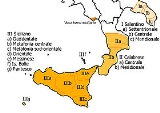
As a language, Sicilian has its own dialect
Dialect

A dialect is a variety of a language that is characteristic of a particular group of the language's speakers. The term is applied most often to regional speech patterns, but a dialect may also be defined by other factors, such as social class....
s, in the following main groupings (Gordon and Bonner 2001):
  • Western Sicilian (in Palermo
    Palermo

    Palermo is a historic city in southern Italy, the Capital of the autonomous region Sicily and the province of Palermo. The city is noted for its rich history, culture, architecture and gastronomy, playing an important role throughout much of its existence; it is over 2,700 years old....
    , Trapani
    Trapani

    Trapani is a city on the west coast of Sicily in Italy. It is the capital of the Province of Trapani. Founded by Elymians, the city is still an important fishing port and the main gateway to the nearby Egadi Islands....
    , Central-Western Agrigentino
    Agrigento

    Agrigento , is a city on the southern coast of Sicily, Italy, and capital of the province of Agrigento. It is renowned as the site of the ancient Greek city of Akragras , one of the leading cities of Magna Graecia during the golden age of Ancient Greece....
    )
  • Central Metafonetica (in the central part of Sicily that includes some areas of the Provinces of Caltanissetta
    Province of Caltanissetta

    The Province of Caltanissetta is a province in the southern part of Sicily, Italy. It contains 22 comuni , see Comuni of the Province of Caltanissetta....
    , Messina
    Province of Messina

    Messina is a Provinces of Italy in the autonomous island region of Sicily in Italy. Its capital is the city of Messina, Italy....
    , Enna
    Province of Enna

    Enna is a Provinces of Italy in the autonomous island region of Sicily in Italy. Its capital is the city of Enna.It has an area of 2,562 km?, and a total population of 177,200 ....
    , Palermo
    Province of Palermo

    The Province of Palermo is a Provinces of Italy in the autonomous region of Sicily, an island off the coast of Italy. Its capital is the city of Palermo....
     and Agrigento
    Province of Agrigento

    Agrigento is a Provinces of Italy in the autonomous island region of Sicily in Italy. Its capital is the city of Agrigento.It has an area of 3,042 km?, and a total population of 448,053 ....
    )
  • Southeast Metafonetica (in the Province of Ragusa
    Province of Ragusa

    The Province of Ragusa is a Provinces of Italy in the autonomous island region of Sicily in Italy. Ragusa is in the south-east of the island. Its capital is the city of Ragusa, Italy....
     and the adjoining area within the Province of Syracuse
    Province of Syracuse

    The Province of Syracuse is a Provinces of Italy in the autonomous island region of Sicily in Italy. Its capital is the city of Syracuse, Italy....
    )
  • Ennese (in the province of Enna
    Province of Enna

    Enna is a Provinces of Italy in the autonomous island region of Sicily in Italy. Its capital is the city of Enna.It has an area of 2,562 km?, and a total population of 177,200 ....
    )
  • Eastern Nonmetafonetica (in the area including the province of Catania
    Province of Catania

    Catania is a Provinces of Italy in the autonomous island region of Sicily in Italy. Its capital is the city of Catania.It has an area of 3,552 km?, and a total population of 1,073,881 ....
    , the second largest city in Sicily, and the adjoining area within the Province of Syracuse
    Province of Syracuse

    The Province of Syracuse is a Provinces of Italy in the autonomous island region of Sicily in Italy. Its capital is the city of Syracuse, Italy....
    )
  • Messinese (in the province of Messina
    Province of Messina

    Messina is a Provinces of Italy in the autonomous island region of Sicily in Italy. Its capital is the city of Messina, Italy....
    )
  • Isole Eolie (in the Aeolian Islands
    Aeolian Islands

    The Aeolian Islands are a volcanic archipelago in the Tyrrhenian Sea north of Sicily. The locals residing on the islands are known as Eolian. They are a popular tourist destination in the summer, and attract up to 200,000 visitors annually....
    )
  • Pantesco (on the island of Pantelleria
    Pantelleria

    Pantelleria , the ancient Cossyra, is an island in the Strait of Sicily in the Mediterranean Sea, 100 km southwest of Sicily and just 70 km east of the Tunisian coast....
    )
  • Southern and Central Calabrian (Calabrese) (in the southern and central sections of Calabria
    Calabria

    Calabria , is a Regions of Italy in Southern Italy Italy, south of Naples, located at the "toe" of the Italian peninsula. It is bounded to the north by the region of Basilicata, to the south-west by the region of Sicily, to the west by the Tyrrhenian Sea, and to the east by the Ionian Sea....
    , including the provinces of Reggio Calabria
    Province of Reggio Calabria

    The Province of Reggio Calabria is a Provinces of Italy in the Calabria region of Italy. Its capital is the city of Reggio Calabria.It has an area of 3,183 km?, and a total population of 565,866 ....
    , Vibo Valentia
    Province of Vibo Valentia

    The Province of Vibo Valentia is a Provinces of Italy in the Calabria region , recently set up by a national law 6 March 1992 and coming into effect 1 January 1996....
    , Catanzaro
    Province of Catanzaro

    The Province of Catanzaro is a Provinces of Italy of the Calabria region, in Italy. The city of Catanzaro is capital both of the province and of the region....
     and most of Crotone
    Province of Crotone

    The Province of Crotone is a Provinces of Italy in the Calabria region of Italy. It was created in 1996 out of part of the Province of Catanzaro....
    )
  • Southern Apulian (Pugliese) (also called Salentino
    Salentino

    The Salentino dialect is the traditional vernacular of the southern Italian province of Lecce, province of Brindisi and part of that of province of Taranto, known more commonly as the Salento, the extreme southern part of the region of Puglia or the southern "heel" of the Italian peninsula....
    , and reportedly a dialect of Sicilian on the peninsular section of Apulia
    Apulia

    Apulia is a region in southeastern Italy bordering the Adriatic Sea in the east, the Ionian Sea to the southeast, and the Strait of Otranto and Gulf of Taranto in the south....
    )
  • Cilentano (In the Geographical region of Cilento
    Cilento

    Cilento is an Italian geographical region of Campania in the central and southern part of the Province of Salerno and an important Tourism area of southern Italy....
     in Campania
    Campania

    Campania is a Regions of Italy of southern Italy in Europe. The region has a population of around 5.8 million people, making it the second-most-populous region of Italy, its total area of 13,595 km? makes it the most densely populated region in the country....
    )


Other observations

Sicilian is described as "vigorous" (in terms of not being in danger of extinction), although most Sicilians are described as being at least bilingual (being fluent in Italian as the official language of Italy). The strong French influence on Sicilian (elaborated below) raises the prospect that it may be better classified as a Southern Romance
Southern Romance languages

The Southern Romance languages are a sub-group of the family of Romance languages that includes Sardinian language, Corsican language, the Gallurese dialect, and the diasystems of Sassarese language....
 rather than Italo-Western
Italo-Western languages

Italo-Western is the largest sub-group of Romance languages. It comprises 38 languages in 2 subsets: Italo-Dalmatian, and Western Romance languages....
 language (Gordon).

Early influences

The fact that Sicily
Sicily

Sicily is an Autonomous regions with special statute of Italy. Of all the regions of Italy, Sicily covers the largest land area at 25,708 km? and currently has just over five million inhabitants....
 is the largest island in the middle of the Mediterranean and that virtually all the peoples of the Mediterranean (and beyond) have passed through it, be that as friend or foe, over the millennia, ensures that the Sicilian language is both rich and varied in its influences. The language has inherited vocabulary and/or grammatical forms from all of the following: Greek
Greek language

Greek is an Indo-European languages native to the southern Balkan peninsula, the language of the Greek people. It forms an independent branch within Indo-European....
, Latin
Latin

Latin is an Italic language, historically spoken in Latium and Ancient Rome. Through the Military history of the Roman Empire, Latin spread throughout the Mediterranean and a large part of Europe....
, Arabic
Arabic language

Arabic is a Central Semitic language, thus related to and classified alongside other Semitic languages languages such as Hebrew language and Aramaic language....
, Norman
Norman language

Norman is a Romance languages and one of the Langues d'o?l. The northern Norman can be classified in the septentrional O?l languages with Picard language and Walloon language....
, Lombard, Provençal
Provençal language

Proven?al is one of several dialects of Occitan spoken by a minority of people in southern France, mostly in Provence. In the English language-speaking world, "Proven?al" is often used to refer to all dialects of Occitan, but it actually refers specifically to the dialect spoken in Provence, as well as in the southern portion of the Dauphin?...
, German
German language

German is a West Germanic languages, thus related to and classified alongside English language and Dutch language. It is one of the world's world language and the most widely spoken mother tongue in the European Union....
, Catalan
Catalan language

Catalan is a Romance languages, the national language and official language of Andorra, and a official language in the Autonomous Communities of Spain of the Balearic Islands, Catalonia and Valencian Community and in the city of Alghero in the Italy List of islands in the Mediterranean of Sardinia....
, Spanish
Spanish language

Spanish or Castilian is a Romance languages that originated in northern Spain, and gradually spread in the Kingdom of Castile and evolved into the principal language of government and trade....
 and of course Italian
Italian language

Italian is a Romance languages spoken by about 63 million people as a first language, primarily in Italy. In Switzerland, Italian is one of four Linguistic geography of Switzerlands....
, not to mention prehistoric influences from the earliest settlers on the island. The very earliest influences, visible in Sicilian to this day, exhibit both prehistoric Mediterranean elements and prehistoric Indo-European
Indo-European languages

The Indo-European languages are a Language family of several hundred related languages and dialects, including most major languages of Europe, the Iranian plateau , Central Asia and the Indian subcontinent ....
 elements, and occasionally a cross-over of both (Giarizzo 1989 and Ruffino 2001).

Before the Roman conquest
Ancient Rome

Ancient Rome was a civilization that grew out of a small agricultural community founded on the Italian Peninsula as early as the 10th century BC....
, Sicily was occupied by remnants of the indigenous populations
Indigenous peoples

File:Kaiapos.jpegThe term indigenous peoples or autochthonous peoples can be used to describe any ethnic group of people who inhabit a geographic region with which they have the earliest known historical connection, alongside immigrants which have populated the region and which are greater in number....
 (the Sicani
Sicani

The Sicani or Sicanians were one of three Ancient Italic people of Sicily present at the time of Phoenician and Greek colonization....
, Elymi, Siculi, the third arriving between the second and first millennium BC), as well as by Phoenicians (from between the 10th and 8th centuries BC) and Greeks
Ancient Greece

The term Ancient Greece refers to the period of History of Greece lasting from the Greek Dark Ages ca. 1100 BC and the Dorian invasion, to 146 BC and the Roman Republic conquest of Greece after the Battle of Corinth ....
 (from the 8th century BC). The Greek language
Greek language

Greek is an Indo-European languages native to the southern Balkan peninsula, the language of the Greek people. It forms an independent branch within Indo-European....
 influence remains strongly visible, while the influences from the other groups are less obvious. What can be stated with certainty is that there remain pre-Indo-European words in Sicilian of an ancient Mediterranean origin, but one cannot be more precise than that. Of the three main prehistoric groups, only the Siculi were Indo-European, and their speech is likely to have been closely related to that of the Romans (Ruffino).

The following table illustrates the difficulty linguists face in tackling the various sub-strata of the Sicilian language. The examples are for the English word "twins" (Ruffino).
Stratum Word Source
Modern giamelli Italian
Italian language

Italian is a Romance languages spoken by about 63 million people as a first language, primarily in Italy. In Switzerland, Italian is one of four Linguistic geography of Switzerlands....
 
gemelli
Medieval bizzuni, vuzzuni Norman
Norman language

Norman is a Romance languages and one of the Langues d'o?l. The northern Norman can be classified in the septentrional O?l languages with Picard language and Walloon language....
 
besson
binelli Ligurian
Ligurian language

The Ligurian language was spoken in pre-Roman times and into the Roman era by an ancient people of north-western Italy and south-eastern France known as the Ligures....
 
beneli
Ancient èmmuli Latin
Classical Latin

Classical Latin is the form of the Latin used by the ancient Rome in what is usually regarded as "classical" Latin literature. Its use spanned the Golden Age of Latin literature—broadly the 1st century BC and the early 1st century AD—possibly extending to the Silver Age—broadly the 1st and 2nd centuries....
 
gemulus
cucchi Latin
Classical Latin

Classical Latin is the form of the Latin used by the ancient Rome in what is usually regarded as "classical" Latin literature. Its use spanned the Golden Age of Latin literature—broadly the 1st century BC and the early 1st century AD—possibly extending to the Silver Age—broadly the 1st and 2nd centuries....
 
copula
minzuddi Latin
Classical Latin

Classical Latin is the form of the Latin used by the ancient Rome in what is usually regarded as "classical" Latin literature. Its use spanned the Golden Age of Latin literature—broadly the 1st century BC and the early 1st century AD—possibly extending to the Silver Age—broadly the 1st and 2nd centuries....
 
medius
ièmiddi, ièddimi Greek didymos


A similar qualifier can be applied to many of the words that appear in this article. Sometimes we may know that a particular word has a prehistoric derivation, but we do not know whether the Sicilians have inherited it directly from the indigenous populations, or whether it has come to them via another route. Similarly, we might know that a particular word has a Greek
Greek language

Greek is an Indo-European languages native to the southern Balkan peninsula, the language of the Greek people. It forms an independent branch within Indo-European....
 origin, but we do not know from which Greek period the Sicilians first used it (pre-Roman occupation or during its Byzantine period
Byzantine Empire

Byzantine Empire and Eastern Roman Empire are conventional names used to describe the Roman Empire during the Middle Ages, centered on its capital of Constantinople....
), or once again, whether the particular word may even have come to Sicily via another route. For instance, by the time the Romans had occupied Sicily during the 3rd century BC, the Latin language had made its own borrowings from Greek (Ruffino).

Pre-classical period

The words with a prehistoric Mediterranean derivation often refer to plants native to the Mediterranean region or to other natural features. Bearing in mind the qualifiers mentioned above (alternative sources are provided where known), examples of such words include:
  • alastra (a thorny, prickly plant native to the Mediterranean region; but also Greek kelastron and may in fact have penetrated Sicilian via one of the Gallic
    Gaul

    Gaul is the name used for the region of Western Europe comprising part of present day northern Italy, France, Belgium, western Switzerland and the parts of the Netherlands and Germany on the west bank of the River Rhine....
     idioms), (Ruffino)
  • ammarrari (to dam or block a canal or running water; but also Spanish embarrar - to muddy), (Giarrizzo)
  • calancuni (ripples caused by a fast running river)
  • calanna (landslide of rocks)
  • racioppu (stalk or stem, e.g. of a fruit, ancient Mediterranean word rak), (Giarrizzo)
  • timpa (crag, cliff; but also Greek tymba, Latin tumba and Catalan timba) (Ruffino).


There are also Sicilian words with an ancient Indo-European origin that do not appear to have come to the language via any of the major language groups normally associated with Sicilian, i.e. they have been independently derived from a very early Indo-European source. The Siculi are a possible source of such words, but there is also the possibility of a cross-over between ancient Mediterranean words and introduced Indo-European forms. Some examples of Sicilian words with an ancient Indo-European origin:
  • dudda (mulberry; similar to Welsh
    Welsh language

    Welsh ]], is a member of the Brythonic branch of Celtic languages spoken natively in Wales, in England by some along the Welsh Marches and in the Welsh settlement in Argentina in the Chubut Valley in Argentina Patagonia....
     rhudd meaning the colour "pink"; Romanian
    Romanian language

    Romanian or Daco-Romanian ; self-designation: limba rom?na, ) is a Romance languages spoken by around 24 to 28 million people, primarily in Romania and Moldova....
     duda), (Giarrizzo)
  • scrozzu (not well developed; similar to Lithuanian
    Lithuanian language

    Lithuanian is the official state language of Lithuania and is recognised as one of the official languages of the European Union. There are about 2.96 million native Lithuanian speakers in Lithuania and about 170,000 abroad....
     su-skurdes with a similar meaning and Old High German
    Old High German

    The term Old High German refers to the earliest stage of the German language and it conventionally covers the period from around 500 to 1050. Coherent written texts do not appear until the second half of the 8th century, and some treat the period before 750 as 'prehistoric' and date the start of Old High German proper to 750 for this reason...
     scurz, meaning short), (Giarrizzo)
  • sfunnacata (multitude, vast number; from Indo-European und/fund meaning water), (Giarrizzo).


Greek influences

The following Sicilian words are of a Greek origin (including some examples where it is unclear whether the word is derived directly from Greek, or via Latin):
  • appizzari - to rot, go bad (as in fruit), ruin (from (eks) èpeson), (Giarrizzo)
  • babbiari - to fool around (from babazo, which also gives the sicilian words: babbazzu and babbu - stupid; but Latin babulus and Spanish babieca)
  • bucali - pitcher (from baukalion), (Giarrizzo)
  • bùmmulu - water receptacle (from bombylos; but Latin bombyla), (Ruffino)
  • cartedda - basket (from kartallos; but Latin cratellum), (Ruffino)
  • carusu - boy (from kouros; but Latin carus - dear, Sanskrit
    Sanskrit

    Sanskrit is a historical Indo-Aryan language, one of the liturgical languages of Hinduism and Buddhism, and one of the 22 official languages of India....
     
    caruh - amiable)
  • casèntaru - earthworm (from gas enteron), (Giarrizzo)
  • cirasa - cherry (from kerasos; but Latin cerasum), (Giarrizzo)
  • cona - icon, image, metaphor (from eikon; but Latin icona), (Ruffino)
  • cuddura - type of bread (from kollyra; but Latin collyra), (Ruffino)
  • grasta - flower pot (from gastra; but Latin gastra), (Ruffino)
  • naca - cradle (from nake), (Giarrizzo)
  • ntamari - to stun, amaze (from thambeo; but Calabrian (Calabrese) tammaru - stupid, comes from Arabic tammar date vendor), (Giarrizzo)
  • pistiari - to eat (from apestiein), (Giarrizzo)
  • tuppiàri - to knock (from typto), (Giarrizzo).


Vulgar Latin was spoken by the Roman occupation troops who garrisoned Sicily after Rome annexed the island (after the end of the First Punic War
First Punic War

The First Punic War was the first of Punic Wars fought between Carthage and the Roman Republic. For 23 years, the two powers struggled for supremacy in the western Mediterranean Sea....
, ca. 261 BC). A historical feature shared by Sicily, the far south of Calabria, and the province of Lecce
Lecce

Lecce is a historic city in southern Italy Italy, the Capital of the province of Lecce as well as the one of the most important cities of Apulia....
, is that during the Roman period, these areas were never completely Latinised. Greek remained the main language for the majority of the population. This helps explain the linguistic differences in these areas and those immediately to the north which were, more or less, Latinised (Hull). It is also why Sicilian is often referred to as a neo-Latin language – it did not descend directly from Latin (although some linguists disagree with that view, see below).

From 476 to 535 AD, the Ostrogothic kingdom ruled Sicily, although their presence did not impact the Sicilian language (Ruffino). The few Germanic
Germanic languages

The Germanic languages are a group of related languages that constitute a branch of the Indo-European languages language family. The common ancestor of all the languages in this branch is Proto-Germanic, spoken in approximately the mid-1st millennium BC in Pre-Roman Iron Age....
 influences to be found in Sicilian do not appear to originate from this period. One exception might be
abbanniari or vanniari (to hawk goods, proclaim publicly) from Gothic
Gothic language

Gothic is an extinct language Germanic language that was spoken by the Goths. It is known primarily from Codex Argenteus, a 6th century copy of a 4th century Bible translation, and is the only East Germanic languages with a sizable corpus....
 
bandujan - to give a signal. Also possible is schimmenti (diagonal) from Gothic slimbs (slanting). Other sources of Germanic influences include the Hohenstaufen rule of the 13th century, words of Nordic and Germanic origin contained within the speech of 11th century Norman
Normans

The Normans were the people who gave their names to Normandy, a region in northern France. They descended from Viking conquerors of the territory and the native population of mostly Frankish and Gallo-Roman stock....
 and Lombard
Lombards

The Lombards were a Germanic peoples originally from Northern Europe who settled in the valley of the Danube and from there invaded Byzantine Italian peninsula in 568 under the leadership of Alboin....
 settlers, and the short period of Austrian
Austrian Empire

The Austrian Empire was a periodization successor state empire founded on a remnant of the Holy Roman Empire centered on what is today's Austria that officially lasted from 1804 to 1867....
 rule in the 18th century.

Arab period

In 535 AD, Emperor Justinian I
Justinian I

Flavius Petrus Sabbatius Iustinianus , AD 482 or 483 ? 13 or 14 November 565, was the second member of the Justinian Dynasty and List of Roman Emperors from 527 until his death....
 made Sicily a Byzantine
Byzantine Empire

Byzantine Empire and Eastern Roman Empire are conventional names used to describe the Roman Empire during the Middle Ages, centered on its capital of Constantinople....
 province, and for the second time in Sicilian history, the Greek language
Greek language

Greek is an Indo-European languages native to the southern Balkan peninsula, the language of the Greek people. It forms an independent branch within Indo-European....
 became a familiar sound across the island (Hull, 1989). As the power of the Byzantine Empire waned, Sicily was progressively conquered
Emirate of Sicily

The Emirate of Sicily was an Caliphate on the island of Sicily from 965 to 1072....
 by Saracen
Saracen

Saracen was a term used by Europeans in the Middle Ages for Fatimids at first, then later for all who professed the religion of Islam....
s from North Africa
North Africa

North Africa or Northern Africa is the northernmost region of the African continent, separated by the Sahara from Sub-Saharan Africa.Geopolitically, the United Nations subregion of Northern Africa includes the following seven countries or territories:...
, from the mid 9th to mid 10th centuries. The Arabic language
Arabic language

Arabic is a Central Semitic language, thus related to and classified alongside other Semitic languages languages such as Hebrew language and Aramaic language....
 influence is noticeable in around 300 Sicilian words, most of which relate to agriculture and related activities (Hull and Ruffino). This is understandable since the Saracens introduced to Sicily the most then-modern irrigation and farming techniques and a new range of crops
Muslim Agricultural Revolution

The Islamic Golden Age from the 8th century to the 13th century witnessed a fundamental transformation in agriculture known as the Arab Agricultural Revolution, Medieval Green Revolution, or Muslim Agricultural Revolution....
 – nearly all of which remain endemic to the island to this day.

Some words of Arabic origin
Influence of Arabic on other languages

Arabic language has had a great influence on other languages, especially in vocabulary. The influence of Arabic has been most profound in those countries dominated by Islam or Islamic power....
:

  • azzizzari - to embellish (from aziz; precious, beautiful), (Giarrizzo)
  • babbaluciu - snail (from babus; but Greek boubalàkion), (Giarrizzo)
  • burnia - jar (from burniya; but Latin hirnea), (Giarrizzo)
  • cafisu - measure for liquids (from qafiz), (Giarrizzo)
  • cassata
    Cassata

    Cassata or Cassata siciliana is a traditional sweet from the area of Palermo, Sicily . Cassata may also refer to a Neapolitan ice cream containing candied or dried fruit and nuts....
    - sicilian cake (from qashatah; but Latin caseata - something made from cheese), (Giarrizzo)
  • gèbbia - artificial pond to store water for irrigation (from gabiya), (Giarrizzo)
  • giuggiulena - sesame seed (from giulgiulan), (Giarrizzo)
  • mafia
    Mafia

    The Mafia is a Sicily criminal society which is believed to have emerged in late 19th century Sicily. It is a loose association of criminal groups that share a common organizational structure and code of conduct....
    - swagger or boldness/bravado (from mahyas "aggressive boasting, bragging", or from marfud "rejected")
  • ràisi - leader (from rais), (Giarrizzo)
  • saia - canal (from saqiya), (Giarrizzo)
  • zaffarana - saffron, type of plant whose flowers are used for medicinal purposes and in Sicilian cooking (from safara)
  • zagara - blossom (from zahar)
  • zibbibbu - type of grape (from zabib), (Giarrizzo)
  • zuccu - tree trunk (from suq; but Aragonese
    Aragonese language

    Aragonese , is a Romance languages now spoken in a number of local varieties by between 10,000 and 30,000 people over the valleys of the Arag?n River, Sobrarbe and Ribagorza in Aragon....
     
    soccu and Spanish zoque), (Giarrizzo).


Throughout the Arab epoch of Sicilian history, a large Greek-speaking population remained on the island and continued to use the Greek language, or most certainly a variant of Greek heavily influenced by Arabic (Hull). What is less clear is the extent to which a Latin-speaking population survived on the island. While a form of Vulgar Latin clearly survived in isolated communities during the Arab epoch, there is much debate as to the influence it had (if any) on the development of the Sicilian language, following the re-Latinisation of Sicily (discussed in the next section). There are few Sicilian words reflecting an archaic Latin form (as may be found, for example, in Sardinian
Sardinian

Sardinian can refer to:* Sardinia* Sardinian language* Sardinian ...
), so the influence may have been minor (Hull). However, some forms do exist, so the tantalising prospect of a Sicilian form of a Vulgar Latin surviving the Arab period and influencing the modern development of Sicilian remains open (as already mentioned, Privitera puts forward the radical proposition that medieval Sicilian descends directly from a form of Vulgar Latin that survived throughout the Byzantine and Arab periods).

These are some words of Latin origin that may have survived the Arab epoch:
  • antura - a while ago (from ante oram - an hour ago), (Giarrizzo)
  • asciari - to find (from afflare, cf. Portuguese
    Portuguese language

    Portuguese is a Romance language that originated in what is now Galicia and Portugal. It is derived from the Latin language spoken by the Romanization Pre-Roman peoples of the Iberian Peninsula around 2000 years ago....
     "achar", to find), (Giarrizzo)
  • bìfara - to fruit twice yearly, Large-green fig (from bifera), (Giarrizzo)
  • filìnia - spider's web (from filum, line, strand), (Giarrizzo)
  • oggiallanu or ovannu - last year (from hodie est annus).


Linguistic development from the middle ages

By 1000 AD the whole of what is today southern Italy, including Sicily, was a complex mix of small state
State

A state is a political Social contract with effective sovereignty over a geographic area and representing a population. These may be nation states, State or multinational states....
s and principalities
Principality

A principality is a monarchy feudatory or sovereign state, ruled or reigned over by a monarch with the title of prince or princess, or a monarch with another title within the generic use of the term prince....
, languages and religions (Hull). The whole of Sicily was controlled by Muslim Saracens, although there remained a large Greek speaking and Christian population. The far south of the Italian peninsula was part of the Byzantine empire and predominantly Greek speaking, although many communities were reasonably independent of Constantinople
Constantinople

Constantinople was the empire capital of the Roman Empire , the Byzantine Empire , the Latin Empire , and the Ottoman Empire . Strategically located between the Golden Horn and the Sea of Marmara at the point where Europe meets Asia, Byzantine Constantinople had been the capital of a Christendom empire, successor to ancient ancient Greece...
. The principality of Salerno was controlled by Lombards (or Langobards) who had also started to make some incursions into Byzantine territory and had managed to establish some isolated independent city-state
City-state

A city-state is an independent country whose territory consists solely of a single major city and the area immediately surrounding it. Examples include the city-states of ancient Greece , the Phoenician cities of Canaan , the Sumerian cities of Mesopotamia , the Mayans of pre-Columbian Mesoamerica , the central Asian cities along the Silk Roa...
s (Norwich 1992). It was into this mix that the Normans thrust themselves in ever increasing numbers during the first half of the 11th century.

Norman French influence

When the two most famous of southern Italy's Norman adventurers, Roger of Hauteville
Roger I of Sicily

Roger I , called Bosso and the Great Count, was the Italo-Normans Count of Sicily from 1071 to 1101. He was the last great leader of the Norman conquest of southern Italy....
 and his brother, Robert Guiscard
Robert Guiscard

Robert Guiscard, from Latin Viscardus and Old French Viscart, often rendered the Resourceful, the Cunning, the Wily, or the Fox, was a Normans adventurer conspicuous in the Norman conquest of southern Italy....
, began their conquest of Sicily in 1061, they already controlled the far south of Italy (Apulia
Apulia

Apulia is a region in southeastern Italy bordering the Adriatic Sea in the east, the Ionian Sea to the southeast, and the Strait of Otranto and Gulf of Taranto in the south....
 and Calabria
Calabria

Calabria , is a Regions of Italy in Southern Italy Italy, south of Naples, located at the "toe" of the Italian peninsula. It is bounded to the north by the region of Basilicata, to the south-west by the region of Sicily, to the west by the Tyrrhenian Sea, and to the east by the Ionian Sea....
). It took Roger 30 years to complete the conquest of Sicily (Robert died in 1085), (Norwich). In the process, the re-Latinisation and re-Christian
Christianity

Christianity is a Monotheistic religion #Christian view religion centered on the life and teachings of Jesus as New Testament view on Jesus' life....
isation of Sicily had begun. A long list of Norman
Norman language

Norman is a Romance languages and one of the Langues d'o?l. The northern Norman can be classified in the septentrional O?l languages with Picard language and Walloon language....
 words were to become absorbed by the new language during this period, for example:
  • accattari - to buy (from Norman
    Norman language

    Norman is a Romance languages and one of the Langues d'o?l. The northern Norman can be classified in the septentrional O?l languages with Picard language and Walloon language....
     
    acater, Modern French
    French language

    French is a Romance language spoken around the world by around 80 million people as first language, by 190 million as second language, and by about another 200 million people as an acquired tongue, with significant speakers in 54 countries....
     
    acheter), (Ruffino)
  • ammuntuari/ammuntuvari – to mention, nominate (from Norman mentevoir), (Giarrizzo)
  • bucceri (vucceri) - butcher (from bouchier), (Hull)
  • custureri - tailor (from coustrier; Modern French
    French language

    French is a Romance language spoken around the world by around 80 million people as first language, by 190 million as second language, and by about another 200 million people as an acquired tongue, with significant speakers in 54 countries....
     
    couturier), (Hull)
  • firranti - grey (from ferrant), (Giarrizzo)
  • foddi - mad (from fol; Modern French
    French language

    French is a Romance language spoken around the world by around 80 million people as first language, by 190 million as second language, and by about another 200 million people as an acquired tongue, with significant speakers in 54 countries....
     
    fou/fol/folle), (Hull)
  • giugnettu - July (from juignet; Modern French
    French language

    French is a Romance language spoken around the world by around 80 million people as first language, by 190 million as second language, and by about another 200 million people as an acquired tongue, with significant speakers in 54 countries....
     
    juillet), (Hull)
  • ladiu or laiu - ugly (from laid), (Hull)
  • largasìa - generosity (from largesse), (Giarrizzo)
  • puseri - thumb (from poucier), (Hull)
  • racina - grape (from raisin), (Hull)
  • raggia – anger (from rage), (Giarrizzo)
  • testa - head (from teste), (Hull)
  • trippari - to hop, skip (from Norman triper), (Giarrizzo).


The following factors that emerged during or immediately after the conquest were to prove critical in the formation of the Sicilian language:
  • The Normans brought with them not only their own Norman-speaking kin (more than likely in quite small numbers), but mercenaries from mainland Italy. In particular, these included Lombards (with their Gallo-Italic idiom, Lombardic
    Lombardic language

    Lombardic or Langobardic is the extinct language of the Lombards , the Germanic languages speaking settlers in Italy in the 6th century. The language declined from the 7th century, but may have been in scattered use until as late as ca....
    , ancestral to the modern Lombard language) and other Italians from around Campania
    Campania

    Campania is a Regions of Italy of southern Italy in Europe. The region has a population of around 5.8 million people, making it the second-most-populous region of Italy, its total area of 13,595 km? makes it the most densely populated region in the country....
    . The latter would bring with them the Vulgar Latin
    Vulgar Latin

    Vulgar Latin is a blanket term covering the popular dialects and sociolects of the Latin which diverged from each other in the early Middle Ages, evolving into the Romance languages by the 9th century....
     from that region, an idiom not too different from that to be found in central Italy
    Italy

    Italy , officially the Italian Republic , is a country located on the Italian Peninsula in Southern Europe and on the two largest islands in the Mediterranean Sea, Sicily and Sardinia....
     at the time (Hull).
  • The thirty-year-long war of conquest and the encouragement given to re-establishing Christianity resulted in the depopulation of Saracens in most parts of Sicily, many of whom escaped to North Africa (Hull, 1989 and Norwich).
  • Further migrations to settle the depopulated areas were encouraged from the mainland by Roger, in particular, Italian settlers from areas controlled by the Roman Catholic Church. The western parts of Sicily were colonised by migrants from Campania, and the central-eastern parts by settlers from the western Padan Plain (a.k.a. Po River
    Po River

    The Po is a river that flows 652 km eastward across northern Italy, from Monviso to the Adriatic Sea near Venice. It has a drainage area of 71,000 km? and is the longest river in Italy....
     Valley) in northern Italy who also brought with them a Gallo-Italic idiom. After the death of Roger I, and under the regency of Adelaide del Vasto
    Adelaide del Vasto

    Adelaide del Vasto was the third wife of Roger I of Sicily and mother of Roger II of Sicily, as well as Queen consort of Kingdom of Jerusalem due to her later marriage to Baldwin I of Jerusalem, as his third wife....
     during the minority of her son, Roger II
    Roger II of Sicily

    Roger II was King of Sicily, son of Roger I of Sicily and successor to his brother Simon, Count of Sicily. He began his rule as Count of Sicily in 1105, later became Duke of Apulia , then King of Sicily ....
     (herself from northern Italy), this process of Lombardic colonisation was intensified (Hull and Norwich).


We can see above the main factors that go into framing the Sicilian language as we know it today. The Vulgar Latin base (predominantly from Campania) was similar to the Vulgar Latin in central Italy (and therefore, by implication, reasonably similar to the Vulgar Latin in Tuscany that would eventually form the base for the national language). This base from Campania was influenced by the many Gallic influences present in Sicily at the time, namely Norman, French and Langobardic. Underneath that were remnants of the Arabic and Greek idioms that the new language eventually replaced, but hundreds of words remained in the vocabulary of the changing Romance language.

Other Gallic influences

The Lombard influence is of particular interest. Even to the present day, a Gallo-siculo
Gallo-siculo

The Gallo-Sicilian dialects represent a group of dialects found in central-eastern Sicily that date back to migrations from Northern Italy during the time of Roger I of Sicily and which continued after his death under his successor Roger II of Sicily ....
 dialect exists in the areas where the Lombard colonies were the strongest, namely Novara
Novara di Sicilia

Novara di Sicilia is a comune in the Province of Messina in the Italy region Sicily, located about 160 km east of Palermo and about 40 km southwest of Messina....
, Nicosia, Sperlinga
Sperlinga

Sperlinga is a comune in the province of Enna, in region of Sicily in southern Italy....
, Aidone
Aidone

Aidone is a town in the province of Enna, in region of Sicily in southern Italy....
 and Piazza Armerina
Piazza Armerina

Piazza Armerina is an comune in the province of Enna of the autonomous island region of Sicily....
 (Hull). The Siculo-Gallic dialect did not survive in other major Lombard colonies, such as Randazzo
Randazzo

Randazzo is a town of Sicily, Italy, in the province of Catania. It is situated at the Northern foot of Mount Etna, 70 km NW of Catania by rail....
, Bronte
Brontë

The Bront? sisters , Charlotte Bront? , Emily Bront? and Anne Bront? , were English writers of the 1840s and 1850s. Their novels caused a sensation when they were first published and were subsequently accepted into the canon of great English literature....
 and Paternò
Paternò

Patern? is a town in the Province of Catania, Sicily, southern Italy....
 (although they did influence the local Sicilian vernacular). The Gallo-Italic influence was also felt on the Sicilian language itself, as follows (Hull):
  • sòggiru - father-in-law (from suoxer)
  • cugnatu - brother-in-law (from cognau)
  • figghiozzu - godson (from figlioz)
  • orbu and orvu - blind (from orb)
  • arricintari - to rinse (from rexentar)
  • unni - where (from ond)
  • the names of the days of the week:
    • luni - Monday (from lunes)
    • marti - Tuesday (from martes)
    • mèrcuri - Wednesday (from mèrcor)
    • jovi - Thursday (from juovia)
    • vènniri - Friday (from vènner)


The origins of another Gallic influence, that of Old Provençal
Provençal

Proven?al may refer to*Proven?al, meaning "of Provence", a region of France*The Proven?al of the Occitan language, spoken in the south of France...
, had three possible sources.
  1. As mentioned above, the number of actual Normans in Sicily are unlikely to have ever numbered much higher than 5,000 at any time. Their numbers were boosted by mercenaries from southern Italy, but it is also possible that mercenaries came from as far away as southern France. The Normans made San Fratello
    San Fratello

    For the San Fratello , see here.San Fratello , formerly San Filadelfo, is a comune in the Province of Messina in the Italy region Sicily, located about 110 km east of Palermo and about 90 km west of Messina....
     a garrison town in the early years of the occupation of the north-eastern corner of Sicily. To this day (in ever decreasing numbers) a Siculo-Gallic dialect is spoken in San Fratello that is clearly influenced by Old Provençal, leading one to the conclusion that a significant number in the garrison came from that part of France (Privitera 2001). This may well explain the dialect spoken only in San Fratello, but it does not wholly explain the diffusion of many Provençal
    Provençal language

    Proven?al is one of several dialects of Occitan spoken by a minority of people in southern France, mostly in Provence. In the English language-speaking world, "Proven?al" is often used to refer to all dialects of Occitan, but it actually refers specifically to the dialect spoken in Provence, as well as in the southern portion of the Dauphin?...
     words into the Sicilian language. On that point we are confronted with a further two possibilities.
  2. Some Provençal words may have entered the language during the regency of Margaret of Navarre between 1166 and 1171 when her son, William II of Sicily
    William II of Sicily

    William II , called the Good, was Kingdom of Sicily from 1166 to 1189.William was only eleven years old at the death of his father William I of Sicily, when he was placed under the regency of his mother, Margaret of Navarre....
    , succeeded to the throne at the age of 12. The Queen's closest advisers, entourage and administrators were from the south of France (Norwich), and many Provençal words entered the language during this period.
  3. The Sicilian School
    Sicilian School

    The Sicilian School was a small community of Sicily, and to a lesser extent, mainland Italian poets gathered around Frederick II, Holy Roman Emperor, most of them belonging to his court, the Magna Curia....
     of poetry
    (discussed below) was strongly influenced by the Provençal of the troubadour
    Troubadour

    A troubadour was a composer and performer of Occitan lyric poetry during the High Middle Ages .The troubadour school or tradition began in the eleventh century in Occitania, but it subsequently spread into Italy, Spain, and even Greece....
     tradition (Cipolla 2004 p. 141). This element is deeply embedded in Sicilian culture, for example, the tradition of Sicilian puppetry (
    opira dî puppi) and the tradition of the cantastorii (literally sing stories). There is no doubt that Provençal troubadours were active during the reign of Frederick II, Holy Roman Emperor
    Frederick II, Holy Roman Emperor

    Frederick II , of the House of Hohenstaufen dynasty, was an Kingdom of Italy pretender to the title of King of the Romans from 1212 and unopposed holder of that monarchy from 1215....
    , and that some Provençal words would have passed into the Sicilian language via this route.


Some examples of Sicilian words derived from Provençal:
  • addumari - to light (from allumar); but also "to turn sthg. on"
  • aggrifari - to kidnap, abduct (from grifar), (Giarrizzo)
  • banna – side, place (from banda), (Giarrizzo)
  • burgisi - landowners, citizens (from borges)
  • lascu - sparse, thin, infrequent (from lasc), (Giarrizzo)
  • lavanca and allavanca - precipice (from lavanca), (Giarrizzo)
  • paraggiu - equal (from paratge), (Giarrizzo)


Sicilian School of Poetry

It was during the reign of Frederick II
Frederick II, Holy Roman Emperor

Frederick II , of the House of Hohenstaufen dynasty, was an Kingdom of Italy pretender to the title of King of the Romans from 1212 and unopposed holder of that monarchy from 1215....
 (or Frederick I of Sicily) between 1198 and 1250, with his patronage of the Sicilian School
Sicilian School

The Sicilian School was a small community of Sicily, and to a lesser extent, mainland Italian poets gathered around Frederick II, Holy Roman Emperor, most of them belonging to his court, the Magna Curia....
 of poetry, that Sicilian became the first of the Italic idioms to be used as a literary language
Literary language

A literary language is a register of a language that is used in literary writing. This may also include Sacred language. The difference between literary and non-literary forms is more marked in some languages than in others....
 (Cipolla 2004 p. 141). The influence of the school, and the use of Sicilian itself as a poetic language, was acknowledged by the two great Tuscan writers of the early Renaissance period Dante
DANTE

DANTE is a not-for-profit organisation that plans, builds and operates the international networks that interconnect the various National Research and Education Networks in Europe and surrounding regions....
 and Petrarch
Petrarch

Francesco Petrarca , known in English language as Petrarch, was an Italy scholar, poet and one of the earliest Renaissance humanism. Petrarch is often popularly called the "Father of Humanism"....
. The influence of the Sicilian language cannot be understated in the eventual formulation of a lingua franca
Lingua franca

A lingua franca is a language systematically used to communicate between persons not sharing a mother tongue, in particular when it is a third language, distinct from both persons' mother tongues....
 that was to become modern Italian
Italian language

Italian is a Romance languages spoken by about 63 million people as a first language, primarily in Italy. In Switzerland, Italian is one of four Linguistic geography of Switzerlands....
. The victory of the Angevin
Angevin

Angevin is the name applied to the residents of Anjou, a former province of the Ancien R?gime in France, as well as to the residents of Angers....
 army over the Sicilians at Benevento
Benevento

Benevento is a town and comune of Campania, Italy, capital of the province of Benevento, 50 km northeast of Naples. It is situated on a hill 130 m above sea-level at the confluence of the Calore Irpino and Sabato....
 in 1266 not only marked the end of the 136-year Norman-Swabian reign in Sicily, it effectively ensured that the centre of literary influence would eventually move from Sicily to Tuscany (Cipolla 2004 p. 141). While Sicilian, as both an official and literary language would continue to exist for another two centuries, the language would soon follow the fortunes of the kingdom itself in terms of prestige and influence.

As a side note, there are some Germanic influences in the Sicilian language, and many of these date back to the time of the Swabian kings (amongst whom Frederick II, Holy Roman Emperor
Frederick II, Holy Roman Emperor

Frederick II , of the House of Hohenstaufen dynasty, was an Kingdom of Italy pretender to the title of King of the Romans from 1212 and unopposed holder of that monarchy from 1215....
 enjoyed the longest reign). Words that probably originate from this era include:
  • arbitriari - to work in the fields (from arbeit), (Giarrizzo)
  • vardari - to watch over (from wartên), (Giarrizzo)
  • guastari or vastari - to waste, use up (from wastjan)
  • guddefi - forest, woods (from wald, note resemblance to Anglo-Saxon
    Old English language

    Old English is an early form of the English language that was spoken and written in parts of what are now England and south-eastern Scotland between the mid-5th century and the mid-12th century....
     wudu), (Giarrizzo)
  • guzzuniari - to wag, as in a tail (from hutsen), (Giarrizzo)
  • lancedda - terracotta jug for holding water (from Old High German lagella), (Giarrizzo)
  • salaguni - willow (from Old High German salaha)
  • sparagnari - to save money (from Old High German sparen), (Giarrizzo).


Catalan influence

Following the Sicilian Vespers
Sicilian Vespers

The Sicilian Vespers is the name given to a rebellion in Sicily in 1282 against the rule of the Angevin king Charles I of Naples, who had taken control of the island with Papacy support in 1266....
 of 1282, the kingdom was to come under the influence of the Kingdom of Aragon
Kingdom of Aragon

The Kingdom of Aragon was an old Monarchy in the Iberian Peninsula, corresponding to the modern-day Autonomous communities of Spain of Aragon , in Spain....
 (Runciman 1958), and as a result, the Catalan language
Catalan language

Catalan is a Romance languages, the national language and official language of Andorra, and a official language in the Autonomous Communities of Spain of the Balearic Islands, Catalonia and Valencian Community and in the city of Alghero in the Italy List of islands in the Mediterranean of Sardinia....
 (and the closely related Aragonese
Aragonese language

Aragonese , is a Romance languages now spoken in a number of local varieties by between 10,000 and 30,000 people over the valleys of the Arag?n River, Sobrarbe and Ribagorza in Aragon....
) would add a new layer of vocabulary in the succeeding century. For the whole of the 14th century, both Catalan and Sicilian were the official languages of the royal court (Hughes 1993). Sicilian was also used to record the proceedings of the parliament
Parliament

A parliament is a legislature, especially in those countries whose system of government is based on the Westminster system modeled after that of the United Kingdom....
 of Sicily (one of the oldest parliaments in Europe) and for other official purposes (Cipolla 2004, p. 155). While it is often difficult to determine whether a word has come to us directly from Catalan (as opposed to Provençal or Spanish), the following are likely to be such examples:
  • accabbari - to finish, end (from acabar)
  • addunarisi - to notice, realise (from adonar-se), (Giarrizzo)
  • affruntarisi - to be embarrassed (from afrontar-se), (Giarrizzo)
  • ammucciari - to hide (from amagar)
  • arruciari – to moisten, soak (from arruixar), (Giarrizzo)
  • criscimogna - growth, development (from creiximoni), (Giarrizzo)
  • muccaturi - handkerchief (from mocador)
  • nzirtari - to guess (from encertar)
  • priàrisi - to be pleased (from prear-se), (Giarrizzo)
  • taliàri - to look at somebody/something. (from talaiar; but Arab tali'a).


Spanish period to the modern age

By the time the Aragonian crown was joined with the Spanish realm
Spain

Spain or the Kingdom of Spain , is a country located in Southern Europe on the Iberian Peninsula.The Spanish constitution does not establish any official denomination of the country, even though Espa?a , Estado espa?ol and Naci?n espa?ola are used interchangeably....
 in the late 15th century, the Italianisation of written Sicilian in the parliamentary and court records had commenced. By 1543 this process was virtually complete, with the Tuscan dialect
Tuscan dialect

The Tuscan dialect or the Tuscan language is an Italian dialects spoken in Tuscany, Italy. In many respects it wandered less than other Romance dialects from the Latin language and evolved linearly and homogeneously, without major influences from other foreign languages....
 of Italian becoming the lingua franca of the Italian peninsula and supplanting written Sicilian (Cipolla 2004 p. 155).

Spanish rule had hastened this process in two important ways:
  • Unlike the Aragonians, almost immediately the Spanish placed viceroy
    Viceroy

    A viceroy is a royal official who governs a country or province in the name of and as representative of the monarch. The term derives from the Latin prefix vice-, meaning "in the place of" and the French word roi, meaning king....
    s on the Sicilian throne. In a sense, the diminishing prestige of the Sicilian kingdom reflected the decline of Sicilian from an official, written language to eventually a spoken language amongst predominantly illiterates.
  • The expulsion of all Jews from Spanish dominions ca. 1492 altered the population of Sicily. Not only did the population decline, many of whom were involved in important industries, but some of these Jewish families had been in Sicily for around 1,500 years, and Sicilian was their mother tongue which they used in their schools. Thus the seeds of a possible broad-based education system utilising books written in Sicilian was lost.


Spanish rule lasted over three centuries (not counting the Aragonian and Bourbon
House of Bourbon

The House of Bourbon is an important European royal house, a branch of the Capetian dynasty. Bourbon kings first ruled Kingdom of Navarre and France in the 16th century....
 periods on either side) and had a significant influence on the Sicilian vocabulary. The following words are of Spanish derivation:
  • arricugghirisi - to return home; (from arrecogerse; but Catalan recollir-se)
  • balanza – scales (from balanza), (Giarrizzo)
  • fileccia - arrow (from flecha), (Giarrizzo)
  • làstima – lament, annoyance (from lástima), (Giarrizzo)
  • pignata – pan (from pinada)
  • pinzèddu – brush (from pincel), (Giarrizzo)
  • ricivu – receipt (from recibo), (Giarrizzo)
  • spagnari - to be frightened ( cross over of Sic. appagnari with Sp. espantarse), (Giarrizzo)
  • spatari - to impede or disarm someone of his sword (from espadar), (Giarrizzo)
  • sulità or sulitati – solitude (from soledad), (Giarrizzo).


Since the Italian Unification
Italian unification

Italian Unification was the political and social movement that annexed different states of the Italian peninsula into the single state of Italy in the 19th century....
 (the Risorgimento of 1860–1861), the Sicilian language has been significantly influenced by (Tuscan) Italian. This process has quickened since World War II
World War II

World War II, or the Second World War , was a global military conflict which involved a Participants in World War II, including all of the great powers, organised into two opposing military alliances: the Allies of World War II and the Axis powers....
 due to improving educational standards and the impact of mass media, such that increasingly, even within the family home, Sicilian is not necessarily the language of choice. The Sicilian Regional Parliament recently voted to make the teaching of Sicilian a part of the school curriculum at primary school level, but as of 2007 only a fraction of schools teach Sicilian. There is also little in the way of mass media offered in Sicilian. The combination of these factors means that the Sicilian language continues to adopt Italian vocabulary and grammatical forms to such an extent that many Sicilians themselves cannot distinguish between correct and incorrect Sicilian language usage.

Distinguishing features of Sicilian


Unique sounds

Sicilian has a number of consonant sounds which, if not unique to Sicilian, certainly set it apart from the other major Romance languages. The most unusual sounds include, but are not limited to, the retroflex consonant
Retroflex consonant

In phonetics, retroflex consonants are consonant sounds used in some languages. The tongue is placed behind the alveolar ridge, and may even be curled back to touch the palate: that is, they are articulated in the postalveolar consonant to palatal consonant region of the mouth....
s or cacuminals (Cipolla 2005).

  • DD — The -ll- sound (in words of Latin origin, for example) manifests itself in Sicilian as a voiced retroflex plosive
    Voiced retroflex plosive

    The voiced retroflex plosive is a type of consonantal sound, used in some Speech communication languages. The symbol in the International Phonetic Alphabet that represents this sound is , and the equivalent X-SAMPA symbol is d`....
     with the tip of the tongue curled up and back, a sound which is not part of standard (Tuscan) Italian. In standard literary Sicilian, this sound is written simply as -dd- (but can also be found written ??, ddh or ddr). The sound itself is not but rather (in IPA
    International Phonetic Alphabet

    The International Phonetic Alphabet "The acronym 'IPA' strictly refers [...] to the 'International Phonetic Association'. But it is now such a common practice to use the acronym also to refer to the alphabet itself that resistance seems pedantic....
     notation). For example, the Italian word bello is beddu in Sicilian. For comparison, this sound is somewhat like the 'r' sound in Japanese
    Japanese language

    IPA: [n?iho?go] is a language spoken by over 130 million people in Japan and in Japanese emigrant communities. It is related to the Ryukyuan languages....
    .


  • DR, TR — Similarly, Sicilian has a unique pronunciation of the digraphs
    Digraph (orthography)

    A digraph, bigraph , or digram is a pair of characters used to write one phoneme or a sequence of phonemes that does not correspond to the normal values of the two characters combined....
     -tr- and -dr- not common to Italian. The sound of -tr- is exactly like that heard in English tree and the sound of -dr- exactly like the digraph heard in English dragon.


  • RR — The Sicilian consonant cluster
    Consonant cluster

    In linguistics, a consonant cluster is a group of consonants which have no intervening vowel. In English, for example, the groups and are consonant clusters in the word splits....
     -rr- also differs from Italian in that it is a voiced postalveolar fricative
    Voiced postalveolar fricative

    The voiced palato-alveolar fricative or domed postalveolar fricative is a type of consonantal sound, used in some Speech communication languages....
     ( according to IPA
    International Phonetic Alphabet

    The International Phonetic Alphabet "The acronym 'IPA' strictly refers [...] to the 'International Phonetic Association'. But it is now such a common practice to use the acronym also to refer to the alphabet itself that resistance seems pedantic....
     notation). At the beginning of a word, the single letter -r- is similarly always pronounced double, though this is not indicated orthographically. Therefore, the -rr- sound heard in the words riccu and terra is similar to the 'sh' sound in English vision or the 'j' sound in French jour. This phenomenon, however, does not include words that include an 'r' resulting from rhotacism
    Rhotacism

    Rhotacism may refer to several phenomena related to the usage of the consonant r .*the excessive or idiosyncratic use of the r;*conversely, the inability or difficulty in pronouncing r....
     (renti from denti) or assimilation
    Assimilation (linguistics)

    Assimilation is a common phonological process by which the phonetics of a speech segment becomes more like that of another segment in a word . A common example of assimilation would be "don't be silly" where the and in "don't" become and , where said naturally in many accents and discourse styles ....
     (ranni from granni).


  • STR — The trigraph
    Trigraph

    A trigraph is a group of three symbols, most commonly letters.Trigraph can mean:...
     -str- in Sicilian is quite different from the Italian form of the trigraph. The t is not pronounced at all and there is a faint whistle
    Whistled language

    Whistled languages use whistling to emulate speech and facilitate communication. A whistled language is a system of whistled communication which allows fluent whistlers to transmit and comprehend a potentially unlimited number of messages over long distances....
     between the s and the r, the latter not being trilled
    Trill consonant

    In phonetics, a trill is a consonantal sound produced by vibrations between the articulator and the place of articulation. Standard Spanish <rr > as in perro is an alveolar trill, while in Parisian French it is almost always uvular trill....
     as would be the case in Italian (Cipolla 2005). An example of this trigraph is the shr sound heard in English shred.


  • Latin FL — The other unique Sicilian sound is found in those words that have been derived from Latin words containing -fl-. This has generally become fi in Italian, for example, fiume from Latin flumen (river). In standard literary Sicilian, the sound is rendered as ci (representing the voiceless palatal fricative
    Voiceless palatal fricative

    The voiceless palatal fricative is a type of consonantal sound, used in some Speech communication languages. The symbol in the International Phonetic Alphabet that represents this sound is , and the equivalent X-SAMPA symbol is C....
     ), e.g. ciumi or , (but can also be found in written form as hi, sci, x or çi). The sound approximates to an allophone
    Allophone

    In phonetics, an allophone is one of several similar speech sounds that belong to the same phoneme. A phoneme is an abstract unit of speech sound that can distinguish words: That is, changing a phoneme in a word can produce another word....
     of English language
    English language

    English is a West Germanic language that originated in Anglo-Saxon England and has lingua franca status in many parts of the world as a result of the military, economic, scientific, political and cultural influence of the British Empire in the 18th, 19th and early 20th centuries and that of the United States from the mid 20th century onwa...
      before as in words like huge, but slightly more fricative (Cipolla 2005).


  • Sicilian Vowel System — One obvious difference from Italian is what linguists describe as the Sicilian Vowel System
    Sicilian Vowel System

    The Sicilian Vowel System refers to the system of vowels in the Sicilian language. It is characteristic of the dialects of Sicily, Southern Calabria, and Salento....
    . Unlike the seven vowels shared by Latin, Italian and many other Romance languages, the Sicilian Vowel System only includes five (a, è, i, ò, u). This results in the unstressed vowel o of Latin becoming an unstressed u in Sicilian (Hull). This causes the vowel u to have a far greater presence than the vowel o in Sicilian, while the opposite is true of other Romance languages such as Spanish and Italian (notwithstanding the conservative nature of Sicilian which retains the vowel u of the Latin stems -us and -um). Likewise, the unstressed vowel e of Latin becomes unstressed vowel i in Sicilian. As a result, the vowel i has a much greater presence than vowel e in Sicilian. In addition, one will never find a Sicilian word ending in the unaccented vowels e or o, with the exception of monosyllabic conjunctions. Due to the influence of Italian in the media post-World War II, as well as the recent influx of English terminology related to technology and globalization, there is an increasing number of words entering the Sicilian lexicon that do not adhere to the Sicilian Vowel System. However, the future of these borrowings is uncertain as Sicilian has always Sicilianized foreign loanwords over time in the past.


  • Consonantal Palatalization — A further range of consonantal sound shifts occurred between the Vulgar Latin introduced to the island following Norman rule and the subsequent development of the Sicilian language. These sound shifts include: Latin /nd/ to Sicilian /nn/; Latin /mb/ to Sicilian /mm/; Latin /pl/ to Sicilian /chi/; and Latin /li/ to Sicilian /gghi/ (Pitrè 1875).


Gemination and contractions

Rarely indicated in writing, spoken Sicilian exhibits syntactic doubling
Syntactic doubling

Syntactic doubling is an external sandhi phenomenon in Italian language and some other Italo-Western languages. It consists in the lengthening of the initial consonant after words of certain categories....
 or raddoppiamento (Cipolla 2005), which means that the first consonant of a word is lengthened when it is preceded by a vowel in the preceding word, e.g. è bonu . This process of lengthening is also called gemination
Gemination

In phonetics, gemination happens when a spoken consonant is pronounced for an audibly longer period of time than a short consonant.Consonant length is distinctive in some languages, for instance Arabic language, Estonian language, Finnish language, Russian language, Hebrew language, Hungarian language, Italian language, Japanese language, L...
, which is a general term used for the lengthening of any sound.

The letter j at the start of a word can have three separate sounds, depending on what precedes the word (Cipolla 2005). For instance, in jornu (day), the j is pronounced as in English y, . However, after a nasal consonant
Nasal consonant

A nasal consonant is produced with a lowered soft palate in the mouth, allowing air to escape freely through the nose. The oral cavity still acts as a resonance chamber for the sound, but the air does not escape through the mouth as it is blocked by the tongue....
, it is pronounced as in un jornu, [un'd?o?nu] (which English speakers might spell as "unjornu", with the j sound in "jelly"). Tri jorna (three days) is pronounced [tri'gjo?na], the j becoming (like English gu in "ague"), after a vowel.

Another difference between the written and spoken languages is the extent to which contractions
Contraction (grammar)

In current English usage, contraction is shortening of a word, syllable, or word group by omission of internal letters.In traditional grammar, contraction can denote the formation of a new word from one word or a group of words, for example, by elision....
 will occur in everyday speech. Thus a common expression such as avemu a accattari... (we have to go and buy...) will generally be reduced to amâ 'ccattari when talking to family and friends (Bonner).

The circumflex
Circumflex

The circumflex is a diacritic mark used in written Serbian language, Croatian language, Esperanto, French language, West Frisian language, Norwegian language, Romanian language, Slovak language, Vietnamese language, Romaji, Romanization of Persian, Welsh language, Portuguese language, Italian language, Afrikaans language, Turkish language...
 is commonly used in denoting a wide range of contractions in the written language, in particular, the joining of simple prepositions and the definite article. Examples: di lu = (of the), a lu = ô (to the), pi lu = (for the), nta lu = ntô (in the), etc (Bonner).

Gender and the formation of plurals

Generally speaking, Sicilian has the same ending for feminine nouns (and their adjectives) as does Italian
Italian language

Italian is a Romance languages spoken by about 63 million people as a first language, primarily in Italy. In Switzerland, Italian is one of four Linguistic geography of Switzerlands....
, that being the [a], for example: casa (house), porta (door), carta (paper), but there are exceptions to this rule, for example, soru (sister), ficu (fig). Whereas Italian uses [o] as the ending for masculine nouns, Sicilian generally uses [u], for example: omu (man), libbru (book), nomu (name). The ending i can be either masculine or feminine, as in Italian the ending e can be of either gender.

Unlike Italian, Sicilian uses one letter, i, to denote the plural for both masculine and feminine nouns, for example: casi (houses), porti (doors), tauli (tables). There are also many exceptions to this rule which are not always shared by Italian, for example: òmini (men), libbra (books), jorna (days), jòcura (games), manu (hand/hands), vrazza (arms), jardina (gardens), scrittura (writers), signa (signs), etc (Bonner).

Omission of initial Latin "i"

In the vast majority of instances where the originating Latin word has had an initial "i", the Sicilian has dropped it completely. This can also happen occasionally where there was once an initial "e", and to a lesser extent "a" and "o". Examples: mpurtanti (important), gnuranti (ignorant), nimicu (enemy), ntirissanti (interesting), llustrari (to illustrate), mmàggini (image), cona (icon), miricanu (American), etc (Camilleri 1998).

Verb "to have"

Unlike Italian, Sicilian only has one auxiliary verb
Auxiliary verb

In linguistics, an auxiliary is a verb functioning to give further semantics or syntax information about the main or full verb following it....
, aviri, to have. This is a characteristic that it shares with Catalan
Catalan language

Catalan is a Romance languages, the national language and official language of Andorra, and a official language in the Autonomous Communities of Spain of the Balearic Islands, Catalonia and Valencian Community and in the city of Alghero in the Italy List of islands in the Mediterranean of Sardinia....
 and Romanian
Romanian language

Romanian or Daco-Romanian ; self-designation: limba rom?na, ) is a Romance languages spoken by around 24 to 28 million people, primarily in Romania and Moldova....
. Sicilian also uses the verb "to have" to denote obligation (as is used in languages like English
English language

English is a West Germanic language that originated in Anglo-Saxon England and has lingua franca status in many parts of the world as a result of the military, economic, scientific, political and cultural influence of the British Empire in the 18th, 19th and early 20th centuries and that of the United States from the mid 20th century onwa...
, German
German language

German is a West Germanic languages, thus related to and classified alongside English language and Dutch language. It is one of the world's world language and the most widely spoken mother tongue in the European Union....
 and in Spanish
Spanish language

Spanish or Castilian is a Romance languages that originated in northern Spain, and gradually spread in the Kingdom of Castile and evolved into the principal language of government and trade....
, which uses the respective verb tener, though in formal —mainly written— language haber is still used. For example: avi a jiri (pronounced — English: "[he/she] has to go"; German: "[er/sie] hat zu gehen"; Spanish: tiene que ir or ha de ir). As also occurs in German and Spanish, a preposition is required before the verb in this specific construction.

The verb "aviri" is also used to form the future tense in Sicilian, as it no longer has a Simple Future construction. This is an ancient feature, also found in Sardinian. For example: avi a cantari (pronounced or depending on dialects) — English: "[he/she] will sing" (Bonner).

Verb "to go"

Like French, Spanish, and English, but unlike Italian, Sicilian may use the verb jiri, to go, to signify the act of being about to do something. Italian does not use the verb andare, to go, in this way. For example: vaiu a cantari (pronounced ), in English "I'm going to sing" or, literally, "I go to sing." In this way, jiri + a + infinitive can also be a way to form the simple future construction (Bonner)..

Tenses and moods

The main conjugations in Sicilian are illustrated below with the verb èssiri, "to be" (Pitrè 1875).

Infinitive èssiri / siri
Gerund essennu / sennu
Past participlestatu
Indicativeiutuiddunuàutrivuàutriiddi
Presentsugnuesti / èsemusitisunnu / sù
Imperfecteraerieraèramuèravuèranu
Preteritefuifustifufomufùstivuforu
Future¹------
Conditional²iutuiddunuàutrivuàutriiddi
 foraforiforafòramufòravufòranu
Subjunctiveiutuiddunuàutrivuàutriiddi
Presentsiasi'/fussisia siamusiatisianu
Imperfect fussi fussi fussi fùssimu fùssivu fùssiru
Imperative tuvassìa³ vuàutri  
  fussi siti  


1. The Simple Future tense in Sicilian is no longer in use. However the Sicilian language employs several possible methods of expressing the future tense:
1) by simply using the present indicative, usually preceded by an adverb of time:
Stasira vaiu ô tiatru — This evening I [will] go to the theatre. Dumani ti scrivu — Tomorrow I [will] write to you.
2) by using a compound form consisting of the appropriate conjugation of aviri a ("have to") in combination with the infinitive form of the verb in question:
Stasira aiu a jiri ô tiatru — This evening I will [/must] go to the theatre. Dumani t’aiu a scrìviri — Tomorrow I will [/must] write to you. In speech the contracted forms of aviri often come into play: aiu a ? ; ai a ? , avi a ? avâ, avemu a ? hamâ; aviti a ? hatâ Dumani t'ê scrìviri — Tomorrow I will [/must] write to you (Bonner).

2. The Conditional tense has also fallen into disuse. The Conditional has two tenses:
1) The Present tense, which is replaced by either:
i) the Present Indicative: Cci chiamu siddu mi duni lu sò nùmmaru — I [would] call her if you [would] give me her number, or ii) the Imperfect Subjunctive: Cci chiamassi siddu mi dassi lu sò nùmmaru — I'd call her if you would give me her number; and
2) the Past tense, which is replaced by the Past Perfect Subjunctive:
Cci avissi jutu siddu m’avissi dittu [/diciutu] unni esti / e — I’d have gone if you would have told me where it is.
Note that in a hypothetical statement, both tenses are replaced by the Imperfect and Past Perfect of the Subjunctive:
Si fussi riccu m’accattassi nu palazzu — If I were rich I would buy a palace. S'avissi travagghiatu nun avissi patutu la misèria — If I had worked I wouldn’t have suffered the misery (Bonner 2001).

3. The 2nd person singular (polite) of the Imperative does not follow the same pattern as the rest of the tense. The 2nd person singular and plural employ the Present Indicative in place of the Imperative, while the 2nd person singular (polite), because of its formality, employs the Present Subjunctive, which makes it less of a command and more of a request.

Examples of the written language

A range of extracts are offered below to illustrate the written form of Sicilian over the last few centuries, starting with a translation of the Lord's Prayer
Lord's Prayer

The Lord's Prayer, also known as the Our Father or Pater noster, is probably the best-known prayer in Christianity. On Easter Sunday 2007 it was estimated that 2 billion Catholic, Protestant and Eastern Orthodox Christians read, recited, or sang the short prayer in hundreds of languages in houses of worship of all shapes and size...
 (Bonner), through to extracts from three of Sicily's more celebrated poets: Antonio Veneziano, Giovanni Meli
Giovanni Meli

Giovanni Meli was a Palermitan Sicilian poet and man of letters. After studying philosophy and medicine he worked as a doctor in Cinisi in the province of Palermo....
 and Nino Martoglio
Nino Martoglio

Nino Martoglio was a Sicily, a publisher, a journalist and a producer of theatrical works. He wrote mostly in Sicilian language and likewise, his theatrical works were mostly in Sicilian....
. The Lord's Prayer is written with three variations: a standard literary form from the island of Sicily, a southern Calabria
Calabria

Calabria , is a Regions of Italy in Southern Italy Italy, south of Naples, located at the "toe" of the Italian peninsula. It is bounded to the north by the region of Basilicata, to the south-west by the region of Sicily, to the west by the Tyrrhenian Sea, and to the east by the Ionian Sea....
n literary form and a southern Apulia
Apulia

Apulia is a region in southeastern Italy bordering the Adriatic Sea in the east, the Ionian Sea to the southeast, and the Strait of Otranto and Gulf of Taranto in the south....
n literary form.

Lu Patri Nostru

Sicilian (Sicily)Calabro-sicilian (southern Calabria)Salentino (southern Apulia, around Lecce)ItalianLatin
Patri nostru, ca siti ntrô celu,Patri nostru ca siti 'nto celuSire nesciu ca stai an cieluPadre nostro, che sei nei cieli,Pater noster, qui es in caelis,
Santificatu fussi lu Vostru nomu.Fussi santificatu u nomu vostru.Cu'bbessa santificatu lu nume tou.Sia santificato il tuo nome.Sanctificetur nomen tuum.
Viatu vinissi lu Vostru regnu.Venissi prestu lu regnu vostru.Cu'bbegna 'mprima lu regnu tou.Venga il tuo regno.Adveniat regnum tuum.
Fatta fussi la Vostra VuluntatiFussi sempri faciùta a Vuluntà VostraCu'bbessa sempre fatta la Vuluntate toaSia fatta la tua volontàFiat voluntas tua
Comu ntrô celu accussì ntra terra.Comu 'ndo celu cusì 'nta terra.Comu an cielu cussì an terra.Come in cielo così in terra.Sicut in caelo et in terra.
Dàtini sta jurnata lu nostru panuzzu,Ratandìllu sta jurnata u pani quotidianu,Dànnilu osce lu pane quotidianu nesciu,Dacci oggi il nostro pane quotidiano,Panem nostrum quotidianum da nobis hodie,
E pirdunàtini li nostri piccatiE pirdunatindi i nostri piccatiE perdunanni li peccati nesciE rimetti a noi i nostri debitiEt dimitte nobis debita nostra
Accussì comu nuiàtri li pirdunemu ê nostri nìmici.Cusì comu nui i rimentimu ê nemici nostri.Cussì comu nui li rimentimu a li nemici nesci.Come noi li rimettiamo ai nostri debitori.Sicut et nos dimittimus debitoribus nostris.
E nun lassàtini cascari ntrâ tintazzioni,E non 'ndi rassàti mi carimu ntâ tentazzioni,E nu' lassare cu cadimu 'n tentazzione,E non ci indurre in tentazione,Et ne nos inducas in tentationem,
Ma scanzàtini dû mali.Ma levatindi r'avanzi u mali.Ma 'lléandenni te lu male.Ma liberaci dal male.Sed libera nos a malo.
Amen.Amen.Amen.Amen.Amen.


Extract from Antonio Veneziano


Celia, Lib. 2
(ca. 1575–1580)
SicilianItalianEnglish
Non è xhiamma ordinaria, no, la mia,No, la mia non è fiamma ordinaria,No, mine is no ordinary flame,
è xhiamma chi sul'iu tegnu e rizettu,è una fiamma che sol'io possiedo e controllo,it's a flame that only I possess and oversight,
xhiamma pura e celesti, ch'ardi 'n mia;una fiamma pura e celeste che dientro di me cresce;a pure celestial flame that in me grows;  
per gran misteriu e cu stupendu effettu.  da un grande mistero e con stupendo effetto.by a great mystery and with great effect.
Amuri, 'ntentu a fari idulatria,l'Amore, desiderante d'adorare icone,Love, wanting to worship idols,
s'ha novamenti sazerdoti elettu;è diventato sacerdote un'altra volta;has once again become a high priest;
tu, sculpita 'ntra st'alma, sìa la dia;tu, sculpita dientro quest'anima, sei la dea;you, sculpted in this soul, are the goddess;
sacrifiziu lu cori, ara stu pettu.il mio cuore è la vittima, il mio seno è l'altare.my heart is the victim, my breast is the altar.


(sourced directly from
Arba Sicula Volume II, 1980)

Extract from Giovanni Meli
Giovanni Meli

Giovanni Meli was a Palermitan Sicilian poet and man of letters. After studying philosophy and medicine he worked as a doctor in Cinisi in the province of Palermo....


Don Chisciotti e Sanciu Panza (Cantu quintu)
(~1790)
SicilianEnglish
Stracanciatu di notti soli jiri;Disguised he roams at night alone;
S'ammuccia ntra purtuni e cantuneri;Hiding in any nook and cranny;
cu vacabunni ci mustra piaciri;he enjoys the company of vagabonds;
poi lu so sbiu sunnu li sumeri,however, donkeys are his real diversion,
li pruteggi e li pigghia a ben vuliri,he protects them and looks after all their needs,
li tratta pri parenti e amici veri;treating them as real family and friends;
siccomu ancora è n'amicu viracisince he remains a true friend
di li bizzarri, capricciusi e audaci.of all who are bizarre, capricious and bold.
(Meli 1995)

Extract from Nino Martoglio
Nino Martoglio

Nino Martoglio was a Sicily, a publisher, a journalist and a producer of theatrical works. He wrote mostly in Sicilian language and likewise, his theatrical works were mostly in Sicilian....


Briscula 'n Cumpagni
(~1900; trans: A game of Briscula amongst friends)
SicilianItalianEnglish
Càrricu, mancu? Cca cc'è 'n sei di spati!... Nemmeno un carico? Qui c'è un sei di spade!... A high card perhaps? Here's the six of spades!...
E chi schifiu è, di sta manera? Ma che schifo, in questo modo? What is this rubbish you're playing?
  Don Peppi Nnappa, d'accussì jucati?  Signor Peppe Nappa, ma giocate così?  Who taught you to play this game?
Misseri e sceccu ccu tutta 'a tistera, Messere e asino con tutti i finimenti, My dear gentlemen and donkeys with all your finery,
  comu vi l'haju a diri, a vastunati,  come ve lo devo dire, forse a bastonate,  as I have repeatedly told you till I'm blue in the face,
  ca mancu haju sali di salera!  che non ho nemmeno il sale per la saliera!  I ain't got nothing that's even worth a pinch a salt!
(Martoglio 1993)

Influences on the Italian language

As one of the most-spoken languages of Italy, Sicilian has notably influenced the Italian lexicon. In fact, there are several Sicilian words that are nowadays part of the Italian language; they usually refer to things closely associated to Sicilian culture, with some notable exceptions (Zingarelli 2007):
  • arancino
    Arancini

    Arancini are a typical speciality of Sicily cuisine.They are fried or, less commonly, baked rice balls, having a diameter of 8-10 cm, filled usually with rag? , but also with tomato sauce, mozzarella, peas, and other things....
    (from arancinu): arancino, a Sicilian cuisine specialty;
  • canestrato (from ncannistratu): a cheese typical of Sicily;
  • ''cannolo
    Cannoli

    Cannoli, in Sicilian, are Sicily pastry desserts. The singular is cannolo , meaning ?little tube?, with the etymology stemming from the Latin "canna", or reed....
    '' (from ''cannolu''): cannolo, a Sicilian pastry;
  • ''cannolicchio'' (from ''cannulicchiu''): razor-clam;
  • ''carnezzeria'' (from ''carnizzaria''): butcher's shop;
  • ''caruso'' (from ''carusu''): boy;
  • ''cassata
    Cassata

    Cassata or Cassata siciliana is a traditional sweet from the area of Palermo, Sicily . Cassata may also refer to a Neapolitan ice cream containing candied or dried fruit and nuts....
    '': cassata, a Sicilian pastry;
  • ''cirneco'' (from ''cirnecu''): a small breed of dogs common in Sicily;
  • ''cosca
    Cosca

    The word cosca is a Sicilian word which refers to any plant ? such as the artichoke or the thistle ? whose spiny closely folded leaves symbolize the tightness of relationships between members of the Mafia....
    '': a small group of criminals affiliated to the Sicilian mafia;
  • ''curatolo'' (from ''curatulu''): watchman in a farm, with a yearly contract;
  • ''dammuso'' (from ''dammusu''): stony habitation typical of the island of Pantelleria
    Pantelleria

    Pantelleria , the ancient Cossyra, is an island in the Strait of Sicily in the Mediterranean Sea, 100 km southwest of Sicily and just 70 km east of the Tunisian coast....
    ;
  • ''intrallazzo'' (from ntrallazzu''): illegal exchange of goods or favours, but in a wider sense also cheat, intrigue;
  • ''marranzano'' (from ''marranzanu''): Jew's harp;
  • ''marrobbio'' (from ''marrubbiu''): quick variation of sea level produced by a store of water in the coasts as a consequence of either wind action or an atmospheric depression;
  • ''minchia'': penis in its original meaning, but also stupid person, is also widely used as interjection to show either astonishment or rage;
  • ''picciotto'' (from ''picciottu''): young man, but also the lowest grade in the Mafia hierarchy;
  • ''pizzino'' (from ''pizzinu''): small piece of paper;
  • ''pizzo
    Pizzo (extortion)

    In Southern Italy, the pizzo is protection money paid by a business to the Mafia, usually coerced and constituting extortion. The term is derived from the Sicilian pizzu ....
    '' (from ''pizzu''): literally meaning beak in Sicilian, it is protection money paid to the Mafia; it comes from the saying ''fari vagnari a pizzu'' (to wet one's beak).
  • ''quaquaraquà'': person devoid of value, nonentity;
  • ''scasare'' (from ''scasari''): to leave en masse (means literally to move home);
  • ''stidda'' (it.: ''stella''): lower Mafia organization.


Language situation today

Sicilian is estimated to have millions of speakers. However, it remains very much a home language spoken among peers and close associates. The regional Italian
Italian language

Italian is a Romance languages spoken by about 63 million people as a first language, primarily in Italy. In Switzerland, Italian is one of four Linguistic geography of Switzerlands....
 dialect has encroached on Sicilian, most evidently in the speech of the younger generations.

Poets in Sicily sometimes write in Sicilian. However, most speakers (especially the youngest ones) are literate just in Italian, not Sicilian; this implies a poor knowledge of the written language in all its formal grammar and spelling rules, in contrast to a still-wide diffusion of informal spoken Sicilian in the island.

The education system does not support the language. Local universities do not carry courses in Sicilian, or where they do it is described as ''dialettologia'', that is, the study of dialects.

Other words/phrases

  • Sicilian phrase = Italian translation (English translation)
  • fàciri na bedda figura = fare una bella figura (to make a good impression)
  • vinu = vino (wine)
  • omu = uomo (man)
  • fìmmina = donna (woman)
  • vossìa = Lei (you -polite form-)
  • Accura! = Stai attento! (be careful!)


See also

  • Sicily
    Sicily

    Sicily is an Autonomous regions with special statute of Italy. Of all the regions of Italy, Sicily covers the largest land area at 25,708 km? and currently has just over five million inhabitants....
  • Sicilian School
    Sicilian School

    The Sicilian School was a small community of Sicily, and to a lesser extent, mainland Italian poets gathered around Frederick II, Holy Roman Emperor, most of them belonging to his court, the Magna Curia....
  • Siculo-Arabic
    Siculo-Arabic

    Siculo Arabic was a Varieties of Arabic of Arabic spoken in Sicily and Malta between the ninth and the fourteenth centuries. It is extinct in Sicily, but developed into what is now the Maltese language on the islands of Malta....


External links

  • A non-profit organisation dedicated to preserving the Sicilian language