


Vojvodina

Encyclopedia
Vojvodina, officially called Autonomous Province of Vojvodina (Serbian
: Аутономна Покрајина Војводина, Autonomna Pokrajina Vojvodina ʋɔ̌jʋɔdina; ; ; ; ; Rusyn
: Автономна Покраїна Войводина) is an autonomous province
of Serbia
. Its capital and largest city is Novi Sad
. Vojvodina has a multi-ethnic and multi-cultural identity, with a number of mechanisms for the promotion of minorities; there are more than 26 ethnic group
s in the province, which has six official language
s.
means a type of duchy
– more specifically, a voivodeship
. It derives from the word "vojvoda" (see voivode) which stems from the Proto-Slavic language word "voevoda". Those words are etymologically connected with modern-day words "vojnik" (soldier
) and "voditi" (to lead). Its original name (from 1848) was the "Serbian Voivodeship" (Srpska Vojvodina).
The full official names of the province in all official languages of Vojvodina are:
Names in other languages that are not official in the province, but that are spoken by some local inhabitants:
Mačva: Through the history, the region of Mačva (whose northern part is within present-day Vojvodina) has been a part of: the Roman Empire
(1st-4th century), the Byzantine Empire
(4th-5th century; 5th-7th century; 11th-12th century), the Hun Empire (5th century), the Slavic-controlled territories (7th-9th century), the Bulgarian Empire
(9th-11th century), the Kingdom of Hungary
(12th-13th century; 14th century; 15th century; 16th century), the State of Serb king Stefan Dragutin (13th-14th century), the Serbian Empire
(14th century), the State of Nikola Altomanović
(14th century), the Moravian Serbia
(14th century), the Serbian Despotate
(15th century), the Ottoman Empire
(15th century; 16th-18th century; 18th-19th century), the Habsburg Monarchy
(1718-1739), the Karađorđe's Serbia (1804-1813), the vassal Principality of Serbia (1815-1878), the independent Principality of Serbia (1878-1882), the Kingdom of Serbia
(1882-1918), the Kingdom of Serbs, Croats and Slovenes (1918-1929), the Kingdom of Yugoslavia
(1929-1941), the Nedić's Serbia
(1941-1944), the Socialist Federal Republic of Yugoslavia
(1944-1992), the Federal Republic of Yugoslavia (1992-2003), and the Serbia and Montenegro
(2003-2006). Since 2006, the region is part of an independent Serbia
.
Autonomous region named Serbian Vojvodina
was proclaimed in May Assembly
, which was organized by local Serbs in 1848. Due to advance of Hungarian army in 1849 and disagreement between Serb leaders, autonomous Serb region ceased to exist in 1849 and remains of its army were included into Austrian imperial army. Later in that year (1849), after Austrian and Russian army defeated Hungarians, a separate Habsburg crownland named Voivodeship of Serbia and Banat of Temeschwar was formed. It existed from 1849 to 1860 and included much larger territory than original proclaimed territory of Serbian Vojvodina. After World War I
, in 1918, the Assembly of local Serbs, Bunjevci and other Slavs of Banat, Bačka and Baranja declared secession of these regions from the Kingdom of Hungary
and creation of an administrative province named Banat, Bačka and Baranja
, which joined the Kingdom of Serbia. Its borders towards newly independent Hungary were later (in 1920) defined by the Treaty of Trianon
. In 1929 region was a province of the Kingdom of Yugoslavia named Danube Banovina
and since 1945 it is an autonomous province of Socialist Republic of Serbia and new socialist Yugoslavia (Together with Kosovo and Metohija, it enjoyed high autonomous status between 1974 and 1990).
. First Indo-European
peoples settled in the territory of present-day Vojvodina in 4200 BC. During the Eneolithic period, the Bronze Age
and the Iron Age
, several Indo-European archaeological cultures were centered in or around Vojvodina: the Vučedol culture
, the Vinkovci culture, the Vatin culture
, the Belegiš culture, the Bosut culture
, etc. Before the Roman conquest in the 1st century BC, Indo-European peoples of Illyrian, Thracian and Celtic
origin inhabited this area. First states organized in this area were the Celtic State of the Scordisci
(3rd century BC-1st century AD) with capital in Singidunum
(Belgrade
), and Dacian Kingdom of Burebista
(1st century BC).
During Roman rule, Sirmium
(today's Sremska Mitrovica
) was one of the four capital cities of the Roman Empire
and six Roman Emperors were born in this city or in its surroundings. The city was also the capital of several Roman administrative units, including the Lower Pannonia
, the Pannonia Secunda
, the Diocese of Pannonia
, and the Praetorian prefecture of Illyricum
. Roman rule lasted until the 5th century, after which the region came into the possession of various peoples and states. While Banat
was a part of the Roman province of Dacia
, Syrmia
belonged to a Roman province of Pannonia
. Bačka
was not part of the Roman Empire and was populated and ruled by Sarmatian Iazyges
.
in the 670s. The Bulgars of Kuber moved south with Maurus to Macedonia where they cooperated with Tervel in the 8th century.
Slavs settled today's Vojvodina in the 6th and 7th centuries, before some of them crossed rivers Sava and Danube and settled in the Balkans. Slavic tribes that lived in the territory of present-day Vojvodina included Abodrites, Severans, Braničevci and Timočani. In the 9th century, after fall of the Avar state, first forms of Slavic statehood emanated in this area. First Slavic states that ruled over this region included Bulgarian Empire, Great Moravia and Ljudevit's Pannonian Duchy. During Bulgarian administration (9th century), Bulgarian local dukes Salan
and Glad
ruled over the region. The residence of Salan was Titel and that of Glad was possibly in the rumored rampart of Galad or perhaps in the Kladovo (Gladovo) in Serbia. The descendant of Glad was duke Ahtum, another local ruler from the 11th century who opposed the establishment of Hungarian rule over the region.
In the village of Čelarevo
the archaeologists have also found traces of people who practiced Judaic religion. Bunardžić dated Avar-Bulgar graves excavated in Čelarevo, containing skulls with Mongolian features and Judaic symbols, to the late 8th and 9th centuries. Erdely and Vilkhnovich consider the graves to belong to the Kabars who eventually broke ties with the Khazar Empire between the 830s and 862 (Three other Khazar tribes joined the Magyars and took part of the Magyar conquest of the Carpathian basin including what is now Vojvodina in 895-907).
between 10th and 12th century and remained under Hungarian administration until the 16th century (Following periods of Ottoman and Habsburg administrations, Hungarian political dominance over most of the region was established again in 1867 and over entire region in 1882, after abolishment of Habsburg Military Frontier).
Regional demographic balance started changing in the 11th century when Magyars started to replace local Slavic population. Since the 14th century, the balance started to change again in favour of the Slavs when Serbian refugees fleeing from territories conquered by the Ottoman army settled in the area. Most of the Hungarians left from the region during Ottoman administration and main part of population of Vojvodina in Ottoman times was composed of Serbs and Muslims.
by the Ottoman Empire
, the region fell into a period of anarchy and civil wars. In 1526 Jovan Nenad
, a leader of the Serb mercenaries, established his rule in Bačka
, northern Banat
and a small part of Syrmia
. He created an ephemeral independent state, with Subotica
as its capital. At the peak of his power, Jovan Nenad proclaimed himself Serbian Emperor in Subotica. Taking advantage of the extremely confused military and political situation, the Hungarian noblemen from the region joined forces against him and defeated the Serbian troops in the summer of 1527. Emperor Jovan Nenad was assassinated and his state collapsed. After the fall of emperor's state, the supreme military commander of Jovan Nenad's army, Radoslav Čelnik
, established his own temporary state in the region of Syrmia, where he ruled as Ottoman vassal.
A few decades later, the whole region was added to the Ottoman Empire
, which ruled over it until the end of the 17th and the first half of the 18th century, when it was incorporated into the Habsburg Monarchy
. The Treaty of Karlowitz
of 1699, between Holy League
and Ottoman Empire
, marked the withdrawal of the Ottoman forces from Central Europe
, and the supremacy of the Habsburg Empire in that part of the continent. According to the treaty, western part of Vojvodina passed to Habsburgs. Eastern part of it (eastern Syrmia and Province of Tamışvar
) remained in Ottoman hands until Austrian conquest in 1716. This new border change is ratified by the Treaty of Passarowitz
in 1718.
At the beginning of Habsburg rule, most of the region was integrated into the Habsburg Military Frontier
district, while western parts of Bačka were put under civil administration within Bač county. Later, the civil administration was expanded to other (mostly northern) parts of the region, while southern parts remained under military administration. Eastern part of it was held by the Ottomans between 1787–1788, during the Russo-Turkish War.
In 1716, Vienna
temporarily forbade settlement by Hungarians and Jews
in the area, while large numbers of German speakers were settled in the region. From 1782, Protestant
Hungarians and Germans settled in larger numbers.
During the 1848-49 revolutions, Vojvodina was a site of war between Serbs and Hungarians, due to the opposite national conceptions of these two peoples. At the May Assembly
in Sremski Karlovci
(13–15 May 1848), Serbs
declared the constitution of the Serbian Voivodship (Serbian Duchy), a Serbian autonomous region within the Austrian Empire
. The Serbian Voivodship consisted of Syrmia
, Bačka
, Banat
, and Baranja
. The metropolitan
of Sremski Karlovci, Josif Rajačić
, was elected patriarch
, while Stevan Šupljikac
was chosen as first voivod (duke). The ethnic war hit this area perhaps the hardest, with terrible atrocities committed against the civilian populations by both sides.
Following the Habsburg and Serb victory over Hungarians in 1849, a new administrative territory was created in the region (in November 1849), in accordance with a decision made by the Austrian emperor. By this decision, Serbian autonomous region created in 1848 was transformed into the new Austrian crown land
known as Voivodship of Serbia and Tamiš Banat
. It consisted of Banat
, Bačka
and Syrmia
, excluding the southern parts of these regions which were part of the Military Frontier. An Austrian governor seated in Temeschwar
ruled the area, and the title of voivod belonged to the emperor himself. The full title of the emperor was "Grand Voivod of the Voivodship of Serbia" (German: Großwoiwode der Woiwodschaft Serbien). German and Illyrian (Serbian) were the official languages of the crown land. In 1860, the new province was abolished and most of it (with exception of Syrmia) was again included into Habsburg Kingdom of Hungary
. Since 1867, Kingdom of Hungary is one of two self-governing parts of Austria-Hungary
. The era following the Austro-Hungarian Compromise of 1867 was a period of economic flourishing, since Kingdom of Hungary had the second fastest growing economy in Europe between 1867–1913, but ethnic relations were strained. According to the 1910 census, the last census conducted in Austria-Hungary, population of Vojvodina included 510,754 (33.8%) Serbs, 425,672 (28.1%) Hungarians and 324,017 (21.4%) Germans.
, the Austro-Hungarian Empire collapsed. On 29 October 1918, Syrmia became a part of the State of Slovenes, Croats and Serbs
. On 31 October 1918, the Banat Republic
was proclaimed in Temeschwar
. The government of Hungary recognized its independence, but it was short-lived.
On 25 November 1918, the Assembly of Serbs
, Bunjevci
, and other nations of Vojvodina in Novi Sad
proclaimed the unification of Vojvodina (Banat, Bačka and Baranja
) with the Kingdom of Serbia
(The assembly numbered 757 deputies, of which 578 were Serbs
, 84 Bunjevci
, 62 Slovaks
, 21 Rusyn
, 6 Germans
, 3 Šokci, 2 Croats
and 1 Hungarian). One day before this, on 24 November, the Assembly of Syrmia also proclaimed the unification of Syrmia with Serbia. On 1 December 1918, Vojvodina (as part of the Kingdom of Serbia) officially became part of the Kingdom of Serbs, Croats and Slovenes.
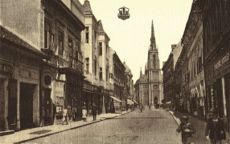 Between 1929 and 1941, the region was known as the Danube Banovina
, a province of the Kingdom of Yugoslavia
. Its capital city was Novi Sad
. The Banovina consisted of the Syrmia
, Bačka
, Banat
, Baranja
, Šumadija
, and Braničevo
regions.
Between 1941 and 1944, during World War II
, the Axis Powers
divided and occupied Vojvodina
. Bačka and Baranja were annexed by Horthy's Hungary and Syrmia was included into the Independent State of Croatia
. A smaller Danube Banovina (including Banat, Šumadija, and Braničevo) existed as part of what was known as "Nedić's Serbia". The administrative center of this smaller province was Smederevo
. However, Banat itself was a separate autonomous region ruled by its German minority. The occupying powers committed numerous crimes against the civilian population, especially against Serbs, Jews and Roma; the Jewish population of Vojvodina was almost completely killed or deported. In total, Axis authorities killed about 50,000 citizens of Vojvodina, while more than 280,000 people were interned, arrested, violated or tortured.
Axis occupation ended in 1944 and the region was temporarily placed under military administration (1944–1945) run by the new communist authorities. During, and after the military administration, several thousands of citizens were killed - this affected mostly ethnic Germans, but also one part of Hungarian and Serb populations. Both, war-time Axis occupational authorities and post-war communities ones, run the concentration/prison camps in the territory of Vojvodina (See the List of concentration and internment camps). While war-time prisoners in these camps were mostly Jews, Serbs and communists, post-war camps were formed for ethnic Germans (Danube Swabians
). Most of Vojvodina Germans (about 200,000) left from the region in 1944, together with defated German army. Most of those who remained in the region (about 150,000) were sent to some of the villages cordoned off as prisons. It is estimated that some 48,447 Germans died in the camps from disease, hunger, malnutrition, mistreatment, and coldness. Some 8,049 Germans was killed by the partisans during military administration in Vojvodina after October 1944. It is also estimated that post-war communist authorities killed some 20,000 Hungarians and some 23,000-24,000 Serbs. According to professor Dragoljub Živković, 47,000 ethnic Serbs was killed in Vojvodina during entire 1941-1948 period. About half of that number was killed by occupational forces and another half was killed by post-war communist authorities.
The region was politically restored in 1944 (incorporating Syrmia, Banat, Bačka, and Baranja) and became an autonomous province of Serbia in 1945. Instead of the previous name (Danube Banovina), the region regained its historical name of Vojvodina, while its capital city remained Novi Sad
. When final borders of Vojvodina were defined, Baranja was assigned to Croatia, while northern part of Mačva region was assigned to Vojvodina.
, but it gained extensive rights of self-rule under the 1974 Yugoslav constitution, which gave both Kosovo and Vojvodina de facto veto power in the Serbian and Yugoslav parliaments, as changes to their status could not be made without the consent of the two Provincial Assemblies. The 1974 Serbian constitution, adopted at the same time, reiterated that "the Socialist Republic of Serbia comprises the Socialist Autonomous Province of Vojvodina
and the Socialist Autonomous Province of Kosovo
, which originated in the common struggle of nations and nationalities of Yugoslavia in the National Liberation War (the Second World War) and socialist revolution".
Under the rule of the Serbian president Slobodan Milošević
, Vojvodina and Kosovo
lost elements of statehood in September 1990. Vojvodina was still referred to as an autonomous province of Serbia, but most of its autonomous powers - including, crucially, its vote on the Yugoslav collective presidency - were transferred to the control of Belgrade. The province, however, still had its own parliament and government and some other autonomous functions as well.
The fall of Milošević in 2000 created a new climate for reform in Vojvodina. Following talks between the political parties, the level of the province's autonomy was increased by the omnibus law
in 2002. The old statute of the Autonomous Province of Vojvodina dated from 1991 and has been deemed by the Serbian Parliament as outdated. The Vojvodina provincial assembly adopted a new statute on 15 October 2008, 89 of 120 councilors voted in favor of the bill, whilst 21 voted against. The Statute, partly amended, was approved by Parliament of Serbia on 30 November 2009 with 137 MPs in favor and 24 against. The Statute was officially proclaimed on 14 December 2009, in Novi Sad
, and came into force on 1 January 2010.
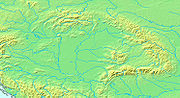
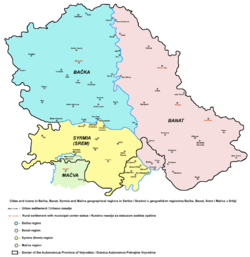
It is located in the northern part of the country, in the Pannonian Plain of Central Europe
. It has a population of about 2 million, about 27% of Serbia's total. The region is divided by the Danube
and Tisza
rivers into: Bačka
in the northwest, Banat
in the east and Syrmia
(Srem) in the southwest. A small part of the Mačva
region is also located in Vojvodina, in the Srem District
. Today, the western part of Syrmia
is in Croatia
, the northern part of Bačka is in Hungary, the eastern part of Banat is in Romania
(with a small piece in Hungary), while Baranja
(which is between the Danube and the Drava
) is in Hungary and Croatia. Vojvodina has a total surface area of 21500 km² (8,301.2 sq mi). Vojvodina is also part of the Danube-Kris-Mures-Tisa
euroregion
.
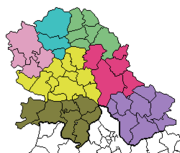
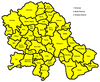 After a constitution of Serbia
from 1992, Vojvodina is divided into seven districts
, which are called after its main geographical location. Districts are named after the main region which district covers. Minister of Local Government, in the Serbian Government
appoints commissioners of the districts, but they have no political power. Local government lies in municipalities and cites. The seven districts are further subdivided into 43 municipalities and the cities of Novi Sad
and Subotica
.
 Largest cities of Vojvodina (with population figures):
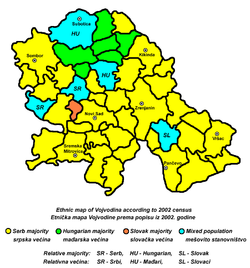
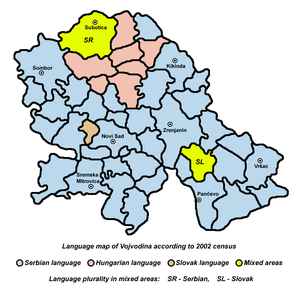
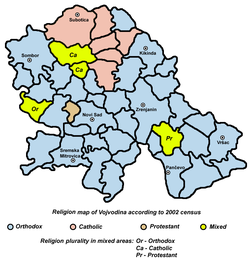
Vojvodina is more diverse than the rest of Serbia with more than 25 ethnic groups and six official languages.
The largest ethnic groups are Serbs
(65%) and Hungarians (14%).
Population by national or ethnic groups:
Population by native language:
Population by religion:
Population by gender:
Population by age groups:
Source: Republic Statistical Office of Serbia
, G17 Plus
, Hungarian Coalition
, League of Social Democrats of Vojvodina
, and Socialist Party of Serbia
.
The current president of Vojvodinian government is Bojan Pajtić
(Democratic Party
), while the president of the Vojvodinian parliament is Sándor Egeresi
(Hungarian Coalition
).
 Vojvodina has a regional academy of science and art, Vojvodina Academy of Sciences and Arts
. Its main aim is to cherish traditions in sciences and arts of the multicultural and multiethnic circle through cooperation with other academies and institutions and to improve life conditions of the Vojvodina region by using the spiritual and natural resources of Vojvodina. The Government of Vojvodina is the founder of several newspapers and magazines in Vojvodina's official languages: Дневник
("Daily news") in Serbian and Magyar Szó
("Hungarian Word") in Hungarian are daily newspapers, and weekly magazines are Hrvatska riječ
("Croatian Word") in Croatian, Hlas Ľudu ("The Voice of the People") in Slovak, Libertatea ("Freedom") in Romanian, and Руске слово ("Rusyn Word") in Rusyn. There is also Bunjevačke novine
("The Bunjevac newspaper") in Bunjevac. Hidden Europe article praises the cosmopolitism in the province.
monasteries on Fruška Gora
mountain, numerous hunting grounds, cultural-historical monuments, different folklores, interesting galleries and museums, plain landscapes with a lot of greenery, big rivers, canals and lakes, sandy terrain Deliblatska Peščara
("the European Sahara"), etc.
In the last few years, Exit
has been very popular among the European summer music festivals.
Companies:
Vojvodina promotes its investment potentials through Vojvodina Investment Promotion - VIP, investment promotion agency founded by the Parliament of the Autonomous Province of Vojvodina.
and Human Rights Watch
have expressed concern about rising levels of ethnic tension and related violent incidents in Vojvodina. Of particular concern, according to the reports, is a frequently lax response on the part of the police.
Serbian language
Serbian is a form of Serbo-Croatian, a South Slavic language, spoken by Serbs in Serbia, Bosnia and Herzegovina, Montenegro, Croatia and neighbouring countries....
: Аутономна Покрајина Војводина, Autonomna Pokrajina Vojvodina ʋɔ̌jʋɔdina; ; ; ; ; Rusyn
Pannonian Rusyn language
Pannonian Rusyn or simply Rusyn is a Slavic language or dialect spoken by Pannonian Rusyns in north-western Serbia and eastern Croatia...
: Автономна Покраїна Войводина) is an autonomous province
Subdivisions of Serbia
The territorial organization of Serbia is regulated by the Law on Territorial Organization, adopted by the National Assembly of Serbia on 29 December 2007...
of Serbia
Serbia
Serbia , officially the Republic of Serbia , is a landlocked country located at the crossroads of Central and Southeast Europe, covering the southern part of the Carpathian basin and the central part of the Balkans...
. Its capital and largest city is Novi Sad
Novi Sad
Novi Sad is the capital of the northern Serbian province of Vojvodina, and the administrative centre of the South Bačka District. The city is located in the southern part of Pannonian Plain on the Danube river....
. Vojvodina has a multi-ethnic and multi-cultural identity, with a number of mechanisms for the promotion of minorities; there are more than 26 ethnic group
Ethnic group
An ethnic group is a group of people whose members identify with each other, through a common heritage, often consisting of a common language, a common culture and/or an ideology that stresses common ancestry or endogamy...
s in the province, which has six official language
Official language
An official language is a language that is given a special legal status in a particular country, state, or other jurisdiction. Typically a nation's official language will be the one used in that nation's courts, parliament and administration. However, official status can also be used to give a...
s.
Name
The name "Vojvodina" in Serbian languageSerbian language
Serbian is a form of Serbo-Croatian, a South Slavic language, spoken by Serbs in Serbia, Bosnia and Herzegovina, Montenegro, Croatia and neighbouring countries....
means a type of duchy
Duchy
A duchy is a territory, fief, or domain ruled by a duke or duchess.Some duchies were sovereign in areas that would become unified realms only during the Modern era . In contrast, others were subordinate districts of those kingdoms that unified either partially or completely during the Medieval era...
– more specifically, a voivodeship
Voivodeship
Voivodship is a term denoting the position of, or more commonly the area administered by, a voivod. Voivodeships have existed since medieval times in Poland, Romania, Hungary, Lithuania, Latvia, Russia and Serbia....
. It derives from the word "vojvoda" (see voivode) which stems from the Proto-Slavic language word "voevoda". Those words are etymologically connected with modern-day words "vojnik" (soldier
Soldier
A soldier is a member of the land component of national armed forces; whereas a soldier hired for service in a foreign army would be termed a mercenary...
) and "voditi" (to lead). Its original name (from 1848) was the "Serbian Voivodeship" (Srpska Vojvodina).
The full official names of the province in all official languages of Vojvodina are:
- Аутономна Покрајина Војводина, Autonomna Pokrajina Vojvodina (in SerbianSerbian languageSerbian is a form of Serbo-Croatian, a South Slavic language, spoken by Serbs in Serbia, Bosnia and Herzegovina, Montenegro, Croatia and neighbouring countries....
/Serbo-CroatianSerbo-CroatianSerbo-Croatian or Serbo-Croat, less commonly Bosnian/Croatian/Serbian , is a South Slavic language with multiple standards and the primary language of Serbia, Croatia, Bosnia and Herzegovina, and Montenegro...
) - Autonomna Pokrajina Vojvodina (in CroatianCroatian languageCroatian is the collective name for the standard language and dialects spoken by Croats, principally in Croatia, Bosnia and Herzegovina, the Serbian province of Vojvodina and other neighbouring countries...
) - Vajdaság Autonóm Tartomány (in Hungarian)
- Autonómna Pokrajina Vojvodina (in SlovakSlovak languageSlovak , is an Indo-European language that belongs to the West Slavic languages .Slovak is the official language of Slovakia, where it is spoken by 5 million people...
) - Provincia Autonomă Voivodina (in RomanianRomanian languageRomanian Romanian Romanian (or Daco-Romanian; obsolete spellings Rumanian, Roumanian; self-designation: română, limba română ("the Romanian language") or românește (lit. "in Romanian") is a Romance language spoken by around 24 to 28 million people, primarily in Romania and Moldova...
) - Автономна Покраїна Войводина (in Pannonian RusynPannonian Rusyn languagePannonian Rusyn or simply Rusyn is a Slavic language or dialect spoken by Pannonian Rusyns in north-western Serbia and eastern Croatia...
)
Names in other languages that are not official in the province, but that are spoken by some local inhabitants:
- Autonomna Pokrajina Vojvodina, Аутономна Покрајина Војводина (in MontenegrinMontenegrin languageMontenegrin is a name used for the Serbo-Croatian language as spoken by Montenegrins; it also refers to an incipient standardized form of the Shtokavian dialect of Serbo-Croatian used as the official language of Montenegro...
) - Voyvodina (in RomaniRomani languageRomani or Romany, Gypsy or Gipsy is any of several languages of the Romani people. They are Indic, sometimes classified in the "Central" or "Northwestern" zone, and sometimes treated as a branch of their own....
) - Autonomna Pokrajina Vojvodina (in BunjevacBunjevac languageThe Bunjevac dialect or Bunjevac language is a Štokavian dialect used by members of the Bunjevci community. The speakers live in parts of the autonomous province of Vojvodina in Serbia as well as in southern parts of Croatia. The speech has an exclusive Serbo-Croatian Ikavian reflex of the Common...
) - Автономна Покраина Војводина (in MacedonianMacedonian languageMacedonian is a South Slavic language spoken as a first language by approximately 2–3 million people principally in the region of Macedonia but also in the Macedonian diaspora...
) - Автономний край Воєводина (in UkrainianUkrainian languageUkrainian is a language of the East Slavic subgroup of the Slavic languages. It is the official state language of Ukraine. Written Ukrainian uses a variant of the Cyrillic alphabet....
) - Autonomna Pokrajina Vojvodina (in BosnianBosnian languageBosnian is a South Slavic language, spoken by Bosniaks. As a standardized form of the Shtokavian dialect, it is one of the three official languages of Bosnia and Herzegovina....
) - Autonome Provinz Woiwodina (in GermanGerman languageGerman is a West Germanic language, related to and classified alongside English and Dutch. With an estimated 90 – 98 million native speakers, German is one of the world's major languages and is the most widely-spoken first language in the European Union....
) - Avtonomna pokrajina Vojvodina (in Slovene)
- Krahina Autonome e Vojvodinës (in AlbanianAlbanian languageAlbanian is an Indo-European language spoken by approximately 7.6 million people, primarily in Albania and Kosovo but also in other areas of the Balkans in which there is an Albanian population, including western Macedonia, southern Montenegro, southern Serbia and northwestern Greece...
) - Автономна област Войводина (in BulgarianBulgarian languageBulgarian is an Indo-European language, a member of the Slavic linguistic group.Bulgarian, along with the closely related Macedonian language, demonstrates several linguistic characteristics that set it apart from all other Slavic languages such as the elimination of case declension, the...
) - Autonomní oblast Vojvodina (in CzechCzech languageCzech is a West Slavic language with about 12 million native speakers; it is the majority language in the Czech Republic and spoken by Czechs worldwide. The language was known as Bohemian in English until the late 19th century...
)
The territory of present-day Vojvodina throughout history
Banat, Bačka and Syrmia: throughout history, the territory of present day Vojvodina (including regions of Banat, Bačka and Syrmia) has been (entirely or partially) a part of:- the State of the ScordisciScordisciThe Scordisci were an Iron Age tribe centered in the territory of present-day Serbia, at the confluence of the Savus , Dravus and Danube rivers. They were historically notable from the beginning of the third century BC until the turn of the common era...
(3rd century BC–1st century AD), with capital in SingidunumSingidunumSingidunum is the name for the ancient city in Serbia which became Belgrade, the capital of Serbia. It was recorded that a Celtic tribe Scordisci settled the area in the 3rd century BC following the Gallic invasion of the Balkans. The Roman Empire conquered the area in 75 BC and later garrisoned...
(present-day BelgradeBelgradeBelgrade is the capital and largest city of Serbia. It is located at the confluence of the Sava and Danube rivers, where the Pannonian Plain meets the Balkans. According to official results of Census 2011, the city has a population of 1,639,121. It is one of the 15 largest cities in Europe...
), - DaciaDaciaIn ancient geography, especially in Roman sources, Dacia was the land inhabited by the Dacians or Getae as they were known by the Greeks—the branch of the Thracians north of the Haemus range...
(1st century BC), - the Roman EmpireRoman EmpireThe Roman Empire was the post-Republican period of the ancient Roman civilization, characterised by an autocratic form of government and large territorial holdings in Europe and around the Mediterranean....
(1st-5th century), - the Hun EmpireHunsThe Huns were a group of nomadic people who, appearing from east of the Volga River, migrated into Europe c. AD 370 and established the vast Hunnic Empire there. Since de Guignes linked them with the Xiongnu, who had been northern neighbours of China 300 years prior to the emergence of the Huns,...
(5th century), - the Ostrogoth Kingdom (5th century),
- the Gepid Kingdom (5th-6th century),
- the Langobard State (6th century),
- the Byzantine EmpireByzantine EmpireThe Byzantine Empire was the Eastern Roman Empire during the periods of Late Antiquity and the Middle Ages, centred on the capital of Constantinople. Known simply as the Roman Empire or Romania to its inhabitants and neighbours, the Empire was the direct continuation of the Ancient Roman State...
(6th century; 11th-12th century), - the Avar KhanateEurasian AvarsThe Eurasian Avars or Ancient Avars were a highly organized nomadic confederacy of mixed origins. They were ruled by a khagan, who was surrounded by a tight-knit entourage of nomad warriors, an organization characteristic of Turko-Mongol groups...
(6th-8th century), - the Frankish KingdomFranksThe Franks were a confederation of Germanic tribes first attested in the third century AD as living north and east of the Lower Rhine River. From the third to fifth centuries some Franks raided Roman territory while other Franks joined the Roman troops in Gaul. Only the Salian Franks formed a...
(8th-9th century), - the Principality of Pannonian Croatia (9th century),
- the Principality of Lower Pannonia (9th century),
- the Great MoraviaGreat MoraviaGreat Moravia was a Slavic state that existed in Central Europe and lasted for nearly seventy years in the 9th century whose creators were the ancestors of the Czechs and Slovaks. It was a vassal state of the Germanic Frankish kingdom and paid an annual tribute to it. There is some controversy as...
(9th century) - according to various sources, Great Moravia included territory of present-day Vojvodina. According to alternative theory presented by Peter Püspöki Nagy, Great Moravia was centered in present-day Serbia: around the river Velika Morava and in present-day Vojvodina, - the Bulgarian EmpireBulgarian EmpireBulgarian Empire is a term used to describe two periods in the medieval history of Bulgaria, during which it acted as a key regional power in Europe in general and in Southeastern Europe in particular, rivalling Byzantium...
(9th-11th century), - the Voivodeship of SalanSalan]Salan, Dux Salanus or Zalan was, according to the Gesta Hungarorum, a Bulgarian voivod who ruled in the 9th century between Danube and Tisa rivers, mainly in the territory of present-day Bačka region of Serbia and Hungary. The capital city of his voivodship was Titel...
(9th century), - the Voivodeship of GladGlad (duke)Glad was a duke of Bulgarian origin who, according to the 13th-century chronicle Gesta Ungarorum "", ruled in the territory of modern Banat at the time of the Hungarian conquest of the Carpathian Basin around 896...
(9th century), - the Kingdom of HungaryKingdom of HungaryThe Kingdom of Hungary comprised present-day Hungary, Slovakia and Croatia , Transylvania , Carpatho Ruthenia , Vojvodina , Burgenland , and other smaller territories surrounding present-day Hungary's borders...
(10th-16th century), - the Voivodeship of AhtumAhtumAhtum, also Achtum or Ajtony , was a local ruler in the region of Banat in the first decades of the 11th century. King Saint Stephen I of Hungary sent Csanád - one of Ahtum’s former retainers - to fight against him...
(11th century), - the Voivodeship of SermonSermon (ruler)Sermon was an 11th century voivode of Syrmia and a local governor in the First Bulgarian Empire, vassal of Bulgarian emperor Samuil...
(11th century), - the Kingdom of SyrmiaSyrmiaSyrmia is a fertile region of the Pannonian Plain in Europe, between the Danube and Sava rivers. It is divided between Serbia in the east and Croatia in the west....
of Serb king Stefan Dragutin (13th-14th century) - Initially, Stefan Dragutin was vassal of Hungarian king, but later became an independent ruler, - the realm of Ugrin CsákUgrin CsákUgrin Csák was a prominent Hungarian nobleman and oligarch in the early 14th century.-Ugrin Csák as an oligarch:...
(13th-14th century) - Initially, Ugrin Csák was an Hungarian nobleman, but later became an independent ruler, - the Serb state of Jovan Nenad (1526-1527),
- the Ottoman EmpireOttoman EmpireThe Ottoman EmpireIt was usually referred to as the "Ottoman Empire", the "Turkish Empire", the "Ottoman Caliphate" or more commonly "Turkey" by its contemporaries...
(16th-18th century),- the Ottoman vassal duchy of Radoslav ČelnikRadoslav CelnikRadoslav Čelnik was a duke of Srem in the 16th century. At first, Radoslav Čelnik was a general commander of Emperor Jovan Nenad's army. In 1527, when Emperor Jovan Nenad was murdered and his army was dispersed, Radoslav Čelnik, together with part of the former emperor's army moved from Bačka to...
(1527-1530),
- the Ottoman vassal duchy of Radoslav Čelnik
- the Habsburg MonarchyHabsburg MonarchyThe Habsburg Monarchy covered the territories ruled by the junior Austrian branch of the House of Habsburg , and then by the successor House of Habsburg-Lorraine , between 1526 and 1867/1918. The Imperial capital was Vienna, except from 1583 to 1611, when it was moved to Prague...
(from 1699 to 1804), including:- Military FrontierMilitary FrontierThe Military Frontier was a borderland of Habsburg Austria and later the Austro-Hungarian Monarchy, which acted as the cordon sanitaire against incursions from the Ottoman Empire...
, - Banat of TemeswarBanat of TemeswarThe Banat of Temeswar was a Habsburg province that existed between 1718 and 1778. It was located in the present day region of Banat, which was named after this province...
(until 1778), - Habsburg Kingdom of HungaryHabsburg Kingdom of HungaryThe term Habsburg Kingdom of Hungary can refer to the following provinces of the Habsburg Empire :*Kingdom of Hungary *Hungarian part of Austria-Hungary...
(which included Habsburg Kingdom of Croatia and Habsburg Kingdom of SlavoniaKingdom of SlavoniaThe Kingdom of Slavonia was a province of the Habsburg Monarchy and the Austrian Empire that existed from 1699 to 1868. The province included northern parts of present-day regions of Slavonia and Syrmia...
),
- Military Frontier
- the Austrian EmpireAustrian EmpireThe Austrian Empire was a modern era successor empire, which was centered on what is today's Austria and which officially lasted from 1804 to 1867. It was followed by the Empire of Austria-Hungary, whose proclamation was a diplomatic move that elevated Hungary's status within the Austrian Empire...
(from 1804 to 1867), including:- Serbian VojvodinaSerbian VojvodinaThe Serbian Vojvodina was a Serbian autonomous region within the Austrian Empire...
(1848-1849), - Voivodeship of Serbia and Banat of Temeschwar (1849-1860),
- Military FrontierMilitary FrontierThe Military Frontier was a borderland of Habsburg Austria and later the Austro-Hungarian Monarchy, which acted as the cordon sanitaire against incursions from the Ottoman Empire...
, - Habsburg Kingdom of HungaryHabsburg Kingdom of HungaryThe term Habsburg Kingdom of Hungary can refer to the following provinces of the Habsburg Empire :*Kingdom of Hungary *Hungarian part of Austria-Hungary...
(which included Habsburg Kingdom of Croatia and Habsburg Kingdom of SlavoniaKingdom of SlavoniaThe Kingdom of Slavonia was a province of the Habsburg Monarchy and the Austrian Empire that existed from 1699 to 1868. The province included northern parts of present-day regions of Slavonia and Syrmia...
) - after 1849, Kingdom of Slavonia was a separate Habsburg crownland,
- Serbian Vojvodina
- the Austria-HungaryAustria-HungaryAustria-Hungary , more formally known as the Kingdoms and Lands Represented in the Imperial Council and the Lands of the Holy Hungarian Crown of Saint Stephen, was a constitutional monarchic union between the crowns of the Austrian Empire and the Kingdom of Hungary in...
(from 1867 to 1918), including:- Military FrontierMilitary FrontierThe Military Frontier was a borderland of Habsburg Austria and later the Austro-Hungarian Monarchy, which acted as the cordon sanitaire against incursions from the Ottoman Empire...
(until 1882), - Kingdom of SlavoniaKingdom of SlavoniaThe Kingdom of Slavonia was a province of the Habsburg Monarchy and the Austrian Empire that existed from 1699 to 1868. The province included northern parts of present-day regions of Slavonia and Syrmia...
(until 1868), - Habsburg Kingdom of HungaryKingdom of HungaryThe Kingdom of Hungary comprised present-day Hungary, Slovakia and Croatia , Transylvania , Carpatho Ruthenia , Vojvodina , Burgenland , and other smaller territories surrounding present-day Hungary's borders...
(which included Habsburg Kingdom of Croatia-SlavoniaKingdom of Croatia-SlavoniaThe Kingdom of Croatia-Slavonia or Croatia Slavonia was an autonomous kingdom within the Austro-Hungarian Empire. It was part of the Hungarian Kingdom within the dual Austro-Hungarian state, being within the Lands of the Crown of St. Stephen or Transleithania...
),
- Military Frontier
- the State of Slovenes, Croats and SerbsState of Slovenes, Croats and SerbsThe State of Slovenes, Croats and Serbs was a short-lived state formed from the southernmost parts of the Austro-Hungarian monarchy after its dissolution at the end of the World War I by the resident population of Slovenes, Croats, and Serbs...
(1918), - the Banat RepublicBanat RepublicThe Banat Republic was a short-lived state proclaimed in Timişoara on November 1, 1918, the day after the dissolution of the Austro-Hungarian Empire. Recognized only by Hungary, the republic was invaded by the army of neighboring Serbia on November 15...
(1918), - the Kingdom of SerbiaKingdom of SerbiaThe Kingdom of Serbia was created when Prince Milan Obrenović, ruler of the Principality of Serbia, was crowned King in 1882. The Principality of Serbia was ruled by the Karađorđevic dynasty from 1817 onwards . The Principality, suzerain to the Porte, had expelled all Ottoman troops by 1867, de...
(1918), - the Kingdom of Serbs, Croats and Slovenes (1918-1929),
- the Kingdom of YugoslaviaKingdom of YugoslaviaThe Kingdom of Yugoslavia was a state stretching from the Western Balkans to Central Europe which existed during the often-tumultuous interwar era of 1918–1941...
(1929-1941, also during World War - from 1941 to 1944: the Nedić's SerbiaNedic's SerbiaSerbia under German occupation refers to an administrative area in occupied Yugoslavia established by Nazi Germany following the invasion and dismantling of Yugoslavia in April of 1941...
, the Pavelić'sAnte PavelicAnte Pavelić was a Croatian fascist leader, revolutionary, and politician. He ruled as Poglavnik or head, of the Independent State of Croatia , a World War II puppet state of Nazi Germany in Axis-occupied Yugoslavia...
Independent State of CroatiaIndependent State of CroatiaThe Independent State of Croatia was a World War II puppet state of Nazi Germany, established on a part of Axis-occupied Yugoslavia. The NDH was founded on 10 April 1941, after the invasion of Yugoslavia by the Axis powers. All of Bosnia and Herzegovina was annexed to NDH, together with some parts...
and Horthy'sMiklós HorthyMiklós Horthy de Nagybánya was the Regent of the Kingdom of Hungary during the interwar years and throughout most of World War II, serving from 1 March 1920 to 15 October 1944. Horthy was styled "His Serene Highness the Regent of the Kingdom of Hungary" .Admiral Horthy was an officer of the...
HungaryHungary during World War IIHungary during World War II was a member of the Axis powers. In the 1930s, the Kingdom of Hungary relied on increased trade with Fascist Italy and Nazi Germany to pull itself out of the Great Depression. By 1938, Hungarian politics and foreign policy had become increasingly pro-Fascist Italian and...
), - the Socialist Federal Republic of YugoslaviaSocialist Federal Republic of YugoslaviaThe Socialist Federal Republic of Yugoslavia was the Yugoslav state that existed from the abolition of the Yugoslav monarchy until it was dissolved in 1992 amid the Yugoslav Wars. It was a socialist state and a federation made up of six socialist republics: Bosnia and Herzegovina, Croatia,...
(1944-1992), - the Federal Republic of Yugoslavia (1992-2003),
- Serbia and MontenegroSerbia and MontenegroSerbia and Montenegro was a country in southeastern Europe, formed from two former republics of the Socialist Federal Republic of Yugoslavia : Serbia and Montenegro. Following the breakup of Yugoslavia, it was established in 1992 as a federation called the Federal Republic of Yugoslavia...
(2003-2006), and, - since 2006, the independent Serbia (from 1945 to 2006, Serbia, which included autonomous Vojvodina, was a republic within Yugoslavia and Serbia and Montenegro).
Mačva: Through the history, the region of Mačva (whose northern part is within present-day Vojvodina) has been a part of: the Roman Empire
Roman Empire
The Roman Empire was the post-Republican period of the ancient Roman civilization, characterised by an autocratic form of government and large territorial holdings in Europe and around the Mediterranean....
(1st-4th century), the Byzantine Empire
Byzantine Empire
The Byzantine Empire was the Eastern Roman Empire during the periods of Late Antiquity and the Middle Ages, centred on the capital of Constantinople. Known simply as the Roman Empire or Romania to its inhabitants and neighbours, the Empire was the direct continuation of the Ancient Roman State...
(4th-5th century; 5th-7th century; 11th-12th century), the Hun Empire (5th century), the Slavic-controlled territories (7th-9th century), the Bulgarian Empire
Bulgarian Empire
Bulgarian Empire is a term used to describe two periods in the medieval history of Bulgaria, during which it acted as a key regional power in Europe in general and in Southeastern Europe in particular, rivalling Byzantium...
(9th-11th century), the Kingdom of Hungary
Kingdom of Hungary
The Kingdom of Hungary comprised present-day Hungary, Slovakia and Croatia , Transylvania , Carpatho Ruthenia , Vojvodina , Burgenland , and other smaller territories surrounding present-day Hungary's borders...
(12th-13th century; 14th century; 15th century; 16th century), the State of Serb king Stefan Dragutin (13th-14th century), the Serbian Empire
Serbian Empire
The Serbian Empire was a short-lived medieval empire in the Balkans that emerged from the Serbian Kingdom. Stephen Uroš IV Dušan was crowned Emperor of Serbs and Greeks on 16 April, 1346, a title signifying a successorship to the Eastern Roman Empire...
(14th century), the State of Nikola Altomanović
Nikola Altomanovic
Nikola Altomanović was Serbian župan from 14th century. He ruled vast areas from Rudnik, over Polimlje, Podrinje, east Herzegovina with Trebinje, till Konavle and Dračevica, neighboring the Republic of Dubrovnik...
(14th century), the Moravian Serbia
Moravian Serbia
The Moravian Serbia was one of the states that emerged from the collapse of the Serbian Empire in the 14th century. The state was created through political and military activities of its first ruler Prince Lazar Hrebeljanović, who later fought and perished at the Battle of Kosovo.-History:Lazar...
(14th century), the Serbian Despotate
Serbian Despotate
The Serbian Despotate was a Serbian state, the last to be conquered by the Ottoman Empire. Although the Battle of Kosovo in 1389 is generally considered the end of the medieval Serbian state, the Despotate, a successor of the Serbian Empire and Moravian Serbia survived for 70 more years,...
(15th century), the Ottoman Empire
Ottoman Empire
The Ottoman EmpireIt was usually referred to as the "Ottoman Empire", the "Turkish Empire", the "Ottoman Caliphate" or more commonly "Turkey" by its contemporaries...
(15th century; 16th-18th century; 18th-19th century), the Habsburg Monarchy
Habsburg Monarchy
The Habsburg Monarchy covered the territories ruled by the junior Austrian branch of the House of Habsburg , and then by the successor House of Habsburg-Lorraine , between 1526 and 1867/1918. The Imperial capital was Vienna, except from 1583 to 1611, when it was moved to Prague...
(1718-1739), the Karađorđe's Serbia (1804-1813), the vassal Principality of Serbia (1815-1878), the independent Principality of Serbia (1878-1882), the Kingdom of Serbia
Kingdom of Serbia
The Kingdom of Serbia was created when Prince Milan Obrenović, ruler of the Principality of Serbia, was crowned King in 1882. The Principality of Serbia was ruled by the Karađorđevic dynasty from 1817 onwards . The Principality, suzerain to the Porte, had expelled all Ottoman troops by 1867, de...
(1882-1918), the Kingdom of Serbs, Croats and Slovenes (1918-1929), the Kingdom of Yugoslavia
Kingdom of Yugoslavia
The Kingdom of Yugoslavia was a state stretching from the Western Balkans to Central Europe which existed during the often-tumultuous interwar era of 1918–1941...
(1929-1941), the Nedić's Serbia
Nedic's Serbia
Serbia under German occupation refers to an administrative area in occupied Yugoslavia established by Nazi Germany following the invasion and dismantling of Yugoslavia in April of 1941...
(1941-1944), the Socialist Federal Republic of Yugoslavia
Socialist Federal Republic of Yugoslavia
The Socialist Federal Republic of Yugoslavia was the Yugoslav state that existed from the abolition of the Yugoslav monarchy until it was dissolved in 1992 amid the Yugoslav Wars. It was a socialist state and a federation made up of six socialist republics: Bosnia and Herzegovina, Croatia,...
(1944-1992), the Federal Republic of Yugoslavia (1992-2003), and the Serbia and Montenegro
Serbia and Montenegro
Serbia and Montenegro was a country in southeastern Europe, formed from two former republics of the Socialist Federal Republic of Yugoslavia : Serbia and Montenegro. Following the breakup of Yugoslavia, it was established in 1992 as a federation called the Federal Republic of Yugoslavia...
(2003-2006). Since 2006, the region is part of an independent Serbia
Serbia
Serbia , officially the Republic of Serbia , is a landlocked country located at the crossroads of Central and Southeast Europe, covering the southern part of the Carpathian basin and the central part of the Balkans...
.
Autonomous region named Serbian Vojvodina
Serbian Vojvodina
The Serbian Vojvodina was a Serbian autonomous region within the Austrian Empire...
was proclaimed in May Assembly
May Assembly
May Assembly was the national assembly of the Serbs in Austrian Empire, held in 1 and 3 May 1848 in Sremski Karlovci, during which the Serbs proclaimed autonomous Serbian Vojvodina. This action was later recognized by the supreme Austrian authority in Vienna...
, which was organized by local Serbs in 1848. Due to advance of Hungarian army in 1849 and disagreement between Serb leaders, autonomous Serb region ceased to exist in 1849 and remains of its army were included into Austrian imperial army. Later in that year (1849), after Austrian and Russian army defeated Hungarians, a separate Habsburg crownland named Voivodeship of Serbia and Banat of Temeschwar was formed. It existed from 1849 to 1860 and included much larger territory than original proclaimed territory of Serbian Vojvodina. After World War I
World War I
World War I , which was predominantly called the World War or the Great War from its occurrence until 1939, and the First World War or World War I thereafter, was a major war centred in Europe that began on 28 July 1914 and lasted until 11 November 1918...
, in 1918, the Assembly of local Serbs, Bunjevci and other Slavs of Banat, Bačka and Baranja declared secession of these regions from the Kingdom of Hungary
Kingdom of Hungary
The Kingdom of Hungary comprised present-day Hungary, Slovakia and Croatia , Transylvania , Carpatho Ruthenia , Vojvodina , Burgenland , and other smaller territories surrounding present-day Hungary's borders...
and creation of an administrative province named Banat, Bačka and Baranja
Banat, Backa and Baranja
Banat, Bačka and Baranja was a de facto province of the Kingdom of Serbia and the Kingdom of Serbs, Croats and Slovenes between October 1918 and March 1919...
, which joined the Kingdom of Serbia. Its borders towards newly independent Hungary were later (in 1920) defined by the Treaty of Trianon
Treaty of Trianon
The Treaty of Trianon was the peace agreement signed in 1920, at the end of World War I, between the Allies of World War I and Hungary . The treaty greatly redefined and reduced Hungary's borders. From its borders before World War I, it lost 72% of its territory, which was reduced from to...
. In 1929 region was a province of the Kingdom of Yugoslavia named Danube Banovina
Danube Banovina
The Danube Banovina or Danube Banate was a province of the Kingdom of Yugoslavia between 1929 and 1941. This province consisted of the geographical regions of Syrmia, Bačka, Banat, Baranja, Šumadija, and Braničevo. The capital city of the Danube Banovina was Novi Sad...
and since 1945 it is an autonomous province of Socialist Republic of Serbia and new socialist Yugoslavia (Together with Kosovo and Metohija, it enjoyed high autonomous status between 1974 and 1990).
Pre-Roman times and Roman administration
In Neolithic period, two important archaeological cultures flourished in this area: the Starčevo culture and the Vinča cultureVinca culture
The Vinča culture is a Neolithic archaeological culture in Southeastern Europe, dated to the period 5500–4500 BCE. Named for its type site, Vinča-Belo Brdo, a large tell settlement discovered by Serbian archaeologist Miloje Vasić in 1908, it represents the material remains of a prehistoric society...
. First Indo-European
Indo-European
Indo-European may refer to:* Indo-European languages** Aryan race, a 19th century and early 20th century term for those peoples who are the native speakers of Indo-European languages...
peoples settled in the territory of present-day Vojvodina in 4200 BC. During the Eneolithic period, the Bronze Age
Bronze Age
The Bronze Age is a period characterized by the use of copper and its alloy bronze as the chief hard materials in the manufacture of some implements and weapons. Chronologically, it stands between the Stone Age and Iron Age...
and the Iron Age
Iron Age
The Iron Age is the archaeological period generally occurring after the Bronze Age, marked by the prevalent use of iron. The early period of the age is characterized by the widespread use of iron or steel. The adoption of such material coincided with other changes in society, including differing...
, several Indo-European archaeological cultures were centered in or around Vojvodina: the Vučedol culture
Vucedol culture
The Vučedol culture was a Indo-European culture that flourished between 3000 and 2200 BC , centered in Syrmia and eastern Slavonia on the right bank of the Danube river, but possibly spreading throughout the Pannonian plain and western Balkans...
, the Vinkovci culture, the Vatin culture
Vatin culture
The Vatin culture is a name of an prehistoric Bronze Age culture, which was named after village Vatin in Serbia. The culture had Indo-European roots and was culturally connected with Mycenaean Greece...
, the Belegiš culture, the Bosut culture
Bosut culture
Bosut culture is a name of an prehistoric Iron Age culture, which was named after Gradina on Bosut archaeological site in Serbia. It is sometimes grouped with related Basarabi culture into Bosut-Basarabi complex...
, etc. Before the Roman conquest in the 1st century BC, Indo-European peoples of Illyrian, Thracian and Celtic
Celtic
The words Celt and Celtic can refer to:In ethno-linguistics:*Celts, a people of the Celtic nations*Celts , the modern Celtic identity*Celtic languages...
origin inhabited this area. First states organized in this area were the Celtic State of the Scordisci
Scordisci
The Scordisci were an Iron Age tribe centered in the territory of present-day Serbia, at the confluence of the Savus , Dravus and Danube rivers. They were historically notable from the beginning of the third century BC until the turn of the common era...
(3rd century BC-1st century AD) with capital in Singidunum
Singidunum
Singidunum is the name for the ancient city in Serbia which became Belgrade, the capital of Serbia. It was recorded that a Celtic tribe Scordisci settled the area in the 3rd century BC following the Gallic invasion of the Balkans. The Roman Empire conquered the area in 75 BC and later garrisoned...
(Belgrade
Belgrade
Belgrade is the capital and largest city of Serbia. It is located at the confluence of the Sava and Danube rivers, where the Pannonian Plain meets the Balkans. According to official results of Census 2011, the city has a population of 1,639,121. It is one of the 15 largest cities in Europe...
), and Dacian Kingdom of Burebista
Burebista
Burebista was a king of the Getae and Dacians, who unified for the first time their tribes and ruled them between 82 BC and 44 BC. He led plunder and conquest raids across Central and Southeastern Europe, subjugating most of the neighbouring tribes...
(1st century BC).
During Roman rule, Sirmium
Sirmium
Sirmium was a city in ancient Roman Pannonia. Firstly mentioned in the 4th century BC and originally inhabited by the Illyrians and Celts, it was conquered by the Romans in the 1st century BC and subsequently became the capital of the Roman province of Lower Pannonia. In 294 AD, Sirmium was...
(today's Sremska Mitrovica
Sremska Mitrovica
Sremska Mitrovica is a city and municipality located in the Vojvodina province of Serbia, on the left bank of the Sava river. As of 2002 the town had a total population of 39,041, while Sremska Mitrovica municipality had a population of 85,605...
) was one of the four capital cities of the Roman Empire
Roman Empire
The Roman Empire was the post-Republican period of the ancient Roman civilization, characterised by an autocratic form of government and large territorial holdings in Europe and around the Mediterranean....
and six Roman Emperors were born in this city or in its surroundings. The city was also the capital of several Roman administrative units, including the Lower Pannonia
Lower Pannonia
The Lower Pannonia or Pannonia Inferior was an ancient Roman province. It was formed in the year 103 AD. The Lower Pannonia included parts of present-day Hungary, Serbia, Croatia, and Bosnia and Herzegovina.-Cities:...
, the Pannonia Secunda
Pannonia Secunda
The Pannonia Secunda was one of the provinces of the Roman Empire. It was formed in the year 296, during the reign of emperor Diocletian. The capital of the province was Sirmium...
, the Diocese of Pannonia
Diocese of Pannonia
The Diocese of Pannonia , from 379 known as the Diocese of Illyricum, was a diocese of the Late Roman Empire. The seat of the vicarius was Sirmium.-History:...
, and the Praetorian prefecture of Illyricum
Praetorian prefecture of Illyricum
The praetorian prefecture of Illyricum was one of four praetorian prefectures into which the Late Roman Empire was divided.The administrative centre of the prefecture was Sirmium , and, after 379, Thessalonica...
. Roman rule lasted until the 5th century, after which the region came into the possession of various peoples and states. While Banat
Banat
The Banat is a geographical and historical region in Central Europe currently divided between three countries: the eastern part lies in western Romania , the western part in northeastern Serbia , and a small...
was a part of the Roman province of Dacia
Dacia
In ancient geography, especially in Roman sources, Dacia was the land inhabited by the Dacians or Getae as they were known by the Greeks—the branch of the Thracians north of the Haemus range...
, Syrmia
Syrmia
Syrmia is a fertile region of the Pannonian Plain in Europe, between the Danube and Sava rivers. It is divided between Serbia in the east and Croatia in the west....
belonged to a Roman province of Pannonia
Pannonia
Pannonia was an ancient province of the Roman Empire bounded north and east by the Danube, coterminous westward with Noricum and upper Italy, and southward with Dalmatia and upper Moesia....
. Bačka
Backa
Bačka is a geographical area within the Pannonian plain bordered by the river Danube to the west and south, and by the river Tisza to the east of which confluence is located near Titel...
was not part of the Roman Empire and was populated and ruled by Sarmatian Iazyges
Iazyges
The Iazyges were an ancient nomadic tribe. Known also as Jaxamatae, Ixibatai, Iazygite, Jászok, Ászi, they were a branch of the Sarmatian people who, c. 200 BC, swept westward from central Asia onto the steppes of what is now Ukraine...
.
Early Middle Ages and Slavic settlement
After Romans were driven away from this region, various Indo-European and Turkic peoples and states ruled in the area. These peoples included Goths, Sarmatians, Huns, Gepids and Avars. For regional history, the largest importance had a Gepid state, which had its capital in Sirmium. According to the Miracles of Saint Demetrius, Avars gave the region of Syrmia to Bulgar leader named KuberKuber
Khan Kuber was a Bulgar leader, brother of Khan Asparukh and member of the Dulo clan, who according to the Miracles of St Demetrius, in the 670s was the leader of a mixed Christian population of Bulgars, ‘Romans’, Slavs and Germanic people that had been transferred to the Syrmia region in Pannonia...
in the 670s. The Bulgars of Kuber moved south with Maurus to Macedonia where they cooperated with Tervel in the 8th century.
Slavs settled today's Vojvodina in the 6th and 7th centuries, before some of them crossed rivers Sava and Danube and settled in the Balkans. Slavic tribes that lived in the territory of present-day Vojvodina included Abodrites, Severans, Braničevci and Timočani. In the 9th century, after fall of the Avar state, first forms of Slavic statehood emanated in this area. First Slavic states that ruled over this region included Bulgarian Empire, Great Moravia and Ljudevit's Pannonian Duchy. During Bulgarian administration (9th century), Bulgarian local dukes Salan
Salan
]Salan, Dux Salanus or Zalan was, according to the Gesta Hungarorum, a Bulgarian voivod who ruled in the 9th century between Danube and Tisa rivers, mainly in the territory of present-day Bačka region of Serbia and Hungary. The capital city of his voivodship was Titel...
and Glad
Glad (duke)
Glad was a duke of Bulgarian origin who, according to the 13th-century chronicle Gesta Ungarorum "", ruled in the territory of modern Banat at the time of the Hungarian conquest of the Carpathian Basin around 896...
ruled over the region. The residence of Salan was Titel and that of Glad was possibly in the rumored rampart of Galad or perhaps in the Kladovo (Gladovo) in Serbia. The descendant of Glad was duke Ahtum, another local ruler from the 11th century who opposed the establishment of Hungarian rule over the region.
In the village of Čelarevo
Celarevo
Čelarevo is a village located in the Bačka Palanka municipality, in the South Bačka District of Serbia. It is situated in the Autonomous Province of Vojvodina...
the archaeologists have also found traces of people who practiced Judaic religion. Bunardžić dated Avar-Bulgar graves excavated in Čelarevo, containing skulls with Mongolian features and Judaic symbols, to the late 8th and 9th centuries. Erdely and Vilkhnovich consider the graves to belong to the Kabars who eventually broke ties with the Khazar Empire between the 830s and 862 (Three other Khazar tribes joined the Magyars and took part of the Magyar conquest of the Carpathian basin including what is now Vojvodina in 895-907).
Hungarian administration
Following territorial disputes with Byzantine and Bulgarian states, most of Vojvodina became part of the Kingdom of HungaryKingdom of Hungary
The Kingdom of Hungary comprised present-day Hungary, Slovakia and Croatia , Transylvania , Carpatho Ruthenia , Vojvodina , Burgenland , and other smaller territories surrounding present-day Hungary's borders...
between 10th and 12th century and remained under Hungarian administration until the 16th century (Following periods of Ottoman and Habsburg administrations, Hungarian political dominance over most of the region was established again in 1867 and over entire region in 1882, after abolishment of Habsburg Military Frontier).
Regional demographic balance started changing in the 11th century when Magyars started to replace local Slavic population. Since the 14th century, the balance started to change again in favour of the Slavs when Serbian refugees fleeing from territories conquered by the Ottoman army settled in the area. Most of the Hungarians left from the region during Ottoman administration and main part of population of Vojvodina in Ottoman times was composed of Serbs and Muslims.
Ottoman administration
After the defeat of the Hungarian Kingdom at MohácsMohács
Mohács is a town in Baranya county, Hungary on the right bank of the Danube.-History:Two famous battles took place there:# Battle of Mohács, 1526# Battle of Mohács, 1687...
by the Ottoman Empire
Ottoman Empire
The Ottoman EmpireIt was usually referred to as the "Ottoman Empire", the "Turkish Empire", the "Ottoman Caliphate" or more commonly "Turkey" by its contemporaries...
, the region fell into a period of anarchy and civil wars. In 1526 Jovan Nenad
Emperor Jovan Nenad
Jovan Nenad was a 16th-century military commander of Serb mercenaries in the Kingdom of Hungary who took advantage of a Hungarian military defeat in the Battle of Mohács and subsequent struggle over the Hungarian throne to carve out his own state and styled himself emperor , ruling over a...
, a leader of the Serb mercenaries, established his rule in Bačka
Backa
Bačka is a geographical area within the Pannonian plain bordered by the river Danube to the west and south, and by the river Tisza to the east of which confluence is located near Titel...
, northern Banat
Banat
The Banat is a geographical and historical region in Central Europe currently divided between three countries: the eastern part lies in western Romania , the western part in northeastern Serbia , and a small...
and a small part of Syrmia
Syrmia
Syrmia is a fertile region of the Pannonian Plain in Europe, between the Danube and Sava rivers. It is divided between Serbia in the east and Croatia in the west....
. He created an ephemeral independent state, with Subotica
Subotica
Subotica is a city and municipality in northern Serbia, in the Autonomous Province of Vojvodina...
as its capital. At the peak of his power, Jovan Nenad proclaimed himself Serbian Emperor in Subotica. Taking advantage of the extremely confused military and political situation, the Hungarian noblemen from the region joined forces against him and defeated the Serbian troops in the summer of 1527. Emperor Jovan Nenad was assassinated and his state collapsed. After the fall of emperor's state, the supreme military commander of Jovan Nenad's army, Radoslav Čelnik
Radoslav Celnik
Radoslav Čelnik was a duke of Srem in the 16th century. At first, Radoslav Čelnik was a general commander of Emperor Jovan Nenad's army. In 1527, when Emperor Jovan Nenad was murdered and his army was dispersed, Radoslav Čelnik, together with part of the former emperor's army moved from Bačka to...
, established his own temporary state in the region of Syrmia, where he ruled as Ottoman vassal.
A few decades later, the whole region was added to the Ottoman Empire
Ottoman Empire
The Ottoman EmpireIt was usually referred to as the "Ottoman Empire", the "Turkish Empire", the "Ottoman Caliphate" or more commonly "Turkey" by its contemporaries...
, which ruled over it until the end of the 17th and the first half of the 18th century, when it was incorporated into the Habsburg Monarchy
Habsburg Monarchy
The Habsburg Monarchy covered the territories ruled by the junior Austrian branch of the House of Habsburg , and then by the successor House of Habsburg-Lorraine , between 1526 and 1867/1918. The Imperial capital was Vienna, except from 1583 to 1611, when it was moved to Prague...
. The Treaty of Karlowitz
Treaty of Karlowitz
The Treaty of Karlowitz was signed on 26 January 1699 in Sremski Karlovci , concluding the Austro-Ottoman War of 1683–1697 in which the Ottoman side had been defeated at the Battle of Zenta...
of 1699, between Holy League
Great Turkish War
The Great Turkish War refers to a series of conflicts between the Ottoman Empire and contemporary European powers, then joined into a Holy League, during the second half of the 17th century.-1667–1683:...
and Ottoman Empire
Ottoman Empire
The Ottoman EmpireIt was usually referred to as the "Ottoman Empire", the "Turkish Empire", the "Ottoman Caliphate" or more commonly "Turkey" by its contemporaries...
, marked the withdrawal of the Ottoman forces from Central Europe
Central Europe
Central Europe or alternatively Middle Europe is a region of the European continent lying between the variously defined areas of Eastern and Western Europe...
, and the supremacy of the Habsburg Empire in that part of the continent. According to the treaty, western part of Vojvodina passed to Habsburgs. Eastern part of it (eastern Syrmia and Province of Tamışvar
Temesvar Province, Ottoman Empire
The Province of Temeşvar was a first-level administrative unit of the Ottoman Empire located in the Banat region of Central Europe. Besides Banat, the province also included area north of the Mureş River, part of the Crişana region. Its territory is now divided between Hungary, Romania, and Serbia...
) remained in Ottoman hands until Austrian conquest in 1716. This new border change is ratified by the Treaty of Passarowitz
Treaty of Passarowitz
The Treaty of Passarowitz or Treaty of Požarevac was the peace treaty signed in Požarevac , a town in Ottoman Empire , on 21 July 1718 between the Ottoman Empire on one side and the Habsburg Monarchy of Austria and the Republic of Venice on the other.During the years 1714-1718, the Ottomans had...
in 1718.
Habsburg administration
During the Great Serb Migration, some Serbs from Ottoman territories settled in the Habsburg Monarchy at the end of the 17th century (in 1690), but most of them went further to the north (in what is now Republic of Hungary) and only small part of them settled in western part of present-day Vojvodina. However, because of this event, all Serbs in Habsburg Monarchy gained a status of a recognized nation with extensive rights, in exchange for providing a border militia that could be mobilized against invaders from the south, as well as in case of civil unrest in Habsburg Kingdom of Hungary.At the beginning of Habsburg rule, most of the region was integrated into the Habsburg Military Frontier
Military Frontier
The Military Frontier was a borderland of Habsburg Austria and later the Austro-Hungarian Monarchy, which acted as the cordon sanitaire against incursions from the Ottoman Empire...
district, while western parts of Bačka were put under civil administration within Bač county. Later, the civil administration was expanded to other (mostly northern) parts of the region, while southern parts remained under military administration. Eastern part of it was held by the Ottomans between 1787–1788, during the Russo-Turkish War.
In 1716, Vienna
Vienna
Vienna is the capital and largest city of the Republic of Austria and one of the nine states of Austria. Vienna is Austria's primary city, with a population of about 1.723 million , and is by far the largest city in Austria, as well as its cultural, economic, and political centre...
temporarily forbade settlement by Hungarians and Jews
Jews
The Jews , also known as the Jewish people, are a nation and ethnoreligious group originating in the Israelites or Hebrews of the Ancient Near East. The Jewish ethnicity, nationality, and religion are strongly interrelated, as Judaism is the traditional faith of the Jewish nation...
in the area, while large numbers of German speakers were settled in the region. From 1782, Protestant
Protestantism
Protestantism is one of the three major groupings within Christianity. It is a movement that began in Germany in the early 16th century as a reaction against medieval Roman Catholic doctrines and practices, especially in regards to salvation, justification, and ecclesiology.The doctrines of the...
Hungarians and Germans settled in larger numbers.
During the 1848-49 revolutions, Vojvodina was a site of war between Serbs and Hungarians, due to the opposite national conceptions of these two peoples. At the May Assembly
May Assembly
May Assembly was the national assembly of the Serbs in Austrian Empire, held in 1 and 3 May 1848 in Sremski Karlovci, during which the Serbs proclaimed autonomous Serbian Vojvodina. This action was later recognized by the supreme Austrian authority in Vienna...
in Sremski Karlovci
Sremski Karlovci
Sremski Karlovci is a town and municipality in Serbia, in the autonomous province of Vojvodina, situated on the bank of the river Danube, 8 km from Novi Sad...
(13–15 May 1848), Serbs
Serbs
The Serbs are a South Slavic ethnic group of the Balkans and southern Central Europe. Serbs are located mainly in Serbia, Montenegro and Bosnia and Herzegovina, and form a sizable minority in Croatia, the Republic of Macedonia and Slovenia. Likewise, Serbs are an officially recognized minority in...
declared the constitution of the Serbian Voivodship (Serbian Duchy), a Serbian autonomous region within the Austrian Empire
Austrian Empire
The Austrian Empire was a modern era successor empire, which was centered on what is today's Austria and which officially lasted from 1804 to 1867. It was followed by the Empire of Austria-Hungary, whose proclamation was a diplomatic move that elevated Hungary's status within the Austrian Empire...
. The Serbian Voivodship consisted of Syrmia
Syrmia
Syrmia is a fertile region of the Pannonian Plain in Europe, between the Danube and Sava rivers. It is divided between Serbia in the east and Croatia in the west....
, Bačka
Backa
Bačka is a geographical area within the Pannonian plain bordered by the river Danube to the west and south, and by the river Tisza to the east of which confluence is located near Titel...
, Banat
Banat
The Banat is a geographical and historical region in Central Europe currently divided between three countries: the eastern part lies in western Romania , the western part in northeastern Serbia , and a small...
, and Baranja
Baranya (region)
Baranya or Baranja is a geographical region between the Danube and the Drava rivers. Its territory is divided between Hungary and Croatia...
. The metropolitan
Metropolitan bishop
In Christian churches with episcopal polity, the rank of metropolitan bishop, or simply metropolitan, pertains to the diocesan bishop or archbishop of a metropolis; that is, the chief city of a historical Roman province, ecclesiastical province, or regional capital.Before the establishment of...
of Sremski Karlovci, Josif Rajačić
Josif Rajacic
Josif Rajačić was a metropolitan of Sremski Karlovci, Serbian patriarch, administrator of Serbian Vojvodina and baron.-Life:...
, was elected patriarch
Patriarch
Originally a patriarch was a man who exercised autocratic authority as a pater familias over an extended family. The system of such rule of families by senior males is called patriarchy. This is a Greek word, a compound of πατριά , "lineage, descent", esp...
, while Stevan Šupljikac
Stevan Šupljikac
Stevan Šupljikac, known simply as Vojvoda Šupljikac was a voivode and the first Duke of the Serbian Vojvodina, in 1848.-Life:...
was chosen as first voivod (duke). The ethnic war hit this area perhaps the hardest, with terrible atrocities committed against the civilian populations by both sides.
Following the Habsburg and Serb victory over Hungarians in 1849, a new administrative territory was created in the region (in November 1849), in accordance with a decision made by the Austrian emperor. By this decision, Serbian autonomous region created in 1848 was transformed into the new Austrian crown land
Crown land
In Commonwealth realms, Crown land is an area belonging to the monarch , the equivalent of an entailed estate that passed with the monarchy and could not be alienated from it....
known as Voivodship of Serbia and Tamiš Banat
Voivodship of Serbia and Tamiš Banat
The Voivodeship of Serbia and Banat of Temeschwar or Serbian Voivodeship and Banat of Temeschwar was a province of the Austrian Empire that existed between 1849 and 1860....
. It consisted of Banat
Banat
The Banat is a geographical and historical region in Central Europe currently divided between three countries: the eastern part lies in western Romania , the western part in northeastern Serbia , and a small...
, Bačka
Backa
Bačka is a geographical area within the Pannonian plain bordered by the river Danube to the west and south, and by the river Tisza to the east of which confluence is located near Titel...
and Syrmia
Syrmia
Syrmia is a fertile region of the Pannonian Plain in Europe, between the Danube and Sava rivers. It is divided between Serbia in the east and Croatia in the west....
, excluding the southern parts of these regions which were part of the Military Frontier. An Austrian governor seated in Temeschwar
Timisoara
Timișoara is the capital city of Timiș County, in western Romania. One of the largest Romanian cities, with an estimated population of 311,586 inhabitants , and considered the informal capital city of the historical region of Banat, Timișoara is the main social, economic and cultural center in the...
ruled the area, and the title of voivod belonged to the emperor himself. The full title of the emperor was "Grand Voivod of the Voivodship of Serbia" (German: Großwoiwode der Woiwodschaft Serbien). German and Illyrian (Serbian) were the official languages of the crown land. In 1860, the new province was abolished and most of it (with exception of Syrmia) was again included into Habsburg Kingdom of Hungary
Kingdom of Hungary
The Kingdom of Hungary comprised present-day Hungary, Slovakia and Croatia , Transylvania , Carpatho Ruthenia , Vojvodina , Burgenland , and other smaller territories surrounding present-day Hungary's borders...
. Since 1867, Kingdom of Hungary is one of two self-governing parts of Austria-Hungary
Austria-Hungary
Austria-Hungary , more formally known as the Kingdoms and Lands Represented in the Imperial Council and the Lands of the Holy Hungarian Crown of Saint Stephen, was a constitutional monarchic union between the crowns of the Austrian Empire and the Kingdom of Hungary in...
. The era following the Austro-Hungarian Compromise of 1867 was a period of economic flourishing, since Kingdom of Hungary had the second fastest growing economy in Europe between 1867–1913, but ethnic relations were strained. According to the 1910 census, the last census conducted in Austria-Hungary, population of Vojvodina included 510,754 (33.8%) Serbs, 425,672 (28.1%) Hungarians and 324,017 (21.4%) Germans.
Serbian and Yugoslav administration
At the end of World War IWorld War I
World War I , which was predominantly called the World War or the Great War from its occurrence until 1939, and the First World War or World War I thereafter, was a major war centred in Europe that began on 28 July 1914 and lasted until 11 November 1918...
, the Austro-Hungarian Empire collapsed. On 29 October 1918, Syrmia became a part of the State of Slovenes, Croats and Serbs
State of Slovenes, Croats and Serbs
The State of Slovenes, Croats and Serbs was a short-lived state formed from the southernmost parts of the Austro-Hungarian monarchy after its dissolution at the end of the World War I by the resident population of Slovenes, Croats, and Serbs...
. On 31 October 1918, the Banat Republic
Banat Republic
The Banat Republic was a short-lived state proclaimed in Timişoara on November 1, 1918, the day after the dissolution of the Austro-Hungarian Empire. Recognized only by Hungary, the republic was invaded by the army of neighboring Serbia on November 15...
was proclaimed in Temeschwar
Timisoara
Timișoara is the capital city of Timiș County, in western Romania. One of the largest Romanian cities, with an estimated population of 311,586 inhabitants , and considered the informal capital city of the historical region of Banat, Timișoara is the main social, economic and cultural center in the...
. The government of Hungary recognized its independence, but it was short-lived.
On 25 November 1918, the Assembly of Serbs
Serbs
The Serbs are a South Slavic ethnic group of the Balkans and southern Central Europe. Serbs are located mainly in Serbia, Montenegro and Bosnia and Herzegovina, and form a sizable minority in Croatia, the Republic of Macedonia and Slovenia. Likewise, Serbs are an officially recognized minority in...
, Bunjevci
Bunjevci
Bunjevci are a South Slavic community and ethnic group living mostly in the Bačka region of Serbia and southern Hungary...
, and other nations of Vojvodina in Novi Sad
Novi Sad
Novi Sad is the capital of the northern Serbian province of Vojvodina, and the administrative centre of the South Bačka District. The city is located in the southern part of Pannonian Plain on the Danube river....
proclaimed the unification of Vojvodina (Banat, Bačka and Baranja
Banat, Backa and Baranja
Banat, Bačka and Baranja was a de facto province of the Kingdom of Serbia and the Kingdom of Serbs, Croats and Slovenes between October 1918 and March 1919...
) with the Kingdom of Serbia
Kingdom of Serbia
The Kingdom of Serbia was created when Prince Milan Obrenović, ruler of the Principality of Serbia, was crowned King in 1882. The Principality of Serbia was ruled by the Karađorđevic dynasty from 1817 onwards . The Principality, suzerain to the Porte, had expelled all Ottoman troops by 1867, de...
(The assembly numbered 757 deputies, of which 578 were Serbs
Serbs
The Serbs are a South Slavic ethnic group of the Balkans and southern Central Europe. Serbs are located mainly in Serbia, Montenegro and Bosnia and Herzegovina, and form a sizable minority in Croatia, the Republic of Macedonia and Slovenia. Likewise, Serbs are an officially recognized minority in...
, 84 Bunjevci
Bunjevci
Bunjevci are a South Slavic community and ethnic group living mostly in the Bačka region of Serbia and southern Hungary...
, 62 Slovaks
Slovaks
The Slovaks, Slovak people, or Slovakians are a West Slavic people that primarily inhabit Slovakia and speak the Slovak language, which is closely related to the Czech language.Most Slovaks today live within the borders of the independent Slovakia...
, 21 Rusyn
Rusyns
Carpatho-Rusyns are a primarily diasporic ethnic group who speak an Eastern Slavic language, or Ukrainian dialect, known as Rusyn. Carpatho-Rusyns descend from a minority of Ruthenians who did not adopt the use of the ethnonym "Ukrainian" in the early twentieth century...
, 6 Germans
Germans
The Germans are a Germanic ethnic group native to Central Europe. The English term Germans has referred to the German-speaking population of the Holy Roman Empire since the Late Middle Ages....
, 3 Šokci, 2 Croats
Croats
Croats are a South Slavic ethnic group mostly living in Croatia, Bosnia and Herzegovina and nearby countries. There are around 4 million Croats living inside Croatia and up to 4.5 million throughout the rest of the world. Responding to political, social and economic pressure, many Croats have...
and 1 Hungarian). One day before this, on 24 November, the Assembly of Syrmia also proclaimed the unification of Syrmia with Serbia. On 1 December 1918, Vojvodina (as part of the Kingdom of Serbia) officially became part of the Kingdom of Serbs, Croats and Slovenes.
Danube Banovina
The Danube Banovina or Danube Banate was a province of the Kingdom of Yugoslavia between 1929 and 1941. This province consisted of the geographical regions of Syrmia, Bačka, Banat, Baranja, Šumadija, and Braničevo. The capital city of the Danube Banovina was Novi Sad...
, a province of the Kingdom of Yugoslavia
Kingdom of Yugoslavia
The Kingdom of Yugoslavia was a state stretching from the Western Balkans to Central Europe which existed during the often-tumultuous interwar era of 1918–1941...
. Its capital city was Novi Sad
Novi Sad
Novi Sad is the capital of the northern Serbian province of Vojvodina, and the administrative centre of the South Bačka District. The city is located in the southern part of Pannonian Plain on the Danube river....
. The Banovina consisted of the Syrmia
Syrmia
Syrmia is a fertile region of the Pannonian Plain in Europe, between the Danube and Sava rivers. It is divided between Serbia in the east and Croatia in the west....
, Bačka
Backa
Bačka is a geographical area within the Pannonian plain bordered by the river Danube to the west and south, and by the river Tisza to the east of which confluence is located near Titel...
, Banat
Banat
The Banat is a geographical and historical region in Central Europe currently divided between three countries: the eastern part lies in western Romania , the western part in northeastern Serbia , and a small...
, Baranja
Baranya (region)
Baranya or Baranja is a geographical region between the Danube and the Drava rivers. Its territory is divided between Hungary and Croatia...
, Šumadija
Šumadija
Šumadija is a geographical region in Serbia. The area is heavily covered with forests, hence the name...
, and Braničevo
Branicevo (region)
Braničevo is a geographical region in east-central Serbia. It is mostly situated in the Braničevo District.-History:...
regions.
Between 1941 and 1944, during World War II
World War II
World War II, or the Second World War , was a global conflict lasting from 1939 to 1945, involving most of the world's nations—including all of the great powers—eventually forming two opposing military alliances: the Allies and the Axis...
, the Axis Powers
Axis Powers
The Axis powers , also known as the Axis alliance, Axis nations, Axis countries, or just the Axis, was an alignment of great powers during the mid-20th century that fought World War II against the Allies. It began in 1936 with treaties of friendship between Germany and Italy and between Germany and...
divided and occupied Vojvodina
Occupation of Vojvodina, 1941-1944
The Occupation of Vojvodina from 1941 to 1944 was carried out by Nazi Germany and its client states / puppet regimes: Horthy's Hungary and Independent State of Croatia....
. Bačka and Baranja were annexed by Horthy's Hungary and Syrmia was included into the Independent State of Croatia
Independent State of Croatia
The Independent State of Croatia was a World War II puppet state of Nazi Germany, established on a part of Axis-occupied Yugoslavia. The NDH was founded on 10 April 1941, after the invasion of Yugoslavia by the Axis powers. All of Bosnia and Herzegovina was annexed to NDH, together with some parts...
. A smaller Danube Banovina (including Banat, Šumadija, and Braničevo) existed as part of what was known as "Nedić's Serbia". The administrative center of this smaller province was Smederevo
Smederevo
Smederevo is a city and municipality in Serbia, on the right bank of the Danube, about 40 km downstream of the capital Belgrade. According to official results of the 2011 census, the city has a population of 107,528...
. However, Banat itself was a separate autonomous region ruled by its German minority. The occupying powers committed numerous crimes against the civilian population, especially against Serbs, Jews and Roma; the Jewish population of Vojvodina was almost completely killed or deported. In total, Axis authorities killed about 50,000 citizens of Vojvodina, while more than 280,000 people were interned, arrested, violated or tortured.
Axis occupation ended in 1944 and the region was temporarily placed under military administration (1944–1945) run by the new communist authorities. During, and after the military administration, several thousands of citizens were killed - this affected mostly ethnic Germans, but also one part of Hungarian and Serb populations. Both, war-time Axis occupational authorities and post-war communities ones, run the concentration/prison camps in the territory of Vojvodina (See the List of concentration and internment camps). While war-time prisoners in these camps were mostly Jews, Serbs and communists, post-war camps were formed for ethnic Germans (Danube Swabians
Danube Swabians
The Danube Swabians is a collective term for the German-speaking population who lived in the former Kingdom of Hungary, especially alongside the Danube River valley. Because of different developments within the territory settled, the Danube Swabians cannot be seen as a unified people...
). Most of Vojvodina Germans (about 200,000) left from the region in 1944, together with defated German army. Most of those who remained in the region (about 150,000) were sent to some of the villages cordoned off as prisons. It is estimated that some 48,447 Germans died in the camps from disease, hunger, malnutrition, mistreatment, and coldness. Some 8,049 Germans was killed by the partisans during military administration in Vojvodina after October 1944. It is also estimated that post-war communist authorities killed some 20,000 Hungarians and some 23,000-24,000 Serbs. According to professor Dragoljub Živković, 47,000 ethnic Serbs was killed in Vojvodina during entire 1941-1948 period. About half of that number was killed by occupational forces and another half was killed by post-war communist authorities.
The region was politically restored in 1944 (incorporating Syrmia, Banat, Bačka, and Baranja) and became an autonomous province of Serbia in 1945. Instead of the previous name (Danube Banovina), the region regained its historical name of Vojvodina, while its capital city remained Novi Sad
Novi Sad
Novi Sad is the capital of the northern Serbian province of Vojvodina, and the administrative centre of the South Bačka District. The city is located in the southern part of Pannonian Plain on the Danube river....
. When final borders of Vojvodina were defined, Baranja was assigned to Croatia, while northern part of Mačva region was assigned to Vojvodina.
Legal status
At first, the province enjoyed only a small level of autonomy within SerbiaSerbia
Serbia , officially the Republic of Serbia , is a landlocked country located at the crossroads of Central and Southeast Europe, covering the southern part of the Carpathian basin and the central part of the Balkans...
, but it gained extensive rights of self-rule under the 1974 Yugoslav constitution, which gave both Kosovo and Vojvodina de facto veto power in the Serbian and Yugoslav parliaments, as changes to their status could not be made without the consent of the two Provincial Assemblies. The 1974 Serbian constitution, adopted at the same time, reiterated that "the Socialist Republic of Serbia comprises the Socialist Autonomous Province of Vojvodina
Socialist Autonomous Province of Vojvodina
Socialist Autonomous Province of Vojvodina , also known shortly as SAP Vojvodina , was one of the two socialist autonomous provinces of the Socialist Republic of Serbia from 1963 to 1990 and one of the federal units of the Socialist Federal...
and the Socialist Autonomous Province of Kosovo
Socialist Autonomous Province of Kosovo
Socialist Autonomous Province of Kosovo was one of the two socialist autonomous areas of the Socialist Republic of Serbia incorporated into the Socialist Federal Republic of Yugoslavia from 1974 until 1990...
, which originated in the common struggle of nations and nationalities of Yugoslavia in the National Liberation War (the Second World War) and socialist revolution".
Under the rule of the Serbian president Slobodan Milošević
Slobodan Milošević
Slobodan Milošević was President of Serbia and Yugoslavia. He served as the President of Socialist Republic of Serbia and Republic of Serbia from 1989 until 1997 in three terms and as President of the Federal Republic of Yugoslavia from 1997 to 2000...
, Vojvodina and Kosovo
Kosovo
Kosovo is a region in southeastern Europe. Part of the Ottoman Empire for more than five centuries, later the Autonomous Province of Kosovo and Metohija within Serbia...
lost elements of statehood in September 1990. Vojvodina was still referred to as an autonomous province of Serbia, but most of its autonomous powers - including, crucially, its vote on the Yugoslav collective presidency - were transferred to the control of Belgrade. The province, however, still had its own parliament and government and some other autonomous functions as well.
The fall of Milošević in 2000 created a new climate for reform in Vojvodina. Following talks between the political parties, the level of the province's autonomy was increased by the omnibus law
Omnibus law
Omnibus law was a law adopted in 2002 that regulated the autonomous status of Vojvodina within Serbia. The law affirmed the jurisdiction of provincial administration over culture, education, language policy, media, health, sanitary survey, health assurance, pension and invalid assurance, social...
in 2002. The old statute of the Autonomous Province of Vojvodina dated from 1991 and has been deemed by the Serbian Parliament as outdated. The Vojvodina provincial assembly adopted a new statute on 15 October 2008, 89 of 120 councilors voted in favor of the bill, whilst 21 voted against. The Statute, partly amended, was approved by Parliament of Serbia on 30 November 2009 with 137 MPs in favor and 24 against. The Statute was officially proclaimed on 14 December 2009, in Novi Sad
Novi Sad
Novi Sad is the capital of the northern Serbian province of Vojvodina, and the administrative centre of the South Bačka District. The city is located in the southern part of Pannonian Plain on the Danube river....
, and came into force on 1 January 2010.
Geography
It is located in the northern part of the country, in the Pannonian Plain of Central Europe
Central Europe
Central Europe or alternatively Middle Europe is a region of the European continent lying between the variously defined areas of Eastern and Western Europe...
. It has a population of about 2 million, about 27% of Serbia's total. The region is divided by the Danube
Danube
The Danube is a river in the Central Europe and the Europe's second longest river after the Volga. It is classified as an international waterway....
and Tisza
Tisza
The Tisza or Tisa is one of the main rivers of Central Europe. It rises in Ukraine, and is formed near Rakhiv by the junction of headwaters White Tisa, whose source is in the Chornohora mountains and Black Tisa, which springs in the Gorgany range...
rivers into: Bačka
Backa
Bačka is a geographical area within the Pannonian plain bordered by the river Danube to the west and south, and by the river Tisza to the east of which confluence is located near Titel...
in the northwest, Banat
Banat
The Banat is a geographical and historical region in Central Europe currently divided between three countries: the eastern part lies in western Romania , the western part in northeastern Serbia , and a small...
in the east and Syrmia
Syrmia
Syrmia is a fertile region of the Pannonian Plain in Europe, between the Danube and Sava rivers. It is divided between Serbia in the east and Croatia in the west....
(Srem) in the southwest. A small part of the Mačva
Macva
Mačva is a geographical region in Serbia, mostly situated in the northwest of Central Serbia. It is located in a fertile plain between the Sava and Drina rivers. The chief town of this region is Šabac. The modern Mačva District of Serbia is named after the region, although the region of Mačva...
region is also located in Vojvodina, in the Srem District
Srem District
Syrmia or Srem District is a northwestern district of Serbia. It lies in the regions of Syrmia and Mačva, in the autonomous province of Vojvodina. It has a population of 309,981...
. Today, the western part of Syrmia
Syrmia
Syrmia is a fertile region of the Pannonian Plain in Europe, between the Danube and Sava rivers. It is divided between Serbia in the east and Croatia in the west....
is in Croatia
Croatia
Croatia , officially the Republic of Croatia , is a unitary democratic parliamentary republic in Europe at the crossroads of the Mitteleuropa, the Balkans, and the Mediterranean. Its capital and largest city is Zagreb. The country is divided into 20 counties and the city of Zagreb. Croatia covers ...
, the northern part of Bačka is in Hungary, the eastern part of Banat is in Romania
Romania
Romania is a country located at the crossroads of Central and Southeastern Europe, on the Lower Danube, within and outside the Carpathian arch, bordering on the Black Sea...
(with a small piece in Hungary), while Baranja
Baranya (region)
Baranya or Baranja is a geographical region between the Danube and the Drava rivers. Its territory is divided between Hungary and Croatia...
(which is between the Danube and the Drava
Drava
Drava or Drave is a river in southern Central Europe, a tributary of the Danube. It sources in Toblach/Dobbiaco, Italy, and flows east through East Tirol and Carinthia in Austria, into Slovenia , and then southeast, passing through Croatia and forming most of the border between Croatia and...
) is in Hungary and Croatia. Vojvodina has a total surface area of 21500 km² (8,301.2 sq mi). Vojvodina is also part of the Danube-Kris-Mures-Tisa
Danube-Kris-Mures-Tisza
Danube-Kris-Mureș-Tisza is a euroregion located in Hungary, Romania and Serbia. It is named after four rivers: Danube, Körös, Mureș and Tisa.- Member regions :...
euroregion
Euroregion
In European politics, the term Euroregion usually refers to a transnational co-operation structure between two contiguous territories located in different European countries. Euroregions represent a specific type of cross-border region.-Scope:...
.
Districts and municipalities
Constitution of Serbia
The Constitution of the Republic of Serbia is Serbia's fundamental law. The current constitution was approved in a constitutional referendum, held from on 28–29 October 2006...
from 1992, Vojvodina is divided into seven districts
Districts of Serbia
Districts , officially called administrative districts are the administrative units of Serbia, comprising several municipalities and/or cities each. They are defined by the Government of Serbia's Enactment of 29 January 1992. Districts are regional centers of state authority and they do not have...
, which are called after its main geographical location. Districts are named after the main region which district covers. Minister of Local Government, in the Serbian Government
Government of Serbia
Officially the Government of the Republic of Serbia is the executive branch of government in Serbia.-Current government:The current government was elected on 7 July 2008 by the majority vote in the National Assembly of Serbia and restructured on 14 March 2011...
appoints commissioners of the districts, but they have no political power. Local government lies in municipalities and cites. The seven districts are further subdivided into 43 municipalities and the cities of Novi Sad
Novi Sad
Novi Sad is the capital of the northern Serbian province of Vojvodina, and the administrative centre of the South Bačka District. The city is located in the southern part of Pannonian Plain on the Danube river....
and Subotica
Subotica
Subotica is a city and municipality in northern Serbia, in the Autonomous Province of Vojvodina...
.
Cities
- Novi SadNovi SadNovi Sad is the capital of the northern Serbian province of Vojvodina, and the administrative centre of the South Bačka District. The city is located in the southern part of Pannonian Plain on the Danube river....
(284,252), - SuboticaSuboticaSubotica is a city and municipality in northern Serbia, in the Autonomous Province of Vojvodina...
(99,981), - ZrenjaninZrenjaninZrenjanin is a city and municipality located in the eastern part of Serbian province of Vojvodina. It is the administrative centre of the Central Banat District of Serbia...
(79,773), - PančevoPancevoPančevo is a city and municipality located in the southern part of Serbian province of Vojvodina, 15 km northeast from Belgrade. In 2002, the city had a total population of 77,087, while municipality of Pančevo had 127,162 inhabitants. It is the administrative center of the South Banat...
(77,087), - SomborSomborSombor is a city and municipality located in northwest part of Serbian autonomous province of Vojvodina. The city has a total population of 48,749 , while the Sombor municipality has 87,815 inhabitants...
(51,471), - KikindaKikindaKikinda is a town and a municipality located in Serbia, in the autonomous province of Vojvodina. It is the administrative centre of the North Banat District. The town has 42,000 inhabitants, while the municipality has approximately 67,000 inhabitants.The modern city was founded in 18th century...
(41,935), - Sremska MitrovicaSremska MitrovicaSremska Mitrovica is a city and municipality located in the Vojvodina province of Serbia, on the left bank of the Sava river. As of 2002 the town had a total population of 39,041, while Sremska Mitrovica municipality had a population of 85,605...
(39,041), - VršacVršacVršac is a town and municipality located in Serbia. In 2002 the town's total population was 36,623, while Vršac municipality had 54,369 inhabitants. Vršac is located in the Banat region, in the Vojvodina province of Serbia. It is part of the South Banat District.-Name:The name Vršac is of Serbian...
(36,001), - RumaRumaRuma is a town and municipality located in Vojvodina, Serbia at . In 2002 the town had a total population of 34,229, while Ruma municipality had a population of 60,006.-History:...
(32,125), - Bačka PalankaBacka PalankaBačka Palanka is a city and municipality located in Serbia, on left bank of the Danube, at 45.15° North, 19.24° East...
(29,431), - Inđija (26,244),
- Vrbas (25,887),
- BečejBecejBečej is a town and municipality located in the South Bačka District in Vojvodina, Serbia. The town has a population of 25,703, while Bečej municipality has 40,877 inhabitants. It is multiethnic town, with Hungarians and Serbs as largest ethnic groups...
(25,703), - KovinKovinKovin is a town and municipality in South Banat District of Vojvodina, Serbia. The town has a population of 14,250, while the municipality has 36,802 inhabitants.- Name :...
(20,425), - SentaSentaSenta is a town and municipality on the bank of the Tisa river in the Vojvodina province, Serbia. Although geographically located in Bačka, it is part of the North Banat District...
(20,363), - KulaKula (Vojvodina)Kula is a town and municipality in the West Bačka District of Vojvodina, Serbia. The town Kula has a population of 19,293, while the Kula municipality has a population of 48,306.- Name :...
(19,293), - ApatinApatinApatin is a town and municipality in the Vojvodina administrative region of Serbia, located in the West Bačka District, at . The town of Apatin is the administrative, economic, cultural, educational and tourist centre of the municipality of Apatin...
(19,289), - TemerinTemerinTemerin is a town and municipality in South Bačka District of Vojvodina, Serbia...
(19,143),
Demographics
Vojvodina is more diverse than the rest of Serbia with more than 25 ethnic groups and six official languages.
The largest ethnic groups are Serbs
Serbs
The Serbs are a South Slavic ethnic group of the Balkans and southern Central Europe. Serbs are located mainly in Serbia, Montenegro and Bosnia and Herzegovina, and form a sizable minority in Croatia, the Republic of Macedonia and Slovenia. Likewise, Serbs are an officially recognized minority in...
(65%) and Hungarians (14%).
Population by national or ethnic groups:
| Number | % | |
| TOTAL | 2,031,992 | 100 |
| Serbs Serbs The Serbs are a South Slavic ethnic group of the Balkans and southern Central Europe. Serbs are located mainly in Serbia, Montenegro and Bosnia and Herzegovina, and form a sizable minority in Croatia, the Republic of Macedonia and Slovenia. Likewise, Serbs are an officially recognized minority in... |
1,357,320 | 65.05 |
| Hungarians | 290,207 | 14.28 |
| Slovaks Slovaks The Slovaks, Slovak people, or Slovakians are a West Slavic people that primarily inhabit Slovakia and speak the Slovak language, which is closely related to the Czech language.Most Slovaks today live within the borders of the independent Slovakia... |
56,637 | 2.79 |
| Croats Croats Croats are a South Slavic ethnic group mostly living in Croatia, Bosnia and Herzegovina and nearby countries. There are around 4 million Croats living inside Croatia and up to 4.5 million throughout the rest of the world. Responding to political, social and economic pressure, many Croats have... |
56,546 | 2.78 |
| Yugoslavs Yugoslavs Yugoslavs is a national designation used by a minority of South Slavs across the countries of the former Yugoslavia and in the diaspora... |
49,881 | 2.45 |
| Montenegrins | 35,513 | 1.75 |
| Romanians Romanians The Romanians are an ethnic group native to Romania, who speak Romanian; they are the majority inhabitants of Romania.... |
30,419 | 1.5 |
| Roma | 29,057 | 1.43 |
| Bunjevci Bunjevci Bunjevci are a South Slavic community and ethnic group living mostly in the Bačka region of Serbia and southern Hungary... |
19,776 | 1.05 |
| Pannonian Rusyns Pannonian Rusyns Rusyns in Pannonia, or simply Rusyns or Ruthenians , are a Slavic minority in Serbia and Croatia... |
15,626 | 0.77 |
| Macedonians Macedonians (ethnic group) The Macedonians also referred to as Macedonian Slavs: "... the term Slavomacedonian was introduced and was accepted by the community itself, which at the time had a much more widespread non-Greek Macedonian ethnic consciousness... |
11,785 | 0.58 |
| Ukrainians Ukrainians Ukrainians are an East Slavic ethnic group native to Ukraine, which is the sixth-largest nation in Europe. The Constitution of Ukraine applies the term 'Ukrainians' to all its citizens... |
4,635 | 0.23 |
| Muslims Muslims by nationality Muslims by nationality was a term used in Socialist Federal Republic of Yugoslavia as an official designation of nationality of Slavic Muslims. They were one of the constitutive groups of Bosnia and Herzegovina... (by nationality) |
3,634 | 0.18 |
| Germans Germans The Germans are a Germanic ethnic group native to Central Europe. The English term Germans has referred to the German-speaking population of the Holy Roman Empire since the Late Middle Ages.... |
3,154 | 0.16 |
| Slovenes | 2,005 | 0.1 |
| Sokci | 1,864 | 0.1 |
| Albanians Albanians Albanians are a nation and ethnic group native to Albania and neighbouring countries. They speak the Albanian language. More than half of all Albanians live in Albania and Kosovo... |
1,695 | 0.08 |
| Bulgarians Bulgarians The Bulgarians are a South Slavic nation and ethnic group native to Bulgaria and neighbouring regions. Emigration has resulted in immigrant communities in a number of other countries.-History and ethnogenesis:... |
1,658 | 0.08 |
| Czechs | 1,648 | 0.08 |
| Russians Russians The Russian people are an East Slavic ethnic group native to Russia, speaking the Russian language and primarily living in Russia and neighboring countries.... |
940 | 0.05 |
| Gorani Gorani (Kosovo) The Gorani or Goranci are a South Slavic ethnic group inhabiting the Gora region of the Balkans, located at the triangle between Albania, Kosovo and Macedonia. Another autonym of this people is "Našinci" with literally meaning "our people"... |
606 | 0.03 |
| Bosniaks Bosniaks The Bosniaks or Bosniacs are a South Slavic ethnic group, living mainly in Bosnia and Herzegovina, with a smaller minority also present in other lands of the Balkan Peninsula especially in Serbia, Montenegro and Croatia... |
417 | 0.02 |
| Vlachs | 101 | 0 |
| Others | 5,311 | 0.26 |
| Regional identity Region Region is most commonly found as a term used in terrestrial and astrophysics sciences also an area, notably among the different sub-disciplines of geography, studied by regional geographers. Regions consist of subregions that contain clusters of like areas that are distinctive by their uniformity... |
10,154 | 0.5 |
| Undeclared | 55,016 | 2.71 |
| Unknown | 23,774 | 1.17 |
Population by native language:
| Number | % | |
| Serbian language Serbian language Serbian is a form of Serbo-Croatian, a South Slavic language, spoken by Serbs in Serbia, Bosnia and Herzegovina, Montenegro, Croatia and neighbouring countries.... |
1,557,020 | 76.63 |
| Hungarian language Hungarian language Hungarian is a Uralic language, part of the Ugric group. With some 14 million speakers, it is one of the most widely spoken non-Indo-European languages in Europe.... |
284,205 | 13.99 |
| Slovak language Slovak language Slovak , is an Indo-European language that belongs to the West Slavic languages .Slovak is the official language of Slovakia, where it is spoken by 5 million people... |
55,065 | 2.71 |
| Romanian language Romanian language Romanian Romanian Romanian (or Daco-Romanian; obsolete spellings Rumanian, Roumanian; self-designation: română, limba română ("the Romanian language") or românește (lit. "in Romanian") is a Romance language spoken by around 24 to 28 million people, primarily in Romania and Moldova... |
29,512 | 1.45 |
| Romani language Romani language Romani or Romany, Gypsy or Gipsy is any of several languages of the Romani people. They are Indic, sometimes classified in the "Central" or "Northwestern" zone, and sometimes treated as a branch of their own.... |
21,939 | 1.08 |
| Croatian language Croatian language Croatian is the collective name for the standard language and dialects spoken by Croats, principally in Croatia, Bosnia and Herzegovina, the Serbian province of Vojvodina and other neighbouring countries... |
21,053 | 1.04 |
| Macedonian language Macedonian language Macedonian is a South Slavic language spoken as a first language by approximately 2–3 million people principally in the region of Macedonia but also in the Macedonian diaspora... |
4,152 | n/a |
| Albanian language Albanian language Albanian is an Indo-European language spoken by approximately 7.6 million people, primarily in Albania and Kosovo but also in other areas of the Balkans in which there is an Albanian population, including western Macedonia, southern Montenegro, southern Serbia and northwestern Greece... |
2,369 | n/a |
| Bulgarian language Bulgarian language Bulgarian is an Indo-European language, a member of the Slavic linguistic group.Bulgarian, along with the closely related Macedonian language, demonstrates several linguistic characteristics that set it apart from all other Slavic languages such as the elimination of case declension, the... |
920 | n/a |
Population by religion:
| Number | % | |
| Eastern Orthodox Christians Eastern Orthodox Church The Orthodox Church, officially called the Orthodox Catholic Church and commonly referred to as the Eastern Orthodox Church, is the second largest Christian denomination in the world, with an estimated 300 million adherents mainly in the countries of Belarus, Bulgaria, Cyprus, Georgia, Greece,... |
1,401,475 | 68.97 |
| Catholics Roman Catholic Church The Catholic Church, also known as the Roman Catholic Church, is the world's largest Christian church, with over a billion members. Led by the Pope, it defines its mission as spreading the gospel of Jesus Christ, administering the sacraments and exercising charity... (Roman Catholic and Eastern Rite Eastern Rite Catholic Churches The Eastern Catholic Churches are autonomous, self-governing particular churches in full communion with the Bishop of Rome, the Pope. Together with the Latin Church, they compose the worldwide Catholic Church... ) |
388,313 | 19.11 |
| Protestants | 72,159 | 3.55 |
| Atheists Atheism Atheism is, in a broad sense, the rejection of belief in the existence of deities. In a narrower sense, atheism is specifically the position that there are no deities... |
12,583 | n/a |
| Muslims Islam Islam . The most common are and . : Arabic pronunciation varies regionally. The first vowel ranges from ~~. The second vowel ranges from ~~~... |
8,073 | n/a |
| Jews Judaism Judaism ) is the "religion, philosophy, and way of life" of the Jewish people... |
329 | n/a |
| Oriental religions (Buddhism Buddhism Buddhism is a religion and philosophy encompassing a variety of traditions, beliefs and practices, largely based on teachings attributed to Siddhartha Gautama, commonly known as the Buddha . The Buddha lived and taught in the northeastern Indian subcontinent some time between the 6th and 4th... , Hinduism Hinduism Hinduism is the predominant and indigenous religious tradition of the Indian Subcontinent. Hinduism is known to its followers as , amongst many other expressions... etc.) |
166 | n/a |
| Others | 4,456 | n/a |
| Without religious affiliation | 418 | n/a |
| Undeclared | 101,144 | n/a |
| Unknown | 42,876 | n/a |
Population by gender:
- 984,942 males
- 1,047,050 females
Population by age groups:
- 0–14 years: 15.85% (165,332 males, 156,873 females)
- 15–64 years: 68.62% (693,646 males, 700,416 females)
- 65 years and over: 15.53% (125,964 males, 189,761 females)
Source: Republic Statistical Office of Serbia
Politics
The current ruling coalition in the Vojvodina parliament (after 2008 elections) is composed of the following political parties: Democratic PartyDemocratic Party (Serbia)
The Democratic Party is a political party in Serbia. It is described as a social liberal or social democratic party.-Pre-war history:The Democratic Party was established on 16 February 1919 from unification of Sarajevo parties independent radicals, progressives, liberals and the Serbian part of...
, G17 Plus
G17 Plus
G17 Plus , abbreviated to G17+, is a centre-right political party in Serbia. With 22 seats in the National Assembly, it is the third-largest party, and currently participates in a coalition with, amongst others, the Democratic Party and the Socialist Party...
, Hungarian Coalition
Hungarian Coalition
The Hungarian Coalition ; Serbian: Мађарска Коалиција , Mađarska Koalicija ) is a political coalition composed of 3 ethnic Hungarian political parties in Serbia: the Alliance of Vojvodina Hungarians, the Democratic Party of Vojvodina Hungarians, and the Democratic Fellowship of Vojvodina Hungarians...
, League of Social Democrats of Vojvodina
League of Social Democrats of Vojvodina
The League of Vojvodina Social Democrats is a regionalist social democratic political party in Serbia...
, and Socialist Party of Serbia
Socialist Party of Serbia
The Socialist Party of Serbia is officially a democratic socialist political party in Serbia. It is also widely recognized as a de facto Serbian nationalist party, though the party itself does not officially acknowledge this...
.
The current president of Vojvodinian government is Bojan Pajtić
Bojan Pajtic
Bojan Pajtić is the current President of the Government of Vojvodina.He is a member of the Democratic Party. Pajtić was born in Senta and holds an advanced degree in Law from the University of Novi Sad. He speaks Serbian, Hungarian, and English language. Since November 2004, he has been Chairman...
(Democratic Party
Democratic Party (Serbia)
The Democratic Party is a political party in Serbia. It is described as a social liberal or social democratic party.-Pre-war history:The Democratic Party was established on 16 February 1919 from unification of Sarajevo parties independent radicals, progressives, liberals and the Serbian part of...
), while the president of the Vojvodinian parliament is Sándor Egeresi
Sándor Egeresi
Sándor Egeresi born on 25th June 1964 in Bačka Topola, Vojvodina, Serbia. A politician of Hungarian descent, active in Serbian province of Vojvodina. He finished elementary and secondary school in Bačka Topola after which he finished secondary School of Law...
(Hungarian Coalition
Hungarian Coalition
The Hungarian Coalition ; Serbian: Мађарска Коалиција , Mađarska Koalicija ) is a political coalition composed of 3 ethnic Hungarian political parties in Serbia: the Alliance of Vojvodina Hungarians, the Democratic Party of Vojvodina Hungarians, and the Democratic Fellowship of Vojvodina Hungarians...
).
Culture
Vojvodina Academy of Sciences and Arts
Vojvodinian Academy of Sciences and Art or shortly...
. Its main aim is to cherish traditions in sciences and arts of the multicultural and multiethnic circle through cooperation with other academies and institutions and to improve life conditions of the Vojvodina region by using the spiritual and natural resources of Vojvodina. The Government of Vojvodina is the founder of several newspapers and magazines in Vojvodina's official languages: Дневник
Dnevnik (Novi Sad)
Dnevnik , lit. Daily news, is a Serbian language daily newspaper, published in Novi Sad, Serbia.The newspaper was founded during Axis occupation in 1942, and its original name was Slobodna Vojvodina...
("Daily news") in Serbian and Magyar Szó
Magyar Szó
Magyar Szó is a Hungarian language daily newspaper in Serbia. It was founded in 1944, with the purpose of serving as the information source for the Hungarian minority of Vojvodina. It was published in Novi Sad until 2006, when its staff headquarters relocated to Subotica. Its editor-in-chief is...
("Hungarian Word") in Hungarian are daily newspapers, and weekly magazines are Hrvatska riječ
Hrvatska rijec
Hrvatska riječ is a Croatian language weekly newspaper in Serbia. It was founded in 1945, with the purpose to serve as the information organ for the Croatian minority of Vojvodina....
("Croatian Word") in Croatian, Hlas Ľudu ("The Voice of the People") in Slovak, Libertatea ("Freedom") in Romanian, and Руске слово ("Rusyn Word") in Rusyn. There is also Bunjevačke novine
Bunjevacke novine
Bunjevačke novine is a Bunjevac dialect monthly newspaper published in Subotica, Serbia.-External links:* – official website with all issues since 2005. available...
("The Bunjevac newspaper") in Bunjevac. Hidden Europe article praises the cosmopolitism in the province.
Tourism
Tourist destinations in Vojvodina include well known OrthodoxSerbian Orthodox Church
The Serbian Orthodox Church is one of the autocephalous Orthodox Christian churches, ranking sixth in order of seniority after Constantinople, Alexandria, Antioch, Jerusalem, and Russia...
monasteries on Fruška Gora
Fruška Gora
Fruška Gora is a mountain in north Syrmia. Most part of the territory is located within Vojvodina, Serbia, but a smaller part on its western side overlaps the territory of Croatia...
mountain, numerous hunting grounds, cultural-historical monuments, different folklores, interesting galleries and museums, plain landscapes with a lot of greenery, big rivers, canals and lakes, sandy terrain Deliblatska Peščara
Deliblatska Pešcara
Deliblatska Peščara or Deliblato Sand is a large sand area situated in the Vojvodina province, Serbia. It is located in southern Banat...
("the European Sahara"), etc.
In the last few years, Exit
EXIT (festival)
Exit is an annual summer music festival in the Petrovaradin Fortress of Novi Sad, Serbia. It is staged annually since 2000 and usually lasts four days ....
has been very popular among the European summer music festivals.
Economy
The economy of Vojvodina is largely based on developed food industry and fertile agricultural soil that make up 84% of its territory. About 70% of agricultural products is corn, 20% industrial herbs, and 10% other agricultural cultures. Other branches of industry are also developed such as the metal industry, chemical industry, electrical industry, oil industry and construction industry. In the past decade, ICT sector has been growing rapidly and has taken significant role in Vojvodina's economic development.Companies:
- Naftna Industrija SrbijeNaftna Industrija SrbijeNaftna Industrija Srbije is an oil company in Serbia. The company's main business is the oil and gas exploration, production, importing, processing, transportation, and marketing of oil and oil products in Serbia. It holds monopoly on all oil imports until 2011 except the high quality diesel fuel...
- SrbijagasSrbijagasSrbijagas is the state-owned natural gas provider in Serbia. The current General Director of the company is Dušan Bajatović.-History:...
- Novosadski sajamNovi Sad FairNovi Sad Fair is one of the largest fairs in the region. It's located in Novi Sad, Serbia. It is place of one of the largest agricultural fairs in Europe, which visit approx. 600,000 visitors annually and approx. a million visitors during the whole year on many exhibitions and fairs...
- HIP PetrohemijaHIP PetrohemijaHIP Petrohemija is a public stock company and the largest petrochemicals producer in Serbia. The company owns petrochemical complexes located in Pančevo, Elemir and Crepaja...
Vojvodina promotes its investment potentials through Vojvodina Investment Promotion - VIP, investment promotion agency founded by the Parliament of the Autonomous Province of Vojvodina.
Human rights
In 2005, several international organizations including the European ParliamentEuropean Parliament
The European Parliament is the directly elected parliamentary institution of the European Union . Together with the Council of the European Union and the Commission, it exercises the legislative function of the EU and it has been described as one of the most powerful legislatures in the world...
and Human Rights Watch
Human Rights Watch
Human Rights Watch is an international non-governmental organization that conducts research and advocacy on human rights. Its headquarters are in New York City and it has offices in Berlin, Beirut, Brussels, Chicago, Geneva, Johannesburg, London, Los Angeles, Moscow, Paris, San Francisco, Tokyo,...
have expressed concern about rising levels of ethnic tension and related violent incidents in Vojvodina. Of particular concern, according to the reports, is a frequently lax response on the part of the police.
See also
- BačkaBackaBačka is a geographical area within the Pannonian plain bordered by the river Danube to the west and south, and by the river Tisza to the east of which confluence is located near Titel...
- BanatBanatThe Banat is a geographical and historical region in Central Europe currently divided between three countries: the eastern part lies in western Romania , the western part in northeastern Serbia , and a small...
- SyrmiaSyrmiaSyrmia is a fertile region of the Pannonian Plain in Europe, between the Danube and Sava rivers. It is divided between Serbia in the east and Croatia in the west....
- MačvaMacvaMačva is a geographical region in Serbia, mostly situated in the northwest of Central Serbia. It is located in a fertile plain between the Sava and Drina rivers. The chief town of this region is Šabac. The modern Mačva District of Serbia is named after the region, although the region of Mačva...
- Ethnic groups of VojvodinaEthnic groups of VojvodinaThere are many ethnic groups in Vojvodina.-Serbs:*Serbs – Serbs constitute an absolute majority of people in Vojvodina. According to the 2002 census, there were 1,321,807 Serbs in Vojvodina or 65.05% of the population...
- Statute of the Autonomous Province of VojvodinaStatute of the Autonomous Province of VojvodinaStatute of the Autonomous Province of Vojvodina is the highest law in the province in accordance with the Constitution of Serbia. Vojvodina is an autonomous province of the citizens who live in it, established on the basis of specific national, historic, cultural and other characteristics of the...
- Crimes of the occupants in Vojvodina, 1941-1944
- 1942 raid in Novi Sad1942 raid in Novi SadThe 1942 raid in southern Bačka was a genocidal attack against civilians in Hungarian occupied Bačka in January 1942, after the Axis invasion and partition of Yugoslavia...
- 1944-1945 killings in Bačka1944-1945 Killings in BackaThe Communist purges in Serbia in 1944–1945 were purges committed by members of the Yugoslav Partisan Movement and post-war communist authorities after they gained control over Serbia in 1944. Most of these purges were committed from October, 1944 to May, 1945. During this time, several tens of...
External links
Government of the Autonomous Province of Vojvodina Provincial Secretariat for Regional and International Cooperation- Useful information about Vojvodina, Parks of Nature, River Expedition, Wine Trails, Cities, Etno, Adventure and more
- Interactive map of Novi Sad
- Atlas of Vojvodina (Wikimedia Commons)
- Statistical information about municipalities of Vojvodina
- List of largest cities of Vojvodina The encyclopedia of Vojvodina