

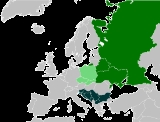
West Slavic languages

Encyclopedia
The West Slavic languages are a subdivision of the Slavic language group
that includes Czech
, Polish
, Slovak
, Kashubian
and Sorbian.
Classification:
Slavic languages
The Slavic languages , a group of closely related languages of the Slavic peoples and a subgroup of Indo-European languages, have speakers in most of Eastern Europe, in much of the Balkans, in parts of Central Europe, and in the northern part of Asia.-Branches:Scholars traditionally divide Slavic...
that includes Czech
Czech language
Czech is a West Slavic language with about 12 million native speakers; it is the majority language in the Czech Republic and spoken by Czechs worldwide. The language was known as Bohemian in English until the late 19th century...
, Polish
Polish language
Polish is a language of the Lechitic subgroup of West Slavic languages, used throughout Poland and by Polish minorities in other countries...
, Slovak
Slovak language
Slovak , is an Indo-European language that belongs to the West Slavic languages .Slovak is the official language of Slovakia, where it is spoken by 5 million people...
, Kashubian
Kashubian language
Kashubian or Cassubian is one of the Lechitic languages, a subgroup of the Slavic languages....
and Sorbian.
Classification:
- Indo-EuropeanIndo-European languagesThe Indo-European languages are a family of several hundred related languages and dialects, including most major current languages of Europe, the Iranian plateau, and South Asia and also historically predominant in Anatolia...
- Balto-SlavicBalto-Slavic languagesThe Balto-Slavic language group traditionally comprises Baltic and Slavic languages, belonging to the Indo-European family of languages. Baltic and Slavic languages share several linguistic traits not found in any other Indo-European branch, which points to the period of common development...
- SlavicSlavic languagesThe Slavic languages , a group of closely related languages of the Slavic peoples and a subgroup of Indo-European languages, have speakers in most of Eastern Europe, in much of the Balkans, in parts of Central Europe, and in the northern part of Asia.-Branches:Scholars traditionally divide Slavic...
- West Slavic
- Czech-Slovak languages
- CzechCzech languageCzech is a West Slavic language with about 12 million native speakers; it is the majority language in the Czech Republic and spoken by Czechs worldwide. The language was known as Bohemian in English until the late 19th century...
- KnaanicKnaanic languageKnaanic is an extinct West Slavic Jewish language, formerly spoken in the lands of the Western Slavs, notably the Czech lands, but also the lands of modern Poland, Lusatia and other Sorbian regions...
(Judaeo-Czech)
- Knaanic
- SlovakSlovak languageSlovak , is an Indo-European language that belongs to the West Slavic languages .Slovak is the official language of Slovakia, where it is spoken by 5 million people...
- Czech
- LechiticLechitic languagesThe Lechitic languages include three languages spoken in Central Europe, mainly in Poland, and historically also in the eastern and northern parts of modern Germany. This language group is a branch of the larger West Slavic language family...
- PolishPolish languagePolish is a language of the Lechitic subgroup of West Slavic languages, used throughout Poland and by Polish minorities in other countries...
- PomeranianPomeranian languageThe Pomeranian language is a group of dialects from the Lechitic cluster of the West Slavic languages. In medieval contexts, it refers to the dialects spoken by the Slavic Pomeranians...
- KashubianKashubian languageKashubian or Cassubian is one of the Lechitic languages, a subgroup of the Slavic languages....
- Slovincian
- Kashubian
- PolabianPolabian languageThe Polabian language is an extinct West Slavic language that was spoken by the Polabian Slavs in present-day North-Eastern Germany around the Elbe river, from which derives its name...
- Silesian
- Polish
- SorbianSorbian languagesThe Sorbian languages are classified under the Slavic branch of the Indo-European languages. They are the native languages of the Sorbs, a Slavic minority in the Lusatia region of eastern Germany. Historically the language has also been known as Wendish or Lusatian. Their collective ISO 639-2 code...
- Upper Sorbian
- Lower Sorbian
- Czech-Slovak languages
- West Slavic
- Slavic
- Balto-Slavic