

Piedmontese language

Encyclopedia
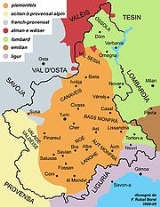
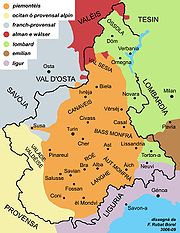
Piedmontese is a Romance language spoken by over 2 million people in Piedmont, northwest Italy
. It is geographically and linguistically included in the Northern Italian group (with Lombard, Emiliano-Romagnolo
, Ligurian
, and Venetan
). It is part of the wider western group of Romance languages
, including French
, Occitan, and Catalan
.
Many European and North American linguists (e. g., Einar Haugen
, Gianrenzo P. Clivio, Hans Göbl, Helmut Lüdtke, George Bossong, Klaus Bochmann, Karl Gebhardt, and Guiu Sobiela Caanitz) acknowledge Piedmontese as an independent language, though in Italy it is often still considered a dialect
.; on the other hand, in the Italian context, "dialect" (dialetto) refers to an indigenous language, not a variety of Italian.
Today it has a certain official status recognized by the Piedmont
regional government, but not by the national government.
Piedmontese was the first language of emigrants who, in the period from 1850 to 1950, left Piedmont for countries such as France
, Argentina
, and Uruguay
.
s used in Piedmont. Nevertheless, literature
in Piedmontese has never ceased to be produced: it includes poetry
, theatre
pieces, novel
s, and scientific work.
and by the Italian Republic, officially to prevent discrimination against migrants from other regions of Italy, who moved in large numbers to Turin
in particular.
In 2004, Piedmontese was recognised as Piedmont's regional language by the regional parliament, although the Italian government has not yet recognised it as such. In theory it is now supposed to be taught to children in school, but this is happening only to a limited extent.
The last decade has seen the publication of learning materials for schoolchildren, as well as general-public magazines. Courses for people already outside the education system have also been developed. In spite of these advances, the current state of Piedmontese is quite grave, as over the last 150 years the number of people with a written active knowledge of the language has shrunk to about 2% of native speakers, according to a recent survey. On the other hand, the same survey showed Piedmontese is still spoken by over half the population, alongside Italian. Authoritative sources confirm this result, putting the figure between 2 million (Assimil, IRES Piemonte) and 3 million speakers (Ethnologue) out of a population of 4.2 million people. Efforts to make it one of the official languages of the Turin 2006 Winter Olympics
were unsuccessful.
 Some of the most relevant characteristics of the Piedmontese language are:
Piedmontese has a number of varieties that may vary from its basic koiné
to quite a large extent. Variations include not only departures from the literary grammar, but also a wide variety in dictionary entries, as different regions maintain words of Frankish
or Lombard
origin, as well as differences in native Romance terminology. Words imported from various languages, including North Africa
n languages, are also present, while more recent imports tend to come from France
and from Italian.
A variety of Piedmontese was Judeo-Piedmontese
, a dialect spoken by the Piedmontese Jews
until the Second World War.
Italy
Italy , officially the Italian Republic languages]] under the European Charter for Regional or Minority Languages. In each of these, Italy's official name is as follows:;;;;;;;;), is a unitary parliamentary republic in South-Central Europe. To the north it borders France, Switzerland, Austria and...
. It is geographically and linguistically included in the Northern Italian group (with Lombard, Emiliano-Romagnolo
Emiliano-Romagnolo
Emiliano-Romagnolo is a Romance language mostly spoken in Emilia-Romagna, Italy and San Marino. It belongs to the Northern Italian group within Romance languages , which is included in the wider group of western Romance languages...
, Ligurian
Ligurian language (Romance)
Ligurian is a Gallo-Romance language spoken in Liguria in Northern Italy, parts of the Mediterranean coastal zone of France, Monaco and in the villages of Carloforte and Calasetta in Sardinia. Genoese , spoken in Genoa, the capital of Liguria, is its most important dialect...
, and Venetan
Venetian language
Venetian or Venetan is a Romance language spoken as a native language by over two million people, mostly in the Veneto region of Italy, where of five million inhabitants almost all can understand it. It is sometimes spoken and often well understood outside Veneto, in Trentino, Friuli, Venezia...
). It is part of the wider western group of Romance languages
Romance languages
The Romance languages are a branch of the Indo-European language family, more precisely of the Italic languages subfamily, comprising all the languages that descend from Vulgar Latin, the language of ancient Rome...
, including French
French language
French is a Romance language spoken as a first language in France, the Romandy region in Switzerland, Wallonia and Brussels in Belgium, Monaco, the regions of Quebec and Acadia in Canada, and by various communities elsewhere. Second-language speakers of French are distributed throughout many parts...
, Occitan, and Catalan
Catalan language
Catalan is a Romance language, the national and only official language of Andorra and a co-official language in the Spanish autonomous communities of Catalonia, the Balearic Islands and Valencian Community, where it is known as Valencian , as well as in the city of Alghero, on the Italian island...
.
Many European and North American linguists (e. g., Einar Haugen
Einar Haugen
Einar Ingvald Haugen was an American linguist, author and Professor at University of Wisconsin–Madison and Harvard University.-Biography:Haugen was born in Sioux City, Iowa to Norwegians from the town of Oppdal in Norway. When he was a young child, the family moved back to Oppdal for a few years,...
, Gianrenzo P. Clivio, Hans Göbl, Helmut Lüdtke, George Bossong, Klaus Bochmann, Karl Gebhardt, and Guiu Sobiela Caanitz) acknowledge Piedmontese as an independent language, though in Italy it is often still considered a dialect
Dialect
The term dialect is used in two distinct ways, even by linguists. One usage refers to a variety of a language that is a characteristic of a particular group of the language's speakers. The term is applied most often to regional speech patterns, but a dialect may also be defined by other factors,...
.; on the other hand, in the Italian context, "dialect" (dialetto) refers to an indigenous language, not a variety of Italian.
Today it has a certain official status recognized by the Piedmont
Piedmont
Piedmont is one of the 20 regions of Italy. It has an area of 25,402 square kilometres and a population of about 4.4 million. The capital of Piedmont is Turin. The main local language is Piedmontese. Occitan is also spoken by a minority in the Occitan Valleys situated in the Provinces of...
regional government, but not by the national government.
Piedmontese was the first language of emigrants who, in the period from 1850 to 1950, left Piedmont for countries such as France
France
The French Republic , The French Republic , The French Republic , (commonly known as France , is a unitary semi-presidential republic in Western Europe with several overseas territories and islands located on other continents and in the Indian, Pacific, and Atlantic oceans. Metropolitan France...
, Argentina
Argentina
Argentina , officially the Argentine Republic , is the second largest country in South America by land area, after Brazil. It is constituted as a federation of 23 provinces and an autonomous city, Buenos Aires...
, and Uruguay
Uruguay
Uruguay ,officially the Oriental Republic of Uruguay,sometimes the Eastern Republic of Uruguay; ) is a country in the southeastern part of South America. It is home to some 3.5 million people, of whom 1.8 million live in the capital Montevideo and its metropolitan area...
.
History
The first documents in the Piedmontese language were written in the 12th century, the sermones subalpini, when it was extremely close to Occitan. Literary Piedmontese developed in the 17th and 18th centuries, but it did not gain literary esteem comparable to that of French or Italian, other languageLanguage
Language may refer either to the specifically human capacity for acquiring and using complex systems of communication, or to a specific instance of such a system of complex communication...
s used in Piedmont. Nevertheless, literature
Literature
Literature is the art of written works, and is not bound to published sources...
in Piedmontese has never ceased to be produced: it includes poetry
Poetry
Poetry is a form of literary art in which language is used for its aesthetic and evocative qualities in addition to, or in lieu of, its apparent meaning...
, theatre
Theatre
Theatre is a collaborative form of fine art that uses live performers to present the experience of a real or imagined event before a live audience in a specific place. The performers may communicate this experience to the audience through combinations of gesture, speech, song, music or dance...
pieces, novel
Novel
A novel is a book of long narrative in literary prose. The genre has historical roots both in the fields of the medieval and early modern romance and in the tradition of the novella. The latter supplied the present generic term in the late 18th century....
s, and scientific work.
Current status
As elsewhere in Italy, Italian dominates everyday communication and is spoken to a far greater extent by the population than Piedmontese. Usage of the language has been discouraged both by the Kingdom of ItalyHistory of Italy
Italy, united in 1861, has significantly contributed to the political, cultural and social development of the entire Mediterranean region. Many cultures and civilizations have existed there since prehistoric times....
and by the Italian Republic, officially to prevent discrimination against migrants from other regions of Italy, who moved in large numbers to Turin
Turin
Turin is a city and major business and cultural centre in northern Italy, capital of the Piedmont region, located mainly on the left bank of the Po River and surrounded by the Alpine arch. The population of the city proper is 909,193 while the population of the urban area is estimated by Eurostat...
in particular.
In 2004, Piedmontese was recognised as Piedmont's regional language by the regional parliament, although the Italian government has not yet recognised it as such. In theory it is now supposed to be taught to children in school, but this is happening only to a limited extent.
The last decade has seen the publication of learning materials for schoolchildren, as well as general-public magazines. Courses for people already outside the education system have also been developed. In spite of these advances, the current state of Piedmontese is quite grave, as over the last 150 years the number of people with a written active knowledge of the language has shrunk to about 2% of native speakers, according to a recent survey. On the other hand, the same survey showed Piedmontese is still spoken by over half the population, alongside Italian. Authoritative sources confirm this result, putting the figure between 2 million (Assimil, IRES Piemonte) and 3 million speakers (Ethnologue) out of a population of 4.2 million people. Efforts to make it one of the official languages of the Turin 2006 Winter Olympics
2006 Winter Olympics
The 2006 Winter Olympics, officially known as the XX Olympic Winter Games, was a winter multi-sport event which was celebrated in Turin, Italy from February 10, 2006, through February 26, 2006. This marked the second time Italy hosted the Olympic Winter Games, the first being the VII Olympic Winter...
were unsuccessful.
Characteristics
- The presence of cliticCliticIn morphology and syntax, a clitic is a morpheme that is grammatically independent, but phonologically dependent on another word or phrase. It is pronounced like an affix, but works at the phrase level...
subject pronouns verbal pronouns, which give a Piedmontese phrase the following form: (subject) + verbal pronoun + verb, as in (mi) i von [I go]. Verbal pronouns are absent only in the imperative form and in the “Piedmontese interrogative form”. - The agglutinating form of verbal pronouns, which can be connected to dative and locative particles (a-i é [there is], i-j diso [I say to him]).
- The interrogative form, which adds an enclitic interrogative particle at the end of the verbal form (Veus-to? [Do you want to…])
- The absence of ordinal numerals, starting from the seventh place on (so that seventh will be Col che a fà set [The one which makes seven]).
- The co-presence of three affirmative interjections (that is, three ways to say yes): Si, sè (from the Latin form sic est, as in Italian); É (from the Latin form est, as in PortuguesePortuguese languagePortuguese is a Romance language that arose in the medieval Kingdom of Galicia, nowadays Galicia and Northern Portugal. The southern part of the Kingdom of Galicia became independent as the County of Portugal in 1095...
); Òj (from the Latin form hoc est as in Occitan, or maybe hoc illud, as in Franco-ProvençalFranco-Provençal languageFranco-Provençal , Arpitan, or Romand is a Romance language with several distinct dialects that form a linguistic sub-group separate from Langue d'Oïl and Langue d'Oc. The name Franco-Provençal was given to the language by G.I...
, French and Old CatalanCatalan languageCatalan is a Romance language, the national and only official language of Andorra and a co-official language in the Spanish autonomous communities of Catalonia, the Balearic Islands and Valencian Community, where it is known as Valencian , as well as in the city of Alghero, on the Italian island...
and Occitan). - The absence of the voiceless postalveolar fricativeVoiceless postalveolar fricativeThe voiceless palato-alveolar fricative or voiceless domed postalveolar fricative is a type of consonantal sound, used in many spoken languages, including English...
/ʃ/ (as in sheep), for which an alveolar S sound (as in sun) is usually substituted. - The presence of a S-C combination .
- The presence of a velar nasalVelar nasalThe velar nasal is the sound of ng in English sing. It is a type of consonantal sound, used in some spoken languages. The symbol in the International Phonetic Alphabet that represents this sound is , and the equivalent X-SAMPA symbol is N....
N-sound [ŋ] , which usually precedes a vowel, as in lun-a [moon]. - The presence of the third piedmontese vowel Ë, which is read as a very short sound (somehow close to the half-mute sound in sir).
- The absence of the phonological contrast that exists in Italian between short (single) and long (double) consonants, for example, it. /fata/ 'fairy' and [fatta] 'done'.
- The existence of a prostheticProsthesis (linguistics)In linguistics, prosthesis is the addition of a sound or syllable at the beginning of a word without changing the word's meaning or the rest of its structure. The alternative spelling prothesis was first used in post-classical Latin, based on Greek próthesis "placing before" or "in public"...
Ë sound, that is interposed when consonantal clusters arise that are not permitted by the phonological system. So stèile 'stars' in 'seven stars' is pronounced set ëstèile.
Piedmontese has a number of varieties that may vary from its basic koiné
Koine language
In linguistics, a koiné language is a standard language or dialect that has arisen as a result of contact between two mutually intelligible varieties of the same language. Since the speakers have understood one another from before the advent of the koiné, the koineization process is not as rapid...
to quite a large extent. Variations include not only departures from the literary grammar, but also a wide variety in dictionary entries, as different regions maintain words of Frankish
Franks
The Franks were a confederation of Germanic tribes first attested in the third century AD as living north and east of the Lower Rhine River. From the third to fifth centuries some Franks raided Roman territory while other Franks joined the Roman troops in Gaul. Only the Salian Franks formed a...
or Lombard
Lombards
The Lombards , also referred to as Longobards, were a Germanic tribe of Scandinavian origin, who from 568 to 774 ruled a Kingdom in Italy...
origin, as well as differences in native Romance terminology. Words imported from various languages, including North Africa
North Africa
North Africa or Northern Africa is the northernmost region of the African continent, linked by the Sahara to Sub-Saharan Africa. Geopolitically, the United Nations definition of Northern Africa includes eight countries or territories; Algeria, Egypt, Libya, Morocco, South Sudan, Sudan, Tunisia, and...
n languages, are also present, while more recent imports tend to come from France
France
The French Republic , The French Republic , The French Republic , (commonly known as France , is a unitary semi-presidential republic in Western Europe with several overseas territories and islands located on other continents and in the Indian, Pacific, and Atlantic oceans. Metropolitan France...
and from Italian.
A variety of Piedmontese was Judeo-Piedmontese
Judæo-Piedmontese
Judæo-Piedmontese was the vernacular language of the Jews living in Piedmont, in North Western Italy, from about the 15th Century until the Second World War....
, a dialect spoken by the Piedmontese Jews
Jews
The Jews , also known as the Jewish people, are a nation and ethnoreligious group originating in the Israelites or Hebrews of the Ancient Near East. The Jewish ethnicity, nationality, and religion are strongly interrelated, as Judaism is the traditional faith of the Jewish nation...
until the Second World War.
Lexical comparison with other Romance languages
| Piedmontese | Italian | French | Spanish | Portuguese | Catalan | English (Germanic but heavily influenced by French) |
|---|---|---|---|---|---|---|
| cadrega | sedia | chaise | silla | cadeira | cadira | chair |
| pijé | prendere, pigliare | prendre | tomar | pegar, tomar | prendre | to take |
| surtì | uscire | sortir | salir | sair | sortir | to go/come out |
| droché/casché/tombé | cadere, cascare | tomber | caer, tumbar | cair, tombar | caure | to fall |
| ca/mison | casa | maison | casa | casa | casa | home |
| brass | braccio | bras | brazo | braço | braç | arm |
| nùmer | numero | numéro | número | número | nombre | number |
| pom | mela | pomme | manzana | maçã | poma | apple |
| travajé | lavorare | travailler | trabajar, laborar | trabalhar | treballar | to work |
| ratavolòira | pipistrello | chauve-souris | murciélago | morcego | ratpenat | bat |
| scòla | scuola | école | escuela | escola | escola | school |
| bòsch | legno | bois | madera, leña | madeira, lenha | fusta | wood |
| monsù | signore | monsieur | señor | senhor, seu | senyor | Mr |
| madama | signora | madame | señora | senhora, dona | senyora | Mrs |
| istà | estate | été | verano, estío | verão | estiu | summer |
| ancheuj | oggi | aujourd'hui | hoy | hoje | avui | today |
| dman | domani | demain | mañana | amanhã | demà | tomorrow |
| jer | ieri | hier | ayer | ontem | ahir | yesterday |
| lùn-es | lunedì | lundi | lunes | segunda-feira | dilluns | Monday |
| màrtes | martedì | mardi | martes | terça-feira | dimarts | Tuesday |
| mèrcol/merco | mercoledì | mercredi | miércoles | quarta-feira | dimecres | Wednesday |
| giòbia | giovedì | jeudi | jueves | quinta-feira | dijous | Thursday |
| vënner | venerdì | vendredi | viernes | sexta-feira | divendres | Friday |
| saba | sabato | samedi | sábado | sábado | dissabte | Saturday |
| dumìnica | domenica | dimanche | domingo | domingo | diumenge | Sunday |
External links
- Cultural Association "Nòste Rèis": features online Piedmontese courses for Italian, French, English, and Spanish speakers with drills and tests
- La Losna - Piedmontese Cultural Association
- http://xoomer.virgilio.it/guidematt/: features literary translations and scientific articles in Piedmontese and information about the language