


Old Italic alphabet

Encyclopedia
Old Italic refers to several now extinct alphabet
systems used on the Italian Peninsula
in ancient times for various Indo-European languages
(predominantly Italic
) and non-Indo-European (e.g. Etruscan
) languages. The alphabets derive from the Euboean Greek Cumaean alphabet, used at Ischia
and Cumae
in the Bay of Naples in the eighth century BC.
Various Indo-European languages
belonging to the Italic
branch (Faliscan
and members of the Sabellian group, including Oscan, Umbrian, and South Picene, and other Indo-European branches such as Celtic
, Venetic and Messapic) originally used the alphabet. Faliscan, Oscan, Umbrian, North Picene, and South Picene all derive from an Etruscan form of the alphabet.
The Germanic
runic alphabet
was derived from one of these alphabets by the 2nd century.
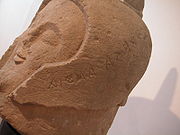 It is not clear whether the process of adaptation from the Greek alphabet
took place in Italy
from the first colony of Greeks, the city of Cumae
, or in Greece
/Asia Minor
. It was in any case a Western Greek alphabet. In the alphabets of the West, X had the sound value [ks], Ψ stood for [kʰ]; in Etruscan: X = [s], Ψ = [kʰ] or [kχ] (Rix 202-209).
The earliest Etruscan abecedarium
, the Marsiliana d'Albegna (near Grosseto
) tablet which dates to c. 700 BC, lists 26 letters corresponding to contemporary forms of the Greek alphabet which retained san
and qoppa
but which had not yet developed omega
.
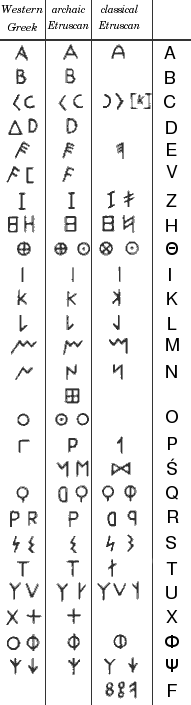
Until about 600 BC, the archaic form of the Etruscan alphabet remained practically unchanged, and the direction of writing was free. From the 6th century, however, evolutions of the alphabet took place, guided by the phonology of the Etruscan language, and letters representing phonemes nonexistent in Etruscan were dropped. By 400 BC, it appears that all of Etruria
was using the classical Etruscan alphabet of 20 letters, mostly written from left to right:
An additional sign , in shape similar to the numeral 8, transcribed as F, was present in both Lydian
and Etruscan (Jensen 513). Its origin is disputed; it may have been an altered B or H or an ex novo creation (Rix 202). Its sound value was /f/ and it replaced the Etruscan FH. Some letters were, on the other hand, falling out of use: B and D were apparently considered superfluous over P and T. K was dropped in favour of G (also transcribed as C). O disappeared and was replaced by U. In the course of its simplification, the redundant letters showed some tendency towards a syllabary
: C, K and Q were predominantly used in the contexts CE, KA, QU.
This classical alphabet remained in use until the 2nd century BC when it began to be contaminated by the rise of the Latin alphabet
. Soon after the Etruscan language itself became extinct.
probably adopted the archaic Etruscan alphabet during the 7th century BC, but a recognizably Oscan variant of the alphabet is attested only from the 5th century BC; its sign inventory extended over the classical Etruscan alphabet by the introduction of long vowel variants of I and U, transcribed as Í and Ú. U came to be used to represent Oscan o, while Ú was used for actual Oscan u.
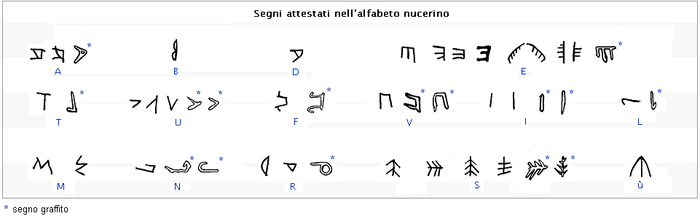
The Nucerian alphabet is based on inscriptions found in southern Italy (Nocera Superiore
, Sorrento
, Vico Equense
and others places). It is attested only between the 6th and the 5th century BC.
The most important sign is the /S/, shaped like a fir tree, and possibly a derivation from the Phoenician alphabet
.
, based on inscriptions found in northern Italy and Canton Ticino, was used to record Lepontic inscriptions, among the oldest testimonies of any Celtic language, in use from the 7th to the 5th centuries BC. The alphabet has 17 letters, derived from the archaic Etruscan alphabet:
The alphabet does not distinguish voiced and unvoiced occlusives, i.e. P represents /b/ or /p/, T is for /t/ or /d/, K for /g/ or /k/.
Z is probably for /ts/. U /u/ and V /w/ are distinguished. Θ is probably for /t/ and X for /g/. There are claims of a related script discovered in Glozel
.
(also, of Bolzano), about 100 Raetic inscriptions.
The alphabet of Sondrio
, west Raetian and Camunic
inscriptions.
The alphabet of Magrè (near Schio
), east Raetian inscriptions.
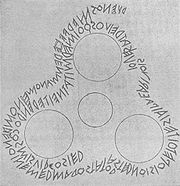
on rock engraves
in Valle Camonica.
21 of the 26 archaic Etruscan letters were adopted for Old Latin
from the 7th century BC, either directly from the Cumae alphabet, or via archaic Etruscan forms, compared to the classical Etruscan alphabet retaining B, D, K, O, Q, X but dropping Θ, Ś, Φ, Ψ, F (Etruscan U is Latin V, Etruscan V is Latin F).
Standard in March, 2001 with the release of version 3.1.
Writing direction (right-to-left, left-to-right, or boustrophedon
) varies based on the language and even the time period. For simplicity most scholars use left-to-right and this is the Unicode default direction for the Old Italic block. For this reason, the glyphs in the code chart are shown with left-to-right orientation.
Alphabet
An alphabet is a standard set of letters—basic written symbols or graphemes—each of which represents a phoneme in a spoken language, either as it exists now or as it was in the past. There are other systems, such as logographies, in which each character represents a word, morpheme, or semantic...
systems used on the Italian Peninsula
Italian Peninsula
The Italian Peninsula or Apennine Peninsula is one of the three large peninsulas of Southern Europe , spanning from the Po Valley in the north to the central Mediterranean Sea in the south. The peninsula's shape gives it the nickname Lo Stivale...
in ancient times for various Indo-European languages
Indo-European
Indo-European may refer to:* Indo-European languages** Aryan race, a 19th century and early 20th century term for those peoples who are the native speakers of Indo-European languages...
(predominantly Italic
Italic languages
The Italic subfamily is a member of the Indo-European language family. It includes the Romance languages derived from Latin , and a number of extinct languages of the Italian Peninsula, including Umbrian, Oscan, Faliscan, and Latin.In the past various definitions of "Italic" have prevailed...
) and non-Indo-European (e.g. Etruscan
Etruscan language
The Etruscan language was spoken and written by the Etruscan civilization, in what is present-day Italy, in the ancient region of Etruria and in parts of Lombardy, Veneto, and Emilia-Romagna...
) languages. The alphabets derive from the Euboean Greek Cumaean alphabet, used at Ischia
Ischia
Ischia is a volcanic island in the Tyrrhenian Sea. It lies at the northern end of the Gulf of Naples, about 30 km from the city of Naples. It is the largest of the Phlegrean Islands. Roughly trapezoidal in shape, it measures around 10 km east to west and 7 km north to south and has...
and Cumae
Cumae
Cumae is an ancient Greek settlement lying to the northwest of Naples in the Italian region of Campania. Cumae was the first Greek colony on the mainland of Italy , and the seat of the Cumaean Sibyl...
in the Bay of Naples in the eighth century BC.
Various Indo-European languages
Indo-European languages
The Indo-European languages are a family of several hundred related languages and dialects, including most major current languages of Europe, the Iranian plateau, and South Asia and also historically predominant in Anatolia...
belonging to the Italic
Italic languages
The Italic subfamily is a member of the Indo-European language family. It includes the Romance languages derived from Latin , and a number of extinct languages of the Italian Peninsula, including Umbrian, Oscan, Faliscan, and Latin.In the past various definitions of "Italic" have prevailed...
branch (Faliscan
Faliscan language
The Faliscan language, the extinct language of the ancient Falisci, forms, together with Latin, the group of Latino-Faliscan languages. It seems probable that the dialect lasted on, though being gradually permeated with Latin, until at least 150 BC.-Corpus:...
and members of the Sabellian group, including Oscan, Umbrian, and South Picene, and other Indo-European branches such as Celtic
Celtic languages
The Celtic languages are descended from Proto-Celtic, or "Common Celtic"; a branch of the greater Indo-European language family...
, Venetic and Messapic) originally used the alphabet. Faliscan, Oscan, Umbrian, North Picene, and South Picene all derive from an Etruscan form of the alphabet.
The Germanic
Germanic languages
The Germanic languages constitute a sub-branch of the Indo-European language family. The common ancestor of all of the languages in this branch is called Proto-Germanic , which was spoken in approximately the mid-1st millennium BC in Iron Age northern Europe...
runic alphabet
Runic alphabet
The runic alphabets are a set of related alphabets using letters known as runes to write various Germanic languages before the adoption of the Latin alphabet and for specialized purposes thereafter...
was derived from one of these alphabets by the 2nd century.
Etruscan alphabet
Greek alphabet
The Greek alphabet is the script that has been used to write the Greek language since at least 730 BC . The alphabet in its classical and modern form consists of 24 letters ordered in sequence from alpha to omega...
took place in Italy
Italy
Italy , officially the Italian Republic languages]] under the European Charter for Regional or Minority Languages. In each of these, Italy's official name is as follows:;;;;;;;;), is a unitary parliamentary republic in South-Central Europe. To the north it borders France, Switzerland, Austria and...
from the first colony of Greeks, the city of Cumae
Cumae
Cumae is an ancient Greek settlement lying to the northwest of Naples in the Italian region of Campania. Cumae was the first Greek colony on the mainland of Italy , and the seat of the Cumaean Sibyl...
, or in Greece
Greece
Greece , officially the Hellenic Republic , and historically Hellas or the Republic of Greece in English, is a country in southeastern Europe....
/Asia Minor
Asia Minor
Asia Minor is a geographical location at the westernmost protrusion of Asia, also called Anatolia, and corresponds to the western two thirds of the Asian part of Turkey...
. It was in any case a Western Greek alphabet. In the alphabets of the West, X had the sound value [ks], Ψ stood for [kʰ]; in Etruscan: X = [s], Ψ = [kʰ] or [kχ] (Rix 202-209).
The earliest Etruscan abecedarium
Abecedarium
An abecedarium is an inscription consisting of the letters of an alphabet, almost always listed in order. Typically, abecedaria are practice exercises....
, the Marsiliana d'Albegna (near Grosseto
Grosseto
Grosseto is a city and comune in the central Italian region of Tuscany, the capital of the Province of Grosseto. The city lies 14 km from the Tyrrhenian Sea, in the Maremma, at the centre of an alluvial plain, on the Ombrone river....
) tablet which dates to c. 700 BC, lists 26 letters corresponding to contemporary forms of the Greek alphabet which retained san
San (letter)
San was an archaic letter of the Greek alphabet. Its shape was similar to modern M, or to a modern Greek Sigma turned sideways, and it was used as an alternative to Sigma to denote the sound . Unlike Sigma, whose position in the alphabet is between Rho and Tau, San appeared between Pi and Qoppa...
and qoppa
Qoppa
Koppa or Qoppa is a letter that was used in early forms of the Greek alphabet, derived from Phoenician qoph. It was originally used to denote the /k/ sound, but dropped out of use as an alphabetic character in favour of Kappa . It has remained in use as a numeral symbol in the system of Greek...
but which had not yet developed omega
Omega
Omega is the 24th and last letter of the Greek alphabet. In the Greek numeric system, it has a value of 800. The word literally means "great O" , as opposed to omicron, which means "little O"...
.
| 𐌀 | 𐌁 | 𐌂 | 𐌃 | 𐌄 | 𐌅 | 𐌆 | 𐌇 | 𐌈 | 𐌉 | 𐌊 | 𐌋 | 𐌌 | |||||||||||||
| 𐌍 | 𐌎 | 𐌏 | 𐌐 | 𐌑 | 𐌒 | 𐌓 | 𐌔 | 𐌕 | 𐌖 | 𐌗 | 𐌘 | 𐌙 | |||||||||||||
| in transliteration, | |||||||||||||||||||||||||
| A | B | G | D | E | V | Z | H | Θ | I | K | L | M | |||||||||||||
| N | Ξ | O | P | Ś | Q | R | S | T | Y | X | Φ | Ψ | |||||||||||||
Until about 600 BC, the archaic form of the Etruscan alphabet remained practically unchanged, and the direction of writing was free. From the 6th century, however, evolutions of the alphabet took place, guided by the phonology of the Etruscan language, and letters representing phonemes nonexistent in Etruscan were dropped. By 400 BC, it appears that all of Etruria
Etruria
Etruria—usually referred to in Greek and Latin source texts as Tyrrhenia—was a region of Central Italy, an area that covered part of what now are Tuscany, Latium, Emilia-Romagna, and Umbria. A particularly noteworthy work dealing with Etruscan locations is D. H...
was using the classical Etruscan alphabet of 20 letters, mostly written from left to right:
| 𐌀 | 𐌂 | 𐌃 | 𐌄 | 𐌅 | 𐌆 | 𐌇 | 𐌈 | 𐌉 | 𐌋 | |
| 𐌌 | 𐌍 | 𐌐 | 𐌑 | 𐌓 | 𐌔 | 𐌕 | 𐌖 | 𐌘 | 𐌙 | 𐌚 |
| A | C | D | E | V | Z | H | Θ | I | L | |
| M | N | P | Ś | R | S | T | U | Φ | Ψ | F |
An additional sign , in shape similar to the numeral 8, transcribed as F, was present in both Lydian
Lydian language
Lydian was an Indo-European language spoken in the region of Lydia in western Anatolia . It belongs to the Anatolian group of the Indo-European language family....
and Etruscan (Jensen 513). Its origin is disputed; it may have been an altered B or H or an ex novo creation (Rix 202). Its sound value was /f/ and it replaced the Etruscan FH. Some letters were, on the other hand, falling out of use: B and D were apparently considered superfluous over P and T. K was dropped in favour of G (also transcribed as C). O disappeared and was replaced by U. In the course of its simplification, the redundant letters showed some tendency towards a syllabary
Syllabary
A syllabary is a set of written symbols that represent syllables, which make up words. In a syllabary, there is no systematic similarity between the symbols which represent syllables with the same consonant or vowel...
: C, K and Q were predominantly used in the contexts CE, KA, QU.
This classical alphabet remained in use until the 2nd century BC when it began to be contaminated by the rise of the Latin alphabet
Latin alphabet
The Latin alphabet, also called the Roman alphabet, is the most recognized alphabet used in the world today. It evolved from a western variety of the Greek alphabet called the Cumaean alphabet, which was adopted and modified by the Etruscans who ruled early Rome...
. Soon after the Etruscan language itself became extinct.
Oscan alphabet
The OsciOsci
The Osci , were an Italic people of Campania and Latium adiectum during Roman times. They spoke the Oscan language, also spoken by the Samnites of Southern Italy. Although the language of the Samnites was called Oscan, the Samnites were never called Osci, or the Osci Samnites...
probably adopted the archaic Etruscan alphabet during the 7th century BC, but a recognizably Oscan variant of the alphabet is attested only from the 5th century BC; its sign inventory extended over the classical Etruscan alphabet by the introduction of long vowel variants of I and U, transcribed as Í and Ú. U came to be used to represent Oscan o, while Ú was used for actual Oscan u.
| 𐌀 | 𐌁 | 𐌂 | 𐌃 | 𐌄 | 𐌅 | 𐌆 | 𐌇 | 𐌈 | 𐌋 | 𐌌 | 𐌍 | 𐌐 | 𐌑 | 𐌓 | 𐌔 | 𐌕 | 𐌖 | 𐌚 | 𐌞 | 𐌝 |
| A | B | G | D | E | V | Z | H | I | L | M | N | P | Ś | R | S | T | U | F | Ú | Í |
Alphabet of Nuceria
The Nucerian alphabet is based on inscriptions found in southern Italy (Nocera Superiore
Nocera Superiore
Nocera Superiore is a town and comune in the province of Salerno in the Campania region of south-western Italy.-History:It was an Etruscan city, founded around the 7th century BC...
, Sorrento
Sorrento
Sorrento is the name of many cities and towns:*Sorrento, Italy*Sorrento, Florida, United States*Sorrento, Louisiana, United States*Sorrento, Maine, United States*Sorrento, Victoria, a township on the Mornington Peninsula, Victoria, Australia...
, Vico Equense
Vico Equense
Vico Equense is a coastal town and comune in the province of Naples, in the Campania region of southern Italy.-Geography:Vico Equense is part of the greater Bay of Naples metropolitan area and is a popular destination for tourists...
and others places). It is attested only between the 6th and the 5th century BC.
The most important sign is the /S/, shaped like a fir tree, and possibly a derivation from the Phoenician alphabet
Phoenician alphabet
The Phoenician alphabet, called by convention the Proto-Canaanite alphabet for inscriptions older than around 1050 BC, was a non-pictographic consonantal alphabet, or abjad. It was used for the writing of Phoenician, a Northern Semitic language, used by the civilization of Phoenicia...
.
Alphabet of Lugano
The Alphabet of LuganoLugano
Lugano is a city of inhabitants in the city proper and a total of over 145,000 people in the agglomeration/city region, in the south of Switzerland, in the Italian-speaking canton of Ticino, which borders Italy...
, based on inscriptions found in northern Italy and Canton Ticino, was used to record Lepontic inscriptions, among the oldest testimonies of any Celtic language, in use from the 7th to the 5th centuries BC. The alphabet has 17 letters, derived from the archaic Etruscan alphabet:
| 𐌀 | 𐌄 | 𐌉 | 𐌊 | 𐌋 | 𐌌 | 𐌍 | 𐌏 | 𐌐 | 𐌓 | 𐌔 | 𐌕 | 𐌈 | 𐌖 | 𐌅 | 𐌗 | 𐌆 |
| A | E | I | K | L | M | N | O | P | R | S | T | Θ | U | V | X | Z |
The alphabet does not distinguish voiced and unvoiced occlusives, i.e. P represents /b/ or /p/, T is for /t/ or /d/, K for /g/ or /k/.
Z is probably for /ts/. U /u/ and V /w/ are distinguished. Θ is probably for /t/ and X for /g/. There are claims of a related script discovered in Glozel
Glozel
Glozel is a hamlet in central France, part of the commune of Ferrières-sur-Sichon, Canton of Le Mayet-de-Montagne, Allier, some 17 km from Vichy....
.
Raetic alphabets
The alphabet of SanzenoSanzeno
Sanzeno is a comune in Trentino in the northern Italian region Trentino-Alto Adige/Südtirol, located about 35 km north of Trento...
(also, of Bolzano), about 100 Raetic inscriptions.
The alphabet of Sondrio
Sondrio
Sondrio is an Italian town and comune located in the heart of the Valtellina. Sondrio counts approximately 22,000 inhabitants and it is the administrative centre for the Lombard Province of Sondrio.- History :...
, west Raetian and Camunic
Camunic language
The Camunic language is an extinct language which was spoken in the first millennium BC in the Valcamonica and Valtellina valleys of the Central Alps. It has most recently been considered to represent a form of Celtic .-Language:...
inscriptions.
The alphabet of Magrè (near Schio
Schio
Schio is a town and comune in the province of Vicenza situated North of Vicenza and East of the Lake of Garda. It is surrounded by the Little Dolomites and Mount Pasubio.-History:...
), east Raetian inscriptions.
Venetic alphabet
Alphabet of Este: Similar but not identical to that of Magrè, Venetic inscriptions.Camunic alphabet
Inscripted abecedariumAbecedarium
An abecedarium is an inscription consisting of the letters of an alphabet, almost always listed in order. Typically, abecedaria are practice exercises....
on rock engraves
Rock Drawings in Valcamonica
The stone carvings of Val Camonica constitute one of the largest collections of prehistoric petroglyphs in the world. The collection was recognized by Unesco in 1979 and was Italy's first recognized World Heritage Site...
in Valle Camonica.
Latin alphabet
21 of the 26 archaic Etruscan letters were adopted for Old Latin
Old Latin
Old Latin refers to the Latin language in the period before the age of Classical Latin; that is, all Latin before 75 BC...
from the 7th century BC, either directly from the Cumae alphabet, or via archaic Etruscan forms, compared to the classical Etruscan alphabet retaining B, D, K, O, Q, X but dropping Θ, Ś, Φ, Ψ, F (Etruscan U is Latin V, Etruscan V is Latin F).
| 𐌀 | 𐌁 | 𐌂 | 𐌃 | 𐌄 | 𐌅 | 𐌆 | 𐌇 | 𐌉 | 𐌊 | 𐌋 | 𐌌 | 𐌍 | 𐌏 | 𐌐 | 𐌒 | 𐌓 | 𐌔 | 𐌕 | 𐌖 | 𐌗 |
| A | B | C | D | E | F | Z | H | I | K | L | M | N | O | P | Q | R | S | T | V | X |
Unicode
The Old Italic alphabets were unified and added to the UnicodeUnicode
Unicode is a computing industry standard for the consistent encoding, representation and handling of text expressed in most of the world's writing systems...
Standard in March, 2001 with the release of version 3.1.
Block
The Unicode block for Old Italic is U+10300–U+1032F without specification of a particular alphabet (i.e. the Old Italic alphabets are considered equivalent, and the font used will determine the variant).Writing direction (right-to-left, left-to-right, or boustrophedon
Boustrophedon
Boustrophedon , is a type of bi-directional text, mostly seen in ancient manuscripts and other inscriptions. Every other line of writing is flipped or reversed, with reversed letters. Rather than going left-to-right as in modern English, or right-to-left as in Arabic and Hebrew, alternate lines in...
) varies based on the language and even the time period. For simplicity most scholars use left-to-right and this is the Unicode default direction for the Old Italic block. For this reason, the glyphs in the code chart are shown with left-to-right orientation.
Letters with Transliteration
| Letter | Translit. | Name | Letter | Translit. | Name | Letter | Translit. | Name |
|---|---|---|---|---|---|---|---|---|
| 𐌀 | a | a | 𐌁 | b | be | 𐌂 | c | ke |
| 𐌃 | d | de | 𐌄 | e | e | 𐌅 | v | ve |
| 𐌆 | z | ze | 𐌇 | h | he | 𐌈 | þ | the |
| 𐌉 | i | i | 𐌊 | k | ka | 𐌋 | l | el |
| 𐌌 | m | em | 𐌍 | n | en | 𐌎 | š | esh |
| 𐌏 | o | o | 𐌐 | p | pe | 𐌑 | ś | she |
| 𐌒 | q | ku | 𐌓 | r | er | 𐌔 | s | es |
| 𐌕 | t | te | 𐌖 | u | u | 𐌗 | x | eks |
| 𐌘 | ph | phe | 𐌙 | ch | khe | 𐌚 | f | ef |
| 𐌛 | ř | ers | 𐌜 | ç | che | 𐌝 | í | ii |
| 𐌞 | ú | uu | 𐌠 | I | 1 | 𐌡 | V | 5 |
| 𐌢 | X | 10 | 𐌣 | L | 50 |
External links
- Etruscan Texts Project: A searchable online database of Etruscan inscriptions.
- Old Italic Unicode
- The Etruscan alphabet (Omniglot)
- Old Italic alphabets (Omniglot)
- Etruscan (Ancient Scripts)
- Oscan (Ancient Scripts)
- Unicode Fonts