


Old Church Slavonic

Encyclopedia
Old Church Slavonic or Old Church Slavic (OCS) was the first literary
Slavic language, first developed by the 9th century Byzantine Greek
missionaries Saints Cyril and Methodius
who were credited with standardizing
the language and using it for translating the Bible
and other Ancient Greek ecclesiastical texts as part of the Christianisation of the Slavic peoples
. It played an important role in the history of the Slavic languages and served as a basis and model for later Church Slavonic traditions, and some Eastern Orthodox and Eastern Catholic churches use Church Slavonic as a liturgical language to this day.
in 863 (see Glagolitic alphabet
for details). For that purpose, Cyril
and his brother Methodius started to translate religious literature to Old Church Slavonic, allegedly based on Slavic dialects spoken in the hinterland of their home-town, Thessaloniki, in the region of Macedonia
.
As part of the preparation for the mission, in 862/863, the Glagolitic alphabet
was created and the most important prayers and liturgical book
s, including the Aprakos Evangeliar (a Gospel Book
lectionary
containing only feast-day and Sunday readings), the Psalter
, and Acts of the Apostles
, were translated. (The Gospels were also translated early, but it is unclear whether Sts. Cyril or Methodius had a hand in this). The language and the alphabet were taught at the Great Moravian Academy (Veľkomoravské učilište) and were used for government and religious documents and books between 863 and 885. The texts written during this phase contain characteristics of the Slavic
vernacular
s in Great Moravia
.
In 885, the use of the Old Church Slavonic in Great Moravia was prohibited by the Pope
in favour of Latin
. Students of the two apostles
, who were expelled from Great Moravia in 886, brought the Glagolitic alphabet and the Old Church Slavonic language to the Bulgarian Empire. It was taught at two Bulgaria
n literary schools in Preslav
(capital 893–972) and Ohrid
(capital 991/997–1015). The Cyrillic alphabet
was developed shortly afterwards in the Preslav Literary School
and replaced the Glagolitic one. The texts written during this era contain characteristics of the vernacular of Bulgaria. There are some linguistic differences between texts written in the two academies. Thereupon the language, in its Bulgarian dialects, spread to other South-Eastern and Eastern European Slavic territories, most notably to Croatia
, Serbia
, Bohemia
, Lesser Poland
, and principalities of the Kievan Rus'
. The texts written in each country contain characteristics of the local Slavic vernacular. By the mid-eleventh century, OCS diversified into regional versions: Bulgarian, Serbian, Old Russian, and up to the fifteenth century, also Czech and Croatian. These local offspring of OCS, are called “Church Slavonic” languages.
Apart from the Slavic countries, Slavonic has been used as a liturgical language by the Romanian Orthodox Church, as well as a literary and official language of the prince courts of Wallachia and Moldavia (see Old Church Slavonic in Romania), before gradually being replaced by Romanian starting with the 18th century.
Church Slavonic maintained a prestige status, particularly in Russia
, for many centuries among Slavs in the East it had a status analogous to that of the Latin language
in western Europe
, but had the advantage of being substantially less divergent from the vernacular
tongues of average parishioners. Some Orthodox churches, such as the Macedonian Orthodox Church
, Russian Orthodox Church
, Bulgarian Orthodox Church
and Serbian Orthodox Church
, as well as several Greek Catholic churches, still use Church Slavonic in their services and chants today.
, but later Glagolitic was replaced by the Cyrillic alphabet
. Only in Croatia
was the local variant of the Glagolitic alphabet preserved. See Early Cyrillic alphabet
for a detailed description of the script and information about the sounds it originally expressed.
s (masculine, feminine, neuter), three numbers (singular, plural, dual) and seven cases
: nominative
, vocative
, accusative
, instrumental
, dative
, genitive
, and locative
. Synthetic
verbal conjugation is expressed in present, aorist and imperfect tenses, while perfect, pluperfect, future and conditional tenses/moods are made by combining auxiliary verbs with participles or synthetic tense forms.
and Saint Methodius to Great Moravia
(863–885). The only well-preserved manuscript of Moravian dialect, the Kiev Folia, is characterised by the replacement of some Southern Slavic phonetic and lexical features with Western Slavic ones. Manuscripts written in the medieval Bulgarian tsardom have, on the other hand, few Western Slavic features.
Old Church Slavonic is valuable to historical linguists since it preserves archaic features believed to have once been common to all Slavic languages. Some of these features are:
The Southern Slavic nature of the language is evident from the following variations:
}, /la/ by means of liquid metathesis of Proto-Slavic *or, *ol clusters
} from the Proto-Slavic *x before *ąi
} and /dzv/ from the Proto-Slavic *kv', *gv'
Old Church Slavonic has some extra features in common with Bulgarian:
in 863. While in the Prague fragments the only Moravian influence is replacing /ʃt/ with /ts/ and /ʒd/ with /z/, the dialect evidenced by the Kiev Folia is characterised by the following features:
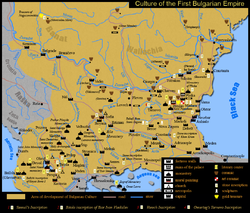 Old Church Slavonic was developed initially in the First Bulgarian Empire
and was taught in Preslav
(Bulgarian capital between 893 and 972), and in Ohrid
(Bulgarian capital between 991/997 and 1015). It didn't represent one regional dialect but a generalized form of early eastern South Slavic, which cannot be localized. The existence of two major literary centres in the Empire led in the period from the ninth to the eleventh centuries to the development of two dialects, named "(Eastern) Bulgarian" and "(Western) Macedonian" respectively. Some researchrs do not distinguish different Bulgarian dialects, but only one, called "Macedo-Bulgarian" or simply "Bulgarian". Others, as Horace Lunt
, have changed their opinion with time. The development of the Slavic literacy at that time, was crucial for the development of distinct Bulgarian ethnic consciousness in the state.
. The Cyrillic alphabet
is attributed to this school, as the earliest datable Cyrillic inscriptions have been found in the area. A number of prominent Bulgarian writers and scholars worked at the school, including Naum of Preslav (until 893), Constantine of Preslav
, John Exarch
, Chernorizets Hrabar
, etc. The main features of this dialect are the following:
Present-day Modern Bulgarian was standardized on the basis of the 19th-century Eastern Bulgarian vernacular.
, today part of the Republic of Macedonia
. At that period, administratively Ohrid was in the province of Kutmichevitsa
in the First Bulgarian Empire
until 1018. The main literary centre of this dialect was the Ohrid Literary School
, whose most prominent member and most likely founder, was Saint Clement of Ohrid
. The language variety that was used in the area started shaping Macedonian dialects. This dialect is represented by the Codex Zographensis
and Marianus
, among others. The main features of this dialect are the following:
The Macedonian language
was standardized in 1945 on the basis of the Central Macedonian dialects which evolved from the Macedonian dialect. Even though nowadays the Macedonian dialects make the Macedonian language itself, most sources before the Second World War referred to them as Bulgarian dialects
.
n or Bulgaria
n features were also preserved. Some of the significant later dialects of Old Church Slavonic (referred to as Church Slavonic) in the present time are: Slovene, Croatian
, Serbian
, Russian
. In all cases, denasalization of the yus
es occurred; so that only Old Church Slavonic and modern Polish
retained the old Slavonic nasal vowels.
Due to Bulgaria becoming annexed in 1396, and the Ottoman conquering of Serbia in 1459, Serbia saw an influx of educated refugee-scribes trained in the Bulgarian dialect in that period, which re-introduced a more classical form.
of angular Croatian type. It is characterized by the following developments:
For example, the Freising Fragments, dating from the tenth century, do show some linguistic and cultural traits of Old Church Slavonic, but are usually not included in the canon as some of the phonological features of the writings appear to belong to certain Pannonian Slavic dialect of the period. Similarly, the Ostromir Gospels exhibits dialectal features that classify it as East Slavic
, rather than South Slavic, so it's not included in the canon either. On the other hand, the Kiev Missal
is included in the canon, even though it manifests some West Slavic features and contains Western liturgy, due to the Bulgarian linguistic layer and connection to the Moravian mission.
Manuscripts are usually classified in two groups, depending on the used alphabet, of Cyrillic and Glagolitic. With the exception of Kiev Missal and Glagolita Clozianus which exhibit West-Slavic and Croatian features respectively, all Glagolitic texts are assumed to be of the Macedonian dialect:
All Cyrillic manuscripts are of the Bulgarian dialect and date from the eleventh century, except for Zographos Fragments which are of the Macedonian dialect:
, including a short mission in the Balaton principality
, and a Bulgarian tradition begun by some of the missionaries who relocated to Bulgaria
after the expulsion from Great Moravia.
Old Church Slavonic's first writings, translations of Christian liturgical and Biblical texts, were produced by Byzantine missionaries Saint Cyril
and Saint Methodius, mostly during their mission to Great Moravia
.
The most important authors in Old Church Slavonic after the death of Methodius and the dissolution of the Great Moravian academy were Clement of Ohrid
(active also in Great Moravia), Constantine of Preslav
, Chernorizetz Hrabar and John Exarch
, all of whom worked in medieval Bulgaria
at the end of the 9th and the beginning of the 10th century. The Second Book of Enoch
was only preserved in Old Church Slavonic, although the original most certainly had been Greek
or even Hebrew or Aramaic.
and Slovene languages. The language is sometimes called Old Slavic, which may be confused with the distinct Proto-Slavic language
. The commonly accepted terms in modern English-language Slavic studies
are Old Church Slavonic and Old Church Slavic.
Historically, a few now-obsolete names have also been used:
Literary language
A literary language is a register of a language that is used in literary writing. This may also include liturgical writing. The difference between literary and non-literary forms is more marked in some languages than in others...
Slavic language, first developed by the 9th century Byzantine Greek
Byzantine Greeks
Byzantine Greeks or Byzantines is a conventional term used by modern historians to refer to the medieval Greek or Hellenised citizens of the Byzantine Empire, centered mainly in Constantinople, the southern Balkans, the Greek islands, Asia Minor , Cyprus and the large urban centres of the Near East...
missionaries Saints Cyril and Methodius
Saints Cyril and Methodius
Saints Cyril and Methodius were two Byzantine Greek brothers born in Thessaloniki in the 9th century. They became missionaries of Christianity among the Slavic peoples of Bulgaria, Great Moravia and Pannonia. Through their work they influenced the cultural development of all Slavs, for which they...
who were credited with standardizing
Standard language
A standard language is a language variety used by a group of people in their public discourse. Alternatively, varieties become standard by undergoing a process of standardization, during which it is organized for description in grammars and dictionaries and encoded in such reference works...
the language and using it for translating the Bible
Bible
The Bible refers to any one of the collections of the primary religious texts of Judaism and Christianity. There is no common version of the Bible, as the individual books , their contents and their order vary among denominations...
and other Ancient Greek ecclesiastical texts as part of the Christianisation of the Slavic peoples
Slavic peoples
The Slavic people are an Indo-European panethnicity living in Eastern Europe, Southeast Europe, North Asia and Central Asia. The term Slavic represents a broad ethno-linguistic group of people, who speak languages belonging to the Slavic language family and share, to varying degrees, certain...
. It played an important role in the history of the Slavic languages and served as a basis and model for later Church Slavonic traditions, and some Eastern Orthodox and Eastern Catholic churches use Church Slavonic as a liturgical language to this day.
History
The language was standardized for the mission of the two apostles to Great MoraviaGreat Moravia
Great Moravia was a Slavic state that existed in Central Europe and lasted for nearly seventy years in the 9th century whose creators were the ancestors of the Czechs and Slovaks. It was a vassal state of the Germanic Frankish kingdom and paid an annual tribute to it. There is some controversy as...
in 863 (see Glagolitic alphabet
Glagolitic alphabet
The Glagolitic alphabet , also known as Glagolitsa, is the oldest known Slavic alphabet. The name was not coined until many centuries after its creation, and comes from the Old Slavic glagolъ "utterance" . The verb glagoliti means "to speak"...
for details). For that purpose, Cyril
Saints Cyril and Methodius
Saints Cyril and Methodius were two Byzantine Greek brothers born in Thessaloniki in the 9th century. They became missionaries of Christianity among the Slavic peoples of Bulgaria, Great Moravia and Pannonia. Through their work they influenced the cultural development of all Slavs, for which they...
and his brother Methodius started to translate religious literature to Old Church Slavonic, allegedly based on Slavic dialects spoken in the hinterland of their home-town, Thessaloniki, in the region of Macedonia
Macedonia (region)
Macedonia is a geographical and historical region of the Balkan peninsula in southeastern Europe. Its boundaries have changed considerably over time, but nowadays the region is considered to include parts of five Balkan countries: Greece, the Republic of Macedonia, Bulgaria, Albania, Serbia, as...
.
As part of the preparation for the mission, in 862/863, the Glagolitic alphabet
Glagolitic alphabet
The Glagolitic alphabet , also known as Glagolitsa, is the oldest known Slavic alphabet. The name was not coined until many centuries after its creation, and comes from the Old Slavic glagolъ "utterance" . The verb glagoliti means "to speak"...
was created and the most important prayers and liturgical book
Liturgical book
A liturgical book is a book published by the authority of a church, that contains the text and directions for the liturgy of its official religious services.-Roman Catholic:...
s, including the Aprakos Evangeliar (a Gospel Book
Gospel Book
The Gospel Book, Evangelion, or Book of the Gospels is a codex or bound volume containing one or more of the four Gospels of the Christian New Testament...
lectionary
Lectionary
A Lectionary is a book or listing that contains a collection of scripture readings appointed for Christian or Judaic worship on a given day or occasion.-History:...
containing only feast-day and Sunday readings), the Psalter
Psalter
A psalter is a volume containing the Book of Psalms, often with other devotional material bound in as well, such as a liturgical calendar and litany of the Saints. Until the later medieval emergence of the book of hours, psalters were the books most widely owned by wealthy lay persons and were...
, and Acts of the Apostles
Acts of the Apostles
The Acts of the Apostles , usually referred to simply as Acts, is the fifth book of the New Testament; Acts outlines the history of the Apostolic Age...
, were translated. (The Gospels were also translated early, but it is unclear whether Sts. Cyril or Methodius had a hand in this). The language and the alphabet were taught at the Great Moravian Academy (Veľkomoravské učilište) and were used for government and religious documents and books between 863 and 885. The texts written during this phase contain characteristics of the Slavic
Slavic peoples
The Slavic people are an Indo-European panethnicity living in Eastern Europe, Southeast Europe, North Asia and Central Asia. The term Slavic represents a broad ethno-linguistic group of people, who speak languages belonging to the Slavic language family and share, to varying degrees, certain...
vernacular
Vernacular
A vernacular is the native language or native dialect of a specific population, as opposed to a language of wider communication that is not native to the population, such as a national language or lingua franca.- Etymology :The term is not a recent one...
s in Great Moravia
Great Moravia
Great Moravia was a Slavic state that existed in Central Europe and lasted for nearly seventy years in the 9th century whose creators were the ancestors of the Czechs and Slovaks. It was a vassal state of the Germanic Frankish kingdom and paid an annual tribute to it. There is some controversy as...
.
In 885, the use of the Old Church Slavonic in Great Moravia was prohibited by the Pope
Pope
The Pope is the Bishop of Rome, a position that makes him the leader of the worldwide Catholic Church . In the Catholic Church, the Pope is regarded as the successor of Saint Peter, the Apostle...
in favour of Latin
Latin
Latin is an Italic language originally spoken in Latium and Ancient Rome. It, along with most European languages, is a descendant of the ancient Proto-Indo-European language. Although it is considered a dead language, a number of scholars and members of the Christian clergy speak it fluently, and...
. Students of the two apostles
Equal-to-apostles
An equal-to-the-apostles is a special title given to some canonized saints in Eastern Orthodoxy. It is also used by Eastern Rite Catholic Churches that are in communion with Rome...
, who were expelled from Great Moravia in 886, brought the Glagolitic alphabet and the Old Church Slavonic language to the Bulgarian Empire. It was taught at two Bulgaria
Bulgaria
Bulgaria , officially the Republic of Bulgaria , is a parliamentary democracy within a unitary constitutional republic in Southeast Europe. The country borders Romania to the north, Serbia and Macedonia to the west, Greece and Turkey to the south, as well as the Black Sea to the east...
n literary schools in Preslav
Preslav Literary School
The Preslav Literary School was the first literary school in the medieval Bulgarian Empire. It was established by Boris I in 885 or 886 in Bulgaria's capital, Pliska...
(capital 893–972) and Ohrid
Ohrid Literary School
The Ohrid Literary School was one of the two major medieval Bulgarian cultural centres, along with the Preslav Literary School . The school was established in Ohrid in 886 by Saint Clement of Ohrid on orders of Boris I of Bulgaria simultaneously or shortly after the establishment of the Preslav...
(capital 991/997–1015). The Cyrillic alphabet
Cyrillic alphabet
The Cyrillic script or azbuka is an alphabetic writing system developed in the First Bulgarian Empire during the 10th century AD at the Preslav Literary School...
was developed shortly afterwards in the Preslav Literary School
Preslav Literary School
The Preslav Literary School was the first literary school in the medieval Bulgarian Empire. It was established by Boris I in 885 or 886 in Bulgaria's capital, Pliska...
and replaced the Glagolitic one. The texts written during this era contain characteristics of the vernacular of Bulgaria. There are some linguistic differences between texts written in the two academies. Thereupon the language, in its Bulgarian dialects, spread to other South-Eastern and Eastern European Slavic territories, most notably to Croatia
Croatia
Croatia , officially the Republic of Croatia , is a unitary democratic parliamentary republic in Europe at the crossroads of the Mitteleuropa, the Balkans, and the Mediterranean. Its capital and largest city is Zagreb. The country is divided into 20 counties and the city of Zagreb. Croatia covers ...
, Serbia
Serbia
Serbia , officially the Republic of Serbia , is a landlocked country located at the crossroads of Central and Southeast Europe, covering the southern part of the Carpathian basin and the central part of the Balkans...
, Bohemia
Bohemia
Bohemia is a historical region in central Europe, occupying the western two-thirds of the traditional Czech Lands. It is located in the contemporary Czech Republic with its capital in Prague...
, Lesser Poland
Lesser Poland
Lesser Poland is one of the historical regions of Poland, with its capital in the city of Kraków. It forms the southeastern corner of the country, and should not be confused with the modern Lesser Poland Voivodeship, which covers only a small, southern part of Lesser Poland...
, and principalities of the Kievan Rus'
Kievan Rus'
Kievan Rus was a medieval polity in Eastern Europe, from the late 9th to the mid 13th century, when it disintegrated under the pressure of the Mongol invasion of 1237–1240....
. The texts written in each country contain characteristics of the local Slavic vernacular. By the mid-eleventh century, OCS diversified into regional versions: Bulgarian, Serbian, Old Russian, and up to the fifteenth century, also Czech and Croatian. These local offspring of OCS, are called “Church Slavonic” languages.
Apart from the Slavic countries, Slavonic has been used as a liturgical language by the Romanian Orthodox Church, as well as a literary and official language of the prince courts of Wallachia and Moldavia (see Old Church Slavonic in Romania), before gradually being replaced by Romanian starting with the 18th century.
Church Slavonic maintained a prestige status, particularly in Russia
Russia
Russia or , officially known as both Russia and the Russian Federation , is a country in northern Eurasia. It is a federal semi-presidential republic, comprising 83 federal subjects...
, for many centuries among Slavs in the East it had a status analogous to that of the Latin language
Latin
Latin is an Italic language originally spoken in Latium and Ancient Rome. It, along with most European languages, is a descendant of the ancient Proto-Indo-European language. Although it is considered a dead language, a number of scholars and members of the Christian clergy speak it fluently, and...
in western Europe
Europe
Europe is, by convention, one of the world's seven continents. Comprising the westernmost peninsula of Eurasia, Europe is generally 'divided' from Asia to its east by the watershed divides of the Ural and Caucasus Mountains, the Ural River, the Caspian and Black Seas, and the waterways connecting...
, but had the advantage of being substantially less divergent from the vernacular
Vernacular
A vernacular is the native language or native dialect of a specific population, as opposed to a language of wider communication that is not native to the population, such as a national language or lingua franca.- Etymology :The term is not a recent one...
tongues of average parishioners. Some Orthodox churches, such as the Macedonian Orthodox Church
Macedonian Orthodox Church
The Macedonian Orthodox Church – Ohrid Archbishopric or just Macedonian Orthodox Church is the body of Christians who are united under the Archbishop of Ohrid and Macedonia, exercising jurisdiction over Macedonian Orthodox Christians in the Republic of Macedonia and in exarchates in the Macedonian...
, Russian Orthodox Church
Russian Orthodox Church
The Russian Orthodox Church or, alternatively, the Moscow Patriarchate The ROC is often said to be the largest of the Eastern Orthodox churches in the world; including all the autocephalous churches under its umbrella, its adherents number over 150 million worldwide—about half of the 300 million...
, Bulgarian Orthodox Church
Bulgarian Orthodox Church
The Bulgarian Orthodox Church - Bulgarian Patriarchate is an autocephalous Eastern Orthodox Church with some 6.5 million members in the Republic of Bulgaria and between 1.5 and 2.0 million members in a number of European countries, the Americas and Australia...
and Serbian Orthodox Church
Serbian Orthodox Church
The Serbian Orthodox Church is one of the autocephalous Orthodox Christian churches, ranking sixth in order of seniority after Constantinople, Alexandria, Antioch, Jerusalem, and Russia...
, as well as several Greek Catholic churches, still use Church Slavonic in their services and chants today.
Script
Initially Old Church Slavonic was written with the Glagolitic alphabetGlagolitic alphabet
The Glagolitic alphabet , also known as Glagolitsa, is the oldest known Slavic alphabet. The name was not coined until many centuries after its creation, and comes from the Old Slavic glagolъ "utterance" . The verb glagoliti means "to speak"...
, but later Glagolitic was replaced by the Cyrillic alphabet
Cyrillic alphabet
The Cyrillic script or azbuka is an alphabetic writing system developed in the First Bulgarian Empire during the 10th century AD at the Preslav Literary School...
. Only in Croatia
Croatia
Croatia , officially the Republic of Croatia , is a unitary democratic parliamentary republic in Europe at the crossroads of the Mitteleuropa, the Balkans, and the Mediterranean. Its capital and largest city is Zagreb. The country is divided into 20 counties and the city of Zagreb. Croatia covers ...
was the local variant of the Glagolitic alphabet preserved. See Early Cyrillic alphabet
Early Cyrillic alphabet
The Early Cyrillic alphabet is a writing system developed in the First Bulgarian Empire in the 9th or 10th century to write the Old Church Slavonic liturgical language...
for a detailed description of the script and information about the sounds it originally expressed.
Grammar
As an ancient Indo-European language, OCS has highly inflective morphology. Nominals can be declined in three grammatical genderGrammatical gender
Grammatical gender is defined linguistically as a system of classes of nouns which trigger specific types of inflections in associated words, such as adjectives, verbs and others. For a system of noun classes to be a gender system, every noun must belong to one of the classes and there should be...
s (masculine, feminine, neuter), three numbers (singular, plural, dual) and seven cases
Grammatical case
In grammar, the case of a noun or pronoun is an inflectional form that indicates its grammatical function in a phrase, clause, or sentence. For example, a pronoun may play the role of subject , of direct object , or of possessor...
: nominative
Nominative case
The nominative case is one of the grammatical cases of a noun or other part of speech, which generally marks the subject of a verb or the predicate noun or predicate adjective, as opposed to its object or other verb arguments...
, vocative
Vocative case
The vocative case is the case used for a noun identifying the person being addressed and/or occasionally the determiners of that noun. A vocative expression is an expression of direct address, wherein the identity of the party being spoken to is set forth expressly within a sentence...
, accusative
Accusative case
The accusative case of a noun is the grammatical case used to mark the direct object of a transitive verb. The same case is used in many languages for the objects of prepositions...
, instrumental
Instrumental case
The instrumental case is a grammatical case used to indicate that a noun is the instrument or means by or with which the subject achieves or accomplishes an action...
, dative
Dative case
The dative case is a grammatical case generally used to indicate the noun to whom something is given, as in "George gave Jamie a drink"....
, genitive
Genitive case
In grammar, genitive is the grammatical case that marks a noun as modifying another noun...
, and locative
Locative case
Locative is a grammatical case which indicates a location. It corresponds vaguely to the English prepositions "in", "on", "at", and "by"...
. Synthetic
Synthetic language
In linguistic typology, a synthetic language is a language with a high morpheme-per-word ratio, as opposed to a low morpheme-per-word ratio in what is described as an isolating language...
verbal conjugation is expressed in present, aorist and imperfect tenses, while perfect, pluperfect, future and conditional tenses/moods are made by combining auxiliary verbs with participles or synthetic tense forms.
Basis and local influences
Old Church Slavonic is evidenced by a relatively small body of manuscripts, most of which were written in Bulgaria during the late 10th and the early 11th centuries. The language has a Southern Slavic basis with an admixture of Western Slavic features inherited during the mission of Saint CyrilSaints Cyril and Methodius
Saints Cyril and Methodius were two Byzantine Greek brothers born in Thessaloniki in the 9th century. They became missionaries of Christianity among the Slavic peoples of Bulgaria, Great Moravia and Pannonia. Through their work they influenced the cultural development of all Slavs, for which they...
and Saint Methodius to Great Moravia
Great Moravia
Great Moravia was a Slavic state that existed in Central Europe and lasted for nearly seventy years in the 9th century whose creators were the ancestors of the Czechs and Slovaks. It was a vassal state of the Germanic Frankish kingdom and paid an annual tribute to it. There is some controversy as...
(863–885). The only well-preserved manuscript of Moravian dialect, the Kiev Folia, is characterised by the replacement of some Southern Slavic phonetic and lexical features with Western Slavic ones. Manuscripts written in the medieval Bulgarian tsardom have, on the other hand, few Western Slavic features.
Old Church Slavonic is valuable to historical linguists since it preserves archaic features believed to have once been common to all Slavic languages. Some of these features are:
- The nasal vowels /ɛ̃/ and /ɔ̃/
- Supershort /i/ and /u/.
- Open articulation[specify in IPA] of the yat vowel. and [ʎ] from Proto-Slavic *nj and *lj
- Proto-Slavic declension system based on stem-endings (so-called o-stems, jo-stems, a-stems and ja-stems)
- aorists, the imperfect, Proto-Slavic paradigms for participles etc. were still used
The Southern Slavic nature of the language is evident from the following variations:
- Phonetic:
}, /la/ by means of liquid metathesis of Proto-Slavic *or, *ol clusters
} from the Proto-Slavic *x before *ąi
} and /dzv/ from the Proto-Slavic *kv', *gv'
- morphosyntactic
- use of the dative possessive case in personal pronouns and nouns: ; descriptive future tense using the verb ("to want"); use of the comparative form (smaller) to denote "younger".
- use of suffixed demonstrative pronouns (tъ, ta, to). In Bulgarian and Macedonian these developed into suffixed definite articles.
Old Church Slavonic has some extra features in common with Bulgarian:
- Open articulation of the YatYatYat or Jat is the thirty-second letter of the old Cyrillic alphabet. Its name in Old Church Slavonic is jěd’ or iad’ . In the common scientific Latin transliteration for old Slavic languages, the letter is represented by e with caron: .The yat represented a Common Slavic long vowel...
vowel ; still preserved in the Bulgarian dialects of the Rhodope mountainsRhodope MountainsThe Rhodopes are a mountain range in Southeastern Europe, with over 83% of its area in southern Bulgaria and the remainder in Greece. Its highest peak, Golyam Perelik , is the seventh highest Bulgarian mountain...
; - The existence of /ʃt/ and /ʒd/ as reflexes of Proto-Slavic *tj and *dj or *gt and *kt before front vowelFront vowelA front vowel is a type of vowel sound used in some spoken languages. The defining characteristic of a front vowel is that the tongue is positioned as far in front as possible in the mouth without creating a constriction that would be classified as a consonant. Front vowels are sometimes also...
s. - Use of possessive dative for personal pronouns and nouns, as in , etc.
- Descriptive future tense with the auxiliary verb , for example
| Proto-Slavic | OCS | Bulg. | Czech | Maced. | Pol. | Rus. | Slovak | Sloven. | Cro./Serb. |
|---|---|---|---|---|---|---|---|---|---|
| *dʲ | ʒd | ʒd | z | ɟ | dz | ʑ | dz | j | dʑ |
| *tʲ | ʃt | ʃt | ts | c | ts | tɕ | ts | tʃ | tɕ |
| *ɡt/kt | ʃt | ʃt | ts | c | ts | tɕ | ts | tʃ | tɕ |
Moravian dialect
The language was standardized for the first time by the mission of the two apostles to Great MoraviaGreat Moravia
Great Moravia was a Slavic state that existed in Central Europe and lasted for nearly seventy years in the 9th century whose creators were the ancestors of the Czechs and Slovaks. It was a vassal state of the Germanic Frankish kingdom and paid an annual tribute to it. There is some controversy as...
in 863. While in the Prague fragments the only Moravian influence is replacing /ʃt/ with /ts/ and /ʒd/ with /z/, the dialect evidenced by the Kiev Folia is characterised by the following features:
- Confusion between the letters Big yus and Uk (ѹ) occurs once in the Kiev Folia, when the expected form is spelled from Proto-Slavic *tj, use of /dz/ from *dj, /ʃtʃ/ *skj
- use of the words mьša, cirky, papežь, prěfacija, klepati, piskati etc.
- preservation of the consonant cluster /dl/ (e.g. modlitvami)
- use of the ending –ъmь instead of –omь in the masculine singular instrumentalInstrumental caseThe instrumental case is a grammatical case used to indicate that a noun is the instrument or means by or with which the subject achieves or accomplishes an action...
, use of the pronoun čьso
Bulgarian dialect(s)
First Bulgarian Empire
The First Bulgarian Empire was a medieval Bulgarian state founded in the north-eastern Balkans in c. 680 by the Bulgars, uniting with seven South Slavic tribes...
and was taught in Preslav
Preslav
Preslav was the capital of the First Bulgarian Empire from 893 to 972 and one of the most important cities of medieval Southeastern Europe. The ruins of the city are situated in modern northeastern Bulgaria, some 20 kilometres southwest of the regional capital of Shumen, and are currently a...
(Bulgarian capital between 893 and 972), and in Ohrid
Ohrid
Ohrid is a city on the eastern shore of Lake Ohrid in the Republic of Macedonia. It has about 42,000 inhabitants, making it the seventh largest city in the country. The city is the seat of Ohrid Municipality. Ohrid is notable for having once had 365 churches, one for each day of the year and has...
(Bulgarian capital between 991/997 and 1015). It didn't represent one regional dialect but a generalized form of early eastern South Slavic, which cannot be localized. The existence of two major literary centres in the Empire led in the period from the ninth to the eleventh centuries to the development of two dialects, named "(Eastern) Bulgarian" and "(Western) Macedonian" respectively. Some researchrs do not distinguish different Bulgarian dialects, but only one, called "Macedo-Bulgarian" or simply "Bulgarian". Others, as Horace Lunt
Horace Lunt
Horace Gray Lunt was a linguist working in the field of Slavic Studies, Professor Emeritus at the Slavic Language and Literature Department and the Ukrainian Institute at Harvard University....
, have changed their opinion with time. The development of the Slavic literacy at that time, was crucial for the development of distinct Bulgarian ethnic consciousness in the state.
(Eastern) Bulgarian dialect
The (Eastern) Bulgarian dialect is one of the oldest dialects of the Old Church Slavonic language. The main literary centre of this dialect was the Preslav Literary SchoolPreslav Literary School
The Preslav Literary School was the first literary school in the medieval Bulgarian Empire. It was established by Boris I in 885 or 886 in Bulgaria's capital, Pliska...
. The Cyrillic alphabet
Cyrillic alphabet
The Cyrillic script or azbuka is an alphabetic writing system developed in the First Bulgarian Empire during the 10th century AD at the Preslav Literary School...
is attributed to this school, as the earliest datable Cyrillic inscriptions have been found in the area. A number of prominent Bulgarian writers and scholars worked at the school, including Naum of Preslav (until 893), Constantine of Preslav
Constantine of Preslav
Constantine of Preslav was a medieval Bulgarian scholar, writer and translator, one of the most important men of letters working at the Preslav Literary School at the end of the 9th and the beginning of the 10th century. Biographical evidence about his life is scarce but he is believed to have...
, John Exarch
John Exarch
John Exarch was a medieval Bulgarian scholar, writer and translator, one of the most important men of letters working at the Preslav Literary School at the end of the 9th and the beginning of the 10th century. Evidence about his life is scarce but his literary legacy suggests an excellent...
, Chernorizets Hrabar
Chernorizets Hrabar
Chernorizets Hrabar was a Bulgarian monk, scholar and writer who worked at the Preslav Literary School at the end of the 9th and the beginning of the 10th century, developing Medieval Bulgarian literature and spreading Old Church Slavonic.- Name :...
, etc. The main features of this dialect are the following:
- The Glagolitic and Cyrillic alphabets were used concurrently.
- In some documents the original supershort vowels ъ and ь merged with one letter taking the place of the other.
- In Macedonian dialects ъ was sometimes substituted with о.
- In Bulgarian dialects the original ascending reflex (рь, ль) of syllabic /r/ and /l/ was sometimes metathesized to ьр, ьл; or a combination of the ordering was used.
- The central vowel ы merged with ъи.
- Sometimes the use of letter ⟨Ѕ⟩ (/dz/) was merged with that of ⟨З⟩ (/z/).
- The verb forms were substituted or alternated with .
- Use of some words with Bulgar origin, such as кумиръ, чрьтогъ, блъванъ, etc.
Present-day Modern Bulgarian was standardized on the basis of the 19th-century Eastern Bulgarian vernacular.
(Western) Macedonian dialect
The (Western) Macedonian dialect is one of the oldest dialects of Old Church Slavonic. The dialect is named so by modern scientists because its literary centre, Ohrid, is located in what today is referred to as the geographical region of MacedoniaMacedonia (region)
Macedonia is a geographical and historical region of the Balkan peninsula in southeastern Europe. Its boundaries have changed considerably over time, but nowadays the region is considered to include parts of five Balkan countries: Greece, the Republic of Macedonia, Bulgaria, Albania, Serbia, as...
, today part of the Republic of Macedonia
Republic of Macedonia
Macedonia , officially the Republic of Macedonia , is a country located in the central Balkan peninsula in Southeast Europe. It is one of the successor states of the former Yugoslavia, from which it declared independence in 1991...
. At that period, administratively Ohrid was in the province of Kutmichevitsa
Kutmichevitsa
Kutmichevitsa was an administrative region of the Bulgarian Empire as well as Byzantine Empire during much of the Middle Ages, corresponding roughly with the territory of modern southern Albania, with some parts in present southwestern Macedonia, commonly taken too be the area included in the...
in the First Bulgarian Empire
First Bulgarian Empire
The First Bulgarian Empire was a medieval Bulgarian state founded in the north-eastern Balkans in c. 680 by the Bulgars, uniting with seven South Slavic tribes...
until 1018. The main literary centre of this dialect was the Ohrid Literary School
Ohrid Literary School
The Ohrid Literary School was one of the two major medieval Bulgarian cultural centres, along with the Preslav Literary School . The school was established in Ohrid in 886 by Saint Clement of Ohrid on orders of Boris I of Bulgaria simultaneously or shortly after the establishment of the Preslav...
, whose most prominent member and most likely founder, was Saint Clement of Ohrid
Clement of Ohrid
Saint Clement of Ohrid was a medieval Bulgarian saint, scholar, writer and enlightener of the Slavs. He was the most prominent disciple of Saints Cyril and Methodius and is often associated with the creation of the Glagolitic and Cyrillic alphabets, especially their popularisation among...
. The language variety that was used in the area started shaping Macedonian dialects. This dialect is represented by the Codex Zographensis
Codex Zographensis
The Codex Zographensis ) is an illuminated manuscript Gospel Book that was found in the Bulgarian Zograf Monastery on Mount Athos in 1843 by Croatian writer and diplomat Antun Mihanović, and which dates from the late 10th or early 11th century....
and Marianus
Codex Marianus
The Codex Marianus ) is a Glagolitic fourfold Gospel Book from the beginning of eleventh century , which is , one of the oldest manuscript witnesses to the Old Church Slavonic language, one of the two fourfold gospels being part of the Old Church Slavonic canon, which contains a parts written by...
, among others. The main features of this dialect are the following:
- Continuous usage of the Glagolithic alphabet instead of the Cyrillic alphabetCyrillic alphabetThe Cyrillic script or azbuka is an alphabetic writing system developed in the First Bulgarian Empire during the 10th century AD at the Preslav Literary School...
; - A feature called "mixing (confusion) of the nasals" so that /ɔ̃/ became [ɛ̃] after /rʲ lʲ nʲ/, and in a cluster of a labial consonant and /lʲ/. /ɛ̃/ became [ɔ̃] after sibilant consonants and /j/.
- Wide use of the soft consonant clusters /ʃt/ and /ʒd/; in the later stages, these developed into the modern Macedonian phonemes /c/ /ɟ/
- Strict distinction in the articulation of the yers and their vocalisation in strong position (ъ → /o/ and ь → /e/) or deletion in weak position;
- Confusion of /ɛ̃/ with yat and yat with /e/;
- Denasalization in the latter stages: /ɛ̃/ → /e/ and /ɔ̃/ → /a/, оу, ъ;
- Wider usage and retainment of the phoneme /dz/ (which in all Slavic languages but MacedonianMacedonian languageMacedonian is a South Slavic language spoken as a first language by approximately 2–3 million people principally in the region of Macedonia but also in the Macedonian diaspora...
has dеaffricated to /z/);
The Macedonian language
Macedonian language
Macedonian is a South Slavic language spoken as a first language by approximately 2–3 million people principally in the region of Macedonia but also in the Macedonian diaspora...
was standardized in 1945 on the basis of the Central Macedonian dialects which evolved from the Macedonian dialect. Even though nowadays the Macedonian dialects make the Macedonian language itself, most sources before the Second World War referred to them as Bulgarian dialects
Bulgarian dialects
Bulgarian dialects are the regional spoken varieties of the Bulgarian language, a South Slavic language. Bulgarian dialectology dates to the 1830s and the pioneering work of Neofit Rilski, Bolgarska gramatika...
.
Later dialects
Later use of the language in a number of medieval Slavic states resulted in the adjustment of Old Church Slavonic to the local vernacular, though a number of Southern Slavic, MoraviaMoravia
Moravia is a historical region in Central Europe in the east of the Czech Republic, and one of the former Czech lands, together with Bohemia and Silesia. It takes its name from the Morava River which rises in the northwest of the region...
n or Bulgaria
Bulgaria
Bulgaria , officially the Republic of Bulgaria , is a parliamentary democracy within a unitary constitutional republic in Southeast Europe. The country borders Romania to the north, Serbia and Macedonia to the west, Greece and Turkey to the south, as well as the Black Sea to the east...
n features were also preserved. Some of the significant later dialects of Old Church Slavonic (referred to as Church Slavonic) in the present time are: Slovene, Croatian
Croatian language
Croatian is the collective name for the standard language and dialects spoken by Croats, principally in Croatia, Bosnia and Herzegovina, the Serbian province of Vojvodina and other neighbouring countries...
, Serbian
Serbian language
Serbian is a form of Serbo-Croatian, a South Slavic language, spoken by Serbs in Serbia, Bosnia and Herzegovina, Montenegro, Croatia and neighbouring countries....
, Russian
Russian language
Russian is a Slavic language used primarily in Russia, Belarus, Uzbekistan, Kazakhstan, Tajikistan and Kyrgyzstan. It is an unofficial but widely spoken language in Ukraine, Moldova, Latvia, Turkmenistan and Estonia and, to a lesser extent, the other countries that were once constituent republics...
. In all cases, denasalization of the yus
Yus
Little Yus and Big Yus , or Jus, are letters of the Cyrillic script, representing two Common Slavonic nasal vowels in the early Cyrillic and Glagolitic alphabets. Each can occur in iotified form , formed as ligatures with the letter Decimal I...
es occurred; so that only Old Church Slavonic and modern Polish
Polish language
Polish is a language of the Lechitic subgroup of West Slavic languages, used throughout Poland and by Polish minorities in other countries...
retained the old Slavonic nasal vowels.
Serbian dialect
The Serbian dialect was written in mostly Cyrillic, but also the Glagolitic alphabet depending on region, by the 12th century the Serbs used exclusively the Cyrillic alphabet (and Latin script in coastal areas). The 1186 Miroslav Gospels is written in the Serbian dialect. Characteristics are as follows:- nasal vowels were denasalised and in one case closed: *ę > e, *ǫ > u, e.g. OCS rǫka -> Sr. ruka ("hand"), OCS językъ -> Sr. jezik ("tongue, language")
- extensive use of diacritical signs by the ResavaResavaResava refers to several toponyms and related topics, all of them located around the river Resava in central Serbia:* Resava , a river* Resava, a region, surrounding the river* Resava, a monastery...
dialect - use of letters i, y, ě for the sound /i/ by the BosniaBosnia (region)Bosnia is a eponomous region of Bosnia and Herzegovina. It lies mainly in the Dinaric Alps, ranging to the southern borders of the Pannonian plain, with the rivers Sava and Drina marking its northern and eastern borders. The other eponomous region, the southern, other half of the country is...
n variant, and i, y for the sound /i/ by other variants of the Serbian dialect.
Due to Bulgaria becoming annexed in 1396, and the Ottoman conquering of Serbia in 1459, Serbia saw an influx of educated refugee-scribes trained in the Bulgarian dialect in that period, which re-introduced a more classical form.
Russian dialect
The Russian dialect was developed after the 10th century on the basis of the earlier Bulgarian dialects, from which it differed slightly. Its main features are:- substitution of the nasal sound /õ/ with [u]
- merging of letters ě and ja
(Middle) Bulgarian dialect
The line between OCS and post-OCS manuscripts is arbitrary and terminology is varied. The common term "Middle Bulgarian" is usually contrasted to "Old Bulgarian" (= OCS), and loosely used for manuscripts whose language demonstrates a broad spectrum of regional and temporal dialect featers after the 11th century.Croatian dialect
The Croatian dialect of Old Church Slavonic is one of the earliest known today. It only used the Glagolitic alphabetGlagolitic alphabet
The Glagolitic alphabet , also known as Glagolitsa, is the oldest known Slavic alphabet. The name was not coined until many centuries after its creation, and comes from the Old Slavic glagolъ "utterance" . The verb glagoliti means "to speak"...
of angular Croatian type. It is characterized by the following developments:
- de-nasalisation of PSl. *ę > e, PSl. *ǫ > u, e.g. Cr. ruka : OCS rǫka ("hand"), Cr. jezik : OCS językъ ("tongue, language")
- PSl. *y > i, e.g. Cr. biti : OCS byti ("to be")
- PSl. weak-positionedHavlík's lawHavlík's law is a Slavic rhythmic law dealing with the reduced vowels in Proto-Slavic. It is named for the Czech scholar Antonín Havlík , who determined the pattern in 1889. While Havlík's law was a precursor to the loss of the jers, that process is part of the individual history of the various...
yers *ъ and *ь in merged, probably representing some schwa-like sound, and only one of the letters was used (usually 'ъ'). Evident in earliest documents like Baška tabletBaška tabletBaška tablet is one of the first monuments containing an inscription in the Croatian language, dating from the year 1100.The tablet was discovered by scholars in 1851 in the paving of the Romanesque church of St. Lucy in Jurandvor, near Baška, on the island of Krk...
. - PSl. strong-positionedHavlík's lawHavlík's law is a Slavic rhythmic law dealing with the reduced vowels in Proto-Slavic. It is named for the Czech scholar Antonín Havlík , who determined the pattern in 1889. While Havlík's law was a precursor to the loss of the jers, that process is part of the individual history of the various...
yers *ъ and *ь were vocalized into a in most Štokavian and Čakavian speeches, e.g. Cr. pas : OCS pьsъ ("dog") - PSl. hard and soft syllabic liquids *r and r′ retained syllabicity and were written as simply r, as opposed to OCS sequences of mostly rь and rъ, e.g. krstъ and trgъ as opposed to OCS krьstъ and trъgъ ("cross", "market")
- PSl. #vьC and #vъC > #uC, e.g. Cr. udova : OCS. vъdova ("widow")
Canon of Old Church Slavonic
The core corpus of Old Church Slavonic manuscripts is usually referred to as canon. Manuscript must satisfy certain linguistic, chronological and cultural criteria to be incorporated into the canon, i.e. it must not significantly depart from the language and tradition of Constantine and Methodius, usually known as the Cyrillo-Methodian tradition.For example, the Freising Fragments, dating from the tenth century, do show some linguistic and cultural traits of Old Church Slavonic, but are usually not included in the canon as some of the phonological features of the writings appear to belong to certain Pannonian Slavic dialect of the period. Similarly, the Ostromir Gospels exhibits dialectal features that classify it as East Slavic
East Slavic languages
The East Slavic languages constitute one of three regional subgroups of Slavic languages, currently spoken in Eastern Europe. It is the group with the largest numbers of speakers, far out-numbering the Western and Southern Slavic groups. Current East Slavic languages are Belarusian, Russian,...
, rather than South Slavic, so it's not included in the canon either. On the other hand, the Kiev Missal
Kiev Missal
The Kiev Missal is a 7-folio Glagolitic Old Church Slavonic canon manuscript containing parts of the Roman-rite liturgy. It is usually held to be the oldest Old Church Slavonic manuscript with coherent text, dated at the latter half of the 10th century...
is included in the canon, even though it manifests some West Slavic features and contains Western liturgy, due to the Bulgarian linguistic layer and connection to the Moravian mission.
Manuscripts are usually classified in two groups, depending on the used alphabet, of Cyrillic and Glagolitic. With the exception of Kiev Missal and Glagolita Clozianus which exhibit West-Slavic and Croatian features respectively, all Glagolitic texts are assumed to be of the Macedonian dialect:
- Kiev MissalKiev MissalThe Kiev Missal is a 7-folio Glagolitic Old Church Slavonic canon manuscript containing parts of the Roman-rite liturgy. It is usually held to be the oldest Old Church Slavonic manuscript with coherent text, dated at the latter half of the 10th century...
(Ki, KM), seven folios, late tenth century - Codex ZographensisCodex ZographensisThe Codex Zographensis ) is an illuminated manuscript Gospel Book that was found in the Bulgarian Zograf Monastery on Mount Athos in 1843 by Croatian writer and diplomat Antun Mihanović, and which dates from the late 10th or early 11th century....
, (Zo), 288 folios, tenth or eleventh century - Codex MarianusCodex MarianusThe Codex Marianus ) is a Glagolitic fourfold Gospel Book from the beginning of eleventh century , which is , one of the oldest manuscript witnesses to the Old Church Slavonic language, one of the two fourfold gospels being part of the Old Church Slavonic canon, which contains a parts written by...
(Mar), 173 folios, early eleventh century - Codex AssemaniusCodex AssemaniusCodex Assemanius is a rounded Glagolitic Old Church Slavonic canon evangeliary consisting of 158 illuminated parchment folios, dated to early 11th century...
(Ass), 158 folios, early eleventh century - Psalterium SinaiticumPsalterium SinaiticumThe Psalterium Sinaiticum is a 209-folio Glagolitic Old Church Slavonic canon manuscript, the earliest Slavic psalter, dated to the 11th century...
(Pas, Ps. sin.), 177 folios, eleventh century - Euchologium SinaiticumEuchologium SinaiticumThe Euchologium Sinaiticum is a 109-folio Glagolitic Old Church Slavonic canon euchologium. It contains parts of the liturgy of the St. John Chrysostom, and is dated to the 11th century....
(Eu, Euch), 109 folios, eleventh century - Glagolita ClozianusGlagolita ClozianusThe Glagolita Clozianus is a 14-folio Glagolitic Old Church Slavonic canon miscellany, written in the eleventh century.What remained of an originally very large codex having probably 552 folios are 14 folios containing 5 homilies...
(Clo, Cloz), 14 folios, eleventh century - Ohrid Folios (Ohr), 2 folios, eleventh century
- Rila Folios (Ri, Ril), 2 folios and 5 fragments, eleventh century
All Cyrillic manuscripts are of the Bulgarian dialect and date from the eleventh century, except for Zographos Fragments which are of the Macedonian dialect:
- Sava's bookSava's bookThe Sava's book is a 129-folio Cyrillic Old Church Slavonic canon evangeliary, written in the eleventh century.The original 126 parchment folios are of Bulgarian provenience, being bound into a larger codex with later additions of the Russian Church Slavonic recension...
(Sa, Sav), 126 folios - Codex Suprasliensis, (Supr), 284 folios
- Enina ApostleEnina ApostleThe Enina Apostle or Enina Apostolos is a 10th or 11th-century Old Bulgarian Cyrillic manuscript. Discovered in a poor condition in 1960 during restoration work in the central Bulgarian village of Enina, the partially preserved parchment manuscript is housed in the SS. Cyril and Methodius National...
(En, Enin), 39 folios - Hilandar Folios (Hds, Hil), 2 folios
- Undol'skij's Fragments (Und), 2 folios
- Macedonian Folio (Mac), 1 folio
- Zographos Fragments (Zogr. Fr.), 2 folios
- Sluck Psalter (Ps. Sl., Sl), 5 folios
Authors
The history of Old Church Slavonic writing includes a northern tradition begun by the mission to Great MoraviaGreat Moravia
Great Moravia was a Slavic state that existed in Central Europe and lasted for nearly seventy years in the 9th century whose creators were the ancestors of the Czechs and Slovaks. It was a vassal state of the Germanic Frankish kingdom and paid an annual tribute to it. There is some controversy as...
, including a short mission in the Balaton principality
Balaton Principality
The Principality of Lower Pannonia was a Slavic principality located in the western part of the Pannonian plain, between the rivers Danube to its east The Principality of Lower Pannonia (also called Pannonia, Lower Pannonia, Pannonian Principality, Transdanubian Principality, Slavic Pannonian...
, and a Bulgarian tradition begun by some of the missionaries who relocated to Bulgaria
Bulgaria
Bulgaria , officially the Republic of Bulgaria , is a parliamentary democracy within a unitary constitutional republic in Southeast Europe. The country borders Romania to the north, Serbia and Macedonia to the west, Greece and Turkey to the south, as well as the Black Sea to the east...
after the expulsion from Great Moravia.
Old Church Slavonic's first writings, translations of Christian liturgical and Biblical texts, were produced by Byzantine missionaries Saint Cyril
Saints Cyril and Methodius
Saints Cyril and Methodius were two Byzantine Greek brothers born in Thessaloniki in the 9th century. They became missionaries of Christianity among the Slavic peoples of Bulgaria, Great Moravia and Pannonia. Through their work they influenced the cultural development of all Slavs, for which they...
and Saint Methodius, mostly during their mission to Great Moravia
Great Moravia
Great Moravia was a Slavic state that existed in Central Europe and lasted for nearly seventy years in the 9th century whose creators were the ancestors of the Czechs and Slovaks. It was a vassal state of the Germanic Frankish kingdom and paid an annual tribute to it. There is some controversy as...
.
The most important authors in Old Church Slavonic after the death of Methodius and the dissolution of the Great Moravian academy were Clement of Ohrid
Clement of Ohrid
Saint Clement of Ohrid was a medieval Bulgarian saint, scholar, writer and enlightener of the Slavs. He was the most prominent disciple of Saints Cyril and Methodius and is often associated with the creation of the Glagolitic and Cyrillic alphabets, especially their popularisation among...
(active also in Great Moravia), Constantine of Preslav
Constantine of Preslav
Constantine of Preslav was a medieval Bulgarian scholar, writer and translator, one of the most important men of letters working at the Preslav Literary School at the end of the 9th and the beginning of the 10th century. Biographical evidence about his life is scarce but he is believed to have...
, Chernorizetz Hrabar and John Exarch
John Exarch
John Exarch was a medieval Bulgarian scholar, writer and translator, one of the most important men of letters working at the Preslav Literary School at the end of the 9th and the beginning of the 10th century. Evidence about his life is scarce but his literary legacy suggests an excellent...
, all of whom worked in medieval Bulgaria
Bulgaria
Bulgaria , officially the Republic of Bulgaria , is a parliamentary democracy within a unitary constitutional republic in Southeast Europe. The country borders Romania to the north, Serbia and Macedonia to the west, Greece and Turkey to the south, as well as the Black Sea to the east...
at the end of the 9th and the beginning of the 10th century. The Second Book of Enoch
Second Book of Enoch
The Second Book of Enoch is a pseudepigraphic of the Old Testament. It is usually considered to be part of the Apocalyptic literature. Late 1st century CE is the dating often preferred...
was only preserved in Old Church Slavonic, although the original most certainly had been Greek
Greek language
Greek is an independent branch of the Indo-European family of languages. Native to the southern Balkans, it has the longest documented history of any Indo-European language, spanning 34 centuries of written records. Its writing system has been the Greek alphabet for the majority of its history;...
or even Hebrew or Aramaic.
Nomenclature
The name of the language in Old Church Slavonic texts was simply Slavic , derived from the word for Slavs , the self-designation of the compilers of the texts. This name is preserved in the modern names of the SlovakSlovak language
Slovak , is an Indo-European language that belongs to the West Slavic languages .Slovak is the official language of Slovakia, where it is spoken by 5 million people...
and Slovene languages. The language is sometimes called Old Slavic, which may be confused with the distinct Proto-Slavic language
Proto-Slavic language
Proto-Slavic is the proto-language from which Slavic languages later emerged. It was spoken before the seventh century AD. As with most other proto-languages, no attested writings have been found; the language has been reconstructed by applying the comparative method to all the attested Slavic...
. The commonly accepted terms in modern English-language Slavic studies
Slavistics
Slavic studies or Slavistics is the academic field of area studies concerned with Slavic areas, Slavic languages, literature, history, and culture. Originally, a Slavist or Slavicist was primarily a linguist or philologist who researches Slavistics, a Slavic or Slavonic scholar...
are Old Church Slavonic and Old Church Slavic.
Historically, a few now-obsolete names have also been used:
- Old Bulgarian is the only designation used by Bulgarian-languageBulgarian languageBulgarian is an Indo-European language, a member of the Slavic linguistic group.Bulgarian, along with the closely related Macedonian language, demonstrates several linguistic characteristics that set it apart from all other Slavic languages such as the elimination of case declension, the...
writers. Outside of Bulgaria, Old Bulgarian was used in the 19th century by August SchleicherAugust SchleicherAugust Schleicher was a German linguist. His great work was A Compendium of the Comparative Grammar of the Indo-European Languages, in which he attempted to reconstruct the Proto-Indo-European language...
, Martin HattalaMartin HattalaMartin Hattala was a Slovak pedagogue, Roman Catholic theologian and linguist...
, Leopold Geitler and August LeskienAugust LeskienAugust Leskien was a German linguist active in the field of comparative linguistics, particularly relating to the Baltic and Slavic languages.-Biography:...
who noted similarities between the first literary Slavic works and the modern Bulgarian language. For similar reasons, RussiaRussiaRussia or , officially known as both Russia and the Russian Federation , is a country in northern Eurasia. It is a federal semi-presidential republic, comprising 83 federal subjects...
n linguist Aleksandr Vostokov used the term Slav-Bulgarian. - Old Macedonian is occasionally used by Western scholars for many of the same reasons, but also in a regional context.
- Old Slovenian was used by early 19th century scholars who conjectured that the language was based on the dialect of PannoniaPannoniaPannonia was an ancient province of the Roman Empire bounded north and east by the Danube, coterminous westward with Noricum and upper Italy, and southward with Dalmatia and upper Moesia....
.
Modern Slavic nomenclature
Here are some of the names used by speakers of modern Slavic languages: (staražytnasłavianskaja mova), ‘Old Slavic’, ‘Old (Church) Slavic’ (starobălgarski), ‘Old Bulgarian’, ‘Old Slavic’, ‘Old (Church) Slavic’ (staro(crkovno)slovenski), ‘Old (Church) Slavic’, ‘Old Church Slavic’ (staroslavjánskij jazýk), ‘Old Slavic language’, ‘Old (Church) Slavic’, ‘(Old) Slavic’, ‘Old Church Slavic’ (staroslovjans'ka mova), ‘Old Slavic’See also
- Proto-Slavic languageProto-Slavic languageProto-Slavic is the proto-language from which Slavic languages later emerged. It was spoken before the seventh century AD. As with most other proto-languages, no attested writings have been found; the language has been reconstructed by applying the comparative method to all the attested Slavic...
- Church Slavonic language
- SlavoserbianSlavoserbianThe Slavonic-Serbian language is a form of the Serbian language which was used, exclusively as a written language , at the end of the 18th century and the beginning of the 19th century, predominantly by Serbian writers in Vojvodina and other parts of the Habsburg Monarchy...
- Old Bulgarian
- Old MacedonianOld MacedonianOld Macedonian may refer to:* An alternative name for the Old Church Slavonic language* The Macedonian recension of Old Church Slavonic...
External links
- Old Church Slavonic Online, a comprehensive tutorial at the A. Richard Diebold Center for Indo-European Language and Culture, Linguistics Research Center, University of Texas at AustinUniversity of Texas at AustinThe University of Texas at Austin is a state research university located in Austin, Texas, USA, and is the flagship institution of the The University of Texas System. Founded in 1883, its campus is located approximately from the Texas State Capitol in Austin...
- Medieval Slavic Fonts on AATSEEL
- Corpus Cyrillo-Methodianum Helsingiense: An Electronic Corpus of Old Church Slavonic Texts
- Research Guide to Old Church Slavonic
- Old Church Slavonic and the Macedonian dialect of the Church Slavonic language, Elka Ulchar