Northwest Caucasian languages

Encyclopedia
The Northwest Caucasian languages, also called Abkhazo-Adyghean, or sometimes Pontic as opposed to Caspian for the Northeast Caucasian languages
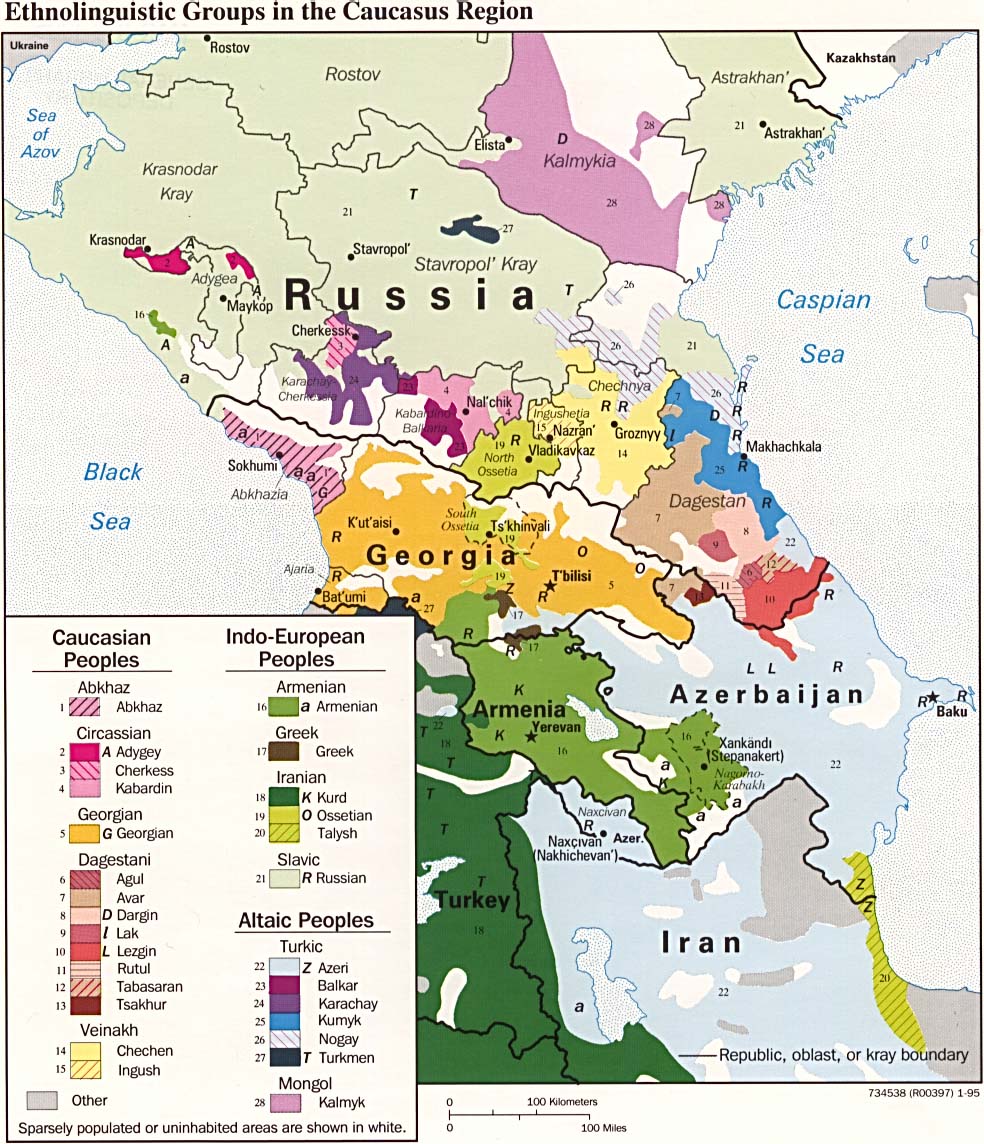
, are a group of languages spoken in the Caucasus
region, chiefly in Russia
(Adygea, Kabardino-Balkaria
, Karachay-Cherkessia
), the disputed territory
of Abkhazia
, and Turkey
, with smaller communities scattered throughout the Middle East
.
vowels (two or three, depending upon the analysis) coupled with rich consonantal systems that include many forms of secondary articulation
. Ubykh (Ubyx)
, for example, had both the minimal number of vowels (two), and probably the largest inventory of consonants outside Southern Africa.
Linguistic reconstruction
s suggest that both the richness of the consonantal systems and the poverty of the vocalic systems may be the result of a historical process, whereby vowel features such as labialisation
and palatalisation were reassigned to adjacent consonants. For example, ancestral */ki/ may have become /kʲə/ and */ku/ may have become /kʷə/, losing the old vowels */i/ and */u/ but gaining the new consonants /kʲ/ and /kʷ/. The linguist John Colarusso has further postulated that some instances of this may also be due to the levelling of an old grammatical class
prefix system (so */w-ka/ may have become /kʷa/), on the basis of pairs like Ubykh /ɡʲə/ vs. Kabardian and Abkhaz /ɡʷə/ heart. This same process is claimed by some to lie behind the development of labiovelars in Proto-Indo-European
which once neighboured Proto-NWC.
, ergative
and indirect object, and there are also a wide range of applicative constructions
. There is a split between "dynamic" and "stative" verb
s, with dynamic verbs having an especially complex morphology.
All Northwest Caucasian languages are left-branching, so that the verb comes at the end of the sentence and modifiers such as relative clauses precede a noun.
They do not generally permit more than one finite verb in a sentence, which precludes the existence of subordinate clauses in the Indo-European
sense; equivalent functions are performed by extensive arrays of nominal
and participial
non-finite verb forms (although Abkhaz appears to be developing limited subordinate clauses, perhaps under the influence of Russian).
, Abaza
, Kabardian
or East Circassian, Adyghe
or West Circassian, and Ubykh
. They are classified as follows:
.svg.png)
(or Cherkess) is a cover term for the series of dialects that include the literary languages of Adyghe and Kabardian.
is one of the more widely spoken Northwest Caucasian languages. It has 500,000 speakers spread throughout Russia
and the Middle East
: 280,000 in Turkey
; 125,000 in Russia, where it is official in the Republic of Adygea; 45,000 in Jordan
, 25,000 in Syria
, and 20,000 in Iraq
. There is even a small community in the United States
. Four main dialects are recognised: Temirgoy, Abadzekh
, Shapsugh and Bzhedugh, as well as many minor ones such as Hakuchi
spoken by the last speakers of Ubykh in Turkey. Adyghe has three phonemic vowels, and its consonants and consonant clusters are less complex than the Abkhaz–Abaza dialects.
has just over one million speakers: 550,000 in Turkey
and 450,000 in Russia
, where it is an official language of the republics of Kabardino-Balkaria
and Karachay-Cherkessia
. Kabardian has the least number of consonants of any North-Western Caucasian language, with 48, including some rather unusual ejective fricatives and a small number of vowels. It has two major dialects, called Kabardian and Cherkess (Circassian); Kabardian itself has several dialects, including Terek, the literary standard, and Besleney, which is intelligible with both Terek and Adyghe
.
has 100,000 speakers in Abkhazia
(a de facto independent republic, but a de jure autonomous entity within Georgia
), where it is the official language, and an unknown number of speakers in Turkey
. It has been a literary language from the beginning of the 20th century. Abkhaz and Abaza may be said to be dialects of the same language, but each preserves phonemes which the other has lost. Abkhaz is characterised by unusual consonant clusters and one of the world's smallest vowel inventories: It has only two distinctive vowels, an open vowel /a/ and a mid vowel /ə/. Next to palatalized
or labialized consonants, /a/ is realized as [e] or [o], and /ə/ as [i] or [u]. There are three major dialect
s: Abzhuy and Bzyp in Abkhazia
and Sadz
in Turkey.
has some 45,000 speakers, 35,000 in Russia
and 10,000 in Turkey
. It is a literary language, but nowhere official. It shares with Abkhaz the distinction of having just two phonemic vowels. Abaza is phonologically more complex than Abkhaz, and is characterised by large consonant clusters, similar to those that can be found in Georgian
. There are three major dialects, T’ap’anta, Ashkhar, and Bezshagh. Some are partially intelligible with Abkhaz.
is more closely related to Abkhaz and Abaza than to Adyghe and Kabardian. The population switched to speaking Adyghe, and Ubykh became extinct on October 7, 1992, with the death of Tevfik Esenç
. A dialectal division within Ubykh was suspected by Georges Dumézil
, but the divergent form he described in 1965 was never investigated further. With eighty-one consonants, Ubykh has one of the largest inventories in the world, and probably the largest outside the Khoisan languages
. There are pharyngealised consonant
s and a four-way place contrast among sibilants. It was the only Northwest Caucasian language never to have a literary form.
For these reasons, Proto–Northwest Caucasian is widely accepted as being one of the most difficult proto-languages to deal with, and it is therefore more difficult than most to relate to other families.
. Hattic was spoken in Anatolia
(Turkey
), in the area around ancient Hattusa (modern Boğazköy), until about 1800 BC, when it was replaced by the Indo-European
Hittite language
. The name Hetto-Iberian (or Proto-Iberian) was proposed by Georgian historian Simon Janashia
for a superfamily comprising the South Caucasian languages
, other Caucasian language groups, Hattic and other languages of ancient Anatolia
. (The Iberian in the name refers to Caucasian Iberia
, a kingdom centered in Eastern Georgia which lasted from the 4th century BC to the 5th century AD; it is not related to the Iberian Peninsula.)
family, at a time depth of perhaps 12,000 years before the present. This hypothesised proto-language is called Proto-Pontic, but is not widely accepted.
There does at least appear to have been extensive contact between the two proto-languages, and the resemblances may be due to this influence.
into a North Caucasian
family, sometimes simply called Kavkazian (in opposition to Kartvelian (South Caucasian)
, which is thought to be unrelated, albeit heavily influenced by their northern neighbours). This hypothesis has perhaps been best illustrated by Sergei A. Starostin and Sergei Nikolayev, who present a set of phonological correspondences and shared morphological structure. However, there is no consensus that the relationship has been demonstrated, and many consider the correspondences to be spurious for the reasons mentioned above. See the article on North Caucasian languages
for details, as well as the external links below.
(including Northwest Caucasian), Basque
, Burushaski
, Yeniseian
, Sino-Tibetan
, and Na–Dene families. However, this is an even more tentative hypothesis than Nostratic
, which attempts to relate Indo-European
, Uralic
, Kartvelian, Altaic
, etc., and which is widely considered to be undemonstrated.
Northeast Caucasian languages
The Northeast Caucasian languages constitute a language family spoken in the Russian republics of Dagestan, Chechnya, Ingushetia, northern Azerbaijan, and in northeastern Georgia, as well as in diaspora populations in Russia, Turkey, and the Middle East...
, are a group of languages spoken in the Caucasus
Caucasus
The Caucasus, also Caucas or Caucasia , is a geopolitical region at the border of Europe and Asia, and situated between the Black and the Caspian sea...
region, chiefly in Russia
Russia
Russia or , officially known as both Russia and the Russian Federation , is a country in northern Eurasia. It is a federal semi-presidential republic, comprising 83 federal subjects...
(Adygea, Kabardino-Balkaria
Kabardino-Balkaria
The Kabardino-Balkar Republic , or Kabardino-Balkaria , is a federal subject of Russia located in the North Caucasus. Population: -Geography:The republic is situated in the North Caucasus mountains, with plains in the northern part....
, Karachay-Cherkessia
Karachay-Cherkessia
The Karachay-Cherkess Republic , or Karachay-Cherkessia is a federal subject of Russia . Population: -Geography:*Area: *Borders:**internal: Krasnodar Krai , Kabardino-Balkar Republic , Stavropol Krai ....
), the disputed territory
International recognition of Abkhazia and South Ossetia
Abkhazia and South Ossetia are two breakaway republics in the Caucasus with disputed status over whether they are a part of Georgia or sovereign states. The Republic of Abkhazia and the Republic of South Ossetia were recognised following the 2008 South Ossetia War between Russia and Georgia, by six...
of Abkhazia
Abkhazia
Abkhazia is a disputed political entity on the eastern coast of the Black Sea and the south-western flank of the Caucasus.Abkhazia considers itself an independent state, called the Republic of Abkhazia or Apsny...
, and Turkey
Turkey
Turkey , known officially as the Republic of Turkey , is a Eurasian country located in Western Asia and in East Thrace in Southeastern Europe...
, with smaller communities scattered throughout the Middle East
Middle East
The Middle East is a region that encompasses Western Asia and Northern Africa. It is often used as a synonym for Near East, in opposition to Far East...
.
Phonetics
The entire family is characterised by a paucity of phonemicPhoneme
In a language or dialect, a phoneme is the smallest segmental unit of sound employed to form meaningful contrasts between utterances....
vowels (two or three, depending upon the analysis) coupled with rich consonantal systems that include many forms of secondary articulation
Secondary articulation
Secondary articulation refers to co-articulated consonants where the two articulations are not of the same manner. The approximant-like secondary articulation is weaker than the primary, and colors it rather than obscuring it...
. Ubykh (Ubyx)
Ubykh language
Ubykh or Ubyx is an extinct language of the Northwestern Caucasian group, spoken by the Ubykh people...
, for example, had both the minimal number of vowels (two), and probably the largest inventory of consonants outside Southern Africa.
Linguistic reconstruction
Linguistic reconstruction
Linguistic reconstruction is the practice of establishing the features of the unattested ancestor of one or more given languages. There are two kinds of reconstruction. Internal reconstruction uses irregularities in a single language to make inferences about an earlier stage of that language...
s suggest that both the richness of the consonantal systems and the poverty of the vocalic systems may be the result of a historical process, whereby vowel features such as labialisation
Labialisation
Labialization is a secondary articulatory feature of sounds in some languages. Labialized sounds involve the lips while the remainder of the oral cavity produces another sound. The term is normally restricted to consonants. When vowels involve the lips, they are called rounded.The most common...
and palatalisation were reassigned to adjacent consonants. For example, ancestral */ki/ may have become /kʲə/ and */ku/ may have become /kʷə/, losing the old vowels */i/ and */u/ but gaining the new consonants /kʲ/ and /kʷ/. The linguist John Colarusso has further postulated that some instances of this may also be due to the levelling of an old grammatical class
Noun class
In linguistics, the term noun class refers to a system of categorizing nouns. A noun may belong to a given class because of characteristic features of its referent, such as sex, animacy, shape, but counting a given noun among nouns of such or another class is often clearly conventional...
prefix system (so */w-ka/ may have become /kʷa/), on the basis of pairs like Ubykh /ɡʲə/ vs. Kabardian and Abkhaz /ɡʷə/ heart. This same process is claimed by some to lie behind the development of labiovelars in Proto-Indo-European
Proto-Indo-European language
The Proto-Indo-European language is the reconstructed common ancestor of the Indo-European languages, spoken by the Proto-Indo-Europeans...
which once neighboured Proto-NWC.
Grammar
Northwest Caucasian languages have rather simple noun systems, manifesting only a handful of cases at the most, coupled with highly agglutinative verbal systems so complex that virtually the entire syntactic structure of the sentence is contained within the verb. All finite verbs are marked for agreement with three arguments: absolutiveAbsolutive case
The absolutive case is the unmarked grammatical case of a core argument of a verb which is used as the citation form of a noun.-In ergative languages:...
, ergative
Ergative case
The ergative case is the grammatical case that identifies the subject of a transitive verb in ergative-absolutive languages.-Characteristics:...
and indirect object, and there are also a wide range of applicative constructions
Applicative voice
The applicative voice is a grammatical voice which promotes an oblique argument of a verb to the object argument, and indicates the oblique role within the meaning of the verb. When the applicative voice is applied to a verb, its valency may be increased by one...
. There is a split between "dynamic" and "stative" verb
Verb
A verb, from the Latin verbum meaning word, is a word that in syntax conveys an action , or a state of being . In the usual description of English, the basic form, with or without the particle to, is the infinitive...
s, with dynamic verbs having an especially complex morphology.
All Northwest Caucasian languages are left-branching, so that the verb comes at the end of the sentence and modifiers such as relative clauses precede a noun.
They do not generally permit more than one finite verb in a sentence, which precludes the existence of subordinate clauses in the Indo-European
Indo-European languages
The Indo-European languages are a family of several hundred related languages and dialects, including most major current languages of Europe, the Iranian plateau, and South Asia and also historically predominant in Anatolia...
sense; equivalent functions are performed by extensive arrays of nominal
Noun
In linguistics, a noun is a member of a large, open lexical category whose members can occur as the main word in the subject of a clause, the object of a verb, or the object of a preposition .Lexical categories are defined in terms of how their members combine with other kinds of...
and participial
Participle
In linguistics, a participle is a word that shares some characteristics of both verbs and adjectives. It can be used in compound verb tenses or voices , or as a modifier...
non-finite verb forms (although Abkhaz appears to be developing limited subordinate clauses, perhaps under the influence of Russian).
Classification
There are five recognized languages in the Northwest Caucasian family: AbkhazAbkhaz language
Abkhaz is a Northwest Caucasian language spoken mainly by the Abkhaz people. It is the official language of Abkhazia where around 100,000 people speak it. Furthermore, it is spoken by thousands of members of the Abkhazian diaspora in Turkey, Georgia's autonomous republic of Adjara, Syria, Jordan...
, Abaza
Abaza language
The Abaza language is a language of the Caucasus mountains in the Russian Karachay-Cherkess Republic by the Abazins...
, Kabardian
Kabardian language
The Kabardian language, also known as East Circassian , is a Northwest Caucasian language, closely related to the Adyghe language. It is spoken mainly in the Russian republics of Kabardino-Balkaria and Karachay-Cherkessia and in Turkey and the Middle East...
or East Circassian, Adyghe
Adyghe language
Adyghe language , also known as West Circassian , is one of the two official languages of the Republic of Adygea in the Russian Federation, the other being Russian. It is spoken by various tribes of the Adyghe people: Abzekh, Adamey, Bzhedugh; Hatukuay, Kemirgoy, Makhosh; Natekuay, Shapsigh; Zhane,...
or West Circassian, and Ubykh
Ubykh language
Ubykh or Ubyx is an extinct language of the Northwestern Caucasian group, spoken by the Ubykh people...
. They are classified as follows:
- Abkhaz–Abaza (Abazgi) dialects
- AbazaAbaza languageThe Abaza language is a language of the Caucasus mountains in the Russian Karachay-Cherkess Republic by the Abazins...
(45,000 speakers) - Abkhaz (Abxaz)Abkhaz languageAbkhaz is a Northwest Caucasian language spoken mainly by the Abkhaz people. It is the official language of Abkhazia where around 100,000 people speak it. Furthermore, it is spoken by thousands of members of the Abkhazian diaspora in Turkey, Georgia's autonomous republic of Adjara, Syria, Jordan...
(110,000)
- Abaza
- Circassian dialects (Cherkess)
- Adyghe (Adyge)Adyghe languageAdyghe language , also known as West Circassian , is one of the two official languages of the Republic of Adygea in the Russian Federation, the other being Russian. It is spoken by various tribes of the Adyghe people: Abzekh, Adamey, Bzhedugh; Hatukuay, Kemirgoy, Makhosh; Natekuay, Shapsigh; Zhane,...
(500,000) - KabardianKabardian languageThe Kabardian language, also known as East Circassian , is a Northwest Caucasian language, closely related to the Adyghe language. It is spoken mainly in the Russian republics of Kabardino-Balkaria and Karachay-Cherkessia and in Turkey and the Middle East...
(1,000,000)
- Adyghe (Adyge)
- Ubykh (Ubyx)Ubykh languageUbykh or Ubyx is an extinct language of the Northwestern Caucasian group, spoken by the Ubykh people...
(extinct)
Circassian dialect continuum
CircassianCircassian language
Circassian language may refer to:* any of the Northwest Caucasian languages* in a more narrow sense,** the Adyghe language ** the Kabardian language...
(or Cherkess) is a cover term for the series of dialects that include the literary languages of Adyghe and Kabardian.
Adyghe (Adyge)
The Adyghe (Adyge, Adyg) languageAdyghe language
Adyghe language , also known as West Circassian , is one of the two official languages of the Republic of Adygea in the Russian Federation, the other being Russian. It is spoken by various tribes of the Adyghe people: Abzekh, Adamey, Bzhedugh; Hatukuay, Kemirgoy, Makhosh; Natekuay, Shapsigh; Zhane,...
is one of the more widely spoken Northwest Caucasian languages. It has 500,000 speakers spread throughout Russia
Russia
Russia or , officially known as both Russia and the Russian Federation , is a country in northern Eurasia. It is a federal semi-presidential republic, comprising 83 federal subjects...
and the Middle East
Middle East
The Middle East is a region that encompasses Western Asia and Northern Africa. It is often used as a synonym for Near East, in opposition to Far East...
: 280,000 in Turkey
Turkey
Turkey , known officially as the Republic of Turkey , is a Eurasian country located in Western Asia and in East Thrace in Southeastern Europe...
; 125,000 in Russia, where it is official in the Republic of Adygea; 45,000 in Jordan
Jordan
Jordan , officially the Hashemite Kingdom of Jordan , Al-Mamlaka al-Urduniyya al-Hashemiyya) is a kingdom on the East Bank of the River Jordan. The country borders Saudi Arabia to the east and south-east, Iraq to the north-east, Syria to the north and the West Bank and Israel to the west, sharing...
, 25,000 in Syria
Syria
Syria , officially the Syrian Arab Republic , is a country in Western Asia, bordering Lebanon and the Mediterranean Sea to the West, Turkey to the north, Iraq to the east, Jordan to the south, and Israel to the southwest....
, and 20,000 in Iraq
Iraq
Iraq ; officially the Republic of Iraq is a country in Western Asia spanning most of the northwestern end of the Zagros mountain range, the eastern part of the Syrian Desert and the northern part of the Arabian Desert....
. There is even a small community in the United States
United States
The United States of America is a federal constitutional republic comprising fifty states and a federal district...
. Four main dialects are recognised: Temirgoy, Abadzekh
Abadzekh
Abadzekhs are a people of Adyghe branch.A significant part of them live in diaspora, which are descendants of refugees from the Caucasian War with the Russian Empire. Their dominant religion is Sunni Islam...
, Shapsugh and Bzhedugh, as well as many minor ones such as Hakuchi
Hakuchi Adyghe
Hakuchi Adyghe is a subdialect of the Shapsugh dialect of Adyghe spoken in Turkey.The dialect is phonologically peculiar when compared to the other Adyghe dialects...
spoken by the last speakers of Ubykh in Turkey. Adyghe has three phonemic vowels, and its consonants and consonant clusters are less complex than the Abkhaz–Abaza dialects.
Kabardian
KabardianKabardian language
The Kabardian language, also known as East Circassian , is a Northwest Caucasian language, closely related to the Adyghe language. It is spoken mainly in the Russian republics of Kabardino-Balkaria and Karachay-Cherkessia and in Turkey and the Middle East...
has just over one million speakers: 550,000 in Turkey
Turkey
Turkey , known officially as the Republic of Turkey , is a Eurasian country located in Western Asia and in East Thrace in Southeastern Europe...
and 450,000 in Russia
Russia
Russia or , officially known as both Russia and the Russian Federation , is a country in northern Eurasia. It is a federal semi-presidential republic, comprising 83 federal subjects...
, where it is an official language of the republics of Kabardino-Balkaria
Kabardino-Balkaria
The Kabardino-Balkar Republic , or Kabardino-Balkaria , is a federal subject of Russia located in the North Caucasus. Population: -Geography:The republic is situated in the North Caucasus mountains, with plains in the northern part....
and Karachay-Cherkessia
Karachay-Cherkessia
The Karachay-Cherkess Republic , or Karachay-Cherkessia is a federal subject of Russia . Population: -Geography:*Area: *Borders:**internal: Krasnodar Krai , Kabardino-Balkar Republic , Stavropol Krai ....
. Kabardian has the least number of consonants of any North-Western Caucasian language, with 48, including some rather unusual ejective fricatives and a small number of vowels. It has two major dialects, called Kabardian and Cherkess (Circassian); Kabardian itself has several dialects, including Terek, the literary standard, and Besleney, which is intelligible with both Terek and Adyghe
Adyghe language
Adyghe language , also known as West Circassian , is one of the two official languages of the Republic of Adygea in the Russian Federation, the other being Russian. It is spoken by various tribes of the Adyghe people: Abzekh, Adamey, Bzhedugh; Hatukuay, Kemirgoy, Makhosh; Natekuay, Shapsigh; Zhane,...
.
Abkhaz (Abxaz) language
The Abkhaz (Abxaz) languageAbkhaz language
Abkhaz is a Northwest Caucasian language spoken mainly by the Abkhaz people. It is the official language of Abkhazia where around 100,000 people speak it. Furthermore, it is spoken by thousands of members of the Abkhazian diaspora in Turkey, Georgia's autonomous republic of Adjara, Syria, Jordan...
has 100,000 speakers in Abkhazia
Abkhazia
Abkhazia is a disputed political entity on the eastern coast of the Black Sea and the south-western flank of the Caucasus.Abkhazia considers itself an independent state, called the Republic of Abkhazia or Apsny...
(a de facto independent republic, but a de jure autonomous entity within Georgia
Georgia (country)
Georgia is a sovereign state in the Caucasus region of Eurasia. Located at the crossroads of Western Asia and Eastern Europe, it is bounded to the west by the Black Sea, to the north by Russia, to the southwest by Turkey, to the south by Armenia, and to the southeast by Azerbaijan. The capital of...
), where it is the official language, and an unknown number of speakers in Turkey
Turkey
Turkey , known officially as the Republic of Turkey , is a Eurasian country located in Western Asia and in East Thrace in Southeastern Europe...
. It has been a literary language from the beginning of the 20th century. Abkhaz and Abaza may be said to be dialects of the same language, but each preserves phonemes which the other has lost. Abkhaz is characterised by unusual consonant clusters and one of the world's smallest vowel inventories: It has only two distinctive vowels, an open vowel /a/ and a mid vowel /ə/. Next to palatalized
Palatalization
In linguistics, palatalization , also palatization, may refer to two different processes by which a sound, usually a consonant, comes to be produced with the tongue in a position in the mouth near the palate....
or labialized consonants, /a/ is realized as [e] or [o], and /ə/ as [i] or [u]. There are three major dialect
Dialect
The term dialect is used in two distinct ways, even by linguists. One usage refers to a variety of a language that is a characteristic of a particular group of the language's speakers. The term is applied most often to regional speech patterns, but a dialect may also be defined by other factors,...
s: Abzhuy and Bzyp in Abkhazia
Abkhazia
Abkhazia is a disputed political entity on the eastern coast of the Black Sea and the south-western flank of the Caucasus.Abkhazia considers itself an independent state, called the Republic of Abkhazia or Apsny...
and Sadz
Sadz
The Sadz or Asadzwa, also Jigets are a sub-ethnic group of the Abkhazians. They are sometimes purported to have originated from the Sanigoi tribe mentioned by the Classic authors...
in Turkey.
Abaza Language
The Abaza languageAbaza language
The Abaza language is a language of the Caucasus mountains in the Russian Karachay-Cherkess Republic by the Abazins...
has some 45,000 speakers, 35,000 in Russia
Russia
Russia or , officially known as both Russia and the Russian Federation , is a country in northern Eurasia. It is a federal semi-presidential republic, comprising 83 federal subjects...
and 10,000 in Turkey
Turkey
Turkey , known officially as the Republic of Turkey , is a Eurasian country located in Western Asia and in East Thrace in Southeastern Europe...
. It is a literary language, but nowhere official. It shares with Abkhaz the distinction of having just two phonemic vowels. Abaza is phonologically more complex than Abkhaz, and is characterised by large consonant clusters, similar to those that can be found in Georgian
Georgian language
Georgian is the native language of the Georgians and the official language of Georgia, a country in the Caucasus.Georgian is the primary language of about 4 million people in Georgia itself, and of another 500,000 abroad...
. There are three major dialects, T’ap’anta, Ashkhar, and Bezshagh. Some are partially intelligible with Abkhaz.
Ubykh (Ubyx) language
The Ubykh (Ubyx) languageUbykh language
Ubykh or Ubyx is an extinct language of the Northwestern Caucasian group, spoken by the Ubykh people...
is more closely related to Abkhaz and Abaza than to Adyghe and Kabardian. The population switched to speaking Adyghe, and Ubykh became extinct on October 7, 1992, with the death of Tevfik Esenç
Tevfik Esenç
Tevfik Esenç was a Circassian exile in Turkey and the last known fully competent speaker of the Ubykh language.Esenç was raised by his Ubykh-speaking grandparents for a time in the village of Hacı Osman in Turkey, and he served a term as the muhtar of that village, before receiving a post in the...
. A dialectal division within Ubykh was suspected by Georges Dumézil
Georges Dumézil
Georges Dumézil was a French comparative philologist best known for his analysis of sovereignty and power in Proto-Indo-European religion and society...
, but the divergent form he described in 1965 was never investigated further. With eighty-one consonants, Ubykh has one of the largest inventories in the world, and probably the largest outside the Khoisan languages
Khoisan languages
The Khoisan languages are the click languages of Africa which do not belong to other language families. They include languages indigenous to southern and eastern Africa, though some, such as the Khoi languages, appear to have moved to their current locations not long before the Bantu expansion...
. There are pharyngealised consonant
Pharyngealisation
-Further reading:*Ian Maddieson, -See also:*Velarization*Creaky voice *Pharyngeal consonant*Epiglottal consonant*Pharynx...
s and a four-way place contrast among sibilants. It was the only Northwest Caucasian language never to have a literary form.
Relationship to other language families
A number of factors make the reconstruction of the Northwest Caucasian proto-language problematic:- most roots in Northwest Caucasian languages are monosyllabic, and many are single consonants;
- the sound changeSound changeSound change includes any processes of language change that affect pronunciation or sound system structures...
s are often intricate, and a large number of consonants and sibilant contrasts provides further complexity; - ablaut was extensive and still plays some part in the modern languages;
- borrowings between languages of the family were frequent;
- extensive homophonyHomophoneA homophone is a word that is pronounced the same as another word but differs in meaning. The words may be spelled the same, such as rose and rose , or differently, such as carat, caret, and carrot, or to, two, and too. Homophones that are spelled the same are also both homographs and homonyms...
occurs in the modern languages.
For these reasons, Proto–Northwest Caucasian is widely accepted as being one of the most difficult proto-languages to deal with, and it is therefore more difficult than most to relate to other families.
Connections to Hattic
Some scholars have seen affinities between the Northwest Caucasian (Circassian) family and the extinct Hattic languageHattic language
Hattic was a language spoken by the Hattians in Asia Minor between the 3rd and the 2nd millennia BC. Scholars call this language 'Hattic' to distinguish it from the Hittite language--the Indo-European language of the Hittite Empire....
. Hattic was spoken in Anatolia
Anatolia
Anatolia is a geographic and historical term denoting the westernmost protrusion of Asia, comprising the majority of the Republic of Turkey...
(Turkey
Turkey
Turkey , known officially as the Republic of Turkey , is a Eurasian country located in Western Asia and in East Thrace in Southeastern Europe...
), in the area around ancient Hattusa (modern Boğazköy), until about 1800 BC, when it was replaced by the Indo-European
Indo-European
Indo-European may refer to:* Indo-European languages** Aryan race, a 19th century and early 20th century term for those peoples who are the native speakers of Indo-European languages...
Hittite language
Hittite language
Hittite is the extinct language once spoken by the Hittites, a people who created an empire centred on Hattusa in north-central Anatolia...
. The name Hetto-Iberian (or Proto-Iberian) was proposed by Georgian historian Simon Janashia
Simon Janashia
Simon Janashia was an outstanding Georgian historian and public benefactor, one of the founders and Academician of the Georgian Academy of Sciences , Doctor of Historical Sciences, Professor....
for a superfamily comprising the South Caucasian languages
South Caucasian languages
The Kartvelian languages are spoken primarily in Georgia, with a large group of ethnic Georgian speakers in Russia, the United States, the European Union, and northeastern parts of Turkey. There are approximately 5.2 million speakers of this language family worldwide.It is not known to be related...
, other Caucasian language groups, Hattic and other languages of ancient Anatolia
Anatolia
Anatolia is a geographic and historical term denoting the westernmost protrusion of Asia, comprising the majority of the Republic of Turkey...
. (The Iberian in the name refers to Caucasian Iberia
Caucasian Iberia
Iberia , also known as Iveria , was a name given by the ancient Greeks and Romans to the ancient Georgian kingdom of Kartli , corresponding roughly to the eastern and southern parts of the present day Georgia...
, a kingdom centered in Eastern Georgia which lasted from the 4th century BC to the 5th century AD; it is not related to the Iberian Peninsula.)
Connections to Indo-European
It has been conjectured that the North-West Caucasian languages may be genetically related to the Indo-EuropeanIndo-European languages
The Indo-European languages are a family of several hundred related languages and dialects, including most major current languages of Europe, the Iranian plateau, and South Asia and also historically predominant in Anatolia...
family, at a time depth of perhaps 12,000 years before the present. This hypothesised proto-language is called Proto-Pontic, but is not widely accepted.
There does at least appear to have been extensive contact between the two proto-languages, and the resemblances may be due to this influence.
North Caucasian family
Many linguists join the Northwest and Northeast Caucasian languagesNortheast Caucasian languages
The Northeast Caucasian languages constitute a language family spoken in the Russian republics of Dagestan, Chechnya, Ingushetia, northern Azerbaijan, and in northeastern Georgia, as well as in diaspora populations in Russia, Turkey, and the Middle East...
into a North Caucasian
North Caucasian languages
North Caucasian languages is a blanket term for two language phyla spoken chiefly in the north Caucasus and Turkey: the Northwest Caucasian family and the Northeast Caucasian family North Caucasian languages (sometimes called simply Caucasic as opposed to Kartvelian, and to avoid confusion with...
family, sometimes simply called Kavkazian (in opposition to Kartvelian (South Caucasian)
South Caucasian languages
The Kartvelian languages are spoken primarily in Georgia, with a large group of ethnic Georgian speakers in Russia, the United States, the European Union, and northeastern parts of Turkey. There are approximately 5.2 million speakers of this language family worldwide.It is not known to be related...
, which is thought to be unrelated, albeit heavily influenced by their northern neighbours). This hypothesis has perhaps been best illustrated by Sergei A. Starostin and Sergei Nikolayev, who present a set of phonological correspondences and shared morphological structure. However, there is no consensus that the relationship has been demonstrated, and many consider the correspondences to be spurious for the reasons mentioned above. See the article on North Caucasian languages
North Caucasian languages
North Caucasian languages is a blanket term for two language phyla spoken chiefly in the north Caucasus and Turkey: the Northwest Caucasian family and the Northeast Caucasian family North Caucasian languages (sometimes called simply Caucasic as opposed to Kartvelian, and to avoid confusion with...
for details, as well as the external links below.
Higher-level connections
A few linguists have proposed even broader relationships, of which the Dene–Caucasian hypothesis is perhaps the most popular. Dene–Caucasian links the North CaucasianNorth Caucasian languages
North Caucasian languages is a blanket term for two language phyla spoken chiefly in the north Caucasus and Turkey: the Northwest Caucasian family and the Northeast Caucasian family North Caucasian languages (sometimes called simply Caucasic as opposed to Kartvelian, and to avoid confusion with...
(including Northwest Caucasian), Basque
Basque language
Basque is the ancestral language of the Basque people, who inhabit the Basque Country, a region spanning an area in northeastern Spain and southwestern France. It is spoken by 25.7% of Basques in all territories...
, Burushaski
Burushaski language
The Burushaski or Burushko language , is a language isolate . It is spoken by some 87,000 Burusho people in the Hunza, Nagar, Yasin, and Ishkoman valleys, and some parts of the Gilgit valley, in Gilgit–Baltistan in Pakistan and by about 300 Burusho people in Srinagar in Jammu and Kashmir, India...
, Yeniseian
Yeniseian languages
The Yeniseian language family is spoken in central Siberia.-Family division:0. Proto-Yeniseian...
, Sino-Tibetan
Sino-Tibetan languages
The Sino-Tibetan languages are a language family comprising, at least, the Chinese and the Tibeto-Burman languages, including some 250 languages of East Asia, Southeast Asia and parts of South Asia. They are second only to the Indo-European languages in terms of the number of native speakers...
, and Na–Dene families. However, this is an even more tentative hypothesis than Nostratic
Nostratic languages
Nostratic is a proposed language family that includes many of the indigenous language families of Eurasia, including the Indo-European, Uralic and Altaic as well as Kartvelian languages...
, which attempts to relate Indo-European
Indo-European languages
The Indo-European languages are a family of several hundred related languages and dialects, including most major current languages of Europe, the Iranian plateau, and South Asia and also historically predominant in Anatolia...
, Uralic
Uralic languages
The Uralic languages constitute a language family of some three dozen languages spoken by approximately 25 million people. The healthiest Uralic languages in terms of the number of native speakers are Hungarian, Finnish, Estonian, Mari and Udmurt...
, Kartvelian, Altaic
Altaic languages
Altaic is a proposed language family that includes the Turkic, Mongolic, Tungusic, and Japonic language families and the Korean language isolate. These languages are spoken in a wide arc stretching from northeast Asia through Central Asia to Anatolia and eastern Europe...
, etc., and which is widely considered to be undemonstrated.
External links
- MultiTree Page for Northwest Caucasian languages
- CIA linguistic map of the Caucasus
- Atlas of the Caucasian Languages with detailed Language Guide (by Yuri B. Koryakov)
- A Comparative Dictionary of North Caucasian Languages: Preface by Sergei Starostin & Sergein Nikolayev
- North Caucasian Etymological Dictionary, by S. A. Starostin & S. Nikolayev
- http://www.gardeningdaily.com/flowers-and-plants/Languages_of_the_Caucasus