

Aquitanian language

Encyclopedia
The Aquitanian language was spoken in ancient Aquitaine
(approximately between the Pyrenees
and the Garonne
, the region later known as Gascony
) before the Roman conquest and, probably much later, until the Early Middle Ages
.
Archaeological, toponymical
and historical evidence strongly suggest that it was a Vasconic language
or group of languages that represent a precursor of the Basque language
. The most important of this is a series of votive and funerary texts in Latin which contain about 400 personal names and 70 names of gods.
speakers. Luigi Luca Cavalli-Sforza
's studies of the genetic history of Europe
identified a cline of genes with highest frequencies in the Basque country, and lower levels beyond the area of Iberia
and Southern France
. Cavalli-Sforza describes this weakest of the five patterns he obtained as isolated remnants of the pre-Neolithic population of Europe. It corresponds roughly to the geographical spread of rhesus negative
blood types. The conclusion that the Basques are a genetic isolate has become a widely discussed but also controversial conclusion. Aquitanian origins may be traced more or less directly to the Chalcolithic culture of Artenac
. Basque itself appears to be a language from the age of metal.
and Roman
sources assign to Aquitanians.
But some also had been found at the south of the Pyrenees in the territory that Greek and Roman sources assign to Vascones:
The vascologist Joaquín Gorrotxategi, who has written several works on Aquitanian, and Mitxelena have pointed the similarities of some Iberian
onomastic elements with Aquitanian. In particular, Mitxelena spoke about an onomastic pool from which both Aquitanian and Iberian would have drawn:
For other more marginal theories see Basque language: Hypotheses on connections with other languages.
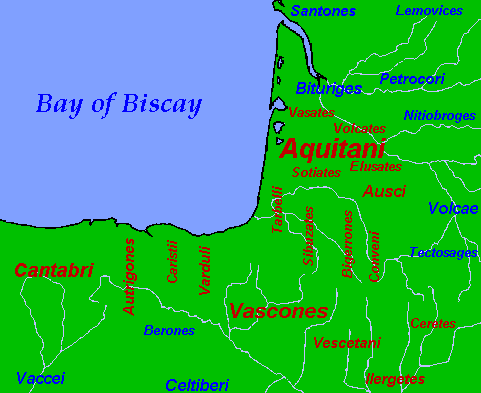 Since ancient times there are clues that indicate the relationship between Southwestern France and the Basques. During the Roman conquest of Gaul
by Julius Caesar
, Aquitania
was the territory between Garonne
and the Pyrenees
. It was inhabited by tribes of horsemen who Caesar said were very distinct in customs and language from the Celts of Gaul. During the Middle Ages, this territory was named Gascony
, a name derived from Vasconia
, and cognate with the word Basque.
There are many clues that indicate that Aquitanian was spoken in the Pyrenees, at least as far east as Val d'Aran
. The placenames that end in -os, -osse, -ons, -ost and -oz are considered to be of Aquitanian origin, take for instance place-name Biscarrosse
, directly related to Biscarrués
(output after Navarro-Aragonese
phonetic change) south of the Pyrenees, where "biscar" means ridge-line (modern Basque spelling "bizkar", same meaning). Such suffixes in place-names are ubiquitous in east of Navarre
and Aragon
, with the classical mediaeval -os > -ues taking place in stressed syllables, pointing to a language continuum both sides of the Pyrenees. This strong formal element can be traced at either side of the mountain range as far west as an imaginary line roughly stretching from Pamplona
to Bayonne
(cf. Bardos
/Bardoze, Ossès
/Ortzaize, Briscous
/Beskoitze), where it ceases to appear.
Other than place-names and little written evidence, the picture is not very clear at the west of the Basque Country
, as the historical record is scant. The territory was inhabited by the Caristii
, Varduli
and Autrigones
, and has been claimed as either Basque or Celtic depending on the author, since Indo-European
lexical elements have been found underlying or intertwined in place-names from nature, like rivers or mountains (Butron, Nervion, Deba/Deva, suffix -ika etc.) in an otherwise generally Basque linguistic landscape, or Spanish, especially in Álava. Archaeological findings in Iruña-Veleia
in 2006 were initially claimed as evidence of the antiquity of Basque in the south but were subsequently dismissed as forgery
.
Cantabri
ans are also mentioned as relatives of Aquitanians, as they sent troops to fight on their side against the Romans.
The Vascones, who occupied modern Navarra are usually identified with the Basques (Vascos in Spanish), their name being one of the most important proofs. In 1960, a stele
with Aquitanian names was found in Lerga
, which could reinforce the idea that Basques and Aquitanians were related. The ethnic and linguistic kinship is confirmed by Julio Caro Baroja
, who considers the Aquitanian-Basque relation an ancient and mediaeval stage ahead of the well-attested territorial shrinking process undergone by the Basque language during the Modern Age.
Novempopulania
Novempopulania was one of the provinces created by Diocletian out of Gallia Aquitania, being also called Aquitania Tertia. The area of Novempopulania was historically the first one to receive the name of Aquitania, as it was here where the original Aquitani dwelt primarily...
(approximately between the Pyrenees
Pyrenees
The Pyrenees is a range of mountains in southwest Europe that forms a natural border between France and Spain...
and the Garonne
Garonne
The Garonne is a river in southwest France and northern Spain, with a length of .-Source:The Garonne's headwaters are to be found in the Aran Valley in the Pyrenees, though three different locations have been proposed as the true source: the Uelh deth Garona at Plan de Beret , the Ratera-Saboredo...
, the region later known as Gascony
Gascony
Gascony is an area of southwest France that was part of the "Province of Guyenne and Gascony" prior to the French Revolution. The region is vaguely defined and the distinction between Guyenne and Gascony is unclear; sometimes they are considered to overlap, and sometimes Gascony is considered a...
) before the Roman conquest and, probably much later, until the Early Middle Ages
Middle Ages
The Middle Ages is a periodization of European history from the 5th century to the 15th century. The Middle Ages follows the fall of the Western Roman Empire in 476 and precedes the Early Modern Era. It is the middle period of a three-period division of Western history: Classic, Medieval and Modern...
.
Archaeological, toponymical
Toponymy
Toponymy is the scientific study of place names , their origins, meanings, use and typology. The word "toponymy" is derived from the Greek words tópos and ónoma . Toponymy is itself a branch of onomastics, the study of names of all kinds...
and historical evidence strongly suggest that it was a Vasconic language
Vasconic languages
The Vasconic substratum theory is a proposal that many western European languages contain remnants of an old language family of Vasconic languages, of which Basque is the only surviving member. The proposal was made by the German linguist Theo Vennemann, but has been rejected by other linguists...
or group of languages that represent a precursor of the Basque language
Basque language
Basque is the ancestral language of the Basque people, who inhabit the Basque Country, a region spanning an area in northeastern Spain and southwestern France. It is spoken by 25.7% of Basques in all territories...
. The most important of this is a series of votive and funerary texts in Latin which contain about 400 personal names and 70 names of gods.
History
Aquitanian and its related descendant, Basque, are commonly thought to be a remnant of the languages spoken in Western Europe before the arrival of Indo-EuropeanIndo-European
Indo-European may refer to:* Indo-European languages** Aryan race, a 19th century and early 20th century term for those peoples who are the native speakers of Indo-European languages...
speakers. Luigi Luca Cavalli-Sforza
Luigi Luca Cavalli-Sforza
Luigi Luca Cavalli-Sforza is an Italian population geneticist born in Genoa, who has been a professor at Stanford University since 1970 .-Books:...
's studies of the genetic history of Europe
Genetic history of Europe
The genetic history of Europe can be inferred from the patterns of genetic diversity across continents and time. The primary data to develop historical scenarios coming from sequences of mitochondrial, Y-chromosome and autosomal DNA from modern populations and if available from ancient DNA...
identified a cline of genes with highest frequencies in the Basque country, and lower levels beyond the area of Iberia
Iberia
The name Iberia refers to three historical regions of the old world:* Iberian Peninsula, in Southwest Europe, location of modern-day Portugal and Spain** Prehistoric Iberia...
and Southern France
Southern France
Southern France , colloquially known as le Midi is defined geographical area consisting of the regions of France that border the Atlantic Ocean south of the Gironde, Spain, the Mediterranean, and Italy...
. Cavalli-Sforza describes this weakest of the five patterns he obtained as isolated remnants of the pre-Neolithic population of Europe. It corresponds roughly to the geographical spread of rhesus negative
Rh blood group system
The Rh blood group system is one of thirty current human blood group systems. Clinically, it is the most important blood group system after ABO. At Present, the Rh blood group system consists of 50 defined blood-group antigens, among which the 5 antigens D, C, c, E, and e are the most important...
blood types. The conclusion that the Basques are a genetic isolate has become a widely discussed but also controversial conclusion. Aquitanian origins may be traced more or less directly to the Chalcolithic culture of Artenac
Artenacian culture
Artenacian culture, named after the archaeological site of Artenac in Charente appeared in the Late Chalcolithic, c. 2400 BC, apparently as reaction to migrations of Danubian peoples into Western France....
. Basque itself appears to be a language from the age of metal.
Persons' names and gods' names
Almost all the Aquitanian inscriptions had been found at the north of the Pyrenees in the territory that GreekAncient Greece
Ancient Greece is a civilization belonging to a period of Greek history that lasted from the Archaic period of the 8th to 6th centuries BC to the end of antiquity. Immediately following this period was the beginning of the Early Middle Ages and the Byzantine era. Included in Ancient Greece is the...
and Roman
Ancient Rome
Ancient Rome was a thriving civilization that grew on the Italian Peninsula as early as the 8th century BC. Located along the Mediterranean Sea and centered on the city of Rome, it expanded to one of the largest empires in the ancient world....
sources assign to Aquitanians.
- Anthroponyms: Belexeia, Lavrco, Borsei, Andereseni, Nescato, Cissonbonnis, Sembecconi, Gerexo, Bihossi, Talsconis, Halscotarris etc.
- Theonyms: Baigorixo, Ilunno, Arixoni, ArtaheArtaheArtaha Artaha Artaha (also spelled Artehe is the name of an ancient god that was worshiped in Southern Gaul, in the region of Aquitania.The theonym is recorded in several inscriptions from Saint-Pé-d'Ardet, where there seems to have been a Gallo-Roman-era cult center for the god:-References:AE:...
, Ilurberrixo, Astoiluno, Haravsoni, Leherenno etc.
But some also had been found at the south of the Pyrenees in the territory that Greek and Roman sources assign to Vascones:
- Anthroponyms: Ummesahar, Ederetta, Serhuhoris, Dusanharis, Abisunhar etc.
- Theonyms: Larrahe, Loxae / Losae, Lacubegi, Selatse / Stelaitse, Helasse, Errensae.
Relations with other languages
Most Aquitanian onomastic elements are clearly identifiable from a Basque perspective, matching closely the forms reconstructed by the Vascologist Koldo (Luis) Mitxelena for Proto-Basque:| Aquitanian | Proto-Basque | Basque | Basque meaning |
|---|---|---|---|
| adin | *adiN | adin | age, judgement |
| andere, er(h)e | *andere | andre | lady, woman |
| andos(s), andox | *andoś | lord | |
| arix | *aris | aritz | oak |
| artahe, artehe | *artehe | arte | holm oak |
| atta | *aTa | aita | father |
| belex | ?*beLe | bele | crow |
| bels | *bels | beltz | black |
| bihox, bihos | *bihos | bihotz | heart |
| bon, -pon | *boN | on | good |
| bors | *bors | bortz | five |
| cis(s)on, gison | *gisoN | gizon | man |
| -c(c)o | *-Ko | -ko | diminutive suffix |
| corri, gorri | *goRi | gorri | red |
| hals- | *hals | haltza | alder |
| han(n)a | ?*aNane | anaia | brother |
| har-, -ar | *aR | ar | male |
| hars- | *hars | hartz | bear |
| heraus- | *herauś | herauts | boar |
| il(l)un, ilur | *iLun | il(h)un | dark |
| leher | *leheR | leher | pine |
| nescato | *neśka | neska, neskato | girl, young woman |
| ombe, umme | *unbe | ume | child |
| oxson, osson | *otso | otso | wolf |
| sahar | *sahaR | zahar | old |
| sembe | *senbe | seme | son |
| seni | *śeni | sein | boy |
| -ten | *-teN | -ten | diminutive suffix (fossilized) |
| -t(t)o | *-To | -t(t)o | diminutive suffix |
| -x(s)o | *-tso | -txo,-txu | diminutive suffix |
The vascologist Joaquín Gorrotxategi, who has written several works on Aquitanian, and Mitxelena have pointed the similarities of some Iberian
Iberian language
The Iberian language was the language of a people identified by Greek and Roman sources who lived in the eastern and southeastern regions of the Iberian peninsula. The ancient Iberians can be identified as a rather nebulous local culture between the 7th and 1st century BC...
onomastic elements with Aquitanian. In particular, Mitxelena spoke about an onomastic pool from which both Aquitanian and Iberian would have drawn:
| Iberian | Aquitanian |
|---|---|
| atin | adin |
| ata | atta |
| baiser | baese-, bais- |
| beleś | belex |
| bels | bels |
| boś | box |
| lauŕ | laur |
| talsku | talsco / HALSCO |
| taŕ | t(h)ar / HAR |
| tautin | tautinn / hauten |
| tetel | tetel |
| uŕke | urcha |
For other more marginal theories see Basque language: Hypotheses on connections with other languages.
Geographical extent
Gaul
Gaul was a region of Western Europe during the Iron Age and Roman era, encompassing present day France, Luxembourg and Belgium, most of Switzerland, the western part of Northern Italy, as well as the parts of the Netherlands and Germany on the left bank of the Rhine. The Gauls were the speakers of...
by Julius Caesar
Julius Caesar
Gaius Julius Caesar was a Roman general and statesman and a distinguished writer of Latin prose. He played a critical role in the gradual transformation of the Roman Republic into the Roman Empire....
, Aquitania
Aquitania
Aquitania may refer to:* the territory of the Aquitani, a people living in Roman times in what is now Aquitaine, France* Aquitaine, a region of France roughly between the Pyrenees, the Atlantic ocean and the Garonne, also a former kingdom and duchy...
was the territory between Garonne
Garonne
The Garonne is a river in southwest France and northern Spain, with a length of .-Source:The Garonne's headwaters are to be found in the Aran Valley in the Pyrenees, though three different locations have been proposed as the true source: the Uelh deth Garona at Plan de Beret , the Ratera-Saboredo...
and the Pyrenees
Pyrenees
The Pyrenees is a range of mountains in southwest Europe that forms a natural border between France and Spain...
. It was inhabited by tribes of horsemen who Caesar said were very distinct in customs and language from the Celts of Gaul. During the Middle Ages, this territory was named Gascony
Gascony
Gascony is an area of southwest France that was part of the "Province of Guyenne and Gascony" prior to the French Revolution. The region is vaguely defined and the distinction between Guyenne and Gascony is unclear; sometimes they are considered to overlap, and sometimes Gascony is considered a...
, a name derived from Vasconia
Vasconia
Vasconia is an historical name derived from the ancient tribe of the Vascones and used in different times, specially in the Middle Ages, to refer to the Basque territories...
, and cognate with the word Basque.
There are many clues that indicate that Aquitanian was spoken in the Pyrenees, at least as far east as Val d'Aran
Val d'Aran
The Val d'Aran is a valley in the Pyrenees mountains and a comarca in the northwestern part of the province of Lleida, in Catalonia, northern Spain. Most of the valley constitutes the only part of Spain, and of Catalonia, on the north face of the Pyrenees, hence the only part of Catalonia whose...
. The placenames that end in -os, -osse, -ons, -ost and -oz are considered to be of Aquitanian origin, take for instance place-name Biscarrosse
Biscarrosse
Biscarrosse is a commune in the Landes department in Aquitaine in south-western France. It is located southwest of Bordeaux, and inland from the seaside resort of Biscarrosse-Plage on the Atlantic coast....
, directly related to Biscarrués
Biscarrués
Biscarrués is a municipality located in the province of Huesca, Aragon, Spain. According to the 2004 census , the municipality has a population of 232 inhabitants....
(output after Navarro-Aragonese
Navarro-Aragonese
Navarro-Aragonese was a Romance language spoken south of the middle Pyrenees and in part of the Ebro River basin in the Middle Ages. The language extended over the County of Aragón, Sobrarbe, Ribagorza, the southern plains of Navarre on both banks of the Ebro including La Rioja and the eastern...
phonetic change) south of the Pyrenees, where "biscar" means ridge-line (modern Basque spelling "bizkar", same meaning). Such suffixes in place-names are ubiquitous in east of Navarre
Navarre
Navarre , officially the Chartered Community of Navarre is an autonomous community in northern Spain, bordering the Basque Country, La Rioja, and Aragon in Spain and Aquitaine in France...
and Aragon
Aragon
Aragon is a modern autonomous community in Spain, coextensive with the medieval Kingdom of Aragon. Located in northeastern Spain, the Aragonese autonomous community comprises three provinces : Huesca, Zaragoza, and Teruel. Its capital is Zaragoza...
, with the classical mediaeval -os > -ues taking place in stressed syllables, pointing to a language continuum both sides of the Pyrenees. This strong formal element can be traced at either side of the mountain range as far west as an imaginary line roughly stretching from Pamplona
Pamplona
Pamplona is the historial capital city of Navarre, in Spain, and of the former kingdom of Navarre.The city is famous worldwide for the San Fermín festival, from July 6 to 14, in which the running of the bulls is one of the main attractions...
to Bayonne
Bayonne
Bayonne is a city and commune in south-western France at the confluence of the Nive and Adour rivers, in the Pyrénées-Atlantiques department, of which it is a sub-prefecture...
(cf. Bardos
Bardos, Pyrénées-Atlantiques
Bardos is a small village in the traditional Basque province of Labourd, now a commune in the Pyrénées-Atlantiques department in south-western France.Bardos is part of the province Basque of Lapurdi.-External links:...
/Bardoze, Ossès
Ossès
Ossès is a commune in the Pyrénées-Atlantiques department in south-western France.It lies in the traditional Basque province of Lower Navarre.-Geography:...
/Ortzaize, Briscous
Briscous
Briscous is a small village in the traditional Basque province of Labourd, now a commune in the Pyrénées-Atlantiques department in south-western France.-External links:*...
/Beskoitze), where it ceases to appear.
Other than place-names and little written evidence, the picture is not very clear at the west of the Basque Country
Basque Country (autonomous community)
The Basque Country is an autonomous community of northern Spain. It includes the Basque provinces of Álava, Biscay and Gipuzkoa, also called Historical Territories....
, as the historical record is scant. The territory was inhabited by the Caristii
Caristii
The Caristii were a tribe reported by Roman historians in Northern Hispania west of the Deba and east of the Nervion rivers, in modern Biscay and Alava...
, Varduli
Varduli
The Varduli were a tribe that Roman historians reported in Northern Hispania, west of the Vascones and east of the Caristii and the Deba river, comprising the main part of the current Basque province of Gipuzkoa and parts of Alava and Navarre. Their main city was Ara-Caeli...
and Autrigones
Autrigones
Location of the tribe of the Autrigones.The Autrigones were a pre-Roman people of ancient Spain, described by the Roman historian Paulus Orosius as neighbours of the Gallaeci, and thus had their homeland in the northwest of Hispania.-Location:Their historical territory now lies split between the...
, and has been claimed as either Basque or Celtic depending on the author, since Indo-European
Indo-European languages
The Indo-European languages are a family of several hundred related languages and dialects, including most major current languages of Europe, the Iranian plateau, and South Asia and also historically predominant in Anatolia...
lexical elements have been found underlying or intertwined in place-names from nature, like rivers or mountains (Butron, Nervion, Deba/Deva, suffix -ika etc.) in an otherwise generally Basque linguistic landscape, or Spanish, especially in Álava. Archaeological findings in Iruña-Veleia
Iruña-Veleia
Veleia was a Roman town in Hispania, currently located in the Basque Country, Spain. The site is located in the municipality of Iruña de Oca, 10 kilometers west of Vitoria. The town was an important station on the Roman road ab Asturica Burdigalam that ran parallel to the coast of the Bay of Biscay...
in 2006 were initially claimed as evidence of the antiquity of Basque in the south but were subsequently dismissed as forgery
Archaeological forgery
Archaeological forgery is the manufacture of supposedly ancient items that are sold to the antiquities market and may even end up in the collections of museums. It is related to art forgery....
.
Cantabri
Cantabri
The Cantabri were a pre-Roman Celtic people which lived in the northern Atlantic coastal region of ancient Hispania, from the 4th to late 1st centuries BC.-Origins:...
ans are also mentioned as relatives of Aquitanians, as they sent troops to fight on their side against the Romans.
The Vascones, who occupied modern Navarra are usually identified with the Basques (Vascos in Spanish), their name being one of the most important proofs. In 1960, a stele
Stele
A stele , also stela , is a stone or wooden slab, generally taller than it is wide, erected for funerals or commemorative purposes, most usually decorated with the names and titles of the deceased or living — inscribed, carved in relief , or painted onto the slab...
with Aquitanian names was found in Lerga
Lerga
Lerga is a town and municipality located in the province and autonomous community of Navarre, northern Spain.-External links:*...
, which could reinforce the idea that Basques and Aquitanians were related. The ethnic and linguistic kinship is confirmed by Julio Caro Baroja
Julio Caro Baroja
Julio Caro Baroja was a world-renowned Basque Spanish anthropologist, historian, linguist and essayist. He was known for his special interest in Basque culture, history and society. Of Basque ancestry, he was the nephew of the renowned writer Pio Baroja; and his brother, painter, writer and...
, who considers the Aquitanian-Basque relation an ancient and mediaeval stage ahead of the well-attested territorial shrinking process undergone by the Basque language during the Modern Age.
See also
- AquitaniAquitaniThe Aquitani were a people living in what is now Aquitaine, France, in the region between the Pyrenees, the Atlantic ocean and the Garonne...
- Gallia AquitaniaGallia AquitaniaGallia Aquitania was a province of the Roman Empire, bordered by the provinces of Gallia Lugdunensis, Gallia Narbonensis, and Hispania Tarraconensis...
- Duchy of VasconiaDuchy of VasconiaThe Duchy of Vasconia , or Wasconia, was originally a Frankish march formed by 602 to keep the Basques in check. It comprised the former Roman province of Novempopulania and, at least in some periods, also the lands south of the Pyrenees centred on Pamplona.In the ninth century, civil war within...
- Basque peopleBasque peopleThe Basques as an ethnic group, primarily inhabit an area traditionally known as the Basque Country , a region that is located around the western end of the Pyrenees on the coast of the Bay of Biscay and straddles parts of north-central Spain and south-western France.The Basques are known in the...
- Northern Basque CountryNorthern Basque CountryThe French Basque Country or Northern Basque Country situated within the western part of the French department of the Pyrénées-Atlantiques constitutes the north-eastern part of the Basque Country....
- Vasconic languagesVasconic languagesThe Vasconic substratum theory is a proposal that many western European languages contain remnants of an old language family of Vasconic languages, of which Basque is the only surviving member. The proposal was made by the German linguist Theo Vennemann, but has been rejected by other linguists...
- Neolithic EuropeNeolithic EuropeNeolithic Europe refers to a prehistoric period in which Neolithic technology was present in Europe. This corresponds roughly to a time between 7000 BC and c. 1700 BC...
- Pre-Roman peoples of the Iberian PeninsulaPre-Roman peoples of the Iberian PeninsulaThis is a list of the Pre-Roman peoples of the Iberian peninsula .-Non-Indo-European:*Aquitanians**Aquitani**Autrigones - some consider them Celtic .**Caristii - some consider them Celtic ....
Further reading
- Ballester, Xaverio (2001): "La adfinitas de las lenguas aquitana e ibérica", Palaeohispanica 1, pp. 21–33.
- Gorrochategui, Joaquín (1984): Onomástica indígena de Aquitania, Bilbao.
- Gorrochategui, Joaquín (1993): La onomástica aquitana y su relación con la ibérica, Lengua y cultura en Hispania prerromana : actas del V Coloquio sobre lenguas y culturas de la Península Ibérica : (Colonia 25–28 de Noviembre de 1989) (Francisco Villar and Jürgen Untermann, eds.), ISBN 84-7481-736-6, pp. 609–34
- Gorrochategui, Joaquín (1995): "The Basque Language and its Neighbors in Antiquity", Towards a History of the Basque Language, pp. 31–63.
- Hoz, Javier de (1995): "El poblamiento antiguo de los Pirineos desde el punto de vista lingüístico", Muntanyes i Població. El passat dels Pirineus des d'una perspectiva multidisciplinària, pp. 271–97.
- Michelena, Luis (1954): "De onomástica aquitana", Pirineos 10, pp. 409–58.
- Michelena, Luis (1977): Fonética histórica vasca, San Sebastián.
- Núñez, LuisLuis Núñez AstrainLuis C. Nuñez Astrain is a linguist and sociologist, and was editor of the newspaper Egin.He has a Bachelor of Arts in Linguistics and Sociology from the Sorbonne.- Bibliography :* Así está la enseñanza primaria * Euskara gaur...
(2003): El Euskera arcaico. Extensión y parentescos, Tafalla. - Rodríguez Ramos, Jesús (2002): "La hipótesis del vascoiberismo desde el punto de vista de la epigrafía íbera", Fontes Linguae Vasconum 90, pp. 197–219.
- Rodríguez Ramos, Jesús (2002): "Índice crítico de formantes de compuesto de tipo onomástico en la lengua íbera", Cypsela 14, pp. 251–75.
- Trask, L.R.Larry TraskRobert Lawrence "Larry" Trask was Professor of Linguistics at the University of Sussex and an authority on the Basque language and historical linguistics....
(1995): "Origin and relatives of the Basque Language: Review of the evidence", Towards a History of the Basque Language, pp. 65–99. - Trask, L.R. (1997): The History of Basque, London/New York, ISBN 0-415-13116-2
- Trask, L.R. (2008): (edited for web publication by Max Wheeler), University of Sussex
- Velaza, Javier (1995): "Epigrafía y dominios lingüísticos en territorio de los vascones", Roma y el nacimiento de la cultura epigráfica en occidente, pp. 209–18.
External links
- Aquitanian Language by Jesús Rodríguez Ramos