
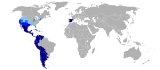
Spanish
also known as CastilianThere are two names given to the Spanish language: Spanish and Castilian . Spanish speakers from different countries or backgrounds can show a preference for one term or the other, or use them indiscriminately, but political issues or common usage might lead speakers to prefer one term over the...
, is a
Romance languageThe Romance languages are a branch of the Indo-European language family, more precisely of the Italic languages subfamily, comprising all the languages that descend from Vulgar Latin, the language of ancient Rome...
in the
Ibero-Romance groupThe Iberian Romance languages or Ibero-Romance languages are the Romance languages that developed on the Iberian Peninsula, an area consisting primarily of Spain, Portugal, and Andorra....
that evolved from several languages and dialects in central-northern
IberiaThe Iberian Peninsula , sometimes called Iberia, is located in the extreme southwest of Europe and includes the modern-day sovereign states of Spain, Portugal and Andorra, as well as the British Overseas Territory of Gibraltar...
around the 9th century and gradually spread with the expansion of the
Kingdom of CastileKingdom of Castile was one of the medieval kingdoms of the Iberian Peninsula. It emerged as a political autonomous entity in the 9th century. It was called County of Castile and was held in vassalage from the Kingdom of León. Its name comes from the host of castles constructed in the region...
(present northern
SpainSpain , officially the Kingdom of Spain languages]] under the European Charter for Regional or Minority Languages. In each of these, Spain's official name is as follows:;;;;;;), is a country and member state of the European Union located in southwestern Europe on the Iberian Peninsula...
) into central and southern Iberia during the later Medieval period.
Modern Spanish developed with the readjustment of consonants that began in 15th century. The language continues to adopt foreign words from a variety of other languages as well as developing new words. Spanish was taken most notably
to the AmericasColonial expansion under the Spanish Empire was initiated by the Spanish conquistadores and developed by the Monarchy of Spain through its administrators and missionaries. The motivations for colonial expansion were trade and the spread of the Christian faith through indigenous conversions...
as well as to Africa
and Asia PacificSpanish East Indies was a term used to describe Spanish territories in Asia-Pacific which lasted for three centuries . With the seat of government in Manila, the territory encompassed the Philippine Islands, Guam and the Mariana Islands, the Caroline Islands, and for a period of time, parts of...
with the expansion of the
Spanish EmpireThe Spanish Empire comprised territories and colonies administered directly by Spain in Europe, in America, Africa, Asia and Oceania. It originated during the Age of Exploration and was therefore one of the first global empires. At the time of Habsburgs, Spain reached the peak of its world power....
between the 15th and 19th centuries, where it became the most important language for government and trade.
In 1999, there were according to
EthnologueEthnologue: Languages of the World is a web and print publication of SIL International , a Christian linguistic service organization, which studies lesser-known languages, to provide the speakers with Bibles in their native language and support their efforts in language development.The Ethnologue...
358 million people speaking Spanish as a native language and a total of 417 million speakers worldwide. Currently these figures are up to 400 and 500 million people respectively. Spanish is the
second most natively spoken language in the world, after Mandarin Chinese.
MexicoThe United Mexican States , commonly known as Mexico , is a federal constitutional republic in North America. It is bordered on the north by the United States; on the south and west by the Pacific Ocean; on the southeast by Guatemala, Belize, and the Caribbean Sea; and on the east by the Gulf of...
contains the largest population of
Spanish speakersHispanophone or Hispanosphere denotes Spanish language speakers and the Spanish-speaking world. The word derives from the Latin political name of the Iberian Peninsula, Hispania, which comprised basically the territory of the modern states of Spain and Portugal.Hispanophones are estimated at...
. Spanish is one of the
six official languagesThe official languages of the United Nations are the six languages that are used in UN meetings, and in which all official UN documents are written...
of the
United NationsThe United Nations is an international organization whose stated aims are facilitating cooperation in international law, international security, economic development, social progress, human rights, and achievement of world peace...
, and is used as an
official languageAn official language is a language that is given a special legal status in a particular country, state, or other jurisdiction. Typically a nation's official language will be the one used in that nation's courts, parliament and administration. However, official status can also be used to give a...
by the
European UnionThe European Union is an economic and political union of 27 independent member states which are located primarily in Europe. The EU traces its origins from the European Coal and Steel Community and the European Economic Community , formed by six countries in 1958...
and
MercosurMercosur or Mercosul is an economic and political agreement among Argentina, Brazil, Paraguay and Uruguay. Founded in 1991 by the Treaty of Asunción, which was later amended and updated by the 1994 Treaty of Ouro Preto. Its purpose is to promote free trade and the fluid movement of goods, people,...
.
Due to its increasing presence in the demographics and popular culture of the
United StatesThe United States of America is a federal constitutional republic comprising fifty states and a federal district...
, particularly in the fast-growing states of the
Sun BeltThe Sun Belt or Spanish Belt is a region of the United States generally considered to stretch across the South and Southwest . Another rough boundary of the region is the area south of the 36th parallel, north latitude. It is the largest region which the U.S government does not recognize officially...
, Spanish is widely considered to be the most beneficial second language for a native speaker of
American EnglishAmerican English is a set of dialects of the English language used mostly in the United States. Approximately two-thirds of the world's native speakers of English live in the United States....
. The increasing political stability and economies of many larger Hispanophone nations, the language's immense geographic extent in Latin America and Europe for
tourismTourism is travel for recreational, leisure or business purposes. The World Tourism Organization defines tourists as people "traveling to and staying in places outside their usual environment for not more than one consecutive year for leisure, business and other purposes".Tourism has become a...
, and the growing popularity of warmer, more affordable, and culturally vibrant
retirementRetirement is the point where a person stops employment completely. A person may also semi-retire by reducing work hours.Many people choose to retire when they are eligible for private or public pension benefits, although some are forced to retire when physical conditions don't allow the person to...
destinations found in the Hispanic world have contributed significantly to the growth of learning Spanish as a foreign language across the globe.
History
Spanish emerged from its ancestral
Vulgar LatinVulgar Latin is any of the nonstandard forms of Latin from which the Romance languages developed. Because of its nonstandard nature, it had no official orthography. All written works used Classical Latin, with very few exceptions...
(common Latin) dialects in the 9th century. Latin had been brought to
IberiaThe Iberian Peninsula , sometimes called Iberia, is located in the extreme southwest of Europe and includes the modern-day sovereign states of Spain, Portugal and Andorra, as well as the British Overseas Territory of Gibraltar...
by the Romans during the
Second Punic WarThe Second Punic War, also referred to as The Hannibalic War and The War Against Hannibal, lasted from 218 to 201 BC and involved combatants in the western and eastern Mediterranean. This was the second major war between Carthage and the Roman Republic, with the participation of the Berbers on...
around 210 BC, absorbing influences from the native Iberian languages such as
CeltiberianCeltiberian is an extinct Indo-European language of the Celtic branch spoken by the Celtiberians in an area of the Iberian Peninsula lyingbetween the headwaters of the Duero, Tajo, Júcar and Turia rivers and the Ebro river...
,
BasqueBasque is the ancestral language of the Basque people, who inhabit the Basque Country, a region spanning an area in northeastern Spain and southwestern France. It is spoken by 25.7% of Basques in all territories...
and other
paleohispanic languagesThe Paleohispanic languages were the languages of the pre-Roman peoples of the Iberian Peninsula, excluding languages of foreign colonies, such as Greek in Emporion and Phoenician in Qart Hadast...
. Later, it gained other external influences, most notably from the Arabic of the later
Al-AndalusAl-Andalus was the Arabic name given to a nation and territorial region also commonly referred to as Moorish Iberia. The name describes parts of the Iberian Peninsula and Septimania governed by Muslims , at various times in the period between 711 and 1492, although the territorial boundaries...
period.
Local versions of Vulgar Latin evolved into Spanish in the central-north of Iberia, in an area defined by the then remote crossroad strips of
AlavaÁlava is a province of Spain and a historical territory of the Basque Country, heir of the ancient Lord of Álava. Its capital city is Vitoria-Gasteiz which is also the capital of the autonomous community...
,
CantabriaCantabria is a Spanish historical region and autonomous community with Santander as its capital city. It is bordered on the east by the Basque Autonomous Community , on the south by Castile and León , on the west by the Principality of Asturias, and on the north by the Cantabrian Sea.Cantabria...
,
BurgosBurgos is a city of northern Spain, historic capital of Castile. It is situated at the edge of the central plateau, with about 178,966 inhabitants in the city proper and another 20,000 in its suburbs. It is the capital of the province of Burgos, in the autonomous community of Castile and León...
,
SoriaSoria is a city in north-central Spain, the capital of the province of Soria in the autonomous community of Castile and León. , the municipality has a population of c. 39,500 inhabitants, nearly 40% of the population of the province...
and La Rioja, within the
Kingdom of CastileKingdom of Castile was one of the medieval kingdoms of the Iberian Peninsula. It emerged as a political autonomous entity in the 9th century. It was called County of Castile and was held in vassalage from the Kingdom of León. Its name comes from the host of castles constructed in the region...
(see
Glosas EmilianensesThe Glosas Emilianenses are glosses written in a Latin codex. These marginalia are important as early examples of writing in Basque and a form of Spanish...
). In this formative stage, Spanish (Castilian) developed a strongly differing variant from its close cousin,
LeoneseThe Leonese language is the endonym term used to refer to all vernacular Romance dialects of the Astur-Leonese linguistic group in the Spanish provinces of León and Zamora; Astur-Leonese also includes the dialects...
, and was distinguished by a heavy Basque influence (see
Iberian Romance languagesThe Iberian Romance languages or Ibero-Romance languages are the Romance languages that developed on the Iberian Peninsula, an area consisting primarily of Spain, Portugal, and Andorra....
). This distinctive dialect progressively spread south with the advance of the , and so gathered a sizable lexical influence from Al-Andalus Arabic, especially in the later Medieval period.
In the fifteenth century, in a process similar to that affecting other Romance languages, Spanish underwent a dramatic change with the Readjustment of the Consonants . Typical features of Spanish diachronic
phonologyPhonology is, broadly speaking, the subdiscipline of linguistics concerned with the sounds of language. That is, it is the systematic use of sound to encode meaning in any spoken human language, or the field of linguistics studying this use...
include
lenitionIn linguistics, lenition is a kind of sound change that alters consonants, making them "weaker" in some way. The word lenition itself means "softening" or "weakening" . Lenition can happen both synchronically and diachronically...
(Latin , Spanish ), palatalisation (Latin , Spanish , and Latin , Spanish ) and diphthongisation (stem-changing) of stressed short e and o from Vulgar Latin (Latin , Spanish ; Latin , Spanish ).
The , written in
SalamancaSalamanca is a city in western Spain, in the community of Castile and León. Because it is known for its beautiful buildings and urban environment, the Old City was declared a UNESCO World Heritage Site in 1988. It is the most important university city in Spain and is known for its contributions to...
in 1492 by
Elio Antonio de NebrijaAntonio de Lebrija , also known as Antonio de Nebrija, Elio Antonio de Lebrija, Antonius Nebrissensis, and Antonio of Lebrixa, was a Spanish scholar, known for writing a grammar of the Castilian language, credited as one of the first published grammars of a Romance language...
, was the first grammar written for a modern European language. According to a popular anecdote, when Nebrija presented it to
Queen Isabella IIsabella I was Queen of Castile and León. She and her husband Ferdinand II of Aragon brought stability to both kingdoms that became the basis for the unification of Spain. Later the two laid the foundations for the political unification of Spain under their grandson, Charles V, Holy Roman Emperor...
, she asked him what was the use of such a work, and he answered that language is the instrument of empire.
In his introduction to the grammar, dated August 18, 1492, Nebrija wrote that "... language was always the companion of empire."
From the 16th century onwards, the language was taken to the
AmericasThe Americas, or America , are lands in the Western hemisphere, also known as the New World. In English, the plural form the Americas is often used to refer to the landmasses of North America and South America with their associated islands and regions, while the singular form America is primarily...
and the
Spanish East IndiesSpanish East Indies was a term used to describe Spanish territories in Asia-Pacific which lasted for three centuries . With the seat of government in Manila, the territory encompassed the Philippine Islands, Guam and the Mariana Islands, the Caroline Islands, and for a period of time, parts of...
via
Spanish colonizationColonial expansion under the Spanish Empire was initiated by the Spanish conquistadores and developed by the Monarchy of Spain through its administrators and missionaries. The motivations for colonial expansion were trade and the spread of the Christian faith through indigenous conversions...
. Miguel de Cervantes Saavedra is such a well-known reference in the world that Spanish is often called la lengua de Cervantes ("the language of Cervantes").
In the 20th century, Spanish was introduced to
Equatorial GuineaEquatorial Guinea, officially the Republic of Equatorial Guinea where the capital Malabo is situated.Annobón is the southernmost island of Equatorial Guinea and is situated just south of the equator. Bioko island is the northernmost point of Equatorial Guinea. Between the two islands and to the...
and the
Western SaharaWestern Sahara is a disputed territory in North Africa, bordered by Morocco to the north, Algeria to the northeast, Mauritania to the east and south, and the Atlantic Ocean to the west. Its surface area amounts to . It is one of the most sparsely populated territories in the world, mainly...
, and to areas of the United States that had not been part of the Spanish Empire, such as
Spanish HarlemEast Harlem, also known as Spanish Harlem and El Barrio, is a section of Harlem in the northeastern part of the New York City borough of Manhattan. East Harlem is one of the largest predominantly Latino communities in New York City. It includes the area formerly known as Italian Harlem, in which...
in
New York CityNew York is the most populous city in the United States and the center of the New York Metropolitan Area, one of the most populous metropolitan areas in the world. New York exerts a significant impact upon global commerce, finance, media, art, fashion, research, technology, education, and...
. For details on borrowed words and other external influences upon Spanish, see
Influences on the Spanish languageThe Spanish language has a long history of borrowing words, expressions and subtler features of other languages it has come in contact with.Spanish developed from Vulgar Latin, with influence from Celtiberian , Basque and Arabic, and Visigothic in the north of the Iberian Peninsula.-Formative...
.
Geographic distribution
Spanish is recognised as one of the official languages of the
United NationsThe United Nations is an international organization whose stated aims are facilitating cooperation in international law, international security, economic development, social progress, human rights, and achievement of world peace...
, the
European UnionThe European Union is an economic and political union of 27 independent member states which are located primarily in Europe. The EU traces its origins from the European Coal and Steel Community and the European Economic Community , formed by six countries in 1958...
, the
Organization of American StatesThe Organization of American States is a regional international organization, headquartered in Washington, D.C., United States...
, the
Organization of Ibero-American StatesThe Organization of Ibero-American States is an intergovernmental organization, comprising the Portuguese- and Spanish-speaking nations of America and Europe, plus Equatorial Guinea in Africa....
, the
African UnionThe African Union is a union consisting of 54 African states. The only all-African state not in the AU is Morocco. Established on 9 July 2002, the AU was formed as a successor to the Organisation of African Unity...
, the Union of South American Nations, the
Antarctic Treaty SecretariatThe Antarctic Treaty Secretariat is an organization created in 2003 by the Antarctic Treaty Consultative Meeting for the management of several ATCM tasks such as the support of the annual meeting of signatory countries of the Antarctic Treaty, and the publication of the ATCM annual report.The...
, the
Latin UnionThe Latin Union is an international organization of nations that use Romance languages, with the aim of protecting, projecting, and promoting the common cultural heritage and unifying identities of the Latin, and Latin-influenced, world. It was created in 1954 in Madrid, Spain, and has existed as a...
, the Caricom and the
North American Free Trade AgreementThe North American Free Trade Agreement or NAFTA is an agreement signed by the governments of Canada, Mexico, and the United States, creating a trilateral trade bloc in North America. The agreement came into force on January 1, 1994. It superseded the Canada – United States Free Trade Agreement...
.
| Country |
Population |
Spanish as a native language speakers |
Bilingual and as a second language speakers (in countries where Spanish is official) or as a foreign language (where it is not official) |
Spanish speakers as percentage of population |
Total number of Spanish speakers |
Mexico |
112,336,538 |
|
|
98.5% |
|
United States |
307,006,550 |
35,468,501 |
14,531,499 |
% |
50,000,000 |
Spain |
47,150,819 |
|
|
98.8% |
|
Colombia |
46,240,000 |
|
130,080 |
99.2% |
|
Argentina |
40,900,496 |
36,333,605 |
4,321,488 |
99.4% |
|
Venezuela |
29,434,660 |
|
725,281 |
98.8% |
|
Peru |
29,797,694 |
|
744,942 |
86.6% |
|
Chile |
17,291,300 |
17,041,797 |
85,914 |
99.3% |
|
Ecuador |
14,306,000 |
11,907,200 |
2,126,986 |
98.1% |
|
Guatemala |
14,361,666 |
|
|
86.4% |
|
Cuba |
11,235,863 |
11,235,863 |
|
99.4% |
|
Dominican Republic |
10,225,000 |
10,006,500 |
177,600 |
99.6% |
|
Bolivia |
10,426,154 |
|
|
87.9% |
|
Honduras |
8,215,313 |
8,007,563 |
125,597 |
99.0% |
|
El Salvador |
6,183,002 |
6,168,902 |
|
99.7% |
|
Early Modern France |
65,821,885 |
440,106 |
5,721,380 |
9.4% |
6,161,486 |
Nicaragua |
5,822,000 |
5,331,876 |
315,464 |
97.0% |
|
Morocco |
31,759,997 |
20,000 |
5,480,000 |
17.32% |
5,500,000 |
Brazil |
190,732,694 |
460,018 |
5,000,000 |
2.86% |
5,460,018 |
Costa Rica |
4,615,646 |
4,530,228 |
48,493 |
99.2% |
|
Paraguay |
6,460,000 |
3,682,200 |
446,145 |
69.5% |
|
Puerto Rico |
3,998,000 |
|
|
98.8% |
|
United Kingdom |
62,041,708 |
184,867 |
3,737,633 |
6.4% |
3,922,500 |
Uruguay |
3,372,000 |
3,221,800 |
113,108 |
98.9% |
|
Panama |
3,508,000 |
3,006,957 |
258,991 |
93.1% |
|
Philippines |
94,013,200 |
2,930 |
3,013,843 |
3.2% |
3,016,773 |
Germany |
81,802,000 |
178,976 |
2,527,996 |
3.3% |
2,706,972 |
Italy |
60,605,053 |
422,249 |
1,968,320 |
3.5% |
1,635,976 |
Equatorial Guinea |
1,170,308 |
1,683 |
1,057,446 |
90.5% |
|
Canada |
33,212,696 |
909,000 |
92,853 |
3% |
1,001,853 |
Portugal |
10,636,888 |
9,570 |
727,282 |
6.9% |
737,026 |
Netherlands |
16,665,900 |
59,578 |
622,516 |
4.1% |
682,094 |
Belgium |
10,918,405 |
85,990 |
515,939 |
5.5% |
601,929 |
Kingdom of Romania |
22,246,862 |
|
544,531 |
2.4% |
544,531 |
Sweden |
9,045,389 |
101,472 |
442,601 |
6% |
544,073 |
Australia |
21,007,310 |
106,517 |
374,571 |
2.3% |
481,088 |
Poland |
38,500,696 |
|
316,104 |
0.8% |
316,104 |
Austria |
8,205,533 |
|
267,177 |
3.3% |
267,177 |
Côte d'Ivoire |
20,179,602 |
|
235,806 |
1.2% |
235,806 |
Algeria |
33,769,669 |
|
223,000 |
0.7% |
223,379 |
Denmark |
5,484,723 |
|
219,003 |
4% |
219,003 |
Israel |
7,112,359 |
130,000 |
45,231 |
2.5% |
175,231 |
Japan |
127,288,419 |
78,952 |
60,000 |
0.1% |
138,952 |
Switzerland |
7,581,520 |
123,000 |
14,420 |
1.7% |
137,420 |
Kingdom of Bulgaria |
7,262,675 |
|
133,910 |
1.8% |
133,910 |
Belize |
301,270 |
106,795 |
21,848 |
42.7% |
128,643 |
Netherlands Antilles |
223,652 |
10,699 |
114,835 |
56.1% |
125,534 |
Republic of Ireland |
4,156,119 |
|
123,591 |
3% |
123,591 |
Senegal |
12,853,259 |
|
101,455 |
0.8% |
101,455 |
Greece |
10,722,816 |
|
86,742 |
0.8% |
86,742 |
Finland |
5,244,749 |
|
85,586 |
1.6% |
85,586 |
Hungary |
9,930,915 |
|
85,034 |
0.9% |
85,034 |
Aruba |
100,018 |
6,800 |
68,602 |
75.3% |
75,402 |
Independent State of Croatia |
4,491,543 |
|
73,656 |
1.6% |
73,656 |
Andorra |
84,484 |
29,907 |
25,356 |
68.7% |
58,040 |
Slovakia |
5,455,407 |
|
43,164 |
0.8% |
43,164 |
Norway |
4,644,457 |
12,573 |
23,677 |
0.8% |
36,250 |
Russia |
140,702,094 |
3,320 |
20,000 |
0.01% |
23,320 |
New Zealand |
4,173,460 |
21,645 |
|
0.5% |
21,645 |
Guam |
154,805 |
|
19,092 |
12.3% |
19,092 |
US Virgin Islands |
108,612 |
16,788 |
|
15.5% |
16,788 |
Mainland China |
1,345,751,000 |
2,292 |
12,835 |
0.001124% |
15,127 |
Lithuania |
3,565,205 |
|
13,943 |
0.4% |
13,943 |
Gibraltar |
27,967 |
13,857 |
|
49.5% |
13,857 |
Cyprus |
792,604 |
|
|
1.4% |
11,044 |
Turkey |
71,892,807 |
380 |
8,000 |
0.01% |
8,380 |
Jamaica |
2,804,322 |
8,000 |
|
0.3% |
8,000 |
Luxembourg |
486,006 |
3,000 |
4,344 |
1.5% |
7,344 |
Malta |
403,532 |
6,458 |
|
1.6% |
6,458 |
Trinidad and Tobago |
1,047,366 |
4,100 |
|
0.4% |
4,100 |
Western Sahara |
513,000 |
n.a. |
n.a. |
n.a. |
n.a. |
| Other immigrants in the E.U. |
|
|
|
|
|
| Other Spanish students |
|
|
|
|
|
| Total native speakers in the world + bilingual and as a second language where Spanish is official: |
6,974,970,386 (Total World Population) |
|
29,242,608 |
% |
|
| Total with Spanish speakers as a foreign language: |
78,109,665 |
% |
|
Hispanosphere
It is estimated that the combined total number of Spanish speakers is between 470 and 500 million, making it the second most widely spoken language in terms of native speakers. Spanish is the third most spoken language by total number of speakers (after
Mandarin-Officials:* Mandarin , a bureaucrat of Imperial China , Vietnam, and by analogy, any senior government bureaucrat-Language:...
and
EnglishEnglish is a West Germanic language that arose in the Anglo-Saxon kingdoms of England and spread into what was to become south-east Scotland under the influence of the Anglian medieval kingdom of Northumbria...
).
Global internet usageGlobal Internet usage provides information on the number of people who use the Internet by language, nationality, geography, etc.-Languages used on the Internet:Most web pages on the Internet are in English....
statistics for 2007 show Spanish as the third most commonly used language on the Internet, after English and Mandarin.
Europe
In
EuropeEurope is, by convention, one of the world's seven continents. Comprising the westernmost peninsula of Eurasia, Europe is generally 'divided' from Asia to its east by the watershed divides of the Ural and Caucasus Mountains, the Ural River, the Caspian and Black Seas, and the waterways connecting...
, Spanish is an official language of Spain, the country after which it is named and from which it originated. It is widely spoken in
GibraltarGibraltar is a British overseas territory located on the southern end of the Iberian Peninsula at the entrance of the Mediterranean. A peninsula with an area of , it has a northern border with Andalusia, Spain. The Rock of Gibraltar is the major landmark of the region...
, although English is the official language. It is also commonly spoken in
AndorraAndorra , officially the Principality of Andorra , also called the Principality of the Valleys of Andorra, , is a small landlocked country in southwestern Europe, located in the eastern Pyrenees mountains and bordered by Spain and France. It is the sixth smallest nation in Europe having an area of...
, although
CatalanCatalan is a Romance language, the national and only official language of Andorra and a co-official language in the Spanish autonomous communities of Catalonia, the Balearic Islands and Valencian Community, where it is known as Valencian , as well as in the city of Alghero, on the Italian island...
is the official language.
Spanish is spoken in 20 different countries worldwide. It is also spoken by small communities in other European countries, such as the
United KingdomThe United Kingdom of Great Britain and Northern IrelandIn the United Kingdom and Dependencies, other languages have been officially recognised as legitimate autochthonous languages under the European Charter for Regional or Minority Languages...
,
FranceThe French Republic , The French Republic , The French Republic , (commonly known as France , is a unitary semi-presidential republic in Western Europe with several overseas territories and islands located on other continents and in the Indian, Pacific, and Atlantic oceans. Metropolitan France...
, and
GermanyGermany , officially the Federal Republic of Germany , is a federal parliamentary republic in Europe. The country consists of 16 states while the capital and largest city is Berlin. Germany covers an area of 357,021 km2 and has a largely temperate seasonal climate...
. Spanish is an official language of the
European UnionThe European Union is an economic and political union of 27 independent member states which are located primarily in Europe. The EU traces its origins from the European Coal and Steel Community and the European Economic Community , formed by six countries in 1958...
. In
SwitzerlandSwitzerland name of one of the Swiss cantons. ; ; ; or ), in its full name the Swiss Confederation , is a federal republic consisting of 26 cantons, with Bern as the seat of the federal authorities. The country is situated in Western Europe,Or Central Europe depending on the definition....
, Spanish is the
native languageA first language is the language a person has learned from birth or within the critical period, or that a person speaks the best and so is often the basis for sociolinguistic identity...
of 1.7% of the population, representing the largest minority after the 4 official languages of the country.
Spanish is the fourth most widely studied second language in Western Europe after English, French, and German. In countries where those languages are natively spoken (chiefly the United Kingdom, France, and Germany), Spanish is often the third most popular foreign language. Neighboring Portugal and France have considerable minorities of their population with a high degree of competency in Spanish.
Spain
In Spain and in some parts of the Spanish speaking world, but not all, Spanish is called (Castilian) as well as (Spanish), that is, the language of the
CastileA former kingdom, Castile gradually merged with its neighbours to become the Crown of Castile and later the Kingdom of Spain when united with the Crown of Aragon and the Kingdom of Navarre...
region, contrasting it with other
languages spoken in SpainThe languages of Spain are the languages spoken or once spoken in Spain. Romance languages are the most widely spoken in Spain, of which Spanish is the country's official language...
such as
GalicianGalician is a language of the Western Ibero-Romance branch, spoken in Galicia, an autonomous community located in northwestern Spain, where it is co-official with Castilian Spanish, as well as in border zones of the neighbouring territories of Asturias and Castile and León.Modern Galician and...
,
BasqueBasque is the ancestral language of the Basque people, who inhabit the Basque Country, a region spanning an area in northeastern Spain and southwestern France. It is spoken by 25.7% of Basques in all territories...
, and
CatalanCatalan is a Romance language, the national and only official language of Andorra and a co-official language in the Spanish autonomous communities of Catalonia, the Balearic Islands and Valencian Community, where it is known as Valencian , as well as in the city of Alghero, on the Italian island...
. In this manner, the
Spanish Constitution of 1978-Structure of the State:The Constitution recognizes the existence of nationalities and regions . Preliminary Title As a result, Spain is now composed entirely of 17 Autonomous Communities and two autonomous cities with varying degrees of autonomy, to the extent that, even though the Constitution...
uses the term to define the
official languageAn official language is a language that is given a special legal status in a particular country, state, or other jurisdiction. Typically a nation's official language will be the one used in that nation's courts, parliament and administration. However, official status can also be used to give a...
of the whole Spanish State, as opposed to (lit. the rest of the Spanish languages). Article III reads as follows:
The Spanish Royal Academy uses the term español (rather than "castellano") in its publications, due to the fact that "the term derives from the Provenzal word espaignol, which in turn derives from the Medieval Latin word Hispaniolus, which means 'from—or pertaining to—Hispania'". The Diccionario Panhispánico de Dudas (a linguistic guide published by the Spanish Royal Academy) states that, although the Spanish Royal Academy prefers to use the term español in its publications when referring to the Spanish language, both terms (español and castellano) are regarded as synonymous and equally valid.
Currently, the name castellano, which refers directly to the historical context in which it was introduced in the Americas, is preferred in Spain due to the existence of regions where other official languages are spoken (
CataloniaCatalonia is an autonomous community in northeastern Spain, with the official status of a "nationality" of Spain. Catalonia comprises four provinces: Barcelona, Girona, Lleida, and Tarragona. Its capital and largest city is Barcelona. Catalonia covers an area of 32,114 km² and has an...
,
Basque CountryThe Basque Country is an autonomous community of northern Spain. It includes the Basque provinces of Álava, Biscay and Gipuzkoa, also called Historical Territories....
,
ValenciaThe Valencian Community is an autonomous community of Spain located in central and south-eastern Iberian Peninsula. Its capital and largest city is Valencia...
,
Balearic IslandsThe Balearic Islands are an archipelago of Spain in the western Mediterranean Sea, near the eastern coast of the Iberian Peninsula.The four largest islands are: Majorca, Minorca, Ibiza and Formentera. The archipelago forms an autonomous community and a province of Spain with Palma as the capital...
and Galicia) as well as in
ArgentinaArgentina , officially the Argentine Republic , is the second largest country in South America by land area, after Brazil. It is constituted as a federation of 23 provinces and an autonomous city, Buenos Aires...
,
BoliviaBolivia officially known as Plurinational State of Bolivia , is a landlocked country in central South America. It is the poorest country in South America...
,
ColombiaColombia, officially the Republic of Colombia , is a unitary constitutional republic comprising thirty-two departments. The country is located in northwestern South America, bordered to the east by Venezuela and Brazil; to the south by Ecuador and Peru; to the north by the Caribbean Sea; to the...
,
ChileChile ,officially the Republic of Chile , is a country in South America occupying a long, narrow coastal strip between the Andes mountains to the east and the Pacific Ocean to the west. It borders Peru to the north, Bolivia to the northeast, Argentina to the east, and the Drake Passage in the far...
,
ParaguayParaguay , officially the Republic of Paraguay , is a landlocked country in South America. It is bordered by Argentina to the south and southwest, Brazil to the east and northeast, and Bolivia to the northwest. Paraguay lies on both banks of the Paraguay River, which runs through the center of the...
,
PeruPeru , officially the Republic of Peru , is a country in western South America. It is bordered on the north by Ecuador and Colombia, on the east by Brazil, on the southeast by Bolivia, on the south by Chile, and on the west by the Pacific Ocean....
,
UruguayUruguay ,officially the Oriental Republic of Uruguay,sometimes the Eastern Republic of Uruguay; ) is a country in the southeastern part of South America. It is home to some 3.5 million people, of whom 1.8 million live in the capital Montevideo and its metropolitan area...
and
VenezuelaVenezuela , officially called the Bolivarian Republic of Venezuela , is a tropical country on the northern coast of South America. It borders Colombia to the west, Guyana to the east, and Brazil to the south...
, instead of , which is more commonly used to refer to the language as a whole when relating to a global context.
Latin America
Most Spanish speakers are in
Latin AmericaLatin America is a region of the Americas where Romance languages – particularly Spanish and Portuguese, and variably French – are primarily spoken. Latin America has an area of approximately 21,069,500 km² , almost 3.9% of the Earth's surface or 14.1% of its land surface area...
; of all countries with a majority of Spanish speakers, only
SpainSpain , officially the Kingdom of Spain languages]] under the European Charter for Regional or Minority Languages. In each of these, Spain's official name is as follows:;;;;;;), is a country and member state of the European Union located in southwestern Europe on the Iberian Peninsula...
and
Equatorial GuineaEquatorial Guinea, officially the Republic of Equatorial Guinea where the capital Malabo is situated.Annobón is the southernmost island of Equatorial Guinea and is situated just south of the equator. Bioko island is the northernmost point of Equatorial Guinea. Between the two islands and to the...
are outside the
AmericasThe Americas, or America , are lands in the Western hemisphere, also known as the New World. In English, the plural form the Americas is often used to refer to the landmasses of North America and South America with their associated islands and regions, while the singular form America is primarily...
.
MexicoThe United Mexican States , commonly known as Mexico , is a federal constitutional republic in North America. It is bordered on the north by the United States; on the south and west by the Pacific Ocean; on the southeast by Guatemala, Belize, and the Caribbean Sea; and on the east by the Gulf of...
has the most native speakers of any country. Nationally, Spanish is the official language—either
de factoDe facto is a Latin expression that means "concerning fact." In law, it often means "in practice but not necessarily ordained by law" or "in practice or actuality, but not officially established." It is commonly used in contrast to de jure when referring to matters of law, governance, or...
or
de jureDe jure is an expression that means "concerning law", as contrasted with de facto, which means "concerning fact".De jure = 'Legally', De facto = 'In fact'....
—of
ArgentinaArgentina , officially the Argentine Republic , is the second largest country in South America by land area, after Brazil. It is constituted as a federation of 23 provinces and an autonomous city, Buenos Aires...
,
BoliviaBolivia officially known as Plurinational State of Bolivia , is a landlocked country in central South America. It is the poorest country in South America...
(co-official with Quechua and
AymaraAymara is an Aymaran language spoken by the Aymara people of the Andes. It is one of only a handful of Native American languages with over three million speakers. Aymara, along with Quechua and Spanish, is an official language of Peru and Bolivia...
),
ChileChile ,officially the Republic of Chile , is a country in South America occupying a long, narrow coastal strip between the Andes mountains to the east and the Pacific Ocean to the west. It borders Peru to the north, Bolivia to the northeast, Argentina to the east, and the Drake Passage in the far...
,
ColombiaColombia, officially the Republic of Colombia , is a unitary constitutional republic comprising thirty-two departments. The country is located in northwestern South America, bordered to the east by Venezuela and Brazil; to the south by Ecuador and Peru; to the north by the Caribbean Sea; to the...
,
Costa RicaCosta Rica , officially the Republic of Costa Rica is a multilingual, multiethnic and multicultural country in Central America, bordered by Nicaragua to the north, Panama to the southeast, the Pacific Ocean to the west and the Caribbean Sea to the east....
,
CubaThe Republic of Cuba is an island nation in the Caribbean. The nation of Cuba consists of the main island of Cuba, the Isla de la Juventud, and several archipelagos. Havana is the largest city in Cuba and the country's capital. Santiago de Cuba is the second largest city...
,
Dominican RepublicThe Dominican Republic is a nation on the island of La Hispaniola, part of the Greater Antilles archipelago in the Caribbean region. The western third of the island is occupied by the nation of Haiti, making Hispaniola one of two Caribbean islands that are shared by two countries...
,
El SalvadorEl Salvador or simply Salvador is the smallest and the most densely populated country in Central America. The country's capital city and largest city is San Salvador; Santa Ana and San Miguel are also important cultural and commercial centers in the country and in all of Central America...
,
GuatemalaGuatemala is a country in Central America bordered by Mexico to the north and west, the Pacific Ocean to the southwest, Belize to the northeast, the Caribbean to the east, and Honduras and El Salvador to the southeast...
,
HondurasHonduras is a republic in Central America. It was previously known as Spanish Honduras to differentiate it from British Honduras, which became the modern-day state of Belize...
,
MexicoThe United Mexican States , commonly known as Mexico , is a federal constitutional republic in North America. It is bordered on the north by the United States; on the south and west by the Pacific Ocean; on the southeast by Guatemala, Belize, and the Caribbean Sea; and on the east by the Gulf of...
,
NicaraguaNicaragua is the largest country in the Central American American isthmus, bordered by Honduras to the north and Costa Rica to the south. The country is situated between 11 and 14 degrees north of the Equator in the Northern Hemisphere, which places it entirely within the tropics. The Pacific Ocean...
,
PanamaPanama , officially the Republic of Panama , is the southernmost country of Central America. Situated on the isthmus connecting North and South America, it is bordered by Costa Rica to the northwest, Colombia to the southeast, the Caribbean Sea to the north and the Pacific Ocean to the south. The...
,
ParaguayParaguay , officially the Republic of Paraguay , is a landlocked country in South America. It is bordered by Argentina to the south and southwest, Brazil to the east and northeast, and Bolivia to the northwest. Paraguay lies on both banks of the Paraguay River, which runs through the center of the...
(co-official with
GuaraníGuaraní, specifically the primary variety known as Paraguayan Guaraní , is an indigenous language of South America that belongs to the Tupí–Guaraní subfamily of the Tupian languages. It is one of the official languages of Paraguay , where it is spoken by the majority of the population, and half of...
),
EcuadorEcuador , officially the Republic of Ecuador is a representative democratic republic in South America, bordered by Colombia on the north, Peru on the east and south, and by the Pacific Ocean to the west. It is one of only two countries in South America, along with Chile, that do not have a border...
and
PeruPeru , officially the Republic of Peru , is a country in western South America. It is bordered on the north by Ecuador and Colombia, on the east by Brazil, on the southeast by Bolivia, on the south by Chile, and on the west by the Pacific Ocean....
(co-official with Quechua and, in some regions,
AymaraAymara is an Aymaran language spoken by the Aymara people of the Andes. It is one of only a handful of Native American languages with over three million speakers. Aymara, along with Quechua and Spanish, is an official language of Peru and Bolivia...
),
UruguayUruguay ,officially the Oriental Republic of Uruguay,sometimes the Eastern Republic of Uruguay; ) is a country in the southeastern part of South America. It is home to some 3.5 million people, of whom 1.8 million live in the capital Montevideo and its metropolitan area...
, and
VenezuelaVenezuela , officially called the Bolivarian Republic of Venezuela , is a tropical country on the northern coast of South America. It borders Colombia to the west, Guyana to the east, and Brazil to the south...
. Spanish is also the official language (co-official with
EnglishEnglish is a West Germanic language that arose in the Anglo-Saxon kingdoms of England and spread into what was to become south-east Scotland under the influence of the Anglian medieval kingdom of Northumbria...
) in
Puerto RicoPuerto Rico , officially the Commonwealth of Puerto Rico , is an unincorporated territory of the United States, located in the northeastern Caribbean, east of the Dominican Republic and west of both the United States Virgin Islands and the British Virgin Islands.Puerto Rico comprises an...
.
Spanish has no official recognition in the former
British colonyThe British Overseas Territories are fourteen territories of the United Kingdom which, although they do not form part of the United Kingdom itself, fall under its jurisdiction. They are remnants of the British Empire that have not acquired independence or have voted to remain British territories...
of
BelizeBelize is a constitutional monarchy and the northernmost country in Central America. Belize has a diverse society, comprising many cultures and languages. Even though Kriol and Spanish are spoken among the population, Belize is the only country in Central America where English is the official...
; however, per the 2000 census, it is spoken by 43% of the population. Mainly, it is spoken by the descendants of Hispanics who have been in the region since the 17th century; however, English is the official language.
Spain colonized
Trinidad and TobagoTrinidad and Tobago officially the Republic of Trinidad and Tobago is an archipelagic state in the southern Caribbean, lying just off the coast of northeastern Venezuela and south of Grenada in the Lesser Antilles...
first in 1498, introducing the Spanish language to the Carib people. Also the
Cocoa PanyolThe Cocoa Panyols are an ethnic group in Trinidad & Tobago. The name comes from the patois word for Spanish, espagnol, or even Spanish word Español and reflects the historical association between the group and the cultivation of cacao in Trinidad .This community in Trinidad originated in the late...
s, laborers from Venezuela, took their culture and language with them; they are accredited with the music of "
ParangParang is a popular folk music originating out of Trinidad and Tobago, it was brought to Trinidad by Venezuelan migrants who were primarily of Amerindian and African heritage, something which is strongly reflected in the music itself. The word is derived from two Spanish words:'Parranda', meaning...
" ("
ParrandaParranda or Parranda de aguinaldo is a musical form from the coastal area of the states Aragua and Carabobo in Venezuela where the tambora becomes present as the main accompanying instrument in an Afro-Venezuelan influence...
") on the island. Because of Trinidad's location on the South American coast, the country is greatly influenced by its Spanish-speaking neighbors. A recent census shows that more than 1 500 inhabitants speak Spanish. In 2004, the government launched the Spanish as a First Foreign Language (SAFFL) initiative in March 2005. Government regulations require Spanish to be taught, beginning in primary school, while thirty percent of public employees are to be linguistically competent within five years.
Spanish is important in
BrazilBrazil , officially the Federative Republic of Brazil , is the largest country in South America. It is the world's fifth largest country, both by geographical area and by population with over 192 million people...
because of its proximity to and increased trade with its Spanish-speaking neighbors, and because of its membership in the
MercosurMercosur or Mercosul is an economic and political agreement among Argentina, Brazil, Paraguay and Uruguay. Founded in 1991 by the Treaty of Asunción, which was later amended and updated by the 1994 Treaty of Ouro Preto. Its purpose is to promote free trade and the fluid movement of goods, people,...
trading bloc and the Union of South American Nations. In 2005, the
National Congress of BrazilThe National Congress of Brazil is the legislative body of Brazil's federal government.Unlike regional legislative bodies – Legislative Assemblies and City Councils -, the Congress is bicameral, composed of the Federal Senate and the Chamber of Deputies .The Senate represents the 26 states and...
approved a bill, signed into law by the
PresidentThe president of Brazil is both the head of state and head of government of the Federative Republic of Brazil. The president leads the executive branch of the federal government and is the commander-in-chief of the Brazilian Armed Forces...
, making Spanish language teaching mandatory in both public and private secondary schools in Brazil. In many border towns and villages (especially in the Uruguayan-Brazilian and Paraguayan-Brazilian border areas), a
mixed languageA mixed language is a language that arises through the fusion of two source languages, normally in situations of thorough bilingualism, so that it is not possible to classify the resulting language as belonging to either of the language families that were its source...
known as Portuñol is spoken.
United States
According to 2006 census data, 44.3 million people of the U.S. population were
HispanicHispanic is a term that originally denoted a relationship to Hispania, which is to say the Iberian Peninsula: Andorra, Gibraltar, Portugal and Spain. During the Modern Era, Hispanic sometimes takes on a more limited meaning, particularly in the United States, where the term means a person of ...
or
LatinoThe demonyms Latino and Latina , are defined in English language dictionaries as:* "a person of Latin-American descent."* "A Latin American."* "A person of Hispanic, especially Latin-American, descent, often one living in the United States."...
by origin; 34 million people, 12.2 percent, of the population more than five years old speak Spanish at home. Spanish has a long history in the United States because many south-western states were part of Mexico, and
FloridaFlorida is a state in the southeastern United States, located on the nation's Atlantic and Gulf coasts. It is bordered to the west by the Gulf of Mexico, to the north by Alabama and Georgia and to the east by the Atlantic Ocean. With a population of 18,801,310 as measured by the 2010 census, it...
was also part of Spain, and it recently has been revitalized by Hispanic immigrants. Spanish is the most widely taught language in the country after English. Although the United States has no formally designated "official languages," Spanish is formally recognized at the state level in various states in addition to English; in the U.S. state of
New MexicoNew Mexico is a state located in the southwest and western regions of the United States. New Mexico is also usually considered one of the Mountain States. With a population density of 16 per square mile, New Mexico is the sixth-most sparsely inhabited U.S...
for instance, 40% of the population speaks the language. It also has strong influence in metropolitan areas such as
Los AngelesLos Ángeles is the capital of the province of Biobío, in the commune of the same name, in Region VIII , in the center-south of Chile. It is located between the Laja and Biobío rivers. The population is 123,445 inhabitants...
, Miami, San Antonio,
New York CityNew York is the most populous city in the United States and the center of the New York Metropolitan Area, one of the most populous metropolitan areas in the world. New York exerts a significant impact upon global commerce, finance, media, art, fashion, research, technology, education, and...
,
TampaTâmpa may refer to several villages in Romania:* Tâmpa, a village in Băcia Commune, Hunedoara County* Tâmpa, a village in Miercurea Nirajului, Mureş County* Tâmpa, a mountain in Braşov city...
, Las Vegas, San Francisco and
ChicagoChicago is the largest city in the US state of Illinois. With nearly 2.7 million residents, it is the most populous city in the Midwestern United States and the third most populous in the US, after New York City and Los Angeles...
and in the last decade, the language has rapidly expanded in Atlanta,
BaltimoreBaltimore is the largest independent city in the United States and the largest city and cultural center of the US state of Maryland. The city is located in central Maryland along the tidal portion of the Patapsco River, an arm of the Chesapeake Bay. Baltimore is sometimes referred to as Baltimore...
,
BostonBoston is the capital of and largest city in Massachusetts, and is one of the oldest cities in the United States. The largest city in New England, Boston is regarded as the unofficial "Capital of New England" for its economic and cultural impact on the entire New England region. The city proper had...
,
Charlotte- CHARLOTTE :CHARLOTTE is an American blues-based hard rock band that formed in Los Angeles, California in 1986. Currently, they are signed to indie label, Eonian Records, under which they released their debut cd, Medusa Groove, in 2010. Notable Charlotte songs include 'Siren', 'Little Devils',...
, Cleveland, Dallas, Detroit, Houston,
PhoenixPhoenix is the capital, and largest city, of the U.S. state of Arizona, as well as the sixth most populated city in the United States. Phoenix is home to 1,445,632 people according to the official 2010 U.S. Census Bureau data...
, Philadelphia,
RichmondThe Greater Richmond Region is a region located in a central part of the state of Virginia in the United States. As of 2010, it had a population of 1,258,251, making it the 43rd largest MSA in the country...
, Washington, DC, and
MissouriMissouri is a US state located in the Midwestern United States, bordered by Iowa, Illinois, Kentucky, Tennessee, Arkansas, Oklahoma, Kansas and Nebraska. With a 2010 population of 5,988,927, Missouri is the 18th most populous state in the nation and the fifth most populous in the Midwest. It...
. Spanish is the dominant spoken language in
Puerto RicoPuerto Rico , officially the Commonwealth of Puerto Rico , is an unincorporated territory of the United States, located in the northeastern Caribbean, east of the Dominican Republic and west of both the United States Virgin Islands and the British Virgin Islands.Puerto Rico comprises an...
, a U.S. territory. With a total of 33,701,181 Spanish speakers, according to US Census Bureau, the U.S. has the world's second-largest Spanish-speaking population. Spanish ranks second, behind English, as the language spoken most widely at home.
Africa
In
AfricaAfrica is the world's second largest and second most populous continent, after Asia. At about 30.2 million km² including adjacent islands, it covers 6% of the Earth's total surface area and 20.4% of the total land area...
, Spanish is official in
Equatorial GuineaEquatorial Guinea, officially the Republic of Equatorial Guinea where the capital Malabo is situated.Annobón is the southernmost island of Equatorial Guinea and is situated just south of the equator. Bioko island is the northernmost point of Equatorial Guinea. Between the two islands and to the...
(co-official with
FrenchFrench is a Romance language spoken as a first language in France, the Romandy region in Switzerland, Wallonia and Brussels in Belgium, Monaco, the regions of Quebec and Acadia in Canada, and by various communities elsewhere. Second-language speakers of French are distributed throughout many parts...
and
PortuguesePortuguese is a Romance language that arose in the medieval Kingdom of Galicia, nowadays Galicia and Northern Portugal. The southern part of the Kingdom of Galicia became independent as the County of Portugal in 1095...
), as well as an official language of the
African UnionThe African Union is a union consisting of 54 African states. The only all-African state not in the AU is Morocco. Established on 9 July 2002, the AU was formed as a successor to the Organisation of African Unity...
. In Equatorial Guinea, Spanish is the predominant language when native and non-native speakers (around 500,000 people) are counted, while
FangFang is the dominant Bantu language of Gabon and Equatorial Guinea. It is related to the Bulu and Ewondo languages of southern Cameroon. Fang is spoken in northern Gabon, southern Cameroon, and throughout Equatorial Guinea. Shakira used this language in her song, "Waka Waka .".There are many...
is the most spoken language by number of native speakers.
Today, in
Western SaharaWestern Sahara is a disputed territory in North Africa, bordered by Morocco to the north, Algeria to the northeast, Mauritania to the east and south, and the Atlantic Ocean to the west. Its surface area amounts to . It is one of the most sparsely populated territories in the world, mainly...
, a former Spanish colony, an unknown number of Sahrawis are able to read and write in Spanish, and several thousands have received
universityA university is an institution of higher education and research, which grants academic degrees in a variety of subjects. A university is an organisation that provides both undergraduate education and postgraduate education...
education in foreign countries as part of aid packages (mainly in
CubaThe Republic of Cuba is an island nation in the Caribbean. The nation of Cuba consists of the main island of Cuba, the Isla de la Juventud, and several archipelagos. Havana is the largest city in Cuba and the country's capital. Santiago de Cuba is the second largest city...
and
SpainSpain , officially the Kingdom of Spain languages]] under the European Charter for Regional or Minority Languages. In each of these, Spain's official name is as follows:;;;;;;), is a country and member state of the European Union located in southwestern Europe on the Iberian Peninsula...
). Sahrawi Press Service, the official news service of the
Sahrawi Arab Democratic RepublicThe Sahrawi Arab Democratic Republic is a partially recognised state that claims sovereignty over the entire territory of Western Sahara, a former Spanish colony. SADR was proclaimed by the Polisario Front on February 27, 1976, in Bir Lehlu, Western Sahara. The SADR government controls about...
of
Western SaharaWestern Sahara is a disputed territory in North Africa, bordered by Morocco to the north, Algeria to the northeast, Mauritania to the east and south, and the Atlantic Ocean to the west. Its surface area amounts to . It is one of the most sparsely populated territories in the world, mainly...
, has been available in Spanish since 2001, the official site of the Sahrawi Arab Democratic Republic is in Spanish and RASD TV, the official television channel of the Sahrawi Arab Democratic Republic, broadcasts in Spanish. The
Sahara Film FestivalThe International Sahara Film Festival was first held in 2004. It is now an annual event which takes place in the Sahrawi refugee camps in the South West Corner of Algeria, near the border with Western Sahara. The Festival is backed by the Polisario Front...
, Western Sahara's only film festival, mainly shows Spanish-language films. Spanish is used to document Sahrawi poetry and oral traditions and has also be used in Sahrawi literature. Despite Spanish having been used by the Sahrawi people for over a century due to Western Sahara's history as a former Spanish colony, the Cervantes Institute has denied support and Spanish-language education to Sahrawis in Western Sahara and the Sahrawi refugee camps in Algeria. A group of Sahrawi poets known as 'Generación de la Amistad saharaui' produce Sahrawi literature in Spanish.
Spanish is also spoken in the Spanish cities in
continental North AfricaThe plazas de soberanía or sovereign territories, referred to in English as Spanish North Africa or simply Spanish Africa, are the current Spanish territories in continental North Africa bordering Morocco, except the autonomous cities of Ceuta and Melilla.After the Reconquista, forces of the...
(
CeutaCeuta is an autonomous city of Spain and an exclave located on the north coast of North Africa surrounded by Morocco. Separated from the Iberian peninsula by the Strait of Gibraltar, Ceuta lies on the border of the Mediterranean Sea and the Atlantic Ocean. Ceuta along with the other Spanish...
and
MelillaMelilla is a autonomous city of Spain and an exclave on the north coast of Morocco. Melilla, along with the Spanish exclave Ceuta, is one of the two Spanish territories located in mainland Africa...
) and in the autonomous community of
Canary IslandsThe Canary Islands , also known as the Canaries , is a Spanish archipelago located just off the northwest coast of mainland Africa, 100 km west of the border between Morocco and the Western Sahara. The Canaries are a Spanish autonomous community and an outermost region of the European Union...
(143,000 and 1,995,833 people, respectively). Within Northern Morocco, a former Franco-Spanish protectorate that is also geographically close to Spain, approximately 20,000 people speak Spanish as a second language. It is spoken by some communities of
AngolaAngola, officially the Republic of Angola , is a country in south-central Africa bordered by Namibia on the south, the Democratic Republic of the Congo on the north, and Zambia on the east; its west coast is on the Atlantic Ocean with Luanda as its capital city...
, because of the Cuban influence from the
Cold WarThe Cold War was the continuing state from roughly 1946 to 1991 of political conflict, military tension, proxy wars, and economic competition between the Communist World—primarily the Soviet Union and its satellite states and allies—and the powers of the Western world, primarily the United States...
, in
South SudanSouth Sudan , officially the Republic of South Sudan, is a landlocked country located in the Sahel region of northeastern Africa. It is also part of the North Africa UN sub-region. Its current capital is Juba, which is also its largest city; the capital city is planned to be moved to the more...
among South Sudanese natives that relocated to Cuba during the Sudanese wars and returned in time for their country's independence, and in
NigeriaNigeria , officially the Federal Republic of Nigeria, is a federal constitutional republic comprising 36 states and its Federal Capital Territory, Abuja. The country is located in West Africa and shares land borders with the Republic of Benin in the west, Chad and Cameroon in the east, and Niger in...
by the descendants of
Afro-CubanThe term Afro-Cuban refers to Cubans of Sub Saharan African ancestry, and to historical or cultural elements in Cuba thought to emanate from this community...
ex-slaves.
Asia
Spanish was used by the colonial governments and the educated classes in the former
Spanish East IndiesSpanish East Indies was a term used to describe Spanish territories in Asia-Pacific which lasted for three centuries . With the seat of government in Manila, the territory encompassed the Philippine Islands, Guam and the Mariana Islands, the Caroline Islands, and for a period of time, parts of...
, namely the
PhilippinesThe Philippines , officially known as the Republic of the Philippines , is a country in Southeast Asia in the western Pacific Ocean. To its north across the Luzon Strait lies Taiwan. West across the South China Sea sits Vietnam...
,
GuamGuam is an organized, unincorporated territory of the United States located in the western Pacific Ocean. It is one of five U.S. territories with an established civilian government. Guam is listed as one of 16 Non-Self-Governing Territories by the Special Committee on Decolonization of the United...
and the
Northern Mariana IslandsThe Northern Mariana Islands, officially the Commonwealth of the Northern Mariana Islands , is a commonwealth in political union with the United States, occupying a strategic region of the western Pacific Ocean. It consists of 15 islands about three-quarters of the way from Hawaii to the Philippines...
. From 1565 to 1973 it was an official language of the Philippines. Up to 1899 it was the language of government, trade and education, and spoken as a first language by Spaniards and educated Filipinos. In the mid 19th century the colonial government set up a free public school system with Spanish as the medium of instruction. This increased the use of Spanish throughout the islands and led to a class of Spanish-speaking intellectuals called the Ilustrados. Although Spanish never became the language of a majority of the population, Philippine literature and press primarily used Spanish up to the 1940s. It continued as an official language until the change of Constitution in 1973. Following the U.S. occupation and administration of the islands in 1899, the American government increasingly imposed English, especially after the 1920s. The US authorities conducted a campaign of introducing English as the medium of instruction in schools, universities and public spaces, and prohibited the use of Spanish in media and educational institutions.
After the country became independent in 1946, Spanish remained an official language along with English and Tagalog-based Filipino. However, the language lost its official status in 1973 during the regime of
Ferdinand MarcosFerdinand Emmanuel Edralin Marcos, Sr. was a Filipino leader and an authoritarian President of the Philippines from 1965 to 1986. He was a lawyer, member of the Philippine House of Representatives and a member of the Philippine Senate...
. In 2007 the Arroyo administration announced that it would pass legislation to reintroduce Spanish in the Philippine education system. In 2010 a Memorandum was signed between Spanish and Philippine authorities to cooperate in implementing this decree. Today, Radio Manila broadcasts daily in Spanish. Worthy of mention is the Chabacano language spoken by 600,000 people both in the Philippines and Sabah. Chabacano, a Spanish-Philippine pidgin, sounds strange to Spanish speakers but is mutually intelligible.
The local languages of the Philippines retain much Spanish influence, with many words being derived from Spanish from Spain and
Mexican SpanishMexican Spanish is a version of the Spanish language, as spoken in Mexico and in various places of Canada and the United States of America, where there are communities of Mexican origin....
, due to the control of the islands by Spain through
Mexico CityMexico City is the Federal District , capital of Mexico and seat of the federal powers of the Mexican Union. It is a federal entity within Mexico which is not part of any one of the 31 Mexican states but belongs to the federation as a whole...
until 1821, and directly from Madrid until 1898.
Oceania
Among the countries and territories in
OceaniaOceania is a region centered on the islands of the tropical Pacific Ocean. Conceptions of what constitutes Oceania range from the coral atolls and volcanic islands of the South Pacific to the entire insular region between Asia and the Americas, including Australasia and the Malay Archipelago...
, Spanish is also spoken in
Easter IslandEaster Island is a Polynesian island in the southeastern Pacific Ocean, at the southeasternmost point of the Polynesian triangle. A special territory of Chile that was annexed in 1888, Easter Island is famous for its 887 extant monumental statues, called moai, created by the early Rapanui people...
, a territorial possession of Chile. The U.S. Territories of
GuamGuam is an organized, unincorporated territory of the United States located in the western Pacific Ocean. It is one of five U.S. territories with an established civilian government. Guam is listed as one of 16 Non-Self-Governing Territories by the Special Committee on Decolonization of the United...
and Northern Marianas, and the independent states of
PalauPalau , officially the Republic of Palau , is an island nation in the Pacific Ocean, east of the Philippines and south of Tokyo. In 1978, after three decades as being part of the United Nations trusteeship, Palau chose independence instead of becoming part of the Federated States of Micronesia, a...
,
Marshall IslandsThe Republic of the Marshall Islands , , is a Micronesian nation of atolls and islands in the middle of the Pacific Ocean, just west of the International Date Line and just north of the Equator. As of July 2011 the population was 67,182...
and the
Federated States of MicronesiaThe Federated States of Micronesia or FSM is an independent, sovereign island nation, made up of four states from west to east: Yap, Chuuk, Pohnpei and Kosrae. It comprises approximately 607 islands with c...
all once had majority Spanish speakers, since the Marianas and the
Caroline IslandsThe Caroline Islands are a widely scattered archipelago of tiny islands in the western Pacific Ocean, to the north of New Guinea. Politically they are divided between the Federated States of Micronesia in the eastern part of the group, and Palau at the extreme western end...
were Spanish colonial possessions until the late 19th century (see
Spanish-American WarThe Spanish–American War was a conflict in 1898 between Spain and the United States, effectively the result of American intervention in the ongoing Cuban War of Independence...
), but Spanish is no longer used by the masses but there are still native and second-language speakers. It also exists as an influence on the local native languages and is spoken by Hispanic American resident populations.
Antarctica
The Antarctic Treaty regulates international relations with respect to Antarctica.
ArgentinaArgentina , officially the Argentine Republic , is the second largest country in South America by land area, after Brazil. It is constituted as a federation of 23 provinces and an autonomous city, Buenos Aires...
and
ChileChile ,officially the Republic of Chile , is a country in South America occupying a long, narrow coastal strip between the Andes mountains to the east and the Pacific Ocean to the west. It borders Peru to the north, Bolivia to the northeast, Argentina to the east, and the Drake Passage in the far...
, both Spanish speaking countries, claim territories according to this treaty. The
Argentine AntarcticaArgentine Antarctica is a sector of Antarctica claimed by Argentina as part of its national territory. The Argentine Antarctic region, consisting of the Antarctic Peninsula and a triangular section extending to the South Pole, is delimited by the 25° West and 74° West meridians and the 60° South...
sector had a winter population of 169 in 1999, and in the Chilean Antarctic Territory, according to the national census of 2002, the population was 130 (115 male, 15 female).
Royal Spanish Academy
The (Royal Spanish Academy), founded in 1713, together with the 21 other national ones (see
Association of Spanish Language AcademiesThe Association of Spanish Language Academies is the entity which regulates the Spanish language. It was created in Mexico in 1951 and represents the union of all the separate academies in the Spanish-speaking world....
), exercises a standardizing influence through its publication of dictionaries and widely respected grammar and style guides.
Because of influence and for other sociohistorical reasons, a standardized form of the language (
Standard SpanishStandard Spanish or neutral Spanish is a linguistic variety, or lect, that is considered a correct educated standard for the Spanish language. Standard Spanish is not merely Spanish adjusted to fit in prescriptive molds dictated by a linguistic overseeing authority, but also a form of language that...
) is widely acknowledged for use in literature, academic contexts and the media.
Accent variation
There are important variations spoken among the regions of Spain and throughout Spanish-speaking America. One major phonological difference between Spanish from Spain, broadly speaking, the accents spoken in most of Spain, and the accent of much of southern Spain, the Canary Islands and all the Latin American accents of Spanish, is the absence of a
voiceless dental fricativeThe voiceless dental non-sibilant fricative is a type of consonantal sound used in some spoken languages. It is familiar to English speakers as the 'th' in thing. Though rather rare as a phoneme in the world's inventory of languages, it is encountered in some of the most widespread and influential...
(/θ/ as in English thing) in the latter. In Spain, the Madrid accent is commonly regarded as the standard variety used on radio and television, although attitudes towards southern accents have changed significantly in the last 50 years.
In addition to variations in pronunciation, minor lexical and grammatical differences exist. For example, is the use of slightly different pronouns and differs from the standard.
The variety with the most speakers is
Mexican SpanishMexican Spanish is a version of the Spanish language, as spoken in Mexico and in various places of Canada and the United States of America, where there are communities of Mexican origin....
. It is spoken by more than the twenty percent of the Spanish speakers (107 million of the total 494 million, according to the table above). One of its main features is the
reductionIn phonetics, vowel reduction is any of various changes in the acoustic quality of vowels, which are related to changes in stress, sonority, duration, loudness, articulation, or position in the word , and which are perceived as "weakening"...
or loss of the
unstressed vowelIn English, vowel reduction is the centralization and weakening of an unstressed vowel, such as the characteristic change of many vowels at the ends of words to schwa. Stressed vowels are never reduced in English.-Reduced vowels :...
s, mainly when they are in contact with the sound /s/.
Voseo
Spanish has three
second-personGrammatical person, in linguistics, is deictic reference to a participant in an event; such as the speaker, the addressee, or others. Grammatical person typically defines a language's set of personal pronouns...
singularIn linguistics, grammatical number is a grammatical category of nouns, pronouns, and adjective and verb agreement that expresses count distinctions ....
pronounIn linguistics and grammar, a pronoun is a pro-form that substitutes for a noun , such as, in English, the words it and he...
s: , , and . The use of the pronoun and/or its verb forms is called .
Grammar
is the
subjectThe subject is one of the two main constituents of a clause, according to a tradition that can be tracked back to Aristotle and that is associated with phrase structure grammars; the other constituent is the predicate. According to another tradition, i.e...
form [you say] and object of a preposition (a vos digo) [to you I say], while "os" is the direct
objectAn object in grammar is part of a sentence, and often part of the predicate. It denotes somebody or something involved in the subject's "performance" of the verb. Basically, it is what or whom the verb is acting upon...
form [I saw you] and indirect object without express preposition [I say to you].
Since vos is historically the
2nd-personGrammatical person, in linguistics, is deictic reference to a participant in an event; such as the speaker, the addressee, or others. Grammatical person typically defines a language's set of personal pronouns...
plural, verbs are conjugated as such despite the fact the word now refers to a single person:
.
The possessive form is : . Adjectives, when used in conjunction with vos, do not agree with the pronoun but instead with the real referents in gender and number: .
Two main types of may be distinguished: reverential and American dialectal. In archaic solemn usage, expressed special reverence and could be used to address both the second person singular and the second person plural. In contrast, the more commonly known American form of is always used to address only one speaker and implies closeness and familiarity. Unlike the first type, the second one need not involve vos and may instead be expressed simply in the use of the plural form of the verb (even in combination with the pronoun tú).
The pronominal employs the use of as a pronoun to replace and , which are
second-personGrammatical person, in linguistics, is deictic reference to a participant in an event; such as the speaker, the addressee, or others. Grammatical person typically defines a language's set of personal pronouns...
singularIn linguistics, grammatical number is a grammatical category of nouns, pronouns, and adjective and verb agreement that expresses count distinctions ....
informal.
- As a subject employs: instead of
- As a vocative: instead of
- As a term of preposition: instead of
- And as a term of comparison: instead of
However, for the (that which uses the pronominal verbs and its complements without preposition) and for the possessive, they employ the forms of , respectively: In other words, in the previous examples the authors conjugate the pronoun subject with the pronominal verbs and its complements of .
The verbal consists of the use of the second person plural, more or less modified, for the conjugated forms of the second person singular: . The verbal paradigm of is characterized by its complexity. On the one hand, it affects, to a distinct extent, each verbal tense. On the other hand, it varies in functions of geographic and social factors and not all the forms are accepted in cultured norms.
Extension in Latin America
is used extensively as the primary spoken form of the second-person singular pronoun, although with wide differences in social consideration. Generally, it can be said that there are zones of exclusive use of in the following areas: almost all of
MexicoThe United Mexican States , commonly known as Mexico , is a federal constitutional republic in North America. It is bordered on the north by the United States; on the south and west by the Pacific Ocean; on the southeast by Guatemala, Belize, and the Caribbean Sea; and on the east by the Gulf of...
, the West Indies,
PanamaPanama , officially the Republic of Panama , is the southernmost country of Central America. Situated on the isthmus connecting North and South America, it is bordered by Costa Rica to the northwest, Colombia to the southeast, the Caribbean Sea to the north and the Pacific Ocean to the south. The...
, most of
PeruPeru , officially the Republic of Peru , is a country in western South America. It is bordered on the north by Ecuador and Colombia, on the east by Brazil, on the southeast by Bolivia, on the south by Chile, and on the west by the Pacific Ocean....
and
VenezuelaVenezuela , officially called the Bolivarian Republic of Venezuela , is a tropical country on the northern coast of South America. It borders Colombia to the west, Guyana to the east, and Brazil to the south...
, Coastal
EcuadorEcuador , officially the Republic of Ecuador is a representative democratic republic in South America, bordered by Colombia on the north, Peru on the east and south, and by the Pacific Ocean to the west. It is one of only two countries in South America, along with Chile, that do not have a border...
and the Andean coast of
ColombiaColombia, officially the Republic of Colombia , is a unitary constitutional republic comprising thirty-two departments. The country is located in northwestern South America, bordered to the east by Venezuela and Brazil; to the south by Ecuador and Peru; to the north by the Caribbean Sea; to the...
.
They alternate as a cultured form and as a popular or rural form in:
BoliviaBolivia officially known as Plurinational State of Bolivia , is a landlocked country in central South America. It is the poorest country in South America...
, north and south of Peru, Andean Ecuador, small zones of the Venezuelan Andes and most notably in the state of Zulia, a great part of Colombia, and the oriental border of
CubaThe Republic of Cuba is an island nation in the Caribbean. The nation of Cuba consists of the main island of Cuba, the Isla de la Juventud, and several archipelagos. Havana is the largest city in Cuba and the country's capital. Santiago de Cuba is the second largest city...
.
exists as an intermediate formality of treatment and as a familiar treatment in:
ChileChile ,officially the Republic of Chile , is a country in South America occupying a long, narrow coastal strip between the Andes mountains to the east and the Pacific Ocean to the west. It borders Peru to the north, Bolivia to the northeast, Argentina to the east, and the Drake Passage in the far...
, the Venezuelan Zulia State, the Pacific coast of Colombia, Azuero Peninsula in Panama and the Mexican state of
ChiapasChiapas officially Estado Libre y Soberano de Chiapas is one of the 31 states that, with the Federal District, comprise the 32 Federal Entities of Mexico. It is divided in 118 municipalities and its capital city is Tuxtla Gutierrez. Other important cites in Chiapas include San Cristóbal de las...
.
Areas of generalized include
ArgentinaArgentina , officially the Argentine Republic , is the second largest country in South America by land area, after Brazil. It is constituted as a federation of 23 provinces and an autonomous city, Buenos Aires...
,
Costa RicaCosta Rica , officially the Republic of Costa Rica is a multilingual, multiethnic and multicultural country in Central America, bordered by Nicaragua to the north, Panama to the southeast, the Pacific Ocean to the west and the Caribbean Sea to the east....
, East of Bolivia,
El SalvadorEl Salvador or simply Salvador is the smallest and the most densely populated country in Central America. The country's capital city and largest city is San Salvador; Santa Ana and San Miguel are also important cultural and commercial centers in the country and in all of Central America...
,
GuatemalaGuatemala is a country in Central America bordered by Mexico to the north and west, the Pacific Ocean to the southwest, Belize to the northeast, the Caribbean to the east, and Honduras and El Salvador to the southeast...
,
HondurasHonduras is a republic in Central America. It was previously known as Spanish Honduras to differentiate it from British Honduras, which became the modern-day state of Belize...
,
NicaraguaNicaragua is the largest country in the Central American American isthmus, bordered by Honduras to the north and Costa Rica to the south. The country is situated between 11 and 14 degrees north of the Equator in the Northern Hemisphere, which places it entirely within the tropics. The Pacific Ocean...
,
ParaguayParaguay , officially the Republic of Paraguay , is a landlocked country in South America. It is bordered by Argentina to the south and southwest, Brazil to the east and northeast, and Bolivia to the northwest. Paraguay lies on both banks of the Paraguay River, which runs through the center of the...
,
UruguayUruguay ,officially the Oriental Republic of Uruguay,sometimes the Eastern Republic of Uruguay; ) is a country in the southeastern part of South America. It is home to some 3.5 million people, of whom 1.8 million live in the capital Montevideo and its metropolitan area...
and the Colombian region of Valle and Antioquia.
Ustedes
Spanish forms also differ regarding second-person plural pronouns. "Usted" (Ud.) was initially the written abbreviation of "vuestra merced" (your grace). The dialects of Latin America have only one form of the second-person plural for daily use, (formal or familiar, as the case may be, though non-formal usage can sometimes appear in poetry and rhetorical or literary style). In Spain there are two forms — (formal) and (familiar). The pronoun is the plural form of in most of Spain, but in the Americas (and in certain southern Spanish areas such as
SevilleSeville is the artistic, historic, cultural, and financial capital of southern Spain. It is the capital of the autonomous community of Andalusia and of the province of Seville. It is situated on the plain of the River Guadalquivir, with an average elevation of above sea level...
,
CádizCadiz is a city and port in southwestern Spain. It is the capital of the homonymous province, one of eight which make up the autonomous community of Andalusia....
and in the
Canary IslandsThe Canary Islands , also known as the Canaries , is a Spanish archipelago located just off the northwest coast of mainland Africa, 100 km west of the border between Morocco and the Western Sahara. The Canaries are a Spanish autonomous community and an outermost region of the European Union...
) it is replaced with . It is notable that the use of for the informal plural "you" in southern Spain does not follow the usual rule for pronoun–verb
agreementIn languages, agreement or concord is a form of cross-reference between different parts of a sentence or phrase. Agreement happens when a word changes form depending on the other words to which it relates....
; e.g., while the formal form for "you go", , uses the third-person plural form of the verb, in Seville, Cádiz and other parts of
Western AndalusiaAndalusia is the most populous and the second largest in area of the autonomous communities of Spain. The Andalusian autonomous community is officially recognised as a nationality of Spain. The territory is divided into eight provinces: Huelva, Seville, Cádiz, Córdoba, Málaga, Jaén, Granada and...
the informal form is constructed as , using the second-person plural of the verb. In the Canary Islands, though, the usual pronoun–verb agreement is preserved in most cases. The 'ustedeo' is mainly used in
Costa RicaCosta Rica , officially the Republic of Costa Rica is a multilingual, multiethnic and multicultural country in Central America, bordered by Nicaragua to the north, Panama to the southeast, the Pacific Ocean to the west and the Caribbean Sea to the east....
and
ColombiaColombia, officially the Republic of Colombia , is a unitary constitutional republic comprising thirty-two departments. The country is located in northwestern South America, bordered to the east by Venezuela and Brazil; to the south by Ecuador and Peru; to the north by the Caribbean Sea; to the...
In Honduras especially in San Pedro Sula, Honduras, "usted" is used as a formal pronoun between couples. It is used to portray respect between the romantic couple, while between colleagues and friends "vos" is used. "Usted" is also used to portray respect between someone who is a generation older or is of higher authority.
Vocabulary
Some words can be different, even significantly so, in different Hispanophone countries. Most Spanish speakers can recognize other Spanish forms, even in places where they are not commonly used, but Spaniards generally do not recognize specifically American usages. For example, Spanish mantequilla, aguacate and albaricoque (respectively, 'butter', 'avocado', 'apricot') correspond to manteca, palta, and damasco, respectively, in Argentina, Chile (except manteca), Paraguay, Peru (except manteca and damasco), and Uruguay. The everyday Spanish words coger ('to take'), pisar ('to step on') and concha ('seashell') are considered extremely rude in parts of Latin America, where the meaning of coger and pisar is also "to have sex" and concha means "vulva". The Puerto Rican word for "bobby pin" (pinche) is an obscenity in Mexico, but in
NicaraguaNicaragua is the largest country in the Central American American isthmus, bordered by Honduras to the north and Costa Rica to the south. The country is situated between 11 and 14 degrees north of the Equator in the Northern Hemisphere, which places it entirely within the tropics. The Pacific Ocean...
it simply means "stingy", and in Spain refers to a
chefA chef is a person who cooks professionally for other people. Although over time the term has come to describe any person who cooks for a living, traditionally it refers to a highly skilled professional who is proficient in all aspects of food preparation.-Etymology:The word "chef" is borrowed ...
's helper. Other examples include
tacoA taco is a traditional Mexican dish composed of a corn or wheat tortilla folded or rolled around a filling. A taco can be made with a variety of fillings, including beef, chicken, seafood, vegetables and cheese, allowing for great versatility and variety...
, which means "swearword" (among other meanings) in Spain and "traffic jam" in Chile, but is known to the rest of the world as a Mexican dish. Pija in many countries of Latin America and Spain itself is an obscene slang word for "penis", while in Spain the word also signifies "posh girl" or "snobby". Coche, which means "car" in Spain, central Mexico and Argentina, for the vast majority of Spanish-speakers actually means "baby-stroller" or "pushchair", while carro means "car" in some Latin American countries and "cart" in others, as well as in Spain.
PapayaThe papaya , papaw, or pawpaw is the fruit of the plant Carica papaya, the sole species in the genus Carica of the plant family Caricaceae...
is the slang term for "vagina" in the parts of Cuba and Venezuela, where the fruit is instead called fruta bomba and lechosa, respectively.
Association of Spanish Language Academies
The
Association of Spanish Language AcademiesThe Association of Spanish Language Academies is the entity which regulates the Spanish language. It was created in Mexico in 1951 and represents the union of all the separate academies in the Spanish-speaking world....
is the entity which regulates the Spanish language.
It comprises the academies of 22 countries, ordered by date of Academy foundation:
SpainThe Royal Spanish Academy is the official royal institution responsible for regulating the Spanish language. It is based in Madrid, Spain, but is affiliated with national language academies in twenty-one other hispanophone nations through the Association of Spanish Language Academies...
(1713),
ColombiaThe Academia Colombiana de la Lengua is an association of academics and experts on the use of the Spanish language in Colombia...
(1871),
EcuadorThe Academia Ecuatoriana de la Lengua is an association of academics and experts on the use of the Spanish language in Ecuador....
(1874),
MexicoThe Academia Mexicana de la Lengua is the correspondent academy in Mexico of the Royal Spanish Academy...
(1875),
El SalvadorThe Academia Salvadoreña de la Lengua is an association of academics and experts on the use of the Spanish language in El Salvador....
(1876),
VenezuelaThe Academia Venezolana de la Lengua is an association of academics and experts on Venezuelan Spanish, the variant of the Spanish language in Venezuela. It was founded in Caracas on July 26, 1883. It is a member of the Association of Spanish Language Academies....
(1883),
ChileThe Academia Chilena de la Lengua is an association of academics and experts on the use of the Spanish language in Chile. It is a member of the Asociación de Academias de la Lengua Española....
(1885),
PeruThe Academia Peruana de la Lengua is an association of academics and experts on the use of the Spanish language in Peru....
(1887),
GuatemalaThe Academia Guatemalteca de la Lengua is an association of academics and experts on the use of the Spanish language in Guatemala.It was founded on June 30, 1887...
(1887),
Costa RicaThe Academia Costarricense de la Lengua is an association of academics and experts on the use of the Spanish language in Costa Rica....
(1923),
Philippines (1924),
PanamaThe Academia Panameña de la Lengua is an association of academics and experts on the use of the Spanish language in Panama.It was founded in Panama City on August 9, 1926....
(1926),
CubaThe Academia Cubana de la Lengua is an association of academics and experts on the use of the Spanish language in Cuba....
(1926),
ParaguayThe Academia Paraguaya de la Lengua Española is an association of academics and experts on the use of the Spanish language in Paraguay....
(1927),
Dominican RepublicThe Academia Dominicana de la Lengua is the Dominican Republic's correspondent academy of the Royal Spanish Academy...
(1927),
BoliviaThe Academia Boliviana de la Lengua is an association of academics and experts on the use of the Spanish language in Bolivia....
(1927),
NicaraguaThe Academia Nicaragüense de la Lengua is an association of academics and experts on the use of the Spanish language in Nicaragua....
(1928),
Argentina (1931),
UruguayThe Academia Nacional de Letras del Uruguay is an association of academics and experts on the use of the Spanish language in Uruguay.It was founded in Montevideo on February 10, 1943...
(1943),
HondurasThe Academia Hondureña de la Lengua is an association of academics and experts on the use of the Spanish language in Honduras....
(1949),
Puerto RicoThe Academia Puertorriqueña de la Lengua Española is an association of academics and experts on the use of the Spanish language in Puerto Rico....
(1955), and
United StatesThe North American Academy of the Spanish Language is an institution made up of prominent Hispanicists, including writers, poets, professors, educators and experts in the language itself, whose mission it is to support and promote the study and correct usage of Spanish in the United States,...
(1973).
Classification and related languages
Spanish is closely related to the other
IberianIberian languages is a generic term for the languages currently or formerly spoken in the Iberian Peninsula.- Pre-Roman languages :The following languages were spoken in the Iberian Peninsula before the Roman occupation and the spread of the Latin language.* Aquitanian * Proto-Basque* Tartessian*...
Romance languages:
AsturianAsturian is a Romance language of the West Iberian group, Astur-Leonese Subgroup, spoken in the Spanish Region of Asturias by the Asturian people...
,
CatalanCatalan is a Romance language, the national and only official language of Andorra and a co-official language in the Spanish autonomous communities of Catalonia, the Balearic Islands and Valencian Community, where it is known as Valencian , as well as in the city of Alghero, on the Italian island...
,
GalicianGalician is a language of the Western Ibero-Romance branch, spoken in Galicia, an autonomous community located in northwestern Spain, where it is co-official with Castilian Spanish, as well as in border zones of the neighbouring territories of Asturias and Castile and León.Modern Galician and...
, Ladino,
LeoneseThe Leonese language is the endonym term used to refer to all vernacular Romance dialects of the Astur-Leonese linguistic group in the Spanish provinces of León and Zamora; Astur-Leonese also includes the dialects...
and
PortuguesePortuguese is a Romance language that arose in the medieval Kingdom of Galicia, nowadays Galicia and Northern Portugal. The southern part of the Kingdom of Galicia became independent as the County of Portugal in 1095...
.
CatalanCatalan is a Romance language, the national and only official language of Andorra and a co-official language in the Spanish autonomous communities of Catalonia, the Balearic Islands and Valencian Community, where it is known as Valencian , as well as in the city of Alghero, on the Italian island...
, an
Iberian languageThe Iberian Romance languages or Ibero-Romance languages are the Romance languages that developed on the Iberian Peninsula, an area consisting primarily of Spain, Portugal, and Andorra....
is more similar to
Occitan to the north than to Spanish or Portuguese to the west.
It should be noted that although Portuguese and Spanish are very closely related, particularly in vocabulary (89% lexically similar according to the Ethnologue of Languages), syntax and grammar, there are also some
differencesAlthough Portuguese and Spanish are closely related, to the point of having a considerable degree of mutual intelligibility, there are also important differences between them, which can pose difficulties for people acquainted with one of the languages who attempt to learn the other...
that don't exist between Catalan and Portuguese. While Spanish and Portuguese are widely considered to be mutually intelligible, it has been noted that while most Portuguese speakers can understand spoken Spanish with little difficulty, Spanish speakers face more difficulty in understanding spoken Portuguese. The written forms are considered to be equally intelligible, however.
Judaeo-Spanish
Judaeo-Spanish (also known as Ladino), which is essentially medieval Spanish and closer to modern Spanish than any other language, is spoken by many descendants of the
Sephardi JewsSephardi Jews is a general term referring to the descendants of the Jews who lived in the Iberian Peninsula before their expulsion in the Spanish Inquisition. It can also refer to those who use a Sephardic style of liturgy or would otherwise define themselves in terms of the Jewish customs and...
who were
expelled from Spain in the 15th centuryThe Alhambra Decree was an edict issued on 31 March 1492 by the joint Catholic Monarchs of Spain ordering the expulsion of Jews from the Kingdom of Spain and its territories and possessions by 31 July of that year.The edict was formally revoked on 16 December 1968, following the Second...
. Therefore, its relationship to Spanish is comparable with that of the
Yiddish languageYiddish is a High German language of Ashkenazi Jewish origin, spoken throughout the world. It developed as a fusion of German dialects with Hebrew, Aramaic, Slavic languages and traces of Romance languages...
to
GermanGerman is a West Germanic language, related to and classified alongside English and Dutch. With an estimated 90 – 98 million native speakers, German is one of the world's major languages and is the most widely-spoken first language in the European Union....
. Ladino speakers are currently almost exclusively Sephardi Jews, with family roots in Turkey, Greece or the Balkans; current speakers mostly live in Israel and Turkey, and the United States, with a few pockets in Latin America. It lacks the Native American vocabulary which was influential during the
Spanish colonial periodThe Spanish Empire comprised territories and colonies administered directly by Spain in Europe, in America, Africa, Asia and Oceania. It originated during the Age of Exploration and was therefore one of the first global empires. At the time of Habsburgs, Spain reached the peak of its world power....
, and it retains many archaic features which have since been lost in standard Spanish. It contains, however, other vocabulary which is not found in standard Spanish, including vocabulary from
HebrewHebrew is a Semitic language of the Afroasiatic language family. Culturally, is it considered by Jews and other religious groups as the language of the Jewish people, though other Jewish languages had originated among diaspora Jews, and the Hebrew language is also used by non-Jewish groups, such...
, French, Greek and
TurkishTurkish is a language spoken as a native language by over 83 million people worldwide, making it the most commonly spoken of the Turkic languages. Its speakers are located predominantly in Turkey and Northern Cyprus with smaller groups in Iraq, Greece, Bulgaria, the Republic of Macedonia, Kosovo,...
, and other languages spoken where the Sephardim settled.
Judaeo-Spanish is in serious danger of extinction because many native speakers today are elderly as well as elderly olim (immigrants to
IsraelThe State of Israel is a parliamentary republic located in the Middle East, along the eastern shore of the Mediterranean Sea...
) who have not transmitted the language to their children or grandchildren. However, it is experiencing a minor revival among Sephardi communities, especially in music. In the case of the Latin American communities, the danger of extinction is also due to the risk of assimilation by modern Castilian.
A related dialect is
HaketiaHaketia is an endangered Jewish-Moroccan Romance language, also known as Djudeo Spañol or Ladino Occidental , that was spoken and spread throughout the North of Morocco such as in Tetuan, Tangiers and the Spanish towns of Ceuta and Melilla, in the latter of which it has achieved partial...
, the Judaeo-Spanish of northern Morocco. This too tended to assimilate with modern Spanish, during the Spanish occupation of the region.
Vocabulary comparison
Spanish and
ItalianItalian is a Romance language spoken mainly in Europe: Italy, Switzerland, San Marino, Vatican City, by minorities in Malta, Monaco, Croatia, Slovenia, France, Libya, Eritrea, and Somalia, and by immigrant communities in the Americas and Australia...
share a similar phonological system. At present, the
lexical similarityIn linguistics, lexical similarity is a measure of the degree to which the word sets of two given languages are similar. A lexical similarity of 1 would mean a total overlap between vocabularies, whereas 0 means there are no common words....
with Italian is estimated at 82%. The lexical similarity with
PortuguesePortuguese is a Romance language that arose in the medieval Kingdom of Galicia, nowadays Galicia and Northern Portugal. The southern part of the Kingdom of Galicia became independent as the County of Portugal in 1095...
is greater at 89%.
Mutual intelligibilityIn linguistics, mutual intelligibility is recognized as a relationship between languages or dialects in which speakers of different but related languages can readily understand each other without intentional study or extraordinary effort...
between Spanish and
FrenchFrench is a Romance language spoken as a first language in France, the Romandy region in Switzerland, Wallonia and Brussels in Belgium, Monaco, the regions of Quebec and Acadia in Canada, and by various communities elsewhere. Second-language speakers of French are distributed throughout many parts...
or
RomanianRomanian Romanian Romanian (or Daco-Romanian; obsolete spellings Rumanian, Roumanian; self-designation: română, limba română ("the Romanian language") or românește (lit. "in Romanian") is a Romance language spoken by around 24 to 28 million people, primarily in Romania and Moldova...
is lower (lexical similarity being respectively 75% and 71%): comprehension of Spanish by French speakers who have not studied the language is low at an estimated 45% – the same as English. The common features of the writing systems of the Romance languages allow for a greater amount of interlingual reading comprehension than oral communication would.
LatinLatin is an Italic language originally spoken in Latium and Ancient Rome. It, along with most European languages, is a descendant of the ancient Proto-Indo-European language. Although it is considered a dead language, a number of scholars and members of the Christian clergy speak it fluently, and...
|
Spanish |
GalicianGalician is a language of the Western Ibero-Romance branch, spoken in Galicia, an autonomous community located in northwestern Spain, where it is co-official with Castilian Spanish, as well as in border zones of the neighbouring territories of Asturias and Castile and León.Modern Galician and...
|
PortuguesePortuguese is a Romance language that arose in the medieval Kingdom of Galicia, nowadays Galicia and Northern Portugal. The southern part of the Kingdom of Galicia became independent as the County of Portugal in 1095...
|
Astur-Leonese |
AragoneseAragonese is a Romance language now spoken in a number of local varieties by between 10,000 and 30,000 people over the valleys of the Aragón River, Sobrarbe and Ribagorza in Aragon, Spain...
|
CatalanCatalan is a Romance language, the national and only official language of Andorra and a co-official language in the Spanish autonomous communities of Catalonia, the Balearic Islands and Valencian Community, where it is known as Valencian , as well as in the city of Alghero, on the Italian island...
|
ItalianItalian is a Romance language spoken mainly in Europe: Italy, Switzerland, San Marino, Vatican City, by minorities in Malta, Monaco, Croatia, Slovenia, France, Libya, Eritrea, and Somalia, and by immigrant communities in the Americas and Australia...
|
FrenchFrench is a Romance language spoken as a first language in France, the Romandy region in Switzerland, Wallonia and Brussels in Belgium, Monaco, the regions of Quebec and Acadia in Canada, and by various communities elsewhere. Second-language speakers of French are distributed throughout many parts...
|
RomanianRomanian Romanian Romanian (or Daco-Romanian; obsolete spellings Rumanian, Roumanian; self-designation: română, limba română ("the Romanian language") or românește (lit. "in Romanian") is a Romance language spoken by around 24 to 28 million people, primarily in Romania and Moldova...
|
English English is a West Germanic language that arose in the Anglo-Saxon kingdoms of England and spread into what was to become south-east Scotland under the influence of the Anglian medieval kingdom of Northumbria...
|
| |
|
(outros)¹ |
|
|
|
(archaically also ) |
(altri)² |
(autres)³ |
|
we |
| (lit. "true brother") |
|
|
|
|
|
(archaically also )5 |
|
|
|
brother |
(ClassicalClassical Latin in simplest terms is the socio-linguistic register of the Latin language regarded by the enfranchised and empowered populations of the late Roman republic and the Roman empire as good Latin. Most writers during this time made use of it... )
(EcclesiasticalEcclesiastical Latin is the Latin used by the Latin Rite of the Catholic Church in all periods for ecclesiastical purposes... ) |
|
|
|
|
|
|
|
|
|
Tuesday |
| |
|
/cançom4 |
|
|
|
|
|
|
|
song |
| or |
(archaically also ) |
|
(archaically also ) |
|
|
(archaically also ) |
|
|
|
more |
| |
(also ) |
|
(archaically also ) |
|
|
|
|
|
|
left hand |
or (lit. "no thing born") |
|
/ |
(neca and nula rés in some expressions; archaically also ) |
|
|
|
/ |
/ |
|
nothing |
1. also in early modern Portuguese (e.g. The Lusiads)
2. in Southern Italian dialects and languages
3. Alternatively
4. Depending on the written norm used. See Reintegracionismo
5. Medieval Catalan, e.g. Llibre dels feits del rei en JacmeThe Llibre dels fets is a collection of autobiographical chronicles of the reign of James the Conqueror, King of Aragon and Count of Barcelona. It is written in Catalan in the first person and describes the life of James. Though written at his dictation and with his editing, the work was not...
Characterisation
A defining feature of Spanish was the
diphthongA diphthong , also known as a gliding vowel, refers to two adjacent vowel sounds occurring within the same syllable. Technically, a diphthong is a vowel with two different targets: That is, the tongue moves during the pronunciation of the vowel...
ization of the Latin short vowels e and o into ie and ue, respectively, when they were stressed. Similar sound changes are found in other Romance languages, but in Spanish, they were significant. Some examples:
- Lat. > Sp. , It. , Fr. , Rom. , Port./Gal. , Ar. , Ast. , Cat. "stone".
- Lat. > Sp. , It. , Fr. / , Rom. , Port./Gal. , Ar. , Ast. , Cat. "die".
Peculiar to early Spanish (as in the
GasconGascon is usually considered as a dialect of Occitan, even though some specialists regularly consider it a separate language. Gascon is mostly spoken in Gascony and Béarn in southwestern France and in the Aran Valley of Spain...
dialect of Occitan, and possibly due to a Basque
substratumIn linguistics, a stratum or strate is a language that influences, or is influenced by another through contact. A substratum is a language which has lower power or prestige than another, while a superstratum is the language that has higher power or prestige. Both substratum and superstratum...
) was the mutation of Latin initial f- into h- whenever it was followed by a vowel that did not diphthongize. Compare for instance:
- Lat. > It. , Port. , Ar. , Gal. , Ast. , Fr. , Cat. , Occitan , Rom. , (but Gascon ) Sp. (but Ladino );
- Lat. > Lad. , Port./Gal. , Ar. , Ast. , Sp. ;
- but Lat. > It. , Port./Gal. , Rom. , Ar. , Ast. Cat. , Sp./Lad. .
Some
consonant clusterIn linguistics, a consonant cluster is a group of consonants which have no intervening vowel. In English, for example, the groups and are consonant clusters in the word splits....
s of Latin also produced characteristically different results in these languages, for example:
- Lat. , acc. , > Lad. , , ; Sp. , , . However, in Spanish there are also the forms , , ; Port. , , ; Rom. , , ; Gal. , , ; Ast. , , .
- Lat. acc. , , > Lad. , , ; Sp. , , ; Port. , , ; Gal. , , ; Rom. , , ; Ast. , , .
By the 16th century, the consonant system of Spanish underwent the following important changes that differentiated it from
neighbouring Romance languagesThe Iberian Romance languages or Ibero-Romance languages are the Romance languages that developed on the Iberian Peninsula, an area consisting primarily of Spain, Portugal, and Andorra....
such as
PortuguesePortuguese is a Romance language that arose in the medieval Kingdom of Galicia, nowadays Galicia and Northern Portugal. The southern part of the Kingdom of Galicia became independent as the County of Portugal in 1095...
and
CatalanCatalan is a Romance language, the national and only official language of Andorra and a co-official language in the Spanish autonomous communities of Catalonia, the Balearic Islands and Valencian Community, where it is known as Valencian , as well as in the city of Alghero, on the Italian island...
:
- Initial /f/, when it had evolved into a vacillating /h/, was lost in most words (although this etymological h- is preserved in spelling and in some Andalusian and Caribbean dialects it is still aspirated in some words).
- The consonant written ⟨u⟩ or ⟨v⟩ (in Latin, this was [w], at the time of the merger it may have been a bilabial fricative /β/) merged with the consonant written ⟨b⟩ (a voiced bilabial plosive
The voiced bilabial plosive is a type of consonantal sound, used in some spoken languages. The symbol in the International Phonetic Alphabet that represents this sound is , and the equivalent X-SAMPA symbol is b. The voiced bilabial plosive occurs in English, and it is the sound denoted by the...
, /b/). In contemporary Spanish, there is no difference between the pronunciation of orthographic ⟨b⟩ and ⟨v⟩, excepting emphatic pronunciations that cannot be considered standard or natural.
- The voiced alveolar fricative
The voiced alveolar fricatives are consonantal sounds. The symbol in the International Phonetic Alphabet that represents these sounds depends on whether a sibilant or non-sibilant fricative is being described....
/z/ which existed as a separate phoneme in medieval Spanish merged with its voiceless counterpart /s/. The phoneme which resulted from this merger is currently spelled s.
- The voiced postalveolar fricative
The voiced palato-alveolar fricative or voiced domed postalveolar fricative is a type of consonantal sound, used in some spoken languages. The symbol in the International Phonetic Alphabet that represents this sound is , and the equivalent X-SAMPA symbol is Z. An alternative symbol used in some...
/ʒ/ merged with its voiceless counterpart /ʃ/, which evolved into the modern velar sound /x/ by the 17th century, now written with j, or g before e, i. Nevertheless, in most parts of Argentina and in Uruguay, y and ll have both evolved to /ʒ/ or /ʃ/.
- The voiced alveolar affricate
The voiced alveolar affricate is a type of consonantal sound, used in some spoken languages. The sound is transcribed in the International Phonetic Alphabet with ⟨⟩ or ⟨⟩ , and the equivalent X-SAMPA representation is ⟨dz⟩.-Features:...
/d͡z/ merged with its voiceless counterpart /t͡s/, which then developed into the interdental /θ/, now written z, or c before e, i. But in AndalusiaAndalusia is the most populous and the second largest in area of the autonomous communities of Spain. The Andalusian autonomous community is officially recognised as a nationality of Spain. The territory is divided into eight provinces: Huelva, Seville, Cádiz, Córdoba, Málaga, Jaén, Granada and...
, the Canary IslandsThe Canary Islands , also known as the Canaries , is a Spanish archipelago located just off the northwest coast of mainland Africa, 100 km west of the border between Morocco and the Western Sahara. The Canaries are a Spanish autonomous community and an outermost region of the European Union...
and the Americas this sound merged with /s/ as well. See CeceoIn Spanish dialectology, the terms distinción, seseo and ceceo are used to describe the opposition between dialects that distinguish the phonemes and , and those that exhibit merger of the two sounds into either or .Dialects that distinguish the two sounds, and thus pronounce the words casa...
, for further information.
The consonant system of Mediaeval Spanish has been better preserved in Ladino and in Portuguese, neither of which underwent these shifts
Writing system
Spanish is written in the
Latin alphabetThe Latin alphabet, also called the Roman alphabet, is the most recognized alphabet used in the world today. It evolved from a western variety of the Greek alphabet called the Cumaean alphabet, which was adopted and modified by the Etruscans who ruled early Rome...
, with the addition of the character ⟨
ñÑ is a letter of the modern Latin alphabet, formed by an N with a diacritical tilde. It is used in the Spanish alphabet, Galician alphabet, Asturian alphabet, Basque alphabet, Aragonese old alphabet , Filipino alphabet, Chamorro alphabet and the Guarani alphabet, where it represents...
⟩ ' onMouseout='HidePop("29445")' href="http://www.absoluteastronomy.com/topics/Tilde">tilde
The tilde is a grapheme with several uses. The name of the character comes from Portuguese and Spanish, from the Latin titulus meaning "title" or "superscription", though the term "tilde" has evolved and now has a different meaning in linguistics....
) and the
digraphsA digraph or digram is a pair of characters used to write one phoneme or a sequence of phonemes that does not correspond to the normal values of the two characters combined...
⟨ch⟩ and ⟨ll⟩ . However, the digraph ⟨rr⟩ , which also represents a distinct phoneme /r/, is not similarly regarded as a single letter. Since 1994 ⟨ch⟩ and ⟨ll⟩ have been treated as letter pairs for
collationCollation is the assembly of written information into a standard order. One common type of collation is called alphabetization, though collation is not limited to ordering letters of the alphabet...
purposes, though they remain a part of the alphabet. Words with ⟨ch⟩ are now alphabetically sorted between those with ⟨cg⟩ and ⟨ci⟩, instead of following ⟨cz⟩ as they used to. The situation is similar for ⟨ll⟩.
Thus, the Spanish alphabet has the following 27 letters and 2 digraphs:
- a, b, c, d, e, f, g, h, i, j, k, l, m, n, ñ, o, p, q, r, s, t, u, v, w, x, y, z.
- ch, ll.
The letters "k" and "w" are used only in words and names coming from foreign languages (kilo, folklore, whiskey, William, etc.).
With the exclusion of a very small number of regional terms such as
MéxicoThe United Mexican States , commonly known as Mexico , is a federal constitutional republic in North America. It is bordered on the north by the United States; on the south and west by the Pacific Ocean; on the southeast by Guatemala, Belize, and the Caribbean Sea; and on the east by the Gulf of...
(see Toponymy of Mexico), pronunciation can be entirely determined from spelling. Under the orthographic conventions, a typical Spanish word is stressed on the
syllableA syllable is a unit of organization for a sequence of speech sounds. For example, the word water is composed of two syllables: wa and ter. A syllable is typically made up of a syllable nucleus with optional initial and final margins .Syllables are often considered the phonological "building...
before the last if it ends with a vowel (not including ⟨y⟩) or with a vowel followed by ⟨n⟩ or an ⟨s⟩; it is stressed on the last syllable otherwise. Exceptions to this rule are indicated by placing an
acute accentThe acute accent is a diacritic used in many modern written languages with alphabets based on the Latin, Cyrillic, and Greek scripts.-Apex:An early precursor of the acute accent was the apex, used in Latin inscriptions to mark long vowels.-Greek:...
on the
stressed vowelIn linguistics, stress is the relative emphasis that may be given to certain syllables in a word, or to certain words in a phrase or sentence. The term is also used for similar patterns of phonetic prominence inside syllables. The word accent is sometimes also used with this sense.The stress placed...
.
The acute accent is used, in addition, to distinguish between certain
homophoneA homophone is a word that is pronounced the same as another word but differs in meaning. The words may be spelled the same, such as rose and rose , or differently, such as carat, caret, and carrot, or to, two, and too. Homophones that are spelled the same are also both homographs and homonyms...
s, especially when one of them is a stressed word and the other one is a
cliticIn morphology and syntax, a clitic is a morpheme that is grammatically independent, but phonologically dependent on another word or phrase. It is pronounced like an affix, but works at the phrase level...
: compare ('the', masculine singular definite article) with ('he' or 'it'), or ('you', object pronoun), (preposition 'of'), and (reflexive pronoun) with ('tea'), ('give' [formal imperative/third-person present subjunctive]) and ('I know' or imperative
'be').
The interrogative pronouns also receive accents in direct or indirect questions, and some demonstratives can be accented when used as pronouns. The conjunction ('or') is written with an accent between numerals so as not to be confused with a zero: e.g., should be read as rather than ('10,020'). Accent marks are frequently omitted in capital letters (a widespread practice in the days of
typewriterA typewriter is a mechanical or electromechanical device with keys that, when pressed, cause characters to be printed on a medium, usually paper. Typically one character is printed per keypress, and the machine prints the characters by making ink impressions of type elements similar to the pieces...
s and the early days of computers when only lowercase vowels were available with accents), although the
Real Academia EspañolaThe Royal Spanish Academy is the official royal institution responsible for regulating the Spanish language. It is based in Madrid, Spain, but is affiliated with national language academies in twenty-one other hispanophone nations through the Association of Spanish Language Academies...
advises against this.
When ⟨u⟩ is written between ⟨g⟩ and a front vowel (⟨e i⟩), it indicates a "
hard gIn the Latin-based orthographies of many European languages , a distinction between hard and soft ⟨g⟩ occurs in which ⟨g⟩ represents two distinct phonemes...
" pronunciation. A diaeresis (⟨ü⟩) indicates that it is not silent as it normally would be (e.g., cigüeña, 'stork', is pronounced [θiˈɣweɲa]; if it were written ⟨cigueña⟩, it would be pronounced [θiˈɣeɲa]).
Interrogative and exclamatory clauses are introduced with inverted question and exclamation marks (⟨¿⟩ and ⟨¡⟩, respectively).
Phonology
The phonemic inventory listed in the following table includes
phonemeIn a language or dialect, a phoneme is the smallest segmental unit of sound employed to form meaningful contrasts between utterances....
s that are preserved only in some accents, other accents having merged them (such as
yeísmoYeísmo is a distinctive feature of many dialects of the Spanish language, which consists of the loss of the traditional palatal lateral approximant phoneme and its merger into the phoneme , usually realized as a palatal fricative or affricate. In other words, ‹ll› and ‹y› represent the same sound...
or
seseoIn Spanish dialectology, the terms distinción, seseo and ceceo are used to describe the opposition between dialects that distinguish the phonemes and , and those that exhibit merger of the two sounds into either or .Dialects that distinguish the two sounds, and thus pronounce the words casa...
); these are marked with an asterisk (*), marginal phonemes are represented in parentheses . Where symbols appear in pairs, the symbol to the right represents a voiced consonant.
caption | Table of consonant phonemes of Spanish
|
Labial Labial consonants are consonants in which one or both lips are the active articulator. This precludes linguolabials, in which the tip of the tongue reaches for the posterior side of the upper lip and which are considered coronals...
|
Dental |
AlveolarAlveolar consonants are articulated with the tongue against or close to the superior alveolar ridge, which is called that because it contains the alveoli of the superior teeth...
|
PalatalPalatal consonants are consonants articulated with the body of the tongue raised against the hard palate...
|
VelarVelars are consonants articulated with the back part of the tongue against the soft palate, the back part of the roof of the mouth, known also as the velum)....
|
| Nasal A nasal consonant is a type of consonant produced with a lowered velum in the mouth, allowing air to escape freely through the nose. Examples of nasal consonants in English are and , in words such as nose and mouth.- Definition :...
|
m |
|
n |
ɲ |
|
| Plosive |
p |
b |
t |
d |
|
|
k |
ɡ |
| Fricative Fricatives are consonants produced by forcing air through a narrow channel made by placing two articulators close together. These may be the lower lip against the upper teeth, in the case of ; the back of the tongue against the soft palate, in the case of German , the final consonant of Bach; or...
|
f |
θ* |
s |
(ʃ) |
ʝ |
x |
| Affricate Affricates are consonants that begin as stops but release as a fricative rather than directly into the following vowel.- Samples :...
|
|
|
|
tʃ |
|
| Trill In phonetics, a trill is a consonantal sound produced by vibrations between the articulator and the place of articulation. Standard Spanish <rr> as in perro is an alveolar trill, while in Parisian French it is almost always uvular....
|
|
|
r |
|
|
TapIn phonetics, a flap or tap is a type of consonantal sound, which is produced with a single contraction of the muscles so that one articulator is thrown against another.-Contrast with stops and trills:...
|
|
|
ɾ |
|
|
LateralA lateral is an el-like consonant, in which airstream proceeds along the sides of the tongue, but is blocked by the tongue from going through the middle of the mouth....
|
|
|
l |
ʎ* |
|
Lexical stress
Spanish is a syllable-timed language, so each syllable has the same duration regardless of stress. Stress most often occurs on any of the last three syllables of a word, with some rare exceptions at the fourth last or earlier syllables. The tendencies of stress assignment are as follows:
- In words ending in vowels and /s/, stress most often falls on the penultimate syllable.
- In words ending in all other consonants, the stress more often falls on the last syllable.
- Preantepenultimate stress (stress on the syllable that comes three before the last in a word) occurs rarely and only in words like guardándoselos ('saving them for him/her/them') where clitic
In morphology and syntax, a clitic is a morpheme that is grammatically independent, but phonologically dependent on another word or phrase. It is pronounced like an affix, but works at the phrase level...
s follow certain verbal forms.
In addition to the many exceptions to these tendencies, there are numerous
minimal pairIn phonology, minimal pairs are pairs of words or phrases in a particular language, which differ in only one phonological element, such as a phone, phoneme, toneme or chroneme and have distinct meanings...
s which contrast solely on stress such as sábana ('sheet') and sabana ('savannah'), as well as límite ('boundary'), limite ('[that] he/she limits') and limité ('I limited'), or also "líquido", "liquido" and "liquidó".
The spelling system unambiguously reflects where the stress occurs: in the absence of an accent mark, the stress falls on the last syllable unless the last letter is "n", "s", or a vowel, in which cases the stress falls on the next-to-last syllable; if and only if the absence of an accent mark would give the wrong stress information, an acute accent mark appears over the stressed syllable.
An amusing example of the significance of intonation in Spanish is the phrase (What do you mean, how do I eat? I eat the way I eat!).
V and B
The letters V and B are both normally pronounced identically as /b/ or similar, and academic authorities now state that this is the only correct pronunciation. The Royal Spanish Academy considers the /v/ pronunciation for the letter V to be incorrect and affected. However some Spanish speakers maintain the pronunciation of the /v/ sound as it is in other western European languages. The sound /v/ is used for the letter V, in the Spanish language, by a few second-language speakers in Spain whose native language is
CatalanCatalan is a Romance language, the national and only official language of Andorra and a co-official language in the Spanish autonomous communities of Catalonia, the Balearic Islands and Valencian Community, where it is known as Valencian , as well as in the city of Alghero, on the Italian island...
, in the
Balearic IslandsThe Balearic Islands are an archipelago of Spain in the western Mediterranean Sea, near the eastern coast of the Iberian Peninsula.The four largest islands are: Majorca, Minorca, Ibiza and Formentera. The archipelago forms an autonomous community and a province of Spain with Palma as the capital...
,
Valencian CommunityThe Valencian Community is an autonomous community of Spain located in central and south-eastern Iberian Peninsula. Its capital and largest city is Valencia...
and southern
CataloniaCatalonia is an autonomous community in northeastern Spain, with the official status of a "nationality" of Spain. Catalonia comprises four provinces: Barcelona, Girona, Lleida, and Tarragona. Its capital and largest city is Barcelona. Catalonia covers an area of 32,114 km² and has an...
. In the USA it is also common due to the proximity and influence of English phonology, and the /v/ is also occasionally used in Mexico. Some parts of Central America also use /v/ which the Royal Academy attributes to the interference of local indigenous languages.
Historically, the /v/ pronunciation was uncommon but considered correct well into the 20th century. Spanish schools taught a /v/ pronunciation for most of the 20th century.
Some Spaniards consider the pronunciation of /v/ for the letter V to be more poetic, and it is used by many singers such as
Julio IglesiasJulio José Iglesias de la Cueva , better known simply as Julio Iglesias, is a Spanish singer who has sold over 300 million records worldwide in 14 languages and released 77 albums. According to Sony Music Entertainment, he is one of the top 15 best selling music artists in history,...
, Juan Pardo,
Paloma San BasilioPaloma San Basilio is a Spanish singer. Although she was born in Madrid, at the age of 6 months the family moved to Sevilla , where she was raised till the age of 8...
,
Amaia MonteroAmaia Montero Saldías , also known as the original vocalist of La Oreja de Van Gogh between 1996 and 2007, is a singer/songwriter from Basque Country, Spain. Including her work with the band, Montero has sold more than 7 million albums worldwide.-Background:Amaia Montero is the daughter of José...
and
Alejandro SanzAlejandro Sanz , is a Spanish singer-songwriter and musician. For his work, Sanz has won a total of fifteen Latin Grammy Awards and three Grammy Awards. He has won the Latin Grammy for Album of the Year three times, more than any other artist...
.
Grammar
Spanish is a relatively inflected language, with a two-
genderGrammatical gender is defined linguistically as a system of classes of nouns which trigger specific types of inflections in associated words, such as adjectives, verbs and others. For a system of noun classes to be a gender system, every noun must belong to one of the classes and there should be...
system and about fifty
conjugatedIn linguistics, conjugation is the creation of derived forms of a verb from its principal parts by inflection . Conjugation may be affected by person, number, gender, tense, aspect, mood, voice, or other grammatical categories...
forms per
verbA verb, from the Latin verbum meaning word, is a word that in syntax conveys an action , or a state of being . In the usual description of English, the basic form, with or without the particle to, is the infinitive...
, but limited inflection of
nounIn linguistics, a noun is a member of a large, open lexical category whose members can occur as the main word in the subject of a clause, the object of a verb, or the object of a preposition .Lexical categories are defined in terms of how their members combine with other kinds of...
s,
adjectiveIn grammar, an adjective is a 'describing' word; the main syntactic role of which is to qualify a noun or noun phrase, giving more information about the object signified....
s, and determiners. (For a detailed overview of verbs, see
Spanish verbsSpanish verbs are one of the most complex areas of Spanish grammar. Spanish is a relatively synthetic language with a moderate-to-high degree of inflection, which shows up mostly in the verb conjugation....
and
Spanish irregular verbsSpanish verbs are a complex area of Spanish grammar, with many combinations of tenses, aspects and moods . While conjugation rules are relatively straightforward, a large number of verbs are irregular. Among these, some fall into more-or-less defined deviant patterns, while others are uniquely...
.)
It is
right-branchingIn linguistics, branching is the general tendency towards a given order of words within sentences and smaller grammatical units within sentences...
, uses prepositions, and usually, though not always, places
adjectiveIn grammar, an adjective is a 'describing' word; the main syntactic role of which is to qualify a noun or noun phrase, giving more information about the object signified....
s after
nounIn linguistics, a noun is a member of a large, open lexical category whose members can occur as the main word in the subject of a clause, the object of a verb, or the object of a preposition .Lexical categories are defined in terms of how their members combine with other kinds of...
s, as do most other Romance languages. Its
syntaxIn linguistics, syntax is the study of the principles and rules for constructing phrases and sentences in natural languages....
is generally subject–verb–object, though variations are common. It is a
pro-drop languageA pro-drop language is a language in which certain classes of pronouns may be omitted when they are in some sense pragmatically inferable...
(or
null subject languageIn linguistic typology, a null-subject language is a language whose grammar permits an independent clause to lack an explicit subject. Such a clause is then said to have a null subject. Typically, null subject languages express person, number, and/or gender agreement with the referent on the verb,...
) (that is, it allows the deletion of pronouns which are pragmatically unnecessary) and is
verb-framedIn linguistics, verb-framing and satellite-framing are typological descriptions of how verb phrases in different languages describe the path of motion or the manner of motion, respectively....
.
Instituto Cervantes
The
Instituto CervantesThe Cervantes Institute is a worldwide non-profit organization created by the Spanish government in 1991. It is named after Miguel de Cervantes , the author of Don Quixote and perhaps the most important figure in the history of Spanish literature...
(Cervantes Institute) is a worldwide non-profit organization created by the Spanish government in 1991. This organization has branched out in over 20 different countries with 54 centres devoted to the Spanish and Hispanic American culture and Spanish Language. The ultimate goals of the Institute are to promote the education, the study and the use of Spanish universally as a second language, to support the methods and activities that would help the process of Spanish language education, and to contribute to the advancement of the Spanish and Hispanic American cultures throughout non-Spanish-speaking countries.
See also
- Names given to the Spanish language
There are two names given to the Spanish language: Spanish and Castilian . Spanish speakers from different countries or backgrounds can show a preference for one term or the other, or use them indiscriminately, but political issues or common usage might lead speakers to prefer one term over the...
- Spanish language poets
- Spanish profanity
This article is a summary of Spanish profanity, referred to in the Spanish language as lenguaje soez , maldiciones , malas palabras , insultos , vulgaridades , juramentos , palabrotas , tacos , palabras sucias ,...
- Spanish proverbs
Spanish proverbs are a subset of proverbs that are used in Western cultures in general; there are many that have essentially the same form and content as their counterparts in other Western languages...
Spanish language institutions
- Association of Spanish Language Academies
The Association of Spanish Language Academies is the entity which regulates the Spanish language. It was created in Mexico in 1951 and represents the union of all the separate academies in the Spanish-speaking world....
- Real Academia Española
The Royal Spanish Academy is the official royal institution responsible for regulating the Spanish language. It is based in Madrid, Spain, but is affiliated with national language academies in twenty-one other hispanophone nations through the Association of Spanish Language Academies...
- Instituto Cervantes
The Cervantes Institute is a worldwide non-profit organization created by the Spanish government in 1991. It is named after Miguel de Cervantes , the author of Don Quixote and perhaps the most important figure in the history of Spanish literature...
- Certificate of Use of Language in Spanish
The Certificate of Use of Language in Spanish, or CELU , is an exam designed to determine the level of proficiency in the Spanish language...
- Fundéu BBVA (formerly The Foundation of Urgent Spanish)
The Fundéu BBVA is a non-profit organization created in February 2005 in Madrid, Spain. The Foundation was created in collaboration with the Real Academia Española, and is founded under the Department of Urgent Spanish of Agencia EFE...
Spanish-speaking world
- Countries where Spanish is an official language
- Hispanic culture
- Hispanophone
Hispanophone or Hispanosphere denotes Spanish language speakers and the Spanish-speaking world. The word derives from the Latin political name of the Iberian Peninsula, Hispania, which comprised basically the territory of the modern states of Spain and Portugal.Hispanophones are estimated at...
- Panhispanism
Panhispanism is a political trend aimed to achieve social, economic, and political cooperation of the Spanish speaking countries, principally those of Latin America, due to the distance between Spain or Equatorial Guinea and the Americas. It focuses principally on the former Spanish Empire's...
Romance languages
- Differences between Spanish and Portuguese
Although Portuguese and Spanish are closely related, to the point of having a considerable degree of mutual intelligibility, there are also important differences between them, which can pose difficulties for people acquainted with one of the languages who attempt to learn the other...
- Romance languages
The Romance languages are a branch of the Indo-European language family, more precisely of the Italic languages subfamily, comprising all the languages that descend from Vulgar Latin, the language of ancient Rome...
- Latin Union
The Latin Union is an international organization of nations that use Romance languages, with the aim of protecting, projecting, and promoting the common cultural heritage and unifying identities of the Latin, and Latin-influenced, world. It was created in 1954 in Madrid, Spain, and has existed as a...
Influences on the Spanish language
Dialects and languages influenced by Spanish
- Chavacano language
Chavacano or Chabacano, sometimes referred to by linguists as Philippine Creole Spanish, is a Spanish-based creole language spoken in the Philippines...
- Frespañol
Frespañol , is a portmanteau of the words "Français" and "Español", which mean French and Spanish. This "language" is a mixture between French and Spanish, almost always in speech, but may be used in writing occasionally...
- Llanito
Llanito or Yanito is an Andalusian Spanish based creole spoken in the British overseas territory of Gibraltar. It consists of an eclectic mix of Andalusian Spanish and British English, marked by a great deal of code switching and loanwords from many other Mediterranean languages.Gibraltarians also...
- Palenquero
Palenquero is a Spanish-based creole language spoken in Colombia. Palenquero is the only Spanish-based creole in Latin America. The ethnic group which speaks this Creole consists only of 3,000 people,...
- Papiamento
Papiamento is the most widely spoken language on the Caribbean ABC islands, having the official status on the islands of Aruba and Curaçao. The language is also recognized on Bonaire by the Dutch government....
- Philippine languages
The Philippine languages are a 1991 proposal by Robert Blust that all the languages of the Philippines and northern Sulawesi—except Sama–Bajaw and a few languages of Palawan—form a subfamily of Austronesian languages...
- Portuñol
Portuñol or Portunhol is the code-switching of Portuguese and Spanish.The word portunhol is a portmanteau of the words Portugués/Português and Español/Espanhol ....
- Spanglish
.Spanglish refers to the blend of Spanish and English, in the speech of people who speak parts of two languages, or whose normal language is different from that of the country where they live. The Hispanic population of the United States and the British population in Argentina use varieties of...
- Spanish-based creole languages
-Chavacano:Chavacano is a Spanish-based Creole language and the name of the Six Dialects of Spanish evolved words turned into a Creole language spoken in the Philippines...
- List of English words of Spanish origin
Spanish dialects and varietiesSpanish dialects and varieties are the regional variants of the Spanish language, some of which are quite divergent from one another, especially in pronunciation and vocabulary, and less so in grammar....
-
- European Spanish
- Andalusian Spanish
The Andalusian varieties of Spanish are spoken in Andalusia, Ceuta, Melilla and Gibraltar. They include perhaps the most distinct of the southern variants of peninsular Spanish, differing in many respects from northern varieties, and also from Standard Spanish...
- Canarian Spanish
Canarian Spanish is a variant of standard Spanish spoken in the Canary Islands by the Canarian people, and in the southeastern section of Louisiana in Isleño communities that emigrated to the Americas as early as the 18th century...
- Castilian Spanish
Castilian Spanish is a term related to the Spanish language, but its exact meaning can vary even in that language. In English Castilian Spanish usually refers to the variety of European Spanish spoken in north and central Spain or as the language standard for radio and TV speakers...
- Castrapo
Castrapo is the pejorative name for the form of the Spanish language spoken in the region of Galicia and which heavily uses Galician vocabulary and syntax....
(Galician Spanish)
- Murcian Spanish
Murciano, more popularly known as panocho, is a variant of the Peninsular Spanish, spoken mainly in autonomous region of Murcia and the adjacent Comarca of Vega Baja del Segura in the province of Alicante on the Mediterranean coast.It is considered a southern dialect of the Spanish language,...
- Spanish in the Americas
- North American Spanish
North American Spanish is the name of the Spanish dialects spoken in North America.*Mexican Spanish*Spanish in the United States**New Mexican Spanish...
- Central American Spanish
Central American Spanish is the general name of the Spanish language dialects spoken in Central America...
- Caribbean Spanish
Caribbean Spanish is the general name of the Spanish dialects spoken in the Caribbean region. It closely resembles the Spanish spoken in the Canary Islands and Andalusia....
- South American Spanish
South American Spanish is a broad geographical term for dialects of Spanish spoken on the continent of South America....
- Spanish in the United States
Spanish is the second most used language in the United States. There are more Spanish speakers in the United States than there are speakers of Chinese, French, Italian, Hawaiian, and the Native American languages combined. According to the 2009 American Community Survey conducted by the U.S...
- Spanish in Africa
- Equatoguinean Spanish
Equatoguinean Spanish is the variety of Spanish spoken in Equatorial Guinea. This is the only Spanish variety that is official in Sub-Saharan Africa. It is spoken by about 90% of the population, estimated at 1,170,308 for the year 2010 , all of them second-language speakers...
- Spanish in Asia
- Spanish in the Philippines
External links
Dictionary of the RAE Real Academia EspañolaThe Royal Spanish Academy is the official royal institution responsible for regulating the Spanish language. It is based in Madrid, Spain, but is affiliated with national language academies in twenty-one other hispanophone nations through the Association of Spanish Language Academies...
's official Spanish language dictionary