
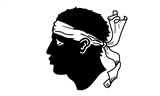
Corsica is an island in the
Mediterranean SeaThe Mediterranean Sea is a sea connected to the Atlantic Ocean surrounded by the Mediterranean region and almost completely enclosed by land: on the north by Anatolia and Europe, on the south by North Africa, and on the east by the Levant...
. It is located west of
ItalyItaly , officially the Italian Republic languages]] under the European Charter for Regional or Minority Languages. In each of these, Italy's official name is as follows:;;;;;;;;), is a unitary parliamentary republic in South-Central Europe. To the north it borders France, Switzerland, Austria and...
, southeast of the French
mainlandMainland is a name given to a large landmass in a region , or to the largest of a group of islands in an archipelago. Sometimes its residents are called "Mainlanders"...
, and north of the island of
SardiniaSardinia is the second-largest island in the Mediterranean Sea . It is an autonomous region of Italy, and the nearest land masses are the French island of Corsica, the Italian Peninsula, Sicily, Tunisia and the Spanish Balearic Islands.The name Sardinia is from the pre-Roman noun *sard[],...
.
Corsica is one of the 27
régionRegion is most commonly found as a term used in terrestrial and astrophysics sciences also an area, notably among the different sub-disciplines of geography, studied by regional geographers. Regions consist of subregions that contain clusters of like areas that are distinctive by their uniformity...
s of
FranceThe French Republic , The French Republic , The French Republic , (commonly known as France , is a unitary semi-presidential republic in Western Europe with several overseas territories and islands located on other continents and in the Indian, Pacific, and Atlantic oceans. Metropolitan France...
, although strictly speaking Corsica is designated as a "territorial collectivity" (
collectivité territoriale) by law. As a territorial collectivity, it enjoys greater powers than other French
régions, but for the most part its status is quite similar. Corsica is referred to as a "région" in common speech, and is almost always listed among the other
régions of France. Although the island is separated from the continental mainland by the
Ligurian SeaThe Ligurian Sea is an arm of the Mediterranean Sea, between the Italian Riviera and the island of Corsica. The sea is probably named after the ancient Ligures people.-Geography:...
and is closer to Italy than to the French mainland,
politicallyPolitical geography is the field of human geography that is concerned with the study of both the spatially uneven outcomes of political processes and the ways in which political processes are themselves affected by spatial structures...
Corsica is part of
Metropolitan FranceMetropolitan France is the part of France located in Europe. It can also be described as mainland France or as the French mainland and the island of Corsica...
. It was once briefly an independent
Corsican RepublicIn November 1755, Pasquale Paoli proclaimed Corsica a sovereign nation, the Corsican Republic, independent from the Republic of Genoa. He created the Corsican Constitution, which was the first constitution written under Enlightenment principles, including the first implementation of female...
, until being incorporated into France in 1769. Its culture has French and Italian elements blended into it.
Napoléon BonaparteNapoleon Bonaparte was a French military and political leader during the latter stages of the French Revolution.As Napoleon I, he was Emperor of the French from 1804 to 1815...
was born in
AjaccioAjaccio , is a commune on the island of Corsica in France. It is the capital and largest city of the region of Corsica and the prefecture of the department of Corse-du-Sud....
, where his ancestral home,
Casa BuonaparteCasa Buonaparte is the ancestral home of the Bonaparte family. It is located on the Rue Saint-Charles in Ajaccio on the island of Corsica. The house was almost continuously owned by members of the family from 1682 to 1923....
, is also located.
Corsica is also the birthplace of the singers
Tino RossiTino Rossi was a singer and film actor.Born Constantino Rossi in Ajaccio, Corsica, France, he became a tenor of French cabaret and one of the great romantic idols of his time. Gifted with an operatic voice, a "Latin Lover" persona made him a movie star as well...
and
AlizéeAlizée Jacotey is a French singer, known professionally by her given name Alizée She was discovered by Mylène Farmer, following her winning performance in the talent show, Graines de Star, in 1999...
.
History
Corsica has been occupied continuously since the
MesolithicThe Mesolithic is an archaeological concept used to refer to certain groups of archaeological cultures defined as falling between the Paleolithic and the Neolithic....
era. It acquired an indigenous population that was influential in the Mediterranean during its long prehistory. After a brief occupation by the Carthaginians,
colonization by the ancient GreeksThe Greeks in pre-Roman Gaul have a significant history of settlement, trade, cultural influence, and armed conflict in the Celtic territory of Gaul , starting from the 6th century BCE during the Greek Archaic period...
and an only slightly longer occupation by the Etruscans it was preempted by the
Roman RepublicThe Roman Republic was the period of the ancient Roman civilization where the government operated as a republic. It began with the overthrow of the Roman monarchy, traditionally dated around 508 BC, and its replacement by a government headed by two consuls, elected annually by the citizens and...
and became with
SardiniaSardinia is the second-largest island in the Mediterranean Sea . It is an autonomous region of Italy, and the nearest land masses are the French island of Corsica, the Italian Peninsula, Sicily, Tunisia and the Spanish Balearic Islands.The name Sardinia is from the pre-Roman noun *sard[],...
a province of the
Roman EmpireThe Roman Empire was the post-Republican period of the ancient Roman civilization, characterised by an autocratic form of government and large territorial holdings in Europe and around the Mediterranean....
. In the 5th century, the Roman Empire collapsed and the island was invaded by the
VandalsThe Vandals were an East Germanic tribe that entered the late Roman Empire during the 5th century. The Vandals under king Genseric entered Africa in 429 and by 439 established a kingdom which included the Roman Africa province, besides the islands of Sicily, Corsica, Sardinia and the Balearics....
, the Visigoths, the Saracens and the
LombardsThe Lombards , also referred to as Longobards, were a Germanic tribe of Scandinavian origin, who from 568 to 774 ruled a Kingdom in Italy...
. Pepin the Short, king of the
FranksThe Franks were a confederation of Germanic tribes first attested in the third century AD as living north and east of the Lower Rhine River. From the third to fifth centuries some Franks raided Roman territory while other Franks joined the Roman troops in Gaul. Only the Salian Franks formed a...
and
CharlemagneCharlemagne was King of the Franks from 768 and Emperor of the Romans from 800 to his death in 814. He expanded the Frankish kingdom into an empire that incorporated much of Western and Central Europe. During his reign, he conquered Italy and was crowned by Pope Leo III on 25 December 800...
's father, expelled the invaders and granted Corsica to pope
Stephen IIPope Stephen II was Pope from 752 to 757, succeeding Pope Zachary following the death of Pope-elect Stephen. Stephen II marks the historical delineation between the Byzantine Papacy and the Frankish Papacy.-Allegiance to Constantinople:...
through the exarchate of
RavennaRavenna is the capital city of the Province of Ravenna in the Emilia-Romagna region of Italy and the second largest comune in Italy by land area, although, at , it is little more than half the size of the largest comune, Rome...
(756), which was the starting point of the temporal power of the papacy.
The
GenoeseGenoa |Ligurian]] Zena ; Latin and, archaically, English Genua) is a city and an important seaport in northern Italy, the capital of the Province of Genoa and of the region of Liguria....
took possession of the island in 1347, and governed it until 1729 – interrupted only by a brief occupation by forces of a
Franco-Ottoman allianceThe Franco-Ottoman alliance, also Franco-Turkish alliance, was an alliance established in 1536 between the king of France Francis I and the Turkish ruler of the Ottoman Empire Suleiman the Magnificent. The alliance has been called "the first non-ideological diplomatic alliance of its kind between a...
in the
Invasion of Corsica (1553)The Invasion of Corsica of 1553 occurred when French, Ottoman and Corsican exile forces combined to capture the island of Corsica from the Genoese....
.
In Corsica,
vendettaA feud , referred to in more extreme cases as a blood feud, vendetta, faida, or private war, is a long-running argument or fight between parties—often groups of people, especially families or clans. Feuds begin because one party perceives itself to have been attacked, insulted or wronged by another...
was a social code that required Corsicans to kill anyone who wronged the family honor. Between 1821 and 1852, no fewer than 4,300 murders were perpetrated in Corsica.
Independent Corsica
In 1729 the Corsican Revolution for
independenceIndependence is a condition of a nation, country, or state in which its residents and population, or some portion thereof, exercise self-government, and usually sovereignty, over its territory....
began. After 26 years of struggle the independent
Corsican RepublicIn November 1755, Pasquale Paoli proclaimed Corsica a sovereign nation, the Corsican Republic, independent from the Republic of Genoa. He created the Corsican Constitution, which was the first constitution written under Enlightenment principles, including the first implementation of female...
was formed in 1755 under the leadership of
Pasquale PaoliFilippo Antonio Pasquale di Paoli , was a Corsican patriot and leader, the president of the Executive Council of the General Diet of the People of Corsica...
and remained sovereign until 1769 when it was
conquered by FranceThe French Conquest of Corsica took place during 1768 and 1769 when the Corsican Republic was occupied by French forces under the command of the Comte de Vaux....
. The first
Corsican ConstitutionThe first Corsican Constitution was drawn up in 1755 for the short-lived Corsican Republic and remained in force until the annexation of Corsica by France in 1769...
was written in
ItalianItalian is a Romance language spoken mainly in Europe: Italy, Switzerland, San Marino, Vatican City, by minorities in Malta, Monaco, Croatia, Slovenia, France, Libya, Eritrea, and Somalia, and by immigrant communities in the Americas and Australia...
(the language of culture in Corsica until the end of the 19th century) by Paoli. He proclaimed that Italian was the
official languageAn official language is a language that is given a special legal status in a particular country, state, or other jurisdiction. Typically a nation's official language will be the one used in that nation's courts, parliament and administration. However, official status can also be used to give a...
of Corsica.
The Corsican Republic was unable to eject the Genoese from the major coastal cities. Following
French losses in the Seven Years WarFrance was one of the leading participants in the Seven Years' War which lasted between 1754 and 1763. France entered the war with hopes of achieving a lasting victory both in Europe against Prussia, Britain and their German Allies and across the globe against their major colonial rivals...
, Corsica was purchased by France from the
Republic of GenoaThe Most Serene Republic of Genoa |Ligurian]]: Repúbrica de Zêna) was an independent state from 1005 to 1797 in Liguria on the northwestern Italian coast, as well as Corsica from 1347 to 1768, and numerous other territories throughout the Mediterranean....
in 1764. After an announcement and brief war in 1768–69 Corsican resistance was largely ended at the
Battle of Ponte NovuThe Battle of Ponte Novu took place on May 8 and 9 1769 between royal French forces under the Comte de Vaux, a seasoned professional soldier with an expert on mountain warfare on his staff, and the native Corsicans under Carlo Salicetti...
. Despite triggering the
Corsican CrisisThe Corsican Crisis was an event in British politics during 1768–69. It was precipitated by the invasion of the island of Corsica by France. The British government under the Duke of Grafton failed to intervene, for which it was widely criticised and was one of many factors that contributed to its...
in
BritainThe former Kingdom of Great Britain, sometimes described as the 'United Kingdom of Great Britain', That the Two Kingdoms of Scotland and England, shall upon the 1st May next ensuing the date hereof, and forever after, be United into One Kingdom by the Name of GREAT BRITAIN. was a sovereign...
, whose government gave secret aid, no foreign military support came for the Corsicans. Corsica was incorporated into France in 1770, marking the end of Corsican sovereignty. However, nationalist feelings still ran high.
Following the outbreak of the
French RevolutionThe French Revolution , sometimes distinguished as the 'Great French Revolution' , was a period of radical social and political upheaval in France and Europe. The absolute monarchy that had ruled France for centuries collapsed in three years...
in 1789, Pasquale Paoli was able to return to Corsica from exile in Britain. In 1794 he invited British forces under
Lord HoodSamuel Hood, 1st Viscount Hood was a British Admiral known particularly for his service in the American War of Independence and French Revolutionary Wars...
to intervene to free Corsica from French rule. Anglo-Corsican forces drove the French from the island and established an
Anglo-Corsican KingdomThe Anglo-Corsican Kingdom was a short-lived self-declared independent state on the island of Corsica during the mid-1790s.-Background and history of the kingdom:During the time of the French Revolution, Corsica had been a part of France for just two decades...
. Following Spain's entry into the war the British decided to withdraw from Corsica in 1796. Corsica then returned to French rule.
In 1814 near the end of the
Napoleonic WarsThe Napoleonic Wars were a series of wars declared against Napoleon's French Empire by opposing coalitions that ran from 1803 to 1815. As a continuation of the wars sparked by the French Revolution of 1789, they revolutionised European armies and played out on an unprecedented scale, mainly due to...
the island was briefly occupied again by British troops. The
Treaty of BastiaThe Treaty of Bastia was an agreement signed in 1814 between Britain and representatives of Corsica which conferred sovereignty of the island to the British crown. The treaty was agreed near the end of the Napoleonic Wars...
gave the British crown sovereignty over the island, but it was later repudiated by
Lord CastelreaghRobert Stewart, 2nd Marquess of Londonderry, KG, GCH, PC, PC , usually known as Lord CastlereaghThe name Castlereagh derives from the baronies of Castlereagh and Ards, in which the manors of Newtownards and Comber were located...
who insisted that the island should be returned to a
restored French monarchyThe Bourbon Restoration is the name given to the period following the successive events of the French Revolution , the end of the First Republic , and then the forcible end of the First French Empire under Napoleon – when a coalition of European powers restored by arms the monarchy to the...
.
Modern Corsica
After the collapse of France to the
German WehrmachtThe Wehrmacht – from , to defend and , the might/power) were the unified armed forces of Nazi Germany from 1935 to 1945. It consisted of the Heer , the Kriegsmarine and the Luftwaffe .-Origin and use of the term:...
in 1940, it came under the rule of the Vichy French regime, which was collaborating with the
NazisNazi Germany , also known as the Third Reich , but officially called German Reich from 1933 to 1943 and Greater German Reich from 26 June 1943 onward, is the name commonly used to refer to the state of Germany from 1933 to 1945, when it was a totalitarian dictatorship ruled by...
. Prior to its use as an aircraft base to attack German occupied Italy, it was liberated by Italian and
Free French ForcesThe Free French Forces were French partisans in World War II who decided to continue fighting against the forces of the Axis powers after the surrender of France and subsequent German occupation and, in the case of Vichy France, collaboration with the Germans.-Definition:In many sources, Free...
shortly after the Italian armistice in 1943.
During World War II, the island was nicknamed "USS Corsica", as the United States military established 17 airfields on Corsica for American tactical bomber groups attacking targets in Italy. One of the pilots stationed there was
Joseph HellerJoseph Heller was a US satirical novelist, short story writer, and playwright. His best known work is Catch-22, a novel about US servicemen during World War II...
, who would use his wartime experience in the creation of his novel
Catch-22Catch-22 is a satirical, historical novel by the American author Joseph Heller. He began writing it in 1953, and the novel was first published in 1961. It is set during World War II in 1943 and is frequently cited as one of the great literary works of the twentieth century...
.
During the
May 1958 crisisThe May 1958 crisis was a political crisis in France during the turmoil of the Algerian War of Independence which led to the return of Charles de Gaulle to political responsibilities after a ten year absence...
, French paratroopers from the Algerian corps landed on Corsica on May 24, taking the French island in a bloodless action called "Operation Corse".
Geography
Corsica was formed as an island through volcanic explosions. It is known as the most mountainous island in the Mediterranean. Corsica is 183 kilometres (113.7 mi) long at longest, 83 kilometres (51.6 mi) wide at widest, has 1000 kilometres (621.4 mi) of coastline, more than 200 beaches, and is very mountainous, with
Monte CintoMonte Cinto is the highest mountain on the island of Corsica, a région of France. Its altitude is 2,706 m and so is its prominence, making it one of the most prominent peaks in Europe....
as the highest peak at 2706 metres (8,878 ft) and 20 other summits of more than 2000 metres (6,561.7 ft). Mountains comprise two-thirds of the island, forming a single chain. Forest comprises 20% of the island.
Approximately 3500 km² (1,351.4 sq mi) of the total surface area of 8680 km² (3,351.4 sq mi) is dedicated to nature reserves (
Parc Naturel Régional de CorseThe Natural Park of Corsica is a natural park. It was listed in 1972 and then relisted for 10 years in June 1999. The Natural Park covers nearly 40% of the island of Corsica....
), mainly in the interior. Corsica contains the GR20, one of Europe's most notable hiking trails.
The island is 90 kilometres (55.9 mi) from
TuscanyTuscany is a region in Italy. It has an area of about 23,000 square kilometres and a population of about 3.75 million inhabitants. The regional capital is Florence ....
in Italy and 170 kilometres (105.6 mi) from the Côte d'Azur in France. It is separated from
SardiniaSardinia is the second-largest island in the Mediterranean Sea . It is an autonomous region of Italy, and the nearest land masses are the French island of Corsica, the Italian Peninsula, Sicily, Tunisia and the Spanish Balearic Islands.The name Sardinia is from the pre-Roman noun *sard[],...
to the south by the
Strait of BonifacioThe Strait of Bonifacio is the strait between Corsica and Sardinia, named after the Corsican town Bonifacio. It is wide and divides the Tyrrhenian Sea from the western Mediterranean Sea...
, a minimum of 11 kilometres (6.8 mi) wide.
Major communities
In 2005 the population of Corsica was settled in approximately 360 communities.
Climate
Zones by altitude
The island is divided into three major ecological zones by altitude. Below 600 metres (1,968.5 ft) is the coastal zone, which features a
Mediterranean climateA Mediterranean climate is the climate typical of most of the lands in the Mediterranean Basin, and is a particular variety of subtropical climate...
, with hot, dry summers and mild, rainy winters. The natural vegetation is Mediterranean forests, woodlands, and shrubs. The coastal lowlands are part of the
Tyrrhenian-Adriatic sclerophyllous and mixed forestsThe Thyrrenian-Adriatic Sclerophyllous and Mixed Forests Ecoregion, in the Mediterranean forests, woodlands, and scrub Biome, is in southern Italy, Sicily, Corsica, and the Dalmatian Islands.-Major forest zones:...
ecoregion, in which forests and woodlands of
evergreenIn botany, an evergreen plant is a plant that has leaves in all seasons. This contrasts with deciduous plants, which completely lose their foliage during the winter or dry season.There are many different kinds of evergreen plants, both trees and shrubs...
sclerophyllSclerophyll is the term for a type of vegetation that has hard leaves and short internodes . The word comes from the Greek sclero and phyllon ....
oakAn oak is a tree or shrub in the genus Quercus , of which about 600 species exist. "Oak" may also appear in the names of species in related genera, notably Lithocarpus...
s predominate, chiefly
Holm OakQuercus ilex, the Holm Oak or Holly Oak is a large evergreen oak native to the Mediterranean region. It takes its name from holm, an ancient name for holly...
(Quercus ilex) and
Cork OakQuercus suber, commonly called the Cork Oak, is a medium-sized, evergreen oak tree in the section Quercus sect. Cerris. It is the primary source of cork for wine bottle stoppers and other uses, such as cork flooring. It is native to southwest Europe and northwest Africa.It grows to up to 20 m,...
(Quercus suber). Much of the coastal lowlands have been cleared for agriculture, grazing and logging, which have reduced the forests considerably.
There is considerable birdlife in Corsica. In some cases Corsica is a delimited part of the species range. For example, the subspecies of
Hooded CrowThe Hooded Crow is a Eurasian bird species in the crow genus. Widely distributed, it is also known locally as Scotch Crow, Danish Crow, and Corbie or Grey Crow in Ireland, which is what its Welsh name, Brân Lwyd, translates as...
,
Corvus cornix ssp
cornix occurs in Corsica, but no further south.
From 600 to 1800 m (1,968.5 to 5,905.5 ) is a temperate montane zone. The mountains are cooler and wetter, and home to the
Corsican montane broadleaf and mixed forestsThe Corsican montane broadleaf and mixed forests ecoregion, in the Mediterranean forests, woodlands, and scrub Biome, are on the island of Corsica. The ecoregion includes the high-altitude regions of Corsica's mountain ranges.-Setting:...
ecoregion, which supports diverse forests of
oakAn oak is a tree or shrub in the genus Quercus , of which about 600 species exist. "Oak" may also appear in the names of species in related genera, notably Lithocarpus...
,
pinePines are trees in the genus Pinus ,in the family Pinaceae. They make up the monotypic subfamily Pinoideae. There are about 115 species of pine, although different authorities accept between 105 and 125 species.-Etymology:...
, and broadleaf deciduous trees, with vegetation more typical of northern Europe. The population lives predominantly below 900 metres (2,952.8 ft), with only shepherds and hikers at 600 to 900 m (1,968.5 to 2,952.8 ).
From 1800 to 2700 m (5,905.5 to 8,858.3 ) is a high alpine zone. Vegetation is sparse. In spite of the southern location, the highest elevations are snow-capped with small glaciers. This zone is uninhabited.
Parc Naturel Régional de Corse
The island has a natural park (Parc Naturel Régional de Corse, Parcu di Corsica), which protects the rare animal and plant species. The parc was created in 1972 and includes the Golfe de Porto, the
Scandola Nature ReserveThe Scandola Nature Reserve , established in December, 1975, is located on the French island Corsica, within Corsica Regional Park...
(a UNESCO World Heritage Site), and some of the highest mountains on the island. Scandola cannot be reached on foot, but people can gain access by boat from the village of Galéria and Porto (Ota). Two endangered subspecies of hoofed mammals, the
mouflonThe mouflon is a subspecies group of the wild sheep Ovis aries. Populations of Ovis aries can be partitioned into the mouflons and urials or arkars...
(Ovis aries musimon) and
Corsican red deerCorsican Red Deer , also known simply as Corsican or Sardinian Deer, is a subspecies of the Red Deer , endemic to the Mediterranean islands of Sardinia, Italy and Corsica, France....
(Cervus elaphus corsicanus) inhabit the parc. The Corsican red deer was re-introduced after it was extinct due to overhunting. This corsican subspecies was the same that survived on Sardinia, so its endemic. There are some more species that exsist only on the island of Corsica especially in the upper mountain range, i.g.
Corsican NuthatchThe Corsican Nuthatch, Sitta whiteheadi, is a small passerine bird which is endemic to Corsica, where it is the only nuthatch.The Corsican Nuthatch is a resident bird of the mountain forests of Corsica, and is closely associated with Corsican Pine preferably with some very old trees aged 300 years...
,
Corsican Fire SalamanderThe Corsican Fire Salamander is a species of salamander in the Salamandridae family. It is found only on the island of Corsica as an endemic species...
and
Corsican Brook SalamanderThe Corsican Brook Salamander or Corsican Mountain Newt is a species of salamander in the Salamandridae family.It is endemic to Corsica, an island in the Mediterranean....
and many plant subspecies.
Extinct animals
Corsica, like all the other Mediterranean islands, was home to indigenous animals of the
PleistoceneThe Pleistocene is the epoch from 2,588,000 to 11,700 years BP that spans the world's recent period of repeated glaciations. The name pleistocene is derived from the Greek and ....
, some endemic to it and some to it and
SardiniaSardinia is the second-largest island in the Mediterranean Sea . It is an autonomous region of Italy, and the nearest land masses are the French island of Corsica, the Italian Peninsula, Sicily, Tunisia and the Spanish Balearic Islands.The name Sardinia is from the pre-Roman noun *sard[],...
(as Sardinia was joined to Corsica for much of the Pleistocene). After the proliferation of humans in the
MesolithicThe Mesolithic is an archaeological concept used to refer to certain groups of archaeological cultures defined as falling between the Paleolithic and the Neolithic....
, these began to disappear, partly from extinction of the species, and partly from eradication only in Corsica. However it is now known that many species managed to survive the mesolithic, and many were still present well into recorded history.
The totally extinct species are
Cynotherium sardousThe Sardinian Dhole Cynotherium sardous was an endemic insular canid, that occurred on the Italian island of Sardinia and the French island of Corsica . It became extinct when humans began to settle on the island.When this canid became confined to the island, it faced a menu consisting of small and...
,
Megaloceros caziotiThe deer of the genus Megaloceros - ; see also Lister - were found throughout Eurasia from the late Pliocene to the Late Pleistocene, and were important herbivores during the Ice Ages. The largest species, M...
,
Soriculus corsicanusSoriculus nigrescens, also known as the Himalayan Shrew, is a species of mammal in the Soricidae family. It is found in Bhutan, China, India, Myanmar, and Nepal...
,
Prolagus sardus,
Bubo insularisThe American horned owls and the Old World eagle-owls make up the genus Bubo, at least as traditionally described. This genus, depending on definition, contains about one or two dozen species of typical owls and is found in many parts of the world. Some of the largest living Strigiformes are in...
and
Athene angelisAthene is a genus of owls, containing two to four living species, depending on classification. These birds are small, with brown and white speckles, yellow eyes, and white eyebrows...
. Birds were especially hard-hit. Some that were eradicated from the vicinity are
Haliaeetos albicillaThe White-tailed Eagle , also known as the Sea Eagle, Erne , or White-tailed Sea-eagle, is a large bird of prey in the family Accipitridae which includes other raptors such as hawks, kites, and harriers...
and
Aquila heliacaThe Eastern Imperial Eagle is a large species of bird of prey that breeds from southeastern Europe to central Asia. Most populations are migratory and winter in northeastern Africa, and southern and eastern Asia. The Spanish Imperial Eagle, found in Spain and Portugal, was formerly lumped with...
.
Demographics
In the 1998 census, 87.1% of the population was French-born with 10% (26,018) being born out of France. The majority of immigrants were from the
MaghrebThe Maghreb is the region of Northwest Africa, west of Egypt. It includes five countries: Morocco, Algeria, Tunisia, Libya, and Mauritania and the disputed territory of Western Sahara...
region, particularly
MoroccansThe Moroccan people are a people that share a common Moroccan culture, ancestry and speak the Moroccan variant of the Arabic language or a Berber language as a mother tongue....
(41.9% of immigrants) but also Italians (18.7%) and
PortugueseThe Portuguese are a nation and ethnic group native to the country of Portugal, in the west of the Iberian peninsula of south-west Europe. Their language is Portuguese, and Roman Catholicism is the predominant religion....
(12.3%).
Language
Corsica is one of the few regions of France that retains its own language in everyday usage:
CorsicanCorsican is a Italo-Dalmatian Romance language spoken and written on the islands of Corsica and northern Sardinia . Corsican is the traditional native language of the Corsican people, and was long the vernacular language alongside the Italian, official language in Corsica until 1859, which was...
, which is more closely related to
ItalianItalian is a Romance language spoken mainly in Europe: Italy, Switzerland, San Marino, Vatican City, by minorities in Malta, Monaco, Croatia, Slovenia, France, Libya, Eritrea, and Somalia, and by immigrant communities in the Americas and Australia...
than to French, is spoken by 65% of the population. However since its takeover by France in the 18th century, French has dominated the media and commerce, and today it is spoken and understood by the entire population (though not all speak it as a native language).
Cuisine
From the mountains to the plains and sea, many ingredients play a role. Game such as wild boar (
Cignale,
Singhjari) is popular. There also is seafood and river fish such as trout. Delicatessen such as
ficatellu (also named as
ficateddu),
coppa, ham (
prizuttu),
lonzu are made from Corsican pork (
porcu nustrale). Cheeses like
Brocciu,
casgiu merzu,
casgiu veghju are made from goat or sheep milk. Chestnuts are the main ingredient in the making of
pulenta. A variety of alcohol also exists ranging from
aquavita (brandy), red and white Corsican wines (
Vinu Corsu), muscat (plain or sparkling), and the famous "cap corse" produced by Mattei.
Art
Corsica has produced a number of internationally known artists including the abstract painter
François LanziFrançois Lanzi was a French-born artist who lived a large part of his adult life in the United Kingdom.- His life :...
and polyphonic chant group
I MuvriniI Muvrini is a Corsican folk music group who sing traditional Corsican music in their native Corsican language.-History:The group was formed in the early 1980s by the brothers Jean-François Bernardini and Alain Bernardini who were born in the village of Tagliu-Isulacciu in the north of Corsica...
.
Administration
The capital of Corsica is
AjaccioAjaccio , is a commune on the island of Corsica in France. It is the capital and largest city of the region of Corsica and the prefecture of the department of Corse-du-Sud....
(Corsican:
Aiacciu). The ruling body is the
Corsican AssemblyThe Corsican Assembly is the unicameral legislative body of the territorial collectivity of Corsica. It has its seat at the Grand Hôtel d'Ajaccio et Continental, in the Corsican capital of Ajaccio.-History:...
. The territorial collectivity is divided in two
départements:
Corse-du-SudCorse-du-Sud is a French département composed of the southern part of the island of Corsica.- History :The department was formed on 15 September 1975, when the Corse department was divided into Haute-Corse and Corse-du-Sud...
and
Haute-CorseHaute-Corse is a French department. It constitutes the northern part of the island of Corsica.- History :The department was formed on 15 September 1975, when the department of Corse was divided into Haute-Corse and Corse-du-Sud...
. These two
départements were created on 15 September 1975 by splitting the hitherto united
département of Corse.
Recent attempts to gain greater autonomy for the territorial collectivity of Corsica have failed. A local referendum held in 2003, aimed at disbanding the
départements and leaving only the territorial collectivity with extended powers, was voted down by a narrow margin.
Economy
Corsica is the least economically developed region in
Metropolitan FranceMetropolitan France is the part of France located in Europe. It can also be described as mainland France or as the French mainland and the island of Corsica...
. Tourism plays a big part in the Corsican economy. The island's climate, mountains and coastlines make it popular among tourists. The island has not had the same level of intensive development as other parts of the Mediterranean and is thus mainly unspoiled. Tourism is particularly concentrated in the area around Porto Vecchio and Bonifacio in the south of the island and Calvi in the northwest.
In 1584 the
GenoeseThe Most Serene Republic of Genoa |Ligurian]]: Repúbrica de Zêna) was an independent state from 1005 to 1797 in Liguria on the northwestern Italian coast, as well as Corsica from 1347 to 1768, and numerous other territories throughout the Mediterranean....
governor ordered all farmers and landowners to plant four trees yearly; a
chestnutChestnut , some species called chinkapin or chinquapin, is a genus of eight or nine species of deciduous trees and shrubs in the beech family Fagaceae, native to temperate regions of the Northern Hemisphere. The name also refers to the edible nuts they produce.-Species:The chestnut belongs to the...
,
oliveThe olive , Olea europaea), is a species of a small tree in the family Oleaceae, native to the coastal areas of the eastern Mediterranean Basin as well as northern Iran at the south end of the Caspian Sea.Its fruit, also called the olive, is of major agricultural importance in the...
,
figFicus is a genus of about 850 species of woody trees, shrubs, vines, epiphytes, and hemiepiphyte in the family Moraceae. Collectively known as fig trees or figs, they are native throughout the tropics with a few species extending into the semi-warm temperate zone. The Common Fig Ficus is a genus of...
and
mulberryMorus is a genus of flowering plants in the family Moraceae. The 10–16 species of deciduous trees it contains are commonly known as Mulberries....
tree. Many communities owe their origin and former richness to the ensuing chestnut woods. Chestnut bread keeps fresh for as long as three weeks. Corsica produces gourmet cheese, wine, sausages, and honey for sale in mainland France and for export. Corsican honey, of which there are six official varietals, is certified as to its origin (
Appellation d'origine contrôléeAppellation d’origine contrôlée , which translates as "controlled designation of origin", is the French certification granted to certain French geographical indications for wines, cheeses, butters, and other agricultural products, all under the auspices of the government bureau Institut National...
) by the French National Institute of Origin and Quality (
Institut National des Appellations d'OrigineThe Institut National des Appellations d'Origine is the French organization charged with regulating French agricultural products with Protected Designations of Origin . Controlled by the French government, it forms part of the Ministry of Agriculture...
– INAO).
Railway
Corsica has 232 kilometres (144 mi) of narrow-gauge railway. The main line runs between
BastiaBastia is a commune in the Haute-Corse department of France located in the northeast of the island of Corsica at the base of Cap Corse. It is also the second-largest city in Corsica after Ajaccio and the capital of the department....
and
AjaccioAjaccio , is a commune on the island of Corsica in France. It is the capital and largest city of the region of Corsica and the prefecture of the department of Corse-du-Sud....
and there is a branch line from Ponte-Leccia to Calvi. The trains are operated by Chemins de fer de Corse (CFC).
There is also a third line along the east coast that is no longer in use due to heavy damage during World War II. There has been talk of restoring it but as yet nothing has happened.
Politics
Corsica is currently governed in almost the same way as any other
région of France. There are several
nationalist movementsCorsican nationalism is a social and political movement in Corsica, active since the 1960s.- History :In 1923 was created the Partitu Corsu d'Azione by Petru Rocca, an Italian irredentist who initially promoted the union of Corsica to the Kingdom of Italy but after World War II changed to promote...
on the island calling for some degree of Corsican
autonomySelf-governance is an abstract concept that refers to several scales of organization.It may refer to personal conduct or family units but more commonly refers to larger scale activities, i.e., professions, industry bodies, religions and political units , up to and including autonomous regions and...
from France or even full
independenceIndependence is a condition of a nation, country, or state in which its residents and population, or some portion thereof, exercise self-government, and usually sovereignty, over its territory....
. Generally speaking, autonomist proposals focus on the promotion of the
Corsican languageCorsican is a Italo-Dalmatian Romance language spoken and written on the islands of Corsica and northern Sardinia . Corsican is the traditional native language of the Corsican people, and was long the vernacular language alongside the Italian, official language in Corsica until 1859, which was...
, more power for local governments, and some exemptions from national taxes in addition to those already applying to Corsica.
The French government is opposed to full independence but has at times shown support for some level of autonomy. There is support on the island for proposals of greater autonomy, but polls show that a large majority of Corsicans are opposed to full independence.
In 1972, the Italian company Montedison dumped toxic waste off the Corsican coast, creating what looked like red mud in waters around the island with the poisoning of the sea, the most visible effects being cetaceans found dead on the shores.
At that time the Corsican people felt that the French government did not support them since it did not complain to Italy to make this situation change. To stop the poisoning, one ship carrying toxic waste from Italy was bombed.
Organisations started to seek money, acting like the
MafiaThe Mafia is a criminal syndicate that emerged in the mid-nineteenth century in Sicily, Italy. It is a loose association of criminal groups that share a common organizational structure and code of conduct, and whose common enterprise is protection racketeering...
, to fund violence. Some groups that claim to support
Corsican independenceCorsican nationalism is a social and political movement in Corsica, active since the 1960s.- History :In 1923 was created the Partitu Corsu d'Azione by Petru Rocca, an Italian irredentist who initially promoted the union of Corsica to the Kingdom of Italy but after World War II changed to promote...
, such as the
National Liberation Front of CorsicaThe National Liberation Front of Corsica is a militant group that advocates an independent state on the island of Corsica, separate from France. They also want all currently imprisoned members of the FLNC in France to be put into Corsican prisons. The organisation's presence is primarily in...
, have carried out a violent campaign since the 1970s that includes bombings and assassination, usually targeting buildings and officials representing the French government or Corsicans themselves for political reasons. A war between two rival independence groups led to several deaths in the 1990s. The peaceful occupation of a
pied-noirPied-Noir , plural Pieds-Noirs, pronounced , is a term referring to French citizens of various origins who lived in French Algeria before independence....
vineyard in
AlériaAléria is a commune in the Haute-Corse department of France on the island of Corsica...
in 1975 marked a turning point when the French government responded with overwhelming force, generating sympathy for the independence groups among the Corsican population.
In 2000, Prime Minister
Lionel JospinLionel Jospin is a French politician, who served as Prime Minister of France from 1997 to 2002.Jospin was the Socialist Party candidate for President of France in the elections of 1995 and 2002. He was narrowly defeated in the final runoff election by Jacques Chirac in 1995...
agreed to grant increased autonomy to Corsica. The proposed autonomy for Corsica would have included greater protection for the
Corsican languageCorsican is a Italo-Dalmatian Romance language spoken and written on the islands of Corsica and northern Sardinia . Corsican is the traditional native language of the Corsican people, and was long the vernacular language alongside the Italian, official language in Corsica until 1859, which was...
(Corsu), the island's traditional language (similar to
ItalianItalian is a Romance language spoken mainly in Europe: Italy, Switzerland, San Marino, Vatican City, by minorities in Malta, Monaco, Croatia, Slovenia, France, Libya, Eritrea, and Somalia, and by immigrant communities in the Americas and Australia...
), whose practice and teaching, like other regional or minority languages in France, had in the past been discouraged. According to the
UNESCOThe United Nations Educational, Scientific and Cultural Organization is a specialized agency of the United Nations...
classification, the Corsican language is currently in danger of becoming extinct. However, plans for increased autonomy were opposed by the
GaullistGaullism is a French political ideology based on the thought and action of Resistance leader then president Charles de Gaulle.-Foreign policy:...
opposition in the
French National AssemblyThe French National Assembly is the lower house of the bicameral Parliament of France under the Fifth Republic. The upper house is the Senate ....
, who feared that they would lead to calls for autonomy from other
régions (such as
BrittanyBrittany is a cultural and administrative region in the north-west of France. Previously a kingdom and then a duchy, Brittany was united to the Kingdom of France in 1532 as a province. Brittany has also been referred to as Less, Lesser or Little Britain...
, Alsace, or
ProvenceProvence ; Provençal: Provença in classical norm or Prouvènço in Mistralian norm) is a region of south eastern France on the Mediterranean adjacent to Italy. It is part of the administrative région of Provence-Alpes-Côte d'Azur...
), eventually threatening France's unity as a country.
In a
referendumA referendum is a direct vote in which an entire electorate is asked to either accept or reject a particular proposal. This may result in the adoption of a new constitution, a constitutional amendment, a law, the recall of an elected official or simply a specific government policy. It is a form of...
on 6 July 2003, a narrow majority of Corsican voters opposed a project from the government of
Jean-Pierre RaffarinJean-Pierre Raffarin is a French conservative politician and senator for Vienne.Jean-Pierre Raffarin served as the Prime Minister of France from 6 May 2002 to 31 May 2005, resigning after France's rejection of the referendum on the European Union draft constitution. However, after Raffarin...
and then-
Interior MinisterThe Minister of the Interior in France is one of the most important governmental cabinet positions, responsible for the following:* The general interior security of the country, with respect to criminal acts or natural catastrophes...
Nicolas SarkozyNicolas Sarkozy is the 23rd and current President of the French Republic and ex officio Co-Prince of Andorra. He assumed the office on 16 May 2007 after defeating the Socialist Party candidate Ségolène Royal 10 days earlier....
that would have suppressed the two
départements of the island and granted greater autonomy to the territorial collectivity of Corsica.
External links