


Romance languages

Encyclopedia
The Romance languages (sometimes referred to as Romanic languages, Latin languages or Neo-Latin languages) are a branch of the Indo-European language family
, more precisely of the Italic languages subfamily
, comprising all the languages that descend from Vulgar Latin
, the language of ancient Rome
. There are more than 800 million native speakers worldwide, mainly in Europe
and the Americas, as well as many smaller regions scattered throughout the world. Because of the extreme difficulty and varying methodology of distinguishing among language, variety, and dialect, it is impossible to count the number of Romance languages now in existence, but a restrictive, arbitrary account can place the total at approximately 25. In fact, the number is much larger, and many more existed previously (SIL
Ethnologue lists 47 Romance languages). Today the six most widely spoken standardized Romance languages are Spanish
(c. 329 million native), Portuguese
(c. 178 million native), French
(c. 68 million native), Italian
(c. 62 million native), Romanian
(c. 23 million native), and Catalan
(c. 12 million native). Many of these languages have large numbers of non-native speakers; this is especially the case for French, in widespread use throughout West Africa
as a lingua franca
. Among numerous other Romance languages are Aragonese
, Aromanian
, Arpitan, Asturian
, Corsican
, Emiliano-Romagnolo, Friulian
, Galician
, Ladino, Leonese
, Lombard, Mirandese
, Neapolitan
, Occitan, Piedmontese
, Romansh, Sardinian
, Sicilian
, Venetian
and Walloon
.
, the popular sociolect
of Latin spoken by soldiers, settlers and merchant
s of the Roman Empire, as distinguished from the Classical form of the language spoken by the Roman upper classes, the form in which the language was generally written. Between 350 BC and AD 150, the expansion of the Empire, together with its administrative and educational policies, made Latin the dominant native language in continental Western Europe. Latin also exerted a strong influence in southeastern Britain
, the Roman province of Africa
, and the Balkans north of the Jireček Line
.
During the Empire's decline, and after its fragmentation and collapse in the 5th century, varieties of Latin began to diverge within each local area at an accelerated rate, and eventually evolved into a continuum of recognizably different typologies. The overseas empires established by Portugal
, Spain
and France
from the 15th century onward spread their languages to the other continents, to such an extent that about two-thirds of all Romance speakers today live outside Europe.
Despite profound influences (e.g. substratum
from pre-Roman languages, especially Continental Celtic languages
; and superstratum from later Germanic
or Slavic
invasions), the phonology
, morphology
, and lexicon
of all Romance languages seem to be predominantly evolutions of Vulgar Latin. In particular, with only one or two exceptions, Romance languages have lost the declension
system of present Latin and as a result, have SVO sentence structure and make extensive use of prepositions.
), contrasted with latine loqui, "to speak in Latin" (Medieval Latin
, the conservative
version of the language used in writing and formal contexts or as a lingua franca
), and with barbarice loqui, "to speak in Barbarian
" (the non-Latin languages of the peoples living outside the Roman Empire
). From this adverb the noun romance originated, which applied initially to anything written romanice, or "in the Roman vernacular".
The word romance with the modern sense of romance novel
or love affair has the same origin. In the medieval literature
of Western Europe, serious writing was usually in Latin, while popular tales, often focusing on love, were composed in the vernacular and came to be called "romances
".
English: She always closes the window before dining.
Some of the lexical divergence above comes from semantic change
: different Romance languages use the same root word with different meaning. Portuguese, for example, has the word fresta, and Spanish fenestra/finiestra (which is a cognate of French fenêtre, Italian finestra, Romanian fereastra and so on, from Latin " "window"), however it now means "skylight" and "slit" as opposed to "window." The Spanish and Portuguese terms defenestrar and defenestración/defenestração meaning "to throw through a window" or "defenestrate, defenestration", and fenestrado, "replete with windows", also have the same root (but are later derivations from Latin). Likewise, Portuguese also has the word cear, a cognate of Italian cenare and Spanish cenar, but uses it in the sense of "to have a late supper" in most varieties, while the preferred word for "to dine" is actually jantar (related to archaic Spanish yantar "to eat") because of semantic changes in the 19th century. Galician has both fiestra (from medieval fẽestra which is the ultimate origin of standard Portuguese fresta), and the less frequently used ventá and xanela.
As an alternative to lei (originally the accusative form), Italian has the pronoun ella, a cognate of the other words for "she", but it is hardly ever used in speaking.
Spanish, Asturian and Leonese ventana and Mirandese and Sardinian bentana come from Latin "wind" (c.f. English window, etymologically 'wind eye'), and Portuguese janela, Galician xanela, Mirandese jinela from Latin "small opening", a derivative of "door".
Sardinian balcone (alternative for bentana) comes from Old Italian and is similar to other Romance languages such as French balcon, Portuguese balcão, Romanian balcon, Spanish balcón, Catalan balcó and Corsican balconi (alternative for purtellu).
and its replacement by prepositions; the loss of the neuter gender, comparative inflections; replacement of some verb
paradigms by innovations (e.g. the synthetic future gave way to an originally analytic strategy now typically formed by infinitive + evolved present indicative forms of 'have'); the use of articles
; and the initial stages of the palatalization
of the plosives /k/, /g/, and /t/. Some modern languages, such as Finnish, have similar, quite sharp, differences between their printed and spoken form. To some scholars, this suggests that the form of Vulgar Latin that evolved into the Romance languages was around during the time of the Roman Empire
(from the end of 1st century BC), and was spoken alongside the written Classical Latin which was reserved for official and formal occasions. Other scholars argue that the distinctions are more rightly viewed as indicative of sociolinguistic and register differences normally found within any language.
into the empire, and the Latin-speaking world was fragmented into several independent states. Central Europe and the Balkans
were occupied by the Germanic and Slavic
tribes, as well as by the Huns
, which isolated the Vlachs
from the rest of Latin Europe
. British Romance
and African Romance
, the forms of Vulgar Latin used in southeastern Britain
and the Roman province of Africa, where it had been spoken by much of the urban population, disappeared in the Middle Ages. But the Germanic tribes that had penetrated Italy, Gaul
, and Hispania
eventually adopted Latin and the remnants of Roman culture, and so Latin remained the dominant language there.
, Medieval Latin
, remained close to the older Classical Latin.
s developed a written form and began to supplant Latin in many of its roles. In some countries, such as Portugal
, this transition was expedited by force of law; whereas in others, such as Italy
, many prominent poets and writers used the vernacular of their own accord – some of the most famous in Italy being Giacomo da Lentini
and Dante Alighieri
.
apparently slowed down the evolution of Romance languages from the 16th century on, and brought a tendency towards greater uniformity of standard language
s within political boundaries, at the expense of other Romance languages and dialect
s less favored politically. In France, for instance, the dialect spoken in the region of Paris gradually spread to the entire country, and the Occitan of the south lost ground.
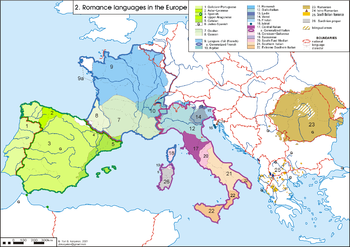 The Romance language most widely spoken natively today is Spanish
(around 400 million speakers), followed by Portuguese
(over 200 million), French
(over 110 million), Italian
(around 65 million), Romanian
(around 24 million), and Catalan
(around 12 million), all of which are official language
s in at least one country. A few other languages have official status on a regional or otherwise limited level, for instance Friulian, Sardinian
and Franco-Provençal
in Italy; Romansh in Switzerland; and Galician
in Spain. French, Italian, Portuguese, Spanish, and Romanian are also official languages of the European Union
. Spanish, Portuguese, French, Italian, Romanian, and Catalan are the official languages of the Latin Union
; and French and Spanish are two of the six official languages of the United Nations
.
Outside Europe, French
, Portuguese
and Spanish
are spoken and enjoy official status in various countries that emerged from their respective colonial empire
s. French is one of the official languages of Canada
, many countries in Africa
, and some islands in the Indian
and Pacific Ocean
. It is also the sole official language of Quebec
. Spanish is an official language of Mexico
, much of South America
, Central America
, the islands of the Greater Antilles
in the Caribbean
(except in Haiti
where the official languages are French and Haitian Kreyol, a French creole
, and Jamaica
, where English
and Jamaican Patois are spoken.), and it is the official language of Equatorial Guinea
in Africa and is the most spoken Romance language in the world. Portuguese is the official language of Brazil
(reaching almost 190 million, it is the language spoken by half of population of South America that resides in Brazil), five African countries (Angola
, Cabo Verde, Guiné-Bissau, Mozambique
and São Tomé e Príncipe), and East Timor
and Macau
in Asia and is the second most spoken Romance language. Although Italy
also had some colonial possessions, its language did not remain official after the end of the colonial domination, resulting in Italian
being spoken only as a minority or secondary language by immigrant communities in North
, South America
, Australia
, and African countries like Libya
, Eritrea
and Somalia
. Romania
did not establish a colonial empire, but the language is spoken as a native language in Moldova
, while it also spread to other countries in rest of Europe, especially the other Romance countries (most notably Italy
and Spain
), and elsewhere such as Israel
, where it is a native language to 5% of the population, and by many more as a secondary language; this is due to the large numbers of Romanian-born Jews
who moved to Israel after World War II
.
The total native speakers of Romance languages are divided as follows (with their ranking within the languages of the world in brackets):
Catalan is unusual in that it is not the main language of any nation-state, other than Andorra
(a European microstate
between Spain and France), but nonetheless has been able to compete and even gain speakers at the expense of the dominant language of its primary nation (Spanish); in fact, Catalan is probably the only minority European language whose long-term survival is not under threat. This is due to a strong belief that the Catalan language is a critical component of the ethnic identity of the Catalan people
. This has allowed them to resist the assimilationist urges that are in the process of destroying most of the remaining minority-language communities, even those that have strong government support (e.g. Irish language
speakers).
The remaining Romance languages survive mostly as spoken languages for informal contact. National governments have historically viewed linguistic diversity as an economic, administrative or military liability, as well as a potential source of separatist
movements; therefore, they have generally fought to eliminate it, by extensively promoting the use of the official language, restricting the use of the "other" languages in the media, characterizing them as mere "dialects", or even persecuting them. As a result, all of these languages are considered endangered to varying degrees according to the UNESCO Red Book of Endangered Languages
, ranging from "vulnerable" (e.g. Sicilian
and Venetian
) to "severely endangered" (most of the Occitan varieties).
In the late 20th and early 21st centuries, increased sensitivity to the rights of minorities have allowed some of these languages to start recovering their prestige and lost rights. Yet it is unclear whether these political changes will be enough to reverse the decline of minority Romance languages.
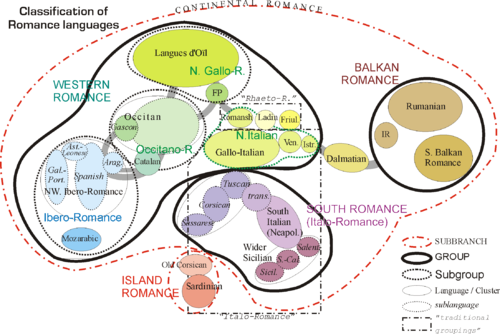
The classification of the Romance languages is inherently difficult, since most of the linguistic area can be considered a dialect continuum
, and in some cases political biases can come into play. Nevertheless, according to SIL
counts, 47 Romance languages and dialects are spoken in Europe
. Along with Latin (which is not included among the Romance languages) and a few extinct languages of ancient Italy, they make up the Italic branch
of the Indo-European family
.
Note that Dalmatian
is now generally grouped under Proto-Italian rather than Eastern Romance .
There are various schemes used to subdivide the Romance languages. Three of the most common schemes are as follows:
The main subfamilies that have been proposed by Ethnologue
within the various classification schemes for Romance languages are:
The three-way division is made primarily based on the outcome of Vulgar Latin (Proto-Romance) vowels:
Italo-Western is in turn split along the so-called La Spezia-Rimini Line
in northern Italy, which divides the central and southern Italian languages from the so-called Western Romance languages
to the north and west. The primary characteristics dividing the two are:
In fact, the reality is somewhat more complex. All of the "southeast" characteristics apply to all languages southeast of the line, and all of the "northwest" characteristics apply to all languages in France and (most of) Spain. However, the Gallo‒Italic languages and the Rhaeto-Romance languages
of Switzerland and Italy are somewhere in between. All of these languages do have the "northwest" characteristics of lenition and loss of gemination. However:
On top of this, the ancient Mozarabic language
in southern Spain, at the far end of the "northwest" group, had the "southeast" characteristics of lack of lenition and palatalization of /k/ to /tʃ/. Certain languages around the Pyrenees
(e.g. some highland Aragonese
dialects) also lack lenition, and northern French dialects such as Norman
and Picard
have palatalization of /k/ to /tʃ/ (although this is possibly a independent, secondary development, since /k/ between vowels, i.e. when subject to lenition, developed to /dz/ rather than /dʒ/, as would be expected for a primary development).
The usual solution to these issues is to create various nested subgroups. Western Romance is split into the Gallo-Iberian languages, in which lenition happens and which include nearly all the Western Romance languages, and the Pyrenean-Mozarabic group, which includes the remaining languages without lenition (and is unlikely to be a valid clade
; probably at least two clades, one for Mozarabic and one for Pyrenean). Gallo-Iberian is split in turn into the Iberian languages (e.g. Spanish
and Portuguese
), and the larger Gallo-Romance languages
(stretching from eastern Spain to northeast Italy).
Probably a more accurate description, however, would be to say that there was a focal point of innovation located in central France, from which a series of innovations spread out as areal changes. The La Spezia-Rimini Line
represents the farthest point to the southeast that these innovations reached, corresponding to the northern chain of the Apennine Mountains
, which cuts straight across northern Italy and forms a major geographic barrier to further language spread. This would explain why some of the "northwest" features (almost all of which can be characterized as innovations) end at differing points in northern Italy, and why some of the languages in geographically remote parts of Spain (in the south, and high in the Pyrenees) are lacking some of these features. It also explains why the languages in France (especially standard French) seem to have innovated earlier and more completely than other Western Romance languages.
Many of the "southeast" features also apply to the Eastern Romance languages (particularly, Romanian), despite the geographic discontinuity. Examples are lack of lenition, maintenance of intertonic vowels, use of vowel-changing plurals, and palatalization of /k/ to /tʃ/. (Gemination is missing, which may be an independent development, and /kt/ develops into /pt/ rather than either of the normal Italo-Western developments.) This has led some researchers to postulate a basic two-way East-West division, with the "Eastern" languages including Romanian and central and southern Italian.
Sardinian does not fit into this picture at all. It is clear that Sardinian became linguistically independent from the remainder of the Romance languages at an extremely early date, possibly already by the 1st century BC. Sardinian contains a large number of archaic features, including total lack of palatalization of /k/ and /g/ and a large amount of vocabulary preserved nowhere else, including some items already archaic by the time of Classical Latin (1st century BC). Sardinian has plurals in /s/ but no lenition of voiceless consonants (at least in most conservative Nuorese
dialects) and a number of innovations unseen elsewhere: most famously, its unique vowel system, but also development of /au/ to /a/, a peculiar sort of lenition that operates as a synchronic feature, and use of su < as an article (another archaic feature, also seen in the Catalan of the Balearic Islands
).
Gallo-Romance languages as a whole are usually characterized by the loss of all unstressed final vowels other than /-a/ (most significantly, final /-o/ and /-e/ were lost). However, when the loss of a final vowel would result in an impossible final cluster (e.g. /tr/), a prop vowel appears in place of the lost vowel, usually /e/. Generally, the same changes also occurred in final syllables closed by a consonant. Furthermore, loss of /e/ in a final syllable was early enough in Primitive Old French that the Classical Latin third-singular /t/ was often preserved, e.g. "he comes" > /ˈvɛːnet/ (Romance vowel changes) > /ˈvjɛnet/ (diphthongization) > /ˈvjɛned/ (lenition) > /ˈvjɛnd/ (Gallo-Romance final vowel loss) > /ˈvjɛnt/ (final devoicing). Elsewhere, final vowel loss occurred later and/or unprotected /t/ was lost earlier (perhaps under Italian influence).
Gallo-Romance is divided four ways:
Other than southern Occitano-Romance, the Gallo-Romance languages are quite innovatory, with French and some of the Gallo-Italian languages rivaling each other for the most extreme phonological changes compared with conservative languages. For example, French sain, saint, sein, ceint, ceint meaning "healthy, holy, breast, (he) girds, (was) girded" (Latin ) are all pronounced /sɛ̃/; similarly cent, sent, sans, sang meaning "hundred, (he) feels, without, blood" (Latin ) are all pronounced /sɑ̃/.
In some ways, however, the Gallo-Romance languages are conservative. The older stages of many of the languages are famous for preserving a two-case system consisting of nominative and oblique: fully marked on nouns, adjectives and determiners, inherited almost directly from the Latin nominative and accusative cases and preserving a number of different declensional classes and irregular forms. In the opposite of the normal pattern, the languages closest to the oïl epicenter preserve the case system the best, while languages at the periphery — near to languages that had long before lost the case system except on pronouns — lose it early. For example, the case system is well-preserved in Old Occitan up through the 13th century or so but is totally lost in Old Catalan
at the time, despite being virtually the same language at the time.
Notable characteristics of the Gallo-Romance languages are:
The Gallo-Italian and Italian Rhaeto-Romance languages have a number of features in common with the other Italian languages:
s, creole language
s, or mixed language
s. Some other languages, such as English
, are sometimes thought of as creoles
of semi-Romance ancestry. There are several dozens of creoles of Portuguese, Swahili
, Spanish
and French origin
, some of them spoken as national language
s in former European colonies.
Creoles of French
Creoles of Spanish
Creoles of Portuguese
, its reformed version Modern Latin, Latino sine flexione
, Occidental
, and Lingua Franca Nova
, as well as languages created for artistic purposes only, such as Talossan
. Because Latin is a very well-attested ancient language, some amateur linguists have even constructed Romance languages that mirror real languages that developed from other ancestral languages. These include Brithenig
(which mirrors Welsh
), Breathanach (mirrors Irish
), Wenedyk
(mirrors Polish
), Þrjótrunn (mirrors Icelandic
), and Helvetian (mirrors German
).
The most significant changes between Classical Latin
and Proto-Romance (and hence all the modern Romance languages) relate to the reduction and loss of the Latin case system
, and the corresponding syntactic changes that were triggered.
The case system was drastically reduced from the vigorous six-case system of Latin. Although four cases can be constructed for Proto-Romance nouns (nominative, accusative, combined genitive/dative, and vocative), the vocative is marginal and present only in Romanian (where it may be an outright innovation), and of the remaining cases, no more than two are present in any one language. Romanian is the only modern Romance language with case marking on nouns, with a two-way opposition between nominative/accusative and genitive/dative. Some of the older Gallo-Romance languages
(in particular, Old French
, Old Occitan and Old Sursilvan) had an opposition between nominative and general oblique. The system of multiple noun declensions was also dramatically reduced; most modern languages have only three types (masculine -o, feminine -a, and an -e that can be either gender). As in English, case is preserved better on pronouns than elsewhere, with some pronouns marked for as many as four cases (nominative, accusative, dative, genitive) plus additional possessive and disjunctive forms.
Concomitant with the loss of cases, freedom of word order was greatly reduced. Classical Latin had a generally verb-final (SOV) but overall quite free word order, with a significant amount of word scrambling and mixing of left-branching and right-branching constructions. The Romance languages eliminated word scrambling and nearly all left-branching constructions, with most languages developing a rigid SVO, right-branching syntax. (Old French
, however, had a freer word order due to the two-case system still present, as well as a predominantly verb-second word order
developed under the influence of the Germanic languages
.) Some freedom, however, is allowed in the placement of adjectives relative to their head noun. In addtion, some languages (e.g. Spanish, Romanian) have an "accusative preposition" (Romanian per, Spanish "personal a") along with clitic doubling
, which allows for some freedom in ordering the arguments of a verb.
The Romance languages developed grammatical articles where Latin had none. Articles are often introduced around the time a robust case system falls apart in order to disambiguate the remaining case markers (which are usually too ambiguous by themselves) and to serve as parsing clues that signal the presence of a noun (a function formerly served by the case endings themselves). This was the pattern followed by the Romance languages: In the Romance languages that still preserved a functioning nominal case system (e.g. Romanian and Old French), only the combination of article and case ending serves to uniquely identify number and case (compare the similar situation in modern German
). All Romance languages have a definite article (originally developed from "self" but replaced in nearly all languages by "that (over there)") and an indefinite article (developed from "one"). Many also have a partitive article ( "of" + definite article).
Latin had a large number of syntactic constructions expressed through infinitives, participles, and similar nominal constructs. Examples are the ablative absolute, the accusative-plus-infinitive construction used for reported speech, gerundive
constructions, and the common use of reduced relative clause
s expressed through participles. All of these are replaced in the Romance languages by subordinate clauses expressed with finite verbs, making the Romance languages much more "verbal" and less "nominal" than Latin. Under the influence of the Balkan sprachbund, Romanian has progressed the furthest, largely eliminating the infinitive. (It is currently being revived, however, due to the increasing influence of other Romance languages.)
Other changes
Key:
Notable changes:
Most instances of most of the sounds below that occur (or used to occur, as described above) in all of the languages are cognate. However:
was rigorously predictable in classical Latin, either on the penultimate syllable (second from last) or antepenultimate syllable (third from last), according to the syllable weight
of the penultimate syllable. This is no longer the case in most Romance languages, and stress differences can be enough to distinguish between words. For example, Italian Papa [ˈpa.pa] (Pope) and papà [pa.ˈpa] (daddy), or the Spanish imperfect subjunctive cantara ([if he] sang) and future cantará ([he] will sing). However, the main function of Romance stress appears to be a clue for speech segmentation
— namely to help the listener identify the word boundaries in normal speech, where inter-word spaces are usually absent.
The position of the stressed syllable
in a word generally varies from word to word in each Romance language. Stress usually remains fixed on its assigned syllable within any language, however, even as the word is inflected. It is usually restricted to one of the last three syllables in the word, although Italian verb forms can violate this, e.g. telefonano [teˈlɛ.fo.na.no] (they telephone). The limit may be exceeded also by verbs with attached clitic
s, provided the clitics are counted as part of the word; e.g. Spanish entregándomelo [en.tre.ˈɣan.do.me.lo] (delivering it to me), Italian mettiamocene [meˈtːjaː.mo.tʃe.ne] (let's put some of it in there), or Portuguese dávamo-vo-lo [ˈda.vɐ.mu.vu.lu] (we were giving it to you).
Stress in the Romance Languages mostly remains on the same syllable as in Latin, but various sound changes have made it no longer so predictable. Still, stress patterns are usually similar across languages, and usually in the penultimate syllable, because in most cases of former antepenultimate stress, the unstressed penultimate syllable was deleted. In its modern form French is the noticeable exception in that stress falls predictably on the last syllable that does not contain a schwa
. It should be observed, however, that the final stress of Modern French is not the result of systematic stress shift, but of the phonological erosion of syllables following the Proto-Romance stressed syllable; thus while e.g. Italian transparently maintains Latin stress on the second syllable of an infinitive such as amare /aˈmare/, in fact French does, too: aimer /ɛˈme/, replicating at first Spanish /aˈmar/, but going beyond in losing /r/ as well.
, number
and case
. Adjectives and pronouns must agree in all features with the noun they are bound to.
number.
s, masculine and feminine. The gender of animate nouns is generally natural (i.e. nouns referring to men are generally masculine, and vice-versa), but for nonanimate nouns it is arbitrary.
Although Latin had a third gender (neuter), there is little trace of this in most languages. The biggest exception is Romanian
, where there is a productive class of "neuter" nouns, which include the descendants of many Latin neuter nouns and which behave like masculines in the singular and feminines in the plural, both in the endings used and in the agreement of adjectives and pronouns (e.g. un deget "one finger" vs. două degete "two fingers", cf. Latin digitum, pl. digita). Such nouns arose because of the identity of the Latin neuter singular -um with the masculine singular, and the identity of the Latin neuter plural -a with the feminine singular. A similar class exists in Italian, although it is no longer productive (e.g. il dito "the finger" vs. le dita "the fingers", l'uovo "the egg" vs. le uova "the eggs"). (A few isolated nouns in Latin had different genders in the singular and plural, but this was an unrelated phenomen; this is similarly the case with a few French nouns, such as amour, délice, orgue.)
, vocative
, accusative
, dative
, genitive
, and ablative
) and two numbers. Adjectives were additionally declined in three genders, leading to potentially 36 (6 * 2 * 3) different endings per adjective. In practice, some category combinations had identical endings to other combinations, but a basic adjective like bonus "good" still had 14 distinct endings.
In all Romance languages, this system was drastically reduced. In most modern Romance languages, in fact, case is no longer marked at all on nouns, adjectives and determiners, and most forms are derived from the Latin accusative case. Much like English, however, case has survived somewhat better on pronouns. Most pronouns have distinct nominative, accusative, genitive and possessive forms (cf. English "I, me, mine, my"). Many also have a separate dative form, a disjunctive form used after prepositions, and (in some languages) a special form used with the preposition con "with" (a conservative feature inherited from Latin forms such as , ).
The system of inflectional classes is also drastically reduced. The basic system is most clearly indicated in Spanish, where there are only three classes, corresponding to the first, second and third declensions in Latin: plural in -as (feminine), plural in -os (masculine), plural in -es (either masculine or feminine). The singular endings exactly track the plural, except the singular -e is dropped after certain consonants.
The same system underlines many other modern Romance languages, such as Portuguese, French and Catalan. In these languages, however, further sound changes have resulted in various irregularities. In Portuguese, for example, loss of /l/ and /n/ between vowels (with nasalization in the latter case) produces various irregular plurals (nação – nações "nation(s)"; hotel – hotéis "hotel(s)"). In French and Catalan, loss of /o/ and /e/ in most unstressed final syllables has caused the -os and -es classes to merge. In French, merger of remaining /e/ with final /a/ into [ǝ], and its subsequent loss, has completely obscured the original Romance system, and loss of final /s/ has caused most nouns to have identical pronunciation in singular and plural, although they are still marked differently in spelling (e.g. femme – femmes "woman – women", both pronounced /fam/).
Noun inflection has survived in Romanian somewhat better than elsewhere. Determiners are still marked for two cases (nominative/accusative and genitive/dative) in both singular and plural, and feminine singular nouns have separate endings for the two cases. In addition, there is a separate vocative case, and the combination of noun with a following clitic
definite article produces a separate set of "definite" inflections for nouns.
The inflectional classes of Latin have also survived more in Romanian than elsewhere, e.g. om – oameni "man – men" (Latin – ); corp – corpuri "body – bodies" (Latin – ). (Many other exceptional forms, however, are due to later sound changes or analogy, e.g. casă – case "house(s)" vs. lună – luni "moon(s)"; frate – fraţi "brother(s)" vs. carte – cărţi "book(s)" vs. vale – văi "valley(s)".)
In Italian, the situation is somewhere in between Spanish and Romanian. There are no case endings and relatively few classes, as in Spanish, but noun endings are generally formed with vowels instead of /s/, as in Romanian: amico – amici "friend(s) (masc.)", amica – amiche "friend(s) (fem.)"; cane – cani "dog(s)". The masculine plural amici is thought to reflect the Latin nominative plural rather than accusative plural (Spanish -os); however, the other plurals are thought to stem from special developments of Latin and .
A different type of noun inflection survived into the medieval period in a number of western Romance languages (Old French
, Old Occitan, and the older forms of a number of Rhaeto-Romance languages
). This inflection distinguished nominative from oblique, with the accusative case grouped with the oblique rather than the nominative, as in Romanian. The oblique case in these languages generally inherits from the Latin accusative; as a result, masculine nouns have distinct endings in the two cases while most feminine nouns don't.
A number of different inflectional classes are still represented at this stage. For example, the difference in the nominative case between masculine li voisins "the neighbor" and li pere "the father", and feminine la riens "the thing" vs. la fame "the woman", faithfully reflects the corresponding Latin inflectional differences ( vs. , vs. ). A number of synchronically quite irregular differences between nominative and oblique reflect direct inheritances of Latin third-declension nouns with two different stems (one for the nominative singular, one for all other forms), most with of which had a stress shift between nominative and the other forms: li ber – le baron "baron" ( – ); la suer – la seror "sister" ( – ); li prestre – le prevoire "priest" ( – ); li sire – le seigneur "lord" ( – ); li enfes – l'enfant "child" ( – ). A few of these multi-stem nouns derive from Latin forms without stress shift, e.g. li om – le ome "man" ( – ). All of these multi-stem nouns refer to people; other nouns with stress shift in Latin (e.g. – "love") have not survived. Interestingly, some of the same nouns with multiple stems in Old French
and/or Old Occitan have come down in Italian in the nominative rather than the accusative (e.g. uomo "man" < , moglie "wife" < ), suggesting that a similar system existed in pre-literary Italian.
The modern situation in Sursilvan
(one of the Rhaeto-Romance languages
) is unique in that the original nominative/oblique distinction has been reinterpreted as a predicative/attributive distinction:
Most Romance languages have the following sets of pronouns and determiners:
(nominative), objective
and genitive forms; in addition, third person pronouns distinguish accusative and dative. There is also an additional set of possessive determiners, distinct from the genitive case of the personal pronoun; this corresponds to the English difference between "my, your" and "mine, yours".
Latin had no third-person personal pronouns, using demonstratives in their place. The Romance languages have innovated a separate set of third-person pronouns by borrowing the demonstrative ("that (over there)"), and creating a separate reinforced demonstrative by attaching a variant of "behold!" (or "here is ...") to the pronoun. Likewise, Latin had no third-person possessives, filling the gap with the genitive of the demonstrative pronouns. The Romance languages instead borrow the reflexive possessive, which then serves indifferently as both reflexive and non-reflexive possessive. Note that the reflexive, and hence the third-person possessive, is unmarked for the gender of the person being referred to. Hence, although gendered possessive forms do exist — e.g. Portuguese seu (masc.) vs. sua (fem.) — these refer to the gender of the object possessed, not the possessor. The gender of the possessor needs to be made clear by a collocation such as French la voiture à lui/elle, Portuguese o carro dele/dela, literally "the car of him/her". (In spoken Brazilian Portuguese
, these collocations are the usual way of expressing the third-person possessive, since the former possessive seu carro now has the meaning "your car".)
The same demonstrative was borrowed to create the definite article (see below), which explains the similarity in form between personal pronoun and definite article. When the two are different, it is usually because of differing degrees of phonetic reduction. Generally, the personal pronoun is unreduced (beyond normal sound change), while the article has suffered various amounts of reduction, e.g. Spanish ella "she" < vs. la "the (fem.)" < < .
Object pronouns in Latin were normal words, but in the Romance languages they have become clitic
forms, which must stand adjacent to a verb and merge phonologically with it. Originally, object pronouns could come either before or after the verb; sound change would often produce different forms in these two cases, with numerous additional complications and contracted forms when multiple clitic pronouns cooccurred. Catalan still largely maintains this system with a highly complex clitic pronoun system. Most languages, however, have simplified this system by undoing some of the clitic mergers and requiring clitics to stand in a particular position relative to the verb (usually after imperatives, before other finite forms, and either before or after non-finite forms depending on the language).
When a pronoun cannot serve as a clitic, a separate disjunctive form is used. These result from dative object pronouns pronounced with stress (which causes them to develop differently from the equivalent unstressed pronouns), or from subject pronouns.
Most Romance languages are null subject language
s. The subject pronouns are used only for emphasis and take the stress, and as a result are not clitics. In French, however (as in some Gallo-Italian languages of northern Italy), verbal agreement marking has degraded to the point that subject pronouns have become mandatory, and have turned into clitics. These forms cannot be stressed, so for emphasis the disjunctive pronouns must be used in combination with the clitic subject forms. The Gallo-Italian languages have actually gone further than this and merged the subject pronouns onto the verb as a new type of verb agreement marking, which must be present even when there is a subject noun phrase. (Some non-standard varieties of French treat disjunctive pronouns as arguments and clitic pronouns
as agreement markers.)
In medieval times, most Romance languages developed a distinction between familiar and polite second-person pronouns (a so-called T-V distinction
), similar to the former English distinction between familiar "thou" and polite "you". As in English, this generally developed by appropriating the plural second-person pronoun to serve in addition as a polite singular. French is still at this stage, with familiar singular tu vs. formal or plural vous. In cases like this, the pronoun requires plural agreement in all cases whenever a single morpheme marks both person and number (as in verb agreement endings and object and possessive pronouns), but singular agreement elsewhere where appropriate (e.g. vous-même "yourself" vs. vous-mêmes "yourselves").
Many languages, however, innovated further in developing an even more polite pronoun, generally composed of a noun phrase (e.g. Portuguese vossa mercê "your mercy", progressively reduced to vossemecê, vosmecê and finally você) and taking third-person singular agreement. A plural equivalent was created at the same time or soon after (Portuguese vossas mercês, reduced to vocês), taking third-person plural agreement. Spanish innovated similarly, with usted(es) from earlier vuestra(s) merced(es).
In Portuguese and Spanish (as in other languages with similar forms), the "extra-polite" forms in time came to be the normal polite forms, and the former polite (or plural) second-person vos knocked down to a familiar form, either becoming a familiar plural (as in European Spanish) or a familiar singular (as in many varieties of Latin American Spanish). In the latter case, it either competes with the original familiar singular tu (as in Guatemala), displaces it entirely (as in Argentina), or is itself displaced (as in Mexico). In American Spanish, the gap created by the loss of familiar plural vos was filled by originally polite ustedes, with the result that there is no familiar/polite distinction in the plural, just as in the original tu/vos system.
A similar path was followed by Italian and Romanian. Romanian uses dumneavoastră "your lordship", while Italian the former polite phrase sua eccellenza "your excellency" has simply been supplanted by the corresponding pronoun Ella or Lei (literally "she", but capitalized when meaning "you"). As in European Spanish, the original second-person plural voi serves as familiar plural. (In Italy, during fascist
times leading up to World War II
, voi was resurrected as a polite singular, and discarded again afterwards, although it remains in some southern dialects.)
Portuguese innovated again in developing a new extra-polite pronoun o senhor "the sir", which in turn downgraded você. Hence, modern European Portuguese has a three-way distinction between "familiar" tu, "equalizing" você and "polite" o senhor. (The original second-person plural vós was discarded centuries ago in speech, and is used today only in translations of the Bible, where tu and vós serve as universal singular and plural pronouns, respectively.) Brazilian Portuguese
, however, has discarded this system entirely, and most dialects simply use você (and plural vocês) as a general-purpose second person pronoun, combined with te (from tu) as the clitic object pronoun. The form o senhor is sometimes used in speech, but only in situations where an English speaker would say "sir" or "ma'am". The result is that second-person verb forms have disappeared entirely, and the whole pronoun system has been radically realigned.
Romance languages have both indefinite and definite articles, both none of the above words form the basis for either of these. Usually the definite article is derived from the Latin demonstrative ("that"), but some languages (e.g. Sardinian
, and some dialects spoken around the Pyrenees) have forms from (emphatic, as in "I myself"). The indefinite article everywhere derives from the number ("one").
Some languages, e.g. French and Italian, have a partitive article that approximately translates as "some". This is used either with mass noun
s or with plural nouns — both cases where the indefinite article cannot occur. A partitive article is used (and in French, required) whenever a bare noun refers to specific (but unspecified or unknown) quantity of the noun, but not when a bare noun refers to a class in general. For example, the partitive would be used in both of the following sentences:
But neither of these:
The sentence "Men arrived today", however, (presumably) means "some specific men arrived today" rather than "men, as a general class, arrived today" (which would mean that there were no men before today). On the other hand, "I hate men" does mean "I hate men, as a general class" rather than "I hate some specific men".
As in many other cases, French has developed the farthest from Latin in its use of articles. In French, nearly all nouns, singular and plural, must be accompanied by an article (either indefinite, definite, or partitive) or demonstrative pronoun. Due to pervasive sound changes, most nouns are pronounced identically in the singular and plural, and there is often heavy homonymy between nouns and identically-pronounced words of other classes. For example, all of the following are pronounced /sɛ̃/: sain "healthy"; saint "saint, holy"; sein "breast"; ceins "(you) put on, gird"; ceint "(he) puts on, girds"; ceint "put on, girded"; and the equivalent noun and adjective plural forms sains, saints, seins, ceints. The article helps identify the noun forms saint or sein, and distinguish singular from plural; likewise, the mandatory subject of verbs helps identify the verb ceint. In more conservative Romance languages, neither articles nor subject pronouns are necessary, since all of the above words are pronounced differently. (In Italian, for example, the equivalents are sano, santo, seno, cingi, cinge, cinto, sani, santi, seni, cinti, where all vowels and consonants are pronounced as written, and ⟨s⟩ and ⟨c⟩ are clearly distinct from each other.)
Latin, at least originally, had a three-way distinction among demonstrative pronouns ( ) corresponding to first, second and third persons. Such a distinction is not reflected in modern English, but formerly existed as "this" vs. "that" vs. "yon(der)". In urban Latin of Rome, came to have a specifically derogatory meaning, but this innovation apparently did not reach the provinces and is not reflected in the modern Romance languages. A number of these languages still have such a three-way distinction, although has been lost and the other pronouns have shifted somewhat in meaning. For example, Spanish has este "this" vs. ese "that (near you)" vs. aquel (fem. aquella) "that (over yonder)". The Spanish pronouns derive, respectively, from Latin -, where is an emphatic prefix derived from "behold it!", possibly with influence from "and".
Reinforced demonstratives such as - became necessary once came to be used as an article as well as a demonstrative. Such forms were often created even when not strictly needed to distinguish otherwise ambiguous forms. Italian, for example, has both questo "this" (-) and quello "that" (-), in addition to dialectal codesto "that (near you)" . French generally prefers forms derived from bare "behold", as in the pronoun ce "this one/that one" (earlier ço, from -) and the determiner ce/cet "this/that" (earlier cest, from -).
Reinforced forms are likewise common in locative adverb
s (words such as English here and there), based on related Latin forms such as "this" vs. "here", "this way", and "that" vs. "there", "that way". Here again French prefers bare while Spanish and Italian prefer (French ici "here" vs. Spanish aquí, Italian qui). In western languages such as Spanish, Portuguese and Catalan, doublets and triplets arose such as Portuguese aqui, acá, cá "(to) here" (-, -, -). From these, a prefix a- was extracted, from which forms like aí "there (near you)" and ali "there (over yonder)" were created; compare Catalan neuter pronouns açò (-) "this", això (-) "that (near you)", allò (-) "that (yonder)".
Subsequent changes often reduced the number of demonstrative distinctions. Standard Italian, for example, has only a two-way distinction "this" vs. "that", as in English, with second-person and third-person demonstratives combined. In Catalan, however, a former three-way distinction aquest, aqueix, aquell has recently been reduced differently, with first-person and second-person demonstratives combined. Hence aquest means either "this" or "that (near you)"; on the phone, aquest is used to refer both to speaker and addressee. Old French
had a similar distinction to Italian (cist/cest vs. cil/cel), both of which could function as either adjectives or pronouns. Modern French, however, has no distinction between "this" and "that": ce/cet, cette < cest, ceste is only an adjective, and celui, celle < cel lui, celle is only a pronoun, and both forms indifferently mean either "this" or "that". (The distinction between "this" and "that" can be made, if necessary, by adding the suffixes -ci "here" or -là "there", e.g. cette femme-ci "this woman" vs. cette femme-là "that woman", but this is rarely done except when specifically necessary to distinguish two entities from each other.)
Verbs have many conjugations
, including in most languages:
Several tenses and aspects, especially of the indicative mood, have been preserved with little change in most languages, as shown in the following table for the Latin verb dīcere (to say), and its descendants.
The main tense and mood distinctions that were made in classical Latin are generally still present in the modern Romance languages, though many are now expressed through compound
rather than simple verbs. The passive voice, which was mostly synthetic in classical Latin, has been completely replaced with compound forms.
For a more detailed illustration of how the verbs have changed with respect to classical Latin, see Romance verbs
.
Note that in Catalan
, the synthetic preterite is predominantly a literary tense, except in Valencian
; but an analytic preterite (formed using an auxiliary , which in other languages signals the future) persists in speech, with the same meaning. In Portuguese
, a morphological present perfect does exist but has a different meaning (closer to "I have been doing"), and is rare in practice.
The following are common features of the Romance languages (inherited from Vulgar Latin
) that are different from Classical Latin:
Vulgar Latin borrowed many words, often from Germanic languages
, that replaced words from Classical Latin during the Migration Period
, including some basic vocabulary. Notable examples are (white), which replaced Classical Latin in most major languages; (war), which replaced ; and the words for the cardinal directions, where cognate
s of English "north", "south", "east" and "west" replaced the Classical Latin words (or ), (or ), , and . (See History of French – The Franks.) Some Celtic
words were incorporated into the basic vocabulary, partly for words with no Latin equivalent ( "shirt", "cart", "beer"), but in some cases replacing Latin vocabulary ( "to change", replacing except in Portuguese; } "piece", largely displacing (later resurrected) and eliminating ). Many Greek words also entered the lexicon. e.g. "sword" (replacing , cf. French épée, Spanish espada, Italian spada); "face" (partly replacing ); "blow" (replacing , cf. Spanish golpe, French coup); "each" (replacing ); common suffixes } (French -iser, Spanish -ear/-izar, Italian -eggiare/-izzare, etc.), .
Lexical replacement
Many basic nouns and verbs, especially those that were short and/or had irregular morphology, were replaced by longer derived forms with regular morphology. Nouns, and sometimes adjectives, were often replaced by diminutive
s: e.g. "ear" > (orig. "little ear") > (French oreille, Spanish oreja, etc.); "bird" > (orig. "little bird"; French oiseau); "old" > > (French vieil, Spanish viejo, etc.). Sometimes augmentative
constructions were used instead: "fish" > } (orig. "big fish") > French poisson. Verbs were often replaced by frequentative
constructions: "to sing" > ; "to throw" > > } (French jeter, Spanish echar, Italian gettare, etc.); > (French aider, Spanish ayudar, Italian aiutare etc.); "hunt" > replaced by } "to hunt", frequentative of "to seize" (French chasser, Spanish cazar, Italian cacciare, etc.).
Many Classical Latin words came to be associated with "high culture" and were replaced by originally "low" terms: "horse" > (orig. "nag"); "house" > (orig. "hut"); "fire" > (orig. "hearth"); "street" > (orig. "furrow") or (orig. "footpath") (but remains in Italian). In some cases, terms from common occupations became generalized: "to find" > Ibero-Romance (orig. "to sniff out", in hunting); "to arrive" > Ibero-Romance (orig. "to fold (sails)"), elsewhere (orig. "to get to the river bank"). The same thing sometimes happened to religious terms, due to the pervasive influence of Christianity: "to speak" > (orig. "to tell parables") or (orig. "to tell stories"), based on Jesus' way of speaking in parable
s.
Many Latin combining prefixes were incorporated in the lexicon as new roots and verb stems, e.g. Italian estrarre (to extract) from Latin (out of) and (to drag).
A number of common Latin words that have disappeared in many or most Romance languages have survived either in the periphery or in remote corners (especially Sardinia). For example, Latin "cheese" survives in the eastern and western edges (Portuguese queijo, Spanish queso, Romanian caş), but in the central areas has been replaced by , originally "formed (cheese)" (French fromage, Italian formaggio); similarly "to eat (up)", which survives as Spanish/Portuguese comer but elsewhere is replaced by , originally "to chew" (French manger, Italian mangiare, Romanian mânca). In some cases, one language happens to preserve a word displaced elsewhere, e.g. Italian ogni "every" < , displaced elsewhere by , originally "whole". Sardinian in particular preserves many words entirely lost elsewhere, e.g. emmo "yes" < "rather/yes/no", mannu "big" < , narare "to say" < "to tell", and domo "house" < ablative
] "at home". Sardinian even preserves some words that were already archaic in Classical Latin, e.g. akina "grape" < , peθa "meat" < .
Latinisms
During medieval times, large numbers of words were borrowed directly from Classical Latin (so-called latinism
s), either in their original form (learned words) or in something approximating their original form (semi-learned words). These introduced many doublets
, e.g. Latin > French fragile "fragile" (learned) and frêle "frail" (popular); Latin "craft, manufacture" > French fabrique "factory" (learned) and forge "forge" (popular), Spanish fábrica "factory" (learned) and fragua "forge" (popular); Latin "legal" > French légal "legal" (learned) and loyal "loyal" (popular), Spanish legal "legal" (learned) and leal "loyal" (popular); "advocate" > French avocat "lawyer" (learned) and avoué "attorney, solicitor
" (popular); Latin "to polish" > Portuguese polir "to polish" (learned) and puir "to wear thin" (popular). Sometimes triplets can be produced: Latin "joint" > Portuguese artículo "(anatomical) articulation" (learned), artigo "article" (semi-learned), artelho "ankle" (popular; obsolete or dialectal). In many cases, the learned word simply displaced the original popular word, e.g. Spanish crudo "crude" (Old Spanish cruo); French légume "vegetable" (Old French
leüm); Portuguese flor "flower" (Old Portuguese chor). The learned word always looks more like the original than the popular word does, since regular sound change
has been bypassed; likewise, it usually has a meaning closer to the original.
Borrowing from Classical Latin has produced a large number of suffix doublets. Examples from Spanish (learned form first): -ción vs. -zon; -cia vs. -za; -ificar vs. -iguar; -izar vs. -ear; -mento vs. -miento; -tud (< nominative ) vs. -dumbre (< accusative ); -ículo vs. -ejo; etc. Similar examples can be found in all the other Romance languages.
This borrowing also introduced large numbers of classical prefixes in their original form (dis-, ex-, post-) and reinforced many others (re-, popular Spanish/Portuguese des- < , popular French dé- < , popular Italian s- < ). Many Greek prefixes and suffixes (hellenisms
) also found their way into the lexicon: tele-, poli-/poly-, meta-, pseudo-, -scope/scopo, -logie/logia/logía, etc.
) or adding a vowel after them (epenthesis
).
Many final consonants were rare, occurring only in certain prepositions (e.g. "towards", "at, near (a person)"), conjunctions ( "but"), demonstratives (e.g. "that (over there)", "this"), and nominative singular noun forms, especially of neuter nouns (e.g. "milk", "honey", "heart"). Many of these prepositions and conjunctions were replaced by others, while the nouns were regularized into forms that avoided the final consonants (e.g. }, }, }).
Final was dropped in Vulgar Latin. Even in Classical Latin
, final , (accusative
endings) was often elided
in poetic meter
, suggesting the was weakly pronounced, probably marking the nasalisation
of the vowel before it. This nasal vowel lost its nasalization in the Romance languages except in monosyllables, where it became /n/ (cf. Spanish quien < , French rien < ).
As a result, only the following final consonants occurred in Vulgar Latin:
Final was eventually dropped in many languages, although this often occurred several centuries after the Vulgar Latin period. For example, the reflex of was dropped in Old French
and Old Spanish only around 1100 AD. In Old French, this occurred only when a vowel still preceded the consonant. Hence "he comes" > Old French vient, and the /t/ was never dropped. (It survives to this day in liaison forms, e.g. vient-il? "is he coming?" /vjɛ̃ti(l)/.)
In Italo-Romance and Eastern Romance, eventually all final consonants were either dropped or protected by an epenthetic vowel, except in clitic forms (e.g. prepositions con, per). Modern Italian still has almost no consonant-final words, although Romanian has regained them through later loss of final /u/. For example, "you love" > ame > ami; "they love" > } > amano. On the evidence of "sloppily-written" Langobardic documents, however, the loss of final /s/ did not occur till the 7th or 8th century AD, after the Vulgar Latin period, and the presence of many former final consonants is betrayed by the syntactic gemination (raddoppiamento sintattico) that they trigger. It is also thought that /s/ became /j/ rather than simply disappearing: > noi "we", > sei "you are", > crai "tomorrow" (southern Italian). In unstressed syllables, the resulting diphthongs were simplified: > /aˈmikai/ > amiche /aˈmike/ "(female) friends", where nominative should produce **amice rather than amiche (masculine > amici not **amichi).
Central Western Romance languages eventually regained a large number of final consonants through the general loss of final /e/ and /o/, e.g. Catalan llet "milk" < , foc "fire" < , peix "fish" < . In French, most of these secondary final consonants were lost, but tertiary final consonants later arose through the loss of /ǝ/ < . Hence masculine "cold" > Old French /froit/ > froid /fʁwa/, feminine > Old French /froidǝ/ > froide /fʁwad/.
was one of the most important processes affecting consonants in Vulgar Latin. This eventually resulted in a whole series of "" and/or consonants in most Romance languages, e.g. Italian /ʃ/, /ʒ/, /tʃ/, /dʒ/, /ts/, /dz/, /ɲ/, /ʎ/.
The following historical stages occurred:
Note how the environments become progressively less "palatal", and the languages affected become progressively fewer.
The outcomes of palatalization depended on the historical stage, the consonants involved, and the languages involved. The primary division is between the Western Romance languages
, with /ts/ resulting from palatalization of /k/, and the remaining languages (Italo-Romance and Eastern Romance) with /tʃ/ resulting. It is often suggested that /tʃ/ was the original result in all languages, with /tʃ/ > /ts/ a later innovation in the Western Romance languages. Evidence of this is the fact that Italian has both /ttʃ/ and /tts/ as outcomes of palatalization in different environments, while Western Romance has only /(t)ts/. Even more suggestive is the fact that Mozarabic, in southern Spain, had /tʃ/ as the outcome despite being in the "Western Romance" area and geographically disconnected from the remaining /tʃ/ areas; this suggests that Mozarabic was an outlying "relic" area where the change /tʃ/ > /ts/ failed to reach. (Northern French dialects, such as Norman
and Picard
, also had /tʃ/, but this may be a secondary development, i.e. due to a later sound change /ts/ > /tʃ/.) Note that /ts,dz,dʒ/ eventually became /s,z,ʒ/ in most Western Romance languages. Thus Latin caelum (sky, heaven), pronounced [ˈkailu(m)] with an initial [k], became Italian cielo [ˈtʃɛlo], Romanian cer [tʃer], Spanish cielo [ˈθjelo]/[ˈsjelo], French ciel [sjɛl], Catalan cel [ˈsɛɫ], and Portuguese céu [ˈsɛw].
The outcome of palatalized /d/ and /g/ is less clear:
This suggests that palatalized /d/ > /dʲ/ > either /j/ or /dz/ depending on location, while palatalized /g/ > /j/; after this, /j/ > /(d)dʒ/ in most areas, but Spanish and Gascon (originating from isolated districts behind the western Pyrenees
) were relic areas unaffected by this change.
In French, the outcomes of /k/ palatalized by /e,i,j/ and by /a/ were different: "hundred" > cent /sɑ̃/ but "song" > chant /ʃɑ̃/.
The original outcomes of palatalization must have continued to be phonetically palatalized even after they had developed into //etc. consonants. This is clear from French, where all originally palatalized consonants triggered the development of a following glide /j/ in certain circumstances (most visible in the endings ). In some cases this /j/ came from a consonant palatalized by an adjoining consonant after the late loss of a separating vowel. For example, > /masʲoˈnata/ > masʲˈnada/ > /masʲˈnʲæðǝ/ > early Old French
maisnieḍe /maisˈniɛðǝ/ "household". Similarly, > /mejeˈtate/ > /mejˈtade/ > /mejˈtæðe/ > early Old French
meitieḍ /mejˈtʲɛθ/ > modern French moitié /mwaˈtje/ "half". In both cases, phonetic palatalization must have remained in primitive Old French at least through the time when unstressed intertonic vowels were lost (c. 8th century AD?), well after the fragmentation of the Romance languages.
The effect of palatalization is indicated in the writing systems of almost all Romance languages, where the letters ⟨c g⟩ have the "hard" pronunciation [k g] in most situations, but a "soft" pronunciation (e.g. French/Portuguese [s ʒ], Italian/Romanian [tʃ dʒ]) before ⟨e i y⟩. (Because Middle English
was originally written by scribes speaking Norman French, the English spelling system has the same peculiarity.) This has the effect of keeping the modern spelling similar to the original Latin spelling, but complicates the relationship between sound and letter. In particular, the hard sounds must be written differently before ⟨e i y⟩ (e.g. Italian ⟨ch gh⟩, Portuguese ⟨qu gu⟩), and likewise for the soft sounds when not before these letters (e.g. Italian ⟨ci gi⟩, Portuguese ⟨ç j⟩). Furthermore, in Spanish, Catalan, Occitan and Brazilian Portuguese, the use of ⟨u⟩ to signal the hard pronunciation before ⟨e i y⟩ means that a different spelling is also needed to signal the sounds /kw gw/ before these letters (Spanish ⟨cu gü⟩, Catalan, Occitan and Brazilian Portuguese ⟨qü gü⟩). This produces a number of orthographic alternations in verbs whose pronunciation is entirely regular. The following are examples of corresponding first-person plural indicative and subjunctive in a number of regular Portuguese verbs: marcamos marquemos "we mark"; caçamos cacemos "we hunt"; chegamos cheguemos "we arrive"; averiguamos averigüemos "we verify"; adequamos adeqüemos "we adapt"; oferecemos ofereçamos "we offer"; dirigimos dirijamos "we drive" erguemos ergamos "we raise"; delinquimos delincamos "we commit a crime".
s shifted by lenition
in Vulgar Latin.
The voiced labial consonant
s /b/ and /w/ (represented by ⟨b⟩ and ⟨v⟩, respectively) both developed a fricative
[β] as an intervocalic allophone. This is clear from the orthography; in medieval times, the spelling of a consonantal ⟨v⟩ is often used for what had been a ⟨b⟩ in Classical Latin, or the two spellings were used interchangeably. In many Romance languages (Italian, French, Portuguese, Romanian, etc.), this fricative later developed into a /v/; but in others (Spanish, Galician, some Catalan and Occitan dialects, etc.) reflexes of /b/ and /w/ simply merged into a single phoneme.
Several other consonants were "softened" in intervocalic position in Western Romance (Spanish, Portuguese, French, Northern Italian), but normally not phonemically in the rest of Italy, nor apparently at all in Romanian. The dividing line between the two sets of dialects is called the La Spezia-Rimini line
and is one of the most important isogloss
es of the Romance dialects. The changes (instances of diachronic lenition) are as follows:
Single voiceless plosives became voiced
: -p-, -t-, -c- → -b-, -d-, -g-. Subsequently, in some languages they were further weakened, either becoming fricatives or approximants
, [β̞], [ð̞], [ɣ˕] (as in Spanish) or disappearing entirely (as /t/ and /k/, but not /p/, in French). The following example shows progressive weakening of original /t/: e.g. > Italian vita [ˈvita], Portuguese vida [ˈvidɐ] (European Portuguese [ˈviðɐ]), Spanish vida [ˈbiða], French vie [vi].
Consonant length is no longer phonemically distinctive in most Romance languages. However some languages of Italy (Italian, Sardinian
, Sicilian, and numerous other varieties of central and southern Italy) do have long consonants like /ɡɡ/, /dd/, /bb/, /kk/, /tt/, /pp/, /ll/, /mm/, /nn/, /ss/, and to a lesser extent /rr/, etc., where the doubling indicates a short hold before the consonant is released, in many cases with distinctive lexical value: e.g. note /ˈnɔ.te/ (notes) vs. notte /ˈnɔt.te/ (night), cade /ˈka.de/ (s/he, it falls) vs. cadde /ˈkad.de/ (s/he, it fell). They may even occur at the beginning of words in Romanesco
, Neapolitan and Sicilian, and are occasionally indicated in writing, e.g. Sicilian cchiù (more), and ccà (here). In general, the consonants /b/, /ts/, and /dz/ are long at the start of a word, while the archiphoneme is realised as a trill
/r/ in the same position.
A few languages have regained secondary geminate consonants. The double consonants of Piedmontese exist only after stressed /ə/, written ë, and are not etymological: vëdde (Latin , to see), sëcca (Latin , dry, feminine of sech). In standard Catalan and Occitan, there exists a geminate sound /lː/ written ŀl (Catalan) or ll (Occitan), but it is usually pronounced as a simple sound in colloquial (and even some formal) speech in both languages.
or prosthetic
vowel was inserted at the beginning of any word that began with /s/ and another consonant: "sword" > Spanish/Portuguese espada, Catalan espasa, Old French espeḍe > modern épée. In Italian, syllabification rules were preserved instead by vowel-final articles, thus feminine spada as la spada, but instead of rendering the masculine *il spaghetto, lo spaghetto came to be the norm. Though receding at present, Italian once had an epenthetic /i/ if a consonant preceded such clusters, so that 'in Switzerland' was in /i/Svizzera. Some speakers still use the prosthetic /i/, and it is fossilized in a few set phrases as per iscritto 'in writing'.
One profound change that affected Vulgar Latin was the reorganisation of its vowel
system. Classical Latin had five short vowels, ă, ĕ, ĭ, ŏ, ŭ, and five long vowels
, ā, ē, ī, ō, ū, each of which was an individual phoneme
(see the table in the right, for their likely pronunciation in IPA), and four diphthong
s, ae, oe, au and eu (five according to some authors, including ui). There were also long and short versions of y, representing the rounded vowel
/y(ː)/ in Greek borrowings, which however probably came to be pronounced /i(ː)/ even before Romance vowel changes started.
There is evidence that in the imperial period all the short vowels except a differed by quality as well as by length from their long counterparts. So, for example ē was pronounced close-mid
/eː/ while ĕ was pronounced open-mid
/ɛ/, and ī was pronounced close
/iː/ while ĭ was pronounced near-close
/ɪ/.
During the Proto-Romance period, phonemic length distinctions were lost. Vowels came to be automatically pronounced long in stressed, open syllables (i.e. when followed by only one consonant), and pronounced short everywhere else. This situation is still maintained in modern Italian: cade [ˈkaːde] "he falls" vs. cadde [ˈkadde] "he fell".
The Proto-Romance loss of phonemic length originally produced a system with nine different quality distinctions in monophthongs, where only original /ă ā/ had merged. Soon, however, many of these vowels coalesced:
The Proto-Romance allophonic vowel-length system was rephonemicized in the Gallo-Romance languages
as a result of the loss of many final vowels. Some northern Italian languages (e.g. Friulan) still maintain this secondary phonemic length, but most languages dropped it by either diphthongizing or shortening the new long vowels.
French phonemicized a third vowel system around 1300 AD as a result of the sound change /VsC/ > /VhC/ > /VːC/ (where V is any vowel and C any consonant). This vowel length was eventually lost by around 1700 AD, but the former long vowels are still marked with a circumflex. A fourth vowel length system, still non-phonemic, has now arisen: All nasal vowels as well as the oral vowels /ɑ o ø/ (which mostly derive from former long vowels) are pronounced long in all stressed closed syllables, and all vowels are pronounced long in syllables closed by the voiced fricatives /v z ʒ ʁ vʁ/. This system in turn has been phonemicized in some non-standard dialects (e.g. Haitian Creole), as a result of the loss of final /ʁ/.
became /ɛː/ by the 1st century AD at the latest. Although this sound was still distinct from all existing vowels, the neutralization of Latin vowel length eventually caused its merger with /ɛ/ < short : e.g. "sky" > French ciel, Spanish/Italian cielo, Portuguese céu /sɛw/, with the same vowel as in "honey" > French/Spanish miel, Italian miele, Portuguese mel /mɛl/. A few words show an early merger of with /eː/, as in > Gallo-Romance /preːða/ > French proie "prey" (vs. the expected form *priée).
generally merged with /eː/: "pain" > Italo-Romance /pena/ > Spanish/Italian pena, French peine. There are relatively few such outcomes, since was rare in Classical Latin (most original instances had become Classical , as in Old Latin "one" > Classical ).
merged with in the popular speech of Rome already by the 1st century BC. A number of authors remarked on this explicitly, e.g. Cicero
's taunt that the populist politician Publius Clodius Pulcher
had changed his name from Claudius to ingratiate himself with the masses. This change never penetrated far from Rome, however, and the pronunciation /au/ was maintained for centuries in the vast majority of Latin-speaking areas, although it eventually developed into some variety of o in many languages. For example, Italian and French have /ɔ/, but this post-dates diphthongization and the French-specific palatalization /ka/ > /tʃ/ (hence > chose). Spanish has /o/, but Portuguese spelling maintains ⟨ou⟩, only recently developed to /o/ (and still /ou/ in many Brazilian dialects). Occitan, Romanian, southern Italian dialects, and many other minority Romance languages still have /au/. A few common words, however, show an early merger with , evidently reflecting a generalization of the popular Roman pronunciation: e.g. French queue, Italian coda /koda/, Occitan coa, Romanian coadă (all meaning "tail") must all derive from rather than Classical . Similarly, Portuguese orelha, Romanian ureche (both "ear") must derive from rather than Classical , and the form is in fact reflected in the Appendix Probi
(but Occitan aurelha reflects , possibly influenced by a reflex of ).
An early process that operated in all Romance languages to varying degrees was metaphony
, conceptually similar to the umlaut
process so characteristic of the Germanic languages
. Depending on the language, certain stressed vowels were raised (or sometimes diphthongized) either by a final /i/ or /u/ or by a directly following /j/. Metaphony is most extensive in the Italo-Romance languages, and applies to nearly all languages in Italy; however, it is absent from Tuscan, and hence from standard Italian.
Metaphony in the southern Italian languages (those to the south of Tuscany) is triggered by final /i/ and /u/. High-mid vowels /e o/ are raised to /i u/, and low-mid vowels /ɛ ɔ/ are either raised to /e o/ or diphthongized to /je wo/. Metaphony is not triggered by final /o/. The main occurrences of final /i/ are as follows:
The main occurrences of final /o/ are as follows:
The main occurrence of final /u/ is in masculine "count" nouns (< ).
Metaphony in the northern Italian languages (those to the north of Tuscany) is triggered only by final /i/. In these languages, as in Tuscan, final /u/ was lowered to /o/; this evidently happened prior to the action of metaphony. In these languages, metaphony also tends to apply to final /a/, raising it to /ɛ/ or /e/.
In most Italian languages, most final vowels have become obscured
(in the south) or lost (in the north), and the effects of metaphony are often the only markers of masculine vs. feminine and singular vs. plural.
In some of the Astur-Leonese dialects, in northern Spain, the same distinction between final /o/ and /u/ exists (right down to the distinction between mass and count nouns), along with a very similar sort of metaphony triggered by final /u/. In these dialects, nouns with final /u/ have a plural in /os/ (< ).
Sardinian likewise has a distinction between final /o/ and /u/ (again with plural /os/), along with metaphony. In the conservative Logudorese and Nuorese
dialects, the result of metaphony is a non-phonemic alternation between [e o] (when final /i/ or /u/ occurs) and [ɛ ɔ] (with other final vowels). In Campidanese, final /e o/ have been raised to /i u/, with the result that the metaphonic alternations have been phonemicized.
Raising of /ɔ/ to /o/ by a following final /u/ occurs sporadically in Portuguese. Example: "pig, pigs" > PIR ˈpɔrku, ˈpɔrkos > Portuguese porco ˈporku vs. porcos ˈpɔrkus; "new (masc., masc. pl., fem., fem. pl.)" > PIR ˈnɔvu, ˈnɔvos, ˈnɔva, ˈnɔvas > Portuguese novo ˈnovu vs. novos, nova, novas ˈnɔvus, ˈnɔva, ˈnɔvas. In this case, Old Portuguese apparently had /u/ in the singular vs. /os/ in the plural, despite the spelling ⟨-o -os⟩; a later development has raised plural /os/ to /us/. Unlike elsewhere, this development is only sporadic and only affects /ɔ/, not /ɛ/. Furthermore, the mass/count distinction is expressed very differently: Only a few "mass neuter" demonstratives exist, and they have a higher rather than lower vowel (tudo "everything" vs. todo "all (masc.)", isto "this (neut.)" vs. este "this (masc.)"). In addition, the original pattern has been extended to some nouns originally in /o/, e.g. todo /o/ "all" vs. plural todos /ɔ/ < .
In all of the Western Romance languages, metaphony was triggered by a final /i/ (especially of the first-person singular of the preterite
), raising mid-high stressed vowels to high vowels. (This does not normally occur in the nominative plural noun forms in Old French
and Old Occitan that have a reflex of nominative plural /i/, suggesting that these developments were removed early by analogy.) Examples: > } > PIR /veˈenti/ > Italian venti; but > pre-PWR /veˈinti/ > PWR /veˈinte/ > Old Spanish veínte (> modern veinte /bejnte/), Old Portuguese veínte (> viínte > modern vinte), Old French
vint (> modern vingt /vɛ̃/). > Italian feci, fece; but > pre-PWR /ˈfedzi, ˈfedzet/ > /ˈfidzi, ˈfedzet/ > PWR /ˈfidze, ˈfedzet/ > Old Spanish fize, fezo (modern hice, hizo), Portuguese fiz, fez, Old French
fis, fist (< *fis, feist).
Romanian shows metaphony of the opposite sort, where final /a/ (and also /e/, especially in the case of /o/) caused a diphthongization /e/ > /ea/, /je/ > /ja/, /o/ > /oa/: "wax" > ceară; "mare" > /*ɛpa/ > /*jepa/ > iapă; "flower" > floare; "our (masc. sg., masc. pl., fem. sg., fem. pl.)" > /*nostru, nostri, nostra, nostre/ > nostru, noştri, noastră, noastre.
A number of languages diphthongized some of the free vowels, especially the low-mid vowels /ɛ ɔ/:
These diphthongizations had the effect of reducing or eliminating the distinctions between low-mid and high-mid vowels in many languages. In Spanish and Romanian, all low-mid vowels were diphthongized, and the distinction disappeared entirely. Portuguese is the most conservative in this respect, keeping the seven-vowel system more or less unchanged (but with changes in particular circumstances, e.g. due to metaphony
, as described above). Other than before palatalized consonants, Catalan keeps /ɔ o/ intact, but /ɛ e/ split in a complex fashion into /ɛ e ǝ/ and then coalesced again in the standard dialect (Eastern Catalan) in such a way that most original /ɛ e/ have reversed their quality to become /e ɛ/.
In French and Italian, the distinction between low-mid and high-mid vowels occurred only in closed syllables. Standard Italian more or less maintains this. In French, /e/ and /ɛ/ merged by the 12th century or so, and the distinction between /ɔ/ and /o/ was eliminated without merging by the sound changes /u/ > /y/, /o/> /u/. Generally this led to a situation where both [e,o] and [ɛ,ɔ] occur allophonically, with the high-mid vowels in open syllables and the low-mid vowels in closed syllables. This is still the situation in modern Spanish, for example. In French, however, both [e/ɛ] and [o/ɔ] were partly rephonemicized: Both /e/ and /ɛ/ occur in open syllables as a result of /aj/ > /ɛ/, and both /o/ and /ɔ/ occur in closed syllables as a result of /al/ > /au/ > /o/.
French also had numerous falling diphthongs from a /j/ spit out before a palatalized sound, including any sound that underwent any of the palatalization processes in Proto-Romance or later: e.g. "peace" > PWR *padʲzʲe > OF paiz /paits/; "point" > PWR *ponjtʲo > *poɲtʲo > OF point. During the Old French period, /l/ before a consonant vocalized to /w/, producing many new falling diphthongs: e.g. "sweet" > PWR *doltʲsʲe > OF dolz > douz /douts/; "it lacks" > OF falt > faut "it is necessary"; "beautiful" > OF beau /bɛaw/. By the end of the Middle French period, all of these falling diphthongs disappeared and were replaced by either monophthongs or rising diphthongs: proto OF /aj ɛj jɛj ej jej wɔj oj uj al ɛl el il ɔl ol ul/ > early OF /aj ɛj i ej yj oj yj aw ɛaw ew i ɔw ow y/ > modern spelling ⟨ai ei i oi ui oi ui au eau eu i ou ou u⟩ > modern French /ɛ ɛ i wa ɥi wa ɥi o o ø i u u y/.
In both French and Portuguese, nasal vowels eventually developed from sequences of a vowel followed by a nasal consonant (/m/ or /n/). Originally, all vowels in both languages were nasalized before any nasal consonants, and nasal consonants not immediately followed by a vowel were eventually dropped. In French, nasal vowels before remaining nasal consonants were subsequently denasalized, but not before causing the vowels to lower somewhat, e.g. "he gives" > OF dune /dunǝ/ > donne /dɔn/, > femme /fam/. Other vowels remained diphthongized, and were dramatically lowered: "end" > fin /fɛ̃/ (often pronounced [fæ̃]); "tongue" > langue /lɑ̃g/; "one" > un /œ̃/,/ɛ̃/.
In Portuguese, /n/ between vowels was dropped, and the resulting hiatus
eliminated through vowel contraction of various sorts, often producing diphthongs: > PWR *ˈmanu, ˈmanos "hand(s)" > mão, mãos /mɐ̃w̃, mɐ̃w̃s/; "dog(s)" > PWR *ˈkane, ˈkanes > *can, ˈcanes > cão, cães /kɐ̃j̃, kɐ̃j̃s/; "reason(s)" > PWR *raˈdʲzʲone, raˈdʲzʲones > *raˈdzon, raˈdzones > razão, razões /χaˈzɐ̃w̃, χaˈzõj̃s/ (Brazil), /ʁaˈzɐ̃ũ, ʁɐˈzõj̃s/ (Portugal). Sometimes the nasalization was eliminated: "moon" > Old Portuguese lũa > lua; "vein" > Old Portuguese vẽa > veia. Nasal vowels that remained actually tend to be raised (rather than lowered, as in French): "end" > fim /fĩ/; "hundred" > PWR ˈtʲsʲɛnto > cento /ˈsẽtu/; "bridge" > PWR ˈpɔnte > ponte /ˈpõtʃi/ (Brazil), /ˈpõtɨ/ (Portugal). In Portugal, vowels before a nasal consonant have become denasalized, but in Brazil they remain heavily nasalized.
and Rhaeto-Romance languages
are the front rounded vowel
s /y ø œ/. All of these languages show an unconditional change /u/ > /y/, e.g. > French lune /lyn/, Occitan /ˈlyno/. Many of the languages in Switzerland and Italy show the further change /y/ > /i/. Also very common is some variation of the French development /ɔː oː/ (lengthened in open syllables) > /we ew/ > /œ œ/, with mid back vowels diphthongizing in some circumstances and then re-monophthongizing into mid-front rounded vowels. (French has both /ø/ and /œ/, with /ø/ developing from /œ/ in certain circumstances.)
There was more variability in the result of the unstressed vowels. Originally in Proto-Romance, the same nine vowels developed in unstressed as stressed syllables, and in Sardinian, they coalesced into the same five vowels in the same way.
In Italo-Western Romance, however, vowels in unstressed syllables were significantly different from stressed vowels, with yet a third outcome for final unstressed syllables. In non-final unstressed syllables, the seven-vowel system of stressed syllables developed, but then the low-mid vowels /ɛ ɔ/ merged into the high-mid vowels /e o/. This system is still preserved, largely or completely, in all of the conservative Romance languages (e.g. Italian, Spanish, Portuguese, Catalan).
In final unstressed syllables, results were somewhat complex. One of the more difficult issues is the development of final short , which appears to have been raised to /u/ rather than lowered to /o/, as happened in all other syllables. However, it is possible that in reality, final /u/ comes from long < , where original final caused vowel lengthening as well as nasalization. Evidence of this comes from Rhaeto-Romance, in particular Sursilvan
, which preserves reflexes of both final and , and where the latter, but not the former, triggers metaphony
(see above). This suggests the development > /ʊs/ > /os/, but > /ũː/ > /u/.
The original five-vowel system in final unstressed syllables was preserved as-is in some of the more conservative central Italian languages, but in most languages there was further coalescence:
Various later changes happened in individual languages, e.g.:
Generally, those languages south and east of the La Spezia-Rimini line
(Romanian and southern Italian) maintained intertonic vowels, while those to the north and west (Western Romance) dropped all except /a/. Standard Italian generally maintained intertonic vowels, but typically raised unstressed /e/ > /i/. Examples: "week" > Italian settimana, Romanian săptămână but Spanish/Portuguese semana, French semaine, Catalan setmana "fourteen" > Italian quattordici, but Spanish catorce, Portuguese/French quatorze > > Italian medesimo but Spanish mismo, Portuguese mesmo, Old French meḍesme > French même > Italian bonità or bontà, Romanian bunătate but Spanish bondad, Portuguese bondade, Old French bonté "to place" > Spanish colgar "to hang", French coucher "to lie (down), sleep" "to take communion" > Romanian cuminecare but Portuguese comungar, Spanish comulgar, Old French comungier "to carry (in a chariot)" > Spanish cargar "to load", French charger "to load" "forge" > /*fawrga/ > Spanish fragua, Portuguese frágua, French forge "to breakfast" > Old French disner > French dîner "to dine" (but > Old French desjune "he dines" > French (il) déjeune "he eats lunch") "to help" > Italian aiutare, Romanian ajuta but French aider (Spanish ayudar, Portuguese ajudar based on stressed forms, e.g. ayuda/ajuda "he helps"; cf. Old French aidier "to help" vs. aiue "he helps")
Portuguese is more conservative in maintaining some intertonic vowels other than /a/: e.g. "to offer" > Portuguese oferecer vs. Spanish ofrecer, French offrir (< ); > Italian -evole, Portuguese -avel vs. Spanish/French -able. French, on the other hand, drops even intertonic /a/ after the stress: > Spanish Estévan but Old French Estievne > French Étienne. Many cases of /a/ before the stress also ultimately dropped in French: "sacrament" > Old French sairement > French serment "oath".
One exception was Romanian before the 19th century, where, after the Roman retreat, literacy was reintroduced through the Romanian Cyrillic alphabet
by Slavic influences. The Cyrillic alphabet was also used for Romanian (Moldovan) in the USSR. Also the non-Christian populations of Spain used the systems of their culture languages (Arabic
and Hebrew
) to write Romance languages such as Ladino and Mozarabic
in aljamiado
.
The Romance languages are written with the classical Latin alphabet
of 23 letters – A, B, C, D, E, F, G, H, I, K, L, M, N, O, P, Q, R, S, T, V, X, Y, Z – subsequently modified and augmented
in various ways. In particular, the single Latin letter V split into V (consonant) and U (vowel), and the letter I split into I and J. The Latin letter K and the new letter W, which came to be widely used in Germanic languages, are seldom used in most Romance languages – mostly for unassimilated foreign names and words.
While most of the 23 basic Latin letters have maintained their phonetic value, for some of them it has diverged considerably; and the new letters added since the Middle Ages have been put to different uses in different scripts. Some letters, notably H and Q, have been variously combined in digraphs
or trigraphs
(see below) to represent phonetic phenomena that could not be recorded with the basic Latin alphabet, or to get around previously established spelling conventions. Most languages added auxiliary marks (diacritics
) to some letters, for these and other purposes.
The spelling rules of most Romance languages are fairly simple, but subject to considerable regional variation. The letters with most conspicuous phonetic variations, between Romance languages or with respect to Latin, are
Otherwise, letters that are not combined as digraphs generally have the same sounds as in the International Phonetic Alphabet
(IPA), whose design was, in fact, greatly influenced by the Romance spelling systems.
sounds in Greek before changing to corresponding fricatives, and the H represented what sounded to the Romans like an /ʰ/ following /t/, /p/, and /k/ respectively. Some of the digraphs used in modern scripts are:
While the digraphs CH, PH, RH and TH were at one time used in many words of Greek origin, most languages have now replaced them with C/QU, F, R and T. Only French has kept these etymological
spellings, which now represent /k/ or /ʃ/, /f/, /ʀ/ and /t/, respectively.
, long consonants are marked with an apostrophe: S'S is a long /zz/, SS'S is a long /ss/, and T'T is a long /tt/. The double consonants in French orthography, however, are merely etymological. In Catalan, the gemination of the l is marked by a punt volat = flying point – l·l.
s) that may be attached to some letters, for various purposes. In some cases, diacritics are used as an alternative to digraphs and trigraphs; namely to represent a larger number of sounds than would be possible with the basic alphabet, or to distinguish between sounds that were previously written the same. Diacritics are also used to mark word stress, to indicate exceptional pronunciation of letters in certain words, and to distinguish words with same pronunciation (homophone
s).
Depending on the language, some letter-diacritic combinations may be considered distinct letters, e.g. for the purposes of lexical sorting. This is the case, for example, of Romanian ([ʃ]) and Spanish ([ɲ]).
The following are the most common use of diacritics in Romance languages.
Less widespread diacritics in the Romance languages are the breve
(in Romanian, ă) and the ring
(in Wallon and the Bolognese dialect of Emiliano-Romagnolo
, å). The French orthography includes the etymological ligatures
œ and (more rarely) æ. The use of the circumflex in French
is partly etymological as well.
" of the alphabet: majuscule ("uppercase" or "capital letters"), derived from Roman stone-carved letter shapes, and minuscule ("lowercase"), derived from Carolingian writing
and Medieval quill pen handwriting which were later adapted by printers in the 15th and 16th centuries.
In particular, all Romance languages presently capitalize (use uppercase for the first letter of) the following words: the first word of each complete sentence
, most words in names of people, places, and organizations, and most words in titles of books. The Romance languages do not follow the German practice of capitalizing all nouns including common ones. Unlike English, the names of months, days of the weeks, and derivatives of proper nouns are usually not capitalized: thus, in Italian one capitalizes Francia ("France") and Francesco ("Francis"), but not francese ("French") or francescano ("Franciscan"). However, each language has some exceptions to this general rule.
Indo-European languages
The Indo-European languages are a family of several hundred related languages and dialects, including most major current languages of Europe, the Iranian plateau, and South Asia and also historically predominant in Anatolia...
, more precisely of the Italic languages subfamily
Italic languages
The Italic subfamily is a member of the Indo-European language family. It includes the Romance languages derived from Latin , and a number of extinct languages of the Italian Peninsula, including Umbrian, Oscan, Faliscan, and Latin.In the past various definitions of "Italic" have prevailed...
, comprising all the languages that descend from Vulgar Latin
Vulgar Latin
Vulgar Latin is any of the nonstandard forms of Latin from which the Romance languages developed. Because of its nonstandard nature, it had no official orthography. All written works used Classical Latin, with very few exceptions...
, the language of ancient Rome
Ancient Rome
Ancient Rome was a thriving civilization that grew on the Italian Peninsula as early as the 8th century BC. Located along the Mediterranean Sea and centered on the city of Rome, it expanded to one of the largest empires in the ancient world....
. There are more than 800 million native speakers worldwide, mainly in Europe
Europe
Europe is, by convention, one of the world's seven continents. Comprising the westernmost peninsula of Eurasia, Europe is generally 'divided' from Asia to its east by the watershed divides of the Ural and Caucasus Mountains, the Ural River, the Caspian and Black Seas, and the waterways connecting...
and the Americas, as well as many smaller regions scattered throughout the world. Because of the extreme difficulty and varying methodology of distinguishing among language, variety, and dialect, it is impossible to count the number of Romance languages now in existence, but a restrictive, arbitrary account can place the total at approximately 25. In fact, the number is much larger, and many more existed previously (SIL
SIL International
SIL International is a U.S.-based, worldwide, Christian non-profit organization, whose main purpose is to study, develop and document languages, especially those that are lesser-known, in order to expand linguistic knowledge, promote literacy, translate the Christian Bible into local languages,...
Ethnologue lists 47 Romance languages). Today the six most widely spoken standardized Romance languages are Spanish
Spanish language
Spanish , also known as Castilian , is a Romance language in the Ibero-Romance group that evolved from several languages and dialects in central-northern Iberia around the 9th century and gradually spread with the expansion of the Kingdom of Castile into central and southern Iberia during the...
(c. 329 million native), Portuguese
Portuguese language
Portuguese is a Romance language that arose in the medieval Kingdom of Galicia, nowadays Galicia and Northern Portugal. The southern part of the Kingdom of Galicia became independent as the County of Portugal in 1095...
(c. 178 million native), French
French language
French is a Romance language spoken as a first language in France, the Romandy region in Switzerland, Wallonia and Brussels in Belgium, Monaco, the regions of Quebec and Acadia in Canada, and by various communities elsewhere. Second-language speakers of French are distributed throughout many parts...
(c. 68 million native), Italian
Italian language
Italian is a Romance language spoken mainly in Europe: Italy, Switzerland, San Marino, Vatican City, by minorities in Malta, Monaco, Croatia, Slovenia, France, Libya, Eritrea, and Somalia, and by immigrant communities in the Americas and Australia...
(c. 62 million native), Romanian
Romanian language
Romanian Romanian Romanian (or Daco-Romanian; obsolete spellings Rumanian, Roumanian; self-designation: română, limba română ("the Romanian language") or românește (lit. "in Romanian") is a Romance language spoken by around 24 to 28 million people, primarily in Romania and Moldova...
(c. 23 million native), and Catalan
Catalan language
Catalan is a Romance language, the national and only official language of Andorra and a co-official language in the Spanish autonomous communities of Catalonia, the Balearic Islands and Valencian Community, where it is known as Valencian , as well as in the city of Alghero, on the Italian island...
(c. 12 million native). Many of these languages have large numbers of non-native speakers; this is especially the case for French, in widespread use throughout West Africa
African French
African French is the generic name of the varieties of French spoken by an estimated 115 million African people spread across 31 francophone African countries...
as a lingua franca
Lingua franca
A lingua franca is a language systematically used to make communication possible between people not sharing a mother tongue, in particular when it is a third language, distinct from both mother tongues.-Characteristics:"Lingua franca" is a functionally defined term, independent of the linguistic...
. Among numerous other Romance languages are Aragonese
Aragonese language
Aragonese is a Romance language now spoken in a number of local varieties by between 10,000 and 30,000 people over the valleys of the Aragón River, Sobrarbe and Ribagorza in Aragon, Spain...
, Aromanian
Aromanian language
Aromanian , also known as Macedo-Romanian, Arumanian or Vlach is an Eastern Romance language spoken in Southeastern Europe...
, Arpitan, Asturian
Asturian language
Asturian is a Romance language of the West Iberian group, Astur-Leonese Subgroup, spoken in the Spanish Region of Asturias by the Asturian people...
, Corsican
Corsican language
Corsican is a Italo-Dalmatian Romance language spoken and written on the islands of Corsica and northern Sardinia . Corsican is the traditional native language of the Corsican people, and was long the vernacular language alongside the Italian, official language in Corsica until 1859, which was...
, Emiliano-Romagnolo, Friulian
Friulian language
Friulan , is a Romance language belonging to the Rhaeto-Romance family, spoken in the Friuli region of northeastern Italy. Friulan has around 800,000 speakers, the vast majority of whom also speak Italian...
, Galician
Galician language
Galician is a language of the Western Ibero-Romance branch, spoken in Galicia, an autonomous community located in northwestern Spain, where it is co-official with Castilian Spanish, as well as in border zones of the neighbouring territories of Asturias and Castile and León.Modern Galician and...
, Ladino, Leonese
Leonese language
The Leonese language is the endonym term used to refer to all vernacular Romance dialects of the Astur-Leonese linguistic group in the Spanish provinces of León and Zamora; Astur-Leonese also includes the dialects...
, Lombard, Mirandese
Mirandese language
The Mirandese language is a Romance language belonging to the Astur-Leonese linguistic group, sparsely spoken in a small area of northeastern Portugal, in the municipalities of Miranda do Douro, Mogadouro and Vimioso...
, Neapolitan
Neapolitan language
Neapolitan is the language of the city and region of Naples , and Campania. On October 14, 2008 a law by the Region of Campania stated that the Neapolitan language had to be protected....
, Occitan, Piedmontese
Piedmontese language
Piedmontese is a Romance language spoken by over 2 million people in Piedmont, northwest Italy. It is geographically and linguistically included in the Northern Italian group . It is part of the wider western group of Romance languages, including French, Occitan, and Catalan.Many European and...
, Romansh, Sardinian
Sardinian language
Sardinian is a Romance language spoken and written on most of the island of Sardinia . It is considered the most conservative of the Romance languages in terms of phonology and is noted for its Paleosardinian substratum....
, Sicilian
Sicilian language
Sicilian is a Romance language. Its dialects make up the Extreme-Southern Italian language group, which are spoken on the island of Sicily and its satellite islands; in southern and central Calabria ; in the southern parts of Apulia, the Salento ; and Campania, on the Italian mainland, where it is...
, Venetian
Venetian language
Venetian or Venetan is a Romance language spoken as a native language by over two million people, mostly in the Veneto region of Italy, where of five million inhabitants almost all can understand it. It is sometimes spoken and often well understood outside Veneto, in Trentino, Friuli, Venezia...
and Walloon
Walloon language
Walloon is a Romance language which was spoken as a primary language in large portions of the Walloon Region of Belgium and some villages of Northern France until the middle of the 20th century. It belongs to the langue d'oïl language family, whose most prominent member is the French language...
.
Origins
Romance languages are the continuation of Vulgar LatinVulgar Latin
Vulgar Latin is any of the nonstandard forms of Latin from which the Romance languages developed. Because of its nonstandard nature, it had no official orthography. All written works used Classical Latin, with very few exceptions...
, the popular sociolect
Sociolect
In sociolinguistics, a sociolect or social dialect is a variety of language associated with a social group such as a socioeconomic class, an ethnic group, an age group, etc....
of Latin spoken by soldiers, settlers and merchant
Merchant
A merchant is a businessperson who trades in commodities that were produced by others, in order to earn a profit.Merchants can be one of two types:# A wholesale merchant operates in the chain between producer and retail merchant...
s of the Roman Empire, as distinguished from the Classical form of the language spoken by the Roman upper classes, the form in which the language was generally written. Between 350 BC and AD 150, the expansion of the Empire, together with its administrative and educational policies, made Latin the dominant native language in continental Western Europe. Latin also exerted a strong influence in southeastern Britain
Roman Britain
Roman Britain was the part of the island of Great Britain controlled by the Roman Empire from AD 43 until ca. AD 410.The Romans referred to the imperial province as Britannia, which eventually comprised all of the island of Great Britain south of the fluid frontier with Caledonia...
, the Roman province of Africa
Africa Province
The Roman province of Africa was established after the Romans defeated Carthage in the Third Punic War. It roughly comprised the territory of present-day northern Tunisia, and the small Mediterranean coast of modern-day western Libya along the Syrtis Minor...
, and the Balkans north of the Jireček Line
Jirecek Line
The Jireček Line is an imaginary line through the ancient Balkans that divided the influences of the Latin and Greek languages until the 4th century...
.
During the Empire's decline, and after its fragmentation and collapse in the 5th century, varieties of Latin began to diverge within each local area at an accelerated rate, and eventually evolved into a continuum of recognizably different typologies. The overseas empires established by Portugal
Portuguese Empire
The Portuguese Empire , also known as the Portuguese Overseas Empire or the Portuguese Colonial Empire , was the first global empire in history...
, Spain
Spanish Empire
The Spanish Empire comprised territories and colonies administered directly by Spain in Europe, in America, Africa, Asia and Oceania. It originated during the Age of Exploration and was therefore one of the first global empires. At the time of Habsburgs, Spain reached the peak of its world power....
and France
French colonial empires
The French colonial empire was the set of territories outside Europe that were under French rule primarily from the 17th century to the late 1960s. In the 19th and 20th centuries, the colonial empire of France was the second-largest in the world behind the British Empire. The French colonial empire...
from the 15th century onward spread their languages to the other continents, to such an extent that about two-thirds of all Romance speakers today live outside Europe.
Despite profound influences (e.g. substratum
Substratum
In linguistics, a stratum or strate is a language that influences, or is influenced by another through contact. A substratum is a language which has lower power or prestige than another, while a superstratum is the language that has higher power or prestige. Both substratum and superstratum...
from pre-Roman languages, especially Continental Celtic languages
Continental Celtic languages
The Continental Celtic languages are the Celtic languages, now extinct, that were spoken on the continent of Europe, as distinguished from the Insular Celtic languages of Britain and Ireland. The Continental Celtic languages were spoken by the people known to Roman and Greek writers as Keltoi,...
; and superstratum from later Germanic
Germanic languages
The Germanic languages constitute a sub-branch of the Indo-European language family. The common ancestor of all of the languages in this branch is called Proto-Germanic , which was spoken in approximately the mid-1st millennium BC in Iron Age northern Europe...
or Slavic
Slavic languages
The Slavic languages , a group of closely related languages of the Slavic peoples and a subgroup of Indo-European languages, have speakers in most of Eastern Europe, in much of the Balkans, in parts of Central Europe, and in the northern part of Asia.-Branches:Scholars traditionally divide Slavic...
invasions), the phonology
Phonology
Phonology is, broadly speaking, the subdiscipline of linguistics concerned with the sounds of language. That is, it is the systematic use of sound to encode meaning in any spoken human language, or the field of linguistics studying this use...
, morphology
Morphology (linguistics)
In linguistics, morphology is the identification, analysis and description, in a language, of the structure of morphemes and other linguistic units, such as words, affixes, parts of speech, intonation/stress, or implied context...
, and lexicon
Lexicon
In linguistics, the lexicon of a language is its vocabulary, including its words and expressions. A lexicon is also a synonym of the word thesaurus. More formally, it is a language's inventory of lexemes. Coined in English 1603, the word "lexicon" derives from the Greek "λεξικόν" , neut...
of all Romance languages seem to be predominantly evolutions of Vulgar Latin. In particular, with only one or two exceptions, Romance languages have lost the declension
Declension
In linguistics, declension is the inflection of nouns, pronouns, adjectives, and articles to indicate number , case , and gender...
system of present Latin and as a result, have SVO sentence structure and make extensive use of prepositions.
Name
The term "Romance" comes from the Vulgar Latin adverb romanice, derived from Romanicus: for instance, in the expression romanice loqui, "to speak in Roman" (that is, the Latin vernacularVernacular
A vernacular is the native language or native dialect of a specific population, as opposed to a language of wider communication that is not native to the population, such as a national language or lingua franca.- Etymology :The term is not a recent one...
), contrasted with latine loqui, "to speak in Latin" (Medieval Latin
Medieval Latin
Medieval Latin was the form of Latin used in the Middle Ages, primarily as a medium of scholarly exchange and as the liturgical language of the medieval Roman Catholic Church, but also as a language of science, literature, law, and administration. Despite the clerical origin of many of its authors,...
, the conservative
Conservative (language)
In linguistics, a conservative form, variety, or modality is one that has changed relatively little over its history, or which is relatively resistant to change...
version of the language used in writing and formal contexts or as a lingua franca
Lingua franca
A lingua franca is a language systematically used to make communication possible between people not sharing a mother tongue, in particular when it is a third language, distinct from both mother tongues.-Characteristics:"Lingua franca" is a functionally defined term, independent of the linguistic...
), and with barbarice loqui, "to speak in Barbarian
Barbarian
Barbarian and savage are terms used to refer to a person who is perceived to be uncivilized. The word is often used either in a general reference to a member of a nation or ethnos, typically a tribal society as seen by an urban civilization either viewed as inferior, or admired as a noble savage...
" (the non-Latin languages of the peoples living outside the Roman Empire
Roman Empire
The Roman Empire was the post-Republican period of the ancient Roman civilization, characterised by an autocratic form of government and large territorial holdings in Europe and around the Mediterranean....
). From this adverb the noun romance originated, which applied initially to anything written romanice, or "in the Roman vernacular".
The word romance with the modern sense of romance novel
Romance novel
The romance novel is a literary genre developed in Western culture, mainly in English-speaking countries. Novels in this genre place their primary focus on the relationship and romantic love between two people, and must have an "emotionally satisfying and optimistic ending." Through the late...
or love affair has the same origin. In the medieval literature
Medieval literature
Medieval literature is a broad subject, encompassing essentially all written works available in Europe and beyond during the Middle Ages . The literature of this time was composed of religious writings as well as secular works...
of Western Europe, serious writing was usually in Latin, while popular tales, often focusing on love, were composed in the vernacular and came to be called "romances
Romance (genre)
As a literary genre of high culture, romance or chivalric romance is a style of heroic prose and verse narrative that was popular in the aristocratic circles of High Medieval and Early Modern Europe. They were fantastic stories about marvel-filled adventures, often of a knight errant portrayed as...
".
Samples
Lexical and grammatical similarities among the Romance languages, and between Latin and each of them, are apparent from the following examples having the same meaning:English: She always closes the window before dining.
| Latin | |
| Aragonese Aragonese language Aragonese is a Romance language now spoken in a number of local varieties by between 10,000 and 30,000 people over the valleys of the Aragón River, Sobrarbe and Ribagorza in Aragon, Spain... |
(Ella) zarra siempre a finestra antes de cenar. |
| Aromanian Aromanian language Aromanian , also known as Macedo-Romanian, Arumanian or Vlach is an Eastern Romance language spoken in Southeastern Europe... |
(Ea/Nâsa) încljidi/nkidi totna firida ninti di tsinâ. |
| Asturian Asturian language Asturian is a Romance language of the West Iberian group, Astur-Leonese Subgroup, spoken in the Spanish Region of Asturias by the Asturian people... |
(Ella) pieslla siempre la feniestra/ventana enantes de cenar. |
| Bergamasque Eastern Lombard language Eastern Lombard is a group of related languages, spoken in the eastern side of Lombardy, mainly in the provinces of Bergamo, Brescia and Mantua, in the area around Crema and in a part of Trentino . Its main variants are Bergamasque and Brescian .... |
(Lé) la sèra sèmper sö la finèstra prima de senà. |
| Bolognese | (Lî) la sèra sänper la fnèstra prémma ed dsnèr. |
| Catalan Catalan language Catalan is a Romance language, the national and only official language of Andorra and a co-official language in the Spanish autonomous communities of Catalonia, the Balearic Islands and Valencian Community, where it is known as Valencian , as well as in the city of Alghero, on the Italian island... |
(Ella) tanca sempre la finestra abans de sopar. |
| Corsican Corsican language Corsican is a Italo-Dalmatian Romance language spoken and written on the islands of Corsica and northern Sardinia . Corsican is the traditional native language of the Corsican people, and was long the vernacular language alongside the Italian, official language in Corsica until 1859, which was... |
Edda chjudi sempri u balconu prima di cinà. |
| Emilian Emilian language The term Emilian refers to a group of local languages, popularly also called dialects, which are part of the Gallo-Italic group, and are spoken in the historical region of Emilia... |
(Lē) la sèra sèmpar sù la fnèstra prima ad snàr. |
| Extremaduran | (Ella) afecha siempri la ventana antis de cenal. |
| Franco-Provençal Franco-Provençal language Franco-Provençal , Arpitan, or Romand is a Romance language with several distinct dialects that form a linguistic sub-group separate from Langue d'Oïl and Langue d'Oc. The name Franco-Provençal was given to the language by G.I... |
(Le) sarre toltin/tojor la fenétra avan de goutâ/dinar/sopar. |
| French French language French is a Romance language spoken as a first language in France, the Romandy region in Switzerland, Wallonia and Brussels in Belgium, Monaco, the regions of Quebec and Acadia in Canada, and by various communities elsewhere. Second-language speakers of French are distributed throughout many parts... |
Elle ferme toujours la fenêtre avant de dîner/souper. |
| Friulian Friulian language Friulan , is a Romance language belonging to the Rhaeto-Romance family, spoken in the Friuli region of northeastern Italy. Friulan has around 800,000 speakers, the vast majority of whom also speak Italian... |
Jê e siere simpri il barcon prin di cenâ. |
| Galician Galician language Galician is a language of the Western Ibero-Romance branch, spoken in Galicia, an autonomous community located in northwestern Spain, where it is co-official with Castilian Spanish, as well as in border zones of the neighbouring territories of Asturias and Castile and León.Modern Galician and... |
(Ela) pecha/fecha sempre a fiestra/xanela antes de cear. |
| Italian Italian language Italian is a Romance language spoken mainly in Europe: Italy, Switzerland, San Marino, Vatican City, by minorities in Malta, Monaco, Croatia, Slovenia, France, Libya, Eritrea, and Somalia, and by immigrant communities in the Americas and Australia... |
(Ella/Lei) chiude sempre la finestra prima di cenare. |
| Judaeo-Spanish | Eya serra syempre la ventana antes de senar. |
| Ladin | (Ëra) stlüj dagnora la finestra impröma de cenè. (badiot) (Ëila) stluj for l viere dan maië da cëina (gherdëina) |
| Leonese Leonese language The Leonese language is the endonym term used to refer to all vernacular Romance dialects of the Astur-Leonese linguistic group in the Spanish provinces of León and Zamora; Astur-Leonese also includes the dialects... |
(Eilla) pecha siempre la ventana primeiru de cenare. |
| Ligurian Ligurian language (Romance) Ligurian is a Gallo-Romance language spoken in Liguria in Northern Italy, parts of the Mediterranean coastal zone of France, Monaco and in the villages of Carloforte and Calasetta in Sardinia. Genoese , spoken in Genoa, the capital of Liguria, is its most important dialect... |
(Le) saera sempre u balcun primma de cenà. |
| Milanese Milanese Milanese is the central variety of the Western Lombard language spoken in the city and province of Milan.... |
(Le) la sara semper sü la finestra prima de disnà. |
| Mirandese Mirandese language The Mirandese language is a Romance language belonging to the Astur-Leonese linguistic group, sparsely spoken in a small area of northeastern Portugal, in the municipalities of Miranda do Douro, Mogadouro and Vimioso... |
(Eilha) cerra siempre la bentana/jinela atrás de jantar. |
| Mozarabic Mozarabic language Mozarabic was a continuum of closely related Romance dialects spoken in Muslim-dominated areas of the Iberian Peninsula during the early stages of the Romance languages' development in Iberia. Mozarabic descends from Late Latin and early Romance dialects spoken in the Iberian Peninsula from the 5th... |
Ella cloudet sempre la fainestra abante da cenare. (reconstructed) |
| Neapolitan Neapolitan language Neapolitan is the language of the city and region of Naples , and Campania. On October 14, 2008 a law by the Region of Campania stated that the Neapolitan language had to be protected.... |
Essa nzerra sempe 'a fenesta primma 'e magnà. |
| Norman Norman language Norman is a Romance language and one of the Oïl languages. Norman can be classified as one of the northern Oïl languages along with Picard and Walloon... |
Lli barre tréjous la crouésie devaunt de daîner. |
| Occitan | (Ela) barra sempre/totjorn la fenèstra abans de sopar. |
| Picard Picard language Picard is a language closely related to French, and as such is one of the larger group of Romance languages. It is spoken in two regions in the far north of France – Nord-Pas-de-Calais and Picardy – and in parts of the Belgian region of Wallonia, the district of Tournai and a part of... |
Ale frunme tojours l’ creusèe édvint éd souper. |
| Piedmontese Piedmontese language Piedmontese is a Romance language spoken by over 2 million people in Piedmont, northwest Italy. It is geographically and linguistically included in the Northern Italian group . It is part of the wider western group of Romance languages, including French, Occitan, and Catalan.Many European and... |
Chila a sara sèmper la fnestra dnans ëd fé sin-a/dnans ëd siné. |
| Portuguese Portuguese language Portuguese is a Romance language that arose in the medieval Kingdom of Galicia, nowadays Galicia and Northern Portugal. The southern part of the Kingdom of Galicia became independent as the County of Portugal in 1095... |
Ela fecha sempre a janela antes de cear/jantar. |
| Romanian Romanian language Romanian Romanian Romanian (or Daco-Romanian; obsolete spellings Rumanian, Roumanian; self-designation: română, limba română ("the Romanian language") or românește (lit. "in Romanian") is a Romance language spoken by around 24 to 28 million people, primarily in Romania and Moldova... |
(Ea) închide totdeauna fereastra înainte de a cina. |
| Romansh | Ella clauda/serra adina la fanestra avant ch'ella tschainia. |
| Sardinian Sardinian language Sardinian is a Romance language spoken and written on most of the island of Sardinia . It is considered the most conservative of the Romance languages in terms of phonology and is noted for its Paleosardinian substratum.... |
Issa serrat semper sa bentana innantis 'e chenare. |
| Sassarese | Edda sarra sempri lu balchoni primma di zinà. |
| Sicilian Sicilian language Sicilian is a Romance language. Its dialects make up the Extreme-Southern Italian language group, which are spoken on the island of Sicily and its satellite islands; in southern and central Calabria ; in the southern parts of Apulia, the Salento ; and Campania, on the Italian mainland, where it is... |
Idda chiudi sempri la finestra prima i manciari. |
| Spanish Spanish language Spanish , also known as Castilian , is a Romance language in the Ibero-Romance group that evolved from several languages and dialects in central-northern Iberia around the 9th century and gradually spread with the expansion of the Kingdom of Castile into central and southern Iberia during the... |
(Ella) siempre cierra la ventana antes de cenar. |
| Umbrian Central Italian Central Italian is a group of Italo-Dalmatian Romance dialects spoken in Lazio, Umbria, central Marche, the far south of Tuscany and a small part of Abruzzo, in central Italy.... |
Essa chjude sempre la finestra prima de cena'. |
| Venetian Venetian language Venetian or Venetan is a Romance language spoken as a native language by over two million people, mostly in the Veneto region of Italy, where of five million inhabitants almost all can understand it. It is sometimes spoken and often well understood outside Veneto, in Trentino, Friuli, Venezia... |
Eła ła sara/sera sempre ła fenestra vanti de xenàr/disnar. |
| Walloon Walloon language Walloon is a Romance language which was spoken as a primary language in large portions of the Walloon Region of Belgium and some villages of Northern France until the middle of the 20th century. It belongs to the langue d'oïl language family, whose most prominent member is the French language... |
Ele sere todi li finiesse divant di soper. |
Some of the lexical divergence above comes from semantic change
Semantic change
Semantic change, also known as semantic shift or semantic progression describes the evolution of word usage — usually to the point that the modern meaning is radically different from the original usage. In diachronic linguistics, semantic change is a change in one of the meanings of a word...
: different Romance languages use the same root word with different meaning. Portuguese, for example, has the word fresta, and Spanish fenestra/finiestra (which is a cognate of French fenêtre, Italian finestra, Romanian fereastra and so on, from Latin " "window"), however it now means "skylight" and "slit" as opposed to "window." The Spanish and Portuguese terms defenestrar and defenestración/defenestração meaning "to throw through a window" or "defenestrate, defenestration", and fenestrado, "replete with windows", also have the same root (but are later derivations from Latin). Likewise, Portuguese also has the word cear, a cognate of Italian cenare and Spanish cenar, but uses it in the sense of "to have a late supper" in most varieties, while the preferred word for "to dine" is actually jantar (related to archaic Spanish yantar "to eat") because of semantic changes in the 19th century. Galician has both fiestra (from medieval fẽestra which is the ultimate origin of standard Portuguese fresta), and the less frequently used ventá and xanela.
As an alternative to lei (originally the accusative form), Italian has the pronoun ella, a cognate of the other words for "she", but it is hardly ever used in speaking.
Spanish, Asturian and Leonese ventana and Mirandese and Sardinian bentana come from Latin "wind" (c.f. English window, etymologically 'wind eye'), and Portuguese janela, Galician xanela, Mirandese jinela from Latin "small opening", a derivative of "door".
Sardinian balcone (alternative for bentana) comes from Old Italian and is similar to other Romance languages such as French balcon, Portuguese balcão, Romanian balcon, Spanish balcón, Catalan balcó and Corsican balconi (alternative for purtellu).
Vulgar Latin
There is a lack of documentary evidence about Vulgar Latin for the purposes of comprehensive research, and the literature is often hard to interpret or generalise upon. Many of its speakers were soldiers, slaves, displaced peoples and forced resettlers, more likely to be natives of conquered lands than natives of Rome. It is believed that Vulgar Latin already had most of the features that are shared by all Romance languages, which distinguish them from Classical Latin, such as the almost complete loss of the Latin case systemGrammatical case
In grammar, the case of a noun or pronoun is an inflectional form that indicates its grammatical function in a phrase, clause, or sentence. For example, a pronoun may play the role of subject , of direct object , or of possessor...
and its replacement by prepositions; the loss of the neuter gender, comparative inflections; replacement of some verb
Verb
A verb, from the Latin verbum meaning word, is a word that in syntax conveys an action , or a state of being . In the usual description of English, the basic form, with or without the particle to, is the infinitive...
paradigms by innovations (e.g. the synthetic future gave way to an originally analytic strategy now typically formed by infinitive + evolved present indicative forms of 'have'); the use of articles
Article (grammar)
An article is a word that combines with a noun to indicate the type of reference being made by the noun. Articles specify the grammatical definiteness of the noun, in some languages extending to volume or numerical scope. The articles in the English language are the and a/an, and some...
; and the initial stages of the palatalization
Palatalization
In linguistics, palatalization , also palatization, may refer to two different processes by which a sound, usually a consonant, comes to be produced with the tongue in a position in the mouth near the palate....
of the plosives /k/, /g/, and /t/. Some modern languages, such as Finnish, have similar, quite sharp, differences between their printed and spoken form. To some scholars, this suggests that the form of Vulgar Latin that evolved into the Romance languages was around during the time of the Roman Empire
Roman Empire
The Roman Empire was the post-Republican period of the ancient Roman civilization, characterised by an autocratic form of government and large territorial holdings in Europe and around the Mediterranean....
(from the end of 1st century BC), and was spoken alongside the written Classical Latin which was reserved for official and formal occasions. Other scholars argue that the distinctions are more rightly viewed as indicative of sociolinguistic and register differences normally found within any language.
Fall of the Western Roman Empire
During the political decline of the Western Roman Empire in the fifth century, there were large-scale migrationsMigration Period
The Migration Period, also called the Barbarian Invasions , was a period of intensified human migration in Europe that occurred from c. 400 to 800 CE. This period marked the transition from Late Antiquity to the Early Middle Ages...
into the empire, and the Latin-speaking world was fragmented into several independent states. Central Europe and the Balkans
Balkans
The Balkans is a geopolitical and cultural region of southeastern Europe...
were occupied by the Germanic and Slavic
Slavic peoples
The Slavic people are an Indo-European panethnicity living in Eastern Europe, Southeast Europe, North Asia and Central Asia. The term Slavic represents a broad ethno-linguistic group of people, who speak languages belonging to the Slavic language family and share, to varying degrees, certain...
tribes, as well as by the Huns
Huns
The Huns were a group of nomadic people who, appearing from east of the Volga River, migrated into Europe c. AD 370 and established the vast Hunnic Empire there. Since de Guignes linked them with the Xiongnu, who had been northern neighbours of China 300 years prior to the emergence of the Huns,...
, which isolated the Vlachs
Vlachs
Vlach is a blanket term covering several modern Latin peoples descending from the Latinised population in Central, Eastern and Southeastern Europe. English variations on the name include: Walla, Wlachs, Wallachs, Vlahs, Olahs or Ulahs...
from the rest of Latin Europe
Latin Europe
Latin Europe is a loose term for the region of Europe with an especially strong Latin cultural heritage inherited from the Roman Empire.-Application:...
. British Romance
British Romance
British Romance, British Vulgar Latin or British Latin are terms used for the Vulgar Latin spoken in southern Great Britain in Late Antiquity ....
and African Romance
African Romance
African Romance or African Latin is an extinct Romance language that is supposed to have been spoken in the Roman province of Africa during the later Roman and early Byzantine Empires, prior to the annexation of the region by the Umayyad Caliphate in 696...
, the forms of Vulgar Latin used in southeastern Britain
Roman Britain
Roman Britain was the part of the island of Great Britain controlled by the Roman Empire from AD 43 until ca. AD 410.The Romans referred to the imperial province as Britannia, which eventually comprised all of the island of Great Britain south of the fluid frontier with Caledonia...
and the Roman province of Africa, where it had been spoken by much of the urban population, disappeared in the Middle Ages. But the Germanic tribes that had penetrated Italy, Gaul
Gaul
Gaul was a region of Western Europe during the Iron Age and Roman era, encompassing present day France, Luxembourg and Belgium, most of Switzerland, the western part of Northern Italy, as well as the parts of the Netherlands and Germany on the left bank of the Rhine. The Gauls were the speakers of...
, and Hispania
Hispania
Another theory holds that the name derives from Ezpanna, the Basque word for "border" or "edge", thus meaning the farthest area or place. Isidore of Sevilla considered Hispania derived from Hispalis....
eventually adopted Latin and the remnants of Roman culture, and so Latin remained the dominant language there.
Latent incubation
Between the fifth and tenth centuries, the dialects of spoken Vulgar Latin diverged in various parts of their domain, eventually becoming distinct languages. This evolution is poorly documented because the literary languageLiterary language
A literary language is a register of a language that is used in literary writing. This may also include liturgical writing. The difference between literary and non-literary forms is more marked in some languages than in others...
, Medieval Latin
Medieval Latin
Medieval Latin was the form of Latin used in the Middle Ages, primarily as a medium of scholarly exchange and as the liturgical language of the medieval Roman Catholic Church, but also as a language of science, literature, law, and administration. Despite the clerical origin of many of its authors,...
, remained close to the older Classical Latin.
Recognition of the vernaculars
Between the 10th and 13th centuries, some local vernacularVernacular
A vernacular is the native language or native dialect of a specific population, as opposed to a language of wider communication that is not native to the population, such as a national language or lingua franca.- Etymology :The term is not a recent one...
s developed a written form and began to supplant Latin in many of its roles. In some countries, such as Portugal
Portugal
Portugal , officially the Portuguese Republic is a country situated in southwestern Europe on the Iberian Peninsula. Portugal is the westernmost country of Europe, and is bordered by the Atlantic Ocean to the West and South and by Spain to the North and East. The Atlantic archipelagos of the...
, this transition was expedited by force of law; whereas in others, such as Italy
Italy
Italy , officially the Italian Republic languages]] under the European Charter for Regional or Minority Languages. In each of these, Italy's official name is as follows:;;;;;;;;), is a unitary parliamentary republic in South-Central Europe. To the north it borders France, Switzerland, Austria and...
, many prominent poets and writers used the vernacular of their own accord – some of the most famous in Italy being Giacomo da Lentini
Giacomo da Lentini
Giacomo da Lentini, also known as Giàcumu da Lintini and Jacopo Notaro, was an Italian poet of the 13th century. He was a senior poet of the Sicilian School and was a notary at the court of the Holy Roman emperor Frederick II...
and Dante Alighieri
Dante Alighieri
Durante degli Alighieri, mononymously referred to as Dante , was an Italian poet, prose writer, literary theorist, moral philosopher, and political thinker. He is best known for the monumental epic poem La commedia, later named La divina commedia ...
.
Uniformization and standardization
The invention of the printing pressPrinting press
A printing press is a device for applying pressure to an inked surface resting upon a print medium , thereby transferring the ink...
apparently slowed down the evolution of Romance languages from the 16th century on, and brought a tendency towards greater uniformity of standard language
Standard language
A standard language is a language variety used by a group of people in their public discourse. Alternatively, varieties become standard by undergoing a process of standardization, during which it is organized for description in grammars and dictionaries and encoded in such reference works...
s within political boundaries, at the expense of other Romance languages and dialect
Dialect
The term dialect is used in two distinct ways, even by linguists. One usage refers to a variety of a language that is a characteristic of a particular group of the language's speakers. The term is applied most often to regional speech patterns, but a dialect may also be defined by other factors,...
s less favored politically. In France, for instance, the dialect spoken in the region of Paris gradually spread to the entire country, and the Occitan of the south lost ground.
Modern status
Spanish language
Spanish , also known as Castilian , is a Romance language in the Ibero-Romance group that evolved from several languages and dialects in central-northern Iberia around the 9th century and gradually spread with the expansion of the Kingdom of Castile into central and southern Iberia during the...
(around 400 million speakers), followed by Portuguese
Portuguese language
Portuguese is a Romance language that arose in the medieval Kingdom of Galicia, nowadays Galicia and Northern Portugal. The southern part of the Kingdom of Galicia became independent as the County of Portugal in 1095...
(over 200 million), French
French language
French is a Romance language spoken as a first language in France, the Romandy region in Switzerland, Wallonia and Brussels in Belgium, Monaco, the regions of Quebec and Acadia in Canada, and by various communities elsewhere. Second-language speakers of French are distributed throughout many parts...
(over 110 million), Italian
Italian language
Italian is a Romance language spoken mainly in Europe: Italy, Switzerland, San Marino, Vatican City, by minorities in Malta, Monaco, Croatia, Slovenia, France, Libya, Eritrea, and Somalia, and by immigrant communities in the Americas and Australia...
(around 65 million), Romanian
Romanian language
Romanian Romanian Romanian (or Daco-Romanian; obsolete spellings Rumanian, Roumanian; self-designation: română, limba română ("the Romanian language") or românește (lit. "in Romanian") is a Romance language spoken by around 24 to 28 million people, primarily in Romania and Moldova...
(around 24 million), and Catalan
Catalan language
Catalan is a Romance language, the national and only official language of Andorra and a co-official language in the Spanish autonomous communities of Catalonia, the Balearic Islands and Valencian Community, where it is known as Valencian , as well as in the city of Alghero, on the Italian island...
(around 12 million), all of which are official language
Official language
An official language is a language that is given a special legal status in a particular country, state, or other jurisdiction. Typically a nation's official language will be the one used in that nation's courts, parliament and administration. However, official status can also be used to give a...
s in at least one country. A few other languages have official status on a regional or otherwise limited level, for instance Friulian, Sardinian
Sardinian language
Sardinian is a Romance language spoken and written on most of the island of Sardinia . It is considered the most conservative of the Romance languages in terms of phonology and is noted for its Paleosardinian substratum....
and Franco-Provençal
Franco-Provençal language
Franco-Provençal , Arpitan, or Romand is a Romance language with several distinct dialects that form a linguistic sub-group separate from Langue d'Oïl and Langue d'Oc. The name Franco-Provençal was given to the language by G.I...
in Italy; Romansh in Switzerland; and Galician
Galician language
Galician is a language of the Western Ibero-Romance branch, spoken in Galicia, an autonomous community located in northwestern Spain, where it is co-official with Castilian Spanish, as well as in border zones of the neighbouring territories of Asturias and Castile and León.Modern Galician and...
in Spain. French, Italian, Portuguese, Spanish, and Romanian are also official languages of the European Union
European Union
The European Union is an economic and political union of 27 independent member states which are located primarily in Europe. The EU traces its origins from the European Coal and Steel Community and the European Economic Community , formed by six countries in 1958...
. Spanish, Portuguese, French, Italian, Romanian, and Catalan are the official languages of the Latin Union
Latin Union
The Latin Union is an international organization of nations that use Romance languages, with the aim of protecting, projecting, and promoting the common cultural heritage and unifying identities of the Latin, and Latin-influenced, world. It was created in 1954 in Madrid, Spain, and has existed as a...
; and French and Spanish are two of the six official languages of the United Nations
United Nations
The United Nations is an international organization whose stated aims are facilitating cooperation in international law, international security, economic development, social progress, human rights, and achievement of world peace...
.
Outside Europe, French
French language
French is a Romance language spoken as a first language in France, the Romandy region in Switzerland, Wallonia and Brussels in Belgium, Monaco, the regions of Quebec and Acadia in Canada, and by various communities elsewhere. Second-language speakers of French are distributed throughout many parts...
, Portuguese
Portuguese language
Portuguese is a Romance language that arose in the medieval Kingdom of Galicia, nowadays Galicia and Northern Portugal. The southern part of the Kingdom of Galicia became independent as the County of Portugal in 1095...
and Spanish
Spanish language
Spanish , also known as Castilian , is a Romance language in the Ibero-Romance group that evolved from several languages and dialects in central-northern Iberia around the 9th century and gradually spread with the expansion of the Kingdom of Castile into central and southern Iberia during the...
are spoken and enjoy official status in various countries that emerged from their respective colonial empire
Colonial empire
The Colonial empires were a product of the European Age of Exploration that began with a race of exploration between the then most advanced maritime powers, Portugal and Spain, in the 15th century...
s. French is one of the official languages of Canada
Canada
Canada is a North American country consisting of ten provinces and three territories. Located in the northern part of the continent, it extends from the Atlantic Ocean in the east to the Pacific Ocean in the west, and northward into the Arctic Ocean...
, many countries in Africa
Africa
Africa is the world's second largest and second most populous continent, after Asia. At about 30.2 million km² including adjacent islands, it covers 6% of the Earth's total surface area and 20.4% of the total land area...
, and some islands in the Indian
Indian Ocean
The Indian Ocean is the third largest of the world's oceanic divisions, covering approximately 20% of the water on the Earth's surface. It is bounded on the north by the Indian Subcontinent and Arabian Peninsula ; on the west by eastern Africa; on the east by Indochina, the Sunda Islands, and...
and Pacific Ocean
Pacific Ocean
The Pacific Ocean is the largest of the Earth's oceanic divisions. It extends from the Arctic in the north to the Southern Ocean in the south, bounded by Asia and Australia in the west, and the Americas in the east.At 165.2 million square kilometres in area, this largest division of the World...
. It is also the sole official language of Quebec
Quebec
Quebec or is a province in east-central Canada. It is the only Canadian province with a predominantly French-speaking population and the only one whose sole official language is French at the provincial level....
. Spanish is an official language of Mexico
Mexico
The United Mexican States , commonly known as Mexico , is a federal constitutional republic in North America. It is bordered on the north by the United States; on the south and west by the Pacific Ocean; on the southeast by Guatemala, Belize, and the Caribbean Sea; and on the east by the Gulf of...
, much of South America
South America
South America is a continent situated in the Western Hemisphere, mostly in the Southern Hemisphere, with a relatively small portion in the Northern Hemisphere. The continent is also considered a subcontinent of the Americas. It is bordered on the west by the Pacific Ocean and on the north and east...
, Central America
Central America
Central America is the central geographic region of the Americas. It is the southernmost, isthmian portion of the North American continent, which connects with South America on the southeast. When considered part of the unified continental model, it is considered a subcontinent...
, the islands of the Greater Antilles
Greater Antilles
The Greater Antilles are one of three island groups in the Caribbean. Comprising Cuba, Jamaica, Hispaniola , and Puerto Rico, the Greater Antilles constitute almost 90% of the land mass of the entire West Indies.-Greater Antilles in context :The islands of the Caribbean Sea, collectively known as...
in the Caribbean
Caribbean
The Caribbean is a crescent-shaped group of islands more than 2,000 miles long separating the Gulf of Mexico and the Caribbean Sea, to the west and south, from the Atlantic Ocean, to the east and north...
(except in Haiti
Haiti
Haiti , officially the Republic of Haiti , is a Caribbean country. It occupies the western, smaller portion of the island of Hispaniola, in the Greater Antillean archipelago, which it shares with the Dominican Republic. Ayiti was the indigenous Taíno or Amerindian name for the island...
where the official languages are French and Haitian Kreyol, a French creole
French-based creole languages
A French Creole, or French-based Creole language, is a creole language based on the French language, more specifically on a 17th century koiné French extant in Paris, the French Atlantic harbors, and the nascent French colonies...
, and Jamaica
Jamaica
Jamaica is an island nation of the Greater Antilles, in length, up to in width and 10,990 square kilometres in area. It is situated in the Caribbean Sea, about south of Cuba, and west of Hispaniola, the island harbouring the nation-states Haiti and the Dominican Republic...
, where English
English language
English is a West Germanic language that arose in the Anglo-Saxon kingdoms of England and spread into what was to become south-east Scotland under the influence of the Anglian medieval kingdom of Northumbria...
and Jamaican Patois are spoken.), and it is the official language of Equatorial Guinea
Equatorial Guinea
Equatorial Guinea, officially the Republic of Equatorial Guinea where the capital Malabo is situated.Annobón is the southernmost island of Equatorial Guinea and is situated just south of the equator. Bioko island is the northernmost point of Equatorial Guinea. Between the two islands and to the...
in Africa and is the most spoken Romance language in the world. Portuguese is the official language of Brazil
Brazil
Brazil , officially the Federative Republic of Brazil , is the largest country in South America. It is the world's fifth largest country, both by geographical area and by population with over 192 million people...
(reaching almost 190 million, it is the language spoken by half of population of South America that resides in Brazil), five African countries (Angola
Angola
Angola, officially the Republic of Angola , is a country in south-central Africa bordered by Namibia on the south, the Democratic Republic of the Congo on the north, and Zambia on the east; its west coast is on the Atlantic Ocean with Luanda as its capital city...
, Cabo Verde, Guiné-Bissau, Mozambique
Mozambique
Mozambique, officially the Republic of Mozambique , is a country in southeastern Africa bordered by the Indian Ocean to the east, Tanzania to the north, Malawi and Zambia to the northwest, Zimbabwe to the west and Swaziland and South Africa to the southwest...
and São Tomé e Príncipe), and East Timor
East Timor
The Democratic Republic of Timor-Leste, commonly known as East Timor , is a state in Southeast Asia. It comprises the eastern half of the island of Timor, the nearby islands of Atauro and Jaco, and Oecusse, an exclave on the northwestern side of the island, within Indonesian West Timor...
and Macau
Macau
Macau , also spelled Macao , is, along with Hong Kong, one of the two special administrative regions of the People's Republic of China...
in Asia and is the second most spoken Romance language. Although Italy
Italy
Italy , officially the Italian Republic languages]] under the European Charter for Regional or Minority Languages. In each of these, Italy's official name is as follows:;;;;;;;;), is a unitary parliamentary republic in South-Central Europe. To the north it borders France, Switzerland, Austria and...
also had some colonial possessions, its language did not remain official after the end of the colonial domination, resulting in Italian
Italian language
Italian is a Romance language spoken mainly in Europe: Italy, Switzerland, San Marino, Vatican City, by minorities in Malta, Monaco, Croatia, Slovenia, France, Libya, Eritrea, and Somalia, and by immigrant communities in the Americas and Australia...
being spoken only as a minority or secondary language by immigrant communities in North
North America
North America is a continent wholly within the Northern Hemisphere and almost wholly within the Western Hemisphere. It is also considered a northern subcontinent of the Americas...
, South America
South America
South America is a continent situated in the Western Hemisphere, mostly in the Southern Hemisphere, with a relatively small portion in the Northern Hemisphere. The continent is also considered a subcontinent of the Americas. It is bordered on the west by the Pacific Ocean and on the north and east...
, Australia
Australia
Australia , officially the Commonwealth of Australia, is a country in the Southern Hemisphere comprising the mainland of the Australian continent, the island of Tasmania, and numerous smaller islands in the Indian and Pacific Oceans. It is the world's sixth-largest country by total area...
, and African countries like Libya
Libya
Libya is an African country in the Maghreb region of North Africa bordered by the Mediterranean Sea to the north, Egypt to the east, Sudan to the southeast, Chad and Niger to the south, and Algeria and Tunisia to the west....
, Eritrea
Eritrea
Eritrea , officially the State of Eritrea, is a country in the Horn of Africa. Eritrea derives it's name from the Greek word Erethria, meaning 'red land'. The capital is Asmara. It is bordered by Sudan in the west, Ethiopia in the south, and Djibouti in the southeast...
and Somalia
Somalia
Somalia , officially the Somali Republic and formerly known as the Somali Democratic Republic under Socialist rule, is a country located in the Horn of Africa. Since the outbreak of the Somali Civil War in 1991 there has been no central government control over most of the country's territory...
. Romania
Romania
Romania is a country located at the crossroads of Central and Southeastern Europe, on the Lower Danube, within and outside the Carpathian arch, bordering on the Black Sea...
did not establish a colonial empire, but the language is spoken as a native language in Moldova
Moldova
Moldova , officially the Republic of Moldova is a landlocked state in Eastern Europe, located between Romania to the West and Ukraine to the North, East and South. It declared itself an independent state with the same boundaries as the preceding Moldavian Soviet Socialist Republic in 1991, as part...
, while it also spread to other countries in rest of Europe, especially the other Romance countries (most notably Italy
Italy
Italy , officially the Italian Republic languages]] under the European Charter for Regional or Minority Languages. In each of these, Italy's official name is as follows:;;;;;;;;), is a unitary parliamentary republic in South-Central Europe. To the north it borders France, Switzerland, Austria and...
and Spain
Spain
Spain , officially the Kingdom of Spain languages]] under the European Charter for Regional or Minority Languages. In each of these, Spain's official name is as follows:;;;;;;), is a country and member state of the European Union located in southwestern Europe on the Iberian Peninsula...
), and elsewhere such as Israel
Israel
The State of Israel is a parliamentary republic located in the Middle East, along the eastern shore of the Mediterranean Sea...
, where it is a native language to 5% of the population, and by many more as a secondary language; this is due to the large numbers of Romanian-born Jews
Jews
The Jews , also known as the Jewish people, are a nation and ethnoreligious group originating in the Israelites or Hebrews of the Ancient Near East. The Jewish ethnicity, nationality, and religion are strongly interrelated, as Judaism is the traditional faith of the Jewish nation...
who moved to Israel after World War II
World War II
World War II, or the Second World War , was a global conflict lasting from 1939 to 1945, involving most of the world's nations—including all of the great powers—eventually forming two opposing military alliances: the Allies and the Axis...
.
The total native speakers of Romance languages are divided as follows (with their ranking within the languages of the world in brackets):
- SpanishSpanish languageSpanish , also known as Castilian , is a Romance language in the Ibero-Romance group that evolved from several languages and dialects in central-northern Iberia around the 9th century and gradually spread with the expansion of the Kingdom of Castile into central and southern Iberia during the...
(Hispanosphere) 47% (2nd) - PortuguesePortuguese languagePortuguese is a Romance language that arose in the medieval Kingdom of Galicia, nowadays Galicia and Northern Portugal. The southern part of the Kingdom of Galicia became independent as the County of Portugal in 1095...
(Lusosphere) 26% (6th) - FrenchFrench languageFrench is a Romance language spoken as a first language in France, the Romandy region in Switzerland, Wallonia and Brussels in Belgium, Monaco, the regions of Quebec and Acadia in Canada, and by various communities elsewhere. Second-language speakers of French are distributed throughout many parts...
(Francophonie) 11% (11th) - ItalianItalian languageItalian is a Romance language spoken mainly in Europe: Italy, Switzerland, San Marino, Vatican City, by minorities in Malta, Monaco, Croatia, Slovenia, France, Libya, Eritrea, and Somalia, and by immigrant communities in the Americas and Australia...
9% (18th) - RomanianRomanian languageRomanian Romanian Romanian (or Daco-Romanian; obsolete spellings Rumanian, Roumanian; self-designation: română, limba română ("the Romanian language") or românește (lit. "in Romanian") is a Romance language spoken by around 24 to 28 million people, primarily in Romania and Moldova...
4% (34th) - CatalanCatalan languageCatalan is a Romance language, the national and only official language of Andorra and a co-official language in the Spanish autonomous communities of Catalonia, the Balearic Islands and Valencian Community, where it is known as Valencian , as well as in the city of Alghero, on the Italian island...
(Països Catalans) 2% (75th) - Others 2%
Catalan is unusual in that it is not the main language of any nation-state, other than Andorra
Andorra
Andorra , officially the Principality of Andorra , also called the Principality of the Valleys of Andorra, , is a small landlocked country in southwestern Europe, located in the eastern Pyrenees mountains and bordered by Spain and France. It is the sixth smallest nation in Europe having an area of...
(a European microstate
European microstates
The European microstates or ministates are a set of very small states in Europe. While Andorra, Liechtenstein, Malta, Monaco, San Marino, and Vatican City are usually included, Luxembourg and Cyprus share certain features as well...
between Spain and France), but nonetheless has been able to compete and even gain speakers at the expense of the dominant language of its primary nation (Spanish); in fact, Catalan is probably the only minority European language whose long-term survival is not under threat. This is due to a strong belief that the Catalan language is a critical component of the ethnic identity of the Catalan people
Catalan people
The Catalans or Catalonians are the people from, or with origins in, Catalonia that form a historical nationality in Spain. The inhabitants of the adjacent portion of southern France are sometimes included in this definition...
. This has allowed them to resist the assimilationist urges that are in the process of destroying most of the remaining minority-language communities, even those that have strong government support (e.g. Irish language
Irish language
Irish , also known as Irish Gaelic, is a Goidelic language of the Indo-European language family, originating in Ireland and historically spoken by the Irish people. Irish is now spoken as a first language by a minority of Irish people, as well as being a second language of a larger proportion of...
speakers).
The remaining Romance languages survive mostly as spoken languages for informal contact. National governments have historically viewed linguistic diversity as an economic, administrative or military liability, as well as a potential source of separatist
Separatism
Separatism is the advocacy of a state of cultural, ethnic, tribal, religious, racial, governmental or gender separation from the larger group. While it often refers to full political secession, separatist groups may seek nothing more than greater autonomy...
movements; therefore, they have generally fought to eliminate it, by extensively promoting the use of the official language, restricting the use of the "other" languages in the media, characterizing them as mere "dialects", or even persecuting them. As a result, all of these languages are considered endangered to varying degrees according to the UNESCO Red Book of Endangered Languages
Red Book of Endangered Languages
The Red Book of Endangered Languages was published by UNESCO and collected a comprehensive list of the world's languages currently facing extinction...
, ranging from "vulnerable" (e.g. Sicilian
Sicilian language
Sicilian is a Romance language. Its dialects make up the Extreme-Southern Italian language group, which are spoken on the island of Sicily and its satellite islands; in southern and central Calabria ; in the southern parts of Apulia, the Salento ; and Campania, on the Italian mainland, where it is...
and Venetian
Venetian language
Venetian or Venetan is a Romance language spoken as a native language by over two million people, mostly in the Veneto region of Italy, where of five million inhabitants almost all can understand it. It is sometimes spoken and often well understood outside Veneto, in Trentino, Friuli, Venezia...
) to "severely endangered" (most of the Occitan varieties).
In the late 20th and early 21st centuries, increased sensitivity to the rights of minorities have allowed some of these languages to start recovering their prestige and lost rights. Yet it is unclear whether these political changes will be enough to reverse the decline of minority Romance languages.
Classification and related languages
The classification of the Romance languages is inherently difficult, since most of the linguistic area can be considered a dialect continuum
Dialect continuum
A dialect continuum, or dialect area, was defined by Leonard Bloomfield as a range of dialects spoken across some geographical area that differ only slightly between neighboring areas, but as one travels in any direction, these differences accumulate such that speakers from opposite ends of the...
, and in some cases political biases can come into play. Nevertheless, according to SIL
SIL International
SIL International is a U.S.-based, worldwide, Christian non-profit organization, whose main purpose is to study, develop and document languages, especially those that are lesser-known, in order to expand linguistic knowledge, promote literacy, translate the Christian Bible into local languages,...
counts, 47 Romance languages and dialects are spoken in Europe
Europe
Europe is, by convention, one of the world's seven continents. Comprising the westernmost peninsula of Eurasia, Europe is generally 'divided' from Asia to its east by the watershed divides of the Ural and Caucasus Mountains, the Ural River, the Caspian and Black Seas, and the waterways connecting...
. Along with Latin (which is not included among the Romance languages) and a few extinct languages of ancient Italy, they make up the Italic branch
Italic languages
The Italic subfamily is a member of the Indo-European language family. It includes the Romance languages derived from Latin , and a number of extinct languages of the Italian Peninsula, including Umbrian, Oscan, Faliscan, and Latin.In the past various definitions of "Italic" have prevailed...
of the Indo-European family
Indo-European languages
The Indo-European languages are a family of several hundred related languages and dialects, including most major current languages of Europe, the Iranian plateau, and South Asia and also historically predominant in Anatolia...
.
Note that Dalmatian
Dalmatian language
Dalmatian was a Romance language spoken in the Dalmatia region of Croatia, and as far south as Kotor in Montenegro. The name refers to a pre-Roman tribe of the Illyrian linguistic group, Dalmatae...
is now generally grouped under Proto-Italian rather than Eastern Romance .
Proposed divisions
| Form ("to sing") | Latin | Nuorese Sardinian | Spanish | Brazilian Portuguese | Romanian | French |
|---|---|---|---|---|---|---|
| Infinitive | [kanˈtare] | [kanˈtar] | [kɐ̃ˈtah] | [kɨnˈta(re)] | [ʃɑ̃ˈte] | |
| Past Part. | [kanˈtatu] | [kanˈtaðo] | [kɐ̃ˈtadu] | [kɨnˈtat] | [ʃɑ̃ˈte] | |
| Gerund | [kanˈtande] | [kanˈtando] | [kɐ̃ˈtɐ̃ndu] | [kɨnˈtɨnd] | [ʃɑ̃ˈtɑ̃] | |
| 1sg. indic. | [ˈkanto] | [ˈkanto] | [ˈkɐ̃tu] | [ˈkɨnt] | [ˈʃɑ̃t] | |
| 2sg. indic. | [ˈkantas] | [ˈkantas] | [ˈkɐ̃tɐs] | [ˈkɨntsʲ] | [ˈʃɑ̃t] | |
| 3sg. indic. | [ˈkantat] | [ˈkanta] | [ˈkɐ̃tɐ] | [ˈkɨntǝ] | [ˈʃɑ̃t] | |
| 1pl. indic. | [kanˈtamus] | [kanˈtamos] | [kɐ̃ˈtɐ̃mus] | [kɨnˈtǝm] | [ʃɑ̃ˈtɔ̃] | |
| 2pl. indic. | [kanˈtates] | [kanˈtais] | [kɐ̃ˈtajs] | [kɨnˈtatsʲ] | [ʃɑ̃ˈte] | |
| 3pl. indic. | [ˈkantan] | [ˈkantan] | [ˈkɐ̃tɐ̃w̃] | [ˈkɨntǝ | [ˈʃɑ̃t] | |
| 1sg. subj. | [ˈkante] | [ˈkante] | [ˈkɐ̃tʃi] | [ˈkɨnt] | [ˈʃɑ̃t] | |
| 2sg. subj. | [ˈkantes] | [ˈkantes] | [ˈkɐ̃tʃis] | [ˈkɨntsʲ] | [ˈʃɑ̃t] | |
| 3sg. subj. | [ˈkantet] | [ˈkante] | [ˈkɐ̃tʃi] | [ˈkɨnte] | [ˈʃɑ̃t] | |
| 1pl. subj. | [kanˈtemas] | [kanˈtemos] | [kɐ̃ˈtẽmus] | [kɨnˈtǝm] | [ʃɑ̃ˈtjɔ̃] | |
| 2pl. subj. | [kanˈtetas] | [kanˈteis] | [kɐ̃ˈtejs] | [kɨnˈtatsʲ] | [ʃɑ̃ˈtje] | |
| 3pl. subj. | [ˈkanten] | [ˈkanten] | [ˈkɐ̃tẽj̃] | [ˈkɨnte] | [ˈʃɑ̃t] | |
| 2sg. impv. | [ˈkanta] | [ˈkanta] | [ˈkɐ̃tɐ] | [ˈkɨntǝ] | [ˈʃɑ̃t] | |
| 2pl. impv. | [kanˈtate] | [kanˈtað] | [kɐ̃ˈtadʒi] | [kɨnˈtatsʲ] | [ʃɑ̃ˈte] | |
There are various schemes used to subdivide the Romance languages. Three of the most common schemes are as follows:
- Italo-Western vs. Eastern vs. Southern. This is the scheme followed by EthnologueEthnologueEthnologue: Languages of the World is a web and print publication of SIL International , a Christian linguistic service organization, which studies lesser-known languages, to provide the speakers with Bibles in their native language and support their efforts in language development.The Ethnologue...
, and is based primarily on the outcome of the ten monophthongMonophthongA monophthong is a pure vowel sound, one whose articulation at both beginning and end is relatively fixed, and which does not glide up or down towards a new position of articulation....
vowels in Classical Latin. This is discussed more below. - West vs. East. This scheme divides the various languages along the La Spezia-Rimini LineLa Spezia-Rimini LineThe La Spezia–Rimini Line , in the linguistics of the Romance languages, is a line that demarcates a number of important isoglosses that distinguish Romance languages south and east of the line from Romance languages north and west of it...
, which runs across north-central Italy just to the north of the city of FlorenceFlorenceFlorence is the capital city of the Italian region of Tuscany and of the province of Florence. It is the most populous city in Tuscany, with approximately 370,000 inhabitants, expanding to over 1.5 million in the metropolitan area....
(whose speech forms the basis of standard Italian). In this scheme, "East" includes the languages of central and southern Italy, and the Balkan Romance (or "Eastern Romance") languages in Romania, Greece, and elsewhere in the Balkans; "West" includes the languages of Portugal, Spain, France, northern Italy and Switzerland. SardinianSardinian languageSardinian is a Romance language spoken and written on most of the island of Sardinia . It is considered the most conservative of the Romance languages in terms of phonology and is noted for its Paleosardinian substratum....
does not easily fit in this scheme. - "ConservativeConservative (language)In linguistics, a conservative form, variety, or modality is one that has changed relatively little over its history, or which is relatively resistant to change...
" vs. "innovatory". This is a non-genetic division whose precise boundaries are subject to debate. Generally, the Gallo-Romance languagesGallo-Romance languagesThe Gallo-Romance branch of Romance languages include French and the other langue d'oïl dialects, Occitan , Catalan, Franco-Provençal, Gallo-Italic, and other languages - Other possible classifications :...
(discussed further below) form the core "innovatory" languages, with standard French generally considered the most innovatory of all, while the languages near the periphery (which include Spanish, Portuguese, Italian and Romanian) are "conservative". SardinianSardinian languageSardinian is a Romance language spoken and written on most of the island of Sardinia . It is considered the most conservative of the Romance languages in terms of phonology and is noted for its Paleosardinian substratum....
is generally acknowledged the most conservative Romance language, and was also the first language to split off genetically from the rest, possibly as early as the 1st century BC. DanteDANTEDelivery of Advanced Network Technology to Europe is a not-for-profit organisation that plans, builds and operates the international networks that interconnect the various national research and education networks in Europe and surrounding regions...
famously denigrated the Sardinians for the conservativeness of their speech, remarking that they imitate Latin "like monkeys imitate men".
The main subfamilies that have been proposed by Ethnologue
Ethnologue
Ethnologue: Languages of the World is a web and print publication of SIL International , a Christian linguistic service organization, which studies lesser-known languages, to provide the speakers with Bibles in their native language and support their efforts in language development.The Ethnologue...
within the various classification schemes for Romance languages are:
- Italo-Western, the largest group, which includes languages such as Catalan, Portuguese, Italian, Spanish, and French.
- Eastern Romance, which includes the Romance languages of Eastern Europe, such as Romanian.
- Southern RomanceSouthern Romance languagesThe Southern Romance languages make up a hypothetical sub-group of the family of Romance languages suggested by Ethnologue but with little support among linguists....
, which includes a few languages with particularly archaic features, such as Sardinian and, partially, Corsican. This family is thought to have included the now-vanished Romance languages of Africa (or at least, they appear to have evolved their vowels in the same way).
The three-way division is made primarily based on the outcome of Vulgar Latin (Proto-Romance) vowels:
| Classical Latin | Proto-Romance | Italo-Western | Eastern Romance | Southern Romance |
|---|---|---|---|---|
| short A | /a/ | /a/ | /a/ | /a/ |
| long A | ||||
| short E | /ɛ/ | /ɛ/ | /ɛ/ | /e/ |
| long E | /e/ | /e/ | /e/ | |
| short I | /ɪ/ | /i/ | ||
| long I | /i/ | /i/ | /i/ | |
| short O | /ɔ/ | /ɔ/ | /o/ | /o/ |
| long O | /o/ | /o/ | ||
| short U | /ʊ/ | /u/ | /u/ | |
| long U | /u/ | /u/ |
Italo-Western is in turn split along the so-called La Spezia-Rimini Line
La Spezia-Rimini Line
The La Spezia–Rimini Line , in the linguistics of the Romance languages, is a line that demarcates a number of important isoglosses that distinguish Romance languages south and east of the line from Romance languages north and west of it...
in northern Italy, which divides the central and southern Italian languages from the so-called Western Romance languages
Western Romance languages
The Western Romance languages are one of the primary subdivisions of the Romance languages. They include at least the following:* The Pyrenean–Mozarabic group consists of two languages in two separate branches:**Aragonese**Mozarabic...
to the north and west. The primary characteristics dividing the two are:
- LenitionLenitionIn linguistics, lenition is a kind of sound change that alters consonants, making them "weaker" in some way. The word lenition itself means "softening" or "weakening" . Lenition can happen both synchronically and diachronically...
of intervocalic stops, which happens to the northwest but not to the southeast. - Degemination of geminate stops (producing new intervocalic voiceless stops, after the old ones were lenited), which again happens to the northwest but not to the southeast.
- Deletion of intertonic vowels (between the stressed syllable and either the first or last syllable), again in the northwest but not the southeast.
- Use of plurals in /s/ in the northwest vs. plurals using vowel change in the southeast.
- Development of palatalized /k/ before /e,i/ to /(t)s/ in the northwest vs. /tʃ/ in the southeast.
- Development of /kt/, which develops to /xt/ > /it/ (sometimes progressing further to /tʃ/) in the northwest but /tt/ in the southeast.
In fact, the reality is somewhat more complex. All of the "southeast" characteristics apply to all languages southeast of the line, and all of the "northwest" characteristics apply to all languages in France and (most of) Spain. However, the Gallo‒Italic languages and the Rhaeto-Romance languages
Rhaeto-Romance languages
Rhaeto-Romance languages are a Romance language sub-family which includes multiple languages spoken in north and north-eastern Italy, and Switzerland...
of Switzerland and Italy are somewhere in between. All of these languages do have the "northwest" characteristics of lenition and loss of gemination. However:
- The Gallo‒Italic languages have vowel-changing plurals rather than /s/ plurals.
- The Lombard language in north-central Italy and the Rhaeto-Romance languages have the "southeast" characteristic of /tʃ/ instead of /(t)s/ for palatalized /k/.
- The Venetian languageVenetian languageVenetian or Venetan is a Romance language spoken as a native language by over two million people, mostly in the Veneto region of Italy, where of five million inhabitants almost all can understand it. It is sometimes spoken and often well understood outside Veneto, in Trentino, Friuli, Venezia...
in northeast Italy and some of the Rhaeto-Romance languages have the "southeast" characteristic of developing /kt/ to /tt/.
On top of this, the ancient Mozarabic language
Mozarabic language
Mozarabic was a continuum of closely related Romance dialects spoken in Muslim-dominated areas of the Iberian Peninsula during the early stages of the Romance languages' development in Iberia. Mozarabic descends from Late Latin and early Romance dialects spoken in the Iberian Peninsula from the 5th...
in southern Spain, at the far end of the "northwest" group, had the "southeast" characteristics of lack of lenition and palatalization of /k/ to /tʃ/. Certain languages around the Pyrenees
Pyrenees
The Pyrenees is a range of mountains in southwest Europe that forms a natural border between France and Spain...
(e.g. some highland Aragonese
Aragonese language
Aragonese is a Romance language now spoken in a number of local varieties by between 10,000 and 30,000 people over the valleys of the Aragón River, Sobrarbe and Ribagorza in Aragon, Spain...
dialects) also lack lenition, and northern French dialects such as Norman
Norman language
Norman is a Romance language and one of the Oïl languages. Norman can be classified as one of the northern Oïl languages along with Picard and Walloon...
and Picard
Picard language
Picard is a language closely related to French, and as such is one of the larger group of Romance languages. It is spoken in two regions in the far north of France – Nord-Pas-de-Calais and Picardy – and in parts of the Belgian region of Wallonia, the district of Tournai and a part of...
have palatalization of /k/ to /tʃ/ (although this is possibly a independent, secondary development, since /k/ between vowels, i.e. when subject to lenition, developed to /dz/ rather than /dʒ/, as would be expected for a primary development).
The usual solution to these issues is to create various nested subgroups. Western Romance is split into the Gallo-Iberian languages, in which lenition happens and which include nearly all the Western Romance languages, and the Pyrenean-Mozarabic group, which includes the remaining languages without lenition (and is unlikely to be a valid clade
Clade
A clade is a group consisting of a species and all its descendants. In the terms of biological systematics, a clade is a single "branch" on the "tree of life". The idea that such a "natural group" of organisms should be grouped together and given a taxonomic name is central to biological...
; probably at least two clades, one for Mozarabic and one for Pyrenean). Gallo-Iberian is split in turn into the Iberian languages (e.g. Spanish
Spanish language
Spanish , also known as Castilian , is a Romance language in the Ibero-Romance group that evolved from several languages and dialects in central-northern Iberia around the 9th century and gradually spread with the expansion of the Kingdom of Castile into central and southern Iberia during the...
and Portuguese
Portuguese language
Portuguese is a Romance language that arose in the medieval Kingdom of Galicia, nowadays Galicia and Northern Portugal. The southern part of the Kingdom of Galicia became independent as the County of Portugal in 1095...
), and the larger Gallo-Romance languages
Gallo-Romance languages
The Gallo-Romance branch of Romance languages include French and the other langue d'oïl dialects, Occitan , Catalan, Franco-Provençal, Gallo-Italic, and other languages - Other possible classifications :...
(stretching from eastern Spain to northeast Italy).
Probably a more accurate description, however, would be to say that there was a focal point of innovation located in central France, from which a series of innovations spread out as areal changes. The La Spezia-Rimini Line
La Spezia-Rimini Line
The La Spezia–Rimini Line , in the linguistics of the Romance languages, is a line that demarcates a number of important isoglosses that distinguish Romance languages south and east of the line from Romance languages north and west of it...
represents the farthest point to the southeast that these innovations reached, corresponding to the northern chain of the Apennine Mountains
Apennine mountains
The Apennines or Apennine Mountains or Greek oros but just as often used alone as a noun. The ancient Greeks and Romans typically but not always used "mountain" in the singular to mean one or a range; thus, "the Apennine mountain" refers to the entire chain and is translated "the Apennine...
, which cuts straight across northern Italy and forms a major geographic barrier to further language spread. This would explain why some of the "northwest" features (almost all of which can be characterized as innovations) end at differing points in northern Italy, and why some of the languages in geographically remote parts of Spain (in the south, and high in the Pyrenees) are lacking some of these features. It also explains why the languages in France (especially standard French) seem to have innovated earlier and more completely than other Western Romance languages.
Many of the "southeast" features also apply to the Eastern Romance languages (particularly, Romanian), despite the geographic discontinuity. Examples are lack of lenition, maintenance of intertonic vowels, use of vowel-changing plurals, and palatalization of /k/ to /tʃ/. (Gemination is missing, which may be an independent development, and /kt/ develops into /pt/ rather than either of the normal Italo-Western developments.) This has led some researchers to postulate a basic two-way East-West division, with the "Eastern" languages including Romanian and central and southern Italian.
Sardinian does not fit into this picture at all. It is clear that Sardinian became linguistically independent from the remainder of the Romance languages at an extremely early date, possibly already by the 1st century BC. Sardinian contains a large number of archaic features, including total lack of palatalization of /k/ and /g/ and a large amount of vocabulary preserved nowhere else, including some items already archaic by the time of Classical Latin (1st century BC). Sardinian has plurals in /s/ but no lenition of voiceless consonants (at least in most conservative Nuorese
Sardinian language
Sardinian is a Romance language spoken and written on most of the island of Sardinia . It is considered the most conservative of the Romance languages in terms of phonology and is noted for its Paleosardinian substratum....
dialects) and a number of innovations unseen elsewhere: most famously, its unique vowel system, but also development of /au/ to /a/, a peculiar sort of lenition that operates as a synchronic feature, and use of su < as an article (another archaic feature, also seen in the Catalan of the Balearic Islands
Balearic Islands
The Balearic Islands are an archipelago of Spain in the western Mediterranean Sea, near the eastern coast of the Iberian Peninsula.The four largest islands are: Majorca, Minorca, Ibiza and Formentera. The archipelago forms an autonomous community and a province of Spain with Palma as the capital...
).
Gallo-Romance languages
The Gallo-Romance languages are generally considered the most innovatory (least conservative) among all the Romance languages. Northern France — the medieval area of the langue d'oïl, out of which modern French developed — was the epicenter. Characteristic Gallo-Romance features generally developed earliest and appear in their most extreme manifestation in the langue d'oïl, gradually spreading out from there along riverways and transalpine roads. It is not coincidental that the earliest vernacular Romance writing occurred in Northern France: Generally, the development of vernacular writing in a given area was forced by the almost total inability of Romance speakers to understand the Classical Latin that still served as the vehicle of writing and culture.Gallo-Romance languages as a whole are usually characterized by the loss of all unstressed final vowels other than /-a/ (most significantly, final /-o/ and /-e/ were lost). However, when the loss of a final vowel would result in an impossible final cluster (e.g. /tr/), a prop vowel appears in place of the lost vowel, usually /e/. Generally, the same changes also occurred in final syllables closed by a consonant. Furthermore, loss of /e/ in a final syllable was early enough in Primitive Old French that the Classical Latin third-singular /t/ was often preserved, e.g. "he comes" > /ˈvɛːnet/ (Romance vowel changes) > /ˈvjɛnet/ (diphthongization) > /ˈvjɛned/ (lenition) > /ˈvjɛnd/ (Gallo-Romance final vowel loss) > /ˈvjɛnt/ (final devoicing). Elsewhere, final vowel loss occurred later and/or unprotected /t/ was lost earlier (perhaps under Italian influence).
Gallo-Romance is divided four ways:
- The Occitano-Romance languagesOccitano-Romance languagesThe Occitano-Romance branch of Romance languages encompasses the dialects pertaining to the Occitan and the Catalan languages situated in France , Spain , Andorra, Monaco, parts of Italy , and historically in the County of Tripoli and the...
of southern France and northern Spain, including Occitan and CatalanCatalan languageCatalan is a Romance language, the national and only official language of Andorra and a co-official language in the Spanish autonomous communities of Catalonia, the Balearic Islands and Valencian Community, where it is known as Valencian , as well as in the city of Alghero, on the Italian island...
. The southern members of this group are the most conservative among all Gallo-Romance, with Catalan the most conservative of all. However, the group is known for an innovatory /ɡ/ ending on many subjunctive and preterite verbs, and an unusual development of [ð] (Latin intervocalic --), which in many varieties merges with [dz] (from intervocalic palatalized -- and --). The inclusion of Catalan in this group (and in the Gallo-Romance languages as a whole) is disputed, with some preferring to group it with the Ibero-Romance languages: This reflects the fact that in its early development, Catalan was closely associated with the Occitan dialects but became linguistically independent by the 10th century or so, with further influence coming from Spain. - The Langues d'oïlLangues d'oïlThe langues d'oïl or langues d'oui , in English the Oïl or Oui languages, are a dialect continuum that includes standard French and its closest autochthonous relatives spoken today in the northern half of France, southern Belgium, and the Channel Islands...
, most notably FrenchFrench languageFrench is a Romance language spoken as a first language in France, the Romandy region in Switzerland, Wallonia and Brussels in Belgium, Monaco, the regions of Quebec and Acadia in Canada, and by various communities elsewhere. Second-language speakers of French are distributed throughout many parts...
but also including Franco-Provençal. - The Gallo-Italian languages of northern Italy, including PiedmontesePiedmontese languagePiedmontese is a Romance language spoken by over 2 million people in Piedmont, northwest Italy. It is geographically and linguistically included in the Northern Italian group . It is part of the wider western group of Romance languages, including French, Occitan, and Catalan.Many European and...
, LigurianLigurian language (Romance)Ligurian is a Gallo-Romance language spoken in Liguria in Northern Italy, parts of the Mediterranean coastal zone of France, Monaco and in the villages of Carloforte and Calasetta in Sardinia. Genoese , spoken in Genoa, the capital of Liguria, is its most important dialect...
, Western LombardWestern LombardWestern Lombard is a Romance language spoken in Italy, in the Lombard provinces of Milan, Monza, Varese, Como, Lecco, Sondrio, a small part of Cremona , Lodi and Pavia, and the Piedmont provinces of Novara, Verbano-Cusio-Ossola and a small part of Vercelli , and Switzerland...
, Eastern Lombard, and Emiliano-RomagnoloEmiliano-RomagnoloEmiliano-Romagnolo is a Romance language mostly spoken in Emilia-Romagna, Italy and San Marino. It belongs to the Northern Italian group within Romance languages , which is included in the wider group of western Romance languages...
. - The Rhaeto-Romance languagesRhaeto-Romance languagesRhaeto-Romance languages are a Romance language sub-family which includes multiple languages spoken in north and north-eastern Italy, and Switzerland...
, including various languages of the southeast Swiss mountains as well as the northeast Italian languages of Ladin and FriulianFriulian languageFriulan , is a Romance language belonging to the Rhaeto-Romance family, spoken in the Friuli region of northeastern Italy. Friulan has around 800,000 speakers, the vast majority of whom also speak Italian...
. This is a diverse group, with the Swiss languages taking after the langues d'oïlLangues d'oïlThe langues d'oïl or langues d'oui , in English the Oïl or Oui languages, are a dialect continuum that includes standard French and its closest autochthonous relatives spoken today in the northern half of France, southern Belgium, and the Channel Islands...
and the Italian languages taking after the nearby Italo-Romance languages.
Other than southern Occitano-Romance, the Gallo-Romance languages are quite innovatory, with French and some of the Gallo-Italian languages rivaling each other for the most extreme phonological changes compared with conservative languages. For example, French sain, saint, sein, ceint, ceint meaning "healthy, holy, breast, (he) girds, (was) girded" (Latin ) are all pronounced /sɛ̃/; similarly cent, sent, sans, sang meaning "hundred, (he) feels, without, blood" (Latin ) are all pronounced /sɑ̃/.
In some ways, however, the Gallo-Romance languages are conservative. The older stages of many of the languages are famous for preserving a two-case system consisting of nominative and oblique: fully marked on nouns, adjectives and determiners, inherited almost directly from the Latin nominative and accusative cases and preserving a number of different declensional classes and irregular forms. In the opposite of the normal pattern, the languages closest to the oïl epicenter preserve the case system the best, while languages at the periphery — near to languages that had long before lost the case system except on pronouns — lose it early. For example, the case system is well-preserved in Old Occitan up through the 13th century or so but is totally lost in Old Catalan
Catalan language
Catalan is a Romance language, the national and only official language of Andorra and a co-official language in the Spanish autonomous communities of Catalonia, the Balearic Islands and Valencian Community, where it is known as Valencian , as well as in the city of Alghero, on the Italian island...
at the time, despite being virtually the same language at the time.
| Language | Change | Form | Pronun. |
|---|---|---|---|
| Vulgar Latin | -- | /saˈpuːtũː/ | |
| Western Romance | vowel changes, first lenition |
/saˈbuːdo/ | |
| Gallo-Romance | loss of final vowels | /saˈbuːt/ | |
| pre-French | second lenition, loss of length |
/saˈvuθ/ | |
| loss of /v/ near rounded vowel |
/sǝˈuθ/ | ||
| early Old French | fronting of /u/ | seüṭ | /sǝˈyθ/ |
| Old French | loss of dental fricatives | seü | /sǝˈy/ |
| French | collapse of hiatus | su | /sy/ |
| Language | Change | Form | Pronun. |
|---|---|---|---|
| Vulgar Latin | -- | /ˈviːtãː/ | |
| Western Romance | vowel changes, first lenition |
/ˈviːda/ | |
| early Old French | second lenition, loss of length, final /a/ to /ǝ/ |
viḍe | /ˈviðǝ/ |
| Old French | loss of dental fricatives | vie | /ˈviǝ/ |
| French | loss of final schwa | vie | /vi/ |
Notable characteristics of the Gallo-Romance languages are:
- Early loss of all final vowels other than /a/ — the defining characteristic, as noted above.
- Further reductions of final vowels in Langue d'oïl and many Gallo-Italic languagesGallo-Italic languagesThe Gallo-Italic or Gallo-Italian is a linguistic set of Romance languages. In accordance with a source such as Ethnologue is a subset of the Gallo-Romance languages, which also include French and Occitan, among others; in accordance with the major Italian linguists and dialectologists The...
, with the feminine /a/ and prop vowel /e/ merging into /ǝ/, which is often subsequently dropped. - Early, heavy reduction of unstressed vowels in the interior of a word (another defining characteristic). This, along with final vowel reduction, accounts for the lion's share of the extreme phonemic differences between the Northern and Central Italian dialects, which otherwise share a great deal of vocabulary and syntax.
- Loss of final vowels phonemicized the long vowels that formerly were automatic concomitants of stressed open syllables. These phonemic long vowels are maintained directly in many Northern Italian dialects. Elsewhere, phonemic length was lost, but in the meantime many of the long vowels diphthongized, resulting in a maintenance of the original distinction. The langue d'oïl branch is again at the forefront of innovation, with no less than five of the seven long vowels diphthongizing (only high vowels were spared).
- Front rounded vowelFront rounded vowelA front rounded vowel is a particular type of vowel that is both front and rounded.The front rounded vowels defined by the IPA include:, a close front rounded vowel , a near-close near-front rounded vowel , a close-mid front rounded vowel , a mid front rounded vowel, an open-mid front rounded vowel...
s are present in all four branches. /u/ usually fronts to /y/, and secondary mid front rounded vowels often develop from long /oː/ and/or /ɔː/. - Extreme lenition (i.e. multiple rounds of lenition) occurs in many languages esp. in Langue d'oïl and many Gallo-Italian languages. Examples from French: > vie /vi/ "life"; > su /sy/ "known"; similarly vu /vy/ "seen" < , pu /py/ "been able" < , eu /y/ "had" < .
- The Langue d'oïl, Swiss Rhaeto-Romance languagesRhaeto-Romance languagesRhaeto-Romance languages are a Romance language sub-family which includes multiple languages spoken in north and north-eastern Italy, and Switzerland...
and many of the northern dialects of Occitan have a secondary palatalizationPalatalizationIn linguistics, palatalization , also palatization, may refer to two different processes by which a sound, usually a consonant, comes to be produced with the tongue in a position in the mouth near the palate....
of /k/ and /ɡ/ before /a/, producing different results from the primary Romance palatalization: e.g. "hundred" > cent /sɑ̃/, "song" > chant /ʃɑ̃/. - Other than the Occitano-Romance languagesOccitano-Romance languagesThe Occitano-Romance branch of Romance languages encompasses the dialects pertaining to the Occitan and the Catalan languages situated in France , Spain , Andorra, Monaco, parts of Italy , and historically in the County of Tripoli and the...
, most Gallo-Romance languages are subject-obligatory (whereas all the rest of the Romance languages are pro-drop languages). This is a late development triggered by progressive phonetic erosion: Old French was still a null-subject language, and this only changed upon loss of secondarily final consonants in Middle French.
The Gallo-Italian and Italian Rhaeto-Romance languages have a number of features in common with the other Italian languages:
- Loss of final /s/, which triggers raising of the preceding vowel (more properly, the /s/ "debuccalizes" to /j/, which is monophthongized into a higher vowel), e.g. /-as/ -> /-e/, /-es/ -> /-i/, hence Standard Italian plural cani < canes, subjunctive tu canti < tu cantes, indicative tu cante < tu cantas (now tu canti in Standard Italian, borrowed from the subjunctive); amiche "female friends" < amicas.
- Use of nominative -i for masculine plurals instead of accusative -os.
Pidgins, creoles, and mixed languages
Some Romance languages have developed varieties which seem dramatically restructured as to their grammars or to be mixtures with other languages. It is not always clear whether they should be classified as Romance, pidginPidgin
A pidgin , or pidgin language, is a simplified language that develops as a means of communication between two or more groups that do not have a language in common. It is most commonly employed in situations such as trade, or where both groups speak languages different from the language of the...
s, creole language
Creole language
A creole language, or simply a creole, is a stable natural language developed from the mixing of parent languages; creoles differ from pidgins in that they have been nativized by children as their primary language, making them have features of natural languages that are normally missing from...
s, or mixed language
Mixed language
A mixed language is a language that arises through the fusion of two source languages, normally in situations of thorough bilingualism, so that it is not possible to classify the resulting language as belonging to either of the language families that were its source...
s. Some other languages, such as English
English language
English is a West Germanic language that arose in the Anglo-Saxon kingdoms of England and spread into what was to become south-east Scotland under the influence of the Anglian medieval kingdom of Northumbria...
, are sometimes thought of as creoles
Middle English creole hypothesis
The Middle English creole hypothesis is the concept that the English language is a creole, i.e., a language that developed from a pidgin. The vast differences between Old and Middle English have led some historical linguists to claim that the language underwent creolisation at the time of either...
of semi-Romance ancestry. There are several dozens of creoles of Portuguese, Swahili
Swahili language
Swahili or Kiswahili is a Bantu language spoken by various ethnic groups that inhabit several large stretches of the Mozambique Channel coastline from northern Kenya to northern Mozambique, including the Comoro Islands. It is also spoken by ethnic minority groups in Somalia...
, Spanish
Spanish-based Creole languages
-Chavacano:Chavacano is a Spanish-based Creole language and the name of the Six Dialects of Spanish evolved words turned into a Creole language spoken in the Philippines...
and French origin
French-based creole languages
A French Creole, or French-based Creole language, is a creole language based on the French language, more specifically on a 17th century koiné French extant in Paris, the French Atlantic harbors, and the nascent French colonies...
, some of them spoken as national language
National language
A national language is a language which has some connection—de facto or de jure—with a people and perhaps by extension the territory they occupy. The term is used variously. A national language may for instance represent the national identity of a nation or country...
s in former European colonies.
Creoles of French
- Haitian CreoleHaitian Creole languageHaitian Creole language , often called simply Creole or Kreyòl, is a language spoken in Haiti by about twelve million people, which includes all Haitians in Haiti and via emigration, by about two to three million speakers residing in the Bahamas, Cuba, Canada, France, Cayman Islands, French...
- Kweyol
Creoles of Spanish
- ChavacanoChavacano languageChavacano or Chabacano, sometimes referred to by linguists as Philippine Creole Spanish, is a Spanish-based creole language spoken in the Philippines...
- Palenquero
Creoles of Portuguese
- Kabuverdianu
- ForroForro languageForro is a Portuguese-based creole language spoken in São Tomé and Príncipe.The name means "freed slave" in Portuguese. The language is also called crioulo santomense. It should not be confused with the dialect of Portuguese spoken in São Tomé and Príncipe.- History :São Tomé is an island of the...
- PapiamentoPapiamentoPapiamento is the most widely spoken language on the Caribbean ABC islands, having the official status on the islands of Aruba and Curaçao. The language is also recognized on Bonaire by the Dutch government....
Auxiliary and constructed languages
Latin and the Romance languages have also served as the inspiration and basis of numerous auxiliary and constructed languages, such as InterlinguaInterlingua
Interlingua is an international auxiliary language , developed between 1937 and 1951 by the International Auxiliary Language Association...
, its reformed version Modern Latin, Latino sine flexione
Latino sine Flexione
Latino sine flexione , or Peano’s Interlingua , is an international auxiliary language invented by the Italian mathematician Giuseppe Peano in 1903. It is a simplified version of Latin, and retains its vocabulary...
, Occidental
Occidental language
The language Occidental, later Interlingue, is a planned language created by the Balto-German naval officer and teacher Edgar de Wahl and published in 1922....
, and Lingua Franca Nova
Lingua Franca Nova
Lingua Franca Nova is an auxiliary constructed language created by Dr. C. George Boeree of Shippensburg University, Pennsylvania. Its vocabulary is based on the Romance languages French, Italian, Portuguese, Spanish, and Catalan. The grammar is highly reduced and similar to the Romance creoles...
, as well as languages created for artistic purposes only, such as Talossan
Talossan language
The Talossan language is a constructed language created by R. Ben Madison in 1980 for the micronation he founded, the Kingdom of Talossa....
. Because Latin is a very well-attested ancient language, some amateur linguists have even constructed Romance languages that mirror real languages that developed from other ancestral languages. These include Brithenig
Brithenig
Brithenig is an invented language, or constructed language . It was created as a hobby in 1996 by Andrew Smith from New Zealand, who also invented the alternate history of Ill Bethisad to "explain" it....
(which mirrors Welsh
Welsh language
Welsh is a member of the Brythonic branch of the Celtic languages spoken natively in Wales, by some along the Welsh border in England, and in Y Wladfa...
), Breathanach (mirrors Irish
Irish language
Irish , also known as Irish Gaelic, is a Goidelic language of the Indo-European language family, originating in Ireland and historically spoken by the Irish people. Irish is now spoken as a first language by a minority of Irish people, as well as being a second language of a larger proportion of...
), Wenedyk
Wenedyk
Wenedyk is a naturalistic constructed language, created by the Dutch translator Jan van Steenbergen . It is used in the fictional Republic of the Two Crowns , in the alternate timeline of Ill Bethisad...
(mirrors Polish
Polish language
Polish is a language of the Lechitic subgroup of West Slavic languages, used throughout Poland and by Polish minorities in other countries...
), Þrjótrunn (mirrors Icelandic
Icelandic language
Icelandic is a North Germanic language, the main language of Iceland. Its closest relative is Faroese.Icelandic is an Indo-European language belonging to the North Germanic or Nordic branch of the Germanic languages. Historically, it was the westernmost of the Indo-European languages prior to the...
), and Helvetian (mirrors German
German language
German is a West Germanic language, related to and classified alongside English and Dutch. With an estimated 90 – 98 million native speakers, German is one of the world's major languages and is the most widely-spoken first language in the European Union....
).
Basic features
Romance languages have a number of shared features across all languages:- Romance languages are moderately inflectingInflectionIn grammar, inflection or inflexion is the modification of a word to express different grammatical categories such as tense, grammatical mood, grammatical voice, aspect, person, number, gender and case...
, i.e. there is a moderately complex system of affixAffixAn affix is a morpheme that is attached to a word stem to form a new word. Affixes may be derivational, like English -ness and pre-, or inflectional, like English plural -s and past tense -ed. They are bound morphemes by definition; prefixes and suffixes may be separable affixes...
es (primarily suffixSuffixIn linguistics, a suffix is an affix which is placed after the stem of a word. Common examples are case endings, which indicate the grammatical case of nouns or adjectives, and verb endings, which form the conjugation of verbs...
es) that are attached to words to convey grammatical information such as numberGrammatical numberIn linguistics, grammatical number is a grammatical category of nouns, pronouns, and adjective and verb agreement that expresses count distinctions ....
, genderGrammatical genderGrammatical gender is defined linguistically as a system of classes of nouns which trigger specific types of inflections in associated words, such as adjectives, verbs and others. For a system of noun classes to be a gender system, every noun must belong to one of the classes and there should be...
, personGrammatical personGrammatical person, in linguistics, is deictic reference to a participant in an event; such as the speaker, the addressee, or others. Grammatical person typically defines a language's set of personal pronouns...
, tenseGrammatical tenseA tense is a grammatical category that locates a situation in time, to indicate when the situation takes place.Bernard Comrie, Aspect, 1976:6:...
, etc. Verbs have much more inflection than nouns. The amount of synthesisSynthetic languageIn linguistic typology, a synthetic language is a language with a high morpheme-per-word ratio, as opposed to a low morpheme-per-word ratio in what is described as an isolating language...
is significantly more than EnglishEnglish languageEnglish is a West Germanic language that arose in the Anglo-Saxon kingdoms of England and spread into what was to become south-east Scotland under the influence of the Anglian medieval kingdom of Northumbria...
, but less than Classical LatinClassical LatinClassical Latin in simplest terms is the socio-linguistic register of the Latin language regarded by the enfranchised and empowered populations of the late Roman republic and the Roman empire as good Latin. Most writers during this time made use of it...
and much less than the oldest Indo-European languagesIndo-European languagesThe Indo-European languages are a family of several hundred related languages and dialects, including most major current languages of Europe, the Iranian plateau, and South Asia and also historically predominant in Anatolia...
(e.g. Ancient GreekAncient GreekAncient Greek is the stage of the Greek language in the periods spanning the times c. 9th–6th centuries BC, , c. 5th–4th centuries BC , and the c. 3rd century BC – 6th century AD of ancient Greece and the ancient world; being predated in the 2nd millennium BC by Mycenaean Greek...
, SanskritSanskritSanskrit , is a historical Indo-Aryan language and the primary liturgical language of Hinduism, Jainism and Buddhism.Buddhism: besides Pali, see Buddhist Hybrid Sanskrit Today, it is listed as one of the 22 scheduled languages of India and is an official language of the state of Uttarakhand...
). Inflection is fusionalFusional languageA fusional language is a type of synthetic language, distinguished from agglutinative languages by its tendency to overlay many morphemes in a way that can be difficult to segment....
, with a single morpheme representing multiple features (as contrasted with agglutinative languageAgglutinative languageAn agglutinative language is a language that uses agglutination extensively: most words are formed by joining morphemes together. This term was introduced by Wilhelm von Humboldt in 1836 to classify languages from a morphological point of view...
s such as TurkishTurkish languageTurkish is a language spoken as a native language by over 83 million people worldwide, making it the most commonly spoken of the Turkic languages. Its speakers are located predominantly in Turkey and Northern Cyprus with smaller groups in Iraq, Greece, Bulgaria, the Republic of Macedonia, Kosovo,...
or JapaneseJapanese languageis a language spoken by over 130 million people in Japan and in Japanese emigrant communities. It is a member of the Japonic language family, which has a number of proposed relationships with other languages, none of which has gained wide acceptance among historical linguists .Japanese is an...
). For example, Portuguese amei "I loved" is composed of am- "love" and the fusional morpheme -ei "first person, singular, preterite tense, indicative". - Romance languages have a fairly strict subject–verb–object word order, with predominant use of head-first (right-branching) constructions. Adjectives, genitives and relative clauses all follow their head noun, although (except in RomanianRomanian languageRomanian Romanian Romanian (or Daco-Romanian; obsolete spellings Rumanian, Roumanian; self-designation: română, limba română ("the Romanian language") or românește (lit. "in Romanian") is a Romance language spoken by around 24 to 28 million people, primarily in Romania and Moldova...
) determiners usually precede. - In general, nouns, adjectives and determiners inflect only according to grammatical genderGrammatical genderGrammatical gender is defined linguistically as a system of classes of nouns which trigger specific types of inflections in associated words, such as adjectives, verbs and others. For a system of noun classes to be a gender system, every noun must belong to one of the classes and there should be...
(masculine or feminine) and grammatical numberGrammatical numberIn linguistics, grammatical number is a grammatical category of nouns, pronouns, and adjective and verb agreement that expresses count distinctions ....
(singular or plural). Grammatical caseGrammatical caseIn grammar, the case of a noun or pronoun is an inflectional form that indicates its grammatical function in a phrase, clause, or sentence. For example, a pronoun may play the role of subject , of direct object , or of possessor...
is marked only on pronouns, as in English; case marking, as in English, is of the nominative–accusative type (rather than e.g. the ergative–absolutive marking of BasqueBasque languageBasque is the ancestral language of the Basque people, who inhabit the Basque Country, a region spanning an area in northeastern Spain and southwestern France. It is spoken by 25.7% of Basques in all territories...
or the split ergativitySplit ergativitySplit ergativity is shown by languages that have a partly ergative behaviour, but employ another syntax or morphology — usually accusative — in some contexts...
of Hindi). A significant exception, however, is RomanianRomanian languageRomanian Romanian Romanian (or Daco-Romanian; obsolete spellings Rumanian, Roumanian; self-designation: română, limba română ("the Romanian language") or românește (lit. "in Romanian") is a Romance language spoken by around 24 to 28 million people, primarily in Romania and Moldova...
, with two-case marking (nominative/accusative vs. genitive/dative) on nominal elements. - Verbs are inflected according to a complex morphology that marks personGrammatical personGrammatical person, in linguistics, is deictic reference to a participant in an event; such as the speaker, the addressee, or others. Grammatical person typically defines a language's set of personal pronouns...
, numberGrammatical numberIn linguistics, grammatical number is a grammatical category of nouns, pronouns, and adjective and verb agreement that expresses count distinctions ....
(singular or plural), tenseGrammatical tenseA tense is a grammatical category that locates a situation in time, to indicate when the situation takes place.Bernard Comrie, Aspect, 1976:6:...
, moodGrammatical moodIn linguistics, grammatical mood is a grammatical feature of verbs, used to signal modality. That is, it is the use of verbal inflections that allow speakers to express their attitude toward what they are saying...
(indicative, subjunctive, imperative), and sometimes aspectGrammatical aspectIn linguistics, the grammatical aspect of a verb is a grammatical category that defines the temporal flow in a given action, event, or state, from the point of view of the speaker...
and/or genderGrammatical genderGrammatical gender is defined linguistically as a system of classes of nouns which trigger specific types of inflections in associated words, such as adjectives, verbs and others. For a system of noun classes to be a gender system, every noun must belong to one of the classes and there should be...
. Grammatical voice (active, passive, middle/reflexive) and some grammatical aspects (in particular, the perfect aspectPerfect aspectIn linguistics, the perfect , occasionally called the retrospective to avoid confusion with the perfective aspect, is a combination of aspect and tense that calls a listener's attention to the consequences, at some time of perspective , generated by a prior situation, rather than just to the...
) are expressed using periphrastic constructions. - Most Romance languages are null subject languageNull subject languageIn linguistic typology, a null-subject language is a language whose grammar permits an independent clause to lack an explicit subject. Such a clause is then said to have a null subject. Typically, null subject languages express person, number, and/or gender agreement with the referent on the verb,...
s (but modern French is not, as a result of the phonetic decay of verb endings). - All Romance languages have two articles (definiteDefinite ArticleDefinite Article is the title of British comedian Eddie Izzard's 1996 performance released on VHS. It was recorded on different nights at the Shaftesbury Theatre...
and indefinite), and many have in addition a partitive article (expressing the concept of "some"). In some languages (notably, FrenchFrench languageFrench is a Romance language spoken as a first language in France, the Romandy region in Switzerland, Wallonia and Brussels in Belgium, Monaco, the regions of Quebec and Acadia in Canada, and by various communities elsewhere. Second-language speakers of French are distributed throughout many parts...
), the use of an article with a noun is nearly obligatory; it serves to express grammatical number (no longer marked on most nouns) and to cope with the extreme homophonyHomophoneA homophone is a word that is pronounced the same as another word but differs in meaning. The words may be spelled the same, such as rose and rose , or differently, such as carat, caret, and carrot, or to, two, and too. Homophones that are spelled the same are also both homographs and homonyms...
of French vocabulary as a result of extensive sound reductions. - The phonology of most Romance languages is of moderate size with few unusual phonemes. Phonemic vowel length is uncommon. Some languages have developed nasal vowelNasal vowelA nasal vowel is a vowel that is produced with a lowering of the velum so that air escapes both through nose as well as the mouth. By contrast, oral vowels are ordinary vowels without this nasalisation...
s and/or front rounded vowelFront rounded vowelA front rounded vowel is a particular type of vowel that is both front and rounded.The front rounded vowels defined by the IPA include:, a close front rounded vowel , a near-close near-front rounded vowel , a close-mid front rounded vowel , a mid front rounded vowel, an open-mid front rounded vowel...
s. - Word accent is of the stressStress (linguistics)In linguistics, stress is the relative emphasis that may be given to certain syllables in a word, or to certain words in a phrase or sentence. The term is also used for similar patterns of phonetic prominence inside syllables. The word accent is sometimes also used with this sense.The stress placed...
(dynamic) type, rather than making use of pitch (as in Ancient GreekAncient GreekAncient Greek is the stage of the Greek language in the periods spanning the times c. 9th–6th centuries BC, , c. 5th–4th centuries BC , and the c. 3rd century BC – 6th century AD of ancient Greece and the ancient world; being predated in the 2nd millennium BC by Mycenaean Greek...
and some modern Slavic languages), and is free, occurring more or less unpredictably on one of the last three syllables. In practice, the stress is largely predictable, due to the many morphological and phonological stress-related patterns.
Changes from Classical Latin
Case systemThe most significant changes between Classical Latin
Classical Latin
Classical Latin in simplest terms is the socio-linguistic register of the Latin language regarded by the enfranchised and empowered populations of the late Roman republic and the Roman empire as good Latin. Most writers during this time made use of it...
and Proto-Romance (and hence all the modern Romance languages) relate to the reduction and loss of the Latin case system
Grammatical case
In grammar, the case of a noun or pronoun is an inflectional form that indicates its grammatical function in a phrase, clause, or sentence. For example, a pronoun may play the role of subject , of direct object , or of possessor...
, and the corresponding syntactic changes that were triggered.
The case system was drastically reduced from the vigorous six-case system of Latin. Although four cases can be constructed for Proto-Romance nouns (nominative, accusative, combined genitive/dative, and vocative), the vocative is marginal and present only in Romanian (where it may be an outright innovation), and of the remaining cases, no more than two are present in any one language. Romanian is the only modern Romance language with case marking on nouns, with a two-way opposition between nominative/accusative and genitive/dative. Some of the older Gallo-Romance languages
Gallo-Romance languages
The Gallo-Romance branch of Romance languages include French and the other langue d'oïl dialects, Occitan , Catalan, Franco-Provençal, Gallo-Italic, and other languages - Other possible classifications :...
(in particular, Old French
Old French
Old French was the Romance dialect continuum spoken in territories that span roughly the northern half of modern France and parts of modern Belgium and Switzerland from the 9th century to the 14th century...
, Old Occitan and Old Sursilvan) had an opposition between nominative and general oblique. The system of multiple noun declensions was also dramatically reduced; most modern languages have only three types (masculine -o, feminine -a, and an -e that can be either gender). As in English, case is preserved better on pronouns than elsewhere, with some pronouns marked for as many as four cases (nominative, accusative, dative, genitive) plus additional possessive and disjunctive forms.
Concomitant with the loss of cases, freedom of word order was greatly reduced. Classical Latin had a generally verb-final (SOV) but overall quite free word order, with a significant amount of word scrambling and mixing of left-branching and right-branching constructions. The Romance languages eliminated word scrambling and nearly all left-branching constructions, with most languages developing a rigid SVO, right-branching syntax. (Old French
Old French
Old French was the Romance dialect continuum spoken in territories that span roughly the northern half of modern France and parts of modern Belgium and Switzerland from the 9th century to the 14th century...
, however, had a freer word order due to the two-case system still present, as well as a predominantly verb-second word order
V2 word order
In syntax, verb-second word order is the rule in some languages that the second constituent of declarative main clauses is always a verb, while this is not necessarily the case in other types of clauses.- V2 effect :...
developed under the influence of the Germanic languages
Germanic languages
The Germanic languages constitute a sub-branch of the Indo-European language family. The common ancestor of all of the languages in this branch is called Proto-Germanic , which was spoken in approximately the mid-1st millennium BC in Iron Age northern Europe...
.) Some freedom, however, is allowed in the placement of adjectives relative to their head noun. In addtion, some languages (e.g. Spanish, Romanian) have an "accusative preposition" (Romanian per, Spanish "personal a") along with clitic doubling
Clitic doubling
In linguistics, clitic doubling, or pronominal reduplication is a phenomenon by which clitic pronouns appear in verb phrases together with the full noun phrases that they refer to .Clitic doubling is found in many languages, including Albanian, Arumanian, Macedonian, Bulgarian,...
, which allows for some freedom in ordering the arguments of a verb.
The Romance languages developed grammatical articles where Latin had none. Articles are often introduced around the time a robust case system falls apart in order to disambiguate the remaining case markers (which are usually too ambiguous by themselves) and to serve as parsing clues that signal the presence of a noun (a function formerly served by the case endings themselves). This was the pattern followed by the Romance languages: In the Romance languages that still preserved a functioning nominal case system (e.g. Romanian and Old French), only the combination of article and case ending serves to uniquely identify number and case (compare the similar situation in modern German
German language
German is a West Germanic language, related to and classified alongside English and Dutch. With an estimated 90 – 98 million native speakers, German is one of the world's major languages and is the most widely-spoken first language in the European Union....
). All Romance languages have a definite article (originally developed from "self" but replaced in nearly all languages by "that (over there)") and an indefinite article (developed from "one"). Many also have a partitive article ( "of" + definite article).
Latin had a large number of syntactic constructions expressed through infinitives, participles, and similar nominal constructs. Examples are the ablative absolute, the accusative-plus-infinitive construction used for reported speech, gerundive
Gerundive
In linguistics, a gerundive is a particular verb form. The term is applied very differently to different languages; depending on the language, gerundives may be verbal adjectives, verbal adverbs, or finite verbs...
constructions, and the common use of reduced relative clause
Reduced relative clause
A reduced relative clause is a relative clause that is not marked by an overt complementizer . Reduced relative clauses often give rise to ambiguity or garden path effects, and have been a common topic of psycholinguistic study, especially in the field of sentence processing.-Description:Relative...
s expressed through participles. All of these are replaced in the Romance languages by subordinate clauses expressed with finite verbs, making the Romance languages much more "verbal" and less "nominal" than Latin. Under the influence of the Balkan sprachbund, Romanian has progressed the furthest, largely eliminating the infinitive. (It is currently being revived, however, due to the increasing influence of other Romance languages.)
Other changes
- Loss of phonemic vowel lengthVowel lengthIn linguistics, vowel length is the perceived duration of a vowel sound. Often the chroneme, or the "longness", acts like a consonant, and may etymologically be one, such as in Australian English. While not distinctive in most dialects of English, vowel length is an important phonemic factor in...
, and change into a free-stressed language. Classical Latin had an automatically determined stress on the second or third syllable from the end, conditioned by vowel length; once vowel length was neutralized, stress was no longer predictable so long as it remained where it was (which it mostly did). - Development of a series of palatal consonants as a result of palatalizationPalatalizationIn linguistics, palatalization , also palatization, may refer to two different processes by which a sound, usually a consonant, comes to be produced with the tongue in a position in the mouth near the palate....
. - Loss of most traces of the neuter gender.
- Development of a series of analytic perfect tenses, comparable to English "I have done, I had done, I will have done".
- Loss of the Latin synthetic passive voice, replaced by an analytic construction comparable to English "it is/was done".
- Loss of deponent verbDeponent verbIn linguistics, a deponent verb is a verb that is active in meaning but takes its form from a different voice, most commonly the middle or passive. A deponent verb doesn't have active forms; it can be said to have deposited them .-Greek:...
s, replaced by active-voice verbs. - Replacement of the Latin future tense with a new tense formed (usually) by a periphrasisPeriphrasisIn linguistics, periphrasis is a device by which a grammatical category or grammatical relationship is expressed by a free morpheme , instead of being shown by inflection or derivation...
of infinitive + present tense of "have", which usually contracts into a new synthetic tense. A corresponding conditional tense is formed in the same way but using one of the past-tense forms of . - Numerous lexical changes. A number of words were borrowed from the Germanic languagesGermanic languagesThe Germanic languages constitute a sub-branch of the Indo-European language family. The common ancestor of all of the languages in this branch is called Proto-Germanic , which was spoken in approximately the mid-1st millennium BC in Iron Age northern Europe...
and Celtic languagesCeltic languagesThe Celtic languages are descended from Proto-Celtic, or "Common Celtic"; a branch of the greater Indo-European language family...
. Many basic nouns and verbs, especially those that were short and/or had irregular morphology, were replaced by longer derived forms with regular morphology. Throughout the medieval period, words were borrowed from Classical Latin in their original form (learned words) or in something approaching the original form (semi-learned words), often replacing the popular forms of the same words.
Vowels
Every language has a different set of vowels from every other. Common characteristics are as follows:- Most languages have at least five monophthongMonophthongA monophthong is a pure vowel sound, one whose articulation at both beginning and end is relatively fixed, and which does not glide up or down towards a new position of articulation....
s /a e i o u/. The parent language of most of the Italo-Western Romance languages (which includes the vast majority) actually had a seven-vowel system /a ɛ e i ɔ o u/, which is kept in most Italo-Western languages. In some languages, like Spanish and Romanian, the phonemic status and difference between open-mid and close-mid vowels was lost. French has probably the largest inventory of monophthongs, with conservative varieties having 12 oral vowels /a ɑ ɛ e i ɔ o u œ ø y ǝ/ and 4 nasal vowelNasal vowelA nasal vowel is a vowel that is produced with a lowering of the velum so that air escapes both through nose as well as the mouth. By contrast, oral vowels are ordinary vowels without this nasalisation...
s /ɑ̃ ɛ̃ ɔ̃ œ̃/. European PortugueseEuropean PortugueseEuropean Portuguese refers to the variety of Portuguese spoken in continental Portugal, as well as the Azores and Madeira islands...
also has a large inventory, with 9 oral monophthongs /a ɐ ɛ e i ɔ o u ɨ/, 5 nasal monophthongs /ɐ̃ ẽ ĩ õ ũ/, and a large number of oral and nasal diphthongs (see below). (The phonemic status of /ɐ ɨ/ is somewhat doubtful, however, and neither phoneme exists in Brazilian PortugueseBrazilian PortugueseBrazilian Portuguese is a group of Portuguese dialects written and spoken by most of the 190 million inhabitants of Brazil and by a few million Brazilian emigrants, mainly in the United States, United Kingdom, Portugal, Canada, Japan and Paraguay....
). - Some languages have a large inventory of falling diphthongs. These may or may not be considered as phonemic units (rather than sequences of vowel+glide), depending on their behavior. As an example, French, Spanish and Italian have occasional instances of putative falling diphthongs formed from a vowel plus a non syllabic /i/ or /u/ (e.g. Spanish veinte [ˈbeinte] "twenty", deuda [ˈdeuða] "debt"; French paille /paj/ "straw", caoutchouc /kawˈtʃu/ "rubber"; Italian lui /ˈlui/ "he", potei /poˈtei/ "I could"), but these are normally analyzed as sequences of vowel and glide. The diphthongs in Romanian, Portuguese, Catalan and Occitan, however, have various properties suggesting that they are better analyzed as unit phonemes. Portuguese, for example, has the diphthongs /aj ɐj ɛj ej ɔj oj uj aw ɛw ew iw (ow)/, where /ow/ (and to a lesser extent /ej/) appear only in some dialects. All except /aw ɛw/ appear frequently in verb and/or noun inflections. (Portuguese also has nasal diphthongs; see below.)
- Among the major Romance languages, Portuguese and French have nasal vowelNasal vowelA nasal vowel is a vowel that is produced with a lowering of the velum so that air escapes both through nose as well as the mouth. By contrast, oral vowels are ordinary vowels without this nasalisation...
phonemes, stemming from nasalization before a nasal consonantNasal consonantA nasal consonant is a type of consonant produced with a lowered velum in the mouth, allowing air to escape freely through the nose. Examples of nasal consonants in English are and , in words such as nose and mouth.- Definition :...
followed by loss of the consonant (this occurred especially when the nasal consonant was not directly followed by a vowel). Originally, vowels in both languages were nasalized before all nasal consonants, but have subsequently become denasalized before nasal consonants that still remain (except in Brazilian PortugueseBrazilian PortugueseBrazilian Portuguese is a group of Portuguese dialects written and spoken by most of the 190 million inhabitants of Brazil and by a few million Brazilian emigrants, mainly in the United States, United Kingdom, Portugal, Canada, Japan and Paraguay....
, where the pre-nasal vowels in words such as cama "bed", menos "less" remain highly nasalized). In Portuguese, nasal vowels are sometimes analyzed as phonemic sequences of oral vowels plus an underlying nasal consonant, but such an analysis is difficult in French because of the existence of minimal pairs such as bon /bɔ̃/ "good (masc.)", bonne /bɔn/ "good (fem.)". In both languages, there are fewer nasal than oral vowels. Nasalization triggered vowel lowering in French, producing the 4 nasal vowels /ɑ̃ ɛ̃ ɔ̃ œ̃/ (although most speakers nowadays pronounce /œ̃/ as /ɛ̃/). Vowel raising was triggered in Portuguese, however, producing the 5 nasal vowels /ɐ̃ ẽ ĩ õ ũ/. Vowel contraction and other changes also resulted in the Portuguese nasal diphthongs /ɐ̃w̃ ɐ̃j̃ ẽj̃ õj̃ ũj̃/ (of which /ũj̃/ occurs in only one word, muito /mũj̃tu/ "much, many, very", and [ẽj̃] is actually a final-syllable allophone of /ẽ/). - Most languages have fewer vowels in unstressed syllables than stressed syllables. This again reflects the Italo-Western Romance parent language, which had a seven-vowel system in stressed syllables (as described above) but only /a e i o u/ (with no low-mid vowels) in unstressed syllables. Some languages have seen further reductions: e.g. Standard Catalan has only [ǝ i u] in unstressed syllables. French, on the other hand, now allows all 12 of its phonemic vowels to occur either stressed or unstressed.
- Most languages have even fewer vowels in final unstressed syllables than elsewhere. For example, the early stages of most Western Romance languages allowed only /a e o/. Some of these languages now allow more: Spanish, for example, now allows all five of its vowels to occur in final unstressed syllables, but /i u/ only occur in a few borrowed words, e.g. tribu "tribe", taxi "taxi". The Gallo-Romance languagesGallo-Romance languagesThe Gallo-Romance branch of Romance languages include French and the other langue d'oïl dialects, Occitan , Catalan, Franco-Provençal, Gallo-Italic, and other languages - Other possible classifications :...
went even farther, merging final /e o/, and French has carried things to the logical extreme by deleting all post-stressed vowels and uniformly placing the stress on the final syllable (except for a more-or-less non-phonemic final unstressed [ǝ] that occasionally appears). - Phonemic vowel length is uncommon. Vulgar Latin lost the phonemic vowel length of Classical Latin and replaced it with a non-phonemic length system where stressed vowels in open syllables were long, and all other vowels were short. Standard Italian still maintains this system, and it was rephonemicized in the Gallo-Romance languagesGallo-Romance languagesThe Gallo-Romance branch of Romance languages include French and the other langue d'oïl dialects, Occitan , Catalan, Franco-Provençal, Gallo-Italic, and other languages - Other possible classifications :...
(including the Rhaeto-Romance languagesRhaeto-Romance languagesRhaeto-Romance languages are a Romance language sub-family which includes multiple languages spoken in north and north-eastern Italy, and Switzerland...
) as a result of the deletion of many final vowels. Some northern Italian languages (e.g. Friulan) still maintain this secondary phonemic length, but in most languages the new long vowels were either diphthongized or shortened again, in the process eliminating phonemic length. French is again the odd man out: Although it followed a normal Gallo-Romance path by diphthongizing five of the seven long vowels and shortening the remaining two, it phonemicized a third vowel length system around 1300 AD in syllables formerly closed with an /s/ (still marked with a circumflex accent), and now is in the process of phonemicizing a fourth system as a result of lengthening before final voiced fricatives.
Consonants
Most Romance languages have similar sets of consonants. The following is a combined table of the consonants of the five major Romance languages (French, Spanish, Italian, Portuguese, Romanian).Key:
- bold: Appears in all 5 languages.
- italic: Appears in 3-4 languages.
- (paren): Appears in 2 languages.
- ((double paren)): Appears in only 1 language.
Notable changes:
- Spanish has no voiced fricatives. The equivalent of /v/ merged with /b/, and all the rest became voiceless. Spanish also lost /ʃ/, which became /x/.
- The western languages (French, Spanish, Portuguese) all used to have the affricates /ts/, /dz/, /tʃ/, /dʒ/. By the 14th century or so, these all turned into fricatives except for Spanish /tʃ/ (Spanish /ts/ ended up becoming /θ/, at least in Northern and Central Spain; elsewhere, it merged with /s/, as in the other languages.) Romanian /dz/ likewise became /z/.
- French, and recently Spanish, have lost /ʎ/ (which merged with /j/). Romanian merged /ʎ/ and /ɲ/ into /j/.
Most instances of most of the sounds below that occur (or used to occur, as described above) in all of the languages are cognate. However:
- Although all of the languages had or used to have /tʃ/, almost none of these sounds are cognate between pairs of languages. The only real exception is many /tʃ/ between Italian and Romanian, stemming from Latin C- before E or I. Italian also has /tʃ/ brom Vulgar Latin -CY- and supported -TY- (elsewhere /ts/). Former French /tʃ/ is from initial or supported Latin C- before A; Spanish /tʃ/ is from Latin -CT-; former Portuguese /tʃ/ is from initial or supported Latin PL, CL, FL.
- Italian and former Romanian /dz/ (from some instances of Vulgar Latin -DY-) are not cognate with former western /dz/ (from lenitionLenitionIn linguistics, lenition is a kind of sound change that alters consonants, making them "weaker" in some way. The word lenition itself means "softening" or "weakening" . Lenition can happen both synchronically and diachronically...
of /ts/).
| Bilabial Bilabial consonant In phonetics, a bilabial consonant is a consonant articulated with both lips. The bilabial consonants identified by the International Phonetic Alphabet are:... |
Labio- dental Labiodental consonant In phonetics, labiodentals are consonants articulated with the lower lip and the upper teeth.-Labiodental consonant in IPA:The labiodental consonants identified by the International Phonetic Alphabet are:... |
Interdental Interdental consonant Interdental consonants are produced by placing the blade of the tongue against the upper incisors... |
Dental/ Alveolar Alveolar consonant Alveolar consonants are articulated with the tongue against or close to the superior alveolar ridge, which is called that because it contains the alveoli of the superior teeth... |
Post- alveolar Postalveolar consonant Postalveolar consonants are consonants articulated with the tongue near or touching the back of the alveolar ridge, further back in the mouth than the alveolar consonants, which are at the ridge itself, but not as far back as the hard palate... |
Palatal Palatal consonant Palatal consonants are consonants articulated with the body of the tongue raised against the hard palate... |
Velar Velar consonant Velars are consonants articulated with the back part of the tongue against the soft palate, the back part of the roof of the mouth, known also as the velum).... / Uvular Uvular consonant Uvulars are consonants articulated with the back of the tongue against or near the uvula, that is, further back in the mouth than velar consonants. Uvulars may be plosives, fricatives, nasal stops, trills, or approximants, though the IPA does not provide a separate symbol for the approximant, and... |
Glottal Glottal consonant Glottal consonants, also called laryngeal consonants, are consonants articulated with the glottis. Many phoneticians consider them, or at least the so-called fricative, to be transitional states of the glottis without a point of articulation as other consonants have; in fact, some do not consider... |
||||||||
|---|---|---|---|---|---|---|---|---|---|---|---|---|---|---|---|
| Voiceless | Voiced | Voiceless | Voiced | Voiceless | Voiced | Voiceless | Voiced | Voiceless | Voiced | Voiceless | Voiced | Voiceless | Voiced | Voiceless | |
| Nasal Nasal consonant A nasal consonant is a type of consonant produced with a lowered velum in the mouth, allowing air to escape freely through the nose. Examples of nasal consonants in English are and , in words such as nose and mouth.- Definition :... |
m | n | ɲ | ||||||||||||
| Plosive | p | b | t | d | k | ɡ | |||||||||
| Affricate Affricate consonant Affricates are consonants that begin as stops but release as a fricative rather than directly into the following vowel.- Samples :... |
(ts) | ((dz)) | tʃ | (dʒ) | |||||||||||
| Fricative Fricative consonant Fricatives are consonants produced by forcing air through a narrow channel made by placing two articulators close together. These may be the lower lip against the upper teeth, in the case of ; the back of the tongue against the soft palate, in the case of German , the final consonant of Bach; or... |
f | v | ((θ)) | s | z | ʃ | ʒ | ((x)) | ((h)) | ||||||
| Rhotic Rhotic consonant In phonetics, rhotic consonants, also called tremulants or "R-like" sounds, are liquid consonants that are traditionally represented orthographically by symbols derived from the Greek letter rho, including "R, r" from the Roman alphabet and "Р, p" from the Cyrillic alphabet... |
ɾ,r | (ʁ) | |||||||||||||
| Lateral Lateral consonant A lateral is an el-like consonant, in which airstream proceeds along the sides of the tongue, but is blocked by the tongue from going through the middle of the mouth.... |
l | (ʎ) | |||||||||||||
| Approximant Approximant consonant Approximants are speech sounds that involve the articulators approaching each other but not narrowly enough or with enough articulatory precision to create turbulent airflow. Therefore, approximants fall between fricatives, which do produce a turbulent airstream, and vowels, which produce no... |
j | w |
Lexical stress
Word stressStress (linguistics)
In linguistics, stress is the relative emphasis that may be given to certain syllables in a word, or to certain words in a phrase or sentence. The term is also used for similar patterns of phonetic prominence inside syllables. The word accent is sometimes also used with this sense.The stress placed...
was rigorously predictable in classical Latin, either on the penultimate syllable (second from last) or antepenultimate syllable (third from last), according to the syllable weight
Syllable weight
In linguistics, syllable weight is the concept that syllables pattern together according to the number and/or duration of segments in the rime. In classical poetry, both Greek and Latin, distinctions of syllable weight were fundamental to the meter of the line....
of the penultimate syllable. This is no longer the case in most Romance languages, and stress differences can be enough to distinguish between words. For example, Italian Papa [ˈpa.pa] (Pope) and papà [pa.ˈpa] (daddy), or the Spanish imperfect subjunctive cantara ([if he] sang) and future cantará ([he] will sing). However, the main function of Romance stress appears to be a clue for speech segmentation
Speech segmentation
Speech segmentation is the process of identifying the boundaries between words, syllables, or phonemes in spoken natural languages. The term applies both to the mental processes used by humans, and to artificial processes of natural language processing....
— namely to help the listener identify the word boundaries in normal speech, where inter-word spaces are usually absent.
The position of the stressed syllable
Syllable
A syllable is a unit of organization for a sequence of speech sounds. For example, the word water is composed of two syllables: wa and ter. A syllable is typically made up of a syllable nucleus with optional initial and final margins .Syllables are often considered the phonological "building...
in a word generally varies from word to word in each Romance language. Stress usually remains fixed on its assigned syllable within any language, however, even as the word is inflected. It is usually restricted to one of the last three syllables in the word, although Italian verb forms can violate this, e.g. telefonano [teˈlɛ.fo.na.no] (they telephone). The limit may be exceeded also by verbs with attached clitic
Clitic
In morphology and syntax, a clitic is a morpheme that is grammatically independent, but phonologically dependent on another word or phrase. It is pronounced like an affix, but works at the phrase level...
s, provided the clitics are counted as part of the word; e.g. Spanish entregándomelo [en.tre.ˈɣan.do.me.lo] (delivering it to me), Italian mettiamocene [meˈtːjaː.mo.tʃe.ne] (let's put some of it in there), or Portuguese dávamo-vo-lo [ˈda.vɐ.mu.vu.lu] (we were giving it to you).
Stress in the Romance Languages mostly remains on the same syllable as in Latin, but various sound changes have made it no longer so predictable. Still, stress patterns are usually similar across languages, and usually in the penultimate syllable, because in most cases of former antepenultimate stress, the unstressed penultimate syllable was deleted. In its modern form French is the noticeable exception in that stress falls predictably on the last syllable that does not contain a schwa
Schwa
In linguistics, specifically phonetics and phonology, schwa can mean the following:*An unstressed and toneless neutral vowel sound in some languages, often but not necessarily a mid-central vowel...
. It should be observed, however, that the final stress of Modern French is not the result of systematic stress shift, but of the phonological erosion of syllables following the Proto-Romance stressed syllable; thus while e.g. Italian transparently maintains Latin stress on the second syllable of an infinitive such as amare /aˈmare/, in fact French does, too: aimer /ɛˈme/, replicating at first Spanish /aˈmar/, but going beyond in losing /r/ as well.
Nominal Morphology
Nouns, adjectives, and pronouns can be marked for genderGrammatical gender
Grammatical gender is defined linguistically as a system of classes of nouns which trigger specific types of inflections in associated words, such as adjectives, verbs and others. For a system of noun classes to be a gender system, every noun must belong to one of the classes and there should be...
, number
Grammatical number
In linguistics, grammatical number is a grammatical category of nouns, pronouns, and adjective and verb agreement that expresses count distinctions ....
and case
Grammatical case
In grammar, the case of a noun or pronoun is an inflectional form that indicates its grammatical function in a phrase, clause, or sentence. For example, a pronoun may play the role of subject , of direct object , or of possessor...
. Adjectives and pronouns must agree in all features with the noun they are bound to.
Number
The Romance languages inherited from Latin two grammatical numbers, singular and plural; there is no trace of a dualDual (grammatical number)
Dual is a grammatical number that some languages use in addition to singular and plural. When a noun or pronoun appears in dual form, it is interpreted as referring to precisely two of the entities identified by the noun or pronoun...
number.
Gender
Most Romance languages have two grammatical genderGrammatical gender
Grammatical gender is defined linguistically as a system of classes of nouns which trigger specific types of inflections in associated words, such as adjectives, verbs and others. For a system of noun classes to be a gender system, every noun must belong to one of the classes and there should be...
s, masculine and feminine. The gender of animate nouns is generally natural (i.e. nouns referring to men are generally masculine, and vice-versa), but for nonanimate nouns it is arbitrary.
Although Latin had a third gender (neuter), there is little trace of this in most languages. The biggest exception is Romanian
Romanian language
Romanian Romanian Romanian (or Daco-Romanian; obsolete spellings Rumanian, Roumanian; self-designation: română, limba română ("the Romanian language") or românește (lit. "in Romanian") is a Romance language spoken by around 24 to 28 million people, primarily in Romania and Moldova...
, where there is a productive class of "neuter" nouns, which include the descendants of many Latin neuter nouns and which behave like masculines in the singular and feminines in the plural, both in the endings used and in the agreement of adjectives and pronouns (e.g. un deget "one finger" vs. două degete "two fingers", cf. Latin digitum, pl. digita). Such nouns arose because of the identity of the Latin neuter singular -um with the masculine singular, and the identity of the Latin neuter plural -a with the feminine singular. A similar class exists in Italian, although it is no longer productive (e.g. il dito "the finger" vs. le dita "the fingers", l'uovo "the egg" vs. le uova "the eggs"). (A few isolated nouns in Latin had different genders in the singular and plural, but this was an unrelated phenomen; this is similarly the case with a few French nouns, such as amour, délice, orgue.)
Case
Latin had an extensive case system, where all nouns were declined in six cases (nominativeNominative case
The nominative case is one of the grammatical cases of a noun or other part of speech, which generally marks the subject of a verb or the predicate noun or predicate adjective, as opposed to its object or other verb arguments...
, vocative
Vocative case
The vocative case is the case used for a noun identifying the person being addressed and/or occasionally the determiners of that noun. A vocative expression is an expression of direct address, wherein the identity of the party being spoken to is set forth expressly within a sentence...
, accusative
Accusative case
The accusative case of a noun is the grammatical case used to mark the direct object of a transitive verb. The same case is used in many languages for the objects of prepositions...
, dative
Dative case
The dative case is a grammatical case generally used to indicate the noun to whom something is given, as in "George gave Jamie a drink"....
, genitive
Genitive case
In grammar, genitive is the grammatical case that marks a noun as modifying another noun...
, and ablative
Ablative case
In linguistics, ablative case is a name given to cases in various languages whose common characteristic is that they mark motion away from something, though the details in each language may differ...
) and two numbers. Adjectives were additionally declined in three genders, leading to potentially 36 (6 * 2 * 3) different endings per adjective. In practice, some category combinations had identical endings to other combinations, but a basic adjective like bonus "good" still had 14 distinct endings.
| Case | "I" | "you" (familiar sg.) | "oneself" | "he" | "she" | "we" |
|---|---|---|---|---|---|---|
| Nominative | yo | tú | — | él | ella | nosotros |
| Accusative | me | te | se | lo | la | nos |
| Dative | me | te | se | le | le | nos |
| Genitive | mío | tuyo | suyo | suyo; de él | suyo; de ella | nuestro |
| Possessive | mi | tu | su | su | su | nuestro |
| Disjunctive | mí | ti | sí | él | ella | nosotros |
| With con | conmigo | contigo | consigo | con él | con élla | con nosotros (archaic connosco) |
In all Romance languages, this system was drastically reduced. In most modern Romance languages, in fact, case is no longer marked at all on nouns, adjectives and determiners, and most forms are derived from the Latin accusative case. Much like English, however, case has survived somewhat better on pronouns. Most pronouns have distinct nominative, accusative, genitive and possessive forms (cf. English "I, me, mine, my"). Many also have a separate dative form, a disjunctive form used after prepositions, and (in some languages) a special form used with the preposition con "with" (a conservative feature inherited from Latin forms such as , ).
| "boy" | "girl" | "man" | "woman" | |
|---|---|---|---|---|
| Singular | chico | chica | hombre | mujer |
| Plural | chicos | chicas | hombres | mujeres |
The system of inflectional classes is also drastically reduced. The basic system is most clearly indicated in Spanish, where there are only three classes, corresponding to the first, second and third declensions in Latin: plural in -as (feminine), plural in -os (masculine), plural in -es (either masculine or feminine). The singular endings exactly track the plural, except the singular -e is dropped after certain consonants.
The same system underlines many other modern Romance languages, such as Portuguese, French and Catalan. In these languages, however, further sound changes have resulted in various irregularities. In Portuguese, for example, loss of /l/ and /n/ between vowels (with nasalization in the latter case) produces various irregular plurals (nação – nações "nation(s)"; hotel – hotéis "hotel(s)"). In French and Catalan, loss of /o/ and /e/ in most unstressed final syllables has caused the -os and -es classes to merge. In French, merger of remaining /e/ with final /a/ into [ǝ], and its subsequent loss, has completely obscured the original Romance system, and loss of final /s/ has caused most nouns to have identical pronunciation in singular and plural, although they are still marked differently in spelling (e.g. femme – femmes "woman – women", both pronounced /fam/).
| Definiteness | |Case | |"boy" | |"girl" | ||
|---|---|---|---|---|---|
| Singular | Plural | Singular | Plural | ||
| Indefinite | Nominative Accusative |
băiat | băieți | fată | fete |
| Genitive Dative |
băiat | băieți | fete | fete | |
| Vocative | băiatule, băiete | băietilor | fato (fată) | fetelor | |
| Definite | Nominative Accusative |
băiatul | băieții | fata | fetele |
| Genitive Dative |
băiatului | băieților | fetei | fetelor |
Noun inflection has survived in Romanian somewhat better than elsewhere. Determiners are still marked for two cases (nominative/accusative and genitive/dative) in both singular and plural, and feminine singular nouns have separate endings for the two cases. In addition, there is a separate vocative case, and the combination of noun with a following clitic
Clitic
In morphology and syntax, a clitic is a morpheme that is grammatically independent, but phonologically dependent on another word or phrase. It is pronounced like an affix, but works at the phrase level...
definite article produces a separate set of "definite" inflections for nouns.
The inflectional classes of Latin have also survived more in Romanian than elsewhere, e.g. om – oameni "man – men" (Latin – ); corp – corpuri "body – bodies" (Latin – ). (Many other exceptional forms, however, are due to later sound changes or analogy, e.g. casă – case "house(s)" vs. lună – luni "moon(s)"; frate – fraţi "brother(s)" vs. carte – cărţi "book(s)" vs. vale – văi "valley(s)".)
In Italian, the situation is somewhere in between Spanish and Romanian. There are no case endings and relatively few classes, as in Spanish, but noun endings are generally formed with vowels instead of /s/, as in Romanian: amico – amici "friend(s) (masc.)", amica – amiche "friend(s) (fem.)"; cane – cani "dog(s)". The masculine plural amici is thought to reflect the Latin nominative plural rather than accusative plural (Spanish -os); however, the other plurals are thought to stem from special developments of Latin and .
| Case | Latin | Spanish | Old French | Old Sursilvan | Romanian | |
|---|---|---|---|---|---|---|
| Masculine singular | Nominative | bonus | bueno | buens | buns | bun |
| Vocative | bone | |||||
| Accusative | bonum | buen | biVn | |||
| Genitive | bonī | |||||
| Dative | bonō | |||||
| Ablative | bonō | |||||
| Masculine plural | Nominative | bonī | buenos | buen | biVni | buni |
| Vocative | bonī | |||||
| Accusative | bonōs | buens | buns | |||
| Genitive | bonōrum | |||||
| Dative | bonīs | |||||
| Ablative | bonīs | |||||
| Feminine singular | Nominative | bona | buena | buene | buna | bună |
| Vocative | bona | |||||
| Accusative | bonam | |||||
| Genitive | bonae | bune | ||||
| Dative | bonae | |||||
| Ablative | bonā | |||||
| Feminine plural | Nominative | bonae | buenas | buenes | bunas | bune |
| Vocative | bonae | |||||
| Accusative | bonās | |||||
| Genitive | bonārum | |||||
| Dative | bonīs | |||||
| Ablative | bonīs |
A different type of noun inflection survived into the medieval period in a number of western Romance languages (Old French
Old French
Old French was the Romance dialect continuum spoken in territories that span roughly the northern half of modern France and parts of modern Belgium and Switzerland from the 9th century to the 14th century...
, Old Occitan, and the older forms of a number of Rhaeto-Romance languages
Rhaeto-Romance languages
Rhaeto-Romance languages are a Romance language sub-family which includes multiple languages spoken in north and north-eastern Italy, and Switzerland...
). This inflection distinguished nominative from oblique, with the accusative case grouped with the oblique rather than the nominative, as in Romanian. The oblique case in these languages generally inherits from the Latin accusative; as a result, masculine nouns have distinct endings in the two cases while most feminine nouns don't.
A number of different inflectional classes are still represented at this stage. For example, the difference in the nominative case between masculine li voisins "the neighbor" and li pere "the father", and feminine la riens "the thing" vs. la fame "the woman", faithfully reflects the corresponding Latin inflectional differences ( vs. , vs. ). A number of synchronically quite irregular differences between nominative and oblique reflect direct inheritances of Latin third-declension nouns with two different stems (one for the nominative singular, one for all other forms), most with of which had a stress shift between nominative and the other forms: li ber – le baron "baron" ( – ); la suer – la seror "sister" ( – ); li prestre – le prevoire "priest" ( – ); li sire – le seigneur "lord" ( – ); li enfes – l'enfant "child" ( – ). A few of these multi-stem nouns derive from Latin forms without stress shift, e.g. li om – le ome "man" ( – ). All of these multi-stem nouns refer to people; other nouns with stress shift in Latin (e.g. – "love") have not survived. Interestingly, some of the same nouns with multiple stems in Old French
Old French
Old French was the Romance dialect continuum spoken in territories that span roughly the northern half of modern France and parts of modern Belgium and Switzerland from the 9th century to the 14th century...
and/or Old Occitan have come down in Italian in the nominative rather than the accusative (e.g. uomo "man" < , moglie "wife" < ), suggesting that a similar system existed in pre-literary Italian.
The modern situation in Sursilvan
Sursilvan
Sursilvan is a group of dialects of the Romansh language spoken in the Surselva, on the western bank of the Rhine. The most closely related variety is Sutsilvan, which is spoken in the area located to the east.- Example :...
(one of the Rhaeto-Romance languages
Rhaeto-Romance languages
Rhaeto-Romance languages are a Romance language sub-family which includes multiple languages spoken in north and north-eastern Italy, and Switzerland...
) is unique in that the original nominative/oblique distinction has been reinterpreted as a predicative/attributive distinction:
- il hotel ej vɛɲiws natsionalizaws "the hotel has been nationalized"
- il hotel natsionalizaw "the nationalized hotel"
Pronouns, determiners
As described above, case marking on pronouns is much more extensive than for nouns. Determiners (e.g. words such as "a", "the", "this") are also marked for case in Romanian.Most Romance languages have the following sets of pronouns and determiners:
- Personal pronounPersonal pronounPersonal pronouns are pronouns used as substitutes for proper or common nouns. All known languages contain personal pronouns.- English personal pronouns :English in common use today has seven personal pronouns:*first-person singular...
s, in three persons and two genders. - A reflexive pronounReflexive pronounA reflexive pronoun is a pronoun that is preceded by the noun, adjective, adverb or pronoun to which it refers within the same clause. In generative grammar, a reflexive pronoun is an anaphor that must be bound by its antecedent...
, used when the object is the same as the subject. This approximately corresponds to English "-self", but separate forms exist only in the third person, with no number marking. - Definite and indefinite articlesArticle (grammar)An article is a word that combines with a noun to indicate the type of reference being made by the noun. Articles specify the grammatical definiteness of the noun, in some languages extending to volume or numerical scope. The articles in the English language are the and a/an, and some...
, and in some languages, a partitive article that expresses the concept of "some". - A two-way of three-way distinction among demonstrativeDemonstrativeIn linguistics, demonstratives are deictic words that indicate which entities a speaker refers to and distinguishes those entities from others...
s. Many languages have a three-way distinction of distance (near me, near you, near him) not paralleled in current English, but formerly present as "this/that/yon". - Relative pronounRelative pronounA relative pronoun is a pronoun that marks a relative clause within a larger sentence. It is called a relative pronoun because it relates the relative clause to the noun that it modifies. In English, the relative pronouns are: who, whom, whose, whosever, whosesoever, which, and, in some...
s and interrogatives, with the same forms used for both (similar to English "who" and "which"). - Various indefinite pronounIndefinite pronounAn indefinite pronoun is a pronoun that refers to one or more unspecified beings, objects, or places.-List of English indefinite pronouns:Note that many of these words can function as other parts of speech too, depending on context...
s and determiners (e.g. Spanish algún "some", alguién "someone", algo "something"; ningún "no", nadie "no one"; todo "every"; cada "each"; mucho "much/many/a lot", poco "few/little"; otro "other/another"; etc.).
Personal pronouns
Unlike in English, a separate neuter personal pronoun ("it") generally does not exist, but both singular and plural third person distinguish masculine from feminine. Also, as described above, case is marked on pronouns even though it is not usually on nouns, similar to English. As in English, there are subjectiveSubjective (grammar)
In linguistics, a subjective pronoun is a personal pronoun that is used as the subject of a sentence. Subjective pronouns are usually in the nominative case for languages with a nominative–accusative alignment pattern....
(nominative), objective
Objective (grammar)
An objective pronoun in grammar functions as the target of a verb, as distinguished from a subjective pronoun, which is the initiator of a verb. Objective pronouns are instances of the oblique case....
and genitive forms; in addition, third person pronouns distinguish accusative and dative. There is also an additional set of possessive determiners, distinct from the genitive case of the personal pronoun; this corresponds to the English difference between "my, your" and "mine, yours".
Development from Latin
Latin had no third-person personal pronouns, using demonstratives in their place. The Romance languages have innovated a separate set of third-person pronouns by borrowing the demonstrative ("that (over there)"), and creating a separate reinforced demonstrative by attaching a variant of "behold!" (or "here is ...") to the pronoun. Likewise, Latin had no third-person possessives, filling the gap with the genitive of the demonstrative pronouns. The Romance languages instead borrow the reflexive possessive, which then serves indifferently as both reflexive and non-reflexive possessive. Note that the reflexive, and hence the third-person possessive, is unmarked for the gender of the person being referred to. Hence, although gendered possessive forms do exist — e.g. Portuguese seu (masc.) vs. sua (fem.) — these refer to the gender of the object possessed, not the possessor. The gender of the possessor needs to be made clear by a collocation such as French la voiture à lui/elle, Portuguese o carro dele/dela, literally "the car of him/her". (In spoken Brazilian Portuguese
Brazilian Portuguese
Brazilian Portuguese is a group of Portuguese dialects written and spoken by most of the 190 million inhabitants of Brazil and by a few million Brazilian emigrants, mainly in the United States, United Kingdom, Portugal, Canada, Japan and Paraguay....
, these collocations are the usual way of expressing the third-person possessive, since the former possessive seu carro now has the meaning "your car".)
The same demonstrative was borrowed to create the definite article (see below), which explains the similarity in form between personal pronoun and definite article. When the two are different, it is usually because of differing degrees of phonetic reduction. Generally, the personal pronoun is unreduced (beyond normal sound change), while the article has suffered various amounts of reduction, e.g. Spanish ella "she" < vs. la "the (fem.)" < < .
Clitic pronouns
Object pronouns in Latin were normal words, but in the Romance languages they have become clitic
Clitic
In morphology and syntax, a clitic is a morpheme that is grammatically independent, but phonologically dependent on another word or phrase. It is pronounced like an affix, but works at the phrase level...
forms, which must stand adjacent to a verb and merge phonologically with it. Originally, object pronouns could come either before or after the verb; sound change would often produce different forms in these two cases, with numerous additional complications and contracted forms when multiple clitic pronouns cooccurred. Catalan still largely maintains this system with a highly complex clitic pronoun system. Most languages, however, have simplified this system by undoing some of the clitic mergers and requiring clitics to stand in a particular position relative to the verb (usually after imperatives, before other finite forms, and either before or after non-finite forms depending on the language).
When a pronoun cannot serve as a clitic, a separate disjunctive form is used. These result from dative object pronouns pronounced with stress (which causes them to develop differently from the equivalent unstressed pronouns), or from subject pronouns.
Most Romance languages are null subject language
Null subject language
In linguistic typology, a null-subject language is a language whose grammar permits an independent clause to lack an explicit subject. Such a clause is then said to have a null subject. Typically, null subject languages express person, number, and/or gender agreement with the referent on the verb,...
s. The subject pronouns are used only for emphasis and take the stress, and as a result are not clitics. In French, however (as in some Gallo-Italian languages of northern Italy), verbal agreement marking has degraded to the point that subject pronouns have become mandatory, and have turned into clitics. These forms cannot be stressed, so for emphasis the disjunctive pronouns must be used in combination with the clitic subject forms. The Gallo-Italian languages have actually gone further than this and merged the subject pronouns onto the verb as a new type of verb agreement marking, which must be present even when there is a subject noun phrase. (Some non-standard varieties of French treat disjunctive pronouns as arguments and clitic pronouns
Clitic
In morphology and syntax, a clitic is a morpheme that is grammatically independent, but phonologically dependent on another word or phrase. It is pronounced like an affix, but works at the phrase level...
as agreement markers.)
Familar/formal distinction
In medieval times, most Romance languages developed a distinction between familiar and polite second-person pronouns (a so-called T-V distinction
T-V distinction
In sociolinguistics, a T–V distinction is a contrast, within one language, between second-person pronouns that are specialized for varying levels of politeness, social distance, courtesy, familiarity, or insult toward the addressee....
), similar to the former English distinction between familiar "thou" and polite "you". As in English, this generally developed by appropriating the plural second-person pronoun to serve in addition as a polite singular. French is still at this stage, with familiar singular tu vs. formal or plural vous. In cases like this, the pronoun requires plural agreement in all cases whenever a single morpheme marks both person and number (as in verb agreement endings and object and possessive pronouns), but singular agreement elsewhere where appropriate (e.g. vous-même "yourself" vs. vous-mêmes "yourselves").
Many languages, however, innovated further in developing an even more polite pronoun, generally composed of a noun phrase (e.g. Portuguese vossa mercê "your mercy", progressively reduced to vossemecê, vosmecê and finally você) and taking third-person singular agreement. A plural equivalent was created at the same time or soon after (Portuguese vossas mercês, reduced to vocês), taking third-person plural agreement. Spanish innovated similarly, with usted(es) from earlier vuestra(s) merced(es).
In Portuguese and Spanish (as in other languages with similar forms), the "extra-polite" forms in time came to be the normal polite forms, and the former polite (or plural) second-person vos knocked down to a familiar form, either becoming a familiar plural (as in European Spanish) or a familiar singular (as in many varieties of Latin American Spanish). In the latter case, it either competes with the original familiar singular tu (as in Guatemala), displaces it entirely (as in Argentina), or is itself displaced (as in Mexico). In American Spanish, the gap created by the loss of familiar plural vos was filled by originally polite ustedes, with the result that there is no familiar/polite distinction in the plural, just as in the original tu/vos system.
A similar path was followed by Italian and Romanian. Romanian uses dumneavoastră "your lordship", while Italian the former polite phrase sua eccellenza "your excellency" has simply been supplanted by the corresponding pronoun Ella or Lei (literally "she", but capitalized when meaning "you"). As in European Spanish, the original second-person plural voi serves as familiar plural. (In Italy, during fascist
Fascism
Fascism is a radical authoritarian nationalist political ideology. Fascists seek to rejuvenate their nation based on commitment to the national community as an organic entity, in which individuals are bound together in national identity by suprapersonal connections of ancestry, culture, and blood...
times leading up to World War II
World War II
World War II, or the Second World War , was a global conflict lasting from 1939 to 1945, involving most of the world's nations—including all of the great powers—eventually forming two opposing military alliances: the Allies and the Axis...
, voi was resurrected as a polite singular, and discarded again afterwards, although it remains in some southern dialects.)
Portuguese innovated again in developing a new extra-polite pronoun o senhor "the sir", which in turn downgraded você. Hence, modern European Portuguese has a three-way distinction between "familiar" tu, "equalizing" você and "polite" o senhor. (The original second-person plural vós was discarded centuries ago in speech, and is used today only in translations of the Bible, where tu and vós serve as universal singular and plural pronouns, respectively.) Brazilian Portuguese
Brazilian Portuguese
Brazilian Portuguese is a group of Portuguese dialects written and spoken by most of the 190 million inhabitants of Brazil and by a few million Brazilian emigrants, mainly in the United States, United Kingdom, Portugal, Canada, Japan and Paraguay....
, however, has discarded this system entirely, and most dialects simply use você (and plural vocês) as a general-purpose second person pronoun, combined with te (from tu) as the clitic object pronoun. The form o senhor is sometimes used in speech, but only in situations where an English speaker would say "sir" or "ma'am". The result is that second-person verb forms have disappeared entirely, and the whole pronoun system has been radically realigned.
Articles
Latin had no articles as such. The closest definite article was the non-specific demonstrative is, ea, id meaning approximately "this/that/the". The closest indefinite articles were the indefinite determiners aliquī, aliqua, aliquod "some (non-specific)" and certus "a certain".Romance languages have both indefinite and definite articles, both none of the above words form the basis for either of these. Usually the definite article is derived from the Latin demonstrative ("that"), but some languages (e.g. Sardinian
Sardinian language
Sardinian is a Romance language spoken and written on most of the island of Sardinia . It is considered the most conservative of the Romance languages in terms of phonology and is noted for its Paleosardinian substratum....
, and some dialects spoken around the Pyrenees) have forms from (emphatic, as in "I myself"). The indefinite article everywhere derives from the number ("one").
Some languages, e.g. French and Italian, have a partitive article that approximately translates as "some". This is used either with mass noun
Mass noun
In linguistics, a mass noun is a noun that refers to some entity as an undifferentiated unit rather than as something with discrete subsets. Non-count nouns are best identified by their syntactic properties, and especially in contrast with count nouns. The semantics of mass nouns are highly...
s or with plural nouns — both cases where the indefinite article cannot occur. A partitive article is used (and in French, required) whenever a bare noun refers to specific (but unspecified or unknown) quantity of the noun, but not when a bare noun refers to a class in general. For example, the partitive would be used in both of the following sentences:
- I want milk.
- Men arrived today.
But neither of these:
- Milk is good for you.
- I hate men.
The sentence "Men arrived today", however, (presumably) means "some specific men arrived today" rather than "men, as a general class, arrived today" (which would mean that there were no men before today). On the other hand, "I hate men" does mean "I hate men, as a general class" rather than "I hate some specific men".
As in many other cases, French has developed the farthest from Latin in its use of articles. In French, nearly all nouns, singular and plural, must be accompanied by an article (either indefinite, definite, or partitive) or demonstrative pronoun. Due to pervasive sound changes, most nouns are pronounced identically in the singular and plural, and there is often heavy homonymy between nouns and identically-pronounced words of other classes. For example, all of the following are pronounced /sɛ̃/: sain "healthy"; saint "saint, holy"; sein "breast"; ceins "(you) put on, gird"; ceint "(he) puts on, girds"; ceint "put on, girded"; and the equivalent noun and adjective plural forms sains, saints, seins, ceints. The article helps identify the noun forms saint or sein, and distinguish singular from plural; likewise, the mandatory subject of verbs helps identify the verb ceint. In more conservative Romance languages, neither articles nor subject pronouns are necessary, since all of the above words are pronounced differently. (In Italian, for example, the equivalents are sano, santo, seno, cingi, cinge, cinto, sani, santi, seni, cinti, where all vowels and consonants are pronounced as written, and ⟨s⟩ and ⟨c⟩ are clearly distinct from each other.)
Latin, at least originally, had a three-way distinction among demonstrative pronouns ( ) corresponding to first, second and third persons. Such a distinction is not reflected in modern English, but formerly existed as "this" vs. "that" vs. "yon(der)". In urban Latin of Rome, came to have a specifically derogatory meaning, but this innovation apparently did not reach the provinces and is not reflected in the modern Romance languages. A number of these languages still have such a three-way distinction, although has been lost and the other pronouns have shifted somewhat in meaning. For example, Spanish has este "this" vs. ese "that (near you)" vs. aquel (fem. aquella) "that (over yonder)". The Spanish pronouns derive, respectively, from Latin -, where is an emphatic prefix derived from "behold it!", possibly with influence from "and".
Reinforced demonstratives such as - became necessary once came to be used as an article as well as a demonstrative. Such forms were often created even when not strictly needed to distinguish otherwise ambiguous forms. Italian, for example, has both questo "this" (-) and quello "that" (-), in addition to dialectal codesto "that (near you)" . French generally prefers forms derived from bare "behold", as in the pronoun ce "this one/that one" (earlier ço, from -) and the determiner ce/cet "this/that" (earlier cest, from -).
Reinforced forms are likewise common in locative adverb
Locative adverb
A locative adverb is a type of adverb that refers to a location, or to a combination of a location and a relation to that location. Generally, a locative adverb is semantically equivalent to a prepositional phrase involving a locative or directional preposition...
s (words such as English here and there), based on related Latin forms such as "this" vs. "here", "this way", and "that" vs. "there", "that way". Here again French prefers bare while Spanish and Italian prefer (French ici "here" vs. Spanish aquí, Italian qui). In western languages such as Spanish, Portuguese and Catalan, doublets and triplets arose such as Portuguese aqui, acá, cá "(to) here" (-, -, -). From these, a prefix a- was extracted, from which forms like aí "there (near you)" and ali "there (over yonder)" were created; compare Catalan neuter pronouns açò (-) "this", això (-) "that (near you)", allò (-) "that (yonder)".
Subsequent changes often reduced the number of demonstrative distinctions. Standard Italian, for example, has only a two-way distinction "this" vs. "that", as in English, with second-person and third-person demonstratives combined. In Catalan, however, a former three-way distinction aquest, aqueix, aquell has recently been reduced differently, with first-person and second-person demonstratives combined. Hence aquest means either "this" or "that (near you)"; on the phone, aquest is used to refer both to speaker and addressee. Old French
Old French
Old French was the Romance dialect continuum spoken in territories that span roughly the northern half of modern France and parts of modern Belgium and Switzerland from the 9th century to the 14th century...
had a similar distinction to Italian (cist/cest vs. cil/cel), both of which could function as either adjectives or pronouns. Modern French, however, has no distinction between "this" and "that": ce/cet, cette < cest, ceste is only an adjective, and celui, celle < cel lui, celle is only a pronoun, and both forms indifferently mean either "this" or "that". (The distinction between "this" and "that" can be made, if necessary, by adding the suffixes -ci "here" or -là "there", e.g. cette femme-ci "this woman" vs. cette femme-là "that woman", but this is rarely done except when specifically necessary to distinguish two entities from each other.)
Verbal Morphology
| Latin | Portuguese | Spanish | Catalan | Occitan | French | Rhaeto-Romance | Italian | Romanian | Sardinian |
|---|---|---|---|---|---|---|---|---|---|
| Present indicative | Present indicative | ||||||||
| Present subjunctive | Present indicative | ||||||||
| Imperfect indicative | Imperfect indicative | ||||||||
| Imperfect subjunctive | Personal infinitive | — | — | — | — | — | — | — | Imperfect subjunctive / Personal infinitive |
| Future indicative | — | eres ("you are") | — | — | future of "to be" in Old French Old French Old French was the Romance dialect continuum spoken in territories that span roughly the northern half of modern France and parts of modern Belgium and Switzerland from the 9th century to the 14th century... |
— | — | — | — |
| Perfect indicative | Preterite | Simple preterite (literary except in Valencian Valencian Valencian is the traditional and official name of the Catalan language in the Valencian Community. There are dialectical differences from standard Catalan, and under the Valencian Statute of Autonomy, the Acadèmia Valenciana de la Llengua has been established as its regulator... ) |
Preterite | Remote past (literary) | — | Simple past (literary) | Simple past (literary except in the Oltenia Oltenia Oltenia is a historical province and geographical region of Romania, in western Wallachia. It is situated between the Danube, the Southern Carpathians and the Olt river .... n dialect) |
In Old Sardinian; only traces in modern lang |
|
| Perfect subjunctive | — | ||||||||
| Pluperfect indicative | Literary pluperfect | Imperfect subjunctive (-ra form) | — | Second conditional in Old Occitan |
Second preterite in very early Old French Old French Old French was the Romance dialect continuum spoken in territories that span roughly the northern half of modern France and parts of modern Belgium and Switzerland from the 9th century to the 14th century... (Sequence of Saint Eulalia Sequence of Saint Eulalia The Sequence of Saint Eulalia is the earliest surviving piece of French hagiography and one of the earliest extant vernacular writings, dating from around 880... ) |
— | — | — | — |
| Pluperfect subjunctive | Imperfect subjunctive | Pluperfect indicative | — | ||||||
| Future perfect | Future subjunctive (very much alive) |
Future subjunctive (moribund) |
— | possible traces of future subjunctive in Old Occitan |
— | — | possible traces of future subjunctive in Old Italian |
— | — |
| New future | infinitive- | infinitive | infinitive | ||||||
| New conditional | infinitive- | infinitive- | infinitive- | infinitive (split apart from infinitive- in 18th-century Romanian) |
— | ||||
| Preterite vs. present perfect (in speech) |
preterite only (present perfect exists, but has different meaning) |
both | both (but usually an analytic preterite infinitive is used) |
? | present perfect only | present perfect only | present perfect only | present perfect only | present perfect only |
Verbs have many conjugations
Grammatical conjugation
In linguistics, conjugation is the creation of derived forms of a verb from its principal parts by inflection . Conjugation may be affected by person, number, gender, tense, aspect, mood, voice, or other grammatical categories...
, including in most languages:
- A present tensePresent tenseThe present tense is a grammatical tense that locates a situation or event in present time. This linguistic definition refers to a concept that indicates a feature of the meaning of a verb...
, a preteritePreteriteThe preterite is the grammatical tense expressing actions that took place or were completed in the past...
, an imperfect, a pluperfect, a future tenseFuture tenseIn grammar, a future tense is a verb form that marks the event described by the verb as not having happened yet, but expected to happen in the future , or to happen subsequent to some other event, whether that is past, present, or future .-Expressions of future tense:The concept of the future,...
and a future perfectFuture Perfect-Album Credits:*Produced by T-Bone Burnett*All Songs Written by Autolux*Engineered by Mike Piersante*Mixed by Dave Sardy*Mastered by Stephen Marcussen *Artwork by Carla Azar-Vinyl releases:...
in the indicative mood, for statements of fact. - Present and preterite subjunctive tenses, for hypothetical or uncertain conditions. Several languages (for example, Italian, Portuguese and Spanish) have also imperfect and pluperfect subjunctives, although it is not unusual to have just one subjunctive equivalent for preterit and imperfect (e.g. no unique subjunctive equivalent in Italian of the so-called passato remoto). Portuguese, and until recently Spanish, also have future and future perfect subjunctives, which have no equivalent in Latin.
- An imperative mood, for direct commands.
- Three non-finite formsNon-finite verbIn linguistics, a non-finite verb is a verb form that is not limited by a subject and, more generally, is not fully inflected by categories that are marked inflectionally in language, such as tense, aspect, mood, number, gender, and person...
: infinitive, gerund, and past participle. - Distinct active and passive voices, as well as an impersonal passive voiceImpersonal passive voiceThe impersonal passive voice is a verb voice that decreases the valency of an intransitive verb to zero.The impersonal passive deletes the subject of an intransitive verb. In place of the verb's subject, the construction instead may include a syntactic placeholder, also called a dummy. This...
. - Note that, although these categories are largely inherited from Classical Latin, many of the forms are either newly constructed or inherited from different categories (e.g. the Romance imperfect subjunctive most commonly derives from the Latin pluperfect subjunctive, while the Romance pluperfect subjunctive derives from a new present perfect tense with the auxiliary verb placed in the imperfect subjunctive.
Several tenses and aspects, especially of the indicative mood, have been preserved with little change in most languages, as shown in the following table for the Latin verb dīcere (to say), and its descendants.
| | Infinitive | | Indicative | Subjunctive | Imperative | |||
|---|---|---|---|---|---|---|
| Present | Preterite | Imperfect | Present | Present | ||
| Latin | dīcere | dīcit | dīxit | dicēbat | dīcat/dīcet | dīc |
| Aragonese Aragonese language Aragonese is a Romance language now spoken in a number of local varieties by between 10,000 and 30,000 people over the valleys of the Aragón River, Sobrarbe and Ribagorza in Aragon, Spain... |
dicir | diz | dició | deciba/diciba | diga | diz |
| Asturian Asturian language Asturian is a Romance language of the West Iberian group, Astur-Leonese Subgroup, spoken in the Spanish Region of Asturias by the Asturian people... |
dicir | diz | dixo | dicía | diga | di |
| Catalan Catalan language Catalan is a Romance language, the national and only official language of Andorra and a co-official language in the Spanish autonomous communities of Catalonia, the Balearic Islands and Valencian Community, where it is known as Valencian , as well as in the city of Alghero, on the Italian island... |
dir | diu | digué/va dir | deia | digui/diga | digues |
| Emilian Emilian language The term Emilian refers to a group of local languages, popularly also called dialects, which are part of the Gallo-Italic group, and are spoken in the historical region of Emilia... |
dîr | dîs | l'à détt / dgé | dgeva | dégga | dì |
| Franco-Provençal Franco-Provençal language Franco-Provençal , Arpitan, or Romand is a Romance language with several distinct dialects that form a linguistic sub-group separate from Langue d'Oïl and Langue d'Oc. The name Franco-Provençal was given to the language by G.I... |
dire | di | dè | djéve | dijisse/dzéze | dète |
| French French language French is a Romance language spoken as a first language in France, the Romandy region in Switzerland, Wallonia and Brussels in Belgium, Monaco, the regions of Quebec and Acadia in Canada, and by various communities elsewhere. Second-language speakers of French are distributed throughout many parts... |
dire | dit | dit | disait | dise | dis |
| Galician Galician language Galician is a language of the Western Ibero-Romance branch, spoken in Galicia, an autonomous community located in northwestern Spain, where it is co-official with Castilian Spanish, as well as in border zones of the neighbouring territories of Asturias and Castile and León.Modern Galician and... |
dicir | di | dixo | dicía | diga | di |
| Italian Italian language Italian is a Romance language spoken mainly in Europe: Italy, Switzerland, San Marino, Vatican City, by minorities in Malta, Monaco, Croatia, Slovenia, France, Libya, Eritrea, and Somalia, and by immigrant communities in the Americas and Australia... |
dicere/dire | dice | disse | diceva | dica | dì |
| Judaeo-Spanish (Ladino) Judaeo-Spanish Judaeo-Spanish , in Israel commonly referred to as Ladino, and known locally as Judezmo, Djudeo-Espanyol, Djudezmo, Djudeo-Kasteyano, Spaniolit and other names, is a Romance language derived from Old Spanish... |
dezir | dize | disho | dezía | diga | dezí |
| Leonese Leonese language The Leonese language is the endonym term used to refer to all vernacular Romance dialects of the Astur-Leonese linguistic group in the Spanish provinces of León and Zamora; Astur-Leonese also includes the dialects... |
dicire | diz | dixu | dicía | diga | di |
| Milanese | dì | dis | ha dit | diseva | diga | dì |
| Mirandolese Mirandese language The Mirandese language is a Romance language belonging to the Astur-Leonese linguistic group, sparsely spoken in a small area of northeastern Portugal, in the municipalities of Miranda do Douro, Mogadouro and Vimioso... |
dir | diś | à dit | dgiva | diga | dì |
| Neapolitan Neapolitan language Neapolitan is the language of the city and region of Naples , and Campania. On October 14, 2008 a law by the Region of Campania stated that the Neapolitan language had to be protected.... |
dicere | dice | dicette | diceva | diche | dije |
| Occitan | díser/dire | ditz | diguèt | disiá | diga | diga |
| Picard Picard language Picard is a language closely related to French, and as such is one of the larger group of Romance languages. It is spoken in two regions in the far north of France – Nord-Pas-de-Calais and Picardy – and in parts of the Belgian region of Wallonia, the district of Tournai and a part of... |
dire | dit | – | disoait | diche | – |
| Piedmontese Piedmontese language Piedmontese is a Romance language spoken by over 2 million people in Piedmont, northwest Italy. It is geographically and linguistically included in the Northern Italian group . It is part of the wider western group of Romance languages, including French, Occitan, and Catalan.Many European and... |
dì | dis | dìsser1 , l'ha dit | disìa | disa | dis |
| Portuguese Portuguese language Portuguese is a Romance language that arose in the medieval Kingdom of Galicia, nowadays Galicia and Northern Portugal. The southern part of the Kingdom of Galicia became independent as the County of Portugal in 1095... |
dizer | diz | disse | dizia | diga | diz2 |
| Romanian Romanian language Romanian Romanian Romanian (or Daco-Romanian; obsolete spellings Rumanian, Roumanian; self-designation: română, limba română ("the Romanian language") or românește (lit. "in Romanian") is a Romance language spoken by around 24 to 28 million people, primarily in Romania and Moldova... |
a zice, zicere3 | zice | zise | zicea | zică | zi |
| Romansh | dir | di | ha ditg | discheva4 | dia | di |
| Sardinian Sardinian language Sardinian is a Romance language spoken and written on most of the island of Sardinia . It is considered the most conservative of the Romance languages in terms of phonology and is noted for its Paleosardinian substratum.... |
nàrrere | nàrat | àt naradu | naraìat | nàrat | nàras |
| Sicilian Sicilian language Sicilian is a Romance language. Its dialects make up the Extreme-Southern Italian language group, which are spoken on the island of Sicily and its satellite islands; in southern and central Calabria ; in the southern parts of Apulia, the Salento ; and Campania, on the Italian mainland, where it is... |
dìciri | dici | dissi | dicìa | dica5 | dici |
| Spanish Spanish language Spanish , also known as Castilian , is a Romance language in the Ibero-Romance group that evolved from several languages and dialects in central-northern Iberia around the 9th century and gradually spread with the expansion of the Kingdom of Castile into central and southern Iberia during the... |
decir | dice | dijo | decía | diga | di |
| Venetian Venetian language Venetian or Venetan is a Romance language spoken as a native language by over two million people, mostly in the Veneto region of Italy, where of five million inhabitants almost all can understand it. It is sometimes spoken and often well understood outside Veneto, in Trentino, Friuli, Venezia... |
dir | dise | – | disea | diga | dì/disi |
| Walloon Walloon language Walloon is a Romance language which was spoken as a primary language in large portions of the Walloon Region of Belgium and some villages of Northern France until the middle of the 20th century. It belongs to the langue d'oïl language family, whose most prominent member is the French language... |
dire | dit | a dit | dijheut | dixhe | di |
| Basic meaning | to say | he says | he said | he was saying | he says | say [thou] |
- 1Until the 18th century.
- 2With the disused variant dize.
- 3long infinitive
- 4In modern times, scheva.
- 5Sicilian now uses imperfect subjunctive dicissi in place of present subjunctive.
The main tense and mood distinctions that were made in classical Latin are generally still present in the modern Romance languages, though many are now expressed through compound
Periphrasis
In linguistics, periphrasis is a device by which a grammatical category or grammatical relationship is expressed by a free morpheme , instead of being shown by inflection or derivation...
rather than simple verbs. The passive voice, which was mostly synthetic in classical Latin, has been completely replaced with compound forms.
- Owing to sound changes which made it homophonousHomonymIn linguistics, a homonym is, in the strict sense, one of a group of words that often but not necessarily share the same spelling and the same pronunciation but have different meanings...
with the preterite, the Latin future indicative tense was dropped, and replaced with a periphrasis of the form infinitiveInfinitiveIn grammar, infinitive is the name for certain verb forms that exist in many languages. In the usual description of English, the infinitive of a verb is its basic form with or without the particle to: therefore, do and to do, be and to be, and so on are infinitives...
+ present tense of habēre (to have). Eventually, this structure was reanalysedGrammaticalisationIn linguistics, grammaticalization is a process by which words representing objects and actions transform through sound change and language migration to become grammatical objects...
as a new future tenseFuture tenseIn grammar, a future tense is a verb form that marks the event described by the verb as not having happened yet, but expected to happen in the future , or to happen subsequent to some other event, whether that is past, present, or future .-Expressions of future tense:The concept of the future,...
. - In a similar process, an entirely new conditional form was created.
- While the synthetic passive voice of classical Latin was abandoned in favour of periphrasticPeriphrasisIn linguistics, periphrasis is a device by which a grammatical category or grammatical relationship is expressed by a free morpheme , instead of being shown by inflection or derivation...
constructions, most of the active voice remained in use. However, several tenses have changed meaning, especially subjunctives. For example:- The Latin pluperfect indicative became a conditionalConditional moodIn linguistics, the conditional mood is the inflectional form of the verb used in the independent clause of a conditional sentence to refer to a hypothetical state of affairs, or an uncertain event, that is contingent on another set of circumstances...
in Sicilian, and an imperfect subjunctiveSubjunctive moodIn grammar, the subjunctive mood is a verb mood typically used in subordinate clauses to express various states of irreality such as wish, emotion, possibility, judgment, opinion, necessity, or action that has not yet occurred....
in Spanish. - The Latin pluperfect subjunctive developed into an imperfect subjunctive in all languages except Romansh, where it became a conditional, and Romanian, where it became a pluperfect indicative.
- The Latin preterite subjunctive, together with the future perfect indicative, became a future subjunctive in Old Spanish, Portuguese, and GalicianGalician languageGalician is a language of the Western Ibero-Romance branch, spoken in Galicia, an autonomous community located in northwestern Spain, where it is co-official with Castilian Spanish, as well as in border zones of the neighbouring territories of Asturias and Castile and León.Modern Galician and...
. - The Latin imperfect subjunctive became a personal infinitiveInfinitiveIn grammar, infinitive is the name for certain verb forms that exist in many languages. In the usual description of English, the infinitive of a verb is its basic form with or without the particle to: therefore, do and to do, be and to be, and so on are infinitives...
in Portuguese and Galician.
- The Latin pluperfect indicative became a conditional
- Many Romance languages have two verbs "to be". One is derived from Vulgar Latin < Latin "to be" with an admixture of forms derived from "to sit", and is used mostly for essential attributes; the other is derived from "to stand", and mostly used for temporary states. This development is most notable in Spanish, Portuguese and Catalan. In French and Italian, the derivative of largely preserved an earlier meaning of "to stand/to stay", although in modern Italian, stare is used in a few constructions where English would use "to be", as in sto bene "I am well". In Old FrenchOld FrenchOld French was the Romance dialect continuum spoken in territories that span roughly the northern half of modern France and parts of modern Belgium and Switzerland from the 9th century to the 14th century...
, the derivatives of and were estre and ester, respectively. In modern French, estre persists as être "to be" while ester has been lost as a separate verb; but the former imperfect of ester is used as the modern imperfect of être (e.g. il était "he was"), replacing the irregular forms derived from Latin (e.g. ere(t), iere(t) < ). In Italian, the two verbs share the same past participle, stato. persists most notably in the future of (e.g. Spanish/Portuguese/French/etc. ser-, Italian sar-), although in Old FrenchOld FrenchOld French was the Romance dialect continuum spoken in territories that span roughly the northern half of modern France and parts of modern Belgium and Switzerland from the 9th century to the 14th century...
the future a direct derivation from Latin, e.g. (i)ert "he will be" < . See Romance copulaRomance copulaThe copula or copulae in all Romance languages largely derive from the Latin verbs "to be" ; "to stand" ; and "to sit"...
, for further information.
For a more detailed illustration of how the verbs have changed with respect to classical Latin, see Romance verbs
Romance verbs
Romance verbs refers to the verbs of the Romance languages. In the transition from Latin to the Romance languages, verbs went through many phonetic, syntactic, and semantic changes. Most of the distinctions present in classical Latin continued to be made, but synthetic forms were often replaced...
.
- During the RenaissanceRenaissanceThe Renaissance was a cultural movement that spanned roughly the 14th to the 17th century, beginning in Italy in the Late Middle Ages and later spreading to the rest of Europe. The term is also used more loosely to refer to the historical era, but since the changes of the Renaissance were not...
, Italian, Portuguese, Spanish and a few other Romance languages developed a progressive aspect which did not exist in Latin. In French, progressive constructions remain very limited, the imperfect generally being preferred, as in Latin. - Many Romance languages now have a verbal construction analogous to the present perfect of English. In some, it has taken the place of the old preteritePreteriteThe preterite is the grammatical tense expressing actions that took place or were completed in the past...
(at least in the vernacular); in others, the two coexist with somewhat different meanings (cf. English I did vs. I have done). A few examples:- preterite only: Galician, Asturian, Sicilian, Leonese, Portuguese, some dialects of Spanish;
- preterite and present perfect: Catalan, Occitan, standard Spanish;
- present perfect predominant, preterite now literary: French, Romanian, several dialects of Italian and Spanish.
- present perfect only: Romansh
Note that in Catalan
Catalan language
Catalan is a Romance language, the national and only official language of Andorra and a co-official language in the Spanish autonomous communities of Catalonia, the Balearic Islands and Valencian Community, where it is known as Valencian , as well as in the city of Alghero, on the Italian island...
, the synthetic preterite is predominantly a literary tense, except in Valencian
Valencian
Valencian is the traditional and official name of the Catalan language in the Valencian Community. There are dialectical differences from standard Catalan, and under the Valencian Statute of Autonomy, the Acadèmia Valenciana de la Llengua has been established as its regulator...
; but an analytic preterite (formed using an auxiliary , which in other languages signals the future) persists in speech, with the same meaning. In Portuguese
Portuguese language
Portuguese is a Romance language that arose in the medieval Kingdom of Galicia, nowadays Galicia and Northern Portugal. The southern part of the Kingdom of Galicia became independent as the County of Portugal in 1095...
, a morphological present perfect does exist but has a different meaning (closer to "I have been doing"), and is rare in practice.
The following are common features of the Romance languages (inherited from Vulgar Latin
Vulgar Latin
Vulgar Latin is any of the nonstandard forms of Latin from which the Romance languages developed. Because of its nonstandard nature, it had no official orthography. All written works used Classical Latin, with very few exceptions...
) that are different from Classical Latin:
- Adjectives generally follow the noun they modify.
- The normal clause structure is SVO, rather than SOV, and is much less flexible than in Latin.
- Many Latin constructions involving nominalized verbal forms (e.g. the use of accusative plus infinitive in indirect discourseFree indirect speechFree indirect speech is a style of third-person narration which uses some of the characteristics of third-person along with the essence of first-person direct speech...
and the use of the ablative absoluteLatin grammarThe grammar of Latin, like that of other ancient Indo-European languages, is highly inflected; consequently, it allows for a large degree of flexibility in choosing word order...
) were dropped in favor of constructions with subordinate clause. Exceptions can be found in Italian, for example, Latin tempore permittente > Italian tempo permettendo; L. hoc facto > I. fatto ciò.
Lexicon
BorrowingVulgar Latin borrowed many words, often from Germanic languages
Germanic languages
The Germanic languages constitute a sub-branch of the Indo-European language family. The common ancestor of all of the languages in this branch is called Proto-Germanic , which was spoken in approximately the mid-1st millennium BC in Iron Age northern Europe...
, that replaced words from Classical Latin during the Migration Period
Migration Period
The Migration Period, also called the Barbarian Invasions , was a period of intensified human migration in Europe that occurred from c. 400 to 800 CE. This period marked the transition from Late Antiquity to the Early Middle Ages...
, including some basic vocabulary. Notable examples are (white), which replaced Classical Latin in most major languages; (war), which replaced ; and the words for the cardinal directions, where cognate
Cognate
In linguistics, cognates are words that have a common etymological origin. This learned term derives from the Latin cognatus . Cognates within the same language are called doublets. Strictly speaking, loanwords from another language are usually not meant by the term, e.g...
s of English "north", "south", "east" and "west" replaced the Classical Latin words (or ), (or ), , and . (See History of French – The Franks.) Some Celtic
Celtic languages
The Celtic languages are descended from Proto-Celtic, or "Common Celtic"; a branch of the greater Indo-European language family...
words were incorporated into the basic vocabulary, partly for words with no Latin equivalent ( "shirt", "cart", "beer"), but in some cases replacing Latin vocabulary ( "to change", replacing except in Portuguese; } "piece", largely displacing (later resurrected) and eliminating ). Many Greek words also entered the lexicon. e.g. "sword" (replacing , cf. French épée, Spanish espada, Italian spada); "face" (partly replacing ); "blow" (replacing , cf. Spanish golpe, French coup); "each" (replacing ); common suffixes } (French -iser, Spanish -ear/-izar, Italian -eggiare/-izzare, etc.), .
Lexical replacement
Many basic nouns and verbs, especially those that were short and/or had irregular morphology, were replaced by longer derived forms with regular morphology. Nouns, and sometimes adjectives, were often replaced by diminutive
Diminutive
In language structure, a diminutive, or diminutive form , is a formation of a word used to convey a slight degree of the root meaning, smallness of the object or quality named, encapsulation, intimacy, or endearment...
s: e.g. "ear" > (orig. "little ear") > (French oreille, Spanish oreja, etc.); "bird" > (orig. "little bird"; French oiseau); "old" > > (French vieil, Spanish viejo, etc.). Sometimes augmentative
Augmentative
An augmentative is a morphological form of a word which expresses greater intensity, often in size, but also in other attributes...
constructions were used instead: "fish" > } (orig. "big fish") > French poisson. Verbs were often replaced by frequentative
Frequentative
In grammar, a frequentative form of a word is one which indicates repeated action. The frequentative form can be considered a separate, but not completely independent word, called a frequentative...
constructions: "to sing" > ; "to throw" > > } (French jeter, Spanish echar, Italian gettare, etc.); > (French aider, Spanish ayudar, Italian aiutare etc.); "hunt" > replaced by } "to hunt", frequentative of "to seize" (French chasser, Spanish cazar, Italian cacciare, etc.).
Many Classical Latin words came to be associated with "high culture" and were replaced by originally "low" terms: "horse" > (orig. "nag"); "house" > (orig. "hut"); "fire" > (orig. "hearth"); "street" > (orig. "furrow") or (orig. "footpath") (but remains in Italian). In some cases, terms from common occupations became generalized: "to find" > Ibero-Romance (orig. "to sniff out", in hunting); "to arrive" > Ibero-Romance (orig. "to fold (sails)"), elsewhere (orig. "to get to the river bank"). The same thing sometimes happened to religious terms, due to the pervasive influence of Christianity: "to speak" > (orig. "to tell parables") or (orig. "to tell stories"), based on Jesus' way of speaking in parable
Parable
A parable is a succinct story, in prose or verse, which illustrates one or more instructive principles, or lessons, or a normative principle. It differs from a fable in that fables use animals, plants, inanimate objects, and forces of nature as characters, while parables generally feature human...
s.
Many Latin combining prefixes were incorporated in the lexicon as new roots and verb stems, e.g. Italian estrarre (to extract) from Latin (out of) and (to drag).
A number of common Latin words that have disappeared in many or most Romance languages have survived either in the periphery or in remote corners (especially Sardinia). For example, Latin "cheese" survives in the eastern and western edges (Portuguese queijo, Spanish queso, Romanian caş), but in the central areas has been replaced by , originally "formed (cheese)" (French fromage, Italian formaggio); similarly "to eat (up)", which survives as Spanish/Portuguese comer but elsewhere is replaced by , originally "to chew" (French manger, Italian mangiare, Romanian mânca). In some cases, one language happens to preserve a word displaced elsewhere, e.g. Italian ogni "every" < , displaced elsewhere by , originally "whole". Sardinian in particular preserves many words entirely lost elsewhere, e.g. emmo "yes" < "rather/yes/no", mannu "big" < , narare "to say" < "to tell", and domo "house" < ablative
Ablative case
In linguistics, ablative case is a name given to cases in various languages whose common characteristic is that they mark motion away from something, though the details in each language may differ...
] "at home". Sardinian even preserves some words that were already archaic in Classical Latin, e.g. akina "grape" < , peθa "meat" < .
Latinisms
During medieval times, large numbers of words were borrowed directly from Classical Latin (so-called latinism
Latinism
A Latinism is an idiom, structure, or word derived from or suggestive of the Latin language. For Latinistic words in English, see Latin influence in English....
s), either in their original form (learned words) or in something approximating their original form (semi-learned words). These introduced many doublets
Doublet (linguistics)
In etymology, two or more words in the same language are called doublets or etymological twins when they have different phonological forms but the same etymological root. Often, but not always, the variants have entered the language through different routes...
, e.g. Latin > French fragile "fragile" (learned) and frêle "frail" (popular); Latin "craft, manufacture" > French fabrique "factory" (learned) and forge "forge" (popular), Spanish fábrica "factory" (learned) and fragua "forge" (popular); Latin "legal" > French légal "legal" (learned) and loyal "loyal" (popular), Spanish legal "legal" (learned) and leal "loyal" (popular); "advocate" > French avocat "lawyer" (learned) and avoué "attorney, solicitor
Solicitor
Solicitors are lawyers who traditionally deal with any legal matter including conducting proceedings in courts. In the United Kingdom, a few Australian states and the Republic of Ireland, the legal profession is split between solicitors and barristers , and a lawyer will usually only hold one title...
" (popular); Latin "to polish" > Portuguese polir "to polish" (learned) and puir "to wear thin" (popular). Sometimes triplets can be produced: Latin "joint" > Portuguese artículo "(anatomical) articulation" (learned), artigo "article" (semi-learned), artelho "ankle" (popular; obsolete or dialectal). In many cases, the learned word simply displaced the original popular word, e.g. Spanish crudo "crude" (Old Spanish cruo); French légume "vegetable" (Old French
Old French
Old French was the Romance dialect continuum spoken in territories that span roughly the northern half of modern France and parts of modern Belgium and Switzerland from the 9th century to the 14th century...
leüm); Portuguese flor "flower" (Old Portuguese chor). The learned word always looks more like the original than the popular word does, since regular sound change
Sound change
Sound change includes any processes of language change that affect pronunciation or sound system structures...
has been bypassed; likewise, it usually has a meaning closer to the original.
Borrowing from Classical Latin has produced a large number of suffix doublets. Examples from Spanish (learned form first): -ción vs. -zon; -cia vs. -za; -ificar vs. -iguar; -izar vs. -ear; -mento vs. -miento; -tud (< nominative ) vs. -dumbre (< accusative ); -ículo vs. -ejo; etc. Similar examples can be found in all the other Romance languages.
This borrowing also introduced large numbers of classical prefixes in their original form (dis-, ex-, post-) and reinforced many others (re-, popular Spanish/Portuguese des- < , popular French dé- < , popular Italian s- < ). Many Greek prefixes and suffixes (hellenisms
Hellenism (neoclassicism)
Hellenism, as a neoclassical movement distinct from other Roman or Greco-Roman forms of neoclassicism emerging after the European Renaissance, is most often associated with Germany and England in the eighteenth and nineteenth centuries...
) also found their way into the lexicon: tele-, poli-/poly-, meta-, pseudo-, -scope/scopo, -logie/logia/logía, etc.
Apocope
There was a tendency to eliminate final consonants in Vulgar Latin, either by dropping them (apocopeApocope
In phonology, apocope is the loss of one or more sounds from the end of a word, and especially the loss of an unstressed vowel.-Historical sound change:...
) or adding a vowel after them (epenthesis
Epenthesis
In phonology, epenthesis is the addition of one or more sounds to a word, especially to the interior of a word. Epenthesis may be divided into two types: excrescence, for the addition of a consonant, and anaptyxis for the addition of a vowel....
).
Many final consonants were rare, occurring only in certain prepositions (e.g. "towards", "at, near (a person)"), conjunctions ( "but"), demonstratives (e.g. "that (over there)", "this"), and nominative singular noun forms, especially of neuter nouns (e.g. "milk", "honey", "heart"). Many of these prepositions and conjunctions were replaced by others, while the nouns were regularized into forms that avoided the final consonants (e.g. }, }, }).
Final was dropped in Vulgar Latin. Even in Classical Latin
Classical Latin
Classical Latin in simplest terms is the socio-linguistic register of the Latin language regarded by the enfranchised and empowered populations of the late Roman republic and the Roman empire as good Latin. Most writers during this time made use of it...
, final , (accusative
Accusative case
The accusative case of a noun is the grammatical case used to mark the direct object of a transitive verb. The same case is used in many languages for the objects of prepositions...
endings) was often elided
Elision
Elision is the omission of one or more sounds in a word or phrase, producing a result that is easier for the speaker to pronounce...
in poetic meter
Meter (poetry)
In poetry, metre is the basic rhythmic structure of a verse or lines in verse. Many traditional verse forms prescribe a specific verse metre, or a certain set of metres alternating in a particular order. The study of metres and forms of versification is known as prosody...
, suggesting the was weakly pronounced, probably marking the nasalisation
Nasal vowel
A nasal vowel is a vowel that is produced with a lowering of the velum so that air escapes both through nose as well as the mouth. By contrast, oral vowels are ordinary vowels without this nasalisation...
of the vowel before it. This nasal vowel lost its nasalization in the Romance languages except in monosyllables, where it became /n/ (cf. Spanish quien < , French rien < ).
As a result, only the following final consonants occurred in Vulgar Latin:
- Final in third-person singular verb forms, and (often reduced to ) in third-person plural verb forms.
- Final in a large number of morphological endings (verb endings , , ; nominative singular ; plural ) and certain other words ( "three", "tomorrow", etc.).
- Final in some monosyllables (from earlier ), and where reduced to .
- Final , in some prepositions (e.g. ), which were proclitic forms that attached phonologically to the following word.
- Very occasionally, final , e.g. Occitan oc "yes" < (possibly protected by a final epenthetic vowel at one point).
Final was eventually dropped in many languages, although this often occurred several centuries after the Vulgar Latin period. For example, the reflex of was dropped in Old French
Old French
Old French was the Romance dialect continuum spoken in territories that span roughly the northern half of modern France and parts of modern Belgium and Switzerland from the 9th century to the 14th century...
and Old Spanish only around 1100 AD. In Old French, this occurred only when a vowel still preceded the consonant. Hence "he comes" > Old French vient, and the /t/ was never dropped. (It survives to this day in liaison forms, e.g. vient-il? "is he coming?" /vjɛ̃ti(l)/.)
In Italo-Romance and Eastern Romance, eventually all final consonants were either dropped or protected by an epenthetic vowel, except in clitic forms (e.g. prepositions con, per). Modern Italian still has almost no consonant-final words, although Romanian has regained them through later loss of final /u/. For example, "you love" > ame > ami; "they love" > } > amano. On the evidence of "sloppily-written" Langobardic documents, however, the loss of final /s/ did not occur till the 7th or 8th century AD, after the Vulgar Latin period, and the presence of many former final consonants is betrayed by the syntactic gemination (raddoppiamento sintattico) that they trigger. It is also thought that /s/ became /j/ rather than simply disappearing: > noi "we", > sei "you are", > crai "tomorrow" (southern Italian). In unstressed syllables, the resulting diphthongs were simplified: > /aˈmikai/ > amiche /aˈmike/ "(female) friends", where nominative should produce **amice rather than amiche (masculine > amici not **amichi).
Central Western Romance languages eventually regained a large number of final consonants through the general loss of final /e/ and /o/, e.g. Catalan llet "milk" < , foc "fire" < , peix "fish" < . In French, most of these secondary final consonants were lost, but tertiary final consonants later arose through the loss of /ǝ/ < . Hence masculine "cold" > Old French /froit/ > froid /fʁwa/, feminine > Old French /froidǝ/ > froide /fʁwad/.
Palatalization
PalatalizationPalatalization
In linguistics, palatalization , also palatization, may refer to two different processes by which a sound, usually a consonant, comes to be produced with the tongue in a position in the mouth near the palate....
was one of the most important processes affecting consonants in Vulgar Latin. This eventually resulted in a whole series of "" and/or consonants in most Romance languages, e.g. Italian /ʃ/, /ʒ/, /tʃ/, /dʒ/, /ts/, /dz/, /ɲ/, /ʎ/.
The following historical stages occurred:
| Stage | Environment | Consonants affected | Result | Languages affected |
|---|---|---|---|---|
| 1 | before /j/ (from in hiatus Hiatus (linguistics) In phonology, hiatus or diaeresis refers to two vowel sounds occurring in adjacent syllables, with no intervening consonant. When two adjacent vowel sounds occur in the same syllable, the result is instead described as a diphthong.... ) |
/t/, /d/ | /tsʲ/, /jj~dzʲ~ddʒʲ/ | all |
| 2 | all remaining, except labial consonant Labial consonant Labial consonants are consonants in which one or both lips are the active articulator. This precludes linguolabials, in which the tip of the tongue reaches for the posterior side of the upper lip and which are considered coronals... s |
/ttʃʲ~ttsʲ/ < , /jj~ddʒʲ/ < , /ɲɲ/, /ʎʎ/, /Cʲ/ | all except Sardinian Sardinian language Sardinian is a Romance language spoken and written on most of the island of Sardinia . It is considered the most conservative of the Romance languages in terms of phonology and is noted for its Paleosardinian substratum.... |
|
| 3 | before /i/ | /k/, /g/ | /tʃʲ~tsʲ/, /j~dʒʲ/ | all except Sardinian |
| 4 | before /e/ | all except Sardinian and Dalmatian Dalmatian language Dalmatian was a Romance language spoken in the Dalmatia region of Croatia, and as far south as Kotor in Montenegro. The name refers to a pre-Roman tribe of the Illyrian linguistic group, Dalmatae... |
||
| 5 | before /a/ | /tɕ~tʃʲ/, /dʑ~dʒʲ/ | north-central Gallo-Romance (e.g. French French language French is a Romance language spoken as a first language in France, the Romandy region in Switzerland, Wallonia and Brussels in Belgium, Monaco, the regions of Quebec and Acadia in Canada, and by various communities elsewhere. Second-language speakers of French are distributed throughout many parts... , northern Occitan); Rhaeto-Romance |
Note how the environments become progressively less "palatal", and the languages affected become progressively fewer.
The outcomes of palatalization depended on the historical stage, the consonants involved, and the languages involved. The primary division is between the Western Romance languages
Western Romance languages
The Western Romance languages are one of the primary subdivisions of the Romance languages. They include at least the following:* The Pyrenean–Mozarabic group consists of two languages in two separate branches:**Aragonese**Mozarabic...
, with /ts/ resulting from palatalization of /k/, and the remaining languages (Italo-Romance and Eastern Romance) with /tʃ/ resulting. It is often suggested that /tʃ/ was the original result in all languages, with /tʃ/ > /ts/ a later innovation in the Western Romance languages. Evidence of this is the fact that Italian has both /ttʃ/ and /tts/ as outcomes of palatalization in different environments, while Western Romance has only /(t)ts/. Even more suggestive is the fact that Mozarabic, in southern Spain, had /tʃ/ as the outcome despite being in the "Western Romance" area and geographically disconnected from the remaining /tʃ/ areas; this suggests that Mozarabic was an outlying "relic" area where the change /tʃ/ > /ts/ failed to reach. (Northern French dialects, such as Norman
Norman language
Norman is a Romance language and one of the Oïl languages. Norman can be classified as one of the northern Oïl languages along with Picard and Walloon...
and Picard
Picard language
Picard is a language closely related to French, and as such is one of the larger group of Romance languages. It is spoken in two regions in the far north of France – Nord-Pas-de-Calais and Picardy – and in parts of the Belgian region of Wallonia, the district of Tournai and a part of...
, also had /tʃ/, but this may be a secondary development, i.e. due to a later sound change /ts/ > /tʃ/.) Note that /ts,dz,dʒ/ eventually became /s,z,ʒ/ in most Western Romance languages. Thus Latin caelum (sky, heaven), pronounced [ˈkailu(m)] with an initial [k], became Italian cielo [ˈtʃɛlo], Romanian cer [tʃer], Spanish cielo [ˈθjelo]/[ˈsjelo], French ciel [sjɛl], Catalan cel [ˈsɛɫ], and Portuguese céu [ˈsɛw].
The outcome of palatalized /d/ and /g/ is less clear:
- Original /j/ has the same outcome as palatalized /g/ everywhere.
- Romanian fairly consistently has /z/ < /dz/ from palatalized /d/, but /dʒ/ from palatalized /g/.
- Italian inconsistently has /ddz~ddʒ/ from palatalized /d/, and /ddʒ/ from palatalized /g/.
- Most other languages have the same results for palatalized /d/ and /g/: consistent /dʒ/ initially, but either /j/ or /dʒ/ medially (depending on language and exact context). But SpanishSpanish languageSpanish , also known as Castilian , is a Romance language in the Ibero-Romance group that evolved from several languages and dialects in central-northern Iberia around the 9th century and gradually spread with the expansion of the Kingdom of Castile into central and southern Iberia during the...
has /j/ initially except before /o/, /u/; nearby GasconGascon languageGascon is usually considered as a dialect of Occitan, even though some specialists regularly consider it a separate language. Gascon is mostly spoken in Gascony and Béarn in southwestern France and in the Aran Valley of Spain...
is similar.
This suggests that palatalized /d/ > /dʲ/ > either /j/ or /dz/ depending on location, while palatalized /g/ > /j/; after this, /j/ > /(d)dʒ/ in most areas, but Spanish and Gascon (originating from isolated districts behind the western Pyrenees
Pyrenees
The Pyrenees is a range of mountains in southwest Europe that forms a natural border between France and Spain...
) were relic areas unaffected by this change.
In French, the outcomes of /k/ palatalized by /e,i,j/ and by /a/ were different: "hundred" > cent /sɑ̃/ but "song" > chant /ʃɑ̃/.
The original outcomes of palatalization must have continued to be phonetically palatalized even after they had developed into //etc. consonants. This is clear from French, where all originally palatalized consonants triggered the development of a following glide /j/ in certain circumstances (most visible in the endings ). In some cases this /j/ came from a consonant palatalized by an adjoining consonant after the late loss of a separating vowel. For example, > /masʲoˈnata/ > masʲˈnada/ > /masʲˈnʲæðǝ/ > early Old French
Old French
Old French was the Romance dialect continuum spoken in territories that span roughly the northern half of modern France and parts of modern Belgium and Switzerland from the 9th century to the 14th century...
maisnieḍe /maisˈniɛðǝ/ "household". Similarly, > /mejeˈtate/ > /mejˈtade/ > /mejˈtæðe/ > early Old French
Old French
Old French was the Romance dialect continuum spoken in territories that span roughly the northern half of modern France and parts of modern Belgium and Switzerland from the 9th century to the 14th century...
meitieḍ /mejˈtʲɛθ/ > modern French moitié /mwaˈtje/ "half". In both cases, phonetic palatalization must have remained in primitive Old French at least through the time when unstressed intertonic vowels were lost (c. 8th century AD?), well after the fragmentation of the Romance languages.
The effect of palatalization is indicated in the writing systems of almost all Romance languages, where the letters ⟨c g⟩ have the "hard" pronunciation [k g] in most situations, but a "soft" pronunciation (e.g. French/Portuguese [s ʒ], Italian/Romanian [tʃ dʒ]) before ⟨e i y⟩. (Because Middle English
Middle English
Middle English is the stage in the history of the English language during the High and Late Middle Ages, or roughly during the four centuries between the late 11th and the late 15th century....
was originally written by scribes speaking Norman French, the English spelling system has the same peculiarity.) This has the effect of keeping the modern spelling similar to the original Latin spelling, but complicates the relationship between sound and letter. In particular, the hard sounds must be written differently before ⟨e i y⟩ (e.g. Italian ⟨ch gh⟩, Portuguese ⟨qu gu⟩), and likewise for the soft sounds when not before these letters (e.g. Italian ⟨ci gi⟩, Portuguese ⟨ç j⟩). Furthermore, in Spanish, Catalan, Occitan and Brazilian Portuguese, the use of ⟨u⟩ to signal the hard pronunciation before ⟨e i y⟩ means that a different spelling is also needed to signal the sounds /kw gw/ before these letters (Spanish ⟨cu gü⟩, Catalan, Occitan and Brazilian Portuguese ⟨qü gü⟩). This produces a number of orthographic alternations in verbs whose pronunciation is entirely regular. The following are examples of corresponding first-person plural indicative and subjunctive in a number of regular Portuguese verbs: marcamos marquemos "we mark"; caçamos cacemos "we hunt"; chegamos cheguemos "we arrive"; averiguamos averigüemos "we verify"; adequamos adeqüemos "we adapt"; oferecemos ofereçamos "we offer"; dirigimos dirijamos "we drive" erguemos ergamos "we raise"; delinquimos delincamos "we commit a crime".
Lenition
Stop consonantStop consonant
In phonetics, a plosive, also known as an occlusive or an oral stop, is a stop consonant in which the vocal tract is blocked so that all airflow ceases. The occlusion may be done with the tongue , lips , and &...
s shifted by lenition
Lenition
In linguistics, lenition is a kind of sound change that alters consonants, making them "weaker" in some way. The word lenition itself means "softening" or "weakening" . Lenition can happen both synchronically and diachronically...
in Vulgar Latin.
The voiced labial consonant
Labial consonant
Labial consonants are consonants in which one or both lips are the active articulator. This precludes linguolabials, in which the tip of the tongue reaches for the posterior side of the upper lip and which are considered coronals...
s /b/ and /w/ (represented by ⟨b⟩ and ⟨v⟩, respectively) both developed a fricative
Voiced bilabial fricative
-See also:* List of phonetics topics...
[β] as an intervocalic allophone. This is clear from the orthography; in medieval times, the spelling of a consonantal ⟨v⟩ is often used for what had been a ⟨b⟩ in Classical Latin, or the two spellings were used interchangeably. In many Romance languages (Italian, French, Portuguese, Romanian, etc.), this fricative later developed into a /v/; but in others (Spanish, Galician, some Catalan and Occitan dialects, etc.) reflexes of /b/ and /w/ simply merged into a single phoneme.
Several other consonants were "softened" in intervocalic position in Western Romance (Spanish, Portuguese, French, Northern Italian), but normally not phonemically in the rest of Italy, nor apparently at all in Romanian. The dividing line between the two sets of dialects is called the La Spezia-Rimini line
La Spezia-Rimini Line
The La Spezia–Rimini Line , in the linguistics of the Romance languages, is a line that demarcates a number of important isoglosses that distinguish Romance languages south and east of the line from Romance languages north and west of it...
and is one of the most important isogloss
Isogloss
An isogloss—also called a heterogloss —is the geographical boundary of a certain linguistic feature, such as the pronunciation of a vowel, the meaning of a word, or use of some syntactic feature...
es of the Romance dialects. The changes (instances of diachronic lenition) are as follows:
Single voiceless plosives became voiced
Voice (phonetics)
Voice or voicing is a term used in phonetics and phonology to characterize speech sounds, with sounds described as either voiceless or voiced. The term, however, is used to refer to two separate concepts. Voicing can refer to the articulatory process in which the vocal cords vibrate...
: -p-, -t-, -c- → -b-, -d-, -g-. Subsequently, in some languages they were further weakened, either becoming fricatives or approximants
Approximant consonant
Approximants are speech sounds that involve the articulators approaching each other but not narrowly enough or with enough articulatory precision to create turbulent airflow. Therefore, approximants fall between fricatives, which do produce a turbulent airstream, and vowels, which produce no...
, [β̞], [ð̞], [ɣ˕] (as in Spanish) or disappearing entirely (as /t/ and /k/, but not /p/, in French). The following example shows progressive weakening of original /t/: e.g. > Italian vita [ˈvita], Portuguese vida [ˈvidɐ] (European Portuguese [ˈviðɐ]), Spanish vida [ˈbiða], French vie [vi].
- The voiced plosives /d/ and /ɡ/ tended to disappear.
- The plain sibilantSibilant consonantA sibilant is a manner of articulation of fricative and affricate consonants, made by directing a stream of air with the tongue towards the sharp edge of the teeth, which are held close together. Examples of sibilants are the consonants at the beginning of the English words sip, zip, ship, chip,...
-s- [s] was also voiced to [z] between vowels, although in many languages its spelling has not changed. (In Spanish, intervocalic [z] was later devoiced back to [s].) - The double plosives became single: -pp-, -tt-, -cc-, -bb-, -dd-, -gg- → -p-, -t-, -c-, -b-, -d-, -g- in most languages. In French spelling, double consonants are merely etymological.
- The double sibilant -ss- [sː] also became phonetically single [s], although in many languages its spelling has not changed.
Consonant length is no longer phonemically distinctive in most Romance languages. However some languages of Italy (Italian, Sardinian
Sardinian language
Sardinian is a Romance language spoken and written on most of the island of Sardinia . It is considered the most conservative of the Romance languages in terms of phonology and is noted for its Paleosardinian substratum....
, Sicilian, and numerous other varieties of central and southern Italy) do have long consonants like /ɡɡ/, /dd/, /bb/, /kk/, /tt/, /pp/, /ll/, /mm/, /nn/, /ss/, and to a lesser extent /rr/, etc., where the doubling indicates a short hold before the consonant is released, in many cases with distinctive lexical value: e.g. note /ˈnɔ.te/ (notes) vs. notte /ˈnɔt.te/ (night), cade /ˈka.de/ (s/he, it falls) vs. cadde /ˈkad.de/ (s/he, it fell). They may even occur at the beginning of words in Romanesco
Romanesco
Romanesco or Romanesque is a regional language or sociolect subsumed within the Italian language spoken in Rome. It is part of the Central Italian dialects and is thus genetically closer to the Tuscan dialect and Standard Italian....
, Neapolitan and Sicilian, and are occasionally indicated in writing, e.g. Sicilian cchiù (more), and ccà (here). In general, the consonants /b/, /ts/, and /dz/ are long at the start of a word, while the archiphoneme
Trill consonant
In phonetics, a trill is a consonantal sound produced by vibrations between the articulator and the place of articulation. Standard Spanish <rr> as in perro is an alveolar trill, while in Parisian French it is almost always uvular....
/r/ in the same position.
A few languages have regained secondary geminate consonants. The double consonants of Piedmontese exist only after stressed /ə/, written ë, and are not etymological: vëdde (Latin , to see), sëcca (Latin , dry, feminine of sech). In standard Catalan and Occitan, there exists a geminate sound /lː/ written ŀl (Catalan) or ll (Occitan), but it is usually pronounced as a simple sound in colloquial (and even some formal) speech in both languages.
Prosthesis
In Western Romance, an epentheticEpenthesis
In phonology, epenthesis is the addition of one or more sounds to a word, especially to the interior of a word. Epenthesis may be divided into two types: excrescence, for the addition of a consonant, and anaptyxis for the addition of a vowel....
or prosthetic
Prosthesis
In medicine, a prosthesis, prosthetic, or prosthetic limb is an artificial device extension that replaces a missing body part. It is part of the field of biomechatronics, the science of using mechanical devices with human muscle, skeleton, and nervous systems to assist or enhance motor control...
vowel was inserted at the beginning of any word that began with /s/ and another consonant: "sword" > Spanish/Portuguese espada, Catalan espasa, Old French espeḍe > modern épée. In Italian, syllabification rules were preserved instead by vowel-final articles, thus feminine spada as la spada, but instead of rendering the masculine *il spaghetto, lo spaghetto came to be the norm. Though receding at present, Italian once had an epenthetic /i/ if a consonant preceded such clusters, so that 'in Switzerland' was in /i/Svizzera. Some speakers still use the prosthetic /i/, and it is fossilized in a few set phrases as per iscritto 'in writing'.
Loss of vowel length, reorientation
| Evolution of the stressed vowels in early Romance | ||||||||
|---|---|---|---|---|---|---|---|---|
| Classical | Proto- Romance |
Western Romance |
Balkan Romance | Sardinian | Sicilian | |||
| Acad.1 | Roman | IPA | Acad.1 | IPA | 1 Traditional academic transcription in Latin and Romance studies, respectively. | |||
One profound change that affected Vulgar Latin was the reorganisation of its vowel
Vowel
In phonetics, a vowel is a sound in spoken language, such as English ah! or oh! , pronounced with an open vocal tract so that there is no build-up of air pressure at any point above the glottis. This contrasts with consonants, such as English sh! , where there is a constriction or closure at some...
system. Classical Latin had five short vowels, ă, ĕ, ĭ, ŏ, ŭ, and five long vowels
Vowel length
In linguistics, vowel length is the perceived duration of a vowel sound. Often the chroneme, or the "longness", acts like a consonant, and may etymologically be one, such as in Australian English. While not distinctive in most dialects of English, vowel length is an important phonemic factor in...
, ā, ē, ī, ō, ū, each of which was an individual phoneme
Phoneme
In a language or dialect, a phoneme is the smallest segmental unit of sound employed to form meaningful contrasts between utterances....
(see the table in the right, for their likely pronunciation in IPA), and four diphthong
Diphthong
A diphthong , also known as a gliding vowel, refers to two adjacent vowel sounds occurring within the same syllable. Technically, a diphthong is a vowel with two different targets: That is, the tongue moves during the pronunciation of the vowel...
s, ae, oe, au and eu (five according to some authors, including ui). There were also long and short versions of y, representing the rounded vowel
Close front rounded vowel
The close front rounded vowel, or high front rounded vowel, is a type of vowel sound, used in some spoken languages. The symbol in the International Phonetic Alphabet that represents this sound is , and the equivalent X-SAMPA symbol is y...
/y(ː)/ in Greek borrowings, which however probably came to be pronounced /i(ː)/ even before Romance vowel changes started.
There is evidence that in the imperial period all the short vowels except a differed by quality as well as by length from their long counterparts. So, for example ē was pronounced close-mid
Close-mid vowel
A close-mid vowel is a type of vowel sound used in some spoken languages. The defining characteristic of a close-mid vowel is that the tongue is positioned two-thirds of the way from a close vowel to a mid vowel...
/eː/ while ĕ was pronounced open-mid
Open-mid vowel
An open-mid vowel is a type of vowel sound used in some spoken languages. The defining characteristic of an open-mid vowel is that the tongue is positioned two-thirds of the way from an open vowel to a mid vowel...
/ɛ/, and ī was pronounced close
Close vowel
A close vowel is a type of vowel sound used in many spoken languages. The defining characteristic of a close vowel is that the tongue is positioned as close as possible to the roof of the mouth without creating a constriction that would be classified as a consonant.This term is prescribed by the...
/iː/ while ĭ was pronounced near-close
Near-close vowel
A near-close vowel is a type of vowel sound used in some spoken languages. The defining characteristic of a near-close vowel is that the tongue is positioned similarly to a close vowel, but slightly less constricted. Near-close vowels are sometimes described as lax variants of the fully close vowels...
/ɪ/.
During the Proto-Romance period, phonemic length distinctions were lost. Vowels came to be automatically pronounced long in stressed, open syllables (i.e. when followed by only one consonant), and pronounced short everywhere else. This situation is still maintained in modern Italian: cade [ˈkaːde] "he falls" vs. cadde [ˈkadde] "he fell".
The Proto-Romance loss of phonemic length originally produced a system with nine different quality distinctions in monophthongs, where only original /ă ā/ had merged. Soon, however, many of these vowels coalesced:
- The simplest outcome was in SardinianSardinian languageSardinian is a Romance language spoken and written on most of the island of Sardinia . It is considered the most conservative of the Romance languages in terms of phonology and is noted for its Paleosardinian substratum....
, where the former long and short vowels in Latin simply coalesced, e.g. /ĕ ē/ > /e/, /ĭ ī/ > /i/: This produced a simple five-vowel system /a e i o u/. - In most areas, however (technically, the Italo-Western languagesItalo-Western languagesItalo-Western is, in some classifications, the largest branch of the Romance languages. It in turn comprises two branches, Italo-Dalmatian and Western:...
), the near-close vowels /ɪ ʊ/ lowered and merged into the high-mid vowels /e o/. As a result, Latin pira "pear" and vēra "true", came to rhyme (e.g. Italian and Spanish pera, vera, and Old FrenchOld FrenchOld French was the Romance dialect continuum spoken in territories that span roughly the northern half of modern France and parts of modern Belgium and Switzerland from the 9th century to the 14th century...
poire, voire. Similarly, Latin nucem (from nux "nut") and vōcem (from vōx "voice") become Italian noce, voce, Portuguese noz, voz, and French noix, voix. This produced a seven-vowel system /a ɛ e i ɔ o u/, still maintained in conservative languages such as Italian and Portuguese, and lightly transformed in Spanish (where /ɛ/ > /je/, /ɔ/ > /we/). - In the Eastern Romance languagesEastern Romance languagesThe Eastern Romance languages in their narrow conception, sometimes known as the Vlach languages, are a group of Romance languages that developed in Southeastern Europe from the local eastern variant of Vulgar Latin. Some classifications include the Italo-Dalmatian languages; when Italian is...
(particularly, RomanianRomanian languageRomanian Romanian Romanian (or Daco-Romanian; obsolete spellings Rumanian, Roumanian; self-designation: română, limba română ("the Romanian language") or românește (lit. "in Romanian") is a Romance language spoken by around 24 to 28 million people, primarily in Romania and Moldova...
), the front vowels /ĕ ē ĭ ī/ evolved as in the majority of languages, but the back vowels /ŏ ō ŭ ū/ evolved as in Sardinian. This produced an unbalanced six-vowel system: /a ɛ e i o u/. In modern Romanian, this system has been significantly transformed, with /ɛ/ > /je/ and with new vowels /ǝ ɨ/ evolving, leading to a balanced seven-vowel system with central as well as front and back vowels: /a e i ǝ ɨ o u/. - SicilianSicilian languageSicilian is a Romance language. Its dialects make up the Extreme-Southern Italian language group, which are spoken on the island of Sicily and its satellite islands; in southern and central Calabria ; in the southern parts of Apulia, the Salento ; and Campania, on the Italian mainland, where it is...
is sometimes described as having its own distinct vowel system. In fact, Sicilian passed through the same developments as the main bulk of Italo-Western languages. Subsequently, however, high-mid vowels (but not low-mid vowels) were raised in all syllables, stressed and unstressed; i.e. /e o/ > /i u/.
The Proto-Romance allophonic vowel-length system was rephonemicized in the Gallo-Romance languages
Gallo-Romance languages
The Gallo-Romance branch of Romance languages include French and the other langue d'oïl dialects, Occitan , Catalan, Franco-Provençal, Gallo-Italic, and other languages - Other possible classifications :...
as a result of the loss of many final vowels. Some northern Italian languages (e.g. Friulan) still maintain this secondary phonemic length, but most languages dropped it by either diphthongizing or shortening the new long vowels.
French phonemicized a third vowel system around 1300 AD as a result of the sound change /VsC/ > /VhC/ > /VːC/ (where V is any vowel and C any consonant). This vowel length was eventually lost by around 1700 AD, but the former long vowels are still marked with a circumflex. A fourth vowel length system, still non-phonemic, has now arisen: All nasal vowels as well as the oral vowels /ɑ o ø/ (which mostly derive from former long vowels) are pronounced long in all stressed closed syllables, and all vowels are pronounced long in syllables closed by the voiced fricatives /v z ʒ ʁ vʁ/. This system in turn has been phonemicized in some non-standard dialects (e.g. Haitian Creole), as a result of the loss of final /ʁ/.
Latin diphthongs
The Latin diphthongs and , pronounced /ai/ and /oi/ in earlier Latin, were early on monophthongized.became /ɛː/ by the 1st century AD at the latest. Although this sound was still distinct from all existing vowels, the neutralization of Latin vowel length eventually caused its merger with /ɛ/ < short : e.g. "sky" > French ciel, Spanish/Italian cielo, Portuguese céu /sɛw/, with the same vowel as in "honey" > French/Spanish miel, Italian miele, Portuguese mel /mɛl/. A few words show an early merger of with /eː/, as in > Gallo-Romance /preːða/ > French proie "prey" (vs. the expected form *priée).
generally merged with /eː/: "pain" > Italo-Romance /pena/ > Spanish/Italian pena, French peine. There are relatively few such outcomes, since was rare in Classical Latin (most original instances had become Classical , as in Old Latin "one" > Classical ).
merged with in the popular speech of Rome already by the 1st century BC. A number of authors remarked on this explicitly, e.g. Cicero
Cicero
Marcus Tullius Cicero , was a Roman philosopher, statesman, lawyer, political theorist, and Roman constitutionalist. He came from a wealthy municipal family of the equestrian order, and is widely considered one of Rome's greatest orators and prose stylists.He introduced the Romans to the chief...
's taunt that the populist politician Publius Clodius Pulcher
Publius Clodius Pulcher
Publius Clodius Pulcher was a Roman politician known for his popularist tactics...
had changed his name from Claudius to ingratiate himself with the masses. This change never penetrated far from Rome, however, and the pronunciation /au/ was maintained for centuries in the vast majority of Latin-speaking areas, although it eventually developed into some variety of o in many languages. For example, Italian and French have /ɔ/, but this post-dates diphthongization and the French-specific palatalization /ka/ > /tʃ/ (hence > chose). Spanish has /o/, but Portuguese spelling maintains ⟨ou⟩, only recently developed to /o/ (and still /ou/ in many Brazilian dialects). Occitan, Romanian, southern Italian dialects, and many other minority Romance languages still have /au/. A few common words, however, show an early merger with , evidently reflecting a generalization of the popular Roman pronunciation: e.g. French queue, Italian coda /koda/, Occitan coa, Romanian coadă (all meaning "tail") must all derive from rather than Classical . Similarly, Portuguese orelha, Romanian ureche (both "ear") must derive from rather than Classical , and the form is in fact reflected in the Appendix Probi
Appendix Probi
The Appendix Probi is a palimpsest appended to the Instituta Artium, a work written in the third or fourth century AD by the grammarian Valerius Probus. The text only survives in a manuscript of the seventh or eighth century...
(but Occitan aurelha reflects , possibly influenced by a reflex of ).
Metaphony
An early process that operated in all Romance languages to varying degrees was metaphony
Metaphony
In historical linguistics, metaphony is a general term for a class of sound change in which one vowel in a word is influenced by another in a process of assimilation....
, conceptually similar to the umlaut
Germanic umlaut
In linguistics, umlaut is a process whereby a vowel is pronounced more like a following vowel or semivowel. The term umlaut was originally coined and is used principally in connection with the study of the Germanic languages...
process so characteristic of the Germanic languages
Germanic languages
The Germanic languages constitute a sub-branch of the Indo-European language family. The common ancestor of all of the languages in this branch is called Proto-Germanic , which was spoken in approximately the mid-1st millennium BC in Iron Age northern Europe...
. Depending on the language, certain stressed vowels were raised (or sometimes diphthongized) either by a final /i/ or /u/ or by a directly following /j/. Metaphony is most extensive in the Italo-Romance languages, and applies to nearly all languages in Italy; however, it is absent from Tuscan, and hence from standard Italian.
| Unaffected | Affected |
|---|---|
| /ˈmetto/ "I put" | /ˈmitti/ "you put" |
| /ˈkwesto/ "this (neut.)" | /ˈkwistu/ "this (masc.)" |
| /moˈdɛsta/ "modest (fem.)" | /moˈdestu/ "modest (masc.)" |
| /ˈprɛdoko/ "I preach" | /ˈprediki/ "you preach" |
| /ˈfjore/ "flower" | /ˈfjuri/ "flowers" |
| /ˈsposa/ "wife" | /ˈspusu/ "husband" |
| /ˈmɔre/ "he dies" | /ˈmori/ "you die" |
| /ˈmɔʃa/ "depressed (fem.)" | /ˈmoʃu/ "depressed (fem.)" |
| Unaffected | Affected |
|---|---|
| /ˈpɛre/ "foot" | /ˈpjeri/ "feet" |
| /ˈlɛddʒe/ "light (fem.)" | /ˈljeddʒi/ "light (masc.)" |
| /ˈpɛnʒo/ "I think" | /ˈpjenʒi/ "you think" |
| /ˈmese/ "month" | /ˈmisi/ "months" |
| /ˈmette/ "he puts" | /ˈmitti/ "you put" |
| /ˈvɔsko/ "forest" | /ˈvwoski/ "forests" |
| /ˈɣrɔssa/ "big (fem.)" | /ˈɣrwossu "big (masc.)" |
| /ˈmɔvo/ "I move" | /ˈmwovi/ "you move" |
| /ˈkavrone/ "carbon" | /ˈkavruni/ "carbons" |
| /ˈsola/ "alone (fem.)" | /ˈsulu/ "alone (masc.)" |
| /ˈkorre/ "he runs" | /ˈkurri/ "you run" |
Metaphony in the southern Italian languages (those to the south of Tuscany) is triggered by final /i/ and /u/. High-mid vowels /e o/ are raised to /i u/, and low-mid vowels /ɛ ɔ/ are either raised to /e o/ or diphthongized to /je wo/. Metaphony is not triggered by final /o/. The main occurrences of final /i/ are as follows:
- The plural of nouns in -o (< nominative plural ).
- The plural of nouns in -e (either a regular development of third-declension plural , or from analogical plural ).
- The second-person singular present tense (a regular development of in verbs in , and analogical in verbs in ; in Old Italian, the regular ending -e is still found in -are verbs).
- The first-person singular past indicative (< ).
The main occurrences of final /o/ are as follows:
- The first-person singular present indicative (< ).
- Masculine "mass" nouns, and "neuter" (mass-noun) demonstratives (disputed origin).
The main occurrence of final /u/ is in masculine "count" nouns (< ).
Metaphony in the northern Italian languages (those to the north of Tuscany) is triggered only by final /i/. In these languages, as in Tuscan, final /u/ was lowered to /o/; this evidently happened prior to the action of metaphony. In these languages, metaphony also tends to apply to final /a/, raising it to /ɛ/ or /e/.
In most Italian languages, most final vowels have become obscured
Cheshirisation
Cheshirisation, or cheshirization, is a term coined by James Matisoff to refer to a type of sound change where a trace remains of a sound that has otherwise disappeared from a word. The term is a neologism, i.e. it is not an established scientific term. It is used here to describe a process that...
(in the south) or lost (in the north), and the effects of metaphony are often the only markers of masculine vs. feminine and singular vs. plural.
In some of the Astur-Leonese dialects, in northern Spain, the same distinction between final /o/ and /u/ exists (right down to the distinction between mass and count nouns), along with a very similar sort of metaphony triggered by final /u/. In these dialects, nouns with final /u/ have a plural in /os/ (< ).
Sardinian likewise has a distinction between final /o/ and /u/ (again with plural /os/), along with metaphony. In the conservative Logudorese and Nuorese
Sardinian language
Sardinian is a Romance language spoken and written on most of the island of Sardinia . It is considered the most conservative of the Romance languages in terms of phonology and is noted for its Paleosardinian substratum....
dialects, the result of metaphony is a non-phonemic alternation between [e o] (when final /i/ or /u/ occurs) and [ɛ ɔ] (with other final vowels). In Campidanese, final /e o/ have been raised to /i u/, with the result that the metaphonic alternations have been phonemicized.
Raising of /ɔ/ to /o/ by a following final /u/ occurs sporadically in Portuguese. Example: "pig, pigs" > PIR ˈpɔrku, ˈpɔrkos > Portuguese porco ˈporku vs. porcos ˈpɔrkus; "new (masc., masc. pl., fem., fem. pl.)" > PIR ˈnɔvu, ˈnɔvos, ˈnɔva, ˈnɔvas > Portuguese novo ˈnovu vs. novos, nova, novas ˈnɔvus, ˈnɔva, ˈnɔvas. In this case, Old Portuguese apparently had /u/ in the singular vs. /os/ in the plural, despite the spelling ⟨-o -os⟩; a later development has raised plural /os/ to /us/. Unlike elsewhere, this development is only sporadic and only affects /ɔ/, not /ɛ/. Furthermore, the mass/count distinction is expressed very differently: Only a few "mass neuter" demonstratives exist, and they have a higher rather than lower vowel (tudo "everything" vs. todo "all (masc.)", isto "this (neut.)" vs. este "this (masc.)"). In addition, the original pattern has been extended to some nouns originally in /o/, e.g. todo /o/ "all" vs. plural todos /ɔ/ < .
In all of the Western Romance languages, metaphony was triggered by a final /i/ (especially of the first-person singular of the preterite
Preterite
The preterite is the grammatical tense expressing actions that took place or were completed in the past...
), raising mid-high stressed vowels to high vowels. (This does not normally occur in the nominative plural noun forms in Old French
Old French
Old French was the Romance dialect continuum spoken in territories that span roughly the northern half of modern France and parts of modern Belgium and Switzerland from the 9th century to the 14th century...
and Old Occitan that have a reflex of nominative plural /i/, suggesting that these developments were removed early by analogy.) Examples: > } > PIR /veˈenti/ > Italian venti; but > pre-PWR /veˈinti/ > PWR /veˈinte/ > Old Spanish veínte (> modern veinte /bejnte/), Old Portuguese veínte (> viínte > modern vinte), Old French
Old French
Old French was the Romance dialect continuum spoken in territories that span roughly the northern half of modern France and parts of modern Belgium and Switzerland from the 9th century to the 14th century...
vint (> modern vingt /vɛ̃/). > Italian feci, fece; but > pre-PWR /ˈfedzi, ˈfedzet/ > /ˈfidzi, ˈfedzet/ > PWR /ˈfidze, ˈfedzet/ > Old Spanish fize, fezo (modern hice, hizo), Portuguese fiz, fez, Old French
Old French
Old French was the Romance dialect continuum spoken in territories that span roughly the northern half of modern France and parts of modern Belgium and Switzerland from the 9th century to the 14th century...
fis, fist (< *fis, feist).
Romanian shows metaphony of the opposite sort, where final /a/ (and also /e/, especially in the case of /o/) caused a diphthongization /e/ > /ea/, /je/ > /ja/, /o/ > /oa/: "wax" > ceară; "mare" > /*ɛpa/ > /*jepa/ > iapă; "flower" > floare; "our (masc. sg., masc. pl., fem. sg., fem. pl.)" > /*nostru, nostri, nostra, nostre/ > nostru, noştri, noastră, noastre.
Diphthongization
A number of languages diphthongized some of the free vowels, especially the low-mid vowels /ɛ ɔ/:
- Spanish consistently diphthongized all low-mid vowels /ɛ ɔ/ > /je we/ except for before certain palatal consonants (which raised the vowels to high-mid before diphthongization took place).
- Romanian similarly diphthongized /ɛ/ to /je/ (the corresponding vowel /ɔ/ did not develop from Proto-Romance).
- Italian diphthongized /ɛ/ >/jɛ/ and /ɔ/ >/wɔ/ in open syllables (in the situations where vowels were lengthened in Proto-Romance).
- French similarly diphthongized /ɛ ɔ/ in open syllables (when lengthened), along with /a e o/: /aː ɛː eː ɔː oː/ > /ae ie ei uo ou/ > OF /e je oi we eu/ > modern /e je wa œ œ/.
- French also diphthongized /ɛ ɔ/ before palatalized consonants, especially /j/. Further development was as follows: /ɛj/ > /iej/ > /i/; /ɔj/ > /uoj/ > early OF /uj/ > modern /ɥi/.
- Catalan dipthongized /ɛ ɔ/ before /j/ from palatalized consonants, just like French, with similar results: /ɛj/ > /i/, /ɔj/ > /uj/.
These diphthongizations had the effect of reducing or eliminating the distinctions between low-mid and high-mid vowels in many languages. In Spanish and Romanian, all low-mid vowels were diphthongized, and the distinction disappeared entirely. Portuguese is the most conservative in this respect, keeping the seven-vowel system more or less unchanged (but with changes in particular circumstances, e.g. due to metaphony
Metaphony
In historical linguistics, metaphony is a general term for a class of sound change in which one vowel in a word is influenced by another in a process of assimilation....
, as described above). Other than before palatalized consonants, Catalan keeps /ɔ o/ intact, but /ɛ e/ split in a complex fashion into /ɛ e ǝ/ and then coalesced again in the standard dialect (Eastern Catalan) in such a way that most original /ɛ e/ have reversed their quality to become /e ɛ/.
In French and Italian, the distinction between low-mid and high-mid vowels occurred only in closed syllables. Standard Italian more or less maintains this. In French, /e/ and /ɛ/ merged by the 12th century or so, and the distinction between /ɔ/ and /o/ was eliminated without merging by the sound changes /u/ > /y/, /o/> /u/. Generally this led to a situation where both [e,o] and [ɛ,ɔ] occur allophonically, with the high-mid vowels in open syllables and the low-mid vowels in closed syllables. This is still the situation in modern Spanish, for example. In French, however, both [e/ɛ] and [o/ɔ] were partly rephonemicized: Both /e/ and /ɛ/ occur in open syllables as a result of /aj/ > /ɛ/, and both /o/ and /ɔ/ occur in closed syllables as a result of /al/ > /au/ > /o/.
French also had numerous falling diphthongs from a /j/ spit out before a palatalized sound, including any sound that underwent any of the palatalization processes in Proto-Romance or later: e.g. "peace" > PWR *padʲzʲe > OF paiz /paits/; "point" > PWR *ponjtʲo > *poɲtʲo > OF point. During the Old French period, /l/ before a consonant vocalized to /w/, producing many new falling diphthongs: e.g. "sweet" > PWR *doltʲsʲe > OF dolz > douz /douts/; "it lacks" > OF falt > faut "it is necessary"; "beautiful" > OF beau /bɛaw/. By the end of the Middle French period, all of these falling diphthongs disappeared and were replaced by either monophthongs or rising diphthongs: proto OF /aj ɛj jɛj ej jej wɔj oj uj al ɛl el il ɔl ol ul/ > early OF /aj ɛj i ej yj oj yj aw ɛaw ew i ɔw ow y/ > modern spelling ⟨ai ei i oi ui oi ui au eau eu i ou ou u⟩ > modern French /ɛ ɛ i wa ɥi wa ɥi o o ø i u u y/.
Nasalization
In both French and Portuguese, nasal vowels eventually developed from sequences of a vowel followed by a nasal consonant (/m/ or /n/). Originally, all vowels in both languages were nasalized before any nasal consonants, and nasal consonants not immediately followed by a vowel were eventually dropped. In French, nasal vowels before remaining nasal consonants were subsequently denasalized, but not before causing the vowels to lower somewhat, e.g. "he gives" > OF dune /dunǝ/ > donne /dɔn/, > femme /fam/. Other vowels remained diphthongized, and were dramatically lowered: "end" > fin /fɛ̃/ (often pronounced [fæ̃]); "tongue" > langue /lɑ̃g/; "one" > un /œ̃/,/ɛ̃/.
In Portuguese, /n/ between vowels was dropped, and the resulting hiatus
Hiatus (linguistics)
In phonology, hiatus or diaeresis refers to two vowel sounds occurring in adjacent syllables, with no intervening consonant. When two adjacent vowel sounds occur in the same syllable, the result is instead described as a diphthong....
eliminated through vowel contraction of various sorts, often producing diphthongs: > PWR *ˈmanu, ˈmanos "hand(s)" > mão, mãos /mɐ̃w̃, mɐ̃w̃s/; "dog(s)" > PWR *ˈkane, ˈkanes > *can, ˈcanes > cão, cães /kɐ̃j̃, kɐ̃j̃s/; "reason(s)" > PWR *raˈdʲzʲone, raˈdʲzʲones > *raˈdzon, raˈdzones > razão, razões /χaˈzɐ̃w̃, χaˈzõj̃s/ (Brazil), /ʁaˈzɐ̃ũ, ʁɐˈzõj̃s/ (Portugal). Sometimes the nasalization was eliminated: "moon" > Old Portuguese lũa > lua; "vein" > Old Portuguese vẽa > veia. Nasal vowels that remained actually tend to be raised (rather than lowered, as in French): "end" > fim /fĩ/; "hundred" > PWR ˈtʲsʲɛnto > cento /ˈsẽtu/; "bridge" > PWR ˈpɔnte > ponte /ˈpõtʃi/ (Brazil), /ˈpõtɨ/ (Portugal). In Portugal, vowels before a nasal consonant have become denasalized, but in Brazil they remain heavily nasalized.
Front-rounded vowels
Characteristic of the Gallo-Romance languagesGallo-Romance languages
The Gallo-Romance branch of Romance languages include French and the other langue d'oïl dialects, Occitan , Catalan, Franco-Provençal, Gallo-Italic, and other languages - Other possible classifications :...
and Rhaeto-Romance languages
Rhaeto-Romance languages
Rhaeto-Romance languages are a Romance language sub-family which includes multiple languages spoken in north and north-eastern Italy, and Switzerland...
are the front rounded vowel
Front rounded vowel
A front rounded vowel is a particular type of vowel that is both front and rounded.The front rounded vowels defined by the IPA include:, a close front rounded vowel , a near-close near-front rounded vowel , a close-mid front rounded vowel , a mid front rounded vowel, an open-mid front rounded vowel...
s /y ø œ/. All of these languages show an unconditional change /u/ > /y/, e.g. > French lune /lyn/, Occitan /ˈlyno/. Many of the languages in Switzerland and Italy show the further change /y/ > /i/. Also very common is some variation of the French development /ɔː oː/ (lengthened in open syllables) > /we ew/ > /œ œ/, with mid back vowels diphthongizing in some circumstances and then re-monophthongizing into mid-front rounded vowels. (French has both /ø/ and /œ/, with /ø/ developing from /œ/ in certain circumstances.)
Unstressed vowels
| Latin | Proto- Romance |
Stressed | Non-final unstressed |
Final-unstressed |
|---|---|---|---|---|
| Original | Later Italo- Romance |
Later Western- Romance |
Gallo- Romance |
Primitive French |
| IPA | Acad.1 | IPA | 1 Traditional academic transcription in Romance studies. | |
There was more variability in the result of the unstressed vowels. Originally in Proto-Romance, the same nine vowels developed in unstressed as stressed syllables, and in Sardinian, they coalesced into the same five vowels in the same way.
In Italo-Western Romance, however, vowels in unstressed syllables were significantly different from stressed vowels, with yet a third outcome for final unstressed syllables. In non-final unstressed syllables, the seven-vowel system of stressed syllables developed, but then the low-mid vowels /ɛ ɔ/ merged into the high-mid vowels /e o/. This system is still preserved, largely or completely, in all of the conservative Romance languages (e.g. Italian, Spanish, Portuguese, Catalan).
In final unstressed syllables, results were somewhat complex. One of the more difficult issues is the development of final short , which appears to have been raised to /u/ rather than lowered to /o/, as happened in all other syllables. However, it is possible that in reality, final /u/ comes from long < , where original final caused vowel lengthening as well as nasalization. Evidence of this comes from Rhaeto-Romance, in particular Sursilvan
Sursilvan
Sursilvan is a group of dialects of the Romansh language spoken in the Surselva, on the western bank of the Rhine. The most closely related variety is Sutsilvan, which is spoken in the area located to the east.- Example :...
, which preserves reflexes of both final and , and where the latter, but not the former, triggers metaphony
Metaphony
In historical linguistics, metaphony is a general term for a class of sound change in which one vowel in a word is influenced by another in a process of assimilation....
(see above). This suggests the development > /ʊs/ > /os/, but > /ũː/ > /u/.
| English | Latin | Proto-Italo-Western | Conservative Central Italian | Italian | Spanish | Catalan | Old French |
|---|---|---|---|---|---|---|---|
| one (fem.) | una | una | una | una | una | une | |
| door | porta | porta | porta | puerta | porta | porte | |
| seven | sette | sette | sette | siete | set | set | |
| sea | mare | mare | mare | mar | mar | mer | |
| peace | pace | pace | pace | paz | paç | paiz | |
| part | parte | parte | parte | parte | part | part | |
| mother | matre | matre | madre | madre | mare | meḍre | |
| twenty | veenti | vinti | venti | veinte | vint | vint | |
| four | quattro | quattro | quattro | cuatro | quatre | quatre | |
| eight | octo | ɔtto | otto | ocho | vuit | huit | |
| when | quando | quando | quando | cuando | quan | quant | |
| fourth | quartu | quartu | quarto | cuarto | quart | quart | |
| one (masc.) | unu | unu | uno | uno | un | un | |
| port | portu | portu | porto | puerto | port | port | |
The original five-vowel system in final unstressed syllables was preserved as-is in some of the more conservative central Italian languages, but in most languages there was further coalescence:
- In TuscanTuscan dialectThe Tuscan language , or the Tuscan dialect is an Italo-Dalmatian language spoken in Tuscany, Italy.Standard Italian is based on Tuscan, specifically on its Florentine variety...
(including standard Italian), final /u/ merged into /o/. - In the Western Romance languagesWestern Romance languagesThe Western Romance languages are one of the primary subdivisions of the Romance languages. They include at least the following:* The Pyrenean–Mozarabic group consists of two languages in two separate branches:**Aragonese**Mozarabic...
, final /i/ eventually merged into /e/ (although final /i/ triggered metaphonyMetaphonyIn historical linguistics, metaphony is a general term for a class of sound change in which one vowel in a word is influenced by another in a process of assimilation....
before that). Conservative languages like Spanish largely maintain that system, but drop final /e/ after certain single consonants, e.g. /r/, /l/, /n/, /d/, /z/ (< palatalized ). - In the Gallo-Romance languagesGallo-Romance languagesThe Gallo-Romance branch of Romance languages include French and the other langue d'oïl dialects, Occitan , Catalan, Franco-Provençal, Gallo-Italic, and other languages - Other possible classifications :...
(part of Western Romance), final /o/ and /e/ were dropped entirely unless that produced an impossible final cluster (e.g. /tr/), in which case a "prop vowel" /e/ was added. This left only two final vowels: /a/ and prop vowel /e/. Catalan preserves this system. - In primitive Old FrenchOld FrenchOld French was the Romance dialect continuum spoken in territories that span roughly the northern half of modern France and parts of modern Belgium and Switzerland from the 9th century to the 14th century...
(one of the Gallo-Romance languagesGallo-Romance languagesThe Gallo-Romance branch of Romance languages include French and the other langue d'oïl dialects, Occitan , Catalan, Franco-Provençal, Gallo-Italic, and other languages - Other possible classifications :...
), these two remaining vowels merged into /ǝ/.
Various later changes happened in individual languages, e.g.:
- In French, most final consonants were dropped, and then final /ǝ/ was also dropped. The /ǝ/ is still preserved in spelling as a final silent -e, whose main purpose is to signal that the previous consonant is pronounced, e.g. port "port" /pɔʁ/ vs. porte "door" /pɔʁt/. These changes also eliminated the difference between singular and plural in most words: ports "ports" (still /pɔʁ/), portes "doors" (still /pɔʁt/). Final consonants reappear in liaison contexts (in close connection with a following vowel-initial word), e.g. nous /nu/ "we" vs. nous avons /nuz-aˈvɔ̃/ "we have", il fait /il fɛ/ "he does" vs. fait-il?" /fɛt-il/ "does he?".
- In Catalan, final unstressed /as/ > /es/.
- In Portuguese, final unstressed /o/ and /u/ were apparently preserved intact for a while, since final unstressed /u/, but not /o/ or /os/, triggered metaphonyMetaphonyIn historical linguistics, metaphony is a general term for a class of sound change in which one vowel in a word is influenced by another in a process of assimilation....
(see above). Final-syllable unstressed /o/ was raised in preliterary times to /u/, but always still written ⟨o⟩. At some point (perhaps in late Old Portuguese), final-syllable unstressed /e/ was raised to /i/ (but still written ⟨e⟩); this remains in Brazilian PortugueseBrazilian PortugueseBrazilian Portuguese is a group of Portuguese dialects written and spoken by most of the 190 million inhabitants of Brazil and by a few million Brazilian emigrants, mainly in the United States, United Kingdom, Portugal, Canada, Japan and Paraguay....
, but has developed to /ɨ/ in European PortugueseEuropean PortugueseEuropean Portuguese refers to the variety of Portuguese spoken in continental Portugal, as well as the Azores and Madeira islands...
.
Intertonic vowels
The so-called intertonic vowels are those unstressed vowels not either initial or final, i.e. those vowels that are between the initial or final syllable and the tonic (i.e. stressed) syllable, hence intertonic. Intertonic vowels were the most subject to loss or modification. Already in Vulgar Latin, intertonic vowels between a single consonant and a following /r/ or /l/ tended to drop: "old" > > Italian vecchio, French vieil, Spanish viejo, Portuguese velho. But many languages ultimately dropped almost all intertonic vowels.Generally, those languages south and east of the La Spezia-Rimini line
La Spezia-Rimini Line
The La Spezia–Rimini Line , in the linguistics of the Romance languages, is a line that demarcates a number of important isoglosses that distinguish Romance languages south and east of the line from Romance languages north and west of it...
(Romanian and southern Italian) maintained intertonic vowels, while those to the north and west (Western Romance) dropped all except /a/. Standard Italian generally maintained intertonic vowels, but typically raised unstressed /e/ > /i/. Examples: "week" > Italian settimana, Romanian săptămână but Spanish/Portuguese semana, French semaine, Catalan setmana "fourteen" > Italian quattordici, but Spanish catorce, Portuguese/French quatorze > > Italian medesimo but Spanish mismo, Portuguese mesmo, Old French meḍesme > French même > Italian bonità or bontà, Romanian bunătate but Spanish bondad, Portuguese bondade, Old French bonté "to place" > Spanish colgar "to hang", French coucher "to lie (down), sleep" "to take communion" > Romanian cuminecare but Portuguese comungar, Spanish comulgar, Old French comungier "to carry (in a chariot)" > Spanish cargar "to load", French charger "to load" "forge" > /*fawrga/ > Spanish fragua, Portuguese frágua, French forge "to breakfast" > Old French disner > French dîner "to dine" (but > Old French desjune "he dines" > French (il) déjeune "he eats lunch") "to help" > Italian aiutare, Romanian ajuta but French aider (Spanish ayudar, Portuguese ajudar based on stressed forms, e.g. ayuda/ajuda "he helps"; cf. Old French aidier "to help" vs. aiue "he helps")
Portuguese is more conservative in maintaining some intertonic vowels other than /a/: e.g. "to offer" > Portuguese oferecer vs. Spanish ofrecer, French offrir (< ); > Italian -evole, Portuguese -avel vs. Spanish/French -able. French, on the other hand, drops even intertonic /a/ after the stress: > Spanish Estévan but Old French Estievne > French Étienne. Many cases of /a/ before the stress also ultimately dropped in French: "sacrament" > Old French sairement > French serment "oath".
Writing systems
The Romance languages have kept the writing system of Latin, adapting it to their evolution.One exception was Romanian before the 19th century, where, after the Roman retreat, literacy was reintroduced through the Romanian Cyrillic alphabet
Romanian Cyrillic alphabet
The Romanian Cyrillic alphabet was used to write the Romanian language before 1860–1862, when it was officially replaced by a Latin-based Romanian alphabet. Cyrillic remained in occasional use until circa 1920...
by Slavic influences. The Cyrillic alphabet was also used for Romanian (Moldovan) in the USSR. Also the non-Christian populations of Spain used the systems of their culture languages (Arabic
Arabic alphabet
The Arabic alphabet or Arabic abjad is the Arabic script as it is codified for writing the Arabic language. It is written from right to left, in a cursive style, and includes 28 letters. Because letters usually stand for consonants, it is classified as an abjad.-Consonants:The Arabic alphabet has...
and Hebrew
Hebrew alphabet
The Hebrew alphabet , known variously by scholars as the Jewish script, square script, block script, or more historically, the Assyrian script, is used in the writing of the Hebrew language, as well as other Jewish languages, most notably Yiddish, Ladino, and Judeo-Arabic. There have been two...
) to write Romance languages such as Ladino and Mozarabic
Mozarabic language
Mozarabic was a continuum of closely related Romance dialects spoken in Muslim-dominated areas of the Iberian Peninsula during the early stages of the Romance languages' development in Iberia. Mozarabic descends from Late Latin and early Romance dialects spoken in the Iberian Peninsula from the 5th...
in aljamiado
Aljamiado
Aljamiado or Aljamía texts are manuscripts which use the Arabic script for transcribing Romance languages such as Mozarabic, Berber Spanish or Ladino.According to Anwar G...
.
Letters
| Sound | Spanish | Portuguese | French | Italian | Romanian |
|---|---|---|---|---|---|
| /k/, not + ⟨e, i, y⟩ | ⟨c⟩ | ||||
| /k/ + ⟨e, i, y⟩ | ⟨qu⟩ | ⟨ch⟩ | |||
| palatalized /k/ (/tʃ/~/s/~/θ/), + ⟨e, i, y⟩ | ⟨c⟩ | ||||
| palatalized /k/ (/tʃ/~/s/~/θ/), not + ⟨e, i, y⟩ | ⟨z⟩ | ⟨ç⟩ | ⟨ci⟩ | ||
| /kw/, not + ⟨e, i, y⟩ | ⟨qu⟩ | ||||
| /kw/ + ⟨e, i, y⟩ | ⟨cu⟩ | ⟨qu⟩ | |||
| /g/, not + ⟨e, i, y⟩ | ⟨g⟩ | ||||
| /g/ + ⟨e, i, y⟩ | ⟨gu⟩ | ⟨gh⟩ | |||
| palatalized /g/ (/dʒ/~/ʒ/~/x/), + ⟨e, i, y⟩ | ⟨g⟩ | ||||
| palatalized /g/ (/dʒ/~/ʒ/~/x/), not + ⟨e, i, y⟩ | ⟨j⟩ | ⟨gi⟩ | |||
| /gw/, not + ⟨e ,i, y⟩ | ⟨gu⟩ | ||||
| /gw/ +⟨e, i, y⟩ | ⟨gü⟩ | ⟨gu⟩ | |||
| (former) /ʎ/ | ⟨ll⟩ | ⟨lh⟩ | ⟨il(l)⟩ | ⟨gli⟩ | — |
| /ɲ/ | ⟨ñ⟩ | ⟨nh⟩ | ⟨gn⟩ | — | |
The Romance languages are written with the classical Latin alphabet
Latin alphabet
The Latin alphabet, also called the Roman alphabet, is the most recognized alphabet used in the world today. It evolved from a western variety of the Greek alphabet called the Cumaean alphabet, which was adopted and modified by the Etruscans who ruled early Rome...
of 23 letters – A, B, C, D, E, F, G, H, I, K, L, M, N, O, P, Q, R, S, T, V, X, Y, Z – subsequently modified and augmented
Alphabets derived from the Latin
A Latin alphabet is an alphabetical writing system that uses letters of the original Roman Latin alphabet and often various extensions, the Latin script...
in various ways. In particular, the single Latin letter V split into V (consonant) and U (vowel), and the letter I split into I and J. The Latin letter K and the new letter W, which came to be widely used in Germanic languages, are seldom used in most Romance languages – mostly for unassimilated foreign names and words.
While most of the 23 basic Latin letters have maintained their phonetic value, for some of them it has diverged considerably; and the new letters added since the Middle Ages have been put to different uses in different scripts. Some letters, notably H and Q, have been variously combined in digraphs
Digraph (orthography)
A digraph or digram is a pair of characters used to write one phoneme or a sequence of phonemes that does not correspond to the normal values of the two characters combined...
or trigraphs
Trigraph (orthography)
A trigraph is a group of three letters used to represent a single sound or a combination of sounds that does not correspond to the written letters combined. For example, in the word schilling, the trigraph sch represents the voiceless postalveolar fricative , rather than the consonant cluster...
(see below) to represent phonetic phenomena that could not be recorded with the basic Latin alphabet, or to get around previously established spelling conventions. Most languages added auxiliary marks (diacritics
Diacritics
diacritics is a quarterly academic journal established in 1971 at Cornell University and published by the Johns Hopkins University Press. Articles serve to review recent literature in the field of literary criticism, and have covered topics in gender studies, political theory, psychoanalysis, queer...
) to some letters, for these and other purposes.
The spelling rules of most Romance languages are fairly simple, but subject to considerable regional variation. The letters with most conspicuous phonetic variations, between Romance languages or with respect to Latin, are
- B: May alternate in pronunciation with v, for example in some variants of Spanish.
- C: Generally a "hard" [k], but "soft" (fricativeFricative consonantFricatives are consonants produced by forcing air through a narrow channel made by placing two articulators close together. These may be the lower lip against the upper teeth, in the case of ; the back of the tongue against the soft palate, in the case of German , the final consonant of Bach; or...
or affricateAffricate consonantAffricates are consonants that begin as stops but release as a fricative rather than directly into the following vowel.- Samples :...
) before e, i, or y. - G: Generally a "hard" [ɡ], but "soft" (fricative or affricate) before e, i, or y. In some languages, like Spanish, the hard g is pronounced as a fricative [ɣ] after vowels. In Romansch, the soft g is a voiced palatal plosiveVoiced palatal plosiveThe voiced palatal plosive is a type of consonantal sound, used in some spoken languages. The symbol in the International Phonetic Alphabet that represents this sound is ⟨⟩, a barred dotless ⟨j⟩ , and the equivalent X-SAMPA symbol is J\.The sound does not exist as a phoneme in English, but is...
[ɟ] or a voiced alveolo-palatalAlveolo-palatal consonantIn phonetics, alveolo-palatal consonants are palatalized postalveolar sounds, usually fricatives and affricates, articulated with the blade of the tongue behind the alveolar ridge, and the body of the tongue raised toward the palate...
affricate [dʑ]. - H: SilentSilent letterIn an alphabetic writing system, a silent letter is a letter that, in a particular word, does not correspond to any sound in the word's pronunciation...
in most languages; used to form various digraphsDigraph (orthography)A digraph or digram is a pair of characters used to write one phoneme or a sequence of phonemes that does not correspond to the normal values of the two characters combined...
. But represents [h] in Romanian, Walloon and Gascon Occitan. - J: Represents a fricative in most languages, or the palatal approximantPalatal approximantThe palatal approximant is a type of consonantal sound used in many spoken languages. The symbol in the International Phonetic Alphabet that represents this sound is '...
[j] in Romansh and in several of the languages of Italy. Italian does not use this letter in native words. Usually pronounced like the soft g (except in Romansch and the languages of Italy). - Q: As in Latin, its phonetic value is that of a hard c, and in native words it is always followed by a (sometimes silent) u. Romanian does not use this letter in native words.
- S: Generally voicelessVoice (phonetics)Voice or voicing is a term used in phonetics and phonology to characterize speech sounds, with sounds described as either voiceless or voiced. The term, however, is used to refer to two separate concepts. Voicing can refer to the articulatory process in which the vocal cords vibrate...
[s], but voiced [z] between vowels in most languages. In Spanish, Romanian, Galician and several varieties of Italian, however, it is always pronounced voiceless. At the end of syllables, it may represent special allophonicAllophoneIn phonology, an allophone is one of a set of multiple possible spoken sounds used to pronounce a single phoneme. For example, and are allophones for the phoneme in the English language...
pronunciations. In Romansh, it also stands for a voiceless or voiced fricative, [ʃ] or [ʒ], before certain consonants. - W: No Romance language uses this letter in native words, with the exception of WalloonWalloon languageWalloon is a Romance language which was spoken as a primary language in large portions of the Walloon Region of Belgium and some villages of Northern France until the middle of the 20th century. It belongs to the langue d'oïl language family, whose most prominent member is the French language...
. - X: Its pronunciation is rather variable, both between and within languages. In the Middle Ages, the languages of IberiaIberian languagesIberian languages is a generic term for the languages currently or formerly spoken in the Iberian Peninsula.- Pre-Roman languages :The following languages were spoken in the Iberian Peninsula before the Roman occupation and the spread of the Latin language.* Aquitanian * Proto-Basque* Tartessian*...
used this letter to denote the voiceless postalveolar fricativeVoiceless postalveolar fricativeThe voiceless palato-alveolar fricative or voiceless domed postalveolar fricative is a type of consonantal sound, used in many spoken languages, including English...
[ʃ], which is still the case in Modern CatalanCatalan languageCatalan is a Romance language, the national and only official language of Andorra and a co-official language in the Spanish autonomous communities of Catalonia, the Balearic Islands and Valencian Community, where it is known as Valencian , as well as in the city of Alghero, on the Italian island...
and PortuguesePortuguese languagePortuguese is a Romance language that arose in the medieval Kingdom of Galicia, nowadays Galicia and Northern Portugal. The southern part of the Kingdom of Galicia became independent as the County of Portugal in 1095...
. With the Renaissance the classical pronunciation [ks] – or similar consonant clusterConsonant clusterIn linguistics, a consonant cluster is a group of consonants which have no intervening vowel. In English, for example, the groups and are consonant clusters in the word splits....
s, such as [ɡz], [ɡs], or [kθ] – were frequently reintroduced in latinismLatinismA Latinism is an idiom, structure, or word derived from or suggestive of the Latin language. For Latinistic words in English, see Latin influence in English....
s and hellenisms. In VenetianVenetian languageVenetian or Venetan is a Romance language spoken as a native language by over two million people, mostly in the Veneto region of Italy, where of five million inhabitants almost all can understand it. It is sometimes spoken and often well understood outside Veneto, in Trentino, Friuli, Venezia...
it represents [z], and in LigurianLigurian language (Romance)Ligurian is a Gallo-Romance language spoken in Liguria in Northern Italy, parts of the Mediterranean coastal zone of France, Monaco and in the villages of Carloforte and Calasetta in Sardinia. Genoese , spoken in Genoa, the capital of Liguria, is its most important dialect...
the voiced postalveolar fricativeVoiced postalveolar fricativeThe voiced palato-alveolar fricative or voiced domed postalveolar fricative is a type of consonantal sound, used in some spoken languages. The symbol in the International Phonetic Alphabet that represents this sound is , and the equivalent X-SAMPA symbol is Z. An alternative symbol used in some...
[ʒ]. Italian does not use this letter in native words. - Y: This letter is not used in most languages, with the prominent exceptions of French and Spanish, where it represents [j] before vowels (or various similar fricatives such as the palatal fricative [ʝ], in Spanish), and the vowel or semivowelSemivowelIn phonetics and phonology, a semivowel is a sound, such as English or , that is phonetically similar to a vowel sound but functions as the syllable boundary rather than as the nucleus of a syllable.-Classification:...
[i] elsewhere. - Z: In most languages it represents the sound [z], but in Italian it denotes the affricates [dz] and [ts] (which, although not normally in contrast, are usually strictly assigned lexically in any single variety: Standard Italian gazza 'magpie' always with [ddz], mazza 'club, mace' only with [tts]), in Romansh the voiceless affricate [ts], and in Galician and Spanish it denotes either the voiceless dental fricativeVoiceless dental fricativeThe voiceless dental non-sibilant fricative is a type of consonantal sound used in some spoken languages. It is familiar to English speakers as the 'th' in thing. Though rather rare as a phoneme in the world's inventory of languages, it is encountered in some of the most widespread and influential...
[θ] or [s].
Otherwise, letters that are not combined as digraphs generally have the same sounds as in the International Phonetic Alphabet
International Phonetic Alphabet
The International Phonetic Alphabet "The acronym 'IPA' strictly refers [...] to the 'International Phonetic Association'. But it is now such a common practice to use the acronym also to refer to the alphabet itself that resistance seems pedantic...
(IPA), whose design was, in fact, greatly influenced by the Romance spelling systems.
Digraphs and trigraphs
Since most Romance languages have more sounds than can be accommodated in the Roman Latin alphabet they all resort to the use of digraphs and trigraphs – combinations of two or three letters with a single sound value. The concept (but not the actual combinations) derives from Classical Latin; which used, for example, TH, PH, and CH when transliterating the Greek letters "θ", "ϕ" (later "φ"), and "χ". These were once aspiratedAspiration (phonetics)
In phonetics, aspiration is the strong burst of air that accompanies either the release or, in the case of preaspiration, the closure of some obstruents. To feel or see the difference between aspirated and unaspirated sounds, one can put a hand or a lit candle in front of one's mouth, and say pin ...
sounds in Greek before changing to corresponding fricatives, and the H represented what sounded to the Romans like an /ʰ/ following /t/, /p/, and /k/ respectively. Some of the digraphs used in modern scripts are:
- CI: used in Italian, Romance languages in Italy and Romanian to represent /tʃ/ before A, O, or U.
- CH: used in Italian, Romance languages in Italy, Romanian, Romansh and SardinianSardinian languageSardinian is a Romance language spoken and written on most of the island of Sardinia . It is considered the most conservative of the Romance languages in terms of phonology and is noted for its Paleosardinian substratum....
to represent /k/ before E or I; /tʃ/ in Occitan, Spanish, Astur-leonese and Galician; [c] or [tɕ] in Romansh before A, O or U; and /ʃ/ in most other languages. In Catalan it is used in some old spelling conventions for /k/. - DD: used in SicilianSicilian languageSicilian is a Romance language. Its dialects make up the Extreme-Southern Italian language group, which are spoken on the island of Sicily and its satellite islands; in southern and central Calabria ; in the southern parts of Apulia, the Salento ; and Campania, on the Italian mainland, where it is...
and SardinianSardinian languageSardinian is a Romance language spoken and written on most of the island of Sardinia . It is considered the most conservative of the Romance languages in terms of phonology and is noted for its Paleosardinian substratum....
to represent the voiced retroflex plosiveVoiced retroflex plosiveThe voiced retroflex plosive is a type of consonantal sound, used in some spoken languages. The symbol in the International Phonetic Alphabet that represents this sound is , and the equivalent X-SAMPA symbol is d`. The IPA symbol is a lowercase letter d with a rightward-pointing tail protruding...
/ɖ/. In recent history more accurately transcribed as DDH. - DJ: used in Walloon and Catalan for /dʒ/.
- GI: used in Italian, Romance languages in Italy and Romanian to represent /dʒ/ before A, O, or U, and in Romansh to represent [ɟi] or /dʑi/ or (before A, E, O, and U) [ɟ] or /dʑ/
- GH: used in Italian, Romance languages in Italy, Romanian, Romansh and SardinianSardinian languageSardinian is a Romance language spoken and written on most of the island of Sardinia . It is considered the most conservative of the Romance languages in terms of phonology and is noted for its Paleosardinian substratum....
to represent /ɡ/ before E or I, and in Galician for the voiceless pharyngeal fricativeVoiceless pharyngeal fricativeThe voiceless pharyngeal fricative is a type of consonantal sound, used in some spoken languages. The symbol in the International Phonetic Alphabet that represents this sound is h-bar .-Features:Features of the voiceless pharyngeal fricative:...
/ħ/ (not standard sound). - GL: used in Romansh before consonants and I and at the end of words for /ʎ/.
- GLI: used in Italian and Romansh for /ʎ/.
- GN: used in French, Italian, Romance languages in Italy and Romansh for /ɲ/, as in champignon or gnocchi.
- GU: used before E or I to represent /ɡ/ or /ɣ/ in all Romance languages except Italian, Romance languages in Italy, Romansh, and Romanian (which use GH instead).
- IG: used at the end of word in Catalan for /tʃ/, as in maig, safareig or enmig.
- IX: used between vowels or at the end of word in Catalan for /ʃ/, as in caixa or calaix.
- LH: used in Portuguese and Occitan /ʎ/.
- LL: used in Spanish, Catalan, Galician, Astur-leonese, Norman and Dgèrnésiais, originally for /ʎ/ which has merged in some cases with /j/. Represents /l/ in French unless it follows I (i) when it represents /j/ (or /ʎ/ in some dialects). It's used in Occitan for a long /ll/
- L·L: used in Catalan for a geminate consonant [ɫɫ].
- NH: used in Portuguese and Occitan for /ɲ/, used in official Galician for /ŋ/ .
- N-: used in Piedmontese and Ligurian for /ŋ/ between two vowels.
- NN: used in LeoneseLeonese languageThe Leonese language is the endonym term used to refer to all vernacular Romance dialects of the Astur-Leonese linguistic group in the Spanish provinces of León and Zamora; Astur-Leonese also includes the dialects...
for /ɲ/, - NY: used in Catalan for /ɲ/.
- QU: represents [kw] in Italian, Romance languages in Italy, and Romansh; [k] in French, Astur-leonese and Spanish (normally before e or i); [k] (before e or i) or [kw] (normally before a or o) in Occitan, Catalan and Portuguese.
- RR: used between vowels in several languages (Occitan, Catalan, Spanish...) to denote a trilledTrill consonantIn phonetics, a trill is a consonantal sound produced by vibrations between the articulator and the place of articulation. Standard Spanish <rr> as in perro is an alveolar trill, while in Parisian French it is almost always uvular....
/r/ or a guttural RGuttural RIn linguistics, guttural R refers to pronunciation of a rhotic consonant as a guttural consonant. These consonants are usually uvular, but can also be realized as a velar, pharyngeal, or glottal rhotic...
, instead of the flapFlap consonantIn phonetics, a flap or tap is a type of consonantal sound, which is produced with a single contraction of the muscles so that one articulator is thrown against another.-Contrast with stops and trills:...
/ɾ/. - SC: used before E or I in Italian and Romance languages in Italy for /ʃ/, and in French, Portuguese, Catalan and American Spanish as /s/ in words of certain etymology (notice this would be /θ/ in standard peninsular Spanish)
- SCH: used in Romansh for [ʃ] or [ʒ].
- SCI: used in Italian and Romance languages in Italy to represent /ʃ/ before A, O, or U.
- SH: used in Aranese Occitan for /ʃ/.
- SS: used in French, Portuguese, Piedmontese, Romansh, Occitan, and Catalan for /s/ between vowels.
- TS: used in Catalan for /ts/.
- TG: used in Romansh for [c] or [tɕ]. In Catalan is used for /dʒ/ before E and I, as in metge or fetge.
- TH: used in Jèrriais for /θ/; used in Aranese for either /t/ or /tʃ/.
- TJ: used between vowels and before A, O or U, in Catalan for /dʒ/, as in sotjar or mitjó.
- TSCH: used in Romansh for [tʃ].
- TX: used at the beginning or at the end of word or between vowels in Catalan for /tʃ/, as in txec, esquitx or atxa.
- TZ: used in Catalan for /dz/.
While the digraphs CH, PH, RH and TH were at one time used in many words of Greek origin, most languages have now replaced them with C/QU, F, R and T. Only French has kept these etymological
Etymology
Etymology is the study of the history of words, their origins, and how their form and meaning have changed over time.For languages with a long written history, etymologists make use of texts in these languages and texts about the languages to gather knowledge about how words were used during...
spellings, which now represent /k/ or /ʃ/, /f/, /ʀ/ and /t/, respectively.
Double consonants
Gemination, in the languages where it occurs, is usually indicated by doubling the consonant, except when it does not contrast phonemically with the corresponding short consonant, in which case gemination is not indicated. In JèrriaisJèrriais
Jèrriais is the form of the Norman language spoken in Jersey, in the Channel Islands, off the coast of France. It has been in decline over the past century as English has increasingly become the language of education, commerce and administration...
, long consonants are marked with an apostrophe: S'S is a long /zz/, SS'S is a long /ss/, and T'T is a long /tt/. The double consonants in French orthography, however, are merely etymological. In Catalan, the gemination of the l is marked by a punt volat = flying point – l·l.
Diacritics
Romance languages also introduced various marks (diacriticDiacritic
A diacritic is a glyph added to a letter, or basic glyph. The term derives from the Greek διακριτικός . Diacritic is both an adjective and a noun, whereas diacritical is only an adjective. Some diacritical marks, such as the acute and grave are often called accents...
s) that may be attached to some letters, for various purposes. In some cases, diacritics are used as an alternative to digraphs and trigraphs; namely to represent a larger number of sounds than would be possible with the basic alphabet, or to distinguish between sounds that were previously written the same. Diacritics are also used to mark word stress, to indicate exceptional pronunciation of letters in certain words, and to distinguish words with same pronunciation (homophone
Homophone
A homophone is a word that is pronounced the same as another word but differs in meaning. The words may be spelled the same, such as rose and rose , or differently, such as carat, caret, and carrot, or to, two, and too. Homophones that are spelled the same are also both homographs and homonyms...
s).
Depending on the language, some letter-diacritic combinations may be considered distinct letters, e.g. for the purposes of lexical sorting. This is the case, for example, of Romanian ([ʃ]) and Spanish ([ɲ]).
The following are the most common use of diacritics in Romance languages.
- Vowel quality: the system of marking close-mid vowelClose-mid vowelA close-mid vowel is a type of vowel sound used in some spoken languages. The defining characteristic of a close-mid vowel is that the tongue is positioned two-thirds of the way from a close vowel to a mid vowel...
s with an acute, é, and open-mid vowelOpen-mid vowelAn open-mid vowel is a type of vowel sound used in some spoken languages. The defining characteristic of an open-mid vowel is that the tongue is positioned two-thirds of the way from an open vowel to a mid vowel...
s with a grave accent, è, is widely used (in Catalan, French, Italian, etc.) Portuguese, however, uses the circumflexCircumflexThe circumflex is a diacritic used in the written forms of many languages, and is also commonly used in various romanization and transcription schemes. It received its English name from Latin circumflexus —a translation of the Greek περισπωμένη...
(ê) for the former, and the acute (é), for the latter. - Nasality: Portuguese marks nasal vowelNasal vowelA nasal vowel is a vowel that is produced with a lowering of the velum so that air escapes both through nose as well as the mouth. By contrast, oral vowels are ordinary vowels without this nasalisation...
s with a tildeTildeThe tilde is a grapheme with several uses. The name of the character comes from Portuguese and Spanish, from the Latin titulus meaning "title" or "superscription", though the term "tilde" has evolved and now has a different meaning in linguistics....
(ã) when they occur before other written vowels and in some other instances. While not frequent among the other Romance languages, the use of this symbol generally to indicate nasality has been incorporated in the orthographies of many South American indigenous languagesIndigenous languages of the AmericasIndigenous languages of the Americas are spoken by indigenous peoples from Alaska and Greenland to the southern tip of South America, encompassing the land masses which constitute the Americas. These indigenous languages consist of dozens of distinct language families as well as many language...
(GuaraniGuaraní languageGuaraní, specifically the primary variety known as Paraguayan Guaraní , is an indigenous language of South America that belongs to the Tupí–Guaraní subfamily of the Tupian languages. It is one of the official languages of Paraguay , where it is spoken by the majority of the population, and half of...
is an example). - Palatalization: some historical palatalizationPalatalizationIn linguistics, palatalization , also palatization, may refer to two different processes by which a sound, usually a consonant, comes to be produced with the tongue in a position in the mouth near the palate....
s are indicated with the cedillaCedillaA cedilla , also known as cedilha or cédille, is a hook added under certain letters as a diacritical mark to modify their pronunciation.-Origin:...
(ç) in French, Catalan, Occitan and Portuguese. In Spanish and several other world languages influenced by it, the grapheme ñÑÑ is a letter of the modern Latin alphabet, formed by an N with a diacritical tilde. It is used in the Spanish alphabet, Galician alphabet, Asturian alphabet, Basque alphabet, Aragonese old alphabet , Filipino alphabet, Chamorro alphabet and the Guarani alphabet, where it represents...
represents a palatal nasalPalatal nasalThe palatal nasal is a type of consonant, used in some spoken languages. The symbol in the International Phonetic Alphabet that represents this sound is , a lowercase letter n with a leftward-pointing tail protruding from the bottom of the left stem of the letter. The equivalent X-SAMPA symbol is J...
consonant. In Romanian some palatalized consonants are indicated with i [ʲ], same as Russian do with "e" and "и". - Diaeresis: when a vowel and another letter that would normally be combined into a digraphDigraph (orthography)A digraph or digram is a pair of characters used to write one phoneme or a sequence of phonemes that does not correspond to the normal values of the two characters combined...
with a single sound are exceptionally pronounced apart, this is often indicated with a diaeresis markUmlaut (diacritic)The diaeresis and the umlaut are diacritics that consist of two dots placed over a letter, most commonly a vowel. When that letter is an i or a j, the diacritic replaces the tittle: ï....
on the vowel. In the Spanish word pingüino (penguin), the letter u is pronounced, although normally it is silentSilent letterIn an alphabetic writing system, a silent letter is a letter that, in a particular word, does not correspond to any sound in the word's pronunciation...
in the digraph gu when this is followed by an e or an i. Other Romance languages that use the diaeresis in this fashion are French, Catalan and Occitan. Brazilian Portuguese is no longer adopting diaeresis since its last orthographic reform of 2009. - Stress: the stressed vowel in a polysyllabic word may be indicated with the acuteAcute accentThe acute accent is a diacritic used in many modern written languages with alphabets based on the Latin, Cyrillic, and Greek scripts.-Apex:An early precursor of the acute accent was the apex, used in Latin inscriptions to mark long vowels.-Greek:...
, é (in Spanish, Portuguese, Catalan), or the grave accentGrave accentThe grave accent is a diacritical mark used in written Breton, Catalan, Corsican, Dutch, French, Greek , Italian, Mohawk, Norwegian, Occitan, Portuguese, Scottish Gaelic, Vietnamese, Welsh, Romansh, and other languages.-Greek:The grave accent was first used in the polytonic orthography of Ancient...
, è (Italian, Catalan, Romansh). The orthographies of French and Romanian do not mark stress. In Italian and Romansh orthography, indicating stress with a diacritic is only required when it falls on the last syllable of a word. - Homophones: words that are pronounced exactly or nearly the same way, but have different meanings, can be differentiated by a diacritic. An acute accentAcute accentThe acute accent is a diacritic used in many modern written languages with alphabets based on the Latin, Cyrillic, and Greek scripts.-Apex:An early precursor of the acute accent was the apex, used in Latin inscriptions to mark long vowels.-Greek:...
, for example, is used in Spanish to distinguish si ("if") from sí ("yes"), and in Catalan to distinguish os ("bone") from ós ("bear"). A grave accentGrave accentThe grave accent is a diacritical mark used in written Breton, Catalan, Corsican, Dutch, French, Greek , Italian, Mohawk, Norwegian, Occitan, Portuguese, Scottish Gaelic, Vietnamese, Welsh, Romansh, and other languages.-Greek:The grave accent was first used in the polytonic orthography of Ancient...
is used in French to distinguish ou ("or") from où ("where"); in Italian and Romansh to distinguish e ("and") from è ("is"); and in Catalan to distinguish mà ("hand") from ma ("my"). The circumflex can also have this function in French, sometimes. Often, such words are monosyllables, the accented one being phonetically stressedStress (linguistics)In linguistics, stress is the relative emphasis that may be given to certain syllables in a word, or to certain words in a phrase or sentence. The term is also used for similar patterns of phonetic prominence inside syllables. The word accent is sometimes also used with this sense.The stress placed...
, while the unaccented one is a cliticCliticIn morphology and syntax, a clitic is a morpheme that is grammatically independent, but phonologically dependent on another word or phrase. It is pronounced like an affix, but works at the phrase level...
; examples are the Spanish clitics de, se, and te (a preposition and two personal pronouns), versus the stressed words dé, sé, and té (two verbs and a noun).
Less widespread diacritics in the Romance languages are the breve
Breve
A breve is a diacritical mark ˘, shaped like the bottom half of a circle. It resembles the caron , but is rounded, while the caron has a sharp tip...
(in Romanian, ă) and the ring
Ring (diacritic)
A ring diacritic may appear above or below letters. It may be combined with some letters of the extended Latin alphabets in various contexts.-Ring above:...
(in Wallon and the Bolognese dialect of Emiliano-Romagnolo
Emiliano-Romagnolo
Emiliano-Romagnolo is a Romance language mostly spoken in Emilia-Romagna, Italy and San Marino. It belongs to the Northern Italian group within Romance languages , which is included in the wider group of western Romance languages...
, å). The French orthography includes the etymological ligatures
Ligature (typography)
In writing and typography, a ligature occurs where two or more graphemes are joined as a single glyph. Ligatures usually replace consecutive characters sharing common components and are part of a more general class of glyphs called "contextual forms", where the specific shape of a letter depends on...
œ and (more rarely) æ. The use of the circumflex in French
Use of the circumflex in French
The circumflex is one of the five diacritics used in the French language. It may be used atop the vowels a, e, i, o, and u.In French, the circumflex has three primary functions:...
is partly etymological as well.
Upper and lower case
Most languages are written with a mixture of two distinct but phonetically identical variants or "casesLetter case
In orthography and typography, letter case is the distinction between the larger majuscule and smaller minuscule letters...
" of the alphabet: majuscule ("uppercase" or "capital letters"), derived from Roman stone-carved letter shapes, and minuscule ("lowercase"), derived from Carolingian writing
Carolingian minuscule
Carolingian or Caroline minuscule is a script developed as a writing standard in Europe so that the Roman alphabet could be easily recognized by the literate class from one region to another. It was used in Charlemagne's empire between approximately 800 and 1200...
and Medieval quill pen handwriting which were later adapted by printers in the 15th and 16th centuries.
In particular, all Romance languages presently capitalize (use uppercase for the first letter of) the following words: the first word of each complete sentence
Sentence (linguistics)
In the field of linguistics, a sentence is an expression in natural language, and often defined to indicate a grammatical unit consisting of one or more words that generally bear minimal syntactic relation to the words that precede or follow it...
, most words in names of people, places, and organizations, and most words in titles of books. The Romance languages do not follow the German practice of capitalizing all nouns including common ones. Unlike English, the names of months, days of the weeks, and derivatives of proper nouns are usually not capitalized: thus, in Italian one capitalizes Francia ("France") and Francesco ("Francis"), but not francese ("French") or francescano ("Franciscan"). However, each language has some exceptions to this general rule.
Vocabulary comparison
The tables below provide a vocabulary comparison that illustrates a number of examples of sound shifts that have occurred between Latin and Romance languages, along with a selection of minority languages.| Latin | Sardinian Sardinian language Sardinian is a Romance language spoken and written on most of the island of Sardinia . It is considered the most conservative of the Romance languages in terms of phonology and is noted for its Paleosardinian substratum.... |
Italian Italian language Italian is a Romance language spoken mainly in Europe: Italy, Switzerland, San Marino, Vatican City, by minorities in Malta, Monaco, Croatia, Slovenia, France, Libya, Eritrea, and Somalia, and by immigrant communities in the Americas and Australia... |
Sicilian Sicilian language Sicilian is a Romance language. Its dialects make up the Extreme-Southern Italian language group, which are spoken on the island of Sicily and its satellite islands; in southern and central Calabria ; in the southern parts of Apulia, the Salento ; and Campania, on the Italian mainland, where it is... |
Romanian Romanian language Romanian Romanian Romanian (or Daco-Romanian; obsolete spellings Rumanian, Roumanian; self-designation: română, limba română ("the Romanian language") or românește (lit. "in Romanian") is a Romance language spoken by around 24 to 28 million people, primarily in Romania and Moldova... |
Friulian Friulian language Friulan , is a Romance language belonging to the Rhaeto-Romance family, spoken in the Friuli region of northeastern Italy. Friulan has around 800,000 speakers, the vast majority of whom also speak Italian... |
Piedmontese Piedmontese language Piedmontese is a Romance language spoken by over 2 million people in Piedmont, northwest Italy. It is geographically and linguistically included in the Northern Italian group . It is part of the wider western group of Romance languages, including French, Occitan, and Catalan.Many European and... |
Romansh | French French language French is a Romance language spoken as a first language in France, the Romandy region in Switzerland, Wallonia and Brussels in Belgium, Monaco, the regions of Quebec and Acadia in Canada, and by various communities elsewhere. Second-language speakers of French are distributed throughout many parts... |
Occitan | Catalan Catalan language Catalan is a Romance language, the national and only official language of Andorra and a co-official language in the Spanish autonomous communities of Catalonia, the Balearic Islands and Valencian Community, where it is known as Valencian , as well as in the city of Alghero, on the Italian island... |
Aragonese Aragonese language Aragonese is a Romance language now spoken in a number of local varieties by between 10,000 and 30,000 people over the valleys of the Aragón River, Sobrarbe and Ribagorza in Aragon, Spain... |
Spanish Spanish language Spanish , also known as Castilian , is a Romance language in the Ibero-Romance group that evolved from several languages and dialects in central-northern Iberia around the 9th century and gradually spread with the expansion of the Kingdom of Castile into central and southern Iberia during the... |
Ladino Judaeo-Spanish Judaeo-Spanish , in Israel commonly referred to as Ladino, and known locally as Judezmo, Djudeo-Espanyol, Djudezmo, Djudeo-Kasteyano, Spaniolit and other names, is a Romance language derived from Old Spanish... |
Asturian Asturian language Asturian is a Romance language of the West Iberian group, Astur-Leonese Subgroup, spoken in the Spanish Region of Asturias by the Asturian people... |
Mirandese Mirandese language The Mirandese language is a Romance language belonging to the Astur-Leonese linguistic group, sparsely spoken in a small area of northeastern Portugal, in the municipalities of Miranda do Douro, Mogadouro and Vimioso... |
Galician Galician language Galician is a language of the Western Ibero-Romance branch, spoken in Galicia, an autonomous community located in northwestern Spain, where it is co-official with Castilian Spanish, as well as in border zones of the neighbouring territories of Asturias and Castile and León.Modern Galician and... |
Portuguese Portuguese language Portuguese is a Romance language that arose in the medieval Kingdom of Galicia, nowadays Galicia and Northern Portugal. The southern part of the Kingdom of Galicia became independent as the County of Portugal in 1095... |
Venetian Venetian language Venetian or Venetan is a Romance language spoken as a native language by over two million people, mostly in the Veneto region of Italy, where of five million inhabitants almost all can understand it. It is sometimes spoken and often well understood outside Veneto, in Trentino, Friuli, Venezia... |
Lombard | Emilian Emilian language The term Emilian refers to a group of local languages, popularly also called dialects, which are part of the Gallo-Italic group, and are spoken in the historical region of Emilia... |
English English language English is a West Germanic language that arose in the Anglo-Saxon kingdoms of England and spread into what was to become south-east Scotland under the influence of the Anglian medieval kingdom of Northumbria... |
||
|---|---|---|---|---|---|---|---|---|---|---|---|---|---|---|---|---|---|---|---|---|---|---|---|
| abba | acqua | acqua | apǎ | aghe | eva | aua | eau | aiga | aigua | augua | agua | agua | agua | auga | auga | água | aqua | aqua | âcua | water | |||
| artu | alto | autu | în-alt | alt | àut | aut | haut | n-aut | alt | alto | alto | alto | altu | alto | alto | alto | alto | alt | èlt | high | |||
| caàddu | cavallo | cavaddu | cal | ĉhaval | caval | chaval | cheval | caval | cavall | caballo | caballo | kavayo | caballu | cabalo | cabalo | cavalo | cavaeo | cavall | cavâl | horse | |||
| deo | io | iu | eu | jo | i(/mi) | jau | je | je | jo | yo | yo | yo | yo | you | eu | eu | (mi) | (mì) | (mé) | I | |||
| faghere | fare | fari | (a) face | fâ | fé | far | faire | far/fàser | fer | fer | hacer | azer | facer | fazer | facer | fazer | far | fà | fèr | to do | |||
| fogu | fuoco | focu | foc | fûc | feu | fieu | feu | fuòc | foc | fuego | fuego | huego | fueu | fuogo | fogo | fogo | fogo | foeugh | fûg | fire | |||
| isula | isola | isula | ((insulǎ)) | îsule | ìsola | insla | île | iscla | illa | isla/isola | isla | isola/adá | isla | ilha | illa | ilha | isoea | isola | îsla | island | |||
| latte | latte | latti | lapte | lat | làit | latg | lait | lach | llet | leit | leche | leche | lleche | lheite | leite | leite | late | latt | lât | milk | |||
| limba | lingua | lingua | limbǎ | lenghe | lenga | lingua | langue | lenga | llengua | luenga | lengua | lingua | llingua | lhéngua | lingua | língua | lengoa | lengua | langua | tongue/ language |
|||
| nostru | nostro | nostru | nostru | nestri | nòst | noss | notre | nòstre | nostre | nuestro | nuestro | muestro | nuesu | nuosso | noso | nosso | nostro | noster | nòster | our | |||
| noa | nuovo | novu | nou | gnove | neuv | nov | neuf | nòu | nou | nuebo | nuevo | muevo | nuevu | nuobo | novo | novo | novo | noeuv | nôv | new | |||
| pedde | pelle | peddi | piele | piel | pel | pel | peau | pèl | pell | piel | piel | pyél | piel | piel | pel | pele | pée | pell | pèl | skin | |||
| pròia/proìda | pioggia | chiuvuta | ploaie | ploe | pieuva | plievgia | pluie | pluèja | pluja | plebia | lluvia | luvya | lluvia | chuba | chuvia/choiva | chuva | piova | pioeuva | piôva | rain | |||
| tres | tre | tri | trei | tre | tre | trais | trois | tres | tres | tres | tres | tres | trés | trés | tres | três | tre | trii | trî (m Grammatical gender Grammatical gender is defined linguistically as a system of classes of nouns which trigger specific types of inflections in associated words, such as adjectives, verbs and others. For a system of noun classes to be a gender system, every noun must belong to one of the classes and there should be... )/ trai (f Grammatical gender Grammatical gender is defined linguistically as a system of classes of nouns which trigger specific types of inflections in associated words, such as adjectives, verbs and others. For a system of noun classes to be a gender system, every noun must belong to one of the classes and there should be... ) |
three | |||
| Latin | Sardinian Sardinian language Sardinian is a Romance language spoken and written on most of the island of Sardinia . It is considered the most conservative of the Romance languages in terms of phonology and is noted for its Paleosardinian substratum.... |
Italian Italian language Italian is a Romance language spoken mainly in Europe: Italy, Switzerland, San Marino, Vatican City, by minorities in Malta, Monaco, Croatia, Slovenia, France, Libya, Eritrea, and Somalia, and by immigrant communities in the Americas and Australia... |
Sicilian Sicilian language Sicilian is a Romance language. Its dialects make up the Extreme-Southern Italian language group, which are spoken on the island of Sicily and its satellite islands; in southern and central Calabria ; in the southern parts of Apulia, the Salento ; and Campania, on the Italian mainland, where it is... |
Romanian Romanian language Romanian Romanian Romanian (or Daco-Romanian; obsolete spellings Rumanian, Roumanian; self-designation: română, limba română ("the Romanian language") or românește (lit. "in Romanian") is a Romance language spoken by around 24 to 28 million people, primarily in Romania and Moldova... |
Friulian Friulian language Friulan , is a Romance language belonging to the Rhaeto-Romance family, spoken in the Friuli region of northeastern Italy. Friulan has around 800,000 speakers, the vast majority of whom also speak Italian... |
Piedmontese Piedmontese language Piedmontese is a Romance language spoken by over 2 million people in Piedmont, northwest Italy. It is geographically and linguistically included in the Northern Italian group . It is part of the wider western group of Romance languages, including French, Occitan, and Catalan.Many European and... |
Romansh | French French language French is a Romance language spoken as a first language in France, the Romandy region in Switzerland, Wallonia and Brussels in Belgium, Monaco, the regions of Quebec and Acadia in Canada, and by various communities elsewhere. Second-language speakers of French are distributed throughout many parts... |
Occitan | Catalan Catalan language Catalan is a Romance language, the national and only official language of Andorra and a co-official language in the Spanish autonomous communities of Catalonia, the Balearic Islands and Valencian Community, where it is known as Valencian , as well as in the city of Alghero, on the Italian island... |
Aragonese Aragonese language Aragonese is a Romance language now spoken in a number of local varieties by between 10,000 and 30,000 people over the valleys of the Aragón River, Sobrarbe and Ribagorza in Aragon, Spain... |
Spanish Spanish language Spanish , also known as Castilian , is a Romance language in the Ibero-Romance group that evolved from several languages and dialects in central-northern Iberia around the 9th century and gradually spread with the expansion of the Kingdom of Castile into central and southern Iberia during the... |
Ladino Judaeo-Spanish Judaeo-Spanish , in Israel commonly referred to as Ladino, and known locally as Judezmo, Djudeo-Espanyol, Djudezmo, Djudeo-Kasteyano, Spaniolit and other names, is a Romance language derived from Old Spanish... |
Asturian Asturian language Asturian is a Romance language of the West Iberian group, Astur-Leonese Subgroup, spoken in the Spanish Region of Asturias by the Asturian people... |
Mirandese Mirandese language The Mirandese language is a Romance language belonging to the Astur-Leonese linguistic group, sparsely spoken in a small area of northeastern Portugal, in the municipalities of Miranda do Douro, Mogadouro and Vimioso... |
Galician Galician language Galician is a language of the Western Ibero-Romance branch, spoken in Galicia, an autonomous community located in northwestern Spain, where it is co-official with Castilian Spanish, as well as in border zones of the neighbouring territories of Asturias and Castile and León.Modern Galician and... |
Portuguese Portuguese language Portuguese is a Romance language that arose in the medieval Kingdom of Galicia, nowadays Galicia and Northern Portugal. The southern part of the Kingdom of Galicia became independent as the County of Portugal in 1095... |
Venetian Venetian language Venetian or Venetan is a Romance language spoken as a native language by over two million people, mostly in the Veneto region of Italy, where of five million inhabitants almost all can understand it. It is sometimes spoken and often well understood outside Veneto, in Trentino, Friuli, Venezia... |
Lombard | Emilian Emilian language The term Emilian refers to a group of local languages, popularly also called dialects, which are part of the Gallo-Italic group, and are spoken in the historical region of Emilia... |
English English language English is a West Germanic language that arose in the Anglo-Saxon kingdoms of England and spread into what was to become south-east Scotland under the influence of the Anglian medieval kingdom of Northumbria... |
External links
- Lexikon der Romanistischen Linguistik (LRL), edd. Holtus / Metzeltin / Schmitt
- Michael Metzeltin, Las lenguas románicas estándar. Historia de su formación y de su uso, Oviedo, 2004
- Orbis Latinus, site on Romance languages
- Hugh Wilkinson's papers on Romance Languages
- Spanish is a Romance language, but what does that have to do with the type of romance between lovers?, dictionary.com