

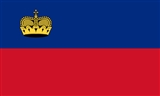
Liechtenstein

Encyclopedia
The Principality of Liechtenstein ( ; , ˈfʏʁstn̩tuːm ˈlɪçtn̩ʃtaɪn) is a doubly landlocked alpine country
in Central Europe
, bordered by Switzerland
to the west and south and by Austria
to the east. Its area is just over 160 square kilometres (61.8 sq mi), and it has an estimated population of 35,000. Its capital is Vaduz
. The biggest town is Schaan
. Liechtenstein has the second highest gross domestic product per person in the world when adjusted by purchasing power parity
, and has the world's lowest external debt. Liechtenstein also has the second lowest unemployment rate in the world at 1.5% (Monaco
is first).
Liechtenstein is the smallest yet the richest (by measure of GDP per capita) German
-speaking country in the world and the only country to lie entirely within the Alps
. It is the only predominantly German-speaking country not to share a common border with Germany
and the only predominantly German-speaking nation to have a monarch. It is known as a principality
as it is a constitutional monarchy
headed by a prince. Liechtenstein is divided into 11 municipalities. Much of its terrain is mountainous, making it a winter sport
s destination. Many cultivated fields and small farms characterize its landscape both in the south (Oberland, upper land) and in the north (Unterland, lower land). The country has a strong financial sector located in the capital, Vaduz, and has been identified as a tax haven
. It is a member of the European Free Trade Association
and part of the European Economic Area
but not of the European Union
.
province of Raetia
. For centuries this territory, geographically removed from European strategic interests, had little impact on European history. Prior to the reign of its current dynasty
, the region was enfeoffed
to a line of the counts of Hohenems
.
The Liechtenstein dynasty
, from which the principality takes its name, comes from Castle Liechtenstein in Lower Austria, which the family possessed from at least 1140 until the 13th century, and from 1807 onward. Through the centuries, the dynasty acquired vast tracts of land, predominantly in Moravia
, Lower Austria
, Silesia
, and Styria, though these territories were all held in fief
under other more senior feudal lords, particularly under various lines of the Habsburg
family, whom several Liechtenstein princes served as close advisers. Thus, without any territory held directly under the Imperial throne, the Liechtenstein dynasty was unable to meet a primary requirement to qualify for a seat in the Imperial diet (parliament
), the Reichstag
.
The family yearned for the added power a seat in the Imperial government would bring and therefore sought to acquire lands that would be unmittelbar, or held without any feudal personage other than the Holy Roman Emperor
having rights on the land. After some time, the family was able to arrange the purchase of the minuscule Herrschaft ("Lordship") of Schellenberg
and county of Vaduz
(in 1699 and 1712 respectively) from the Hohenems. Tiny Schellenberg and Vaduz had exactly the political status required: no feudal lord other than their comital
sovereign and the suzerain
Emperor.
On 23 January 1719, after the lands had been purchased, Charles VI, Holy Roman Emperor
, decreed that Vaduz and Schellenberg were united and elevated the newly formed territory to the dignity of Fürstentum (principality
) with the name "Liechtenstein" in honour of "[his] true servant, Anton Florian of Liechtenstein
". It was on this date that Liechtenstein became a sovereign member state of the Holy Roman Empire
. It is a testament to the pure political expediency of the purchases that the Princes of Liechtenstein did not set foot in their new principality for over 120 years.
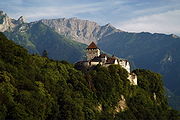 As a result of the Napoleonic Wars
, by 1806 much of the Holy Roman Empire was under the effective control of French emperor Napoleon I
. When the empire was dissolved, this had broad consequences for Liechtenstein: imperial, legal and political mechanisms broke down. The state ceased to owe obligations to any feudal lord beyond its borders.
Modern publications generally attribute Liechtenstein's sovereignty to these events. Its prince ceased to owe obligations to any suzerain. From 25 July 1806 when the Confederation of the Rhine
was founded, the Prince of Liechtenstein was a member, in fact a vassal of its hegemon, styled protector, French Emperor Napoleon I, until the dissolution of the confederation on 19 October 1813.
Soon afterward, Liechtenstein joined the German Confederation
(20 June 1815 24 August 1866) which was presided over by the Emperor of Austria
.
Then, in 1818, Johann I
granted the territory a limited constitution. 1818 also saw the first visit of a member of the house of Liechtenstein, Prince Alois; however, the first visit by a sovereign prince would not occur until 1842.
Developments during the 19th century included:
, Liechtenstein was closely tied first to the Austrian Empire
and later to Austria-Hungary
; the ruling princes continued to derive much of their wealth from estates in the Habsburg territories, and they spent much of their time at their two palaces in Vienna. The economic devastation caused by this war forced the country to conclude a customs and monetary union with its other neighbour, Switzerland. Liechtenstein's army was disbanded in 1868 for financial reasons.
At the time of the dissolution of the Austro-Hungarian Empire, it was argued that Liechtenstein, as a fief of the Holy Roman Empire, was no longer bound to the emerging independent state of Austria
, since the latter did not consider itself as the legal successor to the empire. This is partly contradicted by the coeval Liechtenstein perception that the dethroned Austro-Hungarian Emperor still maintained an abstract heritage of the Holy Roman Empire.
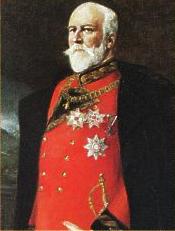 In early 1938, just after the annexation of Austria into Greater Nazi Germany
, 84 year old Prince Franz I abdicated, naming his 31-year-old third cousin, Prince Franz Joseph
, as his successor. His wife Elisabeth von Gutmann
, whom he had married in 1929, was a wealthy Jewish woman from Vienna, and local Liechtenstein Nazis had already identified her as their Jewish "problem". Although Liechtenstein had no official Nazi party, a Nazi sympathy movement had been simmering for years within its National Union party.
During World War II
, Liechtenstein remained officially neutral, looking to neighboring Switzerland for assistance and guidance, while family treasures within the war zone were taken to Liechtenstein for safekeeping. At the close of the conflict, Czechoslovakia
and Poland
, acting to seize what they considered to be German possessions, expropriated the entirety of the Liechtenstein dynasty's hereditary lands and possessions in Bohemia
, Moravia
, and Silesia
– the princes of Liechtenstein lived in Vienna
until the Anschluss
of 1938. The expropriations (subject to modern legal dispute at the International Court of Justice
) included over 1600 km² (618 sq mi) of agricultural and forest land, and several family castles and palaces.
Citizens of Liechtenstein were forbidden to enter Czechoslovakia during the Cold War
. More recently the diplomatic conflict revolving around the controversial post-war Beneš decrees
resulted in Liechtenstein not sharing international relations with the Czech Republic
or Slovakia
. Diplomatic relations were established between Liechtenstein and the Czech Republic on 13 July 2009, and with Slovakia on 9 December 2009.
Liechtenstein gave asylum to about 501 soldiers of the First Russian National Army (a collaborationist Russian force within the German Wehrmacht
) at the close of World War II. About 200 of the group somewhat voluntarily agreed to return to the USSR. They departed in a train to Vienna and nothing was ever heard of them again. The remainder stayed in Liechtenstein for another year, resisting with support of Liechtenstein further pressure by the Soviet government to participate in the repatriation program. Eventually the government of Argentina offered asylum, and about a hundred people left. This is commemorated by a monument at the border town of Hinterschellenberg
. In contrast, the British and Americans repatriated the Russians
who had fought for Germany to the USSR, and many of them perished in the Gulag
.
In dire financial straits following the war, the Liechtenstein dynasty often resorted to selling family artistic treasures, including the priceless portrait "Ginevra de' Benci
" by Leonardo da Vinci
, which was purchased by the National Gallery of Art
of the United States
in 1967. Liechtenstein prospered, however, during the decades following, as it used its low corporate tax
rates to draw many companies to the country.
The Prince of Liechtenstein is the world's sixth wealthiest leader with an estimated wealth of USD
$5 billion. The country's population enjoys one of the world's highest standards of living.
. It has a form of mixed constitution
, in which power is shared by the monarch and an elected parliament. The Constitution of Liechtenstein
was adopted in March 2003
, replacing the previous 1921 constitution which had established Liechtenstein as a constitutional monarchy headed by the reigning prince of the Princely House of Liechtenstein. A parliamentary system had been established, although the reigning Prince retained substantial political authority.
The reigning Prince is the head of state and represents Liechtenstein in its international relations (although Switzerland has taken responsibility for much of Liechtenstein's diplomatic relations). The Prince may veto laws adopted by parliament. The Prince can call referendums, propose new legislation, and dissolve parliament, although dissolution of parliament may be subject to a referendum.
Executive authority is vested in a collegiate government comprising the head of government (prime minister) and four government councilors (ministers). The head of government and the other ministers are appointed by the Prince upon the proposal and concurrence of parliament, thus reflecting the partisan balance of parliament. The constitution stipulates that at least two members of the government be chosen from each of the two regions. The members of the government are collectively and individually responsible to parliament; parliament may ask the Prince to remove an individual minister or the entire government.
Legislative authority is vested in the unicameral Landtag
made up of 25 members elected for maximum four-year terms according to a proportional representation formula. Fifteen members are elected from the "Oberland" (Upper Country or region) and ten members are elected from the "Unterland" (Lower Country or region). Parties must receive at least 8% of the national vote to win seats in parliament. Parliament proposes and approves a government, which is formally appointed by the Prince. Parliament may also pass votes of no confidence in the entire government or individual members.
Parliament elects from among its members a "Landesausschuss" (National Committee) made up of the president of the parliament and four additional members. The National Committee is charged with performing parliamentary oversight functions. Parliament can call for referendums on proposed legislation. Parliament shares the authority to propose new legislation with the Prince and with the number of citizens required for an initiative referendum.
Judicial authority is vested in the Regional Court at Vaduz, the Princely High Court of Appeal at Vaduz, the Princely Supreme Court, the Administrative Court, and the State Court. The State Court rules on the conformity of laws with the constitution and has five members elected by parliament.
On 1 July 1984, Liechtenstein became the last country in Europe to grant women the right to vote. The referendum on women's suffrage
, in which only men were allowed to participate, passed with 51.3% in favor.
in March 2003, nearly two-thirds of the electorate voted in support of Hans-Adam II's proposed new constitution to replace the 1921 one. The proposed constitution was criticised by many, including the Council of Europe
, as expanding the powers of the monarchy (continuing the power to veto any law, and allowing the Prince to dismiss the government or any minister). The Prince threatened that if the constitution failed, he would, among other things, convert some of the royal property for commercial use and move to Austria. The royal family and the Prince enjoy tremendous public support inside the nation, and the resolution passed with about 64% in favour.
and is bordered to the east by Austria and to the south and west by Switzerland. The entire western border of Liechtenstein is formed by the Rhine. Measured south to north the country is about 24 km (15 mi) long. Its highest point, the Grauspitz
, is 2599 m (8,527 ft). Despite its Alpine location, prevailing southerly winds make the climate of Liechtenstein comparatively mild. In winter, the mountain slopes are well suited to winter sport
s.
New surveys
using more accurate measurements of the country's borders in 2006 have set its area at 160 km² (61.776 sq mi), with borders of 77.9 km (48.4 mi). Thus, Liechtenstein discovered in 2006 that its borders are 1.9 km (1.2 mi) longer than previously thought.
Liechtenstein is one of only two doubly landlocked countries in the world—being a landlocked country wholly surrounded by other landlocked countries (the other is Uzbekistan
). Liechtenstein is the sixth-smallest independent nation in the world by land area.
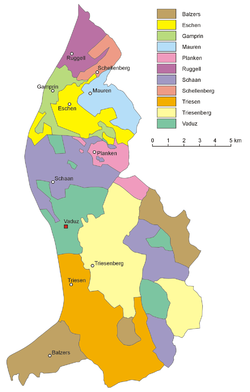
The principality of Liechtenstein is divided into 11 communes called Gemeinden (singular Gemeinde). The Gemeinden mostly consist only of a single town or village. Five of them (Eschen
, Gamprin
, Mauren
, Ruggell
, and Schellenberg
) fall within the electoral district Unterland (the lower county), and the remainder (Balzers
, Planken
, Schaan
, Triesen
, Triesenberg
, and Vaduz
) within Oberland (the upper county).
Very low business taxes (lowest in Europe)—the maximum tax rate is 20%—as well as easy Rules of Incorporation have induced about 73,700 holding (or so-called 'letter box') companies to establish registered offices in Liechtenstein. This provides about 30% of Liechtenstein's state revenue. Liechtenstein also generates revenue from Stiftungen ("foundations"), which are financial entities created to increase the privacy of nonresident foreigners' financial holdings. The foundation is registered in the name of a Liechtensteiner, often a lawyer.
Recently, Liechtenstein has shown strong determination to prosecute international money-launderers and has worked to promote the country's image as a legitimate finance center. In February 2008, the country's LGT Bank was implicated in a tax-fraud scandal in Germany
, which strained the ruling family's relationship with the German government. Crown Prince Alois has accused the German government of trafficking in stolen goods. This refers to its $7.3 million purchase of private banking information illegally offered by a former employee of LGT Group. However, the United States Senate
's subcommittee on tax haven banks said that the LGT bank, which is owned by the royal family, and on whose board they serve, "is a willing partner, and an aider and abettor to clients trying to evade taxes, dodge creditors or defy court orders."
Liechtenstein participates in a customs union
with Switzerland and employs the Swiss franc
as national currency. The country imports about 85% of its energy. Liechtenstein has been a member of the European Economic Area
(an organization serving as a bridge between the European Free Trade Association
(EFTA) and the European Union
) since May 1995. The government is working to harmonize its economic policies with those of an integrated Europe. Since 2002, Liechtenstein's rate of unemployment has doubled. In 2008, it stood at 1.5%. Currently, there is only one hospital in Liechtenstein, the Liechtensteinisches Landesspital in Vaduz. The gross domestic product
(GDP) on a purchasing power parity
basis is $5.028 billion, or $141,100 per person which in the second highest in the world.
Liechtenstein is a large producer of ceramics and is the world's largest producer of sausage casings, potassium storage units and false teeth. Other industries include electronics, textiles, precision instruments, metal manufacturing, power tools, anchor bolts, calculators, pharmaceuticals, and food products. Its most recognizable international company and largest employer is Hilti
, a manufacturer of direct fastening systems and other high-end power tools. Liechtenstein produces wheat, barley, corn, potatoes, dairy products, livestock, and wine. Tourism accounts for a large portion of the country's economy.
programme. This rate is higher for the self-employed, up to a maximum of 11%, making the maximum income tax rate about 29% in total. The basic tax rate on wealth
is 0.06% per annum, and the combined total rate is 0.89%.
The maximum business income tax
rate is 18–20%.
Liechtenstein's gift
and estate taxes
vary depending on the relationship the recipient has to the giver and the amount of the inheritance. The tax ranges between 0.5% and 0.75% for spouses and children and 18% to 27% for non-related recipients. The estate tax is progressive.
The 2008 Liechtenstein tax affair
is a series of tax investigations in numerous countries whose governments suspect that some of their citizens may have evaded tax obligations by using banks and trusts in Liechtenstein; the affair broke open with the biggest complex of investigations ever initiated for tax evasion
in the Federal Republic of Germany
. It was also seen as an attempt to put pressure on Liechtenstein, then one of the remaining uncooperative tax havens
along with Andorra
and Monaco
— as identified by the Paris-based Organisation for Economic Co-operation and Development
in 2007. On 27 May 2009 the OECD removed Liechtenstein from the blacklist of uncooperative countries.
In August 2009, the British Government Department, HM Revenue & Customs, agreed with the Alpine tax haven to start exchanging information. It is believed that up to 5,000 British investors have roughly £3 billion stashed in accounts and trusts in the country.
 Liechtenstein is the fourth smallest country of Europe, after Vatican City
, Monaco
, and San Marino
. Its population is primarily Alemannic
-speaking, although its resident population is approximately one third foreign-born, primarily German
speakers from Germany
, Austria
, and Switzerland
, other Swiss, Italians, and Turks
. Foreign-born people make up two-thirds of the country's workforce.
The official language is German; most speak Alemannic, a dialect
of German that is highly divergent from Standard German
but closely related to those dialects spoken in neighbouring regions such as Vorarlberg
, Austria. In Triesenberg
, a dialect promoted by the municipality is spoken. According to the 2000 census, 87.9% of the population is Christian
, of whom 78.4% adhere to the Roman Catholic faith, while about 8% are Protestant. Compared to the 1990 census, the percentage of Christians fell, whereas Muslim
s and the undeclared more than doubled in size. According to a 2009 Pew Research Center
report, Muslims constitute approximately 4.8% of the population.
Liechtensteiners have an average life expectancy at birth of 80.31 years, male: 76.86 years, female: 83.77 years (2011 est.). The infant mortality rate is 4.64 deaths per 1,000 live births, according to recent estimates. The literacy rate of Liechtenstein is 100%. The Programme for International Student Assessment
, coordinated by the OECD, currently ranks Liechtenstein's education as the 10th best in the world.
9.5 km (5.9 mi) of railway connects Austria and Switzerland through Liechtenstein. The country's railways
are administered by the Austrian Federal Railways
as part of the route between Feldkirch
, Austria
, and Buchs
, Switzerland
. Liechtenstein is nominally within the Austrian Verkehrsverbund Vorarlberg tariff region.
There are four stations in Liechtenstein, namely Schaan-Vaduz, Forst Hilti, Nendeln, and Schaanwald, served by an irregularly stopping train service that runs between Feldkirch and Buchs provided by the Austrian Federal Rail Service. While EuroCity
and other long distance international trains also travel along the route, they do not normally stop at the stations within the borders of Liechtenstein.
Liechtenstein Bus
is a subsidiary of the Swiss Postbus system, but separately run, and connects to the Swiss bus network at Buchs
and at Sargans
. Buses also run to the Austrian town of Feldkirch.
Liechtenstein has no airport; the nearest large airport is Zürich Airport near Zürich
, Switzerland
. There is a small heliport
at Balzers
available for chartered helicopter flights.
.jpg) As a result of its small size, Liechtenstein has been strongly affected by external cultural influences, most notably those originating in the southern German-speaking areas of Europe, including Austria, Bavaria, Switzerland, and specifically Tirol
As a result of its small size, Liechtenstein has been strongly affected by external cultural influences, most notably those originating in the southern German-speaking areas of Europe, including Austria, Bavaria, Switzerland, and specifically Tirol
and Vorarlberg
. The "Historical Society of the Principality of Liechtenstein" plays a role in preserving the culture and history of the country.
The largest museum is the Kunstmuseum Liechtenstein
, an international museum of modern and contemporary art with an important international art collection. The building by the Swiss architects Morger, Degelo and Kerez is a landmark in Vaduz. It was completed in November 2000 and forms a "black box" of tinted concrete and black basalt stone. The museum collection is also the national art collection of Liechtenstein.
The other important museum is the Liechtenstein National Museum (Liechtensteinisches Landesmuseum) showing permanent exhibition on the cultural and natural history of Liechtenstein as well as special exhibitions. There is also a stamp museum and a ski museum.
The most famous historical sites are Vaduz Castle, Gutenberg Castle, the Red House and the ruins of Schellenberg.
Music and theatre are an important part of the culture. There are numerous music organizations such as the Liechtenstein Musical Company, the annual Guitar Days and the International Josef Gabriel Rheinberger Society, which play in two main theatres.
"In all my travels, there is no country better than Liechtenstein, and no music better than that made by Liechtenstein's Lords." - Sir John Mandeville, The Travels of Sir John Mandeville
The Private Art Collection of the Prince of Liechtenstein, one of the world's leading private art collections, is shown at the Liechtenstein Museum
in Vienna
.
Amateur radio
is a hobby of some nationals and visitors. However, unlike virtually every other sovereign nation, Liechtenstein does not have its own ITU Prefix
. It uses Switzerland's callsign prefixes (typically "HB") followed by a zero.
 Liechtenstein football teams play in the Swiss football leagues. The Liechtenstein Football Cup
allows access for one Liechtenstein team each year to the UEFA Europa League; FC Vaduz
, a team playing in the Swiss Challenge League
, the second division in Swiss football, is the most successful team in the Cup, and scored their greatest success in the European Cup Winners' Cup in 1996 when they tied and defeated the Latvia
n team FC Universitate Riga by 1–1 and 4–2, to go on to a lucrative fixture against Paris St Germain, which they lost 0–4 and 0–3.
The Liechtenstein national football team
is regarded as an easy target for any team drawn against them; this was the basis for a book about Liechtenstein's unsuccessful qualifying campaign for the 2002 World Cup
by British author, Charlie Connelly
. In one surprising week during autumn 2004, however, the team managed a 2–2 draw with Portugal
, who only a few months earlier had been the losing finalists in the European Championships. Four days later, the Liechtenstein team traveled to Luxembourg, where they defeated the home team
4-0 in a 2006 World Cup qualifying match. In the qualification stage of the European Championship 2008, Liechtenstein beat Latvia 1-0, a result which prompted the resignation of the Latvian coach. They went on to beat Iceland 3-0 on 17 October 2007, which is considered one of the most dramatic losses of the Icelandic national football team. On 7 September 2010, they came within seconds of a 1–1 draw against Scotland
in Glasgow, having led 1–0 earlier in the second half, but Liechtenstein lost 2–1 thanks to a goal by Stephen McManus
in the 97th minute. On 3 June 2011, Liechtenstein defeated Lithuania
2-0.
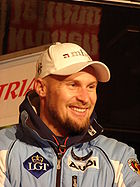
As an alpine
country, the main sporting opportunity for Liechtensteiners to excel is in winter sports such as downhill skiing: the country's single ski area is Malbun
. Hanni Wenzel
won two gold medals and one silver medal in the 1980 Winter Olympics (she won bronze in 1976), and her brother Andreas
won one silver medal in 1980 and one bronze medal in 1984 in the giant slalom
event. With nine medals overall (all in alpine skiing), Liechtenstein has won more Olympic medals per capita than any other nation. It is the smallest nation to win a medal in any Olympics, Winter or Summer, and the only nation to win a medal in the Winter Games but not in the Summer Games. Other notable skiers from Liechtenstein are Marco Büchel
, Willi Frommelt
, Paul Frommelt
and Ursula Konzett
.
is responsible for keeping order within the country. It consists of 87 field officers and 38 civilian staff totaling 125 employes. All officers are equipped with small arms
. The country has one of the world's lowest crime rates. Liechtenstein's prison holds few, if any, inmates, and those with sentences over two years are transferred to Austrian jurisdiction. The Liechtenstein National Police maintains a trilateral treaty with Austria and Switzerland that enables close cross-border cooperation among the police forces of the three countries.
Liechtenstein follows a policy of neutrality
and is one of few countries in the world that maintains no military. The army was abolished soon after the Austro-Prussian War
in which Liechtenstein fielded an army of 80 men, although they were not involved in any fighting. The demise of the German Confederation
in that war freed Liechtenstein from its international obligation to maintain an army, and parliament seized this opportunity and refused to provide funding for one. The Prince objected, as such a move would leave the country defenseless, but relented on 12 February 1868 and disbanded the force. The last soldier to serve under the colours of Liechtenstein died in 1939 at age 95.
In March 2007, a 170-person Swiss infantry unit became lost during a training exercise and inadvertently crossed 1.5 km into Liechtenstein. The accidental invasion ended when the unit realized their mistake, and turned back. The Swiss army later informed Liechtenstein of the incursion and offered official apologies.
Alpine states
The term Alpine states or Alpine countries refers to the countries associated with the region of Alps. As defined by the Alpine Convention of 1991, the region of the Alps comprise the territory of 8 countries. This territory includes 83 NUTS 3-level local administrative regions and about 6,200...
in Central Europe
Central Europe
Central Europe or alternatively Middle Europe is a region of the European continent lying between the variously defined areas of Eastern and Western Europe...
, bordered by Switzerland
Switzerland
Switzerland name of one of the Swiss cantons. ; ; ; or ), in its full name the Swiss Confederation , is a federal republic consisting of 26 cantons, with Bern as the seat of the federal authorities. The country is situated in Western Europe,Or Central Europe depending on the definition....
to the west and south and by Austria
Austria
Austria , officially the Republic of Austria , is a landlocked country of roughly 8.4 million people in Central Europe. It is bordered by the Czech Republic and Germany to the north, Slovakia and Hungary to the east, Slovenia and Italy to the south, and Switzerland and Liechtenstein to the...
to the east. Its area is just over 160 square kilometres (61.8 sq mi), and it has an estimated population of 35,000. Its capital is Vaduz
Vaduz
Vaduz is the capital of the principality of Liechtenstein and the seat of the national parliament. The town, located along the Rhine, has about 5,100 inhabitants , most of whom are Roman Catholic. Its cathedral is the seat of a Roman Catholic archbishop....
. The biggest town is Schaan
Schaan
Schaan is the largest municipality of Liechtenstein. It is located to the north of Vaduz, the capital, in the central part of the country. As of 2005 it has a population of making it the largest administrative district in Liechtenstein, and covers an area of 26.8 km², including mountains and...
. Liechtenstein has the second highest gross domestic product per person in the world when adjusted by purchasing power parity
Purchasing power parity
In economics, purchasing power parity is a condition between countries where an amount of money has the same purchasing power in different countries. The prices of the goods between the countries would only reflect the exchange rates...
, and has the world's lowest external debt. Liechtenstein also has the second lowest unemployment rate in the world at 1.5% (Monaco
Monaco
Monaco , officially the Principality of Monaco , is a sovereign city state on the French Riviera. It is bordered on three sides by its neighbour, France, and its centre is about from Italy. Its area is with a population of 35,986 as of 2011 and is the most densely populated country in the...
is first).
Liechtenstein is the smallest yet the richest (by measure of GDP per capita) German
German language
German is a West Germanic language, related to and classified alongside English and Dutch. With an estimated 90 – 98 million native speakers, German is one of the world's major languages and is the most widely-spoken first language in the European Union....
-speaking country in the world and the only country to lie entirely within the Alps
Alps
The Alps is one of the great mountain range systems of Europe, stretching from Austria and Slovenia in the east through Italy, Switzerland, Liechtenstein and Germany to France in the west....
. It is the only predominantly German-speaking country not to share a common border with Germany
Germany
Germany , officially the Federal Republic of Germany , is a federal parliamentary republic in Europe. The country consists of 16 states while the capital and largest city is Berlin. Germany covers an area of 357,021 km2 and has a largely temperate seasonal climate...
and the only predominantly German-speaking nation to have a monarch. It is known as a principality
Principality
A principality is a monarchical feudatory or sovereign state, ruled or reigned over by a monarch with the title of prince or princess, or by a monarch with another title within the generic use of the term prince....
as it is a constitutional monarchy
Constitutional monarchy
Constitutional monarchy is a form of government in which a monarch acts as head of state within the parameters of a constitution, whether it be a written, uncodified or blended constitution...
headed by a prince. Liechtenstein is divided into 11 municipalities. Much of its terrain is mountainous, making it a winter sport
Winter sport
A winter sport is a sport which is played on snow or ice. Most such sports are variations of skiing, ice skating and sledding. Traditionally such sports were only played in cold areas during winter, but artificial snow and ice allow more flexibility...
s destination. Many cultivated fields and small farms characterize its landscape both in the south (Oberland, upper land) and in the north (Unterland, lower land). The country has a strong financial sector located in the capital, Vaduz, and has been identified as a tax haven
Tax haven
A tax haven is a state or a country or territory where certain taxes are levied at a low rate or not at all while offering due process, good governance and a low corruption rate....
. It is a member of the European Free Trade Association
European Free Trade Association
The European Free Trade Association or EFTA is a free trade organisation between four European countries that operates parallel to, and is linked to, the European Union . EFTA was established on 3 May 1960 as a trade bloc-alternative for European states who were either unable to, or chose not to,...
and part of the European Economic Area
European Economic Area
The European Economic Area was established on 1 January 1994 following an agreement between the member states of the European Free Trade Association and the European Community, later the European Union . Specifically, it allows Iceland, Liechtenstein and Norway to participate in the EU's Internal...
but not of the European Union
European Union
The European Union is an economic and political union of 27 independent member states which are located primarily in Europe. The EU traces its origins from the European Coal and Steel Community and the European Economic Community , formed by six countries in 1958...
.
History
At one time, the territory was part of the ancient RomanRoman Empire
The Roman Empire was the post-Republican period of the ancient Roman civilization, characterised by an autocratic form of government and large territorial holdings in Europe and around the Mediterranean....
province of Raetia
Raetia
Raetia was a province of the Roman Empire, named after the Rhaetian people. It was bounded on the west by the country of the Helvetii, on the east by Noricum, on the north by Vindelicia, on the west by Cisalpine Gaul and on south by Venetia et Histria...
. For centuries this territory, geographically removed from European strategic interests, had little impact on European history. Prior to the reign of its current dynasty
Dynasty
A dynasty is a sequence of rulers considered members of the same family. Historians traditionally consider many sovereign states' history within a framework of successive dynasties, e.g., China, Ancient Egypt and the Persian Empire...
, the region was enfeoffed
Enfeoffment
Under the European feudal system, enfeoffment was the deed by which a person was given land in exchange for a pledge of service. This mechanism was later used to avoid restrictions on the passage of title in land by a system in which a landowner would give land to one person for the use of another...
to a line of the counts of Hohenems
Hohenems
Hohenems is a town in the westernmost Austrian state of Vorarlberg, in the Dornbirn district. It lies in the middle of the Austrian part of the Rhine valley. With a population of 15,200 it is the fifth largest municipality in Vorarlberg...
.
The Liechtenstein dynasty
Princely Family of Liechtenstein
The Liechtenstein dynasty, from which the principality takes its name, is the family which reigns by constitutional, hereditary right over the nation of Liechtenstein...
, from which the principality takes its name, comes from Castle Liechtenstein in Lower Austria, which the family possessed from at least 1140 until the 13th century, and from 1807 onward. Through the centuries, the dynasty acquired vast tracts of land, predominantly in Moravia
Moravia
Moravia is a historical region in Central Europe in the east of the Czech Republic, and one of the former Czech lands, together with Bohemia and Silesia. It takes its name from the Morava River which rises in the northwest of the region...
, Lower Austria
Lower Austria
Lower Austria is the northeasternmost state of the nine states in Austria. The capital of Lower Austria since 1986 is Sankt Pölten, the most recently designated capital town in Austria. The capital of Lower Austria had formerly been Vienna, even though Vienna is not officially part of Lower Austria...
, Silesia
Silesia
Silesia is a historical region of Central Europe located mostly in Poland, with smaller parts also in the Czech Republic, and Germany.Silesia is rich in mineral and natural resources, and includes several important industrial areas. Silesia's largest city and historical capital is Wrocław...
, and Styria, though these territories were all held in fief
Fiefdom
A fee was the central element of feudalism and consisted of heritable lands granted under one of several varieties of feudal tenure by an overlord to a vassal who held it in fealty in return for a form of feudal allegiance and service, usually given by the...
under other more senior feudal lords, particularly under various lines of the Habsburg
Habsburg
The House of Habsburg , also found as Hapsburg, and also known as House of Austria is one of the most important royal houses of Europe and is best known for being an origin of all of the formally elected Holy Roman Emperors between 1438 and 1740, as well as rulers of the Austrian Empire and...
family, whom several Liechtenstein princes served as close advisers. Thus, without any territory held directly under the Imperial throne, the Liechtenstein dynasty was unable to meet a primary requirement to qualify for a seat in the Imperial diet (parliament
Parliament
A parliament is a legislature, especially in those countries whose system of government is based on the Westminster system modeled after that of the United Kingdom. The name is derived from the French , the action of parler : a parlement is a discussion. The term came to mean a meeting at which...
), the Reichstag
Reichstag (Holy Roman Empire)
The Imperial Diet was the Diet, or general assembly, of the Imperial Estates of the Holy Roman Empire.During the period of the Empire, which lasted formally until 1806, the Diet was not a parliament in today's sense; instead, it was an assembly of the various estates of the realm...
.
The family yearned for the added power a seat in the Imperial government would bring and therefore sought to acquire lands that would be unmittelbar, or held without any feudal personage other than the Holy Roman Emperor
Holy Roman Emperor
The Holy Roman Emperor is a term used by historians to denote a medieval ruler who, as German King, had also received the title of "Emperor of the Romans" from the Pope...
having rights on the land. After some time, the family was able to arrange the purchase of the minuscule Herrschaft ("Lordship") of Schellenberg
Schellenberg
Schellenberg is a municipality in the lowland area of Liechtenstein, on the banks of the Rhine. , it has a population of 952 and covers an area of .-Early history:...
and county of Vaduz
Vaduz
Vaduz is the capital of the principality of Liechtenstein and the seat of the national parliament. The town, located along the Rhine, has about 5,100 inhabitants , most of whom are Roman Catholic. Its cathedral is the seat of a Roman Catholic archbishop....
(in 1699 and 1712 respectively) from the Hohenems. Tiny Schellenberg and Vaduz had exactly the political status required: no feudal lord other than their comital
Count
A count or countess is an aristocratic nobleman in European countries. The word count came into English from the French comte, itself from Latin comes—in its accusative comitem—meaning "companion", and later "companion of the emperor, delegate of the emperor". The adjective form of the word is...
sovereign and the suzerain
Suzerainty
Suzerainty occurs where a region or people is a tributary to a more powerful entity which controls its foreign affairs while allowing the tributary vassal state some limited domestic autonomy. The dominant entity in the suzerainty relationship, or the more powerful entity itself, is called a...
Emperor.
On 23 January 1719, after the lands had been purchased, Charles VI, Holy Roman Emperor
Charles VI, Holy Roman Emperor
Charles VI was the penultimate Habsburg sovereign of the Habsburg Empire. He succeeded his elder brother, Joseph I, as Holy Roman Emperor, King of Bohemia , Hungary and Croatia , Archduke of Austria, etc., in 1711...
, decreed that Vaduz and Schellenberg were united and elevated the newly formed territory to the dignity of Fürstentum (principality
Principality
A principality is a monarchical feudatory or sovereign state, ruled or reigned over by a monarch with the title of prince or princess, or by a monarch with another title within the generic use of the term prince....
) with the name "Liechtenstein" in honour of "[his] true servant, Anton Florian of Liechtenstein
Anton Florian of Liechtenstein
Anton Florian, Prince of Liechtenstein was the Prince of Liechtenstein between 1718 and 1721.He was born in Wilfersdorf, in what is now Lower Austria...
". It was on this date that Liechtenstein became a sovereign member state of the Holy Roman Empire
Holy Roman Empire
The Holy Roman Empire was a realm that existed from 962 to 1806 in Central Europe.It was ruled by the Holy Roman Emperor. Its character changed during the Middle Ages and the Early Modern period, when the power of the emperor gradually weakened in favour of the princes...
. It is a testament to the pure political expediency of the purchases that the Princes of Liechtenstein did not set foot in their new principality for over 120 years.
Napoleonic Wars
The Napoleonic Wars were a series of wars declared against Napoleon's French Empire by opposing coalitions that ran from 1803 to 1815. As a continuation of the wars sparked by the French Revolution of 1789, they revolutionised European armies and played out on an unprecedented scale, mainly due to...
, by 1806 much of the Holy Roman Empire was under the effective control of French emperor Napoleon I
Napoleon I of France
Napoleon Bonaparte was a French military and political leader during the latter stages of the French Revolution.As Napoleon I, he was Emperor of the French from 1804 to 1815...
. When the empire was dissolved, this had broad consequences for Liechtenstein: imperial, legal and political mechanisms broke down. The state ceased to owe obligations to any feudal lord beyond its borders.
Modern publications generally attribute Liechtenstein's sovereignty to these events. Its prince ceased to owe obligations to any suzerain. From 25 July 1806 when the Confederation of the Rhine
Confederation of the Rhine
The Confederation of the Rhine was a confederation of client states of the First French Empire. It was formed initially from 16 German states by Napoleon after he defeated Austria's Francis II and Russia's Alexander I in the Battle of Austerlitz. The Treaty of Pressburg, in effect, led to the...
was founded, the Prince of Liechtenstein was a member, in fact a vassal of its hegemon, styled protector, French Emperor Napoleon I, until the dissolution of the confederation on 19 October 1813.
Soon afterward, Liechtenstein joined the German Confederation
German Confederation
The German Confederation was the loose association of Central European states created by the Congress of Vienna in 1815 to coordinate the economies of separate German-speaking countries. It acted as a buffer between the powerful states of Austria and Prussia...
(20 June 1815 24 August 1866) which was presided over by the Emperor of Austria
Emperor of Austria
The Emperor of Austria was a hereditary imperial title and position proclaimed in 1804 by the Holy Roman Emperor Francis II, a member of the House of Habsburg-Lorraine, and continually held by him and his heirs until the last emperor relinquished power in 1918. The emperors retained the title of...
.
Then, in 1818, Johann I
Johann I Josef, Prince of Liechtenstein
Johann I Joseph, Prince of Liechtenstein, born Johann Baptist Joseph Adam Johann Nepomuk Aloys Franz de Paula was the Prince of Liechtenstein between 1805 and 1806 and again from 1814 until 1836...
granted the territory a limited constitution. 1818 also saw the first visit of a member of the house of Liechtenstein, Prince Alois; however, the first visit by a sovereign prince would not occur until 1842.
Developments during the 19th century included:
- In 1836, the first factory was opened, making ceramics.
- In 1861, the Savings and Loans Bank was founded, as was the first cotton-weaving mill.
- Two bridges over the Rhine were built in 1868, and in 1872 a railway line across Liechtenstein was constructed.
20th century
Until the end of World War IWorld War I
World War I , which was predominantly called the World War or the Great War from its occurrence until 1939, and the First World War or World War I thereafter, was a major war centred in Europe that began on 28 July 1914 and lasted until 11 November 1918...
, Liechtenstein was closely tied first to the Austrian Empire
Austrian Empire
The Austrian Empire was a modern era successor empire, which was centered on what is today's Austria and which officially lasted from 1804 to 1867. It was followed by the Empire of Austria-Hungary, whose proclamation was a diplomatic move that elevated Hungary's status within the Austrian Empire...
and later to Austria-Hungary
Austria-Hungary
Austria-Hungary , more formally known as the Kingdoms and Lands Represented in the Imperial Council and the Lands of the Holy Hungarian Crown of Saint Stephen, was a constitutional monarchic union between the crowns of the Austrian Empire and the Kingdom of Hungary in...
; the ruling princes continued to derive much of their wealth from estates in the Habsburg territories, and they spent much of their time at their two palaces in Vienna. The economic devastation caused by this war forced the country to conclude a customs and monetary union with its other neighbour, Switzerland. Liechtenstein's army was disbanded in 1868 for financial reasons.
At the time of the dissolution of the Austro-Hungarian Empire, it was argued that Liechtenstein, as a fief of the Holy Roman Empire, was no longer bound to the emerging independent state of Austria
Austria
Austria , officially the Republic of Austria , is a landlocked country of roughly 8.4 million people in Central Europe. It is bordered by the Czech Republic and Germany to the north, Slovakia and Hungary to the east, Slovenia and Italy to the south, and Switzerland and Liechtenstein to the...
, since the latter did not consider itself as the legal successor to the empire. This is partly contradicted by the coeval Liechtenstein perception that the dethroned Austro-Hungarian Emperor still maintained an abstract heritage of the Holy Roman Empire.
Nazi Germany
Nazi Germany , also known as the Third Reich , but officially called German Reich from 1933 to 1943 and Greater German Reich from 26 June 1943 onward, is the name commonly used to refer to the state of Germany from 1933 to 1945, when it was a totalitarian dictatorship ruled by...
, 84 year old Prince Franz I abdicated, naming his 31-year-old third cousin, Prince Franz Joseph
Franz Joseph II, Prince of Liechtenstein
Franz Joseph II, Prince of Liechtenstein, , was the Sovereign Prince of Liechtenstein from 1938 until his death...
, as his successor. His wife Elisabeth von Gutmann
Elisabeth von Gutmann
Elisabeth von Gutmann was princess consort of Franz I, Prince of Liechtenstein.-Early life:Elisabeth was born at Vienna, Austria-Hungary, she was the daughter of Wilhelm Ritter von Gutmann and his wife Ida Wodianer...
, whom he had married in 1929, was a wealthy Jewish woman from Vienna, and local Liechtenstein Nazis had already identified her as their Jewish "problem". Although Liechtenstein had no official Nazi party, a Nazi sympathy movement had been simmering for years within its National Union party.
During World War II
World War II
World War II, or the Second World War , was a global conflict lasting from 1939 to 1945, involving most of the world's nations—including all of the great powers—eventually forming two opposing military alliances: the Allies and the Axis...
, Liechtenstein remained officially neutral, looking to neighboring Switzerland for assistance and guidance, while family treasures within the war zone were taken to Liechtenstein for safekeeping. At the close of the conflict, Czechoslovakia
Czechoslovakia
Czechoslovakia or Czecho-Slovakia was a sovereign state in Central Europe which existed from October 1918, when it declared its independence from the Austro-Hungarian Empire, until 1992...
and Poland
Poland
Poland , officially the Republic of Poland , is a country in Central Europe bordered by Germany to the west; the Czech Republic and Slovakia to the south; Ukraine, Belarus and Lithuania to the east; and the Baltic Sea and Kaliningrad Oblast, a Russian exclave, to the north...
, acting to seize what they considered to be German possessions, expropriated the entirety of the Liechtenstein dynasty's hereditary lands and possessions in Bohemia
Bohemia
Bohemia is a historical region in central Europe, occupying the western two-thirds of the traditional Czech Lands. It is located in the contemporary Czech Republic with its capital in Prague...
, Moravia
Moravia
Moravia is a historical region in Central Europe in the east of the Czech Republic, and one of the former Czech lands, together with Bohemia and Silesia. It takes its name from the Morava River which rises in the northwest of the region...
, and Silesia
Silesia
Silesia is a historical region of Central Europe located mostly in Poland, with smaller parts also in the Czech Republic, and Germany.Silesia is rich in mineral and natural resources, and includes several important industrial areas. Silesia's largest city and historical capital is Wrocław...
– the princes of Liechtenstein lived in Vienna
Vienna
Vienna is the capital and largest city of the Republic of Austria and one of the nine states of Austria. Vienna is Austria's primary city, with a population of about 1.723 million , and is by far the largest city in Austria, as well as its cultural, economic, and political centre...
until the Anschluss
Anschluss
The Anschluss , also known as the ', was the occupation and annexation of Austria into Nazi Germany in 1938....
of 1938. The expropriations (subject to modern legal dispute at the International Court of Justice
International Court of Justice
The International Court of Justice is the primary judicial organ of the United Nations. It is based in the Peace Palace in The Hague, Netherlands...
) included over 1600 km² (618 sq mi) of agricultural and forest land, and several family castles and palaces.
Citizens of Liechtenstein were forbidden to enter Czechoslovakia during the Cold War
Cold War
The Cold War was the continuing state from roughly 1946 to 1991 of political conflict, military tension, proxy wars, and economic competition between the Communist World—primarily the Soviet Union and its satellite states and allies—and the powers of the Western world, primarily the United States...
. More recently the diplomatic conflict revolving around the controversial post-war Beneš decrees
Beneš decrees
Decrees of the President of the Republic , more commonly known as the Beneš decrees, were a series of laws that were drafted by the Czechoslovak Government-in-Exile in the absence of the Czechoslovak parliament during the German occupation of Czechoslovakia in World War II and issued by President...
resulted in Liechtenstein not sharing international relations with the Czech Republic
Czech Republic
The Czech Republic is a landlocked country in Central Europe. The country is bordered by Poland to the northeast, Slovakia to the east, Austria to the south, and Germany to the west and northwest....
or Slovakia
Slovakia
The Slovak Republic is a landlocked state in Central Europe. It has a population of over five million and an area of about . Slovakia is bordered by the Czech Republic and Austria to the west, Poland to the north, Ukraine to the east and Hungary to the south...
. Diplomatic relations were established between Liechtenstein and the Czech Republic on 13 July 2009, and with Slovakia on 9 December 2009.
Liechtenstein gave asylum to about 501 soldiers of the First Russian National Army (a collaborationist Russian force within the German Wehrmacht
Wehrmacht
The Wehrmacht – from , to defend and , the might/power) were the unified armed forces of Nazi Germany from 1935 to 1945. It consisted of the Heer , the Kriegsmarine and the Luftwaffe .-Origin and use of the term:...
) at the close of World War II. About 200 of the group somewhat voluntarily agreed to return to the USSR. They departed in a train to Vienna and nothing was ever heard of them again. The remainder stayed in Liechtenstein for another year, resisting with support of Liechtenstein further pressure by the Soviet government to participate in the repatriation program. Eventually the government of Argentina offered asylum, and about a hundred people left. This is commemorated by a monument at the border town of Hinterschellenberg
Hinterschellenberg
Hinterschellenberg is a village of Liechtenstein, located very close to the Austrian border and belonging to the municipality of Planken.-Overview:...
. In contrast, the British and Americans repatriated the Russians
Operation Keelhaul
Operation Keelhaul was carried out in Northern Italy by British and American forces to repatriate Soviet Armed Forces POWs of the Nazis to the Soviet Union between August 14, 1946 and May 9, 1947...
who had fought for Germany to the USSR, and many of them perished in the Gulag
Gulag
The Gulag was the government agency that administered the main Soviet forced labor camp systems. While the camps housed a wide range of convicts, from petty criminals to political prisoners, large numbers were convicted by simplified procedures, such as NKVD troikas and other instruments of...
.
In dire financial straits following the war, the Liechtenstein dynasty often resorted to selling family artistic treasures, including the priceless portrait "Ginevra de' Benci
Ginevra de' Benci
Ginevra de' Benci was an aristocrat from 15th-century Florence, admired for her intelligence by Florentine contemporaries. She is the subject of a portrait painting by Leonardo da Vinci...
" by Leonardo da Vinci
Leonardo da Vinci
Leonardo di ser Piero da Vinci was an Italian Renaissance polymath: painter, sculptor, architect, musician, scientist, mathematician, engineer, inventor, anatomist, geologist, cartographer, botanist and writer whose genius, perhaps more than that of any other figure, epitomized the Renaissance...
, which was purchased by the National Gallery of Art
National Gallery of Art
The National Gallery of Art and its Sculpture Garden is a national art museum, located on the National Mall between 3rd and 9th Streets at Constitution Avenue NW, in Washington, DC...
of the United States
United States
The United States of America is a federal constitutional republic comprising fifty states and a federal district...
in 1967. Liechtenstein prospered, however, during the decades following, as it used its low corporate tax
Corporate tax
Many countries impose corporate tax or company tax on the income or capital of some types of legal entities. A similar tax may be imposed at state or lower levels. The taxes may also be referred to as income tax or capital tax. Entities treated as partnerships are generally not taxed at the...
rates to draw many companies to the country.
The Prince of Liechtenstein is the world's sixth wealthiest leader with an estimated wealth of USD
United States dollar
The United States dollar , also referred to as the American dollar, is the official currency of the United States of America. It is divided into 100 smaller units called cents or pennies....
$5 billion. The country's population enjoys one of the world's highest standards of living.
Government
Liechtenstein is governed under a Constitutional monarchyConstitutional monarchy
Constitutional monarchy is a form of government in which a monarch acts as head of state within the parameters of a constitution, whether it be a written, uncodified or blended constitution...
. It has a form of mixed constitution
Mixed government
Mixed government, also known as a mixed constitution, is a form of government that integrates elements of democracy, aristocracy, and monarchy. In a mixed government, some issues are decided by the majority of the people, some other issues by few, and some other issues by a single person...
, in which power is shared by the monarch and an elected parliament. The Constitution of Liechtenstein
Constitution of Liechtenstein
There has been a written constitution in the Principality of Liechtenstein since 5 October 1921. It was granted by Johann II, Prince of Liechtenstein, and established the rule of parliamentary democracy mixed with that of constitutional monarchy. It has twelve chapters covering the...
was adopted in March 2003
Liechtenstein constitutional referendum, 2003
The constitutional referendum regarding the Prince’s powers was a national vote held in Liechtenstein on 14 March 2003. The referendum was two part, consisting of a "Princely Initiative" and a "Constitution Peace Initiative"...
, replacing the previous 1921 constitution which had established Liechtenstein as a constitutional monarchy headed by the reigning prince of the Princely House of Liechtenstein. A parliamentary system had been established, although the reigning Prince retained substantial political authority.
The reigning Prince is the head of state and represents Liechtenstein in its international relations (although Switzerland has taken responsibility for much of Liechtenstein's diplomatic relations). The Prince may veto laws adopted by parliament. The Prince can call referendums, propose new legislation, and dissolve parliament, although dissolution of parliament may be subject to a referendum.
Executive authority is vested in a collegiate government comprising the head of government (prime minister) and four government councilors (ministers). The head of government and the other ministers are appointed by the Prince upon the proposal and concurrence of parliament, thus reflecting the partisan balance of parliament. The constitution stipulates that at least two members of the government be chosen from each of the two regions. The members of the government are collectively and individually responsible to parliament; parliament may ask the Prince to remove an individual minister or the entire government.
Legislative authority is vested in the unicameral Landtag
Landtag of Liechtenstein
The Diet is the parliament or legislature of Liechtenstein. It has 25 members, elected for a four year term by proportional representation in two multi-seat constituencies....
made up of 25 members elected for maximum four-year terms according to a proportional representation formula. Fifteen members are elected from the "Oberland" (Upper Country or region) and ten members are elected from the "Unterland" (Lower Country or region). Parties must receive at least 8% of the national vote to win seats in parliament. Parliament proposes and approves a government, which is formally appointed by the Prince. Parliament may also pass votes of no confidence in the entire government or individual members.
Parliament elects from among its members a "Landesausschuss" (National Committee) made up of the president of the parliament and four additional members. The National Committee is charged with performing parliamentary oversight functions. Parliament can call for referendums on proposed legislation. Parliament shares the authority to propose new legislation with the Prince and with the number of citizens required for an initiative referendum.
Judicial authority is vested in the Regional Court at Vaduz, the Princely High Court of Appeal at Vaduz, the Princely Supreme Court, the Administrative Court, and the State Court. The State Court rules on the conformity of laws with the constitution and has five members elected by parliament.
On 1 July 1984, Liechtenstein became the last country in Europe to grant women the right to vote. The referendum on women's suffrage
Liechtenstein women's suffrage referendum, 1984
A referendum on the introduction of women's suffrage in national elections was held in Liechtenstein on 1 July 1984. Following the introduction of female suffrage in neighbouring Switzerland after a referendum in 1971, Liechtenstein had been the only remaining European country to deny women the...
, in which only men were allowed to participate, passed with 51.3% in favor.
New constitution
In a national referendumLiechtenstein constitutional referendum, 2003
The constitutional referendum regarding the Prince’s powers was a national vote held in Liechtenstein on 14 March 2003. The referendum was two part, consisting of a "Princely Initiative" and a "Constitution Peace Initiative"...
in March 2003, nearly two-thirds of the electorate voted in support of Hans-Adam II's proposed new constitution to replace the 1921 one. The proposed constitution was criticised by many, including the Council of Europe
Council of Europe
The Council of Europe is an international organisation promoting co-operation between all countries of Europe in the areas of legal standards, human rights, democratic development, the rule of law and cultural co-operation...
, as expanding the powers of the monarchy (continuing the power to veto any law, and allowing the Prince to dismiss the government or any minister). The Prince threatened that if the constitution failed, he would, among other things, convert some of the royal property for commercial use and move to Austria. The royal family and the Prince enjoy tremendous public support inside the nation, and the resolution passed with about 64% in favour.
Geography
Liechtenstein is situated in the Upper Rhine valley of the European AlpsAlps
The Alps is one of the great mountain range systems of Europe, stretching from Austria and Slovenia in the east through Italy, Switzerland, Liechtenstein and Germany to France in the west....
and is bordered to the east by Austria and to the south and west by Switzerland. The entire western border of Liechtenstein is formed by the Rhine. Measured south to north the country is about 24 km (15 mi) long. Its highest point, the Grauspitz
Grauspitz
The Grauspitz is the highest mountain in Liechtenstein. The easiest route to the summit ascends over the Hinter Grauspitz , and along a class 3–4 razor ridge. It peaks at ....
, is 2599 m (8,527 ft). Despite its Alpine location, prevailing southerly winds make the climate of Liechtenstein comparatively mild. In winter, the mountain slopes are well suited to winter sport
Winter sport
A winter sport is a sport which is played on snow or ice. Most such sports are variations of skiing, ice skating and sledding. Traditionally such sports were only played in cold areas during winter, but artificial snow and ice allow more flexibility...
s.
New surveys
Surveying
See Also: Public Land Survey SystemSurveying or land surveying is the technique, profession, and science of accurately determining the terrestrial or three-dimensional position of points and the distances and angles between them...
using more accurate measurements of the country's borders in 2006 have set its area at 160 km² (61.776 sq mi), with borders of 77.9 km (48.4 mi). Thus, Liechtenstein discovered in 2006 that its borders are 1.9 km (1.2 mi) longer than previously thought.
Liechtenstein is one of only two doubly landlocked countries in the world—being a landlocked country wholly surrounded by other landlocked countries (the other is Uzbekistan
Uzbekistan
Uzbekistan , officially the Republic of Uzbekistan is a doubly landlocked country in Central Asia and one of the six independent Turkic states. It shares borders with Kazakhstan to the west and to the north, Kyrgyzstan and Tajikistan to the east, and Afghanistan and Turkmenistan to the south....
). Liechtenstein is the sixth-smallest independent nation in the world by land area.
The principality of Liechtenstein is divided into 11 communes called Gemeinden (singular Gemeinde). The Gemeinden mostly consist only of a single town or village. Five of them (Eschen
Eschen
Eschen is a municipality in the north of Liechtenstein. As of 2005 it has a population of 4,150, and covers an area of 10.3 km². It is the fourth largest city in Liechtenstein.-External links:*...
, Gamprin
Gamprin
-Overview:It contains Bendern which is among the most historic of Liechtenstein's communities. Lower Country men swore allegiance to the Prince in 1699 at Bendern. The community of Bendern also had ecclesiastical relevance going back to in least the fifteenth century. They have a church dedicated...
, Mauren
Mauren
-History:It was first called "Muron" in documents from 1178. It has a memorial to the Liechtenstein educator and historian Peter Kaiser .-External links:**...
, Ruggell
Ruggell
Ruggell is the most northerly and low lying of the Liechtenstein communities/municipalities, with population of 1,932 in 2007.-Overview:The name is said to be from the Latin for "clearing the land." Most known for conservation areas and the historic St...
, and Schellenberg
Schellenberg
Schellenberg is a municipality in the lowland area of Liechtenstein, on the banks of the Rhine. , it has a population of 952 and covers an area of .-Early history:...
) fall within the electoral district Unterland (the lower county), and the remainder (Balzers
Balzers
Balzers is a village and community located in southern Liechtenstein. As of the 2005 census, the community has a total population of 4,420. The main part of the village is situated along the east bank of the Rhine.- History and Culture :...
, Planken
Planken
Planken is the least populated of Liechtenstein's municipalities. The entire community of Planken is estimated to have 366 people.-History:Its name is said to derive from a Latin word for rising meadows. Its most notable structure is an eighteenth-century chapel that was redesigned in 1955 under...
, Schaan
Schaan
Schaan is the largest municipality of Liechtenstein. It is located to the north of Vaduz, the capital, in the central part of the country. As of 2005 it has a population of making it the largest administrative district in Liechtenstein, and covers an area of 26.8 km², including mountains and...
, Triesen
Triesen
Triesen is the third largest of Liechtenstein's municipalities. It contains several historic churches dating from the fifteenth century. It also has a weaving mill from 1863 that's considered a historical monument. The population is around 4,600....
, Triesenberg
Triesenberg
Triesenberg is a municipality in Liechtenstein with a population of 2,564. Its area of 30 square kilometers makes it the largest municipality in Liechtenstein. The center of the municipality rests at an elevation of 884-1,000 metres.-History:...
, and Vaduz
Vaduz
Vaduz is the capital of the principality of Liechtenstein and the seat of the national parliament. The town, located along the Rhine, has about 5,100 inhabitants , most of whom are Roman Catholic. Its cathedral is the seat of a Roman Catholic archbishop....
) within Oberland (the upper county).
Economy
Despite (or perhaps because of) its limited natural resources, Liechtenstein is one of the few countries in the world with more registered companies than citizens; it has developed a prosperous, highly industrialized free-enterprise economy and boasts a financial service sector as well as a living standard which compares favorably with those of the urban areas of Liechtenstein's large European neighbours.Very low business taxes (lowest in Europe)—the maximum tax rate is 20%—as well as easy Rules of Incorporation have induced about 73,700 holding (or so-called 'letter box') companies to establish registered offices in Liechtenstein. This provides about 30% of Liechtenstein's state revenue. Liechtenstein also generates revenue from Stiftungen ("foundations"), which are financial entities created to increase the privacy of nonresident foreigners' financial holdings. The foundation is registered in the name of a Liechtensteiner, often a lawyer.
Recently, Liechtenstein has shown strong determination to prosecute international money-launderers and has worked to promote the country's image as a legitimate finance center. In February 2008, the country's LGT Bank was implicated in a tax-fraud scandal in Germany
2008 Liechtenstein tax affair
The 2008 Liechtenstein tax affair is a series of tax investigations in numerous countries whose governments suspect that some of their citizens may have evaded tax obligations by using banks and trusts in Liechtenstein; the affair broke open with the biggest complex of investigations ever initiated...
, which strained the ruling family's relationship with the German government. Crown Prince Alois has accused the German government of trafficking in stolen goods. This refers to its $7.3 million purchase of private banking information illegally offered by a former employee of LGT Group. However, the United States Senate
United States Senate
The United States Senate is the upper house of the bicameral legislature of the United States, and together with the United States House of Representatives comprises the United States Congress. The composition and powers of the Senate are established in Article One of the U.S. Constitution. Each...
's subcommittee on tax haven banks said that the LGT bank, which is owned by the royal family, and on whose board they serve, "is a willing partner, and an aider and abettor to clients trying to evade taxes, dodge creditors or defy court orders."
Liechtenstein participates in a customs union
Customs union
A customs union is a type of trade bloc which is composed of a free trade area with a common external tariff. The participant countries set up common external trade policy, but in some cases they use different import quotas...
with Switzerland and employs the Swiss franc
Swiss franc
The franc is the currency and legal tender of Switzerland and Liechtenstein; it is also legal tender in the Italian exclave Campione d'Italia. Although not formally legal tender in the German exclave Büsingen , it is in wide daily use there...
as national currency. The country imports about 85% of its energy. Liechtenstein has been a member of the European Economic Area
European Economic Area
The European Economic Area was established on 1 January 1994 following an agreement between the member states of the European Free Trade Association and the European Community, later the European Union . Specifically, it allows Iceland, Liechtenstein and Norway to participate in the EU's Internal...
(an organization serving as a bridge between the European Free Trade Association
European Free Trade Association
The European Free Trade Association or EFTA is a free trade organisation between four European countries that operates parallel to, and is linked to, the European Union . EFTA was established on 3 May 1960 as a trade bloc-alternative for European states who were either unable to, or chose not to,...
(EFTA) and the European Union
European Union
The European Union is an economic and political union of 27 independent member states which are located primarily in Europe. The EU traces its origins from the European Coal and Steel Community and the European Economic Community , formed by six countries in 1958...
) since May 1995. The government is working to harmonize its economic policies with those of an integrated Europe. Since 2002, Liechtenstein's rate of unemployment has doubled. In 2008, it stood at 1.5%. Currently, there is only one hospital in Liechtenstein, the Liechtensteinisches Landesspital in Vaduz. The gross domestic product
Gross domestic product
Gross domestic product refers to the market value of all final goods and services produced within a country in a given period. GDP per capita is often considered an indicator of a country's standard of living....
(GDP) on a purchasing power parity
Purchasing power parity
In economics, purchasing power parity is a condition between countries where an amount of money has the same purchasing power in different countries. The prices of the goods between the countries would only reflect the exchange rates...
basis is $5.028 billion, or $141,100 per person which in the second highest in the world.
Liechtenstein is a large producer of ceramics and is the world's largest producer of sausage casings, potassium storage units and false teeth. Other industries include electronics, textiles, precision instruments, metal manufacturing, power tools, anchor bolts, calculators, pharmaceuticals, and food products. Its most recognizable international company and largest employer is Hilti
Hilti
Hilti Corporation, Hilti Aktiengesellschaft or Hilti AG also known as Hilti Group develops, manufactures, and markets products for the construction and building maintenance industries, primarily to the professional end-user...
, a manufacturer of direct fastening systems and other high-end power tools. Liechtenstein produces wheat, barley, corn, potatoes, dairy products, livestock, and wine. Tourism accounts for a large portion of the country's economy.
Taxation
The government of Liechtenstein taxes both personal and business income and principal (wealth). The basic rate of personal income tax is 1.2%. When combined with the additional income tax imposed by the communes, the combined income tax rate is 17.82%. An additional income tax of 4.3% is levied on all employees under the country's social securitySocial security
Social security is primarily a social insurance program providing social protection or protection against socially recognized conditions, including poverty, old age, disability, unemployment and others. Social security may refer to:...
programme. This rate is higher for the self-employed, up to a maximum of 11%, making the maximum income tax rate about 29% in total. The basic tax rate on wealth
Wealth tax
A wealth tax is generally conceived of as a levy based on the aggregate value of all household holdings actually accumulated as purchasing power stock , including owner-occupied housing; cash, bank deposits, money funds, and savings in insurance and pension plans; investment in real estate and...
is 0.06% per annum, and the combined total rate is 0.89%.
The maximum business income tax
Income tax
An income tax is a tax levied on the income of individuals or businesses . Various income tax systems exist, with varying degrees of tax incidence. Income taxation can be progressive, proportional, or regressive. When the tax is levied on the income of companies, it is often called a corporate...
rate is 18–20%.
Liechtenstein's gift
Gift tax
A gift tax is a tax imposed on the gratuitous transfer of ownership of property. The United States Internal Revenue Service says a gift is "Any transfer to an individual, either directly or indirectly, where full consideration is not received in return."When a taxable gift in the form of cash,...
and estate taxes
Inheritance tax
An inheritance tax or estate tax is a levy paid by a person who inherits money or property or a tax on the estate of a person who has died...
vary depending on the relationship the recipient has to the giver and the amount of the inheritance. The tax ranges between 0.5% and 0.75% for spouses and children and 18% to 27% for non-related recipients. The estate tax is progressive.
The 2008 Liechtenstein tax affair
2008 Liechtenstein tax affair
The 2008 Liechtenstein tax affair is a series of tax investigations in numerous countries whose governments suspect that some of their citizens may have evaded tax obligations by using banks and trusts in Liechtenstein; the affair broke open with the biggest complex of investigations ever initiated...
is a series of tax investigations in numerous countries whose governments suspect that some of their citizens may have evaded tax obligations by using banks and trusts in Liechtenstein; the affair broke open with the biggest complex of investigations ever initiated for tax evasion
Tax evasion
Tax evasion is the general term for efforts by individuals, corporations, trusts and other entities to evade taxes by illegal means. Tax evasion usually entails taxpayers deliberately misrepresenting or concealing the true state of their affairs to the tax authorities to reduce their tax liability,...
in the Federal Republic of Germany
Germany
Germany , officially the Federal Republic of Germany , is a federal parliamentary republic in Europe. The country consists of 16 states while the capital and largest city is Berlin. Germany covers an area of 357,021 km2 and has a largely temperate seasonal climate...
. It was also seen as an attempt to put pressure on Liechtenstein, then one of the remaining uncooperative tax havens
FATF Blacklist
The FATF blacklist was the common shorthand description for the Financial Action Task Force list of "Non-Cooperative Countries or Territories" ; that is, countries which it perceived to be non-cooperative in the global fight against money laundering and terrorist financing...
along with Andorra
Andorra
Andorra , officially the Principality of Andorra , also called the Principality of the Valleys of Andorra, , is a small landlocked country in southwestern Europe, located in the eastern Pyrenees mountains and bordered by Spain and France. It is the sixth smallest nation in Europe having an area of...
and Monaco
Monaco
Monaco , officially the Principality of Monaco , is a sovereign city state on the French Riviera. It is bordered on three sides by its neighbour, France, and its centre is about from Italy. Its area is with a population of 35,986 as of 2011 and is the most densely populated country in the...
— as identified by the Paris-based Organisation for Economic Co-operation and Development
Organisation for Economic Co-operation and Development
The Organisation for Economic Co-operation and Development is an international economic organisation of 34 countries founded in 1961 to stimulate economic progress and world trade...
in 2007. On 27 May 2009 the OECD removed Liechtenstein from the blacklist of uncooperative countries.
In August 2009, the British Government Department, HM Revenue & Customs, agreed with the Alpine tax haven to start exchanging information. It is believed that up to 5,000 British investors have roughly £3 billion stashed in accounts and trusts in the country.
Demographics
Vatican City
Vatican City , or Vatican City State, in Italian officially Stato della Città del Vaticano , which translates literally as State of the City of the Vatican, is a landlocked sovereign city-state whose territory consists of a walled enclave within the city of Rome, Italy. It has an area of...
, Monaco
Monaco
Monaco , officially the Principality of Monaco , is a sovereign city state on the French Riviera. It is bordered on three sides by its neighbour, France, and its centre is about from Italy. Its area is with a population of 35,986 as of 2011 and is the most densely populated country in the...
, and San Marino
San Marino
San Marino, officially the Republic of San Marino , is a state situated on the Italian Peninsula on the eastern side of the Apennine Mountains. It is an enclave surrounded by Italy. Its size is just over with an estimated population of over 30,000. Its capital is the City of San Marino...
. Its population is primarily Alemannic
Alemannic German
Alemannic is a group of dialects of the Upper German branch of the Germanic language family. It is spoken by approximately ten million people in six countries: Switzerland, Germany, Austria, Liechtenstein, France and Italy...
-speaking, although its resident population is approximately one third foreign-born, primarily German
German language
German is a West Germanic language, related to and classified alongside English and Dutch. With an estimated 90 – 98 million native speakers, German is one of the world's major languages and is the most widely-spoken first language in the European Union....
speakers from Germany
Germany
Germany , officially the Federal Republic of Germany , is a federal parliamentary republic in Europe. The country consists of 16 states while the capital and largest city is Berlin. Germany covers an area of 357,021 km2 and has a largely temperate seasonal climate...
, Austria
Austria
Austria , officially the Republic of Austria , is a landlocked country of roughly 8.4 million people in Central Europe. It is bordered by the Czech Republic and Germany to the north, Slovakia and Hungary to the east, Slovenia and Italy to the south, and Switzerland and Liechtenstein to the...
, and Switzerland
Switzerland
Switzerland name of one of the Swiss cantons. ; ; ; or ), in its full name the Swiss Confederation , is a federal republic consisting of 26 cantons, with Bern as the seat of the federal authorities. The country is situated in Western Europe,Or Central Europe depending on the definition....
, other Swiss, Italians, and Turks
Turkish people
Turkish people, also known as the "Turks" , are an ethnic group primarily living in Turkey and in the former lands of the Ottoman Empire where Turkish minorities had been established in Bulgaria, Cyprus, Bosnia and Herzegovina, Georgia, Greece, Kosovo, Macedonia, and Romania...
. Foreign-born people make up two-thirds of the country's workforce.
The official language is German; most speak Alemannic, a dialect
Dialect
The term dialect is used in two distinct ways, even by linguists. One usage refers to a variety of a language that is a characteristic of a particular group of the language's speakers. The term is applied most often to regional speech patterns, but a dialect may also be defined by other factors,...
of German that is highly divergent from Standard German
Standard German
Standard German is the standard variety of the German language used as a written language, in formal contexts, and for communication between different dialect areas...
but closely related to those dialects spoken in neighbouring regions such as Vorarlberg
Vorarlberg
Vorarlberg is the westernmost federal-state of Austria. Although it is the second smallest in terms of area and population , it borders three countries: Germany , Switzerland and Liechtenstein...
, Austria. In Triesenberg
Triesenberg
Triesenberg is a municipality in Liechtenstein with a population of 2,564. Its area of 30 square kilometers makes it the largest municipality in Liechtenstein. The center of the municipality rests at an elevation of 884-1,000 metres.-History:...
, a dialect promoted by the municipality is spoken. According to the 2000 census, 87.9% of the population is Christian
Christian
A Christian is a person who adheres to Christianity, an Abrahamic, monotheistic religion based on the life and teachings of Jesus of Nazareth as recorded in the Canonical gospels and the letters of the New Testament...
, of whom 78.4% adhere to the Roman Catholic faith, while about 8% are Protestant. Compared to the 1990 census, the percentage of Christians fell, whereas Muslim
Muslim
A Muslim, also spelled Moslem, is an adherent of Islam, a monotheistic, Abrahamic religion based on the Quran, which Muslims consider the verbatim word of God as revealed to prophet Muhammad. "Muslim" is the Arabic term for "submitter" .Muslims believe that God is one and incomparable...
s and the undeclared more than doubled in size. According to a 2009 Pew Research Center
Pew Research Center
The Pew Research Center is an American think tank organization based in Washington, D.C. that provides information on issues, attitudes and trends shaping the United States and the world. The Center and its projects receive funding from The Pew Charitable Trusts. In 1990, Donald S...
report, Muslims constitute approximately 4.8% of the population.
| Religion | 2000 | 1990 |
| Catholics | 78.4 % | 84.9 % |
| Reformed Church | 7.9% | 9.4 % |
| Christian-Orthodox Churches | 1.1% | 0.7 % |
| Other Christian Churches | 0.4% | 0.1 % |
| Muslims | 4.8% | 2.4 % |
| Jewish | 0.1% | 0.0 % |
| Other religions | 0.3% | 0.1 % |
| Undeclared / no religion | 7.0 % | 2.4 % |
| Total: | 100% | 100% |
Liechtensteiners have an average life expectancy at birth of 80.31 years, male: 76.86 years, female: 83.77 years (2011 est.). The infant mortality rate is 4.64 deaths per 1,000 live births, according to recent estimates. The literacy rate of Liechtenstein is 100%. The Programme for International Student Assessment
Programme for International Student Assessment
The Programme for International Student Assessment is a worldwide evaluation in OECD member countries of 15-year-old school pupils' scholastic performance, performed first in 2000 and repeated every three years...
, coordinated by the OECD, currently ranks Liechtenstein's education as the 10th best in the world.
Transport
There are about 250 km (155 mi) of paved roadway within Liechtenstein, with 90 km (56 mi) of marked bicycle paths.9.5 km (5.9 mi) of railway connects Austria and Switzerland through Liechtenstein. The country's railways
Rail transport in Liechtenstein
Liechtenstein's railway is operated by the Austrian Federal Railways. The railway only incidentally serves stations in Liechtenstein, and is an exception to the more usual co-operation with Switzerland, such as Liechteinstein's use of the Swiss franc as its currency and its common customs area...
are administered by the Austrian Federal Railways
ÖBB
The Austrian Federal Railways is the national railway system of Austria, and the administrators of Liechtenstein's railways...
as part of the route between Feldkirch
Feldkirch, Vorarlberg
- Schools :* Bundesgymnasium und Bundesrealgymnasium Feldkirch * Bundeshandelsakademie und Bundeshandelsschule Feldkirch* Bundesoberstufenrealgymnasium und Bundesrealgymnasium Schillerstrasse...
, Austria
Austria
Austria , officially the Republic of Austria , is a landlocked country of roughly 8.4 million people in Central Europe. It is bordered by the Czech Republic and Germany to the north, Slovakia and Hungary to the east, Slovenia and Italy to the south, and Switzerland and Liechtenstein to the...
, and Buchs
Buchs, St. Gallen
Buchs is a municipality in the Wahlkreis of Werdenberg in the canton of St. Gallen in Switzerland.-Geography:Buchs has an area, , of . Of this area, 39.6% is used for agricultural purposes, while 27.8% is forested...
, Switzerland
Switzerland
Switzerland name of one of the Swiss cantons. ; ; ; or ), in its full name the Swiss Confederation , is a federal republic consisting of 26 cantons, with Bern as the seat of the federal authorities. The country is situated in Western Europe,Or Central Europe depending on the definition....
. Liechtenstein is nominally within the Austrian Verkehrsverbund Vorarlberg tariff region.
There are four stations in Liechtenstein, namely Schaan-Vaduz, Forst Hilti, Nendeln, and Schaanwald, served by an irregularly stopping train service that runs between Feldkirch and Buchs provided by the Austrian Federal Rail Service. While EuroCity
EuroCity
EuroCity, abbreviated EC, denotes an international train service within the European inter-city rail network. In contrast to trains with the "IC" label, "EC" trains are international trains that meet certain criteria. The EuroCity label replaces the older Trans Europ Express name for...
and other long distance international trains also travel along the route, they do not normally stop at the stations within the borders of Liechtenstein.
Liechtenstein Bus
Liechtenstein Bus
Liechtenstein Bus is a bus company based in Vaduz, Liechtenstein. The company operates a total of 19 petrol-powered buses and 27 diesel buses on a network of 13 routes throughout Liechtenstein...
is a subsidiary of the Swiss Postbus system, but separately run, and connects to the Swiss bus network at Buchs
Buchs, St. Gallen
Buchs is a municipality in the Wahlkreis of Werdenberg in the canton of St. Gallen in Switzerland.-Geography:Buchs has an area, , of . Of this area, 39.6% is used for agricultural purposes, while 27.8% is forested...
and at Sargans
Sargans
Sargans is a municipality in the Wahlkreis of Sarganserland in the canton of St. Gallen in Switzerland.Sargans is known for its castle, which dates from before the founding of the Swiss Confederation in 1291...
. Buses also run to the Austrian town of Feldkirch.
Liechtenstein has no airport; the nearest large airport is Zürich Airport near Zürich
Zürich
Zurich is the largest city in Switzerland and the capital of the canton of Zurich. It is located in central Switzerland at the northwestern tip of Lake Zurich...
, Switzerland
Switzerland
Switzerland name of one of the Swiss cantons. ; ; ; or ), in its full name the Swiss Confederation , is a federal republic consisting of 26 cantons, with Bern as the seat of the federal authorities. The country is situated in Western Europe,Or Central Europe depending on the definition....
. There is a small heliport
Heliport
A heliport is a small airport suitable only for use by helicopters. Heliports typically contain one or more helipads and may have limited facilities such as fuel, lighting, a windsock, or even hangars...
at Balzers
Balzers
Balzers is a village and community located in southern Liechtenstein. As of the 2005 census, the community has a total population of 4,420. The main part of the village is situated along the east bank of the Rhine.- History and Culture :...
available for chartered helicopter flights.
Culture
German Tyrol
German Tyrol is a historical region in the Alps now divided between Austria and Italy. It includes largely ethnic German areas of historical County of Tyrol: the Austrian state of Tyrol and the province of South Tyrol but not the largely Italian-speaking province of Trentino .-History:German...
and Vorarlberg
Vorarlberg
Vorarlberg is the westernmost federal-state of Austria. Although it is the second smallest in terms of area and population , it borders three countries: Germany , Switzerland and Liechtenstein...
. The "Historical Society of the Principality of Liechtenstein" plays a role in preserving the culture and history of the country.
The largest museum is the Kunstmuseum Liechtenstein
Kunstmuseum Liechtenstein
The Kunstmuseum Liechtenstein is the state museum of modern and contemporary art in Vaduz. The building by the Swiss architects Meinrad Morger, Heinrich Degelo and Christian Kerez was completed in November 2000...
, an international museum of modern and contemporary art with an important international art collection. The building by the Swiss architects Morger, Degelo and Kerez is a landmark in Vaduz. It was completed in November 2000 and forms a "black box" of tinted concrete and black basalt stone. The museum collection is also the national art collection of Liechtenstein.
The other important museum is the Liechtenstein National Museum (Liechtensteinisches Landesmuseum) showing permanent exhibition on the cultural and natural history of Liechtenstein as well as special exhibitions. There is also a stamp museum and a ski museum.
The most famous historical sites are Vaduz Castle, Gutenberg Castle, the Red House and the ruins of Schellenberg.
Music and theatre are an important part of the culture. There are numerous music organizations such as the Liechtenstein Musical Company, the annual Guitar Days and the International Josef Gabriel Rheinberger Society, which play in two main theatres.
"In all my travels, there is no country better than Liechtenstein, and no music better than that made by Liechtenstein's Lords." - Sir John Mandeville, The Travels of Sir John Mandeville
The Private Art Collection of the Prince of Liechtenstein, one of the world's leading private art collections, is shown at the Liechtenstein Museum
Liechtenstein Museum
The Liechtenstein Museum is in Vienna, Austria, named after the princely House of Liechtenstein, one of Europe's oldest noble families. The museum includes the Princely Collections containing important European works of art, forming one of the world's leading private art collections.The museum has...
in Vienna
Vienna
Vienna is the capital and largest city of the Republic of Austria and one of the nine states of Austria. Vienna is Austria's primary city, with a population of about 1.723 million , and is by far the largest city in Austria, as well as its cultural, economic, and political centre...
.
Amateur radio
Amateur radio
Amateur radio is the use of designated radio frequency spectrum for purposes of private recreation, non-commercial exchange of messages, wireless experimentation, self-training, and emergency communication...
is a hobby of some nationals and visitors. However, unlike virtually every other sovereign nation, Liechtenstein does not have its own ITU Prefix
ITU prefix
The International Telecommunication Union allocates call sign prefixes for radio and television stations of all types. They also form the basis for, but do not exactly match, aircraft registration identifiers. These prefixes are agreed upon internationally, and are a form of country code...
. It uses Switzerland's callsign prefixes (typically "HB") followed by a zero.
Sports
Liechtenstein football Cup
The Liechtenstein Football Cup is Liechtenstein's premier football competition, and has been organised annually by the Liechtenstein Football Association since 1946. The winner qualifies to take part in the UEFA Europa League....
allows access for one Liechtenstein team each year to the UEFA Europa League; FC Vaduz
FC Vaduz
FC Vaduz is a Liechtenstein football club from Vaduz, that play in the Swiss Football League. The club plays at the national Rheinpark Stadion, which has a capacity of 6,127 when all seated but has additional standing places in the North and South ends of the ground, giving a total stadium capacity...
, a team playing in the Swiss Challenge League
Challenge League
The Swiss Challenge League is the second highest tier of the Swiss Football League. Sixteen teams play in the Challenge League. The winners of the league are promoted to the Super League, and the bottom two teams are relegated to the 1. Liga...
, the second division in Swiss football, is the most successful team in the Cup, and scored their greatest success in the European Cup Winners' Cup in 1996 when they tied and defeated the Latvia
Latvia
Latvia , officially the Republic of Latvia , is a country in the Baltic region of Northern Europe. It is bordered to the north by Estonia , to the south by Lithuania , to the east by the Russian Federation , to the southeast by Belarus and shares maritime borders to the west with Sweden...
n team FC Universitate Riga by 1–1 and 4–2, to go on to a lucrative fixture against Paris St Germain, which they lost 0–4 and 0–3.
The Liechtenstein national football team
Liechtenstein national football team
The Liechtenstein national football team is the national football team of Liechtenstein and is controlled by the Liechtenstein Football Association. The organisation is known as the Liechtensteiner Fussballverband in German. The team's first match was an unofficial match against Malta in Seoul, a...
is regarded as an easy target for any team drawn against them; this was the basis for a book about Liechtenstein's unsuccessful qualifying campaign for the 2002 World Cup
2002 FIFA World Cup
The 2002 FIFA World Cup was the 17th staging of the FIFA World Cup, held in South Korea and Japan from 31 May to 30 June. It was also the first World Cup held in Asia, and the last in which the golden goal rule was implemented. Brazil won the tournament for a record fifth time, beating Germany 2–0...
by British author, Charlie Connelly
Charlie Connelly
Charlie Connelly is an author and broadcaster. Connelly began his career as a writer of books relating to sporting events, most commonly football. His breakthrough 2002 book, Stamping Grounds, was his fifth, and followed the Liechtenstein national football team in their unsuccessful campaign to...
. In one surprising week during autumn 2004, however, the team managed a 2–2 draw with Portugal
Portugal national football team
The Portugal national football team represents Portugal in association football and is controlled by the Portuguese Football Federation, the governing body for football in Portugal. Portugal's home ground is Estádio Nacional in Oeiras, and their head coach is Paulo Bento...
, who only a few months earlier had been the losing finalists in the European Championships. Four days later, the Liechtenstein team traveled to Luxembourg, where they defeated the home team
Luxembourg national football team
The Luxembourg national football team is the national football team of Luxembourg, and is controlled by the Luxembourg Football Federation. The team play most of their home matches at the Stade Josy Barthel, in Luxembourg.- History :...
4-0 in a 2006 World Cup qualifying match. In the qualification stage of the European Championship 2008, Liechtenstein beat Latvia 1-0, a result which prompted the resignation of the Latvian coach. They went on to beat Iceland 3-0 on 17 October 2007, which is considered one of the most dramatic losses of the Icelandic national football team. On 7 September 2010, they came within seconds of a 1–1 draw against Scotland
Scotland national football team
The Scotland national football team represents Scotland in international football and is controlled by the Scottish Football Association. Scotland are the joint oldest national football team in the world, alongside England, whom they played in the world's first international football match in 1872...
in Glasgow, having led 1–0 earlier in the second half, but Liechtenstein lost 2–1 thanks to a goal by Stephen McManus
Stephen McManus
Stephen McManus is a Scottish footballer who currently plays as a centre back for Middlesbrough. McManus was club captain of Celtic from 2007 until his move to Middlesbrough....
in the 97th minute. On 3 June 2011, Liechtenstein defeated Lithuania
Lithuania national football team
The national football team of Lithuania is under the auspices of the Lithuanian Football Federation. It played its first match in 1923. In 1940, Lithuania was occupied by the Soviet Union; the country regained its independence in 1990 and played their first match as a new nation against Georgia on...
2-0.
As an alpine
Alps
The Alps is one of the great mountain range systems of Europe, stretching from Austria and Slovenia in the east through Italy, Switzerland, Liechtenstein and Germany to France in the west....
country, the main sporting opportunity for Liechtensteiners to excel is in winter sports such as downhill skiing: the country's single ski area is Malbun
Malbun
Malbun is a ski-resort village in the municipality of Triesenberg, Liechtenstein.-Geography:Malbun is the only resort for skiing in Liechtenstein. It is located at 5,200 ft above sea level in the Alps, on a road to Steg and Vaduz, and few kilometers from the Austrian border....
. Hanni Wenzel
Hanni Wenzel
Hannelore Wenzel is a former champion alpine ski racer from Liechtenstein. She won the country's first Olympic medal at the 1976 Winter Olympics in Innsbruck, Austria....
won two gold medals and one silver medal in the 1980 Winter Olympics (she won bronze in 1976), and her brother Andreas
Andreas Wenzel
Andreas Wenzel is a former World Cup alpine ski racer, active from 1976 to 1988. He was the overall World Cup champion in 1980, the same season in which his older sister Hanni won the women's overall title...
won one silver medal in 1980 and one bronze medal in 1984 in the giant slalom
Giant Slalom skiing
Giant slalom is an alpine skiing discipline. It involves skiing between sets of poles spaced at a greater distance to each other than in slalom but less than in super G....
event. With nine medals overall (all in alpine skiing), Liechtenstein has won more Olympic medals per capita than any other nation. It is the smallest nation to win a medal in any Olympics, Winter or Summer, and the only nation to win a medal in the Winter Games but not in the Summer Games. Other notable skiers from Liechtenstein are Marco Büchel
Marco Büchel
Marco Büchel is a retired alpine ski racer from Liechtenstein. He participated in a record-tying six Winter Olympics, starting in 1992 and ending in 2010....
, Willi Frommelt
Willi Frommelt
Willi Frommelt is a former Alpine skier from Liechtenstein.-References:...
, Paul Frommelt
Paul Frommelt
Paul Frommelt is a former Alpine skier from Liechtenstein.In the 1970s and 1980s he belonged to the Liechtenstein skiing team together with the siblings Andreas Wenzel and Hanni Wenzel. He was a slalom specialist and he won four slalom competitions in the World Cup. He also came third at the 1978...
and Ursula Konzett
Ursula Konzett
Ursula Gregg is a former Alpine skier from Liechtenstein.- Olympic Games :* Alpine skiing at the 1984 Winter Olympics .** Bronze medal in slalom...
.
Security and defense
The Liechtenstein National PoliceLaw enforcement in Liechtenstein
Law enforcement in Liechtenstein is handled solely by the small National Police of Liechtenstein , consisting of 87 officers and 38 civilian staff, a total of 125 employees who police the 160 km² doubly landlocked alpine country in Western-Central Europe...
is responsible for keeping order within the country. It consists of 87 field officers and 38 civilian staff totaling 125 employes. All officers are equipped with small arms
Small arms
Small arms is a term of art used by armed forces to denote infantry weapons an individual soldier may carry. The description is usually limited to revolvers, pistols, submachine guns, carbines, assault rifles, battle rifles, multiple barrel firearms, sniper rifles, squad automatic weapons, light...
. The country has one of the world's lowest crime rates. Liechtenstein's prison holds few, if any, inmates, and those with sentences over two years are transferred to Austrian jurisdiction. The Liechtenstein National Police maintains a trilateral treaty with Austria and Switzerland that enables close cross-border cooperation among the police forces of the three countries.
Liechtenstein follows a policy of neutrality
Neutral country
A neutral power in a particular war is a sovereign state which declares itself to be neutral towards the belligerents. A non-belligerent state does not need to be neutral. The rights and duties of a neutral power are defined in Sections 5 and 13 of the Hague Convention of 1907...
and is one of few countries in the world that maintains no military. The army was abolished soon after the Austro-Prussian War
Austro-Prussian War
The Austro-Prussian War was a war fought in 1866 between the German Confederation under the leadership of the Austrian Empire and its German allies on one side and the Kingdom of Prussia with its German allies and Italy on the...
in which Liechtenstein fielded an army of 80 men, although they were not involved in any fighting. The demise of the German Confederation
German Confederation
The German Confederation was the loose association of Central European states created by the Congress of Vienna in 1815 to coordinate the economies of separate German-speaking countries. It acted as a buffer between the powerful states of Austria and Prussia...
in that war freed Liechtenstein from its international obligation to maintain an army, and parliament seized this opportunity and refused to provide funding for one. The Prince objected, as such a move would leave the country defenseless, but relented on 12 February 1868 and disbanded the force. The last soldier to serve under the colours of Liechtenstein died in 1939 at age 95.
In March 2007, a 170-person Swiss infantry unit became lost during a training exercise and inadvertently crossed 1.5 km into Liechtenstein. The accidental invasion ended when the unit realized their mistake, and turned back. The Swiss army later informed Liechtenstein of the incursion and offered official apologies.