

Apulia

Encyclopedia
Apulia is a region in Southern Italy bordering the Adriatic Sea
in the east, the Ionian Sea
to the southeast, and the Strait of Òtranto
and Gulf of Taranto
in the south. Its most southern portion, known as Salento
peninsula, forms a high heel on the "boot" of Italy
. The region comprises 19345 sqkm, and its population is about 4.1 million. It is bordered by the other Italian regions of Molise
to the north, Campania
to the west, and Basilicata
to the southwest. It neighbors Greece
and Albania
, across the Ionian and Adriatic Seas, respectively. The region extends as far north as Monte Gargano
, and was the scene of the last stages in the Second Punic War
.
plateau. The only mountainous areas, the Gargano
promontory and the Monti Dauni
, do not exceed 1,150 m (3,800 ft) and are to be found in the north of Apulia, which is the least mountainous region in Italy.
Apulia is a very dry region. Its few rivers are torrential and are to be found on the Tavoliere delle Puglie
, a tableland at the foot of the Gargano promontory that is one of the largest and agriculturally most productive plains in Italy. Elsewhere, rainwater permeates the limestone bedrock to form underground watercourses that resurface near the coast. Groundwater is therefore abundant, and there are many caves and potholes. The caves at Castellana Grotte
are particularly spectacular.
peoples, the Messapii
being the most well known. Mycenaean Greeks then colonized the area. In the 8th century BC the Ancient Greeks expanded until reaching the area of Taranto
and Salento
in Magna Graecia
. In the fifth and fourth centuries BC, the Greek settlement at Taras
produced a distinctive style of pottery (Apulian vase painting
).
In ancient times only the northern part of the region was called Apulia; the southern peninsula was known as Calabria, a name later used to designate the southwestern tip
of the Italian peninsula
(the "toe" of the Italian "boot").
Apulia was an important area for the ancient Romans
, who conquered it during the course of wars against the Samnites and against Pyrrhus
in the fourth and third centuries BC but also suffered a crushing defeat here in the battle of Cannae
against Hannibal. However, after the Carthaginians left the region, the Romans captured the ports of Brindisi and Taranto, and established dominion over the region. During the Imperial age Apulia was a flourishing area for production of grain and oil, becoming the most important exporter to the Eastern provinces.
After the fall of Rome, Apulia was held successively by the Goths
, the Lombards
and, from the 6th century onwards, the Byzantines
. Bari became the capital of a province that extended to modern Basilicata, and was ruled by a catepano (governor), hence the name of Capitanata of the Barese neighbourhood. From 800 on, a Saracen presence
was intermittent, but Apulia remained under the Byzantine
authority, till the 11th century, when the Normans conquered it with relative ease.
 Robert Guiscard
set up the Duchy of Apulia in 1059. After the Norman conquest of Sicily
in the late 11th century, Palermo
replaced Melfi (just west of present day Apulia) as the center of Norman power, and Apulia became a mere province, first of the Kingdom of Sicily
, then of the Kingdom of Naples
. From the late 12th to early 13th centuries, Apulia was a favorite residence of the Hohenstaufen
emperors, notably Frederick II
. After the fall of the latter's heir, Manfred
, under the Angevine and catalan-Aragonese
/Spanish dominations Apulia became largely dominated by a small number of powerful landowners (Baroni). In 1734 there were the battle of Bitonto
, a Spanish victory over Austrian forces. The coast was occupied at times by the Turks
and by the Venetians
. The French also controlled the region in 1806-1815, resulting in the abolition of feudalism and the reformation of the justice system.
 Liberation movements began to spread in the 1820s. In 1861, with the fall of Two Sicilies, the region joined Italy
. Social and agrarian reforms that had proceeded slowly from the 19th century accelerated in the mid-20th century.
The characteristic Apulian architecture of the 11th–13th centuries reflects Greek
, Byzantine
, Norman
, and Pisa
n influences. Universities are located in Bari
, Lecce and Foggia
, with branches in Taranto and Brindisi.
was around 4.6% in 2000, while its population was 7% of the total. The per capita GDP is low compared to the national average and represents about 68.1% of the EU average.
In comparison with the country as a whole, the economy of Apulia is characterised by a greater emphasis on agriculture and services and a smaller part played by industry. The share of gross value added generated by the agricultural and services sectors in the total gross value added of the region is above the national average in 2000, whereas the share of industry is below.
In the last 20 years the industrial base of the region's economy has changed radically. Alongside highly capital-intensive large-scale plants - such as ILVA
(steel-making) in Taranto
and Eni
(petrochemicals) in Brindisi
and Manfredonia
- a network of small and medium-sized firms has gradually expanded, and these now provide approximately 70% of the jobs in the region. The majority of such firms are financed by local capital.
As a result, highly specialised areas have developed, producing on a scale not only of domestic but also of international significance: food processing and vehicles in the province of Foggia
; footwear, textiles, wood and furniture in the Barletta
area north of Bari
; wood and furniture in the Murge area to the west; engineering, rubber, wood and furniture and computer software around Bari itself; textiles and clothing at Monopoli
-Putignano
to the south; and footwear and textiles in the Casarano
area.
In certain of these sectors - especially textiles, clothing, footwear, vehicles and food products - the region has attained a significant degree of competitiveness with foreign producers. A major contribution to the competitiveness of the region's economy stems from the existence of important research and development centres such as Tecnopolis-CSATA near Bari, the Cittadella della ricerca (Centre for research and new materials) near Brindisi and the new software development centres, again near Bari.
The region has a good network of roads but the railway network is somewhat inadequate, particularly in the south. Apulia's 800 kilometres (497 mi) of coastline is studded with ports, which make this region an important terminal for transport and tourism to Greece
and the eastern Mediterranean.
Emigration from the region's depressed areas to northern Italy and the rest of Europe was very intense in the years between 1956 and 1971. Subsequently the trend declined as economic conditions improved, to the point where there was net immigration in the years between 1982 and 1985. Since 1986 the stagnation in employment has led to a new inversion of the trend, caused not so much by an increase in the number of people leaving but by a fall in the number coming to live in the region, but in the 2000s net immigration has been positive again. As of 2008, the Italian national institute of statistics ISTAT estimated that 63,868 foreign-born immigrants live in Apulia, equal to 1.6% of the total regional population.
, Apulia gave about 51.54% of its votes to Silvio Berlusconi
, and at the April 2008 election
Apulians gave about 47% of their votes to the People of Freedom-led coalition, eleven points more than to the Democratic Party
-led coalition.
Despite this, locally the region has been governed by a Left-wing coalition led by the Democratic Party and the Left Ecology Freedom party since 2005. Nichi Vendola
of the Refoundation Communist Party was elected president, becoming first openly gay president of an Italian region. Vendola was re-elected at the 2010 elections this time representing the Left Ecology freedom party.
), instituted in 2009, will be available only after the 2011 census) :
. However, as a consequence of its long and varied history, other historical languages have been spoken in this region for centuries. In the northern and central sections, some dialects of the Neapolitan language
are spoken: for example Bari dialect
, spoken in the zone of Bari
or Foggiano near Foggia
. In the southern part of the region, dialects of the Sicilian language
called Tarantino
and Salentino
are spoken. In isolated pockets of the Southern part of Salento
, a dialect of modern Greek called Griko, is spoken by just a few thousand people. A rare dialect of the Franco-Provençal language
called Faetar is spoken in two isolated towns in the Province of Foggia
. In a couple of villages, the Arbëreshë
dialect of the Albanian language
has been spoken by a very small community since a wave of refugees settled there in the 15th century. The Messapic language formerly spoken in the region was extinct by the 1st century BC due to the Romanization/Latinization
of this area that took place after the definitive conquest of the region by the Romans
during the 3rd century BC (see Punic Wars
).
Adriatic Sea
The Adriatic Sea is a body of water separating the Italian Peninsula from the Balkan peninsula, and the system of the Apennine Mountains from that of the Dinaric Alps and adjacent ranges...
in the east, the Ionian Sea
Ionian Sea
The Ionian Sea , is an arm of the Mediterranean Sea, south of the Adriatic Sea. It is bounded by southern Italy including Calabria, Sicily and the Salento peninsula to the west, southern Albania to the north, and a large number of Greek islands, including Corfu, Zante, Kephalonia, Ithaka, and...
to the southeast, and the Strait of Òtranto
Strait of Otranto
The Strait of Otranto connects the Adriatic Sea with the Ionian Sea and separates Italy from Albania. Its width at Punta Palascìa, east of Salento is less than . The strait is named after the Italian city of Otranto.- History :...
and Gulf of Taranto
Gulf of Taranto
The Gulf of Taranto is a gulf of the Ionian Sea, in southern Italy.The Gulf of Taranto is almost square, 140 km long and wide, and is delimited by the capes Santa Maria di Leuca and Colonna...
in the south. Its most southern portion, known as Salento
Salento
Salento is the south-eastern extremity of the Apulia region of Italy. It is a sub-peninsula of the main Italian Peninsula, sometimes described as the "heel" of the Italian "boot"...
peninsula, forms a high heel on the "boot" of Italy
Italy
Italy , officially the Italian Republic languages]] under the European Charter for Regional or Minority Languages. In each of these, Italy's official name is as follows:;;;;;;;;), is a unitary parliamentary republic in South-Central Europe. To the north it borders France, Switzerland, Austria and...
. The region comprises 19345 sqkm, and its population is about 4.1 million. It is bordered by the other Italian regions of Molise
Molise
Molise is a region of Southern Italy, the second smallest of the regions. It was formerly part of the region of Abruzzi e Molise and now a separate entity...
to the north, Campania
Campania
Campania is a region in southern Italy. The region has a population of around 5.8 million people, making it the second-most-populous region of Italy; its total area of 13,590 km² makes it the most densely populated region in the country...
to the west, and Basilicata
Basilicata
Basilicata , also known as Lucania, is a region in the south of Italy, bordering on Campania to the west, Apulia to the north and east, and Calabria to the south, having one short southwestern coastline on the Tyrrhenian Sea between Campania in the northwest and Calabria in the southwest, and a...
to the southwest. It neighbors Greece
Greece
Greece , officially the Hellenic Republic , and historically Hellas or the Republic of Greece in English, is a country in southeastern Europe....
and Albania
Albania
Albania , officially known as the Republic of Albania , is a country in Southeastern Europe, in the Balkans region. It is bordered by Montenegro to the northwest, Kosovo to the northeast, the Republic of Macedonia to the east and Greece to the south and southeast. It has a coast on the Adriatic Sea...
, across the Ionian and Adriatic Seas, respectively. The region extends as far north as Monte Gargano
Monte Gargano
Gargano is a historical and geographical Italian sub-region situated in Apulia, consisting of a wide isolated mountain massif made of highland and several peaks and forming the backbone of the Gargano Promontory projecting into the Adriatic Sea. The high point is Monte Calvo at . Most of the upland...
, and was the scene of the last stages in the Second Punic War
Second Punic War
The Second Punic War, also referred to as The Hannibalic War and The War Against Hannibal, lasted from 218 to 201 BC and involved combatants in the western and eastern Mediterranean. This was the second major war between Carthage and the Roman Republic, with the participation of the Berbers on...
.
Geography
Situated at the south-eastern tip of the Italian peninsula, Apulia covers over 19000 sqkm in succession of broad plains and low-lying hills. The central area of the region is occupied by the Murge, a vast, semi-arid karstKARST
Kilometer-square Area Radio Synthesis Telescope is a Chinese telescope project to which FAST is a forerunner. KARST is a set of large spherical reflectors on karst landforms, which are bowlshaped limestone sinkholes named after the Kras region in Slovenia and Northern Italy. It will consist of...
plateau. The only mountainous areas, the Gargano
Gargano
Gargano is a historical and geographical Italian sub-region situated in Apulia, consisting of a wide isolated mountain massif made of highland and several peaks and forming the backbone of the Gargano Promontory projecting into the Adriatic Sea. The high point is Monte Calvo at . Most of the upland...
promontory and the Monti Dauni
Monti Dauni
thumb|250px|View of the Monti Dauni.The Monti Dauni area a mountain chain in southern Italy, constituting the eastern appendix of the Campanian Apennines...
, do not exceed 1,150 m (3,800 ft) and are to be found in the north of Apulia, which is the least mountainous region in Italy.
Apulia is a very dry region. Its few rivers are torrential and are to be found on the Tavoliere delle Puglie
Tavoliere delle Puglie
thumb|300px|The Tavoliere seen from the [[Gargano]] promontory.The Tavoliere delle Puglie is a plain in northern Apulia, southern Italy, occupying nearly a half of the Capitanata traditional region. It covers a surface of c...
, a tableland at the foot of the Gargano promontory that is one of the largest and agriculturally most productive plains in Italy. Elsewhere, rainwater permeates the limestone bedrock to form underground watercourses that resurface near the coast. Groundwater is therefore abundant, and there are many caves and potholes. The caves at Castellana Grotte
Castellana Grotte
Castellana Grotte is a town and comune in the province of Bari, Puglia, Italy.-Geography:Agricultural center of the lower Murgia, it is situated 40 km in south of Bari.-External links:...
are particularly spectacular.
History
One of the richest in Italy for archaeological findings. The region was first settled by IllyricIllyrians
The Illyrians were a group of tribes who inhabited part of the western Balkans in antiquity and the south-eastern coasts of the Italian peninsula...
peoples, the Messapii
Messapii
thumb|220px|Messapic ceramic, Archaeological Museum of [[Oria, Italy|Oria]], Apulia.The Messapii were an ancient tribe that inhabited, in historical times, the south-eastern peninsula or "heel" of Italy , known variously in ancient times as Calabria, Messapia and Iapygia...
being the most well known. Mycenaean Greeks then colonized the area. In the 8th century BC the Ancient Greeks expanded until reaching the area of Taranto
Taranto
Taranto is a coastal city in Apulia, Southern Italy. It is the capital of the Province of Taranto and is an important commercial port as well as the main Italian naval base....
and Salento
Salento
Salento is the south-eastern extremity of the Apulia region of Italy. It is a sub-peninsula of the main Italian Peninsula, sometimes described as the "heel" of the Italian "boot"...
in Magna Graecia
Magna Graecia
Magna Græcia is the name of the coastal areas of Southern Italy on the Tarentine Gulf that were extensively colonized by Greek settlers; particularly the Achaean colonies of Tarentum, Crotone, and Sybaris, but also, more loosely, the cities of Cumae and Neapolis to the north...
. In the fifth and fourth centuries BC, the Greek settlement at Taras
Taras
Taras may mean:* Taras, ancient city of Magna Graecia, modern Taranto.* Taraš, a village in Vojvodina, Serbia.* Taras , the son of Poseidon and of the nymph Satyrion....
produced a distinctive style of pottery (Apulian vase painting
Apulian vase painting
Apulian vase painting was the leading South Italian vase painting tradition between 430 and 300 BC. Of the circa 20,000 surviving specimens of Italian red-figure vases, about half are from Apulian production, while the rest are from the four other centres of production, Paestum, Campania, Lucania...
).
In ancient times only the northern part of the region was called Apulia; the southern peninsula was known as Calabria, a name later used to designate the southwestern tip
Calabria
Calabria , in antiquity known as Bruttium, is a region in southern Italy, south of Naples, located at the "toe" of the Italian Peninsula. The capital city of Calabria is Catanzaro....
of the Italian peninsula
Italian Peninsula
The Italian Peninsula or Apennine Peninsula is one of the three large peninsulas of Southern Europe , spanning from the Po Valley in the north to the central Mediterranean Sea in the south. The peninsula's shape gives it the nickname Lo Stivale...
(the "toe" of the Italian "boot").
Apulia was an important area for the ancient Romans
Ancient Rome
Ancient Rome was a thriving civilization that grew on the Italian Peninsula as early as the 8th century BC. Located along the Mediterranean Sea and centered on the city of Rome, it expanded to one of the largest empires in the ancient world....
, who conquered it during the course of wars against the Samnites and against Pyrrhus
Pyrrhic War
The Pyrrhic War was a complex series of battles and shifting political alliances among the Greeks , Romans, the Italian peoples , and the CarthaginiansThe Pyrrhic War initially started as a minor conflict between Rome and the city of Tarentum over a naval...
in the fourth and third centuries BC but also suffered a crushing defeat here in the battle of Cannae
Battle of Cannae
The Battle of Cannae was a major battle of the Second Punic War, which took place on August 2, 216 BC near the town of Cannae in Apulia in southeast Italy. The army of Carthage under Hannibal decisively defeated a numerically superior army of the Roman Republic under command of the consuls Lucius...
against Hannibal. However, after the Carthaginians left the region, the Romans captured the ports of Brindisi and Taranto, and established dominion over the region. During the Imperial age Apulia was a flourishing area for production of grain and oil, becoming the most important exporter to the Eastern provinces.
After the fall of Rome, Apulia was held successively by the Goths
Goths
The Goths were an East Germanic tribe of Scandinavian origin whose two branches, the Visigoths and the Ostrogoths, played an important role in the fall of the Roman Empire and the emergence of Medieval Europe....
, the Lombards
Lombards
The Lombards , also referred to as Longobards, were a Germanic tribe of Scandinavian origin, who from 568 to 774 ruled a Kingdom in Italy...
and, from the 6th century onwards, the Byzantines
Byzantine Empire
The Byzantine Empire was the Eastern Roman Empire during the periods of Late Antiquity and the Middle Ages, centred on the capital of Constantinople. Known simply as the Roman Empire or Romania to its inhabitants and neighbours, the Empire was the direct continuation of the Ancient Roman State...
. Bari became the capital of a province that extended to modern Basilicata, and was ruled by a catepano (governor), hence the name of Capitanata of the Barese neighbourhood. From 800 on, a Saracen presence
History of Islam in southern Italy
The history of Islam in southern Italy begins with the Islamic conquest and subsequent rule of Sicily and Malta, a process that started in the 9th century. Islamic rule over Sicily was effective from 902, and the complete rule of the island lasted from 965 until 1061...
was intermittent, but Apulia remained under the Byzantine
Byzantine
Byzantine usually refers to the Roman Empire during the Middle Ages.Byzantine may also refer to:* A citizen of the Byzantine Empire, or native Greek during the Middle Ages...
authority, till the 11th century, when the Normans conquered it with relative ease.
Robert Guiscard
Robert d'Hauteville, known as Guiscard, Duke of Apulia and Calabria, from Latin Viscardus and Old French Viscart, often rendered the Resourceful, the Cunning, the Wily, the Fox, or the Weasel was a Norman adventurer conspicuous in the conquest of southern Italy and Sicily...
set up the Duchy of Apulia in 1059. After the Norman conquest of Sicily
Sicily
Sicily is a region of Italy, and is the largest island in the Mediterranean Sea. Along with the surrounding minor islands, it constitutes an autonomous region of Italy, the Regione Autonoma Siciliana Sicily has a rich and unique culture, especially with regard to the arts, music, literature,...
in the late 11th century, Palermo
Palermo
Palermo is a city in Southern Italy, the capital of both the autonomous region of Sicily and the Province of Palermo. The city is noted for its history, culture, architecture and gastronomy, playing an important role throughout much of its existence; it is over 2,700 years old...
replaced Melfi (just west of present day Apulia) as the center of Norman power, and Apulia became a mere province, first of the Kingdom of Sicily
Kingdom of Sicily
The Kingdom of Sicily was a state that existed in the south of Italy from its founding by Roger II in 1130 until 1816. It was a successor state of the County of Sicily, which had been founded in 1071 during the Norman conquest of southern Italy...
, then of the Kingdom of Naples
Kingdom of Naples
The Kingdom of Naples, comprising the southern part of the Italian peninsula, was the remainder of the old Kingdom of Sicily after secession of the island of Sicily as a result of the Sicilian Vespers rebellion of 1282. Known to contemporaries as the Kingdom of Sicily, it is dubbed Kingdom of...
. From the late 12th to early 13th centuries, Apulia was a favorite residence of the Hohenstaufen
Hohenstaufen
The House of Hohenstaufen was a dynasty of German kings in the High Middle Ages, lasting from 1138 to 1254. Three of these kings were also crowned Holy Roman Emperor. In 1194 the Hohenstaufens also became Kings of Sicily...
emperors, notably Frederick II
Frederick II, Holy Roman Emperor
Frederick II , was one of the most powerful Holy Roman Emperors of the Middle Ages and head of the House of Hohenstaufen. His political and cultural ambitions, based in Sicily and stretching through Italy to Germany, and even to Jerusalem, were enormous...
. After the fall of the latter's heir, Manfred
Manfred of Sicily
Manfred was the King of Sicily from 1258 to 1266. He was a natural son of the emperor Frederick II of Hohenstaufen but his mother, Bianca Lancia , is reported by Matthew of Paris to have been married to the emperor while on her deathbed.-Background:Manfred was born in Venosa...
, under the Angevine and catalan-Aragonese
Crown of Aragon
The Crown of Aragon Corona d'Aragón Corona d'Aragó Corona Aragonum controlling a large portion of the present-day eastern Spain and southeastern France, as well as some of the major islands and mainland possessions stretching across the Mediterranean as far as Greece...
/Spanish dominations Apulia became largely dominated by a small number of powerful landowners (Baroni). In 1734 there were the battle of Bitonto
Battle of Bitonto
The Battle of Bitonto was a Spanish victory over Austrian forces near Bitonto in the Kingdom of Naples in the War of Polish Succession...
, a Spanish victory over Austrian forces. The coast was occupied at times by the Turks
Ottoman Empire
The Ottoman EmpireIt was usually referred to as the "Ottoman Empire", the "Turkish Empire", the "Ottoman Caliphate" or more commonly "Turkey" by its contemporaries...
and by the Venetians
Republic of Venice
The Republic of Venice or Venetian Republic was a state originating from the city of Venice in Northeastern Italy. It existed for over a millennium, from the late 7th century until 1797. It was formally known as the Most Serene Republic of Venice and is often referred to as La Serenissima, in...
. The French also controlled the region in 1806-1815, resulting in the abolition of feudalism and the reformation of the justice system.
Italy
Italy , officially the Italian Republic languages]] under the European Charter for Regional or Minority Languages. In each of these, Italy's official name is as follows:;;;;;;;;), is a unitary parliamentary republic in South-Central Europe. To the north it borders France, Switzerland, Austria and...
. Social and agrarian reforms that had proceeded slowly from the 19th century accelerated in the mid-20th century.
The characteristic Apulian architecture of the 11th–13th centuries reflects Greek
Architecture of Ancient Greece
The architecture of Ancient Greece is the architecture produced by the Greek-speaking people whose culture flourished on the Greek mainland and Peloponnesus, the Aegean Islands, and in colonies in Asia Minor and Italy for a period from about 900 BC until the 1st century AD, with the earliest...
, Byzantine
Byzantine architecture
Byzantine architecture is the architecture of the Byzantine Empire. The empire gradually emerged as a distinct artistic and cultural entity from what is today referred to as the Roman Empire after AD 330, when the Roman Emperor Constantine moved the capital of the Roman Empire east from Rome to...
, Norman
Norman architecture
About|Romanesque architecture, primarily English|other buildings in Normandy|Architecture of Normandy.File:Durham Cathedral. Nave by James Valentine c.1890.jpg|thumb|200px|The nave of Durham Cathedral demonstrates the characteristic round arched style, though use of shallow pointed arches above the...
, and Pisa
Pisa
Pisa is a city in Tuscany, Central Italy, on the right bank of the mouth of the River Arno on the Tyrrhenian Sea. It is the capital city of the Province of Pisa...
n influences. Universities are located in Bari
University of Bari
The University of Bari is a university located in Bari, Italy. It was founded in 1925 and is organized in 12 Faculties.-Organization:These are the 13 faculties in which the university is divided into:* Faculty of Agricultural Science...
, Lecce and Foggia
University of Foggia
The University of Foggia , is a university located in Foggia, Italy. It was founded in 1999 and is organized in 6 Faculties. It has branch centers in San Severo, San Giovanni Rotondo, Lucera, Cerignola and Manfredonia....
, with branches in Taranto and Brindisi.
Economy
The region's contribution to Italy's gross value addedGross value added
Gross Value Added ' is a measure in economics of the value of goods and services produced in an area, industry or sector of an economy...
was around 4.6% in 2000, while its population was 7% of the total. The per capita GDP is low compared to the national average and represents about 68.1% of the EU average.
In comparison with the country as a whole, the economy of Apulia is characterised by a greater emphasis on agriculture and services and a smaller part played by industry. The share of gross value added generated by the agricultural and services sectors in the total gross value added of the region is above the national average in 2000, whereas the share of industry is below.
In the last 20 years the industrial base of the region's economy has changed radically. Alongside highly capital-intensive large-scale plants - such as ILVA
Gruppo Riva
Gruppo Riva is an Italian steel producer. After the Arcelor-Mittal merger and the takeover of Corus by Tata Steel, the group is currently the world’s eighteenth and the third largest steel producer in Europe...
(steel-making) in Taranto
Taranto
Taranto is a coastal city in Apulia, Southern Italy. It is the capital of the Province of Taranto and is an important commercial port as well as the main Italian naval base....
and Eni
Eni
Eni S.p.A. is an Italian multinational oil and gas company, present in 70 countries, and currently Italy's largest industrial company with a market capitalization of 87.7 billion euros , as of July 24, 2008...
(petrochemicals) in Brindisi
Brindisi
Brindisi is a city in the Apulia region of Italy, the capital of the province of Brindisi, off the coast of the Adriatic Sea.Historically, the city has played an important role in commerce and culture, due to its position on the Italian Peninsula and its natural port on the Adriatic Sea. The city...
and Manfredonia
Manfredonia
Manfredonia is a town and comune of Puglia, Italy, in the province of Foggia, from which it is 35 kilometres northeast by rail. Manfredonia is situated on the coast, facing east, to the south of Monte Gargano, and giving its name to the gulf to the east of it...
- a network of small and medium-sized firms has gradually expanded, and these now provide approximately 70% of the jobs in the region. The majority of such firms are financed by local capital.
As a result, highly specialised areas have developed, producing on a scale not only of domestic but also of international significance: food processing and vehicles in the province of Foggia
Foggia
Foggia is a city and comune of Apulia, Italy, capital of the province of Foggia. Foggia is the main city of a plain called Tavoliere, also known as the "granary of Italy".-History:...
; footwear, textiles, wood and furniture in the Barletta
Barletta
Barletta is a city and comune located in the north of Apulia in south eastern Italy. Its current population is 94,140.It is famous for the Colossus of Barletta, a bronze statue, representing a Roman Emperor...
area north of Bari
Bari
Bari is the capital city of the province of Bari and of the Apulia region, on the Adriatic Sea, in Italy. It is the second most important economic centre of mainland Southern Italy after Naples, and is well known as a port and university city, as well as the city of Saint Nicholas...
; wood and furniture in the Murge area to the west; engineering, rubber, wood and furniture and computer software around Bari itself; textiles and clothing at Monopoli
Monopoli
Monopoli is a town and comune in Italy, in the province of Bari, region of Apulia. The town is roughly in area and lies about 40 km southeast from Bari. It has about 50,000 inhabitants....
-Putignano
Putignano
Putignano is a town and comune in the province of Bari, Puglia, Italy.-Economy:In the past the economy of the city was principally based on agriculture, but soon the population converted the rural village into an industrial center...
to the south; and footwear and textiles in the Casarano
Casarano
Casarano is a town and sixth most populous comune in the Italian province of Lecce, in the Apulia region of South-East Italy. The town's economy is mostly agriculture-based, with olive oil being the main product. The Church of Santa Maria Della Croce is one of the oldest Christian sites in the...
area.
In certain of these sectors - especially textiles, clothing, footwear, vehicles and food products - the region has attained a significant degree of competitiveness with foreign producers. A major contribution to the competitiveness of the region's economy stems from the existence of important research and development centres such as Tecnopolis-CSATA near Bari, the Cittadella della ricerca (Centre for research and new materials) near Brindisi and the new software development centres, again near Bari.
The region has a good network of roads but the railway network is somewhat inadequate, particularly in the south. Apulia's 800 kilometres (497 mi) of coastline is studded with ports, which make this region an important terminal for transport and tourism to Greece
Greece
Greece , officially the Hellenic Republic , and historically Hellas or the Republic of Greece in English, is a country in southeastern Europe....
and the eastern Mediterranean.
Demographics
The population density in Apulia is just above the national average. In 2008 it was equal to 211 inhabitants per km2. Foggia is by far the least densely populated province (96 inhabitants per km2 in 2008), whereas Bari is the most densely populated province (308 inhabitants per km2 in 2008).Emigration from the region's depressed areas to northern Italy and the rest of Europe was very intense in the years between 1956 and 1971. Subsequently the trend declined as economic conditions improved, to the point where there was net immigration in the years between 1982 and 1985. Since 1986 the stagnation in employment has led to a new inversion of the trend, caused not so much by an increase in the number of people leaving but by a fall in the number coming to live in the region, but in the 2000s net immigration has been positive again. As of 2008, the Italian national institute of statistics ISTAT estimated that 63,868 foreign-born immigrants live in Apulia, equal to 1.6% of the total regional population.
Government and politics
Apulia is usually considered a traditional right wing region. At the April 2006 electionsItalian general election, 2006
In the Italian general election, 2006 for the renewal of the two Chambers of the Parliament of Italy held on April 9 and April 10, 2006 the incumbent prime minister Silvio Berlusconi, leader of the center-right House of Freedoms, was narrowly defeated by Romano Prodi, leader of the center-left The...
, Apulia gave about 51.54% of its votes to Silvio Berlusconi
Silvio Berlusconi
Silvio Berlusconi , also known as Il Cavaliere – from knighthood to the Order of Merit for Labour which he received in 1977 – is an Italian politician and businessman who served three terms as Prime Minister of Italy, from 1994 to 1995, 2001 to 2006, and 2008 to 2011. Berlusconi is also the...
, and at the April 2008 election
Italian general election, 2008
A snap general election was held in Italy on 13 April and 14 April 2008. The election came after President Giorgio Napolitano dissolved parliament on 6 February 2008 following the defeat of the government of Prime Minister Romano Prodi in a January 2008 Senate vote, and the unsuccessful tentative...
Apulians gave about 47% of their votes to the People of Freedom-led coalition, eleven points more than to the Democratic Party
Democratic Party (Italy)
The Democratic Party is a social-democratic political party in Italy, that is the second-largest in the country. The party is led by Pier Luigi Bersani, who was elected in the 2009 leadership election....
-led coalition.
Despite this, locally the region has been governed by a Left-wing coalition led by the Democratic Party and the Left Ecology Freedom party since 2005. Nichi Vendola
Nichi Vendola
Nicola "Nichi" Vendola is an Italian left-wing politician and currently the President of Apulia.-Life:Born in Terlizzi, province of Bari , Vendola had been a member of the Italian Communist Youth Federation since the age of 14; he studied literature in university, presenting a dissertation about...
of the Refoundation Communist Party was elected president, becoming first openly gay president of an Italian region. Vendola was re-elected at the 2010 elections this time representing the Left Ecology freedom party.
Administrative divisions
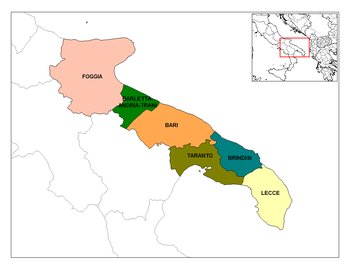
Apulia is divided into six provinces (official data for the 6th province (Barletta-Andria-TraniProvince of Barletta-Andria-Trani
The Province of Barletta-Andria-Trani is a province of Italy in the Apulia region. The establishment of the province took effect in June 2009, and Andria was appointed as its seat of government on May 21, 2010....
), instituted in 2009, will be available only after the 2011 census) :
| Province | Area (km²) | Population | Density (inh./km²) |
|---|---|---|---|
| Province of Bari Province of Bari The Province of Bari is a province in the Apulia region of Italy. Its capital is the city of Bari.It has an area of 5,138 km², and a total population of 1,594,109 . There are 48 comuni in the province, see Comuni of the Province of Bari... |
3,821 | 1,256,821 | 328,9 |
| Province of Barletta-Andria-Trani Province of Barletta-Andria-Trani The Province of Barletta-Andria-Trani is a province of Italy in the Apulia region. The establishment of the province took effect in June 2009, and Andria was appointed as its seat of government on May 21, 2010.... |
1,543 | 392,237 | 254,2 |
| Province of Brindisi Province of Brindisi The Province of Brindisi is a province in the Apulia region of Italy. Its capital is the city of Brindisi. Surrounded by vineyards and artichoke fields, Brindisi is a major sailing port for the southern part of Italy.... |
1,839 | 402,973 | 219.1 |
| Province of Foggia Province of Foggia The Province of Foggia is a province in the Apulia region of Italy.This province is also known as Capitanata, originally Catapanata, because during the Middle Ages it was governed by a catapan, as part of the Catapanate of Italy... |
6,960 | 641,000 | 92.0 |
| Province of Lecce Province of Lecce The Province of Lecce is a province in the Apulia region of Italy. Its capital is the city of Lecce. Totally included in the Salento peninsula, it is the second most populous province in Apulia and the twenty-first most populous in Italy.... |
2,759 | 812,690 | 294.5 |
| Province of Taranto Province of Taranto The Province of Taranto is a province in the Apulia region of Italy. Its capital is the city of Taranto.It has an area of 2,437 km², and a total population of 580,588... |
2,437 | 580,497 | 238.2 |
Language
The official national language (since 1861) is ItalianItalian language
Italian is a Romance language spoken mainly in Europe: Italy, Switzerland, San Marino, Vatican City, by minorities in Malta, Monaco, Croatia, Slovenia, France, Libya, Eritrea, and Somalia, and by immigrant communities in the Americas and Australia...
. However, as a consequence of its long and varied history, other historical languages have been spoken in this region for centuries. In the northern and central sections, some dialects of the Neapolitan language
Neapolitan language
Neapolitan is the language of the city and region of Naples , and Campania. On October 14, 2008 a law by the Region of Campania stated that the Neapolitan language had to be protected....
are spoken: for example Bari dialect
Bari dialect
Bari dialect or dialetto barese is a variety of Romance languages which has developed over time, changing with the numerous linguistic influences in the Apulia region of Italy due to invasion and occupation throughout the centuries...
, spoken in the zone of Bari
Bari
Bari is the capital city of the province of Bari and of the Apulia region, on the Adriatic Sea, in Italy. It is the second most important economic centre of mainland Southern Italy after Naples, and is well known as a port and university city, as well as the city of Saint Nicholas...
or Foggiano near Foggia
Foggia
Foggia is a city and comune of Apulia, Italy, capital of the province of Foggia. Foggia is the main city of a plain called Tavoliere, also known as the "granary of Italy".-History:...
. In the southern part of the region, dialects of the Sicilian language
Sicilian language
Sicilian is a Romance language. Its dialects make up the Extreme-Southern Italian language group, which are spoken on the island of Sicily and its satellite islands; in southern and central Calabria ; in the southern parts of Apulia, the Salento ; and Campania, on the Italian mainland, where it is...
called Tarantino
Tarantino language
Tarantino of the southeastern Italian region of Apulia is a dialect of Southern Italian / Sicilian. Most of the speakers live in the Apulian town of Taranto. The dialect is also spoken by a few Italian immigrants in the United States, especially in California...
and Salentino
Salentino
The Salentino dialect is the traditional vernacular of the southern Italian provinces of Lecce, Brindisi and part of that of Taranto, known more commonly as the Salento, the extreme southern part of the region of Puglia or the southern "heel" of the Italian peninsula.For socio-political reasons...
are spoken. In isolated pockets of the Southern part of Salento
Salento
Salento is the south-eastern extremity of the Apulia region of Italy. It is a sub-peninsula of the main Italian Peninsula, sometimes described as the "heel" of the Italian "boot"...
, a dialect of modern Greek called Griko, is spoken by just a few thousand people. A rare dialect of the Franco-Provençal language
Franco-Provençal language
Franco-Provençal , Arpitan, or Romand is a Romance language with several distinct dialects that form a linguistic sub-group separate from Langue d'Oïl and Langue d'Oc. The name Franco-Provençal was given to the language by G.I...
called Faetar is spoken in two isolated towns in the Province of Foggia
Province of Foggia
The Province of Foggia is a province in the Apulia region of Italy.This province is also known as Capitanata, originally Catapanata, because during the Middle Ages it was governed by a catapan, as part of the Catapanate of Italy...
. In a couple of villages, the Arbëreshë
Arbëreshë
The Arbëreshë are a linguistic and ethnic Albanian minority community living in southern Italy, especially the regions of Apulia, Basilicata, Molise, Calabria and Sicily...
dialect of the Albanian language
Albanian language
Albanian is an Indo-European language spoken by approximately 7.6 million people, primarily in Albania and Kosovo but also in other areas of the Balkans in which there is an Albanian population, including western Macedonia, southern Montenegro, southern Serbia and northwestern Greece...
has been spoken by a very small community since a wave of refugees settled there in the 15th century. The Messapic language formerly spoken in the region was extinct by the 1st century BC due to the Romanization/Latinization
Romanization (cultural)
Romanization or latinization indicate different historical processes, such as acculturation, integration and assimilation of newly incorporated and peripheral populations by the Roman Republic and the later Roman Empire...
of this area that took place after the definitive conquest of the region by the Romans
Ancient Rome
Ancient Rome was a thriving civilization that grew on the Italian Peninsula as early as the 8th century BC. Located along the Mediterranean Sea and centered on the city of Rome, it expanded to one of the largest empires in the ancient world....
during the 3rd century BC (see Punic Wars
Punic Wars
The Punic Wars were a series of three wars fought between Rome and Carthage from 264 B.C.E. to 146 B.C.E. At the time, they were probably the largest wars that had ever taken place...
).
See also
- Capitanata
- Tavoliere delle PuglieTavoliere delle Pugliethumb|300px|The Tavoliere seen from the [[Gargano]] promontory.The Tavoliere delle Puglie is a plain in northern Apulia, southern Italy, occupying nearly a half of the Capitanata traditional region. It covers a surface of c...
- GarganoGarganoGargano is a historical and geographical Italian sub-region situated in Apulia, consisting of a wide isolated mountain massif made of highland and several peaks and forming the backbone of the Gargano Promontory projecting into the Adriatic Sea. The high point is Monte Calvo at . Most of the upland...
- SalentoSalentoSalento is the south-eastern extremity of the Apulia region of Italy. It is a sub-peninsula of the main Italian Peninsula, sometimes described as the "heel" of the Italian "boot"...
- Sacra Corona UnitaSacra corona unitaSacra Corona Unita, or United Sacred Crown, is a Mafia-like criminal organization from Apulia region in Southern Italy, and is especially active in the areas of Brindisi, Lecce and Taranto .-Background and activities:...
- Terra d'OtrantoTerra d'OtrantoTerra d'Otranto was an ancient administrative division of the Kingdom of Naples, consisting of a giustizierato and then converted into a Province of the Kingdom of the Two Sicilies. Now it belongs to Apulia region and is located in the Province of Lecce....
- MurgiaMurgiaMurgia is a sub-region of Apulia in southern Italy, corresponding to a karst topographic plateau of rectangular shape, occupying the central area of the region. The name stems from the Latin murex, meaning "sharp stone"....
- TrulloTrulloA trullo is a traditional Apulian dry stone hut with a conical roof. Their style of construction is specific to the Itria Valley, in the Murge area of the Italian region of Apulia. Trulli were generally constructed as temporary field shelters and storehouses or as permanent dwellings by small...
External links
- Puglia Life - Home of the the English ex-pat community in Puglia (Apulia)
- Official Tourism website
- Official website
- Puglia Video: Art-Endless Treasures
- Environmental League Puglia (in Italian)
- Puglia's west coast video
- Puglia's Photo Gallery
- How to get to Puglia
- Emozioni di una Terra
- Information about best Food and Wine of Puglia
- Bari Cruise Port Video Introduction
- Mare di Puglia
- Web site about town of Gargano: Mattinata
- Puglia, Gargano e Salento mare trulli e masserie
- Web site about the town where Padre Pio lived: San Giovanni Rotondo
- Article on the Apulians in the USA"The Apulians", Tiziano Thomas Dossena, Bridge Apulia-USA N.2, 1997
- Recount with pictures of a tourist's trip through Puglia including Matera
- Video Tournament Medieval of Oria, Salento – and Meteo Oria