

Anglo-Saxons

Encyclopedia
Anglo-Saxon is a term used by historians to designate the Germanic tribes
who invaded and settled the south and east of Great Britain
beginning in the early 5th century AD, and the period from their creation of the English
nation to the Norman conquest
. The Anglo-Saxon Era denotes the period of English history between about 550 and 1066 AD. The term is also used for the language now called Old English, spoken and written by the Anglo-Saxons and their descendants in much of what is now England and some of southeastern Scotland
between at least the mid-5th century and the mid-12th century.
The Benedictine
monk, Bede
, writing in the early 8th century, identified the English as the descendants of three Germanic tribes:
Their language, Old English, derived from Ingvaeonic
West Germanic
dialects and transformed into Middle English
from the 11th century. Old English was divided into four main dialects: West Saxon, Mercian, Northumbrian and Kentish.
, who seems to have frequently used the title rex Anglorum Saxonum or rex Angul-Saxonum (king of the English Saxons
).
The Old English terms ænglisc and Angelcynn ("Angle-kin", gens Anglorum) when they are first attested had already lost their original sense of referring to the Angles, as distinct from, the Saxons, and in their earliest recorded sense refers to the nation of Germanic peoples who settled eastern Britain in and after the 5th century.
The indigenous British people, who wrote in both Latin and Welsh, referred to these invaders as Saxones or Saeson – the latter is still used today in the Welsh word for English people
; in the Scottish Gaelic word for English people, Sasannach; and in the Irish word for English people, Sasanach.
The term Angli Saxones seems to have first been used in continental writing nearly a century before Alfred's time by Paul the Deacon
, historian of the Lombards
, probably to distinguish the English Saxons from the continental Saxons (Ealdseaxe, literally, "old Saxons").
The Angles (Old English Engle, Angle) presumably took their name from their ancestral home in Jutland
, Angul (modern Angeln
), an area shaped like a hook (cf. Old English angel, angul "fishhook", anga "hook").
in 1066.
to Britain from what is now northern Germany, the northern part of the Netherlands and southern Scandinavia
is attested from the 5th century (e.g. Undley bracteate
). Based on Bede's Historia ecclesiastica gentis Anglorum, the intruding population is traditionally divided into Angles, Saxons, and Jutes
, but their composition was likely less clear-cut and may also have included Frisians
and Franks
. Also, the Anglo-Saxon Chronicle
contains text that may be the first recorded indications of the movement of these Germanic tribes
to Britain.
 Christianisation of the Anglo-Saxons
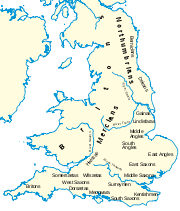
began in 597 and was at least nominally completed in 686. Throughout the 7th and 8th centuries, power fluctuated between the larger kingdoms. Bede records Aethelbert of Kent as being dominant at the close of the 6th century, but power seems to have shifted northwards to the kingdoms of Mercia
and Northumbria
.
Aethelbert and some of the later kings of the other kingdoms were recognised by their fellow kings as Bretwalda
(ruler of Britain). The so-called 'Mercian Supremacy' dominated the 8th century, though again it was not constant. Aethelbald and Offa
, the two most powerful kings, achieved high status. This period has been described as the Heptarchy
, though this term has now fallen out of academic use.
The word arose on the basis that the seven kingdoms of Northumbria, Mercia, Kent
, East Anglia
, Essex
, Sussex
and Wessex were the main polities of south Britain. More recent scholarship has shown that theories of the 'heptarchy' are not grounded in evidence, and it is far more likely that power fluctuated between many more 'kingdoms'. Other politically important 'kingdoms' across this period include: Hwicce
, Magonsaete
, Kingdom of Lindsey
and Middle Anglia.
An important development in the 9th century was the rise of the Kingdom of Wessex
; by the end of his reign Alfred was recognised as overlord by several southern kingdoms. Æthelstan was the first king to achieve direct rule over what is considered "England".
Near the end of the 10th century, there was renewed Scandinavian interest in England, with the conquests of Sweyn of Denmark
and his son Cnut the Great. By 1066 there were three lords with claims to the English throne, resulting in two invasions and the battles of Stamford Bridge
and Hastings
. The latter, which heralded the Norman conquest of England
, resulted in the overthrow of the Anglo-Saxon polity and its replacement with Norman
rule.
, and Scandinavia
. The Byzantine Empire
became a popular destination for many Anglo-Saxon soldiers, as the Byzantines were in need of mercenaries. The Anglo-Saxons became the predominant element in the elite Varangian Guard
, hitherto a largely Scandinavian unit, from which the emperor's bodyguard was drawn and continued to serve the empire until the early 15th century. However, the population of England at home remained largely Anglo-Saxon; for them, little changed immediately except that their Anglo-Saxon lord was replaced by a Norman lord.
There are few remains of Anglo-Saxon architecture, with but one secular work remaining above ground – a 10m. x 5m. houscarl's dwelling re-using local Roman materials. This is still completely standing as an undivided single room with a single central north-facing door, belonging to the Godwin estates, so can be dated 1018–1066. At least fifty churches are of Anglo-Saxon origin, with many more claimed to be, in part from their dedication to local Anglo-Saxon saints, although in some cases the Anglo-Saxon part is small and much-altered. All surviving churches, except one timber church, are built of stone or brick and in some cases show evidence of re-used Roman
work.
The character of Anglo-Saxon ecclesiastical buildings ranges from Celtic influenced architecture in the early period; basilica
influenced Romanesque architecture
; to in the later Anglo-Saxon period, an architecture characterised by pilaster-strips, blank arcading, baluster shafts and triangular headed openings.
style, a fusion of Anglo-Saxon and Celtic techniques and motifs. The Sutton Hoo
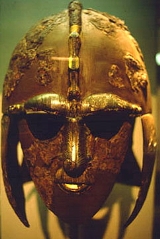
treasure is an exceptional survival of very early Anglo-Saxon metalwork and jewellery, from a royal grave of the early 7th century. The period between Alfred and the Norman Conquest, with the revival of the English economy and culture after the end of the Viking raids, saw a distinct Anglo-Saxon style in art, though one in touch with trends on the Continent.
Anglo-Saxon art is mainly known today through illuminated manuscripts, including the Benedictional of St. Æthelwold
(British Library
) and Leofric Missal
(Oxford, Bodleian Library, MS Bodl, 579), masterpieces of the late "Winchester style", which drew on Hiberno-Saxon art, Carolingian art
and Byzantine art
for style and iconography
, and combined both northern ornamental traditions with Mediterranean figural traditions. The Harley Psalter
was a copy of the Carolingian Utrecht Psalter
— which was a particular influence in creating an Anglo-Saxon style of very lively pen drawings.
Manuscripts were far from the only Anglo-Saxon art form, but they have survived in much greater numbers than other types of object. Contemporaries in Europe regarded Anglo-Saxon goldsmithing and embroidery (Opus Anglicanum
) as especially fine. Perhaps the best known piece of Anglo-Saxon art is the Bayeux Tapestry
which was commissioned by a Norman patron from English artists working in the traditional Anglo-Saxon style. The most common example of Anglo-Saxon art is coins, with thousands of examples extant. Anglo-Saxon artists also worked in fresco
, ivory
, stone carving, metalwork (see Fuller brooch
for example) and enamel
, but few of these pieces have survived.
and continued to be the common language of England
(non-Danelaw
) until after the Norman Conquest of 1066 when, under the influence of the Anglo-Norman language
spoken by the Norman ruling class, it changed into Middle English
roughly between 1150–1500.
Old English is far closer to early Germanic
than Middle English. It is less Latinised and retains many morphological features (nominal and verbal inflection) that were lost during the 12th to 14th centuries. The languages today which are closest to Old English are the Frisian languages, which are spoken by a few hundred thousand people in the northern part of Germany and the Netherlands.
Before literacy in the vernacular Old English or Latin became widespread, a runic alphabet
, the futhorc, was used for inscriptions. When literacy became more prevalent, a form of Latin script was used with a couple of letters derived from the futhorc: 'thorn
' ‹þ› and 'wynn
' ‹ƿ› (generally replaced with ‹w› in modern reproductions).
The letters regularly used in printed and edited texts of Old English are the following:
with only rare occurrences of j, k, q, v, and z.
and how this legal culture developed over the course of time. The Saxons chopped off hands and noses for punishment (if the offender stole something or committed another crime). If someone killed a Saxon, he had to pay money called wergild, the amount varying according to the social rank of the victim.
 Old English literary works include genres such as epic poetry, hagiography
, sermon
s, Bible
translations, legal works, chronicle
s, riddles and others. In all there are about 400 surviving manuscript
s from the period, a significant corpus of both popular interest and specialist research.
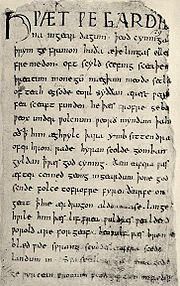
The most famous works from this period include the poem Beowulf
, which has achieved national epic
status in Britain. The Anglo-Saxon Chronicle
is a collection of important early English history. Cædmon's Hymn
from the 7th century is the earliest attested literary text in English.
belief system of the Anglo-Saxons was a form of Germanic paganism
and therefore closely related to the Old Norse religion
, as well as other Germanic pre-Christian cultures.
Christianity gradually replaced the indigenous religion of the English around the 7th and 8th centuries. Celtic Christianity
was introduced into Northumbria and Mercia by monk
s from Ireland
, but the Synod of Whitby
settled the choice for Roman Christianity. As the new clerics became the chroniclers, the old religion was partially lost before it was recorded, and today historians' knowledge of it is largely based on surviving customs and lore, texts, etymological links and archaeological finds.
One of the few recorded references is that a Kentish King would only meet the missionary St. Augustine
in the open air, where he would be under the protection of the sky god, Woden. Written Christian prohibitions on acts of paganism are one of historians' main sources of information on pre-Christian beliefs.
Despite these prohibitions, numerous elements of the pre-Christian culture of the Anglo-Saxon people survived the Christianisation process. Examples include the English language names for days of the week:
component of the modern English language
, which was later expanded and developed through the influence of Old Norse
and Norman French
, though linguists now more often refer to it as Old English. In the 19th century the term "Anglo-Saxon" was broadly used in philology
, and is sometimes so used at present. In Victorian Britain, some writers such as Robert Knox
,
James Anthony Froude
, Charles Kingsley
and Edward A. Freeman used the term "Anglo-Saxon" to justify racism
and imperialism
, claiming that the "Anglo-Saxon" ancestry of the English made them racially superior to the colonised peoples. Similar racist ideas were advocated in the 19th Century United States by Samuel George Morton
and George Fitzhugh
.
The term "Anglo-Saxon" is sometimes used to refer to peoples descended or associated in some way with the English ethnic group. The definition has varied from time to time and varies from place to place. In contemporary Anglophone
cultures outside the United Kingdom
, the term is most commonly found in certain contexts, such as the term "White Anglo-Saxon Protestant
" or "WASP". Such terms are often politicised, and bear little connection to the precise ethnological or historical definition of the term "Anglo-Saxon". It often encapsulates socio-economic identifiers more than ethnic ones.
Outside Anglophone countries, both in Europe and in the rest of the world, the term "Anglo-Saxon" and its direct translations are used to refer to the Anglophone peoples and societies of Britain, the United States
, and other countries such as Australia
, Canada
and New Zealand
- areas which are sometimes referred to as the Anglosphere
. The term "Anglo-Saxon" can be used in a variety of contexts, often to identify the English-speaking world's distinctive language, culture, technology, wealth, markets, economy, and legal systems. Variations include the German
"Angelsachsen", French
"Anglo-Saxon", Spanish
"anglosajón", Portuguese
"anglo-saxão", Italian
"anglosassone", Catalan
"anglosaxó", Japanese
"Angurosakuson" and Ukrainian
"aнглосакси" (anhlosaksy). As with the English language use of the term, what constitutes the "Anglo-Saxon" varies from speaker to speaker.
Modern concepts:
Germanic peoples
The Germanic peoples are an Indo-European ethno-linguistic group of Northern European origin, identified by their use of the Indo-European Germanic languages which diversified out of Proto-Germanic during the Pre-Roman Iron Age.Originating about 1800 BCE from the Corded Ware Culture on the North...
who invaded and settled the south and east of Great Britain
Great Britain
Great Britain or Britain is an island situated to the northwest of Continental Europe. It is the ninth largest island in the world, and the largest European island, as well as the largest of the British Isles...
beginning in the early 5th century AD, and the period from their creation of the English
England
England is a country that is part of the United Kingdom. It shares land borders with Scotland to the north and Wales to the west; the Irish Sea is to the north west, the Celtic Sea to the south west, with the North Sea to the east and the English Channel to the south separating it from continental...
nation to the Norman conquest
Norman conquest of England
The Norman conquest of England began on 28 September 1066 with the invasion of England by William, Duke of Normandy. William became known as William the Conqueror after his victory at the Battle of Hastings on 14 October 1066, defeating King Harold II of England...
. The Anglo-Saxon Era denotes the period of English history between about 550 and 1066 AD. The term is also used for the language now called Old English, spoken and written by the Anglo-Saxons and their descendants in much of what is now England and some of southeastern Scotland
Scotland
Scotland is a country that is part of the United Kingdom. Occupying the northern third of the island of Great Britain, it shares a border with England to the south and is bounded by the North Sea to the east, the Atlantic Ocean to the north and west, and the North Channel and Irish Sea to the...
between at least the mid-5th century and the mid-12th century.
The Benedictine
Benedictine
Benedictine refers to the spirituality and consecrated life in accordance with the Rule of St Benedict, written by Benedict of Nursia in the sixth century for the cenobitic communities he founded in central Italy. The most notable of these is Monte Cassino, the first monastery founded by Benedict...
monk, Bede
Bede
Bede , also referred to as Saint Bede or the Venerable Bede , was a monk at the Northumbrian monastery of Saint Peter at Monkwearmouth, today part of Sunderland, England, and of its companion monastery, Saint Paul's, in modern Jarrow , both in the Kingdom of Northumbria...
, writing in the early 8th century, identified the English as the descendants of three Germanic tribes:
- The AnglesAnglesThe Angles is a modern English term for a Germanic people who took their name from the ancestral cultural region of Angeln, a district located in Schleswig-Holstein, Germany...
, who may have come from AngelnAngelnModern Angeln, also known as Anglia , is a small peninsula in Southern Schleswig in the northern Schleswig-Holstein, Germany, protruding into the Bay of Kiel...
(in modern GermanyGermanyGermany , officially the Federal Republic of Germany , is a federal parliamentary republic in Europe. The country consists of 16 states while the capital and largest city is Berlin. Germany covers an area of 357,021 km2 and has a largely temperate seasonal climate...
); Bede wrote that their whole nation came to Britain, leaving their former land empty. The name EnglandEnglandEngland is a country that is part of the United Kingdom. It shares land borders with Scotland to the north and Wales to the west; the Irish Sea is to the north west, the Celtic Sea to the south west, with the North Sea to the east and the English Channel to the south separating it from continental...
( or ) originates from this tribe. - The SaxonsSaxonsThe Saxons were a confederation of Germanic tribes originating on the North German plain. The Saxons earliest known area of settlement is Northern Albingia, an area approximately that of modern Holstein...
, from Lower SaxonyLower SaxonyLower Saxony is a German state situated in north-western Germany and is second in area and fourth in population among the sixteen states of Germany...
(in modern Germany; ) and the Low CountriesLow CountriesThe Low Countries are the historical lands around the low-lying delta of the Rhine, Scheldt, and Meuse rivers, including the modern countries of Belgium, the Netherlands, Luxembourg and parts of northern France and western Germany....
. - The JutesJutesThe Jutes, Iuti, or Iutæ were a Germanic people who, according to Bede, were one of the three most powerful Germanic peoples of their time, the other two being the Saxons and the Angles...
, possibly from the JutlandJutlandJutland , historically also called Cimbria, is the name of the peninsula that juts out in Northern Europe toward the rest of Scandinavia, forming the mainland part of Denmark. It has the North Sea to its west, Kattegat and Skagerrak to its north, the Baltic Sea to its east, and the Danish–German...
peninsula (in modern DenmarkDenmarkDenmark is a Scandinavian country in Northern Europe. The countries of Denmark and Greenland, as well as the Faroe Islands, constitute the Kingdom of Denmark . It is the southernmost of the Nordic countries, southwest of Sweden and south of Norway, and bordered to the south by Germany. Denmark...
; ).
Their language, Old English, derived from Ingvaeonic
Ingvaeonic
Ingvaeonic , also known as North Sea Germanic, is a postulated grouping of the West Germanic languages that comprises Old Frisian, Old English and Old Saxon....
West Germanic
West Germanic languages
The West Germanic languages constitute the largest of the three traditional branches of the Germanic family of languages and include languages such as German, English, Dutch, Afrikaans, the Frisian languages, and Yiddish...
dialects and transformed into Middle English
Middle English
Middle English is the stage in the history of the English language during the High and Late Middle Ages, or roughly during the four centuries between the late 11th and the late 15th century....
from the 11th century. Old English was divided into four main dialects: West Saxon, Mercian, Northumbrian and Kentish.
Etymology
The term Anglo-Saxon is from writings going back to the time of King Alfred the GreatAlfred the Great
Alfred the Great was King of Wessex from 871 to 899.Alfred is noted for his defence of the Anglo-Saxon kingdoms of southern England against the Vikings, becoming the only English monarch still to be accorded the epithet "the Great". Alfred was the first King of the West Saxons to style himself...
, who seems to have frequently used the title rex Anglorum Saxonum or rex Angul-Saxonum (king of the English Saxons
Saxons
The Saxons were a confederation of Germanic tribes originating on the North German plain. The Saxons earliest known area of settlement is Northern Albingia, an area approximately that of modern Holstein...
).
The Old English terms ænglisc and Angelcynn ("Angle-kin", gens Anglorum) when they are first attested had already lost their original sense of referring to the Angles, as distinct from, the Saxons, and in their earliest recorded sense refers to the nation of Germanic peoples who settled eastern Britain in and after the 5th century.
The indigenous British people, who wrote in both Latin and Welsh, referred to these invaders as Saxones or Saeson – the latter is still used today in the Welsh word for English people
English people
The English are a nation and ethnic group native to England, who speak English. The English identity is of early mediaeval origin, when they were known in Old English as the Anglecynn. England is now a country of the United Kingdom, and the majority of English people in England are British Citizens...
; in the Scottish Gaelic word for English people, Sasannach; and in the Irish word for English people, Sasanach.
The term Angli Saxones seems to have first been used in continental writing nearly a century before Alfred's time by Paul the Deacon
Paul the Deacon
Paul the Deacon , also known as Paulus Diaconus, Warnefred, Barnefridus and Cassinensis, , was a Benedictine monk and historian of the Lombards.-Life:...
, historian of the Lombards
Lombards
The Lombards , also referred to as Longobards, were a Germanic tribe of Scandinavian origin, who from 568 to 774 ruled a Kingdom in Italy...
, probably to distinguish the English Saxons from the continental Saxons (Ealdseaxe, literally, "old Saxons").
The Angles (Old English Engle, Angle) presumably took their name from their ancestral home in Jutland
Jutland
Jutland , historically also called Cimbria, is the name of the peninsula that juts out in Northern Europe toward the rest of Scandinavia, forming the mainland part of Denmark. It has the North Sea to its west, Kattegat and Skagerrak to its north, the Baltic Sea to its east, and the Danish–German...
, Angul (modern Angeln
Angeln
Modern Angeln, also known as Anglia , is a small peninsula in Southern Schleswig in the northern Schleswig-Holstein, Germany, protruding into the Bay of Kiel...
), an area shaped like a hook (cf. Old English angel, angul "fishhook", anga "hook").
Anglo-Saxon history
The history of Anglo-Saxon England broadly covers early medieval England from the end of Roman rule and the establishment of Anglo-Saxon kingdoms in the 5th century until the Conquest by the NormansNormans
The Normans were the people who gave their name to Normandy, a region in northern France. They were descended from Norse Viking conquerors of the territory and the native population of Frankish and Gallo-Roman stock...
in 1066.
Origins (AD 400–600)
Migration of Germanic peoplesGermanic peoples
The Germanic peoples are an Indo-European ethno-linguistic group of Northern European origin, identified by their use of the Indo-European Germanic languages which diversified out of Proto-Germanic during the Pre-Roman Iron Age.Originating about 1800 BCE from the Corded Ware Culture on the North...
to Britain from what is now northern Germany, the northern part of the Netherlands and southern Scandinavia
Scandinavia
Scandinavia is a cultural, historical and ethno-linguistic region in northern Europe that includes the three kingdoms of Denmark, Norway and Sweden, characterized by their common ethno-cultural heritage and language. Modern Norway and Sweden proper are situated on the Scandinavian Peninsula,...
is attested from the 5th century (e.g. Undley bracteate
Undley bracteate
The Undley bracteate is a 5th century bracteate found in Undley Common, near Lakenheath, Suffolk. It bears the earliest known inscription that can be argued to be in Anglo-Frisian Futhorc ....
). Based on Bede's Historia ecclesiastica gentis Anglorum, the intruding population is traditionally divided into Angles, Saxons, and Jutes
Jutes
The Jutes, Iuti, or Iutæ were a Germanic people who, according to Bede, were one of the three most powerful Germanic peoples of their time, the other two being the Saxons and the Angles...
, but their composition was likely less clear-cut and may also have included Frisians
Frisii
The Frisii were an ancient Germanic tribe living in the low-lying region between the Zuiderzee and the River Ems. In the Germanic pre-Migration Period the Frisii and the related Chauci, Saxons, and Angles inhabited the Continental European coast from the Zuyder Zee to south Jutland...
and Franks
Franks
The Franks were a confederation of Germanic tribes first attested in the third century AD as living north and east of the Lower Rhine River. From the third to fifth centuries some Franks raided Roman territory while other Franks joined the Roman troops in Gaul. Only the Salian Franks formed a...
. Also, the Anglo-Saxon Chronicle
Anglo-Saxon Chronicle
The Anglo-Saxon Chronicle is a collection of annals in Old English chronicling the history of the Anglo-Saxons. The original manuscript of the Chronicle was created late in the 9th century, probably in Wessex, during the reign of Alfred the Great...
contains text that may be the first recorded indications of the movement of these Germanic tribes
Germanic peoples
The Germanic peoples are an Indo-European ethno-linguistic group of Northern European origin, identified by their use of the Indo-European Germanic languages which diversified out of Proto-Germanic during the Pre-Roman Iron Age.Originating about 1800 BCE from the Corded Ware Culture on the North...
to Britain.
Heptarchy (600–800)
Christianization of Anglo-Saxon England
The Christianization of Anglo-Saxon England was a process spanning the 7th century.It is essentially the result of the Gregorian mission of 597, which was joined by the efforts of the Hiberno-Scottish mission from the 630s...
began in 597 and was at least nominally completed in 686. Throughout the 7th and 8th centuries, power fluctuated between the larger kingdoms. Bede records Aethelbert of Kent as being dominant at the close of the 6th century, but power seems to have shifted northwards to the kingdoms of Mercia
Mercia
Mercia was one of the kingdoms of the Anglo-Saxon Heptarchy. It was centred on the valley of the River Trent and its tributaries in the region now known as the English Midlands...
and Northumbria
Northumbria
Northumbria was a medieval kingdom of the Angles, in what is now Northern England and South-East Scotland, becoming subsequently an earldom in a united Anglo-Saxon kingdom of England. The name reflects the approximate southern limit to the kingdom's territory, the Humber Estuary.Northumbria was...
.
Aethelbert and some of the later kings of the other kingdoms were recognised by their fellow kings as Bretwalda
Bretwalda
Bretwalda is an Old English word, the first record of which comes from the late 9th century Anglo-Saxon Chronicle. It is given to some of the rulers of Anglo-Saxon kingdoms from the 5th century onwards who had achieved overlordship of some or all of the other Anglo-Saxon kingdoms...
(ruler of Britain). The so-called 'Mercian Supremacy' dominated the 8th century, though again it was not constant. Aethelbald and Offa
Offa of Mercia
Offa was the King of Mercia from 757 until his death in July 796. The son of Thingfrith and a descendant of Eowa, Offa came to the throne after a period of civil war following the assassination of Æthelbald after defeating the other claimant Beornred. In the early years of Offa's reign it is likely...
, the two most powerful kings, achieved high status. This period has been described as the Heptarchy
Heptarchy
The Heptarchy is a collective name applied to the Anglo-Saxon kingdoms of south, east, and central Great Britain during late antiquity and the early Middle Ages, conventionally identified as seven: Northumbria, Mercia, East Anglia, Essex, Kent, Sussex and Wessex...
, though this term has now fallen out of academic use.
The word arose on the basis that the seven kingdoms of Northumbria, Mercia, Kent
Kingdom of Kent
The Kingdom of Kent was a Jutish colony and later independent kingdom in what is now south east England. It was founded at an unknown date in the 5th century by Jutes, members of a Germanic people from continental Europe, some of whom settled in Britain after the withdrawal of the Romans...
, East Anglia
East Anglia
East Anglia is a traditional name for a region of eastern England, named after an ancient Anglo-Saxon kingdom, the Kingdom of the East Angles. The Angles took their name from their homeland Angeln, in northern Germany. East Anglia initially consisted of Norfolk and Suffolk, but upon the marriage of...
, Essex
Essex
Essex is a ceremonial and non-metropolitan county in the East region of England, and one of the home counties. It is located to the northeast of Greater London. It borders with Cambridgeshire and Suffolk to the north, Hertfordshire to the west, Kent to the South and London to the south west...
, Sussex
Kingdom of Sussex
The Kingdom of Sussex or Kingdom of the South Saxons was a Saxon colony and later independent kingdom of the Saxons, on the south coast of England. Its boundaries coincided in general with those of the earlier kingdom of the Regnenses and the later county of Sussex. A large part of its territory...
and Wessex were the main polities of south Britain. More recent scholarship has shown that theories of the 'heptarchy' are not grounded in evidence, and it is far more likely that power fluctuated between many more 'kingdoms'. Other politically important 'kingdoms' across this period include: Hwicce
Hwicce
The Hwicce were one of the peoples of Anglo-Saxon England. The exact boundaries of their kingdom are uncertain, though it is likely that they coincided with those of the old Diocese of Worcester, founded in 679–80, the early bishops of which bore the title Episcopus Hwicciorum...
, Magonsaete
Magonsaete
Magonsæte was a minor sub-kingdom of the greater Anglo-Saxon kingdom of Mercia, thought to be coterminous with the Diocese of Hereford.The British territory of Pengwern was conquered by Oswiu of Northumbria in 656, while he was overlord of the Mercians. Western Pengwern was then occupied by Anglian...
, Kingdom of Lindsey
Kingdom of Lindsey
Lindsey or Linnuis is the name of a petty Anglo-Saxon kingdom, absorbed into Northumbria in the 7th century.It lay between the Humber and the Wash, forming its inland boundaries from the course of the Witham and Trent rivers , and the Foss Dyke between...
and Middle Anglia.
Viking Age and the Norman Conquest (800–1066)
In the 9th century, the Viking challenge grew to serious proportions. Alfred the Great's victory at Edington, Wiltshire, in 878 brought intermittent peace, but with their possession of Jorvik, the Danes gained a solid foothold in England.An important development in the 9th century was the rise of the Kingdom of Wessex
Wessex
The Kingdom of Wessex or Kingdom of the West Saxons was an Anglo-Saxon kingdom of the West Saxons, in South West England, from the 6th century, until the emergence of a united English state in the 10th century, under the Wessex dynasty. It was to be an earldom after Canute the Great's conquest...
; by the end of his reign Alfred was recognised as overlord by several southern kingdoms. Æthelstan was the first king to achieve direct rule over what is considered "England".
Near the end of the 10th century, there was renewed Scandinavian interest in England, with the conquests of Sweyn of Denmark
Sweyn I of Denmark
Sweyn I Forkbeard was king of Denmark and England, as well as parts of Norway. His name appears as Swegen in the Anglo-Saxon Chronicle and he is also known in English as Svein, Swein, Sven the Dane, and Tuck.He was a Viking leader and the father of Cnut the Great...
and his son Cnut the Great. By 1066 there were three lords with claims to the English throne, resulting in two invasions and the battles of Stamford Bridge
Battle of Stamford Bridge
The Battle of Stamford Bridge took place at the village of Stamford Bridge, East Riding of Yorkshire in England on 25 September 1066, between an English army under King Harold Godwinson and an invading Norwegian force led by King Harald Hardrada of Norway and the English king's brother Tostig...
and Hastings
Battle of Hastings
The Battle of Hastings occurred on 14 October 1066 during the Norman conquest of England, between the Norman-French army of Duke William II of Normandy and the English army under King Harold II...
. The latter, which heralded the Norman conquest of England
Norman conquest of England
The Norman conquest of England began on 28 September 1066 with the invasion of England by William, Duke of Normandy. William became known as William the Conqueror after his victory at the Battle of Hastings on 14 October 1066, defeating King Harold II of England...
, resulted in the overthrow of the Anglo-Saxon polity and its replacement with Norman
Normans
The Normans were the people who gave their name to Normandy, a region in northern France. They were descended from Norse Viking conquerors of the territory and the native population of Frankish and Gallo-Roman stock...
rule.
After the Norman Conquest
Following the conquest, the Anglo-Saxon nobility were either exiled or joined the ranks of the peasantry. It has been estimated that only about 8 per cent of the land was under Anglo-Saxon control by 1087. Many Anglo-Saxon nobles fled to Scotland, IrelandIreland
Ireland is an island to the northwest of continental Europe. It is the third-largest island in Europe and the twentieth-largest island on Earth...
, and Scandinavia
Scandinavia
Scandinavia is a cultural, historical and ethno-linguistic region in northern Europe that includes the three kingdoms of Denmark, Norway and Sweden, characterized by their common ethno-cultural heritage and language. Modern Norway and Sweden proper are situated on the Scandinavian Peninsula,...
. The Byzantine Empire
Byzantine Empire
The Byzantine Empire was the Eastern Roman Empire during the periods of Late Antiquity and the Middle Ages, centred on the capital of Constantinople. Known simply as the Roman Empire or Romania to its inhabitants and neighbours, the Empire was the direct continuation of the Ancient Roman State...
became a popular destination for many Anglo-Saxon soldiers, as the Byzantines were in need of mercenaries. The Anglo-Saxons became the predominant element in the elite Varangian Guard
Varangian Guard
The Varangian Guard was an elite unit of the Byzantine Army in 10th to the 14th centuries, whose members served as personal bodyguards of the Byzantine Emperors....
, hitherto a largely Scandinavian unit, from which the emperor's bodyguard was drawn and continued to serve the empire until the early 15th century. However, the population of England at home remained largely Anglo-Saxon; for them, little changed immediately except that their Anglo-Saxon lord was replaced by a Norman lord.
Architecture
Early Anglo-Saxon buildings in Britain were generally simple, not using masonry except in foundations but constructed mainly using timber with thatch for roofing. Generally preferring not to settle within the old Roman cities, the Anglo-Saxons built small towns near their centres of agriculture, at fords in rivers or sited to serve as ports. In each town, a main hall was in the centre, provided with a central hearth.There are few remains of Anglo-Saxon architecture, with but one secular work remaining above ground – a 10m. x 5m. houscarl's dwelling re-using local Roman materials. This is still completely standing as an undivided single room with a single central north-facing door, belonging to the Godwin estates, so can be dated 1018–1066. At least fifty churches are of Anglo-Saxon origin, with many more claimed to be, in part from their dedication to local Anglo-Saxon saints, although in some cases the Anglo-Saxon part is small and much-altered. All surviving churches, except one timber church, are built of stone or brick and in some cases show evidence of re-used Roman
Roman architecture
Ancient Roman architecture adopted certain aspects of Ancient Greek architecture, creating a new architectural style. The Romans were indebted to their Etruscan neighbors and forefathers who supplied them with a wealth of knowledge essential for future architectural solutions, such as hydraulics...
work.
The character of Anglo-Saxon ecclesiastical buildings ranges from Celtic influenced architecture in the early period; basilica
Basilica
The Latin word basilica , was originally used to describe a Roman public building, usually located in the forum of a Roman town. Public basilicas began to appear in Hellenistic cities in the 2nd century BC.The term was also applied to buildings used for religious purposes...
influenced Romanesque architecture
Romanesque architecture
Romanesque architecture is an architectural style of Medieval Europe characterised by semi-circular arches. There is no consensus for the beginning date of the Romanesque architecture, with proposals ranging from the 6th to the 10th century. It developed in the 12th century into the Gothic style,...
; to in the later Anglo-Saxon period, an architecture characterised by pilaster-strips, blank arcading, baluster shafts and triangular headed openings.
Art
Anglo-Saxon art before roughly the time of Alfred (ruled 871–899) is mostly in varieties of the Hiberno-Saxon or InsularInsular art
Insular art, also known as Hiberno-Saxon art, is the style of art produced in the post-Roman history of Ireland and Great Britain. The term derives from insula, the Latin term for "island"; in this period Britain and Ireland shared a largely common style different from that of the rest of Europe...
style, a fusion of Anglo-Saxon and Celtic techniques and motifs. The Sutton Hoo
Sutton Hoo
Sutton Hoo, near to Woodbridge, in the English county of Suffolk, is the site of two 6th and early 7th century cemeteries. One contained an undisturbed ship burial including a wealth of Anglo-Saxon artefacts of outstanding art-historical and archaeological significance, now held in the British...
treasure is an exceptional survival of very early Anglo-Saxon metalwork and jewellery, from a royal grave of the early 7th century. The period between Alfred and the Norman Conquest, with the revival of the English economy and culture after the end of the Viking raids, saw a distinct Anglo-Saxon style in art, though one in touch with trends on the Continent.
Anglo-Saxon art is mainly known today through illuminated manuscripts, including the Benedictional of St. Æthelwold
Benedictional of St. Æthelwold
The Benedictional of St. Æthelwold is a 10th century illuminated benedictional, the most important surviving work of the Anglo-Saxon Winchester School of illumination...
(British Library
British Library
The British Library is the national library of the United Kingdom, and is the world's largest library in terms of total number of items. The library is a major research library, holding over 150 million items from every country in the world, in virtually all known languages and in many formats,...
) and Leofric Missal
Leofric Missal
The Leofric Missal is an illuminated manuscript, not strictly a conventional missal, from the 10th and 11th century, now in the Bodleian Library at Oxford University where it is catalogued as Bodley 579....
(Oxford, Bodleian Library, MS Bodl, 579), masterpieces of the late "Winchester style", which drew on Hiberno-Saxon art, Carolingian art
Carolingian art
Carolingian art comes from the Frankish Empire in the period of roughly 120 years from about AD 780 to 900 — during the reign of Charlemagne and his immediate heirs — popularly known as the Carolingian Renaissance. The art was produced by and for the court circle and a group of...
and Byzantine art
Byzantine art
Byzantine art is the term commonly used to describe the artistic products of the Byzantine Empire from about the 5th century until the Fall of Constantinople in 1453....
for style and iconography
Iconography
Iconography is the branch of art history which studies the identification, description, and the interpretation of the content of images. The word iconography literally means "image writing", and comes from the Greek "image" and "to write". A secondary meaning is the painting of icons in the...
, and combined both northern ornamental traditions with Mediterranean figural traditions. The Harley Psalter
Harley Psalter
The Harley Psalter is an illuminated manuscript of the second and third decades of the eleventh century, with some later additions. It is a Latin psalter on vellum, measures 380 x 310 mm and was probably produced at Christ Church, Canterbury...
was a copy of the Carolingian Utrecht Psalter
Utrecht Psalter
The Utrecht Psalter is a ninth century illuminated psalter which is a key masterpiece of Carolingian art; it is probably the most valuable manuscript in the Netherlands. It is famous for its 166 lively pen illustrations, with one accompanying each psalm and the other texts in the manuscript...
— which was a particular influence in creating an Anglo-Saxon style of very lively pen drawings.
Manuscripts were far from the only Anglo-Saxon art form, but they have survived in much greater numbers than other types of object. Contemporaries in Europe regarded Anglo-Saxon goldsmithing and embroidery (Opus Anglicanum
Opus Anglicanum
Opus Anglicanum or English work is a contemporary term for fine needlework of Medieval England done for ecclesiastical or secular use on clothing, hangings or other textiles, often using gold and silver threads on rich velvet or linen grounds...
) as especially fine. Perhaps the best known piece of Anglo-Saxon art is the Bayeux Tapestry
Bayeux Tapestry
The Bayeux Tapestry is an embroidered cloth—not an actual tapestry—nearly long, which depicts the events leading up to the Norman conquest of England concerning William, Duke of Normandy and Harold, Earl of Wessex, later King of England, and culminating in the Battle of Hastings...
which was commissioned by a Norman patron from English artists working in the traditional Anglo-Saxon style. The most common example of Anglo-Saxon art is coins, with thousands of examples extant. Anglo-Saxon artists also worked in fresco
Fresco
Fresco is any of several related mural painting types, executed on plaster on walls or ceilings. The word fresco comes from the Greek word affresca which derives from the Latin word for "fresh". Frescoes first developed in the ancient world and continued to be popular through the Renaissance...
, ivory
Ivory
Ivory is a term for dentine, which constitutes the bulk of the teeth and tusks of animals, when used as a material for art or manufacturing. Ivory has been important since ancient times for making a range of items, from ivory carvings to false teeth, fans, dominoes, joint tubes, piano keys and...
, stone carving, metalwork (see Fuller brooch
Fuller brooch
The Fuller Brooch is a piece of late 9th century Anglo-Saxon art of unknown provenance.It is a large disc made of hammered sheet silver inlaid with black niello and with a diameter of 11.4 cm. Its centre roundel is decorated with personifications of the five senses. In the centre is Sight with...
for example) and enamel
Vitreous enamel
Vitreous enamel, also porcelain enamel in U.S. English, is a material made by fusing powdered glass to a substrate by firing, usually between 750 and 850 °C...
, but few of these pieces have survived.
Language
Old English, sometimes called Anglo-Saxon, was the language spoken under Alfred the GreatAlfred the Great
Alfred the Great was King of Wessex from 871 to 899.Alfred is noted for his defence of the Anglo-Saxon kingdoms of southern England against the Vikings, becoming the only English monarch still to be accorded the epithet "the Great". Alfred was the first King of the West Saxons to style himself...
and continued to be the common language of England
England
England is a country that is part of the United Kingdom. It shares land borders with Scotland to the north and Wales to the west; the Irish Sea is to the north west, the Celtic Sea to the south west, with the North Sea to the east and the English Channel to the south separating it from continental...
(non-Danelaw
Danelaw
The Danelaw, as recorded in the Anglo-Saxon Chronicle , is a historical name given to the part of England in which the laws of the "Danes" held sway and dominated those of the Anglo-Saxons. It is contrasted with "West Saxon law" and "Mercian law". The term has been extended by modern historians to...
) until after the Norman Conquest of 1066 when, under the influence of the Anglo-Norman language
Anglo-Norman language
Anglo-Norman is the name traditionally given to the kind of Old Norman used in England and to some extent elsewhere in the British Isles during the Anglo-Norman period....
spoken by the Norman ruling class, it changed into Middle English
Middle English
Middle English is the stage in the history of the English language during the High and Late Middle Ages, or roughly during the four centuries between the late 11th and the late 15th century....
roughly between 1150–1500.
Old English is far closer to early Germanic
Germanic languages
The Germanic languages constitute a sub-branch of the Indo-European language family. The common ancestor of all of the languages in this branch is called Proto-Germanic , which was spoken in approximately the mid-1st millennium BC in Iron Age northern Europe...
than Middle English. It is less Latinised and retains many morphological features (nominal and verbal inflection) that were lost during the 12th to 14th centuries. The languages today which are closest to Old English are the Frisian languages, which are spoken by a few hundred thousand people in the northern part of Germany and the Netherlands.
Before literacy in the vernacular Old English or Latin became widespread, a runic alphabet
Runic alphabet
The runic alphabets are a set of related alphabets using letters known as runes to write various Germanic languages before the adoption of the Latin alphabet and for specialized purposes thereafter...
, the futhorc, was used for inscriptions. When literacy became more prevalent, a form of Latin script was used with a couple of letters derived from the futhorc: 'thorn
Thorn (letter)
Thorn or þorn , is a letter in the Old English, Old Norse, and Icelandic alphabets, as well as some dialects of Middle English. It was also used in medieval Scandinavia, but was later replaced with the digraph th. The letter originated from the rune in the Elder Fuþark, called thorn in the...
' ‹þ› and 'wynn
Wynn
Wynn is a letter of the Old English alphabet, where it is used to represent the sound ....
' ‹ƿ› (generally replaced with ‹w› in modern reproductions).
The letters regularly used in printed and edited texts of Old English are the following:
- a æÆÆ is a grapheme formed from the letters a and e. Originally a ligature representing a Latin diphthong, it has been promoted to the full status of a letter in the alphabets of some languages, including Danish, Faroese, Norwegian and Icelandic...
b c d ðEthEth is a letter used in Old English, Icelandic, Faroese , and Elfdalian. It was also used in Scandinavia during the Middle Ages, but was subsequently replaced with dh and later d. The capital eth resembles a D with a line through the vertical stroke...
e f g h i l m n o p r s t þThorn (letter)Thorn or þorn , is a letter in the Old English, Old Norse, and Icelandic alphabets, as well as some dialects of Middle English. It was also used in medieval Scandinavia, but was later replaced with the digraph th. The letter originated from the rune in the Elder Fuþark, called thorn in the...
u w x y
with only rare occurrences of j, k, q, v, and z.
Law
Very few law codes exist from the Anglo-Saxon period to provide an insight into legal culture beyond the influence of Roman lawRoman law
Roman law is the legal system of ancient Rome, and the legal developments which occurred before the 7th century AD — when the Roman–Byzantine state adopted Greek as the language of government. The development of Roman law comprises more than a thousand years of jurisprudence — from the Twelve...
and how this legal culture developed over the course of time. The Saxons chopped off hands and noses for punishment (if the offender stole something or committed another crime). If someone killed a Saxon, he had to pay money called wergild, the amount varying according to the social rank of the victim.
Literature
Hagiography
Hagiography is the study of saints.From the Greek and , it refers literally to writings on the subject of such holy people, and specifically to the biographies of saints and ecclesiastical leaders. The term hagiology, the study of hagiography, is also current in English, though less common...
, sermon
Sermon
A sermon is an oration by a prophet or member of the clergy. Sermons address a Biblical, theological, religious, or moral topic, usually expounding on a type of belief, law or behavior within both past and present contexts...
s, Bible
Bible
The Bible refers to any one of the collections of the primary religious texts of Judaism and Christianity. There is no common version of the Bible, as the individual books , their contents and their order vary among denominations...
translations, legal works, chronicle
Chronicle
Generally a chronicle is a historical account of facts and events ranged in chronological order, as in a time line. Typically, equal weight is given for historically important events and local events, the purpose being the recording of events that occurred, seen from the perspective of the...
s, riddles and others. In all there are about 400 surviving manuscript
Manuscript
A manuscript or handwrite is written information that has been manually created by someone or some people, such as a hand-written letter, as opposed to being printed or reproduced some other way...
s from the period, a significant corpus of both popular interest and specialist research.
The most famous works from this period include the poem Beowulf
Beowulf
Beowulf , but modern scholars agree in naming it after the hero whose life is its subject." of an Old English heroic epic poem consisting of 3182 alliterative long lines, set in Scandinavia, commonly cited as one of the most important works of Anglo-Saxon literature.It survives in a single...
, which has achieved national epic
National epic
A national epic is an epic poem or a literary work of epic scope which seeks or is believed to capture and express the essence or spirit of a particular nation; not necessarily a nation-state, but at least an ethnic or linguistic group with aspirations to independence or autonomy...
status in Britain. The Anglo-Saxon Chronicle
Anglo-Saxon Chronicle
The Anglo-Saxon Chronicle is a collection of annals in Old English chronicling the history of the Anglo-Saxons. The original manuscript of the Chronicle was created late in the 9th century, probably in Wessex, during the reign of Alfred the Great...
is a collection of important early English history. Cædmon's Hymn
Cædmon
Cædmon is the earliest English poet whose name is known. An Anglo-Saxon who cared for the animals and was attached to the double monastery of Streonæshalch during the abbacy of St. Hilda , he was originally ignorant of "the art of song" but learned to compose one night in the course of a dream,...
from the 7th century is the earliest attested literary text in English.
Religion
The indigenous pre-ChristianChristianity
Christianity is a monotheistic religion based on the life and teachings of Jesus as presented in canonical gospels and other New Testament writings...
belief system of the Anglo-Saxons was a form of Germanic paganism
Germanic paganism
Germanic paganism refers to the theology and religious practices of the Germanic peoples of north-western Europe from the Iron Age until their Christianization during the Medieval period...
and therefore closely related to the Old Norse religion
Norse paganism
Norse paganism is the religious traditions of the Norsemen, a Germanic people living in the Nordic countries. Norse paganism is therefore a subset of Germanic paganism, which was practiced in the lands inhabited by the Germanic tribes across most of Northern and Central Europe in the Viking Age...
, as well as other Germanic pre-Christian cultures.
Christianity gradually replaced the indigenous religion of the English around the 7th and 8th centuries. Celtic Christianity
Celtic Christianity
Celtic Christianity or Insular Christianity refers broadly to certain features of Christianity that were common, or held to be common, across the Celtic-speaking world during the Early Middle Ages...
was introduced into Northumbria and Mercia by monk
Monk
A monk is a person who practices religious asceticism, living either alone or with any number of monks, while always maintaining some degree of physical separation from those not sharing the same purpose...
s from Ireland
Ireland
Ireland is an island to the northwest of continental Europe. It is the third-largest island in Europe and the twentieth-largest island on Earth...
, but the Synod of Whitby
Synod of Whitby
The Synod of Whitby was a seventh century Northumbriansynod where King Oswiu of Northumbria ruled that his kingdom would calculate Easter and observe the monastic tonsure according to the customs of Rome, rather than the customs practised by Iona and its satellite institutions...
settled the choice for Roman Christianity. As the new clerics became the chroniclers, the old religion was partially lost before it was recorded, and today historians' knowledge of it is largely based on surviving customs and lore, texts, etymological links and archaeological finds.
One of the few recorded references is that a Kentish King would only meet the missionary St. Augustine
Augustine of Canterbury
Augustine of Canterbury was a Benedictine monk who became the first Archbishop of Canterbury in the year 597...
in the open air, where he would be under the protection of the sky god, Woden. Written Christian prohibitions on acts of paganism are one of historians' main sources of information on pre-Christian beliefs.
Despite these prohibitions, numerous elements of the pre-Christian culture of the Anglo-Saxon people survived the Christianisation process. Examples include the English language names for days of the week:
- Tiw, the Anglo-Saxon equivalent of Tyr: Tuesday
- WodenWodenWoden or Wodan is a major deity of Anglo-Saxon and Continental Germanic polytheism. Together with his Norse counterpart Odin, Woden represents a development of the Proto-Germanic god *Wōdanaz....
, the Anglo-Saxon equivalent of OdinOdinOdin is a major god in Norse mythology and the ruler of Asgard. Homologous with the Anglo-Saxon "Wōden" and the Old High German "Wotan", the name is descended from Proto-Germanic "*Wodanaz" or "*Wōđanaz"....
: Wednesday - ÞunorThorIn Norse mythology, Thor is a hammer-wielding god associated with thunder, lightning, storms, oak trees, strength, the protection of mankind, and also hallowing, healing, and fertility...
, the Anglo-Saxon equivalent of Thor: Thursday - *Fríge, the Anglo-Saxon equivalent of FriggFriggFrigg is a major goddess in Norse paganism, a subset of Germanic paganism. She is said to be the wife of Odin, and is the "foremost among the goddesses" and the queen of Asgard. Frigg appears primarily in Norse mythological stories as a wife and a mother. She is also described as having the power...
: Friday
Contemporary meanings
"Anglo-Saxon" in linguistics is still used as a term for the original West GermanicWest Germanic languages
The West Germanic languages constitute the largest of the three traditional branches of the Germanic family of languages and include languages such as German, English, Dutch, Afrikaans, the Frisian languages, and Yiddish...
component of the modern English language
English language
English is a West Germanic language that arose in the Anglo-Saxon kingdoms of England and spread into what was to become south-east Scotland under the influence of the Anglian medieval kingdom of Northumbria...
, which was later expanded and developed through the influence of Old Norse
Old Norse
Old Norse is a North Germanic language that was spoken by inhabitants of Scandinavia and inhabitants of their overseas settlements during the Viking Age, until about 1300....
and Norman French
Anglo-Norman language
Anglo-Norman is the name traditionally given to the kind of Old Norman used in England and to some extent elsewhere in the British Isles during the Anglo-Norman period....
, though linguists now more often refer to it as Old English. In the 19th century the term "Anglo-Saxon" was broadly used in philology
Philology
Philology is the study of language in written historical sources; it is a combination of literary studies, history and linguistics.Classical philology is the philology of Greek and Classical Latin...
, and is sometimes so used at present. In Victorian Britain, some writers such as Robert Knox
Robert Knox
Robert Knox was a Scottish surgeon, anatomist and zoologist. He was the most popular lecturer in anatomy in Edinburgh before his involvement in the Burke and Hare body-snatching case. This ruined his career, and a later move to London did not improve matters...
,
James Anthony Froude
James Anthony Froude
James Anthony Froude , 23 April 1818–20 October 1894, was an English historian, novelist, biographer, and editor of Fraser's Magazine. From his upbringing amidst the Anglo-Catholic Oxford Movement, Froude intended to become a clergyman, but doubts about the doctrines of the Anglican church,...
, Charles Kingsley
Charles Kingsley
Charles Kingsley was an English priest of the Church of England, university professor, historian and novelist, particularly associated with the West Country and northeast Hampshire.-Life and character:...
and Edward A. Freeman used the term "Anglo-Saxon" to justify racism
Racism
Racism is the belief that inherent different traits in human racial groups justify discrimination. In the modern English language, the term "racism" is used predominantly as a pejorative epithet. It is applied especially to the practice or advocacy of racial discrimination of a pernicious nature...
and imperialism
Imperialism
Imperialism, as defined by Dictionary of Human Geography, is "the creation and/or maintenance of an unequal economic, cultural, and territorial relationships, usually between states and often in the form of an empire, based on domination and subordination." The imperialism of the last 500 years,...
, claiming that the "Anglo-Saxon" ancestry of the English made them racially superior to the colonised peoples. Similar racist ideas were advocated in the 19th Century United States by Samuel George Morton
Samuel George Morton
Samuel George Morton was an American physician and natural scientist. Morton, reared a Quaker but became Episcopalian in midlife, was born in Philadelphia, Pennsylvania, and graduated from the University of Pennsylvania in 1820. After earning an advanced degree from Edinburgh University in...
and George Fitzhugh
George Fitzhugh
George Fitzhugh was an American social theorist who published racial and slavery-based sociological theories in the antebellum era. He argued that "the negro is but a grown up child" who needs the economic and social protections of slavery...
.
The term "Anglo-Saxon" is sometimes used to refer to peoples descended or associated in some way with the English ethnic group. The definition has varied from time to time and varies from place to place. In contemporary Anglophone
English-speaking world
The English-speaking world consists of those countries or regions that use the English language to one degree or another. For more information, please see:Lists:* List of countries by English-speaking population...
cultures outside the United Kingdom
United Kingdom
The United Kingdom of Great Britain and Northern IrelandIn the United Kingdom and Dependencies, other languages have been officially recognised as legitimate autochthonous languages under the European Charter for Regional or Minority Languages...
, the term is most commonly found in certain contexts, such as the term "White Anglo-Saxon Protestant
White Anglo-Saxon Protestant
White Anglo-Saxon Protestant or WASP is an informal term, often derogatory or disparaging, for a closed group of high-status Americans mostly of British Protestant ancestry. The group supposedly wields disproportionate financial and social power. When it appears in writing, it is usually used to...
" or "WASP". Such terms are often politicised, and bear little connection to the precise ethnological or historical definition of the term "Anglo-Saxon". It often encapsulates socio-economic identifiers more than ethnic ones.
Outside Anglophone countries, both in Europe and in the rest of the world, the term "Anglo-Saxon" and its direct translations are used to refer to the Anglophone peoples and societies of Britain, the United States
United States
The United States of America is a federal constitutional republic comprising fifty states and a federal district...
, and other countries such as Australia
Australia
Australia , officially the Commonwealth of Australia, is a country in the Southern Hemisphere comprising the mainland of the Australian continent, the island of Tasmania, and numerous smaller islands in the Indian and Pacific Oceans. It is the world's sixth-largest country by total area...
, Canada
Canada
Canada is a North American country consisting of ten provinces and three territories. Located in the northern part of the continent, it extends from the Atlantic Ocean in the east to the Pacific Ocean in the west, and northward into the Arctic Ocean...
and New Zealand
New Zealand
New Zealand is an island country in the south-western Pacific Ocean comprising two main landmasses and numerous smaller islands. The country is situated some east of Australia across the Tasman Sea, and roughly south of the Pacific island nations of New Caledonia, Fiji, and Tonga...
- areas which are sometimes referred to as the Anglosphere
Anglosphere
Anglosphere is a neologism which refers to those nations with English as the most common language. The term can be used more specifically to refer to those nations which share certain characteristics within their cultures based on a linguistic heritage, through being former British colonies...
. The term "Anglo-Saxon" can be used in a variety of contexts, often to identify the English-speaking world's distinctive language, culture, technology, wealth, markets, economy, and legal systems. Variations include the German
German language
German is a West Germanic language, related to and classified alongside English and Dutch. With an estimated 90 – 98 million native speakers, German is one of the world's major languages and is the most widely-spoken first language in the European Union....
"Angelsachsen", French
French language
French is a Romance language spoken as a first language in France, the Romandy region in Switzerland, Wallonia and Brussels in Belgium, Monaco, the regions of Quebec and Acadia in Canada, and by various communities elsewhere. Second-language speakers of French are distributed throughout many parts...
"Anglo-Saxon", Spanish
Spanish language
Spanish , also known as Castilian , is a Romance language in the Ibero-Romance group that evolved from several languages and dialects in central-northern Iberia around the 9th century and gradually spread with the expansion of the Kingdom of Castile into central and southern Iberia during the...
"anglosajón", Portuguese
Portuguese language
Portuguese is a Romance language that arose in the medieval Kingdom of Galicia, nowadays Galicia and Northern Portugal. The southern part of the Kingdom of Galicia became independent as the County of Portugal in 1095...
"anglo-saxão", Italian
Italian language
Italian is a Romance language spoken mainly in Europe: Italy, Switzerland, San Marino, Vatican City, by minorities in Malta, Monaco, Croatia, Slovenia, France, Libya, Eritrea, and Somalia, and by immigrant communities in the Americas and Australia...
"anglosassone", Catalan
Catalan language
Catalan is a Romance language, the national and only official language of Andorra and a co-official language in the Spanish autonomous communities of Catalonia, the Balearic Islands and Valencian Community, where it is known as Valencian , as well as in the city of Alghero, on the Italian island...
"anglosaxó", Japanese
Japanese language
is a language spoken by over 130 million people in Japan and in Japanese emigrant communities. It is a member of the Japonic language family, which has a number of proposed relationships with other languages, none of which has gained wide acceptance among historical linguists .Japanese is an...
"Angurosakuson" and Ukrainian
Ukrainian language
Ukrainian is a language of the East Slavic subgroup of the Slavic languages. It is the official state language of Ukraine. Written Ukrainian uses a variant of the Cyrillic alphabet....
"aнглосакси" (anhlosaksy). As with the English language use of the term, what constitutes the "Anglo-Saxon" varies from speaker to speaker.
See also
- AnglesAnglesThe Angles is a modern English term for a Germanic people who took their name from the ancestral cultural region of Angeln, a district located in Schleswig-Holstein, Germany...
- Anglo-Frisian
- Anglo-Saxon architectureAnglo-Saxon architectureAnglo-Saxon architecture was a period in the history of architecture in England, and parts of Wales, from the mid-5th century until the Norman Conquest of 1066. Anglo-Saxon secular buildings in Britain were generally simple, constructed mainly using timber with thatch for roofing...
- Anglo-Saxon dressAnglo-Saxon dressAnglo-Saxon dress refers to the variety of early medieval European dress, or clothing, worn by the Anglo-Saxons from the time of their migration to Great Britain in the 5th century until the beginning of the Norman Conquest, when Norman fashions from the Continent began to have a major influence in...
- Anglo-Saxon military organization
- Anglophile
- BritonsBritons (historical)The Britons were the Celtic people culturally dominating Great Britain from the Iron Age through the Early Middle Ages. They spoke the Insular Celtic language known as British or Brythonic...
- FrisiaFrisiaFrisia is a coastal region along the southeastern corner of the North Sea, i.e. the German Bight. Frisia is the traditional homeland of the Frisians, a Germanic people who speak Frisian, a language group closely related to the English language...
- Ingvaeones
- JutesJutesThe Jutes, Iuti, or Iutæ were a Germanic people who, according to Bede, were one of the three most powerful Germanic peoples of their time, the other two being the Saxons and the Angles...
- SaxonsSaxonsThe Saxons were a confederation of Germanic tribes originating on the North German plain. The Saxons earliest known area of settlement is Northern Albingia, an area approximately that of modern Holstein...
- States in Medieval Britain
- Timeline of Anglo-Saxon settlement in Britain
- Staffordshire HoardStaffordshire HoardThe Staffordshire Hoard is the largest hoard of Anglo-Saxon gold and silver metalwork . Discovered in a field near the village of Hammerwich, near Lichfield, in Staffordshire, England on 5 July 2009, it consists of some 3,500 items that are nearly all martial in character...
Modern concepts:
- English peopleEnglish peopleThe English are a nation and ethnic group native to England, who speak English. The English identity is of early mediaeval origin, when they were known in Old English as the Anglecynn. England is now a country of the United Kingdom, and the majority of English people in England are British Citizens...
- Anglo-Saxon economyAnglo-Saxon economyAn Anglo-Saxon economy or Anglo-Saxon capitalism is a capitalist macroeconomic model in which levels of regulation and taxes are low, and government provides relatively fewer services.-Origins of the...
Further reading
- Clark, David, and Nicholas Perkins, eds. Anglo-Saxon Culture and the Modern Imagination (2010)
- F.M. Stenton, Anglo-Saxon England, 3rd edition, (Oxford: University Press, 1971)
- J. Campbell et al., The Anglo-Saxons, (London: Penguin, 1991)
- E. James, Britain in the First Millennium, (London: Arnold, 2001)
- M. Lapidge et al., The Blackwell Encyclopaedia of Anglo-Saxon England, (Oxford: Blackwell, 1999)
- Donald Henson, The Origins of the Anglo-Saxons, (Anglo-Saxon Books, 2006)
Primary sources
- D. Whitelock, ed. English Historical Documents c.500–1042, (London: Eyre and Spottiswoode, 1955)
- Bede, Ecclesiastical History of the English People, trans. L. Sherly-Price, (London: Penguin, 1990)
External links
- Photos of over 600 items found in the Anglo-Saxon Hoard in Staffordshire Sept. 2009
- Anglo-Saxon gold hoard September 2009: largest ever hoard officially declared treasure
- Huge Anglo-Saxon gold hoard found, BBC News, with photos.
- Fides Angliarum Regum: the faith of the English kings
- Anglo-Saxon Origins: The Reality of the Myth by Malcolm ToddMalcolm ToddMalcolm Todd FSA is a British historian and archaeologist with an interest in the interaction between the Roman Empire and Western Europe....
- An Anglo-Saxon Dictionary
- Simon Keynes' bibliography of Anglo-Saxon topics