

Montenegrin language

Encyclopedia
Montenegrin is a name used for the Serbo-Croatian language
as spoken by Montenegrins; it also refers to an incipient standardized form of the Shtokavian dialect
of Serbo-Croatian used as the official language of Montenegro
. The same subdialect of Shtokavian is also the basis of standard Croatian
, Bosnian
, and Serbian
, so all are mutually intelligible and are a single language by that criterion, despite being distinct national standards.
The idea of a Montenegrin standard language separate from Serbian
appeared in 1990s, and gained traction in 2000s, by proponents of Montenegrin independence. Montenegrin became the official language
of Montenegro with the ratification of a new constitution
on 22 October 2007. The Montenegrin standard is still emerging. Its orthography was established 10 July 2009, with the addition of two letters to the alphabet, though grammar and a school curriculum are yet to be approved.
formed the Council for the Codification of the Montenegrin Language, which aims to standardize the Montenegrin language according to international norms. Proceeding documents will, after verification, become a part of the educational programme in Montenegrin schools.
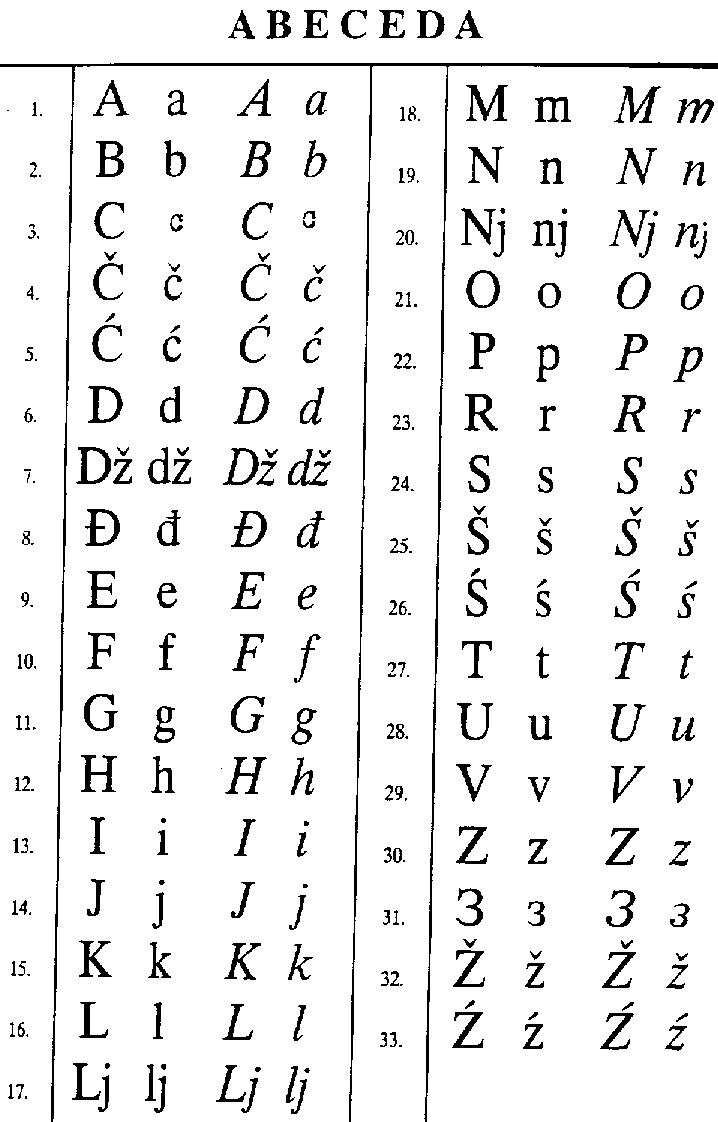
The first Montenegrin standard was officially proposed in July 2009. In addition to the Serbo-Croatian standard, the proposal introduced two additional letters, ⟨ś⟩ and ⟨ź⟩, to replace the digraphs
⟨sj⟩ and ⟨zj⟩. The Ministry of Education has accepted neither of the two drafts by the Council for the Standardization of the Montenegrin language, but adopted an alternate 3rd one, which wasn't a part of their work. The Council has criticized that this act, referring that it corresponds to "a small group" and that it contains an abundance of "methodological, conceptual and linguistic errors".
On 21 June 2010 the Council for General Education adopts the first Montenegrin Grammar.
In the previous census of 1991, the vast majority of Montenegrin citizens, 510,320 or 82.97%, declared themselves as speakers of the then official language: Serbo-Croatian
. The 1981 population census also recorded a Serbo-Croatian-speaking majority. However in the first Communist censuses, the vast majority of the population declared Serbian their native language. Such is also the case with the first recorded population census in Montenegro, in 1909, when approximately 95% of the population of the Principality of Montenegro
declared Serbian their native language. According to the Constitution of Montenegro
, the official language of the republic, since 1992, is Serbian of the Ijekavian standard
. After World War II
and until 1992, the official language of Montenegro was Serbo-Croat. Before that, in the previous old Montenegrin realm, Serbian was the language in usage. The Serbian language
was the officially used language in Communist Montenegro, until after the 1950 Novi Sad Agreement that defined the Serbo-Croat, and "Serbo-Croatian" introduced into the Constitution of the Socialist Republic of Montenegro in 1974. In the late nineties and early 21st century, organizations promoting Montenegrin as a distinct language appeared, and since 2004 the Democratic Party of Socialists of Montenegro
regime introduced the term to usage. The new constitution, adopted on 19 October 2007, deemed Montenegrin to be the official language of Montenegro.
The most recent population census
conducted in Montenegro was in 2011. According to it, 36.97% of the population declared Montenegrin their native language. The speakers' statistics is as follows:
In 2011, 42.88% of Montenegrin citizens declared "Serbian" their native language. The following is the speakers' statistics:
Mijat Šuković, a prominent Montenegrin lawyer, wrote a draft version of the constitution, which passed the parliament's constitutional committee. Šuković suggested Montenegrin
as the official language of Montenegro
. The Venice Commission
, an advisory body of the Council of Europe
, had a generally positive attitude towards the draft of the constitution, but did not address the language and church issues, calling them symbolical. The new constitution was ratified on 19 October 2007, declaring Montenegrin as the official language of Montenegro, as well as recognising Albanian, Bosnian, Croatian and Serbian.
The ruling Democratic Party of Socialists of Montenegro
and Socialdemocratic Party of Montenegro stand for nothing but plainly renaming the country's official language into Montenegrin, meeting opposition from the Socialist People's Party of Montenegro
, the People's Party
, the Democratic Serb Party, the Bosniak Party
, the Movement for Changes
as well as the Serb List
coalition led by the Serb People's Party. However, a referendum was not needed, as two-thirds majority of the parliament voted for the Constitution, including the ruling coalition, Movement for Changes
, the Bosniaks and the Liberals
, while the pro-Serbian parties voted against and the Albanian minority parties abstained from voting. The Constitution was thus ratified and adopted on 19 October 2007, recognizing Montenegrin as the official language of Montenegro.
According to the latest poll of 1,001 Montenegrin citizens conducted by Matica crnogorska
in mid 2010:
 Montenegrins speak Štokavian subdialects, some which are shared with other neighbouring Slavic nations:
(top row) over the Cyrillic
(bottom row). In both alphabets there are special characters.
provide examples of the local Montenegrin vernacular. The medieval literature was mostly written in Old Church Slavonic
and its recension
s, but most of the 19th century works were written in some of the dialects of Montenegro. They include the folk literature collected by Vuk Stefanović Karadžić
and other authors, as well as books of the writers from Montenegro, such as Petar Petrović Njegoš's Gorski vijenac (The Mountain Wreath
), Marko Miljanov
's Primjeri čojstva i junaštva (The Examples of Humanity and Bravery), etc. In the second half of the 19th century and later, the East Herzegovina
dialect, which served as a base for the standard Serbo-Croatian
language, was often used instead of the Zeta
-Sanjak
dialect, characteristical for most dialects of Montenegro. Petar Petrović Njegoš, one of the most respectable Montenegrin authors, changed many characteristics of the Zeta-Sanjak dialect from the manuscript of his Gorski vijenac to those proposed by Vuk Stefanović Karadžić as a standard for the Serbian language
.
For example, most of the accusatives of place, used in the Zeta-Sanjak dialect, were changed by Njegoš to locatives, used in the Serbian standard. Thus the stanzas "U dobro je lako dobar biti, / na muku se poznaju junaci" from the manuscript were changed to "U dobru je lako dobar biti, / na muci se poznaju junaci" in the printed version. Other works of later Montenegrin authors were also often modified to the East Herzegovinian forms, in order to follow the Serbian language literary norm. However, some characteristics of the traditional Montenegrin Zeta-Sanjak dialect sometimes used to appear as well. For example, the poem Onamo namo by Nikola I Petrović Njegoš, although it was written in East Herzegovinian Serbian standard, contains several Zeta-Sanjak forms: "Onamo namo, za brda ona" (accusative, instead of instrumental case
za brdima onim), and "Onamo namo, da viđu (instead of vidim) Prizren", and so on.
states that the "Montenegrin language does not mean a systemically separate language, but just one of four names (Montenegrin, Serbian, Croatian and Bosnian) by which Montenegrins name their part of [the] Shtokavian system, commonly inherited with Muslims
, Serbs and Croats". Introduction of the Montenegrin language has also been supported by other important academic institutions, such as the Matica crnogorska
, although meeting opposition from the Montenegrin Academy of Sciences and Arts
.
Some proponents go further. The chief proponent of Montenegrin is Zagreb
-educated dr Vojislav Nikčević
, professor at the Department of Language and Literature at the University of Montenegro
and the head of the Institute for Montenegrin Language in the capital Podgorica. His dictionaries and grammars were printed by Croatian publishers as the major Montenegrin publishing houses such as Obod in Cetinje
opted for the official nomenclature specified in the Constitution (Serbian until 1974, Serbo-Croatian to 1992, Serbian until 2007). Nikčević advocates amending of the Latin alphabet with three letters Ś, Ź, and З and corresponding Cyrillic letters Ć, З́ and Ѕ (representing IPA ç, ʝ and dz respectively).
Opponents acknowledge that these sounds can be heard by many Montenegrin speakers, however, they do not form a language system and so are allophone
s rather than phonemes. In addition, there are speakers in Montenegro who don't utter them and speakers of Serbian and Croatian outside of Montenegro (notably in Herzegovina and Bosanska Krajina) who do. In addition, introduction of those letters could pose significant technical difficulties (Eastern European code page ISO/IEC 8859-2 does not contain letter З, for example, and the corresponding letters were not proposed for Cyrillic).
Montenegro's former prime minister Milo Đukanović declared his open support for the formalization of the Montenegrin language by declaring himself as a speaker of the Montenegrin language, in an October 2004 interview with Belgrade daily Politika
. Official Montenegrin government communiqués are given in English and Montenegrin on the government's webpage. The official web page of the President of Montenegro states that it is provided in "Montenegrin–Serbian version" (Crnogorsko-srpska verzija).
In 2004, the government of Montenegro changed the school curriculum in such a way that name of the mandatory classes teaching the language was changed from "Serbian language" to "Mother tongue (Serbian, Montenegrin, Croatian, Bosnian)". This change was made, according to the government, in order to better reflect the diversity of languages spoken among citizens in the republic and to protect human rights of non-Serb citizens in Montenegro who declare themselves as speakers of other languages.
This decision resulted in a number of teachers declaring a strike
and parents refusing to send their children to schools. The cities affected by the strike included Nikšić
, Podgorica
, Berane
, Pljevlja
and Herceg Novi
.
Serbo-Croatian language
Serbo-Croatian or Serbo-Croat, less commonly Bosnian/Croatian/Serbian , is a South Slavic language with multiple standards and the primary language of Serbia, Croatia, Bosnia and Herzegovina, and Montenegro...
as spoken by Montenegrins; it also refers to an incipient standardized form of the Shtokavian dialect
Shtokavian dialect
Shtokavian or Štokavian is the prestige dialect of the Serbo-Croatian language, and the basis of its Bosnian, Croatian, Serbian, and Montenegrin standards...
of Serbo-Croatian used as the official language of Montenegro
Montenegro
Montenegro Montenegrin: Crna Gora Црна Гора , meaning "Black Mountain") is a country located in Southeastern Europe. It has a coast on the Adriatic Sea to the south-west and is bordered by Croatia to the west, Bosnia and Herzegovina to the northwest, Serbia to the northeast and Albania to the...
. The same subdialect of Shtokavian is also the basis of standard Croatian
Croatian language
Croatian is the collective name for the standard language and dialects spoken by Croats, principally in Croatia, Bosnia and Herzegovina, the Serbian province of Vojvodina and other neighbouring countries...
, Bosnian
Bosnian language
Bosnian is a South Slavic language, spoken by Bosniaks. As a standardized form of the Shtokavian dialect, it is one of the three official languages of Bosnia and Herzegovina....
, and Serbian
Serbian language
Serbian is a form of Serbo-Croatian, a South Slavic language, spoken by Serbs in Serbia, Bosnia and Herzegovina, Montenegro, Croatia and neighbouring countries....
, so all are mutually intelligible and are a single language by that criterion, despite being distinct national standards.
The idea of a Montenegrin standard language separate from Serbian
Serbian language
Serbian is a form of Serbo-Croatian, a South Slavic language, spoken by Serbs in Serbia, Bosnia and Herzegovina, Montenegro, Croatia and neighbouring countries....
appeared in 1990s, and gained traction in 2000s, by proponents of Montenegrin independence. Montenegrin became the official language
Official language
An official language is a language that is given a special legal status in a particular country, state, or other jurisdiction. Typically a nation's official language will be the one used in that nation's courts, parliament and administration. However, official status can also be used to give a...
of Montenegro with the ratification of a new constitution
Constitution of Montenegro
The current Constitution of Montenegro was ratified and adopted by the Constitutional Parliament of Montenegro on 19 October 2007 on an extraordinary session by achieving the required two-thirds supermajority of votes. The Constitution was officially proclaimed as the Constitution of Montenegro on...
on 22 October 2007. The Montenegrin standard is still emerging. Its orthography was established 10 July 2009, with the addition of two letters to the alphabet, though grammar and a school curriculum are yet to be approved.
Language standardization
In January 2008, the government of MontenegroGovernment of Montenegro
The Government of Montenegro is the executive branch of state authority in Montenegro. It is headed by the prime minister. It comprises the prime minister, the deputy prime ministers as well as ministers....
formed the Council for the Codification of the Montenegrin Language, which aims to standardize the Montenegrin language according to international norms. Proceeding documents will, after verification, become a part of the educational programme in Montenegrin schools.
The first Montenegrin standard was officially proposed in July 2009. In addition to the Serbo-Croatian standard, the proposal introduced two additional letters, ⟨ś⟩ and ⟨ź⟩, to replace the digraphs
Digraph (orthography)
A digraph or digram is a pair of characters used to write one phoneme or a sequence of phonemes that does not correspond to the normal values of the two characters combined...
⟨sj⟩ and ⟨zj⟩. The Ministry of Education has accepted neither of the two drafts by the Council for the Standardization of the Montenegrin language, but adopted an alternate 3rd one, which wasn't a part of their work. The Council has criticized that this act, referring that it corresponds to "a small group" and that it contains an abundance of "methodological, conceptual and linguistic errors".
On 21 June 2010 the Council for General Education adopts the first Montenegrin Grammar.
Official status and speakers' preference
The language remains an ongoing issue in Montenegro.In the previous census of 1991, the vast majority of Montenegrin citizens, 510,320 or 82.97%, declared themselves as speakers of the then official language: Serbo-Croatian
Serbo-Croatian
Serbo-Croatian or Serbo-Croat, less commonly Bosnian/Croatian/Serbian , is a South Slavic language with multiple standards and the primary language of Serbia, Croatia, Bosnia and Herzegovina, and Montenegro...
. The 1981 population census also recorded a Serbo-Croatian-speaking majority. However in the first Communist censuses, the vast majority of the population declared Serbian their native language. Such is also the case with the first recorded population census in Montenegro, in 1909, when approximately 95% of the population of the Principality of Montenegro
Principality of Montenegro
The Principality of Montenegro was a former realm in Southeastern Europe. It existed from 13 March 1852 to 28 August 1910. It was then proclaimed a kingdom by Knjaz Nikola, who then became king....
declared Serbian their native language. According to the Constitution of Montenegro
Constitution of Montenegro
The current Constitution of Montenegro was ratified and adopted by the Constitutional Parliament of Montenegro on 19 October 2007 on an extraordinary session by achieving the required two-thirds supermajority of votes. The Constitution was officially proclaimed as the Constitution of Montenegro on...
, the official language of the republic, since 1992, is Serbian of the Ijekavian standard
Serbian language
Serbian is a form of Serbo-Croatian, a South Slavic language, spoken by Serbs in Serbia, Bosnia and Herzegovina, Montenegro, Croatia and neighbouring countries....
. After World War II
World War II
World War II, or the Second World War , was a global conflict lasting from 1939 to 1945, involving most of the world's nations—including all of the great powers—eventually forming two opposing military alliances: the Allies and the Axis...
and until 1992, the official language of Montenegro was Serbo-Croat. Before that, in the previous old Montenegrin realm, Serbian was the language in usage. The Serbian language
Serbian language
Serbian is a form of Serbo-Croatian, a South Slavic language, spoken by Serbs in Serbia, Bosnia and Herzegovina, Montenegro, Croatia and neighbouring countries....
was the officially used language in Communist Montenegro, until after the 1950 Novi Sad Agreement that defined the Serbo-Croat, and "Serbo-Croatian" introduced into the Constitution of the Socialist Republic of Montenegro in 1974. In the late nineties and early 21st century, organizations promoting Montenegrin as a distinct language appeared, and since 2004 the Democratic Party of Socialists of Montenegro
Democratic Party of Socialists of Montenegro
The Democratic Party of Socialists of Montenegro is the ruling social-democratic political party in Montenegro....
regime introduced the term to usage. The new constitution, adopted on 19 October 2007, deemed Montenegrin to be the official language of Montenegro.
The most recent population census
Demographic History of Montenegro
This article presents the demographic history of Montenegro through census results and official documents which mention demographic composition...
conducted in Montenegro was in 2011. According to it, 36.97% of the population declared Montenegrin their native language. The speakers' statistics is as follows:
- 106,214 Montenegrins (77.98%)
- 13,627 Slavic MuslimsSlavic MuslimsSlavic Muslims are ethnic groups or sub-ethnic groups of Slavs who observe the Islamic faith, such as:* Bosniaks * Gorani * Pomaks * Torbeš See also: Muslims by nationality...
(10%) - 12,549 Bosniacs (9.21%)
- 1,375 CroatsCroatsCroats are a South Slavic ethnic group mostly living in Croatia, Bosnia and Herzegovina and nearby countries. There are around 4 million Croats living inside Croatia and up to 4.5 million throughout the rest of the world. Responding to political, social and economic pressure, many Croats have...
(1.02%) - 2,443 others (1.79%)
In 2011, 42.88% of Montenegrin citizens declared "Serbian" their native language. The following is the speakers' statistics:
- 197,684 SerbsSerbsThe Serbs are a South Slavic ethnic group of the Balkans and southern Central Europe. Serbs are located mainly in Serbia, Montenegro and Bosnia and Herzegovina, and form a sizable minority in Croatia, the Republic of Macedonia and Slovenia. Likewise, Serbs are an officially recognized minority in...
(50.21%) - 156,374 Montenegrins (39.72%)
- 8,696 Slavic MuslimsSlavic MuslimsSlavic Muslims are ethnic groups or sub-ethnic groups of Slavs who observe the Islamic faith, such as:* Bosniaks * Gorani * Pomaks * Torbeš See also: Muslims by nationality...
(2.21%) - 2,723 Bosniacs (0.69%)
- 2,529 CroatsCroatsCroats are a South Slavic ethnic group mostly living in Croatia, Bosnia and Herzegovina and nearby countries. There are around 4 million Croats living inside Croatia and up to 4.5 million throughout the rest of the world. Responding to political, social and economic pressure, many Croats have...
(0.64%) - 1,705 YugoslavsYugoslavsYugoslavs is a national designation used by a minority of South Slavs across the countries of the former Yugoslavia and in the diaspora...
(0.43%) - 24,029 others (6.1%)
Mijat Šuković, a prominent Montenegrin lawyer, wrote a draft version of the constitution, which passed the parliament's constitutional committee. Šuković suggested Montenegrin
Montenegrin
Montenegrin may refer to:* Something of, from, or related to Montenegro, a country located in the Balkans ** A member of the Montenegrins, people from Montenegro or of Montenegrin descent. For more information, see Demographics of Montenegro and Culture of Montenegro. For specific persons, see List...
as the official language of Montenegro
Montenegro
Montenegro Montenegrin: Crna Gora Црна Гора , meaning "Black Mountain") is a country located in Southeastern Europe. It has a coast on the Adriatic Sea to the south-west and is bordered by Croatia to the west, Bosnia and Herzegovina to the northwest, Serbia to the northeast and Albania to the...
. The Venice Commission
Venice Commission
The Venice Commission is an advisory body of the Council of Europe, composed of independent experts in the field of constitutional law. It was created in 1990 after the fall of the Berlin wall, at a time of urgent need for constitutional assistance in Central and Eastern Europe...
, an advisory body of the Council of Europe
Council of Europe
The Council of Europe is an international organisation promoting co-operation between all countries of Europe in the areas of legal standards, human rights, democratic development, the rule of law and cultural co-operation...
, had a generally positive attitude towards the draft of the constitution, but did not address the language and church issues, calling them symbolical. The new constitution was ratified on 19 October 2007, declaring Montenegrin as the official language of Montenegro, as well as recognising Albanian, Bosnian, Croatian and Serbian.
The ruling Democratic Party of Socialists of Montenegro
Democratic Party of Socialists of Montenegro
The Democratic Party of Socialists of Montenegro is the ruling social-democratic political party in Montenegro....
and Socialdemocratic Party of Montenegro stand for nothing but plainly renaming the country's official language into Montenegrin, meeting opposition from the Socialist People's Party of Montenegro
Socialist People's Party of Montenegro
The Socialist People's Party of Montenegro is a socialist opposition political party in Montenegro. It has 16 MPs in the Parliament of Montenegro, which it won on the 2009 parliamentary election...
, the People's Party
People's Party (Montenegro)
The People's Party is an opposition populist political party in Montenegro. It is the main conservative party in Montenegro, as opposed to ruling party and its main opposition, both of which are socialist orientated.At the last legislative elections in Montenegro, in March 2009, NS formed a...
, the Democratic Serb Party, the Bosniak Party
Bosniak Party of Montenegro
The Bosniak Party is a Bosniak minority political party in Montenegro....
, the Movement for Changes
Movement for Changes
Movement for Changes is a political party in Montenegro which has a proclaimed goal to integrate their country into the European Union and to support political and economic reforms to bring it into line with European norms...
as well as the Serb List
Serb List
Serb List was a political alliance in Montenegro. In contrast to other political coalitions, the Serb List was not simply a coalition of parties, but an entity on its own; for instance, the MPs elected on its list are not considered to represent the party they originally come from, but the Serb List...
coalition led by the Serb People's Party. However, a referendum was not needed, as two-thirds majority of the parliament voted for the Constitution, including the ruling coalition, Movement for Changes
Movement for Changes
Movement for Changes is a political party in Montenegro which has a proclaimed goal to integrate their country into the European Union and to support political and economic reforms to bring it into line with European norms...
, the Bosniaks and the Liberals
Liberal Party of Montenegro
The Liberal Party of Montenegro is a centre-left liberal political party in Montenegro. The party advocated liberalism and the bringing down of Milo Đukanović's rule, seeing it as authoritarian and undemocratic...
, while the pro-Serbian parties voted against and the Albanian minority parties abstained from voting. The Constitution was thus ratified and adopted on 19 October 2007, recognizing Montenegrin as the official language of Montenegro.
According to the latest poll of 1,001 Montenegrin citizens conducted by Matica crnogorska
Matica crnogorska
Matica crnogorska is a Montenegrin cultural institution. The name can be literally translated into English as the "Montenegrin queen bee," which is a metaphor meaning "the parent body of the Montenegrins."...
in mid 2010:
- 41.6% Serbian
- 38.2% Montenegrin
- 12.3% - Serbian, Montenegrin, Bosnian, Croatian and Serbo-Croatian are one and the same
- 4.4% Serbo-Croatian
- 1.9% Bosnian
- 1.7% Croatian
Linguistic considerations
- East Herzegovinian dialect (in the west and northwest)
- Zeta-South Sandžak dialect (spoken in the rest of the country).
Montenegrin alphabet
The proponents of the separate Montenegrin language tend to prefer using the Latin alphabetLatin alphabet
The Latin alphabet, also called the Roman alphabet, is the most recognized alphabet used in the world today. It evolved from a western variety of the Greek alphabet called the Cumaean alphabet, which was adopted and modified by the Etruscans who ruled early Rome...
(top row) over the Cyrillic
Cyrillic alphabet
The Cyrillic script or azbuka is an alphabetic writing system developed in the First Bulgarian Empire during the 10th century AD at the Preslav Literary School...
(bottom row). In both alphabets there are special characters.
- Abeceda: A B C Č Ć D Dž Đ E F G H I J K L Lj M N Nj O P R S Š Ś T U V Z З Ž Ź
- Azbuka: А Б В Г Д Ђ Е Ж З́ З Ѕ И Ј К Л Љ М Н Њ О П Р С Т Ћ У Ф Х Ц Ч Џ Ш Ć
Literature
Many literary works of authors from MontenegroMontenegro
Montenegro Montenegrin: Crna Gora Црна Гора , meaning "Black Mountain") is a country located in Southeastern Europe. It has a coast on the Adriatic Sea to the south-west and is bordered by Croatia to the west, Bosnia and Herzegovina to the northwest, Serbia to the northeast and Albania to the...
provide examples of the local Montenegrin vernacular. The medieval literature was mostly written in Old Church Slavonic
Old Church Slavonic
Old Church Slavonic or Old Church Slavic was the first literary Slavic language, first developed by the 9th century Byzantine Greek missionaries Saints Cyril and Methodius who were credited with standardizing the language and using it for translating the Bible and other Ancient Greek...
and its recension
Recension
Recension is the practice of editing or revising a text based on critical analysis. When referring to manuscripts, this may be a revision by another author...
s, but most of the 19th century works were written in some of the dialects of Montenegro. They include the folk literature collected by Vuk Stefanović Karadžić
Vuk Stefanovic Karadžic
Vuk Stefanović Karadžić was a Serbian philolog and linguist, the major reformer of the Serbian language, and deserves, perhaps, for his collections of songs, fairy tales, and riddles to be called the father of the study of Serbian folklore. He was the author of the first Serbian dictionary...
and other authors, as well as books of the writers from Montenegro, such as Petar Petrović Njegoš's Gorski vijenac (The Mountain Wreath
The Mountain Wreath
The Mountain Wreath is a poem and a play, a masterpiece of Montenegrin and Serbian literature, written by Montenegrin Prince-Bishop and poet Petar II Petrović-Njegoš.Njegoš wrote The Mountain Wreath during 1846 in Cetinje and published it the following year after the...
), Marko Miljanov
Marko Miljanov
Marko Miljanov Popović was a warrior and writer from Montenegro. He led the Kuči clan against the Turks in 1862 and distinguished himself in the War of 1876-78...
's Primjeri čojstva i junaštva (The Examples of Humanity and Bravery), etc. In the second half of the 19th century and later, the East Herzegovina
Herzegovina
Herzegovina is the southern region of Bosnia and Herzegovina. While there is no official border distinguishing it from the Bosnian region, it is generally accepted that the borders of the region are Croatia to the west, Montenegro to the south, the canton boundaries of the Herzegovina-Neretva...
dialect, which served as a base for the standard Serbo-Croatian
Serbo-Croatian
Serbo-Croatian or Serbo-Croat, less commonly Bosnian/Croatian/Serbian , is a South Slavic language with multiple standards and the primary language of Serbia, Croatia, Bosnia and Herzegovina, and Montenegro...
language, was often used instead of the Zeta
Zeta
-Science:* Zeta functions, in mathematics** Riemann zeta function* Zeta potential, the electrokinetic potential of a colloidal system* Tropical Storm Zeta , formed in December 2005 and lasting through January 2006* Z-pinch, in fusion power...
-Sanjak
Sanjak
Sanjaks were administrative divisions of the Ottoman Empire. Sanjak, and the variant spellings sandjak, sanjaq, and sinjaq, are English transliterations of the Turkish word sancak, meaning district, banner, or flag...
dialect, characteristical for most dialects of Montenegro. Petar Petrović Njegoš, one of the most respectable Montenegrin authors, changed many characteristics of the Zeta-Sanjak dialect from the manuscript of his Gorski vijenac to those proposed by Vuk Stefanović Karadžić as a standard for the Serbian language
Serbian language
Serbian is a form of Serbo-Croatian, a South Slavic language, spoken by Serbs in Serbia, Bosnia and Herzegovina, Montenegro, Croatia and neighbouring countries....
.
For example, most of the accusatives of place, used in the Zeta-Sanjak dialect, were changed by Njegoš to locatives, used in the Serbian standard. Thus the stanzas "U dobro je lako dobar biti, / na muku se poznaju junaci" from the manuscript were changed to "U dobru je lako dobar biti, / na muci se poznaju junaci" in the printed version. Other works of later Montenegrin authors were also often modified to the East Herzegovinian forms, in order to follow the Serbian language literary norm. However, some characteristics of the traditional Montenegrin Zeta-Sanjak dialect sometimes used to appear as well. For example, the poem Onamo namo by Nikola I Petrović Njegoš, although it was written in East Herzegovinian Serbian standard, contains several Zeta-Sanjak forms: "Onamo namo, za brda ona" (accusative, instead of instrumental case
Instrumental case
The instrumental case is a grammatical case used to indicate that a noun is the instrument or means by or with which the subject achieves or accomplishes an action...
za brdima onim), and "Onamo namo, da viđu (instead of vidim) Prizren", and so on.
Language politics
Most mainstream politicians and other proponents of the Montenegrin language state that the issue is chiefly one of self-determination and the people's right to call the language what they want, rather than an attempt to artificially create a new language when there is none. The Declaration of the Montenegrin PEN CenterMontenegrin PEN Center
The Montenegrin PEN Center is the national chapter of the International PEN in Montenegro. It was formed in 1990, as one-party Communist rule in what was then Yugoslavia was ending....
states that the "Montenegrin language does not mean a systemically separate language, but just one of four names (Montenegrin, Serbian, Croatian and Bosnian) by which Montenegrins name their part of [the] Shtokavian system, commonly inherited with Muslims
Bosniaks
The Bosniaks or Bosniacs are a South Slavic ethnic group, living mainly in Bosnia and Herzegovina, with a smaller minority also present in other lands of the Balkan Peninsula especially in Serbia, Montenegro and Croatia...
, Serbs and Croats". Introduction of the Montenegrin language has also been supported by other important academic institutions, such as the Matica crnogorska
Matica crnogorska
Matica crnogorska is a Montenegrin cultural institution. The name can be literally translated into English as the "Montenegrin queen bee," which is a metaphor meaning "the parent body of the Montenegrins."...
, although meeting opposition from the Montenegrin Academy of Sciences and Arts
Montenegrin Academy of Sciences and Arts
Montenegrin Academy of Sciences and Arts is the most important scientific institution of Montenegro....
.
Some proponents go further. The chief proponent of Montenegrin is Zagreb
Zagreb
Zagreb is the capital and the largest city of the Republic of Croatia. It is in the northwest of the country, along the Sava river, at the southern slopes of the Medvednica mountain. Zagreb lies at an elevation of approximately above sea level. According to the last official census, Zagreb's city...
-educated dr Vojislav Nikčević
Vojislav Nikcevic
Vojislav Nikčević was a Montenegrin linguist.He was born in Stubici, Nikšić, then part of the Kingdom of Yugoslavia, and was educated at the University of Zagreb in Zagreb, Croatia....
, professor at the Department of Language and Literature at the University of Montenegro
University of Montenegro
The University of Montenegro is a university located in Podgorica, Montenegro. It was founded in 1974 and is organized in 20 Faculties.-History:...
and the head of the Institute for Montenegrin Language in the capital Podgorica. His dictionaries and grammars were printed by Croatian publishers as the major Montenegrin publishing houses such as Obod in Cetinje
Cetinje
Cetinje , Цетиње / Cetinje , Italian: Cettigne, Greek: Κετίγνη, Ketígni) is a town and Old Royal Capital of Montenegro. It is also a historical and the secondary capital of Montenegro , with the official residence of the President of Montenegro...
opted for the official nomenclature specified in the Constitution (Serbian until 1974, Serbo-Croatian to 1992, Serbian until 2007). Nikčević advocates amending of the Latin alphabet with three letters Ś, Ź, and З and corresponding Cyrillic letters Ć, З́ and Ѕ (representing IPA ç, ʝ and dz respectively).
Opponents acknowledge that these sounds can be heard by many Montenegrin speakers, however, they do not form a language system and so are allophone
Allophone
In phonology, an allophone is one of a set of multiple possible spoken sounds used to pronounce a single phoneme. For example, and are allophones for the phoneme in the English language...
s rather than phonemes. In addition, there are speakers in Montenegro who don't utter them and speakers of Serbian and Croatian outside of Montenegro (notably in Herzegovina and Bosanska Krajina) who do. In addition, introduction of those letters could pose significant technical difficulties (Eastern European code page ISO/IEC 8859-2 does not contain letter З, for example, and the corresponding letters were not proposed for Cyrillic).
Montenegro's former prime minister Milo Đukanović declared his open support for the formalization of the Montenegrin language by declaring himself as a speaker of the Montenegrin language, in an October 2004 interview with Belgrade daily Politika
Politika
Politika is a Serbian newspaper. It is considered the newspaper of record and is the oldest daily in the Balkans, having been founded on January 25, 1904 by Vladislav Ribnikar. It is currently being published by Politika Newspapers and Magazines , a joint venture between Politika AD and...
. Official Montenegrin government communiqués are given in English and Montenegrin on the government's webpage. The official web page of the President of Montenegro states that it is provided in "Montenegrin–Serbian version" (Crnogorsko-srpska verzija).
In 2004, the government of Montenegro changed the school curriculum in such a way that name of the mandatory classes teaching the language was changed from "Serbian language" to "Mother tongue (Serbian, Montenegrin, Croatian, Bosnian)". This change was made, according to the government, in order to better reflect the diversity of languages spoken among citizens in the republic and to protect human rights of non-Serb citizens in Montenegro who declare themselves as speakers of other languages.
This decision resulted in a number of teachers declaring a strike
Strike action
Strike action, also called labour strike, on strike, greve , or simply strike, is a work stoppage caused by the mass refusal of employees to work. A strike usually takes place in response to employee grievances. Strikes became important during the industrial revolution, when mass labour became...
and parents refusing to send their children to schools. The cities affected by the strike included Nikšić
Nikšić
Nikšić is a city in Montenegro . In 2003 the city had a total population about 75,000.Nikšić is located in Nikšić plain, at the foot of Mount Trebjesa. It is the center of the municipality , which is the largest in Montenegro by area...
, Podgorica
Podgorica
Podgorica , is the capital and largest city of Montenegro.Podgorica's favourable position at the confluence of the Ribnica and Morača rivers and the meeting point of the fertile Zeta Plain and Bjelopavlići Valley has encouraged settlement...
, Berane
Berane
Berane , formerly Ivangrad, is a town in north-eastern Montenegro. It has a population of 11,776 .Berane is the centre of municipality and one of the centres of Polimlje area, named after the Lim River, on which Berane is situated.-History:During the medieval period the Montenegrin land of Berane...
, Pljevlja
Pljevlja
Pljevlja is a town and municipality located in the northern part of Montenegro. The city lies at an altitude of...
and Herceg Novi
Herceg Novi
Herceg Novi is a coastal town in Montenegro located at the entrance to the Bay of Kotor and at the foot of Mount Orjen. It is the administrative center of the Herceg Novi Municipality with around 33,000 inhabitants...
.
See also
- Dialect continuumDialect continuumA dialect continuum, or dialect area, was defined by Leonard Bloomfield as a range of dialects spoken across some geographical area that differ only slightly between neighboring areas, but as one travels in any direction, these differences accumulate such that speakers from opposite ends of the...
- Serbo-Croatian languageSerbo-Croatian languageSerbo-Croatian or Serbo-Croat, less commonly Bosnian/Croatian/Serbian , is a South Slavic language with multiple standards and the primary language of Serbia, Croatia, Bosnia and Herzegovina, and Montenegro...
- Differences in standard Serbian, Croatian and BosnianDifferences in standard Serbian, Croatian and BosnianStandard Bosnian, Croatian and Serbian are different national literary and official registers of the Serbo-Croatian language.- History :In socialist Yugoslavia, the official policy insisted on one language with two standard varieties – Eastern and Western Standard Bosnian, Croatian and Serbian are...
- Montenegrin alphabetMontenegrin alphabetThe Montenegrin alphabet is the collective name given to "Abeceda" and "Азбука" writing systems used to write the Montenegrin language. It was adopted on 9 June 2009 by the minister of education of Montenegro, Sreten Škuletić and replaced the Serbian Cyrillic and Croatian Latin alphabets...
- Montenegrins
External links
- "What Language Do Montenegrins Speak?", Aida Ramusovic, Transitions Online, 16 April 2003. "Govorite li crnogorski?", Violeta Arsenić, VremeVremeVreme is a weekly newsmagazine based in Belgrade, Serbia.After being prepared for seven months throughout 1990 by liberal Serbian intellectuals dissatisfied with the regime's control of the media, its first issue came out on October 29, 1990. Most of its original staff were journalists from...
, 4 March 2000. - Montenet.org: Language in Montenegro
- Standard Language as an Instrument of Culture and the Product of National History, Pavle Ivić
- Montenegrin language on Montenegrina
- "A Brief Note on the Effect of Montenegrin Independence on Language", from the British Government's Permanent Committee on Geographical Names (pdf) (2006)