

West Germanic languages

Encyclopedia
The West Germanic languages constitute the largest of the three traditional branches of the Germanic
family of language
s and include languages such as German
, English
, Dutch
, Afrikaans
, the Frisian languages, and Yiddish
. The other two of these three traditional branches of the Germanic languages are the North
and East Germanic languages
.
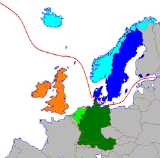
.png) The Germanic languages are traditionally divided into three groups: West, East and North Germanic. Their exact relation is difficult to determine from the sparse evidence of runic inscriptions, and they remained mutually intelligible throughout the Migration Period
The Germanic languages are traditionally divided into three groups: West, East and North Germanic. Their exact relation is difficult to determine from the sparse evidence of runic inscriptions, and they remained mutually intelligible throughout the Migration Period
, so that some individual varieties are difficult to classify. Dialects with the features assigned to the western group formed from Proto-Germanic in the late Jastorf culture
(ca. 1st century BC). The West Germanic group is characterized by a number of phonological
and morphological
innovations not found in North and East Germanic, such as:
Nevertheless, many scholars doubt whether the West Germanic languages descend from a common ancestor later than Proto-Germanic, that is, they doubt whether a "Proto-West-Germanic" ever existed. Rather, some have argued that after East Germanic broke off from the group, the remaining Germanic languages, the Northwest Germanic
languages, divided into four main dialects: North Germanic, and the three groups conventionally called "West Germanic", namely
Evidence for this view comes from a number of linguistic innovations found in both North Germanic and West Germanic, including:
Under this view, the properties that the West Germanic languages have in common separate from the North Germanic languages are not inherited from a "Proto-West-Germanic" language, but rather spread by language contact
among the Germanic languages spoken in central Europe, not reaching those spoken in Scandinavia or reaching them much later. Rhotacism, for example, was largely complete in West Germanic at a time when North Germanic runic inscriptions still clearly distinguished the two phonemes. There is also evidence that the lowering of ē to ā occurred first in West Germanic and spread to North Germanic later, since word-final ē was lowered before it was shortened in West Germanic, while in North Germanic the shortening occurred first, resulting in e that later merged with i.
Nevertheless, it has been argued that, judging by their nearly identical syntax, the West Germanic languages of the Old period were close enough to have been mutually intelligible.
, the West Germanic languages were separated by the insular development of Middle English
on one hand, and by the second Germanic sound shift on the continent on the other.
The High German consonant shift
distinguished the High German languages
from the other West Germanic languages. By early modern times, the span had extended into considerable differences, ranging from Highest Alemannic
in the South (the Walliser dialect being the southernmost surviving German dialect) to Northern Low Saxon
in the North. Although both extremes are considered German
, they are not mutually intelligible. The southernmost varieties have completed the second sound shift, while the northern dialects remained unaffected by the consonant shift.
Of modern German varieties, Low German
is the one that most resembles modern English. The district of Angeln
(or Anglia), from which the name English derives, is in the extreme northern part of Germany between the Danish border and the Baltic coast. The area of the Saxons (parts of today's Schleswig-Holstein
and Lower Saxony
) lay south of Anglia. The Anglo-Saxons
, two Germanic tribes, were a combination of a number of peoples from northern Germany
and the Jutland
Peninsula.
, with adjacent dialect
s being mutually intelligible and more separated ones not.
Germanic languages
The Germanic languages constitute a sub-branch of the Indo-European language family. The common ancestor of all of the languages in this branch is called Proto-Germanic , which was spoken in approximately the mid-1st millennium BC in Iron Age northern Europe...
family of language
Language
Language may refer either to the specifically human capacity for acquiring and using complex systems of communication, or to a specific instance of such a system of complex communication...
s and include languages such as German
German language
German is a West Germanic language, related to and classified alongside English and Dutch. With an estimated 90 – 98 million native speakers, German is one of the world's major languages and is the most widely-spoken first language in the European Union....
, English
English language
English is a West Germanic language that arose in the Anglo-Saxon kingdoms of England and spread into what was to become south-east Scotland under the influence of the Anglian medieval kingdom of Northumbria...
, Dutch
Dutch language
Dutch is a West Germanic language and the native language of the majority of the population of the Netherlands, Belgium, and Suriname, the three member states of the Dutch Language Union. Most speakers live in the European Union, where it is a first language for about 23 million and a second...
, Afrikaans
Afrikaans
Afrikaans is a West Germanic language, spoken natively in South Africa and Namibia. It is a daughter language of Dutch, originating in its 17th century dialects, collectively referred to as Cape Dutch .Afrikaans is a daughter language of Dutch; see , , , , , .Afrikaans was historically called Cape...
, the Frisian languages, and Yiddish
Yiddish language
Yiddish is a High German language of Ashkenazi Jewish origin, spoken throughout the world. It developed as a fusion of German dialects with Hebrew, Aramaic, Slavic languages and traces of Romance languages...
. The other two of these three traditional branches of the Germanic languages are the North
North Germanic languages
The North Germanic languages or Scandinavian languages, the languages of Scandinavians, make up one of the three branches of the Germanic languages, a sub-family of the Indo-European languages, along with the West Germanic languages and the extinct East Germanic languages...
and East Germanic languages
East Germanic languages
The East Germanic languages are a group of extinct Indo-European languages in the Germanic family. The only East Germanic language of which texts are known is Gothic; other languages that are assumed to be East Germanic include Vandalic, Burgundian, and Crimean Gothic...
.
Origins and characteristics
Migration Period
The Migration Period, also called the Barbarian Invasions , was a period of intensified human migration in Europe that occurred from c. 400 to 800 CE. This period marked the transition from Late Antiquity to the Early Middle Ages...
, so that some individual varieties are difficult to classify. Dialects with the features assigned to the western group formed from Proto-Germanic in the late Jastorf culture
Jastorf culture
The Jastorf culture is an Iron Age material culture in what is now north Germany, spanning the 6th to 1st centuries BC, forming the southern part of the Pre-Roman Iron Age. The culture evolved out of the Nordic Bronze Age, through influence from the Halstatt culture farther south...
(ca. 1st century BC). The West Germanic group is characterized by a number of phonological
Phonology
Phonology is, broadly speaking, the subdiscipline of linguistics concerned with the sounds of language. That is, it is the systematic use of sound to encode meaning in any spoken human language, or the field of linguistics studying this use...
and morphological
Morphology (linguistics)
In linguistics, morphology is the identification, analysis and description, in a language, of the structure of morphemes and other linguistic units, such as words, affixes, parts of speech, intonation/stress, or implied context...
innovations not found in North and East Germanic, such as:
- The delabialization of all labiovelar consonants except word-initially.
- GeminationGeminationIn phonetics, gemination happens when a spoken consonant is pronounced for an audibly longer period of time than a short consonant. Gemination is distinct from stress and may appear independently of it....
(lengthening) of all consonants except /r/ before /j/. - Replacement of the 2nd person singular preterit ending -t with -i.
- Loss of word-final /z/. Only Old High German preserves it at all (as /r/) and only in single-syllable words. Following the later loss of word-final /a/ and /aN/, this made the nominative and accusative of many nouns identical.
- The development of a gerundGerundIn linguistics* As applied to English, it refers to the usage of a verb as a noun ....
.
Nevertheless, many scholars doubt whether the West Germanic languages descend from a common ancestor later than Proto-Germanic, that is, they doubt whether a "Proto-West-Germanic" ever existed. Rather, some have argued that after East Germanic broke off from the group, the remaining Germanic languages, the Northwest Germanic
Northwest Germanic
Northwest Germanic is a proposed grouping of the Germanic dialects, representing the current consensus among Germanic historical linguists. It does not challenge the late 19th-century tri-partite division of the Germanic dialects into North Germanic, West Germanic and East Germanic, but proposes...
languages, divided into four main dialects: North Germanic, and the three groups conventionally called "West Germanic", namely
- North Sea Germanic (IngvaeonicIngvaeonicIngvaeonic , also known as North Sea Germanic, is a postulated grouping of the West Germanic languages that comprises Old Frisian, Old English and Old Saxon....
, ancestral to Anglo-Frisian and Low GermanLow GermanLow German or Low Saxon is an Ingvaeonic West Germanic language spoken mainly in northern Germany and the eastern part of the Netherlands...
) - Weser-Rhine Germanic (IstvaeonicLow Franconian languagesLow Franconian, Low Frankish, or Istvaeonic, is a group of several West Germanic languages spoken in the Netherlands, northern Belgium , in the northern department of France, in western Germany , as well as in Suriname, South Africa and Namibia that originally descended from Old Frankish.- The...
, ancestral to Low Franconian) - Elbe Germanic (IrminonicHigh German languagesThe High German languages or the High German dialects are any of the varieties of standard German, Luxembourgish and Yiddish, as well as the local German dialects spoken in central and southern Germany, Austria, Liechtenstein, Switzerland, Luxembourg and in neighboring portions of Belgium and the...
, ancestral to High German)
Evidence for this view comes from a number of linguistic innovations found in both North Germanic and West Germanic, including:
- The lowering of Proto-Germanic ē (/ɛː/, also written ) to ā.
- The development of umlautGermanic umlautIn linguistics, umlaut is a process whereby a vowel is pronounced more like a following vowel or semivowel. The term umlaut was originally coined and is used principally in connection with the study of the Germanic languages...
. - The rhotacismRhotacismRhotacism refers to several phenomena related to the usage of the consonant r :*the excessive or idiosyncratic use of the r;...
of /z/ to /r/. - The development of the demonstrativeDemonstrativeIn linguistics, demonstratives are deictic words that indicate which entities a speaker refers to and distinguishes those entities from others...
pronoun ancestral to English this.
Under this view, the properties that the West Germanic languages have in common separate from the North Germanic languages are not inherited from a "Proto-West-Germanic" language, but rather spread by language contact
Language contact
Language contact occurs when two or more languages or varieties interact. The study of language contact is called contact linguistics.Multilingualism has likely been common throughout much of human history, and today most people in the world are multilingual...
among the Germanic languages spoken in central Europe, not reaching those spoken in Scandinavia or reaching them much later. Rhotacism, for example, was largely complete in West Germanic at a time when North Germanic runic inscriptions still clearly distinguished the two phonemes. There is also evidence that the lowering of ē to ā occurred first in West Germanic and spread to North Germanic later, since word-final ē was lowered before it was shortened in West Germanic, while in North Germanic the shortening occurred first, resulting in e that later merged with i.
Nevertheless, it has been argued that, judging by their nearly identical syntax, the West Germanic languages of the Old period were close enough to have been mutually intelligible.
Middle Ages
During the Middle AgesMiddle Ages
The Middle Ages is a periodization of European history from the 5th century to the 15th century. The Middle Ages follows the fall of the Western Roman Empire in 476 and precedes the Early Modern Era. It is the middle period of a three-period division of Western history: Classic, Medieval and Modern...
, the West Germanic languages were separated by the insular development of Middle English
Middle English
Middle English is the stage in the history of the English language during the High and Late Middle Ages, or roughly during the four centuries between the late 11th and the late 15th century....
on one hand, and by the second Germanic sound shift on the continent on the other.
The High German consonant shift
High German consonant shift
In historical linguistics, the High German consonant shift or second Germanic consonant shift is a phonological development that took place in the southern parts of the West Germanic dialect continuum in several phases, probably beginning between the 3rd and 5th centuries AD, and was almost...
distinguished the High German languages
High German languages
The High German languages or the High German dialects are any of the varieties of standard German, Luxembourgish and Yiddish, as well as the local German dialects spoken in central and southern Germany, Austria, Liechtenstein, Switzerland, Luxembourg and in neighboring portions of Belgium and the...
from the other West Germanic languages. By early modern times, the span had extended into considerable differences, ranging from Highest Alemannic
Highest Alemannic German
Highest Alemannic is a branch of Alemannic German and is often considered to be part of the German language, even though mutual intelligibility with Standard German and other non-Alemannic German dialects is very limited....
in the South (the Walliser dialect being the southernmost surviving German dialect) to Northern Low Saxon
Northern Low Saxon
Northern Low Saxon is a West Low German dialect.As such, it covers a great part of the West Low-German-speaking areas of northern Germany, with the exception of the border regions where Eastphalian and Westphalian are spoken...
in the North. Although both extremes are considered German
German language
German is a West Germanic language, related to and classified alongside English and Dutch. With an estimated 90 – 98 million native speakers, German is one of the world's major languages and is the most widely-spoken first language in the European Union....
, they are not mutually intelligible. The southernmost varieties have completed the second sound shift, while the northern dialects remained unaffected by the consonant shift.
Of modern German varieties, Low German
Low German
Low German or Low Saxon is an Ingvaeonic West Germanic language spoken mainly in northern Germany and the eastern part of the Netherlands...
is the one that most resembles modern English. The district of Angeln
Angeln
Modern Angeln, also known as Anglia , is a small peninsula in Southern Schleswig in the northern Schleswig-Holstein, Germany, protruding into the Bay of Kiel...
(or Anglia), from which the name English derives, is in the extreme northern part of Germany between the Danish border and the Baltic coast. The area of the Saxons (parts of today's Schleswig-Holstein
Schleswig-Holstein
Schleswig-Holstein is the northernmost of the sixteen states of Germany, comprising most of the historical duchy of Holstein and the southern part of the former Duchy of Schleswig...
and Lower Saxony
Lower Saxony
Lower Saxony is a German state situated in north-western Germany and is second in area and fourth in population among the sixteen states of Germany...
) lay south of Anglia. The Anglo-Saxons
Anglo-Saxons
Anglo-Saxon is a term used by historians to designate the Germanic tribes who invaded and settled the south and east of Great Britain beginning in the early 5th century AD, and the period from their creation of the English nation to the Norman conquest. The Anglo-Saxon Era denotes the period of...
, two Germanic tribes, were a combination of a number of peoples from northern Germany
Germany
Germany , officially the Federal Republic of Germany , is a federal parliamentary republic in Europe. The country consists of 16 states while the capital and largest city is Berlin. Germany covers an area of 357,021 km2 and has a largely temperate seasonal climate...
and the Jutland
Jutland
Jutland , historically also called Cimbria, is the name of the peninsula that juts out in Northern Europe toward the rest of Scandinavia, forming the mainland part of Denmark. It has the North Sea to its west, Kattegat and Skagerrak to its north, the Baltic Sea to its east, and the Danish–German...
Peninsula.
Family tree
Note that divisions between subfamilies of Germanic are rarely precisely defined; most form dialect continuaDialect continuum
A dialect continuum, or dialect area, was defined by Leonard Bloomfield as a range of dialects spoken across some geographical area that differ only slightly between neighboring areas, but as one travels in any direction, these differences accumulate such that speakers from opposite ends of the...
, with adjacent dialect
Dialect
The term dialect is used in two distinct ways, even by linguists. One usage refers to a variety of a language that is a characteristic of a particular group of the language's speakers. The term is applied most often to regional speech patterns, but a dialect may also be defined by other factors,...
s being mutually intelligible and more separated ones not.
- Anglo-FrisianAnglo-Frisian languagesThe Anglo-Frisian languages form a group of West Germanic languages consisting of Old English, Old Frisian, and their descendants...
- Anglic
- EnglishEnglish languageEnglish is a West Germanic language that arose in the Anglo-Saxon kingdoms of England and spread into what was to become south-east Scotland under the influence of the Anglian medieval kingdom of Northumbria...
- ScotsScots languageScots is the Germanic language variety spoken in Lowland Scotland and parts of Ulster . It is sometimes called Lowland Scots to distinguish it from Scottish Gaelic, the Celtic language variety spoken in most of the western Highlands and in the Hebrides.Since there are no universally accepted...
- YolaYola languageYola is an extinct West Germanic language formerly spoken in Ireland. A branch of Middle English, it evolved separately among the English who followed the Norman barons Strongbow and Robert Fitzstephen to eastern Ireland in 1169....
(now extinct)
- English
- Frisian languages
- Anglic
- Low GermanLow GermanLow German or Low Saxon is an Ingvaeonic West Germanic language spoken mainly in northern Germany and the eastern part of the Netherlands...
- Northern Low SaxonNorthern Low SaxonNorthern Low Saxon is a West Low German dialect.As such, it covers a great part of the West Low-German-speaking areas of northern Germany, with the exception of the border regions where Eastphalian and Westphalian are spoken...
- Northern Low Saxon
- Low FranconianLow Franconian languagesLow Franconian, Low Frankish, or Istvaeonic, is a group of several West Germanic languages spoken in the Netherlands, northern Belgium , in the northern department of France, in western Germany , as well as in Suriname, South Africa and Namibia that originally descended from Old Frankish.- The...
- DutchDutch languageDutch is a West Germanic language and the native language of the majority of the population of the Netherlands, Belgium, and Suriname, the three member states of the Dutch Language Union. Most speakers live in the European Union, where it is a first language for about 23 million and a second...
- AfrikaansAfrikaansAfrikaans is a West Germanic language, spoken natively in South Africa and Namibia. It is a daughter language of Dutch, originating in its 17th century dialects, collectively referred to as Cape Dutch .Afrikaans is a daughter language of Dutch; see , , , , , .Afrikaans was historically called Cape...
(in South AfricaSouth AfricaThe Republic of South Africa is a country in southern Africa. Located at the southern tip of Africa, it is divided into nine provinces, with of coastline on the Atlantic and Indian oceans...
and NamibiaNamibiaNamibia, officially the Republic of Namibia , is a country in southern Africa whose western border is the Atlantic Ocean. It shares land borders with Angola and Zambia to the north, Botswana to the east and South Africa to the south and east. It gained independence from South Africa on 21 March...
)
- Afrikaans
- Dutch
- High GermanHigh German languagesThe High German languages or the High German dialects are any of the varieties of standard German, Luxembourgish and Yiddish, as well as the local German dialects spoken in central and southern Germany, Austria, Liechtenstein, Switzerland, Luxembourg and in neighboring portions of Belgium and the...
- AlemannicAlemannic GermanAlemannic is a group of dialects of the Upper German branch of the Germanic language family. It is spoken by approximately ten million people in six countries: Switzerland, Germany, Austria, Liechtenstein, France and Italy...
- Austro-BavarianAustro-BavarianBavarian , also Austro-Bavarian, is a major group of Upper German varieties spoken in the south east of the German language area.-History and origin:...
- GermanGerman languageGerman is a West Germanic language, related to and classified alongside English and Dutch. With an estimated 90 – 98 million native speakers, German is one of the world's major languages and is the most widely-spoken first language in the European Union....
- LuxembourgishLuxembourgish languageLuxembourgish is a High German language spoken mainly in Luxembourg. About 320,000 people worldwide speak Luxembourgish.-Language family:...
- YiddishYiddish languageYiddish is a High German language of Ashkenazi Jewish origin, spoken throughout the world. It developed as a fusion of German dialects with Hebrew, Aramaic, Slavic languages and traces of Romance languages...
- Vilamovian
- Alemannic
Comparison
The following table demonstrates the relation of modern West Germanic languages to each other, showing some closely related word-forms, as descended from the Proto-Germanic roots *se/*þe, *hwa, and *he, within the three main West Germanic languages (English, Dutch, and High German). (Note: the Proto-Germanic roots given here are simplifications of three sets of related roots that were similar in form, in that they either shared the same initial consonant sound or, in the case of *Se/*þe, alternated between two consonants.)| Description | | English | | Dutch | | German | ||||||||
|---|---|---|---|---|---|---|---|---|---|---|---|
| From *Se/*þe | From *Hwa | From *He | From *Se/*þe | From *Hwa | From *He | From *Se/*þe | From *Hwa | From *He | |||
| Nominative | Masc. | the | who | he | de | wie | hij, | der | wer | er | |
| Neuter | that | what | it | dat | wat | het | das | was | es | ||
| Fem. | she | (who) | ME Middle English Middle English is the stage in the history of the English language during the High and Late Middle Ages, or roughly during the four centuries between the late 11th and the late 15th century.... /Dial. West Midlands English West Midlands English is a group of dialects of the English language. The accent has experienced ridicule within the UK for its unusual sound. The accent is a result of extensive migration to the region during the Industrial revolution... hoo |
zij, ze | (wie) | sie, die | (wer) | ||||
| Plural | they | (who) | zij, ze | (wie) | sie, die | (wer) | |||||
| Demonstrative | this | dit, deze | dies- | ||||||||
| Adverbial/Nominal | so, thus | while | zo, dus | wijl | so | Weile | |||||
| Relative | such | which | each | zulk | welke | elk | solch- | welch- | MHG Middle High German Middle High German , abbreviated MHG , is the term used for the period in the history of the German language between 1050 and 1350. It is preceded by Old High German and followed by Early New High German... elch- |
||
| Dual | whether | weder | |||||||||
| Description | | English | | Dutch | | German | ||||||||
| Dative | Masc./Neuter | whom | him | wien (obsolete) | hem | dem | wem | ihm | |||
| Fem. | (whom) | her | (wie) | haar | der | (wem) | ihr | ||||
| Plural | them | (whom) | 'em | (wie) | hen/hun | den | (wem) | ihnen | |||
| Genitive | Masc./Neut. | whose | his | diens | wiens | des(sen) | wessen | ||||
| Fem./Plural | their | her | dier | wier | haar | der(en) | ihr- | ||||
| Locative | there | where | here | daar | waar | hier | da, dar- | wo, war- | hier | ||
| Allative | thither | whither | hither | der | wer(waarts) | her | hin | wohin | her | ||
| Ablative | thence | whence | hence | (van) daan | (von) dannen | woher | |||||
| Instrumental | why, how | hoe | wie | ||||||||
| Temporal/ Conjunctive | I | then | when | dan | wanneer | dann | wann | ||||
| II | than | (when) | (dan) | (wanneer) | denn | wenn | |||||
| Description | From *Se/*þe | From *Hwa | From *He | From *Se/*þe | From *Hwa | From *He | From *Se/*þe | From *Hwa | From *He | ||
| English | | Dutch | | German | |||||||||