


Americas

Encyclopedia
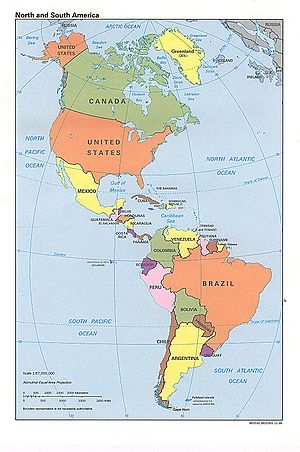
The Americas, or America , are lands in the Western hemisphere
, also known as the New World
. In English, the plural form the Americas is often used to refer to the landmass
es of North America
and South America
with their associated islands and region
s, while the singular form America is primarily used to refer to the United States of America
. The Americas cover 8.3% of the Earth's total surface area (28.4% of its land area) and contain about 13.5% of the human population
(about 900 million people).
. These people are believed to have followed herds of now-extinct pleistocene
megafauna
along ice-free corridors that stretched between the Laurentide
and Cordilleran
ice sheets. Another route proposed is that, either on foot or using primitive boats, they migrated down the Pacific Northwest
coast to South America
. Evidence of the latter would since have been covered by a sea level rise of hundreds of meters following the last ice age.
Archaeologists contend that Paleo-Indians migration out of Beringia (eastern Alaska
), ranges somewhere between 40,000 and 16,500 years ago. The few agreements achieved to date are the origin from Central Asia
, with widespread habitation of the Americas during the end of the last glacial period, or more specifically what is known as the late glacial maximum, around 16,000–13,000 years before present.
The Inuit
migrated into the Arctic
section of North America in another wave of migration, arriving around 1000 CE. Around the same time as the Inuit migrated into North America, Viking settlers
began arriving in Greenland
in 982 and Vinland
shortly thereafter, establishing a settlement at L'Anse aux Meadows
, near the northernmost tip of Newfoundland. The Viking settlers quickly abandoned Vinland, and disappeared from Greenland by 1500.
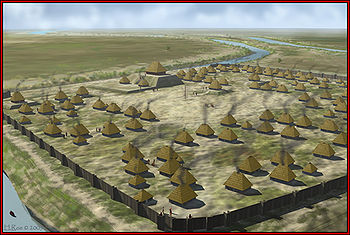 The pre-Columbian era
incorporates all period subdivisions
in the history and prehistory of the Americas
before the appearance of significant Europe
an influences on the American continents, spanning the time of the original settlement in the Upper Paleolithic
to European colonization
during the Early Modern period
.
Pre-Columbian is used especially often in the context of the great indigenous civilizations of the Americas, such as those of Mesoamerica
(the Olmec
, the Toltec
, the Teotihuacano, the Zapotec
, the Mixtec, the Aztec
, and the Maya
) and the Andes
(Inca, Moche
, Muisca
, Cañaris
).
Many pre-Columbian civilization
s established characteristics and hallmarks which included permanent or urban settlements, agriculture
, civic and monumental architecture, and complex societal hierarchies
. Some of these civilizations had long faded by the time of the first permanent European arrivals (c. late 15th–early 16th centuries), and are known only through archaeological
investigations. Others were contemporary with this period, and are also known from historical accounts of the time. A few, such as the Maya, had their own written records. However, most Europeans of the time viewed such texts as pagan, and much was destroyed in Christian pyres. Only a few hidden documents remain today, leaving modern historians with glimpses of ancient culture and knowledge.
According to both indigenous American and European accounts and documents, American civilizations at the time of European encounter possessed many impressive accomplishments. For instance, the Aztec
s built one of the most impressive cities in the world, Tenochtitlan, the ancient site of Mexico City
, with an estimated population of 200,000. American civilizations also displayed impressive accomplishments in astronomy and mathematics.
began shortly after the first voyages of Christopher Columbus
began in 1492. The first Spanish settlement on the continent was Panama City on the Pacific coast of Central America founded on August 5, 1519. Panama City
was the base for the Spanish conquering of South America. The spread of new diseases brought by Europeans and Africans killed many of the inhabitants of North America and South America, with a general population crash of Native Americans
occurring in the mid-16th century, often well ahead of European contact. Native peoples and European colonizers came into widespread conflict, resulting in what David Stannard
has called a genocide of the indigenous populations. Early European immigrants were often part of state-sponsored attempts to found colonies in the Americas. Migration continued as people moved to the Americas fleeing religious persecution
or seeking economic opportunities. Millions of individuals were forcibly transported to the Americas as slaves, prison
ers or indentured servant
s.
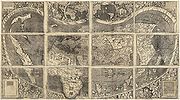 The earliest known use of the name America for this landmass dates from April 25, 1507, where it was used for what is now known as South America. It first appears on a small globe map with twelve time zones, together with the largest wall map made to date, both created by the German
cartographer Martin Waldseemüller
in Saint-Dié-des-Vosges
in France. These were the first maps to show the Americas as a land mass separate from Asia. An accompanying book, Cosmographiae Introductio
, anonymous but apparently written by Waldseemüller's collaborator Matthias Ringmann
, states, "I do not see what right any one would have to object to calling this part [that is, the South American mainland], after Americus who discovered it and who is a man of intelligence, Amerigen, that is, the Land of Americus, or America: since both Europa and Asia got their names from women". Americus Vespucius is the Latin
ized version of the Florentine
explorer Amerigo Vespucci
's name, and America is the feminine form of Americus. Amerigen is explained as Amerigo plus gen, the accusative case
of the Greek word for 'earth', and meaning 'land of Amerigo'. (See etymology.) Amerigo itself is an Italian
form of the medieval Latin Emericus (see also Saint Emeric of Hungary), which through the German
form Heinrich
(in English
, Henry
) derived from the Germanic
name Haimirich
.
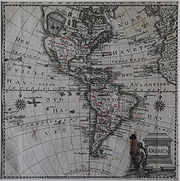
Vespucci was apparently unaware of the use of his name to refer to the new landmass, as Waldseemüller's maps did not reach Spain until a few years after his death. Ringmann may have been misled into crediting Vespucci by the widely published Soderini Letter, a sensationalized version of one of Vespucci's actual letters reporting on the mapping of the South American coast, which glamorized his discoveries and implied that he had recognized that South America was a continent separate from Asia; in fact, it is not known what Vespucci believed on this count, and he may have died believing what Columbus had, that they had reached the East Indies in Asia rather than a new continent. Spain officially refused to accept the name America for two centuries, saying that Columbus should get credit, and Waldseemüller's later maps, after he had ceased collaboration with Ringmann, did not include it; however, usage was established when Gerardus Mercator
applied the name to the entire New World in his 1538 world map. Acceptance may have been aided by the "natural poetic counterpart" that the name America made with Asia, Africa, and Europa.
Gondwanaland around 135 million years ago (Ma), forming its own continent. Starting around 15 Ma, the collision of the Caribbean Plate
and the Pacific Plate
resulted in the emergence of a series of volcanoes along the border that created a number of islands. The gaps in the archipelago of Central America
filled in with material eroded off North America and South America, plus new land created by continued volcanism. By 3 Ma, the continents of North America and South America were linked by the Isthmus of Panama
, thereby forming the single landmass of the Americas.
, which is the northernmost point of land on Earth. The southernmost point is the islands of Southern Thule
, although they are sometimes considered part of Antarctica. The easternmost point is Nordostrundingen
. The westernmost point is Attu Island
.
The mainland of the Americas is the longest north-to-south landmass on Earth. At its longest, it stretches roughly 14,000 kilometres, (just under 8700 miles) from the Boothia Peninsula
in northern Canada to Cape Froward in Chilean Patagonia
. The westernmost point of the mainland of the Americas is the end of the Seward Peninsula
in Alaska, while Ponta do Seixas in northeastern Brazil forms the mainland's easternmost extremity.
, with the Andes
running along the west coast of South America and the Rocky Mountains
and other North American Cordillera
ranges running along the western side of North America. The 2300 km long (1429 mile long) Appalachian Mountains
run along the east coast of North America from Alabama
to Newfoundland. North of the Appalachians, the Arctic Cordillera
runs along the eastern coast of Canada.
The ranges with the highest peaks are the Andes and Rocky Mountain ranges. While high peaks exists in the Sierra Nevada and Cascade Range
, on average there are not as many reaching a height greater than fourteen thousand feet. In North America, the largest amount of fourteeners occur in the United States and more specifically in the U.S. state of Colorado
. The highest peaks in the Americas are located in the Andes with Aconcagua
of Argentina
being the highest; in North America Denali in the U.S. state of Alaska
is the tallest.
Between its coastal mountain ranges, North America has vast flat areas. The Interior Plains
spread over much of the continent with low relief. The Canadian Shield
covers almost 5 million km² of North America and is generally quite flat. Similarly, the north-east of South America is covered by the flat Amazon Basin
. The Brazilian Highlands
on the east coast are fairly smooth but show some variations in landform, while further south the Gran Chaco
and Pampas are broad lowland
s.
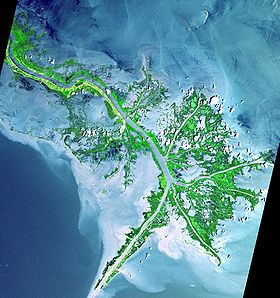
 With coastal mountains and interior plains, the Americas have several large river basins that drain the continents. The largest river basin in North America is that of the Mississippi
, covering the second largest watershed
on the planet. The Mississippi-Missouri river system drains most of 31 states of the U.S., most of the Great Plains
, and large areas between the Rocky and Appalachian mountains. This river is the fourth longest in the world and tenth most powerful in the world.
In North America, to the east of the Appalachian Mountains
, there are no major rivers but rather a series of rivers and streams that flow east with their terminus in the Atlantic Ocean
; these rivers included the Savannah River
. A similar instance arises with central Canadian rivers that drain into Hudson Bay
; the largest being the Churchill River
. On the west coast of North America, the main rivers are the Colorado River
, Columbia River
, Yukon River
, and Sacramento River
.
The Colorado River drains much of the Southern Rockies and parts of the Great Basin and Range Province. The river flows approximately 1450 miles (2,333.5 km) into the Gulf of California
, during which over time it has carved out natural phenomena such as the Grand Canyon
and created phenomena such as the Salton Sea
. The Columbia is a large river, 1243 miles (2,000.4 km) long, in central western North America and is the most powerful river on the West Coast of the Americas. In the far northwest of North America, the Yukon drains much of the Alaskan peninsula and flows 1980 miles (3,186.5 km) from parts of Yukon and the Northwest Territory to the Pacific. Draining to the Arctic Ocean
in North America, the Mackenzie River
drains waters from the great lakes of Canada. This river is the largest in Canada and drains 1805200 square kilometre.
The largest river basin in South America is that of the Amazon
, which has the highest volume flow of any river on Earth. The second largest watershed of South America is that of the Paraná River
, which covers about 2.5 million km².
, American Cloud forests, Florida
and Darien Gap
. In the Rocky Mountains
and Andes
, a similar climate is observed. Often the higher altitudes of these mountains are snow capped.
Southeastern North America is well known for its occurrence of tornadoes and hurricanes, of which the vast majority of tornadoes occur in the United States' Tornado Alley
. Often parts of the Caribbean are exposed to the violent effects of hurricanes. These weather systems are formed by the collision of dry, cool air from Canada and wet, warm air from the Atlantic.
In accordance with these definitions, the three largest population centers in the Americas are: Mexico City, anchor to the largest metropolitan area
in the Americas; New York City
, anchor to the largest urban area
in the Americas; and São Paulo
, the largest city proper
in the Americas. All three cities maintain Alpha classification and large scale influence.
- the Entertainment Capital of the World - lead the world in entertainment, while others such as New York City, Toronto, San Francisco, and Chicago serve as global financial centers and cities such as Houston are centers for aeronautics and health. Of the global cities in the Americas, the most powerful and highest ranked are located in Northern America
. GaWC ranked the top global cities in the Americas as:
, Japan
issued a comprehensive study of global cities in 2009. The ranking is based on six overall categories, "Economy", "Research & Development", "Cultural Interaction", "Livability", "Ecology & Natural Environment", and "Accessibility", with 69 individual indicators among them. This Japanese ranking also breaks down top ten world cities ranked in subjective categories such as "manager, researcher, artist, visitor and resident."
together with the Citibank
published a survey of world cities. The Wealth Report 2011, which includes the World City Survey, assesses four parameters — economic activity, political power, knowledge and influence and quality of life. The list aimed to rank the world's most influential cities. New York tops the list in Ecomomic activity, political power and knowledge and Paris tops it in quality of life.
s and their combinations.
The majority of the population live in Latin America
, named for its predominant cultures whose roots lie in Latin Europe
(including the two dominant languages, Spanish
and Portuguese
, both neolatin), more specifically in the Iberian
nations of Portugal
and Spain
(hence the use of the term Ibero-America
as a synonym). Latin America is typically contrasted with Anglo-America
(where English
, a Germanic language, is prevalent) which comprises Canada
(with the exception of francophone Canada
rooted in Latin Europe (France
): see Québec
and Acadia
) and the United States
. Both are located in North America and present predominantly Anglo-Saxon
and Germanic
roots.
Other faiths include Sikhism
; Buddhism
; Hinduism
; Bahá'í
; a wide variety of indigenous religions, many of which can be categorized as animistic; new age
religions and many African
and African-derived religions. Syncretic
faiths can also be found throughout the continent.
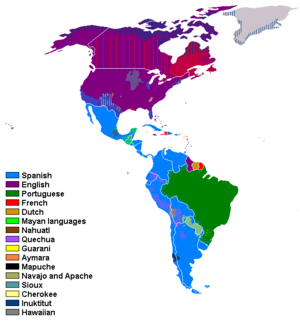 Various language
s are spoken in the Americas. Some are of European origin, others are spoken by indigenous peoples or are the mixture of various idioms like the different creoles.
The dominant language of Latin America
is Spanish
, though the largest nation in Latin America, Brazil
, speaks Portuguese
. Small enclaves of French-, Dutch- and English-speaking regions also exist in Latin America, notably in French Guiana
, Suriname
and Belize
respectively, and Haitian Creole
, of French origin, is dominant in the nation of Haiti
. Native languages
are more prominent in Latin America than in Anglo-America
, with Nahuatl, Quechua
, Aymara
and Guaraní
as the most common. Various other native languages are spoken with less frequency across both Anglo-America and Latin America. Creole language
s other than Haitian Creole are also spoken in parts of Latin America.
The dominant language of Anglo-America, as the name suggests, is English
. French
is also official in Canada
, where it is the predominant language in Québec
and an official language in New Brunswick
along with English. It is also an important language in the U.S. state
of Louisiana
, and in parts of New Hampshire
, Maine
, and Vermont
. Spanish
has kept an ongoing presence in the Southwestern United States
, which formed part of the Viceroyalty of New Spain, especially in California
and New Mexico
, where a distinct variety of Spanish
spoken since the 17th century has survived. It has more recently become widely spoken in other parts of the United States
due to heavy immigration from Latin America. High levels of immigration in general have brought great linguistic diversity to Anglo-America, with over 300 languages known to be spoken in the United States alone, but most languages are spoken only in small enclaves and by relatively small immigrant groups.
The nations of Guyana
, Suriname
, and Belize
are generally considered not to fall into either Anglo-America or Latin America due to lingual differences with Latin America, geographic differences with Anglo-America, and cultural and historical differences with both regions; English is the primary language of Guyana and Belize, and Dutch
is the official and written language of Suriname.
Most of the non-native languages have, to different degrees, evolved differently from the mother country, but are usually still mutually intelligible. Some have combined, however, which has even resulted in completely new languages, such as Papiamento
, which is a combination of Portuguese, Spanish, Dutch (representing the respective colonizers), native Arawak, various African languages
, and, more recently English. Portuñol
, a mixture of Portuguese and Spanish, is spoken in the border regions of Brazil and neighboring Spanish-speaking countries. More specifically, Riverense Portuñol
is spoken by around 100,000 people in the border regions of Brazil and Uruguay. Due to immigration, there are many communities where other languages are spoken from all parts of the world—especially in the United States, Brazil, Argentina and Canada, four very important destinations for immigrants— and half of the population of Uruguay is thought to be of Italian descent
.
remains fairly common; for example, for unofficial purposes the International Olympic Committee
considers "America" one of the five populated continents, as represented by the five rings on the Olympic flag.
People in the United States of America
generally refer to the landmass
es of North America
and South America
as (the) Americas (plural and generally with the definite article), to US citizens as Americans and the United States as America. Since the 19th century, this sense is primary in English, not without uncertainties. However, use of the term in this context may cause offense to people from Canada and Latin America and, thus, they avoid this usage and prefer constructed terms derived from United States or North America. In Canada, its southern neighbor is often referred to as "the United States", "the U.S.A.", or (informally) "the States," while citizens are generally referred to as Americans. English dictionaries and compendiums differ regarding usage and rendition.
."
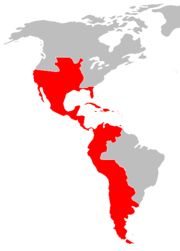 In Spanish, América is the name of a single continent composed of the subcontinent
s of Sudamérica and Norteamérica, the land bridge
of Centroamérica, and the islands of the Antillas
. Americano/a in Spanish refers to a person from América in a similar way that europeo or europea refers to a person from Europa. The terms sudamericano/a, centroamericano/a, antillano/a and norteamericano/a can be used to more specifically refer to the location where a person may live.
Citizens of the United States of America are normally referred to by the term estadounidense (rough literal translation: "United Statesian") instead of americano or americana, and the country's name itself is often translated as Estados Unidos de América (United States of America). Also, the term norteamericano (North American) may refer to a citizen of the United States. This term is primarily used to refer to citizens of the United States, rarely those of other North American countries.
América, however, is rarely used as synonym to the country, and almost never in print and in more formal environments, where the US is called either Estados Unidos da América (i.e. United States of America) or simply Estados Unidos (i.e. United States). There is some difference between the usage of these words in Portugal and in Brazil, with the Portuguese being more prone to apply the term América to the country.
The noun Amérique sometimes refers to the whole as one continent, and sometimes two continents, southern and northern; the United States is generally referred to as les États-Unis d'Amérique, les États-Unis, or les USA. In Québec
, the United States are sometimes called les États or even simply les states in daily informal conversation. However, the use of Amérique to refer to the United States does still have some currency in France.
The adjective américain is most often used for things relating to the United States; however, it may also be used for things relating to the American continents. Books by United States authors translated from English are often described as "traduit de l'américain".
Things relating to the United States can be referred to without ambiguity by the words états-unien, étasunien, or étatsunien, although this usage is rare.
Latin America is generally referred to as Latijns Amerika or, less frequently, Zuid-Amerika (South America).
The adjective Amerikaans is most often used for things or people relating to the United States. There are no alternative words to distinguish between things relating to the United States or to the Americas. Dutch uses the local alternative for things relating to elsewhere in the Americas, such as Argentijns for Argentine
, etc.
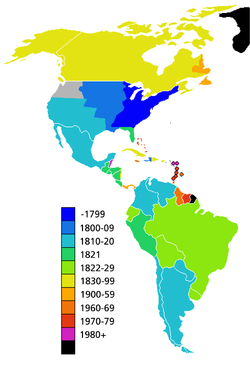
s in the Americas, 23 in North America and 12 in South America:
and other polities in the Americas that do not fall into the category "sovereign states". They are grouped under the states that control them.
Western Hemisphere
The Western Hemisphere or western hemisphere is mainly used as a geographical term for the half of the Earth that lies west of the Prime Meridian and east of the Antimeridian , the other half being called the Eastern Hemisphere.In this sense, the western hemisphere consists of the western portions...
, also known as the New World
New World
The New World is one of the names used for the Western Hemisphere, specifically America and sometimes Oceania . The term originated in the late 15th century, when America had been recently discovered by European explorers, expanding the geographical horizon of the people of the European middle...
. In English, the plural form the Americas is often used to refer to the landmass
Landmass
A landmass is a contiguous area of land surrounded by ocean. Although it may be most often written as one word to distinguish it from the usage "land mass"—the measure of land area—it is also used as two words.Landmasses include:*supercontinents...
es of North America
North America
North America is a continent wholly within the Northern Hemisphere and almost wholly within the Western Hemisphere. It is also considered a northern subcontinent of the Americas...
and South America
South America
South America is a continent situated in the Western Hemisphere, mostly in the Southern Hemisphere, with a relatively small portion in the Northern Hemisphere. The continent is also considered a subcontinent of the Americas. It is bordered on the west by the Pacific Ocean and on the north and east...
with their associated islands and region
Region
Region is most commonly found as a term used in terrestrial and astrophysics sciences also an area, notably among the different sub-disciplines of geography, studied by regional geographers. Regions consist of subregions that contain clusters of like areas that are distinctive by their uniformity...
s, while the singular form America is primarily used to refer to the United States of America
United States
The United States of America is a federal constitutional republic comprising fifty states and a federal district...
. The Americas cover 8.3% of the Earth's total surface area (28.4% of its land area) and contain about 13.5% of the human population
World population
The world population is the total number of living humans on the planet Earth. As of today, it is estimated to be billion by the United States Census Bureau...
(about 900 million people).
History
Settlement
The specifics of Paleo-Indian migration to and throughout the Americas, including the exact dates and routes traveled, are subject to ongoing research and discussion. The traditional theory has been that these early migrants moved into the Beringia land bridge between eastern Siberia and present-day Alaska around 40,000–17,000 years ago, when sea levels were significantly lowered due to the Quaternary glaciationQuaternary glaciation
Quaternary glaciation, also known as the Pleistocene glaciation, the current ice age or simply the ice age, refers to the period of the last few million years in which permanent ice sheets were established in Antarctica and perhaps Greenland, and fluctuating ice sheets have occurred elsewhere...
. These people are believed to have followed herds of now-extinct pleistocene
Pleistocene
The Pleistocene is the epoch from 2,588,000 to 11,700 years BP that spans the world's recent period of repeated glaciations. The name pleistocene is derived from the Greek and ....
megafauna
Megafauna
In terrestrial zoology, megafauna are "giant", "very large" or "large" animals. The most common thresholds used are or...
along ice-free corridors that stretched between the Laurentide
Laurentide ice sheet
The Laurentide Ice Sheet was a massive sheet of ice that covered hundreds of thousands of square miles, including most of Canada and a large portion of the northern United States, multiple times during Quaternary glacial epochs. It last covered most of northern North America between c. 95,000 and...
and Cordilleran
Cordilleran Ice Sheet
The Cordilleran ice sheet was a major ice sheet that covered, during glacial periods of the Quaternary, a large area of North America. This included the following areas:*Western Montana*The Idaho Panhandle...
ice sheets. Another route proposed is that, either on foot or using primitive boats, they migrated down the Pacific Northwest
Pacific Northwest
The Pacific Northwest is a region in northwestern North America, bounded by the Pacific Ocean to the west and, loosely, by the Rocky Mountains on the east. Definitions of the region vary and there is no commonly agreed upon boundary, even among Pacific Northwesterners. A common concept of the...
coast to South America
South America
South America is a continent situated in the Western Hemisphere, mostly in the Southern Hemisphere, with a relatively small portion in the Northern Hemisphere. The continent is also considered a subcontinent of the Americas. It is bordered on the west by the Pacific Ocean and on the north and east...
. Evidence of the latter would since have been covered by a sea level rise of hundreds of meters following the last ice age.
Archaeologists contend that Paleo-Indians migration out of Beringia (eastern Alaska
Geography of Alaska
Alaska is one of two U.S. states not bordered by another state; Hawaii the other. Alaska has more ocean coastline than all of the other U.S. states combined. About of Canadian territory separate Alaska from Washington State. Alaska is thus an exclave of the United States that is part of the...
), ranges somewhere between 40,000 and 16,500 years ago. The few agreements achieved to date are the origin from Central Asia
Central Asia
Central Asia is a core region of the Asian continent from the Caspian Sea in the west, China in the east, Afghanistan in the south, and Russia in the north...
, with widespread habitation of the Americas during the end of the last glacial period, or more specifically what is known as the late glacial maximum, around 16,000–13,000 years before present.
The Inuit
Inuit
The Inuit are a group of culturally similar indigenous peoples inhabiting the Arctic regions of Canada , Denmark , Russia and the United States . Inuit means “the people” in the Inuktitut language...
migrated into the Arctic
Arctic
The Arctic is a region located at the northern-most part of the Earth. The Arctic consists of the Arctic Ocean and parts of Canada, Russia, Greenland, the United States, Norway, Sweden, Finland, and Iceland. The Arctic region consists of a vast, ice-covered ocean, surrounded by treeless permafrost...
section of North America in another wave of migration, arriving around 1000 CE. Around the same time as the Inuit migrated into North America, Viking settlers
Norse colonization of the Americas
The Norse colonization of the Americas began as early as the 10th century, when Norse sailors explored and settled areas of the North Atlantic, including the northeastern fringes of North America....
began arriving in Greenland
Greenland
Greenland is an autonomous country within the Kingdom of Denmark, located between the Arctic and Atlantic Oceans, east of the Canadian Arctic Archipelago. Though physiographically a part of the continent of North America, Greenland has been politically and culturally associated with Europe for...
in 982 and Vinland
Vinland
Vinland was the name given to an area of North America by the Norsemen, about the year 1000 CE.There is a consensus among scholars that the Vikings reached North America approximately five centuries prior to the voyages of Christopher Columbus...
shortly thereafter, establishing a settlement at L'Anse aux Meadows
L'Anse aux Meadows
L'Anse aux Meadows is an archaeological site on the northernmost tip of the island of Newfoundland in the Canadian province of Newfoundland and Labrador. Discovered in 1960, it is the only known site of a Norse or Viking village in Canada, and in North America outside of Greenland...
, near the northernmost tip of Newfoundland. The Viking settlers quickly abandoned Vinland, and disappeared from Greenland by 1500.
Pre-Columbian era
Pre-Columbian era
The pre-Columbian era incorporates all period subdivisions in the history and prehistory of the Americas before the appearance of significant European influences on the American continents, spanning the time of the original settlement in the Upper Paleolithic period to European colonization during...
incorporates all period subdivisions
Archaeology of the Americas
The archaeology of the Americas is the study of the archaeology of North America , Central America, South America and the Caribbean...
in the history and prehistory of the Americas
History of the Americas
The history of the Americas is the collective history of the American landmass, which includes North and South America, as well as Central America and the Caribbean. It begins with people migrating to these areas from Asia during the height of an Ice Age...
before the appearance of significant Europe
Europe
Europe is, by convention, one of the world's seven continents. Comprising the westernmost peninsula of Eurasia, Europe is generally 'divided' from Asia to its east by the watershed divides of the Ural and Caucasus Mountains, the Ural River, the Caspian and Black Seas, and the waterways connecting...
an influences on the American continents, spanning the time of the original settlement in the Upper Paleolithic
Upper Paleolithic
The Upper Paleolithic is the third and last subdivision of the Paleolithic or Old Stone Age as it is understood in Europe, Africa and Asia. Very broadly it dates to between 40,000 and 10,000 years ago, roughly coinciding with the appearance of behavioral modernity and before the advent of...
to European colonization
European colonization of the Americas
The start of the European colonization of the Americas is typically dated to 1492. The first Europeans to reach the Americas were the Vikings during the 11th century, who established several colonies in Greenland and one short-lived settlement in present day Newfoundland...
during the Early Modern period
Early modern period
In history, the early modern period of modern history follows the late Middle Ages. Although the chronological limits of the period are open to debate, the timeframe spans the period after the late portion of the Middle Ages through the beginning of the Age of Revolutions...
.
Pre-Columbian is used especially often in the context of the great indigenous civilizations of the Americas, such as those of Mesoamerica
Mesoamerica
Mesoamerica is a region and culture area in the Americas, extending approximately from central Mexico to Belize, Guatemala, El Salvador, Honduras, Nicaragua, and Costa Rica, within which a number of pre-Columbian societies flourished before the Spanish colonization of the Americas in the 15th and...
(the Olmec
Olmec
The Olmec were the first major Pre-Columbian civilization in Mexico. They lived in the tropical lowlands of south-central Mexico, in the modern-day states of Veracruz and Tabasco....
, the Toltec
Toltec
The Toltec culture is an archaeological Mesoamerican culture that dominated a state centered in Tula, Hidalgo in the early post-classic period of Mesoamerican chronology...
, the Teotihuacano, the Zapotec
Zapotec civilization
The Zapotec civilization was an indigenous pre-Columbian civilization that flourished in the Valley of Oaxaca of southern Mesoamerica. Archaeological evidence shows their culture goes back at least 2500 years...
, the Mixtec, the Aztec
Aztec
The Aztec people were certain ethnic groups of central Mexico, particularly those groups who spoke the Nahuatl language and who dominated large parts of Mesoamerica in the 14th, 15th and 16th centuries, a period referred to as the late post-classic period in Mesoamerican chronology.Aztec is the...
, and the Maya
Maya civilization
The Maya is a Mesoamerican civilization, noted for the only known fully developed written language of the pre-Columbian Americas, as well as for its art, architecture, and mathematical and astronomical systems. Initially established during the Pre-Classic period The Maya is a Mesoamerican...
) and the Andes
Andes
The Andes is the world's longest continental mountain range. It is a continual range of highlands along the western coast of South America. This range is about long, about to wide , and of an average height of about .Along its length, the Andes is split into several ranges, which are separated...
(Inca, Moche
Moche
'The Moche civilization flourished in northern Peru from about 100 AD to 800 AD, during the Regional Development Epoch. While this issue is the subject of some debate, many scholars contend that the Moche were not politically organized as a monolithic empire or state...
, Muisca
Muisca
Muisca was the Chibcha-speaking tribe that formed the Muisca Confederation of the central highlands of present-day Colombia. They were encountered by the Spanish Empire in 1537, at the time of the conquest...
, Cañaris
Cañaris
The Cañari are an indigenous ethnic group traditionally inhabiting the territory of the modern provinces of Azuay and Cañar in Ecuador; the term also refers to an independent pre-Hispanic tribal confederation of the same name, from which the modern people are descended. They are particularly noted...
).
Many pre-Columbian civilization
Civilization
Civilization is a sometimes controversial term that has been used in several related ways. Primarily, the term has been used to refer to the material and instrumental side of human cultures that are complex in terms of technology, science, and division of labor. Such civilizations are generally...
s established characteristics and hallmarks which included permanent or urban settlements, agriculture
Agriculture
Agriculture is the cultivation of animals, plants, fungi and other life forms for food, fiber, and other products used to sustain life. Agriculture was the key implement in the rise of sedentary human civilization, whereby farming of domesticated species created food surpluses that nurtured the...
, civic and monumental architecture, and complex societal hierarchies
Complex society
In anthropology and archaeology, a complex society is a social formation that is otherwise described as a formative or developed state. The main criteria of complexity are:...
. Some of these civilizations had long faded by the time of the first permanent European arrivals (c. late 15th–early 16th centuries), and are known only through archaeological
Archaeology
Archaeology, or archeology , is the study of human society, primarily through the recovery and analysis of the material culture and environmental data that they have left behind, which includes artifacts, architecture, biofacts and cultural landscapes...
investigations. Others were contemporary with this period, and are also known from historical accounts of the time. A few, such as the Maya, had their own written records. However, most Europeans of the time viewed such texts as pagan, and much was destroyed in Christian pyres. Only a few hidden documents remain today, leaving modern historians with glimpses of ancient culture and knowledge.
According to both indigenous American and European accounts and documents, American civilizations at the time of European encounter possessed many impressive accomplishments. For instance, the Aztec
Aztec
The Aztec people were certain ethnic groups of central Mexico, particularly those groups who spoke the Nahuatl language and who dominated large parts of Mesoamerica in the 14th, 15th and 16th centuries, a period referred to as the late post-classic period in Mesoamerican chronology.Aztec is the...
s built one of the most impressive cities in the world, Tenochtitlan, the ancient site of Mexico City
Mexico City
Mexico City is the Federal District , capital of Mexico and seat of the federal powers of the Mexican Union. It is a federal entity within Mexico which is not part of any one of the 31 Mexican states but belongs to the federation as a whole...
, with an estimated population of 200,000. American civilizations also displayed impressive accomplishments in astronomy and mathematics.
European colonization of the Americas
Large-scale European colonization of the AmericasEuropean colonization of the Americas
The start of the European colonization of the Americas is typically dated to 1492. The first Europeans to reach the Americas were the Vikings during the 11th century, who established several colonies in Greenland and one short-lived settlement in present day Newfoundland...
began shortly after the first voyages of Christopher Columbus
Christopher Columbus
Christopher Columbus was an explorer, colonizer, and navigator, born in the Republic of Genoa, in northwestern Italy. Under the auspices of the Catholic Monarchs of Spain, he completed four voyages across the Atlantic Ocean that led to general European awareness of the American continents in the...
began in 1492. The first Spanish settlement on the continent was Panama City on the Pacific coast of Central America founded on August 5, 1519. Panama City
Panama City
Panama is the capital and largest city of the Republic of Panama. It has a population of 880,691, with a total metro population of 1,272,672, and it is located at the Pacific entrance of the Panama Canal, in the province of the same name. The city is the political and administrative center of the...
was the base for the Spanish conquering of South America. The spread of new diseases brought by Europeans and Africans killed many of the inhabitants of North America and South America, with a general population crash of Native Americans
Population history of American indigenous peoples
The population figures for Indigenous peoples in the Americas before the 1492 voyage of Christopher Columbus have proven difficult to establish and rely on archaeological data and written records from European settlers...
occurring in the mid-16th century, often well ahead of European contact. Native peoples and European colonizers came into widespread conflict, resulting in what David Stannard
David Stannard
David Edward Stannard is an American historian and Professor of American Studies at the University of Hawaii. He is particularly known for his book American Holocaust , on the genocide of the native American population.-Early life:He was born to Florence E. Harwood Stannard and David L. Stannard,...
has called a genocide of the indigenous populations. Early European immigrants were often part of state-sponsored attempts to found colonies in the Americas. Migration continued as people moved to the Americas fleeing religious persecution
Religious persecution
Religious persecution is the systematic mistreatment of an individual or group of individuals as a response to their religious beliefs or affiliations or lack thereof....
or seeking economic opportunities. Millions of individuals were forcibly transported to the Americas as slaves, prison
Prison
A prison is a place in which people are physically confined and, usually, deprived of a range of personal freedoms. Imprisonment or incarceration is a legal penalty that may be imposed by the state for the commission of a crime...
ers or indentured servant
Indentured servant
Indentured servitude refers to the historical practice of contracting to work for a fixed period of time, typically three to seven years, in exchange for transportation, food, clothing, lodging and other necessities during the term of indenture. Usually the father made the arrangements and signed...
s.
Etymology and naming
Germany
Germany , officially the Federal Republic of Germany , is a federal parliamentary republic in Europe. The country consists of 16 states while the capital and largest city is Berlin. Germany covers an area of 357,021 km2 and has a largely temperate seasonal climate...
cartographer Martin Waldseemüller
Martin Waldseemüller
Martin Waldseemüller was a German cartographer...
in Saint-Dié-des-Vosges
Saint-Dié-des-Vosges
Saint-Dié-des-Vosges, commonly referred to as Saint-Dié, is a commune in the Vosges department in Lorraine in northeastern France.It is a sub-prefecture of the department.-Geography:...
in France. These were the first maps to show the Americas as a land mass separate from Asia. An accompanying book, Cosmographiae Introductio
Cosmographiae Introductio
Cosmographiae Introductio was a book published in 1507 to accompany Martin Waldseemüller's printed globe and wall-map , which were the first appearance of the name 'America'...
, anonymous but apparently written by Waldseemüller's collaborator Matthias Ringmann
Matthias Ringmann
Matthias Ringmann was a German cartographer and humanist poet. He is credited with naming America on the map of his friend Martin Waldseemüller.- Life :...
, states, "I do not see what right any one would have to object to calling this part [that is, the South American mainland], after Americus who discovered it and who is a man of intelligence, Amerigen, that is, the Land of Americus, or America: since both Europa and Asia got their names from women". Americus Vespucius is the Latin
Latin
Latin is an Italic language originally spoken in Latium and Ancient Rome. It, along with most European languages, is a descendant of the ancient Proto-Indo-European language. Although it is considered a dead language, a number of scholars and members of the Christian clergy speak it fluently, and...
ized version of the Florentine
Florence
Florence is the capital city of the Italian region of Tuscany and of the province of Florence. It is the most populous city in Tuscany, with approximately 370,000 inhabitants, expanding to over 1.5 million in the metropolitan area....
explorer Amerigo Vespucci
Amerigo Vespucci
Amerigo Vespucci was an Italian explorer, financier, navigator and cartographer. The Americas are generally believed to have derived their name from the feminized Latin version of his first name.-Expeditions:...
's name, and America is the feminine form of Americus. Amerigen is explained as Amerigo plus gen, the accusative case
Accusative case
The accusative case of a noun is the grammatical case used to mark the direct object of a transitive verb. The same case is used in many languages for the objects of prepositions...
of the Greek word for 'earth', and meaning 'land of Amerigo'. (See etymology.) Amerigo itself is an Italian
Italian language
Italian is a Romance language spoken mainly in Europe: Italy, Switzerland, San Marino, Vatican City, by minorities in Malta, Monaco, Croatia, Slovenia, France, Libya, Eritrea, and Somalia, and by immigrant communities in the Americas and Australia...
form of the medieval Latin Emericus (see also Saint Emeric of Hungary), which through the German
German language
German is a West Germanic language, related to and classified alongside English and Dutch. With an estimated 90 – 98 million native speakers, German is one of the world's major languages and is the most widely-spoken first language in the European Union....
form Heinrich
Heinrich
Heinrich is a male given name or surname of Germanic origin. Equivalents in other languages are Henry , Hendrik , Hinnerk , Enrico , Henri , Enrique , Enric , and Henrique . A pet form of Heinrich is "Heinz". The once-common Americanized nickname "Heinie" is largely obsolete...
(in English
English language
English is a West Germanic language that arose in the Anglo-Saxon kingdoms of England and spread into what was to become south-east Scotland under the influence of the Anglian medieval kingdom of Northumbria...
, Henry
Henry (given name)
Henry is an English male given name and a surname, from the Old French Henry , derived itself from the Germanic name Haimric , which was derived from the word elements haim, meaning "home" and ric, meaning "power, ruler". Harry, its English short form, was considered the "spoken form" of Henry in...
) derived from the Germanic
Germanic languages
The Germanic languages constitute a sub-branch of the Indo-European language family. The common ancestor of all of the languages in this branch is called Proto-Germanic , which was spoken in approximately the mid-1st millennium BC in Iron Age northern Europe...
name Haimirich
Haimirich
Haimirich is an old Middle High German given name from which many modern names derive. Among them are names like Henry, Henri, Heinrich, Enrico, Enrique and their female counterparts...
.
Vespucci was apparently unaware of the use of his name to refer to the new landmass, as Waldseemüller's maps did not reach Spain until a few years after his death. Ringmann may have been misled into crediting Vespucci by the widely published Soderini Letter, a sensationalized version of one of Vespucci's actual letters reporting on the mapping of the South American coast, which glamorized his discoveries and implied that he had recognized that South America was a continent separate from Asia; in fact, it is not known what Vespucci believed on this count, and he may have died believing what Columbus had, that they had reached the East Indies in Asia rather than a new continent. Spain officially refused to accept the name America for two centuries, saying that Columbus should get credit, and Waldseemüller's later maps, after he had ceased collaboration with Ringmann, did not include it; however, usage was established when Gerardus Mercator
Gerardus Mercator
thumb|right|200px|Gerardus MercatorGerardus Mercator was a cartographer, born in Rupelmonde in the Hapsburg County of Flanders, part of the Holy Roman Empire. He is remembered for the Mercator projection world map, which is named after him...
applied the name to the entire New World in his 1538 world map. Acceptance may have been aided by the "natural poetic counterpart" that the name America made with Asia, Africa, and Europa.
Geology
South America broke off from the west of the supercontinentSupercontinent
In geology, a supercontinent is a landmass comprising more than one continental core, or craton. The assembly of cratons and accreted terranes that form Eurasia qualifies as a supercontinent today.-History:...
Gondwanaland around 135 million years ago (Ma), forming its own continent. Starting around 15 Ma, the collision of the Caribbean Plate
Caribbean Plate
The Caribbean Plate is a mostly oceanic tectonic plate underlying Central America and the Caribbean Sea off the north coast of South America....
and the Pacific Plate
Pacific Plate
The Pacific Plate is an oceanic tectonic plate that lies beneath the Pacific Ocean. At 103 million square kilometres, it is the largest tectonic plate....
resulted in the emergence of a series of volcanoes along the border that created a number of islands. The gaps in the archipelago of Central America
Central America
Central America is the central geographic region of the Americas. It is the southernmost, isthmian portion of the North American continent, which connects with South America on the southeast. When considered part of the unified continental model, it is considered a subcontinent...
filled in with material eroded off North America and South America, plus new land created by continued volcanism. By 3 Ma, the continents of North America and South America were linked by the Isthmus of Panama
Isthmus of Panama
The Isthmus of Panama, also historically known as the Isthmus of Darien, is the narrow strip of land that lies between the Caribbean Sea and the Pacific Ocean, linking North and South America. It contains the country of Panama and the Panama Canal...
, thereby forming the single landmass of the Americas.
Geography
The northernmost point of the Americas is Kaffeklubben IslandKaffeklubben Island
Kaffeklubben Island or The Coffee Club Island is a small island lying off the northern tip of Greenland. It is the northernmost point of land on Earth....
, which is the northernmost point of land on Earth. The southernmost point is the islands of Southern Thule
Southern Thule
Southern Thule is a collection of the three southernmost islands in the South Sandwich Islands: Bellingshausen, Cook, and Thule . Southern Thule is British territory, though claimed by Argentina. The island group is barren, windswept, bitterly cold, and uninhabited. It has an extenzive EEZ rich...
, although they are sometimes considered part of Antarctica. The easternmost point is Nordostrundingen
Nordostrundingen
Nordostrundingen , is a headland located at the northeastern end of the island of Greenland. At 11°19'W it is the most easterly point of land in both the Americas...
. The westernmost point is Attu Island
Attu Island
Attu is the westernmost and largest island in the Near Islands group of the Aleutian Islands of Alaska, making it the westernmost point of land relative to Alaska and the United States. It was the site of the only World War II land battle fought on the incorporated territory of the United States ,...
.
The mainland of the Americas is the longest north-to-south landmass on Earth. At its longest, it stretches roughly 14,000 kilometres, (just under 8700 miles) from the Boothia Peninsula
Boothia Peninsula
Boothia Peninsula is a large peninsula in Nunavut's northern Canadian Arctic, south of Somerset Island. The northern part, Murchison Promontory, is the northernmost point of mainland Canada, and thus North America....
in northern Canada to Cape Froward in Chilean Patagonia
Patagonia
Patagonia is a region located in Argentina and Chile, integrating the southernmost section of the Andes mountains to the southwest towards the Pacific ocean and from the east of the cordillera to the valleys it follows south through Colorado River towards Carmen de Patagones in the Atlantic Ocean...
. The westernmost point of the mainland of the Americas is the end of the Seward Peninsula
Seward Peninsula
The Seward Peninsula is a large peninsula on the western coast of the U.S. state of Alaska. It projects about into the Bering Sea between Norton Sound, the Bering Strait, the Chukchi Sea, and Kotzebue Sound, just below the Arctic Circle...
in Alaska, while Ponta do Seixas in northeastern Brazil forms the mainland's easternmost extremity.
Topography
The western geography of the Americas is dominated by the American cordilleraAmerican cordillera
The American Cordillera is a cordillera that consists of an essentially continuous sequence of mountain ranges that form the western "backbone" of North America, Central America, South America and Antarctica. From north to south, this sequence of overlapping and parallel ranges begins with the...
, with the Andes
Andes
The Andes is the world's longest continental mountain range. It is a continual range of highlands along the western coast of South America. This range is about long, about to wide , and of an average height of about .Along its length, the Andes is split into several ranges, which are separated...
running along the west coast of South America and the Rocky Mountains
Rocky Mountains
The Rocky Mountains are a major mountain range in western North America. The Rocky Mountains stretch more than from the northernmost part of British Columbia, in western Canada, to New Mexico, in the southwestern United States...
and other North American Cordillera
North American Cordillera
The North American Cordillera is the North American portion of the American Cordillera which is a cordillera extending up and down the western side of the Americas. The North American Cordillera covers an extensive area of mountain ranges, intermontane basins, and plateaus in western North...
ranges running along the western side of North America. The 2300 km long (1429 mile long) Appalachian Mountains
Appalachian Mountains
The Appalachian Mountains #Whether the stressed vowel is or ,#Whether the "ch" is pronounced as a fricative or an affricate , and#Whether the final vowel is the monophthong or the diphthong .), often called the Appalachians, are a system of mountains in eastern North America. The Appalachians...
run along the east coast of North America from Alabama
Alabama
Alabama is a state located in the southeastern region of the United States. It is bordered by Tennessee to the north, Georgia to the east, Florida and the Gulf of Mexico to the south, and Mississippi to the west. Alabama ranks 30th in total land area and ranks second in the size of its inland...
to Newfoundland. North of the Appalachians, the Arctic Cordillera
Arctic Cordillera
The Arctic Cordillera is a vast, deeply dissected chain of mountain ranges extending along the northeastern flank of the Canadian Arctic Archipelago from Ellesmere Island to the northeasternmost part of the Labrador Peninsula in northern Labrador and northern Quebec, Canada...
runs along the eastern coast of Canada.
The ranges with the highest peaks are the Andes and Rocky Mountain ranges. While high peaks exists in the Sierra Nevada and Cascade Range
Cascade Range
The Cascade Range is a major mountain range of western North America, extending from southern British Columbia through Washington and Oregon to Northern California. It includes both non-volcanic mountains, such as the North Cascades, and the notable volcanoes known as the High Cascades...
, on average there are not as many reaching a height greater than fourteen thousand feet. In North America, the largest amount of fourteeners occur in the United States and more specifically in the U.S. state of Colorado
Colorado
Colorado is a U.S. state that encompasses much of the Rocky Mountains as well as the northeastern portion of the Colorado Plateau and the western edge of the Great Plains...
. The highest peaks in the Americas are located in the Andes with Aconcagua
Aconcagua
Aconcagua is the highest mountain in the Americas at . It is located in the Andes mountain range, in the Argentine province of Mendoza and it lies west by north of its capital, the city of Mendoza. The summit is also located about 5 kilometres from San Juan Province and 15 kilometres from the...
of Argentina
Argentina
Argentina , officially the Argentine Republic , is the second largest country in South America by land area, after Brazil. It is constituted as a federation of 23 provinces and an autonomous city, Buenos Aires...
being the highest; in North America Denali in the U.S. state of Alaska
Alaska
Alaska is the largest state in the United States by area. It is situated in the northwest extremity of the North American continent, with Canada to the east, the Arctic Ocean to the north, and the Pacific Ocean to the west and south, with Russia further west across the Bering Strait...
is the tallest.
Between its coastal mountain ranges, North America has vast flat areas. The Interior Plains
Interior Plains
The Interior Plains is a vast physiographic region that spreads across the Laurentian craton of central North America.-Geography:The Interior Plains are an extensive physiographic division encompassing 8 distinct physiographic provinces, the Interior Low Plateaus, Great Plains, Central Lowland,...
spread over much of the continent with low relief. The Canadian Shield
Canadian Shield
The Canadian Shield, also called the Laurentian Plateau, or Bouclier Canadien , is a vast geological shield covered by a thin layer of soil that forms the nucleus of the North American or Laurentia craton. It is an area mostly composed of igneous rock which relates to its long volcanic history...
covers almost 5 million km² of North America and is generally quite flat. Similarly, the north-east of South America is covered by the flat Amazon Basin
Amazon Basin
The Amazon Basin is the part of South America drained by the Amazon River and its tributaries that drains an area of about , or roughly 40 percent of South America. The basin is located in the countries of Bolivia, Brazil, Colombia, Ecuador, Guyana, Peru, and Venezuela...
. The Brazilian Highlands
Brazilian Highlands
The Brazilian Highlands or Brazilian Plateau are an extensive geographical region, covering most of the eastern, southern and central portions of Brazil, in all approximately half of the country's land area, or some 4,500,000 km²...
on the east coast are fairly smooth but show some variations in landform, while further south the Gran Chaco
Gran Chaco
The Gran Chaco is a sparsely populated, hot and semi-arid lowland region of the Río de la Plata basin, divided among eastern Bolivia, Paraguay, northern Argentina and a portion of the Brazilian states of Mato Grosso and Mato Grosso do Sul, where it is connected with the Pantanal region...
and Pampas are broad lowland
Lowland
In physical geography, a lowland is any broad expanse of land with a general low level. The term is thus applied to the landward portion of the upward slope from oceanic depths to continental highlands, to a region of depression in the interior of a mountainous region, to a plain of denudation, or...
s.
Hydrology
Mississippi River
The Mississippi River is the largest river system in North America. Flowing entirely in the United States, this river rises in western Minnesota and meanders slowly southwards for to the Mississippi River Delta at the Gulf of Mexico. With its many tributaries, the Mississippi's watershed drains...
, covering the second largest watershed
Drainage basin
A drainage basin is an extent or an area of land where surface water from rain and melting snow or ice converges to a single point, usually the exit of the basin, where the waters join another waterbody, such as a river, lake, reservoir, estuary, wetland, sea, or ocean...
on the planet. The Mississippi-Missouri river system drains most of 31 states of the U.S., most of the Great Plains
Great Plains
The Great Plains are a broad expanse of flat land, much of it covered in prairie, steppe and grassland, which lies west of the Mississippi River and east of the Rocky Mountains in the United States and Canada. This area covers parts of the U.S...
, and large areas between the Rocky and Appalachian mountains. This river is the fourth longest in the world and tenth most powerful in the world.
In North America, to the east of the Appalachian Mountains
Appalachian Mountains
The Appalachian Mountains #Whether the stressed vowel is or ,#Whether the "ch" is pronounced as a fricative or an affricate , and#Whether the final vowel is the monophthong or the diphthong .), often called the Appalachians, are a system of mountains in eastern North America. The Appalachians...
, there are no major rivers but rather a series of rivers and streams that flow east with their terminus in the Atlantic Ocean
Atlantic Ocean
The Atlantic Ocean is the second-largest of the world's oceanic divisions. With a total area of about , it covers approximately 20% of the Earth's surface and about 26% of its water surface area...
; these rivers included the Savannah River
Savannah River
The Savannah River is a major river in the southeastern United States, forming most of the border between the states of South Carolina and Georgia. Two tributaries of the Savannah, the Tugaloo River and the Chattooga River, form the northernmost part of the border...
. A similar instance arises with central Canadian rivers that drain into Hudson Bay
Hudson Bay
Hudson Bay , sometimes called Hudson's Bay, is a large body of saltwater in northeastern Canada. It drains a very large area, about , that includes parts of Ontario, Quebec, Saskatchewan, Alberta, most of Manitoba, southeastern Nunavut, as well as parts of North Dakota, South Dakota, Minnesota,...
; the largest being the Churchill River
Churchill River (Hudson Bay)
The Churchill River is a major river in Alberta, Saskatchewan and Manitoba, Canada. From the head of the Churchill Lake it is 1,609 km long. It was named after John Churchill, 1st Duke of Marlborough and governor of the Hudson's Bay Company from 1685 to 1691...
. On the west coast of North America, the main rivers are the Colorado River
Colorado River
The Colorado River , is a river in the Southwestern United States and northwestern Mexico, approximately long, draining a part of the arid regions on the western slope of the Rocky Mountains. The watershed of the Colorado River covers in parts of seven U.S. states and two Mexican states...
, Columbia River
Columbia River
The Columbia River is the largest river in the Pacific Northwest region of North America. The river rises in the Rocky Mountains of British Columbia, Canada, flows northwest and then south into the U.S. state of Washington, then turns west to form most of the border between Washington and the state...
, Yukon River
Yukon River
The Yukon River is a major watercourse of northwestern North America. The source of the river is located in British Columbia, Canada. The next portion lies in, and gives its name to Yukon Territory. The lower half of the river lies in the U.S. state of Alaska. The river is long and empties into...
, and Sacramento River
Sacramento River
The Sacramento River is an important watercourse of Northern and Central California in the United States. The largest river in California, it rises on the eastern slopes of the Klamath Mountains, and after a journey south of over , empties into Suisun Bay, an arm of the San Francisco Bay, and...
.
The Colorado River drains much of the Southern Rockies and parts of the Great Basin and Range Province. The river flows approximately 1450 miles (2,333.5 km) into the Gulf of California
Gulf of California
The Gulf of California is a body of water that separates the Baja California Peninsula from the Mexican mainland...
, during which over time it has carved out natural phenomena such as the Grand Canyon
Grand Canyon
The Grand Canyon is a steep-sided canyon carved by the Colorado River in the United States in the state of Arizona. It is largely contained within the Grand Canyon National Park, the 15th national park in the United States...
and created phenomena such as the Salton Sea
Salton Sea
The Salton Sea is a shallow, saline, endorheic rift lake located directly on the San Andreas Fault, predominantly in California's Imperial Valley. The lake occupies the lowest elevations of the Salton Sink in the Colorado Desert of Imperial and Riverside counties in Southern California. Like Death...
. The Columbia is a large river, 1243 miles (2,000.4 km) long, in central western North America and is the most powerful river on the West Coast of the Americas. In the far northwest of North America, the Yukon drains much of the Alaskan peninsula and flows 1980 miles (3,186.5 km) from parts of Yukon and the Northwest Territory to the Pacific. Draining to the Arctic Ocean
Arctic Ocean
The Arctic Ocean, located in the Northern Hemisphere and mostly in the Arctic north polar region, is the smallest and shallowest of the world's five major oceanic divisions...
in North America, the Mackenzie River
Mackenzie River
The Mackenzie River is the largest river system in Canada. It flows through a vast, isolated region of forest and tundra entirely within the country's Northwest Territories, although its many tributaries reach into four other Canadian provinces and territories...
drains waters from the great lakes of Canada. This river is the largest in Canada and drains 1805200 square kilometre.
The largest river basin in South America is that of the Amazon
Amazon Basin
The Amazon Basin is the part of South America drained by the Amazon River and its tributaries that drains an area of about , or roughly 40 percent of South America. The basin is located in the countries of Bolivia, Brazil, Colombia, Ecuador, Guyana, Peru, and Venezuela...
, which has the highest volume flow of any river on Earth. The second largest watershed of South America is that of the Paraná River
Paraná River
The Paraná River is a river in south Central South America, running through Brazil, Paraguay and Argentina for some . It is second in length only to the Amazon River among South American rivers. The name Paraná is an abbreviation of the phrase "para rehe onáva", which comes from the Tupi language...
, which covers about 2.5 million km².
Climate
The climate of the Americas varies significantly from region to region. Tropical rainforest climate occurs in the latitudes of the AmazonAmazon Rainforest
The Amazon Rainforest , also known in English as Amazonia or the Amazon Jungle, is a moist broadleaf forest that covers most of the Amazon Basin of South America...
, American Cloud forests, Florida
Florida
Florida is a state in the southeastern United States, located on the nation's Atlantic and Gulf coasts. It is bordered to the west by the Gulf of Mexico, to the north by Alabama and Georgia and to the east by the Atlantic Ocean. With a population of 18,801,310 as measured by the 2010 census, it...
and Darien Gap
Darién Gap
The Darién Gap is a large swath of undeveloped swampland and forest separating Panama's Darién Province in Central America from Colombia in South America. It measures just over long and about wide. Roadbuilding through this area is expensive, and the environmental toll is steep. Political...
. In the Rocky Mountains
Rocky Mountains
The Rocky Mountains are a major mountain range in western North America. The Rocky Mountains stretch more than from the northernmost part of British Columbia, in western Canada, to New Mexico, in the southwestern United States...
and Andes
Andes
The Andes is the world's longest continental mountain range. It is a continual range of highlands along the western coast of South America. This range is about long, about to wide , and of an average height of about .Along its length, the Andes is split into several ranges, which are separated...
, a similar climate is observed. Often the higher altitudes of these mountains are snow capped.
Southeastern North America is well known for its occurrence of tornadoes and hurricanes, of which the vast majority of tornadoes occur in the United States' Tornado Alley
Tornado Alley
Tornado Alley is a colloquial and popular media term that most often refers to the area of the United States where tornadoes are most frequent. Although an official location is not defined, the area between the Rocky Mountains and Appalachian Mountains is usually associated with it.The areas...
. Often parts of the Caribbean are exposed to the violent effects of hurricanes. These weather systems are formed by the collision of dry, cool air from Canada and wet, warm air from the Atlantic.
Population
The total population of the Americas is about 859,000,000 people and is divided as follows:- North America: 2001 with 495 million and in 2002 with 501 million (includes Central AmericaCentral AmericaCentral America is the central geographic region of the Americas. It is the southernmost, isthmian portion of the North American continent, which connects with South America on the southeast. When considered part of the unified continental model, it is considered a subcontinent...
and the CaribbeanCaribbeanThe Caribbean is a crescent-shaped group of islands more than 2,000 miles long separating the Gulf of Mexico and the Caribbean Sea, to the west and south, from the Atlantic Ocean, to the east and north...
) - South America: 2001 with 352 million and in 2002 with 357 million
Largest urban centers
There are three urban centers that each hold titles for being the largest population area based on the three main demographic concepts:- The locality with legally fixed boundaries and an administratively recognized urban status that is usually characterized by some form of local government.
- Unlike an urban area, a metropolitan area includes not only the urban area, but also satellite cities plus intervening rural land that is socio-economically connected to the urban core city, typically by employment ties through commuting, with the urban core city being the primary labor market.
- An urban area is characterized by higher population density and vast human features in comparison to areas surrounding it. Urban areas may be cities, towns or conurbations, but the term is not commonly extended to rural settlements such as villages and hamlets. Urban areas are created and further developed by the process of urbanizationUrbanizationUrbanization, urbanisation or urban drift is the physical growth of urban areas as a result of global change. The United Nations projected that half of the world's population would live in urban areas at the end of 2008....
and do not include large swaths or rural land, as do metropolitan areas.
In accordance with these definitions, the three largest population centers in the Americas are: Mexico City, anchor to the largest metropolitan area
Metropolitan area
The term metropolitan area refers to a region consisting of a densely populated urban core and its less-populated surrounding territories, sharing industry, infrastructure, and housing. A metropolitan area usually encompasses multiple jurisdictions and municipalities: neighborhoods, townships,...
in the Americas; New York City
New York City
New York is the most populous city in the United States and the center of the New York Metropolitan Area, one of the most populous metropolitan areas in the world. New York exerts a significant impact upon global commerce, finance, media, art, fashion, research, technology, education, and...
, anchor to the largest urban area
Urban area
An urban area is characterized by higher population density and vast human features in comparison to areas surrounding it. Urban areas may be cities, towns or conurbations, but the term is not commonly extended to rural settlements such as villages and hamlets.Urban areas are created and further...
in the Americas; and São Paulo
São Paulo
São Paulo is the largest city in Brazil, the largest city in the southern hemisphere and South America, and the world's seventh largest city by population. The metropolis is anchor to the São Paulo metropolitan area, ranked as the second-most populous metropolitan area in the Americas and among...
, the largest city proper
City proper
City proper is defined as a "locality with legally fixed boundaries and an administratively recognized urban status that is usually characterized by some form of local government", or the area within the corporate limits. This definition has been consistently used since the United Nations...
in the Americas. All three cities maintain Alpha classification and large scale influence.
| City | Country | Metro Area Pop. | Rank within the Americas | City Proper Largest Cities in the Americas This is a list of the 50 largest cities in the Americas by population. Official definitions of cities are defined according to the concept of city proper, which is the territory within the city limits. The list ranks the world's urban municipal units according to population... Pop. | Rank within the Americas | Urban Area Urban area An urban area is characterized by higher population density and vast human features in comparison to areas surrounding it. Urban areas may be cities, towns or conurbations, but the term is not commonly extended to rural settlements such as villages and hamlets.Urban areas are created and further... Pop. | Rank within the Americas |
|---|---|---|---|---|---|---|---|
| Mexico City Mexico City Mexico City is the Federal District , capital of Mexico and seat of the federal powers of the Mexican Union. It is a federal entity within Mexico which is not part of any one of the 31 Mexican states but belongs to the federation as a whole... |
 Mexico Mexico |
20,450,000 | 1st | 8,873,017 | 2nd | 19,565,000 | 3rd |
| New York City New York City New York is the most populous city in the United States and the center of the New York Metropolitan Area, one of the most populous metropolitan areas in the world. New York exerts a significant impact upon global commerce, finance, media, art, fashion, research, technology, education, and... |
 United States United States |
18,897,109 | 3rd | 8,175,133 | 3rd | 20,710,000 | 1st |
| São Paulo São Paulo São Paulo is the largest city in Brazil, the largest city in the southern hemisphere and South America, and the world's seventh largest city by population. The metropolis is anchor to the São Paulo metropolitan area, ranked as the second-most populous metropolitan area in the Americas and among... |
 Brazil Brazil |
19,889,559 | 2nd | 11,244,369 | 1st | 20,395,000 | 2nd |
Global cities
The Americas are home to an array of global cities with key importance in finance, politics, and the global economy. Cities such as Los AngelesLos Ángeles
Los Ángeles is the capital of the province of Biobío, in the commune of the same name, in Region VIII , in the center-south of Chile. It is located between the Laja and Biobío rivers. The population is 123,445 inhabitants...
- the Entertainment Capital of the World - lead the world in entertainment, while others such as New York City, Toronto, San Francisco, and Chicago serve as global financial centers and cities such as Houston are centers for aeronautics and health. Of the global cities in the Americas, the most powerful and highest ranked are located in Northern America
Northern America
Northern America is the northernmost region of the Americas, and is part of the North American continent. It lies directly north of the region of Middle America; the land border between the two regions coincides with the border between the United States and Mexico...
. GaWC ranked the top global cities in the Americas as:
Alpha
- Alpha++ world cities:
- New York CityNew York CityNew York is the most populous city in the United States and the center of the New York Metropolitan Area, one of the most populous metropolitan areas in the world. New York exerts a significant impact upon global commerce, finance, media, art, fashion, research, technology, education, and...
- New York City
- Alpha+ world cities:
- ChicagoChicagoChicago is the largest city in the US state of Illinois. With nearly 2.7 million residents, it is the most populous city in the Midwestern United States and the third most populous in the US, after New York City and Los Angeles...
- Chicago
- Alpha world cities:
- Buenos AiresBuenos AiresBuenos Aires is the capital and largest city of Argentina, and the second-largest metropolitan area in South America, after São Paulo. It is located on the western shore of the estuary of the Río de la Plata, on the southeastern coast of the South American continent...
, Los AngelesLos ÁngelesLos Ángeles is the capital of the province of Biobío, in the commune of the same name, in Region VIII , in the center-south of Chile. It is located between the Laja and Biobío rivers. The population is 123,445 inhabitants...
, Mexico CityMexico CityMexico City is the Federal District , capital of Mexico and seat of the federal powers of the Mexican Union. It is a federal entity within Mexico which is not part of any one of the 31 Mexican states but belongs to the federation as a whole...
, San Francisco, São PauloSão PauloSão Paulo is the largest city in Brazil, the largest city in the southern hemisphere and South America, and the world's seventh largest city by population. The metropolis is anchor to the São Paulo metropolitan area, ranked as the second-most populous metropolitan area in the Americas and among...
, TorontoTorontoToronto is the provincial capital of Ontario and the largest city in Canada. It is located in Southern Ontario on the northwestern shore of Lake Ontario. A relatively modern city, Toronto's history dates back to the late-18th century, when its land was first purchased by the British monarchy from...
, Washington D.C.
- Buenos Aires
- Alpha− world cities:
- Atlanta, BostonBostonBoston is the capital of and largest city in Massachusetts, and is one of the oldest cities in the United States. The largest city in New England, Boston is regarded as the unofficial "Capital of New England" for its economic and cultural impact on the entire New England region. The city proper had...
, Dallas, Miami, Philadelphia, SantiagoSantiago, ChileSantiago , also known as Santiago de Chile, is the capital and largest city of Chile, and the center of its largest conurbation . It is located in the country's central valley, at an elevation of above mean sea level...
,
- Atlanta, Boston
Beta
- Beta+ world cities:
- BogotáBogotáBogotá, Distrito Capital , from 1991 to 2000 called Santa Fé de Bogotá, is the capital, and largest city, of Colombia. It is also designated by the national constitution as the capital of the department of Cundinamarca, even though the city of Bogotá now comprises an independent Capital district...
, Houston, MontrealMontrealMontreal is a city in Canada. It is the largest city in the province of Quebec, the second-largest city in Canada and the seventh largest in North America...
, VancouverVancouverVancouver is a coastal seaport city on the mainland of British Columbia, Canada. It is the hub of Greater Vancouver, which, with over 2.3 million residents, is the third most populous metropolitan area in the country,...
- Bogotá
- Beta world cities:
- CaracasCaracasCaracas , officially Santiago de León de Caracas, is the capital and largest city of Venezuela; natives or residents are known as Caraquenians in English . It is located in the northern part of the country, following the contours of the narrow Caracas Valley on the Venezuelan coastal mountain range...
, LimaLimaLima is the capital and the largest city of Peru. It is located in the valleys of the Chillón, Rímac and Lurín rivers, in the central part of the country, on a desert coast overlooking the Pacific Ocean. Together with the seaport of Callao, it forms a contiguous urban area known as the Lima...
, Minneapolis, MontevideoMontevideoMontevideo is the largest city, the capital, and the chief port of Uruguay. The settlement was established in 1726 by Bruno Mauricio de Zabala, as a strategic move amidst a Spanish-Portuguese dispute over the platine region, and as a counter to the Portuguese colony at Colonia del Sacramento...
, Seattle
- Caracas
- Beta− world cities:
- CalgaryCalgaryCalgary is a city in the Province of Alberta, Canada. It is located in the south of the province, in an area of foothills and prairie, approximately east of the front ranges of the Canadian Rockies...
, Cleveland, Denver, Detroit, Guatemala CityGuatemala CityGuatemala City , is the capital and largest city of the Republic of Guatemala and Central America...
, MonterreyMonterreyMonterrey , is the capital city of the northeastern state of Nuevo León in the country of Mexico. The city is anchor to the third-largest metropolitan area in Mexico and is ranked as the ninth-largest city in the nation. Monterrey serves as a commercial center in the north of the country and is the...
, Panama CityPanama CityPanama is the capital and largest city of the Republic of Panama. It has a population of 880,691, with a total metro population of 1,272,672, and it is located at the Pacific entrance of the Panama Canal, in the province of the same name. The city is the political and administrative center of the...
, Rio de JaneiroRio de JaneiroRio de Janeiro , commonly referred to simply as Rio, is the capital city of the State of Rio de Janeiro, the second largest city of Brazil, and the third largest metropolitan area and agglomeration in South America, boasting approximately 6.3 million people within the city proper, making it the 6th...
, San Diego, San JuanSan Juan, Puerto RicoSan Juan , officially Municipio de la Ciudad Capital San Juan Bautista , is the capital and most populous municipality in Puerto Rico, an unincorporated territory of the United States. As of the 2010 census, it had a population of 395,326 making it the 46th-largest city under the jurisdiction of...
, St. Louis
- Calgary
Gamma
- Gamma+ world cities:
- BaltimoreBaltimoreBaltimore is the largest independent city in the United States and the largest city and cultural center of the US state of Maryland. The city is located in central Maryland along the tidal portion of the Patapsco River, an arm of the Chesapeake Bay. Baltimore is sometimes referred to as Baltimore...
, CharlotteCHARLOTTE- CHARLOTTE :CHARLOTTE is an American blues-based hard rock band that formed in Los Angeles, California in 1986. Currently, they are signed to indie label, Eonian Records, under which they released their debut cd, Medusa Groove, in 2010. Notable Charlotte songs include 'Siren', 'Little Devils',...
, Cincinnati, PortlandPortland, OregonPortland is a city located in the Pacific Northwest, near the confluence of the Willamette and Columbia rivers in the U.S. state of Oregon. As of the 2010 Census, it had a population of 583,776, making it the 29th most populous city in the United States...
, San JoséSan José, Costa RicaSan José is the capital and largest city of Costa Rica. Located in the Central Valley, San José is the seat of national government, the focal point of political and economic activity, and the major transportation hub of this Central American nation.Founded in 1738 by order of Cabildo de León, San...
, San JoseSan Jose, CaliforniaSan Jose is the third-largest city in California, the tenth-largest in the U.S., and the county seat of Santa Clara County which is located at the southern end of San Francisco Bay...
- Baltimore
- Gamma world cities:
- ColumbusColumbus, OhioColumbus is the capital of and the largest city in the U.S. state of Ohio. The broader metropolitan area encompasses several counties and is the third largest in Ohio behind those of Cleveland and Cincinnati. Columbus is the third largest city in the American Midwest, and the fifteenth largest city...
, EdmontonEdmontonEdmonton is the capital of the Canadian province of Alberta and is the province's second-largest city. Edmonton is located on the North Saskatchewan River and is the centre of the Edmonton Capital Region, which is surrounded by the central region of the province.The city and its census...
, GuadalajaraGuadalajaraGuadalajara may refer to:In Mexico:*Guadalajara, Jalisco, the capital of the state of Jalisco and second largest city in Mexico**Guadalajara Metropolitan Area*University of Guadalajara, a public university in Guadalajara, Jalisco...
, IndianapolisIndianapolisIndianapolis is the capital of the U.S. state of Indiana, and the county seat of Marion County, Indiana. As of the 2010 United States Census, the city's population is 839,489. It is by far Indiana's largest city and, as of the 2010 U.S...
, Kansas CityKansas City, MissouriKansas City, Missouri is the largest city in the U.S. state of Missouri and is the anchor city of the Kansas City Metropolitan Area, the second largest metropolitan area in Missouri. It encompasses in parts of Jackson, Clay, Cass, and Platte counties...
, PhoenixPhoenix, ArizonaPhoenix is the capital, and largest city, of the U.S. state of Arizona, as well as the sixth most populated city in the United States. Phoenix is home to 1,445,632 people according to the official 2010 U.S. Census Bureau data...
, Pittsburgh, QuitoQuitoSan Francisco de Quito, most often called Quito , is the capital city of Ecuador in northwestern South America. It is located in north-central Ecuador in the Guayllabamba river basin, on the eastern slopes of Pichincha, an active stratovolcano in the Andes mountains...
, San SalvadorSan SalvadorThe city of San Salvador the capital and largest city of El Salvador, which has been designated a Gamma World City. Its complete name is La Ciudad de Gran San Salvador...
, Santo DomingoSanto DomingoSanto Domingo, known officially as Santo Domingo de Guzmán, is the capital and largest city in the Dominican Republic. Its metropolitan population was 2,084,852 in 2003, and estimated at 3,294,385 in 2010. The city is located on the Caribbean Sea, at the mouth of the Ozama River...
, TampaTâmpaTâmpa may refer to several villages in Romania:* Tâmpa, a village in Băcia Commune, Hunedoara County* Tâmpa, a village in Miercurea Nirajului, Mureş County* Tâmpa, a mountain in Braşov city...
- Columbus
- Gamma− world cities:
- AustinAustinAustin is the capital of the U.S. state of Texas.Austin may also refer to:-In the United States:*Austin, Arkansas*Austin, Colorado*Austin, Chicago, Illinois*Austin, Indiana*Austin, Minnesota*Austin, Nevada*Austin, Oregon...
, CuritibaCuritibaCuritiba is the capital of the Brazilian state of Paraná. It is the largest city with the biggest economy of both Paraná and southern Brazil. The population of Curitiba numbers approximately 1.75 million people and the latest GDP figures for the city surpass US$61 billion according to...
, George TownGeorge Town, Cayman IslandsGeorge Town, Grand Cayman, is the capital of the Cayman Islands, in the British West Indies. The city has a population of 35,600 and is the largest city on Grand Cayman....
, GuayaquilGuayaquilGuayaquil , officially Santiago de Guayaquil , is the largest and the most populous city in Ecuador,with about 2.3 million inhabitants in the city and nearly 3.1 million in the metropolitan area, as well as that nation's main port...
, Milwaukee, OrlandoOrlando, FloridaOrlando is a city in the central region of the U.S. state of Florida. It is the county seat of Orange County, and the center of the Greater Orlando metropolitan area. According to the 2010 US Census, the city had a population of 238,300, making Orlando the 79th largest city in the United States...
, OttawaOttawaOttawa is the capital of Canada, the second largest city in the Province of Ontario, and the fourth largest city in the country. The city is located on the south bank of the Ottawa River in the eastern portion of Southern Ontario...
, Porto AlegrePorto AlegrePorto Alegre is the tenth most populous municipality in Brazil, with 1,409,939 inhabitants, and the centre of Brazil's fourth largest metropolitan area . It is also the capital city of the southernmost Brazilian state of Rio Grande do Sul. The city is the southernmost capital city of a Brazilian...
, RichmondRichmond, VirginiaRichmond is the capital of the Commonwealth of Virginia, in the United States. It is an independent city and not part of any county. Richmond is the center of the Richmond Metropolitan Statistical Area and the Greater Richmond area...
, SouthamptonSouthamptonSouthampton is the largest city in the county of Hampshire on the south coast of England, and is situated south-west of London and north-west of Portsmouth. Southampton is a major port and the closest city to the New Forest...
, TegucigalpaTegucigalpaTegucigalpa , and commonly referred as Tegus , is the capital of Honduras and seat of government of the Republic, along with its twin sister Comayagüela. Founded on September 29, 1578 by the Spanish, it became the country's capital on October 30, 1880 under President Marco Aurelio Soto...
- Austin
Global Cities Index
In 2010 the index was updated, and the top American cities of the global 30 ranked were:| Global Rank | City | Score |
|---|---|---|
| 1 | New York City New York City New York is the most populous city in the United States and the center of the New York Metropolitan Area, one of the most populous metropolitan areas in the world. New York exerts a significant impact upon global commerce, finance, media, art, fashion, research, technology, education, and... |
6.22 |
| 6 | Chicago Chicago Chicago is the largest city in the US state of Illinois. With nearly 2.7 million residents, it is the most populous city in the Midwestern United States and the third most populous in the US, after New York City and Los Angeles... |
3.94 |
| 7 | Los Angeles Los Ángeles Los Ángeles is the capital of the province of Biobío, in the commune of the same name, in Region VIII , in the center-south of Chile. It is located between the Laja and Biobío rivers. The population is 123,445 inhabitants... |
3.90 |
| 12 | San Francisco | 3.26 |
| 13 | Washington, D.C. Washington, D.C. Washington, D.C., formally the District of Columbia and commonly referred to as Washington, "the District", or simply D.C., is the capital of the United States. On July 16, 1790, the United States Congress approved the creation of a permanent national capital as permitted by the U.S. Constitution.... |
3.25 |
| 14 | Toronto Toronto Toronto is the provincial capital of Ontario and the largest city in Canada. It is located in Southern Ontario on the northwestern shore of Lake Ontario. A relatively modern city, Toronto's history dates back to the late-18th century, when its land was first purchased by the British monarchy from... |
3.13 |
| 19 | Boston Boston Boston is the capital of and largest city in Massachusetts, and is one of the oldest cities in the United States. The largest city in New England, Boston is regarded as the unofficial "Capital of New England" for its economic and cultural impact on the entire New England region. The city proper had... |
2.78 |
| 22 | Buenos Aires Buenos Aires Buenos Aires is the capital and largest city of Argentina, and the second-largest metropolitan area in South America, after São Paulo. It is located on the western shore of the estuary of the Río de la Plata, on the southeastern coast of the South American continent... |
2.73 |
| 30 | Mexico City Mexico City Mexico City is the Federal District , capital of Mexico and seat of the federal powers of the Mexican Union. It is a federal entity within Mexico which is not part of any one of the 31 Mexican states but belongs to the federation as a whole... |
2.41 |
Global Power City Index
The Institute for Urban Strategies at The Mori Memorial Foundation in TokyoTokyo
, ; officially , is one of the 47 prefectures of Japan. Tokyo is the capital of Japan, the center of the Greater Tokyo Area, and the largest metropolitan area of Japan. It is the seat of the Japanese government and the Imperial Palace, and the home of the Japanese Imperial Family...
, Japan
Japan
Japan is an island nation in East Asia. Located in the Pacific Ocean, it lies to the east of the Sea of Japan, China, North Korea, South Korea and Russia, stretching from the Sea of Okhotsk in the north to the East China Sea and Taiwan in the south...
issued a comprehensive study of global cities in 2009. The ranking is based on six overall categories, "Economy", "Research & Development", "Cultural Interaction", "Livability", "Ecology & Natural Environment", and "Accessibility", with 69 individual indicators among them. This Japanese ranking also breaks down top ten world cities ranked in subjective categories such as "manager, researcher, artist, visitor and resident."
| Global Rank | City | Score | Best category (position) |
|---|---|---|---|
| 1 | New York City New York City New York is the most populous city in the United States and the center of the New York Metropolitan Area, one of the most populous metropolitan areas in the world. New York exerts a significant impact upon global commerce, finance, media, art, fashion, research, technology, education, and... |
330.4 | Economy (1.) Research & Development (1.) |
| 13 | Los Angeles Los Ángeles Los Ángeles is the capital of the province of Biobío, in the commune of the same name, in Region VIII , in the center-south of Chile. It is located between the Laja and Biobío rivers. The population is 123,445 inhabitants... |
240.0 | Research & Development (5.) |
| 15 | Toronto Toronto Toronto is the provincial capital of Ontario and the largest city in Canada. It is located in Southern Ontario on the northwestern shore of Lake Ontario. A relatively modern city, Toronto's history dates back to the late-18th century, when its land was first purchased by the British monarchy from... |
234.6 | Livability (5.) |
| 20 | Boston Boston Boston is the capital of and largest city in Massachusetts, and is one of the oldest cities in the United States. The largest city in New England, Boston is regarded as the unofficial "Capital of New England" for its economic and cultural impact on the entire New England region. The city proper had... |
226.2 | Research & Development(6.) |
World City Survey
In 2011 the London based consultant firm Knight Frank LLPKnight Frank LLP
Knight Frank LLP is a multinational real estate and property service firm founded in London in 1896. Knight Frank together with its New York-based affiliate Newmark Knight Frank is one of the world's leading independent global property consultancies....
together with the Citibank
Citibank
Citibank, a major international bank, is the consumer banking arm of financial services giant Citigroup. Citibank was founded in 1812 as the City Bank of New York, later First National City Bank of New York...
published a survey of world cities. The Wealth Report 2011, which includes the World City Survey, assesses four parameters — economic activity, political power, knowledge and influence and quality of life. The list aimed to rank the world's most influential cities. New York tops the list in Ecomomic activity, political power and knowledge and Paris tops it in quality of life.
| Rank | City | Best category | Score |
|---|---|---|---|
| 1 | New York New York City New York is the most populous city in the United States and the center of the New York Metropolitan Area, one of the most populous metropolitan areas in the world. New York exerts a significant impact upon global commerce, finance, media, art, fashion, research, technology, education, and... |
Economic activity | 151 |
| 6 | Los Angeles Los Ángeles Los Ángeles is the capital of the province of Biobío, in the commune of the same name, in Region VIII , in the center-south of Chile. It is located between the Laja and Biobío rivers. The population is 123,445 inhabitants... |
Knowledge and influence | 122 |
| 9 | Toronto Toronto Toronto is the provincial capital of Ontario and the largest city in Canada. It is located in Southern Ontario on the northwestern shore of Lake Ontario. A relatively modern city, Toronto's history dates back to the late-18th century, when its land was first purchased by the British monarchy from... |
Quality of life | 112 |
| 11 | Chicago Chicago Chicago is the largest city in the US state of Illinois. With nearly 2.7 million residents, it is the most populous city in the Midwestern United States and the third most populous in the US, after New York City and Los Angeles... |
Knowledge and influence | 111 |
| 12 | Washington, D.C. Washington, D.C. Washington, D.C., formally the District of Columbia and commonly referred to as Washington, "the District", or simply D.C., is the capital of the United States. On July 16, 1790, the United States Congress approved the creation of a permanent national capital as permitted by the U.S. Constitution.... |
Political power | 111 |
| 16 | San Francisco | Quality of life | 90 |
| 19 | Mexico City Mexico City Mexico City is the Federal District , capital of Mexico and seat of the federal powers of the Mexican Union. It is a federal entity within Mexico which is not part of any one of the 31 Mexican states but belongs to the federation as a whole... |
Political power | 90 |
Ethnology
The population of the Americas is made up of the descendants of five large ethnic groupEthnic group
An ethnic group is a group of people whose members identify with each other, through a common heritage, often consisting of a common language, a common culture and/or an ideology that stresses common ancestry or endogamy...
s and their combinations.
- The Indigenous peoples of the AmericasIndigenous peoples of the AmericasThe indigenous peoples of the Americas are the pre-Columbian inhabitants of North and South America, their descendants and other ethnic groups who are identified with those peoples. Indigenous peoples are known in Canada as Aboriginal peoples, and in the United States as Native Americans...
, being Amerindians, InuitInuitThe Inuit are a group of culturally similar indigenous peoples inhabiting the Arctic regions of Canada , Denmark , Russia and the United States . Inuit means “the people” in the Inuktitut language...
, and Aleuts. - Those of EuropeEuropeEurope is, by convention, one of the world's seven continents. Comprising the westernmost peninsula of Eurasia, Europe is generally 'divided' from Asia to its east by the watershed divides of the Ural and Caucasus Mountains, the Ural River, the Caspian and Black Seas, and the waterways connecting...
an ancestry, mainly SpanishSpanish peopleThe Spanish are citizens of the Kingdom of Spain. Within Spain, there are also a number of vigorous nationalisms and regionalisms, reflecting the country's complex history....
, BritishBritish peopleThe British are citizens of the United Kingdom, of the Isle of Man, any of the Channel Islands, or of any of the British overseas territories, and their descendants...
, IrishIrish peopleThe Irish people are an ethnic group who originate in Ireland, an island in northwestern Europe. Ireland has been populated for around 9,000 years , with the Irish people's earliest ancestors recorded having legends of being descended from groups such as the Nemedians, Fomorians, Fir Bolg, Tuatha...
, Italian, PortuguesePortuguese peopleThe Portuguese are a nation and ethnic group native to the country of Portugal, in the west of the Iberian peninsula of south-west Europe. Their language is Portuguese, and Roman Catholicism is the predominant religion....
, FrenchFrench peopleThe French are a nation that share a common French culture and speak the French language as a mother tongue. Historically, the French population are descended from peoples of Celtic, Latin and Germanic origin, and are today a mixture of several ethnic groups...
, Polish, GermanGermansThe Germans are a Germanic ethnic group native to Central Europe. The English term Germans has referred to the German-speaking population of the Holy Roman Empire since the Late Middle Ages....
, Dutch, and ScandinaviansScandinaviansScandinavians are a group of Germanic peoples, inhabiting Scandinavia and to a lesser extent countries associated with Scandinavia, and speaking Scandinavian languages. The group includes Danes, Norwegians and Swedes, and additionally the descendants of Scandinavian settlers such as the Icelandic...
. - Those of Black African ancestry, mainly of West African descent.
- AsianAsian peopleAsian people or Asiatic people is a term with multiple meanings that refers to people who descend from a portion of Asia's population.- Central Asia :...
s, that is, those of Eastern, SouthSouth AsiaSouth Asia, also known as Southern Asia, is the southern region of the Asian continent, which comprises the sub-Himalayan countries and, for some authorities , also includes the adjoining countries to the west and the east...
, and Southeast AsiaSoutheast AsiaSoutheast Asia, South-East Asia, South East Asia or Southeastern Asia is a subregion of Asia, consisting of the countries that are geographically south of China, east of India, west of New Guinea and north of Australia. The region lies on the intersection of geological plates, with heavy seismic...
n ancestry. - Those from the Middle EastMiddle EastThe Middle East is a region that encompasses Western Asia and Northern Africa. It is often used as a synonym for Near East, in opposition to Far East...
(Middle Easterners). - MestizoMestizoMestizo is a term traditionally used in Latin America, Philippines and Spain for people of mixed European and Native American heritage or descent...
s, those of mixed European and Amerindian ancestry. - MulattoMulattoMulatto denotes a person with one white parent and one black parent, or more broadly, a person of mixed black and white ancestry. Contemporary usage of the term varies greatly, and the broader sense of the term makes its application rather subjective, as not all people of mixed white and black...
es, people of mixed Black African and European ancestry. - ZamboZamboZambo or Cafuzo are racial terms used in the Spanish and Portuguese Empires and occasionally today to identify individuals in the Americas who are of mixed African and Amerindian ancestry...
s (Spanish) or Cafusos (Portuguese), those of mixed Black African and Amerindian ancestry.
The majority of the population live in Latin America
Latin America
Latin America is a region of the Americas where Romance languages – particularly Spanish and Portuguese, and variably French – are primarily spoken. Latin America has an area of approximately 21,069,500 km² , almost 3.9% of the Earth's surface or 14.1% of its land surface area...
, named for its predominant cultures whose roots lie in Latin Europe
Latin Europe
Latin Europe is a loose term for the region of Europe with an especially strong Latin cultural heritage inherited from the Roman Empire.-Application:...
(including the two dominant languages, Spanish
Spanish language
Spanish , also known as Castilian , is a Romance language in the Ibero-Romance group that evolved from several languages and dialects in central-northern Iberia around the 9th century and gradually spread with the expansion of the Kingdom of Castile into central and southern Iberia during the...
and Portuguese
Portuguese language
Portuguese is a Romance language that arose in the medieval Kingdom of Galicia, nowadays Galicia and Northern Portugal. The southern part of the Kingdom of Galicia became independent as the County of Portugal in 1095...
, both neolatin), more specifically in the Iberian
Iberian Peninsula
The Iberian Peninsula , sometimes called Iberia, is located in the extreme southwest of Europe and includes the modern-day sovereign states of Spain, Portugal and Andorra, as well as the British Overseas Territory of Gibraltar...
nations of Portugal
Portugal
Portugal , officially the Portuguese Republic is a country situated in southwestern Europe on the Iberian Peninsula. Portugal is the westernmost country of Europe, and is bordered by the Atlantic Ocean to the West and South and by Spain to the North and East. The Atlantic archipelagos of the...
and Spain
Spain
Spain , officially the Kingdom of Spain languages]] under the European Charter for Regional or Minority Languages. In each of these, Spain's official name is as follows:;;;;;;), is a country and member state of the European Union located in southwestern Europe on the Iberian Peninsula...
(hence the use of the term Ibero-America
Ibero-America
Ibero-America is a term used since the second half of the 19th century to refer collectively to the countries in the Americas that were formerly colonies of Spain or Portugal. Spain and Portugal are themselves included in some definitions, such as that of the Ibero-American Summit and the...
as a synonym). Latin America is typically contrasted with Anglo-America
Anglo-America
Anglo-America is a region in the Americas in which English is a main language, or one which has significant British historical, ethnic, linguistic, and cultural links...
(where English
English language
English is a West Germanic language that arose in the Anglo-Saxon kingdoms of England and spread into what was to become south-east Scotland under the influence of the Anglian medieval kingdom of Northumbria...
, a Germanic language, is prevalent) which comprises Canada
Canada
Canada is a North American country consisting of ten provinces and three territories. Located in the northern part of the continent, it extends from the Atlantic Ocean in the east to the Pacific Ocean in the west, and northward into the Arctic Ocean...
(with the exception of francophone Canada
Canadian French
Canadian French is an umbrella term referring to the varieties of French spoken in Canada. French is the mother tongue of nearly seven million Canadians, a figure constituting roughly 22% of the national population. At the federal level it has co-official status alongside English...
rooted in Latin Europe (France
France
The French Republic , The French Republic , The French Republic , (commonly known as France , is a unitary semi-presidential republic in Western Europe with several overseas territories and islands located on other continents and in the Indian, Pacific, and Atlantic oceans. Metropolitan France...
): see Québec
Quebec
Quebec or is a province in east-central Canada. It is the only Canadian province with a predominantly French-speaking population and the only one whose sole official language is French at the provincial level....
and Acadia
Acadia
Acadia was the name given to lands in a portion of the French colonial empire of New France, in northeastern North America that included parts of eastern Quebec, the Maritime provinces, and modern-day Maine. At the end of the 16th century, France claimed territory stretching as far south as...
) and the United States
United States
The United States of America is a federal constitutional republic comprising fifty states and a federal district...
. Both are located in North America and present predominantly Anglo-Saxon
Anglo-Saxon
Anglo-Saxon may refer to:* Anglo-Saxons, a group that invaded Britain** Old English, their language** Anglo-Saxon England, their history, one of various ships* White Anglo-Saxon Protestant, an ethnicity* Anglo-Saxon economy, modern macroeconomic term...
and Germanic
Germanic peoples
The Germanic peoples are an Indo-European ethno-linguistic group of Northern European origin, identified by their use of the Indo-European Germanic languages which diversified out of Proto-Germanic during the Pre-Roman Iron Age.Originating about 1800 BCE from the Corded Ware Culture on the North...
roots.
Religion
The most prevalent faiths in the Americas are as follows:- ChristianityChristianityChristianity is a monotheistic religion based on the life and teachings of Jesus as presented in canonical gospels and other New Testament writings...
(North America: 85 percent; South America: 93 percent)- Roman CatholicismRoman Catholic ChurchThe Catholic Church, also known as the Roman Catholic Church, is the world's largest Christian church, with over a billion members. Led by the Pope, it defines its mission as spreading the gospel of Jesus Christ, administering the sacraments and exercising charity...
(practiced by 88 percent of the Mexican population; approximately 74 percent of the population of Brazil, whose Roman Catholic population of 182 million is the greatest of any nation's; approximately 24 percent of the United States population; and more than 40 percent of all of Canadians) - ProtestantismProtestantismProtestantism is one of the three major groupings within Christianity. It is a movement that began in Germany in the early 16th century as a reaction against medieval Roman Catholic doctrines and practices, especially in regards to salvation, justification, and ecclesiology.The doctrines of the...
(practiced mostly in United States, where half of the population are Protestant, and Canada, with slightly more than a quarter of the population; there is a growing contingent of EvangelicalEvangelicalismEvangelicalism is a Protestant Christian movement which began in Great Britain in the 1730s and gained popularity in the United States during the series of Great Awakenings of the 18th and 19th century.Its key commitments are:...
and Pentecostal movements in predominantly Catholic Latin America) - Eastern OrthodoxyEastern Orthodox ChurchThe Orthodox Church, officially called the Orthodox Catholic Church and commonly referred to as the Eastern Orthodox Church, is the second largest Christian denomination in the world, with an estimated 300 million adherents mainly in the countries of Belarus, Bulgaria, Cyprus, Georgia, Greece,...
(found mostly in the United States and Canada—1 percent of the US citizenry; this Christian group is growing faster than many other Christian groups in Canada and now represents roughly 3 percent of the Canadian population) - Non-denominational ChristiansNon-denominational ChristianityIn Christianity, nondenominational institutions or churches are those not formally aligned with an established denomination, or that remain otherwise officially autonomous. This, however, does not preclude an identifiable standard among such congregations...
and other Christians (some 1,000 different Christian denominations and sects practiced in the Americas)
- Roman Catholicism
- IrreligionIrreligionIrreligion is defined as an absence of religion or an indifference towards religion. Sometimes it may also be defined more narrowly as hostility towards religion. When characterized as hostility to religion, it includes antitheism, anticlericalism and antireligion. When characterized as...
(includes atheists and agnostics, as well as those who profess some form of spirituality but do not identify themselves as members of any organized religion) - IslamIslamIslam . The most common are and . : Arabic pronunciation varies regionally. The first vowel ranges from ~~. The second vowel ranges from ~~~...
(practiced by 2 percent of Canadians [580,000 persons] and 0.6 percent of the U.S. population [1,820,000 persons]). Together, Muslims constitute about 1 percent of the North American population and 0.3 percent of all Latin Americans. ArgentinaArgentinaArgentina , officially the Argentine Republic , is the second largest country in South America by land area, after Brazil. It is constituted as a federation of 23 provinces and an autonomous city, Buenos Aires...
has the largest Muslim population in Latin America with up to 600,000 persons, or 1.9 percent of the population) - JudaismJudaismJudaism ) is the "religion, philosophy, and way of life" of the Jewish people...
(practiced by 2 percent of North Americans—approximately 2.5 percent of the U.S. population and 1.2 percent of Canadians—and 0.23 percent of Latin Americans—Argentina has the largest Jewish population in Latin America with 200,000 members)
Other faiths include Sikhism
Sikhism
Sikhism is a monotheistic religion founded during the 15th century in the Punjab region, by Guru Nanak Dev and continued to progress with ten successive Sikh Gurus . It is the fifth-largest organized religion in the world and one of the fastest-growing...
; Buddhism
Buddhism
Buddhism is a religion and philosophy encompassing a variety of traditions, beliefs and practices, largely based on teachings attributed to Siddhartha Gautama, commonly known as the Buddha . The Buddha lived and taught in the northeastern Indian subcontinent some time between the 6th and 4th...
; Hinduism
Hinduism
Hinduism is the predominant and indigenous religious tradition of the Indian Subcontinent. Hinduism is known to its followers as , amongst many other expressions...
; Bahá'í
Bahá'í Faith
The Bahá'í Faith is a monotheistic religion founded by Bahá'u'lláh in 19th-century Persia, emphasizing the spiritual unity of all humankind. There are an estimated five to six million Bahá'ís around the world in more than 200 countries and territories....
; a wide variety of indigenous religions, many of which can be categorized as animistic; new age
New Age
The New Age movement is a Western spiritual movement that developed in the second half of the 20th century. Its central precepts have been described as "drawing on both Eastern and Western spiritual and metaphysical traditions and then infusing them with influences from self-help and motivational...
religions and many African
African Traditional Religion
The traditional religions indigenous to Africa have, for most of their existence, been orally rather than scripturally transmitted. They are generally associated with animism. Most have ethno-based creations stories...
and African-derived religions. Syncretic
Syncretism
Syncretism is the combining of different beliefs, often while melding practices of various schools of thought. The term means "combining", but see below for the origin of the word...
faiths can also be found throughout the continent.
Languages
Language
Language may refer either to the specifically human capacity for acquiring and using complex systems of communication, or to a specific instance of such a system of complex communication...
s are spoken in the Americas. Some are of European origin, others are spoken by indigenous peoples or are the mixture of various idioms like the different creoles.
The dominant language of Latin America
Latin America
Latin America is a region of the Americas where Romance languages – particularly Spanish and Portuguese, and variably French – are primarily spoken. Latin America has an area of approximately 21,069,500 km² , almost 3.9% of the Earth's surface or 14.1% of its land surface area...
is Spanish
Spanish language
Spanish , also known as Castilian , is a Romance language in the Ibero-Romance group that evolved from several languages and dialects in central-northern Iberia around the 9th century and gradually spread with the expansion of the Kingdom of Castile into central and southern Iberia during the...
, though the largest nation in Latin America, Brazil
Brazil
Brazil , officially the Federative Republic of Brazil , is the largest country in South America. It is the world's fifth largest country, both by geographical area and by population with over 192 million people...
, speaks Portuguese
Portuguese language
Portuguese is a Romance language that arose in the medieval Kingdom of Galicia, nowadays Galicia and Northern Portugal. The southern part of the Kingdom of Galicia became independent as the County of Portugal in 1095...
. Small enclaves of French-, Dutch- and English-speaking regions also exist in Latin America, notably in French Guiana
French Guiana
French Guiana is an overseas region of France, consisting of a single overseas department located on the northern Atlantic coast of South America. It has borders with two nations, Brazil to the east and south, and Suriname to the west...
, Suriname
Suriname
Suriname , officially the Republic of Suriname , is a country in northern South America. It borders French Guiana to the east, Guyana to the west, Brazil to the south, and on the north by the Atlantic Ocean. Suriname was a former colony of the British and of the Dutch, and was previously known as...
and Belize
Belize
Belize is a constitutional monarchy and the northernmost country in Central America. Belize has a diverse society, comprising many cultures and languages. Even though Kriol and Spanish are spoken among the population, Belize is the only country in Central America where English is the official...
respectively, and Haitian Creole
Haitian Creole language
Haitian Creole language , often called simply Creole or Kreyòl, is a language spoken in Haiti by about twelve million people, which includes all Haitians in Haiti and via emigration, by about two to three million speakers residing in the Bahamas, Cuba, Canada, France, Cayman Islands, French...
, of French origin, is dominant in the nation of Haiti
Haiti
Haiti , officially the Republic of Haiti , is a Caribbean country. It occupies the western, smaller portion of the island of Hispaniola, in the Greater Antillean archipelago, which it shares with the Dominican Republic. Ayiti was the indigenous Taíno or Amerindian name for the island...
. Native languages
Indigenous languages of the Americas
Indigenous languages of the Americas are spoken by indigenous peoples from Alaska and Greenland to the southern tip of South America, encompassing the land masses which constitute the Americas. These indigenous languages consist of dozens of distinct language families as well as many language...
are more prominent in Latin America than in Anglo-America
Anglo-America
Anglo-America is a region in the Americas in which English is a main language, or one which has significant British historical, ethnic, linguistic, and cultural links...
, with Nahuatl, Quechua
Quechua languages
Quechua is a Native South American language family and dialect cluster spoken primarily in the Andes of South America, derived from an original common ancestor language, Proto-Quechua. It is the most widely spoken language family of the indigenous peoples of the Americas, with a total of probably...
, Aymara
Aymara language
Aymara is an Aymaran language spoken by the Aymara people of the Andes. It is one of only a handful of Native American languages with over three million speakers. Aymara, along with Quechua and Spanish, is an official language of Peru and Bolivia...
and Guaraní
Guaraní language
Guaraní, specifically the primary variety known as Paraguayan Guaraní , is an indigenous language of South America that belongs to the Tupí–Guaraní subfamily of the Tupian languages. It is one of the official languages of Paraguay , where it is spoken by the majority of the population, and half of...
as the most common. Various other native languages are spoken with less frequency across both Anglo-America and Latin America. Creole language
Creole language
A creole language, or simply a creole, is a stable natural language developed from the mixing of parent languages; creoles differ from pidgins in that they have been nativized by children as their primary language, making them have features of natural languages that are normally missing from...
s other than Haitian Creole are also spoken in parts of Latin America.
The dominant language of Anglo-America, as the name suggests, is English
English language
English is a West Germanic language that arose in the Anglo-Saxon kingdoms of England and spread into what was to become south-east Scotland under the influence of the Anglian medieval kingdom of Northumbria...
. French
French language
French is a Romance language spoken as a first language in France, the Romandy region in Switzerland, Wallonia and Brussels in Belgium, Monaco, the regions of Quebec and Acadia in Canada, and by various communities elsewhere. Second-language speakers of French are distributed throughout many parts...
is also official in Canada
Canada
Canada is a North American country consisting of ten provinces and three territories. Located in the northern part of the continent, it extends from the Atlantic Ocean in the east to the Pacific Ocean in the west, and northward into the Arctic Ocean...
, where it is the predominant language in Québec
Quebec
Quebec or is a province in east-central Canada. It is the only Canadian province with a predominantly French-speaking population and the only one whose sole official language is French at the provincial level....
and an official language in New Brunswick
New Brunswick
New Brunswick is one of Canada's three Maritime provinces and is the only province in the federation that is constitutionally bilingual . The provincial capital is Fredericton and Saint John is the most populous city. Greater Moncton is the largest Census Metropolitan Area...
along with English. It is also an important language in the U.S. state
U.S. state
A U.S. state is any one of the 50 federated states of the United States of America that share sovereignty with the federal government. Because of this shared sovereignty, an American is a citizen both of the federal entity and of his or her state of domicile. Four states use the official title of...
of Louisiana
Louisiana
Louisiana is a state located in the southern region of the United States of America. Its capital is Baton Rouge and largest city is New Orleans. Louisiana is the only state in the U.S. with political subdivisions termed parishes, which are local governments equivalent to counties...
, and in parts of New Hampshire
New Hampshire
New Hampshire is a state in the New England region of the northeastern United States of America. The state was named after the southern English county of Hampshire. It is bordered by Massachusetts to the south, Vermont to the west, Maine and the Atlantic Ocean to the east, and the Canadian...
, Maine
Maine
Maine is a state in the New England region of the northeastern United States, bordered by the Atlantic Ocean to the east and south, New Hampshire to the west, and the Canadian provinces of Quebec to the northwest and New Brunswick to the northeast. Maine is both the northernmost and easternmost...
, and Vermont
Vermont
Vermont is a state in the New England region of the northeastern United States of America. The state ranks 43rd in land area, , and 45th in total area. Its population according to the 2010 census, 630,337, is the second smallest in the country, larger only than Wyoming. It is the only New England...
. Spanish
Spanish language
Spanish , also known as Castilian , is a Romance language in the Ibero-Romance group that evolved from several languages and dialects in central-northern Iberia around the 9th century and gradually spread with the expansion of the Kingdom of Castile into central and southern Iberia during the...
has kept an ongoing presence in the Southwestern United States
Southwestern United States
The Southwestern United States is a region defined in different ways by different sources. Broad definitions include nearly a quarter of the United States, including Arizona, California, Colorado, Nevada, New Mexico, Oklahoma, Texas and Utah...
, which formed part of the Viceroyalty of New Spain, especially in California
Californio
Californio is a term used to identify a Spanish-speaking Catholic people, regardless of race, born in California before 1848...
and New Mexico
New Mexico
New Mexico is a state located in the southwest and western regions of the United States. New Mexico is also usually considered one of the Mountain States. With a population density of 16 per square mile, New Mexico is the sixth-most sparsely inhabited U.S...
, where a distinct variety of Spanish
New Mexican Spanish
New Mexican Spanish is a variant or dialect of Spanish spoken in the United States, primarily in the northern part of the state of New Mexico and the southern part of the state of Colorado...
spoken since the 17th century has survived. It has more recently become widely spoken in other parts of the United States
United States
The United States of America is a federal constitutional republic comprising fifty states and a federal district...
due to heavy immigration from Latin America. High levels of immigration in general have brought great linguistic diversity to Anglo-America, with over 300 languages known to be spoken in the United States alone, but most languages are spoken only in small enclaves and by relatively small immigrant groups.
The nations of Guyana
Guyana
Guyana , officially the Co-operative Republic of Guyana, previously the colony of British Guiana, is a sovereign state on the northern coast of South America that is culturally part of the Anglophone Caribbean. Guyana was a former colony of the Dutch and of the British...
, Suriname
Suriname
Suriname , officially the Republic of Suriname , is a country in northern South America. It borders French Guiana to the east, Guyana to the west, Brazil to the south, and on the north by the Atlantic Ocean. Suriname was a former colony of the British and of the Dutch, and was previously known as...
, and Belize
Belize
Belize is a constitutional monarchy and the northernmost country in Central America. Belize has a diverse society, comprising many cultures and languages. Even though Kriol and Spanish are spoken among the population, Belize is the only country in Central America where English is the official...
are generally considered not to fall into either Anglo-America or Latin America due to lingual differences with Latin America, geographic differences with Anglo-America, and cultural and historical differences with both regions; English is the primary language of Guyana and Belize, and Dutch
Dutch language
Dutch is a West Germanic language and the native language of the majority of the population of the Netherlands, Belgium, and Suriname, the three member states of the Dutch Language Union. Most speakers live in the European Union, where it is a first language for about 23 million and a second...
is the official and written language of Suriname.
- Spanish: spoken by approximately 310 million in many nations throughout the continent, being the de jure or de facto official language of all the Hispanic AmericaHispanic AmericaHispanic America or Spanish America is the region comprising the American countries inhabited by Spanish-speaking populations.These countries have significant commonalities with each other and with Spain, whose colonies they formerly were...
n countries. - English: spoken by approximately 300 million people in the United States, Canada, JamaicaJamaicaJamaica is an island nation of the Greater Antilles, in length, up to in width and 10,990 square kilometres in area. It is situated in the Caribbean Sea, about south of Cuba, and west of Hispaniola, the island harbouring the nation-states Haiti and the Dominican Republic...
, Trinidad and TobagoTrinidad and TobagoTrinidad and Tobago officially the Republic of Trinidad and Tobago is an archipelagic state in the southern Caribbean, lying just off the coast of northeastern Venezuela and south of Grenada in the Lesser Antilles...
, The BahamasThe BahamasThe Bahamas , officially the Commonwealth of the Bahamas, is a nation consisting of 29 islands, 661 cays, and 2,387 islets . It is located in the Atlantic Ocean north of Cuba and Hispaniola , northwest of the Turks and Caicos Islands, and southeast of the United States...
, BermudaBermudaBermuda is a British overseas territory in the North Atlantic Ocean. Located off the east coast of the United States, its nearest landmass is Cape Hatteras, North Carolina, about to the west-northwest. It is about south of Halifax, Nova Scotia, Canada, and northeast of Miami, Florida...
, Belize, Guyana, the Falklands and many islands of the CaribbeanCaribbeanThe Caribbean is a crescent-shaped group of islands more than 2,000 miles long separating the Gulf of Mexico and the Caribbean Sea, to the west and south, from the Atlantic Ocean, to the east and north...
. - Portuguese: spoken by approximately 185 million in South America, mostly Brazil, and with some important presence in UruguayUruguayUruguay ,officially the Oriental Republic of Uruguay,sometimes the Eastern Republic of Uruguay; ) is a country in the southeastern part of South America. It is home to some 3.5 million people, of whom 1.8 million live in the capital Montevideo and its metropolitan area...
and ParaguayParaguayParaguay , officially the Republic of Paraguay , is a landlocked country in South America. It is bordered by Argentina to the south and southwest, Brazil to the east and northeast, and Bolivia to the northwest. Paraguay lies on both banks of the Paraguay River, which runs through the center of the...
(see Dialectos Portugueses del Uruguay and BrasiguayosBrasiguayosBrasiguayo or brasiguaio is a term referring to Brazilian migrants in Paraguay and their descendants. They typically live in the Southeastern Paraguayan departments of Canindeyú and Alto Paraná, which border with Brazil. Most emigrated from Brazil by the 1960s. They are often accused of imposing...
). It is also spoken by Portuguese communities in the New EnglandNew EnglandNew England is a region in the northeastern corner of the United States consisting of the six states of Maine, New Hampshire, Vermont, Massachusetts, Rhode Island, and Connecticut...
/Mid-AtlanticMid-Atlantic StatesThe Mid-Atlantic states, also called middle Atlantic states or simply the mid Atlantic, form a region of the United States generally located between New England and the South...
regions of the United States and Venezuela. - French: spoken by approximately 12 million in Canada (majority 7 million in Québec—see also Québec FrenchQuebec FrenchQuebec French , or Québécois French, is the predominant variety of the French language in Canada, in its formal and informal registers. Quebec French is used in everyday communication, as well as in education, the media, and government....
—and AcadianAcadianThe Acadians are the descendants of the 17th-century French colonists who settled in Acadia . Acadia was a colony of New France...
communities in New Brunswick and Nova ScotiaNova ScotiaNova Scotia is one of Canada's three Maritime provinces and is the most populous province in Atlantic Canada. The name of the province is Latin for "New Scotland," but "Nova Scotia" is the recognized, English-language name of the province. The provincial capital is Halifax. Nova Scotia is the...
); the Caribbean (Haiti, GuadeloupeGuadeloupeGuadeloupe is an archipelago located in the Leeward Islands, in the Lesser Antilles, with a land area of 1,628 square kilometres and a population of 400,000. It is the first overseas region of France, consisting of a single overseas department. As with the other overseas departments, Guadeloupe...
, MartiniqueMartiniqueMartinique is an island in the eastern Caribbean Sea, with a land area of . Like Guadeloupe, it is an overseas region of France, consisting of a single overseas department. To the northwest lies Dominica, to the south St Lucia, and to the southeast Barbados...
); French Guiana; the French islands of Saint Pierre and Miquelon; and AcadianaAcadianaAcadiana, or The Heart of Acadiana, is the official name given to the French Louisiana region that is home to a large Francophone population. Of the 64 parishes that make up Louisiana, 22 named parishes and other parishes of similar cultural environment, make up the intrastate...
(a Francophone area in southern Louisiana, United States). - QuechuaQuechua languagesQuechua is a Native South American language family and dialect cluster spoken primarily in the Andes of South America, derived from an original common ancestor language, Proto-Quechua. It is the most widely spoken language family of the indigenous peoples of the Americas, with a total of probably...
: native language spoken by 10–13 million speakers in EcuadorEcuadorEcuador , officially the Republic of Ecuador is a representative democratic republic in South America, bordered by Colombia on the north, Peru on the east and south, and by the Pacific Ocean to the west. It is one of only two countries in South America, along with Chile, that do not have a border...
, PeruPeruPeru , officially the Republic of Peru , is a country in western South America. It is bordered on the north by Ecuador and Colombia, on the east by Brazil, on the southeast by Bolivia, on the south by Chile, and on the west by the Pacific Ocean....
, BoliviaBoliviaBolivia officially known as Plurinational State of Bolivia , is a landlocked country in central South America. It is the poorest country in South America...
, northern ChileChileChile ,officially the Republic of Chile , is a country in South America occupying a long, narrow coastal strip between the Andes mountains to the east and the Pacific Ocean to the west. It borders Peru to the north, Bolivia to the northeast, Argentina to the east, and the Drake Passage in the far...
, and northwest ArgentinaArgentinaArgentina , officially the Argentine Republic , is the second largest country in South America by land area, after Brazil. It is constituted as a federation of 23 provinces and an autonomous city, Buenos Aires...
. - Haitian Creole: creole language, based in French and various African languages, spoken by over 10 million in Haiti and the Haitian diaspora in Canada and the United States.
- GuaraníGuaraní languageGuaraní, specifically the primary variety known as Paraguayan Guaraní , is an indigenous language of South America that belongs to the Tupí–Guaraní subfamily of the Tupian languages. It is one of the official languages of Paraguay , where it is spoken by the majority of the population, and half of...
(avañe'ẽ): native language spoken by approximately 6 million people in ParaguayParaguayParaguay , officially the Republic of Paraguay , is a landlocked country in South America. It is bordered by Argentina to the south and southwest, Brazil to the east and northeast, and Bolivia to the northwest. Paraguay lies on both banks of the Paraguay River, which runs through the center of the...
, and regions of ArgentinaArgentinaArgentina , officially the Argentine Republic , is the second largest country in South America by land area, after Brazil. It is constituted as a federation of 23 provinces and an autonomous city, Buenos Aires...
, BoliviaBoliviaBolivia officially known as Plurinational State of Bolivia , is a landlocked country in central South America. It is the poorest country in South America...
, and Brazil. - Chinese languages are spoken by at least 5 million people living mostly in the United States, Canada, Peru, Brazil and Panama.
- ItalianItalian languageItalian is a Romance language spoken mainly in Europe: Italy, Switzerland, San Marino, Vatican City, by minorities in Malta, Monaco, Croatia, Slovenia, France, Libya, Eritrea, and Somalia, and by immigrant communities in the Americas and Australia...
: spoken by approximately 4 million people, mostly in Argentina, Brazil, and the New EnglandNew EnglandNew England is a region in the northeastern corner of the United States consisting of the six states of Maine, New Hampshire, Vermont, Massachusetts, Rhode Island, and Connecticut...
/Mid-AtlanticMid-Atlantic StatesThe Mid-Atlantic states, also called middle Atlantic states or simply the mid Atlantic, form a region of the United States generally located between New England and the South...
regions of the United States. It is also spoken in southern OntarioSouthern OntarioSouthern Ontario is a region of the province of Ontario, Canada that lies south of the French River and Algonquin Park. Depending on the inclusion of the Parry Sound and Muskoka districts, its surface area would cover between 14 to 15% of the province. It is the southernmost region of...
and Quebec in Canada, Uruguay, Venezuela and Mexico. It includes pidgin dialects of Italian such as TalianTalianTalian is a dialect spoken mainly in the wine-producing area of the state of Rio Grande do Sul in Brazil. Talian is sometimes called Vêneto ...
(Brazil), and ChipiloChipilo Venetian dialectChipilo Venetian or Chipileño is a diaspora language currently spoken by the descendants of some five hundred Venetian 19th century immigrants to Mexico. The Venetians settled in the State of Puebla, founding the city of Chipilo...
(Mexico). - GermanGerman languageGerman is a West Germanic language, related to and classified alongside English and Dutch. With an estimated 90 – 98 million native speakers, German is one of the world's major languages and is the most widely-spoken first language in the European Union....
: Some 2.2 million. Spoken by 1.1 million people in the United States plus another million in parts of Latin America, such as Mexico, Brazil, Argentina, Chile, and Paraguay. - AymaraAymara languageAymara is an Aymaran language spoken by the Aymara people of the Andes. It is one of only a handful of Native American languages with over three million speakers. Aymara, along with Quechua and Spanish, is an official language of Peru and Bolivia...
: native language spoken by some 2.2 million speakers in Bolivia, Peru and Chile. - Quiché and other Mayan languagesMayan languagesThe Mayan languages form a language family spoken in Mesoamerica and northern Central America. Mayan languages are spoken by at least 6 million indigenous Maya, primarily in Guatemala, Mexico, Belize and Honduras...
: native languages spoken by about 1.9 million speakers in GuatemalaGuatemalaGuatemala is a country in Central America bordered by Mexico to the north and west, the Pacific Ocean to the southwest, Belize to the northeast, the Caribbean to the east, and Honduras and El Salvador to the southeast...
and southern MexicoMexicoThe United Mexican States , commonly known as Mexico , is a federal constitutional republic in North America. It is bordered on the north by the United States; on the south and west by the Pacific Ocean; on the southeast by Guatemala, Belize, and the Caribbean Sea; and on the east by the Gulf of...
. - NahuatlNahuatlNahuatl is thought to mean "a good, clear sound" This language name has several spellings, among them náhuatl , Naoatl, Nauatl, Nahuatl, Nawatl. In a back formation from the name of the language, the ethnic group of Nahuatl speakers are called Nahua...
: native language of central Mexico with 1.5 million speakers. It was the language of the AztecAztecThe Aztec people were certain ethnic groups of central Mexico, particularly those groups who spoke the Nahuatl language and who dominated large parts of Mesoamerica in the 14th, 15th and 16th centuries, a period referred to as the late post-classic period in Mesoamerican chronology.Aztec is the...
empire. - TagalogTagalog languageTagalog is an Austronesian language spoken as a first language by a third of the population of the Philippines and as a second language by most of the rest. It is the first language of the Philippine region IV and of Metro Manila...
has been present in the continent since the Spanish empireSpanish EmpireThe Spanish Empire comprised territories and colonies administered directly by Spain in Europe, in America, Africa, Asia and Oceania. It originated during the Age of Exploration and was therefore one of the first global empires. At the time of Habsburgs, Spain reached the peak of its world power....
. It is now spoken by 1.5 million people mostly living in the United States and Canada. - Antillean CreoleAntillean CreoleAntillean Creole is a creole language with a vocabulary based on French. It is spoken primarily in the Lesser Antilles. Its grammar and vocabulary also include elements of Carib and African languages. Antillean Creole is related to Haitian Creole, but has a number of distinctive features; they are...
: spoken by approximately 1.2 million in the Eastern Caribbean (Guadeloupe, Martinique, DominicaDominicaDominica , officially the Commonwealth of Dominica, is an island nation in the Lesser Antilles region of the Caribbean Sea, south-southeast of Guadeloupe and northwest of Martinique. Its size is and the highest point in the country is Morne Diablotins, which has an elevation of . The Commonwealth...
, Saint LuciaSaint LuciaSaint Lucia is an island country in the eastern Caribbean Sea on the boundary with the Atlantic Ocean. Part of the Lesser Antilles, it is located north/northeast of the island of Saint Vincent, northwest of Barbados and south of Martinique. It covers a land area of 620 km2 and has an...
) and French Guiana. - VietnameseVietnamese languageVietnamese is the national and official language of Vietnam. It is the mother tongue of 86% of Vietnam's population, and of about three million overseas Vietnamese. It is also spoken as a second language by many ethnic minorities of Vietnam...
is spoken by 1 million recent immigrants to the United States. - Various Indian languages such as HindiHindiStandard Hindi, or more precisely Modern Standard Hindi, also known as Manak Hindi , High Hindi, Nagari Hindi, and Literary Hindi, is a standardized and sanskritized register of the Hindustani language derived from the Khariboli dialect of Delhi...
and PunjabiPunjabi languagePunjabi is an Indo-Aryan language spoken by inhabitants of the historical Punjab region . For Sikhs, the Punjabi language stands as the official language in which all ceremonies take place. In Pakistan, Punjabi is the most widely spoken language...
are spoken by Indo-CaribbeanIndo-CaribbeanIndo-Caribbean people or Indo-Caribbeans are Caribbean people with roots in India or the Indian subcontinent. They are mostly descendants of the original indentured workers brought by the British, the Dutch and the French during colonial times...
s and have large populations in the United States and Canada. - KoreanKorean languageKorean is the official language of the country Korea, in both South and North. It is also one of the two official languages in the Yanbian Korean Autonomous Prefecture in People's Republic of China. There are about 78 million Korean speakers worldwide. In the 15th century, a national writing...
has recently become a major language in the United States with about 1 million speakers. Also found in Canada, and pockets of Brazil, Argentina, Mexico and other Latin American countries. - JapaneseJapanese languageis a language spoken by over 130 million people in Japan and in Japanese emigrant communities. It is a member of the Japonic language family, which has a number of proposed relationships with other languages, none of which has gained wide acceptance among historical linguists .Japanese is an...
was once a major minority language in the United States but has recently dwindled in terms of population. Also found in Brazil and Peru. - Mapudungun (or Mapuche): native language spoken by approximately 440,000 people in ChileChileChile ,officially the Republic of Chile , is a country in South America occupying a long, narrow coastal strip between the Andes mountains to the east and the Pacific Ocean to the west. It borders Peru to the north, Bolivia to the northeast, Argentina to the east, and the Drake Passage in the far...
and Argentina. - American Sign LanguageAmerican Sign LanguageAmerican Sign Language, or ASL, for a time also called Ameslan, is the dominant sign language of Deaf Americans, including deaf communities in the United States, in the English-speaking parts of Canada, and in some regions of Mexico...
: An estimated 100,000–500,000 people within the Deaf Community use ASL as their primary language in the United States and Canada. - GarífunaGarifunaThe Garinagu are descendants of Carib, Arawak and West African people. The British colonial administration used the term Black Carib and Garinagu to distinguish them from Yellow and Red Carib, the Amerindian population that did not intermarry with Africans...
(or Garinagu): native language spoken by the Garífuna people who mostly live in Honduras, but also inhabit parts of the Caribbean coastal regions in Belize, Guatemala, and Nicaragua. - DutchDutch languageDutch is a West Germanic language and the native language of the majority of the population of the Netherlands, Belgium, and Suriname, the three member states of the Dutch Language Union. Most speakers live in the European Union, where it is a first language for about 23 million and a second...
: the official language of and universally spoken in ArubaArubaAruba is a 33 km-long island of the Lesser Antilles in the southern Caribbean Sea, located 27 km north of the coast of Venezuela and 130 km east of Guajira Peninsula...
, CuraçaoCuraçaoCuraçao is an island in the southern Caribbean Sea, off the Venezuelan coast. The Country of Curaçao , which includes the main island plus the small, uninhabited island of Klein Curaçao , is a constituent country of the Kingdom of the Netherlands...
, Sint Maarten, SurinameSurinameSuriname , officially the Republic of Suriname , is a country in northern South America. It borders French Guiana to the east, Guyana to the west, Brazil to the south, and on the north by the Atlantic Ocean. Suriname was a former colony of the British and of the Dutch, and was previously known as...
and the Caribbean Netherlands, and by immigrant communities in the United States and Canada. - HmongHmong languageHmong or Mong is the common name for a dialect continuum of the West Hmongic branch of the Hmong–Mien/Miao–Yao language family spoken by the Hmong people of Sichuan, Yunnan, Guizhou, Guangxi, northern Vietnam, Thailand, and Laos...
is an indigenous language in Southeast AsiaSoutheast AsiaSoutheast Asia, South-East Asia, South East Asia or Southeastern Asia is a subregion of Asia, consisting of the countries that are geographically south of China, east of India, west of New Guinea and north of Australia. The region lies on the intersection of geological plates, with heavy seismic...
, whose largest number of speakers outside AsiaAsiaAsia is the world's largest and most populous continent, located primarily in the eastern and northern hemispheres. It covers 8.7% of the Earth's total surface area and with approximately 3.879 billion people, it hosts 60% of the world's current human population...
is in the United States (about 200,000). The language originated in LaosLaosLaos Lao: ສາທາລະນະລັດ ປະຊາທິປະໄຕ ປະຊາຊົນລາວ Sathalanalat Paxathipatai Paxaxon Lao, officially the Lao People's Democratic Republic, is a landlocked country in Southeast Asia, bordered by Burma and China to the northwest, Vietnam to the east, Cambodia to the south and Thailand to the west...
of Southeast Asia. - NavajoNavajo languageNavajo or Navaho is an Athabaskan language spoken in the southwestern United States. It is geographically and linguistically one of the Southern Athabaskan languages .Navajo has more speakers than any other Native American language north of the...
: native language spoken by about 178,000 speakers in the Southwest U.S. on the Navajo NationNavajo NationThe Navajo Nation is a semi-autonomous Native American-governed territory covering , occupying all of northeastern Arizona, the southeastern portion of Utah, and northwestern New Mexico...
(Indian reservation). The tribe's isolation until the early 20th century provided a language used in a military code in World War IIWorld War IIWorld War II, or the Second World War , was a global conflict lasting from 1939 to 1945, involving most of the world's nations—including all of the great powers—eventually forming two opposing military alliances: the Allies and the Axis...
. - MiskitoMiskito languageMiskito is a Misumalpan language spoken by the Miskito people in northeastern Nicaragua, especially in the North Atlantic Autonomous Region, and in eastern Honduras....
: Spoken by up over 180,000 Miskitos. They are Indigenous people who inhabit the Caribbean coast of NicaraguaNicaraguaNicaragua is the largest country in the Central American American isthmus, bordered by Honduras to the north and Costa Rica to the south. The country is situated between 11 and 14 degrees north of the Equator in the Northern Hemisphere, which places it entirely within the tropics. The Pacific Ocean...
and the easternmost region of HondurasHondurasHonduras is a republic in Central America. It was previously known as Spanish Honduras to differentiate it from British Honduras, which became the modern-day state of Belize...
. - JavaneseJavanese languageJavanese language is the language of the Javanese people from the central and eastern parts of the island of Java, in Indonesia. In addition, there are also some pockets of Javanese speakers in the northern coast of western Java...
is a major language in SurinameSurinameSuriname , officially the Republic of Suriname , is a country in northern South America. It borders French Guiana to the east, Guyana to the west, Brazil to the south, and on the north by the Atlantic Ocean. Suriname was a former colony of the British and of the Dutch, and was previously known as...
, introducted by IndonesiaIndonesiaIndonesia , officially the Republic of Indonesia , is a country in Southeast Asia and Oceania. Indonesia is an archipelago comprising approximately 13,000 islands. It has 33 provinces with over 238 million people, and is the world's fourth most populous country. Indonesia is a republic, with an...
n farm laborers by Dutch contractors in the 19th century. - Pennsylvania DutchPennsylvania DutchPennsylvania Dutch refers to immigrants and their descendants from southwestern Germany and Switzerland who settled in Pennsylvania in the 17th and 18th centuries...
: Some descendants of the Pennsylvania Dutch in the Northeast U.S. speak a local form of the German language which dates back to the 17th and 18th centuries. They number about 85,000. - Inuktitut and other Inuit/Eskimo languagesInuit languageThe Inuit language is traditionally spoken across the North American Arctic and to some extent in the subarctic in Labrador. The related Yupik languages are spoken in western and southern Alaska and Russian Far East, particularly the Diomede Islands, but is severely endangered in Russia today and...
: native language spoken by about 75,000 across the North American Arctic and to some extent in the subarctic in LabradorLabradorLabrador is the distinct, northerly region of the Canadian province of Newfoundland and Labrador. It comprises the mainland portion of the province, separated from the island of Newfoundland by the Strait of Belle Isle...
. - OjibweOjibwe languageOjibwe , also called Anishinaabemowin, is an indigenous language of the Algonquian language family. Ojibwe is characterized by a series of dialects that have local names and frequently local writing systems...
: An Algonquian language spoken by 56,531 in the forested Upper MidwestUpper MidwestThe Upper Midwest is a region in the northern portion of the U.S. Census Bureau's Midwestern United States. It is largely a sub-region of the midwest. Although there are no uniformly agreed-upon boundaries, the region is most commonly used to refer to the states of Minnesota, Wisconsin, and...
and southern Canada. - DanishDanish languageDanish is a North Germanic language spoken by around six million people, principally in the country of Denmark. It is also spoken by 50,000 Germans of Danish ethnicity in the northern parts of Schleswig-Holstein, Germany, where it holds the status of minority language...
and Greenlandic (Inuit) are the official languages of Greenland; most of the population speak both of the languages (approximately 50,000 people). A minority of Danish migrants with no InuitInuitThe Inuit are a group of culturally similar indigenous peoples inhabiting the Arctic regions of Canada , Denmark , Russia and the United States . Inuit means “the people” in the Inuktitut language...
ancestry speak Danish as their first, or only, language. - CreeCree languageCree is an Algonquian language spoken by approximately 117,000 people across Canada, from the Northwest Territories and Alberta to Labrador, making it the aboriginal language with the highest number of speakers in Canada. It is also spoken in the U.S. state of Montana...
: Cree is the name for a group of closely related Algonquian languages spoken by approximately 50,000 speakers across Canada. - SiouxSioux languageSioux is a Siouan language spoken by over 33,000 Sioux in the United States and Canada, making it the fifth most spoken indigenous language in the United States or Canada, behind Navajo, Cree, Inuit and Ojibwe.-Regional variation:...
: Spoken by around 33,000 people in the plains region of the United States and Canada. - Nicaraguan CreoleMiskito Coastal CreoleMískito Coast Creole or Nicaragua Creole English is a language spoken in Nicaragua based on English. Its approximately 30,000 speakers are found along the Mosquito Coast of the Caribbean Sea. The language is nearly identical to Belizean Creole , and similar to all Central American Creoles...
: Spoken in Nicaragua by up to 30,000 people. It is spoken primarily by persons of AfricaAfricaAfrica is the world's second largest and second most populous continent, after Asia. At about 30.2 million km² including adjacent islands, it covers 6% of the Earth's total surface area and 20.4% of the total land area...
n, Amerindian, and EuropeEuropeEurope is, by convention, one of the world's seven continents. Comprising the westernmost peninsula of Eurasia, Europe is generally 'divided' from Asia to its east by the watershed divides of the Ural and Caucasus Mountains, the Ural River, the Caspian and Black Seas, and the waterways connecting...
an descent on the Caribbean Coast. - CherokeeCherokeeThe Cherokee are a Native American people historically settled in the Southeastern United States . Linguistically, they are part of the Iroquoian language family...
: native language spoken in a small corner of OklahomaOklahomaOklahoma is a state located in the South Central region of the United States of America. With an estimated 3,751,351 residents as of the 2010 census and a land area of 68,667 square miles , Oklahoma is the 28th most populous and 20th-largest state...
, U.S. by about 19,000 speakers. The use of this language has rebounded in the late 20th century. It is known to possess its own alphabet, the Cherokee syllabary. - WelshWelsh languageWelsh is a member of the Brythonic branch of the Celtic languages spoken natively in Wales, by some along the Welsh border in England, and in Y Wladfa...
: Brought to Argentina during the Welsh settlement of River ChubutChubut RiverThe Chubut River is located in the Patagonia region of southern Argentina. Its name comes from the Tehuelche word chupat, which means "transparent". The Argentine Chubut Province, through which the river flows, is named after it...
over the late 19th century. - GullahGullah languageGullah is a creole language spoken by the Gullah people , an African American population living on the Sea Islands and the coastal region of the U.S...
: a creole language based on English with strong influences from West and Central African languages spoken by the Gullah people, an African American population living on the coastal region of the U.S. states of South CarolinaSouth CarolinaSouth Carolina is a state in the Deep South of the United States that borders Georgia to the south, North Carolina to the north, and the Atlantic Ocean to the east. Originally part of the Province of Carolina, the Province of South Carolina was one of the 13 colonies that declared independence...
and GeorgiaGeorgia (U.S. state)Georgia is a state located in the southeastern United States. It was established in 1732, the last of the original Thirteen Colonies. The state is named after King George II of Great Britain. Georgia was the fourth state to ratify the United States Constitution, on January 2, 1788...
. - Sranan TongoSranan TongoSranan is a creole language spoken as a lingua franca by approximately 300,000 people in Suriname...
: also known as Taki Taki, is the most used spoken language of SurinameSurinameSuriname , officially the Republic of Suriname , is a country in northern South America. It borders French Guiana to the east, Guyana to the west, Brazil to the south, and on the north by the Atlantic Ocean. Suriname was a former colony of the British and of the Dutch, and was previously known as...
. It is not usually used in its written form. It is a creole language based on Spanish, English, Dutch, Hindustani, and various other languages.
Most of the non-native languages have, to different degrees, evolved differently from the mother country, but are usually still mutually intelligible. Some have combined, however, which has even resulted in completely new languages, such as Papiamento
Papiamento
Papiamento is the most widely spoken language on the Caribbean ABC islands, having the official status on the islands of Aruba and Curaçao. The language is also recognized on Bonaire by the Dutch government....
, which is a combination of Portuguese, Spanish, Dutch (representing the respective colonizers), native Arawak, various African languages
African languages
There are over 2100 and by some counts over 3000 languages spoken natively in Africa in several major language families:*Afro-Asiatic spread throughout the Middle East, North Africa, the Horn of Africa, and parts of the Sahel...
, and, more recently English. Portuñol
Portuñol
Portuñol or Portunhol is the code-switching of Portuguese and Spanish.The word portunhol is a portmanteau of the words Portugués/Português and Español/Espanhol ....
, a mixture of Portuguese and Spanish, is spoken in the border regions of Brazil and neighboring Spanish-speaking countries. More specifically, Riverense Portuñol
Riverense Portuñol language
The Riverense Portuñol/Portunhol, also known as Fronterizo/Fronteiriço or just Portuñol/Portunhol, is a mixed language formed from Portuguese and Spanish. It is spoken on the border between Uruguay and Brazil, and more specifically in the region of the twin cities of Rivera and Santana do...
is spoken by around 100,000 people in the border regions of Brazil and Uruguay. Due to immigration, there are many communities where other languages are spoken from all parts of the world—especially in the United States, Brazil, Argentina and Canada, four very important destinations for immigrants— and half of the population of Uruguay is thought to be of Italian descent
Italian settlement in Uruguay
An Italian Uruguayan is an Uruguayan citizen of full or partial Italian ancestry. Almost half of the population is of Italian origin or has some degree of Italian descent...
.
America/Americas
Use of the word America to refer to the relevant lands and regions of the Western hemisphereWestern Hemisphere
The Western Hemisphere or western hemisphere is mainly used as a geographical term for the half of the Earth that lies west of the Prime Meridian and east of the Antimeridian , the other half being called the Eastern Hemisphere.In this sense, the western hemisphere consists of the western portions...
remains fairly common; for example, for unofficial purposes the International Olympic Committee
International Olympic Committee
The International Olympic Committee is an international corporation based in Lausanne, Switzerland, created by Pierre de Coubertin on 23 June 1894 with Demetrios Vikelas as its first president...
considers "America" one of the five populated continents, as represented by the five rings on the Olympic flag.
People in the United States of America
United States
The United States of America is a federal constitutional republic comprising fifty states and a federal district...
generally refer to the landmass
Landmass
A landmass is a contiguous area of land surrounded by ocean. Although it may be most often written as one word to distinguish it from the usage "land mass"—the measure of land area—it is also used as two words.Landmasses include:*supercontinents...
es of North America
North America
North America is a continent wholly within the Northern Hemisphere and almost wholly within the Western Hemisphere. It is also considered a northern subcontinent of the Americas...
and South America
South America
South America is a continent situated in the Western Hemisphere, mostly in the Southern Hemisphere, with a relatively small portion in the Northern Hemisphere. The continent is also considered a subcontinent of the Americas. It is bordered on the west by the Pacific Ocean and on the north and east...
as (the) Americas (plural and generally with the definite article), to US citizens as Americans and the United States as America. Since the 19th century, this sense is primary in English, not without uncertainties. However, use of the term in this context may cause offense to people from Canada and Latin America and, thus, they avoid this usage and prefer constructed terms derived from United States or North America. In Canada, its southern neighbor is often referred to as "the United States", "the U.S.A.", or (informally) "the States," while citizens are generally referred to as Americans. English dictionaries and compendiums differ regarding usage and rendition.
English usage
People unconnected with the United States rarely call themselves American. The English-speaking world normally uses the word to refer to a permanent resident of the United States of America, or a person born in the U.S. and identified with it. Canadians abroad typically resent being referred to as "AmericansAmericans
The people of the United States, also known as simply Americans or American people, are the inhabitants or citizens of the United States. The United States is a multi-ethnic nation, home to people of different ethnic and national backgrounds...
."
Spanish usage
Subcontinent
A subcontinent is a large, relatively self-contained landmass forming a subdivision of a continent. By dictionary entries, the term subcontinent signifies "having a certain geographical or political independence" from the rest of the continent, or "a vast and more or less self-contained subdivision...
s of Sudamérica and Norteamérica, the land bridge
Land bridge
A land bridge, in biogeography, is an isthmus or wider land connection between otherwise separate areas, over which animals and plants are able to cross and colonise new lands...
of Centroamérica, and the islands of the Antillas
Antilles
The Antilles islands form the greater part of the West Indies in the Caribbean Sea. The Antilles are divided into two major groups: the "Greater Antilles" to the north and west, including the larger islands of Cuba, Jamaica, Hispaniola , and Puerto Rico; and the smaller "Lesser Antilles" on the...
. Americano/a in Spanish refers to a person from América in a similar way that europeo or europea refers to a person from Europa. The terms sudamericano/a, centroamericano/a, antillano/a and norteamericano/a can be used to more specifically refer to the location where a person may live.
Citizens of the United States of America are normally referred to by the term estadounidense (rough literal translation: "United Statesian") instead of americano or americana, and the country's name itself is often translated as Estados Unidos de América (United States of America). Also, the term norteamericano (North American) may refer to a citizen of the United States. This term is primarily used to refer to citizens of the United States, rarely those of other North American countries.
Portuguese usage
In Portuguese, the word americano refers to the whole of the Americas. But, in Brazil and Portugal, it is widely used to refer to the citizens of the United States. The least ambiguous terms, estadunidense (used in Brazil, something like "United Statesian" or "estadounidense" in Spanish), and "ianque"—the Portuguese version of "Yankee"—are rarely used.América, however, is rarely used as synonym to the country, and almost never in print and in more formal environments, where the US is called either Estados Unidos da América (i.e. United States of America) or simply Estados Unidos (i.e. United States). There is some difference between the usage of these words in Portugal and in Brazil, with the Portuguese being more prone to apply the term América to the country.
French usage
In French, as in English, the word américain can be confusing as it can be used to refer either to the United States, or to the American continents.The noun Amérique sometimes refers to the whole as one continent, and sometimes two continents, southern and northern; the United States is generally referred to as les États-Unis d'Amérique, les États-Unis, or les USA. In Québec
Quebec
Quebec or is a province in east-central Canada. It is the only Canadian province with a predominantly French-speaking population and the only one whose sole official language is French at the provincial level....
, the United States are sometimes called les États or even simply les states in daily informal conversation. However, the use of Amérique to refer to the United States does still have some currency in France.
The adjective américain is most often used for things relating to the United States; however, it may also be used for things relating to the American continents. Books by United States authors translated from English are often described as "traduit de l'américain".
Things relating to the United States can be referred to without ambiguity by the words états-unien, étasunien, or étatsunien, although this usage is rare.
Dutch usage
In Dutch, the word Amerika mostly refers to the United States. Although the United States is equally often referred to as de Verenigde Staten or de VS, Amerika relatively rarely refers to the Americas, but it is the only commonly used Dutch word for the Americas. This often leads to ambiguity and to stress that something concerns the Americas as a whole, Dutch uses a combination, namely Noord- en Zuid-Amerika (North and South America).Latin America is generally referred to as Latijns Amerika or, less frequently, Zuid-Amerika (South America).
The adjective Amerikaans is most often used for things or people relating to the United States. There are no alternative words to distinguish between things relating to the United States or to the Americas. Dutch uses the local alternative for things relating to elsewhere in the Americas, such as Argentijns for Argentine
Argentine people
Argentines are the citizens of Argentina, or their descendants abroad. Argentina is a multiethnic society, which means that it is home to people of many different ethnic backgrounds. According to the , Argentina had a population of 36,260,130 inhabitants, of which 1,527,320, or 4.2%, were born...
, etc.
Russian usage
In the 19th century in Russia the word "America" was used for a traditional continent such as Europe and Asia. In the 20th century these traditional continents are known as "parts of the world". Now the term "continent" means any of six large continuous landmasses (Eurasia, Africa, North America, South America, Antarctica, and Australia). Now the word Ameriсa refers to the United States more often than to America as a "part of the world". There is no term equivalent to "Americas" in Russian.Countries and territories
Sovereign states
There are 35 sovereign stateSovereign state
A sovereign state, or simply, state, is a state with a defined territory on which it exercises internal and external sovereignty, a permanent population, a government, and the capacity to enter into relations with other sovereign states. It is also normally understood to be a state which is neither...
s in the Americas, 23 in North America and 12 in South America:
Overseas regions, dependencies, colonies
The following is a list of overseas regions, dependenciesDependent territory
A dependent territory, dependent area or dependency is a territory that does not possess full political independence or sovereignty as a State, and remains politically outside of the controlling state's integral area....
and other polities in the Americas that do not fall into the category "sovereign states". They are grouped under the states that control them.
(Autonomous country Kingdom of Denmark The Kingdom of Denmark or the Danish Realm , is a constitutional monarchy and sovereign state consisting of Denmark proper in northern Europe and two autonomous constituent countries, the Faroe Islands in the North Atlantic and Greenland in North America. Denmark is the hegemonial part, where the... )  Early Modern France Early Modern France(Overseas region) (Overseas region) (Overseas region) (Overseas collectivity) (Overseas collectivity) (Overseas collectivity) |
 United Kingdom United Kingdom(Overseas territory British overseas territories The British Overseas Territories are fourteen territories of the United Kingdom which, although they do not form part of the United Kingdom itself, fall under its jurisdiction. They are remnants of the British Empire that have not acquired independence or have voted to remain British territories... ) (Overseas territory) (Overseas territory) (Overseas territory) (Overseas territory) (Overseas territory) (Overseas territory) (Overseas territory) |
(Constituent country Kingdom of the Netherlands The Kingdom of the Netherlands is a sovereign state and constitutional monarchy with territory in Western Europe and in the Caribbean. The four parts of the Kingdom—Aruba, Curaçao, the Netherlands, and Sint Maarten—are referred to as "countries", and participate on a basis of equality... ) (Public body Public body (Netherlands) In the Netherlands, the term public body is the general denomination for administrative divisions within the Dutch state, such as the central government, a province, a municipality or a water board... ) (Constituent country) (Public body) (Constituent country) (Public body) United States(Unincorporated territory) (Unincorporated territory) (Unincorporated territory) |
Multinational organizations in the Americas
- Alliance for ProgressAlliance for ProgressThe Alliance for Progress initiated by U.S. President John F. Kennedy in 1961 aimed to establish economic cooperation between the U.S. and South America.-Origin and goals:...
- American Capital of CultureAmerican Capital of CultureThe non-governmental organization American Capital of Culture Organization selects one city in the Americas annually to serve as the American Capital of Culture for a period of one year...
- Andean Community of NationsAndean Community of NationsThe Andean Community is a customs union comprising the South American countries of Bolivia, Colombia, Ecuador and Peru. The trade bloc was called the Andean Pact until 1996 and came into existence with the signing of the Cartagena Agreement in 1969...
- Association of Caribbean StatesAssociation of Caribbean StatesThe Association of Caribbean States was formed with the aim of promoting consultation, cooperation, and concerted action among all the countries of the Caribbean. It comprises twenty-five member states and four associate members...
- Bank of the South
- Bolivarian Alternative for the AmericasBolivarian Alternative for the AmericasThe Bolivarian Alliance for the Peoples of Our America is an international cooperation organization based on the idea of social, political, and economic integration between the countries of Latin America and the Caribbean...
- Caribbean CommunityCaribbean CommunityThe Caribbean Community is an organisation of 15 Caribbean nations and dependencies. CARICOM's main purposes are to promote economic integration and cooperation among its members, to ensure that the benefits of integration are equitably shared, and to coordinate foreign policy...
- CARICOM Single Market and EconomyCARICOM Single Market and EconomyThe CARICOM Single Market and Economy, also known as the Caribbean Single Market and Economy , is an integrated development strategy envisioned at the 10th Meeting of the Conference of Heads of Government of the Caribbean Community which took place in July 1989 in Grand Anse, Grenada...
- Central American Common Market
- Central American ParliamentCentral American ParliamentThe Central American Parliament , also known as PARLACEN is a political institution devoted to the integration of the Central American countries. Its headquarters are in Guatemala City....
- Contadora GroupContadora GroupThe Contadora Group was an initiative launched in the early 1980s by the foreign ministers of Colombia, Mexico, Panama and Venezuela to deal with the military conflicts in El Salvador, Nicaragua and Guatemala, which were threatening to destabilize the entire Central American region.The original...
- Free Trade Area of the AmericasFree Trade Area of the AmericasThe Free Trade Area of the Americas , , ) was a proposed agreement to eliminate or reduce the trade barriers among all countries in the Americas but Cuba. In the last round of negotiations, trade ministers from 34 countries met in Miami, United States, in November 2003 to discuss the proposal...
- Latin American Free Trade Agreement
- Latin American ParliamentLatin American ParliamentThe Latin American Parliament , is a regional, permanent organization composed by the countries of Latin America and the Caribbean. It is a consultative assembly similar to the early European Parliament...
or (Parlatino) - List of Parliamentary Speakers in the Americas in 1984
- Mercosur or MercosulMercosurMercosur or Mercosul is an economic and political agreement among Argentina, Brazil, Paraguay and Uruguay. Founded in 1991 by the Treaty of Asunción, which was later amended and updated by the 1994 Treaty of Ouro Preto. Its purpose is to promote free trade and the fluid movement of goods, people,...
- North American Free Trade AgreementNorth American Free Trade AgreementThe North American Free Trade Agreement or NAFTA is an agreement signed by the governments of Canada, Mexico, and the United States, creating a trilateral trade bloc in North America. The agreement came into force on January 1, 1994. It superseded the Canada – United States Free Trade Agreement...
- North Atlantic Treaty Organization
- Organization of American StatesOrganization of American StatesThe Organization of American States is a regional international organization, headquartered in Washington, D.C., United States...
- Organisation of Eastern Caribbean StatesOrganisation of Eastern Caribbean StatesThe Organisation of Eastern Caribbean States , created in 1981, is an inter-governmental organisation dedicated to economic harmonisation and integration, protection of human and legal rights, and the encouragement of good governance between countries and dependencies in the Eastern Caribbean...
- Organization of Ibero-American StatesOrganization of Ibero-American StatesThe Organization of Ibero-American States is an intergovernmental organization, comprising the Portuguese- and Spanish-speaking nations of America and Europe, plus Equatorial Guinea in Africa....
- Pan American Sports Organization
- Regional Security SystemRegional Security SystemThe Regional Security System is an international agreement for the defence and security of the eastern Caribbean region.The Regional Security System was created out of a need for collective response to security threats, which were impacting on the stability of the region in the late 1970s and...
- Rio GroupRio Group- List of Summit meetings :- See also :* Community of Latin American and Caribbean States, possible successor of the Rio Group* Union of South American Nations...
- School of the Americas
- Summit of the AmericasSummit of the AmericasThe Summits of the Americas is a series of international summit meetings bringing together the leaders of countries in North America, Central America, South America and the Caribbean. Neither the elderly leader nor a representative from Cuba participated in this summit...
- Union of South American Nations
- YOA Orchestra of the AmericasYOA Orchestra of the AmericasLed by Artistic Advisor, Plácido Domingo, YOA Orchestra of the Americas is a multicultural symphony orchestra of 100 musicians, ages 18 to 30, from more than 20 countries of the Western Hemisphere. Musicians are selected through a rigorous audition process at local, national and international...
See also
- Americas (terminology)Americas (terminology)The Americas, also known as America, are the lands of the western hemisphere, composed of numerous entities and regions variably defined by geography, politics, and culture....
- Amerrique MountainsAmerrique MountainsThe Amerrique Mountains are a small mountain range in the central spine of Nicaragua, the Cordillera Chontaleña, separating Lake Nicaragua from the Mosquito Coast...
- British North AmericaBritish North AmericaBritish North America is a historical term. It consisted of the colonies and territories of the British Empire in continental North America after the end of the American Revolutionary War and the recognition of American independence in 1783.At the start of the Revolutionary War in 1775 the British...
- Columbia
- Conquistadors
- Decolonization of the AmericasDecolonization of the AmericasDecolonization of the Americas refers to the process by which the countries in the Americas gained their independence from European rule. Decolonization began with a series of revolutions in the late 18th and early to mid-19th centuries...
- Ethnic groups in Central AmericaEthnic groups in Central AmericaCentral America is a region formed by 6 Latin American countries and one Anglo American nation...
- Former American countries
- French AmericaFrench AmericaFrench America is the French-speaking community of peoples and diaspora, notably those tracing back origins to New France, the early French colonization of the Americas...
- La Merika
- List of conflicts in the Americas
- List of countries in the Americas by population
- MesoamericaMesoamericaMesoamerica is a region and culture area in the Americas, extending approximately from central Mexico to Belize, Guatemala, El Salvador, Honduras, Nicaragua, and Costa Rica, within which a number of pre-Columbian societies flourished before the Spanish colonization of the Americas in the 15th and...
- Middle America (Americas)Middle America (Americas)Middle America is a region in the mid-latitudes of the Americas. In southern North America, it usually comprises Mexico, the nations of Central America, and the West Indies. The scope of the term may vary...
- Monarchies in the AmericasMonarchies in the AmericasThere are currently 13 monarchies in the Americas; that is: self-governing states and territories in North and South America where supreme power resides with an individual, who is recognised as the head of state...
- New SpainNew SpainNew Spain, formally called the Viceroyalty of New Spain , was a viceroyalty of the Spanish colonial empire, comprising primarily territories in what was known then as 'América Septentrional' or North America. Its capital was Mexico City, formerly Tenochtitlan, capital of the Aztec Empire...
- New SwedenNew SwedenNew Sweden was a Swedish colony along the Delaware River on the Mid-Atlantic coast of North America from 1638 to 1655. Fort Christina, now in Wilmington, Delaware, was the first settlement. New Sweden included parts of the present-day American states of Delaware, New Jersey, and Pennsylvania....
- Northern AmericaNorthern AmericaNorthern America is the northernmost region of the Americas, and is part of the North American continent. It lies directly north of the region of Middle America; the land border between the two regions coincides with the border between the United States and Mexico...
- Paleo-Indians
- Pan-AmericanismPan-Americanism-History:The struggle for independence after 1810 by the Latin American nations evoked a sense of unity, especially in South America where, under Simón Bolívar in the north and José de San Martín in the south, there were cooperative efforts. Francisco Morazán briefly headed a Federal Republic of...
- Southern ConeSouthern ConeSouthern Cone is a geographic region composed of the southernmost areas of South America, south of the Tropic of Capricorn. Although geographically this includes part of Southern and Southeast of Brazil, in terms of political geography the Southern cone has traditionally comprised Argentina,...