
Encyclopedia
Amazonian redirects here, for other uses see Amazonian The
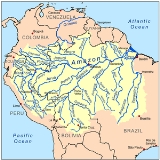
Amazon Basin is the part of
South America drained by the
Amazon River and its tributaries.
Geography
The South American
rainforest of Amazonia , the largest in the world, was originally covered by more than 7,000,000 km² of dense tropical forest. For centuries, this has protected the area and the animals residing in it. But over the past 30 years the Brazilian government has transformed Amazonia into factory sites and settlements by sponsoring road projects, colonization schemes, and industrial developments.
Flora and fauna
Not all of the plant and animal life of Amazonia are known because of its hugely unexplored areas. No one knows how many species of fish there are in the river either. Dense plant growth because the rainfall and regrowth of leaves occur gradually throughout each year. Hugh Diversity of tree species but usually have smooth, straight trunks and large leaves.
History
The Amazon basin has been continuously inhabited for over 12,000 years, since the first proven arrivals of human beings in South America. Those peoples, when found by European explorers in the 16th century, were scattered in hundreds of small tribes with no writing system except for the part ruled by the Inca Empire. Perhaps as many as 90% of the inhabitants died due to European diseases within the first hundred years of contact, many tribes perished even before direct contact with Europeans, as their germs travelled faster than explorers, contaminating village after village.
Upon the European discovery of America, the Portuguese and the Spanish signed the
Treaty of Tordesillas, dividing the continent into a large Spanish western part, which encompassed all of the then unknown North America and Central America, and western South America, the Portuguese had Eastern South America, what would become modern eastern Brazil.
By the late 17th century Portuguese/Brazilian explorers had dominated much of the Amazon basin because the mouth of the
Amazon river lay within the Portuguese side, as well as the Brazilian inward exploration ventures such as the
Bandeiras, which originated in
São Paulo and conquered much of what is today central Brazil and then proceeded to the Amazon. In 1750 the Treaty of Madrid officialized the transfer of most of the Amazon basin and the region of
Mato Grosso to the Portuguese side, hugely contributing to the continental size of what is now Brazil.
Brazilian General Rondon is also reckoned as a major 19th century explorer of the Amazon as well as a defender of its native poeples, the Brazilian state of
Rondônia is named after him.
In 1903 Brazil bought a large portion of northern
Bolivia and made it its current state of Acre. In 2006 the new socialist Bolivian president
Evo Morales talked about "getting it back. The Brazilians got it for the price of a horse". No action was taken and the two nations remain friendly. In the late 19th century, a US-Brazilian joint venture failed to implement the Madeira-Mamoré railway, in the state of
Rondônia, with a huge cost in money and lives.
Intense deforestation began in the second half of the
20th century, follow population growth and development plans such as the failed Brazilian Transamazonian highway. In the late 1980s the Brazilian
Chico Mendes, who lived in Acre, became internationally famous for his passionate defense of the forest and its people, especially after he was shot dead by farmers whose interests he harmed.
Demographics
The Amazon basin is inhabited by roughly 22 million people, of which 11 million on the Brazilian side. The two largest cities in the Amazon basin are
Manaus and
Belém .
Settlements
Amazonia is not heavily populated. There are a few
cities along the Amazon's banks, such as
Iquitos,
Peru and scattered settlements inland, but most of the population lives in cities, such as
Manaus in
Brazil. In many regions, the forest has been cleared for
soy bean plantations and
ranching and some of the inhabitants harvest wild
rubber latex and
Brazil nuts. Though a substantial area of the Amazon basin has been cleared, most of the rain forest remains relatively
undisturbed, in spite of literally thousands of years of human occupation.
Languages
The most widely spoken language in the Amazon is
Portuguese, followed closely by
Spanish. On the
Brazilian side Portuguese is spoken by at least 98% of the population, whilst in the Spanish-speaking countries there can still be found a large amount of speakers of Native American languages, though Spanish easily predominates.
There are hundreds of native languages still spoken in the Amazon, most of which spoken by only a handful of people, thus seriously endangered. One of the most widely spoken languages in the Amazon is Nheengatu, which is actually descended from ancient Tupi, originally spoken in coastal and central regions of Brazil, and brought to its present location along the Negro river by Brazilian colonizers, which until the mid-18th century used Tupi more than the official Portuguese to communicate. Other than modern Nheengatu, other languages of the Tupi Family are spoken there, along with other language families like Jê , Arawak, Karib, Arawá, Yanomamo and others.
Economy
Most people in the Amazon region live off
fishing and basic
agriculture, and especially in the southern part of the Brazilian side, cattle herding, which is extremely destructive of the forest. One importante exception is the Zona Franca de Manaus , created by the Brazilian government in the 1970s to implement light industries in the region, mostly electronics and motorcycles. Contrary to what might be believed, this light industrialization is very little polutive and actually, according to some environmentalists, has helped save the rainforest around
Manaus by creating job opportunities and education, thus driving people away from the heavily damaging subsistance and
slash-and-burn agriculture.
External links
- See Amazon River. Peace Palace Library
-
Dense plant growth because the rainfall and regrowth of leaves occur gradually throughout each year. Hugh Diversity of tree speices but usually have smooth, straight trunks and large leaves.