
This
list of pre-Columbian civilizations includes those
civilizationA civilization is a complex society or culture group characterized by dependence upon agriculture, long-distance trade, state form of government, occupational specialization, population, and class stratification.-Definition:...
s and
cultureCulture is a term that has different meanings. For example, in 1952, Alfred Kroeber and Clyde Kluckhohn compiled a list of 164 definitions of "culture" in Culture: A Critical Review of Concepts and Definitions...
s of the Americas which flourished prior to the
European colonization of the AmericasThe start of the European colonization of the Americas is typically dated to 1492, although there was at least one earlier colonization effort...
.
These
pre-ColumbianThe Pre-Columbian era incorporates all period subdivisions in the history and prehistory of the Americas before the appearance of significant European influences on the American continents, spanning the time of the original settlement in the Upper Paleolithic to European colonization during the...
civilizations established characteristics such as permanent or urban settlements,
agricultureAgriculture is the production of food and goods through farming and forestry. Agriculture was the key development that led to the rise of human civilization, with the husbandry of domesticated animals and plants creating food surpluses that enabled the development of more densely populated and...
, and
complex societal hierarchiesIn anthropology and archaeology, a complex society is a social formation that is otherwise described as a formative or developed state .-Concept:...
.
Many of these civilizations had long ceased to function by the time of the first permanent
EuropeEurope is, by convention, one of the world's seven continents. Comprising the westernmost peninsula of Eurasia, Europe is generally divided from Asia to its east by the water divide of the Ural Mountains, the Ural River, the Caspian Sea, the Caucasus Mountains , and the Black Sea to the southeast...
an arrivals (c. late
15thAs a means of recording the passage of time, the 15th century was the century which lasted from 1401 to 1500.Spanish and Portuguese explorations led to discovery of the Americas and the sea passage along Cape of Good Hope to India for the European civilization...
- early
16th centuriesAs a means of recording the passage of time, the 16th century lasted from 1501 through 1600.During the 16th century, Spain and Portugal explored and conquered the world seas. Latin America became a Spanish colony, while Portugal became the master of the Indian Ocean.In Europe, the Protestant...
), and are known only through
archaeologicalArchaeology or archeology is the science that studies human cultures through the recovery, documentation, analysis, and interpretation of material culture and environmental data, including architecture, artifacts, biofacts, and landscapes...
investigations.
This
list of pre-Columbian civilizations includes those
civilizationA civilization is a complex society or culture group characterized by dependence upon agriculture, long-distance trade, state form of government, occupational specialization, population, and class stratification.-Definition:...
s and
cultureCulture is a term that has different meanings. For example, in 1952, Alfred Kroeber and Clyde Kluckhohn compiled a list of 164 definitions of "culture" in Culture: A Critical Review of Concepts and Definitions...
s of the Americas which flourished prior to the
European colonization of the AmericasThe start of the European colonization of the Americas is typically dated to 1492, although there was at least one earlier colonization effort...
.
These
pre-ColumbianThe Pre-Columbian era incorporates all period subdivisions in the history and prehistory of the Americas before the appearance of significant European influences on the American continents, spanning the time of the original settlement in the Upper Paleolithic to European colonization during the...
civilizations established characteristics such as permanent or urban settlements,
agricultureAgriculture is the production of food and goods through farming and forestry. Agriculture was the key development that led to the rise of human civilization, with the husbandry of domesticated animals and plants creating food surpluses that enabled the development of more densely populated and...
, and
complex societal hierarchiesIn anthropology and archaeology, a complex society is a social formation that is otherwise described as a formative or developed state .-Concept:...
.
Many of these civilizations had long ceased to function by the time of the first permanent
EuropeEurope is, by convention, one of the world's seven continents. Comprising the westernmost peninsula of Eurasia, Europe is generally divided from Asia to its east by the water divide of the Ural Mountains, the Ural River, the Caspian Sea, the Caucasus Mountains , and the Black Sea to the southeast...
an arrivals (c. late
15thAs a means of recording the passage of time, the 15th century was the century which lasted from 1401 to 1500.Spanish and Portuguese explorations led to discovery of the Americas and the sea passage along Cape of Good Hope to India for the European civilization...
- early
16th centuriesAs a means of recording the passage of time, the 16th century lasted from 1501 through 1600.During the 16th century, Spain and Portugal explored and conquered the world seas. Latin America became a Spanish colony, while Portugal became the master of the Indian Ocean.In Europe, the Protestant...
), and are known only through
archaeologicalArchaeology or archeology is the science that studies human cultures through the recovery, documentation, analysis, and interpretation of material culture and environmental data, including architecture, artifacts, biofacts, and landscapes...
investigations. Others were contemporary with this period, and are also known from historical accounts of the time. A few (such as the
MayaThe Maya is a Mesoamerican civilization, noted for the only known fully developed written language of the pre-Columbian Americas, as well as its art, architecture, and mathematical and astronomical systems. Initially established during the Preclassic period , many Maya cities reached their highest...
) had their own written records. However, most Europeans of the time largely viewed such text as heretical and few survived Christian pyres. Only a few hidden documents remain today, leaving modern historians with glimpses of ancient culture and knowledge.
From both indigenous American and European accounts and documents, American civilizations at the time of European encounter possessed many impressive feats such as the most populous city in the world as well as modern theory of astronomy and mathematics.
Where they persist, the societies and cultures which gave rise to these civilizations may now be substantively different in form to that of the original. However, many of these peoples and their descendants still uphold various traditions and practices which relate back to these earlier times, even if combined with those more recently-adopted.
The cultures are listed alphabetically, with the approximate time interval of existence and modern-day location.
North AmericaNorth America is the northern continent of the Americas, situated in the Earth's northern hemisphere and in the western hemisphere. It is bordered on the north by the Arctic Ocean, on the east by the North Atlantic Ocean, on the southeast by the Caribbean Sea, and on the west by the North Pacific...
- Adena
The Adena culture was a Pre-Columbian Native American culture that existed from 1000 BC to 200 BC, in a time known as the early Woodland Period. The Adena culture refers to what were probably a number of related Native American societies sharing a burial complex and ceremonial system...
, 1000 BC to 200 BC, Ohio, Indiana, West Virginia, Kentucky, and parts of Pennsylvania and New York.
- Ancient Pueblo (Anasazi) culture, 1200 BC - 1300 AD, Utah, Arizona, Colorado, New Mexico
- Fort Ancient
Fort Ancient is a name for a Native American culture that flourished from 1000-1650 C.E. among a people who predominantly inhabited land along the Ohio River in areas of southern modern-day Ohio, northern Kentucky and western West Virginia. The Fort Ancient culture was once thought to have been an...
, 1000 AD - 1650 AD, Ohio
- Hopewell
The Hopewell tradition is the term used to describe common aspects of the Native American culture that flourished along rivers in the northeastern and midwestern United States from 200 BCE to 500 CE...
, 200 BC - 500 AD, Southeastern Canada and eastern United States
- The Fremont
The Fremont culture or Fremont people is a pre-Columbian archaeological culture which received its name from the Fremont River in the U.S. state of Utah where the first Fremont sites were discovered. The Fremont River itself is named for John Charles Frémont, an American explorer. It inhabited...
, 700 AD - 1300 AD, Utah and parts of Nevada, Idaho and Colorado
- Mississipians
The Mississippian culture was a mound-building Native American culture that flourished in what is now the Midwestern, Eastern, and Southeastern United States from approximately 800 CE to 1500 CE, varying regionally....
, 800 AD - 1500 AD, Midwestern, Eastern, and Southeastern United States
- Poverty Point culture, 2200 BC - 700 BC, lower Mississippi Valley and surrounding Gulf coast
MesoamericaMesoamerica or Meso-America is a region and culture area in the Americas, extending approximately from central Mexico to Honduras and Nicaragua, within which a number of pre-Columbian societies flourished before the Spanish colonization of the Americas in the 15th and 16th centuries...
- Aztec
The Aztec people were certain ethnic groups of central Mexico, particularly those groups who spoke the Nahuatl language and who dominated large parts of Mesoamerica in the 14th, 15th and 16th centuries, a period referred to as the Late post-Classic period in Mesoamerican chronology.Often the term...
, 1200 AD - 1600 AD, central Mexico
- Huastec, 1000 BC - 1500 AD, Hidalgo, Veracruz, San Luis Potosí and Tamaulipas
- Mixtec
The Mixtec are indigenous Mesoamerican peoples inhabiting the Mexican states of Oaxaca, Guerrero and Puebla in a region known as La Mixteca. The Mixtecan languages form an important branch of the Otomanguean linguistic family....
, ? - 1600 AD, western Oaxaca
- Maya
The Maya is a Mesoamerican civilization, noted for the only known fully developed written language of the pre-Columbian Americas, as well as its art, architecture, and mathematical and astronomical systems. Initially established during the Preclassic period , many Maya cities reached their highest...
, 2000 BC - 1500 AD, Honduras, Guatemala, El Salvador
- Olmec
The Olmec were an ancient Pre-Columbian civilization living in the tropical lowlands of south-central Mexico, in what are roughly the modern-day states of Veracruz and Tabasco....
, 1200 BC - 400 BC, Veracruz and Tabasco
- P'urhépecha
The Tarascan state was a state in pre-Columbian Mesoamerica, roughly covering the geographic area of the present-day Mexican state of Michoacán. At the time of the Spanish conquest of Mexico it was the second-largest state in Mexico. The state was founded in the early 14th century and lost its...
or Tarascan state, 1300 AD - 1530 AD, Michoacán
- Teotihuacán
Teotihuacan is an enormous archaeological site in the Basin of Mexico, containing some of the largest pyramidal structures built in the pre-Columbian Americas...
, 200 BC - 800 AD, near Mexico City
- Toltec
The word Toltec refers to populations and polities that inhabited pre-Columbian central Mexico. The word has been used in different ways in Mesoamerican studies by different scholars to refer to the ancestors mentioned in the mythical/historical narratives of the Aztecs...
, ?
- Totonac
The Totonac people resided in the eastern coastal and mountainous regions of Mexico at the time of the Spanish arrival in 1519. Today they reside in the states of Veracruz, Puebla, and Hidalgo. They are one of the possible builders of the Pre-Columbian city of El Tajín, and further maintained...
, ? - 1500, eastern Mexico
- Western Mexico shaft tomb tradition
The Western Mexico shaft tomb tradition or shaft tomb culture refers to a set of interlocked cultural traits found in the western Mexican states of Jalisco, Nayarit, and, to a lesser extent, Colima to its south, roughly dating to the period between 300 BCE and 400 CE, although there is not wide...
, 300 BC - 400 AD, Jalisco, Nayarit, and, to a lesser extent, Colima
- Zapotec
The Zapotec civilization was an indigenous pre-Columbian civilization that flourished in the Valley of Oaxaca of southern Mesoamerica. Archaeological evidence shows their culture goes back at least 2500 years...
, 500 BC - 1500 AD, Oaxaca
South AmericaSouth America is the southern continent of the Americas, situated entirely in the Western Hemisphere and mostly in the Southern Hemisphere, with a relatively small portion in the Northern Hemisphere...

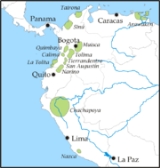
- Calima culture, Columbia
- Cañaris
Cañaris was a South American Indian tribe in central south Ecuador. Their greatest significance was the defense against numerous Incan armies for many years. Through wars and marriages, the Inca Empire conquered their territory under the lead of Huayna Capac to the north...
, ? - 1500 AD, central south Ecuador
- Chachapoya, 800 AD - 1500 AD, Amazonas Region in Peru
- Chavin
The Chavín were a civilization that developed in the northern Andean highlands of Peru from 900 BC to 200 BC. The Chavin were located in the Mosna Valley where the Mosna and Huachecsa rivers merge...
, 900 BC - 200 BC, northern Andean highlands of Peru*Chibcha
- Chimú
The Chimú were the residents of Chimor with its capital at the city of Chan Chan, a large adobe city, in the Moche valley of Trujillo, Peru. The Inca ruler Tupac Inca Yupanqui led a campaign which conquered the Chimú around 1470 AD, just fifty years before the arrival of the Spanish in the region...
, 900 AD - 1500 AD, northern coast of Peru
- El Abra
El Abra is an archaeological excavation site, located in the valley of the same name, east of the city of Zipaquirá, department Cundinamarca, Colombia; in the Altiplano Cundiboyacense, at an altitude of 2,570 m...
, 12500 BC - 10000 BC, Cundinamarca, Colombia
- Huari
The Wari were a Middle Horizon civilization that flourished in the Andes in the south-central coastal area of modern-day Peru, from about A.D. 500 to 900. The capital city of the same name is located north-east of the modern city of Ayacucho, Peru. This city was the center of a civilization that...
, 500 AD - 900 AD, south-central coastal area of Peru
- Inca
The Inca Empire was the largest empire in pre-Columbian America. The administrative, political and military center of the empire was located in Cusco in modern-day Peru. The Inca Empire arose from the highlands of Peru sometime in early 13th century...
, 1200 AD - 1533 AD, western South America, including large parts of Ecuador, Peru, western and south central Bolivia, northwest Argentina, north and north-central Chile, and southern Colombia.
- La Tolita
- Las Vegas
The Las Vegas culture was a complex of late-Pleistocene and Holocene settlements along the coast of present day Ecuador, which emerged between 8000 BC and 4600 BC...
, 8000 BC - 4600 BC, coast of Ecuador
- Moche
'The Moche civilization flourished in northern Peru from about 100 A.D. to 800 A.D., during the Regional Development Epoch...
, 100 AD - 800 AD, northern Peru
- Muisca
Muisca refers to a nation of the Chibchan Culture that formed the Muisca Confederation encountered by the Spanish in 1537, at the time of the conquest of what is now part of central Colombia. The Muisca comprised two confederations: the Hunza, whose sovereign was the Zaque, and the Bacatá, whose...
, ? - 1500, central Colombia
- Narino
- Nazca culture
Nasca culture refers to the archaeological culture ) flourished from the first to eighth centuries AD beside the dry southern coast of Peru in the river valleys of the Rio Grande de Nazca drainage and the Ica Valley Nasca culture (alternatively spelled Nazca when referring to the geographical...
, 0 AD - 800 AD, southern coast of Peru
- Norte Chico
Norte Chico or Near North Coast ranges over five river valleys north of present-day Lima: the Chancay River, the Huaura River, Supe River, Fortaleza River and Pativilca River....
or Caral-Supe, 3000 BC - 1700 BC, north-central coastal Peru
- Quimbaya
The Quimbaya civilization is a South American civilization, noted for spectacular gold work characterized by technical accuracy and detailed designs. The majority of the gold work is made in tumbaga alloy, with 30% copper, which imparts beautiful color tonalities to the pieces...
, 100 BC - 1000 AD, Quindío, Caldas and Risaralda departments in Colombia
- San Agustin
San Agustín is a town and municipality in the southern Colombian Department of Huila. The town is located 227 km away from the capital of the Department, Neiva. Population is around 30,000. The village was originally founded in 1752 by Alejo Astudillo but attacks by indigenous people destroyed it...
- Tairona
Tairona is a group of chiefdoms in the region of Sierra Nevada de Santa Marta in present-day Cesar, Magdalena and La Guajira Departments of Colombia, South America, which goes back at least to the 1st century AD and had significant demographic growth around the 11th century.The Tairona people...
, 100 AD - 1600 AD, Cesar, Magdalena and La Guajira Departments of Colombia
- Tierradentro
Tierradentro is a National archeological park in the jurisdiction of the municipality of Inza, Department of Cauca. The park is located 100 km away from the capital of the Department, Popayán....
, first millennium AD, Department of Cauca, Colombia
- Tiwanaku
Tiwanaku is an important Pre-Columbian archaeological site in western Bolivia. Tiwanaku is recognized by Andean scholars as one of the most important precursors to the Inca Empire, flourishing as the ritual and administrative capital of a major state power for approximately five hundred years...
, 300 BC - 1000 AD, western Bolivia
- Tolima
Tolima may refer to:* Nevado del Tolima, volcano in Colombia* Tolima Department of Colombia.* Tolima Valley* Deportes Tolima a Football team in First Division...
- Valdivia
The Valdivia Culture is one of the oldest settled cultures recorded in the Americas. It emerged from the earlier Las Vegas culture and thrived on the Santa Elena peninsula near the modern-day town of Valdivia, Ecuador between 3500 BC and 1800 BC....
, coastal Ecuador, 3500 BC - 1800 BC
See also
- Indigenous peoples of the Americas
The indigenous peoples of the Americas are the pre-Columbian inhabitants of the Americas, their descendants, and many ethnic groups who identify with those peoples...
– for coverage on present-day indigenousThe term indigenous peoples can be used to describe any ethnic group of people who inhabit a geographic region with which they have the earliest known historical connection, alongside more recent immigrants who have populated the region and may be greater in number...
societies.
- Lithic stage in Canada (18000 BCE - 8000 BCE)
- Models of migration to the New World
There have been several models of migration to the New World proposed by various academic communities. The question of how, when and why humans first entered the Americas is of intense interest to archaeologists and anthropologists and has been a subject of heated debate for centuries...
- Time line of significant archeological, geological and genetic evidence in the Americas
- Cultural periods of Peru
This is a chart of Cultural periods of Peru and the Andean Region developed by Edward Lanning and used by some archaeologists studying the area. An alternative dating system was developed by Luis Lumbreras and provides different dates for some archaeological finds...
- Mesoamerican chronology
align=right style="margin: 0 0 1em 1em;"||}Mesoamerican chronology divides the history of pre-Columbian Mesoamerica into a number of named successive eras or periods, from the earliest evidence of human habitation through to the early Colonial period which followed the Spanish colonization of the...
- List of archaeological periods in North America
External links