


Moche

Encyclopedia
The Moche civilization (alternatively, the Mochica culture, Early Chimu, Pre-Chimu, Proto-Chimu, etc.) flourished in northern Peru
Peru
Peru , officially the Republic of Peru , is a country in western South America. It is bordered on the north by Ecuador and Colombia, on the east by Brazil, on the southeast by Bolivia, on the south by Chile, and on the west by the Pacific Ocean....
from about 100 AD to 800 AD, during the Regional Development Epoch
Cultural periods of Peru
This is a chart of cultural periods of Peru and the Andean Region developed by Edward Lanning and used by some archaeologists studying the area...
. While this issue is the subject of some debate, many scholars contend that the Moche were not politically organized as a monolithic empire or state. Rather, they were likely a group of autonomous polities that shared a common elite culture, as seen in the rich iconography
Iconography
Iconography is the branch of art history which studies the identification, description, and the interpretation of the content of images. The word iconography literally means "image writing", and comes from the Greek "image" and "to write". A secondary meaning is the painting of icons in the...
and monument
Monument
A monument is a type of structure either explicitly created to commemorate a person or important event or which has become important to a social group as a part of their remembrance of historic times or cultural heritage, or simply as an example of historic architecture...
al architecture that survive today. They are particularly noted for their elaborately painted ceramics
Ceramics (art)
In art history, ceramics and ceramic art mean art objects such as figures, tiles, and tableware made from clay and other raw materials by the process of pottery. Some ceramic products are regarded as fine art, while others are regarded as decorative, industrial or applied art objects, or as...
, gold
Gold
Gold is a chemical element with the symbol Au and an atomic number of 79. Gold is a dense, soft, shiny, malleable and ductile metal. Pure gold has a bright yellow color and luster traditionally considered attractive, which it maintains without oxidizing in air or water. Chemically, gold is a...
work, monumental constructions (huaca
Huaca
In Quechua, a Native American language of South America, a huaca or waqa is an object that represents something revered, typically a monument of some kind. The term huaca can refer to natural locations, such as immense rocks. Some huacas have been associated with veneration and ritual...
s) and irrigation
Irrigation
Irrigation may be defined as the science of artificial application of water to the land or soil. It is used to assist in the growing of agricultural crops, maintenance of landscapes, and revegetation of disturbed soils in dry areas and during periods of inadequate rainfall...
systems. Moche history may be broadly divided into three periods – the emergence of the Moche culture in Early Moche (AD 100–300), its expansion and florescence during Middle Moche (AD 300–600), and the urban nucleation and subsequent collapse in Late Moche (AD 500–750).
Moche society was agriculturally based, with a significant level of investment in the construction of a network of irrigation canals for the diversion of river water to supply their crops. Their culture was sophisticated; and their artifacts express their lives, with detailed scenes of hunting, fishing, fighting, sacrifice, sexual encounters and elaborate ceremonies.
The Moche cultural sphere is centered around several valleys on the north coast of Peru – Lambayeque
Lambayeque Region
Lambayeque is a region in northwestern Peru known for its rich Moche and Chimú historical past. The region's name originates from the ancient pre-Inca civilization of the Lambayeque.-Etymology:...
, Jequetepeque, Chicama, Moche, Virú
Virú culture
The Virú culture occupied the valleys of Chicama and Virú in La Libertad Region of Peru from 100 to 300 CE. The center of their culture was "Castillo de Tomabal", on the left bank of the river Virú....
, Chao, Santa
Santa River
The Santa River is a river in the South American Andes cordillera in the Ancash Region of northwest central Peru.-River Course:Laguna Conococha, at an altitude of 4050 m above sea level and at , is considered the headwaters of the Rio Santa. Laguna Conococha itself is fed by small streams from the...
, and Nepena. The Huaca del Sol
Huaca del Sol
The Huaca del Sol is an adobe brick temple built by the Moche civilization on the coast of what is now Peru. The temple is one of several ruins found near the peak of Cerro Blanco, in the coastal desert near Trujillo, Peru...
, a pyramid
Pyramid
A pyramid is a structure whose outer surfaces are triangular and converge at a single point. The base of a pyramid can be trilateral, quadrilateral, or any polygon shape, meaning that a pyramid has at least three triangular surfaces...
al adobe structure on the Rio Moche, had been the largest pre-Columbian structure in Peru. However, it was partly destroyed when Spanish Conquistadores mined its graves for gold. Fortunately the nearby Huaca de la Luna
Huaca de la Luna
Huaca de la Luna is a large adobe brick structure built mainly by the Moche people of northern Peru. Along with the Huaca del Sol, the Huaca de la Luna is part of Huacas de Moche, which is the remains of an ancient Moche capital city called Cerro Blanco.-Background:The Huacas de Moche site is...
has remained largely intact; it contains many colorful murals with complex iconography. It has been under archeological excavation since the early 1990s. Other major Moche sites include Sipan
Sipán
Sipán is a Moche archaeological site in northern Peru that is famous for the tomb of El Señor de Sipán , excavated by Walter Alva and his wife Susana Meneses. It is considered to be one of the most important archaeological discoveries in the last 30 years, because the main tomb was found intact...
, Pampa Grande, Loma Negra, Dos Cabezas, Pacatnamu, San Jose de Moro, the El Brujo
El Brujo
The El Brujo Archaeological Complex, just north of Trujillo, La Libertad Province, Peru, is an ancient monument of the Moche culture. It includes Huaca Prieta and the nearby colonial remains of Salinar, Moche, Lambayeque, Chimú.Huaca El Brujo and Huaca Cao Viejo were built by the...
complex, Mocollope, Cerro Mayal, Galindo, Huanchaco, and Panamarca.
Material culture
Moche pottery is some of the most varied in the world. The use of mold technologyMolding (process)
Molding or moulding is the process of manufacturing by shaping pliable raw material using a rigid frame or model called a pattern....
is evident. This would have enabled the mass production of certain forms. But Moche ceramics vary widely in shape and theme, with most important social activities documented in pottery, including war, sex
Sex
In biology, sex is a process of combining and mixing genetic traits, often resulting in the specialization of organisms into a male or female variety . Sexual reproduction involves combining specialized cells to form offspring that inherit traits from both parents...
, metalwork
Metalworking
Metalworking is the process of working with metals to create individual parts, assemblies, or large scale structures. The term covers a wide range of work from large ships and bridges to precise engine parts and delicate jewelry. It therefore includes a correspondingly wide range of skills,...
, and weaving.
Traditional North-coast Peruvian ceramic art
Ceramic art
In art history, ceramics and ceramic art mean art objects such as figures, tiles, and tableware made from clay and other raw materials by the process of pottery. Some ceramic products are regarded as fine art, while others are regarded as decorative, industrial or applied art objects, or as...
uses a limited palette, relying primarily on red and white; fineline painting, fully modeled clay, veristic figures, and stirrup spouts. Moche ceramics created between 150-800 AD epitomize this style. These realistic pots have been found not just at major North coast archeological sites, such as Huaca de la luna, Huaca del sol, and Sipan, but at small villages and unrecorded burial sites as well.
Because irrigation
Irrigation
Irrigation may be defined as the science of artificial application of water to the land or soil. It is used to assist in the growing of agricultural crops, maintenance of landscapes, and revegetation of disturbed soils in dry areas and during periods of inadequate rainfall...
was the source of wealth and foundation of the empire, the Moche culture emphasized the importance of circulation and flow. Expanding upon this, the Moche focused on the passage of fluids in their artwork, particularly life fluids through vulnerable human orifices. There are countless images of defeated warriors losing life fluids through their nose, or helpless victims getting their eyes torn out by birds or captors. Images of captive sex-slaves with gaping orifices and leaking fluids portray extreme exposure, humiliation, and a loss of power.
The coloration of Moche pottery is often simple, with yellowish cream and rich red used almost exclusively on elite pieces, with white and black used in only a few pieces. Their adobe buildings have been mostly destroyed by looters
Looting
Looting —also referred to as sacking, plundering, despoiling, despoliation, and pillaging—is the indiscriminate taking of goods by force as part of a military or political victory, or during a catastrophe, such as during war, natural disaster, or rioting...
and natural forces over the last 1300 years, but the huaca
Huaca
In Quechua, a Native American language of South America, a huaca or waqa is an object that represents something revered, typically a monument of some kind. The term huaca can refer to natural locations, such as immense rocks. Some huacas have been associated with veneration and ritual...
s that remain show that the coloring of their murals was very vibrant.
The realistic detail in Moche ceramics may have helped them serve as didactic models. Older generations could pass down general knowledge about reciprocity
Norm of reciprocity
The norm of reciprocity is the social expectation that people will respond to each other in kind—returning benefits for benefits, and responding with either indifference or hostility to harms. The social norm of reciprocity often takes different forms in different areas of social life, or in...
and embodiment to younger generations through such portrayals. The sex pots could teach about procreation, sexual pleasure, cultural and social norms, a sort of immortality, and transfer of life and souls, transformation, and the relationship between the two cyclical views of nature and life.
Moche wove textiles - mostly from wool from vicuña
Vicuña
The vicuña or vicugna is one of two wild South American camelids, along with the guanaco, which live in the high alpine areas of the Andes. It is a relative of the llama, and is now believed to share a wild ancestor with domesticated alpacas, which are raised for their fibre...
and alpaca
Alpaca
An alpaca is a domesticated species of South American camelid. It resembles a small llama in appearance.Alpacas are kept in herds that graze on the level heights of the Andes of southern Peru, northern Bolivia, Ecuador, and northern Chile at an altitude of to above sea level, throughout the year...
. Although there are few surviving examples of this, descendants of the Moche people have strong weaving traditions.
Religion

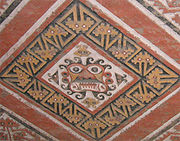
Human sacrifice
Human sacrifice is the act of killing one or more human beings as part of a religious ritual . Its typology closely parallels the various practices of ritual slaughter of animals and of religious sacrifice in general. Human sacrifice has been practised in various cultures throughout history...
played a significant part in Moche religious practices. These rites appear to have involved the elite as key actors in a spectacle of costumed participants, monumental settings and possibly the ritual consumption of blood. While some scholars, such as Christopher Donnan and Izumi Shimada
Izumi Shimada
Izumi Shimada is a Distinguished Professor of Anthropology at Southern Illinois University, Carbondale and 2007 Outstanding Scholar with research interests in the archaeology of complex pre-Hispanic cultures in the Andes, the technology and organization of craft production, mortuary analysis,...
, argue that the sacrificial victims were the losers of ritual battles among local elites, others, such as John Verano
John Verano
John Verano is an associate professor of anthropology at Tulane University. He received his B.A. from Stanford University in 1977 in anthropology. He then went on to the University of California, Los Angeles to receive his M.A. in 1980 and his Ph.D. in 1987....
and Richard Sutter, suggest that the sacrificial victims were warriors captured in territorial battles between the Moche and other nearby societies. Excavations in plazas near Moche huacas have found groups of people sacrificed together and the skeletons of young men deliberately excarnated
Excarnation
In archaeology and anthropology, the term, excarnation , refers to the burial practice of removing the flesh and organs of the dead, leaving only the bones....
, perhaps for temple displays.
The Moche may have also held and tortured the victims for several weeks before sacrificing them, with the intent of deliberately drawing blood. Verano believes that some parts of the victim may have been eaten as well in ritual cannibalism. The sacrifices may have been associated with rites of ancestral renewal and agricultural fertility. Moche iconography features a figure which scholars have nicknamed the "Decapitator" or Ai Apaec; it is frequently depicted as a spider, but sometimes as a winged creature or a sea monster: together all three features symbolize land, water and air. When the body is included, the figure is usually shown with one arm holding a knife and another holding a severed head by the hair. The "Decapitator" is thought to have figured prominently in the beliefs surrounding the practice of sacrifice.
Ai Apaec has also been depicted as "a human figure with a tiger's mouth and snarling fangs".
Collapse
There are several theories as to what caused the demise of the Moche political structure. Some scholars have emphasised the role of environmental change. Studies of ice cores drilled from glaciers in the AndesAndes
The Andes is the world's longest continental mountain range. It is a continual range of highlands along the western coast of South America. This range is about long, about to wide , and of an average height of about .Along its length, the Andes is split into several ranges, which are separated...
reveal climatic events between 536 to 594 AD, possibly a super El Niño, that resulted in 30 years of intense rain and flooding followed by 30 years of drought, part of the aftermath of the climate changes of 535–536
Climate changes of 535–536
The extreme weather events of 535–536 were the most severe and protracted short-term episodes of cooling in the Northern Hemisphere in the last 2,000 years. The event is thought to have been caused by an extensive atmospheric dust veil, possibly resulting from a large volcanic eruption in the...
. These weather events could have disrupted the Moche way of life and shattered their faith in their religion, which had promised stable weather through sacrifices.
But more recently discovered evidence demonstrates that these events did not cause the final Moche demise. Moche polities survived beyond 650 AD in the Jequetepeque Valley and the Moche Valleys. For instance, in the Jequetepeque Valley, later settlements are characterized by fortifications and defensive works. While there is no evidence of a foreign invasion, as many scholars have suggested in the past (i.e. a Huari
Huari Culture
The Wari were a Middle Horizon civilization that flourished in the south-central Andes and coastal area of modern-day Peru, from about CE 500 to 1000...
invasion), the defensive works suggest social unrest, possibly the result of climatic changes, as factions fought for control over increasingly scarce resources.
Links with other cultures
Chronologically, the Moche was an Early Intermediate PeriodCultural periods of Peru
This is a chart of cultural periods of Peru and the Andean Region developed by Edward Lanning and used by some archaeologists studying the area...
culture, which was preceded by the Chavín horizon
Chavín culture
The Chavín were a civilization that developed in the northern Andean highlands of Peru from 900 BC to 200 BC. They extended their influence to other civilizations along the coast. The Chavín were located in the Mosna Valley where the Mosna and Huachecsa rivers merge...
and succeeded by the Huari and Chimú. The Moche co-existed with the Ica-Nazca culture in the south. They are thought to have had some limited contact with the Ica-Nazca because they latter mined guano
Guano
Guano is the excrement of seabirds, cave dwelling bats, and seals. Guano manure is an effective fertilizer due to its high levels of phosphorus and nitrogen and also its lack of odor. It was an important source of nitrates for gunpowder...
for fertilizer and may have traded with northerners. Moche pottery has been found near Ica, but no Ica-Nazca pottery has been found in Moche territory. The coastal Moche culture also co-existed (or overlapped in time) with the slightly earlier Recuay culture in the highlands. Some Moche iconographic motifs can be traced to Recuay design elements.
21st century discoveries
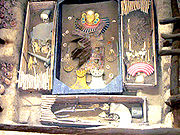
El Brujo
The El Brujo Archaeological Complex, just north of Trujillo, La Libertad Province, Peru, is an ancient monument of the Moche culture. It includes Huaca Prieta and the nearby colonial remains of Salinar, Moche, Lambayeque, Chimú.Huaca El Brujo and Huaca Cao Viejo were built by the...
archeological site on the outskirts of present-day Trujillo, Peru
Trujillo, Peru
Trujillo, in northwestern Peru, is the capital of the La Libertad Region, and the third largest city in Peru. The urban area has 811,979 inhabitants and is an economic hub in northern Peru...
. It is the best preserved Moche mummy found to date and the elaborate tomb that housed her had unprecedented decoration. The archaeologists on the site believe that the tomb had been undisturbed since approximately 450 AD. The tomb also contained various military and ornamental artifacts, including war clubs and spear throwers. A garrote
Garrote
A garrote or garrote vil is a handheld weapon, most often referring to a ligature of chain, rope, scarf, wire or fishing line used to strangle someone....
d young girl, probably a servant, was found in the tomb with the mummy of a probably elite woman. News of the discovery was announced by Peruvian and U.S. archaeologists in collaboration with National Geographic in May 2006.
In 2006 perhaps the most lavish (certainly the most valuable, pound-for-pound) Moche artifact ever discovered turned up in a Londoner's office; it was a magnificent gold mask depicting a sea goddess
Goddess
A goddess is a female deity. In some cultures goddesses are associated with Earth, motherhood, love, and the household. In other cultures, goddesses also rule over war, death, and destruction as well as healing....
, with beautiful spirals radiating from her stone-inlaid face. Experts thought that the artifact, nicknamed La Mina, may have been looted from a nobleman's tomb in the late 1980s ; it has now been returned to Peru.
See also
- Chimu Empire, heavily influenced inheritors of the Moche.
- El Señor de Sipán (the Lord of Sipán)
- Moche Crawling FelineMoche Crawling FelineThe Moche Crawling Feline is a specific stirrup spout vessel dating from 100—800 CE. This Moche ceramic effigy is currently in the collection of Larco Museum, in Lima, Peru. It comes from the North Coast of Peru...
Further reading
- Schmid, Martin, Die Mochica an der Norküste Perus. Religion und Kunst einer vorinkaischen andinen Hochkultur. Hamburg, 2008
External links
- "A Peruvian Woman Warrior of A.D. 450" New York Times, 17 May 2006, by John Noble Wilford
- BBC:"The Lost Civilization of Peru" Includes bibliography.
- Gallery of Moche erotic pottery at the Larco Museum
- Grim rites of the Moche
- Linked National University of Trujillo, IBM, National Geographic & press reports on El Brujo Archaeological project
- Sun and Moon Huacas Official Project information
- Temples Of Doom - human sacrifice, Discover, March 1999 by Heather PringleHeather PringleHeather Pringle is a prize-winning Canadian non-fiction author and journalist, focusing on archaeology. Her 2006 book The Master Plan detailed Heinrich Himmler's establishment of the Ahnenerbe in a pseudo-scientific attempt to "prove" Aryan superiority. It won the Hubert Evans Non-Fiction Prize...
- "Sacrificial Practices and Blood Rituals Among the Moche People of Ancient Peru" by Francesco Sammarco
- Moche pottery and the practice of war Horniman Museum video on YouTube channel
- The Moche of Ancient Peru: Media and Messages by Jeffrey Quilter. Peabody Museum Press 2011.