

Martinique

Encyclopedia
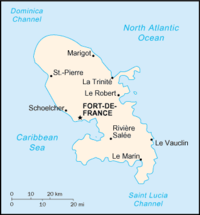
Martinique is an island
in the eastern Caribbean Sea
, with a land area of 1128 km² (435.5 sq mi). Like Guadeloupe
, it is an overseas region of France
, consisting of a single overseas department. To the northwest lies Dominica
, to the south St Lucia, and to the southeast Barbados
. As with the other overseas departments, Martinique is one of the twenty-seven regions of France
(being an overseas region) and an integral part of the Republic
. The first European to encounter the island was Christopher Columbus
in 1502.
As part of France, Martinique is part of the European Union
, and its currency is the Euro
. Its official language is French
, although many of its inhabitants also speak Antillean Creole
(Créole Martiniquais).

The island was occupied first by Arawaks, then by Caribs. It was charted by Columbus
in 1493, but Spain had little interest in the territory. It was claimed by France in 1635 and, despite several interludes of British occupation, once during the Seven Years' War
and twice during the Napoleonic Wars
, has remained a French possession. In 1946, the French National Assembly voted unanimously to transform the colony into an overseas department.
citizens with full political and legal rights. Martinique sends four deputies
to the French National Assembly and two senators to the French Senate.
Caribbean, island in the Caribbean Sea, north of St. Lucia and south of Dominica
Geographic coordinates:
14°40′N 61°00′W
Map references:
Central America
and the Caribbean
Area:
total:
1100 square kilometres (424.7 sq mi)
land:
1060 square kilometres (409.3 sq mi)
water:
40 square kilometres (15.4 sq mi)
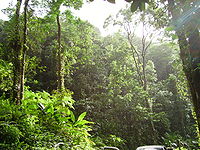
 The north of the island is mountainous and lushly forested. It features four ensembles of pitons (volcanoes) and mornes (mountains): the Piton Conil on the extreme North, which dominates the Dominica Channel; Mount Pelée, an active volcano; the Morne Jacob; and the Pitons du Carbet, an ensemble of five extinct volcanoes covered with rainforest and dominating the Bay of Fort de France at 1196 metres (3,923.9 ft).
The highest of the island's many mountains, at 1397 metres (4,583.3 ft), is the famous volcano Mount Pelée
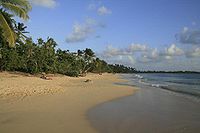
. Its volcanic ash has created gray and black sand beaches in the north (in particular between Anse Ceron and Anse des Gallets), contrasting markedly from the white sands of Les Salines in the south.
The south is more easily traversed, though it still features some impressive geographic features. Because it is easier to travel and because of the many beaches and food facilities throughout this region, the south receives the bulk of the tourist traffic. The beaches from Pointe de Bout, through Diamant (which features right off the coast of Roche de Diamant), St. Luce, the continent of St. Anne and down to Les Salines are popular.
is based on trade. Agriculture accounts for about 6% of GDP and the small industrial sector for 11%. Sugar
production has declined, with most of the sugarcane now used for the production of rum
. Banana exports are increasing, going mostly to France. The bulk of meat, vegetable, and grain requirements must be imported, contributing to a chronic trade deficit that requires large annual transfers of aid from France. Tourism has become more important than agricultural exports as a source of foreign exchange. The majority of the work force is employed in the service sector and in administration.
serves the island.
 As an overseas département of France
, Martinique's culture blends French and Caribbean
influences. The city of Saint-Pierre (destroyed by a volcanic eruption of Mount Pelée
), was often referred to as the "Paris
of the Lesser Antilles
". Following traditional French custom, many businesses close at midday to allow a lengthy lunch, then reopen later in the afternoon. The official language is French
.
Many Martinicans speak Martiniquan Creole
, a subdivision of Antillean Creole
that is virtually identical to the varieties spoken in neighboring English-speaking islands of Saint Lucia and Dominica. Martiniquan Creole is based on French, Carib
and African languages with elements of English
, Spanish
, and Portuguese
. It continues to be used in oral storytelling traditions and other forms of speech and to a lesser extent in writing. Its use is predominant among friends and close family. Though it is normally not used in professional situations, members of the media and politicians have begun to use it more frequently as a way to redeem national identity and prevent cultural assimilation by mainland France. Indeed, unlike other varieties of French creole such as Mauritian Creole
, Martinican Creole is not readily understood by speakers of Standard French due to significant differences in grammar, syntax, vocabulary and pronunciation, though over the years it has progressively adapted features of Standard French
Most of Martinique's population is descended from enslaved Africans
brought to work on sugar plantations during the colonial era, generally mixed with some French, Amerindian (Carib people), Indian (Tamil), Lebanese or Chinese ancestry. Between 5 and 10% of the population is of Indian (Tamil
) origin. The island also boasts a small Syro
-Lebanese
community, a small but increasing Chinese
community, and the Béké
community, descendants of European ethnic groups
of the first French and British settlers, who still dominate parts of the agricultural and trade sectors of the economy. Whites represent 5% of the population.
The Béké people (which totals around 5,000 people in the island, most of them of aristocratic origin by birth or after buying the title) generally live in mansions on the Atlantic coast of the island (mostly in the François - Cap Est district). In addition to the island population, the island hosts a metropolitan French community, most of which lives on the island on a temporary basis (generally from 3 to 5 years).
There are an estimated 260,000 people of Martiniquan origin living in mainland France, most of them in the Paris region.
Today, the island enjoys a higher standard of living than most other Caribbean countries. French products are easily available, from Chanel
fashions to Limoges
porcelain. Studying in the métropole (mainland France, especially Paris) is common for young adults. Martinique has been a vacation hotspot for many years, attracting both upper-class French and more budget-conscious travelers.
Martinique has a hybrid cuisine, mixing elements of African, French, Carib Amerindian and South Asian traditions. One of its most famous dishes is the Colombo (compare Tamil word kuzhambu for gravy or broth), a unique curry of chicken (curry chicken), meat or fish with vegetables, spiced with a distinctive masala
of Tamil origins, sparked with tamarind
, and often containing wine, coconut milk
, cassava
and rum. A strong tradition of Martiniquan desserts and cakes incorporate pineapple, rum, and a wide range of local ingredients.

General information
Travel
Island
An island or isle is any piece of sub-continental land that is surrounded by water. Very small islands such as emergent land features on atolls can be called islets, cays or keys. An island in a river or lake may be called an eyot , or holm...
in the eastern Caribbean Sea
Caribbean Sea
The Caribbean Sea is a sea of the Atlantic Ocean located in the tropics of the Western hemisphere. It is bounded by Mexico and Central America to the west and southwest, to the north by the Greater Antilles, and to the east by the Lesser Antilles....
, with a land area of 1128 km² (435.5 sq mi). Like Guadeloupe
Guadeloupe
Guadeloupe is an archipelago located in the Leeward Islands, in the Lesser Antilles, with a land area of 1,628 square kilometres and a population of 400,000. It is the first overseas region of France, consisting of a single overseas department. As with the other overseas departments, Guadeloupe...
, it is an overseas region of France
France
The French Republic , The French Republic , The French Republic , (commonly known as France , is a unitary semi-presidential republic in Western Europe with several overseas territories and islands located on other continents and in the Indian, Pacific, and Atlantic oceans. Metropolitan France...
, consisting of a single overseas department. To the northwest lies Dominica
Dominica
Dominica , officially the Commonwealth of Dominica, is an island nation in the Lesser Antilles region of the Caribbean Sea, south-southeast of Guadeloupe and northwest of Martinique. Its size is and the highest point in the country is Morne Diablotins, which has an elevation of . The Commonwealth...
, to the south St Lucia, and to the southeast Barbados
Barbados
Barbados is an island country in the Lesser Antilles. It is in length and as much as in width, amounting to . It is situated in the western area of the North Atlantic and 100 kilometres east of the Windward Islands and the Caribbean Sea; therein, it is about east of the islands of Saint...
. As with the other overseas departments, Martinique is one of the twenty-seven regions of France
Régions of France
France is divided into 27 administrative regions , 22 of which are in Metropolitan France, and five of which are overseas. Corsica is a territorial collectivity , but is considered a region in mainstream usage, and is even shown as such on the INSEE website...
(being an overseas region) and an integral part of the Republic
France
The French Republic , The French Republic , The French Republic , (commonly known as France , is a unitary semi-presidential republic in Western Europe with several overseas territories and islands located on other continents and in the Indian, Pacific, and Atlantic oceans. Metropolitan France...
. The first European to encounter the island was Christopher Columbus
Christopher Columbus
Christopher Columbus was an explorer, colonizer, and navigator, born in the Republic of Genoa, in northwestern Italy. Under the auspices of the Catholic Monarchs of Spain, he completed four voyages across the Atlantic Ocean that led to general European awareness of the American continents in the...
in 1502.
As part of France, Martinique is part of the European Union
European Union
The European Union is an economic and political union of 27 independent member states which are located primarily in Europe. The EU traces its origins from the European Coal and Steel Community and the European Economic Community , formed by six countries in 1958...
, and its currency is the Euro
Euro
The euro is the official currency of the eurozone: 17 of the 27 member states of the European Union. It is also the currency used by the Institutions of the European Union. The eurozone consists of Austria, Belgium, Cyprus, Estonia, Finland, France, Germany, Greece, Ireland, Italy, Luxembourg,...
. Its official language is French
French language
French is a Romance language spoken as a first language in France, the Romandy region in Switzerland, Wallonia and Brussels in Belgium, Monaco, the regions of Quebec and Acadia in Canada, and by various communities elsewhere. Second-language speakers of French are distributed throughout many parts...
, although many of its inhabitants also speak Antillean Creole
Antillean Creole
Antillean Creole is a creole language with a vocabulary based on French. It is spoken primarily in the Lesser Antilles. Its grammar and vocabulary also include elements of Carib and African languages. Antillean Creole is related to Haitian Creole, but has a number of distinctive features; they are...
(Créole Martiniquais).
History
The island was occupied first by Arawaks, then by Caribs. It was charted by Columbus
Christopher Columbus
Christopher Columbus was an explorer, colonizer, and navigator, born in the Republic of Genoa, in northwestern Italy. Under the auspices of the Catholic Monarchs of Spain, he completed four voyages across the Atlantic Ocean that led to general European awareness of the American continents in the...
in 1493, but Spain had little interest in the territory. It was claimed by France in 1635 and, despite several interludes of British occupation, once during the Seven Years' War
Seven Years' War
The Seven Years' War was a global military war between 1756 and 1763, involving most of the great powers of the time and affecting Europe, North America, Central America, the West African coast, India, and the Philippines...
and twice during the Napoleonic Wars
Napoleonic Wars
The Napoleonic Wars were a series of wars declared against Napoleon's French Empire by opposing coalitions that ran from 1803 to 1815. As a continuation of the wars sparked by the French Revolution of 1789, they revolutionised European armies and played out on an unprecedented scale, mainly due to...
, has remained a French possession. In 1946, the French National Assembly voted unanimously to transform the colony into an overseas department.
Politics
The inhabitants of Martinique are FrenchFrance
The French Republic , The French Republic , The French Republic , (commonly known as France , is a unitary semi-presidential republic in Western Europe with several overseas territories and islands located on other continents and in the Indian, Pacific, and Atlantic oceans. Metropolitan France...
citizens with full political and legal rights. Martinique sends four deputies
Member of Parliament
A Member of Parliament is a representative of the voters to a :parliament. In many countries with bicameral parliaments, the term applies specifically to members of the lower house, as upper houses often have a different title, such as senate, and thus also have different titles for its members,...
to the French National Assembly and two senators to the French Senate.
Subdivisions
Martinique is divided into four arrondissements, 34 communes, and 45 cantons.Geography
Location:Caribbean, island in the Caribbean Sea, north of St. Lucia and south of Dominica
Dominica
Dominica , officially the Commonwealth of Dominica, is an island nation in the Lesser Antilles region of the Caribbean Sea, south-southeast of Guadeloupe and northwest of Martinique. Its size is and the highest point in the country is Morne Diablotins, which has an elevation of . The Commonwealth...
Geographic coordinates:
14°40′N 61°00′W
Map references:
Central America
Central America
Central America is the central geographic region of the Americas. It is the southernmost, isthmian portion of the North American continent, which connects with South America on the southeast. When considered part of the unified continental model, it is considered a subcontinent...
and the Caribbean
Caribbean
The Caribbean is a crescent-shaped group of islands more than 2,000 miles long separating the Gulf of Mexico and the Caribbean Sea, to the west and south, from the Atlantic Ocean, to the east and north...
Area:
total:
1100 square kilometres (424.7 sq mi)
land:
1060 square kilometres (409.3 sq mi)
water:
40 square kilometres (15.4 sq mi)
Environment
The highest of the island's many mountains, at 1397 metres (4,583.3 ft), is the famous volcano Mount Pelée
Mount Pelée
Mount Pelée is an active volcano at the northern end of the island and French overseas department of Martinique in the Lesser Antilles island arc of the Caribbean. Its volcanic cone is composed of layers of volcanic ash and hardened lava....
. Its volcanic ash has created gray and black sand beaches in the north (in particular between Anse Ceron and Anse des Gallets), contrasting markedly from the white sands of Les Salines in the south.
The south is more easily traversed, though it still features some impressive geographic features. Because it is easier to travel and because of the many beaches and food facilities throughout this region, the south receives the bulk of the tourist traffic. The beaches from Pointe de Bout, through Diamant (which features right off the coast of Roche de Diamant), St. Luce, the continent of St. Anne and down to Les Salines are popular.
Economy
The economy of MartiniqueMartinique
Martinique is an island in the eastern Caribbean Sea, with a land area of . Like Guadeloupe, it is an overseas region of France, consisting of a single overseas department. To the northwest lies Dominica, to the south St Lucia, and to the southeast Barbados...
is based on trade. Agriculture accounts for about 6% of GDP and the small industrial sector for 11%. Sugar
Sugar
Sugar is a class of edible crystalline carbohydrates, mainly sucrose, lactose, and fructose, characterized by a sweet flavor.Sucrose in its refined form primarily comes from sugar cane and sugar beet...
production has declined, with most of the sugarcane now used for the production of rum
Rum
Rum is a distilled alcoholic beverage made from sugarcane by-products such as molasses, or directly from sugarcane juice, by a process of fermentation and distillation. The distillate, a clear liquid, is then usually aged in oak barrels...
. Banana exports are increasing, going mostly to France. The bulk of meat, vegetable, and grain requirements must be imported, contributing to a chronic trade deficit that requires large annual transfers of aid from France. Tourism has become more important than agricultural exports as a source of foreign exchange. The majority of the work force is employed in the service sector and in administration.
Infrastructure
Martinique Aimé Césaire International AirportMartinique Aimé Césaire International Airport
Martinique Aimé Césaire International Airport is the international airport of Martinique in the French West Indies. Located in Le Lamentin, a suburb of the capital Fort-de-France, it was opened in 1950 and renamed in 2007 after author and politician Aimé Césaire.- Passenger airlines :- Charter :-...
serves the island.
Demographics
| 24,000 | 74,000 | 120,400 | 152,925 | 157,805 | 162,861 | 167,119 | 175,863 | 189,599 | 203,781 | 239,130 | 292,062 | 320,030 | 324,832 | 328,566 | 359,572 | 381,427 | 397,732 | 400,000 | 402,000 |
| Official figures from past censuses and INSEE INSEE INSEE is the French National Institute for Statistics and Economic Studies. It collects and publishes information on the French economy and society, carrying out the periodic national census. Located in Paris, it is the French branch of Eurostat, European Statistical System... estimates. |
|||||||||||||||||||
Culture
France
The French Republic , The French Republic , The French Republic , (commonly known as France , is a unitary semi-presidential republic in Western Europe with several overseas territories and islands located on other continents and in the Indian, Pacific, and Atlantic oceans. Metropolitan France...
, Martinique's culture blends French and Caribbean
Caribbean
The Caribbean is a crescent-shaped group of islands more than 2,000 miles long separating the Gulf of Mexico and the Caribbean Sea, to the west and south, from the Atlantic Ocean, to the east and north...
influences. The city of Saint-Pierre (destroyed by a volcanic eruption of Mount Pelée
Mount Pelée
Mount Pelée is an active volcano at the northern end of the island and French overseas department of Martinique in the Lesser Antilles island arc of the Caribbean. Its volcanic cone is composed of layers of volcanic ash and hardened lava....
), was often referred to as the "Paris
Paris
Paris is the capital and largest city in France, situated on the river Seine, in northern France, at the heart of the Île-de-France region...
of the Lesser Antilles
Lesser Antilles
The Lesser Antilles are a long, partly volcanic island arc in the Western Hemisphere. Most of its islands form the eastern boundary of the Caribbean Sea with the Atlantic Ocean, with the remainder located in the southern Caribbean just north of South America...
". Following traditional French custom, many businesses close at midday to allow a lengthy lunch, then reopen later in the afternoon. The official language is French
French language
French is a Romance language spoken as a first language in France, the Romandy region in Switzerland, Wallonia and Brussels in Belgium, Monaco, the regions of Quebec and Acadia in Canada, and by various communities elsewhere. Second-language speakers of French are distributed throughout many parts...
.
Many Martinicans speak Martiniquan Creole
Creole language
A creole language, or simply a creole, is a stable natural language developed from the mixing of parent languages; creoles differ from pidgins in that they have been nativized by children as their primary language, making them have features of natural languages that are normally missing from...
, a subdivision of Antillean Creole
Antillean Creole
Antillean Creole is a creole language with a vocabulary based on French. It is spoken primarily in the Lesser Antilles. Its grammar and vocabulary also include elements of Carib and African languages. Antillean Creole is related to Haitian Creole, but has a number of distinctive features; they are...
that is virtually identical to the varieties spoken in neighboring English-speaking islands of Saint Lucia and Dominica. Martiniquan Creole is based on French, Carib
Carib language
Carib, also known as Caribe, Cariña, Galibi, Galibí, Kali'na, Kalihna, Kalinya, Galibi Carib, Maraworno and Marworno, is an Amerindian language in the Cariban language family....
and African languages with elements of English
English language
English is a West Germanic language that arose in the Anglo-Saxon kingdoms of England and spread into what was to become south-east Scotland under the influence of the Anglian medieval kingdom of Northumbria...
, Spanish
Spanish language
Spanish , also known as Castilian , is a Romance language in the Ibero-Romance group that evolved from several languages and dialects in central-northern Iberia around the 9th century and gradually spread with the expansion of the Kingdom of Castile into central and southern Iberia during the...
, and Portuguese
Portuguese language
Portuguese is a Romance language that arose in the medieval Kingdom of Galicia, nowadays Galicia and Northern Portugal. The southern part of the Kingdom of Galicia became independent as the County of Portugal in 1095...
. It continues to be used in oral storytelling traditions and other forms of speech and to a lesser extent in writing. Its use is predominant among friends and close family. Though it is normally not used in professional situations, members of the media and politicians have begun to use it more frequently as a way to redeem national identity and prevent cultural assimilation by mainland France. Indeed, unlike other varieties of French creole such as Mauritian Creole
Mauritian Creole
Mauritian Creole is a French-based creole language spoken in Mauritius. In addition to the French base of the language, there are also some words from English and from the many African and Asian languages that have been spoken on the island.- Sociolinguistic Situation :Mauritian Creole is the...
, Martinican Creole is not readily understood by speakers of Standard French due to significant differences in grammar, syntax, vocabulary and pronunciation, though over the years it has progressively adapted features of Standard French
Most of Martinique's population is descended from enslaved Africans
African diaspora
The African diaspora was the movement of Africans and their descendants to places throughout the world—predominantly to the Americas also to Europe, the Middle East and other places around the globe...
brought to work on sugar plantations during the colonial era, generally mixed with some French, Amerindian (Carib people), Indian (Tamil), Lebanese or Chinese ancestry. Between 5 and 10% of the population is of Indian (Tamil
Tamil people
Tamil people , also called Tamils or Tamilians, are an ethnic group native to Tamil Nadu, India and the north-eastern region of Sri Lanka. Historic and post 15th century emigrant communities are also found across the world, notably Malaysia, Singapore, Mauritius, South Africa, Australia, Canada,...
) origin. The island also boasts a small Syro
Syria
Syria , officially the Syrian Arab Republic , is a country in Western Asia, bordering Lebanon and the Mediterranean Sea to the West, Turkey to the north, Iraq to the east, Jordan to the south, and Israel to the southwest....
-Lebanese
Lebanese people
The Lebanese people are a nation and ethnic group of Levantine people originating in what is today the country of Lebanon, including those who had inhabited Mount Lebanon prior to the creation of the modern Lebanese state....
community, a small but increasing Chinese
Overseas Chinese
Overseas Chinese are people of Chinese birth or descent who live outside the Greater China Area . People of partial Chinese ancestry living outside the Greater China Area may also consider themselves Overseas Chinese....
community, and the Béké
Béké
Béké or beke is a Creole term to describe a descendant of the early European, usually French, settlers in the French Antilles.-Origin:The origin of the term is not clear and several explanations have been proposed. It could be a word from the Igbo language where it describes a European...
community, descendants of European ethnic groups
European ethnic groups
The ethnic groups in Europe are the various ethnic groups that reside in the nations of Europe. European ethnology is the field of anthropology focusing on Europe....
of the first French and British settlers, who still dominate parts of the agricultural and trade sectors of the economy. Whites represent 5% of the population.
The Béké people (which totals around 5,000 people in the island, most of them of aristocratic origin by birth or after buying the title) generally live in mansions on the Atlantic coast of the island (mostly in the François - Cap Est district). In addition to the island population, the island hosts a metropolitan French community, most of which lives on the island on a temporary basis (generally from 3 to 5 years).
There are an estimated 260,000 people of Martiniquan origin living in mainland France, most of them in the Paris region.
Today, the island enjoys a higher standard of living than most other Caribbean countries. French products are easily available, from Chanel
Chanel
Chanel S.A. is a French fashion house founded by the couturier Gabrielle "Coco" Chanel, well established in haute couture, specializing in luxury goods . She gained the name "Coco" while maintaining a career as a singer at a café in France...
fashions to Limoges
Limoges
Limoges |Limousin]] dialect of Occitan) is a city and commune, the capital of the Haute-Vienne department and the administrative capital of the Limousin région in west-central France....
porcelain. Studying in the métropole (mainland France, especially Paris) is common for young adults. Martinique has been a vacation hotspot for many years, attracting both upper-class French and more budget-conscious travelers.
Martinique has a hybrid cuisine, mixing elements of African, French, Carib Amerindian and South Asian traditions. One of its most famous dishes is the Colombo (compare Tamil word kuzhambu for gravy or broth), a unique curry of chicken (curry chicken), meat or fish with vegetables, spiced with a distinctive masala
Masala
Masala or massala is a term used in South Asian cuisines to mostly describe a mixture of spices. A masala can either be a combination of dried spices, or a paste made from a mixture of spices and other ingredients—often garlic, ginger, onions and chilli paste...
of Tamil origins, sparked with tamarind
Tamarind
Tamarind is a tree in the family Fabaceae. The genus Tamarindus is monotypic .-Origin:...
, and often containing wine, coconut milk
Coconut milk
Coconut milk is the water that comes from the grated meat of a coconut. The colour and rich taste of the milk can be attributed to the high oil content. In many parts of the world, the term coconut milk is also used to refer to coconut water, the naturally occurring liquid found inside the hollow...
, cassava
Cassava
Cassava , also called yuca or manioc, a woody shrub of the Euphorbiaceae native to South America, is extensively cultivated as an annual crop in tropical and subtropical regions for its edible starchy tuberous root, a major source of carbohydrates...
and rum. A strong tradition of Martiniquan desserts and cakes incorporate pineapple, rum, and a wide range of local ingredients.
In popular culture
- Martinique is the main setting of the 1944 film To Have and Have NotTo Have and Have Not (film)To Have and Have Not is a 1944 romance-war-adventure film. The movie was directed by Howard Hawks and stars Humphrey Bogart, Walter Brennan, and Lauren Bacall in her first film...
starring Humphrey BogartHumphrey BogartHumphrey DeForest Bogart was an American actor. He is widely regarded as a cultural icon.The American Film Institute ranked Bogart as the greatest male star in the history of American cinema....
and Lauren BacallLauren BacallLauren Bacall is an American film and stage actress and model, known for her distinctive husky voice and sultry looks.She first emerged as leading lady in the Humphrey Bogart film To Have And Have Not and continued on in the film noir genre, with appearances in The Big Sleep and Dark Passage ,...
. - The island is mentioned in the songs "KokomoKokomo (song)"Kokomo" is a song written by John Phillips, Scott McKenzie, Mike Love and Terry Melcher and recorded by The Beach Boys in spring 1988. Its lyrics describe two lovers taking a trip to a relaxing Caribbean island called Kokomo. It was released as a single in July 1988 by Elektra Records and became a...
" by The Beach BoysThe Beach BoysThe Beach Boys are an American rock band, formed in 1961 in Hawthorne, California. The group was initially composed of brothers Brian, Dennis and Carl Wilson, their cousin Mike Love, and friend Al Jardine. Managed by the Wilsons' father Murry, The Beach Boys signed to Capitol Records in 1962...
, and "Uffington wassail" by Half Man Half BiscuitHalf Man Half BiscuitHalf Man Half Biscuit, often "HMHB", are an English rock band from Birkenhead, Merseyside, active since the mid-1980s, known for satirical, sardonic, and sometimes surreal songs. The group comprises Nigel Blackwell , Neil Crossley , Ken Hancock , and Carl Henry...
. - In the gothic soap opera Dark ShadowsDark ShadowsDark Shadows is a gothic soap opera that originally aired weekdays on the ABC television network, from June 27, 1966 to April 2, 1971. The show was created by Dan Curtis. The story bible, which was written by Art Wallace, does not mention any supernatural elements...
, the characters of Angelique Bouchard CollinsAngelique the WitchAngélique Bouchard Collins, usually known as simply Angélique, is a fictional character from the TV gothic horror-soap opera Dark Shadows and its various adaptations...
, Josette du PresJosette du PresJosette du Pres was a character played primarily by Kathryn Leigh Scott during the 1795 flashback on the cult TV serial Dark Shadows.-Josette and Barnabas:...
, and Josette's family are from Martinique. - Martinique was featured in the 1999 remake of The Thomas Crown AffairThe Thomas Crown Affair (1999 film)The Thomas Crown Affair is a 1999 American heist film directed by John McTiernan. The film, starring Pierce Brosnan, Rene Russo and Denis Leary, is a remake of the 1968 film of the same name....
, and in the movie Sugar Cane AlleySugar Cane AlleySugar Cane Alley is a 1983 film directed by Euzhan Palcy. It is set in Martinique in the 1930s, where blacks working sugarcane fields were still treated harshly by the white ruling class...
. - Setting of Caridad Bravo AdamsCaridad Bravo AdamsCaridad Bravo Adams was a prolific Mexican writer and the most famous telenovela writer worldwide....
' novel Corazón SalvajeCorazón salvajeCorazón salvaje was a novel written by prolific Mexican writer Caridad Bravo Adams and published in 1957 after it had been adapted to the screen the previous year....
. - Much of the 1979 Italian thriller Concorde Affaire '79Concorde Affaire '79Concorde Affaire '79 , also known as The Concorde Affair, is an Italian action thriller directed by Ruggero Deodato and was written by Ernesto Gastaldi and Renzo Genta.- Summary :...
took place on and around the island. - The Bugs BunnyBugs BunnyBugs Bunny is a animated character created in 1938 at Leon Schlesinger Productions, later Warner Bros. Cartoons. Bugs is an anthropomorphic gray rabbit and is famous for his flippant, insouciant personality and his portrayal as a trickster. He has primarily appeared in animated cartoons, most...
cartoon "8 Ball Bunny8 Ball Bunny8 Ball Bunny is a Looney Tunes cartoon directed by Chuck Jones and written by Michael Maltese. It was animated in 1949 and released theatrically on July 8, 1950.-Plot:...
"' saw Bugs and a showbiz penguin called Playboy stranded on Martinique. - "Martinique Blue" was a popular color used by automotive builder PontiacPontiacPontiac was an automobile brand that was established in 1926 as a companion make for General Motors' Oakland. Quickly overtaking its parent in popularity, it supplanted the Oakland brand entirely by 1933 and, for most of its life, became a companion make for Chevrolet. Pontiac was sold in the...
, a division of General MotorsGeneral MotorsGeneral Motors Company , commonly known as GM, formerly incorporated as General Motors Corporation, is an American multinational automotive corporation headquartered in Detroit, Michigan and the world's second-largest automaker in 2010...
, on 1978 FirebirdPontiac FirebirdThe Pontiac Firebird was built by the Pontiac division of General Motors between 1967 and 2002. The Firebird was introduced the same year as the automaker's platform-sharing model, the Chevrolet Camaro...
s and Trans Ams. Also known as cowl tag color code 24. - Martinique is one of the hotel areas at Disney's Caribbean Beach ResortDisney's Caribbean Beach ResortDisney's Caribbean Beach Resort is a resort which is located in the Walt Disney World Resort. It is located in the Epcot area of Walt Disney World, close to the waterpark Typhoon Lagoon and is classified as a moderately priced resort. The resort started operating on October 1, 1988 and is owned and...
a tropical island themed hotel in Walt Disney World. - In Pirates of the Caribbean: On Stranger TidesPirates of the Caribbean: On Stranger TidesPirates of the Caribbean: On Stranger Tides is a 2011 adventure fantasy film and the fourth installment in the Pirates of the Caribbean series...
, Angelica (Penélope CruzPenélope CruzPenélope Cruz Sánchez is a Spanish actress. Signed by an agent at age 15, she made her acting debut at 16 on television and her feature film debut the following year in Jamón, jamón , to critical acclaim...
) while talking to Captain Jack Sparrow (Johnny DeppJohnny DeppJohn Christopher "Johnny" Depp II is an American actor, producer and musician. He has won the Golden Globe Award and Screen Actors Guild award for Best Actor. Depp rose to prominence on the 1980s television series 21 Jump Street, becoming a teen idol...
), mentions that the last time he left her was at "La Martinique"
In literature
- Martinique is the main setting of Patrick ChamoiseauPatrick ChamoiseauPatrick Chamoiseau is a French author from Martinique known for his work in the créolité movement.-Biography:Chamoiseau was born on December 3, 1953 in Fort-de-France, Martinique, where he currently resides. After he studied law in Paris he returned to Martinique inspired by Édouard Glissant to...
's novel Solibo Magnificent. - Martinique is referenced frequently in Jean RhysJean RhysJean Rhys , born Ella Gwendolen Rees Williams, was a mid 20th-century novelist from Dominica. Educated from the age of 16 in Great Britain, she is best known for her novel Wide Sargasso Sea , written as a "prequel" to Charlotte Brontë's Jane Eyre.-Early life:Rhys was born in Roseau, Dominica...
' novel Wide Sargasso Sea as the previous home of the protagonist's mother and caretaker. - Aimé CésaireAimé CésaireAimé Fernand David Césaire was a French poet, author and politician from Martinique. He was "one of the founders of the négritude movement in Francophone literature".-Student, educator, and poet:...
's seminal poem, "Notebook on Return to My Native Land," envisions the poet's imagined journey back to his homeland Martinique to find it in a state of colossal poverty and psychological inferiority due to the French colonial presence.
Miscellaneous topics
- Antillean CreoleAntillean CreoleAntillean Creole is a creole language with a vocabulary based on French. It is spoken primarily in the Lesser Antilles. Its grammar and vocabulary also include elements of Carib and African languages. Antillean Creole is related to Haitian Creole, but has a number of distinctive features; they are...
- CréolitéCréolitéCréolité is a literary movement first developed in the 1980s by Martinican writers Patrick Chamoiseau, Jean Bernabé and Raphaël Confiant. The trio published Eloge de la créolité in 1989 as a response to the perceived inadequacies of the négritude movement...
- Aimé CésaireAimé CésaireAimé Fernand David Césaire was a French poet, author and politician from Martinique. He was "one of the founders of the négritude movement in Francophone literature".-Student, educator, and poet:...
- Patrick ChamoiseauPatrick ChamoiseauPatrick Chamoiseau is a French author from Martinique known for his work in the créolité movement.-Biography:Chamoiseau was born on December 3, 1953 in Fort-de-France, Martinique, where he currently resides. After he studied law in Paris he returned to Martinique inspired by Édouard Glissant to...
- Frantz FanonFrantz FanonFrantz Fanon was a Martiniquo-Algerian psychiatrist, philosopher, revolutionary and writer whose work is influential in the fields of post-colonial studies, critical theory and Marxism...
- Édouard GlissantÉdouard GlissantÉdouard Glissant was a Martinican writer, poet and literary critic. He is widely recognised as one of the most influential figures in Caribbean thought and cultural commentary.-Life:...
- Jimmy Philémond-MontoutJimmy Philémond-MontoutJimmy Philémond-Montout is a Canadian-Martiniquais film producer, film director, and screenwriter.-Selected filmography:*Galeriens *Closed Door * Popol- Vuh * Our New Wave Producer...
- NégritudeNégritudeNégritude is a literary and ideological movement, developed by francophone black intellectuals, writers, and politiciansin France in the 1930s by a group that included the future Senegalese President Léopold Sédar Senghor, Martinican poet Aimé Césaire, and the Guianan Léon Damas.The Négritude...
- Ronny TuriafRonny TuriafRonny Turiaf is a French professional basketball player for the New York Knicks of the NBA. Turiaf has been a member of the French national basketball team....
- Scouts et Guides de Martinique
See also
- 2009 French Caribbean general strikes2009 French Caribbean general strikesThe 2009 French Caribbean general strikes began in the French overseas region of Guadeloupe on 20 January 2009, and spread to neighbouring Martinique on 5 February 2009. Both islands are located in the Lesser Antilles of the Caribbean...
- Caribbean SeaCaribbean SeaThe Caribbean Sea is a sea of the Atlantic Ocean located in the tropics of the Western hemisphere. It is bounded by Mexico and Central America to the west and southwest, to the north by the Greater Antilles, and to the east by the Lesser Antilles....
- Colonial and Departmental Heads of MartiniqueColonial and Departmental Heads of Martinique-List of Colonial and Departmental Heads of Martinique:-External links:*...
- Lesser AntillesLesser AntillesThe Lesser Antilles are a long, partly volcanic island arc in the Western Hemisphere. Most of its islands form the eastern boundary of the Caribbean Sea with the Atlantic Ocean, with the remainder located in the southern Caribbean just north of South America...
- List of Martinique-related topics
- Overseas departments and territories of FranceOverseas departments and territories of FranceThe French Overseas Departments and Territories consist broadly of French-administered territories outside of the European continent. These territories have varying legal status and different levels of autonomy, although all have representation in the Parliament of France , and consequently the...
External links
Government- Prefecture Région Martinique - Official site
- Regional Council of Martinique Official site
General information
Travel
- Martinique Tourism Authority - Official site
- A glance at Martinique - Documentary by Ali Sattarpour