
Encyclopedia
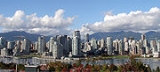
Vancouver is a Canadian city in the
province of
British Columbia. It is the largest metropolitan centre in western
Canada and the third largest in the country. Vancouver is one of the cities of the
Greater Vancouver Regional District and of the larger
geographic region commonly known as the Lower Mainland of B.C.
The
Port of Vancouver is significant on a world scale, and Vancouver is the third largest film production centre for US-based productions in
North America after
Hollywood and
New York, giving it the nickname of Hollywood North.
In 2006, Vancouver was ranked the 56th most expensive city to live among 144 major cities in the world, and the 2nd most expensive in Canada .
The city's population is estimated to be 583,267 and that of the metropolitan area 2,208,300 . Some predict that by 2020, the population of the metropolitan area will be 2.6 million. A resident of Vancouver is called a "Vancouverite."
The current mayor is
Sam Sullivan.
Vancouver will be the host city for the
2010 Winter Olympics, and the 2009
World Police and Fire Games. Swangard Stadium, just across the city line in
Burnaby, will host some games for the
2007 FIFA U-20 World Cup.
History
Archeological records indicate the presence of
Aboriginal peoples in the Vancouver area for at least 3,000 years. The traces of several settlements around Vancouver, indicate a food-gathering people with a complex social system.
The arrival of ships captained by José María Narváez of
Spain in 1791 and
George Vancouver of
Britain the following year, heralded great change for the lives of the First Nations. The explorer and
North West Company trader Simon Fraser and his crew were the first Europeans known to have visited the site of the present-day city. In 1808, they descended the
Fraser River perhaps as far as
Point Grey, near the
University of British Columbia. The first European settlement was established in 1862 at McCleery's Farm on the Fraser River, just east of the ancient village of Musqueam in what is now
Marpole. A sawmill established at Moodyville in 1863, began the city's long relationship with lumbering, and was quickly followed by mills on the south shore of the inlet owned by Captain Edward Stamp. Stamp, who had begun lumbering in the
Port Alberni area, first attempted to run a mill at Brockton Point, but difficult currents and reefs forced the relocation of the operation to a point near the foot of Dunlevy Street, known as Hastings Mill.
The settlement of Gastown grew up quickly around the original makeshift tavern established by “Gassy” Jack Deighton in 1867 on the edge of the Hastings Mill property. In 1870, the colonial government surveyed the settlement and laid out a townsite, renamed “Granville,” in honour of the then British Secretary of State for the Colonies,
Granville Leveson-Gower, 2nd Earl Granville. This site, with its natural harbour, was eventually selected as the terminus for the
Canadian Pacific Railway to the chagrin of
Port Moody,
New Westminster and
Victoria, all of which had vied to be the railhead. The building of the railway was among the preconditions for British Columbia joining Confederation in 1871. The City of Vancouver was incorporated on April 6, 1886, the same year that the first transcontinental train arrived.
A fire on Sunday, June 13 of that year destroyed most of the city, which was quickly rebuilt. Due to the advent of the railway, the population increased rapidly from 5,000 in 1887 to 100,000 in 1900. During the first decade of the twentieth century, Vancouver's population tripled and along with it came a
construction boom and, as
Rudyard Kipling noted on his visit to the new city in 1887, the "curious institution...called 'real estate'" and the speculative buying and selling of property. By 1890 the beginnings of one of the world's first electric street railways were promoting growth along what are now the city's main arterials, powered by ample hydroelectricity generated from nearby rivers and lakes
Geography
Vancouver is adjacent to the
Strait of Georgia, a body of
water that is shielded from the
Pacific Ocean by
Vancouver Island. It is in the Pacific
Time Zone , and the Pacific Maritime Ecozone. The city itself forms part of the
Burrard Peninsula, lying between
Burrard Inlet to the north and the
Fraser River to the south. Those unfamiliar with the region may be surprised to learn that Vancouver is not on
Vancouver Island. However, both the island and the city are named after
Royal Navy Captain
George Vancouver of
Great Britain, who explored the region in 1792.
Vancouver has an area of 114.67 km² , including both flat and hilly ground. Vancouver has a wet
climate and is surrounded by water; while early records show that there may have been as many as fifty creeks and streams in the area, currently only four are left.
Climate
Vancouver's climate is unusually temperate by Canadian standards; its winters are the fourth warmest of Canadian cities monitored by
Environment Canada, after nearby
Victoria,
Nanaimo, and Duncan, all of which are found on Vancouver Island. Vancouver has daily minimum temperatures falling below 0°C on an average of 46 days per year and below -10°C on only two days per year. Precipitation varies from about 1,100 mm at Point Grey to 3,500 mm or more near the north shore mountains. Summer months are generally sunny and very dry, often resulting in yellow grass in parks and lawns. Temperatures are moderate. The daily maximum averages 22°C in July and August, and temperatures rise above 30°C only about once every five summers on average. Recent summers have been getting warmer.
Thunderstorms are rare, with zero to about six per year. Rainfall is frequent in
winter; more than half of all winter days record measureable precipitation, snowfall much less so, with only 11 winter days averaging any snowfall, and only 3 days with amounts of 6 cm or greater.
Despite it's reputation as a cloudy city , Vancouver actually averages 288 days with measurable sunshine.
Flora
The original vegetation of most of Vancouver and its suburbs was dense
temperate rain forest, mostly conifers with scattered pockets of maple and alder, plus large areas of swampland . The conifers were the usual coastal BC mix of
Sitka spruce,
Western red cedar,
Western hemlock and
Douglas fir and yew, and were reckoned to be the greatest concentration of the largest of these trees on the entire British Columbia Coast; only those of Seattle's Elliott Bay rivalled those of Burrard Inlet and English Bay in size, and there too sawmills and lumbering sprang up to exploit the gigantic trees which were within an "easy"
drag of the shoreline, and therefore markets. The largest trees in Vancouver's old-growth forest were in the area of what is now
Gastown, where the first logging occurred, and on the south slopes of
False Creek and English Bay, especially around Jericho Beach. Stanley Park, which to most people appears to be first-growth, is actually mostly second and third growth and evidence of old-fashioned logging techniques such as
springboard notches can be seen throughout the park.
A diverse range of plants and trees were imported from other parts of the continent and from points across the Pacific and can be found growing throughout Vancouver and the Lower Mainland. Various species of palm trees have proven to be hardy to this climate, and are a common sight as are large numbers of other exotic trees including the
monkey puzzle tree, the
Japanese maple and various flowering exotics such as
magnolias,
azaleas and
rhododendrons. Many rhododendrons have grown to immense size as with other species imported from harsher climates in Eastern Canada or Europe; although the native
Douglas maple can attain tremendous size. Also, streets in large areas of the city are lined with varieties of flowering
Japanese cherry which were donated by
Japan in the 1930s and make an impressive show every spring. Certain areas of
West Vancouver which have the right balance of sunlight and rainfall are home to the
arbutus , which is more associated with the climate of the
Gulf Islands,
Greater Victoria, and northern
Puget Sound.
Scenery
Vancouver is internationally renowned for its beautiful scenery. Vancouver has one of North America's largest urban parks,
Stanley Park. The North Shore mountains dominate the city landscape, and on a clear day scenic vistas include the snow-capped volcano
Mount Baker in the State of
Washington to the southeast;
Vancouver Island across the
Strait of Georgia to the west and southwest and the Sunshine Coast to the northwest.
Air pollution
The air quality in the city has been deteriorating over the last several decades, largely due to the fast pace unable to be stopped immigration , increasing number of cars, and traffic jam all over Fraser Valley area, yellow sky can be seen year around. Vancouver is a fast-growing city on Canada’s west coast, where the car population is growing at almost twice the speed of the human population , and where the resulting volume of cars is causing increasing congestion, pollution, frustration, stress, and economic loss, as in so many cities around the world, although some actions have be taken by various levels of government . The British Columbia Lung Association reported that between 2001 and 2003, Vancouver had lower particulate matter pollution than other cities in British Columbia, including Victoria, Prince George, and Kelowna. Air quality in the Fraser Valley often suffers as Vancouver's pollution is blown in that direction and "boxed in" by the mountains. Air quality measurements for the Lower Fraser Valley, including Vancouver, are updated and published every hour online by the
Greater Vancouver Regional District.
Social fabric
Vancouver is considered to be a relaxed city, particularly by North American standards. There is a lively cultural scene, many diversions, and year-round access to outdoor activities such as hiking, cycling, boating, and skiing. Some have called it a "city of neighbourhoods", each with a distinct character and ethnic mix. The city is consistently ranked within the top 3 cities in the world in which to live.
Increasingly, however, this popularity comes with a price. Vancouver can be an expensive city, with the highest housing prices in Canada. A recent survey comparing median house prices to median incomes found Vancouver was the most unaffordable city for housing in Canada -- and the fifteenth worst in the world, just marginally better than
London. The city has adopted various strategies to reduce housing costs, including cooperative housing, legalized secondary suites, increased density and smart growth. Nevertheless, as with many other cities in North America, homelessness is a concern, as is the growing gap between
rich and
poor. The city’s residents are thought to be affluent, a superficial perception reinforced by the number of
luxury vehicles on city streets, the rate at which residential properties sell , and, according to the Vancouver Sun, the fact that Vancouverites are three times more likely to dine out than other Canadians. The issue of house prices is most evident because as of July 2006, 30% of all houses in Vancouver are listed at over a million dollars, which makes the city more expensive than in any other major Canadian city, with Toronto in second, with house prices averaging $370,000 in comparison. It should be noted that a number of municipalities in British Columbia within 2-3 hours from Vancouver, such as Whistler, Victoria, Langley, have average house prices ranging from $500,000 to 2.5 million dollars. In few other cities in Canada is the disparity between rich and poor so vivid. The
Downtown Eastside district of Vancouver is one of the poorest neighbourhoods in Canada,yet is located a mere six to ten blocks from expensive downtown areas such as the gentrified
Yaletown and
Coal Harbour neighbourhoods.
Vancouver's population density on the downtown peninsula is 49 people per acre . City planners in the late 1950s and 1960s deliberately encouraged the development of high-rise condominium towers in the
West End downtown neighbourhood, which has resulted in a compact, pedestrian/transit/bike friendly urban core. A major and ongoing downtown condominium construction boom began in the late 1990s, financed in large part by a huge flow of capital from
Hong Kong immigrants prior to the 1997 hand-over. High-rise residential developments from this period now dominate the Yaletown and Coal Harbour districts of the downtown peninsula, and also cluster around some of the SkyTrain stations on the east side of the city. Vancouver continues to pursue policies intended to increase density as an alternative to
sprawl, most recently in the form of Mayor
Sam Sullivan's Eco-Density initiative.
Vancouver is showing some evidence of attaining world city status.
Globalization and World Cities Study Group and Network gave the city two points.
Crime
As of 2005, Greater Vancouver had the highest crime rate among major Canadian cities . Vancouver's property-crime rate is particularly high; ranking among the highest rates of property crime for major cities in all of North America. One of the most common property crimes in the Vancouver area is automobile break-in; thus visitors are advised to conceal all items left in their car, and to use auto-theft protection devices.
Demographics
Vancouver is home to people of many ethnic backgrounds and religions. The Chinese are by far the largest visible ethnic minority group in the city. Vancouver has one of the most diverse Chinese-speaking communities, with several dialects of
Chinese being represented. Vancouver contains the second largest
Chinatown in North America . There are also many multicultural neighbourhoods, such as the
Punjabi Market, Little Italy, Greektown,
Japantown,
Commercial Drive, and a series of Koreatowns. Bilingual street signs can be seen at these centres of ethnic concentration.
Many immigrants from
Hong Kong made Vancouver their home following the transfer of sovereignty of that former British colony from the United Kingdom to China. This continued a tradition of immigration from around the world that had already established Vancouver as the second most multi-ethnic of Canada's cities before the Hong Kong influx began. Other significant Asian ethnic groups in Vancouver are South Asians , Vietnamese,
Filipino,
Korean,
Cambodian, and
Japanese.
Non-visible minorities, such as newly-arrived Eastern Europeans and the new wave of Latin American arrivals, are also a feature of the city's ethnic landscape. Prior to the Hong Kong influx of the 1980s, the largest non-British ethnic group in the city was German, followed by Ukrainian and the Scandinavian ethnicities.
There is also a sizable community of aboriginal people in Vancouver as well as in the surrounding metropolitan region, with the result that Vancouver constitutes the largest native community in the province.
Lifestyle
The city of Vancouver has developed a reputation as a tolerant city that is open to social experimentation and alternative lifestyles as well as being willing to explore alternative
drug policies. The city has adopted a
Four Pillars Drug Strategy, which combines harm reduction with treatment, enforcement, and prevention. The strategy is largely a response to endemic
HIV and
hepatitis C among injection drug users in the city's
Downtown Eastside neighbourhood. The area is characterized by entrenched poverty, the commercial sex trade, and an
AIDS epidemic that in the 1990s became the worst in the developed world. Some community and professional groups — such as
From Grief to Action and
Keeping the Door Open — are fostering public dialogue in the city about further alternatives to current drug policies. The former mayor, Larry Campbell, came to office in 2002 in part because of his willingness to champion alternative interventions for drug issues, such as supervised injection sites. Although it is technically illegal, Vancouver police generally do not arrest people for possessing small amounts of
marijuana. Police have, however, been involved in raids on cafes that openly sold marijuana and have aggressive programs to shut down hydroponic marijuana growing operations in residential areas.
While not completely free of racial tension, Vancouver is known for having more harmonious race relations than most large multiethnic cities. One result is a relatively high rate of intermarriage; mixed ethnicity couples are unremarkable in any neighbourhood. Sushi is one of the most popular foods in the city, with more than 300 sushi restaurants in the metropolitan area. Both the annual Dragon Boat Festival and Lunar New Year's Day Parade are well attended by residents of all ethnic backgrounds. Vancouver has a relatively large music and arts scene and one of the largest gay communities in
North America. The area of downtown along Davie Street is home to most of the city's gay clubs and bars and is known as Davie Village. Every year Vancouver holds one of the country's largest Gay Pride Parades, which attracts as many as hundreds of thousands of spectators.
The influx of
Hong Kong immigrants in the 1980s led to the popularization of a brag invented by new-immigrant Chinese youths from Hong Kong, who dubbed the city "Hongcouver". It was largely a media phenomenon and was never in wide usage among Vancouverites , although it may have become current in other cities and areas of BC for a short time because of the media coverage.
Rankings
Vancouver consistently ranks among the top five cities in worldwide "quality of life" rankings. Most recently, the city ranked first in a worldwide quality of life survey conducted by the Economist Intelligence Unit. In a similar survey by Mercer Human Resource Consulting, Vancouver ranked second in 2002 and 2003 and third in 2004. Vancouver has tied for first with the cities of
Salzburg and
Oslo among the
UN chosen cities for highest living standards the last 4 years running. Condé Nast Traveler magazine named Vancouver the "Readers' Choice #1 City in the Americas" for 2005. The city generally ranks first when compared to its Canadian and U.S. peers.
The City of Vancouver also maintains a running public record of the complete list of city awards that Vancouver has won.
Economy
With its location on the
Pacific Rim and at the western terminus of Canada's
transcontinental highway and rail routes, Vancouver is one of the nation's largest industrial centres.
The
Port of Vancouver, Canada's largest and most diversified, does more than $43 billion in trade with over 90 countries annually. Port activities generate $4 billion in gross domestic product and $8.9 billion in economic output.
Vancouver is the headquarters of
forest product and
mining companies. In recent years, Vancouver has become an increasingly important centre for
software development,
biotechnology and a vibrant
film industry.
The city’s scenic location makes it a major tourist destination. Visitors come for the city’s gardens,
Stanley Park, Queen Elizabeth Park, and a combination of mountains, ocean, forest and parklands surrounding the city. The city's numerous beaches, parks, waterfronts, and mountain backdrop, combined with its cultural and multi-ethnic character, all contribute to its unique appeal and style. Over a million people annually pass through Vancouver en route to a
cruise ship vacation, usually to
Alaska.
Vancouver International Airport is Canada's second busiest airport and the second largest gateway on the west coast of North America for international passengers.
The
1986 World Exposition was held in Vancouver. This
World's Fair was the last to be held in North America and was considered to be a great success.
Government and politics
Vancouver is governed by the ten-member Vancouver City Council, a nine-member School Board, and a seven-member Parks Board, all elected for three-year terms through an at-large system.
Historically, in all levels of government, the more affluent west side of Vancouver has voted along
conservative or centre-right lines while the eastern side of the city has voted along left-wing lines. This was reaffirmed with the results of the
2005 provincial election.
Though polarized, a political consensus has emerged in Vancouver around a number of issues. Protection of urban parks, a focus on the development of rapid transit as opposed to a freeway system, a harm reduction approach to illegal drug use and a general concern about community based development are examples of policies that have come to have broad support across the
political spectrum in Vancouver.
In 1983, the City of Vancouver was one of the first cities in the world to declare itself a "Nuclear Weapons Free Zone". City Council has amended its policies and erected signage to this effect. This is mostly a symbolic declaration; Canadian municipalities have no jurisdiction over what can and cannot be brought into city limits,
and foreign countries do not disclose what weapons are on board visiting military vessels.
In the 2005 Municipal Election elections, City Council moved back to the right after a term dominated by the leftist Coalition of Progressive Electors .
Sam Sullivan of the centre-right Non-Partisan Association narrowly defeated Jim Green for the position of mayor and was joined by 5 of his party's members on Council. The moderate left Vision Vancouver brought 4 members to Council with the final seat going to COPE. The NPA also won 6 of 9 School Board seats and 5 of 7 Parks Board seats, while the remaining Board seats were won by COPE. Former Mayor
Larry Campbell chose not to run for re-election and was subsequently appointed to the
Senate of Canada.
In the
Legislative Assembly of British Columbia, Vancouver has ten constituencies: in the
2005 provincial election, the
BC Liberal Party and the
BC New Democratic Party each won five seats.
In the
Canadian House of Commons, Vancouver has five constituencies: in the
2004 federal elections, the
Liberal Party of Canada won four seats, while the
New Democratic Party won one. In the
2006 federal elections, all the same MPs were re-elected. However, on February 6, 2006,
David Emerson of
Vancouver Kingsway defected to the
Conservative Party, giving the Conservatives one seat in Vancouver. As of February 2006, the Liberals hold three seats, and the NDP and the Conservatives hold one each.
Infrastructure
Transportation
Municipal bylaws and geography have prevented the spread of urban
freeways, and the only major freeway within city limits is
Highway 1, which passes through the eastern edge of the city.
TransLink, the
Greater Vancouver Regional District transportation authority, is responsible for roads and public transportation within region. It provides
bus service,
B-Line Rapid Bus Service , a foot passenger and bicycle ferry service , a two-line automated metro system called
SkyTrain, and the commuter rail
West Coast Express. Future projects include the
Canada Line, a commuter metro line will connect YVR and the neighbooring municipality, Richmond together from Downtown in less than 26 min. .
Inter-city passenger rail service is operated from Pacific Central Station by
VIA Rail to points east;
Amtrak Cascades to
Seattle, Washington; and
Rocky Mountaineer rail tour routes. The city is also served by two
B.C. Ferries terminals. One is to the northwest at
Horseshoe Bay,
West Vancouver, and the other is to the south, at
Tsawwassen .
Vancouver is served by
Vancouver International Airport , located on Sea Island in the City of
Richmond, immediately south of Vancouver.
HeliJet and two
float plane companies operate scheduled air service from Vancouver harbour.
Elect