

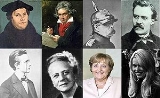
Germans

Encyclopedia
The Germans are a Germanic
ethnic group
native to Central Europe
. The English term Germans has referred to the German-speaking
population of the Holy Roman Empire
since the Late Middle Ages
.
Of approximately 100 million native speakers of German in the world, about 66–75 million consider themselves Germans. There are an additional 80 million people of German ancestry mainly in the United States, Brazil, Canada, Argentina, France, Russia, Chile
, Poland, Australia and Romania
who most likely are not native speakers of German. Thus, the total number of Germans worldwide lies between 66 and 160 million, depending on the criteria applied (native speakers, single-ancestry ethnic Germans, partial German ancestry, etc.).
Today, peoples from countries with a German-speaking majority or significant German-speaking population groups other than Germany, such as Austria
, Switzerland, Liechtenstein
and Luxembourg
, have developed their own national identity and usually do not refer to themselves as Germans in a modern context.
 The German term Deutsche originates from the Old High German
word diutisc (from diot "people"), referring to the Germanic
"language of the people". It not clear that how commonly, if at all, the word was used as an ethnonym in Old High German.
Used as a noun, ein diutscher in the sense of "a German" emerges in Middle High German
, attested from the second half of the 12th century.
The Old French
term alemans is taken from the name of the Alamanni
. It was loaned into Middle English
as almains in the early 14th century. The word dutch is attested in English from the 14th century, denoting continental West Germanic ("Dutch" and "German") dialects and their speakers.
While in most the Romance languages the Germans have been named from the Swabia
ns or Alamanni (some, like standard Italian, retain an older borrowing of the endonym), the Old Norse
, Finnish and Estonian names of the Germans was taken from that of the Saxons
. In Slavic languages
, the Germans were given the name of (singular ), originally with a meaning "foreigner, one who does not speak [Slavic]".
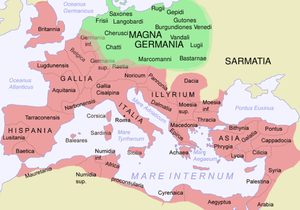
The English term Germans is only attested from the mid-16th century, based on the classical Latin term Germani used by Julius Caesar
and later Tacitus
. It gradually replaced Dutch and Almains, the latter becoming mostly obsolete by the early 18th century.
Persons who speak German as their first language, look German and whose families have lived in German for generations are considered "most German", followed by categories of diminishing Germanness such as Aussiedler (people of German ancestry whose families have lived in Eastern Europe but who have returned to Germany), Restdeutsche (people living in lands that have historically belonged to Germany but which is currently outside of Germany), Auswanderer (people whose families have emigrated from Germany and who still speak German), German speakers in German speaking nations such as Austrians
, and finally people of German emigrant background who no longer speak German.
, the Peace of Westphalia
(1648) left a core territory that was to become Germany.
in Southern Germany
and the (Germanic
) Jastorf culture
in Northern Germany
.
The Germanic peoples during the Migrations Period
came into contact with other peoples; in the case of the populations settling in the territory of modern Germany, they encountered Celts to the south, and Balts
and Slavs towards the east.
The Limes Germanicus
was breached in AD 260. Migrating Germanic tribes commingled with the local Gallo-Roman populations in what is now Swabia
and Bavaria
.
The migration-period peoples who would coalesce into a "German" ethnicity were the Saxons
, Franci
, Thuringii
, Alamanni
and Bavarii
. By the 800s, the territory of modern Germany had been united under the rule of Charlemagne
. Much of what is now Eastern Germany
became Slavonic-speaking (Sorbs
and Veleti
), after these areas were vacated by Germanic tribes (Vandals
, Lombards
, Burgundians
and Suebi
amongst others) which had migrated into the former areas of the Roman Empire
.
, ultimately as a result of the formation of the kingdom of Germany
within East Francia and later the Holy Roman Empire
, beginning in the 9th century. The process was gradual and lacked any clear definition, and the use of exonyms designating "the Germans" develops only during the High Middle Ages
. The title of rex teutonicum "King of the Germans" is first used in the late 11th century, by the chancery of Pope Gregory VII
. Natively, the term ein diutscher "a German" is used of the people of Germany from the 12th century.
After Christianization, the Roman Catholic Church and local rulers led German expansion and settlement in areas inhabited by Slavs and Balts (Ostsiedlung
). Massive German settlement led to their assimilation of Baltic (Old Prussians
) and Slavic (Wends
) populations, who were exhausted by previous warfare. At the same time, naval innovations led to a German domination of trade in the Baltic Sea
and parts of Eastern Europe through the Hanseatic League
. Along the trade routes, Hanseatic trade stations became centers of German culture. German town law
(Stadtrecht) was promoted by the presence of large, relatively wealthy German populations and their influence on political power.
Thus people who would be considered "Germans", with a common culture, language, and worldview different from that of the surrounding rural peoples, colonized trading towns as far north of present-day Germany as Bergen (in Norway
), Stockholm
(in Sweden
), and Vyborg
(now in Russia). The Hanseatic League was not exclusively German in any ethnic sense: many towns who joined the league were outside the Holy Roman Empire and a number of them may only loosely be characterized as German. The Empire was not entirely German either.

 From the late 15th century, the Holy Roman Empire came to be known as the Holy Roman Empire of the German nation, even though it was not exclusively German, and notably included sizeable Slavic minorities.
The Thirty Years' War
, a series of conflicts fought mainly in the territory of modern Germany, weakened the coherence of the Holy Roman Empire, leading to the Kleinstaaterei
in 18th-century Germany.
The Napoleonic Wars
were the cause of the final dissolution of the Holy Roman Empire, and ultimately the cause for the quest for a German nation state in 19th-century German nationalism. After the Congress of Vienna
, Austria
and Prussia
emerged as two competitors. Austria, trying to remain the dominant power in Central Europe, led the way in the terms of the Congress of Vienna. The Congress of Vienna was essentially conservative, assuring that little would change in Europe and preventing Germany from uniting. These terms came to a sudden halt following the Revolutions of 1848
and the Crimean War
in 1856, paving the way for German unification in the 1860s.
In 1866
, because Austria and Prussia could not decide on what was the right solution on how a unified Germany
was to happen caused several problems inside the German Confederation
between the two top German states. The main reasons behind this war was because the Austrian Empire
was not willing to give up any of the German lands it owned and was hoping to unify and lead Germany as "Greater Germany" and therefore did not want to take second place to Prussia. On the other hand Prussia was wanting to unify Germany as "Little Germany" and exclude Austria from it. This consequently seen the Prussians successfully defeat the Austrians and thus Austria now was no longer part of the German Confederation and no longer took part in German politics and the "Little Germany" was prevailed.
In 1870, after France attacked Prussia, Prussia and its new allies in Southern Germany (among them Bavaria) were victorious in the Franco-Prussian War
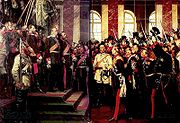
. It created the German Empire
in 1871 as a German nation-state
, effectively excluding the multi-ethnic Austrian Habsburg monarchy
and Liechtenstein
. Integrating the German-speaking Austrians nevertheless remained a strong desire for many people of Germany and Austria, especially among the liberals, the social democrats and also the Catholics who were a minority in Germany.
During the 19th century in the German territories, rapid population growth due to lower death rates, combined with poverty, spurred millions of Germans to emigrate, chiefly to the United States. Today, roughly 17% of the United States' population (23% of the white
population) is of mainly German ancestry.

The dissolution of the Austrian-Hungarian Empire
after World War I led to a strong desire of the population of the new Republic of German Austria to be integrated into Germany or Switzerland. This was, however, prevented by the Treaty of Versailles
.
The Nazis, led by Adolf Hitler
, attempted to unite all people they claimed Germans (Volksdeutsche
) into one realm, including ethnic Germans in eastern Europe, many of whom had emigrated more than one hundred fifty years before and developed separate cultures in their new lands. This idea was initially welcomed by many ethnic Germans in Czechoslovakia
, Austria, Poland
, Danzig
and western Lithuania
. The Swiss resisted the idea. They had viewed themselves as a distinctly separate nation since the Peace of Westphalia
of 1648.
After World War II, eastern European nations, including areas annexed by the Soviet Union
and Poland
, expelled ethnic Germans from their territories, including Czechoslovakia
, Hungary, Romania
and Yugoslavia
. 14 million ethnic German refugees fled to western Germany and Europe, the United States, Canada, and South America.
After WWII, Austrians
increasingly saw themselves as a separate nation from the German nation. Recent polls show that no more than 6% of the German-speaking Austrians consider themselves as "Germans". An Austrian identity was vastly emphasized along with the "first-victim of Nazism theory." Today over 80 percent of the Austrians see themselves as an independent nation.
and Romania
, arrived in Germany under special provisions of right of return. With the collapse of the Iron Curtain
since 1987, 3 million "Aussiedler" – ethnic Germans, mainly from Eastern Europe and the former Soviet Union
– took advantage of Germany's law of return to leave the "land of their birth" for Germany. Approximately 2 million, just from the territories of the former Soviet Union, have resettled in Germany since the late 1980s. On the other hand, significant numbers of ethnic Germans have moved from Germany to other European countries, especially Switzerland
, the Netherlands
, Britain, Spain and Portugal
.
and R1a
followed by R1b
; the predominant mitochondrial haplogroup is H
, followed by U
and T
.
, related to and classified alongside English, Dutch
and Scandinavian. Spoken by approximately 100 million native speakers
, German is one of the world's major languages
and the most widely spoken first language
in the European Union
.
There are several dialects of German:
Ethnic German
s form an important minority group in several countries in central
and eastern Europe—(Poland
, Hungary
, Romania
, Russia
) as well as in Namibia
(German Namibian), Brazil
(German-Brazilian
) (approx. 3% of the population), Argentina
(German-Argentine) (1,5% ~ 7,5% of the population) and Chile
(German-Chilean) (approx. 1% of the population).
Some groups may be classified as Ethnic Germans despite no longer having German as their mother tongue or belonging to a distinct German culture. Until the 1990s, two million Ethnic Germans lived throughout the former Soviet Union, particularly in Russia and Kazakhstan
.
In the United States 1990 census, 57 million people were fully or partly of German ancestry, forming the largest single ethnic group in the country. States with the highest percentage of Americans of German descent are in the northern Midwest (especially Wisconsin
, Minnesota
, North Dakota
, South Dakota
, Nebraska
, Iowa
, Kansas
, Michigan
) and the Mid-Atlantic
state, Pennsylvania
. But Germanic immigrant enclaves existed in many other states (e.g., the German Texan
s and the Denver, Colorado area) and to a lesser extent, the Pacific Northwest (i.e. Idaho
, Montana
, Oregon
and Washington state
).
Notable Ethnic German minorities also exist in other Anglosphere
countries such as Canada
(approx. 10% of the population) and Australia
(approx. 4% of the population). As in the United States, most people of German descent in Canada and Australia have almost completely assimilated, culturally and linguistically, into the English-speaking mainstream.
Distribution of German citizens, German speakers, and people claiming German ancestry:
Geographic distribution of native speakers of varieties
of the German language:
.jpg)
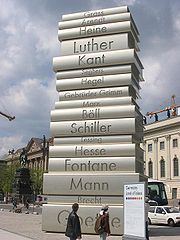 German literature can be traced back to the Middle Ages
, with the most notable authors of the period being Walther von der Vogelweide
and Wolfram von Eschenbach
.
The Nibelungenlied
, whose author remains unknown, is also an important work of the epoch, as is the Thidrekssaga. The fairy tales collections collected and published by Jacob and Wilhelm Grimm
in the 19th century became famous throughout the world.
Theologian Luther
, who translated the Bible into German, is widely credited for having set the basis for the modern "High German" language. Among the most admired German poets and authors are Lessing
, Goethe
, Schiller
, Kleist
, Hoffmann
, Brecht
, Heine
and Schmidt
. Nine Germans have won the Nobel Prize in literature
: Theodor Mommsen
, Paul von Heyse, Gerhart Hauptmann
, Thomas Mann
, Nelly Sachs
, Hermann Hesse
, Heinrich Böll
, Günter Grass
, and Herta Müller
.
.jpg) Germany's influence on philosophy is historically significant and many notable German philosophers have helped shape Western philosophy
Germany's influence on philosophy is historically significant and many notable German philosophers have helped shape Western philosophy
since the Middle Ages. The rise of the modern natural sciences and the related decline of religion raised a series of questions, which recur throughout German philosophy, concerning the relationships between knowledge and faith, reason and emotion, and scientific, ethical, and artistic ways of seeing the world.
German philosophers have helped shape western philosophy
from as early as the Middle Ages (Albertus Magnus
). Later, Leibniz
(17th century) and most importantly Kant
played central roles in the history of philosophy
. Kantianism
inspired the work of Schopenhauer
and Nietzsche as well as German idealism
defended by Fichte
and Hegel
. Marx
and Engels
developed communist theory in the second half of the 19th century while Heidegger
and Gadamer
pursued the tradition of German philosophy in the 20th century. A number of German intellectuals were also influential in sociology
, most notably Adorno, Habermas
, Horkheimer
, Luhmann
, Simmel
, Tönnies
, and Weber
. The University of Berlin
founded in 1810 by linguist and philosopher Wilhelm von Humboldt
served as an influential model for a number of modern western universities.
In the 21st century Germany has been an important country for the development of contemporary analytic philosophy in continental Europe, along with France, Austria, Switzerland and the Scandinavian countries.
 Germany has been the home of many famous inventors and engineers, such as Johannes Gutenberg, who is credited with the invention of movable type
printing
in Europe; Hans Geiger, the creator of the Geiger counter
; and Konrad Zuse
, who built the first electronic computer. German inventors, engineers and industrialists such as Zeppelin
, Daimler
, Diesel
, Otto, Wankel
, Von Braun
and Benz
helped shape modern automotive and air transportation technology including the beginnings of space travel.
The work of David Hilbert
and Max Planck
was crucial to the foundation of modern physics
, which Werner Heisenberg
and Erwin Schrödinger
developed further. They were preceded by such key physicists as Hermann von Helmholtz
, Joseph von Fraunhofer
, and Gabriel Daniel Fahrenheit, among others. Wilhelm Conrad Röntgen
discovered X-ray
s, an accomplishment that made him the first winner of the Nobel Prize in Physics
in 1901. The Walhalla temple
for "laudable and distinguished Germans", features a number of scientists, and is located east of Regensburg
, in Bavaria
.
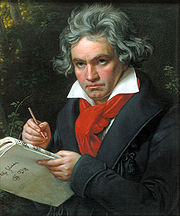
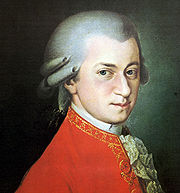 In the field of music, Germany claims some of the most renowned classical
composers of the world including Bach
, Mozart and Beethoven
, who marked the transition between the Classical and Romantic
eras in Western classical music. Other composers of the Austro
-German tradition who achieved international fame include Brahms
, Wagner
, Haydn
, Schubert
, Händel
, Schumann
, Liszt
, Mendelssohn Bartholdy
, Johann Strauss II
, Bruckner
, Mahler
, Telemann
, Richard Strauss
, Schoenberg
, Orff
, and most recently, Henze
, Lachenmann
, and Stockhausen
.
As of 2006, Germany is the fifth largest music market in the world and has exerted a strong influence on Dance and Rock music, and pioneered trance music
. Artists such as Herbert Grönemeyer
, Scorpions
, Rammstein
, Nena
, Dieter Bohlen
, Tokio Hotel
and Modern Talking
have enjoyed international fame. German musicians and, particularly, the pioneering bands Tangerine Dream
and Kraftwerk
have also contributed to the development of electronic music
. Germany hosts many large rock music festivals annually. The Rock am Ring
festival is the largest music festival in Germany, and among the largest in the world. German artists also make up a large percentage of Industrial music
acts, which is called Neue Deutsche Härte
. Germany hosts some of the largest Goth
scenes and festivals in the entire world, with events like Wave-Gothic-Treffen and M'era Luna Festival
easily attracting up to 30,000 people. Amongst Germany's famous artists there are
various Dutch entertainers, such as Johannes Heesters
, Rudi Carell and Sylvie van der Vaart.
German cinema dates back to the very early years of the medium with the work of Max Skladanowsky
. It was particularly influential during the years of the Weimar Republic
with German expressionists
such as Robert Wiene
and Friedrich Wilhelm Murnau
. The Nazi era produced mostly propaganda films although the work of Leni Riefenstahl
still introduced new aesthetics in film. From the 1960s, New German Cinema
directors such as Volker Schlöndorff
, Werner Herzog
, Wim Wenders
, Rainer Werner Fassbinder
placed West-German
cinema back onto the international stage with their often provocative films, while the Deutsche Film-Aktiengesellschaft
controlled film production in the GDR. More recently, films such as Das Boot
(1981), The Never Ending Story
(1984) Run Lola Run
(1998), Das Experiment
(2001), Good Bye Lenin!
(2003), Gegen die Wand (Head-on)
(2004) and Der Untergang (Downfall) (2004) have enjoyed international success. In 2007 the Academy Award for Best Foreign Language Film went to F.H. von Donnersmarck
's The Lives of Others
. The Berlin Film Festival, held yearly since 1951, is one of the world's foremost film and cinemas festivals.
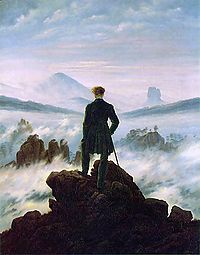
painters include Albrecht Altdorfer
, Lucas Cranach the Elder
, Matthias Grünewald
, Hans Holbein the Younger
and the well-known Albrecht Dürer
. The most important Baroque
artists from Germany are Cosmas Damian Asam
. Further artists are the romantic
Caspar David Friedrich
, the surrealist
Max Ernst
, the conceptualist
Joseph Beuys
or the neo-expressionist
Georg Baselitz
.
contributions from Germany include the Carolingian
and Ottonian styles
, important precursors of Romanesque
. The region then produced significant works in styles such as the Gothic
, Renaissance
and Baroque
. The nation was particularly important in the early modern movement
through the Deutscher Werkbund
and the Bauhaus
movement identified with Walter Gropius
. The Nazis
closed these movements and favoured a type of neo-classicism. Since World War II, further important modern and post-modern structures have been built, particularly since the reunification of Berlin.
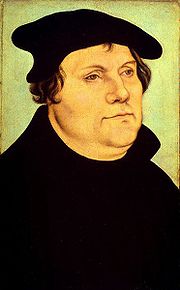 64.1 percent of the German population belongs to Christian denominations. 31.4 percent are Roman Catholic
, and 32.7 percent are affiliated with Protestantism
(the figures are known accurately because Germany imposes a church tax
on those who disclose a religious affiliation / but there are many people, who are religious but not registered). The North and East is predominantly Protestant, the South and West rather Catholic. Nowadays there is a non-religious majority in Hamburg and the East German states.
Germany formed a substantial part of the Roman Catholic Holy Roman Empire
, but was also the source of Protestant reformers
such as Martin Luther
. Historically, Germany had a substantial Jewish population
. Only a few thousand people of Jewish origin remained in Germany after the Holocaust
, but the German Jewish community now has approximately 100,000 members, many from the former Soviet Union
. Germany also has a substantial Muslim minority, most of whom are from Turkey
.
German theologians include Luther
, Melanchthon
, Schleiermacher, Feuerbach
, and Rudolf Otto
. Also Germany brought up many mystics
including Meister Eckhart
, Rudolf Steiner
, Jakob Boehme, and some popes (e.g. Benedict XVI).
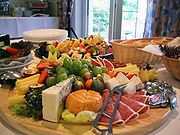 The "home cuisine" differs very much from the "restaurant cuisine". More traditional dishes can be found in restaurants. Cuisine differs also greatly according to regions (in the north people eat fish, in the Rhine region beer is replaced with wine, in Bavaria roasted pork is consumed) and season (in spring people eat white asparagus with ham and sauce hollandaise, in fall people eat green cabbage with a special kind of sausage and mustard and in winter/for Christmas people eat duck or goose with red cabbage, dumplings and brown gravy).
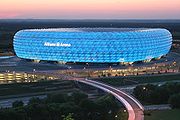 Sport forms an integral part of German life, as demonstrated by the fact that 27 million Germans are members of a sports club and an additional twelve million pursue such an activity individually. Football is by far the most popular sport, and the German Football Federation (Deutscher Fußballbund) with more than 6.3 million members is the largest athletic organisation in the country. It also attracts the greatest audience, with hundreds of thousands of spectators attending Bundesliga
matches and millions more watching on television. The other two most popular sports in Germany are marksmanship
and tennis represented by the German Marksmen’s Federation and the German Tennis Federation respectively, both including more than a million members. Other popular sports include handball
, volleyball, basketball, and ice hockey
. Germany has historically been one of the strongest contenders in the Olympic Games. In the 2008 Summer Olympics
, Germany finished fifth overall, whereas in the 2006 Winter Olympics
Germany finished first.
. The wars launched a new movement that was born in France itself during the French Revolution. Nationalism during the 19th century threatened the old aristocratic regimes. Many ethnic groups of Central and Eastern Europe had been divided for centuries, ruled over by the old Monarchies of the Romanovs and the Habsburgs. Germans, for the most part, had been a loose and disunited people since the Reformation
when the Holy Roman Empire
was shattered into a patchwork of states. The new German nationalists, mostly young reformers such as Johann Tillmann of East Prussia
, sought to unite all the German-speaking and ethnic-German (Volksdeutsche) people.
and the Austrian Empire
were the two most powerful nations dominated by German-speaking elites. Both sought to expand their influence and territory. The Austrian Empire – like the Holy Roman Empire
– was a multi-ethnic state, but German-speaking people there did not have an absolute numerical majority; the creation of the Austro-Hungarian Empire was one result of the growing nationalism of other ethnicities especially the Hungarians. Prussia under Otto von Bismarck
would ride on the coat-tails of nationalism to unite all of modern-day Germany. The German Empire
("Second Reich") was created in 1871 following the proclamation of Wilhelm I as head of a union of German-speaking states, while disregarding millions of its non-German subjects who desired self-determination from German rule.
There was also a rejection of Roman Catholicism with the Away from Rome!
movement calling for German speakers to identify with Lutheran or Old Catholic churches.
.jpg) Following the defeat in World War I, influence of German-speaking elites over Central
Following the defeat in World War I, influence of German-speaking elites over Central
and Eastern Europe was greatly limited. At the treaty of Versailles
Germany was substantially reduced in size. Austria-Hungary was split up. Rump-Austria, which to a certain extent corresponded to the German-speaking areas of Austria-Hungary (a complete split into language groups was impossible due to multi-lingual areas and language-exclaves) adopted the name "German-Austria" . The name German-Austria was forbidden by the victorious powers of World War I. Volga Germans living in the Soviet Union
were interned in gulag
s or forcibly relocated during the second world war
.
The Heim ins Reich
initiative (German: literally Home into the Empire, meaning Back to Reich, see Reich
) was a policy pursued by Nazi Germany
which attempted to convince people of German descent living outside of Germany (such as Sudetenland
) that they should strive to bring these regions "home" into a greater Germany.
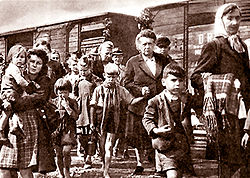 World War II brought about the decline of Pan-Germanism
, much as World War I had led to the demise of Pan-Slavism
. The Germans in Central and Eastern Europe were expelled, parts of Germany itself were devastated, and the country was divided, firstly into Russian, French, American, and British zones and then into West Germany
and East Germany. To add to the disaster, Germany suffered even larger territorial losses than it did in the First World War, with huge portions of eastern Germany directly annexed by the Soviet Union and Poland
. The scale of the Germans' defeat was unprecedented. Nationalism and Pan-Germanism became almost taboo because they had been used so destructively by the Nazis. Indeed, the word "Volksdeutscher" in reference to ethnic Germans naturalized during WWII later developed into a mild epithet.
However, the reunification of Germany
in 1990 revived the old debates. The fear of nationalistic misuse of Pan-Germanism nevertheless remains strong. But the overwhelming majority of Germans today are not chauvinistic in nationalism, but in 2006 and again in 2010, the German National Football Team won third place in the 2006
and 2010 FIFA World Cup
s, ignited a positive scene of German pride, in fanfare when it comes to sport.
Germanic peoples
The Germanic peoples are an Indo-European ethno-linguistic group of Northern European origin, identified by their use of the Indo-European Germanic languages which diversified out of Proto-Germanic during the Pre-Roman Iron Age.Originating about 1800 BCE from the Corded Ware Culture on the North...
ethnic group
Ethnic group
An ethnic group is a group of people whose members identify with each other, through a common heritage, often consisting of a common language, a common culture and/or an ideology that stresses common ancestry or endogamy...
native to Central Europe
Central Europe
Central Europe or alternatively Middle Europe is a region of the European continent lying between the variously defined areas of Eastern and Western Europe...
. The English term Germans has referred to the German-speaking
German language
German is a West Germanic language, related to and classified alongside English and Dutch. With an estimated 90 – 98 million native speakers, German is one of the world's major languages and is the most widely-spoken first language in the European Union....
population of the Holy Roman Empire
Holy Roman Empire
The Holy Roman Empire was a realm that existed from 962 to 1806 in Central Europe.It was ruled by the Holy Roman Emperor. Its character changed during the Middle Ages and the Early Modern period, when the power of the emperor gradually weakened in favour of the princes...
since the Late Middle Ages
Late Middle Ages
The Late Middle Ages was the period of European history generally comprising the 14th to the 16th century . The Late Middle Ages followed the High Middle Ages and preceded the onset of the early modern era ....
.
Of approximately 100 million native speakers of German in the world, about 66–75 million consider themselves Germans. There are an additional 80 million people of German ancestry mainly in the United States, Brazil, Canada, Argentina, France, Russia, Chile
Chile
Chile ,officially the Republic of Chile , is a country in South America occupying a long, narrow coastal strip between the Andes mountains to the east and the Pacific Ocean to the west. It borders Peru to the north, Bolivia to the northeast, Argentina to the east, and the Drake Passage in the far...
, Poland, Australia and Romania
Romania
Romania is a country located at the crossroads of Central and Southeastern Europe, on the Lower Danube, within and outside the Carpathian arch, bordering on the Black Sea...
who most likely are not native speakers of German. Thus, the total number of Germans worldwide lies between 66 and 160 million, depending on the criteria applied (native speakers, single-ancestry ethnic Germans, partial German ancestry, etc.).
Today, peoples from countries with a German-speaking majority or significant German-speaking population groups other than Germany, such as Austria
Austria
Austria , officially the Republic of Austria , is a landlocked country of roughly 8.4 million people in Central Europe. It is bordered by the Czech Republic and Germany to the north, Slovakia and Hungary to the east, Slovenia and Italy to the south, and Switzerland and Liechtenstein to the...
, Switzerland, Liechtenstein
Liechtenstein
The Principality of Liechtenstein is a doubly landlocked alpine country in Central Europe, bordered by Switzerland to the west and south and by Austria to the east. Its area is just over , and it has an estimated population of 35,000. Its capital is Vaduz. The biggest town is Schaan...
and Luxembourg
Luxembourg
Luxembourg , officially the Grand Duchy of Luxembourg , is a landlocked country in western Europe, bordered by Belgium, France, and Germany. It has two principal regions: the Oesling in the North as part of the Ardennes massif, and the Gutland in the south...
, have developed their own national identity and usually do not refer to themselves as Germans in a modern context.
Name
Old High German
The term Old High German refers to the earliest stage of the German language and it conventionally covers the period from around 500 to 1050. Coherent written texts do not appear until the second half of the 8th century, and some treat the period before 750 as 'prehistoric' and date the start of...
word diutisc (from diot "people"), referring to the Germanic
Germanic languages
The Germanic languages constitute a sub-branch of the Indo-European language family. The common ancestor of all of the languages in this branch is called Proto-Germanic , which was spoken in approximately the mid-1st millennium BC in Iron Age northern Europe...
"language of the people". It not clear that how commonly, if at all, the word was used as an ethnonym in Old High German.
Used as a noun, ein diutscher in the sense of "a German" emerges in Middle High German
Middle High German
Middle High German , abbreviated MHG , is the term used for the period in the history of the German language between 1050 and 1350. It is preceded by Old High German and followed by Early New High German...
, attested from the second half of the 12th century.
The Old French
Old French
Old French was the Romance dialect continuum spoken in territories that span roughly the northern half of modern France and parts of modern Belgium and Switzerland from the 9th century to the 14th century...
term alemans is taken from the name of the Alamanni
Alamanni
The Alamanni, Allemanni, or Alemanni were originally an alliance of Germanic tribes located around the upper Rhine river . One of the earliest references to them is the cognomen Alamannicus assumed by Roman Emperor Caracalla, who ruled the Roman Empire from 211 to 217 and claimed thereby to be...
. It was loaned into Middle English
Middle English
Middle English is the stage in the history of the English language during the High and Late Middle Ages, or roughly during the four centuries between the late 11th and the late 15th century....
as almains in the early 14th century. The word dutch is attested in English from the 14th century, denoting continental West Germanic ("Dutch" and "German") dialects and their speakers.
While in most the Romance languages the Germans have been named from the Swabia
Swabia
Swabia is a cultural, historic and linguistic region in southwestern Germany.-Geography:Like many cultural regions of Europe, Swabia's borders are not clearly defined...
ns or Alamanni (some, like standard Italian, retain an older borrowing of the endonym), the Old Norse
Old Norse
Old Norse is a North Germanic language that was spoken by inhabitants of Scandinavia and inhabitants of their overseas settlements during the Viking Age, until about 1300....
, Finnish and Estonian names of the Germans was taken from that of the Saxons
Saxons
The Saxons were a confederation of Germanic tribes originating on the North German plain. The Saxons earliest known area of settlement is Northern Albingia, an area approximately that of modern Holstein...
. In Slavic languages
Slavic languages
The Slavic languages , a group of closely related languages of the Slavic peoples and a subgroup of Indo-European languages, have speakers in most of Eastern Europe, in much of the Balkans, in parts of Central Europe, and in the northern part of Asia.-Branches:Scholars traditionally divide Slavic...
, the Germans were given the name of (singular ), originally with a meaning "foreigner, one who does not speak [Slavic]".
The English term Germans is only attested from the mid-16th century, based on the classical Latin term Germani used by Julius Caesar
Julius Caesar
Gaius Julius Caesar was a Roman general and statesman and a distinguished writer of Latin prose. He played a critical role in the gradual transformation of the Roman Republic into the Roman Empire....
and later Tacitus
Tacitus
Publius Cornelius Tacitus was a senator and a historian of the Roman Empire. The surviving portions of his two major works—the Annals and the Histories—examine the reigns of the Roman Emperors Tiberius, Claudius, Nero and those who reigned in the Year of the Four Emperors...
. It gradually replaced Dutch and Almains, the latter becoming mostly obsolete by the early 18th century.
German Ethnic Identity
The German ethnic identity is complex, and has been described as forming a continuum of "Germanness" defined by factors such as language, appearance, family background, country of residence and country of origin.Persons who speak German as their first language, look German and whose families have lived in German for generations are considered "most German", followed by categories of diminishing Germanness such as Aussiedler (people of German ancestry whose families have lived in Eastern Europe but who have returned to Germany), Restdeutsche (people living in lands that have historically belonged to Germany but which is currently outside of Germany), Auswanderer (people whose families have emigrated from Germany and who still speak German), German speakers in German speaking nations such as Austrians
Austrians
Austrians are a nation and ethnic group, consisting of the population of the Republic of Austria and its historical predecessor states who share a common Austrian culture and Austrian descent....
, and finally people of German emigrant background who no longer speak German.
History
The Germans are a Germanic people, which as an ethnicity emerged during the Middle Ages. From the multi-ethnic Holy Roman EmpireHoly Roman Empire
The Holy Roman Empire was a realm that existed from 962 to 1806 in Central Europe.It was ruled by the Holy Roman Emperor. Its character changed during the Middle Ages and the Early Modern period, when the power of the emperor gradually weakened in favour of the princes...
, the Peace of Westphalia
Peace of Westphalia
The Peace of Westphalia was a series of peace treaties signed between May and October of 1648 in Osnabrück and Münster. These treaties ended the Thirty Years' War in the Holy Roman Empire, and the Eighty Years' War between Spain and the Dutch Republic, with Spain formally recognizing the...
(1648) left a core territory that was to become Germany.
Origins
The area of modern-day Germany in the European Iron Age was divided into the (Celtic) La Tène horizonLa Tène culture
The La Tène culture was a European Iron Age culture named after the archaeological site of La Tène on the north side of Lake Neuchâtel in Switzerland, where a rich cache of artifacts was discovered by Hansli Kopp in 1857....
in Southern Germany
Southern Germany
The term Southern Germany is used to describe a region in the south of Germany. There is no specific boundary to the region, but it usually includes all of Bavaria and Baden-Württemberg, and the southern part of Hesse...
and the (Germanic
Germanic peoples
The Germanic peoples are an Indo-European ethno-linguistic group of Northern European origin, identified by their use of the Indo-European Germanic languages which diversified out of Proto-Germanic during the Pre-Roman Iron Age.Originating about 1800 BCE from the Corded Ware Culture on the North...
) Jastorf culture
Jastorf culture
The Jastorf culture is an Iron Age material culture in what is now north Germany, spanning the 6th to 1st centuries BC, forming the southern part of the Pre-Roman Iron Age. The culture evolved out of the Nordic Bronze Age, through influence from the Halstatt culture farther south...
in Northern Germany
Northern Germany
- Geography :The key terrain features of North Germany are the marshes along the coastline of the North Sea and Baltic Sea, and the geest and heaths inland. Also prominent are the low hills of the Baltic Uplands, the ground moraines, end moraines, sandur, glacial valleys, bogs, and Luch...
.
The Germanic peoples during the Migrations Period
Migration Period
The Migration Period, also called the Barbarian Invasions , was a period of intensified human migration in Europe that occurred from c. 400 to 800 CE. This period marked the transition from Late Antiquity to the Early Middle Ages...
came into contact with other peoples; in the case of the populations settling in the territory of modern Germany, they encountered Celts to the south, and Balts
Balts
The Balts or Baltic peoples , defined as speakers of one of the Baltic languages, a branch of the Indo-European language family, are descended from a group of Indo-European tribes who settled the area between the Jutland peninsula in the west and Moscow, Oka and Volga rivers basins in the east...
and Slavs towards the east.
The Limes Germanicus
Limes Germanicus
The Limes Germanicus was a line of frontier fortifications that bounded the ancient Roman provinces of Germania Inferior, Germania Superior and Raetia, dividing the Roman Empire and the unsubdued Germanic tribes from the years 83 to about 260 AD...
was breached in AD 260. Migrating Germanic tribes commingled with the local Gallo-Roman populations in what is now Swabia
Swabia
Swabia is a cultural, historic and linguistic region in southwestern Germany.-Geography:Like many cultural regions of Europe, Swabia's borders are not clearly defined...
and Bavaria
Bavaria
Bavaria, formally the Free State of Bavaria is a state of Germany, located in the southeast of Germany. With an area of , it is the largest state by area, forming almost 20% of the total land area of Germany...
.
The migration-period peoples who would coalesce into a "German" ethnicity were the Saxons
Saxons
The Saxons were a confederation of Germanic tribes originating on the North German plain. The Saxons earliest known area of settlement is Northern Albingia, an area approximately that of modern Holstein...
, Franci
Franci
Franci may refer to:* an adjective related to the Franks, a West Germanic tribal confederation first attested in the 3rd century* Franci Kek , a Slovenian politician* Franci Litsingi, an alternative spelling for Francis Litsingi...
, Thuringii
Thuringii
The Thuringii or Toringi were a Germanic tribe which appeared late during the Völkerwanderung in the Harz Mountains of central Germania around 280, in a region which still bears their name to this day — Thuringia. They evidently filled a void left when the previous inhabitants — the...
, Alamanni
Alamanni
The Alamanni, Allemanni, or Alemanni were originally an alliance of Germanic tribes located around the upper Rhine river . One of the earliest references to them is the cognomen Alamannicus assumed by Roman Emperor Caracalla, who ruled the Roman Empire from 211 to 217 and claimed thereby to be...
and Bavarii
Bavarii
The Bavarii were a Germanic tribe whose name emerged late in Teutonic tribal times. The full name originally was the Germanic *baio-warioz. This name has been handed down as Baiwaren, Baioaren, Bioras, latinised Bavarii, Baioarii. or Bavarii, Bavarians, Bajuwaren, Bajuvarii, Bajuwaren and Baiern....
. By the 800s, the territory of modern Germany had been united under the rule of Charlemagne
Charlemagne
Charlemagne was King of the Franks from 768 and Emperor of the Romans from 800 to his death in 814. He expanded the Frankish kingdom into an empire that incorporated much of Western and Central Europe. During his reign, he conquered Italy and was crowned by Pope Leo III on 25 December 800...
. Much of what is now Eastern Germany
Eastern Germany
Eastern Germany may refer to:* New federal states of Germany, the states that joined the Federal Republic of Germany after 1990Historically:* Former eastern territories of Germany, territories lost by Germany during and after the two world wars...
became Slavonic-speaking (Sorbs
Sorbs
Sorbs are a Western Slavic people of Central Europe living predominantly in Lusatia, a region on the territory of Germany and Poland. In Germany they live in the states of Brandenburg and Saxony. They speak the Sorbian languages - closely related to Polish and Czech - officially recognized and...
and Veleti
Veleti
The Veleti or Wilzi were a group of medieval Lechites tribes within the territory of modern northeastern Germany; see Polabian Slavs. In common with other Slavic groups between the Elbe and Oder Rivers, they were often described by Germanic sources as Wends. In the late 10th century, they were...
), after these areas were vacated by Germanic tribes (Vandals
Vandals
The Vandals were an East Germanic tribe that entered the late Roman Empire during the 5th century. The Vandals under king Genseric entered Africa in 429 and by 439 established a kingdom which included the Roman Africa province, besides the islands of Sicily, Corsica, Sardinia and the Balearics....
, Lombards
Lombards
The Lombards , also referred to as Longobards, were a Germanic tribe of Scandinavian origin, who from 568 to 774 ruled a Kingdom in Italy...
, Burgundians
Burgundians
The Burgundians were an East Germanic tribe which may have emigrated from mainland Scandinavia to the island of Bornholm, whose old form in Old Norse still was Burgundarholmr , and from there to mainland Europe...
and Suebi
Suebi
The Suebi or Suevi were a group of Germanic peoples who were first mentioned by Julius Caesar in connection with Ariovistus' campaign, c...
amongst others) which had migrated into the former areas of the Roman Empire
Roman Empire
The Roman Empire was the post-Republican period of the ancient Roman civilization, characterised by an autocratic form of government and large territorial holdings in Europe and around the Mediterranean....
.
Medieval history
A German ethnicity emerged in the course of the Middle AgesMiddle Ages
The Middle Ages is a periodization of European history from the 5th century to the 15th century. The Middle Ages follows the fall of the Western Roman Empire in 476 and precedes the Early Modern Era. It is the middle period of a three-period division of Western history: Classic, Medieval and Modern...
, ultimately as a result of the formation of the kingdom of Germany
Kingdom of Germany
The Kingdom of Germany developed out of the eastern half of the former Carolingian Empire....
within East Francia and later the Holy Roman Empire
Holy Roman Empire
The Holy Roman Empire was a realm that existed from 962 to 1806 in Central Europe.It was ruled by the Holy Roman Emperor. Its character changed during the Middle Ages and the Early Modern period, when the power of the emperor gradually weakened in favour of the princes...
, beginning in the 9th century. The process was gradual and lacked any clear definition, and the use of exonyms designating "the Germans" develops only during the High Middle Ages
High Middle Ages
The High Middle Ages was the period of European history around the 11th, 12th, and 13th centuries . The High Middle Ages were preceded by the Early Middle Ages and followed by the Late Middle Ages, which by convention end around 1500....
. The title of rex teutonicum "King of the Germans" is first used in the late 11th century, by the chancery of Pope Gregory VII
Pope Gregory VII
Pope St. Gregory VII , born Hildebrand of Sovana , was Pope from April 22, 1073, until his death. One of the great reforming popes, he is perhaps best known for the part he played in the Investiture Controversy, his dispute with Henry IV, Holy Roman Emperor affirming the primacy of the papal...
. Natively, the term ein diutscher "a German" is used of the people of Germany from the 12th century.
After Christianization, the Roman Catholic Church and local rulers led German expansion and settlement in areas inhabited by Slavs and Balts (Ostsiedlung
Ostsiedlung
Ostsiedlung , also called German eastward expansion, was the medieval eastward migration and settlement of Germans from modern day western and central Germany into less-populated regions and countries of eastern Central Europe and Eastern Europe. The affected area roughly stretched from Slovenia...
). Massive German settlement led to their assimilation of Baltic (Old Prussians
Old Prussians
The Old Prussians or Baltic Prussians were an ethnic group, autochthonous Baltic tribes that inhabited Prussia, the lands of the southeastern Baltic Sea in the area around the Vistula and Curonian Lagoons...
) and Slavic (Wends
Wends
Wends is a historic name for West Slavs living near Germanic settlement areas. It does not refer to a homogeneous people, but to various peoples, tribes or groups depending on where and when it is used...
) populations, who were exhausted by previous warfare. At the same time, naval innovations led to a German domination of trade in the Baltic Sea
Baltic Sea
The Baltic Sea is a brackish mediterranean sea located in Northern Europe, from 53°N to 66°N latitude and from 20°E to 26°E longitude. It is bounded by the Scandinavian Peninsula, the mainland of Europe, and the Danish islands. It drains into the Kattegat by way of the Øresund, the Great Belt and...
and parts of Eastern Europe through the Hanseatic League
Hanseatic League
The Hanseatic League was an economic alliance of trading cities and their merchant guilds that dominated trade along the coast of Northern Europe...
. Along the trade routes, Hanseatic trade stations became centers of German culture. German town law
German town law
German town law or German municipal concerns concerns town privileges used by many cities, towns, and villages throughout Central and Eastern Europe during the Middle Ages.- Town law in Germany :...
(Stadtrecht) was promoted by the presence of large, relatively wealthy German populations and their influence on political power.
Thus people who would be considered "Germans", with a common culture, language, and worldview different from that of the surrounding rural peoples, colonized trading towns as far north of present-day Germany as Bergen (in Norway
Norway
Norway , officially the Kingdom of Norway, is a Nordic unitary constitutional monarchy whose territory comprises the western portion of the Scandinavian Peninsula, Jan Mayen, and the Arctic archipelago of Svalbard and Bouvet Island. Norway has a total area of and a population of about 4.9 million...
), Stockholm
Stockholm
Stockholm is the capital and the largest city of Sweden and constitutes the most populated urban area in Scandinavia. Stockholm is the most populous city in Sweden, with a population of 851,155 in the municipality , 1.37 million in the urban area , and around 2.1 million in the metropolitan area...
(in Sweden
Sweden
Sweden , officially the Kingdom of Sweden , is a Nordic country on the Scandinavian Peninsula in Northern Europe. Sweden borders with Norway and Finland and is connected to Denmark by a bridge-tunnel across the Öresund....
), and Vyborg
Vyborg
Vyborg is a town in Leningrad Oblast, Russia, situated on the Karelian Isthmus near the head of the Bay of Vyborg, to the northwest of St. Petersburg and south from Russia's border with Finland, where the Saimaa Canal enters the Gulf of Finland...
(now in Russia). The Hanseatic League was not exclusively German in any ethnic sense: many towns who joined the league were outside the Holy Roman Empire and a number of them may only loosely be characterized as German. The Empire was not entirely German either.
Early Modern period
The Thirty Years' War
Thirty Years' War
The Thirty Years' War was fought primarily in what is now Germany, and at various points involved most countries in Europe. It was one of the most destructive conflicts in European history....
, a series of conflicts fought mainly in the territory of modern Germany, weakened the coherence of the Holy Roman Empire, leading to the Kleinstaaterei
Kleinstaaterei
is a German word, mainly used for the political situation in Germany and neighbouring regions during the Holy Roman Empire and during the German Confederation...
in 18th-century Germany.
The Napoleonic Wars
Napoleonic Wars
The Napoleonic Wars were a series of wars declared against Napoleon's French Empire by opposing coalitions that ran from 1803 to 1815. As a continuation of the wars sparked by the French Revolution of 1789, they revolutionised European armies and played out on an unprecedented scale, mainly due to...
were the cause of the final dissolution of the Holy Roman Empire, and ultimately the cause for the quest for a German nation state in 19th-century German nationalism. After the Congress of Vienna
Congress of Vienna
The Congress of Vienna was a conference of ambassadors of European states chaired by Klemens Wenzel von Metternich, and held in Vienna from September, 1814 to June, 1815. The objective of the Congress was to settle the many issues arising from the French Revolutionary Wars, the Napoleonic Wars,...
, Austria
Austrian Empire
The Austrian Empire was a modern era successor empire, which was centered on what is today's Austria and which officially lasted from 1804 to 1867. It was followed by the Empire of Austria-Hungary, whose proclamation was a diplomatic move that elevated Hungary's status within the Austrian Empire...
and Prussia
Prussia
Prussia was a German kingdom and historic state originating out of the Duchy of Prussia and the Margraviate of Brandenburg. For centuries, the House of Hohenzollern ruled Prussia, successfully expanding its size by way of an unusually well-organized and effective army. Prussia shaped the history...
emerged as two competitors. Austria, trying to remain the dominant power in Central Europe, led the way in the terms of the Congress of Vienna. The Congress of Vienna was essentially conservative, assuring that little would change in Europe and preventing Germany from uniting. These terms came to a sudden halt following the Revolutions of 1848
Revolutions of 1848 in the German states
The Revolutions of 1848 in the German states, also called the March Revolution – part of the Revolutions of 1848 that broke out in many countries of Europe – were a series of loosely coordinated protests and rebellions in the states of the German Confederation, including the Austrian Empire...
and the Crimean War
Crimean War
The Crimean War was a conflict fought between the Russian Empire and an alliance of the French Empire, the British Empire, the Ottoman Empire, and the Kingdom of Sardinia. The war was part of a long-running contest between the major European powers for influence over territories of the declining...
in 1856, paving the way for German unification in the 1860s.
In 1866
Austro-Prussian War
The Austro-Prussian War was a war fought in 1866 between the German Confederation under the leadership of the Austrian Empire and its German allies on one side and the Kingdom of Prussia with its German allies and Italy on the...
, because Austria and Prussia could not decide on what was the right solution on how a unified Germany
Unification of Germany
The formal unification of Germany into a politically and administratively integrated nation state officially occurred on 18 January 1871 at the Versailles Palace's Hall of Mirrors in France. Princes of the German states gathered there to proclaim Wilhelm of Prussia as Emperor Wilhelm of the German...
was to happen caused several problems inside the German Confederation
German Confederation
The German Confederation was the loose association of Central European states created by the Congress of Vienna in 1815 to coordinate the economies of separate German-speaking countries. It acted as a buffer between the powerful states of Austria and Prussia...
between the two top German states. The main reasons behind this war was because the Austrian Empire
Austrian Empire
The Austrian Empire was a modern era successor empire, which was centered on what is today's Austria and which officially lasted from 1804 to 1867. It was followed by the Empire of Austria-Hungary, whose proclamation was a diplomatic move that elevated Hungary's status within the Austrian Empire...
was not willing to give up any of the German lands it owned and was hoping to unify and lead Germany as "Greater Germany" and therefore did not want to take second place to Prussia. On the other hand Prussia was wanting to unify Germany as "Little Germany" and exclude Austria from it. This consequently seen the Prussians successfully defeat the Austrians and thus Austria now was no longer part of the German Confederation and no longer took part in German politics and the "Little Germany" was prevailed.
In 1870, after France attacked Prussia, Prussia and its new allies in Southern Germany (among them Bavaria) were victorious in the Franco-Prussian War
Franco-Prussian War
The Franco-Prussian War or Franco-German War, often referred to in France as the 1870 War was a conflict between the Second French Empire and the Kingdom of Prussia. Prussia was aided by the North German Confederation, of which it was a member, and the South German states of Baden, Württemberg and...
. It created the German Empire
German Empire
The German Empire refers to Germany during the "Second Reich" period from the unification of Germany and proclamation of Wilhelm I as German Emperor on 18 January 1871, to 1918, when it became a federal republic after defeat in World War I and the abdication of the Emperor, Wilhelm II.The German...
in 1871 as a German nation-state
Nation-state
The nation state is a state that self-identifies as deriving its political legitimacy from serving as a sovereign entity for a nation as a sovereign territorial unit. The state is a political and geopolitical entity; the nation is a cultural and/or ethnic entity...
, effectively excluding the multi-ethnic Austrian Habsburg monarchy
Habsburg Monarchy
The Habsburg Monarchy covered the territories ruled by the junior Austrian branch of the House of Habsburg , and then by the successor House of Habsburg-Lorraine , between 1526 and 1867/1918. The Imperial capital was Vienna, except from 1583 to 1611, when it was moved to Prague...
and Liechtenstein
Liechtenstein
The Principality of Liechtenstein is a doubly landlocked alpine country in Central Europe, bordered by Switzerland to the west and south and by Austria to the east. Its area is just over , and it has an estimated population of 35,000. Its capital is Vaduz. The biggest town is Schaan...
. Integrating the German-speaking Austrians nevertheless remained a strong desire for many people of Germany and Austria, especially among the liberals, the social democrats and also the Catholics who were a minority in Germany.
During the 19th century in the German territories, rapid population growth due to lower death rates, combined with poverty, spurred millions of Germans to emigrate, chiefly to the United States. Today, roughly 17% of the United States' population (23% of the white
White American
White Americans are people of the United States who are considered or consider themselves White. The United States Census Bureau defines White people as those "having origins in any of the original peoples of Europe, the Middle East, or North Africa...
population) is of mainly German ancestry.
Twentieth century
The dissolution of the Austrian-Hungarian Empire
Austria-Hungary
Austria-Hungary , more formally known as the Kingdoms and Lands Represented in the Imperial Council and the Lands of the Holy Hungarian Crown of Saint Stephen, was a constitutional monarchic union between the crowns of the Austrian Empire and the Kingdom of Hungary in...
after World War I led to a strong desire of the population of the new Republic of German Austria to be integrated into Germany or Switzerland. This was, however, prevented by the Treaty of Versailles
Treaty of Versailles
The Treaty of Versailles was one of the peace treaties at the end of World War I. It ended the state of war between Germany and the Allied Powers. It was signed on 28 June 1919, exactly five years after the assassination of Archduke Franz Ferdinand. The other Central Powers on the German side of...
.
The Nazis, led by Adolf Hitler
Adolf Hitler
Adolf Hitler was an Austrian-born German politician and the leader of the National Socialist German Workers Party , commonly referred to as the Nazi Party). He was Chancellor of Germany from 1933 to 1945, and head of state from 1934 to 1945...
, attempted to unite all people they claimed Germans (Volksdeutsche
Volksdeutsche
Volksdeutsche - "German in terms of people/folk" -, defined ethnically, is a historical term from the 20th century. The words volk and volkische conveyed in Nazi thinking the meanings of "folk" and "race" while adding the sense of superior civilization and blood...
) into one realm, including ethnic Germans in eastern Europe, many of whom had emigrated more than one hundred fifty years before and developed separate cultures in their new lands. This idea was initially welcomed by many ethnic Germans in Czechoslovakia
Sudetenland
Sudetenland is the German name used in English in the first half of the 20th century for the northern, southwest and western regions of Czechoslovakia inhabited mostly by ethnic Germans, specifically the border areas of Bohemia, Moravia, and those parts of Silesia being within Czechoslovakia.The...
, Austria, Poland
Second Polish Republic
The Second Polish Republic, Second Commonwealth of Poland or interwar Poland refers to Poland between the two world wars; a period in Polish history in which Poland was restored as an independent state. Officially known as the Republic of Poland or the Commonwealth of Poland , the Polish state was...
, Danzig
Free City of Danzig
The Free City of Danzig was a semi-autonomous city-state that existed between 1920 and 1939, consisting of the Baltic Sea port of Danzig and surrounding areas....
and western Lithuania
Lithuania
Lithuania , officially the Republic of Lithuania is a country in Northern Europe, the biggest of the three Baltic states. It is situated along the southeastern shore of the Baltic Sea, whereby to the west lie Sweden and Denmark...
. The Swiss resisted the idea. They had viewed themselves as a distinctly separate nation since the Peace of Westphalia
Peace of Westphalia
The Peace of Westphalia was a series of peace treaties signed between May and October of 1648 in Osnabrück and Münster. These treaties ended the Thirty Years' War in the Holy Roman Empire, and the Eighty Years' War between Spain and the Dutch Republic, with Spain formally recognizing the...
of 1648.
After World War II, eastern European nations, including areas annexed by the Soviet Union
Soviet Union
The Soviet Union , officially the Union of Soviet Socialist Republics , was a constitutionally socialist state that existed in Eurasia between 1922 and 1991....
and Poland
Poland
Poland , officially the Republic of Poland , is a country in Central Europe bordered by Germany to the west; the Czech Republic and Slovakia to the south; Ukraine, Belarus and Lithuania to the east; and the Baltic Sea and Kaliningrad Oblast, a Russian exclave, to the north...
, expelled ethnic Germans from their territories, including Czechoslovakia
Czechoslovakia
Czechoslovakia or Czecho-Slovakia was a sovereign state in Central Europe which existed from October 1918, when it declared its independence from the Austro-Hungarian Empire, until 1992...
, Hungary, Romania
Romania
Romania is a country located at the crossroads of Central and Southeastern Europe, on the Lower Danube, within and outside the Carpathian arch, bordering on the Black Sea...
and Yugoslavia
Yugoslavia
Yugoslavia refers to three political entities that existed successively on the western part of the Balkans during most of the 20th century....
. 14 million ethnic German refugees fled to western Germany and Europe, the United States, Canada, and South America.
After WWII, Austrians
Austrians
Austrians are a nation and ethnic group, consisting of the population of the Republic of Austria and its historical predecessor states who share a common Austrian culture and Austrian descent....
increasingly saw themselves as a separate nation from the German nation. Recent polls show that no more than 6% of the German-speaking Austrians consider themselves as "Germans". An Austrian identity was vastly emphasized along with the "first-victim of Nazism theory." Today over 80 percent of the Austrians see themselves as an independent nation.
1945 to present
Between 1950 and 1987, about 1.4 million ethnic Germans and their dependants, mostly from PolandPoland
Poland , officially the Republic of Poland , is a country in Central Europe bordered by Germany to the west; the Czech Republic and Slovakia to the south; Ukraine, Belarus and Lithuania to the east; and the Baltic Sea and Kaliningrad Oblast, a Russian exclave, to the north...
and Romania
Romania
Romania is a country located at the crossroads of Central and Southeastern Europe, on the Lower Danube, within and outside the Carpathian arch, bordering on the Black Sea...
, arrived in Germany under special provisions of right of return. With the collapse of the Iron Curtain
Iron Curtain
The concept of the Iron Curtain symbolized the ideological fighting and physical boundary dividing Europe into two separate areas from the end of World War II in 1945 until the end of the Cold War in 1989...
since 1987, 3 million "Aussiedler" – ethnic Germans, mainly from Eastern Europe and the former Soviet Union
Soviet Union
The Soviet Union , officially the Union of Soviet Socialist Republics , was a constitutionally socialist state that existed in Eurasia between 1922 and 1991....
– took advantage of Germany's law of return to leave the "land of their birth" for Germany. Approximately 2 million, just from the territories of the former Soviet Union, have resettled in Germany since the late 1980s. On the other hand, significant numbers of ethnic Germans have moved from Germany to other European countries, especially Switzerland
Switzerland
Switzerland name of one of the Swiss cantons. ; ; ; or ), in its full name the Swiss Confederation , is a federal republic consisting of 26 cantons, with Bern as the seat of the federal authorities. The country is situated in Western Europe,Or Central Europe depending on the definition....
, the Netherlands
Netherlands
The Netherlands is a constituent country of the Kingdom of the Netherlands, located mainly in North-West Europe and with several islands in the Caribbean. Mainland Netherlands borders the North Sea to the north and west, Belgium to the south, and Germany to the east, and shares maritime borders...
, Britain, Spain and Portugal
Portugal
Portugal , officially the Portuguese Republic is a country situated in southwestern Europe on the Iberian Peninsula. Portugal is the westernmost country of Europe, and is bordered by the Atlantic Ocean to the West and South and by Spain to the North and East. The Atlantic archipelagos of the...
.
Genetics
The predominant Y-chromosome haplogroup among Germans is I1Haplogroup I1 (Y-DNA)
In human genetics, Haplogroup I1 is a Y chromosome haplogroup occurring at greatest frequency in Scandinavia, associated with the mutations identified as M253, M307, P30, and P40. These are known as single nucleotide polymorphisms . It is a subclade of Haplogroup I. Before a reclassification in...
and R1a
Haplogroup R1a (Y-DNA)
Haplogroup R1a is the phylogenetic name of a major clade of Human Y-chromosome DNA haplogroups. In other words, it is a way of grouping a significant part of all modern men according to a shared male-line ancestor. It is common in many parts of Eurasia and is frequently discussed in human...
followed by R1b
Haplogroup R1b (Y-DNA)
The point of origin of R1b is thought to lie in Eurasia, most likely in Western Asia. T. Karafet et al. estimated the age of R1, the parent of R1b, as 18,500 years before present....
; the predominant mitochondrial haplogroup is H
Haplogroup H (mtDNA)
In human mitochondrial genetics, Haplogroup H is a human mitochondrial DNA haplogroup that likely originated in Southwest Asia 25,000-30,000 YBP.-Origin:...
, followed by U
Haplogroup U (mtDNA)
In human mitochondrial genetics, Haplogroup U is a human mitochondrial DNA haplogroup.-Origins:Haplogroup U descends from a woman in the Haplogroup R branch of the phylogenetic tree, who lived around 55,000 years ago...
and T
Haplogroup T (mtDNA)
In human mitochondrial genetics, Haplogroup T is a human mitochondrial DNA haplogroup.-Known Origins:Mitochondrial Haplogroup T derives from the haplogroup JT, which also gave rise to haplogroup J...
.
Language
The native language of Germans is German a Germanic languageGermanic languages
The Germanic languages constitute a sub-branch of the Indo-European language family. The common ancestor of all of the languages in this branch is called Proto-Germanic , which was spoken in approximately the mid-1st millennium BC in Iron Age northern Europe...
, related to and classified alongside English, Dutch
Dutch language
Dutch is a West Germanic language and the native language of the majority of the population of the Netherlands, Belgium, and Suriname, the three member states of the Dutch Language Union. Most speakers live in the European Union, where it is a first language for about 23 million and a second...
and Scandinavian. Spoken by approximately 100 million native speakers
First language
A first language is the language a person has learned from birth or within the critical period, or that a person speaks the best and so is often the basis for sociolinguistic identity...
, German is one of the world's major languages
World language
A world language is a language spoken internationally which is learned by many people as a second language. A world language is not only characterized by the number of its speakers , but also by its geographical distribution, and its use in international organizations and in diplomatic relations...
and the most widely spoken first language
First language
A first language is the language a person has learned from birth or within the critical period, or that a person speaks the best and so is often the basis for sociolinguistic identity...
in the European Union
European Union
The European Union is an economic and political union of 27 independent member states which are located primarily in Europe. The EU traces its origins from the European Coal and Steel Community and the European Economic Community , formed by six countries in 1958...
.
There are several dialects of German:
- High German
- Upper GermanUpper GermanUpper German is a family of High German dialects spoken primarily in southern Germany, Austria, Switzerland and Northern Italy.-Family tree:Upper German can be generally classified as Alemannic or Austro-Bavarian...
- the Bavarians (ca. 10 million) form the Austro-BavarianAustro-BavarianBavarian , also Austro-Bavarian, is a major group of Upper German varieties spoken in the south east of the German language area.-History and origin:...
linguistic group, together with those AustriansAustriansAustrians are a nation and ethnic group, consisting of the population of the Republic of Austria and its historical predecessor states who share a common Austrian culture and Austrian descent....
who speak German and do not live in VorarlbergVorarlbergVorarlberg is the westernmost federal-state of Austria. Although it is the second smallest in terms of area and population , it borders three countries: Germany , Switzerland and Liechtenstein...
and the western Tyrol district of ReutteReutte (district)- Administrative divisions :The 37 municipalities of the district:* Bach* Berwang* Biberwier* Bichlbach* Breitenwang* Ehenbichl* Ehrwald* Elbigenalp* Elmen* Forchach* Grän* Gramais* Häselgehr* Heiterwang* Hinterhornbach* Höfen* Holzgau* Jungholz...
. - the Swabians (ca. 10 million) form the AlemannicAlemannic GermanAlemannic is a group of dialects of the Upper German branch of the Germanic language family. It is spoken by approximately ten million people in six countries: Switzerland, Germany, Austria, Liechtenstein, France and Italy...
group, together with the Alemannic Swiss, Liechtensteiners, AlsatiansAlsatian languageAlsatian is a Low Alemannic German dialect spoken in most of Alsace, a region in eastern France which has passed between French and German control many times.-Language family:...
and VorarlbergVorarlbergVorarlberg is the westernmost federal-state of Austria. Although it is the second smallest in terms of area and population , it borders three countries: Germany , Switzerland and Liechtenstein...
ians.
- the Bavarians (ca. 10 million) form the Austro-Bavarian
- Central GermanCentral GermanCentral German is a group of High German dialects spoken from the Rhineland in the west to the former eastern territories of Germany.-History:...
dialect group (ca. 45 million)- West Central GermanWest Central GermanWest Central German belongs to the Central, High German dialect family in the German language. Its dialects are thoroughly Franconian including the following sub-families:* Central Franconian...
- Central FranconianCentral FranconianCentral Franconian is a name for the following set of West Central German dialect groups:* Ripuarian...
(Ripuarian, KölschKölsch languageKölsch is a very closely related small set of dialects, or variants, of the Ripuarian Central German group of languages. Kölsch is spoken in and partially around Cologne in the area covered by the Archdiocese and former Electorate of Cologne reaching from Neuss in the north to just south of Bonn,...
), forms a dialectal unity with LuxembourgishLuxembourgish languageLuxembourgish is a High German language spoken mainly in Luxembourg. About 320,000 people worldwide speak Luxembourgish.-Language family:... - Rhine FranconianRhine FranconianRhine Franconian , or Rhenish Franconian, is a dialect family of West Central German. It comprises the German dialects spoken across the western regions of the states of Saarland, Rhineland-Palatinate, and Hesse in Germany...
- HessianHessian dialectsHessian is a West Central German group of dialects of the German language in the central German state of Hesse. The dialect most similar to Hessian is Palatinate German of the Rhine Franconian sub-family...
- Hessian
- Central Franconian
- East Central GermanEast Central GermanEast Central German is the non-Franconian sub-group of Central German dialects, themselves part of High German. It comprises:*Standard German*Thuringian*Upper Saxon German*Lausitzisch-Neumärkisch, whose best-known form is the Berlinerisch dialect...
- Standard GermanStandard GermanStandard German is the standard variety of the German language used as a written language, in formal contexts, and for communication between different dialect areas...
- Thuringian
- Upper SaxonUpper Saxon GermanUpper Saxon is a Central German dialect spoken in much of the modern German states of Saxony and Thuringia. Contrary to its name it is not a descendant of Old Saxon. The degree of accent varies from place to place within the states, with it being anywhere from a relatively mild accent in the...
- High PrussianHigh PrussianHigh Prussian is a dialect of East Central German that developed in the region of East Prussia. The dialect developed from High German, brought in by Silesian German settlers in the 13th—15th centuries, and was influenced by the Baltic Old Prussian language...
- German SilesianGerman minority in PolandThe registered German minority in Poland consists of 152,900 people, according to a 2002 census.The German language is used in certain areas in Opole Voivodeship , where most of the minority resides...
- Standard German
- West Central German
- Upper German
- Low GermanLow GermanLow German or Low Saxon is an Ingvaeonic West Germanic language spoken mainly in northern Germany and the eastern part of the Netherlands...
(ca. 3–10 million), forms a dialectal unity with Dutch Low SaxonDutch Low SaxonDutch Low Saxon is a group of Low Saxon, i.e. West Low German dialects spoken in the northeastern Netherlands. In comparison, the remainder of the Netherlands speak a collection of Low Franconian dialects.The class "Dutch Low Saxon" is not unanimous...
- Low Saxon
- East Low GermanEast Low GermanEast Low German is a group of Low German dialects, including various varieties known as Pomeranian and Prussian, spoken in Northeast Germany as well as by minorities in present northern Poland. Together with West Low German, it constitutes Low German...
Geographic distribution
Ethnic German
Ethnic German
Ethnic Germans historically also ), also collectively referred to as the German diaspora, refers to people who are of German ethnicity. Many are not born in Europe or in the modern-day state of Germany or hold German citizenship...
s form an important minority group in several countries in central
Central Europe
Central Europe or alternatively Middle Europe is a region of the European continent lying between the variously defined areas of Eastern and Western Europe...
and eastern Europe—(Poland
Demographics of Poland
The Demographics of Poland is about the demographic features of the population of Poland, including population density, ethnicity, education level, health of the populace, economic status, religious affiliations and other aspects of the population....
, Hungary
Demographics of Hungary
This article is about the demographic features of the population of Hungary, including population density, ethnicity, education level, health of the populace, economic status, religious affiliations and other aspects of the population.-Historical:...
, Romania
Demographics of Romania
This article is about the demographic features of the population of Romania, including population density, ethnicity, education level, health of the populace, economic status, religious affiliations and other aspects of the population....
, Russia
Demographics of Russia
The demographics of Russia is about the demographic features of the population of the Russian Federation, including population growth, population density, ethnic composition, education level, health, economic status, and other aspects of the population....
) as well as in Namibia
Demographics of Namibia
This article is about the demographic features of the population of Namibia, including population density, ethnicity, education level, health of the populace, economic status, religious affiliations and other aspects of the population....
(German Namibian), Brazil
Demographics of Brazil
Brazils population is very diverse, comprising many races and ethnic groups. In general, Brazilians trace their origins from four sources: Amerindians, Europeans, Africans and Asians....
(German-Brazilian
German-Brazilian
A German Brazilian is a Brazilian person of ethnic German ancestry or origin...
) (approx. 3% of the population), Argentina
Argentina
Argentina , officially the Argentine Republic , is the second largest country in South America by land area, after Brazil. It is constituted as a federation of 23 provinces and an autonomous city, Buenos Aires...
(German-Argentine) (1,5% ~ 7,5% of the population) and Chile
Chile
Chile ,officially the Republic of Chile , is a country in South America occupying a long, narrow coastal strip between the Andes mountains to the east and the Pacific Ocean to the west. It borders Peru to the north, Bolivia to the northeast, Argentina to the east, and the Drake Passage in the far...
(German-Chilean) (approx. 1% of the population).
Some groups may be classified as Ethnic Germans despite no longer having German as their mother tongue or belonging to a distinct German culture. Until the 1990s, two million Ethnic Germans lived throughout the former Soviet Union, particularly in Russia and Kazakhstan
Kazakhstan
Kazakhstan , officially the Republic of Kazakhstan, is a transcontinental country in Central Asia and Eastern Europe. Ranked as the ninth largest country in the world, it is also the world's largest landlocked country; its territory of is greater than Western Europe...
.
In the United States 1990 census, 57 million people were fully or partly of German ancestry, forming the largest single ethnic group in the country. States with the highest percentage of Americans of German descent are in the northern Midwest (especially Wisconsin
Wisconsin
Wisconsin is a U.S. state located in the north-central United States and is part of the Midwest. It is bordered by Minnesota to the west, Iowa to the southwest, Illinois to the south, Lake Michigan to the east, Michigan to the northeast, and Lake Superior to the north. Wisconsin's capital is...
, Minnesota
Minnesota
Minnesota is a U.S. state located in the Midwestern United States. The twelfth largest state of the U.S., it is the twenty-first most populous, with 5.3 million residents. Minnesota was carved out of the eastern half of the Minnesota Territory and admitted to the Union as the thirty-second state...
, North Dakota
North Dakota
North Dakota is a state located in the Midwestern region of the United States of America, along the Canadian border. The state is bordered by Canada to the north, Minnesota to the east, South Dakota to the south and Montana to the west. North Dakota is the 19th-largest state by area in the U.S....
, South Dakota
South Dakota
South Dakota is a state located in the Midwestern region of the United States. It is named after the Lakota and Dakota Sioux American Indian tribes. Once a part of Dakota Territory, South Dakota became a state on November 2, 1889. The state has an area of and an estimated population of just over...
, Nebraska
Nebraska
Nebraska is a state on the Great Plains of the Midwestern United States. The state's capital is Lincoln and its largest city is Omaha, on the Missouri River....
, Iowa
Iowa
Iowa is a state located in the Midwestern United States, an area often referred to as the "American Heartland". It derives its name from the Ioway people, one of the many American Indian tribes that occupied the state at the time of European exploration. Iowa was a part of the French colony of New...
, Kansas
Kansas
Kansas is a US state located in the Midwestern United States. It is named after the Kansas River which flows through it, which in turn was named after the Kansa Native American tribe, which inhabited the area. The tribe's name is often said to mean "people of the wind" or "people of the south...
, Michigan
Michigan
Michigan is a U.S. state located in the Great Lakes Region of the United States of America. The name Michigan is the French form of the Ojibwa word mishigamaa, meaning "large water" or "large lake"....
) and the Mid-Atlantic
Mid-Atlantic States
The Mid-Atlantic states, also called middle Atlantic states or simply the mid Atlantic, form a region of the United States generally located between New England and the South...
state, Pennsylvania
Pennsylvania
The Commonwealth of Pennsylvania is a U.S. state that is located in the Northeastern and Mid-Atlantic regions of the United States. The state borders Delaware and Maryland to the south, West Virginia to the southwest, Ohio to the west, New York and Ontario, Canada, to the north, and New Jersey to...
. But Germanic immigrant enclaves existed in many other states (e.g., the German Texan
German Texan
German Texan is an ethnic category that includes residents of the state of Texas with German ancestry who identify with the term. This identification may include cultural agreements—German language, German cuisine, feasts, music, hard work, frugality, and close family ties. From their first...
s and the Denver, Colorado area) and to a lesser extent, the Pacific Northwest (i.e. Idaho
Idaho
Idaho is a state in the Rocky Mountain area of the United States. The state's largest city and capital is Boise. Residents are called "Idahoans". Idaho was admitted to the Union on July 3, 1890, as the 43rd state....
, Montana
Montana
Montana is a state in the Western United States. The western third of Montana contains numerous mountain ranges. Smaller, "island ranges" are found in the central third of the state, for a total of 77 named ranges of the Rocky Mountains. This geographical fact is reflected in the state's name,...
, Oregon
Oregon
Oregon is a state in the Pacific Northwest region of the United States. It is located on the Pacific coast, with Washington to the north, California to the south, Nevada on the southeast and Idaho to the east. The Columbia and Snake rivers delineate much of Oregon's northern and eastern...
and Washington state
Washington State
Washington State may refer to:* Washington , often referred to as "Washington state" to differentiate it from Washington, D.C., the capital of the United States* Washington State University, a land-grant college in that state- See also :...
).
Notable Ethnic German minorities also exist in other Anglosphere
Anglosphere
Anglosphere is a neologism which refers to those nations with English as the most common language. The term can be used more specifically to refer to those nations which share certain characteristics within their cultures based on a linguistic heritage, through being former British colonies...
countries such as Canada
Demographics of Canada
This article about the demographic features of the population of Canada, including population density, ethnicity, education level, health of the populace, economic status, religious affiliations and other aspects of the population, the People of Canada....
(approx. 10% of the population) and Australia
Demographics of Australia
This article is about the demographic features of the population of Australia, including population density, ethnicity, education level, health of the populace, economic status, religions, and other aspects of the population....
(approx. 4% of the population). As in the United States, most people of German descent in Canada and Australia have almost completely assimilated, culturally and linguistically, into the English-speaking mainstream.
Distribution of German citizens, German speakers, and people claiming German ancestry:
| country | German ancestry | German citizens Germans Abroad Germans Abroad or Auslandsdeutsche, are German citizens residing outside of Germany. Auslandsdeutsche usually do not pay taxes to Germany. Germans Abroad are allowed to vote in the Republic's elections... |
comments |
 Germany Germany |
66,420,000 | 75,000,000 | see Demographics of Germany Demographics of Germany The Demographics of Germany were determined also by a series of full Census in Germany, with the most recent held in 1987. Since reunification, German authorities rely on a micro census.... |
| USA | 50,000,000 | see German American German American German Americans are citizens of the United States of German ancestry and comprise about 51 million people, or 17% of the U.S. population, the country's largest self-reported ancestral group... |
|
 Brazil Brazil |
5,000,000 | see German Brazilian German Brazilian A German Brazilian is a Brazilian person of ethnic German ancestry or origin... |
|
 Canada Canada |
3,200,000 | see Canadians of German ethnicity | |
 South Africa South Africa |
1,200,000 | see Afrikaner Afrikaner Afrikaners are an ethnic group in Southern Africa descended from almost equal numbers of Dutch, French and German settlers whose native tongue is Afrikaans: a Germanic language which derives primarily from 17th century Dutch, and a variety of other languages.-Related ethno-linguistic groups:The... . Although studies show that between 30–40% of Afrikaners have German ancestry, due to intermarriage this figure is likely to be much higher. |
|
 Argentina Argentina |
600,000 | see German-Argentine | |
The  Commonwealth of Independent States (mainly Commonwealth of Independent States (mainly  Russia and Russia and  Kazakhstan) Kazakhstan) |
1,000,000 | 600,000 | see Germans in Russia History of Germans in Russia and the Soviet Union The German minority in Russia and the Soviet Union was created from several sources and in several waves. The 1914 census puts the number of Germans living in Russian Empire at 2,416,290. In 1989, the German population of the Soviet Union was roughly 2 million. In the 2002 Russian census, 597,212... , Germans of Kazakhstan Germans of Kazakhstan The Germans of Kazakhstan are a minority in Kazakhstan, and make up a small percentage of the population. Today they live mostly in the northeastern part of the country between the cities of Astana and Oskemen, the majority being urban dwellers... , Volga Germans, Caucasus Germans Caucasus Germans Caucasus Germans are part of the German minority in Russia and the Soviet Union. They migrated to the Caucasus largely in the first half of the 19th century and settled in the North Caucasus, Georgia, Azerbaijan, Armenia, and in the region of Kars... |
 Early Modern France Early Modern France |
1,000,000 | predominant ethnic group of Alsace Alsace Alsace is the fifth-smallest of the 27 regions of France in land area , and the smallest in metropolitan France. It is also the seventh-most densely populated region in France and third most densely populated region in metropolitan France, with ca. 220 inhabitants per km²... and Moselle Moselle Moselle is a department in the east of France named after the river Moselle.- History :Moselle is one of the original 83 departments created during the French Revolution on March 4, 1790... ; 970,000 with German dialects as mother tongue |
|
 Australia Australia |
812,000 | incl. 106,524 German-born. See German Australian German Australian German religious refugees represented the first major wave of German settlement in Australia, arriving in South Australia in 1838. Some were active as missionaries and explorers in Australia from early in the 19th century, and German prospectors were well-represented in the 1850s gold rushes... |
|
 Italy (in South Tyrol Italy (in South TyrolSouth Tyrol South Tyrol , also known by its Italian name Alto Adige, is an autonomous province in northern Italy. It is one of the two autonomous provinces that make up the autonomous region of Trentino-Alto Adige/Südtirol. The province has an area of and a total population of more than 500,000 inhabitants... ) |
500,000 | ||
 Netherlands Netherlands |
179,000 | ||
 United Kingdom United Kingdom |
266,000 | 92,000 | see German migration to the United Kingdom German migration to the United Kingdom German migration to the United Kingdom has been taking place for hundreds of years. Today, there are many Germans living in the United Kingdom, and many Britons have German ancestry, including the British royal family... |
 Spain Spain |
255,000 | German immigrants | |
 Switzerland Switzerland |
266,000 | see German immigration to Switzerland German immigration to Switzerland About a quarter of a million German nationals had permanent residence in Switzerland in 2009.Ever since the emergence of Switzerland and Germany as distinct nations in the Early Modern period, there has been considerable population movement in both directions, but meaningful population statistics... |
|
 Poland Poland |
153,000 | mainly in Opole Voivodeship Opole Voivodeship - Administrative division :Opole Voivodeship is divided into 12 counties : 1 city county and 11 land counties. These are further divided into 71 gminas.The counties are listed in the following table .- Economy :... , see German minority in Poland German minority in Poland The registered German minority in Poland consists of 152,900 people, according to a 2002 census.The German language is used in certain areas in Opole Voivodeship , where most of the minority resides... . |
|
 Chile Chile |
150,000 ~ 200,000 | see German-Chilean | |
 Peru Peru |
180,000 | see German Peruvian German Peruvian A German Peruvian is a Peruvian citizen of German descent. In generally, the term is also applied to descents of other German speaking immigrants, such as Austrians or Swiss... |
|
 Hungary Hungary |
120,344 | see Germans of Hungary | |
 Austria Austria |
124,710 | ||
 Israel Israel |
100,000 | ||
 Kingdom of Romania Kingdom of Romania |
60,000 | see Germans of Romania Germans of Romania The Germans of Romania or Rumäniendeutsche were 760,000 strong in 1930. They are not a single group; thus, to understand their language, culture, and history, one must view them as independent groups:... |
|
 Uruguay Uruguay |
46,000 | 6,000 | |
 Czech Republic Czech Republic |
40,000 | see Germans in the Czech Republic Germans in the Czech Republic There are various communities of Germans in the Czech Republic . In the 2001 census, 39,106 Czech citizens, or around 0.4% of the Czech Republic's total population, declared German ethnicity. Government statistics also showed 14,157 German citizens living in the CR .-Migration history:Ethnic... |
|
 Bolivia Bolivia |
40,000 | German speaking Mennonites. See Ethnic Germans in Bolivia | |
 Belgium Belgium |
38,366 |
excludes German-speaking ethnic Belgians Eupen-Malmedy Eupen-Malmedy, or the East Cantons , is a group of cantons in Belgium, composed of the former Prussian districts of Malmedy and Eupen, together with the Neutral Moresnet... |
|
 Norway Norway |
37,000 | ||
 Ecuador Ecuador |
33,000 | ||
 Namibia Namibia |
30,000 | German Namibian | |
 Dominican Republic Dominican Republic |
25,000 | ||
 Denmark Denmark |
15,000–20,000 | ||
 Greece Greece |
15,498 | ||
 Republic of Ireland Republic of Ireland |
11,797 | ||
 Slovakia Slovakia |
5000–10,000 | ||
 Philippines Philippines |
6,400 | see German settlement in the Philippines German settlement in the Philippines German settlement in the Philippines began during the Colonial era when the German Empire attempted to acquire the Philippines. This also refers to Filipino citizens of either pure or mixed German descent currently residing in the country.-Spanish Rule:... |
|
 Serbia Serbia |
3,900 | see Germans of Serbia Germans of Serbia The Germans of Serbia are an ethnic minority which numbers about 3,900 people, mostly in the autonomous Vojvodina region. The Germans of Vojvodina refer to themselves as Swabian. The Hungarian and Serbian populations also refer to them as Swabian as well. They are known as the Danube Swabians or... |
|
 Turkmenistan Turkmenistan |
2,700 | ||
 Tajikistan Tajikistan |
2,700 |
Geographic distribution of native speakers of varieties
German dialects
German dialect is dominated by the geographical spread of the High German consonant shift, and the dialect continuum that connects the German with the Dutch language.-German dialects in relation to varieties of standard German:...
of the German language:
| Country | German speaking population (outside Europe) |
|---|---|
| USA | 5,000,000 |
| Brazil Brazil Brazil , officially the Federative Republic of Brazil , is the largest country in South America. It is the world's fifth largest country, both by geographical area and by population with over 192 million people... |
3,000,000 |
| Argentina Argentina Argentina , officially the Argentine Republic , is the second largest country in South America by land area, after Brazil. It is constituted as a federation of 23 provinces and an autonomous city, Buenos Aires... |
500,000 |
| Canada | 450,000 – 620,000 |
| Australia | 110,000 |
| South Africa | 75,000 (German expatriate citizens alone) |
| Chile Chile Chile ,officially the Republic of Chile , is a country in South America occupying a long, narrow coastal strip between the Andes mountains to the east and the Pacific Ocean to the west. It borders Peru to the north, Bolivia to the northeast, Argentina to the east, and the Drake Passage in the far... |
40,000 |
| Paraguay Paraguay Paraguay , officially the Republic of Paraguay , is a landlocked country in South America. It is bordered by Argentina to the south and southwest, Brazil to the east and northeast, and Bolivia to the northwest. Paraguay lies on both banks of the Paraguay River, which runs through the center of the... |
30,000 – 40,000 |
| Namibia Namibia Namibia, officially the Republic of Namibia , is a country in southern Africa whose western border is the Atlantic Ocean. It shares land borders with Angola and Zambia to the north, Botswana to the east and South Africa to the south and east. It gained independence from South Africa on 21 March... |
30,000 (German expatriate citizens alone) |
| Mexico Mexico The United Mexican States , commonly known as Mexico , is a federal constitutional republic in North America. It is bordered on the north by the United States; on the south and west by the Pacific Ocean; on the southeast by Guatemala, Belize, and the Caribbean Sea; and on the east by the Gulf of... |
10,000 |
| Venezuela Venezuela Venezuela , officially called the Bolivarian Republic of Venezuela , is a tropical country on the northern coast of South America. It borders Colombia to the west, Guyana to the east, and Brazil to the south... |
10,000 |
Culture
Literature
Middle Ages
The Middle Ages is a periodization of European history from the 5th century to the 15th century. The Middle Ages follows the fall of the Western Roman Empire in 476 and precedes the Early Modern Era. It is the middle period of a three-period division of Western history: Classic, Medieval and Modern...
, with the most notable authors of the period being Walther von der Vogelweide
Walther von der Vogelweide
Walther von der Vogelweide is the most celebrated of the Middle High German lyric poets.-Life history:For all his fame, Walther's name is not found in contemporary records, with the exception of a solitary mention in the travelling accounts of Bishop Wolfger of Erla of the Passau diocese:...
and Wolfram von Eschenbach
Wolfram von Eschenbach
Wolfram von Eschenbach was a German knight and poet, regarded as one of the greatest epic poets of his time. As a Minnesinger, he also wrote lyric poetry.-Life:...
.
The Nibelungenlied
Nibelungenlied
The Nibelungenlied, translated as The Song of the Nibelungs, is an epic poem in Middle High German. The story tells of dragon-slayer Siegfried at the court of the Burgundians, how he was murdered, and of his wife Kriemhild's revenge....
, whose author remains unknown, is also an important work of the epoch, as is the Thidrekssaga. The fairy tales collections collected and published by Jacob and Wilhelm Grimm
Brothers Grimm
The Brothers Grimm , Jacob Grimm and Wilhelm Grimm , were German academics, linguists, cultural researchers, and authors who collected folklore and published several collections of it as Grimm's Fairy Tales, which became very popular...
in the 19th century became famous throughout the world.
Theologian Luther
Martin Luther
Martin Luther was a German priest, professor of theology and iconic figure of the Protestant Reformation. He strongly disputed the claim that freedom from God's punishment for sin could be purchased with money. He confronted indulgence salesman Johann Tetzel with his Ninety-Five Theses in 1517...
, who translated the Bible into German, is widely credited for having set the basis for the modern "High German" language. Among the most admired German poets and authors are Lessing
Gotthold Ephraim Lessing
Gotthold Ephraim Lessing was a German writer, philosopher, dramatist, publicist, and art critic, and one of the most outstanding representatives of the Enlightenment era. His plays and theoretical writings substantially influenced the development of German literature...
, Goethe
Johann Wolfgang von Goethe
Johann Wolfgang von Goethe was a German writer, pictorial artist, biologist, theoretical physicist, and polymath. He is considered the supreme genius of modern German literature. His works span the fields of poetry, drama, prose, philosophy, and science. His Faust has been called the greatest long...
, Schiller
Friedrich Schiller
Johann Christoph Friedrich von Schiller was a German poet, philosopher, historian, and playwright. During the last seventeen years of his life , Schiller struck up a productive, if complicated, friendship with already famous and influential Johann Wolfgang von Goethe...
, Kleist
Heinrich von Kleist
Bernd Heinrich Wilhelm von Kleist was a poet, dramatist, novelist and short story writer. The Kleist Prize, a prestigious prize for German literature, is named after him.- Life :...
, Hoffmann
E.T.A. Hoffmann
Ernst Theodor Wilhelm Hoffmann , better known by his pen name E.T.A. Hoffmann , was a German Romantic author of fantasy and horror, a jurist, composer, music critic, draftsman and caricaturist...
, Brecht
Bertolt Brecht
Bertolt Brecht was a German poet, playwright, and theatre director.An influential theatre practitioner of the 20th century, Brecht made equally significant contributions to dramaturgy and theatrical production, the latter particularly through the seismic impact of the tours undertaken by the...
, Heine
Heinrich Heine
Christian Johann Heinrich Heine was one of the most significant German poets of the 19th century. He was also a journalist, essayist, and literary critic. He is best known outside Germany for his early lyric poetry, which was set to music in the form of Lieder by composers such as Robert Schumann...
and Schmidt
Arno Schmidt
Arno Schmidt was a German author and translator.-Biography:Born in Hamburg, son of a police constable, Schmidt moved with his widowed mother to Lauban and attended the secondary school in Görlitz. He then worked as a clerk in a textile company in Greiffenberg...
. Nine Germans have won the Nobel Prize in literature
Nobel Prize in Literature
Since 1901, the Nobel Prize in Literature has been awarded annually to an author from any country who has, in the words from the will of Alfred Nobel, produced "in the field of literature the most outstanding work in an ideal direction"...
: Theodor Mommsen
Theodor Mommsen
Christian Matthias Theodor Mommsen was a German classical scholar, historian, jurist, journalist, politician, archaeologist, and writer generally regarded as the greatest classicist of the 19th century. His work regarding Roman history is still of fundamental importance for contemporary research...
, Paul von Heyse, Gerhart Hauptmann
Gerhart Hauptmann
Gerhart Hauptmann was a German dramatist and novelist who received the Nobel Prize in Literature in 1912.-Life and work:...
, Thomas Mann
Thomas Mann
Thomas Mann was a German novelist, short story writer, social critic, philanthropist, essayist, and 1929 Nobel Prize laureate, known for his series of highly symbolic and ironic epic novels and novellas, noted for their insight into the psychology of the artist and the intellectual...
, Nelly Sachs
Nelly Sachs
Nelly Sachs was a Jewish German poet and playwright whose experiences resulting from the rise of the Nazis in World War II Europe transformed her into a poignant spokeswoman for the grief and yearnings of her fellow Jews...
, Hermann Hesse
Hermann Hesse
Hermann Hesse was a German-Swiss poet, novelist, and painter. In 1946, he received the Nobel Prize in Literature...
, Heinrich Böll
Heinrich Böll
Heinrich Theodor Böll was one of Germany's foremost post-World War II writers. Böll was awarded the Georg Büchner Prize in 1967 and the Nobel Prize for Literature in 1972.- Biography :...
, Günter Grass
Günter Grass
Günter Wilhelm Grass is a Nobel Prize-winning German author, poet, playwright, sculptor and artist.He was born in the Free City of Danzig...
, and Herta Müller
Herta Müller
Herta Müller is a Romanian-born German novelist, poet and essayist noted for her works depicting the effects of violence, cruelty and terror, usually in the setting of Communist Romania under the repressive Nicolae Ceauşescu regime which she experienced herself...
.
Philosophy
Western philosophy
Western philosophy is the philosophical thought and work of the Western or Occidental world, as distinct from Eastern or Oriental philosophies and the varieties of indigenous philosophies....
since the Middle Ages. The rise of the modern natural sciences and the related decline of religion raised a series of questions, which recur throughout German philosophy, concerning the relationships between knowledge and faith, reason and emotion, and scientific, ethical, and artistic ways of seeing the world.
German philosophers have helped shape western philosophy
Western philosophy
Western philosophy is the philosophical thought and work of the Western or Occidental world, as distinct from Eastern or Oriental philosophies and the varieties of indigenous philosophies....
from as early as the Middle Ages (Albertus Magnus
Albertus Magnus
Albertus Magnus, O.P. , also known as Albert the Great and Albert of Cologne, is a Catholic saint. He was a German Dominican friar and a bishop, who achieved fame for his comprehensive knowledge of and advocacy for the peaceful coexistence of science and religion. Those such as James A. Weisheipl...
). Later, Leibniz
Gottfried Leibniz
Gottfried Wilhelm Leibniz was a German philosopher and mathematician. He wrote in different languages, primarily in Latin , French and German ....
(17th century) and most importantly Kant
Immanuel Kant
Immanuel Kant was a German philosopher from Königsberg , researching, lecturing and writing on philosophy and anthropology at the end of the 18th Century Enlightenment....
played central roles in the history of philosophy
History of philosophy
The history of philosophy is the study of philosophical ideas and concepts through time. Issues specifically related to history of philosophy might include : How can changes in philosophy be accounted for historically? What drives the development of thought in its historical context? To what...
. Kantianism
Kantianism
Kantianism is the philosophy of Immanuel Kant, a German philosopher born in Königsberg, Prussia . The term Kantianism or Kantian is sometimes also used to describe contemporary positions in philosophy of mind, epistemology, and ethics.-Ethics:Kantian ethics are deontological, revolving entirely...
inspired the work of Schopenhauer
Arthur Schopenhauer
Arthur Schopenhauer was a German philosopher known for his pessimism and philosophical clarity. At age 25, he published his doctoral dissertation, On the Fourfold Root of the Principle of Sufficient Reason, which examined the four separate manifestations of reason in the phenomenal...
and Nietzsche as well as German idealism
German idealism
German idealism was a philosophical movement that emerged in Germany in the late 18th and early 19th centuries. It developed out of the work of Immanuel Kant in the 1780s and 1790s, and was closely linked both with romanticism and the revolutionary politics of the Enlightenment...
defended by Fichte
Johann Gottlieb Fichte
Johann Gottlieb Fichte was a German philosopher. He was one of the founding figures of the philosophical movement known as German idealism, a movement that developed from the theoretical and ethical writings of Immanuel Kant...
and Hegel
Georg Wilhelm Friedrich Hegel
Georg Wilhelm Friedrich Hegel was a German philosopher, one of the creators of German Idealism. His historicist and idealist account of reality as a whole revolutionized European philosophy and was an important precursor to Continental philosophy and Marxism.Hegel developed a comprehensive...
. Marx
Karl Marx
Karl Heinrich Marx was a German philosopher, economist, sociologist, historian, journalist, and revolutionary socialist. His ideas played a significant role in the development of social science and the socialist political movement...
and Engels
Friedrich Engels
Friedrich Engels was a German industrialist, social scientist, author, political theorist, philosopher, and father of Marxist theory, alongside Karl Marx. In 1845 he published The Condition of the Working Class in England, based on personal observations and research...
developed communist theory in the second half of the 19th century while Heidegger
Martin Heidegger
Martin Heidegger was a German philosopher known for his existential and phenomenological explorations of the "question of Being."...
and Gadamer
Hans-Georg Gadamer
Hans-Georg Gadamer was a German philosopher of the continental tradition, best known for his 1960 magnum opus, Truth and Method .-Life:...
pursued the tradition of German philosophy in the 20th century. A number of German intellectuals were also influential in sociology
Sociology
Sociology is the study of society. It is a social science—a term with which it is sometimes synonymous—which uses various methods of empirical investigation and critical analysis to develop a body of knowledge about human social activity...
, most notably Adorno, Habermas
Jürgen Habermas
Jürgen Habermas is a German sociologist and philosopher in the tradition of critical theory and pragmatism. He is perhaps best known for his theory on the concepts of 'communicative rationality' and the 'public sphere'...
, Horkheimer
Max Horkheimer
Max Horkheimer was a German-Jewish philosopher-sociologist, famous for his work in critical theory as a member of the 'Frankfurt School' of social research. His most important works include The Eclipse of Reason and, in collaboration with Theodor Adorno, The Dialectic of Enlightenment...
, Luhmann
Niklas Luhmann
Niklas Luhmann was a German sociologist, and a prominent thinker in sociological systems theory.-Biography:...
, Simmel
Georg Simmel
Georg Simmel was a major German sociologist, philosopher, and critic.Simmel was one of the first generation of German sociologists: his neo-Kantian approach laid the foundations for sociological antipositivism, asking 'What is society?' in a direct allusion to Kant's question 'What is nature?',...
, Tönnies
Ferdinand Tönnies
Ferdinand Tönnies was a German sociologist. He was a major contributor to sociological theory and field studies, best known for his distinction between two types of social groups, Gemeinschaft and Gesellschaft...
, and Weber
Max Weber
Karl Emil Maximilian "Max" Weber was a German sociologist and political economist who profoundly influenced social theory, social research, and the discipline of sociology itself...
. The University of Berlin
Humboldt University of Berlin
The Humboldt University of Berlin is Berlin's oldest university, founded in 1810 as the University of Berlin by the liberal Prussian educational reformer and linguist Wilhelm von Humboldt, whose university model has strongly influenced other European and Western universities...
founded in 1810 by linguist and philosopher Wilhelm von Humboldt
Wilhelm von Humboldt
Friedrich Wilhelm Christian Karl Ferdinand Freiherr von Humboldt was a German philosopher, government functionary, diplomat, and founder of Humboldt Universität. He is especially remembered as a linguist who made important contributions to the philosophy of language and to the theory and practice...
served as an influential model for a number of modern western universities.
In the 21st century Germany has been an important country for the development of contemporary analytic philosophy in continental Europe, along with France, Austria, Switzerland and the Scandinavian countries.
Science
Movable type
Movable type is the system of printing and typography that uses movable components to reproduce the elements of a document ....
printing
Printing
Printing is a process for reproducing text and image, typically with ink on paper using a printing press. It is often carried out as a large-scale industrial process, and is an essential part of publishing and transaction printing....
in Europe; Hans Geiger, the creator of the Geiger counter
Geiger counter
A Geiger counter, also called a Geiger–Müller counter, is a type of particle detector that measures ionizing radiation. They detect the emission of nuclear radiation: alpha particles, beta particles or gamma rays. A Geiger counter detects radiation by ionization produced in a low-pressure gas in a...
; and Konrad Zuse
Konrad Zuse
Konrad Zuse was a German civil engineer and computer pioneer. His greatest achievement was the world's first functional program-controlled Turing-complete computer, the Z3, which became operational in May 1941....
, who built the first electronic computer. German inventors, engineers and industrialists such as Zeppelin
Ferdinand von Zeppelin
Ferdinand Adolf Heinrich August Graf von Zeppelin was a German general and later aircraft manufacturer. He founded the Zeppelin Airship company...
, Daimler
Gottlieb Daimler
Gottlieb Daimler was an engineer, industrial designer and industrialist born in Schorndorf , in what is now Germany. He was a pioneer of internal-combustion engines and automobile development...
, Diesel
Rudolf Diesel
Rudolf Christian Karl Diesel was a German inventor and mechanical engineer, famous for the invention of the diesel engine.-Early life:Diesel was born in Paris, France in 1858 the second of three children of Theodor and Elise Diesel. His parents were Bavarian immigrants living in Paris. Theodor...
, Otto, Wankel
Felix Wankel
Felix Heinrich Wankel was a German mechanical engineer and inventor after whom the Wankel engine was named. He is the only twentieth century engineer to have designed an internal combustion engine which went into production.-Early life:Wankel was born in Lahr, Baden, in the upper Rhine Valley...
, Von Braun
Wernher von Braun
Wernher Magnus Maximilian, Freiherr von Braun was a German rocket scientist, aerospace engineer, space architect, and one of the leading figures in the development of rocket technology in Nazi Germany during World War II and in the United States after that.A former member of the Nazi party,...
and Benz
Karl Benz
Karl Friedrich Benz, was a German engine designer and car engineer, generally regarded as the inventor of the gasoline-powered car, and together with Bertha Benz pioneering founder of the automobile manufacturer Mercedes-Benz...
helped shape modern automotive and air transportation technology including the beginnings of space travel.
The work of David Hilbert
David Hilbert
David Hilbert was a German mathematician. He is recognized as one of the most influential and universal mathematicians of the 19th and early 20th centuries. Hilbert discovered and developed a broad range of fundamental ideas in many areas, including invariant theory and the axiomatization of...
and Max Planck
Max Planck
Max Karl Ernst Ludwig Planck, ForMemRS, was a German physicist who actualized the quantum physics, initiating a revolution in natural science and philosophy. He is regarded as the founder of the quantum theory, for which he received the Nobel Prize in Physics in 1918.-Life and career:Planck came...
was crucial to the foundation of modern physics
Physics
Physics is a natural science that involves the study of matter and its motion through spacetime, along with related concepts such as energy and force. More broadly, it is the general analysis of nature, conducted in order to understand how the universe behaves.Physics is one of the oldest academic...
, which Werner Heisenberg
Werner Heisenberg
Werner Karl Heisenberg was a German theoretical physicist who made foundational contributions to quantum mechanics and is best known for asserting the uncertainty principle of quantum theory...
and Erwin Schrödinger
Erwin Schrödinger
Erwin Rudolf Josef Alexander Schrödinger was an Austrian physicist and theoretical biologist who was one of the fathers of quantum mechanics, and is famed for a number of important contributions to physics, especially the Schrödinger equation, for which he received the Nobel Prize in Physics in 1933...
developed further. They were preceded by such key physicists as Hermann von Helmholtz
Hermann von Helmholtz
Hermann Ludwig Ferdinand von Helmholtz was a German physician and physicist who made significant contributions to several widely varied areas of modern science...
, Joseph von Fraunhofer
Joseph von Fraunhofer
Joseph von Fraunhofer was a German optician. He is known for the discovery of the dark absorption lines known as Fraunhofer lines in the Sun's spectrum, and for making excellent optical glass and achromatic telescope objectives.-Biography:Fraunhofer was born in Straubing, Bavaria...
, and Gabriel Daniel Fahrenheit, among others. Wilhelm Conrad Röntgen
Wilhelm Conrad Röntgen
Wilhelm Conrad Röntgen was a German physicist, who, on 8 November 1895, produced and detected electromagnetic radiation in a wavelength range today known as X-rays or Röntgen rays, an achievement that earned him the first Nobel Prize in Physics in 1901....
discovered X-ray
X-ray
X-radiation is a form of electromagnetic radiation. X-rays have a wavelength in the range of 0.01 to 10 nanometers, corresponding to frequencies in the range 30 petahertz to 30 exahertz and energies in the range 120 eV to 120 keV. They are shorter in wavelength than UV rays and longer than gamma...
s, an accomplishment that made him the first winner of the Nobel Prize in Physics
Nobel Prize in Physics
The Nobel Prize in Physics is awarded once a year by the Royal Swedish Academy of Sciences. It is one of the five Nobel Prizes established by the will of Alfred Nobel in 1895 and awarded since 1901; the others are the Nobel Prize in Chemistry, Nobel Prize in Literature, Nobel Peace Prize, and...
in 1901. The Walhalla temple
Walhalla temple
The Walhalla temple is a hall of fame that honors laudable and distinguished Germans, famous personalities in German history — politicians, sovereigns, scientists and artists of the German tongue". The hall is housed in a neo-classical building above the Danube River, east of Regensburg, in...
for "laudable and distinguished Germans", features a number of scientists, and is located east of Regensburg
Regensburg
Regensburg is a city in Bavaria, Germany, located at the confluence of the Danube and Regen rivers, at the northernmost bend in the Danube. To the east lies the Bavarian Forest. Regensburg is the capital of the Bavarian administrative region Upper Palatinate...
, in Bavaria
Bavaria
Bavaria, formally the Free State of Bavaria is a state of Germany, located in the southeast of Germany. With an area of , it is the largest state by area, forming almost 20% of the total land area of Germany...
.
Music
Classical music
Classical music is the art music produced in, or rooted in, the traditions of Western liturgical and secular music, encompassing a broad period from roughly the 11th century to present times...
composers of the world including Bach
Johann Sebastian Bach
Johann Sebastian Bach was a German composer, organist, harpsichordist, violist, and violinist whose sacred and secular works for choir, orchestra, and solo instruments drew together the strands of the Baroque period and brought it to its ultimate maturity...
, Mozart and Beethoven
Ludwig van Beethoven
Ludwig van Beethoven was a German composer and pianist. A crucial figure in the transition between the Classical and Romantic eras in Western art music, he remains one of the most famous and influential composers of all time.Born in Bonn, then the capital of the Electorate of Cologne and part of...
, who marked the transition between the Classical and Romantic
Romantic music
Romantic music or music in the Romantic Period is a musicological and artistic term referring to a particular period, theory, compositional practice, and canon in Western music history, from 1810 to 1900....
eras in Western classical music. Other composers of the Austro
Austria
Austria , officially the Republic of Austria , is a landlocked country of roughly 8.4 million people in Central Europe. It is bordered by the Czech Republic and Germany to the north, Slovakia and Hungary to the east, Slovenia and Italy to the south, and Switzerland and Liechtenstein to the...
-German tradition who achieved international fame include Brahms
Johannes Brahms
Johannes Brahms was a German composer and pianist, and one of the leading musicians of the Romantic period. Born in Hamburg, Brahms spent much of his professional life in Vienna, Austria, where he was a leader of the musical scene...
, Wagner
Richard Wagner
Wilhelm Richard Wagner was a German composer, conductor, theatre director, philosopher, music theorist, poet, essayist and writer primarily known for his operas...
, Haydn
Joseph Haydn
Franz Joseph Haydn , known as Joseph Haydn , was an Austrian composer, one of the most prolific and prominent composers of the Classical period. He is often called the "Father of the Symphony" and "Father of the String Quartet" because of his important contributions to these forms...
, Schubert
Franz Schubert
Franz Peter Schubert was an Austrian composer.Although he died at an early age, Schubert was tremendously prolific. He wrote some 600 Lieder, nine symphonies , liturgical music, operas, some incidental music, and a large body of chamber and solo piano music...
, Händel
George Frideric Handel
George Frideric Handel was a German-British Baroque composer, famous for his operas, oratorios, anthems and organ concertos. Handel was born in 1685, in a family indifferent to music...
, Schumann
Robert Schumann
Robert Schumann, sometimes known as Robert Alexander Schumann, was a German composer, aesthete and influential music critic. He is regarded as one of the greatest and most representative composers of the Romantic era....
, Liszt
Franz Liszt
Franz Liszt ; ), was a 19th-century Hungarian composer, pianist, conductor, and teacher.Liszt became renowned in Europe during the nineteenth century for his virtuosic skill as a pianist. He was said by his contemporaries to have been the most technically advanced pianist of his age...
, Mendelssohn Bartholdy
Felix Mendelssohn
Jakob Ludwig Felix Mendelssohn Barthóldy , use the form 'Mendelssohn' and not 'Mendelssohn Bartholdy'. The Grove Dictionary of Music and Musicians gives ' Felix Mendelssohn' as the entry, with 'Mendelssohn' used in the body text...
, Johann Strauss II
Johann Strauss II
Johann Strauss II , also known as Johann Baptist Strauss or Johann Strauss, Jr., the Younger, or the Son , was an Austrian composer of light music, particularly dance music and operettas. He composed over 500 waltzes, polkas, quadrilles, and other types of dance music, as well as several operettas...
, Bruckner
Anton Bruckner
Anton Bruckner was an Austrian composer known for his symphonies, masses, and motets. The first are considered emblematic of the final stage of Austro-German Romanticism because of their rich harmonic language, complex polyphony, and considerable length...
, Mahler
Gustav Mahler
Gustav Mahler was a late-Romantic Austrian composer and one of the leading conductors of his generation. He was born in the village of Kalischt, Bohemia, in what was then Austria-Hungary, now Kaliště in the Czech Republic...
, Telemann
Georg Philipp Telemann
Georg Philipp Telemann was a German Baroque composer and multi-instrumentalist. Almost completely self-taught in music, he became a composer against his family's wishes. After studying in Magdeburg, Zellerfeld, and Hildesheim, Telemann entered the University of Leipzig to study law, but eventually...
, Richard Strauss
Richard Strauss
Richard Georg Strauss was a leading German composer of the late Romantic and early modern eras. He is known for his operas, which include Der Rosenkavalier and Salome; his Lieder, especially his Four Last Songs; and his tone poems and orchestral works, such as Death and Transfiguration, Till...
, Schoenberg
Arnold Schoenberg
Arnold Schoenberg was an Austrian composer, associated with the expressionist movement in German poetry and art, and leader of the Second Viennese School...
, Orff
Carl Orff
Carl Orff was a 20th-century German composer, best known for his cantata Carmina Burana . In addition to his career as a composer, Orff developed an influential method of music education for children.-Early life:...
, and most recently, Henze
Hans Werner Henze
Hans Werner Henze is a German composer of prodigious output best known for "his consistent cultivation of music for the theatre throughout his life"...
, Lachenmann
Helmut Lachenmann
Helmut Lachenmann is a German composer associated with musique concrète instrumentale.-Life and works:...
, and Stockhausen
Karlheinz Stockhausen
Karlheinz Stockhausen was a German composer, widely acknowledged by critics as one of the most important but also controversial composers of the 20th and early 21st centuries. Another critic calls him "one of the great visionaries of 20th-century music"...
.
As of 2006, Germany is the fifth largest music market in the world and has exerted a strong influence on Dance and Rock music, and pioneered trance music
Trance music
Trance is a genre of electronic dance music that developed in the 1990s.:251 It is generally characterized by a tempo of between 125 and 150 bpm,:252 repeating melodic synthesizer phrases, and a musical form that builds up and breaks down throughout a track...
. Artists such as Herbert Grönemeyer
Herbert Grönemeyer
Herbert Grönemeyer is a German musician and actor, popular in Germany, Austria and Switzerland. He starred as war correspondent Lieutenant Werner in Wolfgang Petersen's movie Das Boot, but later concentrated on his musical career...
, Scorpions
Scorpions (band)
Scorpions are a heavy metal/hard rock band from Hannover, Germany, formed in 1965 by guitarist Rudolf Schenker, who is the band's only constant member. They are known for their 1980s rock anthem "Rock You Like a Hurricane" and many singles, such as "No One Like You", "Send Me an Angel", "Still...
, Rammstein
Rammstein
Rammstein is a German Neue Deutsche Härte band from Berlin, formed in 1994. The band consists of members Till Lindemann , Richard Z. Kruspe , Paul H. Landers , Oliver "Ollie" Riedel , Christoph "Doom" Schneider and Christian "Flake" Lorenz...
, Nena
Nena
Gabriele Susanne Kerner , better known by her stage name Nena, is a German singer and actress. She rose to international fame in 1983 with the New German Wave song "99 Luftballons". In 1984, she re-recorded this song in English as "99 Red Balloons". Nena was also the name of the band with whom she...
, Dieter Bohlen
Dieter Bohlen
Dieter Günter Bohlen is a German songwriter, singer, musician, producer, entertainer, TV personality, and writer. Bohlen is best known for being part of popular pop-duo Modern Talking during 1984–1987 and 1998–2003.-Biography:Bohlen took his Abitur in Oldenburg...
, Tokio Hotel
Tokio Hotel
Tokio Hotel is a pop rock band from Germany, founded in 2001 by singer Bill Kaulitz, guitarist Tom Kaulitz, drummer Gustav Schäfer and bassist Georg Listing...
and Modern Talking
Modern Talking
Modern Talking was a German dance pop duo consisting of Thomas Anders and Dieter Bohlen. Their music has often been classified as Europop. They have been referred to as Germany's most successful pop duo, and have had a number of hit singles, reaching the top 5 in many countries...
have enjoyed international fame. German musicians and, particularly, the pioneering bands Tangerine Dream
Tangerine Dream
Tangerine Dream is a German electronic music group founded in 1967 by Edgar Froese. The band has undergone many personnel changes over the years, with Froese being the only continuous member...
and Kraftwerk
Kraftwerk
Kraftwerk is an influential electronic music band from Düsseldorf, Germany. The group was formed by Ralf Hütter and Florian Schneider in 1970, and was fronted by them until Schneider's departure in 2008...
have also contributed to the development of electronic music
Electronic music
Electronic music is music that employs electronic musical instruments and electronic music technology in its production. In general a distinction can be made between sound produced using electromechanical means and that produced using electronic technology. Examples of electromechanical sound...
. Germany hosts many large rock music festivals annually. The Rock am Ring
Rock am Ring
The Rock am Ring and Rock im Park festivals are two simultaneous rock music festivals held annually in Germany....
festival is the largest music festival in Germany, and among the largest in the world. German artists also make up a large percentage of Industrial music
Industrial music
Industrial music is a style of experimental music that draws on transgressive and provocative themes. The term was coined in the mid-1970s with the founding of Industrial Records by the band Throbbing Gristle, and the creation of the slogan "industrial music for industrial people". In general, the...
acts, which is called Neue Deutsche Härte
Neue Deutsche Härte
Neue Deutsche Härte is a genre of industrial metal. The term was invented by the German music press after the release of the debut album Herzeleid by Rammstein....
. Germany hosts some of the largest Goth
Goth subculture
The goth subculture is a contemporary subculture found in many countries. It began in England during the early 1980s in the gothic rock scene, an offshoot of the post-punk genre. The goth subculture has survived much longer than others of the same era, and has continued to diversify...
scenes and festivals in the entire world, with events like Wave-Gothic-Treffen and M'era Luna Festival
M'era Luna Festival
The M'era Luna is a festival of goth, metal and industrial music. It is held annually on the second weekend of every August, in Hildesheim, Germanyat Flugplatz Hildesheim-Drispenstedt, a former British Army airbase....
easily attracting up to 30,000 people. Amongst Germany's famous artists there are
various Dutch entertainers, such as Johannes Heesters
Johannes Heesters
Johan Marius Nicolaas "Johannes" Heesters is a Dutch actor, singer and entertainer with a -year career, almost exclusively in the German-speaking world. In Germany and Austria, Heesters is mainly known for his acting career...
, Rudi Carell and Sylvie van der Vaart.
Cinema
German cinema dates back to the very early years of the medium with the work of Max Skladanowsky
Max Skladanowsky
Max Skladanowsky was a German inventor and early filmmaker. Along with his brother Emil, he invented the Bioscop, an early movie projector the Skladanowsky brothers used to display the first moving picture show to a paying audience on November 1, 1895, some two months before the public debut of...
. It was particularly influential during the years of the Weimar Republic
Weimar Republic
The Weimar Republic is the name given by historians to the parliamentary republic established in 1919 in Germany to replace the imperial form of government...
with German expressionists
German Expressionism
German Expressionism refers to a number of related creative movements beginning in Germany before the First World War that reached a peak in Berlin, during the 1920s...
such as Robert Wiene
Robert Wiene
Robert Wiene was an important film director of the German silent cinema.Robert Wiene was born in Breslau, as the elder son of the successful theatre actor Carl Wiene. His younger brother Conrad also became an actor, but Robert Wiene at first studied law at the University of Berlin. In 1908 he also...
and Friedrich Wilhelm Murnau
Friedrich Wilhelm Murnau
Friedrich Wilhelm "F. W." Murnau was one of the most influential German film directors of the silent era, and a prominent figure in the expressionist movement in German cinema during the 1920s...
. The Nazi era produced mostly propaganda films although the work of Leni Riefenstahl
Leni Riefenstahl
Helene Bertha Amalie "Leni" Riefenstahl was a German film director, actress and dancer widely noted for her aesthetics and innovations as a filmmaker. Her most famous film was Triumph des Willens , a propaganda film made at the 1934 Nuremberg congress of the Nazi Party...
still introduced new aesthetics in film. From the 1960s, New German Cinema
New German Cinema
New German cinema is a period in German cinema which lasted from the late 1960s into the 1980s. It saw the emergence of a new generation of directors...
directors such as Volker Schlöndorff
Volker Schlöndorff
Volker Schlöndorff is a Berlin-based German filmmaker who has worked in Germany, France and the United States...
, Werner Herzog
Werner Herzog
Werner Herzog Stipetić , known as Werner Herzog, is a German film director, producer, screenwriter, actor, and opera director.He is often considered as one of the greatest figures of the New German Cinema, along with Rainer Werner Fassbinder, Margarethe von Trotta, Volker Schlöndorff, Werner...
, Wim Wenders
Wim Wenders
Ernst Wilhelm "Wim" Wenders is a German film director, playwright, author, photographer and producer.-Early life:Wenders was born in Düsseldorf. He graduated from high school in Oberhausen in the Ruhr area. He then studied medicine and philosophy in Freiburg and Düsseldorf...
, Rainer Werner Fassbinder
Rainer Werner Fassbinder
Rainer Werner Maria Fassbinder was a German movie director, screenwriter and actor. He is considered one of the most important representatives of the New German Cinema.He maintained a frenetic pace in film-making...
placed West-German
West Germany
West Germany is the common English, but not official, name for the Federal Republic of Germany or FRG in the period between its creation in May 1949 to German reunification on 3 October 1990....
cinema back onto the international stage with their often provocative films, while the Deutsche Film-Aktiengesellschaft
Deutsche Film-Aktiengesellschaft
Deutsche Film-Aktiengesellschaft, better known as DEFA, was the public-owned film studio in East Germany throughout that country's history.-History:...
controlled film production in the GDR. More recently, films such as Das Boot
Das Boot
Das Boot is a 1981 German epic war film written and directed by Wolfgang Petersen, produced by Günter Rohrbach, and starring Jürgen Prochnow, Herbert Grönemeyer, and Klaus Wennemann...
(1981), The Never Ending Story
The NeverEnding Story (film)
The NeverEnding Story is a 1984 German-American epic fantasy film based on the novel of the same name written by Michael Ende. The film was directed and co-written by Wolfgang Petersen and starred Barret Oliver, Noah Hathaway and Tami Stronach. At the time of its release, it was the most...
(1984) Run Lola Run
Run Lola Run
Run Lola Run is a 1998 German crime thriller film written and directed by Tom Tykwer and starring Franka Potente as Lola and Moritz Bleibtreu as Manni. The story follows a woman who needs to obtain 100,000 German marks in 20 minutes to save her boyfriend's life...
(1998), Das Experiment
Das Experiment
Das Experiment is a 2001 German film directed by Oliver Hirschbiegel, about a social experiment, based on Mario Giordano's novel Black Box, which resembles Philip Zimbardo's Stanford prison experiment of 1971.-Plot:...
(2001), Good Bye Lenin!
Good Bye Lenin!
Good Bye, Lenin! is a 2003 German tragicomedy film, released internationally in 2003. Directed by Wolfgang Becker, the cast includes Daniel Brühl, Katrin Saß, Chulpan Khamatova, and Maria Simon...
(2003), Gegen die Wand (Head-on)
Head-On
Head-On is a 2004 film written and directed by Fatih Akın.-Synopsis:Cahit Tomruk is a Turkish German in his 40s. He has given up on life after the death of his wife and seeks solace in cocaine and alcohol. One night, he intentionally drives his car head-on into a wall, and barely survives...
(2004) and Der Untergang (Downfall) (2004) have enjoyed international success. In 2007 the Academy Award for Best Foreign Language Film went to F.H. von Donnersmarck
Florian Henckel von Donnersmarck
Florian Maria Georg Christian, Graf Henckel von Donnersmarck is a German film director, best known for writing and directing the 2007 Oscar-winning film The Lives of Others and the 2010 film The Tourist.-Personal life and family:...
's The Lives of Others
The Lives of Others
The Lives of Others is a 2006 German drama film, marking the feature film debut of filmmaker Florian Henckel von Donnersmarck. The film involves the monitoring of the cultural scene of East Berlin by agents of the Stasi, the GDR's secret police...
. The Berlin Film Festival, held yearly since 1951, is one of the world's foremost film and cinemas festivals.
Art
Important German RenaissanceRenaissance
The Renaissance was a cultural movement that spanned roughly the 14th to the 17th century, beginning in Italy in the Late Middle Ages and later spreading to the rest of Europe. The term is also used more loosely to refer to the historical era, but since the changes of the Renaissance were not...
painters include Albrecht Altdorfer
Albrecht Altdorfer
Albrecht Altdorfer was a German painter, printmaker and architect of the Renaissance era.-Biography:Altdorfer was born in Regensburg or Altdorf around 1480....
, Lucas Cranach the Elder
Lucas Cranach the Elder
Lucas Cranach the Elder , was a German Renaissance painter and printmaker in woodcut and engraving...
, Matthias Grünewald
Matthias Grünewald
Matthias Grünewald or "Mathis" , "Gothart" or "Neithardt" , , was a German Renaissance painter of religious works, who ignored Renaissance classicism to continue the expressive and intense style of late medieval Central European art into the 16th century.Only ten paintings—several consisting...
, Hans Holbein the Younger
Hans Holbein the Younger
Hans Holbein the Younger was a German artist and printmaker who worked in a Northern Renaissance style. He is best known as one of the greatest portraitists of the 16th century. He also produced religious art, satire and Reformation propaganda, and made a significant contribution to the history...
and the well-known Albrecht Dürer
Albrecht Dürer
Albrecht Dürer was a German painter, printmaker, engraver, mathematician, and theorist from Nuremberg. His prints established his reputation across Europe when he was still in his twenties, and he has been conventionally regarded as the greatest artist of the Northern Renaissance ever since...
. The most important Baroque
Baroque
The Baroque is a period and the style that used exaggerated motion and clear, easily interpreted detail to produce drama, tension, exuberance, and grandeur in sculpture, painting, literature, dance, and music...
artists from Germany are Cosmas Damian Asam
Cosmas Damian Asam
Cosmas Damian Asam was a German painter and architect during the late Baroque period. Born in Benediktbeuern, he moved to Rome in 1711 to study at the Accademia di San Luca with Carlo Maratta. There, he could see the fresco Ascensione di Cristo by Melozzo da Forlì in Santi Apostoli Church...
. Further artists are the romantic
Romanticism
Romanticism was an artistic, literary and intellectual movement that originated in the second half of the 18th century in Europe, and gained strength in reaction to the Industrial Revolution...
Caspar David Friedrich
Caspar David Friedrich
Caspar David Friedrich was a 19th-century German Romantic landscape painter, generally considered the most important German artist of his generation. He is best known for his mid-period allegorical landscapes which typically feature contemplative figures silhouetted against night skies, morning...
, the surrealist
Surrealism
Surrealism is a cultural movement that began in the early 1920s, and is best known for the visual artworks and writings of the group members....
Max Ernst
Max Ernst
Max Ernst was a German painter, sculptor, graphic artist, and poet. A prolific artist, Ernst was one of the primary pioneers of the Dada movement and Surrealism.-Early life:...
, the conceptualist
Conceptualism
Conceptualism is a philosophical theory that explains universality of particulars as conceptualized frameworks situated within the thinking mind. Intermediate between Nominalism and Realism, the conceptualist view approaches the metaphysical concept of universals from a perspective that denies...
Joseph Beuys
Joseph Beuys
Joseph Beuys was a German performance artist, sculptor, installation artist, graphic artist, art theorist and pedagogue of art.His extensive work is grounded in concepts of humanism, social philosophy and anthroposophy; it culminates in his "extended definition of art" and the idea of social...
or the neo-expressionist
Neo-expressionism
Neo-expressionism is a style of modern painting and sculpture that emerged in the late 1970s and dominated the art market until the mid-1980s...
Georg Baselitz
Georg Baselitz
Georg Baselitz is a German painter who studied in the former East Germany, before moving to what was then the country of West Germany...
.
Architecture
ArchitecturalArchitecture
Architecture is both the process and product of planning, designing and construction. Architectural works, in the material form of buildings, are often perceived as cultural and political symbols and as works of art...
contributions from Germany include the Carolingian
Carolingian architecture
Carolingian architecture is the style of north European Pre-Romanesque architecture belonging to the period of the Carolingian Renaissance of the late 8th and 9th centuries, when the Carolingian family dominated west European politics...
and Ottonian styles
Ottonian architecture
Ottonian Architecture is an architectural style which evolved during the reign of Emperor Otto the Great . The style was found in Germany and lasted from the mid 10th century until the mid 11th century....
, important precursors of Romanesque
Romanesque architecture
Romanesque architecture is an architectural style of Medieval Europe characterised by semi-circular arches. There is no consensus for the beginning date of the Romanesque architecture, with proposals ranging from the 6th to the 10th century. It developed in the 12th century into the Gothic style,...
. The region then produced significant works in styles such as the Gothic
Gothic architecture
Gothic architecture is a style of architecture that flourished during the high and late medieval period. It evolved from Romanesque architecture and was succeeded by Renaissance architecture....
, Renaissance
Renaissance architecture
Renaissance architecture is the architecture of the period between the early 15th and early 17th centuries in different regions of Europe, demonstrating a conscious revival and development of certain elements of ancient Greek and Roman thought and material culture. Stylistically, Renaissance...
and Baroque
Baroque architecture
Baroque architecture is a term used to describe the building style of the Baroque era, begun in late sixteenth century Italy, that took the Roman vocabulary of Renaissance architecture and used it in a new rhetorical and theatrical fashion, often to express the triumph of the Catholic Church and...
. The nation was particularly important in the early modern movement
Modern architecture
Modern architecture is generally characterized by simplification of form and creation of ornament from the structure and theme of the building. It is a term applied to an overarching movement, with its exact definition and scope varying widely...
through the Deutscher Werkbund
Deutscher Werkbund
The Deutscher Werkbund was a German association of artists, architects, designers, and industrialists. The Werkbund was to become an important event in the development of modern architecture and industrial design, particularly in the later creation of the Bauhaus school of design...
and the Bauhaus
Bauhaus
', commonly known simply as Bauhaus, was a school in Germany that combined crafts and the fine arts, and was famous for the approach to design that it publicized and taught. It operated from 1919 to 1933. At that time the German term stood for "School of Building".The Bauhaus school was founded by...
movement identified with Walter Gropius
Walter Gropius
Walter Adolph Georg Gropius was a German architect and founder of the Bauhaus School who, along with Ludwig Mies van der Rohe and Le Corbusier, is widely regarded as one of the pioneering masters of modern architecture....
. The Nazis
Nazi architecture
Nazi architecture was an architectural plan which played a role in the Nazi party's plans to create a cultural and spiritual rebirth in Germany as part of the Third Reich....
closed these movements and favoured a type of neo-classicism. Since World War II, further important modern and post-modern structures have been built, particularly since the reunification of Berlin.
Religion
Roman Catholicism in Germany
The German Catholic Church, part of the worldwide Catholic Church, is under the leadership of the Pope, curia in Rome, and the German bishops. The current president of the conference is Robert Zollitsch, the archbishop to Freiburg, the country's second largest diocese with 2.07 million Catholics...
, and 32.7 percent are affiliated with Protestantism
(the figures are known accurately because Germany imposes a church tax
Church tax
A church tax is a tax imposed on members of some religious congregations in Austria, Denmark, Finland, Germany, Iceland, Italy, Sweden, some parts of Switzerland and several other countries.- Germany :About 70% of church revenues come from church tax...
on those who disclose a religious affiliation / but there are many people, who are religious but not registered). The North and East is predominantly Protestant, the South and West rather Catholic. Nowadays there is a non-religious majority in Hamburg and the East German states.
Germany formed a substantial part of the Roman Catholic Holy Roman Empire
Holy Roman Empire
The Holy Roman Empire was a realm that existed from 962 to 1806 in Central Europe.It was ruled by the Holy Roman Emperor. Its character changed during the Middle Ages and the Early Modern period, when the power of the emperor gradually weakened in favour of the princes...
, but was also the source of Protestant reformers
Protestant Reformation
The Protestant Reformation was a 16th-century split within Western Christianity initiated by Martin Luther, John Calvin and other early Protestants. The efforts of the self-described "reformers", who objected to the doctrines, rituals and ecclesiastical structure of the Roman Catholic Church, led...
such as Martin Luther
Martin Luther
Martin Luther was a German priest, professor of theology and iconic figure of the Protestant Reformation. He strongly disputed the claim that freedom from God's punishment for sin could be purchased with money. He confronted indulgence salesman Johann Tetzel with his Ninety-Five Theses in 1517...
. Historically, Germany had a substantial Jewish population
History of the Jews in Germany
The presence of Jews in Germany has been established since the early 4th century. The community prospered under Charlemagne, but suffered during the Crusades...
. Only a few thousand people of Jewish origin remained in Germany after the Holocaust
The Holocaust
The Holocaust , also known as the Shoah , was the genocide of approximately six million European Jews and millions of others during World War II, a programme of systematic state-sponsored murder by Nazi...
, but the German Jewish community now has approximately 100,000 members, many from the former Soviet Union
Soviet Union
The Soviet Union , officially the Union of Soviet Socialist Republics , was a constitutionally socialist state that existed in Eurasia between 1922 and 1991....
. Germany also has a substantial Muslim minority, most of whom are from Turkey
Turkey
Turkey , known officially as the Republic of Turkey , is a Eurasian country located in Western Asia and in East Thrace in Southeastern Europe...
.
German theologians include Luther
Martin Luther
Martin Luther was a German priest, professor of theology and iconic figure of the Protestant Reformation. He strongly disputed the claim that freedom from God's punishment for sin could be purchased with money. He confronted indulgence salesman Johann Tetzel with his Ninety-Five Theses in 1517...
, Melanchthon
Philipp Melanchthon
Philipp Melanchthon , born Philipp Schwartzerdt, was a German reformer, collaborator with Martin Luther, the first systematic theologian of the Protestant Reformation, intellectual leader of the Lutheran Reformation, and an influential designer of educational systems...
, Schleiermacher, Feuerbach
Ludwig Andreas Feuerbach
Ludwig Andreas von Feuerbach was a German philosopher and anthropologist. He was the fourth son of the eminent jurist Paul Johann Anselm Ritter von Feuerbach, brother of mathematician Karl Wilhelm Feuerbach and uncle of painter Anselm Feuerbach...
, and Rudolf Otto
Rudolf Otto
Rudolf Otto was an eminent German Lutheran theologian and scholar of comparative religion.-Life:Born in Peine near Hanover, Otto attended the Gymnasium Andreanum in Hildesheim and studied at the universities of Erlangen and Göttingen, where he wrote his dissertation on Martin Luther's...
. Also Germany brought up many mystics
Mysticism
Mysticism is the knowledge of, and especially the personal experience of, states of consciousness, i.e. levels of being, beyond normal human perception, including experience and even communion with a supreme being.-Classical origins:...
including Meister Eckhart
Meister Eckhart
Eckhart von Hochheim O.P. , commonly known as Meister Eckhart, was a German theologian, philosopher and mystic, born near Gotha, in the Landgraviate of Thuringia in the Holy Roman Empire. Meister is German for "Master", referring to the academic title Magister in theologia he obtained in Paris...
, Rudolf Steiner
Rudolf Steiner
Rudolf Joseph Lorenz Steiner was an Austrian philosopher, social reformer, architect, and esotericist. He gained initial recognition as a literary critic and cultural philosopher...
, Jakob Boehme, and some popes (e.g. Benedict XVI).
Cuisine
Sport
Fußball-Bundesliga
The Fußball-Bundesliga is a professional association football league in Germany. At the top of Germany's football league system, it is the country's primary football competition. It is contested by 18 teams and operates on a system of promotion and relegation with the 2. Bundesliga...
matches and millions more watching on television. The other two most popular sports in Germany are marksmanship
Shooting sports
A shooting sport is a competitive sport involving tests of proficiency using various types of guns such as firearms and airguns . Hunting is also a shooting sport, and indeed shooting live pigeons was an Olympic event...
and tennis represented by the German Marksmen’s Federation and the German Tennis Federation respectively, both including more than a million members. Other popular sports include handball
Team handball
Handball is a team sport in which two teams of seven players each pass a ball to throw it into the goal of the other team...
, volleyball, basketball, and ice hockey
Ice hockey
Ice hockey, often referred to as hockey, is a team sport played on ice, in which skaters use wooden or composite sticks to shoot a hard rubber puck into their opponent's net. The game is played between two teams of six players each. Five members of each team skate up and down the ice trying to take...
. Germany has historically been one of the strongest contenders in the Olympic Games. In the 2008 Summer Olympics
2008 Summer Olympics
The 2008 Summer Olympics, officially known as the Games of the XXIX Olympiad, was a major international multi-sport event that took place in Beijing, China, from August 8 to August 24, 2008. A total of 11,028 athletes from 204 National Olympic Committees competed in 28 sports and 302 events...
, Germany finished fifth overall, whereas in the 2006 Winter Olympics
2006 Winter Olympics
The 2006 Winter Olympics, officially known as the XX Olympic Winter Games, was a winter multi-sport event which was celebrated in Turin, Italy from February 10, 2006, through February 26, 2006. This marked the second time Italy hosted the Olympic Winter Games, the first being the VII Olympic Winter...
Germany finished first.
Origins
Pan-Germanism's origins began in the early 19th century following the Napoleonic WarsNapoleonic Wars
The Napoleonic Wars were a series of wars declared against Napoleon's French Empire by opposing coalitions that ran from 1803 to 1815. As a continuation of the wars sparked by the French Revolution of 1789, they revolutionised European armies and played out on an unprecedented scale, mainly due to...
. The wars launched a new movement that was born in France itself during the French Revolution. Nationalism during the 19th century threatened the old aristocratic regimes. Many ethnic groups of Central and Eastern Europe had been divided for centuries, ruled over by the old Monarchies of the Romanovs and the Habsburgs. Germans, for the most part, had been a loose and disunited people since the Reformation
Protestant Reformation
The Protestant Reformation was a 16th-century split within Western Christianity initiated by Martin Luther, John Calvin and other early Protestants. The efforts of the self-described "reformers", who objected to the doctrines, rituals and ecclesiastical structure of the Roman Catholic Church, led...
when the Holy Roman Empire
Holy Roman Empire
The Holy Roman Empire was a realm that existed from 962 to 1806 in Central Europe.It was ruled by the Holy Roman Emperor. Its character changed during the Middle Ages and the Early Modern period, when the power of the emperor gradually weakened in favour of the princes...
was shattered into a patchwork of states. The new German nationalists, mostly young reformers such as Johann Tillmann of East Prussia
East Prussia
East Prussia is the main part of the region of Prussia along the southeastern Baltic Coast from the 13th century to the end of World War II in May 1945. From 1772–1829 and 1878–1945, the Province of East Prussia was part of the German state of Prussia. The capital city was Königsberg.East Prussia...
, sought to unite all the German-speaking and ethnic-German (Volksdeutsche) people.
Unification
By the 1860s the Kingdom of PrussiaKingdom of Prussia
The Kingdom of Prussia was a German kingdom from 1701 to 1918. Until the defeat of Germany in World War I, it comprised almost two-thirds of the area of the German Empire...
and the Austrian Empire
Austrian Empire
The Austrian Empire was a modern era successor empire, which was centered on what is today's Austria and which officially lasted from 1804 to 1867. It was followed by the Empire of Austria-Hungary, whose proclamation was a diplomatic move that elevated Hungary's status within the Austrian Empire...
were the two most powerful nations dominated by German-speaking elites. Both sought to expand their influence and territory. The Austrian Empire – like the Holy Roman Empire
Holy Roman Empire
The Holy Roman Empire was a realm that existed from 962 to 1806 in Central Europe.It was ruled by the Holy Roman Emperor. Its character changed during the Middle Ages and the Early Modern period, when the power of the emperor gradually weakened in favour of the princes...
– was a multi-ethnic state, but German-speaking people there did not have an absolute numerical majority; the creation of the Austro-Hungarian Empire was one result of the growing nationalism of other ethnicities especially the Hungarians. Prussia under Otto von Bismarck
Otto von Bismarck
Otto Eduard Leopold, Prince of Bismarck, Duke of Lauenburg , simply known as Otto von Bismarck, was a Prussian-German statesman whose actions unified Germany, made it a major player in world affairs, and created a balance of power that kept Europe at peace after 1871.As Minister President of...
would ride on the coat-tails of nationalism to unite all of modern-day Germany. The German Empire
German Empire
The German Empire refers to Germany during the "Second Reich" period from the unification of Germany and proclamation of Wilhelm I as German Emperor on 18 January 1871, to 1918, when it became a federal republic after defeat in World War I and the abdication of the Emperor, Wilhelm II.The German...
("Second Reich") was created in 1871 following the proclamation of Wilhelm I as head of a union of German-speaking states, while disregarding millions of its non-German subjects who desired self-determination from German rule.
There was also a rejection of Roman Catholicism with the Away from Rome!
Away from Rome!
Away from Rome! was a religious movement founded in Austria founded by the Pan-German politician Georg Ritter von Schönerer.It was founded while the Kulturkampf divided Imperial Germany, and advocated the conversion of all Roman Catholic German speakers of Austria to Lutheran Protestantism, or, in...
movement calling for German speakers to identify with Lutheran or Old Catholic churches.
1918–1945
Central Europe
Central Europe or alternatively Middle Europe is a region of the European continent lying between the variously defined areas of Eastern and Western Europe...
and Eastern Europe was greatly limited. At the treaty of Versailles
Treaty of Versailles
The Treaty of Versailles was one of the peace treaties at the end of World War I. It ended the state of war between Germany and the Allied Powers. It was signed on 28 June 1919, exactly five years after the assassination of Archduke Franz Ferdinand. The other Central Powers on the German side of...
Germany was substantially reduced in size. Austria-Hungary was split up. Rump-Austria, which to a certain extent corresponded to the German-speaking areas of Austria-Hungary (a complete split into language groups was impossible due to multi-lingual areas and language-exclaves) adopted the name "German-Austria" . The name German-Austria was forbidden by the victorious powers of World War I. Volga Germans living in the Soviet Union
Soviet Union
The Soviet Union , officially the Union of Soviet Socialist Republics , was a constitutionally socialist state that existed in Eurasia between 1922 and 1991....
were interned in gulag
Gulag
The Gulag was the government agency that administered the main Soviet forced labor camp systems. While the camps housed a wide range of convicts, from petty criminals to political prisoners, large numbers were convicted by simplified procedures, such as NKVD troikas and other instruments of...
s or forcibly relocated during the second world war
Eastern Front (World War II)
The Eastern Front of World War II was a theatre of World War II between the European Axis powers and co-belligerent Finland against the Soviet Union, Poland, and some other Allies which encompassed Northern, Southern and Eastern Europe from 22 June 1941 to 9 May 1945...
.
The Heim ins Reich
Heim ins Reich
The Heim ins Reich initiative was a policy pursued by Adolf Hitler starting in 1938 and was one of the factors leading to World War II. The initiative attempted to convince people of German descent living outside of the German Reich that they should strive to bring these regions "home" into a...
initiative (German: literally Home into the Empire, meaning Back to Reich, see Reich
Reich
Reich is a German word cognate with the English rich, but also used to designate an empire, realm, or nation. The qualitative connotation from the German is " sovereign state." It is the word traditionally used for a variety of sovereign entities, including Germany in many periods of its history...
) was a policy pursued by Nazi Germany
Nazi Germany
Nazi Germany , also known as the Third Reich , but officially called German Reich from 1933 to 1943 and Greater German Reich from 26 June 1943 onward, is the name commonly used to refer to the state of Germany from 1933 to 1945, when it was a totalitarian dictatorship ruled by...
which attempted to convince people of German descent living outside of Germany (such as Sudetenland
Sudetenland
Sudetenland is the German name used in English in the first half of the 20th century for the northern, southwest and western regions of Czechoslovakia inhabited mostly by ethnic Germans, specifically the border areas of Bohemia, Moravia, and those parts of Silesia being within Czechoslovakia.The...
) that they should strive to bring these regions "home" into a greater Germany.
After 1945
Pan-Germanism
Pan-Germanism is a pan-nationalist political idea. Pan-Germanists originally sought to unify the German-speaking populations of Europe in a single nation-state known as Großdeutschland , where "German-speaking" was taken to include the Low German, Frisian and Dutch-speaking populations of the Low...
, much as World War I had led to the demise of Pan-Slavism
Pan-Slavism
Pan-Slavism was a movement in the mid-19th century aimed at unity of all the Slavic peoples. The main focus was in the Balkans where the South Slavs had been ruled for centuries by other empires, Byzantine Empire, Austria-Hungary, the Ottoman Empire, and Venice...
. The Germans in Central and Eastern Europe were expelled, parts of Germany itself were devastated, and the country was divided, firstly into Russian, French, American, and British zones and then into West Germany
West Germany
West Germany is the common English, but not official, name for the Federal Republic of Germany or FRG in the period between its creation in May 1949 to German reunification on 3 October 1990....
and East Germany. To add to the disaster, Germany suffered even larger territorial losses than it did in the First World War, with huge portions of eastern Germany directly annexed by the Soviet Union and Poland
Poland
Poland , officially the Republic of Poland , is a country in Central Europe bordered by Germany to the west; the Czech Republic and Slovakia to the south; Ukraine, Belarus and Lithuania to the east; and the Baltic Sea and Kaliningrad Oblast, a Russian exclave, to the north...
. The scale of the Germans' defeat was unprecedented. Nationalism and Pan-Germanism became almost taboo because they had been used so destructively by the Nazis. Indeed, the word "Volksdeutscher" in reference to ethnic Germans naturalized during WWII later developed into a mild epithet.
However, the reunification of Germany
German reunification
German reunification was the process in 1990 in which the German Democratic Republic joined the Federal Republic of Germany , and when Berlin reunited into a single city, as provided by its then Grundgesetz constitution Article 23. The start of this process is commonly referred by Germans as die...
in 1990 revived the old debates. The fear of nationalistic misuse of Pan-Germanism nevertheless remains strong. But the overwhelming majority of Germans today are not chauvinistic in nationalism, but in 2006 and again in 2010, the German National Football Team won third place in the 2006
2006 FIFA World Cup
The 2006 FIFA World Cup was the 18th FIFA World Cup, the quadrennial international football world championship tournament. It was held from 9 June to 9 July 2006 in Germany, which won the right to host the event in July 2000. Teams representing 198 national football associations from all six...
and 2010 FIFA World Cup
2010 FIFA World Cup
The 2010 FIFA World Cup was the 19th FIFA World Cup, the world championship for men's national association football teams. It took place in South Africa from 11 June to 11 July 2010...
s, ignited a positive scene of German pride, in fanfare when it comes to sport.
See also
- Germanic peoplesGermanic peoplesThe Germanic peoples are an Indo-European ethno-linguistic group of Northern European origin, identified by their use of the Indo-European Germanic languages which diversified out of Proto-Germanic during the Pre-Roman Iron Age.Originating about 1800 BCE from the Corded Ware Culture on the North...
- Ethnic Germans, also referred to as the German diaspora
- German eastward expansion
- Names for the German languageNames for the German languageThe origin of the name for the German language varies between languages, in a similar way to the various names for Germany.-Italian:In Italian the sole name for German is still tedesco, from the Latin theodiscus, meaning "vernacular".-Slavonic:...
- Pan-GermanismPan-GermanismPan-Germanism is a pan-nationalist political idea. Pan-Germanists originally sought to unify the German-speaking populations of Europe in a single nation-state known as Großdeutschland , where "German-speaking" was taken to include the Low German, Frisian and Dutch-speaking populations of the Low...
- German questionGerman questionThe German question was a debate in the 19th century, especially during the Revolutions of 1848, over the best way to achieve the Unification of Germany. From 1815–1871, a number of 37 independent German-speaking states existed within the German Confederation...
- Unification of GermanyUnification of GermanyThe formal unification of Germany into a politically and administratively integrated nation state officially occurred on 18 January 1871 at the Versailles Palace's Hall of Mirrors in France. Princes of the German states gathered there to proclaim Wilhelm of Prussia as Emperor Wilhelm of the German...
- Organised persecution of ethnic GermansOrganised persecution of ethnic GermansThe Organised persecution of ethnic Germans refers to systematic activity against groups of ethnic Germans based on their ethnicity.Historically, this has been due to two causes: the German population were considered, whether factually or not, linked with German nationalist regimes such as those of...
- Flight and expulsion of Germans (1944–1950)
- List of Germans
- List of Alsatians and Lorrainians
- List of Austrians
- List of Swiss people
- List of terms used for Germans
- Ethnic groups in Europe
- Genetic history of EuropeGenetic history of EuropeThe genetic history of Europe can be inferred from the patterns of genetic diversity across continents and time. The primary data to develop historical scenarios coming from sequences of mitochondrial, Y-chromosome and autosomal DNA from modern populations and if available from ancient DNA...
- Anti-German sentimentAnti-German sentimentAnti-German sentiment is defined as an opposition to or fear of Germany, its inhabitants, and the German language. Its opposite is Germanophilia.-Russia:...
- German exodus from Eastern EuropeGerman exodus from Eastern EuropeThe German exodus from Eastern Europe describes the dramatic reduction of ethnic German populations in lands to the east of present-day Germany and Austria. The exodus began in the aftermath of World War I and was implicated in the rise of Nazism. It culminated in expulsions of Germans from...
- List of Germanic peoples
- German AmericanGerman AmericanGerman Americans are citizens of the United States of German ancestry and comprise about 51 million people, or 17% of the U.S. population, the country's largest self-reported ancestral group...