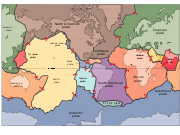
Pacific Plate

Encyclopedia
Pacific Ocean
The Pacific Ocean is the largest of the Earth's oceanic divisions. It extends from the Arctic in the north to the Southern Ocean in the south, bounded by Asia and Australia in the west, and the Americas in the east.At 165.2 million square kilometres in area, this largest division of the World...
. At 103 million square kilometres, it is the largest tectonic plate.
The north-eastern side is a divergent boundary
Divergent boundary
In plate tectonics, a divergent boundary or divergent plate boundary is a linear feature that exists between two tectonic plates that are moving away from each other. Divergent boundaries within continents initially produce rifts which produce rift valleys...
with the Explorer Plate
Explorer Plate
The Explorer Plate is an oceanic tectonic plate beneath the Pacific Ocean off the west coast of Vancouver Island, Canada.The eastern boundary of the Explorer Plate is being slowly subducted under the North American Plate, to which it may eventually accrete owing to the slow rate of subduction...
, the Juan de Fuca Plate
Juan de Fuca Plate
The Juan de Fuca Plate, named after the explorer of the same name, is a tectonic plate, generated from the Juan de Fuca Ridge, and subducting under the northerly portion of the western side of the North American Plate at the Cascadia subduction zone...
and the Gorda Plate
Gorda Plate
The Gorda Plate, located beneath the Pacific Ocean off the coast of northern California, is one of the northern remnants of the Farallon Plate. It is sometimes referred to as simply the southernmost portion of the neighboring Juan de Fuca Plate, another Farallon remnant.Unlike most tectonic...
forming respectively the Explorer Ridge
Explorer Ridge
The Explorer Ridge is a mid-ocean ridge, a divergent tectonic plate boundary located about west of Vancouver Island, British Columbia, Canada. It lies at the northern extremity of the Pacific spreading axis...
, the Juan de Fuca Ridge
Juan de Fuca Ridge
The Juan de Fuca Ridge is a tectonic spreading center located off the coasts of the state of Washington in the United States and the province of British Columbia in Canada. It runs northward from a transform boundary, the Blanco Fracture Zone, to a triple junction with the Nootka Fault and the...
and the Gorda Ridge
Gorda Ridge
The Gorda Ridge is a tectonic spreading center located off the coast of Oregon and northern California north of Cape Mendocino. It runs from a triple junction with the San Andreas Fault and the Mendocino Fracture Zone northward to another transform boundary, the Blanco Fracture Zone...
. In the middle of the eastern side is a transform boundary with the North American Plate
North American Plate
The North American Plate is a tectonic plate covering most of North America, Greenland, Cuba, Bahamas, and parts of Siberia, Japan and Iceland. It extends eastward to the Mid-Atlantic Ridge and westward to the Chersky Range in eastern Siberia. The plate includes both continental and oceanic crust...
along the San Andreas Fault
San Andreas Fault
The San Andreas Fault is a continental strike-slip fault that runs a length of roughly through California in the United States. The fault's motion is right-lateral strike-slip...
, and a boundary with the Cocos Plate
Cocos Plate
The Cocos Plate is an oceanic tectonic plate beneath the Pacific Ocean off the west coast of Central America, named for Cocos Island, which rides upon it.-Geology:...
. The south-eastern side is a divergent boundary
Divergent boundary
In plate tectonics, a divergent boundary or divergent plate boundary is a linear feature that exists between two tectonic plates that are moving away from each other. Divergent boundaries within continents initially produce rifts which produce rift valleys...
with the Nazca Plate
Nazca Plate
]The Nazca Plate, named after the Nazca region of southern Peru, is an oceanic tectonic plate in the eastern Pacific Ocean basin off the west coast of South America. The ongoing subduction along the Peru-Chile Trench of the Nazca Plate under the South American Plate is largely responsible for the...
forming the East Pacific Rise
East Pacific Rise
The East Pacific Rise is a mid-oceanic ridge, a divergent tectonic plate boundary located along the floor of the Pacific Ocean. It separates the Pacific Plate to the west from the North American Plate, the Rivera Plate, the Cocos Plate, the Nazca Plate, and the Antarctic Plate...
.
The southern side is a divergent boundary
Divergent boundary
In plate tectonics, a divergent boundary or divergent plate boundary is a linear feature that exists between two tectonic plates that are moving away from each other. Divergent boundaries within continents initially produce rifts which produce rift valleys...
with the Antarctic Plate
Antarctic Plate
The Antarctic Plate is a tectonic plate covering the continent of Antarctica and extending outward under the surrounding oceans. The Antarctic Plate has a boundary with the Nazca Plate, the South American Plate, the African Plate, the Indo-Australian Plate, the Scotia Plate and a divergent boundary...
forming the Pacific-Antarctic Ridge
Pacific-Antarctic Ridge
The Pacific–Antarctic Ridge is a divergent tectonic plate boundary located on the seafloor of the South Pacific Ocean, separating the Pacific Plate from the Antarctic Plate...
.
The western side, the plate is bounded by the Okhotsk Plate
Okhotsk Plate
The Okhotsk Plate is a tectonic plate covering the Sea of Okhotsk, the Kamchatka Peninsula, Sakhalin Island and Tōhoku and Hokkaidō in Japan. It was formerly considered a part of the North American Plate, but recent studies indicate that it is an independent plate, bounded on the north by the...
at the Kuril-Kamchatka Trench
Kuril-Kamchatka Trench
The Kuril–Kamchatka Trench or Kuril Trench is an oceanic trench in the northwest Pacific Ocean. It lies off the southeast coast of Kamchatka and parallels the Kuril Island chain to meet the Japan Trench east of Hokkaido...
and the Japan Trench
Japan Trench
__notoc__The Japan Trench is an oceanic trench, a part of the Pacific Ring of Fire, in the floor of the northern Pacific Ocean off northeast Japan. It extends from the Kuril Islands to the Bonin Islands and is at its deepest. It is an extension of the Kuril-Kamchatka Trench to the north and the...
, forms a convergent boundary
Convergent boundary
In plate tectonics, a convergent boundary, also known as a destructive plate boundary , is an actively deforming region where two tectonic plates or fragments of lithosphere move toward one another and collide...
by subducting under the Philippine Sea Plate creating the Mariana Trench
Mariana Trench
The Mariana Trench or Marianas Trench is the deepest part of the world's oceans. It is located in the western Pacific Ocean, to the east of the Mariana Islands. The trench is about long but has a mean width of only...
, has a transform boundary with the Caroline Plate
Caroline Plate
The Caroline Plate is a small tectonic plate located north of New Guinea. It forms a subduction zone along the border with the Bird's Head Plate and the Woodlark Plate to the south. A transform boundary forms the northern border with the Pacific Plate. Along the border with the Philippine Sea Plate...
, and has a collision boundary with the North Bismarck Plate
North Bismarck Plate
The North Bismarck Plate is a small tectonic plate located in the Bismarck Sea off the northeast coast of New Guinea.-Tectonics:To the north it collides with the Pacific Plate and the Caroline Plate, part of the western part subducts under the Woodlark Plate of New Guinea, and it is separated from...
.
In the south-west, the Pacific Plate has a complex but generally convergent boundary with the Indo-Australian Plate
Indo-Australian Plate
The Indo-Australian Plate is a major tectonic plate that includes the continent of Australia and surrounding ocean, and extends northwest to include the Indian subcontinent and adjacent waters...
, subducting under it north of New Zealand
New Zealand
New Zealand is an island country in the south-western Pacific Ocean comprising two main landmasses and numerous smaller islands. The country is situated some east of Australia across the Tasman Sea, and roughly south of the Pacific island nations of New Caledonia, Fiji, and Tonga...
forming the Tonga Trench
Tonga Trench
The Tonga Trench is located in the South Pacific Ocean and is deep at its deepest point, known as the Horizon Deep.The Tonga Trench is a convergent plate boundary. The trench lies at the northern end of the Kermadec-Tonga Subduction Zone, an active subduction zone where the Pacific Plate is being...
and the Kermadec Trench
Kermadec Trench
The Kermadec trench is one of Earth's deepest oceanic trenches, reaching a depth of . Formed by the subduction of the Pacific Plate under the Indo-Australian Plate, it runs over a thousand kilometres parallel with and to the east of the Kermadec Ridge and island arc, from near the northeastern tip...
. The Alpine Fault
Alpine Fault
The Alpine Fault is a geological fault, more specifically known as a right-lateral strike-slip fault, that runs almost the entire length of New Zealand's South Island. It forms a transform boundary between the Pacific Plate and the Indo-Australian Plate. Earthquakes along the fault, and the...
marks a transform boundary between the two plates, and further south the Indo-Australian Plate subducts under the Pacific Plate forming the Puysegur Trench
Puysegur trench
The deep Puysegur Trench is a deep cleft in the floor of the south Tasman Sea formed by the subduction of the Indo-Australian Plate under the Pacific Plate to the south of New Zealand. Immediately to its east lies a ridge, a northern extension of the Macquarie Ridge, which separates the Puysegur...
. The southern part of Zealandia
Zealandia (continent)
Zealandia , also known as Tasmantis or the New Zealand continent, is a nearly submerged continental fragment that sank after breaking away from Australia 60–85 million years ago, having separated from Antarctica between 85 and 130 million years ago...
, which is to the east of this boundary, is the plate's largest block of continental crust.
The northern side is a convergent boundary
Convergent boundary
In plate tectonics, a convergent boundary, also known as a destructive plate boundary , is an actively deforming region where two tectonic plates or fragments of lithosphere move toward one another and collide...
subducting under the North American Plate
North American Plate
The North American Plate is a tectonic plate covering most of North America, Greenland, Cuba, Bahamas, and parts of Siberia, Japan and Iceland. It extends eastward to the Mid-Atlantic Ridge and westward to the Chersky Range in eastern Siberia. The plate includes both continental and oceanic crust...
forming the Aleutian Trench
Aleutian Trench
The Aleutian Trench is a subduction zone and oceanic trench which runs along the southern coastline of Alaska and the adjacent waters of northeastern Siberia off the coast of Kamchatka Peninsula. It is classified as a "marginal trench" in the east as it runs along the margin of the continent, and...
and the corresponding Aleutian Islands.
The Pacific Plate contains an interior hot spot
Hotspot (geology)
The places known as hotspots or hot spots in geology are volcanic regions thought to be fed by underlying mantle that is anomalously hot compared with the mantle elsewhere. They may be on, near to, or far from tectonic plate boundaries. There are two hypotheses to explain them...
forming the Hawaiian Islands
Hawaiian Islands
The Hawaiian Islands are an archipelago of eight major islands, several atolls, numerous smaller islets, and undersea seamounts in the North Pacific Ocean, extending some 1,500 miles from the island of Hawaii in the south to northernmost Kure Atoll...
.
Hillis and Müller are reported to consider the Bird's Head Plate
Bird's Head Plate
The Bird's Head Plate is a minor tectonic plate incorporating the Bird's Head Peninsula at the western end of the island of New Guinea. Hillis & Müller consider it to be moving in unison with the Pacific Plate. Bird considers it to be unconnected to the Pacific Plate. The plate is separating from...
to be moving in unison with the Pacific Plate. Bird considers them to be unconnected.
Paleo-geology of the Pacific Plate
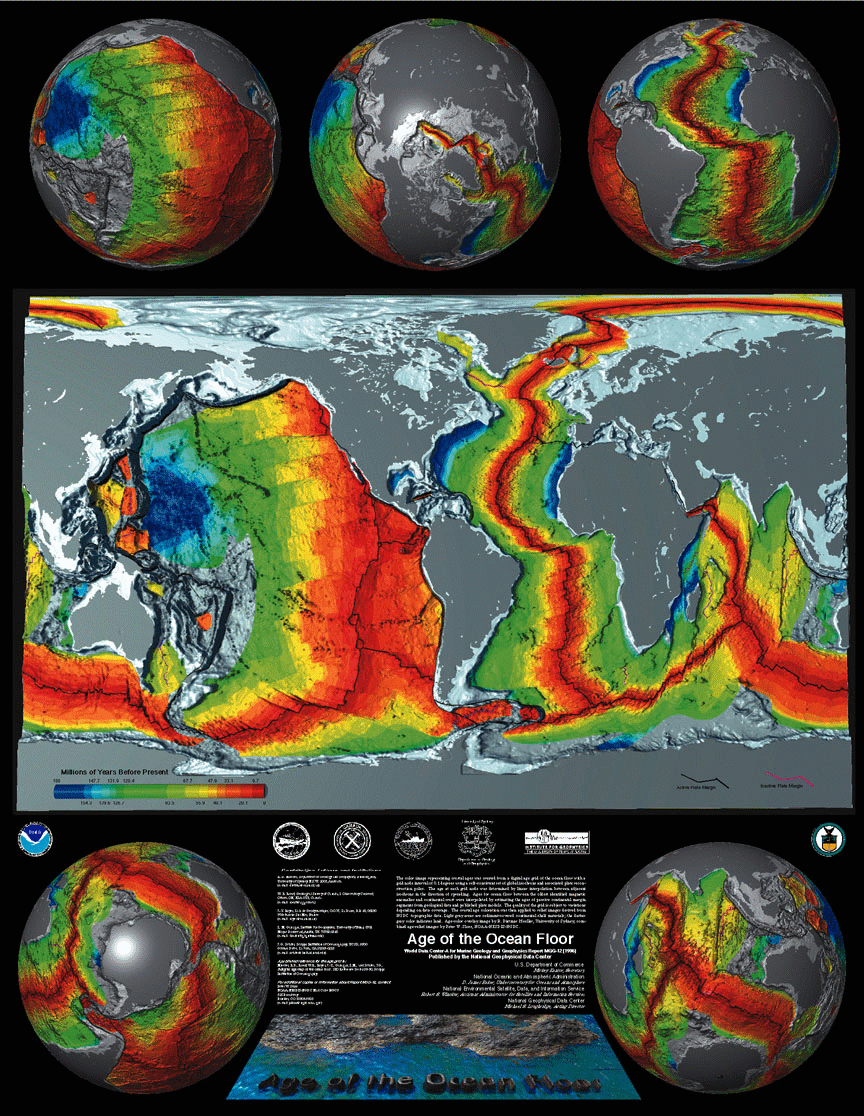
The Pacific Plate has the distinction of showing one of the largest areal sections of the oldest members of seabed geology being entrenched into eastern Asian oceanic trenchOceanic trench
The oceanic trenches are hemispheric-scale long but narrow topographic depressions of the sea floor. They are also the deepest parts of the ocean floor....
es. A geologic map
Geologic map
A geologic map or geological map is a special-purpose map made to show geological features. Rock units or geologic strata are shown by color or symbols to indicate where they are exposed at the surface...
of the Pacific Ocean seabed shows not only the geologic sequences, and associated Ring of Fire
Pacific Ring of Fire
The Pacific Ring of Fire is an area where large numbers of earthquakes and volcanic eruptions occur in the basin of the Pacific Ocean. In a horseshoe shape, it is associated with a nearly continuous series of oceanic trenches, volcanic arcs, and volcanic belts and/or plate movements...
zones on the ocean's perimeters, but the various ages of the seafloor in a stair-step fashion, youngest to oldest, the oldest being consumed into the Asian oceanic trenches. The oldest member disappearing by way of the Plate Tectonics
Plate tectonics
Plate tectonics is a scientific theory that describes the large scale motions of Earth's lithosphere...
cycle is early-Cretaceous
Cretaceous
The Cretaceous , derived from the Latin "creta" , usually abbreviated K for its German translation Kreide , is a geologic period and system from circa to million years ago. In the geologic timescale, the Cretaceous follows the Jurassic period and is followed by the Paleogene period of the...
(145 to 137 million years ago).
All maps of Earth's ocean floor geology show ages younger than 145 million years, only about 1/40 of the Earth's 4.55 billion year history.