


San Juan, Puerto Rico

Encyclopedia
San Juan officially Municipio de la Ciudad Capital San Juan Bautista (Municipality of the Capital City, Saint John the Baptist), is the capital and most populous municipality
in Puerto Rico
, an unincorporated territory of the United States
. As of the 2010 census
, it had a population of 395,326 making it the 46th-largest city under the jurisdiction of the United States. San Juan was founded by Spanish
colonists in 1521, who called it Ciudad de Puerto Rico ("Rich Port City"). Puerto Rico's capital is the second oldest European-established city in the Americas, after Santo Domingo
, in the Dominican Republic
. Several historical buildings are located in San Juan; among the most notable are the city's former defensive forts, Fort San Felipe del Morro and Fort San Cristóbal, and La Fortaleza
, the oldest executive mansion in continuous use in the Americas.
Today, San Juan is one of Puerto Rico's most important seaport
s, and is the island's manufacturing, financial, cultural, and tourism center
. The population of the Metropolitan Statistical Area
, including San Juan and the municipalities of Bayamón
, Guaynabo
, Cataño
, Canóvanas
, Caguas
, Toa Alta
, Toa Baja
, Carolina
and Trujillo Alto
, is about 2 million inhabitants; thus, about half the population of Puerto Rico now lives and works in this area. San Juan is also a principal city of the San Juan-Caguas-Fajardo Combined Statistical Area. The city has been the host of numerous important events within the sports community, including the 1979 Pan American Games
, 1966 Central American and Caribbean Games
, 2006 and 2009 World Baseball Classic
s, the Caribbean Series and the Special Olympics
and MLB San Juan Series in 2010.
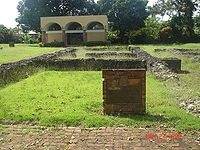 In 1508, Juan Ponce de León
founded the original settlement Caparra
(named after the province Caceres
, Spain, the birthplace of then-governor of Spain's Caribbean territories Nicolás de Ovando
), which today is known as the Pueblo Viejo sector of Guaynabo, just to the west of the present San Juan metropolitan area. A year later, the settlement was moved to a site then called Puerto Rico, Spanish for "rich port" or "good port", after its similar geographical features to the island of Gran Canaria
in the Canary Islands
. In 1521, the newer settlement was given its formal name, San Juan Bautista de Puerto Rico, in honor of John the Baptist
, following the tradition of christening the town with both its formal name and the name which Christopher Columbus
had originally given the island.
The ambiguous use of San Juan Bautista and Puerto Rico for both the city and the island led to a reversal in practical use by most inhabitants: by 1746, the name for the city (Puerto Rico) had become that of the entire island, while the name for the Island (San Juan Bautista) had become the name for the city.
San Juan, as a settlement of the Spanish Empire
, was used by merchant and military ships traveling from Spain as the first stopover in the Americas
. Because of its prominence in the Caribbean, a network of fortifications was built to protect the transports of gold and silver from the New World
to Europe. Because of the rich cargoes, San Juan became a target of the foreign powers of the time.
The city was witness to attacks from the English led by Sir Francis Drake in 1595 (in what is known as the Battle of Puerto Rico) and by George Clifford
, Earl of Cumberland
, in 1598. Artillery from San Juan's fort, El Morro
, repelled Drake; however, Clifford managed to land troops and lay siege to the city. After a few months of British occupation, Clifford was forced to abandon the siege when his troops began to suffer from exhaustion and sickness. In 1625 the city was sacked by Dutch forces led by Captain Balduino Enrico (also known as Boudewijn Hendricksz/Bowdoin Henrick), but El Morro withstood the assault and was not taken. The Dutch were counterattacked by Captain Juan de Amezquita
and 50 members of the civilian militia on land and by the cannons of the Spanish troops in El Morro Castle. The land battle left 60 Dutch soldiers dead and Enrico with a sword wound to his neck which he received from the hands of Amezquita. The Dutch ships at sea were boarded by Puerto Ricans who defeated those aboard. After a long battle, the Spanish soldiers and volunteers of the city's militia were able to defend the city from the attack and save the island from an invasion. On October 21, Enrico set La Fortaleza and the city ablaze. Captains Amezquita and Andre Botello decided to put a stop to the destruction and led 200 men in an attack against the enemy's front and rear guard. They drove Enrico and his men from their trenches and into the ocean in their haste to reach their ships.
The English attacked again
in 1797, during the French Revolutionary Wars
, led by Sir Ralph Abercromby
(who had just conquered Trinidad
). His army laid siege to the city but was forced to withdraw in defeat as the Puerto Rican defenses proved more resilient than those of Trinidad. Various events and circumstances, including liberalized commerce with Spain, the opening of the island to immigrants as a direct result of the Royal Decree of Graces of 1815
, and the colonial revolutions, led to an expansion of San Juan and other Puerto Rican settlements in the late 18th and early 19th century.
On May 8, 1898, United States Navy ships, among them the , , , , and , commanded by Rear Admiral
William T. Sampson
arrived at San Juan Bay. The USS Yale captured a Spanish freighter, the Rita in San Juan Bay, thus being the first hostile encounter between the warring sides in Puerto Rico. On May 9, Yale fought a brief battle with an auxiliary cruiser of Spain, name unknown, resulting in a Spanish victory. Around this time, Captain Ángel Rivero Méndez
was assigned the command of the Spanish forces in the fortress of San Cristóbal in San Juan. On May 10, the Yale returned to San Juan Bay, Rivero-Méndez ordered his men to open fire upon the using an Ordoñez 15 centimeter cannon, thus becoming the first attack against the Americans in Puerto Rico during the Spanish-American War
. For his actions, Captain Rivero-Mendez was awarded the "Cruz de la Orden de Merito Militar" (The Cross of the Order of the Military Merit) first class. The residents of San Juan were furious with Rivero and blamed him for the destruction caused to their city by the American bombardments. Nothing came of those accusations and Capt. Rivero-Méndez was ordered to turn over the keys of all the military installations in San Juan to Captain Henry A. Reed of the U.S. Army after the Treaty of Paris of 1898
was signed. On July 25, General Nelson A. Miles
landed at Guánica (in southwestern Puerto Rico) with 3,300 soldiers in what was known as the Puerto Rico Campaign. The American troops found some resistance and engaged the Spanish and Puerto Rican troops in battle, the most notable of these the Battles of Yauco and Asomante. All military actions in Puerto Rico were suspended August 13, 1898, after President William McKinley
and French Ambassador Jules Cambon
, acting on behalf of the Spanish government, signed an armistice
. Spain ceded the island to the United States later the same year by signing the Treaty of Paris
.
Camp Las Casas
, located in the district of Santurce, served as the main training camp for the Puerto Rican soldiers prior to World War I and World War II; the majority of the men trained in this facility were assigned to the "Porto Rico Regiment of Infantry" which was renamed the 65th Infantry Regiment
of the United States Army by the Reorganization Act of June 4, 1920. The 65th Infantry was deactivated in 1956 and became the only unit ever to be transferred from an active Army component to the Puerto Rico National Guard
.
Lieutenant Teofilo Marxuach
(Retired as a Lieutenant Colonel), a native of Arroyo, Puerto Rico
, fired the first shot in what is considered to be the first shot of World War I fired by the regular armed forces of the United States against any ship flying the colors of the Central Powers
Marxuach, who was a member of the "Porto Rico Regiment of Infantry" and Officer of the Day, on March 25, 1915, opened fire on the Odenwald, an armed German supply vessel, when it was trying to force its way out of San Juan's bay. The shots ordered by Lt. Marxuach were the first fired by the United States in World War I.
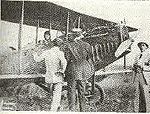 In 1919, Félix Rigau Carrera
, "El Aguila de Sabana Grande" (The Eagle from Sabana Grande), the first Hispanic fighter pilot in the United States Marine Corps
and first Puerto Rican pilot, became the first native Puerto Rican to fly an aircraft in the island when he flew his Curtiss JN-4
from Las Casas. At the time, the area was used by the military as an air base and it was also Puerto Rico's first commercial airport, and Rigau Carrera was allowed to perform his historic flight from the air field. Camp Las Casas was eventually closed down, and in 1950 a public housing project by the name of Residencial Fray Bartolome de Las Casas
was constructed on its former location.
On January 2, 1947, the people of San Juan elected Felisa Rincón de Gautier
(also known as Doña Fela) (1897–1994) as their mayor. Thus, she became the first woman to be elected as the Mayor of a capital city in any of The Americas. During the Cold War
era, she ordered the establishment of the island's first Civil Defense system under the directorship of Colonel Gilberto Jose Marxuach
(Teofilo's son). Rincón de Gautier served as mayor until January 2, 1969.
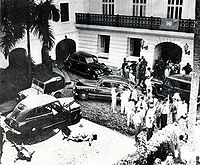 On October 30, 1950, San Juan was the scene of the San Juan Uprising, one of many uprisings which occurred in various towns and cities in Puerto Rico, by the Puerto Rican Nationalist Party
against the governments of Puerto Rico and the United States. Among the uprising's main objective was to attack "La Fortaleza
" (the Governors mansion) and the United States Federal Court House Building in Old San Juan. In accordance to the planned uprising in San Juan, a group of nationalists were supposed to attack simultaneously the gubernatorial mansion La Fortaleza
, where Puerto Rican governor Luis Muñoz Marín
resided, and the United States Federal Court House which is located close to an area called "La Marina" in Old San Juan. The La Fortaleza battle, which ensued between the nationalists and the police lasted 15 minutes, and ended when four of the five attackers were killed.
 On March 8, 1948 the city government of San Juan officially adopted as the city's first flag an orange field, in the center of which is the Coat of Arms of the City. The orange color was based and taken from Father Diego de Torres Vargas
' text and it reads : "Escudo de armas dado a Puerto Rico por los Reyes Católicos en el año de 1511, siendo Procurador un vecino llamado Pedro Moreno. Son : un cordero blanco con su banderilla colorada, sobre un libro, y todo sobre una isla verde, que es la de Puerto Rico, y por los lados una F y una I, que quiere decir Fernando e Isabel, los Reyes Católicos que se las dieron, y hoy se conservan en el estandarte real, que es de damasco anaranjado, con que se ganó la ciudad" ("Coat of Arms given to Puerto Rico by the Catholic Monarchs
in the year 1511 being Procurator a vecino
named Pedro Moreno. They are: a white lamb with a red flag, on top of a book, and everything above a green island, which is Puerto Rico...which is of orange damask, with which the city was won"). It appears that the color was changed from orange to white at some point.
and Trujillo Alto
; east of and Guaynabo
; and west of Carolina
. The city occupies an area of 76.93 square miles (199.2 km²), of which, 29.11 square miles (75.4 km²) (37.83%) is water. San Juan's main water bodies are San Juan Bay and two natural lagoons, the Condado
and San José.
(Koppen
Am). San Juan enjoys an average temperature of 79.9 °F (26.6 °C) although 90 °F (32 °C) or higher temperatures are often felt during the summer, especially if the winds come from the south. In the winter, temperatures can drop to the 60s, though the average winter low is 71 °F (22 °C). The coldest temperature ever recorded was 60 °F (16 °C) on March 3, 1957, and the hottest was 98 °F (37 °C) on October 9, 1981. Rainfall is well-distributed throughout the year, but the months of January, February, and March are the driest; as February averages just under 2.36 inches (6 cm) of rain, the city falls under the tropical monsoon category. Rain averages nearly 51 inches (130 cm), falling on an average 194 days per year; despite this dampness, the city averages nearly 3,000 hours of sunshine per year, or just over 2/3 of the possible total.
San Juan averages 50.75 inches (1,289 mm) of rain per year. Because in its driest month San Juan's receives just under 2.36 inches (6 cm), it falls under the Tropical monsoon climate category.
http://www.city-data.com/states/Puerto-Rico-Climate.html
. The small island, which comprises an area of 47 square miles (122 km2), also hosts the working class neighborhood of Puerta de Tierra and most of Puerto Rico's central government
buildings, including the Commonwealth's Capitol.
The main central part of the city is characterized by narrow streets made of blue cobblestone
and picturesque colonial buildings, some of which date back to the 16th and 17th century. Sections of the old city are surrounded by massive walls and several defensive structures and notable forts. These include the 16th-century Fort San Felipe del Morro
and the 17th-century Fort San Cristóbal
, both part of San Juan National Historic Site
, and the 16th-century El Palacio de Santa Catalina, also known as La Fortaleza
, which serves as the governor's mansion. Other buildings of interest predating the 20th century are the Ayuntamiento or Alcaldía (City Hall), the Diputación Provincial and the Real Intendencia buildings, which currently house the Puerto Rico Department of State, the Casa Rosa
, the San José Church
(1523) and the adjacent Hotel El Convento
, the former house of the Ponce de León family known as Casa Blanca
, the Teatro Tapia
, the former Spanish barracks (now Museum of Ballajá), La Princesa (former municipal jail, now headquartering the Puerto Rico Tourism Company
), and the municipal cemetery of Santa María Magdalena de Pazzi
, located just outside the city walls. The Cathedral of San Juan Bautista
(construction began in the 1520s) is also located in Old San Juan, and contains the tomb of the Spanish explorer and settlement founder Juan Ponce de León
. Old San Juan, also known as the "old city", is the main cultural tourist attraction in Puerto Rico; its bayside is lined by dock slips for large cruise ships.
East of Old San Juan lies the wealthy tourist-oriented neighborhood of Condado, which occupies land that used to be owned by entrepreneur Pablo Ubarri Capetillo, a Spanish railroad developer and Count of San José de Santurce under the Spanish colonial period. Beaches such as nearby Ocean Park
, popular with swimmers, surfers and kitesurfers, are found all along the district's Atlantic coastline which is also the locus of numerous hotels.
Near Condado are two separate business districts, Santurce
and Miramar. Miramar is mainly a residential area rising south of the Condado Lagoon. It comprises the former barrio
of Miraflores, as well as drained marshland and landfill over which was built San Juan's first airport, the Isla Grande airport, which was renamed Fernando Luis Ribas Dominicci Airport
in honor of Major Fernando Luis Ribas-Dominicci (USAF).
Miramar now hosts the Puerto Rico Convention Center
as well as some of San Juan Harbor's cruise ship piers. In 2005 Miramar was designated an historical district of Puerto Rico.
Santurce, originally named San Mateo de Cangrejos (Saint Matthew of the Crabs), was a settlement for freed African slaves during the early days of the city. After Pablo Ubarri sought permission to link San Juan with Río Piedras proper via steam tramway in 1878, the time it took to travel between both points were shortened and thereby stimulated the colonization and growth of the district. At the beginning of the twentieth century an electric trolley was installed, the township was split into three parts, and its main settlement, merged with the city, was renamed using the Spanish spelling of Santurtzi
(Saint George
in Basque), Ubarri's birthplace in Vizcaya
, Spain. The "Museo de Arte de Puerto Rico" (Puerto Rico Museum of Art
) and other important cultural venues are located in Santurce.
South of Santurce is Hato Rey, part of the former municipality of Río Piedras. Hato Rey was grazing ground for cattle owned by the royal government (hence its name, the King's Herd in Spanish) as early as the 16th century, and is now considered the financial center of the island. A section of this district is often referred to as Milla de Oro (actually 0.47 mile (0.7563898 km) long) due in part to the many banks and businesses located there.
In the southern part of the city is the socially diversified community of Río Piedras. Founded in the mid 1850s, Río Piedras was a separate town which hosted sugar cane plantations and the estates of some of San Juan's wealthiest inhabitants (as well as their working class staff). The Spanish colonial governors also had their summer home there on land which eventually gave way to the main campus of the University of Puerto Rico
. In 1951 the municipalities of San Juan and Río Piedras were merged to redefine San Juan's current city limits. Today Río Piedras comprises the largest area of the municipality of San Juan. and is home to the renowned, traditional "Plaza del Mercado" (Río Piedras Marketplace
), the main campus and the Medical Sciences campus of the University of Puerto Rico
and the San Juan Botanical Garden
.
San Juan is the largest city in Puerto Rico in population. From 1899 to 1950 the municipality of San Juan excluded the township of Río Piedras. For this reason, population data and land area for the period make reference only to the Antiguo San Juan and Santurce barrios, or subdivisions, of San Juan. The old municipality of Río Piedras constituted the third most populated city of Puerto Rico at the time of its annexation in 1951. Its strategic location south of the capital served as a junction for all the principal ways of transportation of the island and as a geographical entry to San Juan, which are factors that prompted Río Piedras's dramatic urban development in the 20th century.
According to the 2010 Census, the racial composition of San Juan was as follows:
Among the Hispanic and Latino population, Puerto Ricans
are, unsurprisingly, the largest group; they make up 87.5% of San Juan's Hispanic population. People of Dominican
descent made up 12.2% of the Hispanic population, while those of Cuban
descent formed 1.7% of the Hispanic populace. Other Hispanic and Latino groups collectively formed 3.2% of San Juan's Hispanic population.
There are 13,304 whites of non-Hispanic origin living in San Juan; 10,571 blacks of non-Hispanic origin living in San Juan. Non-Hispanic whites and blacks form 3.2% and 2.6% of San Juan's population respectively. There are also approximately 562 Asians of non-Hispanic origin in San Juan; they make up only 0.14% of the population. However, Asians of Hispanic and non-Hispanic origin together number at 6,342. The vast majority of Asians in San Juan are of Chinese
descent; of the 6,342 Asians, 4,928 are Chinese. Chinese comprise 1.4% of the population. The only other sizable Asian group in San Juan are Indian Americans; there are 698 people of Indian descent in the city, forming 0.2% of the population. There are very small numbers of people of Filipino
, Japanese
, and Vietnamese
ancestry; none of these groups number more than 100 members.
According to the 2006–2008 American Community Survey, 87.5% of San Juan's population was native and 12.5% were foreign-born. Of the native population, 86.9% were born in Puerto Rico or the United States, of which 75.6% were born in Puerto Rico and 8.9% were born in the United States. The remaining 0.7% were born in a U.S. territory or were born abroad to American parents. The remaining 11.9% of the population were born outside the United States, Puerto Rico, and U.S. territories. In recent years, an increasing number of Americans not of Hispanic ancestry (both of African American
and of White American
descent) have moved to San Juan. In addition, a large number of Stateside Puerto Ricans have settled in the city upon their return to Puerto Rico. There is also a growing West Indian population, both of Hispanic and non-Hispanic origin.
In terms of ancestry, 23,875 people claimed American ancestry, which is equivalent to 5.8% of San Juan's population. Other sizable ancestry groups included those of Italian
descent, French
descent, and West Indian descent. People of Italian descent numbered at 1,694, forming 0.4% of the population; people of French descent numbered at 1,064, forming 0.2% of the population. Finally, those of West Indian descent numbered at 1,393, forming 0.3% of San Juan's population. Approximately 1,026 people claimed Sub-Saharan Africa
n ancestry; 719 claimed Irish
ancestry; 646 claimed German
ancestry; 431 claimed Arab
ancestry, and 346 claimed English
ancestry. There are many other ancestry groups in San Juan, but they are very scant.
. The city's economy relies mostly on companies dedicated to the manufacture of several products, including: Chemical substance
s (bleach and house cleaning products); medicines; rum and other beverages; fertilizer
s; electric tools; electronic devices
; plastics, textile
s, and food-based products. Tourism is also a key industry, based on San Juan's proximity to Puerto Rico's main airport, the Luis Muñoz Marín International Airport
.
The tourism focus of the city is located in the district of Condado Beach where there are numerous luxurious hotels. Historical locations such as El Morro, Old San Juan and El Cuartel de Ballaja are promoted in tourism campaigns. The district of Hato Rey contains a corporate sector known as "La Milla de Oro," (The Golden Mile) which serves as the headquarters of numerous local and international banks. San Juan's Hato Rey district is often referred to as the "Wall Street of the Caribbean," due to the influence of the area on Puerto Rico and the Caribbean's economy.
, Ocean Park
, Isla Verde
and Condado
.
Places and monuments emphasized in tourism campaigns include: Old San Juan, promoting the historic nature of its colonial buildings and narrow streets covered by adoquine, a blue stone cast from furnace slag; they were brought over as ballast on Spanish ships. This includes the city's ancient defensive wall and forts, most notably El Morro and the Castle of San Cristóbal. On January 23, 1984 both of these edifices were catalogued as being part of humanity's cultural patrimony. The numerous restaurants and art galleries in the zone are frequently visited by tourists. The local universities are promoted as historic places, most notably the campus of University of Puerto Rico located in Río Piedras, which is the oldest university on the island being founded in 1903.
and José Enrique Pedreira
who became a renowned composer of Puerto Rican Danzas. International musicians such as renowned opera singer Justino Díaz
and Grammy Award
winners Raymond Ayala and Ricky Martin
were born in the city. Other notable residents include writers Giannina Braschi
and Tomas Blanco, award-winning actors Raúl Juliá
and Benicio del Toro
, and comedian José Miguel Agrelot
. Rafael Cordero
(1790–1868), was influential in the development of Puerto Rican education and is renowned as " The Father of Public Education in Puerto Rico." The city is also the home of numerous contemporary and classic art museums. The Puerto Rico Arts Museum owns the largest collection of contemporary art in Puerto Rico, housing over 1,100 permanent art pieces and displaying numerous temporary exhibitions containing artwork from various locations through Latin America.
The Museum of Contemporary Art of Puerto Rico, located in Santurce, specializes in contemporary artwork from Latin America and the Caribbean. The paintings displayed in the permanent exhibition are either acquired by the museum's administrative personnel or donated by artists and collectors. They are judged by a panel of painters, art critics, and scholars before being displayed.
Other museums such as the Pablo Casals
Museum, the Book Museum, Americas Museum and the National Gallery display historic items and artwork alongside contemporary art. Miscellaneous museums such as the Children's Museum and the Bacardi
Distillery (also known as the "Rum Cathedral") in nearby Cataño appeal to different audiences through interactive exhibitions.
, San Juan's government is compromised of two branches, the executive and the legislative. Those citizens eligible to vote directly elect a mayor and the municipal assembly for four-year terms. The municipal government is housed in City Hall or Casa Alcaldia, which is located at 153 San Francisco Street, facing the Plaza de Armas
or Military Square at the center of Old San Juan. City Hall was constructed based on Madrid's City Hall starting in 1604 and finally completed in 1789.
The executive branch is headed by a popularly elected mayor. The office is currently held by Jorge A. Santini. In addition to running the city's day-to-day operations and supervising associated departments, the mayor is also responsible for appointing a secretary-auditor and a treasurer. San Juan's Municipal Legislature is made up of 17 municipal legislators, elected at-large, which represent the city's population.
San Juan is home to many of Puerto Rico's institutions of higher learning. The University of Puerto Rico Río Piedras Campus is located in San Juan, along with the University of Puerto Rico's Medical Sciences Campus
. Other colleges located in San Juan are the University of the Sacred Heart
, the Polytechnic University of Puerto Rico
, the Ana G. Méndez University System's Metropolitan University, the Metropolitan Campus of the Inter American University of Puerto Rico, the Carlos Albizu University
, the Evangelic Seminary of Puerto Rico
and the Center for Advanced Studies on Puerto Rico and the Caribbean
. There are numerous smaller colleges located in the city, including the ICPR Junior College, the Instituto de Banca y Comercio and the International Junior College, located in Santurce. There are also several technical schools based in San Juan, including the Technological College of San Juan, the Liceo de Artes y Ciencias, Ramirez College of Business and Technology, and the Puerto Rico Technical Junior College. The Puerto Rico Conservatory of Music and the School of Plastic Arts in Old San Juan specialize in education that promotes the fine arts and music.
Public and Private Schools
Also, San Juan is home to 136 public schools operated by the Puerto Rico Department of Education. Most of the specialized schools operated by the Commonwealth of Puerto Rico are located in San Juan. These schools emphasize topics such as Science and Math, Radio and Television, Arts, Trade, Music, and Sports, but also include other subjects such as Spanish, English, and Social Studies in their curriculum. In addition to dozens of state-run elementary, intermediate, and high schools, the government of the city of San Juan operates two bilingual schools, including one sports-magnet school, the first municipal-run schools in Puerto Rico. Several private schools are located in San Juan, including Robinson and St. John's schools in the Condado, Perpetuo Socorro in Miramar, St. John's Episcopal, Santa Mónica and Academia San Jorge
in Santurce
, Commonwealth High School, La Merced and Espíritu Santo in Hato Rey, Escuela Josefita Monserrate de Selles, San Antonio, Colegio San Ignacio de Loyola
, San José in Río Piedras and Cupeyville
, St. Mary's, Boneville and Cupey Maria Montesory School in Cupey.
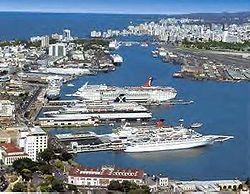 The Port of San Juan is the fourth busiest seaport in the Western Hemisphere, ranked among the top 17 in the world in terms of container movement. It is also the largest home-based cruise port in the world with over a dozen cruise ships. It is the second busiest port in cruise volume after Miami.
The Metropolitan Area is served by two airports. The Luis Muñoz Marín International Airport
, San Juan's primary commercial airport, is located eight miles (12.7 km) from Old San Juan in the neighboring municipality of Carolina
. The airport accommodates more than 30 domestic and international airlines and is the busiest airport in the Caribbean. It is often referred to as "The Gateway to the Caribbean" because it serves as the main connection to the island and the rest of the Caribbean for the United States and vice versa. The area's secondary airport is the Fernando Ribas Dominicci Airport, which is located directly across the San Antonio Creek or Cano San Antonio from Old San Juan in the Isla Grande district. Dominicci Airport is used mainly by general aviation aircraft, charter flights, and some domestic commercial flights. It used to be the city's and also the island of Puerto Rico's main international gateway until the opening of Luis Muñoz Marin International Airport
. It is now also widely used by the Isla Grande Flight School and Caribbean Flight Center, the only flight school on the island.
The Metropolitan Bus Authority
(Autoridad Metropolitana de Autobuses
or AMA in Spanish) provides daily bus transportation to residents of San Juan, Guaynabo, Bayamón, Toa Baja, Trujillo Alto, Cataño and Carolina through 30 fixed routes. Its fleet consists of 277 regular buses and 35 handicap-accessible buses. AMA's ridership is estimated at 112,000 on weekdays. There is also a daily ferry service, known as the Cataño Ferry
(La Lancha de Cataño), which operates between Old San Juan and the town of Cataño
.
.jpg) In an attempt to decrease vehicle dependency and road congestion, the City built a metro
In an attempt to decrease vehicle dependency and road congestion, the City built a metro
system dubbed "Tren Urbano
" ("Urban Train"). The 10.7 mile (17.2 km) line connects to 16 stations. The project, which opened in late 2004, cost $2.25 billion dollars and was more than $1 billion over budget and four years late. The Tren Urbano has received less ridership than was originally projected and has not significantly reduced the city's automobile traffic, despite a reported 7.5% ridership increase in 2006 over 2005. There is a planned project to build a "interurban light rail system" connecting the cities of San Juan and Caguas
.
Increased investment in public transportation, however, has not changed the fact that San Juan is an automobile reliant city and its fast growth has sparked urban sprawl. As of mid-2010, the government has approved plans for a redesign of this Puerto Rican city, featuring a new mass transit system, new roads and intersections, and more beach access points. No cars will be allowed inside the oldest part of city (Old San Juan). The plans hope to remedy previous poor urban planning in the oldest section of the city, the Isleta, while curbing reliance on motor vehicles. The plans for redevelopment also hope to make the city more appealing in order to attract new residents, as San Juan has suffered from a shrinking population over the past 60 years.
, hospital, and preventive care health services. The municipal government sponsors regular health fairs in different areas of the city focusing on health care for the elderly and the disabled. There are 20 hospitals in San Juan, half of them operated by the government. The largest hospital in San Juan and most important of Puerto Rico and the Caribbean is the Rio Piedras Medical Center, or Centro Medico de Rio Piedras in Spanish. This hospital, founded in 1956, is operated by the Medical Services Administration of the Department of Health of Puerto Rico. It is made up of eight other hospitals.
The city of San Juan operates 10 hospitals. Of these, nine are Diagnostic and Treatment Centers located in communities throughout San Juan. The main hospital is located at Centro Medico. These 10 hospitals are:
Also, there are 10 private hospitals in San Juan. These are:
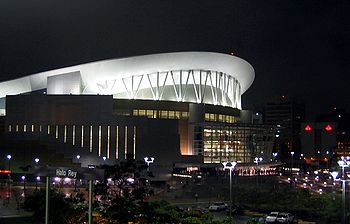 Teams based in San Juan have been notably successful in athletic competition. The Santurce Crabbers
won the National Superior Basketball League championship on 1998, 1999, 2000, 2001 and 2003 during this period being recognized as a dynasty. The San Juan Senators and the Santurce Crabbers
were the two major baseball teams in the city, winning the championship of the Puerto Rican Professional Baseball League
a total of seventeen times. The Santurce Crabbers are located third among teams with more championships in the Caribbean Series, winning championships in the 1951, 1953, 1955, 1993 and 2000 editions of the tournament. The city has also been the host of numerous events within the sports community; some examples include:
The recently-built $28-million San Juan Natatorium is beginning to attract islandwide and regional swim meets, as well winter training by top-rated mainland U.S. colleges and universities, including the United States Military Academy
at West Point and the United States Naval Academy
at Annapolis.
In July 2007, the San Juan Golf Academy and its golf driving range began operating atop the city's former sanitary landfill in Puerto Nuevo
and will eventually include the city's first and only 9-hole golf course.
: Cádiz, Spain
Cartagena, Colombia
Honolulu
, Hawaii, United States Jacksonville
, Florida, United States Guatemala City, Guatemala San Juan City, Philippines Santiago
, Dominican Republic
is twinned
with San Juan, Puerto Rico.
Municipalities of Puerto Rico
The Municipalities of Puerto Rico number 78 and they make up the smallest electoral division of the Commonwealth. Each municipality is divided into barrios, though the latter are not vested with political authority.-Administrative divisions:...
in Puerto Rico
Puerto Rico
Puerto Rico , officially the Commonwealth of Puerto Rico , is an unincorporated territory of the United States, located in the northeastern Caribbean, east of the Dominican Republic and west of both the United States Virgin Islands and the British Virgin Islands.Puerto Rico comprises an...
, an unincorporated territory of the United States
United States
The United States of America is a federal constitutional republic comprising fifty states and a federal district...
. As of the 2010 census
United States Census Bureau
The United States Census Bureau is the government agency that is responsible for the United States Census. It also gathers other national demographic and economic data...
, it had a population of 395,326 making it the 46th-largest city under the jurisdiction of the United States. San Juan was founded by Spanish
Spanish Empire
The Spanish Empire comprised territories and colonies administered directly by Spain in Europe, in America, Africa, Asia and Oceania. It originated during the Age of Exploration and was therefore one of the first global empires. At the time of Habsburgs, Spain reached the peak of its world power....
colonists in 1521, who called it Ciudad de Puerto Rico ("Rich Port City"). Puerto Rico's capital is the second oldest European-established city in the Americas, after Santo Domingo
Santo Domingo
Santo Domingo, known officially as Santo Domingo de Guzmán, is the capital and largest city in the Dominican Republic. Its metropolitan population was 2,084,852 in 2003, and estimated at 3,294,385 in 2010. The city is located on the Caribbean Sea, at the mouth of the Ozama River...
, in the Dominican Republic
Dominican Republic
The Dominican Republic is a nation on the island of La Hispaniola, part of the Greater Antilles archipelago in the Caribbean region. The western third of the island is occupied by the nation of Haiti, making Hispaniola one of two Caribbean islands that are shared by two countries...
. Several historical buildings are located in San Juan; among the most notable are the city's former defensive forts, Fort San Felipe del Morro and Fort San Cristóbal, and La Fortaleza
La Fortaleza
La Fortaleza is the current official residence of the Governor of Puerto Rico. It was built between 1533 and 1540 to defend the harbor of San Juan. The structure is also known as Palacio de Santa Catalina . It is the oldest executive mansion in the New World...
, the oldest executive mansion in continuous use in the Americas.
Today, San Juan is one of Puerto Rico's most important seaport
San Juan Port
The Port of San Juan is a seaport facility located in the metropolitan area of San Juan, Puerto Rico.The "Port of San Juan" is the general name used to call various passenger and cargo facilities located in lands around the San Juan Bay...
s, and is the island's manufacturing, financial, cultural, and tourism center
Tourism in Puerto Rico
Tourism has been a money revenue industry for Puerto Rico for a number of decades given it is host to diverse natural wonders, cultural and historical buildings, concerts and sporting events....
. The population of the Metropolitan Statistical Area
San Juan-Caguas-Guaynabo metropolitan area
The San Juan-Caguas-Guaynabo Metropolitan Statistical Area is a United States Census Bureau defined Metropolitan Statistical Area in northeastern Puerto Rico...
, including San Juan and the municipalities of Bayamón
Bayamón, Puerto Rico
Bayamón is a municipality of Puerto Rico located on the northern coastal valley, north of Aguas Buenas and Comerío; south of Toa Baja and Cataño; west of Guaynabo; and east of Toa Alta and Naranjito. Bayamón is spread over 11 wards and Bayamón Pueblo...
, Guaynabo
Guaynabo, Puerto Rico
Guaynabo is a municipality in the northern part of Puerto Rico, located in the northern coast of the island, north of Aguas Buenas; south of Cataño; east of Bayamón; and west of San Juan...
, Cataño
Cataño, Puerto Rico
Cataño is a municipality located on northern coast of Puerto Rico bordering the Atlantic Ocean and adjacent to the north and east by San Juan; north of Bayamón and Guaynabo; east of Toa Baja and west of Guaynabo and is part of the San Juan Metropolitan Area. Cataño is spread over 7 wards and...
, Canóvanas
Canóvanas, Puerto Rico
Canóvanas is a municipality in Puerto Rico, located in the northeastern region, north of Juncos and Las Piedras; south of Loíza; east of Carolina; and west of Río Grande. Canóvanas is spread over 7 wards and Canóvanas Pueblo...
, Caguas
Caguas, Puerto Rico
Caguas , founded in 1775, is a city and municipality of Puerto Rico located in the Central Mountain Range of Puerto Rico, south of San Juan and Trujillo Alto, west of Gurabo and San Lorenzo, east of Aguas Buenas, Cidra, and Cayey....
, Toa Alta
Toa Alta, Puerto Rico
Toa Alta is a municipality of Puerto Rico located in the northern coast of the island, north of Naranjito; south of Dorado and Toa Baja; east of Vega Alta and Corozal; and west of Bayamón. Toa Alta is spread over eight wards and Toa Alta Pueblo...
, Toa Baja
Toa Baja, Puerto Rico
Toa Baja is a municipality of Puerto Rico located in the northern coast, north of Toa Alta and Bayamón; east of Dorado; and west of Cataño. Toa Baja is spread over 5 wards and Toa Baja Pueblo . It is part of the San Juan-Caguas-Guaynabo Metropolitan Statistical Area.Toa Baja considered to be a...
, Carolina
Carolina, Puerto Rico
Carolina is a city located in the northern part of Puerto Rico, bordering the Atlantic Ocean; it lies north of Gurabo and Juncos; east of Trujillo Alto and San Juan; and west of Canóvanas and Loíza. Carolina is spread over 12 wards plus Carolina Pueblo...
and Trujillo Alto
Trujillo Alto, Puerto Rico
-Barrios :*Carraízo*Las Cuevas*Dos Bocas*La Gloria*Quebrada Grande*Quebrada Negrito*Saint Just*Trujillo Alto Pueblo*Cooperativa Jardines de Trujillo Alto-Geo/Topography:*Carraízo dam...
, is about 2 million inhabitants; thus, about half the population of Puerto Rico now lives and works in this area. San Juan is also a principal city of the San Juan-Caguas-Fajardo Combined Statistical Area. The city has been the host of numerous important events within the sports community, including the 1979 Pan American Games
Pan American Games
The Pan-American or Pan American Games are a major event in the Americas featuring summer and formerly winter sports, in which thousands of athletes participate in a variety of competitions. The Pan American Games are the second largest multi-sport event after the Summer Olympics...
, 1966 Central American and Caribbean Games
Central American and Caribbean Games
The Central American and Caribbean Games are a multi-sport regional championships event, held quadrennial , typically in the middle year between Summer Olympics...
, 2006 and 2009 World Baseball Classic
World Baseball Classic
The World Baseball Classic is an international baseball tournament sanctioned by the International Baseball Federation and created by Major League Baseball , the Major League Baseball Players Association , and other professional baseball leagues and their players associations around the world...
s, the Caribbean Series and the Special Olympics
Special Olympics
Special Olympics is the world's largest sports organization for children and adults with intellectual disabilities, providing year-round training and competitions to more than 3.1 million athletes in 175 countries....
and MLB San Juan Series in 2010.
History
Juan Ponce de León
Juan Ponce de León was a Spanish explorer. He became the first Governor of Puerto Rico by appointment of the Spanish crown. He led the first European expedition to Florida, which he named...
founded the original settlement Caparra
Caparra Archaeological Site
Caparra is an archaeological site in the municipality of Guaynabo, Puerto Rico. It was declared a U.S. National Historic Landmark in 1994.At the time of the designation in 1994, it was stated:...
(named after the province Caceres
Cáceres (province)
The province of Cáceres is a province of western Spain, in the northern part of the autonomous community of Extremadura. It is bordered by the provinces of Salamanca, Ávila, Toledo, and Badajoz, and by Portugal....
, Spain, the birthplace of then-governor of Spain's Caribbean territories Nicolás de Ovando
Nicolás de Ovando
Fray Nicolás de Ovando y Cáceres was a Spanish soldier from a noble family and a Knight of the Order of Alcántara. He was Governor of the Indies from 1502 until 1509...
), which today is known as the Pueblo Viejo sector of Guaynabo, just to the west of the present San Juan metropolitan area. A year later, the settlement was moved to a site then called Puerto Rico, Spanish for "rich port" or "good port", after its similar geographical features to the island of Gran Canaria
Gran Canaria
Gran Canaria is the second most populous island of the Canary Islands, with a population of 838,397 which constitutes approximately 40% of the population of the archipelago...
in the Canary Islands
Canary Islands
The Canary Islands , also known as the Canaries , is a Spanish archipelago located just off the northwest coast of mainland Africa, 100 km west of the border between Morocco and the Western Sahara. The Canaries are a Spanish autonomous community and an outermost region of the European Union...
. In 1521, the newer settlement was given its formal name, San Juan Bautista de Puerto Rico, in honor of John the Baptist
John the Baptist
John the Baptist was an itinerant preacher and a major religious figure mentioned in the Canonical gospels. He is described in the Gospel of Luke as a relative of Jesus, who led a movement of baptism at the Jordan River...
, following the tradition of christening the town with both its formal name and the name which Christopher Columbus
Christopher Columbus
Christopher Columbus was an explorer, colonizer, and navigator, born in the Republic of Genoa, in northwestern Italy. Under the auspices of the Catholic Monarchs of Spain, he completed four voyages across the Atlantic Ocean that led to general European awareness of the American continents in the...
had originally given the island.
The ambiguous use of San Juan Bautista and Puerto Rico for both the city and the island led to a reversal in practical use by most inhabitants: by 1746, the name for the city (Puerto Rico) had become that of the entire island, while the name for the Island (San Juan Bautista) had become the name for the city.
San Juan, as a settlement of the Spanish Empire
Spanish Empire
The Spanish Empire comprised territories and colonies administered directly by Spain in Europe, in America, Africa, Asia and Oceania. It originated during the Age of Exploration and was therefore one of the first global empires. At the time of Habsburgs, Spain reached the peak of its world power....
, was used by merchant and military ships traveling from Spain as the first stopover in the Americas
Americas
The Americas, or America , are lands in the Western hemisphere, also known as the New World. In English, the plural form the Americas is often used to refer to the landmasses of North America and South America with their associated islands and regions, while the singular form America is primarily...
. Because of its prominence in the Caribbean, a network of fortifications was built to protect the transports of gold and silver from the New World
New World
The New World is one of the names used for the Western Hemisphere, specifically America and sometimes Oceania . The term originated in the late 15th century, when America had been recently discovered by European explorers, expanding the geographical horizon of the people of the European middle...
to Europe. Because of the rich cargoes, San Juan became a target of the foreign powers of the time.
The city was witness to attacks from the English led by Sir Francis Drake in 1595 (in what is known as the Battle of Puerto Rico) and by George Clifford
George Clifford, 3rd Earl of Cumberland
Sir George Clifford, 3rd Earl of Cumberland, KG was an English peer, as well as a naval commander and courtier in the court of Queen Elizabeth I.-Background:...
, Earl of Cumberland
Earl of Cumberland
The title of Earl of Cumberland was created in the Peerage of England in 1525 for the 11th Baron de Clifford. It became extinct in 1643. See also Duke of Cumberland.The subsidiary title of the first three earls was Baron de Clifford...
, in 1598. Artillery from San Juan's fort, El Morro
Fort San Felipe del Morro
Also known as Fort San Felipe del Morro or Morro Castle, is a 16th-century citadel located in San Juan, Puerto Rico.- Rundown :Lies on the northwestern-most point of the islet of San Juan, Puerto Rico...
, repelled Drake; however, Clifford managed to land troops and lay siege to the city. After a few months of British occupation, Clifford was forced to abandon the siege when his troops began to suffer from exhaustion and sickness. In 1625 the city was sacked by Dutch forces led by Captain Balduino Enrico (also known as Boudewijn Hendricksz/Bowdoin Henrick), but El Morro withstood the assault and was not taken. The Dutch were counterattacked by Captain Juan de Amezquita
Juan de Amezquita
Captain Juan de Amezquita , was a Puerto Rican soldier who defended Puerto Rico from an invasion by the Dutch in 1625. He fought and wounded Captain Balduino Enrico who was ordered by the Dutch Government to capture Puerto Rico.-Early years:Amezquita was born and raised in the town of San...
and 50 members of the civilian militia on land and by the cannons of the Spanish troops in El Morro Castle. The land battle left 60 Dutch soldiers dead and Enrico with a sword wound to his neck which he received from the hands of Amezquita. The Dutch ships at sea were boarded by Puerto Ricans who defeated those aboard. After a long battle, the Spanish soldiers and volunteers of the city's militia were able to defend the city from the attack and save the island from an invasion. On October 21, Enrico set La Fortaleza and the city ablaze. Captains Amezquita and Andre Botello decided to put a stop to the destruction and led 200 men in an attack against the enemy's front and rear guard. They drove Enrico and his men from their trenches and into the ocean in their haste to reach their ships.
The English attacked again
Battle of San Juan (1797)
The Battle of San Juan was a 1797 British attack on the Spanish colonial port city of San Juan in Puerto Rico. The attack was carried out facing the historic town of Miramar....
in 1797, during the French Revolutionary Wars
French Revolutionary Wars
The French Revolutionary Wars were a series of major conflicts, from 1792 until 1802, fought between the French Revolutionary government and several European states...
, led by Sir Ralph Abercromby
Ralph Abercromby
Sir Ralph Abercromby was a Scottish soldier and politician. He rose to the rank of lieutenant-general in the British Army, was noted for his services during the Napoleonic Wars, and served as Commander-in-Chief, Ireland.He twice served as MP for Clackmannanshire and Kinross-shire, and was...
(who had just conquered Trinidad
Trinidad
Trinidad is the larger and more populous of the two major islands and numerous landforms which make up the island nation of Trinidad and Tobago. It is the southernmost island in the Caribbean and lies just off the northeastern coast of Venezuela. With an area of it is also the fifth largest in...
). His army laid siege to the city but was forced to withdraw in defeat as the Puerto Rican defenses proved more resilient than those of Trinidad. Various events and circumstances, including liberalized commerce with Spain, the opening of the island to immigrants as a direct result of the Royal Decree of Graces of 1815
Royal Decree of Graces of 1815
The Royal Decree of Graces of 1815 is a legal order approved by the Spanish Crown in the early half of the 19th century to encourage Spaniards and later Europeans of non-Spanish origin to settle and populate the colonies of Cuba and Puerto Rico....
, and the colonial revolutions, led to an expansion of San Juan and other Puerto Rican settlements in the late 18th and early 19th century.
On May 8, 1898, United States Navy ships, among them the , , , , and , commanded by Rear Admiral
Rear admiral (United States)
Rear admiral is a naval commissioned officer rank above that of a commodore and captain, and below that of a vice admiral. The uniformed services of the United States are unique in having two grades of rear admirals.- Rear admiral :...
William T. Sampson
William T. Sampson
William Thomas Sampson was a United States Navy rear admiral known for his victory in the Battle of Santiago de Cuba during the Spanish-American War.-Biography:...
arrived at San Juan Bay. The USS Yale captured a Spanish freighter, the Rita in San Juan Bay, thus being the first hostile encounter between the warring sides in Puerto Rico. On May 9, Yale fought a brief battle with an auxiliary cruiser of Spain, name unknown, resulting in a Spanish victory. Around this time, Captain Ángel Rivero Méndez
Ángel Rivero Méndez
Ángel Rivero Méndez was a Puerto Rican soldier, writer, journalist and a businessman who is credited with inventing the "Kola Champagne" soft drink...
was assigned the command of the Spanish forces in the fortress of San Cristóbal in San Juan. On May 10, the Yale returned to San Juan Bay, Rivero-Méndez ordered his men to open fire upon the using an Ordoñez 15 centimeter cannon, thus becoming the first attack against the Americans in Puerto Rico during the Spanish-American War
Spanish-American War
The Spanish–American War was a conflict in 1898 between Spain and the United States, effectively the result of American intervention in the ongoing Cuban War of Independence...
. For his actions, Captain Rivero-Mendez was awarded the "Cruz de la Orden de Merito Militar" (The Cross of the Order of the Military Merit) first class. The residents of San Juan were furious with Rivero and blamed him for the destruction caused to their city by the American bombardments. Nothing came of those accusations and Capt. Rivero-Méndez was ordered to turn over the keys of all the military installations in San Juan to Captain Henry A. Reed of the U.S. Army after the Treaty of Paris of 1898
Treaty of Paris (1898)
The Treaty of Paris of 1898 was signed on December 10, 1898, at the end of the Spanish-American War, and came into effect on April 11, 1899, when the ratifications were exchanged....
was signed. On July 25, General Nelson A. Miles
Nelson A. Miles
Nelson Appleton Miles was a United States soldier who served in the American Civil War, Indian Wars, and the Spanish-American War.-Early life:Miles was born in Westminster, Massachusetts, on his family's farm...
landed at Guánica (in southwestern Puerto Rico) with 3,300 soldiers in what was known as the Puerto Rico Campaign. The American troops found some resistance and engaged the Spanish and Puerto Rican troops in battle, the most notable of these the Battles of Yauco and Asomante. All military actions in Puerto Rico were suspended August 13, 1898, after President William McKinley
William McKinley
William McKinley, Jr. was the 25th President of the United States . He is best known for winning fiercely fought elections, while supporting the gold standard and high tariffs; he succeeded in forging a Republican coalition that for the most part dominated national politics until the 1930s...
and French Ambassador Jules Cambon
Jules Cambon
Jules-Martin Cambon was a French diplomat.He began his career as a lawyer , served in the Franco-Prussian War and entered the civil service in 1871...
, acting on behalf of the Spanish government, signed an armistice
Armistice
An armistice is a situation in a war where the warring parties agree to stop fighting. It is not necessarily the end of a war, but may be just a cessation of hostilities while an attempt is made to negotiate a lasting peace...
. Spain ceded the island to the United States later the same year by signing the Treaty of Paris
Treaty of Paris (1898)
The Treaty of Paris of 1898 was signed on December 10, 1898, at the end of the Spanish-American War, and came into effect on April 11, 1899, when the ratifications were exchanged....
.
Camp Las Casas
Camp Las Casas
Camp Las Casas was a United States military instalation established in Santurce, Puerto Rico in 1904. The camp was the main training base of the "Porto Rico Regiment of Infantry," On January 15, 1899, the military government changed the name of Puerto Rico to Porto Rico a segregated U.S...
, located in the district of Santurce, served as the main training camp for the Puerto Rican soldiers prior to World War I and World War II; the majority of the men trained in this facility were assigned to the "Porto Rico Regiment of Infantry" which was renamed the 65th Infantry Regiment
65th Infantry Regiment (United States)
The 65th Infantry Regiment, nicknamed "The Borinqueneers," was an all-volunteer Puerto Rican regiment of the United States Army. Its motto was Honor et Fidelitas, Latin for Honor and Fidelity. It participated in World War I, World War II, and the Korean War...
of the United States Army by the Reorganization Act of June 4, 1920. The 65th Infantry was deactivated in 1956 and became the only unit ever to be transferred from an active Army component to the Puerto Rico National Guard
Puerto Rico National Guard
The Puerto Rico National Guard is the component of the United States National Guard in the U.S. Territory of Puerto Rico. It comprises both Army and Air National Guard components with a total authorized strength of 10,000 soldiers and airmen. The Constitution of the United States specifically...
.
Lieutenant Teofilo Marxuach
Teofilo Marxuach
Lieutenant Colonel Teófilo Marxuach, , was the person who ordered the first shot fired in World War I on behalf of the United States on an armed German supply ship trying to force its way out of the San Juan Bay...
(Retired as a Lieutenant Colonel), a native of Arroyo, Puerto Rico
Arroyo, Puerto Rico
Arroyo is a municipality located along the southern coast of Puerto Rico and bordered by the Caribbean Sea, east of the municipality of Guayama and northwest of the municipality of Patillas. Arroyo is spread over 5 wards and Arroyo Pueblo...
, fired the first shot in what is considered to be the first shot of World War I fired by the regular armed forces of the United States against any ship flying the colors of the Central Powers
Central Powers
The Central Powers were one of the two warring factions in World War I , composed of the German Empire, the Austro-Hungarian Empire, the Ottoman Empire, and the Kingdom of Bulgaria...
Marxuach, who was a member of the "Porto Rico Regiment of Infantry" and Officer of the Day, on March 25, 1915, opened fire on the Odenwald, an armed German supply vessel, when it was trying to force its way out of San Juan's bay. The shots ordered by Lt. Marxuach were the first fired by the United States in World War I.
Felix Rigau Carrera
First Lieutenant Félix Rigau Carrera , known as "El Águila de Sabana Grande" , was the first Puerto Rican pilot and the first Hispanic fighter pilot in the United States Marine Corps...
, "El Aguila de Sabana Grande" (The Eagle from Sabana Grande), the first Hispanic fighter pilot in the United States Marine Corps
United States Marine Corps
The United States Marine Corps is a branch of the United States Armed Forces responsible for providing power projection from the sea, using the mobility of the United States Navy to deliver combined-arms task forces rapidly. It is one of seven uniformed services of the United States...
and first Puerto Rican pilot, became the first native Puerto Rican to fly an aircraft in the island when he flew his Curtiss JN-4
Curtiss JN-4
The Curtiss JN-4 "Jenny" was one of a series of "JN" biplanes built by the Curtiss Aeroplane Company of Hammondsport, New York, later the Curtiss Aeroplane and Motor Company. Although the Curtiss JN series was originally produced as a training aircraft for the U.S...
from Las Casas. At the time, the area was used by the military as an air base and it was also Puerto Rico's first commercial airport, and Rigau Carrera was allowed to perform his historic flight from the air field. Camp Las Casas was eventually closed down, and in 1950 a public housing project by the name of Residencial Fray Bartolome de Las Casas
Residencial Las Casas
Residencial Fray Bartolomé de Las Casas, more commonly known as Residencial Las Casas or Las Casas, is a public housing complex located in San Juan, Puerto Rico consisting of 417 housing units. It is under the management of the Puerto Rico Housing Authority and is under the federal housing program...
was constructed on its former location.
On January 2, 1947, the people of San Juan elected Felisa Rincón de Gautier
Felisa Rincón de Gautier
Felisa Rincón de GautierThis name uses Spanish marriage naming customs; the first is the maiden family name "Rincón" and the second or matrimonial family name is "Gautier"...
(also known as Doña Fela) (1897–1994) as their mayor. Thus, she became the first woman to be elected as the Mayor of a capital city in any of The Americas. During the Cold War
Cold War
The Cold War was the continuing state from roughly 1946 to 1991 of political conflict, military tension, proxy wars, and economic competition between the Communist World—primarily the Soviet Union and its satellite states and allies—and the powers of the Western world, primarily the United States...
era, she ordered the establishment of the island's first Civil Defense system under the directorship of Colonel Gilberto Jose Marxuach
Gilberto Jose Marxuach
Colonel Gilberto José Marxuach a.k.a. "The Father of the San Juan Civil Defense" , was a former officer in the United States Army who in 1951 founded and became the first director of the Civil Defense in the City of San Juan, Puerto Rico.-Early years:Marxuach was born in San Juan, Puerto Rico, to...
(Teofilo's son). Rincón de Gautier served as mayor until January 2, 1969.
Puerto Rican Nationalist Party
The Puerto Rican Nationalist Party was founded on September 17, 1922. Its main objective is to work for Puerto Rican Independence.In 1919, José Coll y Cuchí, a member of the Union Party of Puerto Rico, felt that the Union Party was not doing enough for the cause of Puerto Rican independence and he...
against the governments of Puerto Rico and the United States. Among the uprising's main objective was to attack "La Fortaleza
La Fortaleza
La Fortaleza is the current official residence of the Governor of Puerto Rico. It was built between 1533 and 1540 to defend the harbor of San Juan. The structure is also known as Palacio de Santa Catalina . It is the oldest executive mansion in the New World...
" (the Governors mansion) and the United States Federal Court House Building in Old San Juan. In accordance to the planned uprising in San Juan, a group of nationalists were supposed to attack simultaneously the gubernatorial mansion La Fortaleza
La Fortaleza
La Fortaleza is the current official residence of the Governor of Puerto Rico. It was built between 1533 and 1540 to defend the harbor of San Juan. The structure is also known as Palacio de Santa Catalina . It is the oldest executive mansion in the New World...
, where Puerto Rican governor Luis Muñoz Marín
Luis Muñoz Marín
Don José Luis Alberto Muñoz Marín was a Puerto Rican poet, journalist, and politician. Regarded as the "father of modern Puerto Rico," he was the first democratically elected Governor of Puerto Rico. Muñoz Marín was the son of Luis Muñoz Rivera, a renowned autonomist leader...
resided, and the United States Federal Court House which is located close to an area called "La Marina" in Old San Juan. The La Fortaleza battle, which ensued between the nationalists and the police lasted 15 minutes, and ended when four of the five attackers were killed.
Coat of arms and flag of San Juan
Diego de Torres Vargas
Father Diego de Torres Vargas , a priest, was the first person to write a book about the history of Puerto Rico.-Early years:Torres Vargas was born in San Juan, Puerto Rico, to a prosperous family...
' text and it reads : "Escudo de armas dado a Puerto Rico por los Reyes Católicos en el año de 1511, siendo Procurador un vecino llamado Pedro Moreno. Son : un cordero blanco con su banderilla colorada, sobre un libro, y todo sobre una isla verde, que es la de Puerto Rico, y por los lados una F y una I, que quiere decir Fernando e Isabel, los Reyes Católicos que se las dieron, y hoy se conservan en el estandarte real, que es de damasco anaranjado, con que se ganó la ciudad" ("Coat of Arms given to Puerto Rico by the Catholic Monarchs
Catholic Monarchs
The Catholic Monarchs is the collective title used in history for Queen Isabella I of Castile and King Ferdinand II of Aragon. They were both from the House of Trastámara and were second cousins, being both descended from John I of Castile; they were given a papal dispensation to deal with...
in the year 1511 being Procurator a vecino
Vecino
In Spanish-speaking areas, a vecino is nowadays a neighbor, or a resident of a place.In older times throughout the Spanish Empire, a person who has a house and home in a town or city and contributes to its expenses, not necessarily living near to the person referring to him; a local figure of some...
named Pedro Moreno. They are: a white lamb with a red flag, on top of a book, and everything above a green island, which is Puerto Rico...which is of orange damask, with which the city was won"). It appears that the color was changed from orange to white at some point.
Geography
San Juan is located along the north-eastern coast of Puerto Rico. It lies south of the Atlantic Ocean; north of CaguasCaguas, Puerto Rico
Caguas , founded in 1775, is a city and municipality of Puerto Rico located in the Central Mountain Range of Puerto Rico, south of San Juan and Trujillo Alto, west of Gurabo and San Lorenzo, east of Aguas Buenas, Cidra, and Cayey....
and Trujillo Alto
Trujillo Alto, Puerto Rico
-Barrios :*Carraízo*Las Cuevas*Dos Bocas*La Gloria*Quebrada Grande*Quebrada Negrito*Saint Just*Trujillo Alto Pueblo*Cooperativa Jardines de Trujillo Alto-Geo/Topography:*Carraízo dam...
; east of and Guaynabo
Guaynabo, Puerto Rico
Guaynabo is a municipality in the northern part of Puerto Rico, located in the northern coast of the island, north of Aguas Buenas; south of Cataño; east of Bayamón; and west of San Juan...
; and west of Carolina
Carolina, Puerto Rico
Carolina is a city located in the northern part of Puerto Rico, bordering the Atlantic Ocean; it lies north of Gurabo and Juncos; east of Trujillo Alto and San Juan; and west of Canóvanas and Loíza. Carolina is spread over 12 wards plus Carolina Pueblo...
. The city occupies an area of 76.93 square miles (199.2 km²), of which, 29.11 square miles (75.4 km²) (37.83%) is water. San Juan's main water bodies are San Juan Bay and two natural lagoons, the Condado
Condado Lagoon
Condado Lagoon is an affluent body of water flowing freely between two neighborhoods of Santurce .-Background:...
and San José.
Climate
San Juan features a Tropical monsoon climateTropical monsoon climate
Tropical monsoon climate, occasionally also known as a tropical wet climate or tropical monsoon and trade-wind littoral climate in climate classification, is a relatively rare type of climate that corresponds to the Köppen climate classification category "Am."Tropical monsoon climates have monthly...
(Koppen
Köppen climate classification
The Köppen climate classification is one of the most widely used climate classification systems. It was first published by Crimea German climatologist Wladimir Köppen in 1884, with several later modifications by Köppen himself, notably in 1918 and 1936...
Am). San Juan enjoys an average temperature of 79.9 °F (26.6 °C) although 90 °F (32 °C) or higher temperatures are often felt during the summer, especially if the winds come from the south. In the winter, temperatures can drop to the 60s, though the average winter low is 71 °F (22 °C). The coldest temperature ever recorded was 60 °F (16 °C) on March 3, 1957, and the hottest was 98 °F (37 °C) on October 9, 1981. Rainfall is well-distributed throughout the year, but the months of January, February, and March are the driest; as February averages just under 2.36 inches (6 cm) of rain, the city falls under the tropical monsoon category. Rain averages nearly 51 inches (130 cm), falling on an average 194 days per year; despite this dampness, the city averages nearly 3,000 hours of sunshine per year, or just over 2/3 of the possible total.
San Juan averages 50.75 inches (1,289 mm) of rain per year. Because in its driest month San Juan's receives just under 2.36 inches (6 cm), it falls under the Tropical monsoon climate category.
http://www.city-data.com/states/Puerto-Rico-Climate.html
Cityscape
Old San Juan occupies the western end of a rocky islet at the mouth of San Juan Bay. During the 20th century, the main population centers surged well beyond the walls of the old city and onto Puerto Rico's main island, and merged with the existing settlements east and south of Old San Juan. As a result, the city is now composed of a variety of neighborhoods.Old San Juan
During the Spanish colonial times most of the urban population resided in what is now known as Old San Juan. This sector is located on the western half of a small island called the Isleta de San Juan, which is connected to the mainland by two bridges and a causewayCauseway
In modern usage, a causeway is a road or railway elevated, usually across a broad body of water or wetland.- Etymology :When first used, the word appeared in a form such as “causey way” making clear its derivation from the earlier form “causey”. This word seems to have come from the same source by...
. The small island, which comprises an area of 47 square miles (122 km2), also hosts the working class neighborhood of Puerta de Tierra and most of Puerto Rico's central government
Executive Departments of the Government of Puerto Rico
The Executive Branch of the Government of Puerto Rico comprises various Departments which provide public services to the citizens of Puerto Rico. Currently, there are 16 main departments, each with their own sub-agencies and divisions...
buildings, including the Commonwealth's Capitol.
The main central part of the city is characterized by narrow streets made of blue cobblestone
Cobblestone
Cobblestones are stones that were frequently used in the pavement of early streets. "Cobblestone" is derived from the very old English word "cob", which had a wide range of meanings, one of which was "rounded lump" with overtones of large size...
and picturesque colonial buildings, some of which date back to the 16th and 17th century. Sections of the old city are surrounded by massive walls and several defensive structures and notable forts. These include the 16th-century Fort San Felipe del Morro
Fort San Felipe del Morro
Also known as Fort San Felipe del Morro or Morro Castle, is a 16th-century citadel located in San Juan, Puerto Rico.- Rundown :Lies on the northwestern-most point of the islet of San Juan, Puerto Rico...
and the 17th-century Fort San Cristóbal
Fort San Cristóbal
The Castillo de San Cristóbal is a Spanish fort in San Juan, Puerto Rico. It was built by Spain to protect against land based attacks on the city of San Juan. It is part of San Juan National Historic Site....
, both part of San Juan National Historic Site
San Juan National Historic Site
San Juan National Historic Site in San Juan, Puerto Rico, includes colonial-era forts, bastions, powder houses, and three fourths of the old city wall.-Features:The site includes four features:* Fort San Felipe del Morro* Fort San Cristóbal* El Cañuelo...
, and the 16th-century El Palacio de Santa Catalina, also known as La Fortaleza
La Fortaleza
La Fortaleza is the current official residence of the Governor of Puerto Rico. It was built between 1533 and 1540 to defend the harbor of San Juan. The structure is also known as Palacio de Santa Catalina . It is the oldest executive mansion in the New World...
, which serves as the governor's mansion. Other buildings of interest predating the 20th century are the Ayuntamiento or Alcaldía (City Hall), the Diputación Provincial and the Real Intendencia buildings, which currently house the Puerto Rico Department of State, the Casa Rosa
Casa Rosa
Casa Rosa or Casa Rosada, also known as the Pink House, is a historic house located in Old San Juan, Puerto Rico. The house was built in 1812 as a barrack for the troops assigned to the San Agustin Bastion. It was converted to an officers quarters in 1881 by the Spanish Army. The building was later...
, the San José Church
San José Church
San José Church , located in Old San Juan within the historic colonial section of the capital of Puerto Rico, is one of the first significant works of architecture on the island...
(1523) and the adjacent Hotel El Convento
Hotel El Convento
A former Carmelite convent with over 360 years of history transformed into a luxury Hotel preserving the historic character of Spanish colonial architecture. Located in Old San Juan, Puerto Rico. Rated a 4 Diamond property by the American Automobile Association. Hotel El Convento is the only Small...
, the former house of the Ponce de León family known as Casa Blanca
Casa Blanca (San Juan)
Casa Blanca is a house museum located in Old San Juan within the historic colonial section of the capital of Puerto Rico. Built in 1521 it served as the first fortification of the San Juan islet and residence for Juan Ponce de Leon and his family, although de Leon died in an expedition to Florida...
, the Teatro Tapia
Teatro Tapia
The Teatro Tapia, in San Juan, Puerto Rico, is presumed to be the oldest free-standing drama stage building still in use in the United States. It is named after the poet and dramatist Alejandro Tapia y Rivera .-Location:...
, the former Spanish barracks (now Museum of Ballajá), La Princesa (former municipal jail, now headquartering the Puerto Rico Tourism Company
Puerto Rico Tourism Company
The Puerto Rico Tourism Company was created during Governor Luis A. Ferré's administration to coordinate the marketing and growth of Puerto Rico's tourism sector...
), and the municipal cemetery of Santa María Magdalena de Pazzi
Magdalena de Pazzi
Saint Maria Magdalene de Pazzi is an Italian saint of the Roman Catholic Church.- Life :...
, located just outside the city walls. The Cathedral of San Juan Bautista
Cathedral of San Juan Bautista
The Cathedral of San Juan Bautista is a Roman Catholic cathedral in Old San Juan, Puerto Rico.The cathedral is one of the oldest buildings in San Juan, and is the second oldest cathedral in the Americas. The Catedral de Santa María la Menor in Santo Domingo, Dominican Republic is the oldest...
(construction began in the 1520s) is also located in Old San Juan, and contains the tomb of the Spanish explorer and settlement founder Juan Ponce de León
Juan Ponce de León
Juan Ponce de León was a Spanish explorer. He became the first Governor of Puerto Rico by appointment of the Spanish crown. He led the first European expedition to Florida, which he named...
. Old San Juan, also known as the "old city", is the main cultural tourist attraction in Puerto Rico; its bayside is lined by dock slips for large cruise ships.
Districts
San Juan is subdivided into 18 districts, 16 of which fall within the former (until 1951) Municipio de Río Piedras. Eight districts are further subdivided in to sectors, including two districts in the area that covered the original municipality of San Juan.- CaimitoCaimito, San Juan, Puerto RicoWith a land area of 5.43 square miles , Caimito is the second largest barrio in the municipality of San Juan, Puerto Rico. In the year 2000 it had 20,832 inhabitants and a population density of 3,835.3/sq mi...
- CupeyCupey, San Juan, Puerto RicoCupey is the largest barrio in the municipality of San Juan, and the third most populous with 36,659 inhabitants according to Census 2000. The territorial land area of Cupey is 7.49 square miles...
- El CincoEl Cinco, San Juan, Puerto RicoEl Cinco is a barrio of the municipality of San Juan, Puerto Rico and a former barrio of the dissolved municipality of Rio Piedras. In the year 2000 it had a population of 7,149 and a land area of 1.37 square miles resulting in a population density of 5,207.9/sq mi...
- Gobernador PiñeroGobernador Piñero, San Juan, Puerto RicoWith a 2000 population of 47,779 living in a land area of , it is San Juan’s second most populated "barrio" after Santurce, and the fourth largest in land area. It has a population density of 10,770.4 residents per square mile...
- Hato Rey CentralHato Rey Central, San Juan, Puerto RicoWith a population density of 20,320.7 per square mile , Hato Rey Central is the most densely populated barrio in the municipality of San Juan, Puerto Rico...
- Hato Rey Norte
- Hato Rey Sur
- MonacilloMonacillo, San Juan, Puerto RicoMonacillo is a barrio in San Juan, Puerto Rico. It originally included the area that now forms the Barrio of Monacillo Urbano. In 2000 it had a population of 12,425 living in a land area of 1.15 square miles...
- Monacillo UrbanoMonacillo Urbano, San Juan, Puerto RicoMonacillo Urbano is a barrio in San Juan, Puerto Rico that was originally part of Monacillo Barrio. In 2000 it had a population of 29,309 living in a land area of 3.35 square miles . Monacillo Urbano is surrounded by Gobernador Piñero Barrio to the north, El Cinco Barrio to the east, Monacillo...
- OrienteOriente, San Juan, Puerto RicoOriente is a barrio of San Juan, Puerto Rico, and before 1951 it was part of the former municipality of Rio Piedras. According to Census 2000, it had a population of 34,799, a land area of 1.74 , and it was the second most densely populated barrio of San Juan with 19,979.1 inhabitants per square...
- PuebloPueblo, San Juan, Puerto RicoIt is a one of twenty one barrios in the municipality of San Juan, Puerto Rico. Pueblo includes what used to be the urban center barrio of the former municipality of Rio Piedras...
- Quebrada ArenasQuebrada Arenas, San Juan, Puerto RicoLocated in the southwest corner of San Juan, it is the only rural barrio in the municipality. Quebrada Arenas is totally outside San Juan's municipal urban zone according to the last Census...
- Sabana Llana NorteSabana LlanaSabana Llana is a barrio in San Juan, Puerto Rico.-Location:Sabana Llana is located east of Oriente, north of Trujillo Alto and west of Carolina...
- Sabana Llana SurSabana LlanaSabana Llana is a barrio in San Juan, Puerto Rico.-Location:Sabana Llana is located east of Oriente, north of Trujillo Alto and west of Carolina...
- Old San JuanOld San Juan, Puerto RicoOld San Juan is the oldest settlement within Puerto Rico and it is the historic colonial section of San Juan, Puerto Rico.-Location:...
- SanturceSanturce, San Juan, Puerto RicoSanturce is a district of San Juan, Puerto Rico.-Summary:Santurce is one of the top ten most populated areas of the island holding Miramar, Loíza, Isla Grande, Barrio Obrero, and Condado as main cultural hot spots for art, music, cuisine, fashion, hotels, technology, multimedia, film, textile and...
- Tortugo
- UniversidadUniversidadUniversidad is one of the six boroughs of San Juan, Puerto Rico.-Sectors:Universidad is divided in four distinct locations.*Amparo*Auxilio Mutuo*Institución*Valencia-Facts:...
East of Old San Juan lies the wealthy tourist-oriented neighborhood of Condado, which occupies land that used to be owned by entrepreneur Pablo Ubarri Capetillo, a Spanish railroad developer and Count of San José de Santurce under the Spanish colonial period. Beaches such as nearby Ocean Park
Ocean Park, Puerto Rico
Ocean Park is an upscale beachfront community within the district of Santurce, San Juan, Puerto Rico.-Location:Ocean Park has a land area of and a resident population of 1,976 inhabitants according to the 2000 United States Census...
, popular with swimmers, surfers and kitesurfers, are found all along the district's Atlantic coastline which is also the locus of numerous hotels.
Near Condado are two separate business districts, Santurce
Santurce, San Juan, Puerto Rico
Santurce is a district of San Juan, Puerto Rico.-Summary:Santurce is one of the top ten most populated areas of the island holding Miramar, Loíza, Isla Grande, Barrio Obrero, and Condado as main cultural hot spots for art, music, cuisine, fashion, hotels, technology, multimedia, film, textile and...
and Miramar. Miramar is mainly a residential area rising south of the Condado Lagoon. It comprises the former barrio
Barrio
Barrio is a Spanish word meaning district or neighborhood.-Usage:In its formal usage in English, barrios are generally considered cohesive places, sharing, for example, a church and traditions such as feast days...
of Miraflores, as well as drained marshland and landfill over which was built San Juan's first airport, the Isla Grande airport, which was renamed Fernando Luis Ribas Dominicci Airport
Fernando Luis Ribas Dominicci Airport
-Accidents and incidents:*On April 11, 1952 Pan Am Flight 526A crashed into the sea just after take off due to engine failure, killing 52 out of 69 passengers and crew....
in honor of Major Fernando Luis Ribas-Dominicci (USAF).
Miramar now hosts the Puerto Rico Convention Center
Puerto Rico Convention Center
The Dr. Pedro Rosselló González, Puerto Rico Convention Center is a convention center located in Isla Grande , in San Juan, Puerto Rico owned by the Puerto Rico Convention District Authority, a government agency of Puerto Rico, and...
as well as some of San Juan Harbor's cruise ship piers. In 2005 Miramar was designated an historical district of Puerto Rico.
Santurce, originally named San Mateo de Cangrejos (Saint Matthew of the Crabs), was a settlement for freed African slaves during the early days of the city. After Pablo Ubarri sought permission to link San Juan with Río Piedras proper via steam tramway in 1878, the time it took to travel between both points were shortened and thereby stimulated the colonization and growth of the district. At the beginning of the twentieth century an electric trolley was installed, the township was split into three parts, and its main settlement, merged with the city, was renamed using the Spanish spelling of Santurtzi
Santurtzi
Santurtzi is a port town in the province of Biscay, in the autonomous community of Basque Country, Spain. It is located in the Bilbao Abra bay, near the mouth of the Nervión river, on its left bank, 14km downriver from Bilbao and forms part of the Greater Bilbao agglomeration...
(Saint George
Saint George
Saint George was, according to tradition, a Roman soldier from Syria Palaestina and a priest in the Guard of Diocletian, who is venerated as a Christian martyr. In hagiography Saint George is one of the most venerated saints in the Catholic , Anglican, Eastern Orthodox, and the Oriental Orthodox...
in Basque), Ubarri's birthplace in Vizcaya
Biscay
Biscay is a province of Spain and a historical territory of the Basque Country, heir of the ancient Lord of Biscay. Its capital city is Bilbao...
, Spain. The "Museo de Arte de Puerto Rico" (Puerto Rico Museum of Art
Puerto Rico Museum of Art
The Museum of Art of Puerto Rico is one of the most prestigious art museums in Puerto Rico.-History:...
) and other important cultural venues are located in Santurce.
South of Santurce is Hato Rey, part of the former municipality of Río Piedras. Hato Rey was grazing ground for cattle owned by the royal government (hence its name, the King's Herd in Spanish) as early as the 16th century, and is now considered the financial center of the island. A section of this district is often referred to as Milla de Oro (actually 0.47 mile (0.7563898 km) long) due in part to the many banks and businesses located there.
In the southern part of the city is the socially diversified community of Río Piedras. Founded in the mid 1850s, Río Piedras was a separate town which hosted sugar cane plantations and the estates of some of San Juan's wealthiest inhabitants (as well as their working class staff). The Spanish colonial governors also had their summer home there on land which eventually gave way to the main campus of the University of Puerto Rico
University of Puerto Rico
The University of Puerto Rico is the state university system of Puerto Rico. The system consists of 11 campuses and has approximately 64,511 students and 5,300 faculty members...
. In 1951 the municipalities of San Juan and Río Piedras were merged to redefine San Juan's current city limits. Today Río Piedras comprises the largest area of the municipality of San Juan. and is home to the renowned, traditional "Plaza del Mercado" (Río Piedras Marketplace
Marketplace
A marketplace is the space, actual, virtual or metaphorical, in which a market operates. The term is also used in a trademark law context to denote the actual consumer environment, ie. the 'real world' in which products and services are provided and consumed.-Marketplaces and street markets:A...
), the main campus and the Medical Sciences campus of the University of Puerto Rico
University of Puerto Rico
The University of Puerto Rico is the state university system of Puerto Rico. The system consists of 11 campuses and has approximately 64,511 students and 5,300 faculty members...
and the San Juan Botanical Garden
San Juan Botanical Garden
The San Juan Botanical Garden, also known as the Botanical Garden of the University of Puerto Rico, is located in the Caribbean city of San Juan, capital of Puerto Rico. This lush “urban garden” of native and exotic flora serves as a laboratory for the study, conservation and enrichment of...
.
Demographics
| Race - San Juan, Puerto Rico - 2010 Census | ||
|---|---|---|
| Race | Population | % of Total |
| White White American White Americans are people of the United States who are considered or consider themselves White. The United States Census Bureau defines White people as those "having origins in any of the original peoples of Europe, the Middle East, or North Africa... |
268,708 | 68.0% |
| Black/African American | 73,538 | 18.4% |
| American Indian Native Americans in the United States Native Americans in the United States are the indigenous peoples in North America within the boundaries of the present-day continental United States, parts of Alaska, and the island state of Hawaii. They are composed of numerous, distinct tribes, states, and ethnic groups, many of which survive as... and Alaska Native |
3,071 | 0.8% |
| Asian Asian American Asian Americans are Americans of Asian descent. The U.S. Census Bureau definition of Asians as "Asian” refers to a person having origins in any of the original peoples of the Far East, Southeast Asia, or the Indian subcontinent, including, for example, Cambodia, China, India, Indonesia, Japan,... |
1,750 | 0.4% |
| Native Hawaiians Native Hawaiians Native Hawaiians refers to the indigenous Polynesian people of the Hawaiian Islands or their descendants. Native Hawaiians trace their ancestry back to the original Polynesian settlers of Hawaii.According to the U.S... /Pacific Islander Pacific Islander American Pacific Islander Americans, also known as Oceanian Americans, are residents of the United States with original ancestry from Oceania. They represent the smallest racial group counted in the United States census of 2000. They numbered 874,000 people or 0.3 percent of the United States population... |
36 | 0.0% |
| Some other race | 32,386 | 8.2% |
| Two or more races Multiracial American Multiracial Americans, US residents who identify themselves as of "two or more races", were numbered at around 9 million, or 2.9% of the population, in the census of 2010. However there is considerable evidence that the real number is far higher. Prior to the mid-20th century many people hid their... |
15,835 | 4.0% |
San Juan is the largest city in Puerto Rico in population. From 1899 to 1950 the municipality of San Juan excluded the township of Río Piedras. For this reason, population data and land area for the period make reference only to the Antiguo San Juan and Santurce barrios, or subdivisions, of San Juan. The old municipality of Río Piedras constituted the third most populated city of Puerto Rico at the time of its annexation in 1951. Its strategic location south of the capital served as a junction for all the principal ways of transportation of the island and as a geographical entry to San Juan, which are factors that prompted Río Piedras's dramatic urban development in the 20th century.
According to the 2010 Census, the racial composition of San Juan was as follows:
- WhiteWhite AmericanWhite Americans are people of the United States who are considered or consider themselves White. The United States Census Bureau defines White people as those "having origins in any of the original peoples of Europe, the Middle East, or North Africa...
: 68.0% (Non-Hispanic WhitesNon-Hispanic WhitesNon-Hispanic Whites or White, Not Hispanic or Latino are people in the United States, as defined by the Census Bureau, who are of the White race and are not of Hispanic or Latino origin/ethnicity. Hence the designation is exclusive in the sense that it defines who is not included as opposed to who is...
: 1.2%) - Black or African American: 18.3% (Non-Hispanic Blacks: 0.3%)
- American IndianNative Americans in the United StatesNative Americans in the United States are the indigenous peoples in North America within the boundaries of the present-day continental United States, parts of Alaska, and the island state of Hawaii. They are composed of numerous, distinct tribes, states, and ethnic groups, many of which survive as...
: 0.8% - AsianAsian AmericanAsian Americans are Americans of Asian descent. The U.S. Census Bureau definition of Asians as "Asian” refers to a person having origins in any of the original peoples of the Far East, Southeast Asia, or the Indian subcontinent, including, for example, Cambodia, China, India, Indonesia, Japan,...
: 0.4% - Native HawaiianNative HawaiiansNative Hawaiians refers to the indigenous Polynesian people of the Hawaiian Islands or their descendants. Native Hawaiians trace their ancestry back to the original Polynesian settlers of Hawaii.According to the U.S...
/Pacific IslanderPacific Islander AmericanPacific Islander Americans, also known as Oceanian Americans, are residents of the United States with original ancestry from Oceania. They represent the smallest racial group counted in the United States census of 2000. They numbered 874,000 people or 0.3 percent of the United States population...
: 0.0% - Some other race: 8.2%
- Two or more racesMultiracial AmericanMultiracial Americans, US residents who identify themselves as of "two or more races", were numbered at around 9 million, or 2.9% of the population, in the census of 2010. However there is considerable evidence that the real number is far higher. Prior to the mid-20th century many people hid their...
: 4.0%
- Hispanic or LatinoHispanic and Latino AmericansHispanic or Latino Americans are Americans with origins in the Hispanic countries of Latin America or in Spain, and in general all persons in the United States who self-identify as Hispanic or Latino.1990 Census of Population and Housing: A self-designated classification for people whose origins...
(of any race): 98.2%
Among the Hispanic and Latino population, Puerto Ricans
Puerto Rican people
A Puerto Rican is a person who was born in Puerto Rico.Puerto Ricans born and raised in the continental United States are also sometimes referred to as Puerto Ricans, although they were not born in Puerto Rico...
are, unsurprisingly, the largest group; they make up 87.5% of San Juan's Hispanic population. People of Dominican
Dominican American
A Dominican American is any American who has origins in the Dominican Republic.Immigration records of Dominicans in the United States date from the late 19th century, and New York City has had a Dominican community since the 1930s...
descent made up 12.2% of the Hispanic population, while those of Cuban
Cuban American
A Cuban American is a United States citizen who traces his or her "national origin" to Cuba. Cuban Americans are also considered native born Americans with Cuban parents or Cuban-born persons who were raised and educated in US...
descent formed 1.7% of the Hispanic populace. Other Hispanic and Latino groups collectively formed 3.2% of San Juan's Hispanic population.
There are 13,304 whites of non-Hispanic origin living in San Juan; 10,571 blacks of non-Hispanic origin living in San Juan. Non-Hispanic whites and blacks form 3.2% and 2.6% of San Juan's population respectively. There are also approximately 562 Asians of non-Hispanic origin in San Juan; they make up only 0.14% of the population. However, Asians of Hispanic and non-Hispanic origin together number at 6,342. The vast majority of Asians in San Juan are of Chinese
Chinese American
Chinese Americans represent Americans of Chinese descent. Chinese Americans constitute one group of overseas Chinese and also a subgroup of East Asian Americans, which is further a subgroup of Asian Americans...
descent; of the 6,342 Asians, 4,928 are Chinese. Chinese comprise 1.4% of the population. The only other sizable Asian group in San Juan are Indian Americans; there are 698 people of Indian descent in the city, forming 0.2% of the population. There are very small numbers of people of Filipino
Filipino American
Filipino Americans are Americans of Filipino ancestry. Filipino Americans, often shortened to "Fil-Ams", or "Pinoy",Filipinos in what is now the United States were first documented in the 16th century, with small settlements beginning in the 18th century...
, Japanese
Japanese American
are American people of Japanese heritage. Japanese Americans have historically been among the three largest Asian American communities, but in recent decades have become the sixth largest group at roughly 1,204,205, including those of mixed-race or mixed-ethnicity...
, and Vietnamese
Vietnamese American
A Vietnamese American is an American of Vietnamese descent. They make up about half of all overseas Vietnamese and are the fourth-largest Asian American group....
ancestry; none of these groups number more than 100 members.
According to the 2006–2008 American Community Survey, 87.5% of San Juan's population was native and 12.5% were foreign-born. Of the native population, 86.9% were born in Puerto Rico or the United States, of which 75.6% were born in Puerto Rico and 8.9% were born in the United States. The remaining 0.7% were born in a U.S. territory or were born abroad to American parents. The remaining 11.9% of the population were born outside the United States, Puerto Rico, and U.S. territories. In recent years, an increasing number of Americans not of Hispanic ancestry (both of African American
African American
African Americans are citizens or residents of the United States who have at least partial ancestry from any of the native populations of Sub-Saharan Africa and are the direct descendants of enslaved Africans within the boundaries of the present United States...
and of White American
White American
White Americans are people of the United States who are considered or consider themselves White. The United States Census Bureau defines White people as those "having origins in any of the original peoples of Europe, the Middle East, or North Africa...
descent) have moved to San Juan. In addition, a large number of Stateside Puerto Ricans have settled in the city upon their return to Puerto Rico. There is also a growing West Indian population, both of Hispanic and non-Hispanic origin.
In terms of ancestry, 23,875 people claimed American ancestry, which is equivalent to 5.8% of San Juan's population. Other sizable ancestry groups included those of Italian
Italian American
An Italian American , is an American of Italian ancestry. The designation may also refer to someone possessing Italian and American dual citizenship...
descent, French
French American
French Americans or Franco-Americans are Americans of French or French Canadian descent. About 11.8 million U.S. residents are of this descent, and about 1.6 million speak French at home.An additional 450,000 U.S...
descent, and West Indian descent. People of Italian descent numbered at 1,694, forming 0.4% of the population; people of French descent numbered at 1,064, forming 0.2% of the population. Finally, those of West Indian descent numbered at 1,393, forming 0.3% of San Juan's population. Approximately 1,026 people claimed Sub-Saharan Africa
Sub-Saharan Africa
Sub-Saharan Africa as a geographical term refers to the area of the African continent which lies south of the Sahara. A political definition of Sub-Saharan Africa, instead, covers all African countries which are fully or partially located south of the Sahara...
n ancestry; 719 claimed Irish
Irish American
Irish Americans are citizens of the United States who can trace their ancestry to Ireland. A total of 36,278,332 Americans—estimated at 11.9% of the total population—reported Irish ancestry in the 2008 American Community Survey conducted by the U.S. Census Bureau...
ancestry; 646 claimed German
German American
German Americans are citizens of the United States of German ancestry and comprise about 51 million people, or 17% of the U.S. population, the country's largest self-reported ancestral group...
ancestry; 431 claimed Arab
Arab American
An Arab American is a United States citizen or resident of Arab ethnic, cultural and linguistic heritage or identity, who identifies themselves as Arab. Arab Americans trace ancestry to any of the various waves of immigrants of the countries comprising the Arab World...
ancestry, and 346 claimed English
English American
English Americans are citizens or residents of the United States whose ancestry originates wholly or partly in England....
ancestry. There are many other ancestry groups in San Juan, but they are very scant.
Economy
San Juan experienced significant economic growth following World War II. During this period the city underwent an industrial revolutionIndustrial Revolution
The Industrial Revolution was a period from the 18th to the 19th century where major changes in agriculture, manufacturing, mining, transportation, and technology had a profound effect on the social, economic and cultural conditions of the times...
. The city's economy relies mostly on companies dedicated to the manufacture of several products, including: Chemical substance
Chemical substance
In chemistry, a chemical substance is a form of matter that has constant chemical composition and characteristic properties. It cannot be separated into components by physical separation methods, i.e. without breaking chemical bonds. They can be solids, liquids or gases.Chemical substances are...
s (bleach and house cleaning products); medicines; rum and other beverages; fertilizer
Fertilizer
Fertilizer is any organic or inorganic material of natural or synthetic origin that is added to a soil to supply one or more plant nutrients essential to the growth of plants. A recent assessment found that about 40 to 60% of crop yields are attributable to commercial fertilizer use...
s; electric tools; electronic devices
Electronics
Electronics is the branch of science, engineering and technology that deals with electrical circuits involving active electrical components such as vacuum tubes, transistors, diodes and integrated circuits, and associated passive interconnection technologies...
; plastics, textile
Textile
A textile or cloth is a flexible woven material consisting of a network of natural or artificial fibres often referred to as thread or yarn. Yarn is produced by spinning raw fibres of wool, flax, cotton, or other material to produce long strands...
s, and food-based products. Tourism is also a key industry, based on San Juan's proximity to Puerto Rico's main airport, the Luis Muñoz Marín International Airport
Luis Muñoz Marín International Airport
Luis Muñoz Marín International Airport is a joint civil-military public airport located in Carolina, Puerto Rico, three miles southeast of San Juan. Over 4 million passengers board a plane at the airport per year according to FAA reports . It is owned and managed by the Puerto Rico Ports...
.
The tourism focus of the city is located in the district of Condado Beach where there are numerous luxurious hotels. Historical locations such as El Morro, Old San Juan and El Cuartel de Ballaja are promoted in tourism campaigns. The district of Hato Rey contains a corporate sector known as "La Milla de Oro," (The Golden Mile) which serves as the headquarters of numerous local and international banks. San Juan's Hato Rey district is often referred to as the "Wall Street of the Caribbean," due to the influence of the area on Puerto Rico and the Caribbean's economy.
Tourism
Technological advances after World War II in the development of the airliner, coupled with the island's climate and natural setting, have transformed San Juan into the springboard for tourism around the island, and has made the rest of the Caribbean known throughout the world during the last fifty years. Today the capital features numerous hotels, museums, historical buildings, restaurants, beaches and shopping centers. In San Juan there are numerous tourist attractions, including: Old San JuanOld San Juan, Puerto Rico
Old San Juan is the oldest settlement within Puerto Rico and it is the historic colonial section of San Juan, Puerto Rico.-Location:...
, Ocean Park
Ocean Park, Puerto Rico
Ocean Park is an upscale beachfront community within the district of Santurce, San Juan, Puerto Rico.-Location:Ocean Park has a land area of and a resident population of 1,976 inhabitants according to the 2000 United States Census...
, Isla Verde
Isla Verde, Puerto Rico
Isla Verde is a District of Carolina located east of Santurce next to the Luis Muñoz Marín International Airport above the Teodoro Moscoso Bridge...
and Condado
El Condado, Puerto Rico
-The 21st Century:Condado looks quite different from what it did at the turn of the century. Some of the luxurious homes which still remain nestled between the high-rise condominiums have been converted into small inns, shops, museums or restaurants. Dr...
.
Places and monuments emphasized in tourism campaigns include: Old San Juan, promoting the historic nature of its colonial buildings and narrow streets covered by adoquine, a blue stone cast from furnace slag; they were brought over as ballast on Spanish ships. This includes the city's ancient defensive wall and forts, most notably El Morro and the Castle of San Cristóbal. On January 23, 1984 both of these edifices were catalogued as being part of humanity's cultural patrimony. The numerous restaurants and art galleries in the zone are frequently visited by tourists. The local universities are promoted as historic places, most notably the campus of University of Puerto Rico located in Río Piedras, which is the oldest university on the island being founded in 1903.
Culture
San Juan is the birthplace of numerous artists and musicians, locally known as Sanjuaneros, who have significantly influenced Puerto Rican culture. During the 20th century, the musical aspect of the city was influenced by performers including Afro-Caribbean dancer and choreographer Sylvia del VillardSylvia Del Villard
Sylvia del Villard , was an actress, dancer, choreographer and Afro-Puerto Rican activist.-Early years:...
and José Enrique Pedreira
José Enrique Pedreira
José Enrique Pedreira was a Puerto Rican composer noted for danzas.-Early years:Pedreira was born in San Juan, Puerto Rico, into a family that belonged to San Juan's "High Society". The family sent him to the best private schools on the island at the time and at a young age had him take private...
who became a renowned composer of Puerto Rican Danzas. International musicians such as renowned opera singer Justino Díaz
Justino Díaz
Justino Díaz is an internationally renowned bass-baritone opera singer. In 1963, Díaz won an annual contest held at the Metropolitan Opera of New York, becoming the "first" Puerto Rican to obtain such an honor and as a consequence, made his Metropolitan debut on October 1963 in Verdi's Rigoletto...
and Grammy Award
Grammy Award
A Grammy Award — or Grammy — is an accolade by the National Academy of Recording Arts and Sciences of the United States to recognize outstanding achievement in the music industry...
winners Raymond Ayala and Ricky Martin
Ricky Martin
Enrique "Ricky" Martín Morales , better known as Ricky Martin, is a Puerto Rican and Spanish pop singer and actor who achieved prominence, first as a member of the Latin boy band Menudo, then as a solo artist since 1991.During his career he has sold more than 60 million album copies worldwide...
were born in the city. Other notable residents include writers Giannina Braschi
Giannina Braschi
Giannina Braschi is a Puerto Rican writer. She is credited with writing the first Spanglish novel YO-YO BOING! and the poetry trilogy Empire of Dreams , which chronicles the Latin American immigrant's experiences in the United States...
and Tomas Blanco, award-winning actors Raúl Juliá
Raúl Juliá
Raúl Rafael Juliá y Arcelay was a Puerto Rican actor.Born in San Juan, he gained interest in acting while still in school. Upon completing his studies, Juliá decided to pursue a career in acting. After performing in the local scene for some time, he was convinced by entertainment personality Orson...
and Benicio del Toro
Benicio del Toro
Benicio Monserrate Rafael del Toro Sánchez is a Puerto Rican and Spanish actor and film producer. He won an Academy Award, a Golden Globe Award, a Screen Actors Guild Award, and a BAFTA Award for his role as Javier Rodríguez in Traffic . He is also known for his roles as Fred Fenster in The Usual...
, and comedian José Miguel Agrelot
José Miguel Agrelot
Giuseppe Michael Agrelot , better known as José Miguel Agrelot, was a comedian, radio and television host and media icon in Puerto Rico...
. Rafael Cordero
Rafael Cordero (educator)
Rafael Cordero , known as "The Father of Public Education in Puerto Rico", was a self-educated Puerto Rican who provided free schooling to children regardless of their race or social standing.-Early years:...
(1790–1868), was influential in the development of Puerto Rican education and is renowned as " The Father of Public Education in Puerto Rico." The city is also the home of numerous contemporary and classic art museums. The Puerto Rico Arts Museum owns the largest collection of contemporary art in Puerto Rico, housing over 1,100 permanent art pieces and displaying numerous temporary exhibitions containing artwork from various locations through Latin America.
The Museum of Contemporary Art of Puerto Rico, located in Santurce, specializes in contemporary artwork from Latin America and the Caribbean. The paintings displayed in the permanent exhibition are either acquired by the museum's administrative personnel or donated by artists and collectors. They are judged by a panel of painters, art critics, and scholars before being displayed.
Other museums such as the Pablo Casals
Pablo Casals
Pau Casals i Defilló , known during his professional career as Pablo Casals, was a Spanish Catalan cellist and conductor. He is generally regarded as the pre-eminent cellist of the first half of the 20th century, and one of the greatest cellists of all time...
Museum, the Book Museum, Americas Museum and the National Gallery display historic items and artwork alongside contemporary art. Miscellaneous museums such as the Children's Museum and the Bacardi
Bacardi
Bacardi is a family-controlled spirits company, best known as a producer of rums, including Bacardi Superior and Bacardi 151. The company sells in excess of 200 million bottles per year in nearly 100 countries...
Distillery (also known as the "Rum Cathedral") in nearby Cataño appeal to different audiences through interactive exhibitions.
Government
As one of Puerto Rico's 78 municipalitiesMunicipalities of Puerto Rico
The Municipalities of Puerto Rico number 78 and they make up the smallest electoral division of the Commonwealth. Each municipality is divided into barrios, though the latter are not vested with political authority.-Administrative divisions:...
, San Juan's government is compromised of two branches, the executive and the legislative. Those citizens eligible to vote directly elect a mayor and the municipal assembly for four-year terms. The municipal government is housed in City Hall or Casa Alcaldia, which is located at 153 San Francisco Street, facing the Plaza de Armas
Plaza de Armas
The Plaza de Armas is the name for the main square in many Latin American cities. In Mexico this space is known as El Zócalo, and in Central America as Parque Central...
or Military Square at the center of Old San Juan. City Hall was constructed based on Madrid's City Hall starting in 1604 and finally completed in 1789.
The executive branch is headed by a popularly elected mayor. The office is currently held by Jorge A. Santini. In addition to running the city's day-to-day operations and supervising associated departments, the mayor is also responsible for appointing a secretary-auditor and a treasurer. San Juan's Municipal Legislature is made up of 17 municipal legislators, elected at-large, which represent the city's population.
Safety
In 2010 there were 201 slayings in San Juan. A rate of around 50 per 100,000 residents. Law enforcement in San Juan is the joint responsibility of the Department of Police and Public Safety also known as the San Juan Police Department and the Puerto Rico Police Department. The Municipal Police, originally known as the "San Juan Municipal Guard", was created in 1521 and has active military and law enforcement functions, until 1980 when act#77 created municipal law enforcement agencies in Puerto Rico. It currently employs over 1,000 sworn officers plus civilian staff.Education
Colleges and UniversitiesSan Juan is home to many of Puerto Rico's institutions of higher learning. The University of Puerto Rico Río Piedras Campus is located in San Juan, along with the University of Puerto Rico's Medical Sciences Campus
University of Puerto Rico, Medical Sciences Campus
The University of Puerto Rico, Medical Sciences Campus —or Universidad de Puerto Rico, Recinto de Ciencias Médicas in Spanish— is a state university located in San Juan, Puerto Rico. It is one of the eleven campuses of the University of Puerto Rico...
. Other colleges located in San Juan are the University of the Sacred Heart
University of the Sacred Heart
Universidad del Sagrado Corazón —or Sacred Heart University in English, or simply Sagrado. Universidad del Sagrado Corazón in Puerto Rico is a higher education institution based in Santurce, Puerto Rico and one of the oldest, largest and most prestigious institutions in Puerto Rico.Its...
, the Polytechnic University of Puerto Rico
Polytechnic University of Puerto Rico
The Polytechnic University of Puerto Rico —commonly referred as Poly or La Poly in Spanish— is a private non-profit university located in San Juan, Puerto Rico...
, the Ana G. Méndez University System's Metropolitan University, the Metropolitan Campus of the Inter American University of Puerto Rico, the Carlos Albizu University
Carlos Albizu University
Carlos Albizu University is a private non-profit university offering undergraduate and graduate studies in psychology, business, and education. It has two campuses: one in San Juan, Puerto Rico , and the other in Doral, Florida, near Miami...
, the Evangelic Seminary of Puerto Rico
Evangelic Seminary of Puerto Rico
The Evangelical Seminary of Puerto Rico —or Seminario Evangélico de Puerto Rico in Spanish — is a mainline Protestant seminary in Río Piedras, Puerto Rico that offers graduate studies conducive to either a Master of Divinity or a Master of Arts in Religion...
and the Center for Advanced Studies on Puerto Rico and the Caribbean
Center for Advanced Studies on Puerto Rico and the Caribbean
The Center for Advanced Studies on Puerto Rico and the Caribbean is a private research institute in Old San Juan, San Juan, Puerto Rico that offers graduate studies in arts and philosophy. It was incorporated on February 28, 1968 by Pablo Casals, Luis Muñoz Marín, Roberto Busó Carrasquillo, and...
. There are numerous smaller colleges located in the city, including the ICPR Junior College, the Instituto de Banca y Comercio and the International Junior College, located in Santurce. There are also several technical schools based in San Juan, including the Technological College of San Juan, the Liceo de Artes y Ciencias, Ramirez College of Business and Technology, and the Puerto Rico Technical Junior College. The Puerto Rico Conservatory of Music and the School of Plastic Arts in Old San Juan specialize in education that promotes the fine arts and music.
Public and Private Schools
Also, San Juan is home to 136 public schools operated by the Puerto Rico Department of Education. Most of the specialized schools operated by the Commonwealth of Puerto Rico are located in San Juan. These schools emphasize topics such as Science and Math, Radio and Television, Arts, Trade, Music, and Sports, but also include other subjects such as Spanish, English, and Social Studies in their curriculum. In addition to dozens of state-run elementary, intermediate, and high schools, the government of the city of San Juan operates two bilingual schools, including one sports-magnet school, the first municipal-run schools in Puerto Rico. Several private schools are located in San Juan, including Robinson and St. John's schools in the Condado, Perpetuo Socorro in Miramar, St. John's Episcopal, Santa Mónica and Academia San Jorge
Academia San Jorge
Academia San Jorge is a private, Roman Catholic school in San Juan, Puerto Rico founded in 1925 by Rev. Msgr. José M. Rivera as a parochial school with 53 students from grades K–3. Shortly after, the school started construction on the first building, which still exists today, and added grades 4-12...
in Santurce
Santurce, San Juan, Puerto Rico
Santurce is a district of San Juan, Puerto Rico.-Summary:Santurce is one of the top ten most populated areas of the island holding Miramar, Loíza, Isla Grande, Barrio Obrero, and Condado as main cultural hot spots for art, music, cuisine, fashion, hotels, technology, multimedia, film, textile and...
, Commonwealth High School, La Merced and Espíritu Santo in Hato Rey, Escuela Josefita Monserrate de Selles, San Antonio, Colegio San Ignacio de Loyola
Colegio San Ignacio de Loyola
Colegio San Ignacio de Loyola is a Catholic Jesuit college-preparatory school founded by the Society of Jesus in in 1952. The school was originally located in Santurce, but was moved to its current location by the Jesuit fathers in 1956. Colegio San Ignacio is the only Jesuit school in Puerto Rico...
, San José in Río Piedras and Cupeyville
Cupeyville School
Cupeyville School is a school located in San Juan, Puerto Rico.Cupeyville School is accredited by the Middle States Association, the Department of Education of Puerto Rico, and C.A.D.I.E...
, St. Mary's, Boneville and Cupey Maria Montesory School in Cupey.
Transportation
The Metropolitan Area is served by two airports. The Luis Muñoz Marín International Airport
Luis Muñoz Marín International Airport
Luis Muñoz Marín International Airport is a joint civil-military public airport located in Carolina, Puerto Rico, three miles southeast of San Juan. Over 4 million passengers board a plane at the airport per year according to FAA reports . It is owned and managed by the Puerto Rico Ports...
, San Juan's primary commercial airport, is located eight miles (12.7 km) from Old San Juan in the neighboring municipality of Carolina
Carolina, Puerto Rico
Carolina is a city located in the northern part of Puerto Rico, bordering the Atlantic Ocean; it lies north of Gurabo and Juncos; east of Trujillo Alto and San Juan; and west of Canóvanas and Loíza. Carolina is spread over 12 wards plus Carolina Pueblo...
. The airport accommodates more than 30 domestic and international airlines and is the busiest airport in the Caribbean. It is often referred to as "The Gateway to the Caribbean" because it serves as the main connection to the island and the rest of the Caribbean for the United States and vice versa. The area's secondary airport is the Fernando Ribas Dominicci Airport, which is located directly across the San Antonio Creek or Cano San Antonio from Old San Juan in the Isla Grande district. Dominicci Airport is used mainly by general aviation aircraft, charter flights, and some domestic commercial flights. It used to be the city's and also the island of Puerto Rico's main international gateway until the opening of Luis Muñoz Marin International Airport
Luis Muñoz Marín International Airport
Luis Muñoz Marín International Airport is a joint civil-military public airport located in Carolina, Puerto Rico, three miles southeast of San Juan. Over 4 million passengers board a plane at the airport per year according to FAA reports . It is owned and managed by the Puerto Rico Ports...
. It is now also widely used by the Isla Grande Flight School and Caribbean Flight Center, the only flight school on the island.
Public transport
At 4,300 vehicles per paved mile, San Juan has by far the highest density of vehicles on the road of any country in the world. The city is served by five limited-access expressways and highways and numerous arterial avenues and boulevards, but continues to suffer from severe traffic congestion.The Metropolitan Bus Authority
Public corporations of the Government of Puerto Rico
In Puerto Rico, Public corporations are separate legal entities owned, either entirely or in a large majority, by the Government of the Commonwealth of Puerto Rico. These corporations are created to serve a public service, such as electricity, water, public financing, education, transportation, or...
(Autoridad Metropolitana de Autobuses
Autoridad Metropolitana de Autobuses
Autoridad Metropolitana de Autobuses or by its initials in Spanish, AMA, is a public bus transit system based in San Juan, Puerto Rico. It is operated by the Department of Transportation and Public Works of Puerto Rico....
or AMA in Spanish) provides daily bus transportation to residents of San Juan, Guaynabo, Bayamón, Toa Baja, Trujillo Alto, Cataño and Carolina through 30 fixed routes. Its fleet consists of 277 regular buses and 35 handicap-accessible buses. AMA's ridership is estimated at 112,000 on weekdays. There is also a daily ferry service, known as the Cataño Ferry
Cataño Ferry
La Lancha de Cataño is a ferry service that is widely known by Puerto Ricans and used by tourists that visit Puerto Rico. Despite what the service's name might lead people to think, this ferry service is provided with multiple boats, not just one ship.-Brief history:"La Lancha de Cataño"'s...
(La Lancha de Cataño), which operates between Old San Juan and the town of Cataño
Cataño, Puerto Rico
Cataño is a municipality located on northern coast of Puerto Rico bordering the Atlantic Ocean and adjacent to the north and east by San Juan; north of Bayamón and Guaynabo; east of Toa Baja and west of Guaynabo and is part of the San Juan Metropolitan Area. Cataño is spread over 7 wards and...
.
Rapid transit
A rapid transit, underground, subway, elevated railway, metro or metropolitan railway system is an electric passenger railway in an urban area with a high capacity and frequency, and grade separation from other traffic. Rapid transit systems are typically located either in underground tunnels or on...
system dubbed "Tren Urbano
Tren Urbano
The Tren Urbano — or Urban Train in English — is a fully automated rapid transit that serves the metropolitan area of San Juan, which includes the municipalities of San Juan, Bayamón and Guaynabo. It is electrified by third rail at 750 V DC...
" ("Urban Train"). The 10.7 mile (17.2 km) line connects to 16 stations. The project, which opened in late 2004, cost $2.25 billion dollars and was more than $1 billion over budget and four years late. The Tren Urbano has received less ridership than was originally projected and has not significantly reduced the city's automobile traffic, despite a reported 7.5% ridership increase in 2006 over 2005. There is a planned project to build a "interurban light rail system" connecting the cities of San Juan and Caguas
San Juan-Caguas Rail
The San Juan-Caguas Rail project will link the Puerto Rican cities of San Juan and Caguas through a "regional rail network". The plan was announced by the Mayor of Caguas, William Miranda Marín, along with former governor Aníbal Acevedo Vilá on...
.
Increased investment in public transportation, however, has not changed the fact that San Juan is an automobile reliant city and its fast growth has sparked urban sprawl. As of mid-2010, the government has approved plans for a redesign of this Puerto Rican city, featuring a new mass transit system, new roads and intersections, and more beach access points. No cars will be allowed inside the oldest part of city (Old San Juan). The plans hope to remedy previous poor urban planning in the oldest section of the city, the Isleta, while curbing reliance on motor vehicles. The plans for redevelopment also hope to make the city more appealing in order to attract new residents, as San Juan has suffered from a shrinking population over the past 60 years.
Health and utilities
San Juan has an elaborate system of triageTriage
Triage or ) is the process of determining the priority of patients' treatments based on the severity of their condition. This rations patient treatment efficiently when resources are insufficient for all to be treated immediately. The term comes from the French verb trier, meaning to separate,...
, hospital, and preventive care health services. The municipal government sponsors regular health fairs in different areas of the city focusing on health care for the elderly and the disabled. There are 20 hospitals in San Juan, half of them operated by the government. The largest hospital in San Juan and most important of Puerto Rico and the Caribbean is the Rio Piedras Medical Center, or Centro Medico de Rio Piedras in Spanish. This hospital, founded in 1956, is operated by the Medical Services Administration of the Department of Health of Puerto Rico. It is made up of eight other hospitals.
- San Juan Municipal Hospital: This hospital is operated by the San Juan municipal government.
- Industrial Hospital: This is the hospital for Puerto Rico government employees, whether municipal or Commonwealth government employees. Normally, injured police officers and firefighters are cared for here.
- San Juan Pediatric Hospital - Also operated by the San Juan municipal government.
- Pediatric Hospital: Operated by the government of the Commonwealth, this is the main trauma hospital for pediatric cases.
- Centro Medico Emergency Room: This is the main hospital for trauma cases for Puerto Rico and the Caribbean.
- Centro Cardiovascular del Caribe (Caribbean Cardiovascular Center): This is the main hospital for open heart surgery in the Caribbean. It features a hotel for the patients' families.
- Psychiatric Hospital: The main psychiatric hospital in Puerto Rico. Operated by the government of Puerto Rico.
- Psychiatric Correctional Hospital: It is both a hospital and correctional facility. It is operated jointly by the Puerto Rico Department of Corrections and the Medical Services Administration.
The city of San Juan operates 10 hospitals. Of these, nine are Diagnostic and Treatment Centers located in communities throughout San Juan. The main hospital is located at Centro Medico. These 10 hospitals are:
- La PerlaLa Perla, San Juan, Puerto RicoLa Perla is a slum aside of the northern historic city wall of Old San Juan, Puerto Rico, stretching about 650 yards along the rocky Atlantic coast immediately east of the Santa Maria Magdalena de Pazzis Cemetery and down the slope from Calle Norzagaray.La Perla was established in the late 19th...
- Puerta de Tierra
- Llorens Torres
- Puerto Nuevo
- San José
- Rio Piedras
- Sabana Llana
- Hoare
- Santurce Parada 19
- General Hospital (Centro Medico)
Also, there are 10 private hospitals in San Juan. These are:
- Hospital Metropilitano
- Hospital Auxilio Mutuo
- Hospital Auxilio Mutuo Expreso
- Hospital de Veteranos: The main Veterans hospital in the Caribbean. Operated by the U.S. Veteran Healthcare System.
- Ashford Presbyterian Hospital
- Hospital Pavia Hato Rey
- Hospital Pavia Santurce
- San Jorge Children's Hospital: The most well known children's hospital in the San Juan Metropolitan Area.
- Hospital San Gerardo: Located at the Cupey neighborhood, is a small hospital but is also specialized in psychiatry and elderly.
- Hospital del Maestro (Teachers Hospital): Located in Hato Rey, this hospital is operated by the Puerto Rico Teachers Association.
Sports
Santurce Crabbers (basketball)
The Cangrejeros de Santurce are a BSN basketball team from the Santurce area of San Juan, Puerto Rico. They currently play at the José Miguel Agrelot Coliseum and Mario Morales Coliseum, they have been playing there since 2005...
won the National Superior Basketball League championship on 1998, 1999, 2000, 2001 and 2003 during this period being recognized as a dynasty. The San Juan Senators and the Santurce Crabbers
Santurce Crabbers (baseball)
The Cangrejeros de Santurce were a professional baseball team based in Santurce, the largest barrio of San Juan, Puerto Rico. The franchise joined the Puerto Rico Baseball League since it was the semi-professional Liga de Béisbol Semi-Profesional de Puerto Rico...
were the two major baseball teams in the city, winning the championship of the Puerto Rican Professional Baseball League
Puerto Rican Professional Baseball League
The Puerto Rico Baseball League formerly known as Liga de Béisbol Profesional de Puerto Rico or LBPPR, is the main professional baseball league in Puerto Rico. In 2007, the LBPPR recessed for the first time since its creation...
a total of seventeen times. The Santurce Crabbers are located third among teams with more championships in the Caribbean Series, winning championships in the 1951, 1953, 1955, 1993 and 2000 editions of the tournament. The city has also been the host of numerous events within the sports community; some examples include:
- Host of the 1966 Central American and Caribbean Games1966 Central American and Caribbean GamesThe 10th Central American and Caribbean Games were held in San Juan, Puerto Rico from July 11 to July 25, 1966. These games were one of the largest ever with a total number of 1.689 athletes from eighteen participating nations.-References:...
. - Host of the 1979 Pan American Games1979 Pan American GamesThe 8th Pan American Games were held in San Juan, Puerto Rico, from July 1 to July 15, 1979. The capital of Puerto Rico played host to 3,700 athletes from 34 countries competing in 22 sports, making the VIII Pan American Games the largest to date. Security was a concern due to turmoil over the...
.
- Has been host of the Caribbean World SeriesCaribbean World SeriesThe Caribbean Series , also called the Caribbean World Series is the highest baseball tournament at club level in Latin America. The league winners from the Winter Leagues of Dominican Republic, Mexico, Puerto Rico and Venezuela participate in the tournament...
nine times. - Major League BaseballMajor League BaseballMajor League Baseball is the highest level of professional baseball in the United States and Canada, consisting of teams that play in the National League and the American League...
's Montreal ExposMontreal ExposThe Montreal Expos were a Major League Baseball team located in Montreal, Quebec from 1969 through 2004, holding the first MLB franchise awarded outside the United States. After the 2004 season, MLB moved the Expos to Washington, D.C. and renamed them the Nationals.Named after the Expo 67 World's...
played 22 home games at Hiram Bithorn StadiumHiram Bithorn StadiumHiram Bithorn Stadium is a baseball park in San Juan, Puerto Rico, operated by the municipal government of the city of San Juan. Its name honors the first Puerto Rican to play in the major leagues, Hiram Bithorn, who first played with the Chicago Cubs in 1942...
in both 2003 and 2004. The team also briefly considered moving permanently to San Juan before relocating to Washington, D.C. - Hosted two rounds of the 2006 World Baseball Classic2006 World Baseball Classic---------Pool B:-------------Pool C:-------------Pool D:-------------Pool 1:-----------------Pool 2:-------------Finals:-Semifinals:-Final:-Final standings:...
.
- Host of the 1974 FIBA World Championship1974 FIBA World ChampionshipThe 1974 FIBA World Championship was an international basketball competition hosted by Puerto Rico from July 3 to 14, 1974.-Venues:- Competing nations :- Preliminary round :-Group A:-Group B:-Group C:-Classification round:-Final round:...
(basketball). - Has been host of the FIBA Americas ChampionshipFIBA Americas ChampionshipThe FIBA Americas Championship is the name commonly used to refer to the American Basketball Championship that take place every two years between national teams of the continents...
five times (1980, 1993, 1999, 2003, 2009).
- The first edition of World Wrestling EntertainmentWorld Wrestling EntertainmentWorld Wrestling Entertainment, Inc. is an American publicly traded, privately controlled entertainment company dealing primarily in professional wrestling, with major revenue sources also coming from film, music, product licensing, and direct product sales...
's pay per view New Year's Revolution was held here in January 2005.
- The Latin American Regional Special OlympicsSpecial OlympicsSpecial Olympics is the world's largest sports organization for children and adults with intellectual disabilities, providing year-round training and competitions to more than 3.1 million athletes in 175 countries....
in February 2010
- Host of Major League Baseball's 2010 "San Juan Series", three games of the Mets at Marlins held on June 28–30, 2010 at Hiram Bithorn StadiumHiram Bithorn StadiumHiram Bithorn Stadium is a baseball park in San Juan, Puerto Rico, operated by the municipal government of the city of San Juan. Its name honors the first Puerto Rican to play in the major leagues, Hiram Bithorn, who first played with the Chicago Cubs in 1942...
.
The recently-built $28-million San Juan Natatorium is beginning to attract islandwide and regional swim meets, as well winter training by top-rated mainland U.S. colleges and universities, including the United States Military Academy
United States Military Academy
The United States Military Academy at West Point is a four-year coeducational federal service academy located at West Point, New York. The academy sits on scenic high ground overlooking the Hudson River, north of New York City...
at West Point and the United States Naval Academy
United States Naval Academy
The United States Naval Academy is a four-year coeducational federal service academy located in Annapolis, Maryland, United States...
at Annapolis.
In July 2007, the San Juan Golf Academy and its golf driving range began operating atop the city's former sanitary landfill in Puerto Nuevo
Puerto nuevo
Puerto nuevo is a 1936 Argentine musical film drama directed and written by Luis César Amadori and Mario Soffici. It is a tango film. The music was performed by Uruguayan musician Francisco Canaro.-Main cast:*Pepe Arias*Alicia Vignoli*Charlo...
and will eventually include the city's first and only 9-hole golf course.
Professional teams
| Club | Sport | League | Venue |
|---|---|---|---|
| Cangrejeros de Santurce | Baseball | Puerto Rico Baseball League | Hiram Bithorn Stadium Hiram Bithorn Stadium Hiram Bithorn Stadium is a baseball park in San Juan, Puerto Rico, operated by the municipal government of the city of San Juan. Its name honors the first Puerto Rican to play in the major leagues, Hiram Bithorn, who first played with the Chicago Cubs in 1942... |
| Cangrejeros de Santurce | Basketball | Baloncesto Superior Nacional | José Miguel Agrelot Coliseum José Miguel Agrelot Coliseum The José Miguel Agrelot Coliseum, officially named "Coliseo de Puerto Rico José Miguel Agrelot" , is the biggest indoor arena in Puerto Rico dedicated to entertainment... or Mario "Quijote" Morales Coliseum in Guaynabo. |
| Atléticos de San Juan Atléticos de San Juan Atlético de San Juan FC are an association football club from San Juan, Puerto Rico. A newly formed club, they will play in the Puerto Rico Soccer League, the island's first unified football competition... |
Football/Balompié (Soccer) | Puerto Rico Soccer League Puerto Rico Soccer League The Puerto Rico Soccer League or PRSL is an association football league in Puerto Rico. It is the first unified football league in the island's history, and had a total of six teams for the 2011 season. Association football has been growing in popularity in recent years, and this is an attempt to... |
Hiram Bithorn Stadium. |
| Academia Quintana Academia Quintana Academia Quintana F.C. are an Association Football club from San Juan, Puerto Rico. They were founded in 1969, making them one of the oldest clubs still in existence in Puerto Rico. They are one of the founding members of the Puerto Rico Soccer League, the island's first nationwide league. The... |
Football/Balompié (Soccer) | Puerto Rico Soccer League | Hiram Bithorn Stadium. |
| San Juan United | Football/Balompié (Soccer) | Puerto Rico Soccer League Second Division | Sixto Escobar Stadium. |
Sister cities
The following cities have been identified as sister cities by Sister Cities InternationalSister Cities International
Sister Cities International is a nonprofit citizen diplomacy network that creates and strengthens partnerships between United States and international communities. More than 2,000 cities, states and counties are partnered in 136 countries around the world...
: Cádiz, Spain
Spain
Spain , officially the Kingdom of Spain languages]] under the European Charter for Regional or Minority Languages. In each of these, Spain's official name is as follows:;;;;;;), is a country and member state of the European Union located in southwestern Europe on the Iberian Peninsula...
Cartagena, Colombia
Cartagena, Colombia
Cartagena de Indias , is a large Caribbean beach resort city on the northern coast of Colombia in the Caribbean Coast Region and capital of Bolívar Department...
Honolulu
Honolulu, Hawaii
Honolulu is the capital and the most populous city of the U.S. state of Hawaii. Honolulu is the southernmost major U.S. city. Although the name "Honolulu" refers to the urban area on the southeastern shore of the island of Oahu, the city and county government are consolidated as the City and...
, Hawaii, United States Jacksonville
Jacksonville, Florida
Jacksonville is the largest city in the U.S. state of Florida in terms of both population and land area, and the largest city by area in the contiguous United States. It is the county seat of Duval County, with which the city government consolidated in 1968...
, Florida, United States Guatemala City, Guatemala San Juan City, Philippines Santiago
Santiago de los Caballeros
Santiago de los Caballeros is a city in the Dominican Republic. Founded in 1495 during the first wave of European colonization of the New World, today Santiago is the second largest metropolis in the Dominican Republic, located in the north-central region of the Republic known as Cibao valley...
, Dominican Republic
Dominican Republic
The Dominican Republic is a nation on the island of La Hispaniola, part of the Greater Antilles archipelago in the Caribbean region. The western third of the island is occupied by the nation of Haiti, making Hispaniola one of two Caribbean islands that are shared by two countries...
Twin towns — Sister cities
Killeen, TexasKilleen, Texas
Killeen is a city in Bell County, Texas, The United States. The population was 86,911 at the 2000 census. As of 2009, Killeen had 119,510 people. In 2010 Killeen's population shot to 127,921...
is twinned
Town twinning
Twin towns and sister cities are two of many terms used to describe the cooperative agreements between towns, cities, and even counties in geographically and politically distinct areas to promote cultural and commercial ties.- Terminology :...
with San Juan, Puerto Rico.
See also
- List of people from San Juan, Puerto Rico
- Military history of Puerto RicoMilitary history of Puerto RicoThe recorded military history of Puerto Rico encompasses the period from the 16th century, when Spanish conquistadores battled native Tainos in the rebellion of 1511, to the present employment of Puerto Ricans in the United States Armed Forces in the military campaigns in Afghanistan and...
- List of historical national capitals
- List of national capitals
- Spanish Colonial style
- Did you know-Puerto Rico?