

Javanese language

Encyclopedia
Javanese language is the language of the Javanese people from the central and eastern parts of the island of Java
, in Indonesia
. In addition, there are also some pockets of Javanese speakers in the northern coast of western Java. It is the native language of more than 75,500,000 people.
The Javanese language is part of the Austronesian
family, and is therefore related to Indonesian
and other Malay
varieties. Most speakers of Javanese also speak Indonesian for official and commercial purposes and to communicate with non-Javanese Indonesians.
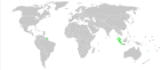
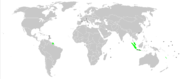
Outside Indonesia, there are some Javanese-speaking people in neighboring countries such as Malaysia and Singapore
. In addition there are also people of Javanese descent in Suriname
(the former Dutch Guiana
until 1975), who speak a creole
descendant of the language. The Javanese speakers in Malaysia are especially found in the states of Selangor
and Johor
. For distribution in other parts, as far as Suriname, see Demographic distribution of Javanese speakers below.
 Javanese is a Nuclear Malayo-Polynesian
language, but is otherwise not particularly close to other languages and is difficult to classify. It is however not too dissimilar from neighboring languages such as Malay
, Sundanese
, Madurese
, and Balinese
.
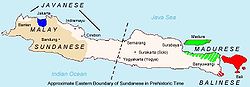
Javanese is spoken in Central and East Java, as well as on the north coast of West Java. In Madura, Bali, Lombok and the Sunda region of West Java, Javanese is also used as a literary language
. It was the court language in Palembang
, South Sumatra
, until their palace was sacked by the Dutch in the late 18th century.
Javanese can be regarded as one of the classical languages of the world, with a vast literature
spanning more than twelve centuries. Scholars divide the development of Javanese language in four different stages:
Javanese is written with the Javanese script
, Arabo-Javanese script
, Arabic script (modified for Javanese) and Latin script.
Although not currently an official language anywhere, Javanese is the Austronesian
language with the largest number of native speakers. It is spoken or understood by approximately 80 million people. At least 45% of the total population of Indonesia are of Javanese descent or live in an area where Javanese is the dominant language. Five out of six Indonesian presidents since 1945 are of Javanese descent. It is therefore not surprising that Javanese has a deep impact on the development of Indonesian
, the national language of Indonesia
, which is a modern dialect of Malay
.
There are three main dialects of Modern Javanese: Central Javanese, Eastern Javanese and Western Javanese. There is a dialect continuum from Banten
in the extreme west of Java to Banyuwangi
, in the foremost eastern corner of the island. All Javanese dialects are more or less mutually intelligible
.
The vowels /i u e o/ are pronounced [ɪ ʊ ɛ ɔ] respectively in closed syllables. In open syllables, /e o/ are also [ɛ ɔ] when the followinɡ vowel is /i u/ in an open syllable, or /ə/, or identical (/e...e/, /o...o/). The main characteristic of the standard dialect of Surakarta is that /a/ is pronounced [ɔ] in word-final open syllables, and in any open penultimate syllable before such an [ɔ].
The Javanese voiced phonemes are not in fact voiced but voiceless, with breathy voice
on the following vowel. In The sounds of the world's languages, the distinction of phonation
in the plosives is described as one of stiff voice
versus slack voice
.
A Javanese syllable
can be of the following type: CSVC. C=consonant
, S= sonorant
(/j/, /r/, /l/, /w/ or any nasal consonant
) and V=vowel
. In Modern Javanese, a bi-syllabic root is of the following type: nCsvVnCsvVC. As in other Austronesian languages, native Javanese roots consist of two syllables; words consisting of more than three syllables are broken up into groups of bi-syllabic words for pronunciation.
Javanese, together with Madurese
, are the only languages of Western Indonesia to possess a distinction between retroflex and dental phonemes. (Madurese also possesses aspirated phonemes including at least one aspirated retroflex phoneme.) These letters are transcribed as "th" and "dh" in the modern Roman script, but previously by the use of a dot
: "" and "". Some scholars assume this might be an influence of the Sanskrit
, but others believe this could be an independent development within the Austronesian super family. Incidentally, a sibilant before a retroflex stop in Sanskrit loanwords is pronounced as a retroflex sibilant whereas in modern Indian languages it is pronounced as a palatal sibilant. Though Acehnese
and Balinese
also possess a retroflex voiceless stop, this is merely an allophone of /t/.
es.
Examples:
Both sentences mean: "He (S) comes (V) in (pp.) the (def. art.) palace (O)". In the Old Javanese sentence, the verb is placed at the beginning and is separated by the particle ta from the rest of the sentence. In Modern Javanese the definite article is lost in prepositions (it is expressed in another way).
Verbs are not inflected for person or number. Tense is not indicated either, but is expressed by auxiliary words such as "yesterday", "already", etc. There is also a complex system of verb affixes to express the different status of the subject and object.
However, in general the structure of Javanese sentences both Old and Modern can be described using the so-called topic–comment model without having to refer to classical grammatical or syntactical categories such as the aforementioned subject, object, predicate, etc. The topic is the head of the sentence; the comment is the modifier. So our Javanese above-mentioned sentence could then be described as follows: Dhèwèké = topic; teka = comment; ing keraton = setting.
has had a deep and lasting impact on the vocabulary of the Javanese language. The "Old Javanese–English Dictionary", written by professor P.J. Zoetmulder in 1982, contains approximately 25,500 entries, over 12,600 of which are borrowings from Sanskrit. Clearly this large number is not an indication of usage, but it is an indication that the Ancient Javanese knew and employed these Sanskrit words in their literary works. In any given Old Javanese literary work, approximately 25% of the vocabulary is derived from Sanskrit. In addition, many Javanese personal names have clearly recognisable Sanskrit roots.
Many Sanskrit words are still in current usage. Modern Javanese speakers refer to much of the Old Javanese and Sanskrit words as kawi
words, which may be roughly translated as "literary". However the so-called kawi words also contain some Arabic words. Furthermore there has been significant word borrowing from Arabic
, Dutch
and Malay
as well, but none as extensively as from Sanskrit.
There are far fewer Arabic loanwords in Javanese than in Malay. These Arabic loanwords are usually concerned with Islamic religion, but some words have entered the basic vocabulary, such as pikir ("to think", from the Arabic fikr), badan ("body"), mripat ("eye", thought to be derived from the Arabic ma'rifah, meaning "knowledge" or "vision"). However, these Arabic words typically have native Austronesian and/or Sanskrit equivalents. In the cases mentioned, pikir = galih, idhĕp (Austronesian), manah, cipta, or cita (Sanskrit), badan = awak (Austronesian), slira, sarira, or angga (Sanskrit), and mripat = mata (Austronesian), soca, or netra (Sanskrit).
Dutch loanwords usually have the same form and meaning as in Indonesian, but there are a few exceptions. Consider this table:
The latter is interesting, as the word sepur also exists in Indonesian. The Indonesian word has preserved the literal Dutch meaning of "railway tracks", while the Javanese word follows Dutch figurative use, where "spoor" (lit. "rail") is used as metonymy
for "trein" (lit. "train"). (Compare the corresponding metonymic use in English: "to travel by rail" may be used for "to travel by train".)
Malay
was the lingua franca
of the Indonesian archipelago before the proclamation of Indonesian independence in 1945, and Indonesian, which was based on Malay, is now the official national language of Indonesia. As a consequence, there has been an influx of Malay and Indonesian vocabulary into Javanese recently. Many of these words are concerned with bureaucracy or politics.
. Each style employs its own vocabulary, grammatical rules and even prosody
. This is not unique to Javanese; neighboring Austronesian languages as well as East Asian languages such as Korean
and Japanese
share similar constructions.
In Javanese these styles are called:
In addition, there are also "meta-style" words – the honorific
s and humilifics. When one talks about oneself, one has to be humble. But when one speaks of someone else with a higher status or to whom one wants to be respectful, honorific terms are used. Status is defined by age, social position and other factors. The humilific words are called krama andhap words while the honorific words are called krama inggil words. For example, children often use the ngoko style, but when talking to the parents they must use both krama inggil and krama andhap.
Below some examples are provided to explain these different styles.
The most polite word for "eat" is dhahar. But it is forbidden to use any most polite word for self expression, except when talking with lower status people, and in this case, ngoko style is used. The use of most polite words is only for speaking to other, especially upper status, people, as shown below:
The use of these different styles is complicated and requires thorough knowledge of the Javanese culture. This is one element that makes it difficult for foreigners to learn Javanese. On the other hand, these different styles of speech are actually not mastered by the majority of Javanese. Most people only master the first style and a rudimentary form of the second style. People who can correctly use the different styles are held in high esteem.
s based on the sub region where the speakers live. They are: Western Javanese, Central Javanese and Eastern Javanese. The differences between these dialectical groups are primarily pronunciation and, to a lesser extent, vocabulary. All Javanese dialects are more or less mutually intelligible.
The Central Javanese variant, based on the speech of Surakarta
(and also to a degree of Yogyakarta), is considered as the most "refined" Javanese dialect. Accordingly standard Javanese is based on this dialect. These two cities are the seats of the four Javanese principalities, heirs to the Mataram Sultanate, which once reigned over almost the whole of Java and beyond. Speakers spread from north to south of the Central Java
province and utilize many dialects, such as Muria and Semarangan, as well as Surakarta and Yogyakarta. To a lesser extent, there are also dialects such as those used in Pekalongan or Dialek Pantura and Kebumen (a variation of Banyumasan). The variations of Javanese dialect in Central Java are said to be so plentiful that almost all administrative regions (kabupaten) have their own native slang
that is only recognizable by people from that region, but those minor dialects are not distinctive to most Javanese speakers.
In addition to Central Java and Yogyakarta provinces, Central Javanese is also used in the western part of East Java province. For example, Javanese spoken in the Madiun
region bears a strong influence of Surakarta Javanese (as well as Javanese spoken in Ponorogo
, Pacitan
, and Tulungagung
), while Javanese spoken in Bojonegoro
and Tuban
is similar to that spoken in the Pati region (Muria dialect).
Western Javanese, spoken in the western part of the Central Java
province and throughout the West Java
province (particularly in the north coast region), contains dialects which are distinct for their Sundanese
influences and which still maintain many archaic words. The dialects include North Banten, Banyumasan
, Tegal, Jawa Serang, North coast, Indramayu (or Dermayon) and Cirebonan (or Basa Cerbon).
Eastern Javanese speakers range from the eastern banks of Brantas River in Kertosono, Nganjuk
to Banyuwangi
, comprising the majority of the East Java
province, excluding Madura
island. However, the dialect has been influenced by Madurese
, and is sometimes referred to as Surabaya
n speech.
The most aberrant dialect is spoken in Balambangan (or Banyuwangi
) in the eastern-most part of Java. It is generally known as Basa Osing
. Osing is the word for negation and is a cognate of the Balinese
tusing, Balinese being the neighboring language directly to the east. In the past this area of Java was in possession of Balinese kings and warlords.
In addition to these three main Javanese dialects, there is Surinamese Javanese. Surinamese Javanese is mainly based on the Central Javanese dialect, especially from the Kedu residency
.
is pronounced as [ɪ] in Central Javanese (Surakarta – Yogyakarta dialect), as [i] in Western Javanese (Banyumasan
dialect) or as [ɛ] in Eastern Javanese.
Phoneme /u/ at closed ultima is pronounced as [ʊ] in Central Javanese, as [u] in Western Javanese or as [ɔ] in Eastern Javanese.
Phoneme /a/ at closed ultima in Central Javanese is pronounced as [a] and at open ultima as [ɔ]. Meanwhile unregarding its position, it is pronounced as [a] in Western Javanese and as [ɔ] in Eastern Javanese.
dialect of Western Javanese employs kepriwé /kəpriwe/ or kepriwèn /kəpriwen/, Eastern Javanese speakers say yok apa /jɔʔ ɔpɔ/ – originally means "like what" (Javanese: kaya apa) or kepiyé /kəpije/, and Central Javanese speakers say piye /pije/ or kepriyé /kəprije/.
.
The 8th and 9th centuries are marked with the emergence of the Javanese literary tradition with Sang Hyang Kamahayanikan, a Buddhist treatise and the Kakawin Rāmâyaṇa , a Javanese rendering in Indian metres of the Vishnuistic Sanskrit epic, Rāmāyaṇa.
Although Javanese as a written language appeared considerably later than Malay (extant in the 7th century), the Javanese literary tradition is continuous from its inception to present day. The oldest works, such as the above mentioned Rāmāyaṇa, and a Javanese rendering of the Indian Mahabharata
epic are studied assiduously today.
The expansion of the Javanese culture, including Javanese script and language, began in 1293 with the eastward push of the Hindu
–Buddhist East-Javanese Empire Majapahit, toward Madura
and Bali
. The Javanese campaign in Bali in 1363 has had a deep and lasting impact. With the introduction of the Javanese administration, Javanese replaced Balinese as the language of administration and literature. Though the Balinese people preserved much of the older literature of Java and even created their own in Javanese idioms, Balinese ceased to be written until the 19th century.
The Majapahit Empire fell due to internal disturbances in Paregreg civil war, thought to have occurred from 1405 to 1406, and attacks by Islamic forces of the Sultanate of Demak
on the north coast of Java. There is a Javanese chronogram
concerning the fall which reads, "sirna ilang krĕtaning bumi" ("vanished and gone was the prosperity of the world"), indicating the date AD 1478. Thus there is a popular belief that Majapahit collapsed in 1478, though it may have lasted into the 16th century. This was the last Hindu Javanese empire.
, originally a vassal state of Majapahit. Ironically, the Mataram Empire rose as an Islamic kingdom which sought revenge for the demise of the Hindu Majapahit Empire by first crushing Demak, the first Javanese Islamic kingdom.
Javanese culture spread westward as Mataram conquered many previously Sundanese areas in western parts of Java; and Javanese became the dominant language in more than a third of this area. As in Bali, the Sundanese language ceased to be written until the 19th century. In the meantime it was heavily influenced by Javanese, and some 40% of Sundanese vocabulary is believed to have been derived from Javanese.
Though Islamic in name, the Mataram II empire preserved many elements of the older culture, incorporating them into the new religion. This is the reason why Javanese script is still in use as opposed to the writing of Old-Malay
for example. After the Malays were converted, they dropped their form of indigenous writing and changed to a form of the "script of the Divine", the Arabic script.
In addition to the rise of Islam, the 16th century saw the emergence of the New Javanese language. The first Islamic documents in Javanese were already written in New Javanese, although still in antiquated idioms and with numerous Arabic loanwords. This is to be expected as these early New Javanese documents are Islamic treatises.
Later, intensive contacts with the Dutch and with other Indonesians gave rise to a simplified form of Javanese and influx of foreign loanwords.
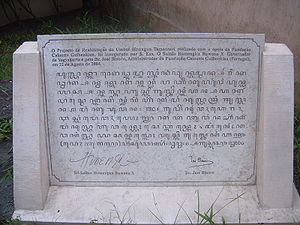 Javanese has been traditionally written with Javanese script
. However, it has also be written with Arabic script
and today generally uses Roman script
. Javanese and anad the related Balinese script
are modern variants of the old Kawi script, a Brahmic script introduced to Java along with Hinduism and Buddhism. Kawi is first attested in a legal document from 804 CE. It was widely used in literature and translations from Sanskrit from the tenth century; by the seventeenth, the script is identified as carakan. A Latin orthography
based on Dutch was introduced in 1926, revised in 1972–1973, and has largely supplanted the carakan.
The letters f
, q
, v
, x
, and z
are used in loanword
s from European languages and Arabic.
n countries, the Netherlands, Suriname
, New Caledonia
and other countries. However, the greatest concentration of speakers is found in the six provinces of Java itself, and in the neighboring Sumatran province of Lampung
.
Below, a table with the number of native speakers in 1980 is provided.
Based on the 1980 census, persons in approximately 43% of Indonesia's households spoke Javanese at home on a daily basis. By this reckoning there were well over 60 million Javanese speakers. In 1980, the total number of the Indonesian population was 147,490,298.
Above only 22 provinces of the then 27 provinces of Indonesia are taken. In each of these provinces, more than 1% of the population are Javanese speakers.
The distribution of persons living in Javanese-speaking households in East Java and Lampung requires clarification. For East Java, daily-language percentages are as follows: 74.5 Javanese; 23.0 Madurese; and 2.2 Indonesian. For Lampung, the official percentages are 62.4 Javanese; 16.4 Lampungese and other languages; 10.5 Sundanese and 9.4 Indonesian.
These figures are somewhat outdated for some regions, especially Jakarta while they remain more or less stable for the rest of Java. In Jakarta the number of Javanese has increased tenfold in the last 25 years. On the other hand, because of the conflict
the number of Javanese in Aceh
might have decreased. Furthermore it has to be noted that Banten
has separated from West Java province in 2000.
In Banten, Western Java, the descendants of the Central Javanese conquerors who founded the Islamic Sultanate there in the 16th century still speak an archaic form of Javanese. The rest of the population mainly speaks Sundanese and Indonesian as this province borders directly on Jakarta. Many commuters live in the Jakartan suburbs in Banten, among them also Javanese speakers. Their exact number is however unknown.
At least one third of the population of Jakarta
is of Javanese descent and as such speak Javanese or have knowledge of it. In the province of West Java
, many people speak Javanese, especially those living in the areas bordering Central Java
, the cultural homeland of the Javanese.
The province of East Java
is also home of the Madurese people, who number almost a quarter of the population (mostly on the Isle of Madura
), but many Madurese actually have some knowledge of colloquial Javanese. Since the 19th century, Madurese was also written in the Javanese script. Unfortunately, the aspirated phonemes of Madurese are not reproduced in writing. The 19th century scribes apparently overlooked, or were ignorant of, the fact that Javanese script does possess these characters.
In Lampung
the original inhabitants, the Lampungese, only make up some 15% of the population. The rest are the so-called "transmigrants", settlers from other parts of Indonesia, many as a result of past government transmigration program
s. Most of these transmigrants are Javanese who have settled there since the 19th century.
In the former Dutch colony of Suriname
(formerly called Dutch Guiana
), in South America, approximately 15% of the population of some 500,000 are of Javanese descent, thus accounting for 75,000 speakers of Javanese. A local variant evolved, the "Tyoro Jowo-Suriname" or "Suriname Javanese".
 Although Javanese is not a national language, it has a recognised status as a regional language
in three Indonesian provinces where the biggest concentrations of Javanese people are found, i.e. Central Java, Yogyakarta and East Java. Javanese is taught at schools and is also used in some mass media
, both electronically and in print. There is, however, no longer a daily newspaper in Javanese. Some examples of Javanese language magazines include: Panjebar Semangat, Jaka Lodhang, Jaya Baya, Damar Jati, and Mekar Sari.
Since 2003, an East Java local television station (JTV) has broadcast some of its programmes in Surabayan dialect. Three such programmes are Pojok kampung (News), Kuis RT/RW and Pojok Perkoro (a criminal programme). Later on JTV also broadcast programmes in Central Javanese dialect which they call 'the western language' (basa kulonan) and Madurese.
In 2005, a new Javanese language magazine Damar Jati, saw its conception. The interesting fact is that, it is not published in the Javanese heartlands, but in Jakarta, the national capital of Indonesia.
Java
Java is an island of Indonesia. With a population of 135 million , it is the world's most populous island, and one of the most densely populated regions in the world. It is home to 60% of Indonesia's population. The Indonesian capital city, Jakarta, is in west Java...
, in Indonesia
Indonesia
Indonesia , officially the Republic of Indonesia , is a country in Southeast Asia and Oceania. Indonesia is an archipelago comprising approximately 13,000 islands. It has 33 provinces with over 238 million people, and is the world's fourth most populous country. Indonesia is a republic, with an...
. In addition, there are also some pockets of Javanese speakers in the northern coast of western Java. It is the native language of more than 75,500,000 people.
The Javanese language is part of the Austronesian
Austronesian languages
The Austronesian languages are a language family widely dispersed throughout the islands of Southeast Asia and the Pacific, with a few members spoken on continental Asia that are spoken by about 386 million people. It is on par with Indo-European, Niger-Congo, Afroasiatic and Uralic as one of the...
family, and is therefore related to Indonesian
Indonesian language
Indonesian is the official language of Indonesia. Indonesian is a normative form of the Riau Islands dialect of Malay, an Austronesian language which has been used as a lingua franca in the Indonesian archipelago for centuries....
and other Malay
Malay language
Malay is a major language of the Austronesian family. It is the official language of Malaysia , Indonesia , Brunei and Singapore...
varieties. Most speakers of Javanese also speak Indonesian for official and commercial purposes and to communicate with non-Javanese Indonesians.
Outside Indonesia, there are some Javanese-speaking people in neighboring countries such as Malaysia and Singapore
Singapore
Singapore , officially the Republic of Singapore, is a Southeast Asian city-state off the southern tip of the Malay Peninsula, north of the equator. An island country made up of 63 islands, it is separated from Malaysia by the Straits of Johor to its north and from Indonesia's Riau Islands by the...
. In addition there are also people of Javanese descent in Suriname
Suriname
Suriname , officially the Republic of Suriname , is a country in northern South America. It borders French Guiana to the east, Guyana to the west, Brazil to the south, and on the north by the Atlantic Ocean. Suriname was a former colony of the British and of the Dutch, and was previously known as...
(the former Dutch Guiana
Dutch Guiana
Dutch Guiana, also known as Netherlands Guyana or Dutch Guyana , is the name given to various Dutch colonies on the northern coast of South America, created by the Dutch West India Company...
until 1975), who speak a creole
Creole language
A creole language, or simply a creole, is a stable natural language developed from the mixing of parent languages; creoles differ from pidgins in that they have been nativized by children as their primary language, making them have features of natural languages that are normally missing from...
descendant of the language. The Javanese speakers in Malaysia are especially found in the states of Selangor
Selangor
Selangor also known by its Arabic honorific, Darul Ehsan, or "Abode of Sincerity") is one of the 13 states of Malaysia. It is on the west coast of Peninsular Malaysia and is bordered by Perak to the north, Pahang to the east, Negeri Sembilan to the south and the Strait of Malacca to the west...
and Johor
Johor
Johor is a Malaysian state, located in the southern portion of Peninsular Malaysia. It is one of the most developed states in Malaysia. The state capital city and royal city of Johor is Johor Bahru, formerly known as Tanjung Puteri...
. For distribution in other parts, as far as Suriname, see Demographic distribution of Javanese speakers below.
Introduction
Nuclear Malayo-Polynesian languages
The Nuclear Malayo-Polynesian languages are a branch of the Austronesian family, proposed by Wouk & Ross , that are thought to have dispersed from a possible homeland in Sulawesi. They are called nuclear because they are the conceptual core of the Malayo-Polynesian family, including both Malay and...
language, but is otherwise not particularly close to other languages and is difficult to classify. It is however not too dissimilar from neighboring languages such as Malay
Malay language
Malay is a major language of the Austronesian family. It is the official language of Malaysia , Indonesia , Brunei and Singapore...
, Sundanese
Sundanese language
Sundanese is the language of about 27 million people from the western third of Java or about 15% of the Indonesian population....
, Madurese
Madurese language
Madurese is a language of the Madurese people of Madura Island and eastern Java, Indonesia; it is also spoken on the neighbouring small Kangean Islands and Sapudi Islands, as well as from migrants to other parts of Indonesia, namely the Tapal Kuda area comprising Pasuruan, Surabaya, Malang until...
, and Balinese
Balinese language
Balinese or simply Bali is a Malayo-Polynesian language spoken by 3.3 million people on the Indonesian island of Bali, as well as northern Nusa Penida, western Lombok and eastern Java...
.
Javanese is spoken in Central and East Java, as well as on the north coast of West Java. In Madura, Bali, Lombok and the Sunda region of West Java, Javanese is also used as a literary language
Literary language
A literary language is a register of a language that is used in literary writing. This may also include liturgical writing. The difference between literary and non-literary forms is more marked in some languages than in others...
. It was the court language in Palembang
Palembang
Palembang is the capital city of the South Sumatra province in Indonesia. Palembang is one of the oldest cities in Indonesia, and has a history of being a capital of a maritime empire. Located on the Musi River banks on the east coast of southern Sumatra island, it has an area of 400.61 square...
, South Sumatra
South Sumatra
South Sumatra is a province of Indonesia.-Geography:It is on the island of Sumatra, and borders the provinces of Lampung to the south, Bengkulu to the west, and Jambi to the north...
, until their palace was sacked by the Dutch in the late 18th century.
Javanese can be regarded as one of the classical languages of the world, with a vast literature
Javanese literature
Javanese literature is, generally speaking, literature from Java and, more specifically, from areas where Javanese is spoken. However, similar with other literary traditions, Javanese language works were and not necessarily produced only in Java, but also in Sunda, Madura, Bali, Lombok, Southern...
spanning more than twelve centuries. Scholars divide the development of Javanese language in four different stages:
- Old Javanese, from the 9th century
- Middle Javanese, from the 13th century
- New Javanese, from the 16th century
- Modern Javanese, from the 20th century (this classification is not used universally)
Javanese is written with the Javanese script
Javanese script
The Javanese alphabet, natively known as Hanacaraka or Carakan , known by the Sundanese people as Cacarakan is the pre-colonial script used to write the Javanese language....
, Arabo-Javanese script
Pegon (language)
Pegon is an Arabic alphabet used to write the Javanese and Sundanese languages, as an alternative to the Roman alphabet or the pre-colonial Javanese script and the old Sundanese script. In particular, it was used for religious writing and poetry from the fifteenth century, particularly in writing...
, Arabic script (modified for Javanese) and Latin script.
Although not currently an official language anywhere, Javanese is the Austronesian
Austronesian languages
The Austronesian languages are a language family widely dispersed throughout the islands of Southeast Asia and the Pacific, with a few members spoken on continental Asia that are spoken by about 386 million people. It is on par with Indo-European, Niger-Congo, Afroasiatic and Uralic as one of the...
language with the largest number of native speakers. It is spoken or understood by approximately 80 million people. At least 45% of the total population of Indonesia are of Javanese descent or live in an area where Javanese is the dominant language. Five out of six Indonesian presidents since 1945 are of Javanese descent. It is therefore not surprising that Javanese has a deep impact on the development of Indonesian
Indonesian language
Indonesian is the official language of Indonesia. Indonesian is a normative form of the Riau Islands dialect of Malay, an Austronesian language which has been used as a lingua franca in the Indonesian archipelago for centuries....
, the national language of Indonesia
Indonesia
Indonesia , officially the Republic of Indonesia , is a country in Southeast Asia and Oceania. Indonesia is an archipelago comprising approximately 13,000 islands. It has 33 provinces with over 238 million people, and is the world's fourth most populous country. Indonesia is a republic, with an...
, which is a modern dialect of Malay
Malay language
Malay is a major language of the Austronesian family. It is the official language of Malaysia , Indonesia , Brunei and Singapore...
.
There are three main dialects of Modern Javanese: Central Javanese, Eastern Javanese and Western Javanese. There is a dialect continuum from Banten
Banten
Banten is a province of Indonesia in Java. Formerly part of the Province of West Java, it was made a separate province in 2000.The administrative center is Serang. Preliminary results from the 2010 census counted some 10.6 million people.-Geography:...
in the extreme west of Java to Banyuwangi
Banyuwangi
The Regency of Banyuwangi is located at the easternmost end of the Indonesian island of Java and it is a very strategic area for those who want to go to Bali, since it also serves as an important ferry port between Java and Bali. It is surrounded by mountains and forests to the west; by sea to the...
, in the foremost eastern corner of the island. All Javanese dialects are more or less mutually intelligible
Mutual intelligibility
In linguistics, mutual intelligibility is recognized as a relationship between languages or dialects in which speakers of different but related languages can readily understand each other without intentional study or extraordinary effort...
.
Vowels
| Front | Central | Back |
|---|---|---|
| i | u | |
| e | ə | o |
| a |
The vowels /i u e o/ are pronounced [ɪ ʊ ɛ ɔ] respectively in closed syllables. In open syllables, /e o/ are also [ɛ ɔ] when the followinɡ vowel is /i u/ in an open syllable, or /ə/, or identical (/e...e/, /o...o/). The main characteristic of the standard dialect of Surakarta is that /a/ is pronounced [ɔ] in word-final open syllables, and in any open penultimate syllable before such an [ɔ].
Consonants
| Labial Labial consonant Labial consonants are consonants in which one or both lips are the active articulator. This precludes linguolabials, in which the tip of the tongue reaches for the posterior side of the upper lip and which are considered coronals... |
Dental/ Alveolar Alveolar consonant Alveolar consonants are articulated with the tongue against or close to the superior alveolar ridge, which is called that because it contains the alveoli of the superior teeth... |
Retroflex Retroflex consonant A retroflex consonant is a coronal consonant where the tongue has a flat, concave, or even curled shape, and is articulated between the alveolar ridge and the hard palate. They are sometimes referred to as cerebral consonants, especially in Indology... |
Palatal Palatal consonant Palatal consonants are consonants articulated with the body of the tongue raised against the hard palate... |
Velar Velar consonant Velars are consonants articulated with the back part of the tongue against the soft palate, the back part of the roof of the mouth, known also as the velum).... |
Glottal Glottal consonant Glottal consonants, also called laryngeal consonants, are consonants articulated with the glottis. Many phoneticians consider them, or at least the so-called fricative, to be transitional states of the glottis without a point of articulation as other consonants have; in fact, some do not consider... |
||
|---|---|---|---|---|---|---|---|
| Nasal Nasal consonant A nasal consonant is a type of consonant produced with a lowered velum in the mouth, allowing air to escape freely through the nose. Examples of nasal consonants in English are and , in words such as nose and mouth.- Definition :... |
m | ɳ | ɲ | ŋ | |||
| Plosive/Affricate | p b̥ | t d̥ | ʈ ɖ̥ | tʃ dʒ̊ | k ɡ̊ | ʔ | |
| Fricative Fricative consonant Fricatives are consonants produced by forcing air through a narrow channel made by placing two articulators close together. These may be the lower lip against the upper teeth, in the case of ; the back of the tongue against the soft palate, in the case of German , the final consonant of Bach; or... |
ʂ | h | |||||
| Approximant Approximant consonant Approximants are speech sounds that involve the articulators approaching each other but not narrowly enough or with enough articulatory precision to create turbulent airflow. Therefore, approximants fall between fricatives, which do produce a turbulent airstream, and vowels, which produce no... |
Central | ɽ | j | w | |||
| Lateral Lateral consonant A lateral is an el-like consonant, in which airstream proceeds along the sides of the tongue, but is blocked by the tongue from going through the middle of the mouth.... |
ɭ |
The Javanese voiced phonemes are not in fact voiced but voiceless, with breathy voice
Breathy voice
Breathy voice is a phonation in which the vocal cords vibrate, as they do in normal voicing, but are held further apart, so that a larger volume of air escapes between them. This produces an audible noise...
on the following vowel. In The sounds of the world's languages, the distinction of phonation
Phonation
Phonation has slightly different meanings depending on the subfield of phonetics. Among some phoneticians, phonation is the process by which the vocal folds produce certain sounds through quasi-periodic vibration. This is the definition used among those who study laryngeal anatomy and physiology...
in the plosives is described as one of stiff voice
Stiff voice
The term stiff voice describes the pronunciation of consonants or vowels with a glottal opening narrower, and the vocal cords stiffer, than what occurs in modal voice. Although there is no specific IPA diacritic for stiff voice, the voicing diacritic may be used in conjunction with the symbol for...
versus slack voice
Slack voice
The term slack voice describes the pronunciation of consonant or vowels with a glottal opening slightly wider than that occurring in modal voice. Such sounds are often referred to informally as lenis or half-voiced in the case of consonants...
.
A Javanese syllable
Syllable
A syllable is a unit of organization for a sequence of speech sounds. For example, the word water is composed of two syllables: wa and ter. A syllable is typically made up of a syllable nucleus with optional initial and final margins .Syllables are often considered the phonological "building...
can be of the following type: CSVC. C=consonant
Consonant
In articulatory phonetics, a consonant is a speech sound that is articulated with complete or partial closure of the vocal tract. Examples are , pronounced with the lips; , pronounced with the front of the tongue; , pronounced with the back of the tongue; , pronounced in the throat; and ,...
, S= sonorant
Sonorant
In phonetics and phonology, a sonorant is a speech sound that is produced without turbulent airflow in the vocal tract; fricatives and plosives are not sonorants. Vowels are sonorants, as are consonants like and . Other consonants, like or , restrict the airflow enough to cause turbulence, and...
(/j/, /r/, /l/, /w/ or any nasal consonant
Nasal consonant
A nasal consonant is a type of consonant produced with a lowered velum in the mouth, allowing air to escape freely through the nose. Examples of nasal consonants in English are and , in words such as nose and mouth.- Definition :...
) and V=vowel
Vowel
In phonetics, a vowel is a sound in spoken language, such as English ah! or oh! , pronounced with an open vocal tract so that there is no build-up of air pressure at any point above the glottis. This contrasts with consonants, such as English sh! , where there is a constriction or closure at some...
. In Modern Javanese, a bi-syllabic root is of the following type: nCsvVnCsvVC. As in other Austronesian languages, native Javanese roots consist of two syllables; words consisting of more than three syllables are broken up into groups of bi-syllabic words for pronunciation.
Javanese, together with Madurese
Madurese language
Madurese is a language of the Madurese people of Madura Island and eastern Java, Indonesia; it is also spoken on the neighbouring small Kangean Islands and Sapudi Islands, as well as from migrants to other parts of Indonesia, namely the Tapal Kuda area comprising Pasuruan, Surabaya, Malang until...
, are the only languages of Western Indonesia to possess a distinction between retroflex and dental phonemes. (Madurese also possesses aspirated phonemes including at least one aspirated retroflex phoneme.) These letters are transcribed as "th" and "dh" in the modern Roman script, but previously by the use of a dot
Dot (diacritic)
When used as a diacritic mark, the term dot is usually reserved for the Interpunct , or to the glyphs 'combining dot above' and 'combining dot below'...
: "" and "". Some scholars assume this might be an influence of the Sanskrit
Sanskrit
Sanskrit , is a historical Indo-Aryan language and the primary liturgical language of Hinduism, Jainism and Buddhism.Buddhism: besides Pali, see Buddhist Hybrid Sanskrit Today, it is listed as one of the 22 scheduled languages of India and is an official language of the state of Uttarakhand...
, but others believe this could be an independent development within the Austronesian super family. Incidentally, a sibilant before a retroflex stop in Sanskrit loanwords is pronounced as a retroflex sibilant whereas in modern Indian languages it is pronounced as a palatal sibilant. Though Acehnese
Acehnese language
Acehnese or Aceh is a Malayo-Polynesian language spoken by Acehnese people natively in Aceh, Sumatra, Indonesia...
and Balinese
Balinese language
Balinese or simply Bali is a Malayo-Polynesian language spoken by 3.3 million people on the Indonesian island of Bali, as well as northern Nusa Penida, western Lombok and eastern Java...
also possess a retroflex voiceless stop, this is merely an allophone of /t/.
Morphology
Javanese, like other Austronesian languages, is an agglutinative language, where base words are modified through extensive use of affixAffix
An affix is a morpheme that is attached to a word stem to form a new word. Affixes may be derivational, like English -ness and pre-, or inflectional, like English plural -s and past tense -ed. They are bound morphemes by definition; prefixes and suffixes may be separable affixes...
es.
Syntax
Modern Javanese usually employs SVO word order. However, Old Javanese particularly had VSO or sometimes VOS word orders. Even in Modern Javanese archaic sentences using VSO structure can still be made.Examples:
- Modern Javanese: "Dhèwèké (S) teka (V) ing (pp.) keraton (O)".
- Old Javanese: "Teka (V) ta (part.) sira (S) ri (pp.) -ng (def. art.) kadhatwan (O)".
Both sentences mean: "He (S) comes (V) in (pp.) the (def. art.) palace (O)". In the Old Javanese sentence, the verb is placed at the beginning and is separated by the particle ta from the rest of the sentence. In Modern Javanese the definite article is lost in prepositions (it is expressed in another way).
Verbs are not inflected for person or number. Tense is not indicated either, but is expressed by auxiliary words such as "yesterday", "already", etc. There is also a complex system of verb affixes to express the different status of the subject and object.
However, in general the structure of Javanese sentences both Old and Modern can be described using the so-called topic–comment model without having to refer to classical grammatical or syntactical categories such as the aforementioned subject, object, predicate, etc. The topic is the head of the sentence; the comment is the modifier. So our Javanese above-mentioned sentence could then be described as follows: Dhèwèké = topic; teka = comment; ing keraton = setting.
Vocabulary
Javanese has a rich vocabulary, with many foreign loan words as well as the native Austronesian base. SanskritSanskrit
Sanskrit , is a historical Indo-Aryan language and the primary liturgical language of Hinduism, Jainism and Buddhism.Buddhism: besides Pali, see Buddhist Hybrid Sanskrit Today, it is listed as one of the 22 scheduled languages of India and is an official language of the state of Uttarakhand...
has had a deep and lasting impact on the vocabulary of the Javanese language. The "Old Javanese–English Dictionary", written by professor P.J. Zoetmulder in 1982, contains approximately 25,500 entries, over 12,600 of which are borrowings from Sanskrit. Clearly this large number is not an indication of usage, but it is an indication that the Ancient Javanese knew and employed these Sanskrit words in their literary works. In any given Old Javanese literary work, approximately 25% of the vocabulary is derived from Sanskrit. In addition, many Javanese personal names have clearly recognisable Sanskrit roots.
Many Sanskrit words are still in current usage. Modern Javanese speakers refer to much of the Old Javanese and Sanskrit words as kawi
Kawi language
Kawi is a literary and prose language on the islands of Java, Bali, and Lombok, based on Old Javanese, a language with a sizable vocabulary of Sanskrit loanwords. Kawi is the ancestor language of modern Javanese. The name "kawi" is derived from the root ku, which in Sanskrit means “poet”, and, in...
words, which may be roughly translated as "literary". However the so-called kawi words also contain some Arabic words. Furthermore there has been significant word borrowing from Arabic
Arabic language
Arabic is a name applied to the descendants of the Classical Arabic language of the 6th century AD, used most prominently in the Quran, the Islamic Holy Book...
, Dutch
Dutch language
Dutch is a West Germanic language and the native language of the majority of the population of the Netherlands, Belgium, and Suriname, the three member states of the Dutch Language Union. Most speakers live in the European Union, where it is a first language for about 23 million and a second...
and Malay
Malay language
Malay is a major language of the Austronesian family. It is the official language of Malaysia , Indonesia , Brunei and Singapore...
as well, but none as extensively as from Sanskrit.
There are far fewer Arabic loanwords in Javanese than in Malay. These Arabic loanwords are usually concerned with Islamic religion, but some words have entered the basic vocabulary, such as pikir ("to think", from the Arabic fikr), badan ("body"), mripat ("eye", thought to be derived from the Arabic ma'rifah, meaning "knowledge" or "vision"). However, these Arabic words typically have native Austronesian and/or Sanskrit equivalents. In the cases mentioned, pikir = galih, idhĕp (Austronesian), manah, cipta, or cita (Sanskrit), badan = awak (Austronesian), slira, sarira, or angga (Sanskrit), and mripat = mata (Austronesian), soca, or netra (Sanskrit).
Dutch loanwords usually have the same form and meaning as in Indonesian, but there are a few exceptions. Consider this table:
| Javanese | Indonesian | Dutch | English |
|---|---|---|---|
| pit | sepeda | fiets | bicycle |
| pit montor | sepeda motor | motorfiets | motorcycle |
| sepur | kereta api | spoor, i.e. (rail)track | train |
The latter is interesting, as the word sepur also exists in Indonesian. The Indonesian word has preserved the literal Dutch meaning of "railway tracks", while the Javanese word follows Dutch figurative use, where "spoor" (lit. "rail") is used as metonymy
Metonymy
Metonymy is a figure of speech used in rhetoric in which a thing or concept is not called by its own name, but by the name of something intimately associated with that thing or concept...
for "trein" (lit. "train"). (Compare the corresponding metonymic use in English: "to travel by rail" may be used for "to travel by train".)
Malay
Malay language
Malay is a major language of the Austronesian family. It is the official language of Malaysia , Indonesia , Brunei and Singapore...
was the lingua franca
Lingua franca
A lingua franca is a language systematically used to make communication possible between people not sharing a mother tongue, in particular when it is a third language, distinct from both mother tongues.-Characteristics:"Lingua franca" is a functionally defined term, independent of the linguistic...
of the Indonesian archipelago before the proclamation of Indonesian independence in 1945, and Indonesian, which was based on Malay, is now the official national language of Indonesia. As a consequence, there has been an influx of Malay and Indonesian vocabulary into Javanese recently. Many of these words are concerned with bureaucracy or politics.
Politeness
Javanese speech varies depending on social context, yielding three distinct styles, or registersRegister (linguistics)
In linguistics, a register is a variety of a language used for a particular purpose or in a particular social setting. For example, when speaking in a formal setting an English speaker may be more likely to adhere more closely to prescribed grammar, pronounce words ending in -ing with a velar nasal...
. Each style employs its own vocabulary, grammatical rules and even prosody
Prosody (linguistics)
In linguistics, prosody is the rhythm, stress, and intonation of speech. Prosody may reflect various features of the speaker or the utterance: the emotional state of the speaker; the form of the utterance ; the presence of irony or sarcasm; emphasis, contrast, and focus; or other elements of...
. This is not unique to Javanese; neighboring Austronesian languages as well as East Asian languages such as Korean
Korean language
Korean is the official language of the country Korea, in both South and North. It is also one of the two official languages in the Yanbian Korean Autonomous Prefecture in People's Republic of China. There are about 78 million Korean speakers worldwide. In the 15th century, a national writing...
and Japanese
Japanese language
is a language spoken by over 130 million people in Japan and in Japanese emigrant communities. It is a member of the Japonic language family, which has a number of proposed relationships with other languages, none of which has gained wide acceptance among historical linguists .Japanese is an...
share similar constructions.
In Javanese these styles are called:
- Ngoko (or even spelled as Ngaka) is informal speech, used between friends and close relatives. It is also used by persons of higher status to persons of lower status, such as elders to younger people or bosses to subordinates.
- Madya is the intermediary form between ngoko and krama. An example of the context where one would use madya is an interaction between strangers on the street, where one wants to be neither too formal nor too informal. The term is from Sanskrit madya, "middle".
- Krama is the polite and formal style. It is used between persons of the same status who do not wish to be informal. It is also the official style for public speeches, announcements, etc. It is also used by persons of lower status to persons of higher status, such as youngsters to elder people or subordinates to bosses. The term is from Sanskrit krama, "in order".
In addition, there are also "meta-style" words – the honorific
Honorific
An honorific is a word or expression with connotations conveying esteem or respect when used in addressing or referring to a person. Sometimes, the term is used not quite correctly to refer to an honorary title...
s and humilifics. When one talks about oneself, one has to be humble. But when one speaks of someone else with a higher status or to whom one wants to be respectful, honorific terms are used. Status is defined by age, social position and other factors. The humilific words are called krama andhap words while the honorific words are called krama inggil words. For example, children often use the ngoko style, but when talking to the parents they must use both krama inggil and krama andhap.
Below some examples are provided to explain these different styles.
- Ngoko: Aku arep mangan (I want to eat)
- Madya: Kula ajeng nedha.
- Krama:
- (Neutral) Kula badhé nedhi.
- (Humble) Dalem badhé nedhi.
The most polite word for "eat" is dhahar. But it is forbidden to use any most polite word for self expression, except when talking with lower status people, and in this case, ngoko style is used. The use of most polite words is only for speaking to other, especially upper status, people, as shown below:
- Mixed:
- (Honorific – Addressed to someone with a high(er) status.) Bapak kersa dhahar? (Do you want to eat? Literal meaning: Does father want to eat?)
- (reply towards persons with lower status, expressing self superiority) Iya, aku kersa dhahar. (Yes, I want to eat.)
- (reply towards persons with lower status, but without having the need to express one's superiority) Iya, aku arep mangan.
- (reply towards persons with the same status) Inggih, kula badhé nedha.
The use of these different styles is complicated and requires thorough knowledge of the Javanese culture. This is one element that makes it difficult for foreigners to learn Javanese. On the other hand, these different styles of speech are actually not mastered by the majority of Javanese. Most people only master the first style and a rudimentary form of the second style. People who can correctly use the different styles are held in high esteem.
Dialects of modern Javanese
There are three main groups of Javanese dialectDialect
The term dialect is used in two distinct ways, even by linguists. One usage refers to a variety of a language that is a characteristic of a particular group of the language's speakers. The term is applied most often to regional speech patterns, but a dialect may also be defined by other factors,...
s based on the sub region where the speakers live. They are: Western Javanese, Central Javanese and Eastern Javanese. The differences between these dialectical groups are primarily pronunciation and, to a lesser extent, vocabulary. All Javanese dialects are more or less mutually intelligible.
The Central Javanese variant, based on the speech of Surakarta
Surakarta
Surakarta, also called Solo or Sala, is a city in Central Java, Indonesia of more than 520,061 people with a population density of 11,811.5 people/km2. The 44 km2 city adjoins Karanganyar Regency and Boyolali Regency to the north, Karanganyar Regency and Sukoharjo Regency to the east and...
(and also to a degree of Yogyakarta), is considered as the most "refined" Javanese dialect. Accordingly standard Javanese is based on this dialect. These two cities are the seats of the four Javanese principalities, heirs to the Mataram Sultanate, which once reigned over almost the whole of Java and beyond. Speakers spread from north to south of the Central Java
Central Java
Central Java is a province of Indonesia. The administrative capital is Semarang. It is one of six provinces on the island of Java.This province is the province of high Human Development in Indonesia and its Points Development Index countries is equivalent to Lebanon. The province of Central Java...
province and utilize many dialects, such as Muria and Semarangan, as well as Surakarta and Yogyakarta. To a lesser extent, there are also dialects such as those used in Pekalongan or Dialek Pantura and Kebumen (a variation of Banyumasan). The variations of Javanese dialect in Central Java are said to be so plentiful that almost all administrative regions (kabupaten) have their own native slang
Slang
Slang is the use of informal words and expressions that are not considered standard in the speaker's language or dialect but are considered more acceptable when used socially. Slang is often to be found in areas of the lexicon that refer to things considered taboo...
that is only recognizable by people from that region, but those minor dialects are not distinctive to most Javanese speakers.
In addition to Central Java and Yogyakarta provinces, Central Javanese is also used in the western part of East Java province. For example, Javanese spoken in the Madiun
Madiun
Madiun is a city in the western part of the province of East Java Indonesia, an agricultural centre. It is the capital of the regency of the same name....
region bears a strong influence of Surakarta Javanese (as well as Javanese spoken in Ponorogo
Ponorogo
Ponorogo is a regency of East Java, Indonesia. It is known as the location of the origin of Indonesian traditional show, the Reog Ponorogo.Ponorogo is located in East Java...
, Pacitan
Pacitan
Pacitan is a regency located in the southwestern East Java Province, with Central Java Province on its west border. Located between 7.55° - 8.17°S and 110.55° - 111.25°E. The borders of Pacitan Regency are: Wonogiri Regency in the west, Ponorogo Regency and Wonogiri Regency in the north,...
, and Tulungagung
Tulungagung
Tulungagung is a regency of East Java, Indonesia.-Etymology:Previously, Tulungagung was only a small area located surrounding a location where the center of the town is situated now. That area was named Tulungagung, because it provided a great water source - in Old Javanese language, tulung means...
), while Javanese spoken in Bojonegoro
Bojonegoro
Bojonegoro is a regency in East Java, Indonesia, about 110 km west of Surabaya. Bojonegoro is located in the inland part of northern Java plain, on the banks of the Bengawan Solo river, the largest river in Java....
and Tuban
Tuban
Tuban is a town located on the north coast of Java, in Tuban Regency, approximately 100 km west of Surabaya, the capital of East Java. Tuban is surrounded by Lamongan in the east, Bojonegoro in the south and Rembang, Central Java in the west....
is similar to that spoken in the Pati region (Muria dialect).
Western Javanese, spoken in the western part of the Central Java
Central Java
Central Java is a province of Indonesia. The administrative capital is Semarang. It is one of six provinces on the island of Java.This province is the province of high Human Development in Indonesia and its Points Development Index countries is equivalent to Lebanon. The province of Central Java...
province and throughout the West Java
West Java
West Java , with a population of over 43 million, is the most populous and most densely populated province of Indonesia. Located on the island of Java, it is slightly smaller in area than densely populated Taiwan, but with nearly double the population...
province (particularly in the north coast region), contains dialects which are distinct for their Sundanese
Sundanese language
Sundanese is the language of about 27 million people from the western third of Java or about 15% of the Indonesian population....
influences and which still maintain many archaic words. The dialects include North Banten, Banyumasan
Banyumasan language
The Banyumasan language, spoken on the island of Java, is usually considered a dialect of Javanese in modern language classification.The Banyumasan language is mainly spoken in the three areas of the island of Java: the Banyumasan region, located in westernmost Central Java Province and surrounding...
, Tegal, Jawa Serang, North coast, Indramayu (or Dermayon) and Cirebonan (or Basa Cerbon).
Eastern Javanese speakers range from the eastern banks of Brantas River in Kertosono, Nganjuk
Nganjuk
Nganjuk is a regency of East Java, Indonesia....
to Banyuwangi
Banyuwangi
The Regency of Banyuwangi is located at the easternmost end of the Indonesian island of Java and it is a very strategic area for those who want to go to Bali, since it also serves as an important ferry port between Java and Bali. It is surrounded by mountains and forests to the west; by sea to the...
, comprising the majority of the East Java
East Java
East Java is a province of Indonesia. It is located on the eastern part of the island of Java and includes neighboring Madura and islands to its east and to its north East Java is a province of Indonesia. It is located on the eastern part of the island of Java and includes neighboring Madura and...
province, excluding Madura
Madura
Madura is an Indonesian island off the northeastern coast of Java. The island comprises an area of approximately 4,250 km². Madura is administered as part of the East Java province. It is separated from Java by the narrow Strait of Madura.-History:...
island. However, the dialect has been influenced by Madurese
Madurese language
Madurese is a language of the Madurese people of Madura Island and eastern Java, Indonesia; it is also spoken on the neighbouring small Kangean Islands and Sapudi Islands, as well as from migrants to other parts of Indonesia, namely the Tapal Kuda area comprising Pasuruan, Surabaya, Malang until...
, and is sometimes referred to as Surabaya
Surabaya
Surabaya is Indonesia's second-largest city with a population of over 2.7 million , and the capital of the province of East Java...
n speech.
The most aberrant dialect is spoken in Balambangan (or Banyuwangi
Banyuwangi
The Regency of Banyuwangi is located at the easternmost end of the Indonesian island of Java and it is a very strategic area for those who want to go to Bali, since it also serves as an important ferry port between Java and Bali. It is surrounded by mountains and forests to the west; by sea to the...
) in the eastern-most part of Java. It is generally known as Basa Osing
Osing language
The Osing language , locally known as the language of Banyuwangi, is the language of the Osing people of East Java, Indonesia....
. Osing is the word for negation and is a cognate of the Balinese
Balinese language
Balinese or simply Bali is a Malayo-Polynesian language spoken by 3.3 million people on the Indonesian island of Bali, as well as northern Nusa Penida, western Lombok and eastern Java...
tusing, Balinese being the neighboring language directly to the east. In the past this area of Java was in possession of Balinese kings and warlords.
In addition to these three main Javanese dialects, there is Surinamese Javanese. Surinamese Javanese is mainly based on the Central Javanese dialect, especially from the Kedu residency
Kedu Residency
Kedu Residency Was a colonial administrative unit in Central Java in Java IndonesiaIt contained the Kebumen, Wonosobo, Temanggung, Purworejo and Magelang regencies...
.
Phonetic Differences
Phoneme /i/ at closed ultimaUltima (linguistics)
In linguistics, the ultima is the last syllable of a word, the penult is the next-to-last syllable, and the antepenult is second-from-last syllable. In a word of three syllables, the names of the syllables are antepenult-penult-ultima.-Etymology:...
is pronounced as [ɪ] in Central Javanese (Surakarta – Yogyakarta dialect), as [i] in Western Javanese (Banyumasan
Banyumasan language
The Banyumasan language, spoken on the island of Java, is usually considered a dialect of Javanese in modern language classification.The Banyumasan language is mainly spoken in the three areas of the island of Java: the Banyumasan region, located in westernmost Central Java Province and surrounding...
dialect) or as [ɛ] in Eastern Javanese.
Phoneme /u/ at closed ultima is pronounced as [ʊ] in Central Javanese, as [u] in Western Javanese or as [ɔ] in Eastern Javanese.
Phoneme /a/ at closed ultima in Central Javanese is pronounced as [a] and at open ultima as [ɔ]. Meanwhile unregarding its position, it is pronounced as [a] in Western Javanese and as [ɔ] in Eastern Javanese.
| Phoneme | Orthography | Central Javanese (standard) | Western Javanese | Eastern Javanese | English |
|---|---|---|---|---|---|
| /i/ | getih | [ɡətɪh] | [ɡətih] | [ɡətɛh] | blood |
| /u/ | abuh | [aβʊh] | [aβuh] | [aβɔh] | swollen |
| /a/ | lenga | [ləŋɔ] | [ləŋaʔ] | [ləŋɔ] | oil |
| /a/ | kancamu | [kancamu] | [kancane kowɛʔ] | [kɔncɔmu] | your friend |
Vocabulary
The vocabulary of Javanese language is enriched by dialectal words. For example, to get the meaning of "you", Western Javanese speakers say rika /rikaʔ/, Eastern Javanese use kon /kɔn/ or koen/kɔən/, and Central Javanese speakers say kowé /kowe/. Another example is the expression of "how": the Tegal dialect of Western Javanese uses kepribèn /kəpriben/, the BanyumasanBanyumasan language
The Banyumasan language, spoken on the island of Java, is usually considered a dialect of Javanese in modern language classification.The Banyumasan language is mainly spoken in the three areas of the island of Java: the Banyumasan region, located in westernmost Central Java Province and surrounding...
dialect of Western Javanese employs kepriwé /kəpriwe/ or kepriwèn /kəpriwen/, Eastern Javanese speakers say yok apa /jɔʔ ɔpɔ/ – originally means "like what" (Javanese: kaya apa) or kepiyé /kəpije/, and Central Javanese speakers say piye /pije/ or kepriyé /kəprije/.
Old Javanese
While evidence of writing in Java dates to the Sanskrit "Tarumanegara inscription" of 450, the oldest example written entirely in Javanese, called the "Sukabumi inscription", is dated March 25, 804. This inscription, located in the district of Pare in the Kediri regency of East Java, is actually a copy of the original, dated some 120 years earlier; only this copy has been preserved. Its contents concern the construction of a dam for an irrigation canal near the river Śrī Hariñjing (nowadays Srinjing). This inscription is the last of its kind to be written using Pallava script; all consequent examples are written using Javanese scriptJavanese script
The Javanese alphabet, natively known as Hanacaraka or Carakan , known by the Sundanese people as Cacarakan is the pre-colonial script used to write the Javanese language....
.
The 8th and 9th centuries are marked with the emergence of the Javanese literary tradition with Sang Hyang Kamahayanikan, a Buddhist treatise and the Kakawin Rāmâyaṇa , a Javanese rendering in Indian metres of the Vishnuistic Sanskrit epic, Rāmāyaṇa.
Although Javanese as a written language appeared considerably later than Malay (extant in the 7th century), the Javanese literary tradition is continuous from its inception to present day. The oldest works, such as the above mentioned Rāmāyaṇa, and a Javanese rendering of the Indian Mahabharata
Mahabharata
The Mahabharata is one of the two major Sanskrit epics of ancient India and Nepal, the other being the Ramayana. The epic is part of itihasa....
epic are studied assiduously today.
The expansion of the Javanese culture, including Javanese script and language, began in 1293 with the eastward push of the Hindu
Hindu
Hindu refers to an identity associated with the philosophical, religious and cultural systems that are indigenous to the Indian subcontinent. As used in the Constitution of India, the word "Hindu" is also attributed to all persons professing any Indian religion...
–Buddhist East-Javanese Empire Majapahit, toward Madura
Madura
Madura is an Indonesian island off the northeastern coast of Java. The island comprises an area of approximately 4,250 km². Madura is administered as part of the East Java province. It is separated from Java by the narrow Strait of Madura.-History:...
and Bali
Bali
Bali is an Indonesian island located in the westernmost end of the Lesser Sunda Islands, lying between Java to the west and Lombok to the east...
. The Javanese campaign in Bali in 1363 has had a deep and lasting impact. With the introduction of the Javanese administration, Javanese replaced Balinese as the language of administration and literature. Though the Balinese people preserved much of the older literature of Java and even created their own in Javanese idioms, Balinese ceased to be written until the 19th century.
Middle Javanese
The Majapahit Empire also saw the rise of a new language, Middle Javanese, which is an intermediate form between Old Javanese and New Javanese. In fact, Middle Javanese is so similar to New Javanese that works written in Middle Javanese should be easily comprehended by Modern Javanese speakers who are well acquainted with literary Javanese.The Majapahit Empire fell due to internal disturbances in Paregreg civil war, thought to have occurred from 1405 to 1406, and attacks by Islamic forces of the Sultanate of Demak
Sultanate of Demak
The Sultanate of Demak was Javanese Muslim state located on Java's north coast in Indonesia, at the site of the present day city of Demak. A port fief to the Majapahit kingdom thought to have been founded in the last quarter of the 15th century, it was influenced by Islam brought by Arab and...
on the north coast of Java. There is a Javanese chronogram
Chronogram
A chronogram is a sentence or inscription in which specific letters, interpreted as numerals, stand for a particular date when rearranged. The word, meaning "time writing", derives from the Greek words chronos and gramma . In the pure chronogram each word contains a numeral, the natural chronogram...
concerning the fall which reads, "sirna ilang krĕtaning bumi" ("vanished and gone was the prosperity of the world"), indicating the date AD 1478. Thus there is a popular belief that Majapahit collapsed in 1478, though it may have lasted into the 16th century. This was the last Hindu Javanese empire.
New Javanese
In the 16th century a new era in Javanese history began with the rise of the Islamic Central Javanese Mataram SultanateMataram Sultanate
The Sultanate of Mataram was the last major independent Javanese empire on Java before the island was colonized by the Dutch. It was the dominant political force in interior Central Java from the late 16th century until the beginning of the 18th century....
, originally a vassal state of Majapahit. Ironically, the Mataram Empire rose as an Islamic kingdom which sought revenge for the demise of the Hindu Majapahit Empire by first crushing Demak, the first Javanese Islamic kingdom.
Javanese culture spread westward as Mataram conquered many previously Sundanese areas in western parts of Java; and Javanese became the dominant language in more than a third of this area. As in Bali, the Sundanese language ceased to be written until the 19th century. In the meantime it was heavily influenced by Javanese, and some 40% of Sundanese vocabulary is believed to have been derived from Javanese.
Though Islamic in name, the Mataram II empire preserved many elements of the older culture, incorporating them into the new religion. This is the reason why Javanese script is still in use as opposed to the writing of Old-Malay
Malay language
Malay is a major language of the Austronesian family. It is the official language of Malaysia , Indonesia , Brunei and Singapore...
for example. After the Malays were converted, they dropped their form of indigenous writing and changed to a form of the "script of the Divine", the Arabic script.
In addition to the rise of Islam, the 16th century saw the emergence of the New Javanese language. The first Islamic documents in Javanese were already written in New Javanese, although still in antiquated idioms and with numerous Arabic loanwords. This is to be expected as these early New Javanese documents are Islamic treatises.
Later, intensive contacts with the Dutch and with other Indonesians gave rise to a simplified form of Javanese and influx of foreign loanwords.
Modern Javanese
Some scholars dub the spoken form of Javanese in the 20th century Modern Javanese, although it is essentially still the same language as New Javanese.Javanese script
Javanese script
The Javanese alphabet, natively known as Hanacaraka or Carakan , known by the Sundanese people as Cacarakan is the pre-colonial script used to write the Javanese language....
. However, it has also be written with Arabic script
Arabic alphabet
The Arabic alphabet or Arabic abjad is the Arabic script as it is codified for writing the Arabic language. It is written from right to left, in a cursive style, and includes 28 letters. Because letters usually stand for consonants, it is classified as an abjad.-Consonants:The Arabic alphabet has...
and today generally uses Roman script
Latin alphabet
The Latin alphabet, also called the Roman alphabet, is the most recognized alphabet used in the world today. It evolved from a western variety of the Greek alphabet called the Cumaean alphabet, which was adopted and modified by the Etruscans who ruled early Rome...
. Javanese and anad the related Balinese script
Balinese script
The Balinese alphabet is an abugida that was used to write the Balinese language, an Austronesian language spoken by about three million people on the Indonesian island of Bali. The use of the Balinese script has mostly been replaced by the Roman alphabet. Although it is learned in school, few...
are modern variants of the old Kawi script, a Brahmic script introduced to Java along with Hinduism and Buddhism. Kawi is first attested in a legal document from 804 CE. It was widely used in literature and translations from Sanskrit from the tenth century; by the seventeenth, the script is identified as carakan. A Latin orthography
Orthography
The orthography of a language specifies a standardized way of using a specific writing system to write the language. Where more than one writing system is used for a language, for example Kurdish, Uyghur, Serbian or Inuktitut, there can be more than one orthography...
based on Dutch was introduced in 1926, revised in 1972–1973, and has largely supplanted the carakan.
| Majuscule Forms (also called uppercase or capital letters) | |||||||||||||||||||||||||||
| A A A is the first letter and a vowel in the basic modern Latin alphabet. It is similar to the Ancient Greek letter Alpha, from which it derives.- Origins :... |
B B B is the second letter in the basic modern Latin alphabet. It is used to represent a variety of bilabial sounds , most commonly a voiced bilabial plosive.-History:... |
C C Ĉ or ĉ is a consonant in Esperanto orthography, representing the sound .Esperanto orthography uses a diacritic for all four of its postalveolar consonants, as do the Latin-based Slavic alphabets... |
D D D is the fourth letter in the basic modern Latin alphabet.- History :The Semitic letter Dâlet may have developed from the logogram for a fish or a door. There are various Egyptian hieroglyphs that might have inspired this. In Semitic, Ancient Greek, and Latin, the letter represented ; in the... |
E E E is the fifth letter and a vowel in the basic modern Latin alphabet. It is the most commonly used letter in the Czech, Danish, Dutch, English, French, German, Hungarian, Latin, Norwegian, Spanish, and Swedish languages.-History:... |
É É is a letter of the Czech, Hungarian, Icelandic, Kashubian, Luxembourgish, Slovak, and Catalan, Danish, English, French, Galician, Irish, Italian, Occitan, Norwegian, Portuguese, Spanish, Swedish, and Vietnamese language as a variant of the letter “e”... |
È È or can be*The letter E with a Grave accent.*In Shakespeare's works, è would be used in the -ed suffix to indicate alternate pronunciation, for example with winged/wingèd, the è would be added to produce a pronunciation of instead of .... |
F F F is the sixth letter in the basic modern Latin alphabet.-History:The origin of ⟨f⟩ is the Semitic letter vâv that represented a sound like or . Graphically, it originally probably depicted either a hook or a club... |
G G G is the seventh letter in the basic modern Latin alphabet.-History:The letter 'G' was introduced in the Old Latin period as a variant of ⟨c⟩ to distinguish voiced, from voiceless, . The recorded originator of ⟨g⟩ is freedman Spurius Carvilius Ruga, the first Roman to open a fee-paying school,... |
H H H .) is the eighth letter in the basic modern Latin alphabet.-History:The Semitic letter ⟨ח⟩ most likely represented the voiceless pharyngeal fricative . The form of the letter probably stood for a fence or posts.... |
I I I is the ninth letter and a vowel in the basic modern Latin alphabet.-History:In Semitic, the letter may have originated in a hieroglyph for an arm that represented a voiced pharyngeal fricative in Egyptian, but was reassigned to by Semites, because their word for "arm" began with that sound... |
J J Ĵ or ĵ is a letter in Esperanto orthography representing the sound .While Esperanto orthography uses a diacritic for its four postalveolar consonants, as do the Latin-based Slavic alphabets, the base letters are Romano-Germanic... |
K K K is the eleventh letter of the English and basic modern Latin alphabet.-History and usage:In English, the letter K usually represents the voiceless velar plosive; this sound is also transcribed by in the International Phonetic Alphabet and X-SAMPA.... |
L L Ł or ł, described in English as L with stroke, is a letter of the Polish, Kashubian, Sorbian, Łacinka , Łatynka , Wilamowicean, Navajo, Dene Suline, Inupiaq, Zuni, Hupa, and Dogrib alphabets, several proposed alphabets for the Venetian language, and the ISO 11940 romanization of the Thai alphabet... |
M M M is the thirteenth letter of the basic modern Latin alphabet.-History:The letter M is derived from the Phoenician Mem, via the Greek Mu . Semitic Mem probably originally pictured water... |
N N N is the fourteenth letter in the basic modern Latin alphabet.- History of the forms :One of the most common hieroglyphs, snake, was used in Egyptian writing to stand for a sound like English ⟨J⟩, because the Egyptian word for "snake" was djet... |
O O O is the fifteenth letter and a vowel in the basic modern Latin alphabet.The letter was derived from the Semitic `Ayin , which represented a consonant, probably , the sound represented by the Arabic letter ع called `Ayn. This Semitic letter in its original form seems to have been inspired by a... |
P P P is the sixteenth letter of the basic modern Latin alphabet.-Usage:In English and most other European languages, P is a voiceless bilabial plosive. Both initial and final Ps can be combined with many other discrete consonants in English words... |
Q Q Q is the seventeenth letter of the basic modern Latin alphabet.- History :The Semitic sound value of Qôp was , a sound common to Semitic languages, but not found in English or most Indo-European ones... |
R R R is the eighteenth letter of the basic modern Latin alphabet.-History:The original Semitic letter may have been inspired by an Egyptian hieroglyph for tp, "head". It was used for by Semites because in their language, the word for "head" was rêš . It developed into Greek Ρ and Latin R... |
S S S is the nineteenth letter in the ISO basic Latin alphabet.-History: Semitic Šîn represented a voiceless postalveolar fricative . Greek did not have this sound, so the Greek sigma came to represent... |
T T T is the 20th letter in the basic modern Latin alphabet. It is the most commonly used consonant and the second most common letter in the English language.- History :Taw was the last letter of the Western Semitic and Hebrew alphabets... |
U U U is the twenty-first letter and a vowel in the basic modern Latin alphabet.-History:The letter U ultimately comes from the Semitic letter Waw by way of the letter Y. See the letter Y for details.... |
V V V is the twenty-second letter in the basic modern Latin alphabet.-Letter:The letter V comes from the Semitic letter Waw, as do the modern letters F, U, W, and Y. See F for details.... |
W W W is the 23rd letter in the basic modern Latin alphabet.In other Germanic languages, including German, its pronunciation is similar or identical to that of English V... |
X X X is the twenty-fourth letter in the basic modern Latin alphabet.-Uses:In mathematics, x is commonly used as the name for an independent variable or unknown value. The usage of x to represent an independent or unknown variable can be traced back to the Arabic word šay شيء = “thing,” used in Arabic... |
Y Y Y is the twenty-fifth letter in the basic modern Latin alphabet and represents either a vowel or a consonant in English.-Name:In Latin, Y was named Y Graeca "Greek Y". This was pronounced as I Graeca "Greek I", since Latin speakers had trouble pronouncing , which was not a native sound... |
Z Z Z is the twenty-sixth and final letter of the basic modern Latin alphabet.-Name and pronunciation:In most dialects of English, the letter's name is zed , reflecting its derivation from the Greek zeta but in American English, its name is zee , deriving from a late 17th century English dialectal... |
| Minuscule Forms (also called lowercase or small letters) | |||||||||||||||||||||||||||
| a | b | c | d | e | é | è | f | g | h | i | j | k | l | m | n | o | p | q | r | s | t | u | v | w | x | y | z |
The letters f
F
F is the sixth letter in the basic modern Latin alphabet.-History:The origin of ⟨f⟩ is the Semitic letter vâv that represented a sound like or . Graphically, it originally probably depicted either a hook or a club...
, q
Q
Q is the seventeenth letter of the basic modern Latin alphabet.- History :The Semitic sound value of Qôp was , a sound common to Semitic languages, but not found in English or most Indo-European ones...
, v
V
V is the twenty-second letter in the basic modern Latin alphabet.-Letter:The letter V comes from the Semitic letter Waw, as do the modern letters F, U, W, and Y. See F for details....
, x
X
X is the twenty-fourth letter in the basic modern Latin alphabet.-Uses:In mathematics, x is commonly used as the name for an independent variable or unknown value. The usage of x to represent an independent or unknown variable can be traced back to the Arabic word šay شيء = “thing,” used in Arabic...
, and z
Z
Z is the twenty-sixth and final letter of the basic modern Latin alphabet.-Name and pronunciation:In most dialects of English, the letter's name is zed , reflecting its derivation from the Greek zeta but in American English, its name is zee , deriving from a late 17th century English dialectal...
are used in loanword
Loanword
A loanword is a word borrowed from a donor language and incorporated into a recipient language. By contrast, a calque or loan translation is a related concept where the meaning or idiom is borrowed rather than the lexical item itself. The word loanword is itself a calque of the German Lehnwort,...
s from European languages and Arabic.
Demographic distribution of Javanese speakers
Javanese is spoken throughout Indonesia, neighboring Southeast AsiaSoutheast Asia
Southeast Asia, South-East Asia, South East Asia or Southeastern Asia is a subregion of Asia, consisting of the countries that are geographically south of China, east of India, west of New Guinea and north of Australia. The region lies on the intersection of geological plates, with heavy seismic...
n countries, the Netherlands, Suriname
Suriname
Suriname , officially the Republic of Suriname , is a country in northern South America. It borders French Guiana to the east, Guyana to the west, Brazil to the south, and on the north by the Atlantic Ocean. Suriname was a former colony of the British and of the Dutch, and was previously known as...
, New Caledonia
New Caledonia
New Caledonia is a special collectivity of France located in the southwest Pacific Ocean, east of Australia and about from Metropolitan France. The archipelago, part of the Melanesia subregion, includes the main island of Grande Terre, the Loyalty Islands, the Belep archipelago, the Isle of...
and other countries. However, the greatest concentration of speakers is found in the six provinces of Java itself, and in the neighboring Sumatran province of Lampung
Lampung
Lampung is a province of Indonesia. It is located on the southern tip of the island of Sumatra and borders the provinces of Bengkulu and South Sumatra. Lampung is the original home of the Lampung people, who speak a distinct language from other people in Sumatra and have their own alphabet. Its...
.
Below, a table with the number of native speakers in 1980 is provided.
| Indonesian province | % of the pop. | Javanese speakers (1980) | |
|---|---|---|---|
| 1. | Aceh province Aceh Aceh is a special region of Indonesia, located on the northern tip of the island of Sumatra. Its full name is Daerah Istimewa Aceh , Nanggroë Aceh Darussalam and Aceh . Past spellings of its name include Acheh, Atjeh and Achin... |
6.7% | 175,000 |
| 2. | North Sumatra North Sumatra North Sumatra is a province of Indonesia on the Sumatra island. Its capital is Medan. It is the most populous Indonesian province outside of Java. It is slightly larger than Sri Lanka in area.- Geography and population :... |
21.0% | 1,757,000 |
| 3. | West Sumatra West Sumatra West Sumatra is a province of Indonesia. It lies on the west coast of the island Sumatra. It borders the provinces of North Sumatra to the north, Riau and Jambi to the east, and Bengkulu to the southeast. It includes the Mentawai Islands off the coast... |
1.0% | 56,000 |
| 4. | Jambi | 17.0% | 245,000 |
| 5. | South Sumatra South Sumatra South Sumatra is a province of Indonesia.-Geography:It is on the island of Sumatra, and borders the provinces of Lampung to the south, Bengkulu to the west, and Jambi to the north... |
12.4% | 573,000 |
| 6. | Bengkulu Bengkulu Bengkulu is a province of Indonesia. It is on the southwest coast of the island of Sumatra, and borders the provinces of West Sumatra, Jambi, South Sumatra and Lampung. The capital and largest city is Bengkulu city. It was formerly the site of a British garrison, which they called Bencoolen... |
15.4% | 118,000 |
| 7. | Lampung Lampung Lampung is a province of Indonesia. It is located on the southern tip of the island of Sumatra and borders the provinces of Bengkulu and South Sumatra. Lampung is the original home of the Lampung people, who speak a distinct language from other people in Sumatra and have their own alphabet. Its... |
62.4% | 2,886,000 |
| 8. | Riau | 8.5% | 184,000 |
| 9. | Jakarta Jakarta Jakarta is the capital and largest city of Indonesia. Officially known as the Special Capital Territory of Jakarta, it is located on the northwest coast of Java, has an area of , and a population of 9,580,000. Jakarta is the country's economic, cultural and political centre... |
3.6% | 236,000 |
| 10. | West Java West Java West Java , with a population of over 43 million, is the most populous and most densely populated province of Indonesia. Located on the island of Java, it is slightly smaller in area than densely populated Taiwan, but with nearly double the population... |
13.3% | 3,652,000 |
| 11. | Central Java Central Java Central Java is a province of Indonesia. The administrative capital is Semarang. It is one of six provinces on the island of Java.This province is the province of high Human Development in Indonesia and its Points Development Index countries is equivalent to Lebanon. The province of Central Java... |
96.9% | 24,579,000 |
| 12. | Yogyakarta | 97.6% | 2,683,000 |
| 13. | East Java East Java East Java is a province of Indonesia. It is located on the eastern part of the island of Java and includes neighboring Madura and islands to its east and to its north East Java is a province of Indonesia. It is located on the eastern part of the island of Java and includes neighboring Madura and... |
74.5% | 21,720,000 |
| 14. | Bali Bali Bali is an Indonesian island located in the westernmost end of the Lesser Sunda Islands, lying between Java to the west and Lombok to the east... |
1.1% | 28,000 |
| 15. | West Kalimantan West Kalimantan West Kalimantan is a province of Indonesia. It is one of four Indonesian provinces in Kalimantan, the Indonesian part of the island of Borneo. Its capital city Pontianak is located right on the Equator.... |
1.7% | 41,000 |
| 16. | Central Kalimantan Central Kalimantan Central Kalimantan is a province of Indonesia, one of four in Kalimantan - the Indonesian part of the island of Borneo. Its provincial capital is Palangka Raya.The province has a population of just over 2.2 million at the 2010 Census... |
4.0% | 38,000 |
| 17. | South Kalimantan South Kalimantan South Kalimantan/South Borneo is one of the thirty-three Provinces of Indonesia and one of four Indonesian provinces in the Indonesian part of Borneo. The provincial capital is Banjarmasin... |
4.7% | 97,000 |
| 18. | East Kalimantan East Kalimantan East Kalimantan is the second largest Indonesian province, located on the Kalimantan region on the east of Borneo island. The resource-rich province has two major cities, Samarinda and Balikpapan... |
10.1% | 123,000 |
| 19. | North Sulawesi North Sulawesi North Sulawesi is a province of Indonesia. It is on the island of Sulawesi, and borders the province of Gorontalo to the west . The islands of Sangihe and Talaud form the northern part of the province, which border Davao del Sur in the Philippines.The capital and largest city in North Sulawesi is... |
1.0% | 20,000 |
| 20. | Central Sulawesi Central Sulawesi Central Sulawesi is a province of Indonesia located in the centre of Sulawesi. It was established on 13 April 1964.... |
2.9% | 37,000 |
| 21. | Southeast Sulawesi | 3.6% | 34,000 |
| 22. | Maluku | 1.1% | 16,000 |
Based on the 1980 census, persons in approximately 43% of Indonesia's households spoke Javanese at home on a daily basis. By this reckoning there were well over 60 million Javanese speakers. In 1980, the total number of the Indonesian population was 147,490,298.
Above only 22 provinces of the then 27 provinces of Indonesia are taken. In each of these provinces, more than 1% of the population are Javanese speakers.
The distribution of persons living in Javanese-speaking households in East Java and Lampung requires clarification. For East Java, daily-language percentages are as follows: 74.5 Javanese; 23.0 Madurese; and 2.2 Indonesian. For Lampung, the official percentages are 62.4 Javanese; 16.4 Lampungese and other languages; 10.5 Sundanese and 9.4 Indonesian.
These figures are somewhat outdated for some regions, especially Jakarta while they remain more or less stable for the rest of Java. In Jakarta the number of Javanese has increased tenfold in the last 25 years. On the other hand, because of the conflict
Free Aceh Movement
The Free Aceh Movement , also known as the Aceh Sumatra National Liberation Front , was a separatist group seeking independence for the Aceh region of Sumatra from Indonesia. GAM fought against Indonesian government forces in the Aceh Insurgency from 1976 to 2005, costing over 15,000 lives...
the number of Javanese in Aceh
Aceh
Aceh is a special region of Indonesia, located on the northern tip of the island of Sumatra. Its full name is Daerah Istimewa Aceh , Nanggroë Aceh Darussalam and Aceh . Past spellings of its name include Acheh, Atjeh and Achin...
might have decreased. Furthermore it has to be noted that Banten
Banten
Banten is a province of Indonesia in Java. Formerly part of the Province of West Java, it was made a separate province in 2000.The administrative center is Serang. Preliminary results from the 2010 census counted some 10.6 million people.-Geography:...
has separated from West Java province in 2000.
In Banten, Western Java, the descendants of the Central Javanese conquerors who founded the Islamic Sultanate there in the 16th century still speak an archaic form of Javanese. The rest of the population mainly speaks Sundanese and Indonesian as this province borders directly on Jakarta. Many commuters live in the Jakartan suburbs in Banten, among them also Javanese speakers. Their exact number is however unknown.
At least one third of the population of Jakarta
Jakarta
Jakarta is the capital and largest city of Indonesia. Officially known as the Special Capital Territory of Jakarta, it is located on the northwest coast of Java, has an area of , and a population of 9,580,000. Jakarta is the country's economic, cultural and political centre...
is of Javanese descent and as such speak Javanese or have knowledge of it. In the province of West Java
West Java
West Java , with a population of over 43 million, is the most populous and most densely populated province of Indonesia. Located on the island of Java, it is slightly smaller in area than densely populated Taiwan, but with nearly double the population...
, many people speak Javanese, especially those living in the areas bordering Central Java
Central Java
Central Java is a province of Indonesia. The administrative capital is Semarang. It is one of six provinces on the island of Java.This province is the province of high Human Development in Indonesia and its Points Development Index countries is equivalent to Lebanon. The province of Central Java...
, the cultural homeland of the Javanese.
The province of East Java
East Java
East Java is a province of Indonesia. It is located on the eastern part of the island of Java and includes neighboring Madura and islands to its east and to its north East Java is a province of Indonesia. It is located on the eastern part of the island of Java and includes neighboring Madura and...
is also home of the Madurese people, who number almost a quarter of the population (mostly on the Isle of Madura
Madura
Madura is an Indonesian island off the northeastern coast of Java. The island comprises an area of approximately 4,250 km². Madura is administered as part of the East Java province. It is separated from Java by the narrow Strait of Madura.-History:...
), but many Madurese actually have some knowledge of colloquial Javanese. Since the 19th century, Madurese was also written in the Javanese script. Unfortunately, the aspirated phonemes of Madurese are not reproduced in writing. The 19th century scribes apparently overlooked, or were ignorant of, the fact that Javanese script does possess these characters.
In Lampung
Lampung
Lampung is a province of Indonesia. It is located on the southern tip of the island of Sumatra and borders the provinces of Bengkulu and South Sumatra. Lampung is the original home of the Lampung people, who speak a distinct language from other people in Sumatra and have their own alphabet. Its...
the original inhabitants, the Lampungese, only make up some 15% of the population. The rest are the so-called "transmigrants", settlers from other parts of Indonesia, many as a result of past government transmigration program
Transmigration program
The transmigration program was an initiative of the Dutch colonial government, and later continued by Indonesian government to move landless people from densely populated areas of Indonesia to less populous areas of the country...
s. Most of these transmigrants are Javanese who have settled there since the 19th century.
In the former Dutch colony of Suriname
Suriname
Suriname , officially the Republic of Suriname , is a country in northern South America. It borders French Guiana to the east, Guyana to the west, Brazil to the south, and on the north by the Atlantic Ocean. Suriname was a former colony of the British and of the Dutch, and was previously known as...
(formerly called Dutch Guiana
Dutch Guiana
Dutch Guiana, also known as Netherlands Guyana or Dutch Guyana , is the name given to various Dutch colonies on the northern coast of South America, created by the Dutch West India Company...
), in South America, approximately 15% of the population of some 500,000 are of Javanese descent, thus accounting for 75,000 speakers of Javanese. A local variant evolved, the "Tyoro Jowo-Suriname" or "Suriname Javanese".
The Javanese language today
Regional language
A regional language is a language spoken in an area of a nation state, whether it be a small area, a federal state or province, or some wider area....
in three Indonesian provinces where the biggest concentrations of Javanese people are found, i.e. Central Java, Yogyakarta and East Java. Javanese is taught at schools and is also used in some mass media
Mass media
Mass media refers collectively to all media technologies which are intended to reach a large audience via mass communication. Broadcast media transmit their information electronically and comprise of television, film and radio, movies, CDs, DVDs and some other gadgets like cameras or video consoles...
, both electronically and in print. There is, however, no longer a daily newspaper in Javanese. Some examples of Javanese language magazines include: Panjebar Semangat, Jaka Lodhang, Jaya Baya, Damar Jati, and Mekar Sari.
Since 2003, an East Java local television station (JTV) has broadcast some of its programmes in Surabayan dialect. Three such programmes are Pojok kampung (News), Kuis RT/RW and Pojok Perkoro (a criminal programme). Later on JTV also broadcast programmes in Central Javanese dialect which they call 'the western language' (basa kulonan) and Madurese.
In 2005, a new Javanese language magazine Damar Jati, saw its conception. The interesting fact is that, it is not published in the Javanese heartlands, but in Jakarta, the national capital of Indonesia.
Daily conversation
| Javanese Ngoko: | Piyé kabaré? |
| Javanese Kromo: | Pripun wartanipun panjenengan? |
| Indonesian/Malay: | Apa kabar? or Bagaimana kabar Anda? |
| English: | How are you? or How have you been?. |
| Javanese Ngoko: | Aku apik waé, piyé awakmu/sampèyan? |
| Javanese Kromo: | Kula saé kémawòn, pripun kalian panjenengan? |
| Indonesian/Malay: | Saya baik-baik saja, bagaimana dengan Anda? |
| English: | I am fine, how about you?. |
| Javanese Ngoko: | Sapa jenengmu? |
| Javanese Kromo: | Sinten asmanipun panjengenan? |
| Indonesian/Malay: | Siapa nama Anda? |
| English: | What is your name. |
| Javanese Ngoko: | Jenengku Jòhn |
| Javanese Kromo: | Nami kula Jòhn |
| Indonesian/Malay: | Nama saya John |
| English: | My name is John. |
| Javanese Ngoko: | Suwun/Matur nuwun |
| Javanese Kromo: | Matur sembah nuwun |
| Indonesian/Malay: | Terima kasih |
| English: | Thank you. |
| Javanese Ngoko: | Kowé arep ngombé apa? |
| Javanese Kromo: | Panjenengan kersa ngunjuk punapa? |
| Indonesian/Malay: | Anda mau minum apa? |
| English: | What do you want to drink?. |
| Javanese Ngoko: | Aku arep ngombé kòpi waé, Mas/Pak! |
| Javanese Kromo: | Kula badhé ngunjuk kòpi kémawòn, Pak! |
| Indonesian/Malay: | Saya ingin minum segelas kopi, Pak! |
| English: | I want to drink a glass of coffee, Sir!. |
| Javanese Ngoko: | Aku tresna karo kowé, Ndhuk! |
| Javanese Kromo: | Kula tresna kalian panjenengan, Nyi! |
| Indonesian/Malay: | Aku jatuh cinta padamu, Dik! |
| English: | I am falling in love with you, Lady!. |
| Javanese: | Witing tresna jalaran saka kulina (proverb) |
| Indonesian/Malay: | Cinta datang karena terbiasa |
| English: | Love comes from habit. |
Words
explanation: Javanese Ngoko is on the left and Javanese Krama is on the right- yes = iya – inggih (nggih)
- no = ora – mboten
- what = apa – menapa
- who = sapa – sinten
- how = piyé/kepriyé – kadospundi/pripun
- why = ngapa – kenging menapa
- eat = mangan/maem – dahar/nedha
- sleep = turu – saré/bobok
- here = ning kéné – mriki
- there = ning kana – mrana
- there is (there are) = ana/ènèng – onten/wonten
- there is no (there are no) = ra ana/ra ènèng – mboten wonten
- no! I don't want it! = emoh/moh – wegah
- make a visit for pleasure = dolan – améng-améng
Numbers
Javanese Ngoko is on the left and Javanese Krama is on the right- 1 = siji – setunggal
- 2 = loro – kalih
- 3 = telu – tiga
- 4 = papat – sekawan
- 5 = lima – gangsal
- 6 = enem – enem
- 7 = pitu – pitu
- 8 = wolu – wolu
- 9 = sanga – sanga
- 10 = sepuluh – sedasa
- 50 = séket – séket
- 100 = satus – setunggal atus
- hundreds = atusan – atusan
- 1000 = sewu – setunggal éwu
- thousands = éwon – éwon
See also
- Javanese literatureJavanese literatureJavanese literature is, generally speaking, literature from Java and, more specifically, from areas where Javanese is spoken. However, similar with other literary traditions, Javanese language works were and not necessarily produced only in Java, but also in Sunda, Madura, Bali, Lombok, Southern...
- Javanese scriptJavanese scriptThe Javanese alphabet, natively known as Hanacaraka or Carakan , known by the Sundanese people as Cacarakan is the pre-colonial script used to write the Javanese language....
- Java (island)
- Hans RasHans RasJohannes Jacobus Ras was emeritus professor of Javanese language and literature at Leiden University, the Netherlands...
- Banyumasan languageBanyumasan languageThe Banyumasan language, spoken on the island of Java, is usually considered a dialect of Javanese in modern language classification.The Banyumasan language is mainly spoken in the three areas of the island of Java: the Banyumasan region, located in westernmost Central Java Province and surrounding...
- Johan Hendrik Caspar KernJohan Hendrik Caspar KernJohan Hendrik Caspar Kern was a Dutch linguist and Orientalist. In the literature, he is usually referred to as H...
Sources
- Elinor C. Horne. 1961. Beginning Javanese. New Haven: Yale University Press.
- W. van der Molen. 1993. Javaans schrift. Leiden: Vakgroep Talen en Culturen van Zuidoost-Azië en Oceanië. ISBN 90-73084-09-1
- S.A. Wurm and Shiro HattoriShiro Hattoriwas a Japanese academic and author. He was a linguistics expert, a specialist in early Japanese and Japonic languages and a professor at the University of Tokyo.-Selected works:...
, eds. 1983. Language Atlas of the Pacific Area, Part II. (Insular South-east Asia). Canberra. - P.J. Zoetmulder. 1982. Old Javanese–English Dictionary. 's-Gravenhage: Martinus Nijhoff. ISBN 90-247-6178-6