

French Guiana

Encyclopedia
French Guiana is an overseas region of France
, consisting of a single overseas department located on the northern Atlantic
coast of South America
. It has borders with two nations, Brazil
to the east and south, and Suriname
to the west. Its 83,534 km² have a very low population density of less than three inhabitants per km², with almost half of its 229,000 people in 2009 living in the urban area of Cayenne
, its capital.
The addition of the adjective "French" in English comes from colonial times when five such colonies existed (The Guianas
), namely from west to east: Spanish Guiana (now Guayana Region
in Venezuela
), British Guiana
(now Guyana
), Dutch Guiana
(now Suriname
), French Guiana, and Portuguese Guiana (now Amapá
, a state in far northern Brazil
). French Guiana and the two larger countries to the north and west, Guyana and Suriname, are still often collectively referred to as the Guianas
and comprise one large shield landmass.
settlements from 1852 until 1951.
In 1809, a Portuguese
-British naval squadron took French Guiana
for the Portuguese Empire
. With the signing of the Treaty of Paris in 1814 the region was handed back to the French, though a Portuguese presence remained until 1817.
A border dispute with Brazil arose in the late 19th century over a vast area of jungle, leading to the short-lived pro-French independent state of Counani
in the disputed territory and some fighting between settlers, before the dispute was resolved largely in favour of Brazil by the arbitration
of the Swiss
government.
In 1946, French Guiana became an overseas department of France. The 1970s saw the settlement of Hmong
refugees from Laos
.
In 1964 the French president, Charles de Gaulle
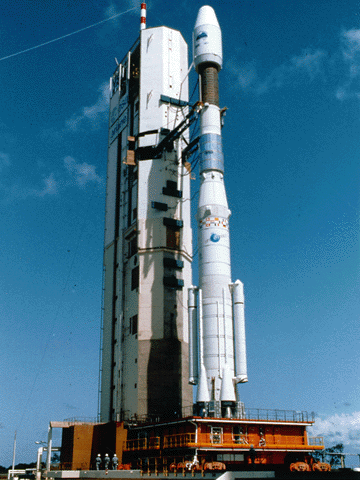
, decided to construct a space-travel base in French Guiana. This would replace the existing Sahara base in Algeria and stimulate economic growth in French Guiana. The department is particularly suitable for the purpose both because it is near to the equator
and because of the extensive access to a large ocean
. The Guiana Space Centre a short distance along the coast from Kourou
has grown considerably since the initial launches of the “Véronique” rockets, and has brought commercial success to the European space industry with launchers such as the Ariane 4 and Ariane 5.
A movement for increased autonomy from France gained some momentum in the 1970s and 1980s, but has since abated.
, French Guiana is not considered to be part of that geographic region, because the Caribbean Sea is actually located several hundred kilometres to the west, beyond the arc of the Lesser Antilles
. However, the boundaries of what people have defined as the Caribbean today has changed. Historically, the boundaries of the Caribbean were at their greatest extent during the 17th and 18th centuries and as such French Guiana was situated on the edge and during some periods maybe thought to be part of the Caribbean proper.
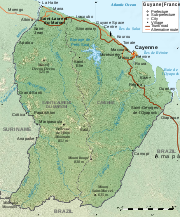 French Guiana lies between latitudes 2°
and 6°
N, and longitudes 51°
and 53°
W. It consists of two main geographical regions: a coastal strip where the majority of the people live, and dense, near-inaccessible rainforest
which gradually rises to the modest peaks of the Tumac-Humac mountains
along the Brazilian frontier. French Guiana's highest peak is Bellevue de l'Inini
in Maripasoula
(851 m). Other mountains include Mont Machalou (782 m), Pic Coudreau (711 m) and Mont St Marcel (635 m), Mont Favard (200 m) and Montagne du Mahury (156 m). Several small islands are found off the coast, the three Îles du Salut
Salvation Islands which include Devil's Island
and the isolated Îles du Connétable
bird sanctuary further along the coast towards Brazil.
The hydroelectric dam in the north of French Guiana forms an artificial lake and provides hydroelectricity
. There are many rivers in French Guiana, including the Waki River.
As of 2007, the Amazonian forest, located in the most remote part of the department, is now protected as one of the nine national parks of France, the Guiana Amazonian Park
. The territory of the park covers some 33900 square kilometres (13,088.9 sq mi) upon the communes of Camopi
, Maripasoula
, Papaïchton
, Saint-Élie
and Saül
.
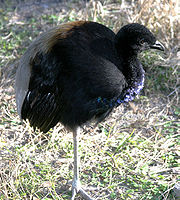 French Guiana is home to many unique and important ecosystem
s: tropical rainforest
s, coastal mangroves, savannahs, inselbergs and many types of wetlands. French Guiana has one of highest levels of biodiversity
in the world, in terms of both flora
and fauna
. This is due to the presence of old-growth forests (i.e. ancient/primary forests), which are biodiversity hotspot
s. The rainforest
s of French Guiana provide shelter for many species during dry periods and terrestrial glaciation. These forests are protected by a national park (the Guiana Amazonian Park
) and six additional nature reserve
s. The International Union for Conservation of Nature (IUCN) and the European Union
(EU) have recommended special efforts to protect these areas.
Following the Grenelle Environment Round Table
of 2007, the Grenelle Law II was proposed in 2009, under law number 2010-788. Article 49 of the law proposed the creation of a single organization responsible for environmental conservation in French Guiana. The proposed organization would combine expertise in the fields of zoology
(flora and fauna) and ecology (functioning of ecosystem
s), and would contribute to the implementation of policies set forth by state and local authorities. Article 64 proposes a "departmental plan of mining orientation" for French Guiana, which would promote mining (specifically of gold) that is compatible with requirements for environmental protection. The coastal environment along the N1 has historically experienced the most changes, but development is occurring locally along the N2, and also in western French Guiana due to gold mining.
5,500 plant species have been recorded, including more than a thousand trees, along with 700 species of birds, 177 species of mammals, over 500 species of fish including 45% of which are endemic and 109 species of amphibian
s. The micro-organisms would be much more numerous, especially in the north, which competes with the Brazilian Amazon, Borneo
and Sumatra
. This is the French department has at least 98% of vertebrate fauna and 96% of vascular plants of France.
The threats to the ecosystem
are habitat fragmentation
by the roads, which remains very limited compared to other forests of South America, impacts of immediate and deferred of EDF
, of gold mining
, poor control of hunting and poaching
facilitated by the creation of many tracks and the appearance of all-terrain vehicle
s. Logging remains moderate because of the lack of roads, on both the difficulty of climate and terrain. An ordinance of 28 July 2005 extended the Forest Code at French Guiana, but with important exceptions and modifications. In an approach that will be sustainable
, concessions or free transfers may be granted by local authorities or other entities for use by persons traditionally deriving their livelihood from the forest, but the means no longer always used traditional means, and the Guianese ecosystem
being vulnerable, the impacts of logging or hunting may be important.
The beaches of the natural reserve of the Amana, the joint Awala-Yalimapo
in the west, is a marine turtle nesting site exceptional. This is one of the largest worldwide for the leatherback turtle.
, potassium
) and organic matter
. Soil acidity is another cause of the poor soils, and it requires farmers to add lime to their fields. All of these soil characteristics have led to the use of slash and burn
agriculture. The resulting ashes elevate soil pH
(i.e. lower soil acidity), and contribute minerals and other nutrients to the soil. Sites of Terra preta
(anthropogenic soils) have been discovered in French Guiana, particularly near the border with Brazil
. Research is being actively pursued in multiple fields to determine how these enriched soils were historically created, and how this can be done in modern times.
 In 2008, the GDP of French Guiana at market exchange rates was US$4.72 billion (€3.21 billion), ranking as the largest economy in the Guianas
, and the 11th largest in South America.
French Guiana is heavily dependent on mainland France for subsidies, trade, and goods. The main industries are fishing (accounting for three-quarters of foreign exports), gold mining and timber. In addition, the Guiana Space Centre at Kourou
accounts for 25% of the GDP and employs about 1,700 people.
There is very little manufacturing. Agriculture is largely undeveloped and is mainly confined to the area near the coast – sugar and bananas are two of the main cash crop
s grown. Tourism, especially eco-tourism
, is growing. Unemployment is a major problem, running at about 20% to 30%.
In 2008, the GDP per capita of French Guiana at market exchange rates, not at PPP
, was US$20,904 (€14,204), the highest in South America, but only 47% of metropolitan France
's average GDP per capita that year.
, 5.2% were born in the French Caribbean
départements (Guadeloupe
and Martinique
), and 28.6% were born in foreign countries (primarily Brazil
, Suriname
, and Haiti
).
Estimates of the percentages of French Guiana ethnic composition vary, a situation compounded by the large proportion of immigrants (about 20,000, nearly 10%).
Mestizos (people of mixed African and native Indian ancestry) are the largest ethnic group, though estimates vary as to the exact percentage, depending upon whether the large Haiti
an community is included as well. Generally the Creole population is judged to be about 60% to 70% of the total population if Haitians (comprising roughly one-third of Creoles) are included, and 30% to 50% without.
Roughly 14% of the population is of European ancestry. The vast majority of these are of French heritage, though there are also people of Dutch
, British, Spanish and Portuguese
ancestry.
The main Asian communities are the Chinese
(3.2%, primarily from Zhejiang province
in mainland China
and Hong Kong) and Hmong
from Laos
(1.5%). There are also smaller groups from various Caribbean
islands, mainly Saint Lucia
as well as Dominica
. Other Asian groups include East Indians, Lebanese
and Vietnamese
.
The main groups living in the interior are the Maroons
(formerly called "Bush Negroes") who are racially black African, and Amerindians
. The Maroons
, descendants of escaped African slaves, live primarily along the Maroni River
. The main Maroon groups are the Saramaca, Aucan (both of whom also live in Suriname
), and Boni (Aluku).
The main Amerindian groups (forming about 3%–4% of the population) are the Arawak, Carib, Emerillon
, Galibi (now called the Kaliña
), Palikour
, Wayampi
and Wayana
. As of late 1990s, there was evidence of an uncontacted group
of Wayampi.
The dominant religion of French Guiana is Roman Catholicism; the Maroons and some Amerindian people maintain their own religions. The Hmong people are also mainly Catholic owing to the influence of missionaries who helped bring them to French Guiana.
in French Guiana has remained high and is today considerably higher than in metropolitan France
, and also higher than the average of the five French overseas departments. It is largely responsible for the high population growth of French Guiana.
, but a number of other local languages exist. Regional languages include French Guiana creole
, six Amerindian languages
(Arawak
, Palikur
, Kali'na
, Wayana
, Wayampi
, Emerillon
), four Maroon
dialects (Saramaka
, Paramaccan
, Boni
, Djuka), as well as Hmong Njua. Other languages spoken include Portuguese
, Hakka, Haitian Creole
, Spanish
, Dutch
and English
.
, the largest landmass for an area outside of Europe (since Greenland
left the European Community in 1985), with one of the longest EU external boundaries. Along with the Spanish enclaves in Africa of Ceuta
and Melilla
, it is one of only three European Union territories outside Europe that is not an island. As an integral part of France, its head of state
is the President of the French Republic, and its head of government is the Prime Minister of France
. The French Government and its agencies have responsibility for a wide range of issues that are reserved to the national executive power, such as defense and external relations.
The President of France appoints a prefect (resident at the prefecture building in Cayenne) as his representative to head the local government of French Guiana. There are two local executive bodies: the 19‑member general council and the 34‑member regional council, both elected. They will soon be reunited into one only council, since they have authority on exactly the same territory.
French Guiana sends two deputies
to the French National Assembly, one representing the commune
(municipality) of Cayenne
and the commune of Macouria
, and the other representing the rest of French Guiana. This latter constituency is the largest in the French Republic by land area. French Guiana also sends two senators to the French Senate.
Politics in French Guiana are dominated by the Guianese Socialist Party
.
A chronic issue affecting French Guiana is the influx of illegal immigrants and clandestine gold prospectors
from Brazil
and Suriname
. The border between the department and Suriname is formed by the Maroni River
, which flows through rain forest and is difficult for the Gendarmerie
and the French Foreign Legion
to patrol. There have been several phases launched by the French government to combat illegal gold mining in French Guiana, beginning with Operation Anaconda beginning in 2003, followed by Operation Harpie in 2008, 2009 and Operation Harpie Reinforce in 2010. Colonel François Müller, the commander of French Guiana's gendarme, believes these operations have been successful. However, after each operation ends, Brazilian miners, , return.
Soon after Operation Harpie Reinforce began, an altercation took place between French authorities and Brazilian miners. On March 12, 2010, a team of French soldiers and border police were attacked while returning from a successful operation, during which "the soldiers had arrested 15 miners, confiscated three boats, and seized 617 grams of gold... currently worth about $22,317". Garimpeiros returned to retrieve the lost loot and colleagues. "The soldiers fired warning shots and rubber “flash balls” but the miners managed to retake one of their boats and about 500 grammes of gold. “The violent reaction by the garimpeiros can be explained by the exceptional take of 617 grammes of gold, about 20 percent of the quantity seized in 2009 during the battle against illegal mining”, said Phillipe Duporge, the director of French Guiana’s border police, at a press conference the next day."
, located in the commune
of Matoury
, a southern suburb of Cayenne
. There are two flights a day to Paris (Orly Airport), served by Air France
and Air Caraïbes
. The flight time from Cayenne to Paris is 8 hours and 25 minutes, and from Paris to Cayenne it is 9 hours and 10 minutes. There are also flights to Fort-de-France
, Pointe-à-Pitre
, Port-au-Prince
, Miami and Belém
.
French Guiana's main seaport is the port of Dégrad des Cannes, located on the estuary
of the Mahury River
, in the commune of Remire-Montjoly
, a south-eastern suburb of Cayenne. Almost all of French Guiana's imports and exports pass through the port of Dégrad des Cannes. Built in 1969, it replaced the old harbour of Cayenne which was congested and could not cope with modern traffic.
An asphalted road from Régina
to Saint-Georges de l'Oyapock (a town by the Brazil
ian border) was opened in 2004, completing the road from Cayenne to the Brazilian border. It is now possible to drive on a fully paved road from Saint-Laurent-du-Maroni
on the Suriname
se border to Saint-Georges de l'Oyapock on the Brazilian border.
Following a treaty between France and Brazil signed in July 2005, the Oyapock River Bridge
over the Oyapock River
(marking the border with Brazil) is currently being built and is due to open in 2012. This bridge will be the first land crossing ever opened between France and Brazil, and indeed between French Guiana and the rest of the world (there exists no other bridge crossing the Oyapock River, and no bridge crossing the Maroni River
marking the border with Suriname – there is a ferry crossing to Albina, Suriname
). When the bridge is opened, it will be possible to drive uninterrupted from Cayenne to Macapá
, the capital of the state of Amapá
in Brazil.
Among French Guiana's military, police and security forces, are:
France
The French Republic , The French Republic , The French Republic , (commonly known as France , is a unitary semi-presidential republic in Western Europe with several overseas territories and islands located on other continents and in the Indian, Pacific, and Atlantic oceans. Metropolitan France...
, consisting of a single overseas department located on the northern Atlantic
Atlantic Ocean
The Atlantic Ocean is the second-largest of the world's oceanic divisions. With a total area of about , it covers approximately 20% of the Earth's surface and about 26% of its water surface area...
coast of South America
South America
South America is a continent situated in the Western Hemisphere, mostly in the Southern Hemisphere, with a relatively small portion in the Northern Hemisphere. The continent is also considered a subcontinent of the Americas. It is bordered on the west by the Pacific Ocean and on the north and east...
. It has borders with two nations, Brazil
Brazil
Brazil , officially the Federative Republic of Brazil , is the largest country in South America. It is the world's fifth largest country, both by geographical area and by population with over 192 million people...
to the east and south, and Suriname
Suriname
Suriname , officially the Republic of Suriname , is a country in northern South America. It borders French Guiana to the east, Guyana to the west, Brazil to the south, and on the north by the Atlantic Ocean. Suriname was a former colony of the British and of the Dutch, and was previously known as...
to the west. Its 83,534 km² have a very low population density of less than three inhabitants per km², with almost half of its 229,000 people in 2009 living in the urban area of Cayenne
Cayenne
Cayenne is the capital of French Guiana, an overseas region and department of France located in South America. The city stands on a former island at the mouth of the Cayenne River on the Atlantic coast. The city's motto is "Ferit Aurum Industria" which means "Work brings wealth"...
, its capital.
The addition of the adjective "French" in English comes from colonial times when five such colonies existed (The Guianas
The Guianas
The Guyanas or the Guianas refers to a region in north-eastern South America which includes the following three territories:* French Guiana, an overseas department of France;...
), namely from west to east: Spanish Guiana (now Guayana Region
Guayana Region
The Guayana Region is an administrative region of Venezuela.The region has a population of 1,383,297 inhabitants and a territory of 458,344 km². It borders the independent nation of Guyana which forms part of The Guyanas...
in Venezuela
Venezuela
Venezuela , officially called the Bolivarian Republic of Venezuela , is a tropical country on the northern coast of South America. It borders Colombia to the west, Guyana to the east, and Brazil to the south...
), British Guiana
British Guiana
British Guiana was the name of the British colony on the northern coast of South America, now the independent nation of Guyana.The area was originally settled by the Dutch at the start of the 17th century as the colonies of Essequibo, Demerara, and Berbice...
(now Guyana
Guyana
Guyana , officially the Co-operative Republic of Guyana, previously the colony of British Guiana, is a sovereign state on the northern coast of South America that is culturally part of the Anglophone Caribbean. Guyana was a former colony of the Dutch and of the British...
), Dutch Guiana
Dutch Guiana
Dutch Guiana, also known as Netherlands Guyana or Dutch Guyana , is the name given to various Dutch colonies on the northern coast of South America, created by the Dutch West India Company...
(now Suriname
Suriname
Suriname , officially the Republic of Suriname , is a country in northern South America. It borders French Guiana to the east, Guyana to the west, Brazil to the south, and on the north by the Atlantic Ocean. Suriname was a former colony of the British and of the Dutch, and was previously known as...
), French Guiana, and Portuguese Guiana (now Amapá
Amapá
Amapá is one of the states of Brazil, located in the extreme north, bordering French Guiana and Suriname to the north. To the east is the Atlantic Ocean, and to the south and west is the Brazilian state of Pará. Perhaps one of the main features of the state is the River Oiapoque, as it was once...
, a state in far northern Brazil
Brazil
Brazil , officially the Federative Republic of Brazil , is the largest country in South America. It is the world's fifth largest country, both by geographical area and by population with over 192 million people...
). French Guiana and the two larger countries to the north and west, Guyana and Suriname, are still often collectively referred to as the Guianas
The Guianas
The Guyanas or the Guianas refers to a region in north-eastern South America which includes the following three territories:* French Guiana, an overseas department of France;...
and comprise one large shield landmass.
History
French Guiana was originally inhabited by a number of indigenous American people. It was settled by the French during the 18th century. According to Bill Marshall, "The first French effort to colonize Guiana, in 1763, failed utterly when tropical diseases and climate killed all but 2,000 of the initial 12,000 settlers. […] During its existence, France transported approximately 56,000 prisoners to Devil's Island. Fewer than 10 percent survived their sentence." Its infamous Île du Diable (Devil's Island) was the site of penalPenal colony
A penal colony is a settlement used to exile prisoners and separate them from the general populace by placing them in a remote location, often an island or distant colonial territory...
settlements from 1852 until 1951.
In 1809, a Portuguese
Portugal
Portugal , officially the Portuguese Republic is a country situated in southwestern Europe on the Iberian Peninsula. Portugal is the westernmost country of Europe, and is bordered by the Atlantic Ocean to the West and South and by Spain to the North and East. The Atlantic archipelagos of the...
-British naval squadron took French Guiana
Invasion of Cayenne (1809)
The Invasion of Cayenne was a combined military operation by an Anglo-Portuguese-Brazilian expeditionary force against Cayenne, capital of the French South American colony of French Guiana in 1809, during the Napoleonic Wars...
for the Portuguese Empire
Portuguese Empire
The Portuguese Empire , also known as the Portuguese Overseas Empire or the Portuguese Colonial Empire , was the first global empire in history...
. With the signing of the Treaty of Paris in 1814 the region was handed back to the French, though a Portuguese presence remained until 1817.
A border dispute with Brazil arose in the late 19th century over a vast area of jungle, leading to the short-lived pro-French independent state of Counani
Republic of Independent Guyana
The Republic of Independent Guyana, in French La République de la Guyane indépendante, commonly referred to by the name of the capital Counani , was a short-lived independent state in the area which was disputed by France and Brazil in the late nineteenth century...
in the disputed territory and some fighting between settlers, before the dispute was resolved largely in favour of Brazil by the arbitration
Arbitration
Arbitration, a form of alternative dispute resolution , is a legal technique for the resolution of disputes outside the courts, where the parties to a dispute refer it to one or more persons , by whose decision they agree to be bound...
of the Swiss
Switzerland
Switzerland name of one of the Swiss cantons. ; ; ; or ), in its full name the Swiss Confederation , is a federal republic consisting of 26 cantons, with Bern as the seat of the federal authorities. The country is situated in Western Europe,Or Central Europe depending on the definition....
government.
In 1946, French Guiana became an overseas department of France. The 1970s saw the settlement of Hmong
Hmong people
The Hmong , are an Asian ethnic group from the mountainous regions of China, Vietnam, Laos, and Thailand. Hmong are also one of the sub-groups of the Miao ethnicity in southern China...
refugees from Laos
Laos
Laos Lao: ສາທາລະນະລັດ ປະຊາທິປະໄຕ ປະຊາຊົນລາວ Sathalanalat Paxathipatai Paxaxon Lao, officially the Lao People's Democratic Republic, is a landlocked country in Southeast Asia, bordered by Burma and China to the northwest, Vietnam to the east, Cambodia to the south and Thailand to the west...
.
In 1964 the French president, Charles de Gaulle
Charles de Gaulle
Charles André Joseph Marie de Gaulle was a French general and statesman who led the Free French Forces during World War II. He later founded the French Fifth Republic in 1958 and served as its first President from 1959 to 1969....
, decided to construct a space-travel base in French Guiana. This would replace the existing Sahara base in Algeria and stimulate economic growth in French Guiana. The department is particularly suitable for the purpose both because it is near to the equator
Equator
An equator is the intersection of a sphere's surface with the plane perpendicular to the sphere's axis of rotation and containing the sphere's center of mass....
and because of the extensive access to a large ocean
Atlantic Ocean
The Atlantic Ocean is the second-largest of the world's oceanic divisions. With a total area of about , it covers approximately 20% of the Earth's surface and about 26% of its water surface area...
. The Guiana Space Centre a short distance along the coast from Kourou
Kourou
Kourou is a commune in French Guiana, an overseas region and department of France located in South America.Kourou is the location of the Guiana Space Centre, France and ESA's main spaceport.-Geography:...
has grown considerably since the initial launches of the “Véronique” rockets, and has brought commercial success to the European space industry with launchers such as the Ariane 4 and Ariane 5.
A movement for increased autonomy from France gained some momentum in the 1970s and 1980s, but has since abated.
Geography
Though sharing cultural affinities with the French-speaking territories of the CaribbeanCaribbean
The Caribbean is a crescent-shaped group of islands more than 2,000 miles long separating the Gulf of Mexico and the Caribbean Sea, to the west and south, from the Atlantic Ocean, to the east and north...
, French Guiana is not considered to be part of that geographic region, because the Caribbean Sea is actually located several hundred kilometres to the west, beyond the arc of the Lesser Antilles
Lesser Antilles
The Lesser Antilles are a long, partly volcanic island arc in the Western Hemisphere. Most of its islands form the eastern boundary of the Caribbean Sea with the Atlantic Ocean, with the remainder located in the southern Caribbean just north of South America...
. However, the boundaries of what people have defined as the Caribbean today has changed. Historically, the boundaries of the Caribbean were at their greatest extent during the 17th and 18th centuries and as such French Guiana was situated on the edge and during some periods maybe thought to be part of the Caribbean proper.
2nd parallel north
The 2nd parallel north is a circle of latitude that is 2 degrees north of the Earth's equatorial plane. It crosses the Atlantic Ocean, Africa, the Indian Ocean, Southeast Asia, the Pacific Ocean and South America....
and 6°
6th parallel north
The 6th parallel north is a circle of latitude that is 6 degrees north of the Earth's equatorial plane. It crosses Africa, the Indian Ocean, Southeast Asia, the Pacific Ocean, South America and the Atlantic Ocean....
N, and longitudes 51°
51st meridian west
The meridian 51° west of Greenwich is a line of longitude that extends from the North Pole across the Arctic Ocean, Greenland, the Atlantic Ocean, South America, the Southern Ocean, and Antarctica to the South Pole....
and 53°
55th meridian west
The meridian 55° west of Greenwich is a line of longitude that extends from the North Pole across the Arctic Ocean, North America, the Atlantic Ocean, South America, the Southern Ocean, and Antarctica to the South Pole....
W. It consists of two main geographical regions: a coastal strip where the majority of the people live, and dense, near-inaccessible rainforest
Rainforest
Rainforests are forests characterized by high rainfall, with definitions based on a minimum normal annual rainfall of 1750-2000 mm...
which gradually rises to the modest peaks of the Tumac-Humac mountains
Tumuk Humak Mountains
The Tumuk Humak Mountains are a mountain range in South America, stretching about east-west in the border area between Brazil in the south, Suriname and French Guiana in the north. In the language of the Apalam and Wayana peoples, Tumucumaque means "the mountain rock symbolizing the struggle...
along the Brazilian frontier. French Guiana's highest peak is Bellevue de l'Inini
Bellevue de l'Inini
Bellevue de l'Inini is the highest point of French Guiana, an overseas department of France, with an altitude of 851 metres ....
in Maripasoula
Maripasoula
Maripasoula is a commune of French Guiana, an overseas region and department of France located in South America. With a land area of , Maripasoula is the largest commune of France, and is recognized as the fourteenth largest city in the world by surface area....
(851 m). Other mountains include Mont Machalou (782 m), Pic Coudreau (711 m) and Mont St Marcel (635 m), Mont Favard (200 m) and Montagne du Mahury (156 m). Several small islands are found off the coast, the three Îles du Salut
Îles du Salut
The Îles du Salut are a group of small islands of volcanic origin about 11 km off the coast of French Guiana in the Atlantic Ocean...
Salvation Islands which include Devil's Island
Devil's Island
Devil's Island is the smallest and northernmost island of the three Îles du Salut located about 6 nautical miles off the coast of French Guiana . It has an area of 14 ha . It was a small part of the notorious French penal colony in French Guiana until 1952...
and the isolated Îles du Connétable
Iles du Connétable
The Îles du Connétable are two islands within French Guiana that were claimed under the Guano Islands Act of 1856 for the United States of America....
bird sanctuary further along the coast towards Brazil.
The hydroelectric dam in the north of French Guiana forms an artificial lake and provides hydroelectricity
Hydroelectricity
Hydroelectricity is the term referring to electricity generated by hydropower; the production of electrical power through the use of the gravitational force of falling or flowing water. It is the most widely used form of renewable energy...
. There are many rivers in French Guiana, including the Waki River.
As of 2007, the Amazonian forest, located in the most remote part of the department, is now protected as one of the nine national parks of France, the Guiana Amazonian Park
Guiana Amazonian Park
Guiana Amazonian Park is one of the nine national parks of France, aiming at protecting part of the amazonian forest located in French Guiana...
. The territory of the park covers some 33900 square kilometres (13,088.9 sq mi) upon the communes of Camopi
Camopi
Camopi is a commune of French Guiana, an overseas region and department of France located in South America. With a land area of , it is the third-largest commune of France....
, Maripasoula
Maripasoula
Maripasoula is a commune of French Guiana, an overseas region and department of France located in South America. With a land area of , Maripasoula is the largest commune of France, and is recognized as the fourteenth largest city in the world by surface area....
, Papaïchton
Papaïchton
Papaïchton is a commune in the overseas region and department of French Guiana...
, Saint-Élie
Saint-Élie
Saint-Élie is a commune of French Guiana, an overseas region and department of France located in South America. It was formerly capital of the Inini territory.-References:*...
and Saül
Saül
Saül is a commune of French Guiana, an overseas region and department of France located in South America.It is very remote, surrounded by dense rainforest and, because there are no roads to the town, it can only be reached by airplane....
.
Administrative divisions
French Guiana is divided into 2 arrondissements, 19 cantons (not shown here), and 22 communes:| Arrondissement of Saint-Laurent-du-Maroni Arrondissement of Saint-Laurent-du-Maroni The arrondissement of Saint-Laurent-du-Maroni is an arrondissement of France, located in the Guyane département, in the Guyane région. It has 3 cantons and 8 communes.-Cantons:The cantons of the arrondissement of Saint-Laurent-du-Maroni are:# Mana... | Arrondissement of Cayenne Arrondissement of Cayenne The arrondissement of Cayenne is an arrondissement of France, located in the Guyane département, in the Guyane région. It has 16 cantons and 14 communes... |
|
|
|---|
Climate
Environment
Ecosystem
An ecosystem is a biological environment consisting of all the organisms living in a particular area, as well as all the nonliving , physical components of the environment with which the organisms interact, such as air, soil, water and sunlight....
s: tropical rainforest
Tropical rainforest
A tropical rainforest is an ecosystem type that occurs roughly within the latitudes 28 degrees north or south of the equator . This ecosystem experiences high average temperatures and a significant amount of rainfall...
s, coastal mangroves, savannahs, inselbergs and many types of wetlands. French Guiana has one of highest levels of biodiversity
Biodiversity
Biodiversity is the degree of variation of life forms within a given ecosystem, biome, or an entire planet. Biodiversity is a measure of the health of ecosystems. Biodiversity is in part a function of climate. In terrestrial habitats, tropical regions are typically rich whereas polar regions...
in the world, in terms of both flora
Flora
Flora is the plant life occurring in a particular region or time, generally the naturally occurring or indigenous—native plant life. The corresponding term for animals is fauna.-Etymology:...
and fauna
Fauna
Fauna or faunæ is all of the animal life of any particular region or time. The corresponding term for plants is flora.Zoologists and paleontologists use fauna to refer to a typical collection of animals found in a specific time or place, e.g. the "Sonoran Desert fauna" or the "Burgess shale fauna"...
. This is due to the presence of old-growth forests (i.e. ancient/primary forests), which are biodiversity hotspot
Biodiversity hotspot
A biodiversity hotspot is a biogeographic region with a significant reservoir of biodiversity that is under threat from humans.The concept of biodiversity hotspots was originated by Norman Myers in two articles in “The Environmentalist” , revised after thorough analysis by Myers and others in...
s. The rainforest
Rainforest
Rainforests are forests characterized by high rainfall, with definitions based on a minimum normal annual rainfall of 1750-2000 mm...
s of French Guiana provide shelter for many species during dry periods and terrestrial glaciation. These forests are protected by a national park (the Guiana Amazonian Park
Guiana Amazonian Park
Guiana Amazonian Park is one of the nine national parks of France, aiming at protecting part of the amazonian forest located in French Guiana...
) and six additional nature reserve
Nature reserve
A nature reserve is a protected area of importance for wildlife, flora, fauna or features of geological or other special interest, which is reserved and managed for conservation and to provide special opportunities for study or research...
s. The International Union for Conservation of Nature (IUCN) and the European Union
European Union
The European Union is an economic and political union of 27 independent member states which are located primarily in Europe. The EU traces its origins from the European Coal and Steel Community and the European Economic Community , formed by six countries in 1958...
(EU) have recommended special efforts to protect these areas.
Following the Grenelle Environment Round Table
Grenelle Environnement
The Grenelle de l'environnement is an open multi-party debate in France that brings together representatives of national and local government and organizations on an equal footing, with goal of unifying a position on a specific theme...
of 2007, the Grenelle Law II was proposed in 2009, under law number 2010-788. Article 49 of the law proposed the creation of a single organization responsible for environmental conservation in French Guiana. The proposed organization would combine expertise in the fields of zoology
Zoology
Zoology |zoölogy]]), is the branch of biology that relates to the animal kingdom, including the structure, embryology, evolution, classification, habits, and distribution of all animals, both living and extinct...
(flora and fauna) and ecology (functioning of ecosystem
Ecosystem
An ecosystem is a biological environment consisting of all the organisms living in a particular area, as well as all the nonliving , physical components of the environment with which the organisms interact, such as air, soil, water and sunlight....
s), and would contribute to the implementation of policies set forth by state and local authorities. Article 64 proposes a "departmental plan of mining orientation" for French Guiana, which would promote mining (specifically of gold) that is compatible with requirements for environmental protection. The coastal environment along the N1 has historically experienced the most changes, but development is occurring locally along the N2, and also in western French Guiana due to gold mining.
5,500 plant species have been recorded, including more than a thousand trees, along with 700 species of birds, 177 species of mammals, over 500 species of fish including 45% of which are endemic and 109 species of amphibian
Amphibian
Amphibians , are a class of vertebrate animals including animals such as toads, frogs, caecilians, and salamanders. They are characterized as non-amniote ectothermic tetrapods...
s. The micro-organisms would be much more numerous, especially in the north, which competes with the Brazilian Amazon, Borneo
Borneo
Borneo is the third largest island in the world and is located north of Java Island, Indonesia, at the geographic centre of Maritime Southeast Asia....
and Sumatra
Sumatra
Sumatra is an island in western Indonesia, westernmost of the Sunda Islands. It is the largest island entirely in Indonesia , and the sixth largest island in the world at 473,481 km2 with a population of 50,365,538...
. This is the French department has at least 98% of vertebrate fauna and 96% of vascular plants of France.
The threats to the ecosystem
Ecosystem
An ecosystem is a biological environment consisting of all the organisms living in a particular area, as well as all the nonliving , physical components of the environment with which the organisms interact, such as air, soil, water and sunlight....
are habitat fragmentation
Habitat fragmentation
Habitat fragmentation as the name implies, describes the emergence of discontinuities in an organism's preferred environment , causing population fragmentation...
by the roads, which remains very limited compared to other forests of South America, impacts of immediate and deferred of EDF
Électricité de France
Électricité de France S.A. is the second largest French utility company. Headquartered in Paris, France, with €65.2 billion in revenues in 2010, EDF operates a diverse portfolio of 120,000+ megawatts of generation capacity in Europe, Latin America, Asia, the Middle East and Africa.EDF is one of...
, of gold mining
Gold mining
Gold mining is the removal of gold from the ground. There are several techniques and processes by which gold may be extracted from the earth.-History:...
, poor control of hunting and poaching
Poaching
Poaching is the illegal taking of wild plants or animals contrary to local and international conservation and wildlife management laws. Violations of hunting laws and regulations are normally punishable by law and, collectively, such violations are known as poaching.It may be illegal and in...
facilitated by the creation of many tracks and the appearance of all-terrain vehicle
All-terrain vehicle
An all-terrain vehicle , also known as a quad, quad bike, three wheeler, or four wheeler, is defined by the American National Standards Institute as a vehicle that travels on low pressure tires, with a seat that is straddled by the operator, along with handlebars for steering control...
s. Logging remains moderate because of the lack of roads, on both the difficulty of climate and terrain. An ordinance of 28 July 2005 extended the Forest Code at French Guiana, but with important exceptions and modifications. In an approach that will be sustainable
Sustainability
Sustainability is the capacity to endure. For humans, sustainability is the long-term maintenance of well being, which has environmental, economic, and social dimensions, and encompasses the concept of union, an interdependent relationship and mutual responsible position with all living and non...
, concessions or free transfers may be granted by local authorities or other entities for use by persons traditionally deriving their livelihood from the forest, but the means no longer always used traditional means, and the Guianese ecosystem
Ecosystem
An ecosystem is a biological environment consisting of all the organisms living in a particular area, as well as all the nonliving , physical components of the environment with which the organisms interact, such as air, soil, water and sunlight....
being vulnerable, the impacts of logging or hunting may be important.
The beaches of the natural reserve of the Amana, the joint Awala-Yalimapo
Awala-Yalimapo
Awala-Yalimapo is a commune on the north coast of French Guiana, close to the border with Suriname. The seat of the commune is the settlement of Awala where the town hall is located. Other settlements in the commune are: Yalimapo, Ayawande, and Piliwa...
in the west, is a marine turtle nesting site exceptional. This is one of the largest worldwide for the leatherback turtle.
Agriculture
French Guiana has some of the poorest soils in the world. The soil is low in nutrients (e.g. nitrogenNitrogen
Nitrogen is a chemical element that has the symbol N, atomic number of 7 and atomic mass 14.00674 u. Elemental nitrogen is a colorless, odorless, tasteless, and mostly inert diatomic gas at standard conditions, constituting 78.08% by volume of Earth's atmosphere...
, potassium
Potassium
Potassium is the chemical element with the symbol K and atomic number 19. Elemental potassium is a soft silvery-white alkali metal that oxidizes rapidly in air and is very reactive with water, generating sufficient heat to ignite the hydrogen emitted in the reaction.Potassium and sodium are...
) and organic matter
Organic matter
Organic matter is matter that has come from a once-living organism; is capable of decay, or the product of decay; or is composed of organic compounds...
. Soil acidity is another cause of the poor soils, and it requires farmers to add lime to their fields. All of these soil characteristics have led to the use of slash and burn
Slash and burn
Slash-and-burn is an agricultural technique which involves cutting and burning of forests or woodlands to create fields. It is subsistence agriculture that typically uses little technology or other tools. It is typically part of shifting cultivation agriculture, and of transhumance livestock...
agriculture. The resulting ashes elevate soil pH
PH
In chemistry, pH is a measure of the acidity or basicity of an aqueous solution. Pure water is said to be neutral, with a pH close to 7.0 at . Solutions with a pH less than 7 are said to be acidic and solutions with a pH greater than 7 are basic or alkaline...
(i.e. lower soil acidity), and contribute minerals and other nutrients to the soil. Sites of Terra preta
Terra preta
Terra preta is a type of very dark, fertile anthropogenic soil found in the Amazon Basin. Terra preta owes its name to its very high charcoal content, and was indeed made by adding a mixture of charcoal, bone, and manure to the otherwise relatively infertile Amazonian soil, and stays there for...
(anthropogenic soils) have been discovered in French Guiana, particularly near the border with Brazil
Brazil
Brazil , officially the Federative Republic of Brazil , is the largest country in South America. It is the world's fifth largest country, both by geographical area and by population with over 192 million people...
. Research is being actively pursued in multiple fields to determine how these enriched soils were historically created, and how this can be done in modern times.
Economy
The Guianas
The Guyanas or the Guianas refers to a region in north-eastern South America which includes the following three territories:* French Guiana, an overseas department of France;...
, and the 11th largest in South America.
French Guiana is heavily dependent on mainland France for subsidies, trade, and goods. The main industries are fishing (accounting for three-quarters of foreign exports), gold mining and timber. In addition, the Guiana Space Centre at Kourou
Kourou
Kourou is a commune in French Guiana, an overseas region and department of France located in South America.Kourou is the location of the Guiana Space Centre, France and ESA's main spaceport.-Geography:...
accounts for 25% of the GDP and employs about 1,700 people.
There is very little manufacturing. Agriculture is largely undeveloped and is mainly confined to the area near the coast – sugar and bananas are two of the main cash crop
Cash crop
In agriculture, a cash crop is a crop which is grown for profit.The term is used to differentiate from subsistence crops, which are those fed to the producer's own livestock or grown as food for the producer's family...
s grown. Tourism, especially eco-tourism
Ecotourism
Ecotourism is a form of tourism visiting fragile, pristine, and usually protected areas, intended as a low impact and often small scale alternative to standard commercial tourism...
, is growing. Unemployment is a major problem, running at about 20% to 30%.
In 2008, the GDP per capita of French Guiana at market exchange rates, not at PPP
Purchasing power parity
In economics, purchasing power parity is a condition between countries where an amount of money has the same purchasing power in different countries. The prices of the goods between the countries would only reflect the exchange rates...
, was US$20,904 (€14,204), the highest in South America, but only 47% of metropolitan France
Metropolitan France
Metropolitan France is the part of France located in Europe. It can also be described as mainland France or as the French mainland and the island of Corsica...
's average GDP per capita that year.
| 1999 | 2000 | 2001 | 2002 | 2003 | 2004 | 2005 | 2006 | 2007 | |
|---|---|---|---|---|---|---|---|---|---|
| French Guiana | 64 | 53 | 60 | 60 | 56 | 52 | 53 | 50 | 49 |
| France | 115 | 115 | 116 | 116 | 112 | 110 | 111 | 109 | 108 |
Demographics
French Guiana's population of 229,000 (January 2009 est.), most of whom live along the coast, is very ethnically diverse. At the 1999 census, 54.4% of the inhabitants of French Guiana were born in French Guiana, 11.8% were born in Metropolitan FranceMetropolitan France
Metropolitan France is the part of France located in Europe. It can also be described as mainland France or as the French mainland and the island of Corsica...
, 5.2% were born in the French Caribbean
Caribbean
The Caribbean is a crescent-shaped group of islands more than 2,000 miles long separating the Gulf of Mexico and the Caribbean Sea, to the west and south, from the Atlantic Ocean, to the east and north...
départements (Guadeloupe
Guadeloupe
Guadeloupe is an archipelago located in the Leeward Islands, in the Lesser Antilles, with a land area of 1,628 square kilometres and a population of 400,000. It is the first overseas region of France, consisting of a single overseas department. As with the other overseas departments, Guadeloupe...
and Martinique
Martinique
Martinique is an island in the eastern Caribbean Sea, with a land area of . Like Guadeloupe, it is an overseas region of France, consisting of a single overseas department. To the northwest lies Dominica, to the south St Lucia, and to the southeast Barbados...
), and 28.6% were born in foreign countries (primarily Brazil
Brazil
Brazil , officially the Federative Republic of Brazil , is the largest country in South America. It is the world's fifth largest country, both by geographical area and by population with over 192 million people...
, Suriname
Suriname
Suriname , officially the Republic of Suriname , is a country in northern South America. It borders French Guiana to the east, Guyana to the west, Brazil to the south, and on the north by the Atlantic Ocean. Suriname was a former colony of the British and of the Dutch, and was previously known as...
, and Haiti
Haiti
Haiti , officially the Republic of Haiti , is a Caribbean country. It occupies the western, smaller portion of the island of Hispaniola, in the Greater Antillean archipelago, which it shares with the Dominican Republic. Ayiti was the indigenous Taíno or Amerindian name for the island...
).
Estimates of the percentages of French Guiana ethnic composition vary, a situation compounded by the large proportion of immigrants (about 20,000, nearly 10%).
Mestizos (people of mixed African and native Indian ancestry) are the largest ethnic group, though estimates vary as to the exact percentage, depending upon whether the large Haiti
Haiti
Haiti , officially the Republic of Haiti , is a Caribbean country. It occupies the western, smaller portion of the island of Hispaniola, in the Greater Antillean archipelago, which it shares with the Dominican Republic. Ayiti was the indigenous Taíno or Amerindian name for the island...
an community is included as well. Generally the Creole population is judged to be about 60% to 70% of the total population if Haitians (comprising roughly one-third of Creoles) are included, and 30% to 50% without.
Roughly 14% of the population is of European ancestry. The vast majority of these are of French heritage, though there are also people of Dutch
Dutch people
The Dutch people are an ethnic group native to the Netherlands. They share a common culture and speak the Dutch language. Dutch people and their descendants are found in migrant communities worldwide, notably in Suriname, Chile, Brazil, Canada, Australia, South Africa, New Zealand, and the United...
, British, Spanish and Portuguese
Portuguese people
The Portuguese are a nation and ethnic group native to the country of Portugal, in the west of the Iberian peninsula of south-west Europe. Their language is Portuguese, and Roman Catholicism is the predominant religion....
ancestry.
The main Asian communities are the Chinese
Overseas Chinese
Overseas Chinese are people of Chinese birth or descent who live outside the Greater China Area . People of partial Chinese ancestry living outside the Greater China Area may also consider themselves Overseas Chinese....
(3.2%, primarily from Zhejiang province
Zhejiang
Zhejiang is an eastern coastal province of the People's Republic of China. The word Zhejiang was the old name of the Qiantang River, which passes through Hangzhou, the provincial capital...
in mainland China
Mainland China
Mainland China, the Chinese mainland or simply the mainland, is a geopolitical term that refers to the area under the jurisdiction of the People's Republic of China . According to the Taipei-based Mainland Affairs Council, the term excludes the PRC Special Administrative Regions of Hong Kong and...
and Hong Kong) and Hmong
Hmong people
The Hmong , are an Asian ethnic group from the mountainous regions of China, Vietnam, Laos, and Thailand. Hmong are also one of the sub-groups of the Miao ethnicity in southern China...
from Laos
Laos
Laos Lao: ສາທາລະນະລັດ ປະຊາທິປະໄຕ ປະຊາຊົນລາວ Sathalanalat Paxathipatai Paxaxon Lao, officially the Lao People's Democratic Republic, is a landlocked country in Southeast Asia, bordered by Burma and China to the northwest, Vietnam to the east, Cambodia to the south and Thailand to the west...
(1.5%). There are also smaller groups from various Caribbean
Caribbean
The Caribbean is a crescent-shaped group of islands more than 2,000 miles long separating the Gulf of Mexico and the Caribbean Sea, to the west and south, from the Atlantic Ocean, to the east and north...
islands, mainly Saint Lucia
Saint Lucia
Saint Lucia is an island country in the eastern Caribbean Sea on the boundary with the Atlantic Ocean. Part of the Lesser Antilles, it is located north/northeast of the island of Saint Vincent, northwest of Barbados and south of Martinique. It covers a land area of 620 km2 and has an...
as well as Dominica
Dominica
Dominica , officially the Commonwealth of Dominica, is an island nation in the Lesser Antilles region of the Caribbean Sea, south-southeast of Guadeloupe and northwest of Martinique. Its size is and the highest point in the country is Morne Diablotins, which has an elevation of . The Commonwealth...
. Other Asian groups include East Indians, Lebanese
Lebanese people
The Lebanese people are a nation and ethnic group of Levantine people originating in what is today the country of Lebanon, including those who had inhabited Mount Lebanon prior to the creation of the modern Lebanese state....
and Vietnamese
Vietnamese people
The Vietnamese people are an ethnic group originating from present-day northern Vietnam and southern China. They are the majority ethnic group of Vietnam, comprising 86% of the population as of the 1999 census, and are officially known as Kinh to distinguish them from other ethnic groups in Vietnam...
.
The main groups living in the interior are the Maroons
Maroon (people)
Maroons were runaway slaves in the West Indies, Central America, South America, and North America, who formed independent settlements together...
(formerly called "Bush Negroes") who are racially black African, and Amerindians
Indigenous peoples of the Americas
The indigenous peoples of the Americas are the pre-Columbian inhabitants of North and South America, their descendants and other ethnic groups who are identified with those peoples. Indigenous peoples are known in Canada as Aboriginal peoples, and in the United States as Native Americans...
. The Maroons
Maroon (people)
Maroons were runaway slaves in the West Indies, Central America, South America, and North America, who formed independent settlements together...
, descendants of escaped African slaves, live primarily along the Maroni River
Maroni River
The Maroni or Marowijne is a river in South America. It originates in the Tumuk Humak Mountains and forms the border between French Guiana and Suriname...
. The main Maroon groups are the Saramaca, Aucan (both of whom also live in Suriname
Suriname
Suriname , officially the Republic of Suriname , is a country in northern South America. It borders French Guiana to the east, Guyana to the west, Brazil to the south, and on the north by the Atlantic Ocean. Suriname was a former colony of the British and of the Dutch, and was previously known as...
), and Boni (Aluku).
The main Amerindian groups (forming about 3%–4% of the population) are the Arawak, Carib, Emerillon
Emerillon
Emerillon are a Tupi–Guarani-speaking people in French Guiana living on the banks of the Camopi and Tampok rivers. Their subsistence is based on horticulture, hunting and bow- and arrow-fishing...
, Galibi (now called the Kaliña
Kalina
Kalina may refer to:feminine given name:* Kalinapeople* Noah Kalina, American photographer* Robert Kalina, Austrian banknote designer* Václav Kalina, Czech footballerplaces* Kalina, a geographical location in Mumbai...
), Palikour
Palikur
The Palikur are an Arawak-speaking clan society located in the riverine areas of the Brazilian state of Amapá and the eastern border area of French Guiana, on the left bank of the Oyapock...
, Wayampi
Wayampi
The Wayampi are a Tupi–Guarani-speaking group located in the south-eastern border area of French Guiana at the confluence of Camopi and Oyapock rivers, and the basins of the Amapari and Carapanatuba Rivers in the central part of Amapá state, Brazil...
and Wayana
Wayana
The Wayana are a Carib-speaking people located in the south-eastern part of the Guiana highlands, a region divided between Brazil, Surinam, and French Guiana...
. As of late 1990s, there was evidence of an uncontacted group
Uncontacted peoples
Uncontacted people, also referred to as isolated people or lost tribes, are communities who live, or have lived, either by choice or by circumstance, without significant contact with globalized civilisation....
of Wayampi.
The dominant religion of French Guiana is Roman Catholicism; the Maroons and some Amerindian people maintain their own religions. The Hmong people are also mainly Catholic owing to the influence of missionaries who helped bring them to French Guiana.
| 1790 estimate | 1839 estimate | 1857 estimate | 1891 estimate | 1946 census | 1954 census | 1961 census | 1967 census | 1974 census | 1982 census | 1990 census | 1999 census | 2007 census | 2009 estimate |
|
|---|---|---|---|---|---|---|---|---|---|---|---|---|---|---|
| 14,520 | 20,940 | 25,561 | 33,500 | 25,499 | 27,863 | 33,505 | 44,392 | 55,125 | 73,022 | 114,678 | 156,790 | 213,029 | 229,000 | |
| Official figures from past censuses and INSEE INSEE INSEE is the French National Institute for Statistics and Economic Studies. It collects and publishes information on the French economy and society, carrying out the periodic national census. Located in Paris, it is the French branch of Eurostat, European Statistical System... estimates. |
||||||||||||||
Fertility
The total fertility rateTotal Fertility Rate
The total fertility rate of a population is the average number of children that would be born to a woman over her lifetime if she were to experience the exact current age-specific fertility rates through her lifetime, and she...
in French Guiana has remained high and is today considerably higher than in metropolitan France
Metropolitan France
Metropolitan France is the part of France located in Europe. It can also be described as mainland France or as the French mainland and the island of Corsica...
, and also higher than the average of the five French overseas departments. It is largely responsible for the high population growth of French Guiana.
| 1999 | 2000 | 2001 | 2002 | 2003 | 2004 | 2005 | 2006 | 2007 | 2008 | |
|---|---|---|---|---|---|---|---|---|---|---|
| French Guiana | 3.87 | 3.93 | 3.79 | 3.73 | 3.77 | 3.47 | 3.79 | 3.80 | 3.71 | 3.57 |
| Four overseas departments | 2.32 | 2.45 | 2.42 | 2.35 | 2.38 | 2.40 | 2.46 | 2.48 | 2.50 | 2.47 |
| Metropolitan France Metropolitan France Metropolitan France is the part of France located in Europe. It can also be described as mainland France or as the French mainland and the island of Corsica... |
1.79 | 1.87 | 1.88 | 1.86 | 1.87 | 1.90 | 1.92 | 1.98 | 1.96 | 1.99 |
| Source: INSEE | ||||||||||
Languages
The official language of French Guiana is FrenchFrench language
French is a Romance language spoken as a first language in France, the Romandy region in Switzerland, Wallonia and Brussels in Belgium, Monaco, the regions of Quebec and Acadia in Canada, and by various communities elsewhere. Second-language speakers of French are distributed throughout many parts...
, but a number of other local languages exist. Regional languages include French Guiana creole
French Guiana Creole
French Guiana Creole is a French-lexified creole language spoken in French Guiana, and to a lesser degree, in Suriname and Guyana. It resembles Antillean Creole, but there are some lexical and grammatical differences between them...
, six Amerindian languages
Indigenous languages of the Americas
Indigenous languages of the Americas are spoken by indigenous peoples from Alaska and Greenland to the southern tip of South America, encompassing the land masses which constitute the Americas. These indigenous languages consist of dozens of distinct language families as well as many language...
(Arawak
Arawakan languages
Macro-Arawakan is a proposed language family of South America and the Caribbean based on the Arawakan languages. Sometimes the proposal is called Arawakan, in which case the central family is called Maipurean....
, Palikur
Palikur
The Palikur are an Arawak-speaking clan society located in the riverine areas of the Brazilian state of Amapá and the eastern border area of French Guiana, on the left bank of the Oyapock...
, Kali'na
Carib language
Carib, also known as Caribe, Cariña, Galibi, Galibí, Kali'na, Kalihna, Kalinya, Galibi Carib, Maraworno and Marworno, is an Amerindian language in the Cariban language family....
, Wayana
Wayana
The Wayana are a Carib-speaking people located in the south-eastern part of the Guiana highlands, a region divided between Brazil, Surinam, and French Guiana...
, Wayampi
Wayampi
The Wayampi are a Tupi–Guarani-speaking group located in the south-eastern border area of French Guiana at the confluence of Camopi and Oyapock rivers, and the basins of the Amapari and Carapanatuba Rivers in the central part of Amapá state, Brazil...
, Emerillon
Emerillon
Emerillon are a Tupi–Guarani-speaking people in French Guiana living on the banks of the Camopi and Tampok rivers. Their subsistence is based on horticulture, hunting and bow- and arrow-fishing...
), four Maroon
Maroon (people)
Maroons were runaway slaves in the West Indies, Central America, South America, and North America, who formed independent settlements together...
dialects (Saramaka
Saramaka
The Saramaka or Saramacca are one of six Maroon peoples in the Republic of Suriname. The word "Maroon" comes from the Spanish cimarrón, itself derived from an Arawakan root; by the early 16th century it was used throughout the Americas to designate slaves who successfully escaped from slavery.-...
, Paramaccan
Paramaccan
The Paramaccan are an ethnic group living in the forested interior of Suriname, mainly in the Marowijne District, and the eponymous term for their language, which has less than 1,000 speakers. The language is English-based with influences from Portuguese and other languages. It is similar to the...
, Boni
Aluku
The Aluku or Boni is the name of a Maroon ethnic group living mainly on the riverbank in Maripasoula, southwest French Guiana, and the eponymous term for their language, which has more than 5,000 speakers. They are mostly descended from former slaves from Suriname Paramaribo, who escaped and...
, Djuka), as well as Hmong Njua. Other languages spoken include Portuguese
Portuguese language
Portuguese is a Romance language that arose in the medieval Kingdom of Galicia, nowadays Galicia and Northern Portugal. The southern part of the Kingdom of Galicia became independent as the County of Portugal in 1095...
, Hakka, Haitian Creole
Haitian Creole language
Haitian Creole language , often called simply Creole or Kreyòl, is a language spoken in Haiti by about twelve million people, which includes all Haitians in Haiti and via emigration, by about two to three million speakers residing in the Bahamas, Cuba, Canada, France, Cayman Islands, French...
, Spanish
Spanish language
Spanish , also known as Castilian , is a Romance language in the Ibero-Romance group that evolved from several languages and dialects in central-northern Iberia around the 9th century and gradually spread with the expansion of the Kingdom of Castile into central and southern Iberia during the...
, Dutch
Dutch language
Dutch is a West Germanic language and the native language of the majority of the population of the Netherlands, Belgium, and Suriname, the three member states of the Dutch Language Union. Most speakers live in the European Union, where it is a first language for about 23 million and a second...
and English
English language
English is a West Germanic language that arose in the Anglo-Saxon kingdoms of England and spread into what was to become south-east Scotland under the influence of the Anglian medieval kingdom of Northumbria...
.
Politics
French Guiana, as part of France, is part of the European UnionEuropean Union
The European Union is an economic and political union of 27 independent member states which are located primarily in Europe. The EU traces its origins from the European Coal and Steel Community and the European Economic Community , formed by six countries in 1958...
, the largest landmass for an area outside of Europe (since Greenland
Greenland
Greenland is an autonomous country within the Kingdom of Denmark, located between the Arctic and Atlantic Oceans, east of the Canadian Arctic Archipelago. Though physiographically a part of the continent of North America, Greenland has been politically and culturally associated with Europe for...
left the European Community in 1985), with one of the longest EU external boundaries. Along with the Spanish enclaves in Africa of Ceuta
Ceuta
Ceuta is an autonomous city of Spain and an exclave located on the north coast of North Africa surrounded by Morocco. Separated from the Iberian peninsula by the Strait of Gibraltar, Ceuta lies on the border of the Mediterranean Sea and the Atlantic Ocean. Ceuta along with the other Spanish...
and Melilla
Melilla
Melilla is a autonomous city of Spain and an exclave on the north coast of Morocco. Melilla, along with the Spanish exclave Ceuta, is one of the two Spanish territories located in mainland Africa...
, it is one of only three European Union territories outside Europe that is not an island. As an integral part of France, its head of state
Head of State
A head of state is the individual that serves as the chief public representative of a monarchy, republic, federation, commonwealth or other kind of state. His or her role generally includes legitimizing the state and exercising the political powers, functions, and duties granted to the head of...
is the President of the French Republic, and its head of government is the Prime Minister of France
Prime Minister of France
The Prime Minister of France in the Fifth Republic is the head of government and of the Council of Ministers of France. The head of state is the President of the French Republic...
. The French Government and its agencies have responsibility for a wide range of issues that are reserved to the national executive power, such as defense and external relations.
The President of France appoints a prefect (resident at the prefecture building in Cayenne) as his representative to head the local government of French Guiana. There are two local executive bodies: the 19‑member general council and the 34‑member regional council, both elected. They will soon be reunited into one only council, since they have authority on exactly the same territory.
French Guiana sends two deputies
Member of Parliament
A Member of Parliament is a representative of the voters to a :parliament. In many countries with bicameral parliaments, the term applies specifically to members of the lower house, as upper houses often have a different title, such as senate, and thus also have different titles for its members,...
to the French National Assembly, one representing the commune
Communes of France
The commune is the lowest level of administrative division in the French Republic. French communes are roughly equivalent to incorporated municipalities or villages in the United States or Gemeinden in Germany...
(municipality) of Cayenne
Cayenne
Cayenne is the capital of French Guiana, an overseas region and department of France located in South America. The city stands on a former island at the mouth of the Cayenne River on the Atlantic coast. The city's motto is "Ferit Aurum Industria" which means "Work brings wealth"...
and the commune of Macouria
Macouria
Macouria is a commune of French Guiana, an overseas region and department of France located in South America. The seat of the commune is the settlement of Tonate, and so the commune is also known unofficially as Macouria-Tonate....
, and the other representing the rest of French Guiana. This latter constituency is the largest in the French Republic by land area. French Guiana also sends two senators to the French Senate.
Politics in French Guiana are dominated by the Guianese Socialist Party
Guianese Socialist Party
The Guianese Socialist Party is a political party in the French overseas région of French Guiana, in South America. The PSG is currently the majority party in the regional council of French Guiana and has one seat in the French National Assembly....
.
A chronic issue affecting French Guiana is the influx of illegal immigrants and clandestine gold prospectors
Gold prospecting
Gold prospecting is the act of searching for new gold deposits. Methods used vary with the type of deposit sought and the resources of the prospector...
from Brazil
Brazil
Brazil , officially the Federative Republic of Brazil , is the largest country in South America. It is the world's fifth largest country, both by geographical area and by population with over 192 million people...
and Suriname
Suriname
Suriname , officially the Republic of Suriname , is a country in northern South America. It borders French Guiana to the east, Guyana to the west, Brazil to the south, and on the north by the Atlantic Ocean. Suriname was a former colony of the British and of the Dutch, and was previously known as...
. The border between the department and Suriname is formed by the Maroni River
Maroni River
The Maroni or Marowijne is a river in South America. It originates in the Tumuk Humak Mountains and forms the border between French Guiana and Suriname...
, which flows through rain forest and is difficult for the Gendarmerie
Gendarmerie Nationale (France)
In France, the National Gendarmerie is a branch of the French Armed Forces, in charge of public safety, with police duties among the civilian population. It also contains a military police force and a special forces component . It has a strength of more than 105,975 persons...
and the French Foreign Legion
French Foreign Legion
The French Foreign Legion is a unique military service wing of the French Army established in 1831. The foreign legion was exclusively created for foreign nationals willing to serve in the French Armed Forces...
to patrol. There have been several phases launched by the French government to combat illegal gold mining in French Guiana, beginning with Operation Anaconda beginning in 2003, followed by Operation Harpie in 2008, 2009 and Operation Harpie Reinforce in 2010. Colonel François Müller, the commander of French Guiana's gendarme, believes these operations have been successful. However, after each operation ends, Brazilian miners, , return.
Soon after Operation Harpie Reinforce began, an altercation took place between French authorities and Brazilian miners. On March 12, 2010, a team of French soldiers and border police were attacked while returning from a successful operation, during which "the soldiers had arrested 15 miners, confiscated three boats, and seized 617 grams of gold... currently worth about $22,317". Garimpeiros returned to retrieve the lost loot and colleagues. "The soldiers fired warning shots and rubber “flash balls” but the miners managed to retake one of their boats and about 500 grammes of gold. “The violent reaction by the garimpeiros can be explained by the exceptional take of 617 grammes of gold, about 20 percent of the quantity seized in 2009 during the battle against illegal mining”, said Phillipe Duporge, the director of French Guiana’s border police, at a press conference the next day."
Transport
French Guiana's main international airport is Cayenne-Rochambeau AirportCayenne-Rochambeau Airport
Cayenne - Rochambeau Airport is French Guiana's main international airport. It is located in the commune of Matoury, southwest of French Guiana's capital city of Cayenne. Air Guyane Express has its head office on the airport property.-Facilities:...
, located in the commune
Communes of France
The commune is the lowest level of administrative division in the French Republic. French communes are roughly equivalent to incorporated municipalities or villages in the United States or Gemeinden in Germany...
of Matoury
Matoury
Matoury is a commune of French Guiana, an overseas region and department of France located in South America.Matoury is a southern suburb of Cayenne, the préfecture and largest city of French Guiana...
, a southern suburb of Cayenne
Cayenne
Cayenne is the capital of French Guiana, an overseas region and department of France located in South America. The city stands on a former island at the mouth of the Cayenne River on the Atlantic coast. The city's motto is "Ferit Aurum Industria" which means "Work brings wealth"...
. There are two flights a day to Paris (Orly Airport), served by Air France
Air France
Air France , stylised as AIRFRANCE, is the French flag carrier headquartered in Tremblay-en-France, , and is one of the world's largest airlines. It is a subsidiary of the Air France-KLM Group and a founding member of the SkyTeam global airline alliance...
and Air Caraïbes
Air Caraïbes
Air Caraïbes is the regional airline of the French Caribbean which comprises two overseas departments of France: Guadeloupe and Martinique. The airline is headquartered in Les Abymes in Guadeloupe. It operates scheduled and charter services serving 13 islands in the West Indies...
. The flight time from Cayenne to Paris is 8 hours and 25 minutes, and from Paris to Cayenne it is 9 hours and 10 minutes. There are also flights to Fort-de-France
Fort-de-France
Fort-de-France is the capital of France's Caribbean overseas department of Martinique. It is also one of the major cities in the Caribbean. Exports include sugar, rum, tinned fruit, and cacao.-Geography:...
, Pointe-à-Pitre
Pointe-à-Pitre
Pointe-à-Pitre is the largest city of Guadeloupe, an overseas région and département of France located in the Lesser Antilles, of which it is a sous-préfecture, being the seat of the Arrondissement of Pointe-à-Pitre....
, Port-au-Prince
Port-au-Prince
Port-au-Prince is the capital and largest city of the Caribbean nation of Haiti. The city's population was 704,776 as of the 2003 census, and was officially estimated to have reached 897,859 in 2009....
, Miami and Belém
Belém
Belém is a Brazilian city, the capital and largest city of state of Pará, in the country's north region. It is the entrance gate to the Amazon with a busy port, airport and bus/coach station...
.
French Guiana's main seaport is the port of Dégrad des Cannes, located on the estuary
Estuary
An estuary is a partly enclosed coastal body of water with one or more rivers or streams flowing into it, and with a free connection to the open sea....
of the Mahury River
Mahury River
The Mahury is a river of French Guiana.-External links:*...
, in the commune of Remire-Montjoly
Rémire-Montjoly
Remire-Montjoly is a commune of French Guiana, an overseas region and department of France located in South America....
, a south-eastern suburb of Cayenne. Almost all of French Guiana's imports and exports pass through the port of Dégrad des Cannes. Built in 1969, it replaced the old harbour of Cayenne which was congested and could not cope with modern traffic.
An asphalted road from Régina
Régina
Régina is a commune of French Guiana, an overseas region and department of France located in South America. With a land area of , it is the second-largest commune of France.Régina lies on the Approuague River. In former times it was a gold mining centre...
to Saint-Georges de l'Oyapock (a town by the Brazil
Brazil
Brazil , officially the Federative Republic of Brazil , is the largest country in South America. It is the world's fifth largest country, both by geographical area and by population with over 192 million people...
ian border) was opened in 2004, completing the road from Cayenne to the Brazilian border. It is now possible to drive on a fully paved road from Saint-Laurent-du-Maroni
Saint-Laurent-du-Maroni
Saint-Laurent-du-Maroni is a commune of French Guiana, an overseas region and department of France located in South America. Saint-Laurent-du-Maroni is one of the two sub-prefectures of French Guiana and the seat of the Arrondissement of Saint-Laurent-du-Maroni...
on the Suriname
Suriname
Suriname , officially the Republic of Suriname , is a country in northern South America. It borders French Guiana to the east, Guyana to the west, Brazil to the south, and on the north by the Atlantic Ocean. Suriname was a former colony of the British and of the Dutch, and was previously known as...
se border to Saint-Georges de l'Oyapock on the Brazilian border.
Following a treaty between France and Brazil signed in July 2005, the Oyapock River Bridge
Oyapock River Bridge
The Oyapock River Bridge is cable-stayed bridge built and expected to be inaugurated in 2011. It will span the Oyapock River to link the cities of Oiapoque in Brazil and Saint-Georges de l'Oyapock in French Guiana....
over the Oyapock River
Oyapock River
The Oyapock or Oiapoque River is a 370-km long river in South America that forms most of the border between French Guiana and the Brazilian state of Amapá...
(marking the border with Brazil) is currently being built and is due to open in 2012. This bridge will be the first land crossing ever opened between France and Brazil, and indeed between French Guiana and the rest of the world (there exists no other bridge crossing the Oyapock River, and no bridge crossing the Maroni River
Maroni River
The Maroni or Marowijne is a river in South America. It originates in the Tumuk Humak Mountains and forms the border between French Guiana and Suriname...
marking the border with Suriname – there is a ferry crossing to Albina, Suriname
Albina, Suriname
Albina is a town in eastern Suriname, and is capital of the Marowijne District. The town lies on the west bank of the Marowijne river , which forms the border with French Guiana, directly opposite the French Guianan town of Saint-Laurent-du-Maroni, to which it is connected by a frequent ferry...
). When the bridge is opened, it will be possible to drive uninterrupted from Cayenne to Macapá
Macapá
Macapá is a Brazilian city, capital of Amapá state. Located in the North Region, it is the only state capital that has no highway connections with other capitals...
, the capital of the state of Amapá
Amapá
Amapá is one of the states of Brazil, located in the extreme north, bordering French Guiana and Suriname to the north. To the east is the Atlantic Ocean, and to the south and west is the Brazilian state of Pará. Perhaps one of the main features of the state is the River Oiapoque, as it was once...
in Brazil.
Main settlements (2007)
- CayenneCayenneCayenne is the capital of French Guiana, an overseas region and department of France located in South America. The city stands on a former island at the mouth of the Cayenne River on the Atlantic coast. The city's motto is "Ferit Aurum Industria" which means "Work brings wealth"...
58,369 - Saint-Laurent-du-MaroniSaint-Laurent-du-MaroniSaint-Laurent-du-Maroni is a commune of French Guiana, an overseas region and department of France located in South America. Saint-Laurent-du-Maroni is one of the two sub-prefectures of French Guiana and the seat of the Arrondissement of Saint-Laurent-du-Maroni...
34,336 - KourouKourouKourou is a commune in French Guiana, an overseas region and department of France located in South America.Kourou is the location of the Guiana Space Centre, France and ESA's main spaceport.-Geography:...
25,918 - MatouryMatouryMatoury is a commune of French Guiana, an overseas region and department of France located in South America.Matoury is a southern suburb of Cayenne, the préfecture and largest city of French Guiana...
25,191 - Remire-MontjolyRémire-MontjolyRemire-Montjoly is a commune of French Guiana, an overseas region and department of France located in South America....
18,947 - ManaMana, French GuianaMana is a commune and town in French Guiana. It was founded in 1828 by Anne-Marie Javouhey. It borders the Mana river, whence it gets its name; and is nearby the Maroni River. Mana is the primary producer of rice in French Guiana, which it exports to Suriname....
8,322 - MacouriaMacouriaMacouria is a commune of French Guiana, an overseas region and department of France located in South America. The seat of the commune is the settlement of Tonate, and so the commune is also known unofficially as Macouria-Tonate....
8,386 - ApatouApatouApatou is a commune in French Guiana, an overseas region and department of France in South America.The commune of Apatou was created on 12 November 1976 by detaching its territory from the commune of Grand-Santi-Papaichton ....
6,360 - MaripasoulaMaripasoulaMaripasoula is a commune of French Guiana, an overseas region and department of France located in South America. With a land area of , Maripasoula is the largest commune of France, and is recognized as the fourteenth largest city in the world by surface area....
5,584 - Saint-Georges 3,692
- Grand-Santi 3,430
- SinnamarySinnamarySinnamary is a town and commune on the coast of French Guiana, between Kourou and Iracoubo. Sinnamary was the second French settlement to be founded in French Guiana: the town was founded in 1664....
3,137
Military, police and security forces in French Guiana
The commander of French Guiana's armed forces has been General Jean-Pierre Hestin since July 2009. The military there is currently 1,900 strong, expected to increase enrollment in 2014–2015.Among French Guiana's military, police and security forces, are:
- The 3rd Foreign Infantry Regiment (3e REI) of KourouKourouKourou is a commune in French Guiana, an overseas region and department of France located in South America.Kourou is the location of the Guiana Space Centre, France and ESA's main spaceport.-Geography:...
(LegionFrench Foreign LegionThe French Foreign Legion is a unique military service wing of the French Army established in 1831. The foreign legion was exclusively created for foreign nationals willing to serve in the French Armed Forces...
). - The 9th Marine Regiment (9e RIMa) of CayenneCayenneCayenne is the capital of French Guiana, an overseas region and department of France located in South America. The city stands on a former island at the mouth of the Cayenne River on the Atlantic coast. The city's motto is "Ferit Aurum Industria" which means "Work brings wealth"...
, the Madeleine. - The gendarmerie and the policeFrench National PoliceThe National Police , formerly the Sûreté Nationale, is one of two national police forces and the main civil law enforcement agency of France, with primary jurisdiction in cities and large towns. The other main agency is the military Gendarmerie, with primary jurisdiction in smaller towns and rural...
, divided into 16 brigades. These serve CayenneCayenneCayenne is the capital of French Guiana, an overseas region and department of France located in South America. The city stands on a former island at the mouth of the Cayenne River on the Atlantic coast. The city's motto is "Ferit Aurum Industria" which means "Work brings wealth"...
, Remire-MontjolyRémire-MontjolyRemire-Montjoly is a commune of French Guiana, an overseas region and department of France located in South America....
, CacaoCacao, French GuianaCacao is a town in French Guiana, lying on the Comté river to the south of Cayenne. Most of the town's population are Hmong farmers, refugees from Laos who were resettled in French Guiana in the 1970s. There is a Sunday morning market at which Hmong weaving, embroidery and food can be purchased...
, RéginaRéginaRégina is a commune of French Guiana, an overseas region and department of France located in South America. With a land area of , it is the second-largest commune of France.Régina lies on the Approuague River. In former times it was a gold mining centre...
, Saint-Georges-de-l'Oyapock, CamopiCamopiCamopi is a commune of French Guiana, an overseas region and department of France located in South America. With a land area of , it is the third-largest commune of France....
, MacouriaMacouriaMacouria is a commune of French Guiana, an overseas region and department of France located in South America. The seat of the commune is the settlement of Tonate, and so the commune is also known unofficially as Macouria-Tonate....
, KourouKourouKourou is a commune in French Guiana, an overseas region and department of France located in South America.Kourou is the location of the Guiana Space Centre, France and ESA's main spaceport.-Geography:...
, SinnamarySinnamarySinnamary is a town and commune on the coast of French Guiana, between Kourou and Iracoubo. Sinnamary was the second French settlement to be founded in French Guiana: the town was founded in 1664....
, IracouboIracouboIracoubo is a commune on the coast of French Guiana, an overseas region and department of France located in South America. The settlement of Iracoubo, seat of the commune, is located between the settlement of Sinnamary and the hamlet of Organabo .There is a parish church dating from 1893 in the...
, ManaManaMana is an indigenous Pacific islander concept of an impersonal force or quality that resides in people, animals, and inanimate objects. The word is a cognate in many Oceanic languages, including Melanesian, Polynesian, and Micronesian....
, Saint-Laurent-du-MaroniSaint-Laurent-du-MaroniSaint-Laurent-du-Maroni is a commune of French Guiana, an overseas region and department of France located in South America. Saint-Laurent-du-Maroni is one of the two sub-prefectures of French Guiana and the seat of the Arrondissement of Saint-Laurent-du-Maroni...
, ApatouApatouApatou is a commune in French Guiana, an overseas region and department of France in South America.The commune of Apatou was created on 12 November 1976 by detaching its territory from the commune of Grand-Santi-Papaichton ....
, Grand-Santi, PapaïchtonPapaïchtonPapaïchton is a commune in the overseas region and department of French Guiana...
, MaripasoulaMaripasoulaMaripasoula is a commune of French Guiana, an overseas region and department of France located in South America. With a land area of , Maripasoula is the largest commune of France, and is recognized as the fourteenth largest city in the world by surface area....
and MatouryMatouryMatoury is a commune of French Guiana, an overseas region and department of France located in South America.Matoury is a southern suburb of Cayenne, the préfecture and largest city of French Guiana...
. - The RSMAG Regiment (Adapted Military Service) of Guyana, located in Saint-Jean-du-Maroni, with a detachment in Cayenne.
- Various detachments corps:
- A French Air ForceFrench Air ForceThe French Air Force , literally Army of the Air) is the air force of the French Armed Forces. It was formed in 1909 as the Service Aéronautique, a service arm of the French Army, then was made an independent military arm in 1933...
platoon based at the Rochambeau 367 airport. - The platoon of the French NavyFrench NavyThe French Navy, officially the Marine nationale and often called La Royale is the maritime arm of the French military. It includes a full range of fighting vessels, from patrol boats to a nuclear powered aircraft carrier and 10 nuclear-powered submarines, four of which are capable of launching...
, based at the naval base of Degrad-des-Cannes. - A detachment of the Paris Fire BrigadeParis Fire BrigadeThe Paris Fire Brigade , is a French Army unit which serves as the fire service for Paris and certain sites of national strategic importance....
in Kourou, ensuring the protection of the Guiana Space Centre.
- A French Air Force
See also
- List of colonial and departmental heads of French Guiana
External links
- Conseil régional de Guyane Official website
- Préfecture de Guyane Official website
- Consular Information Sheet from the United States Department of StateUnited States Department of StateThe United States Department of State , is the United States federal executive department responsible for international relations of the United States, equivalent to the foreign ministries of other countries...
- Ethnologue French Guiana page
- Silvolab Guyanae – scientific interest group in French Guiana
- Article on separatism in French Guiana
- About.com French Guiana travel site
- Status of Forests in French Guiana
- Officials reports, thesis, scientific papers about French Guiana (en|fr)
- Training legionnaires to fight in French Guiana
- The IRD's database AUBLET2 stores information about botanical specimens collected in the Guianas, mainly in French Guiana
- James Rogers and Luis Simón. The Status and Location of the Military Installations of the Member States of the European Union and Their Potential Role for the European Security and Defence Policy (ESDP). Brussels: European Parliament, 2009. 25 pp.