

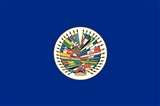
Organization of American States

Encyclopedia
The Organization of American States (OAS, or, as it is known in the three other official languages, OEA) is a regional international organization
, headquartered in Washington, D.C.
, United States
. Its members are the thirty-five independent states of the American Continent.
who, at the 1826 Congress of Panama
, proposed creating a league of American republics, with a common military, a mutual defense pact, and a supranational parliamentary assembly. This meeting was attended by representatives of Gran Colombia
(comprising the modern-day nations of Colombia
, Ecuador
, Panama
, and Venezuela
), Peru
, the United Provinces of Central America, and Mexico
, but the grandly titled "Treaty of Union, League, and Perpetual Confederation" was ultimately ratified only by Gran Colombia. Bolívar's dream soon floundered with civil war in Gran Colombia, the disintegration of Central America, and the emergence of national
rather than continental outlooks in the newly independent American republics. Bolívar's dream of American unity was meant to unify Latin American nations against imperial domination by external power.
The pursuit of regional solidarity and cooperation again came to the forefront in 1889–90, at the First International Conference of American States. Gathered together in Washington, D.C., 18 nations resolved to found the International Union of American Republics, served by a permanent secretariat called the Commercial Bureau of the American Republics (renamed the "International Commercial Bureau" at the Second International Conference in 1901–02). These two bodies, in existence as of 14 April 1890, represent the point of inception to which today's OAS and its General Secretariat trace their origins.
At the Fourth International Conference of American States (Buenos Aires
, 1910), the name of the organization was changed to the "Union of American Republics" and the Bureau became the "Pan American Union".
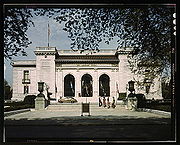
The Pan American Union (building) was constructed in 1910, on Constitution Avenue
, Northwest, Washington, D.C.
 In the mid-1930s, U.S. President Franklin Delano Roosevelt organized an inter-American conference in Buenos Aires. One of the items at the conference was a "League of Nations
of the Americas", an idea proposed by Colombia, Guatemala, and the Dominican Republic. At the subsequent Inter-American Conference for the Maintenance of Peace, 21 nations pledged to remain neutral in the event of a conflict between any two members.
The experience of World War II
convinced hemispheric governments that unilateral action could not ensure the territorial integrity of the American nations in the event of extra-continental aggression. To meet the challenges of global conflict in the postwar world and to contain conflicts within the hemisphere, they adopted a system of collective security
, the Inter-American Treaty of Reciprocal Assistance
(Rio Treaty) signed in 1947 in Rio de Janeiro
.
The Ninth International Conference of American States was held in Bogotá
between March and May 1948 and led by United States Secretary of State
George Marshall
, a meeting which led to a pledge by members to fight communism in America. This was the event that saw the birth of the OAS as it stands today, with the signature by 21 American countries of the Charter of the Organization of American States
on 30 April 1948 (in effect since December 1951). The meeting also adopted the American Declaration of the Rights and Duties of Man
, the world's first general human rights instrument, Bogota considered the first wall of the Organization of American States.
The transition from the Pan American Union to OAS was smooth. The Director General of the former, Alberto Lleras Camargo
, became the Organization's first Secretary General
. The current Secretary General is former Chilean foreign minister José Miguel Insulza
.
Significant milestones in the history of the OAS since the signing of the Charter have included the following:
Over the course of the 1990s, with the end of the Cold War
, the return to democracy in Latin America
, and the thrust toward globalization
, the OAS made major efforts to reinvent itself to fit the new context. Its stated priorities now include the following:
Article 19 of the OAS Charter prohibits any State from interfering with the internal or external affairs of a member state. Article 21 prohibits any State from the military occupation—even temporarily—of a Member State's territory. The Charter subscribes to international law but goes further, saying that Charter rights depend not on power but follow from the existence of the state. The United States is signatory to the OAS Charter, meaning that the U.S. (like other Members) is legally bound by Article 19, 21, and other Charter provisions. [See Membership].
There is an increasing perception that the OAS is biased toward US concerns and influence in non-US states and countries. For example, Article 19 prohibits interfering with member states but does not prohibit interference with non-member states. This effectively forces third world nations to join the OAS by coercion and threat of US interference. There is currently an effort in South American countries including Venezuela, Bolivia, and Ecuador to create a new body that represents the South American countries in a more equitable manner and is not based in Washington, DC.

Suspended between 1962–2009. Has chosen not to reapply for participation.Suspended in 2009. Reinstated in 2011
The later expansion of the OAS included the newly independent nations of the Caribbean (most of whom gained independence only after World War II
) and Canada
. Members with later admission dates (sorted chronologically):
(member since 1967) (1967) (1969) (1975) (1977) (1979) (1979) (1981) (1981) (1982) (1984) (1990) (1991) (1991)
obtained a degree of independence in its foreign policy from the United Kingdom
in 1931, it chose not to join the OAS when it was first formed, despite its close relations with the United States
. Canada became a Permanent Observer in the OAS on 2 February 1972. Canada signed the Charter of the Organization of American States on 13 November 1989, and this decision was ratified on 8 January 1990.
In 2004–2005, Canada was the second largest contributor to the OAS, with an annual assessed contribution representing 12.36% of the OAS Regular Budget (US$9.2 million) and an additional C$9 million in voluntary contributions to specific projects. Shortly after joining as a full member, Canada was instrumental in the creation of the Unit for the Promotion of Democracy, which provides support for the strengthening and consolidation of democratic processes and institutions in OAS member states.
, Uruguay
, on 31 January 1962. The vote was passed by 14 in favor, with one against (Cuba) and six abstentions (Argentina, Bolivia, Brazil, Chile, Ecuador, and Mexico). The operative part of the resolution reads as follows:
This meant that the Cuban nation was still technically a member state, but that the current government was denied the right of representation and attendance at meetings and of participation in activities. The OAS's position was that although Cuba's participation was suspended, its obligations under the Charter, the American Declaration of the Rights and Duties of Man
, etc. still hold: for instance, the Inter-American Commission on Human Rights
continued to publish reports on Cuba's human rights situation and to hear individual cases involving Cuban nationals. However, this stance was occasionally questioned by other individual member states.
Cuba's position was stated in an official note sent to the Organization "merely as a courtesy" by Minister of Foreign Affairs Dr. Raúl Roa on 4 November 1964: "Cuba was arbitrarily excluded... The Organization of American States has no juridical, factual, or moral jurisdiction, nor competence, over a state which it has illegally deprived of its rights."
The reincorporation of Cuba as an active member regularly arose as a topic within the inter-American system (e.g., it was intimated by the outgoing ambassador of Mexico in 1998) but most observers did not see it as a serious possibility while the present government remained in power. Since 1960, the Cuban administration had repeatedly characterized the OAS as the "Ministry of Colonies" of the United States of America. On 6 May 2005, president
Fidel Castro
reiterated that the island nation would not "be part of a disgraceful institution that has only humiliated the honor of Latin American nations". After Fidel Castro's recent retirement and the ascent of his brother Raúl
to power, this official position was reasserted. Venezuelan President Hugo Chávez
promised to veto any final declaration of the 2009 Summit of the Americas
due to Cuba's exclusion.
On 17 April 2009, after a trading of warm words between the administrations of US President Barack Obama and Cuban leader Raúl Castro, OAS Secretary General José Miguel Insulza
said he would ask the 2009 General Assembly to annul the 1962 resolution excluding Cuba.
On 3 June 2009, foreign ministers assembled in San Pedro Sula
, Honduras
, for the OAS's 39th General Assembly
, passed a vote to lift Cuba's suspension from the OAS. The United States had been pressuring the OAS for weeks to condition Cuba's readmission to the continental group on democratic principles and commitment to human rights. Ecuador's Foreign Minister Fander Falconí
said there will be no such conditions. "This is a new proposal, it has no conditions – of any kind," Falconí said. "That suspension was made in the Cold War
, in the language of the Cold War. What we have done here is fix a historic error." At the end of the General Assembly the suspension was lifted but in order to readmit Cuba to the Organization, this state has to comply with all the treaties signed by the Member States including the Inter-American Democratic Charter of 2001.
 Honduras was suspended unanimously at midnight of 5 July 2009, following the 28 June expulsion
of President Manuel Zelaya
. The de facto government had already announced it was leaving the OAS hours earlier; however, this was not taken into account by the OAS, which does not recognize that government as legitimate. An extraordinary meeting had been conducted by the OAS in Washington, D.C.
, with Zelaya in attendance. The suspension of Honduras was approved unanimously with 33 votes—Honduras did not vote. This was the first suspension carried out by the OAS since Cuba's in 1962.Honduras was finally re-admitted to the organization on 1 June 2011 with 32 votes in favor, with Venezuela having some reservations, and only 1 against by Ecuador.
.
, English
, Portuguese
, and French
, the national languages of the majority of its member nations. The Charter, the basic instrument governing OAS, makes no reference to the use of official languages. These references are to be found in the Rules of Procedure governing the various OAS bodies. Article 51 of the Rules of Procedure of the General Assembly, the supreme body of the OAS, which meets once a year, states that English, French, Portuguese and Spanish are the four official languages. Article 28 stipulates that a Style Committee shall be set up with representatives of the four official languages to review the General Assembly resolutions and declarations. Article 53 states that proposals shall be presented in the four official languages. The Rules of Procedure and Statutes of other bodies, such as the Inter-American Council for Integral Development (CIDI), the Permanent Executive Committee of the Inter-American Council for Integral Development (CEPCIDI), the Inter-American Commission of Women (CIM), the Inter-American Drug Abuse Control Commission (CICAD), the Inter-American Commission on Human Rights
(IACHR) and the Inter-American Juridical Committee (CJI), technical bodies of the OAS, also mention the four official languages in which their meetings are to be conducted. Policy is therefore dictated through these instruments that require use of the four official languages at meetings.
Although a number of other languages have official status in one or more member states of OAS (Dutch
in Suriname; Haitian Creole
in Haiti; Quechua and Aymara
in Peru, Ecuador and Bolivia; Guarani
in Paraguay), they are not official languages of the Organization.
International organization
An intergovernmental organization, sometimes rendered as an international governmental organization and both abbreviated as IGO, is an organization composed primarily of sovereign states , or of other intergovernmental organizations...
, headquartered in Washington, D.C.
Washington, D.C.
Washington, D.C., formally the District of Columbia and commonly referred to as Washington, "the District", or simply D.C., is the capital of the United States. On July 16, 1790, the United States Congress approved the creation of a permanent national capital as permitted by the U.S. Constitution....
, United States
United States
The United States of America is a federal constitutional republic comprising fifty states and a federal district...
. Its members are the thirty-five independent states of the American Continent.
History
The notion of closer hemispheric union in America was first put forward by Simón BolívarSimón Bolívar
Simón José Antonio de la Santísima Trinidad Bolívar y Palacios Ponte y Yeiter, commonly known as Simón Bolívar was a Venezuelan military and political leader...
who, at the 1826 Congress of Panama
Congress of Panama
The Congress of Panama was a congress organized by Simón Bolívar in 1826 with the goal of bringing together the new republics of Latin America to develop a unified policy towards Spain...
, proposed creating a league of American republics, with a common military, a mutual defense pact, and a supranational parliamentary assembly. This meeting was attended by representatives of Gran Colombia
Gran Colombia
Gran Colombia is a name used today for the state that encompassed much of northern South America and part of southern Central America from 1819 to 1831. This short-lived republic included the territories of present-day Colombia, Venezuela, Ecuador, Panama, northern Peru and northwest Brazil. The...
(comprising the modern-day nations of Colombia
Colombia
Colombia, officially the Republic of Colombia , is a unitary constitutional republic comprising thirty-two departments. The country is located in northwestern South America, bordered to the east by Venezuela and Brazil; to the south by Ecuador and Peru; to the north by the Caribbean Sea; to the...
, Ecuador
Ecuador
Ecuador , officially the Republic of Ecuador is a representative democratic republic in South America, bordered by Colombia on the north, Peru on the east and south, and by the Pacific Ocean to the west. It is one of only two countries in South America, along with Chile, that do not have a border...
, Panama
Panama
Panama , officially the Republic of Panama , is the southernmost country of Central America. Situated on the isthmus connecting North and South America, it is bordered by Costa Rica to the northwest, Colombia to the southeast, the Caribbean Sea to the north and the Pacific Ocean to the south. The...
, and Venezuela
Venezuela
Venezuela , officially called the Bolivarian Republic of Venezuela , is a tropical country on the northern coast of South America. It borders Colombia to the west, Guyana to the east, and Brazil to the south...
), Peru
Peru
Peru , officially the Republic of Peru , is a country in western South America. It is bordered on the north by Ecuador and Colombia, on the east by Brazil, on the southeast by Bolivia, on the south by Chile, and on the west by the Pacific Ocean....
, the United Provinces of Central America, and Mexico
Mexico
The United Mexican States , commonly known as Mexico , is a federal constitutional republic in North America. It is bordered on the north by the United States; on the south and west by the Pacific Ocean; on the southeast by Guatemala, Belize, and the Caribbean Sea; and on the east by the Gulf of...
, but the grandly titled "Treaty of Union, League, and Perpetual Confederation" was ultimately ratified only by Gran Colombia. Bolívar's dream soon floundered with civil war in Gran Colombia, the disintegration of Central America, and the emergence of national
Nationalism
Nationalism is a political ideology that involves a strong identification of a group of individuals with a political entity defined in national terms, i.e. a nation. In the 'modernist' image of the nation, it is nationalism that creates national identity. There are various definitions for what...
rather than continental outlooks in the newly independent American republics. Bolívar's dream of American unity was meant to unify Latin American nations against imperial domination by external power.
The pursuit of regional solidarity and cooperation again came to the forefront in 1889–90, at the First International Conference of American States. Gathered together in Washington, D.C., 18 nations resolved to found the International Union of American Republics, served by a permanent secretariat called the Commercial Bureau of the American Republics (renamed the "International Commercial Bureau" at the Second International Conference in 1901–02). These two bodies, in existence as of 14 April 1890, represent the point of inception to which today's OAS and its General Secretariat trace their origins.
At the Fourth International Conference of American States (Buenos Aires
Buenos Aires
Buenos Aires is the capital and largest city of Argentina, and the second-largest metropolitan area in South America, after São Paulo. It is located on the western shore of the estuary of the Río de la Plata, on the southeastern coast of the South American continent...
, 1910), the name of the organization was changed to the "Union of American Republics" and the Bureau became the "Pan American Union".
The Pan American Union (building) was constructed in 1910, on Constitution Avenue
Constitution Avenue
In Washington, D.C., Constitution Avenue is a major east-west street running just north of the United States Capitol in the city's Northwest and Northeast quadrants...
, Northwest, Washington, D.C.
League of Nations
The League of Nations was an intergovernmental organization founded as a result of the Paris Peace Conference that ended the First World War. It was the first permanent international organization whose principal mission was to maintain world peace...
of the Americas", an idea proposed by Colombia, Guatemala, and the Dominican Republic. At the subsequent Inter-American Conference for the Maintenance of Peace, 21 nations pledged to remain neutral in the event of a conflict between any two members.
The experience of World War II
World War II
World War II, or the Second World War , was a global conflict lasting from 1939 to 1945, involving most of the world's nations—including all of the great powers—eventually forming two opposing military alliances: the Allies and the Axis...
convinced hemispheric governments that unilateral action could not ensure the territorial integrity of the American nations in the event of extra-continental aggression. To meet the challenges of global conflict in the postwar world and to contain conflicts within the hemisphere, they adopted a system of collective security
Collective security
Collective security can be understood as a security arrangement, regional or global, in which each state in the system accepts that the security of one is the concern of all, and agrees to join in a collective response to threats to, and breaches of, the peace...
, the Inter-American Treaty of Reciprocal Assistance
Inter-American Treaty of Reciprocal Assistance
The Inter-American Treaty of Reciprocal Assistance was an agreement signed on 1947 in Rio de Janeiro among many countries of the Americas...
(Rio Treaty) signed in 1947 in Rio de Janeiro
Rio de Janeiro
Rio de Janeiro , commonly referred to simply as Rio, is the capital city of the State of Rio de Janeiro, the second largest city of Brazil, and the third largest metropolitan area and agglomeration in South America, boasting approximately 6.3 million people within the city proper, making it the 6th...
.
The Ninth International Conference of American States was held in Bogotá
Bogotá
Bogotá, Distrito Capital , from 1991 to 2000 called Santa Fé de Bogotá, is the capital, and largest city, of Colombia. It is also designated by the national constitution as the capital of the department of Cundinamarca, even though the city of Bogotá now comprises an independent Capital district...
between March and May 1948 and led by United States Secretary of State
United States Secretary of State
The United States Secretary of State is the head of the United States Department of State, concerned with foreign affairs. The Secretary is a member of the Cabinet and the highest-ranking cabinet secretary both in line of succession and order of precedence...
George Marshall
George Marshall
George Catlett Marshall was an American military leader, Chief of Staff of the Army, Secretary of State, and the third Secretary of Defense...
, a meeting which led to a pledge by members to fight communism in America. This was the event that saw the birth of the OAS as it stands today, with the signature by 21 American countries of the Charter of the Organization of American States
Charter of the Organization of American States
The Charter of the Organization of the American States is a Pan-American treaty that sets out the creation of the Organization of American States. It was signed at the Ninth International Conference of American States of 30 April 1948, held in Bogotá, Colombia...
on 30 April 1948 (in effect since December 1951). The meeting also adopted the American Declaration of the Rights and Duties of Man
American Declaration of the Rights and Duties of Man
The American Declaration of the Rights and Duties of Man was the world's first international human rights instrument of a general nature, predating the Universal Declaration of Human Rights by less than a year....
, the world's first general human rights instrument, Bogota considered the first wall of the Organization of American States.
The transition from the Pan American Union to OAS was smooth. The Director General of the former, Alberto Lleras Camargo
Alberto Lleras Camargo
Alberto Lleras Camargo was an important Colombian diplomat and political figure.He was a member of the Liberal Party of Colombia; he served as congressman , Minister of Education, Minister of the Interior and Minister of Foreign Affairs, during the governments of Alfonso López Pumarejo and Eduardo...
, became the Organization's first Secretary General
Secretary General of the Organization of American States
According to the Charter of the Organization of American States:-Secretaries General of the OAS:-Assistant Secretaries General of the OAS:*William Manger *William Sanders...
. The current Secretary General is former Chilean foreign minister José Miguel Insulza
José Miguel Insulza
José Miguel Insulza Salinas is a Chilean politician and statesman. He is currently the Secretary General of the Organization of American States. He is nicknamed El Panzer, for his tank-like drive and reputation due to his ability to take political heat with little apparent damage...
.
Significant milestones in the history of the OAS since the signing of the Charter have included the following:
- 1959: Inter-American Commission on Human RightsInter-American Commission on Human RightsThe Inter-American Commission on Human Rights is an autonomous organ of the Organization of American States .Along with the...
created. - 1961: Charter of Punta del Este signed, launching the Alliance for ProgressAlliance for ProgressThe Alliance for Progress initiated by U.S. President John F. Kennedy in 1961 aimed to establish economic cooperation between the U.S. and South America.-Origin and goals:...
. - 1962: OAS suspends CubaCubaThe Republic of Cuba is an island nation in the Caribbean. The nation of Cuba consists of the main island of Cuba, the Isla de la Juventud, and several archipelagos. Havana is the largest city in Cuba and the country's capital. Santiago de Cuba is the second largest city...
- 1969: American Convention on Human RightsAmerican Convention on Human RightsThe American Convention on Human Rights is an international human rights instrument.It was adopted by the nations of the Americas meeting in San José, Costa Rica, in 22 November 1969...
signed (in force since 1978). - 1970: OAS General AssemblyGeneral Assembly of the Organization of American StatesThe General Assembly is the supreme decision-making body of the Organization of American States .The General Assembly came into being as a part of the restructuring of the OAS that took place following adoption of the Protocol of Buenos Aires , which contained extensive amendments to the...
established as the Organization's supreme decision-making body. - 1979: Inter-American Court of Human RightsInter-American Court of Human RightsThe Inter-American Court of Human Rights is an autonomous judicial institution based in the city of San José, Costa Rica. Together with the Inter-American Commission on Human Rights, it makes up the human rights protection system of the Organization of American States , which serves to uphold and...
created. - 1991: Adoption of Resolution 1080, which requires the Secretary General to convene the Permanent CouncilPermanent Council of the Organization of American StatesThe Permanent Council is one of the two main political bodies of the Organization of American States, the other being the General Assembly.The Permanent Council is established under Chapter XII of the OAS Charter. It is composed of ambassadors appointed by the member states , and it meets regularly...
within ten days of a coup d'étatCoup d'étatA coup d'état state, literally: strike/blow of state)—also known as a coup, putsch, and overthrow—is the sudden, extrajudicial deposition of a government, usually by a small group of the existing state establishment—typically the military—to replace the deposed government with another body; either...
in any member country. - 1994: First Summit of the AmericasSummit of the AmericasThe Summits of the Americas is a series of international summit meetings bringing together the leaders of countries in North America, Central America, South America and the Caribbean. Neither the elderly leader nor a representative from Cuba participated in this summit...
(Miami), which resolved to establish a Free Trade Area of the AmericasFree Trade Area of the AmericasThe Free Trade Area of the Americas , , ) was a proposed agreement to eliminate or reduce the trade barriers among all countries in the Americas but Cuba. In the last round of negotiations, trade ministers from 34 countries met in Miami, United States, in November 2003 to discuss the proposal...
by 2005. - 2001: Inter-American Democratic CharterInter-American Democratic CharterThe Inter-American Democratic Charter was adopted on 11 September 2001 by a special session of the General Assembly of the Organization of American States, held in Lima, Peru. It is an inter-American instrument with the central aim of strengthening and upholding democratic institutions in the...
adopted. - 2009: OAS revokes 1962 suspension of CubaCubaThe Republic of Cuba is an island nation in the Caribbean. The nation of Cuba consists of the main island of Cuba, the Isla de la Juventud, and several archipelagos. Havana is the largest city in Cuba and the country's capital. Santiago de Cuba is the second largest city...
- 2009: OAS suspends Honduras due to the coup which ousted president Manuel ZelayaManuel ZelayaJosé Manuel Zelaya Rosales is a politician who was President of Honduras from January 27, 2006 until June 28, 2009. The eldest son of a wealthy businessman, he inherited his father's nickname "Mel," and, before entering politics, was involved in his family's logging and timber businesses.Elected...
- 2011: OAS lifts the suspension of Honduras with the return of Manuel Zelaya from exile.
Goals and purpose
In the words of Article 1 of the Charter, the goal of the member nations in creating the OAS was "to achieve an order of peace and justice, to promote their solidarity, to strengthen their collaboration, and to defend their sovereignty, their territorial integrity, and their independence." Article 2 then defines eight essential purposes:- To strengthen the peace and security of the continent.
- To promote and consolidate representative democracy, with due respect for the principle of nonintervention.
- To prevent possible causes of difficulties and to ensure the pacific settlement of disputes that may arise among the member states.
- To provide for common action on the part of those states in the event of aggression.
- To seek the solution of political, judicial, and economic problems that may arise among them
- To promote, by cooperative action, their economic, social, and cultural development.
- To eradicate extreme poverty, which constitutes an obstacle to the full democratic development of the peoples of the continent.
- To achieve an effective limitation of conventional weapons that will make it possible to devote the largest amount of resources to the economic and social development of the member states.
Over the course of the 1990s, with the end of the Cold War
Cold War
The Cold War was the continuing state from roughly 1946 to 1991 of political conflict, military tension, proxy wars, and economic competition between the Communist World—primarily the Soviet Union and its satellite states and allies—and the powers of the Western world, primarily the United States...
, the return to democracy in Latin America
Latin America
Latin America is a region of the Americas where Romance languages – particularly Spanish and Portuguese, and variably French – are primarily spoken. Latin America has an area of approximately 21,069,500 km² , almost 3.9% of the Earth's surface or 14.1% of its land surface area...
, and the thrust toward globalization
Globalization
Globalization refers to the increasingly global relationships of culture, people and economic activity. Most often, it refers to economics: the global distribution of the production of goods and services, through reduction of barriers to international trade such as tariffs, export fees, and import...
, the OAS made major efforts to reinvent itself to fit the new context. Its stated priorities now include the following:
- Strengthening democracy: Between 1962 and 2002, the Organization sent multinational observation missions to oversee free and fair elections in the member states on more than 100 occasions. The OAS also works to strengthen national and local government and electoral agencies, to promote democratic practices and values, and to help countries detect and defuse official corruption.
- Working for peace: Special OAS missions have supported peace processes in NicaraguaNicaraguaNicaragua is the largest country in the Central American American isthmus, bordered by Honduras to the north and Costa Rica to the south. The country is situated between 11 and 14 degrees north of the Equator in the Northern Hemisphere, which places it entirely within the tropics. The Pacific Ocean...
, SurinameSurinameSuriname , officially the Republic of Suriname , is a country in northern South America. It borders French Guiana to the east, Guyana to the west, Brazil to the south, and on the north by the Atlantic Ocean. Suriname was a former colony of the British and of the Dutch, and was previously known as...
, HaitiHaitiHaiti , officially the Republic of Haiti , is a Caribbean country. It occupies the western, smaller portion of the island of Hispaniola, in the Greater Antillean archipelago, which it shares with the Dominican Republic. Ayiti was the indigenous Taíno or Amerindian name for the island...
, and GuatemalaGuatemalaGuatemala is a country in Central America bordered by Mexico to the north and west, the Pacific Ocean to the southwest, Belize to the northeast, the Caribbean to the east, and Honduras and El Salvador to the southeast...
. The Organization has played a leading part in the removal of landmines deployed in America and it has led negotiations to resolve the continent's remaining border disputes (GuatemalaGuatemalaGuatemala is a country in Central America bordered by Mexico to the north and west, the Pacific Ocean to the southwest, Belize to the northeast, the Caribbean to the east, and Honduras and El Salvador to the southeast...
/BelizeBelizeBelize is a constitutional monarchy and the northernmost country in Central America. Belize has a diverse society, comprising many cultures and languages. Even though Kriol and Spanish are spoken among the population, Belize is the only country in Central America where English is the official...
; PeruPeruPeru , officially the Republic of Peru , is a country in western South America. It is bordered on the north by Ecuador and Colombia, on the east by Brazil, on the southeast by Bolivia, on the south by Chile, and on the west by the Pacific Ocean....
/Ecuador). Work is also underway on the construction of a common inter-American counter-terrorism front. - Defending human rights: The agencies of the inter-American human rights system provide a venue for the denunciation and resolution of human rights violations in individual cases. They also monitor and report on the general human rights situation in the member states.
- Fostering free trade: The OAS is one of the three agencies currently engaged in drafting a treaty aiming to establish a continental free trade areaFree Trade Area of the AmericasThe Free Trade Area of the Americas , , ) was a proposed agreement to eliminate or reduce the trade barriers among all countries in the Americas but Cuba. In the last round of negotiations, trade ministers from 34 countries met in Miami, United States, in November 2003 to discuss the proposal...
from AlaskaAlaskaAlaska is the largest state in the United States by area. It is situated in the northwest extremity of the North American continent, with Canada to the east, the Arctic Ocean to the north, and the Pacific Ocean to the west and south, with Russia further west across the Bering Strait...
to Tierra del FuegoTierra del FuegoTierra del Fuego is an archipelago off the southernmost tip of the South American mainland, across the Strait of Magellan. The archipelago consists of a main island Isla Grande de Tierra del Fuego divided between Chile and Argentina with an area of , and a group of smaller islands including Cape...
. - Fighting the drugs trade: The Inter-American Drug Abuse Control Commission was established in 1986 to coordinate efforts and crossborder cooperation in this area.
- Promoting sustainable development: The goal of the OAS's Inter-American Council for Integral Development is to promote economic development and combating poverty. OAS technical cooperation programs address such areas as river basin management, the conservation of biodiversity, preservation of cultural diversity, planning for global climate change, sustainable tourismSustainable tourismSustainable tourism is tourism attempting to make a low impact on the environment and local culture, while helping to generate future employment for local people. The aim of sustainable tourism is to ensure that development brings a positive experience for local people, tourism companies and the...
, and natural disaster mitigation.
Article 19 of the OAS Charter prohibits any State from interfering with the internal or external affairs of a member state. Article 21 prohibits any State from the military occupation—even temporarily—of a Member State's territory. The Charter subscribes to international law but goes further, saying that Charter rights depend not on power but follow from the existence of the state. The United States is signatory to the OAS Charter, meaning that the U.S. (like other Members) is legally bound by Article 19, 21, and other Charter provisions. [See Membership].
There is an increasing perception that the OAS is biased toward US concerns and influence in non-US states and countries. For example, Article 19 prohibits interfering with member states but does not prohibit interference with non-member states. This effectively forces third world nations to join the OAS by coercion and threat of US interference. There is currently an effort in South American countries including Venezuela, Bolivia, and Ecuador to create a new body that represents the South American countries in a more equitable manner and is not based in Washington, DC.
Organizational structure
The OAS is composed of a General Secretariat (GS/OAS), the Permanent Council, the Inter-American Council for Integral Development, and a number of committees, including:- The Committee on Juridical and Political Affairs
- The Committee on Administrative and Budgetary Affairs
- The Committee on Hemispheric Security
- The Committee on Inter-American Summits Management and Civil Society Participation in OAS Activities
General Assembly
- Forty-first regular session: San Salvador, El Salvador, June 2011.
- Fortieth regular session: Lima, Peru, June 2010.
- Thirty-ninth regular session: San Pedro Sula, Honduras, June 2009.
- Thirty-eight regular session: Medellín, Colombia, June 2008.
- Thirty-seventh regular session: Panama City, Republic of Panama, June 2007.
- Thirty-sixth regular session: Santo Domingo, Dominican Republic, June 2006.
- Thirty-fifth regular session: Fort Lauderdale, Florida, United States, June 2005.
- Thirty-fourth regular session: Quito, Ecuador, June 2004.
- Thirty-third regular session: Santiago, Chile, June 2003.
- Thirty-second regular session: Bridgetown, Barbados, June 2002.
- Thirty-first regular session: San José, Costa Rica, June 2001.
- Thirtieth regular session: Windsor, Canada, June 2000.
- Twenty-ninth regular session: Guatemala City, Guatemala, June 1999.
- Twenty-eight regular session: Caracas, Venezuela, June 1998.
- Twenty-seventh regular session: Lima, Peru, June 1997.
- Twenty-sixth regular session: Panama City, Republic of Panama, June 1996.
- Twenty-fifth regular session: Montrouis, Haiti, June 1995.
- Twenty-fourth regular session: Belém do Pará, Brazil, June 1994.
- Twenty-third regular session: Managua, Nicaragua, June 1993.
- Twenty-second regular session: Nassau, The Bahamas, May 1992.
- Twenty-first regular session: Santiago, Chile, June 1991.
- Twentieth regular session: Asunción, Paraguay, June 1990.
- Nineteenth regular session: Washington, D.C., United States, November 1989.
- Eighteenth regular session: San Salvador, El Salvador, November 1988.
- Seventeenth regular session: Washington, D.C., United States, November 1987.
- Sixteenth regular session: Guatemala City, Guatemala, November 1986.
- Fifteenth regular session: Cartagena de Indias, Colombia, December 1985.
- Fourteenth regular session: Brasília, Brazil, November 1984.
- Thirteenth regular session: Washington, D.C., United States, November 1983.
- Twelfth regular session: Washington, D.C., United States, November 1982.
- Eleventh regular session: Castries, Saint Lucia, December 1981.
- Tenth regular session: Washington, D.C., United States, November 1980.
- Ninth regular session: La Paz, Bolivia, October 1979.
- Eighth regular session: Washington, D.C., United States, June/July 1978.
- Seventh regular session: St. George's, Grenada, June 1977.
- Sixth regular session: Santiago, Chile, June 1976.
- Fifth regular session: Washington, D.C., United States, May 1975.
- Fourth regular session: Atlanta, United States, April/May 1974.
- Third regular session: Washington, D.C., United States, April 1973.
- Second regular session: Washington, D.C., United States, April 1972.
- First regular session: San José, Costa Rica, April 1971.
Membership and adhesions
All 35 independent nations of America are members of the OAS. Upon foundation on 5 May 1948 there were 21 members:Suspended between 1962–2009. Has chosen not to reapply for participation.Suspended in 2009. Reinstated in 2011
The later expansion of the OAS included the newly independent nations of the Caribbean (most of whom gained independence only after World War II
World War II
World War II, or the Second World War , was a global conflict lasting from 1939 to 1945, involving most of the world's nations—including all of the great powers—eventually forming two opposing military alliances: the Allies and the Axis...
) and Canada
Canada
Canada is a North American country consisting of ten provinces and three territories. Located in the northern part of the continent, it extends from the Atlantic Ocean in the east to the Pacific Ocean in the west, and northward into the Arctic Ocean...
. Members with later admission dates (sorted chronologically):
(member since 1967) (1967) (1969) (1975) (1977) (1979) (1979) (1981) (1981) (1982) (1984) (1990) (1991) (1991)
Canada and the OAS
Although CanadaCanada
Canada is a North American country consisting of ten provinces and three territories. Located in the northern part of the continent, it extends from the Atlantic Ocean in the east to the Pacific Ocean in the west, and northward into the Arctic Ocean...
obtained a degree of independence in its foreign policy from the United Kingdom
United Kingdom
The United Kingdom of Great Britain and Northern IrelandIn the United Kingdom and Dependencies, other languages have been officially recognised as legitimate autochthonous languages under the European Charter for Regional or Minority Languages...
in 1931, it chose not to join the OAS when it was first formed, despite its close relations with the United States
Canada-United States relations
Relations between Canada and the United States have spanned more than two centuries. This includes a shared British colonial heritage, warfare during the 1770s and 1812, and the eventual development of one of the most successful international relationships in the modern world...
. Canada became a Permanent Observer in the OAS on 2 February 1972. Canada signed the Charter of the Organization of American States on 13 November 1989, and this decision was ratified on 8 January 1990.
In 2004–2005, Canada was the second largest contributor to the OAS, with an annual assessed contribution representing 12.36% of the OAS Regular Budget (US$9.2 million) and an additional C$9 million in voluntary contributions to specific projects. Shortly after joining as a full member, Canada was instrumental in the creation of the Unit for the Promotion of Democracy, which provides support for the strengthening and consolidation of democratic processes and institutions in OAS member states.
Status of Cuba
The current government of Cuba was excluded from participation in the Organization under a decision adopted by the Eighth Meeting of Consultation in Punta del EstePunta del Este
Punta del Este is a resort town on the Atlantic Coast in the Maldonado Department of southeastern Uruguay. It is located on the intersection of Route 10 with Route 39, directly southeast of the department capital Maldonado and about east of Montevideo...
, Uruguay
Uruguay
Uruguay ,officially the Oriental Republic of Uruguay,sometimes the Eastern Republic of Uruguay; ) is a country in the southeastern part of South America. It is home to some 3.5 million people, of whom 1.8 million live in the capital Montevideo and its metropolitan area...
, on 31 January 1962. The vote was passed by 14 in favor, with one against (Cuba) and six abstentions (Argentina, Bolivia, Brazil, Chile, Ecuador, and Mexico). The operative part of the resolution reads as follows:
This meant that the Cuban nation was still technically a member state, but that the current government was denied the right of representation and attendance at meetings and of participation in activities. The OAS's position was that although Cuba's participation was suspended, its obligations under the Charter, the American Declaration of the Rights and Duties of Man
American Declaration of the Rights and Duties of Man
The American Declaration of the Rights and Duties of Man was the world's first international human rights instrument of a general nature, predating the Universal Declaration of Human Rights by less than a year....
, etc. still hold: for instance, the Inter-American Commission on Human Rights
Inter-American Commission on Human Rights
The Inter-American Commission on Human Rights is an autonomous organ of the Organization of American States .Along with the...
continued to publish reports on Cuba's human rights situation and to hear individual cases involving Cuban nationals. However, this stance was occasionally questioned by other individual member states.
Cuba's position was stated in an official note sent to the Organization "merely as a courtesy" by Minister of Foreign Affairs Dr. Raúl Roa on 4 November 1964: "Cuba was arbitrarily excluded... The Organization of American States has no juridical, factual, or moral jurisdiction, nor competence, over a state which it has illegally deprived of its rights."
The reincorporation of Cuba as an active member regularly arose as a topic within the inter-American system (e.g., it was intimated by the outgoing ambassador of Mexico in 1998) but most observers did not see it as a serious possibility while the present government remained in power. Since 1960, the Cuban administration had repeatedly characterized the OAS as the "Ministry of Colonies" of the United States of America. On 6 May 2005, president
President
A president is a leader of an organization, company, trade union, university, or country.Etymologically, a president is one who presides, who sits in leadership...
Fidel Castro
Fidel Castro
Fidel Alejandro Castro Ruz is a Cuban revolutionary and politician, having held the position of Prime Minister of Cuba from 1959 to 1976, and then President from 1976 to 2008. He also served as the First Secretary of the Communist Party of Cuba from the party's foundation in 1961 until 2011...
reiterated that the island nation would not "be part of a disgraceful institution that has only humiliated the honor of Latin American nations". After Fidel Castro's recent retirement and the ascent of his brother Raúl
Raúl Castro
Raúl Modesto Castro Ruz is a Cuban politician and revolutionary who has been President of the Council of State of Cuba and the President of the Council of Ministers of Cuba since 2008; he previously exercised presidential powers in an acting capacity from 2006 to 2008...
to power, this official position was reasserted. Venezuelan President Hugo Chávez
Hugo Chávez
Hugo Rafael Chávez Frías is the 56th and current President of Venezuela, having held that position since 1999. He was formerly the leader of the Fifth Republic Movement political party from its foundation in 1997 until 2007, when he became the leader of the United Socialist Party of Venezuela...
promised to veto any final declaration of the 2009 Summit of the Americas
Summit of the Americas
The Summits of the Americas is a series of international summit meetings bringing together the leaders of countries in North America, Central America, South America and the Caribbean. Neither the elderly leader nor a representative from Cuba participated in this summit...
due to Cuba's exclusion.
On 17 April 2009, after a trading of warm words between the administrations of US President Barack Obama and Cuban leader Raúl Castro, OAS Secretary General José Miguel Insulza
José Miguel Insulza
José Miguel Insulza Salinas is a Chilean politician and statesman. He is currently the Secretary General of the Organization of American States. He is nicknamed El Panzer, for his tank-like drive and reputation due to his ability to take political heat with little apparent damage...
said he would ask the 2009 General Assembly to annul the 1962 resolution excluding Cuba.
On 3 June 2009, foreign ministers assembled in San Pedro Sula
San Pedro Sula
San Pedro Sula is a city in Honduras. It is located in the northwest corner of the country, in the Valle de Sula , about 60 km south of Puerto Cortés on the Caribbean. With an estimated population of 638,259 people in the main municipality, and 802,598 in its metro area , it is the second...
, Honduras
Honduras
Honduras is a republic in Central America. It was previously known as Spanish Honduras to differentiate it from British Honduras, which became the modern-day state of Belize...
, for the OAS's 39th General Assembly
General Assembly of the Organization of American States
The General Assembly is the supreme decision-making body of the Organization of American States .The General Assembly came into being as a part of the restructuring of the OAS that took place following adoption of the Protocol of Buenos Aires , which contained extensive amendments to the...
, passed a vote to lift Cuba's suspension from the OAS. The United States had been pressuring the OAS for weeks to condition Cuba's readmission to the continental group on democratic principles and commitment to human rights. Ecuador's Foreign Minister Fander Falconí
Fander Falconí
Fander Falconí Benitez is an Ecuadorian economist and politician. He served as Foreign Minister in the government of President Rafael Correa from December 2008 until handing in his resignation on 13 January 2010....
said there will be no such conditions. "This is a new proposal, it has no conditions – of any kind," Falconí said. "That suspension was made in the Cold War
Cold War
The Cold War was the continuing state from roughly 1946 to 1991 of political conflict, military tension, proxy wars, and economic competition between the Communist World—primarily the Soviet Union and its satellite states and allies—and the powers of the Western world, primarily the United States...
, in the language of the Cold War. What we have done here is fix a historic error." At the end of the General Assembly the suspension was lifted but in order to readmit Cuba to the Organization, this state has to comply with all the treaties signed by the Member States including the Inter-American Democratic Charter of 2001.
Suspension of Honduras
2009 Honduran constitutional crisis
The 2009 Honduran constitutional crisis was a political dispute over plans to rewrite the Constitution of Honduras, which culminated in a coup d'état against Honduran President Manuel Zelaya by the Honduran military...
of President Manuel Zelaya
Manuel Zelaya
José Manuel Zelaya Rosales is a politician who was President of Honduras from January 27, 2006 until June 28, 2009. The eldest son of a wealthy businessman, he inherited his father's nickname "Mel," and, before entering politics, was involved in his family's logging and timber businesses.Elected...
. The de facto government had already announced it was leaving the OAS hours earlier; however, this was not taken into account by the OAS, which does not recognize that government as legitimate. An extraordinary meeting had been conducted by the OAS in Washington, D.C.
Washington, D.C.
Washington, D.C., formally the District of Columbia and commonly referred to as Washington, "the District", or simply D.C., is the capital of the United States. On July 16, 1790, the United States Congress approved the creation of a permanent national capital as permitted by the U.S. Constitution....
, with Zelaya in attendance. The suspension of Honduras was approved unanimously with 33 votes—Honduras did not vote. This was the first suspension carried out by the OAS since Cuba's in 1962.Honduras was finally re-admitted to the organization on 1 June 2011 with 32 votes in favor, with Venezuela having some reservations, and only 1 against by Ecuador.
Observer countries
As of May 2011, there are 66 permanent observer countries, including the European UnionEuropean Union
The European Union is an economic and political union of 27 independent member states which are located primarily in Europe. The EU traces its origins from the European Coal and Steel Community and the European Economic Community , formed by six countries in 1958...
.
Official languages
The Organization's official languages are SpanishSpanish language
Spanish , also known as Castilian , is a Romance language in the Ibero-Romance group that evolved from several languages and dialects in central-northern Iberia around the 9th century and gradually spread with the expansion of the Kingdom of Castile into central and southern Iberia during the...
, English
English language
English is a West Germanic language that arose in the Anglo-Saxon kingdoms of England and spread into what was to become south-east Scotland under the influence of the Anglian medieval kingdom of Northumbria...
, Portuguese
Portuguese language
Portuguese is a Romance language that arose in the medieval Kingdom of Galicia, nowadays Galicia and Northern Portugal. The southern part of the Kingdom of Galicia became independent as the County of Portugal in 1095...
, and French
French language
French is a Romance language spoken as a first language in France, the Romandy region in Switzerland, Wallonia and Brussels in Belgium, Monaco, the regions of Quebec and Acadia in Canada, and by various communities elsewhere. Second-language speakers of French are distributed throughout many parts...
, the national languages of the majority of its member nations. The Charter, the basic instrument governing OAS, makes no reference to the use of official languages. These references are to be found in the Rules of Procedure governing the various OAS bodies. Article 51 of the Rules of Procedure of the General Assembly, the supreme body of the OAS, which meets once a year, states that English, French, Portuguese and Spanish are the four official languages. Article 28 stipulates that a Style Committee shall be set up with representatives of the four official languages to review the General Assembly resolutions and declarations. Article 53 states that proposals shall be presented in the four official languages. The Rules of Procedure and Statutes of other bodies, such as the Inter-American Council for Integral Development (CIDI), the Permanent Executive Committee of the Inter-American Council for Integral Development (CEPCIDI), the Inter-American Commission of Women (CIM), the Inter-American Drug Abuse Control Commission (CICAD), the Inter-American Commission on Human Rights
Inter-American Commission on Human Rights
The Inter-American Commission on Human Rights is an autonomous organ of the Organization of American States .Along with the...
(IACHR) and the Inter-American Juridical Committee (CJI), technical bodies of the OAS, also mention the four official languages in which their meetings are to be conducted. Policy is therefore dictated through these instruments that require use of the four official languages at meetings.
Although a number of other languages have official status in one or more member states of OAS (Dutch
Dutch language
Dutch is a West Germanic language and the native language of the majority of the population of the Netherlands, Belgium, and Suriname, the three member states of the Dutch Language Union. Most speakers live in the European Union, where it is a first language for about 23 million and a second...
in Suriname; Haitian Creole
Haitian Creole language
Haitian Creole language , often called simply Creole or Kreyòl, is a language spoken in Haiti by about twelve million people, which includes all Haitians in Haiti and via emigration, by about two to three million speakers residing in the Bahamas, Cuba, Canada, France, Cayman Islands, French...
in Haiti; Quechua and Aymara
Aymara language
Aymara is an Aymaran language spoken by the Aymara people of the Andes. It is one of only a handful of Native American languages with over three million speakers. Aymara, along with Quechua and Spanish, is an official language of Peru and Bolivia...
in Peru, Ecuador and Bolivia; Guarani
Guaraní language
Guaraní, specifically the primary variety known as Paraguayan Guaraní , is an indigenous language of South America that belongs to the Tupí–Guaraní subfamily of the Tupian languages. It is one of the official languages of Paraguay , where it is spoken by the majority of the population, and half of...
in Paraguay), they are not official languages of the Organization.
See also
- Regional integrationRegional integrationRegional integration is a process in which states enter into a regional agreement in order to enhance regional cooperation through regional institutions and rules...
- Organization of Ibero-American StatesOrganization of Ibero-American StatesThe Organization of Ibero-American States is an intergovernmental organization, comprising the Portuguese- and Spanish-speaking nations of America and Europe, plus Equatorial Guinea in Africa....
- Union of South American Nations
- Rio GroupRio Group- List of Summit meetings :- See also :* Community of Latin American and Caribbean States, possible successor of the Rio Group* Union of South American Nations...
- Statues of the LiberatorsStatues of the LiberatorsA series of Statues of the Liberators of western-hemisphere countries from colonial rule is found along Virginia Avenue, N.W., in Washington, D.C...
- Continental organizations
External links
- OAS official site
- Door Opens to OAS for Cuba By Thelma Mejia, Havana Times, 4 June 2009
- OAS Special Rapporteur on Freedom of Expression
- OAS Executive Secretariat for Integral Development (SEDI)
- OAS Foreign Trade Information System – SICE
- Outdoor sculpture at the OAS headquarters building
- Educational Portal of the Americas
- OAS Lifts Ban On Cuba After 47 Years by Portia Siegelbaum, CBS News, 3 June 2009
- Cuba's Fidel Castro Calls OAS a "U.S. Trojan Horse" by Xinhua, 4 June 2009
- The Organization of American States in Haiti: Election Monitoring or Political Intervention?, from the Center for Economic and Policy ResearchCenter for Economic and Policy ResearchThe Center for Economic and Policy Research is a progressive economic policy think-tank based in Washington, DC, founded in 1999. CEPR works on Social Security, the US housing bubble, developing country economies , and gaps in the social policy fabric of the US economy.According to its own...
, October 2011