
All Topics  
Aconcagua


   Email Print
   Bookmark   Link


Aconcagua


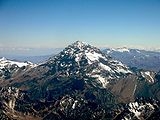
Cerro Aconcagua is the highest mountain in the Americas
Americas

The Americas are the region of the Western hemisphere that consists of the continents of North America and South America with their associated islands and regions....
, and the highest mountain outside Asia
Asia

Asia is the world's largest and most populous continent. It covers 8.6% of the Earth's total surface area and, with over 4 billion people, it contains more than 60% of the world's current human population....
. It is located in the Andes
Andes

The Andes form the world's longest exposed mountain range. They lie as a continuous chain of highland along the western coast of South America. The range is over 7,000 km long, 200-700 km wide , and of an average height of about 4,000 m ....
 mountain range
Mountain range

A mountain range is a chain of mountains bordered by highlands or separated from other mountains by mountain pass or valleys. Individual mountains within the same mountain range do not necessarily have the same geology, though they often do; they may be a mix of different orogeny, for example volcanoes, uplifted mountains or Fold mountains...
, in the Argentine
Argentina

Argentina, officially the Argentine Republic , is a country in South America, constituted as a federation of 23 provinces and an autonomous city....
 province
Provinces of Argentina

Argentina is subdivided into twenty-three provinces and one federal district . The federal district and the provinces have their own constitutions, but exist under a federal system....
 of Mendoza
Mendoza Province

Mendoza is one of the Provinces of Argentina of Argentina, located in the western central part of the country in the Cuyo, Argentina region. Neighboring provinces are from the north clockwise San Juan Province, Argentina, San Luis Province, La Pampa,and Neuqu?n Province....
. The summit is located about 5 kilometres from San Juan Province
San Juan Province (Argentina)

San Juan is a Provinces of Argentina of Argentina, located in the western part of the country. Neighbouring provinces are, moving clockwise from the north, La Rioja Province , San Luis Province and Mendoza Province....
 and 15 kilometres from the international border with Chile
Chile

Chile, officially the Republic of Chile , is a country in South America occupying a long and narrow coastal strip wedged between the Andes mountains and the Pacific Ocean....
. It lies 112 km (70 mi) west by north of the city of Mendoza
Mendoza, Argentina

Mendoza is the capital city of Mendoza Province, in Argentina. It is located in the northern-central part of the province, in a region of foothills and high plains, on the eastern side of the Andes....
. Aconcagua is the highest peak in both the Western
Western Hemisphere

The Western Hemisphere, also Western hemisphere or western hemisphere, is a geography term for the half of the Earth that lies west of the Prime Meridian , the other half being the Eastern Hemisphere....
 and Southern Hemisphere
Southern Hemisphere

The Southern Hemisphere is the half of a planet that is south of the equator?the word sphere literally means 'half ball'. It is also that half of the celestial sphere south of the celestial equator....
s.


Discussion
Ask a question about 'Aconcagua'
Start a new discussion about 'Aconcagua'
Answer questions from other users
Full Discussion Forum


Encyclopedia


Cerro Aconcagua is the highest mountain in the Americas
Americas

The Americas are the region of the Western hemisphere that consists of the continents of North America and South America with their associated islands and regions....
, and the highest mountain outside Asia
Asia

Asia is the world's largest and most populous continent. It covers 8.6% of the Earth's total surface area and, with over 4 billion people, it contains more than 60% of the world's current human population....
. It is located in the Andes
Andes

The Andes form the world's longest exposed mountain range. They lie as a continuous chain of highland along the western coast of South America. The range is over 7,000 km long, 200-700 km wide , and of an average height of about 4,000 m ....
 mountain range
Mountain range

A mountain range is a chain of mountains bordered by highlands or separated from other mountains by mountain pass or valleys. Individual mountains within the same mountain range do not necessarily have the same geology, though they often do; they may be a mix of different orogeny, for example volcanoes, uplifted mountains or Fold mountains...
, in the Argentine
Argentina

Argentina, officially the Argentine Republic , is a country in South America, constituted as a federation of 23 provinces and an autonomous city....
 province
Provinces of Argentina

Argentina is subdivided into twenty-three provinces and one federal district . The federal district and the provinces have their own constitutions, but exist under a federal system....
 of Mendoza
Mendoza Province

Mendoza is one of the Provinces of Argentina of Argentina, located in the western central part of the country in the Cuyo, Argentina region. Neighboring provinces are from the north clockwise San Juan Province, Argentina, San Luis Province, La Pampa,and Neuqu?n Province....
. The summit is located about 5 kilometres from San Juan Province
San Juan Province (Argentina)

San Juan is a Provinces of Argentina of Argentina, located in the western part of the country. Neighbouring provinces are, moving clockwise from the north, La Rioja Province , San Luis Province and Mendoza Province....
 and 15 kilometres from the international border with Chile
Chile

Chile, officially the Republic of Chile , is a country in South America occupying a long and narrow coastal strip wedged between the Andes mountains and the Pacific Ocean....
. It lies 112 km (70 mi) west by north of the city of Mendoza
Mendoza, Argentina

Mendoza is the capital city of Mendoza Province, in Argentina. It is located in the northern-central part of the province, in a region of foothills and high plains, on the eastern side of the Andes....
. Aconcagua is the highest peak in both the Western
Western Hemisphere

The Western Hemisphere, also Western hemisphere or western hemisphere, is a geography term for the half of the Earth that lies west of the Prime Meridian , the other half being the Eastern Hemisphere....
 and Southern Hemisphere
Southern Hemisphere

The Southern Hemisphere is the half of a planet that is south of the equator?the word sphere literally means 'half ball'. It is also that half of the celestial sphere south of the celestial equator....
s. It is one of the Seven Summits
Seven Summits

The Seven Summits are the highest mountains of each of the seven continents. Summiting all of them is regarded as a mountaineering challenge, first postulated as such in the 1980s by Richard Bass ....
.

Aconcagua is bounded by the Valle de las Vacas to the north and east and the Valle de los Horcones Inferior to the West and South. The mountain and its surroundings are part of the Aconcagua Provincial Park
Aconcagua Provincial Park

The Aconcagua Provincial Park is a provincial park located in the Andes Mountains, 180 kilometers west of the city of Mendoza, Argentina. The tallest mountain in the Andes, Aconcagua is located in the park, as well as glaciers, important water resources, and sites of archaeological interest....
. The mountain has a number of glacier
Glacier

A glacier is a large, slow-moving mass of ice, formed from compacted layers of snow, that slowly deforms and flows in response to gravity and high pressure....
s. The largest glacier is the Ventisquero Horcones Inferior at about 10km long which descends from the south face to about 3600m altitude near the Confluencia camp. Two other large glacier systems are the Ventisquero de las Vacas Sur and Glaciar Este/Ventisquero Relinchos system at about 5km long. However the most well-known is the north-eastern or Polish Glacier
Polish Glacier

The Polish Glacier is one of the glaciers of Cerro Aconcagua, the highest peak in the Andes. It was named after the Poland expedition of 1934....
, a common route of ascent.

The mountain was created by the subduction of the Nazca Plate
Nazca Plate

The Nazca Plate, named after the Nazca region of southern Peru, is an oceanic tectonic plate in the eastern Pacific Ocean basin off the west coast of South America....
 beneath the South America
South America

South America is the southern continent of the Americas, situated entirely in the Western Hemisphere and mostly in the Southern Hemisphere, with a relatively small portion in the Northern Hemisphere....
n plate during the geologically recent Andean orogeny
Orogeny

Orogeny refers to natural mountain building, and may be studied as a tectonic structural event, as a geographical event, and a chronological event: orogenic events cause distinctive structural phenomena and related tectonic activity, affect certain regions of rocks and crust, and happen within a specific period of time....
; however, it is not a volcano. The origin of the name is contested, it is either from the Arauca
Mapuche

The Mapuche are the Indigenous peoples of the Americas inhabitants of Central and Southern Chile and Southern Argentina. They were known as Araucanians by the Spaniards....
 Aconca-Hue, which refers to the Aconcagua River
Aconcagua River

The Aconcagua River is a river in Chile that rises from the joint of two minor tributary rivers at above sea level in the Andes, Juncal river from the east and Blanco river from the south east....
 and means 'comes from the other side', the Quechua
Quechua

Quechua is a Native American language of South America. It was already widely spoken across the Central Andes long before the time of the Inca Empire, who established it as the official language of administration for their Empire, and is still spoken today in various regional forms by some 10 million people through much of South America, in...
 Ackon Cahuak, meaning 'Sentinel of Stone', or Quechua Anco Cahuac, 'White Sentinel'.

Climbing

In mountaineering
Mountaineering

Mountaineering is the sport, hobby or profession of walking, hiking, trekking and climbing up mountains. It is also sometimes known as alpinism, particularly in Europe....
 terms, Aconcagua is technically an easy mountain if approached from the north, via the normal route. Although the effects of altitude are severe (atmospheric pressure is 40% of sea-level at the summit), the use of supplemental oxygen is not required. Altitude sickness
Altitude sickness

Altitude sickness, also known as acute mountain sickness , altitude illness, or soroche, is a pathological condition that is caused by acute exposure to low air pressure ....
 will affect most climbers to some extent, depending on the degree of acclimatization
Acclimatization

Acclimatization is the process of an organism adjusting to chronic change in its Ecosystem, often involving temperature, moisture, food, often relating to seasonal climate changes....
.

The second most frequented route is the Polish Glacier Traverse route, also known as the "Falso de los Polacos" route. This approaches the mountain through the Vacas valley, ascends to the base of the Polish Glacier
Polish Glacier

The Polish Glacier is one of the glaciers of Cerro Aconcagua, the highest peak in the Andes. It was named after the Poland expedition of 1934....
, then traverses across to the normal route for the final ascent to the summit. The third most popular route is the Polish Glacier
Polish Glacier

The Polish Glacier is one of the glaciers of Cerro Aconcagua, the highest peak in the Andes. It was named after the Poland expedition of 1934....
 itself.

The routes to the peak from the south and south-west ridges are more demanding and the south face climb is considered very difficult.

Before attempting the mountain climbers need to purchase a permit from the Aconcagua Provincial Park authority in Mendoza
Mendoza, Argentina

Mendoza is the capital city of Mendoza Province, in Argentina. It is located in the northern-central part of the province, in a region of foothills and high plains, on the eastern side of the Andes....
. Prices vary depending on the season.

The camp sites on the normal route are listed below (altitudes are approximate).
Aconcagua Route 1a
* Puente del Inca
Puente del Inca

Puente del Inca, Spanish language for "the Inca's Bridge", is a natural arch that forms a bridge over the Vacas River, a tributary of the Mendoza River....
, 2,740m (8,990ft): A small village on the main road, with facilities including a lodge.
  • Confluencia, 3,380m (11,090ft): A camp site a few hours into the national park.
  • Plaza de Mulas, 4,370m (14,340ft): Base camp, claimed to be the second largest in the world (after Everest
    Mount Everest

    Mount Everest, also called Sagarmatha or Chomolungma, Qomolangma or Zhumulangma is the List of highest mountains on Earth, as measured by the height of its Topographical summit above sea level, which is ....
    ). There are several meal tents, showers and internet access. There is a lodge approx. 1 km from the main campsite across the glacier.
  • Camp Canadá, : A large ledge overlooking Plaza de Mulas.
  • Camp Alaska, : Called 'change of slope' in Spanish, a small site as the slope from Plaza de Mulas to Nido de Cóndores lessens. Not commonly used.
  • Nido de Cóndores, : A large plateau with beautiful views. There is usually a park ranger camped here.
  • Camp Berlín, : The classic high camp, offering reasonable wind protection.
  • Camp Colera, : A larger while slightly more exposed camp situated directly at the north ridge near Camp Berlín, with growing popularity.
  • Several sites possible for camping or bivouac
    Bivouac

    Bivouac may refer to:* Bivouac shelter, an encampment* Bivouac sack, or "bivy sack" or bivy bag, an extremely lightweight alternative to traditional tent systems...
    , including Piedras Blancas (~6100m) and Independencia (~6350m), exist above Colera, however seldom used and offering little protection.


Summit attempts are usually made from a high camp at either Berlín or Colera, or from the lower camp at Nido de Cóndores. Practical hints and descriptions about different routes to the summit can be found on the Aconcagua mountaineering map, published 2006 by climbing map.

History

The first attempt on Aconcagua by a European was made in 1883 by a party led by the German geologist and explorer Paul Güssfeldt
Paul Güssfeldt

Dr Paul G?ssfeldt was a Germany geologist, mountaineer and explorer....
. Bribing porters with the story that there was treasure on the mountain, he approached the mountain via the Rio Volcan, making two attempts on the peak by the north-west ridge and reaching an altitude of . The route that he prospected is now the normal route up the mountain.

The first recorded ascent was in 1897 on a British expedition led by Edward Fitzgerald. The summit was reached by the Swiss guide Matthias Zurbriggen
Matthias Zurbriggen

Matthias Zurbriggen was one of the great nineteenth century Alpinists and mountain guides. He climbed throughout the Alps, and also in South America, the Himalayas and New Zealand....
 on January 14 and by two other expedition members a few days later.

The youngest person to reach the summit of Aconcagua was Matthew Moniz of Boulder, Colorado. He was 10 years old when he reached the summit on December 16, 2008.

Popular culture

The mountain has a cameo in a 1942 Disney cartoon called Pedro. The cartoon stars an anthropomorphic small airplane named Pedro who is compelled to make an air mail run over the Andes and has a near-disastrous encounter with Aconcagua. The mountain (also anthropomorphic, and scary-looking), later appeared in an illustration used in a retelling of the story in a Disney anthology book.


Gallery


See also

  • Mendoza Province
    Mendoza Province

    Mendoza is one of the Provinces of Argentina of Argentina, located in the western central part of the country in the Cuyo, Argentina region. Neighboring provinces are from the north clockwise San Juan Province, Argentina, San Luis Province, La Pampa,and Neuqu?n Province....
  • Las Heras, Mendoza
    Las Heras, Mendoza

    Las Heras is a city in the provinces of Argentina of Mendoza Province, Argentina, located in the north of the metropolitan area of the provincial capital ....
  • Polish Glacier
    Polish Glacier

    The Polish Glacier is one of the glaciers of Cerro Aconcagua, the highest peak in the Andes. It was named after the Poland expedition of 1934....


External links