
All Topics  
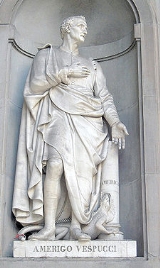
Amerigo Vespucci

 
Amerigo Vespucci

   Email Print
   Bookmark   Link


Amerigo Vespucci


Amerigo Vespucci
Amerigo Vespucci

Amerigo Vespucci was an Italian explorer and cartographer. The continents of The Americas are popularly understood to derive their name from the Grammatical gender Latin version of his given name ....
 (March 9, 1454 – February 22, 1512) was an Italian explorer and cartographer. The continents of America are popularly understood to derive their name from the feminized
Grammatical gender

In linguistics, grammatical genders, sometimes also called noun classes, are classes of nouns reflected in the behavior of associated words; every noun must belong to one of the classes and there should be very few which belong to several classes at once....
 Latin
Latin

Latin is an Italic language, historically spoken in Latium and Ancient Rome. Through the Military history of the Roman Empire, Latin spread throughout the Mediterranean and a large part of Europe....
 version of his first name
Given name

A given name is a personal name that specifies and differentiates between members of a group of individuals, especially in a family, all of whose members usually share the same family name ....
 (see Naming of America
Americas

The Americas are the region of the Western hemisphere that consists of the continents of North America and South America with their associated islands and regions....
).

Vespucci played a senior role in two which explored the east coast of South America
South America

South America is the southern continent of the Americas, situated entirely in the Western Hemisphere and mostly in the Southern Hemisphere, with a relatively small portion in the Northern Hemisphere....
 between 1499 to 1502.


Discussion
Ask a question about 'Amerigo Vespucci'
Start a new discussion about 'Amerigo Vespucci'
Answer questions from other users
Full Discussion Forum


Recent Posts


Encyclopedia


Amerigo Vespucci
Amerigo Vespucci

Amerigo Vespucci was an Italian explorer and cartographer. The continents of The Americas are popularly understood to derive their name from the Grammatical gender Latin version of his given name ....
 (March 9, 1454 – February 22, 1512) was an Italian explorer and cartographer. The continents of America are popularly understood to derive their name from the feminized
Grammatical gender

In linguistics, grammatical genders, sometimes also called noun classes, are classes of nouns reflected in the behavior of associated words; every noun must belong to one of the classes and there should be very few which belong to several classes at once....
 Latin
Latin

Latin is an Italic language, historically spoken in Latium and Ancient Rome. Through the Military history of the Roman Empire, Latin spread throughout the Mediterranean and a large part of Europe....
 version of his first name
Given name

A given name is a personal name that specifies and differentiates between members of a group of individuals, especially in a family, all of whose members usually share the same family name ....
 (see Naming of America
Americas

The Americas are the region of the Western hemisphere that consists of the continents of North America and South America with their associated islands and regions....
).

Vespucci played a senior role in two which explored the east coast of South America
South America

South America is the southern continent of the Americas, situated entirely in the Western Hemisphere and mostly in the Southern Hemisphere, with a relatively small portion in the Northern Hemisphere....
 between 1499 to 1502. On the first of these voyages he discovered that South America extended much further (the Indies
Indies

The Indies or East Indies is a term used, in a wider sense, to describe the lands of South Asia and Southeast Asia, occupying all of the present Indian Union, Pakistan, Bangladesh, Myanmar, Sri Lanka, the Maldives, and also Thailand, Cambodia, Laos, Brunei, Singapore, the Philippines, East Timor, Malaysia and Indonesia....
). Vespucci's voyages became widely known in Europe after two accounts attributed to him were published between 1502 and 1504. In 1507, Martin Waldseemüller
Martin Waldseemüller

Martin Waldseem?ller was a Germany cartography. He and Matthias Ringmann are credited with the first recorded usage of the word Americas, on the 1507 map Universalis Cosmographia in honor of the Florentine explorer Amerigo Vespucci....
 produced a world map on which he named the new continent America
Americas

The Americas are the region of the Western hemisphere that consists of the continents of North America and South America with their associated islands and regions....
 after Vespucci's first name, Amerigo. In an accompanying book, Waldseemüller published one of the Vespucci accounts, which led to criticism that Vespucci was trying to usurp Christopher Columbus
Christopher Columbus

Christopher Columbus was a Republic of Genoa navigator, colonialist and explorer whose voyages across the Atlantic Ocean?funded by Queen Isabella of Spain?led to general European awareness of the America in the Western Hemisphere....
' glory . However, the rediscovery in the 18th century of other letters by Vespucci, primarily the Soderini Letter, has led to the view that the early published accounts were fabrications, not by Vespucci, but by others.

Biography


Amerigo Vespucci worked for Lorenzo de' Medici
Lorenzo de' Medici

Lorenzo de' Medici was an Italy statesman and de facto ruler of the Florentine Republic during the Italian Renaissance. Known as Lorenzo the Magnificent by contemporary Florentines, he was a diplomat, politician and patron of scholars, artists, and poets....
 and his brother, Giovanni. In 1492 they sent him to work at their agency in Seville
Seville

||-||}Seville is the artistic, cultural, and financial capital of southern Spain. It is the capital of Andalusia and of the province of Seville ....
, Spain
Spain

Spain or the Kingdom of Spain , is a country located in Southern Europe on the Iberian Peninsula.The Spanish constitution does not establish any official denomination of the country, even though Espa?a , Estado espa?ol and Naci?n espa?ola are used interchangeably....
. In 1508, after only two voyages to the Americas, the position of chief of navigation of Spain (piloto mayor de Indias) was created for Vespucci, with the responsibility of planning navigation for ocean voyages. He died of malaria
Malaria

Malaria is a Vector -borne infectious disease caused by protozoan parasites. It is widespread in Tropics and subtropical regions, including parts of the Americas, Asia, and Africa....
 on February 22, 1512 in Seville, Spain.

Two letters attributed to Vespucci were published during his lifetime. Mundus Novus (New World) was a Latin translation of a lost Italian letter sent from Lisbon
Lisbon

Lisbon is the Capital and largest city of Portugal. It is also the seat of the Lisbon and capital of the Lisbon region. Its municipalities of Portugal, which matches the city proper excluding the larger continuous conurbation, has a municipal population of 564,477 in , while the Lisbon Metropolitan Area in total has around 2.8 million inha...
 to Lorenzo di Pierfrancesco de' Medici. It describes a voyage to South America in 1501-1502. Mundus Novus was published in late 1502 or early 1503 and soon reprinted and distributed in numerous European countries. Lettera di Amerigo Vespucci delle isole nuovamente trovate in quattro suoi viaggi (Letter of Amerigo Vespucci concerning the isles newly discovered on his four voyages), known as Lettera al Soderini or just Lettera, was a letter in Italian addressed to Piero Soderini
Piero Soderini

Piero di Tommaso Soderini, also known as Pier Soderini, , was an Italy statesman of the Republic of Florence....
. Printed in 1504 or 1505, it claimed to be an account of four voyages to the Americas made by Vespucci between 1497 and 1504. A Latin translation was published by the German Martin Waldseemüller
Martin Waldseemüller

Martin Waldseem?ller was a Germany cartography. He and Matthias Ringmann are credited with the first recorded usage of the word Americas, on the 1507 map Universalis Cosmographia in honor of the Florentine explorer Amerigo Vespucci....
 in 1507 in Cosmographiae Introductio
Cosmographiae Introductio

Cosmographiae Introductio was a book published in 1507 to accompany Martin Waldseem?ller's map of the world and wall-map fwhunjgtjh bi htutihgiooasgbgf gyfuhw7jhjurutyjakutjijtjm jrojtjoj[Y9T6YKK9T99Y9otlo,hkonh,k, k759j,k,jjk....
, a book on cosmography
Cosmography

Cosmography is the science that maps the general features of the universe; describes both heaven and Earth .The 14th century book 'Aja'ib al-makhluqat wa-ghara'ib al-mawjudat by Persian people physician Zakariya al-Qazwini is considered to be an early work of cosmography....
 and geography
Geography

Geography is the study of the Earth and its lands, features, inhabitants, and phenomena. A literal translation would be "to describe or write about the Earth"....
, as Quattuor Americi Vespuccij navigationes (Four Voyages of Amerigo Vespucci). In 1508, King Ferdinand made Vespucci chief navigator of Spain at a huge salary and commissioned him to start a school for navigators out of his home to standardize and modernize navigation techniques used by Spanish sea captains exploring the world. Future luminaries such as Magellan learned at his knee, and Vespucci even developed a rudimentary, but fairly accurate method of determining longitude (which only more accurate chronometers would later improve upon).

In the 18th century three unpublished familiar letters from Vespucci to Lorenzo de' Medici were rediscovered. One describes a voyage made in 1499-1500 which corresponds with the second of the "four voyages". Another was written from Cape Verde
Cap-Vert

Cap-Vert is a peninsula in Senegal, and the westernmost part of the continent of Africa. Originally called Cabo Verde or "Cape Green" by Portuguese explorers, it is not to be confused with the Cape Verde islands, which are some further west....
 in 1501 in the early part of the third of the four voyages, before crossing the Atlantic. The third letter was sent from Lisbon after the completion of that voyage.`

Some have suggested that Vespucci, in the two letters published in his lifetime, was exaggerating his role and constructed deliberate fabrications. However, many scholars now believe that the two letters were not written by him but were fabrications by others based in part on genuine letters by Vespucci. It was the publication and widespread circulation of the letters that might have led Martin Waldseemüller
Martin Waldseemüller

Martin Waldseem?ller was a Germany cartography. He and Matthias Ringmann are credited with the first recorded usage of the word Americas, on the 1507 map Universalis Cosmographia in honor of the Florentine explorer Amerigo Vespucci....
 to name the new continent America
Americas

The Americas are the region of the Western hemisphere that consists of the continents of North America and South America with their associated islands and regions....
 on his world map of 1507 in Lorraine
Lorraine (province)

Lorraine is a historical area in present-day northeast France. Some of the main cities are Metz, France, Nancy and Verdun....
. Vespucci used a Latinised
Latinisation

Latinization could refer to:* Latinization , a literary practice of writing a name in a Latin style when writing in Latin** List of Latinized names...
 form of his name, Americus Vespucius, in his Latin
Latin

Latin is an Italic language, historically spoken in Latium and Ancient Rome. Through the Military history of the Roman Empire, Latin spread throughout the Mediterranean and a large part of Europe....
 writings, which Waldseemüller may have used as a base for the new name, taking the feminine form America.(See also Naming of America
Americas

The Americas are the region of the Western hemisphere that consists of the continents of North America and South America with their associated islands and regions....
.) Amerigo itself is an Italian
Italian language

Italian is a Romance languages spoken by about 63 million people as a first language, primarily in Italy. In Switzerland, Italian is one of four Linguistic geography of Switzerlands....
 form of the medieval Latin Emericus (see also Saint Emeric of Hungary), which through the German
German language

German is a West Germanic languages, thus related to and classified alongside English language and Dutch language. It is one of the world's world language and the most widely spoken mother tongue in the European Union....
 form Heinrich
Heinrich

Heinrich is a male given name or surname of Germanic origin. Equivalents in other languages are Henry , Hendrik , Hinnerk , Enrico , Henri , Enrique , and Henrique ....
 (in English
English language

English is a West Germanic language that originated in Anglo-Saxon England and has lingua franca status in many parts of the world as a result of the military, economic, scientific, political and cultural influence of the British Empire in the 18th, 19th and early 20th centuries and that of the United States from the mid 20th century onwa...
, Henry
Henry

Henry is an English language male given name and a surname, borrowed from Old French, ultimately of Germanic origin from the elements haim and ric ....
) derived from the Germanic
Germanic languages

The Germanic languages are a group of related languages that constitute a branch of the Indo-European languages language family. The common ancestor of all the languages in this branch is Proto-Germanic, spoken in approximately the mid-1st millennium BC in Pre-Roman Iron Age....
 name Haimirich
Haimirich

Haimirich is an old Middle High German given name from which many modern names derive. Among them are names like Henry, Henri, Heinrich, Enrico, Enrique and their female counterparts....
. But it might be Waldseemüller named the continent after Richard Ameryk, who was the principal owner of John Cabot
John Cabot

Giovanni Caboto , known in English as John Cabot, was an Italy navigator and exploration commonly credited as the first European to discover North America, in 1497, notwithstanding Norsemen Leif Ericson's landing ....
's ship Matthew during his voyage of exploration to North America
North America

North America is the northern continent of the Americas, situated in the Earth's northern hemisphere and almost totally in the western hemisphere....
 in 1497.

The two disputed letters claim that Vespucci made four voyages to America, while at most two can be verified from other sources. At the moment there is a dispute between historians on when Vespucci visited mainland the first time. Some great historians like German Arciniegas and Gabriel Camargo Perez think that his first voyage was done in June 1497 with the Spanish Juan de la Cosa. Little is known of his last voyage in 1503–1504 or even whether it actually took place. Vespucci's real historical importance may well be more in his letters, whether he wrote them all or not, than in his discoveries. From these letters, the European public learned about the newly discovered continent of the Americas for the first time; its existence became generally known throughout Europe within a few years of the letters' publication.

Voyages

According to historians such as Martín Fernández de Navarrete
Martín Fernández de Navarrete

Mart?n Fern?ndez de Navarrete , was a Spain sailor and historian who rediscovered Bartolom? de las Casas' abstract of the log Christopher Columbus made on his first voyage....
, Germán Arciniegas
Germán Arciniegas

Germ?n Arciniegas was a Colombian essayist and historian. Arciniegas wrote over 50 books and many columns in the Colombian newspaper El Tiempo and also taught at Columbia University in New York....
 and Gabriel Camargo Pérez, the first voyage of Amerigo Vespucci took place in 1497, probably in a trip organized by King Ferdinand, who wanted to clarify if the mainland of the landmass was far away from the island of Hispaniola
Hispaniola

Hispaniola is the second-largest and most populous island of the Antilles, lying between the islands of Cuba to the west, and Puerto Rico to the east....
, which had been discovered by Columbus.

The captain of this company, which set sail in May 1497 was Vicente Yañez Pinzón
Vicente Yáñez Pinzón

Vicente Y??ez Pinz?n was a Spain navigator, exploration, and conquistador. Along with his older brother Mart?n Alonso Pinz?n, he sailed with Christopher Columbus on the first voyage to the New World in 1492, as captain of Ni?a....
, captain of the Niña
NiNa

are a six-piece group formed in 1999 containing Kate Pierson , bassist Mick Karn , vocalist Yuki Isoya , Takemi Shima and Masahide Sakuma, Japanese musicians from the Plastics, and Steven Wolf, the session drummer....
 on Columbus's first voyage, and may have included Juan Diaz de Solis
Juan Díaz de Solís

Juan D?az de Sol?s, , was a Spain navigator and explorer.D?az de Sol?s was probably born in Lebrija, Seville , although some other authors argue that his birth may have actually taken place in Portugal to an Andalusian emigree family....
. Accompanying Vespucci was pilot and cartographer Juan de la Cosa
Juan de la Cosa

Juan de la Cosa was a Spain cartography, conquistador and exploration. He made the earliest extant European world map to incorporate the territories of the Americas that were discovered in the 15th century, sailed first 3 voyages with Christopher Columbus, and was the owner/captain of the Santa Mar?a ....
 (the then-famous captain who had sailed with Columbus
Christopher Columbus

Christopher Columbus was a Republic of Genoa navigator, colonialist and explorer whose voyages across the Atlantic Ocean?funded by Queen Isabella of Spain?led to general European awareness of the America in the Western Hemisphere....
 in 1492). According to the first letter of Vespucci, they reached land at 16 degrees latitude, probably on the coast of La Guajira peninsula in present-day Colombia
Colombia

Colombia , officially the Republic of Colombia , is a country in north-western South America. Colombia is bordered to the east by Venezuela and Brazil; to the south by Ecuador and Peru; to the north by the Caribbean Sea; to the north west by Panama; and to the west by the Pacific Ocean....
 or the coast of Nicaragua. They then followed the coastal land mass of central America before returning to the Atlantic Ocean
Atlantic Ocean

The Atlantic Ocean is the second-largest of the world's oceanic divisions; with a total area of about 106.4 million square kilometres . It covers approximately one-fifth of the Earth's surface....
 via the Straits of Florida
Straits of Florida

The Straits of Florida, Florida Straits, or Florida Strait is a strait located south-southeast of the North American mainland, generally accepted to be between the Gulf of Mexico and the Atlantic Ocean, and between the Florida Keys and Cuba....
 between Florida
Florida

Florida is a U.S. state located in the Southeastern United States of the United States, bordering Alabama to the northwest and Georgia to the northeast....
 and Cuba
Cuba

The Republic of Cuba is a country in the Caribbean. It consists of the island of Cuba , the island of Isla de la Juventud, and several adjacent small islands....
.

In his letters, Vespucci described this trip, and once Juan de la Cosa returned to Spain, a famous world map, depicting Cuba as an island, was produced. About 1499–1500, Vespucci joined an expedition in the service of Spain, with Alonso de Ojeda
Alonso de Ojeda

Alonso de Ojeda was a Spanish people explorer born of noble parentage in Cuenca. His name is sometimes spelled Alonzo and Oxeda.He came from an impoverished noble family, but had the good fortune to start his career in the household of the Duke of Medinaceli....
 (or Hojeda) as the fleet commander. The intention was to sail around the southern end of the African mainland into the Indian Ocean
Indian Ocean

The Indian Ocean is the third largest of the world's oceanic divisions, covering about 20% of the water on the Earth's surface. It is bounded on the north by Asia ; on the west by Africa; on the east by Indochina, the Sunda Islands, and Australia; and on the south by the Southern Ocean ....
. After hitting land at the coast of what is now Guyana
Guyana

Guyana , officially the Co-operative Republic of Guyana and previously known as British Guiana, is the only state of the Commonwealth of Nations on mainland South America....
, the two seem to have separated. Vespucci sailed southward, discovering the mouth of the Amazon River
Amazon River

The Amazon River of South America is the list of rivers by length in the world by volume, with a total river flow greater than the next top eight largest rivers combined....
 and reaching 6°S, before turning around and seeing Trinidad
Trinidad

Trinidad is the larger and more populous of the two major islands and islands of Trinidad and Tobago which make up the country of Trinidad and Tobago....
 and the Orinoco River and returning to Spain by way of Hispaniola
Hispaniola

Hispaniola is the second-largest and most populous island of the Antilles, lying between the islands of Cuba to the west, and Puerto Rico to the east....
. The letter, to Lorenzo di Pierfrancesco de' Medici, claims that Vespucci determined his longitude celestially

on August 23, 1499, while on this voyage. However, that claim may be fraudulent, which could cast doubt on the letter's credibility.

The last certain voyage of Vespucci was led by Gonçalo Coelho
Gonçalo Coelho

Gon?alo Coelho , Portugal explorer of the South Atlantic and of the South American coast ....
 in 1501–1502 in the service of Portugal
Portugal

Portugal , officially the Portuguese Republic , is a country on the Iberian Peninsula. Located in southwestern Europe, Portugal is the westernmost country of mainland Europe and is bordered by the Atlantic Ocean to the west and south and by Spain to the north and east....
. Departing from Lisbon
Lisbon

Lisbon is the Capital and largest city of Portugal. It is also the seat of the Lisbon and capital of the Lisbon region. Its municipalities of Portugal, which matches the city proper excluding the larger continuous conurbation, has a municipal population of 564,477 in , while the Lisbon Metropolitan Area in total has around 2.8 million inha...
, the fleet sailed first to Cape Verde
Cap-Vert

Cap-Vert is a peninsula in Senegal, and the westernmost part of the continent of Africa. Originally called Cabo Verde or "Cape Green" by Portuguese explorers, it is not to be confused with the Cape Verde islands, which are some further west....
 where they met two of Pedro Álvares Cabral
Pedro Álvares Cabral

Pedro ?lvares Cabral was a Portugal navigator and List of explorers. Cabral is generally regarded as the European discoverer of Brazil .Cabral is thought to have been born in Belmonte , in the Beira Baixa province of Portugal....
's ships returning from India
India

India, officially the Republic of India , is a country in South Asia. It is the List of countries and outlying territories by total area country by geographical area, the List of countries by population country, and the most populous liberal democracy in the world....
. In a letter from Cape Verde, Vespucci says that he hopes to visit the same lands that Álvares Cabral had explored, suggesting that the intention is to sail west to Asia, as on the 1499-1500 voyage. On reaching the coast of Brazil
Brazil

Brazil , officially the Federative Republic of Brazil , is a country in South America. It is the List of countries and outlying territories by total area country by geographical area, occupying nearly half of South America, the List of countries by population country, and the fourth most populous democracy in the world....
, they sailed south along the coast of South America
South America

South America is the southern continent of the Americas, situated entirely in the Western Hemisphere and mostly in the Southern Hemisphere, with a relatively small portion in the Northern Hemisphere....
 to Rio de Janeiro
Rio de Janeiro

Rio de Janeiro , is the second largest city of Brazil and South America, behind S?o Paulo, and the third largest metropolitan area in South America, behind S?o Paulo and Buenos Aires....
's bay. If his own account is to be believed, he reached the latitude of Patagonia
Patagonia

Patagonia is a geographic region containing the southernmost portion of South America. Located in Argentina and Chile, it comprises the Andes mountains to the west and south, and plateaux and low plains to the east....
 before turning back, although this also seems doubtful, since his account does not mention the broad estuary of the Río de la Plata
Río de la Plata

The R?o de la Plata —often rendered in English language as the River Plate or the [La] Plata River—is the estuary formed by the combination of the Uruguay River and the Paran? River....
, which he must have seen if he had gotten that far south. Portuguese maps of South America, created after the voyage of Coelho and Vespucci, do not show any land south of present-day Cananéia
Cananéia

Canan?ia is the southernmost city in the state of S?o Paulo , Brazil, near to where the Tordesilhas Line passed. The population in 2008 was 12,377 and the area is 1,242.010 km?....
 at 25° S, so this may represent the southernmost extent of their voyages.

After the first half of the expedition, Vespucci mapped Alpha
Alpha Centauri

Alpha Centauri ; is the brightest star in the southern constellation of Centaurus and an established binary star system, Alpha Centauri AB ....
 and Beta Centauri
Beta Centauri

Beta Centauri , also known as Hadar or Agena, is the second brightest star in the constellation Centaurus and the list of brightest stars in the night sky....
, as well as the constellation
Constellation

A constellation is a group of stars that appear to have a physical proximity in the sky. The stars in a constellation are often vastly distant from each other, but they appear close to each other from the perspective of Earth....
 Crux
Crux

Crux is the List of constellations by area of the 88 modern constellations, but is one of the most distinctive. Its name is Latin for cross, and it is dominated by a cross-shaped Asterism and is commonly known as the Southern Cross because it is today visible only from the southern hemisphere, although it was visible near the horizon...
, the Southern Cross. Although these star
Star

A star is a massive, luminous ball of Plasma that is held together by its own gravity. The nearest star to Earth is the Sun, which is the source of most of the energy on Earth....
s had been known to the ancient Greeks
Greece

Greece , officially the Hellenic Republic , is a country in southeastern Europe, situated on the southern end of the Balkans. It has borders with Albania, Bulgaria and the former Yugoslav Republic of Macedonia to the north, and Turkey to the east....
, gradual precession had lowered them below the Europe
Europe

Europe is, conventionally, one of the world's seven continents. Comprising the westernmost peninsula of Eurasia, Europe is generally divided from Asia to its east by the water divide of the Ural Mountains, the Ural , the Caspian Sea, and by the Caucasus Mountains to the southeast....
an skyline so that they were forgotten.

On his return to Lisbon, Vespucci wrote in a letter to de' Medici that the land masses they explored were much larger than anticipated and different from the Asia described by earlier Europeans and, therefore, must be a New World, that is, a previously unknown fourth continent, after Europe, Asia
Asia

Asia is the world's largest and most populous continent. It covers 8.6% of the Earth's total surface area and, with over 4 billion people, it contains more than 60% of the world's current human population....
, and Africa
Africa

Africa is the world's second-largest and second most-populous continent, after Asia. At about 30.2 million km? including adjacent islands, it covers 6% of the Earth's total surface area and 20.4% of the total land area....
.

See also

  • Naming of America
    Americas

    The Americas are the region of the Western hemisphere that consists of the continents of North America and South America with their associated islands and regions....


External links

  • Canaday, James A. .
  • Vespucci, Amerigo. .
  • Mason, Wyatt, New York Times, December 12, 2007.