
Encyclopedia
style="font-size: larger;" | New England
|
|
| |
| Political history |
|---|
| Chartering as Plymouth Council for New England | 1620 |
| Formation as United Colonies of New England | 1643 |
| Formation as Dominion of New England | 1686 |
Admission to U.S. - Connecticut - Maine
- Massachusetts - New Hampshire - Rhode Island - Vermont | - January 9, 1788 - separated from Mass. March 15, 1820 - February 6, 1788 - June 21, 1788 - May 29, 1790 - March 4, 1791 |
| Regional statistics |
|---|
| Largest city | Boston |
| U.S. States | Connecticut, Maine, Massachusetts, New Hampshire, Rhode Island, and Vermont |
Area - Total | 69,746 mi² |
Population - Total - Density | 14,239,724 76.7 people/km² |
|
- This article is about the region in the United States of America. For other uses of this name, see New England .
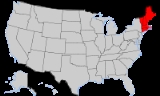
New England is a region of the
United States located in the northeastern corner of the country. It comprises the states of
Connecticut,
Maine,
Massachusetts,
New Hampshire,
Rhode Island, and
Vermont. The region's most populous city, as well as its business and cultural center, is
Boston.
The region was inhabited by
indigenous peoples when
English Pilgrims, fleeing
religious persecution in
Europe, arrived nearly four hundred years ago, at the beginning of the 17th century. In the 18th century, New England was one of the first
North American British colonies to demonstrate ambitions of
independence from the
British Crown, although it would later oppose the
War of 1812 between the United States and
Great Britain. In the 19th century, it played a prominent role in the movement to
abolish slavery in the United States, became a source of some of the first examples of
American literature and
philosophy, and showed the first signs of the effects of the
Industrial Revolution in North America.
A person from New England is referred to as a
New Englander or a
Yankee has a variety of meanings....
. Together, the
Mid-Atlantic and New England regions are referred to as the
Northeastern region of the United States. New England is also a part of the greater U.S.-
Canada Atlantic Northeast region.
History
New England has long been inhabited by
Algonquian-speaking
native peoples, including the
Abenaki, the
Penobscot, the Wampanoag, and others. Before the arrival of Europeans in the region, the Western Abenakis mostly inhabited New Hampshire and Vermont, but also inhabited parts of Québec and western Maine. Their principal town was Norridgewock, in present-day Maine. The Penobscot were settled along the
Penobscot River in Maine. The Wampanoag occupied southeastern Massachusetts, Rhode Island, and the islands of
Martha's Vineyard and
Nantucket.
On April 10, 1606,
James I of England chartered the Virginia Companies of London and Plymouth. The latter included land extending as far as present-day northern Maine. The purpose of each was to claim land for England, trade, and make a profit.
Captain John Smith, exploring the shores of the region in 1614, named the region "New England" in his account of two voyages there, published as . This name was officially sanctioned on November 3, 1620, when the charter of the Virginia Company of Plymouth was replaced by a royal charter for the
Plymouth Council for New England, a joint stock company established to colonize and govern the region. Shortly afterwards, in December 1620, a permanent settlement was established at present-day
Plymouth, Massachusetts by the
Pilgrims, English religious separatists arriving via
Holland. The Massachusetts Bay Colony, which would come to dominate the area, was established at Boston in 1628. Banished from Massachusetts, Roger Williams led a group south, and founded
Providence, Rhode Island in 1636. On March 3 of the same year, the Connecticut Colony was granted a charter, and established its own government. At this time, Vermont was yet unsettled, and the territories of
New Hampshire and
Maine were governed by
Massachusetts.
In these early years, relationships between colonists and Native Americans alternated between peace and armed skirmishes. Six years after the bloodiest of these, the Pequot War, in 1643 the colonies of Massachusetts Bay,
Plymouth, New Haven, and
Connecticut joined together in a loose compact called the
New England Confederation . The confederation was designed largely to coordinate mutual defense against possible wars with
Native Americans, the
Dutch in the
New Netherland colony to the west, the
Spanish in the south, and the
French in
New France to the north, as well as to assist in the return of runaway
slaves. The confederation lost its influence when Massachusetts refused to commit itself to a war against the
Dutch.
The first coins struck in the Colonies, prompted by a shortage of change, were the New England coins produced by the Massachusetts Bay Colony. The first series was a simple design including "NE" on the obverse and the various denominations on the reverse. Other series included the "Willow," "Oak," and "Pine Tree." The "Pine Tree" coinage was the last type in the series, struck by coiner John Hull. Although the majority were dated 1652, it is generally acknowledged that production spanned about thirty years, despite the disapproval of
King Charles II. In 1686,
King James II, concerned about the increasingly independent ways of the colonies, including their self-governing charters, open flouting of the Navigation Acts, and increasing military power, established the Dominion of New England, an administrative union comprising all of the New England colonies. Two years later, the provinces of New York and the
New Jersey, seized from the Dutch, were added. The union, imposed from the outside and contrary to the rooted democratic tradition of the region, was highly unpopular among the colonists.
After the
Glorious Revolution in 1689, the charters of most of the colonies were significantly modified, with the appointment of Royal Governors to nearly every colony. An uneasy tension existed between the Royal Governors, their officers, and the elected governing bodies of the colonies. The governors wanted unlimited authority, and the different layers of locally-elected officials would often resist them. In most cases, the local town governments continued operating as self-governing bodies, just as they had before the appointment of the Royal Governors. This tension culminated itself in the
American Revolution, boiling over with the breakout of the
American War of Independence in 1776. The colonies were now formally united as newly-formed states in a larger union called the
United States of America.
In the 18th century and the early 19th century, New England was still considered to be a very distinct region of the country, as it is today. During the
War of 1812, there was a limited amount of talk of secession from the Union, as New England merchants, just getting back on their feet, opposed the war with their greatest trading partner--
Great Britain.
Aside from the Canadian province of
Nova Scotia, or "New
Scotland," New England is the only
North American region to inherit the name of a kingdom in the
British Isles. New England has largely preserved its regional character, especially in its historic places. Its name is a reminder of the past, as many of the original English-Americans have migrated further west. Today, the region is more ethnically diverse, having seen waves of immigration from
Ireland,
Québec,
Italy,
Asia,
Latin America,
Africa, other parts of the United States, and elsewhere. The enduring European influence can be seen in the region, from Massachusetts' use of traffic
rotaries to the bilingual French and English towns of northern Vermont and New Hampshire, as innocuous as the sprinkled use of British spelling, and as obvious as the region's unique dialect.
Geography and climate
New England's geography is the result of retreating ice sheets that shaped the landscape thousands of years ago, leaving behind rolling hills, mountains, and a jagged coastline. The seacoast of the region, extending from southwestern Connecticut to northeastern Maine, is dotted with lakes, hills, swamps, and sandy beaches, especially in Cape Cod. Farther from the coast are higher elevations, including mountain ranges and rocky hills, which extend through Connecticut, Massachusetts, Vermont, New Hampshire, and Maine. These are a part of the
Appalachian Mountains. Mount Washington, at 1,917 m , in New Hampshire's White Mountains, is the highest peak in New England. It is also the site of the highest recorded wind speed on Earth. Vermont's Green Mountains, which become the
Berkshire Hills in western Massachusetts, are smaller than the White Mountains. Valleys in the region include the Connecticut River Valley and the Merrimack Valley.
The region has many rivers and streams. The longest is the
Connecticut River, which flows from northeastern New Hampshire for 655 km until it empties into the
Long Island Sound.
Lake Champlain, between Vermont and New York, is the largest lake in the region.
The climate in New England is known for its unpredictability, and it varies throughout the region. Maine, New Hampshire, and Vermont, in the north of the region, have a humid continental short summer climate, with cooler summers and long, cold winters. Connecticut, Massachusetts, and Rhode Island, in the south, have a humid continental long summer climate, with hot summers and cold winters. Fall in New England is known for its bright and colorful
foliage, and is an important tourist season. Springs are generally wet and cloudy. The average rainfall for most of the region is from 1,000 to 1,500 mm a year, although the northern parts of Vermont and Maine see slightly less, from 500 to 1,000 mm . Snowfall can often exceed 2,500 mm annually. As a result, the mountains of Vermont and New Hampshire are popular destinations in the winter.
Population
In 1910, 6,552,681 people lived in New England. As of 2000, the total population of New England was 13,922,517. If New England were one state, its population would rank 5th in the nation, behind
Florida. The total area, at 70,054.3756 sq mi , would rank 20th, behind
North Dakota.
Southern New England
The bulk of the region's population is concentrated in southern New England, which comprises Massachusetts, Rhode Island, and Connecticut. The most populous state is Massachusetts, whose population is centered around its political and cultural capital,
Boston.
Western Massachusetts is less densely populated than eastern Massachusetts.
Southwestern Connecticut has grown rapidly in population since 1970, as many corporations formerly headquartered in
Manhattan moved to nearby Fairfield County to take advantage of lower taxes while still staying within the general region, bringing jobs and "New York transplants." The wealth in western Connecticut, the Hartford and New Haven suburbs, and the shoreline all contribute to the state having the highest per capita income of any state in the United States.
Coastal New England
The coastline is more urban than western New England, which is typically rural, even in urban states like Massachusetts. This characteristic of the region's population is due mainly to historical factors; the original colonists settled mostly on the coastline of
Massachusetts Bay. The only New England state without access to the
Atlantic Ocean, Vermont, is also the least-populated. After nearly 400 years, the region still maintains, for the most part, its historical population layout.
New England's coast is dotted with urban centers, such as
Portland,
Portsmouth,
Boston,
New Bedford,
Fall River,
Newport,
Providence,
New Haven, and
Bridgeport, as well as smaller cities, like
Newburyport,
Gloucester,
Biddeford,
Bath,
Rockland, and
New London. The smaller fishing towns, like Gloucester, are popular tourist attractions, as they tend to retain their historical character, and often have colorful pasts.
Cape Cod, the signature hook-shaped peninsula of Massachusetts, also a popular tourist attraction, is lined with sandy beaches and dotted with
bed and breakfast tourist lodgings. The picturesque and rugged coast of Maine is best known for its beauty and for
lobster. New Hampshire, which has the shortest coastline of any coastal state, is home to
Hampton Beach, also frequented by visitors to the region.
Urban New England
Three of the four most densely populated states in the United States are in New England. In order, the four most densely populated states are: New Jersey, Rhode Island, Massachusetts, and Connecticut. Indeed, southern New England forms an integral part of the
BosWash megalopolis, a conglomeration of urban centers that spans from Boston to
Washington, D.C.The
Boston metropolitan area, which includes parts of southern New Hampshire, has a total population of approximately 5.8 million. The largest cities by population in New England are:
- Boston, Massachusetts: 589,141
- Providence, Rhode Island: 173,618
- Worcester, Massachusetts: 172,648
- Springfield, Massachusetts: 152,082
- Bridgeport, Connecticut: 139,529
- Hartford, Connecticut: 124,558
- New Haven, Connecticut: 123,626
- Stamford, Connecticut: 117,083
- Waterbury, Connecticut: 107,271
- Manchester, New Hampshire: 107,006
- Lowell, Massachusetts: 105,167
During the 20th century, urban expansion has made the
New York metropolitan area an important economic influence on Fairfield County and
New Haven in southwestern Connecticut.
Economy
Several factors contribute to the uniqueness of the New England economy. The region is geographically isolated from the rest of the United States, and is relatively small. It has a climate and a supply of natural resources that are different from many other parts of the country. Its population is concentrated on the coast and in its southern states, and its residents have a strong regional identity. Exports consist mostly of industrial products, including specialized
machines and
weaponry, built by the region's educated workforce. About half of the region's exports consist of industrial and commercial machinery, such as
computers and electronic and electrical equipment. This, when combined with instruments,
chemicals, and transportation equipment, makes up about three-quarters of the region's exports.
New England also exports food products, ranging from
fish to
maple syrup. The service industry is also highly important, including tourism, education, financial and insurance services, plus architectural, building, and construction services. The
U.S. Department of Commerce has called the New England economy a microcosm for the entire United States economy.
As of May 2006, the unemployment rate in New England was 4.5%, below the national average. Vermont, with the lowest of the six states, had a rate of 3%. The highest was Rhode Island, with 5.5%. The
metropolitan statistical area with the lowest rate, 2.5%, was
Burlington-South Burlington, in Vermont; the MSA with the highest rate, 7.9%, was
Lawrence-Methuen-Salem MA NH, in Massachusetts and southern New Hampshire.
New England is home to two of the ten poorest cities in the United States: Providence, RI and Hartford, CT . These cities, and others in the region, because of their age have struggled with the transition from compact, pre-1950 settlement and industrial patterns to the contemporary, more suburban and spread-out patterns of residential and industrial living.
With its rocky soil and climate, New England is not a strong agricultural region. Some New England states, however, are ranked highly among U.S. states for particular areas of production. Maine is ranked ninth for
aquaculture, Vermont fifteenth for dairy products, and Connecticut and Massachusetts seventh and eleventh for
tobacco, respectively.
As of 2005, the inflation-adjusted combined GSPs of the six states of New England was $623.1 billion, with Massachusetts contributing the most, and Vermont the least.
Politics
The early European settlers of New England were
English Protestants fleeing religious persecution. This, however, did not prevent them from establishing colonies where religion was legislated to an extreme, and where those who deviated from the established doctrine were persecuted greatly. The early history of most of New England is marked by religious intolerance and harsh laws. In the beginning, there was no
separation of church and state in these places, and the activities of the individual were severely restricted. This contrasts sharply with the strong separation of church and state upon which Rhode Island was founded. Providence had no public burial ground and no Common until the year 1700 because religious and government institutions were so rigorously kept distinct.
Town meetings
A derivative of meetings held by church elders,
town meetings were and are an integral part of governance in towns across New England. At such meetings, any citizen of the town may discuss issues with other members of the co