

San Salvador

Encyclopedia
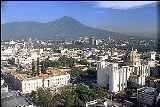
The city of San Salvador the capital and largest city of El Salvador
, which has been designated a Gamma World City
. Its complete name is La Ciudad de Gran San Salvador (The City of the Great Holy Savior). San Salvador lies in a valley in northern Central America
, surrounded by volcanoes and prone to earthquakes, which is why the Pipil and the Spaniards called the area in which the city is located "el valle de las hamacas" (the valley of the hammocks, "salcoatitan" in Pipil language). San Salvador is the second largest metropolitan area in Central America after Guatemala City
. The city has a long history, with origins dating back to the Spanish conquest of the Pipil city of Cuzcatlán which means "The Place of the Diamond Jewels". The name of the city means "holy savior". Residents of San Salvador are called Capitalinos.
 Before the Spanish conquest, the Pipil peoples established their capital, Cuzcatlán, near the current location of San Salvador. Not much is known about Cuzcatlán, as it was abandoned by its inhabitants in an effort to avoid Spanish rule.
Under the orders of conquistador
Pedro de Alvarado
, his associates Gonzalo de Alvarado
and Diego de Holguín
occupied the settlement they found and began to develop it. Diego de Holguín became the first mayor of San Salvador after the town was founded on April 1, 1525. The town changed locations twice, in 1528 and 1545. Originally founded in what is now the archaeological site Ciudad Vieja, north of the present-day city, it was moved to the Valle de Las Hamacas or the Acelhuate Valley, named so due to the intense seismic activity that characterizes it. The new site was chosen as it had more space and more fertile land, thanks to the Acelhuate River. The population of the city remained relatively small until the early twentieth century.
During the presidency of Dr. Rafael Zaldivar on January 1885, businessmen and the president's family built the Sara Zaldivar Asylum for Indigents and the Elderly. In 1902, Hospital Rosales was built, named after its benefactor, Dr. Jose Rosales, a banker who gave his fortune to the hospital and to the orphanage. The hospital's construction was begun by president Carlos Ezeta and finished during the presidency of Tomás Regalado. In 1905 president Pedro José Escalón began construction of the National Palace, funded by coffee exportation taxes. In 1911, the Monumento a los Próceres de 1811 (monument to the heroes of 1811) in Plaza Libertad and the Teatro Nacional were built during Dr. Manuel Enrique Araujo's presidency.
In 1917, an earthquake damaged the capital during the Carlos Melendez presidency. This earthquake was caused by the eruption of the San Salvador Volcano, but the city escaped additional damage because the lava flowed down the back side of the volcano. On December 2, 1931, after a coup d'état
, president Arturo Araujo
was ousted by the military and replaced by a military directorate. The directorate named then vice-president Maximiliano Hernández Martínez
as president and Araujo went into exile. The Martínez regime lasted from December 4, 1931 to May 6, 1944.
In 1964, the Christian Democratic Party (PDC) candidate, José Napoleon Duarte
, an engineer, was elected mayor. Duarte was Mayor of San Salvador from 1964 to 1970. During his term as mayor he built the Pancho Lara park in the Vista Hermosa neighborhood, renewed the electricity system, and began a system of adult education schools. The 1960s to 1980s were the golden age of San Salvador in all regards: security, quality of life, and modernization.
Today the tallest building in the country has 28 floors and is 110 meteres high. In the 1980s, at the commencement of the civil war, many modernization projects were halted because of the outbreak of the war. Examples of suspended projects include a 40 story high government building approximately 160 meters in height, and the Sheraton Hotel Tower a 26 story high building with a rotating restaurant on top.
In 1969, celebrations in the Cuscatlán stadium were held in honor of the returning troops from the football war
with Honduras. Boulevard de los Héroes (Boulevard of the Heroes) was named after the Salvadoran soldiers who fought in Honduras. The 1986 San Salvador earthquake destroyed many government buildings and other important structures, injuring and killing hundreds. Thousands of people were displaced by the disaster and many found shelter in the ruins.
In 1986, Mayor Morales Ehrlich closed streets in the downtown area of the city to create a large market, which has resulted in major traffic congestion affecting the area ever since. The Chapultepec Peace Accords
were signed on Thursday, January 16, 1992, ending 22 years of civil war, and are celebrated as a national holiday with people flooding downtown San Salvador in Plaza Gerardo Barrios and in La Libertad Park.
 Cities in El Salvador, by constitutional provision (Art. 203), are economically and administratively autonomous. San Salvador is governed by a council consisting of a mayor (elected by direct vote every three years, with an option to be re-elected), a trustee and two or more aldermen whose number varies in proportion to the population of the municipality. The mayor as of 2011 is Norman Quijano
of the Nationalist Republican Alliance
party. He is accompanied by a trustee, twelve aldermen, four substitute aldermen, and a secretary. The functions and powers of this government are framed within the rules of the Municipal Code.
San Salvador's government is composed of various departments, including the departments of festivals, parks, cemeteries, and finance. To safeguard the interests of the municipality, there is a board of metropolitan agents. Each of the six city districts also has a government department. The mayor is a member of the Council of Mayors of the Metropolitan Area of San Salvador (COAMSS), composed of fourteen local councils that make up the area known as Greater San Salvador.
. The first three were created as a result of a contest launched in 1943. The shield (designed by the painter José Mejía Vides) shows four quadrants: the two quadrants at the top right and bottom left oblique carry the blue and white (representing the national flag), the top left frame displays an emerald necklace, symbol, and the lower right shows the bell of the Church of La Merced, which represents the beginning of San Salvador's independence movement in 1811, when José Matías Delgado rang the bells.
The flag was designed at the request of the authorities. The anthem was written by Carlos Bustamante (lyrics) and Ciriaco de Jesus Wings (music).
The municipal staff shows a series of figures and symbols relating to local history. From top to bottom these images are: a native Amerindian, first mayor Don Diego de Olguín, Carlos V of Spain, the Royal Decree which named San Salvador, Mayor Don Antonio Gutierrez, priest José Matías Delgado, the seal of liberation of 1811, the 1821 independence seal, the shield of the Municipal Freedom Union, the national emblem, and God.
class="navbox">
Years
Population
1970
731.000
1980
979.700
1990
1.300.000
2000
1.400.000
2005
1.566.713
2007
1.860.000
2009
2.177.432
2011(estimate)
2.500.000
Spanish is the language spoken by virtually all inhabitants. The capital city of San Salvador has about 316,090 people. An estimated 37% of El Salvador's population live in rural areas. Over a million Salvadorans have emigrated to the US, mostly due to the civil wars, dictatorships, and socioeconomic conditions. In addition, since the 1970s, small Salvadoran communities have been established in Canada, Mexico, Costa Rica, Europe and Australia.
was the archbishop of San Salvador at the time of his assassination. The current archbishop of El Salvador is José Luis Escobar Alas. Protestants account for around 39% of San Salvador's population. One of the largest protestant churches in the city is the Centro Internacional de Alabanza, another is the Tabernaculo Biblico Bautista Amigos de Israel. The city also has a synagogue in the San Benito neighborhood which services the Jewish community. A newly built Mormon
temple is a marvel of engineering and architecture, and there are smaller Mormon churches in District 1 and 3. The city has a small Arab
population but they do not practice Islam, since most are Christian Arabs from Palestine
. The city also has Korean Evangelical Churches
that give services in Korean language.
In 2011, the Latin American Capital Cities Union (UCCI), selected San Salvador as "Latin American capital of culture", recognizing San Salvador's cultural diversity. The city government is restoring the downtown area, with the goal of celebrating the city's past, and promoting cultural diversity.
. San Salvador is mainly hot, the coolest months being November through February. The temperature varies widely between midday and midnight, due to changing levels of humidity throughout the day. The highest reading ever recorded in San Salvador was 38.5 °C (101.3 °F), the lowest was 8.2 °C (46.8 °F). The highest dew point
was 27 °C (80.6 °F) and the lowest -10 °C. San Salvador has two seasons: rainy and dry. The dry season lasts from November through April, and the rainy From May through October.
Sometimes, when strong cold fronts affect El Salvador during the dry season, the dew point may fall to temperatures below 10 °C, an event that would be too cold for most of the inhabitants, but this rarely has any effect due to the fact that humidity remains low, which means the dew point remains less relevant, therefore a 7 °C-10 °C dew point is actually felt as a 15 °C-18 °C temperature.
. The volcano its self is not within the city of San Salvador, but rather is within the municipality of Santa Tecla
. The highest point of the volcano is 1893 meters (6211 feet). Another important peak within the municipality is San Jacinto Hill, with a height of 1162 meters (3812 feet), which separates the Municipality of San Salvador from San Marcos
. Other notable hills include Cerro Chantecuán, La Torre, and Candelaria. Another important peak is La Cima, at 921 meters (3021 feet) which has been built-up over 85% of its total area, comprised mostly of residences with a panoramic view of all San Salvador.
Within the urban portion of the city, the highest point is Colonia Escalon in District 3, at 1003 meters (3290 feet), and the lowest point is in District One below the Historic Downtown, Colonia San Esteban, at 645 meters (2016 feet). The topography of the urban area is generally very hilly.
Soil types include regosol, latosol, andosol, lava rocks and andesitic and basaltic lava.
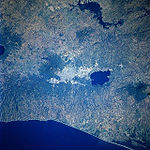
which has one of the largest lakes in the country, the Ilopango Lake. The lake is only 17 km / 10 miles away from downtown San Salvador.
Banks in San Salvador include Banco Agrícola, Citibank, HSBC, Scotiabank, BAC-Credomatic, Banco Promérica, Banco Pro-Credit and the Mexican Banco Azteca. Important insurance companies include Asesuisa, SISA, Mapfre-La Centroamericana and Scotia Seguros are also located in San Salvador. Major department stores in San Salvador include Almacenes Simán, and Sears, Walmart, La Despensa de Don Juan, Super Selectos, and PriceSmart.
The city's financial businesses are not located in the historic downtown region, but are spread throughout the other districts in the city, particularly in District 2 and District 3.
The World Trade Center of San Salvador is located in District 3 (Colonia Escalon) on 87th Avenue North and Mirador Street. The World Trade Center offers some of the best office locations in the country: connected to two hotels (one of which is the Crowne Plaza Hotel), a convention center and a commercial center containing retail shops and restaurants. World Trade Center San Salvador is a unique concept due to the integration of its component elements. Since their completion, the first two towers have maintained a 100 percent occupancy rate with multinational companies, embassies, and firms such as Banco Multisectorial de Inversiones (BMI), Ericsson, Continental Airlines, Microsoft, Inter-American Development Bank, and Banco Promérica.
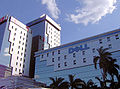
Centro Financiero Gigante is a complex of office buildings located in San Salvador, El Salvador. It has five towers: one with seven floors, another with 10, another with 12, another with 14 and the highest 19 floors, the tallest tower measures 77 meters (252.6 ft) high.
Centro Financiero Gigante is a phased project which began with the construction of two towers. After several years the number of buildings has increased, and it has become one of the most significant business complexes in San Salvador. The tallest tower in the financial center is occupied by the phone company Telefonica
, The next tallest tower is used by RED (Business Communication Systems). The complex also includes the Banco Azteca
center, Stream Global Services
that represent Dell
in Central America, The Israeli Embassy of San Salvador, Tigo, call centers, and some other small offices and banks. The complex was built in phases. In 1997 the project started with Phase I which consisted of the two tallest towers, then a seven story-high tower was built in Phase II, for the old Dell company in Central America, Phase III the buildings for Tigo a 12 story-high and Telemovil a 10-story-high building. The final phase was remodeling of the Telemovil Building to turn into Banco Azteca
Center.
Along Alameda Manuel Enrique Araujo there are many businesses, banks, and financial centers, government institutions and museums, such as: AFP Confia, Superior Council of Public Health, HSBC
Central Office, AFP Crecer, Ministry of Public Works, Centro Internacional de Feria y Convenciones (International Center of Fairs and Conventions), Presidential Palace, Museo de Antropolgia David J. Guzman (Anthropology Museum), Banco Promerica Financial Center, Ministry of Tourism, Channel 2 & 4 Studio Center, Channel 6 Studio Center, CAESS-Centro Intregal al Servicio al cliente.
In Zona Rosa there are luxury hotels and museums. A business center is under construction which will a tower for business, a tower for a hotel, and a shopping center, all three connecting to the main street in the Zona Rosa. Along Zona Rosa there are several embassies, including the embassies of Chile, Taiwan, Mexico, Spain, Italy, Brazil and Israel.
-Telecom, Movistar
-Telefonica, and Digicel
. All of these companies provide 3G networks, Cable TV, Internet and International Roaming.
El Salvador's television stations are mostly based in San Salvador. Stations in San Salvador include the following:
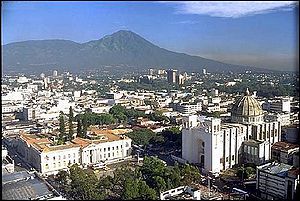 District 1 is the historical center of the capital city. The original buildings of the Spanish colonial era have been mostly destroyed by natural disasters. Notable surviving buildings were erected in the late nineteenth and early twentieth centuries. This district was long the center of political, economic and religious country. The earthquake of 1986 severely damaged the area and due to rising unemployment in the country has been occupied by a large quantity of street vendors and other informal trade. The tallest buildings in district one are the government center buildings. The tallest building is 14 stories and 65 meters of height. The tallest structure is not a building, but rather the cathedral's bell tower, which is approximately 80 meters in height.
. This project has a Mall, Hotel, Small Business Plaza with the company headquarters tower, that is know today a Torre Roble a 14 story and 56 meter high tower. Long after the civil war, the Centro Financiero Gigante Project along the Plaza Las Americas was started, which consisted of four phases one with the two main towers and three phases with other small. Around Salvador del Mundo or Plaza Las Americas many business and banking headquarters have opened, such as Banco Agricola Headquarters, AFP Confia, Torre Montecristo and the Centro Finaciero Gigante that hold the companies of Tigo, Telefónica
, RED
, Banco Azteca
and the Israeli Embassy.
Center, AFP Crecer. District 3 Is home for most embassies like the embassies of Italy, Spain, Mexico, Taiwan (El Salvador established relationships with Taiwan rather than China), Chile, Argentina, Peru, Colombia, Ecuador, Japan, Brazil, and many others. District 3 is home of many shopping centers such as Plaza Basilea, and Plaza Zona Rosa, El Paseo, and Galerias. The shopping centers include many international stores from companies based in North America and Europe.
, Mejicanos
, and Ciudad Delgado.
During the 1960s, urban expansion was most prevalent in the northern and southern parts of the city, while the 1970s saw growth continue further south, north and west. Colonias Miravalle, Montebello, Satellite, Maquilishuat, San Mateo Lomas de San Francisco, Alta Mira, Loma Linda, La Floresta, and Jardines de la Libertad were built during this period.
The expansion of San Salvador during this period, while in all directions, was primarily in the direction of the volcano of San Salvador. The increased demand for housing was due to an increase of the numbers of middle class, military, and professionals.
Around 2000, the city expansion westward slowed. There was an expansion of middle-class neighborhoods such as Merliot, Santa Elena and the Tier, but the product of internal migration and cessation of armed conflict created a high demand for urban public housing. This gave rise to large urban development projects mostly to the east and north, to the phenomenon of "dormitory towns", and to a disorderly growth pattern.
, which served as the temporary capital from 1854 to 1859, until San Salvador was rebuilt.
The continued development of San Salvador was spurred by the success of the local coffee industry, and it became a very productive commercial city. By 1890 San Salvador had 94,580 Inhabitants. In 1901 San Salvador was composed of the Urban Center (population 80,167), Vista Hermosa (13,123), y Planes de Rendero (1,560). In the following years San Salvador expanded towards the the volcano. In the 1970s the city leaped in population from 430,500 to 700,000. As San Salvador grew, it merged with neighboring cities, forming the Metropolitan Area of San Salvador (AMSS). The AMSS is a conglomerate of 14 municipalities. It was instituted in 1993, through Legislative Decree No. 732 of the Law on Territorial Development and the Metropolitan Area of San Salvador and neighboring municipalities. The Act stipulates that the constituent cities form a single urban unit.
Since 1990, due to the rapid growth of San Salvador and the neighboring municipalities, the government established initiatives to plan and guide the development of the metropolis.
The AMSS is the heart of the country's political, financial, economic and cultural life. It accounts for 27% of the population and 70% of the public and private investment, in only 3% of the national territory. Together the fourteen municipalities give the AMSS a total population of 2,177,432 inhabitants (2009 census). The Government expects a total population of 2.5 million by the year 2011.
List of municipalities in AMSS(Distance from San Salvador District 1 to other city downtown):
for every quintal of coffee exported. The materials used were imported from several European countries including Germany, Italy and Belgium. Its facilities were occupied by government offices until 1974.
The building contains four main rooms and 101 secondary rooms. The four main rooms each have a distinctive color. The Red Room (Salon Rojo) is used for the ceremonial presentation of credentials of ambassadors or receptions Salvadoran Foreign Ministry. The Red Room has been used for ceremonial purposes since the administration of General Maximiliano Hernández Martínez. The Yellow Room (Salon Amarillo) is used as an office for the President of the Republic. The Pink Room (Salon Rosado) which housed the Supreme Court and later the Ministry of Defense. And the Blue Room (Salon Azul) which was declared a National Historic Landmark in 1974. The Blue Room's Ionian, Corinthian and Roman style and architecture are notable, and it was the meeting site for the Legislature of El Salvador since 1906. The room, in commemoration of its past purpose, is now called the Salvadoran parliament.
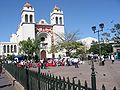 The Metropolitan Cathedral of the Holy Savior (Catedral Metropolitana de San Salvador) is the principal church of the Roman Catholic Archdiocese of San Salvador and the seat of the Archbishop of San Salvador. The church was twice visited by Pope John Paul II who said that the cathedral was "intimately allied with the joys and hopes of the Salvadoran people." During his visits in 1983 and 1996, the Pope knelt and prayed before the Tomb of Archbishop Óscar Romero
, assassinated in 1980, whose tomb here is a major pilgrim draw. The Cathedral site is the place where the old Temple of Santo Domingo (St. Dominic) once stood.
Forty four people died on Palm Sunday, March 31, 1980, during the funeral of Archbishop Romero, as a result of a stampede after some gunmen, allegedly members of security forces (although it has never been corroborated), fired on mourners and on Romero's funeral cortege. The gunmen were never identified. The square in front of the Cathedral was the site of celebrations after the signing of the Chapultepec Peace Accords that ended the Salvadoran Civil War in 1992. The Cathedral was completed and inaugurated on March 19, 1999 and finished off with a festive tiled facade by the Salvadoran master Fernando Llort
.
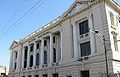 Teatro Nacional de El Salvador, or National Theater of El Salvador, is the oldest theater in Central America. It was designed by the French architect Daniel Beylard, and construction started on November 3, 1911. The building was inaugurated on March 1, 1917. It is of French Renaissance style with modern touches. It was decorated by the Italian architect Lucio Capellaro, and its Great Hall is considered one of the most beautiful and elegant halls in Central America.
The National Theater is located on the southern side of Francisco Morazán Plaza on Calle Delgado. The Theater is in the French Renaissance style with details in other styles such as Rococo, Romantic Style, and Art Nouveau. It has capacity for 650 specters in the Grand Hall. It has balconies on three levels. The Presidential Balcony, located between the third and second Floor, has a direct view of center stage. The theater features an ellipsoidal dome containing a mural by painter Carlos Cañas and a striking crystal chandelier. Other spaces include the Hall, Chamber Hall, and Grand Foyer. It was declared a National Monument in 1979. Today the theater is open to tourists, and - since the Historic Downtown Restoration - it is used for plays, shows, opera, singing, and modern dance performances. The theater is the largest and most luxurious one in Central America.
At the same time, sidewalks will be renovated with ramps to provide access for people with disabilities and seniors. Calle Arce is monitored by 24 members of the Corps Metropolitan Agents (CAM), who specialize in the care and protection of the new public space.
La Plaza Gerardo Barrios, also known as the Civic Plaza, is located in the heart of the city of San Salvador. The statue that dominates the site, dedicated to President Gerardo Barrios, was unveiled in 1909 and was designed by Francisco Durini. The statue is the work was the brothers Antonio and Carlos Ezeta. The figure, made of bronze, is placed on a pedestal of granite and depicts battle scenes and the shield of El Salvador.
The square is the site of many demonstrations and political rallies. It is also the focal point for the celebrations accompanying the feast of San Salvador (5 and 6 August), and the procession dedicated to the Divine Savior of the world (called "the descent") terminates in the square. Mass also celebrated in the square, and it is the destination of many parades.
Plaza Libertad contains the Monument to the Heroes, a commemoration of the centenary of the First Cry of Independence in 1811. The monument highlights an "angel of freedom" at its pinnacle holding laurel wreath in both hands. Years later, as a consequence of increased commercial activity, it was enhanced by the construction of the portals of the West (1915–1916) and the Dalia (1917).
The Government of El Salvador, headed by Rafael Zaldivar, ordered the erection of a marble statue in honor of Francisco Morazán, president of the Federal Republic of Central America, to commemorate the fortieth anniversary of his death on March 15, 1882. The work was created by the artist Francisco Durini in Genoa, Italy. The son of Morazan attended the inauguration as a representative of the Government of Honduras. El Salvador's government declared March 15 as a day of national civic celebration.
Museo de Arte MARTE displays an extensive collection of Salvadoran and international art.
. It is affiliated with the Union of International Fairs (UFI) and the Association of International Fairs of America (AFIDA).
The CIFCO amphitheater is one of the most important performance venues in San Salvador, hosting many concerts and international artists. It has a capacity of 15,000 persons. It also has a parking for over 800 vehicles. From 2003 until 2010, the CIFCO underwent renovation, adding five pavilions and restructuring of the drainage system. The renovation also included the construction of a three-level underground parking for 3,500 vehicles, and hotels within the center. Goals of CIFCO include:
. One of these malls, the Multiplaza
, was built by Grupo Roble. It has been called a city within a city, because the mall includes an apartment tower, a five star hotel, and a office building. The other modern mall is La Gran Via mall, built by Urbanica. It opened in 2004, and is connected to a JW Marriott Hotel, a banking building, mini golf course, theater, a gym, and a Starbucks
.
, Korean, Japanese
, Thai, French
, Chilean, American
, Peruvian
, Mexican
, Spanish
, Middle Eastern
, German
, Chinese
, Argentine and others. Local food options include several "Pupuserias" where one can purchase the famous Salvadoran Pupusas.
A different, but equally popular museum, is Tin Marín Museo de los Niños (Tin Marin Children's Museum), located between Gimnasio Nacional José Adolfo Pineda
and Parque Cuscatlán. Tin Marín seeks to contribute to children becoming integral and creative citizens through significant learning, cultural stimulation and entertaining experimentation. The museum has more than 25 exhibits, including The Airplane, The Grocery Store, and the Planetarium.
Presidente, and other small hotels. Connecting to the Torre Futura
World Trade Center, in the Escalon neighborhood that lies on the foothills of Cerro El Picacho and the San Salvador Volcano, lies the Crowne Plaza
Hotel. The Real InterContinental
hotel connects to the Connecting to the Metrocentro
mall. In Antiguo Cuscatlán
there are many other hotels, for example the Holiday Inn
which is connected by a pedestrian bridge to a small shopping plaza, with many restaurants and cafes and the first Starbucks
in the country. Beverly Hills Hotel, a five star suite hotel, is located in northern Antiguo Cuscatlán next to the Avante Business Center.
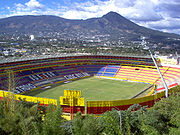 Estadio Cuscatlán
, with a capacity of over 45,000, is the largest soccer venue not only in Central America, but the Caribbean, as well. In addition to being the largest, Estadio Cuscatlán is considered to be the most modern stadium in the region. It was announced on November 16, 2007 that Estadio Cuscatlán would become the first soccer stadium in Central America and Caribbean to have a large LED screen, where the supporters can view the action. The screen is 40 meters in height and width and was completed in March 2008. Estadio Cuscatlán was built in the early 1980s right before the beginning of the civil war. This building, was supposed to kick-off an era of modernization of San Salvador in the 1980s, but the civil war took 12 years of development from the country.
Another major stadium is Estadio Nacional de la Flor Blanca
, with a capacity of 32,000. This stadium hosted the Central American and Caribbean Games in 2002
, where El Salvador came in 6th place among 37 countries.
San Salvador is currently home to two soccer teams in the Primera División (El Salvador): Alianza F.C.
and C.D. Atlético Marte. Alianza F.C. currently plays their home games at Estadio Cuscatlán, while Marte currently plays their home games at Estadio Nacional de la Flor Blanca. Alianza is renowned throughout El Salvador for its loyal supporters and for the atmosphere created during games. Alianza gained fame in Central America for winning the CONCACAF Championship and for beating the Brazilian team, Santos, when that side featured the football legend Pele
. Marte was also once a prominent team, winning 8 national championships and the 1991 CONCACAF Cup Winners Cup.
San Salvador also has many private bilingual schools, such as: Academia Británica Cuscatleca (British English), Colegio Internacional de San Salvador (English), Escuela Americana (English), Escuela Panamericana (English), Liceo Francés (French) and Escuela Alemana (German).
El Salvador employs a school classification system administered by the government teaching service (MINED), which scores both private and public schools. A score of A is among the highest, and a score of C means the school needs improvement.
San Salvador is home to many higher education institutions. The only public university in the country is Universidad de El Salvador
, which is one of the best universities in Central America. Private universities, like Universidad Centroamericana José Simeón Cañas and Universidad Dr. José Matías Delgado, are also located in the capital city. Other universities that focus on particular professions include Escuela de Comunicacion Monica Herrera, ESEN (Escuela Superior de Economia y Negocios), Escuela Militar (Military School) and many others.
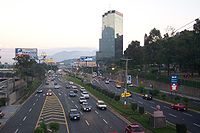 San Salvador has excellent transportion connectivity, due to its extensive road network and its street maintenance system. Interamerican Development Bank has determined that San Salvador has one of the best road systems in Latin America. The road system of Metropolitan Area of San Salvador handles approximately 400,000 vehicles per day. In the morning rush hour, about 600,000 trips are made.
The main highway which passes thru San Salvador is the CA-1 (Pan-American highway), which at one point becomes Bulevar Arturo Castellanos. The RN-21 (also known as Bulevar Diego de Holguin) is a major east–west road which connects the cities, of Santa Tecla, Antiguo Cuscatlán and it finally merges in San Salvador with the RN-5 East/West (also known as Bulevar Los Proceres) that later turn into the North/South RN-5 heading towards the International Airport. Another major roadway is the RN-4 (Carretera Este Oeste) which goes from San Salvador through Apopa, and subsequently merges with the CA-1 Panamericana.
Roads in the capital are named "street" if they travel east-west, and are called "avenue" if they travel north-south. Road numbering starts is at the downtown intersection of Avenida Espana/Avenida Cuscatlán and Delgado Arce street. Avenues to the west of this intersection have odd-number name,s and to the east of the intersection they have even-number names. Streets have odd-number names if they are to the north of the intersection, and even-number names to the south.
One particularly heavily travelled road is 49a Avenida Norte, which connects with the RN-5 highway to the airport. An important historical street is Calle Arce, which was shut down in order to create a pedestrian-only region which is part of the historic downtown of San Salvador. Some streets in the city are very narrow with little room for cars to pass, yet there are also many streets that are wide. Within the city, the speed limits are 90kph on highways, 60kph on main roads, and 40kph on secondary streets and avenues.
, through Ilopango
, Soyapango
, through San Salvador, to Antiguo Cuscatlan
, and terminate in Santa Tecla
. It is estimated that between 40 and 60 busses capable of carrying 160 passengers per trip will start operating in the second half of 2013. The departure interval will be approximately eight to ten minutes. By the time the buses have reached the San Salvador historic downtown they would already transported 20,000 passengers, SITRAMSS us a public-private partnership involving the current passenger transport operators, who must purchase the busses. To pay for the infrastructure development, a loan of $50 million has been provided by the Inter-American Development Bank (BID). The system will work with a prepaid card system which is expected to reduce the time required for passengers to enter the busses. An estimated 200,000 passengers will be transported daily, or about 5,600,000 every month.
A taxi system operates throughout the entire city. Taxi fares depend on the route. Taxi drivers charge based on the destination location, rather than on a timer. Taxis in San Salvador are yellow, and the fleet is primarily composed of Toyota Corollas.
, to Apopa
and from Apopa, to the city of Nejapa
.
There is also a historic railroad consisting of railroad cars from the 1960s which were refurbished and put into operation by the ministry of tourism. Once a month, visitors can board the antique train and experience the way San Salvadorians transported themselves in the 1960s.
s, the most disastrous of which occurred in 1854. In 1917, the San Salvador volcano erupted, which resulted in three major earthquakes that damaged the city so extensively that the government was forced to temporarily move the capital to the city of Santa Tecla (known at that time as New San Salvador). The most recent earthquakes, in 2001 (one in January and one in February), resulted in considerable damage, especially in Las Colinas suburb, where a landslide destroyed homes and killed many people.
During the 1980s, conflicts in El Salvador erupted into a civil war, and many people fled to the city, since most of the fighting occurred outside of it (San Salvador itself was not directly affected by the war until the final offensive of 1989).
Hurricanes, tsunamis, and landslides also pose a threat. On November 2009, Hurricane Ida hit the departments of San Salvador, San Vicente and Cuzcatlan. In San Vicente, the municipalities of Verapaz and Guadalupe were totally destroyed by the rainfall that accompanied the hurricane, and the resultant landslide. Many thousands of people were left homeless. The Army and the Red Cross were able to rescue many people, and the government opened public schools to be used as temporary shelters for three months. The Hurricane destroyed some bridges, and some towns lost communications. The people of El Salvador raised money for the homeless and international aid came from countries such as the United States, Mexico, Nicaragua and Guatemala, and the European Union.
Tropical storm Agatha hit the Central American coast on Thursday, May 27, 2010. About 3 foot (0.9144 m) of rainfall over a period of five days was recorded in the Metropolitan Area of San Salvador, producing sinkholes, flash floods, and mudslides. Districts particularly hard hit included downtown, El Picacho, and Montebello.
that originated in Los Angeles, has proliferated in San Salvador. A rival gang is the Mara Salvatrucha. In 2002 the crime rates in San Salvador skyrocketed and the municipal government was unable to combat the rise. Recent efforts by mayor Norman Quijano
to restore public safety have been somewhat successful. Security measures in San Salvador’s most troubled Districts (5 and 6, which border Soyapango, and are home to many gangs) included safety campaigns and recreational activities to keep youth from joining gangs. The mayor also initiated a security camera program so the police can watch the most heavily trafficked areas of the city. The security camera project started in the historic downtown and will expand throughout the entire city. In addition, the government passed a law providing that anyone who belongs to or is linked to a gang will go to jail without a trial, and, as a result, many gang members have fled to their home countries.
Today, San Salvador is considered to be a land of opportunity for many immigrants from neighboring countries, such as Honduras
, Nicaragua
, and Guatemala
. Immigrants also come from South American countries such as Peru
and Bolivia
, and it also is home to a Korean population and a Europe
an minority.
As of 2011 San Salvador had managed to reduce its crime rate, reducing its murder rate to a level lower than Haiti, Venezuela, Mexico, Guatemala, or Honduras. Also according to a UN Development report, San Salvador has a relatively low robbery rate of 90 per 100,000, compared to San Jose
, the capital of Costa Rica
, which has 524 robberies per 100,000.
Districts 3 and 4 are the safest in the country, comparable to that of a European cities; Districts 1 and 2 have a slightly higher crime rate than 3 or 4; and District 5 bordering San Marcos, and District 6 bordering Soyapango
the areas that have the highest crime rates.
with:
El Salvador
El Salvador or simply Salvador is the smallest and the most densely populated country in Central America. The country's capital city and largest city is San Salvador; Santa Ana and San Miguel are also important cultural and commercial centers in the country and in all of Central America...
, which has been designated a Gamma World City
Global city
A global city is a city that is deemed to be an important node in the global economic system...
. Its complete name is La Ciudad de Gran San Salvador (The City of the Great Holy Savior). San Salvador lies in a valley in northern Central America
Central America
Central America is the central geographic region of the Americas. It is the southernmost, isthmian portion of the North American continent, which connects with South America on the southeast. When considered part of the unified continental model, it is considered a subcontinent...
, surrounded by volcanoes and prone to earthquakes, which is why the Pipil and the Spaniards called the area in which the city is located "el valle de las hamacas" (the valley of the hammocks, "salcoatitan" in Pipil language). San Salvador is the second largest metropolitan area in Central America after Guatemala City
Guatemala City
Guatemala City , is the capital and largest city of the Republic of Guatemala and Central America...
. The city has a long history, with origins dating back to the Spanish conquest of the Pipil city of Cuzcatlán which means "The Place of the Diamond Jewels". The name of the city means "holy savior". Residents of San Salvador are called Capitalinos.
History
Under the orders of conquistador
Conquistador
Conquistadors were Spanish soldiers, explorers, and adventurers who brought much of the Americas under the control of Spain in the 15th to 16th centuries, following Europe's discovery of the New World by Christopher Columbus in 1492...
Pedro de Alvarado
Pedro de Alvarado
Pedro de Alvarado y Contreras was a Spanish conquistador and governor of Guatemala. He participated in the conquest of Cuba, in Juan de Grijalva's exploration of the coasts of Yucatan and the Gulf of Mexico, and in the conquest of Mexico led by Hernan Cortes...
, his associates Gonzalo de Alvarado
Gonzalo de Alvarado
Gonzalo de Alvarado was the name of two Spanish conquistadors, both related to Pedro de Alvarado and participating in the conquest of Mexico and Central America...
and Diego de Holguín
Diego de Holguín
Diego de Holguín, 1486 -? , was a Spanish conquistador and the first mayor of San Salvador, in April of 1525. He had remarkable activity in the conquest of many nations in the Caribbean islands, Central America and Mexico, where he became famous for his courage.Holguín was born around 1486 in a...
occupied the settlement they found and began to develop it. Diego de Holguín became the first mayor of San Salvador after the town was founded on April 1, 1525. The town changed locations twice, in 1528 and 1545. Originally founded in what is now the archaeological site Ciudad Vieja, north of the present-day city, it was moved to the Valle de Las Hamacas or the Acelhuate Valley, named so due to the intense seismic activity that characterizes it. The new site was chosen as it had more space and more fertile land, thanks to the Acelhuate River. The population of the city remained relatively small until the early twentieth century.
During the presidency of Dr. Rafael Zaldivar on January 1885, businessmen and the president's family built the Sara Zaldivar Asylum for Indigents and the Elderly. In 1902, Hospital Rosales was built, named after its benefactor, Dr. Jose Rosales, a banker who gave his fortune to the hospital and to the orphanage. The hospital's construction was begun by president Carlos Ezeta and finished during the presidency of Tomás Regalado. In 1905 president Pedro José Escalón began construction of the National Palace, funded by coffee exportation taxes. In 1911, the Monumento a los Próceres de 1811 (monument to the heroes of 1811) in Plaza Libertad and the Teatro Nacional were built during Dr. Manuel Enrique Araujo's presidency.
In 1917, an earthquake damaged the capital during the Carlos Melendez presidency. This earthquake was caused by the eruption of the San Salvador Volcano, but the city escaped additional damage because the lava flowed down the back side of the volcano. On December 2, 1931, after a coup d'état
Coup d'état
A coup d'état state, literally: strike/blow of state)—also known as a coup, putsch, and overthrow—is the sudden, extrajudicial deposition of a government, usually by a small group of the existing state establishment—typically the military—to replace the deposed government with another body; either...
, president Arturo Araujo
Arturo Araujo
Arturo Araujo was the president of El Salvador from March 1, 1931 to December 2, 1931. He was overthrown in a military coup led by junior officers, and was forced to flee the country for Guatemala...
was ousted by the military and replaced by a military directorate. The directorate named then vice-president Maximiliano Hernández Martínez
Maximiliano Hernández Martínez
Maximiliano Hernández Martínez was the President of El Salvador from 1931 to 1944...
as president and Araujo went into exile. The Martínez regime lasted from December 4, 1931 to May 6, 1944.
In 1964, the Christian Democratic Party (PDC) candidate, José Napoleon Duarte
José Napoleón Duarte
José Napoleón Duarte Fuentes was a Salvadoran political figure who, from March 3, 1980, to 1982, led the civil-military Revolutionary Government Junta that took power in a 1979 coup d'état...
, an engineer, was elected mayor. Duarte was Mayor of San Salvador from 1964 to 1970. During his term as mayor he built the Pancho Lara park in the Vista Hermosa neighborhood, renewed the electricity system, and began a system of adult education schools. The 1960s to 1980s were the golden age of San Salvador in all regards: security, quality of life, and modernization.
Today the tallest building in the country has 28 floors and is 110 meteres high. In the 1980s, at the commencement of the civil war, many modernization projects were halted because of the outbreak of the war. Examples of suspended projects include a 40 story high government building approximately 160 meters in height, and the Sheraton Hotel Tower a 26 story high building with a rotating restaurant on top.
In 1969, celebrations in the Cuscatlán stadium were held in honor of the returning troops from the football war
Football War
The Football War , also known as the Soccer War or 100 hour War, was a four-day war fought by El Salvador and Honduras in 1969. It was caused by political conflicts between Hondurans and Salvadorans, namely issues concerning immigration from El Salvador to Honduras...
with Honduras. Boulevard de los Héroes (Boulevard of the Heroes) was named after the Salvadoran soldiers who fought in Honduras. The 1986 San Salvador earthquake destroyed many government buildings and other important structures, injuring and killing hundreds. Thousands of people were displaced by the disaster and many found shelter in the ruins.
In 1986, Mayor Morales Ehrlich closed streets in the downtown area of the city to create a large market, which has resulted in major traffic congestion affecting the area ever since. The Chapultepec Peace Accords
Chapultepec Peace Accords
The Chapultepec Peace Accords brought peace to El Salvador in 1992 after more than a decade of wrenching civil war.The treaty was negotiated by representatives of the Salvadoran government, the rebel movement FMLN, and political parties, with observers from the Roman Catholic Church and United...
were signed on Thursday, January 16, 1992, ending 22 years of civil war, and are celebrated as a national holiday with people flooding downtown San Salvador in Plaza Gerardo Barrios and in La Libertad Park.
Municipal government
Norman Quijano
Norman Noel Quijano Gonzalez is the current mayor of San Salvador.Dentist by profession, his introduction to politics came through the performance of the Manager of Social Action of the Municipality of San Salvador in the period from 1989 to 1994...
of the Nationalist Republican Alliance
Nationalist Republican Alliance
The Nationalist Republican Alliance is a conservative political party in El Salvador. It was founded on September 30, 1981, by Roberto D'Aubuisson, in order to oppose the reformist military junta that was ruling El Salvador at the time...
party. He is accompanied by a trustee, twelve aldermen, four substitute aldermen, and a secretary. The functions and powers of this government are framed within the rules of the Municipal Code.
San Salvador's government is composed of various departments, including the departments of festivals, parks, cemeteries, and finance. To safeguard the interests of the municipality, there is a board of metropolitan agents. Each of the six city districts also has a government department. The mayor is a member of the Council of Mayors of the Metropolitan Area of San Salvador (COAMSS), composed of fourteen local councils that make up the area known as Greater San Salvador.
City mayors since 1964
- José Napoleón Duarte (1964–1970)
- Carlos Antonio Herrera Rebollo (1970–1974)
- José Antonio Morales Ehrlich (1974–1976)
- Alejandro Duarte (1982–1985)
- José Antonio Morales Ehrlich (1985–1988)
- Armando Calderón Sol (1988–1994)
- Mario Valiente (1994–1997)
- Héctor Silva Arguello (1997–2003)
- Carlos Rivas Zamora (2003–2006)
- Violeta Menjívar(2006–2009)
- Norman Quijano (2009–2012)
Sub-division and projects
The San Salvador Municipality is divided into Districts. Currently the city has six Districts, District 1 (Downtown), District 2 (Colonia Miramonte, Centro America, Satelite, and Miralvalle), District 3 (Colonia Escalon, and San Benito), District 4 (Colonia La Cima, y San Francisco), District 5 (San Jacinto, Málaga, Monseratt), and District 6 (Colonia Don Bosco).City symbols
The symbols of the city are the shield, flag, anthem, and staffStaff of office
A staff of office is a staff, the carrying of which often denotes an official's position, a social rank or a degree of social prestige.Apart from the ecclesiastical and ceremonial usages mentioned below, there are less formal usages. A gold- or silver-topped cane can express social standing...
. The first three were created as a result of a contest launched in 1943. The shield (designed by the painter José Mejía Vides) shows four quadrants: the two quadrants at the top right and bottom left oblique carry the blue and white (representing the national flag), the top left frame displays an emerald necklace, symbol, and the lower right shows the bell of the Church of La Merced, which represents the beginning of San Salvador's independence movement in 1811, when José Matías Delgado rang the bells.
The flag was designed at the request of the authorities. The anthem was written by Carlos Bustamante (lyrics) and Ciriaco de Jesus Wings (music).
The municipal staff shows a series of figures and symbols relating to local history. From top to bottom these images are: a native Amerindian, first mayor Don Diego de Olguín, Carlos V of Spain, the Royal Decree which named San Salvador, Mayor Don Antonio Gutierrez, priest José Matías Delgado, the seal of liberation of 1811, the 1821 independence seal, the shield of the Municipal Freedom Union, the national emblem, and God.
Demographics
| Years | Population(AMSS) |
|---|---|
| 1900 | 138.200 |
| 1910 | 178.200 |
| 1920 | 205.000 |
| 1930 | 191.100 |
| 1940 | 222.500 |
| 1950 | 296.000 |
| 1960 | 475.300 |
Spanish is the language spoken by virtually all inhabitants. The capital city of San Salvador has about 316,090 people. An estimated 37% of El Salvador's population live in rural areas. Over a million Salvadorans have emigrated to the US, mostly due to the civil wars, dictatorships, and socioeconomic conditions. In addition, since the 1970s, small Salvadoran communities have been established in Canada, Mexico, Costa Rica, Europe and Australia.
Religion
There is a great diversity of religion within the city, but the vast majority of the population are Roman Catholic or Protestant. As in much of the country, Roman Catholicism plays a prominent role, and the city celebrates two important Catholic festivals"La Fiesta de Agosto", centered around Jesus Christ, and "Salvador del Mundo". Celebrated priest Óscar RomeroÓscar Romero
Óscar Arnulfo Romero y Galdámez was a bishop of the Catholic Church in El Salvador. He became the fourth Archbishop of San Salvador, succeeding Luis Chávez. He was assassinated on 24 March 1980....
was the archbishop of San Salvador at the time of his assassination. The current archbishop of El Salvador is José Luis Escobar Alas. Protestants account for around 39% of San Salvador's population. One of the largest protestant churches in the city is the Centro Internacional de Alabanza, another is the Tabernaculo Biblico Bautista Amigos de Israel. The city also has a synagogue in the San Benito neighborhood which services the Jewish community. A newly built Mormon
Mormon
The term Mormon most commonly denotes an adherent, practitioner, follower, or constituent of Mormonism, which is the largest branch of the Latter Day Saint movement in restorationist Christianity...
temple is a marvel of engineering and architecture, and there are smaller Mormon churches in District 1 and 3. The city has a small Arab
Arab
Arab people, also known as Arabs , are a panethnicity primarily living in the Arab world, which is located in Western Asia and North Africa. They are identified as such on one or more of genealogical, linguistic, or cultural grounds, with tribal affiliations, and intra-tribal relationships playing...
population but they do not practice Islam, since most are Christian Arabs from Palestine
Palestine
Palestine is a conventional name, among others, used to describe the geographic region between the Mediterranean Sea and the Jordan River, and various adjoining lands....
. The city also has Korean Evangelical Churches
Korean Evangelical Churches
Korean Central Presbyterian Church is an Evangelical Christian megachurch located in Centreville, VA, situated in the Washington D.C. metropolitan area, affiliated with the Presbyterian Church in America. From a sample of more than 50,000 churches in the United States, KCPC was selected to be one...
that give services in Korean language.
Culture
San Salvador is a culturally rich city. Its historical downtown area contains some of the most beautiful architecture in town. The National Theater is an important historical feature: recently remodeled, it was originally built in 1866. The National Palace still has its original facade, which combines neoclassic, neolithic and renaissance architectural styles. Other important sites include El Salvador's Art Museum (Museo de Arte de El Salvador, MARTE), the National Museum David J. Guzmán, the Luis Poma's Theater, and the museum for children, Tin Marin.In 2011, the Latin American Capital Cities Union (UCCI), selected San Salvador as "Latin American capital of culture", recognizing San Salvador's cultural diversity. The city government is restoring the downtown area, with the goal of celebrating the city's past, and promoting cultural diversity.
Geography
The city's average elevation is 560 meters above sea level. The highest regions are the foothills of the Quezaltepec, or San Salvador, volcano, where elevations are approximately 1000 meters above sea level. East of the city lies Lake Illopango, the largest volcanic lake in the nation.Climate
San Salvador features a tropical wet and dry climate under the Köppen climate classificationKöppen climate classification
The Köppen climate classification is one of the most widely used climate classification systems. It was first published by Crimea German climatologist Wladimir Köppen in 1884, with several later modifications by Köppen himself, notably in 1918 and 1936...
. San Salvador is mainly hot, the coolest months being November through February. The temperature varies widely between midday and midnight, due to changing levels of humidity throughout the day. The highest reading ever recorded in San Salvador was 38.5 °C (101.3 °F), the lowest was 8.2 °C (46.8 °F). The highest dew point
Dew point
The dew point is the temperature to which a given parcel of humid air must be cooled, at constant barometric pressure, for water vapor to condense into liquid water. The condensed water is called dew when it forms on a solid surface. The dew point is a saturation temperature.The dew point is...
was 27 °C (80.6 °F) and the lowest -10 °C. San Salvador has two seasons: rainy and dry. The dry season lasts from November through April, and the rainy From May through October.
Sometimes, when strong cold fronts affect El Salvador during the dry season, the dew point may fall to temperatures below 10 °C, an event that would be too cold for most of the inhabitants, but this rarely has any effect due to the fact that humidity remains low, which means the dew point remains less relevant, therefore a 7 °C-10 °C dew point is actually felt as a 15 °C-18 °C temperature.
Topography
The City of San Salvador is situated in a valley between hills, mountains, a volcano, and a caldera lake. The highest point in the city is Cerro El Picacho with a height of 1960 meters (6430 feet). The Picacho is connected to the San Salvador (volcano)San Salvador (volcano)
The San Salvador Volcano is a stratovolcano situated northwest to the city of San Salvador. The crater has been nearly filled with a relatively newer edifice, the Boquerón volcano....
. The volcano its self is not within the city of San Salvador, but rather is within the municipality of Santa Tecla
Santa Tecla
Santa Tecla may mean:* A saint: see Thecla* Santa Tecla, El Salvador, formerly named Nueva San Salvador...
. The highest point of the volcano is 1893 meters (6211 feet). Another important peak within the municipality is San Jacinto Hill, with a height of 1162 meters (3812 feet), which separates the Municipality of San Salvador from San Marcos
San Marcos
San Marcos is a common toponym in Latin America and parts of the United States. It could refer to any of the following:-Towns and cities:*San Marcos, Beni*San Marcos, Antioquia...
. Other notable hills include Cerro Chantecuán, La Torre, and Candelaria. Another important peak is La Cima, at 921 meters (3021 feet) which has been built-up over 85% of its total area, comprised mostly of residences with a panoramic view of all San Salvador.
Within the urban portion of the city, the highest point is Colonia Escalon in District 3, at 1003 meters (3290 feet), and the lowest point is in District One below the Historic Downtown, Colonia San Esteban, at 645 meters (2016 feet). The topography of the urban area is generally very hilly.
Soil types include regosol, latosol, andosol, lava rocks and andesitic and basaltic lava.
Bodies of water
The main river in San Salvador is the Rio Acelhuate which is 2.2 km long. The river used to serve as a water source to San Salvador during the late 1800s and early 1900s but now due to urbanization the river today is very polluted. Within the city there are no major bodies of water, except for some small streams and old aqueduct systems. The city borders IlopangoIlopango
Ilopango is a town in the San Salvador department of El Salvador. It is a few miles east of the nation's capital, San Salvador. It is located near Lake Ilopango, the country's largest lake at 72 square kilometers....
which has one of the largest lakes in the country, the Ilopango Lake. The lake is only 17 km / 10 miles away from downtown San Salvador.
Economy
Financial sector
As the capital, San Salvador supports many commercial activities, such as food and beverage production, handicrafts, construction materials, pharmaceutical and chemical industries, automobiles, and appliances repair. Grupo TACA, a multinational consortium which includes the national airline of El Salvador, Costa Rica, and other Central American countries, has its headquarters in San Salvador. Other companies with headquarters in San Salvador include Unicomer Group, Almacenes Simán, Grupo Roble, Grupo Real, Excel Automotríz, and Grupo Q.Banks in San Salvador include Banco Agrícola, Citibank, HSBC, Scotiabank, BAC-Credomatic, Banco Promérica, Banco Pro-Credit and the Mexican Banco Azteca. Important insurance companies include Asesuisa, SISA, Mapfre-La Centroamericana and Scotia Seguros are also located in San Salvador. Major department stores in San Salvador include Almacenes Simán, and Sears, Walmart, La Despensa de Don Juan, Super Selectos, and PriceSmart.
The city's financial businesses are not located in the historic downtown region, but are spread throughout the other districts in the city, particularly in District 2 and District 3.
- World Trade Center (District 3)
The World Trade Center of San Salvador is located in District 3 (Colonia Escalon) on 87th Avenue North and Mirador Street. The World Trade Center offers some of the best office locations in the country: connected to two hotels (one of which is the Crowne Plaza Hotel), a convention center and a commercial center containing retail shops and restaurants. World Trade Center San Salvador is a unique concept due to the integration of its component elements. Since their completion, the first two towers have maintained a 100 percent occupancy rate with multinational companies, embassies, and firms such as Banco Multisectorial de Inversiones (BMI), Ericsson, Continental Airlines, Microsoft, Inter-American Development Bank, and Banco Promérica.
- Centro Financiero Gigante (District 2)
Centro Financiero Gigante is a complex of office buildings located in San Salvador, El Salvador. It has five towers: one with seven floors, another with 10, another with 12, another with 14 and the highest 19 floors, the tallest tower measures 77 meters (252.6 ft) high.
Centro Financiero Gigante is a phased project which began with the construction of two towers. After several years the number of buildings has increased, and it has become one of the most significant business complexes in San Salvador. The tallest tower in the financial center is occupied by the phone company Telefonica
Telefónica
Telefónica, S.A. is a Spanish broadband and telecommunications provider in Europe and Latin America. Operating globally, it is the third largest provider in the world...
, The next tallest tower is used by RED (Business Communication Systems). The complex also includes the Banco Azteca
Banco Azteca
Banco Azteca operates in Mexico, Panama, Guatemala, Honduras, Peru and Brazil and is already among the largest banks in Mexico in terms of coverage...
center, Stream Global Services
Stream Global Services
Stream Global Services, Inc. is a global outsourcing solution provider, providing BPO services for Fortune 1000 clients , with more than 30,000 employees in 50 service centers of 22 countries in 50 contact centers; it currently manages more than 100 million voice, e-mail, and chat contacts a...
that represent Dell
Dell
Dell, Inc. is an American multinational information technology corporation based in 1 Dell Way, Round Rock, Texas, United States, that develops, sells and supports computers and related products and services. Bearing the name of its founder, Michael Dell, the company is one of the largest...
in Central America, The Israeli Embassy of San Salvador, Tigo, call centers, and some other small offices and banks. The complex was built in phases. In 1997 the project started with Phase I which consisted of the two tallest towers, then a seven story-high tower was built in Phase II, for the old Dell company in Central America, Phase III the buildings for Tigo a 12 story-high and Telemovil a 10-story-high building. The final phase was remodeling of the Telemovil Building to turn into Banco Azteca
Banco Azteca
Banco Azteca operates in Mexico, Panama, Guatemala, Honduras, Peru and Brazil and is already among the largest banks in Mexico in terms of coverage...
Center.
- Alameda Manuel Enrique Araujo and Zona Rosa (District 3)
Along Alameda Manuel Enrique Araujo there are many businesses, banks, and financial centers, government institutions and museums, such as: AFP Confia, Superior Council of Public Health, HSBC
HSBC
HSBC Holdings plc is a global banking and financial services company headquartered in Canary Wharf, London, United Kingdom. it is the world's second-largest banking and financial services group and second-largest public company according to a composite measure by Forbes magazine...
Central Office, AFP Crecer, Ministry of Public Works, Centro Internacional de Feria y Convenciones (International Center of Fairs and Conventions), Presidential Palace, Museo de Antropolgia David J. Guzman (Anthropology Museum), Banco Promerica Financial Center, Ministry of Tourism, Channel 2 & 4 Studio Center, Channel 6 Studio Center, CAESS-Centro Intregal al Servicio al cliente.
In Zona Rosa there are luxury hotels and museums. A business center is under construction which will a tower for business, a tower for a hotel, and a shopping center, all three connecting to the main street in the Zona Rosa. Along Zona Rosa there are several embassies, including the embassies of Chile, Taiwan, Mexico, Spain, Italy, Brazil and Israel.
Communications
San Salvador is home to many communication company headquarters. A relatively large proportion of residents have access to the internet, telephone, and television. The most popular communication companies in El Salvador are Tigo, ClaroClaro (mobile phone network)
Claro is the largest mobile phone network in the Americas. It is part of the Mexican telecom group América Móvil which is one of the four largest mobile phone network operators in the world, with more than 200 million customers...
-Telecom, Movistar
Movistar
Movistar is a major Spanish mobile phone operator owned by Telefónica Móviles. It operates in Spain and in many Latin American countries. It is the largest carrier in Spain with 22 million customers and 41.58% of market share. Its principal competitor in Latin America is America Movil...
-Telefonica, and Digicel
Digicel
Digicel is a mobile phone network provider covering parts of Oceania, Central America, and the Caribbean regions. The company is owned by Irishman Denis O'Brien, is incorporated in Bermuda, and based in Jamaica. It provides mobile services in 26 countries and territories throughout the Caribbean...
. All of these companies provide 3G networks, Cable TV, Internet and International Roaming.
El Salvador's television stations are mostly based in San Salvador. Stations in San Salvador include the following:
- YSTV channel 2, also known as Teledos; one of the stations of Telecorporación Salvadoreña (TCS).
- YSU4 channel 4, also known as Canal Cuatro; another station of Telecorporación Salvadoreña.
- YSWA channel 6, also known as Canal Seis; another station of Telecorporación Salvadoreña.
- YSWE channel 8, broadcasting a service known as Ágape TV.
- YSWD-TVYSWD-TVYSLD, channel 10, is an educational television station in El Salvador....
channel 10, an educational televisionEducational televisionEducational television is the use of television programs in the field of distance education. It may be in the form of individual television programs or dedicated specialty channels that is often associated with cable television in the United States as Public, educational, and government access ...
station. - TV Doce channel 12, broadcasting a service known as Telesistema.
- Channel 15, a station of MTV Networks Latin AmericaMTV Networks Latin AmericaMTV Networks Latin America is a subsidiary of Viacom-owned MTV Networks International. MTVNLA's operational headquarters is located in Miami, FL, USA soon to be relocated to Mexico, Brazil and Argentina. As currently being based in the United States, all MTVNLA channels are regulated by the...
. - CF 17, an independent station broadcasting music videos.
- Canal 19 (channel 19), broadcasting Nickelodeon Latin AmericaNickelodeon Latin AmericaNickelodeon Latin America is a cable and satellite television channel, counterpart of the American network Nickelodeon. It is oriented to Latin American region and the caribbean; mainly for children and teens. It is owned by MTV Networks Latin America. The channel was launched on December 20, 1996...
. - Canal 21 (channel 21), broadcasting TelemundoTelemundoTelemundo is an American television network that broadcasts in Spanish. The network is the second-largest Spanish-language content producer in the world, and the second-largest Spanish-language network in the United States, behind Univision....
. - Musica a Colores channel 23, an independent station broadcasting music videos.
- Fundación Canal 25 (channel 25), broadcasting Trinity Broadcasting NetworkTrinity Broadcasting NetworkThe Trinity Broadcasting Network is a major American Christian television network. TBN is based in Costa Mesa, California, with auxiliary studio facilities in Irving, Texas; Hendersonville, Tennessee; Gadsden, Alabama; Decatur, Georgia; Miami, Florida; Tulsa, Oklahoma; Orlando, Florida; and New...
. - Canal 27 (channel 27), an independent religious televisionReligious broadcastingReligious broadcasting refers to broadcasting by religious organizations, usually with a religious message. Many religious organizations have long recorded content such as sermons and lectures, and have moved into distributing content on their Internet websites.While this article emphasises...
station. - UETC channel 33.
- VTV channel 35; another station of Telecorporación Salvadoreña.
- Canal Católico channel 57, a religious television station operated by the Roman Catholic ChurchRoman Catholicism in El SalvadorThe Roman Catholic Church in El Salvador is part of the worldwide Roman Catholic Church, under the spiritual leadership of the Pope and curia in Rome. There are almost five million Catholics in El Salvador. The country is divided into eight dioceses including one archdiocese, San Salvador...
. - CJC channel 65.
- TCI channel 67.
Retail shopping
Also the most popular retail companies are Walmart, La Despensa de Don Juan, Super Selectos and PriceSmartLandmarks and buildings
In contrast to many other cities, the financial center of San Salvador is not located downtown, but at the periphery, towards the northwestern sections of the city. Downtown or "Old" San Salvador possesses many historical buildings, including the National Palace, the National Theatre, the Plaza Libertad, and the Cathedral. Due to continuous seismic activity, downtown San Salvador currently has no major high rise buildings. However, modern building technology is allowing the construction of taller earthquake-resistant buildings in San Salvador. The rest of the city has undergone a major change of skyline following the year 2008, with many projects completed or underway. Torre Futura, or World Trade Center San Salvador, is the most modern facility in Central America. Its completion in 2009 marked the start of a new era for the financial sector in El Salvador.District 1
District 2
District two is mostly residential. The northern portion has a slower pace, with few traffic jams. District 2 has a long history. During the 1980s, construction in this area was originally intended to be the focal point for the modernization of San Salvador, but due to the outbreak of civil war, many of these projects where cancelled. The planned New Government Center, was to have a 40 story office complex. This and other facilities close by, including for medical facilities, were never built. Although the projected growth in the area never reached it's predicted potential, some other projects were completed during this time. Grupo Roble opened the Metrocentro Project a mall which was the largest at its time and today still is the largest in Central AmericaCentral America
Central America is the central geographic region of the Americas. It is the southernmost, isthmian portion of the North American continent, which connects with South America on the southeast. When considered part of the unified continental model, it is considered a subcontinent...
. This project has a Mall, Hotel, Small Business Plaza with the company headquarters tower, that is know today a Torre Roble a 14 story and 56 meter high tower. Long after the civil war, the Centro Financiero Gigante Project along the Plaza Las Americas was started, which consisted of four phases one with the two main towers and three phases with other small. Around Salvador del Mundo or Plaza Las Americas many business and banking headquarters have opened, such as Banco Agricola Headquarters, AFP Confia, Torre Montecristo and the Centro Finaciero Gigante that hold the companies of Tigo, Telefónica
Telefónica
Telefónica, S.A. is a Spanish broadband and telecommunications provider in Europe and Latin America. Operating globally, it is the third largest provider in the world...
, RED
Red
Red is any of a number of similar colors evoked by light consisting predominantly of the longest wavelengths of light discernible by the human eye, in the wavelength range of roughly 630–740 nm. Longer wavelengths than this are called infrared , and cannot be seen by the naked eye...
, Banco Azteca
Banco Azteca
Banco Azteca operates in Mexico, Panama, Guatemala, Honduras, Peru and Brazil and is already among the largest banks in Mexico in terms of coverage...
and the Israeli Embassy.
District 3
District 3 is undergoing a building boom, with many highrises recently completed, and many more under constructions. District 3 is the district with the greatest economic activity. Torre Futura World trade center is the tallest building in San Salvador and second tallest building in the country at 99 meters and 19 stories. Another building that is currently under construction and will be opened in October 2011 is the Alisios 115 Apartment Tower at 96 meters and 26 stories high. The Alisios tower is located in the Zona Rosa, a key location in the city. Next to this building two additional towers, 24 stories and 92 meters high, will be built. Campestre 105 Towers I, II, and III stand on the top of the Masferrer Roundabout Plaza, the tallest tower with 24 stories and 79.5 meters in height followed by its sister towers with respective floor count of 21 and 13. Next to the Campestre 105 stand the Terra Alta Apartment Tower, with 26 stories and 90 meters in height, The Hilton Hotel is another standing out building in the skyline. Next to the Zona Rosa lies the San Benito Apartment Area, where various projects like La Capilla 525, La Capillas 515, La Capilla 370, La Strada, and La Castella, are the main apartment tower complexes. A project that are still under consideration is The Agrisal Tower Business Cneter, a 25 story high corporate tower connected to a hotel tower and a shopping center. District 3 includes the International Center of Convention and Fairs, the National Museum of Anthropology, and almost all embassies. District 3 is the safest district, and the district with the most tourism activity. This district has many monuments, government buildings, and banking buildings, such as El Salvador del Mundo (officially known as Plaza Las Americas), Ministry of Public Works, Ministry of Tourism, HSBCHSBC
HSBC Holdings plc is a global banking and financial services company headquartered in Canary Wharf, London, United Kingdom. it is the world's second-largest banking and financial services group and second-largest public company according to a composite measure by Forbes magazine...
Center, AFP Crecer. District 3 Is home for most embassies like the embassies of Italy, Spain, Mexico, Taiwan (El Salvador established relationships with Taiwan rather than China), Chile, Argentina, Peru, Colombia, Ecuador, Japan, Brazil, and many others. District 3 is home of many shopping centers such as Plaza Basilea, and Plaza Zona Rosa, El Paseo, and Galerias. The shopping centers include many international stores from companies based in North America and Europe.
District 4
District 4 is composed of three main neighborhoods, La Cima (I, II, & III), Colonia Militar, and Colonia San Francisco. The ridgeline in this area contains residential neighborhoods for the upper-middle class and upper classes, many of which are mansions. The RN-5, a major highway in the city, runs thru this district. Alongside RN-5 is the Torre Cuscatlán, a tower that has 19 floors and two underground parking levels and a height of 79 meters. For many years it was the tallest building in the city, and it is now named Torre Citibank. The Torre Citi has been standing by itself for 30 years. There has been some construction projects near the building in the 1980s, but they were canceled because of the Civil War, and later projects were cancelled in 2009 because of the economic recession. A major landmark in district 4 is the Cuscatlán Stadium which is the largest stadium in Central America with a capacity of over 35,000.District 5
District 5 contains mostly middle class and lower-middle class homes, and also includes the National Zoo. District 5 borders San Marcos on the East. District 5 has a relatively high crime rate. The residential part of District 5, known as Los Planes de Renderos, contains many upper-middle class residences and vacation homes. Many tourists visit this district for its eating experiences, particularly its numerous pupuserias. District 5 has many viewpoints which look out over San Salvador and other cities beyond, such as San MarcosSan Marcos
San Marcos is a common toponym in Latin America and parts of the United States. It could refer to any of the following:-Towns and cities:*San Marcos, Beni*San Marcos, Antioquia...
, Mejicanos
Mejicanos
Mejicanos is a town in the San Salvador department of El Salvador.Mejicanos is a city located in San Salvador, El Salvador. At the 2009 estimate it had 160,751 inhabitants. It has been characterized by its typical food "Yuca Frita con Merienda"....
, and Ciudad Delgado.
District 6
Is the smallest district in San Salvador, most of its skyline is homes, for the middle-low class, the district is known to be quite dangerous. The most outstanding mark is the San Jacinto Hill, The Old Presidential House used to be in District 6. This district also borders Soyapango on the east, and Ciudad Delgado on the North.Tallest buildings
Below is a list of the 10 tallest buildings in the San Salvador Municipality- 1st - Torre FuturaTorre FuturaSan Salvador World Trade Center consists of many buildings, the tallest being Torre Futura at 96 meters in height makes this tower one of the tallest buildings in El Salvador.-Facilities:...
or Torre 3 at the World Trade Center 99.0 meters/324.8 feet - 2nd - Alisios 115 under construction, but achieved its final height 92.0 meters/301 feet
- 3rd - Terra Alta ApartmentsTerra Alta ApartmentsResidential Condominium Building Terra Alta is a residential complex located in San Salvador, El Salvador. Is a project of Archer Group and designed by architect Roberto Antonio Rivera Supply from El Salvador....
90.0 meters/295 feet - 4th - 105 Campestre Torre A105 Campestre Torre A105 Campestre Torre "A" is the tallest of the three towers in the Campestre Complex, its located in the Northern Escalon Area, in the city of San Salvador. Currently is among the tallest building structres in the country of El Salvador...
79.65 meters/257 feet - 5th - Torre CuscatlánTorre CuscatlanTorre Cuscatlán is one of the tallest buildings in San Salvador, El Salvador. Finished in 1989, it is 74 meters high and has 18 floors. Ricardo Jiménez Castillo, who is considered one of the most representative architects of El Salvador, was in charge of the building's design...
Citi-Bank Tower or Torre Democracia 79 meters/259.1 feet - 6th - Centro Financiaro Gigante(CFG) 77.0 meters/252.6 feet
- 7th - 105 Campestre Torre B105 Campestre Torre B105 Campestre Torre "B" is the second tallest tower in the campestre 105 apartment complex. It is located in the Northern Escalon Area, in one of the highest parts of the city. Currently is among the tallest building structures in El Salvador...
73.25 meters/240 feet - 8th - Torre 525 Avenida La CapillaTorre 525 Avenida La CapillaTorre 525 Avenida La Capilla is an apartment complex located in San Salvador, El Salvador. Group project is a Salvadoran, Bolívar. It consists of a tower and has 30 apartments. The structure has 19 floors and has a height of 71 meters....
71.0 meters/232.9 feet - 9th - Ministerio de GobernacionMinisterio de GobernacionGovernment Center Tower is a building located in the city of San Salvador, El Salvador. It houses the offices of the Ministry of the Interior, which is a portfolio of state of the Government of El Salvador....
65 meters/213.2 feet - 10th - Torre 515 Avenida La Capilla 64 meters/209 feet
- 11th - Hilton Princess San Salvador HotelHilton Princess San Salvador HotelHilton Princess San Salvador Hotel is a hotel in San Salvador, El Salvador. It is one of the tallest buildings in the country at 61 metres in height. The lobby has a marble floor and large paintings and the rooms are said to have thick carpets with heavy wood armoires.-External links:*...
55 meters/180
- Within the Metropolitan Area of San Salvador in Antiguo Cuscaltan
- 1st* - El Pedregal also known as Multiplaza ApartamentosMultiplaza ApartamentosMultiplaza El Pedregal is the tallest building in El Salvador by mexican architect Ricardo Legorreta, located in Antiguo Cuscatlan. It was built by Grupo Roble...
110.3 meters/361.8 feet - 10th* - Edificio AvanteEdificio AvanteEdificio Avante is a tall skyscraper currently under construction in the Santa Elena area of San Salvador, El Salvador. Construction started in early 2009 and is due to finish in mid-2010....
67.1 meters/220.1 feet
- Planned
- Europlaza Busines Center approximate heights - Tower 1: 150meters/492 feet; 2 130meters/426 feet; 3 117meters/383feet; 4 100meters/328feet
- Las Magnolias 159 two towers of approximately- 88 meters/290 feet each
- Agrisal Complex two towers approximate heights - 95 meters/310 feet and 60 meters/190 feet
Urban development
Early colonial developments failed to anticipate the extensive growth of the city in the following centuries. Thus, the city contains many narrow streets which create traffic problems, and sidewalks are often overcrowded. As the expansion of San Salvador continues, the need for infrastructure improvements becomes more acute.During the 1960s, urban expansion was most prevalent in the northern and southern parts of the city, while the 1970s saw growth continue further south, north and west. Colonias Miravalle, Montebello, Satellite, Maquilishuat, San Mateo Lomas de San Francisco, Alta Mira, Loma Linda, La Floresta, and Jardines de la Libertad were built during this period.
The expansion of San Salvador during this period, while in all directions, was primarily in the direction of the volcano of San Salvador. The increased demand for housing was due to an increase of the numbers of middle class, military, and professionals.
Around 2000, the city expansion westward slowed. There was an expansion of middle-class neighborhoods such as Merliot, Santa Elena and the Tier, but the product of internal migration and cessation of armed conflict created a high demand for urban public housing. This gave rise to large urban development projects mostly to the east and north, to the phenomenon of "dormitory towns", and to a disorderly growth pattern.
AMSS (San Salvador Metropolitan Area)
San Salvador, founded in the year 1525, was the second city in Central America established by the Spanish colonizers. When El Salvador became independent in 1821, San Salvador had a population of 10,000. A large migration of rural residents to the capital led to a population of 25,000 in 1825. There would be two such migrations in San Salvador's history. San Salvador was largely destroyed by an earthquake in 1854, leading to the the creation of a new city, Santa TeclaSanta Tecla, El Salvador
Santa Tecla is a municipality in the La Libertad department of El Salvador. It is the capital of the department of La Libertad.The city was named after Saint Thecla who was a saint of the early Christian Church, and a reported follower of Paul of Tarsus in the 1st century AD...
, which served as the temporary capital from 1854 to 1859, until San Salvador was rebuilt.
The continued development of San Salvador was spurred by the success of the local coffee industry, and it became a very productive commercial city. By 1890 San Salvador had 94,580 Inhabitants. In 1901 San Salvador was composed of the Urban Center (population 80,167), Vista Hermosa (13,123), y Planes de Rendero (1,560). In the following years San Salvador expanded towards the the volcano. In the 1970s the city leaped in population from 430,500 to 700,000. As San Salvador grew, it merged with neighboring cities, forming the Metropolitan Area of San Salvador (AMSS). The AMSS is a conglomerate of 14 municipalities. It was instituted in 1993, through Legislative Decree No. 732 of the Law on Territorial Development and the Metropolitan Area of San Salvador and neighboring municipalities. The Act stipulates that the constituent cities form a single urban unit.
Since 1990, due to the rapid growth of San Salvador and the neighboring municipalities, the government established initiatives to plan and guide the development of the metropolis.
The AMSS is the heart of the country's political, financial, economic and cultural life. It accounts for 27% of the population and 70% of the public and private investment, in only 3% of the national territory. Together the fourteen municipalities give the AMSS a total population of 2,177,432 inhabitants (2009 census). The Government expects a total population of 2.5 million by the year 2011.
List of municipalities in AMSS(Distance from San Salvador District 1 to other city downtown):
- San Salvador
- Antiguo CuscatlánAntiguo CuscatlanAntiguo Cuscatlán is a municipality in the La Libertad department of El Salvador, southwest of San Salvador and to the east of Santa Tecla. Antiguo Cuscatlán is considered the richest and most urban municipality inside the "Metropolitan Area of San Salvador" as well as in the whole country.It...
- 8.5km (5.4mi) Highest HDI in El Salvador and Central America - Santa TeclaSanta TeclaSanta Tecla may mean:* A saint: see Thecla* Santa Tecla, El Salvador, formerly named Nueva San Salvador...
- 11km (6.8mi) southwest - San MarcosSan MarcosSan Marcos is a common toponym in Latin America and parts of the United States. It could refer to any of the following:-Towns and cities:*San Marcos, Beni*San Marcos, Antioquia...
- 5.5km (3.3mi) south - SoyapangoSoyapangoSoyapango is a municipality in the San Salvador department of El Salvador. Soyapango is a commercial center; it is home to a new modern mall called Plaza Mundo.The municipality is the third most populated area in the country, with 290,412 inhabitants...
- 5km (3mi) east - IlopangoIlopangoIlopango is a town in the San Salvador department of El Salvador. It is a few miles east of the nation's capital, San Salvador. It is located near Lake Ilopango, the country's largest lake at 72 square kilometers....
- 10km (6.2mi) east - San MartinSan Martín-People:*José de San Martín, national hero of Argentina, an 18th-century general and the main leader of the southern part of South America's struggle for independence from Spain...
- 18km (11.2mi) east - TonacatepequeTonacatepequeTonacatepeque is a municipality in the San Salvador department of El Salvador. It has a population of 90,896 inhabitants according to the 2007 Census...
- 30km (25mi) north east - Ciudad Delgado - 4.5km (2.8mi) north east
- CuscatancingoCuscatancingoCuscatancingo is a municipality in the San Salvador department of El Salvador. It is located about 4 kilometers from the city of San Salvador and has a population of about 50,000.The geographical coordinates are -References:##...
- 5km (3mi) north - MejicanosMejicanosMejicanos is a town in the San Salvador department of El Salvador.Mejicanos is a city located in San Salvador, El Salvador. At the 2009 estimate it had 160,751 inhabitants. It has been characterized by its typical food "Yuca Frita con Merienda"....
- 8.5km (5.4mi) north - ApopaApopaApopa is a municipality in the San Salvador department of El Salvador.Probably the seventh biggest city in El Salvador with a little more than 150,000 people, the city has now collided with Soyapango and San Salvador, making it part of The Great San Salvador Metro- Geography :Hydography: The rivers...
- 13.5km (8.5mi) north - NejapaNejapaNejapa is a municipality in the San Salvador department of El Salvador. It is the city after Apopa and before Quezaltepeque. People from Nejapa Are known as Nejapenses. One of the major traditions of Nejapa is "Las Bolas De Fuego" . It is celebrated Every 31st of August. Las Bolas de Fuego has two...
- 20km (12.5mi) north - AyutuxtepequeAyutuxtepequeAyutuxtepeque is a municipality in the San Salvador department of El Salvador....
- 7km (4.5mi) north
Historic Downtown
The historic center of San Salvador includes the area where the capital city of El Salvador was located since the sixteenth century. The original buildings of the Spanish colony have been mostly destroyed by natural disasters over the years. The few notable surviving buildings were erected in the late nineteenth and early twentieth centuries. Mayor Norman Quijano started several large projects with the goal of restoring grandeur of the buildings in the historic downtown. One such project is to reroute the public transportation routes so they no longer pass through the historic downtown. Another project is to relocate illegal street vendors to a designated public market. Another project is the restoration and remodeling of many historical buildings.National Palace
The current National Palace building replaced the old National Palace built during the years 1866–1870, which was destroyed by fire on December 19, 1889. The construction, undertaken between 1905 to 1911, was the work of engineer José Emilio Alcaine and under the direction of the foreman Pascasio González Erazo. To finish its construction, legislation was passed that collected on colonColón
Colón is a Spanish and Portuguese surname, comparable to the Italian and Portuguese Colombo . It may refer to:People:* Cristóbal Colón, the Spanish language name for the explorer Christopher Columbus...
for every quintal of coffee exported. The materials used were imported from several European countries including Germany, Italy and Belgium. Its facilities were occupied by government offices until 1974.
The building contains four main rooms and 101 secondary rooms. The four main rooms each have a distinctive color. The Red Room (Salon Rojo) is used for the ceremonial presentation of credentials of ambassadors or receptions Salvadoran Foreign Ministry. The Red Room has been used for ceremonial purposes since the administration of General Maximiliano Hernández Martínez. The Yellow Room (Salon Amarillo) is used as an office for the President of the Republic. The Pink Room (Salon Rosado) which housed the Supreme Court and later the Ministry of Defense. And the Blue Room (Salon Azul) which was declared a National Historic Landmark in 1974. The Blue Room's Ionian, Corinthian and Roman style and architecture are notable, and it was the meeting site for the Legislature of El Salvador since 1906. The room, in commemoration of its past purpose, is now called the Salvadoran parliament.
Metropolitan Cathedral
Óscar Romero
Óscar Arnulfo Romero y Galdámez was a bishop of the Catholic Church in El Salvador. He became the fourth Archbishop of San Salvador, succeeding Luis Chávez. He was assassinated on 24 March 1980....
, assassinated in 1980, whose tomb here is a major pilgrim draw. The Cathedral site is the place where the old Temple of Santo Domingo (St. Dominic) once stood.
Forty four people died on Palm Sunday, March 31, 1980, during the funeral of Archbishop Romero, as a result of a stampede after some gunmen, allegedly members of security forces (although it has never been corroborated), fired on mourners and on Romero's funeral cortege. The gunmen were never identified. The square in front of the Cathedral was the site of celebrations after the signing of the Chapultepec Peace Accords that ended the Salvadoran Civil War in 1992. The Cathedral was completed and inaugurated on March 19, 1999 and finished off with a festive tiled facade by the Salvadoran master Fernando Llort
Fernando Llort
Fernando Llort Choussy is a Salvadoran artist of international recognition, called "El Salvador's National Artist" by the Foundation for Self-Sufficiency in Central America. He is known for teaching and inspiring the small town of La Palma, Chalatenango, how to make a living through art. His style...
.
National Theater
The National Theater is located on the southern side of Francisco Morazán Plaza on Calle Delgado. The Theater is in the French Renaissance style with details in other styles such as Rococo, Romantic Style, and Art Nouveau. It has capacity for 650 specters in the Grand Hall. It has balconies on three levels. The Presidential Balcony, located between the third and second Floor, has a direct view of center stage. The theater features an ellipsoidal dome containing a mural by painter Carlos Cañas and a striking crystal chandelier. Other spaces include the Hall, Chamber Hall, and Grand Foyer. It was declared a National Monument in 1979. Today the theater is open to tourists, and - since the Historic Downtown Restoration - it is used for plays, shows, opera, singing, and modern dance performances. The theater is the largest and most luxurious one in Central America.
Calle Arce
Calle Arce (Maple street) is a major street in San Salvador. The mayor of San Salvador, Norman Quijano, inaugurated the first phase of the redevelopment of Calle Arce, near the Square of Health. The focus of the redevelopment is the sidewalks between 21st and 19th Avenue North. The project includes the installation of 12 antique lights, originally from Spain and dating from 1900, along with six seats and the planting of 40 trees.At the same time, sidewalks will be renovated with ramps to provide access for people with disabilities and seniors. Calle Arce is monitored by 24 members of the Corps Metropolitan Agents (CAM), who specialize in the care and protection of the new public space.
Plaza Gerardo Barrios
La Plaza Gerardo Barrios, also known as the Civic Plaza, is located in the heart of the city of San Salvador. The statue that dominates the site, dedicated to President Gerardo Barrios, was unveiled in 1909 and was designed by Francisco Durini. The statue is the work was the brothers Antonio and Carlos Ezeta. The figure, made of bronze, is placed on a pedestal of granite and depicts battle scenes and the shield of El Salvador.
The square is the site of many demonstrations and political rallies. It is also the focal point for the celebrations accompanying the feast of San Salvador (5 and 6 August), and the procession dedicated to the Divine Savior of the world (called "the descent") terminates in the square. Mass also celebrated in the square, and it is the destination of many parades.
Plaza Libertad
Plaza Libertad contains the Monument to the Heroes, a commemoration of the centenary of the First Cry of Independence in 1811. The monument highlights an "angel of freedom" at its pinnacle holding laurel wreath in both hands. Years later, as a consequence of increased commercial activity, it was enhanced by the construction of the portals of the West (1915–1916) and the Dalia (1917).
Plaza Morazán
The Government of El Salvador, headed by Rafael Zaldivar, ordered the erection of a marble statue in honor of Francisco Morazán, president of the Federal Republic of Central America, to commemorate the fortieth anniversary of his death on March 15, 1882. The work was created by the artist Francisco Durini in Genoa, Italy. The son of Morazan attended the inauguration as a representative of the Government of Honduras. El Salvador's government declared March 15 as a day of national civic celebration.
Casa Dueñas
This important residential building was built in the 1920s by coffee farmer Miguel Dueñas. The government confiscated the house in 1922 to cover debts of the owner. The house remained unoccupied for years. From 1930 and 1933, Mexico leased the house for use by its diplomatic delegation. From 1935 to 1957, the United States legation rented the house to the residence of its ambassadors. Six U.S. ambassadors resided in the house, with occasional guests such as former Presidents Richard Nixon and Lyndon B. Johnson and Senator Robert Kennedy, and movie stars Clark Gable and Tony Curtis. After 1957 it was the temporary headquarters of an advertising agency. The building remained vacant after 1960, until 1973 when the Department of Vocational Training Ministry of Labour occupied it. In 1986 the structure was declared a Cultural Asset by Executive Agreement of 8 May 1985. The ministry of Labor transferred the property to the authorities of the Ministry of Education, to explore the possibility of a restoration and rehabilitation. In 2001 the restoration work began, under the leadership of Dr. Alfredo Martínez Moreno, former director of Salvadorean Language Academy and the Royal Spanish Academy.Zona Rosa
Zona Rosa is a nightclub neighborhood in District 3. It has many hotels, ranging from five star luxury hotels to small, comfortable guest houses. Zona Rosa also includes many high class restaurants and fast food restaurants. The area includes a small business center, and a 25 story high business tower is under construction. Zona Rosa also has many apartment projects which are changing the landscape and life of the area. It is easy to get to Zona Rosa from any part of the city: it is 45 minutes away from the International Airport, and from Escalon one can take 79 Avenue South.Hotels
- Hilton Princess - The Hilton Princess San Salvador hotel is conveniently located within the business district of San Salvador, 45 minutes away from the San Salvador International Airport; offering the plushest accommodations and the finest amenities among Hilton Princess. The Hilton Princess San Salvador hotel includes 204 guestrooms and suites and 5934 square feet (551.3 m²) of flexible function space.
- Sheraton Presidente - The Sheraton has a central location just a few steps from the city's most exclusive stores, bars and restaurants.
- Suites Las Palmas - Hotel Suites Las Palmas is located in Colonia San Benito, one of the most exclusive and strategic neighborhoods in San Salvador, within the Zona Rosa's lively environment, adjacent to many restaurants, bars, museums and near to International Center for Fairs and Conventions. The Hotel offers 47 suites.
Museums
Two of the most important museums in San Salvador are located in Zona Rosa. They are Museo David J. Guzmán and Museo de Arte de El Salvador (MARTE). David J. Guzman National Museum of Anthropology contains a variety of Mayan and Pipil artifacts that date to Mayan classical period. This museum consists of several co-located facilities. The Museum has its own theater, often used by schools to present lessons on subjects such as the theory of evolution, how dinosaurs disappeared, and the cultural heritage from the Mayan Civilization.Museo de Arte MARTE displays an extensive collection of Salvadoran and international art.
Convention centers
The Centro Internacional de Ferias y Convenciones (CIFCO) is a multipurpose convention center in the city of San Salvador. Its facilities are located in the Colonia San Benito-Zona Rosa (District 3), 5 miles (8 km) from the Historic Downtown of San Salvador (District 1), in a residential area with good transportation facilities and easy access to first class hotels. It is regarded as the largest and most modern convention center in Central AmericaCentral America
Central America is the central geographic region of the Americas. It is the southernmost, isthmian portion of the North American continent, which connects with South America on the southeast. When considered part of the unified continental model, it is considered a subcontinent...
. It is affiliated with the Union of International Fairs (UFI) and the Association of International Fairs of America (AFIDA).
The CIFCO amphitheater is one of the most important performance venues in San Salvador, hosting many concerts and international artists. It has a capacity of 15,000 persons. It also has a parking for over 800 vehicles. From 2003 until 2010, the CIFCO underwent renovation, adding five pavilions and restructuring of the drainage system. The renovation also included the construction of a three-level underground parking for 3,500 vehicles, and hotels within the center. Goals of CIFCO include:
- Support the international exchange of technological, commercial and industrial ideas
- Plan and organize conventions for exhibitors from the realms of commerce, industry and tourism
- Provide a pleasing environment for guests and visitors
- Promoting the image of El SalvadorEl SalvadorEl Salvador or simply Salvador is the smallest and the most densely populated country in Central America. The country's capital city and largest city is San Salvador; Santa Ana and San Miguel are also important cultural and commercial centers in the country and in all of Central America...
both nationally and internationally
Restaurants and nightlife
There are many restaurants in the Zona Rosa. Some of the most notable restaurants include 503, Paradise Lobster and Steak Dinner, A Lo Nuestro, La Pampa Argentina, Inka Grill, Sushi-Itto, Dynasty Chinese, Diva, and Tre-Fratelli. Zona Rosa has the most vibrant nightlife of San Salvador, featuring many bars, nightclubs, and pubs.Shopping centers
- MetrocentroMetrocentroMetrocentro is a shopping mall chain in Central America, owned by Grupo Roble, which is based in San Salvador, El Salvador. The shopping mall Metrocentro in San Salvador is the largest shopping center in Central America...
, on Boulevard Los Heroes, is the largest mall in Central America. It took one year to construct the first part of mall, which opened in 1970, and by 2008 the mall had grown to 1,000 stores. The mall receives about 1,700,000 shoppers every month. The mall is owned by Grupo Roble, a Salvadoran construction company, which has also built Metrocentro malls in other cities in El Salvador, such as Santa AnaSanta Ana-People:*Saint Anne, mother of the Virgin Mary*Santa Anna , Native American tribal leader*Antonio López de Santa Anna , Mexican general and President-United States:*Santa Ana, California...
, San MiguelSan Miguel, El SalvadorSan Miguel is the fourth most populous city in El Salvador after Santa Ana and Soyapango and the second most important after San Salvador. It is located 138 km east of the capital, San Salvador. It is also the capital of the department of San Miguel and a municipality...
and Sonsonate. The company has opened Metrocentro Malls outside El Salvador, in HondurasHondurasHonduras is a republic in Central America. It was previously known as Spanish Honduras to differentiate it from British Honduras, which became the modern-day state of Belize...
, NicaraguaNicaraguaNicaragua is the largest country in the Central American American isthmus, bordered by Honduras to the north and Costa Rica to the south. The country is situated between 11 and 14 degrees north of the Equator in the Northern Hemisphere, which places it entirely within the tropics. The Pacific Ocean...
, GuatemalaGuatemalaGuatemala is a country in Central America bordered by Mexico to the north and west, the Pacific Ocean to the southwest, Belize to the northeast, the Caribbean to the east, and Honduras and El Salvador to the southeast...
, and PanamaPanamaPanama , officially the Republic of Panama , is the southernmost country of Central America. Situated on the isthmus connecting North and South America, it is bordered by Costa Rica to the northwest, Colombia to the southeast, the Caribbean Sea to the north and the Pacific Ocean to the south. The...
. - Centro Comercial el Paseo, on Paseo General Escalon, is a mall which is also owned by Roble. This mall is relatively small compared to Metrocentro, but the stores are more upscale, including a BMW Dealership, Super Selectos Super Market, and MAX Electronic Stores. Restaurants in this mall include La Panetiere (French), Tre Fratelli (Italian), Coffee Cup, Puerco Rico (Puerto Rican), TGI Friday's, and Buffalo Wings.
- Centro Comercial GaleriasCentro Comercial GaleriasThe Mall Galleries is a shopping center in San Salvador, El Salvador. Among the mall's attractions is a mansion known as La Casona [1] dating from the late 50's and kept in perfect condition, which was home to a family of Palestinian origin. Is is the only mall to have such an attraction...
is an eight story mall (3 levels for parking). The mall was built in two phases: the first phase saw the construction of the 3 parking floors and three shopping floors. The second phase added two more stories for shopping. The mall was built around an old house, which was restored and used for shopping space. This mall includes banking facilities, a fast food court, and many European shops, like Givenchy, Bershka, Pull and Bear, and Zara.
Malls in Antiguo Cuscatlán
The two most modern malls in San Salvador are located in Antiguo CuscatlánAntiguo Cuscatlan
Antiguo Cuscatlán is a municipality in the La Libertad department of El Salvador, southwest of San Salvador and to the east of Santa Tecla. Antiguo Cuscatlán is considered the richest and most urban municipality inside the "Metropolitan Area of San Salvador" as well as in the whole country.It...
. One of these malls, the Multiplaza
Multiplaza
Multiplaza is a chain of shopping malls, owned by the Oak Group of El Salvador, in Central America.The first Multiplaza Mall opened in Tegucigalpa, Honduras in 1990 as part of the expansion plan Central Oak Group. After several years Central Oak Group decided to create another chain of department...
, was built by Grupo Roble. It has been called a city within a city, because the mall includes an apartment tower, a five star hotel, and a office building. The other modern mall is La Gran Via mall, built by Urbanica. It opened in 2004, and is connected to a JW Marriott Hotel, a banking building, mini golf course, theater, a gym, and a Starbucks
Starbucks
Starbucks Corporation is an international coffee and coffeehouse chain based in Seattle, Washington. Starbucks is the largest coffeehouse company in the world, with 17,009 stores in 55 countries, including over 11,000 in the United States, over 1,000 in Canada, over 700 in the United Kingdom, and...
.
Cuisine
The restaurant scene in San Salvador is influenced by many different cultures. Food options include ItalianItalian cuisine
Italian cuisine has developed through centuries of social and political changes, with roots as far back as the 4th century BCE. Italian cuisine in itself takes heavy influences, including Etruscan, ancient Greek, ancient Roman, Byzantine, Jewish and Arab cuisines...
, Korean, Japanese
Japanese cuisine
Japanese cuisine has developed over the centuries as a result of many political and social changes throughout Japan. The cuisine eventually changed with the advent of the Medieval age which ushered in a shedding of elitism with the age of shogun rule...
, Thai, French
French cuisine
French cuisine is a style of food preparation originating from France that has developed from centuries of social change. In the Middle Ages, Guillaume Tirel , a court chef, authored Le Viandier, one of the earliest recipe collections of Medieval France...
, Chilean, American
Cuisine of the United States
American cuisine is a style of food preparation originating from the United States of America. European colonization of the Americas yielded the introduction of a number of ingredients and cooking styles to the latter...
, Peruvian
Peruvian cuisine
Peruvian cuisine reflects local cooking practices and ingredients—and, through immigration, influences from Spain, China, Italy, West Africa, and Japan. Due to a lack of ingredients from their home countries, immigrants to Peru modified their traditional cuisines by using ingredients...
, Mexican
Mexican cuisine
Mexican cuisine, a style of food that originates in Mexico, is known for its varied flavors, colourful decoration and variety of spices and ingredients, most of which are native to the country. The cuisine of Mexico has evolved through thousands of years of blending indigenous cultures, with later...
, Spanish
Spanish cuisine
Spanish cuisine consists of a variety of dishes, which stem from differences in geography, culture and climate. It is heavily influenced by seafood available from the waters that surround the country, and reflects the country's deep maritime roots...
, Middle Eastern
Middle Eastern cuisine
Middle-Eastern cuisine, West Asian cuisine, or in some place in the United States, Persian-Mediterranean cuisine is the cuisine of the various countries and peoples of the Middle East . The cuisine of the region is diverse while having a degree of homogeneity...
, German
German cuisine
German cuisine is a style of cooking derived from the nation of Germany. It has evolved as a national cuisine through centuries of social and political change with variations from region to region. The southern regions of Germany, including Bavaria and neighbouring Swabia, share many dishes....
, Chinese
Chinese cuisine
Chinese cuisine is any of several styles originating in the regions of China, some of which have become highly popular in other parts of the world – from Asia to the Americas, Australia, Western Europe and Southern Africa...
, Argentine and others. Local food options include several "Pupuserias" where one can purchase the famous Salvadoran Pupusas.
Museums
San Salvador has many museums. The two largest and most popular are Museo Nacional de Antropologia de El Salvador (MUNA) and Museo de Arte de El Salvador. MUNA's mission is to help Salvadorans reflect on their cultural identity through exhibitions, research, publications and educational programs in the fields of archeology and anthropology. The museum's exhibits are a testimony to the social processes of the various human groups who have inhabited El Salvador. MARTE's mission is to contribute to the development of the country's education and culture through the conservation and dissemination of the artistic heritage, and by strengthening historic knowledge, reaffirming cultural values that shape the Salvadoran identity, and promoting new artistic languages. MARTE, a private, nonprofit organization, opened on May 22, 2003. In the time that it has existed, the museum has become an essential element of the cultural life of Central America, with its representative view of art from the mid-nineteenth century to contemporary times.A different, but equally popular museum, is Tin Marín Museo de los Niños (Tin Marin Children's Museum), located between Gimnasio Nacional José Adolfo Pineda
Gimnasio Nacional José Adolfo Pineda
Gimnasio Nacional José Adolfo Pineda is an indoor sporting arena located in San Salvador, El Salvador. The capacity of the arena is 12,500 spectators. It is mainly used to host basketball and other indoor sporting events...
and Parque Cuscatlán. Tin Marín seeks to contribute to children becoming integral and creative citizens through significant learning, cultural stimulation and entertaining experimentation. The museum has more than 25 exhibits, including The Airplane, The Grocery Store, and the Planetarium.
Hotels
San Salvador is home to over 90 hotels, covering a wide range of sizes and prices. The choices include small hotels, located in quiet neighborhoods, and five star hotels. In the Zona Rosa the Hilton Hotel, a five start hotel built in 1997 by Grupo Agrisal, is 55 meters in height(180 ft) and has 15 stories, plus two parking levels, 204 rooms, and eight suites. Zona Rosa also includes hotels such as Suite Las Palmas, SheratonSheraton
Sheraton may refer to:*Sheraton Hotels and Resorts, a hotel chain*Sheraton, County Durham, a village in County Durham, in England*Sheraton Centre, a mall complex located in the parish of Christ Church, Barbados....
Presidente, and other small hotels. Connecting to the Torre Futura
Torre Futura
San Salvador World Trade Center consists of many buildings, the tallest being Torre Futura at 96 meters in height makes this tower one of the tallest buildings in El Salvador.-Facilities:...
World Trade Center, in the Escalon neighborhood that lies on the foothills of Cerro El Picacho and the San Salvador Volcano, lies the Crowne Plaza
Crowne Plaza
Crowne Plaza is a chain of full service, upscale hotels catering to business travelers and to the meetings and conventions market. It forms part of the InterContinental Hotels Group family of brands, which include InterContinental and Holiday Inn and operates in 52 countries, usually located in...
Hotel. The Real InterContinental
InterContinental
InterContinental is a brand of upscale luxury hotels, founded by Pan American World Airways, under Juan Trippe, and now owned by InterContinental Hotels Group. The chain operates over 200 hotels and resorts in approximately 75 nations.-History:...
hotel connects to the Connecting to the Metrocentro
Metrocentro
Metrocentro is a shopping mall chain in Central America, owned by Grupo Roble, which is based in San Salvador, El Salvador. The shopping mall Metrocentro in San Salvador is the largest shopping center in Central America...
mall. In Antiguo Cuscatlán
Antiguo Cuscatlan
Antiguo Cuscatlán is a municipality in the La Libertad department of El Salvador, southwest of San Salvador and to the east of Santa Tecla. Antiguo Cuscatlán is considered the richest and most urban municipality inside the "Metropolitan Area of San Salvador" as well as in the whole country.It...
there are many other hotels, for example the Holiday Inn
Holiday Inn
Holiday Inn is a brand of hotels, formally a economy motel chain, forming part of the British InterContinental Hotels Group . It is one of the world's largest hotel chains with 238,440 bedrooms and 1,301 hotels globally. There are currently 5 hotels in the pipeline...
which is connected by a pedestrian bridge to a small shopping plaza, with many restaurants and cafes and the first Starbucks
Starbucks
Starbucks Corporation is an international coffee and coffeehouse chain based in Seattle, Washington. Starbucks is the largest coffeehouse company in the world, with 17,009 stores in 55 countries, including over 11,000 in the United States, over 1,000 in Canada, over 700 in the United Kingdom, and...
in the country. Beverly Hills Hotel, a five star suite hotel, is located in northern Antiguo Cuscatlán next to the Avante Business Center.
Gastronomic festivals
All over the country, there are gastronomic festivals, where people sell food and enjoy art and music. At San Salvador, one is held at Las Fuentes de Bethoven Park every month.Sports
Estadio Cuscatlán
Monumental Estadio Cuscatlán is a football stadium located in San Salvador, El Salvador. It is the largest stadium in Central America with a capacity of 45,000...
, with a capacity of over 45,000, is the largest soccer venue not only in Central America, but the Caribbean, as well. In addition to being the largest, Estadio Cuscatlán is considered to be the most modern stadium in the region. It was announced on November 16, 2007 that Estadio Cuscatlán would become the first soccer stadium in Central America and Caribbean to have a large LED screen, where the supporters can view the action. The screen is 40 meters in height and width and was completed in March 2008. Estadio Cuscatlán was built in the early 1980s right before the beginning of the civil war. This building, was supposed to kick-off an era of modernization of San Salvador in the 1980s, but the civil war took 12 years of development from the country.
Another major stadium is Estadio Nacional de la Flor Blanca
Estadio Jorge "Mágico" González
Estadio Jorge "Mágico" González is formerly known as Estadio Nacional "De la Flor Blanca", referring to the name of the suburb where it is located in San Salvador. It is a football stadium in El Salvador. It is named after Jorge Alberto González...
, with a capacity of 32,000. This stadium hosted the Central American and Caribbean Games in 2002
2002 Central American and Caribbean Games
The 19th Central American and Caribbean Games were held in San Salvador, El Salvador from November 19 to November 30, 2002 and included 37 nations and a total number of 7,000 competitors. The main stadium for these championships was the Estadio Jorge "Mágico" González. Cuba did not participate...
, where El Salvador came in 6th place among 37 countries.
San Salvador is currently home to two soccer teams in the Primera División (El Salvador): Alianza F.C.
Alianza F.C.
Alianza Fútbol Club, also known simply as Alianza, is a football club based in San Salvador, El Salvador. Alianza is one of the most popular and successful clubs in El Salvador...
and C.D. Atlético Marte. Alianza F.C. currently plays their home games at Estadio Cuscatlán, while Marte currently plays their home games at Estadio Nacional de la Flor Blanca. Alianza is renowned throughout El Salvador for its loyal supporters and for the atmosphere created during games. Alianza gained fame in Central America for winning the CONCACAF Championship and for beating the Brazilian team, Santos, when that side featured the football legend Pele
Pelé
However, Pelé has always maintained that those are mistakes, that he was actually named Edson and that he was born on 23 October 1940.), best known by his nickname Pelé , is a retired Brazilian footballer. He is widely regarded as one of the greatest football players of all time...
. Marte was also once a prominent team, winning 8 national championships and the 1991 CONCACAF Cup Winners Cup.
Major tourist attractions
- Catedral MetropolitanaCatedral Metropolitana de San SalvadorThe Metropolitan Cathedral of the Holy Savior is the principal church of the Roman Catholic Archdiocese of San Salvador and the seat of the Archbishop of San Salvador...
- Metropolitan Cathedral - Teatro Nacional de El SalvadorTeatro Nacional de El SalvadorTeatro Nacional de El Salvador, or National Theatre of El Salvador, is the oldest theatre in Central America. It began construction on November 3, 1911, by the French architect Daniel Beylard; and inaugurated March 1, 1917. It is of French Renaissance style with modern touches...
- The National Theatre of El Salvador - National Palace (El Salvador)National Palace (El Salvador)The current structure replaced the old National Palace built during the years 1866-1870, which suffered a fire on December 19, 1889. The construction, undertaken between 1905 to 1911, was in charge of the engineer José Emilio Alcaine and under the direction of the foreman Pascasio González Erazo...
- The National Palace - Monumento al Divino Salvador del MundoMonumento al Divino Salvador del MundoMonumento al Divino Salvador del Mundo is a monument located on the Plaza las Américas in San Salvador City, El Salvador. A statue of Jesus Christ on a globe of planet earth and is placed on top of the tall four-sided concrete base pedestal...
- Monument to the Savior of the World - Casa PresidencialCasa Presidencial (El Salvador)Casa Presidencial, or "Presidential House" in the Spanish Language, refers to both the President of El Salvador's official residence and his offices.- History :...
- The Presidential Mansion - Monumento a La Libertad - Monument to Liberty
- Estadio CuscatlánEstadio CuscatlánMonumental Estadio Cuscatlán is a football stadium located in San Salvador, El Salvador. It is the largest stadium in Central America with a capacity of 45,000...
- Soccer stadium - Monumento a la Constitucion - Constitution monument
- Masferrer Roundabout PlazaAlberto MasferrerVicente Alberto Masferrer Mónico, known as Alberto Masferrer, was a Salvadoran essayist, fiction writer, and journalist, best known for the development of the philosophy of vitalismo. He was born in Alegría , Usulután on July 24, 1868...
Education
San Salvador has a large number of private high schools, including Protestant schools (such as Colegio Cristiano Josue, Colegio Bautista de San Salvador located in San Jacinto neighborhood), Catholic high schools (such as Liceo Salvadoreño, Externado San José, Colegio Don Bosco, Colegio La Asunción, Colegio María Auxiliadora), and other secular (such as García Flamenco and Colegio Augusto Walte).San Salvador also has many private bilingual schools, such as: Academia Británica Cuscatleca (British English), Colegio Internacional de San Salvador (English), Escuela Americana (English), Escuela Panamericana (English), Liceo Francés (French) and Escuela Alemana (German).
El Salvador employs a school classification system administered by the government teaching service (MINED), which scores both private and public schools. A score of A is among the highest, and a score of C means the school needs improvement.
San Salvador is home to many higher education institutions. The only public university in the country is Universidad de El Salvador
University of El Salvador
The University of El Salvador or Universidad de El Salvador is the oldest and one of the most prominent university institutions in El Salvador. It serves as the national university of the country...
, which is one of the best universities in Central America. Private universities, like Universidad Centroamericana José Simeón Cañas and Universidad Dr. José Matías Delgado, are also located in the capital city. Other universities that focus on particular professions include Escuela de Comunicacion Monica Herrera, ESEN (Escuela Superior de Economia y Negocios), Escuela Militar (Military School) and many others.
Transportation
San Salvador a major transportation hub, served by a comprehensive public transport network. Major routes of the national transportation network run through the city.Airport
The country's primary airport is El Salvador International Airport (AIES), which handles all international flights for El Salvador. AIES replaced Ilopango as the country's main airport in 1980.- AIES: Until 1980, San Salvador was served by Ilopango International AirportIlopango International AirportIlopango International Airport is an airport located on the eastern part of the city of San Salvador, El Salvador, once serving the city as its international airport until it was replaced by the larger and more modern Comalapa International Airport, located about 50 km south of the city....
, but on January 31, 1980, Ilopango was replaced by the El Salvador International AirportEl Salvador International AirportEl Salvador International Airport , commonly known as Comalapa International Airport or Cuscatlán International Airport, is located about from San Salvador in El Salvador...
(IATA: SAL, ICAO: MSLP). Ilopango airport is located within the city limits and could not be expanded due to the lack of land and the surrounding population, so the new airport was built outside the city in the neighboring department of La Paz. AIES lies on flat terrain, and it is not surrounded by populated areas, so it can be expanded in the future. AIES is located in the municipality of San Luis TalpaSan Luis TalpaSan Luis Talpa is a municipality in the La Paz department of El Salvador. It is close to Cuscatlan International Airport, which itself is about five miles from the capital, San Salvador....
located at 40 km (25miles) from San Salvador. With 2,076,258 passengers in 2008, it was the third busiest airport by passenger traffic in Central America
- Ilopango International: Ilopango International Airport, is used for military and charter aviation. It recently underwent renovation, and re-opened in 2009. Ilopango is the host of an annual air show.
- Tamarindo Regional: There are plans to build a new airport on the Salvadoran coast of El Tamarindo, La Unión.
Roads
The main highway which passes thru San Salvador is the CA-1 (Pan-American highway), which at one point becomes Bulevar Arturo Castellanos. The RN-21 (also known as Bulevar Diego de Holguin) is a major east–west road which connects the cities, of Santa Tecla, Antiguo Cuscatlán and it finally merges in San Salvador with the RN-5 East/West (also known as Bulevar Los Proceres) that later turn into the North/South RN-5 heading towards the International Airport. Another major roadway is the RN-4 (Carretera Este Oeste) which goes from San Salvador through Apopa, and subsequently merges with the CA-1 Panamericana.
Roads in the capital are named "street" if they travel east-west, and are called "avenue" if they travel north-south. Road numbering starts is at the downtown intersection of Avenida Espana/Avenida Cuscatlán and Delgado Arce street. Avenues to the west of this intersection have odd-number name,s and to the east of the intersection they have even-number names. Streets have odd-number names if they are to the north of the intersection, and even-number names to the south.
One particularly heavily travelled road is 49a Avenida Norte, which connects with the RN-5 highway to the airport. An important historical street is Calle Arce, which was shut down in order to create a pedestrian-only region which is part of the historic downtown of San Salvador. Some streets in the city are very narrow with little room for cars to pass, yet there are also many streets that are wide. Within the city, the speed limits are 90kph on highways, 60kph on main roads, and 40kph on secondary streets and avenues.
SITRAMSS
The San Salvador Metropolitan Area Integrated System of Transportation (SITRAMSS) is a proposed high-volume bus transportation system. The first route of the SITRAMSS will make a round trip from San MartinSan Martín
-People:*José de San Martín, national hero of Argentina, an 18th-century general and the main leader of the southern part of South America's struggle for independence from Spain...
, through Ilopango
Ilopango
Ilopango is a town in the San Salvador department of El Salvador. It is a few miles east of the nation's capital, San Salvador. It is located near Lake Ilopango, the country's largest lake at 72 square kilometers....
, Soyapango
Soyapango
Soyapango is a municipality in the San Salvador department of El Salvador. Soyapango is a commercial center; it is home to a new modern mall called Plaza Mundo.The municipality is the third most populated area in the country, with 290,412 inhabitants...
, through San Salvador, to Antiguo Cuscatlan
Antiguo Cuscatlan
Antiguo Cuscatlán is a municipality in the La Libertad department of El Salvador, southwest of San Salvador and to the east of Santa Tecla. Antiguo Cuscatlán is considered the richest and most urban municipality inside the "Metropolitan Area of San Salvador" as well as in the whole country.It...
, and terminate in Santa Tecla
Santa Tecla
Santa Tecla may mean:* A saint: see Thecla* Santa Tecla, El Salvador, formerly named Nueva San Salvador...
. It is estimated that between 40 and 60 busses capable of carrying 160 passengers per trip will start operating in the second half of 2013. The departure interval will be approximately eight to ten minutes. By the time the buses have reached the San Salvador historic downtown they would already transported 20,000 passengers, SITRAMSS us a public-private partnership involving the current passenger transport operators, who must purchase the busses. To pay for the infrastructure development, a loan of $50 million has been provided by the Inter-American Development Bank (BID). The system will work with a prepaid card system which is expected to reduce the time required for passengers to enter the busses. An estimated 200,000 passengers will be transported daily, or about 5,600,000 every month.
Bus and Taxi
Approximately 200,000 people use the city's public bus system daily. Some of the bus transportation system is operated by the city government, but the majority is operated by the private sector. This mixture of ownership has contributed to safety and traffic problems. In 2013, when the SITRAMS commences operation, it will resolve many of these problems. Bus rides typically cost between $0.20 and $0.25, depending on the route. The city government operates a free bus system for use by handicapped, elderly, and pregnant persons. San Salvador is the only city in Central America with a bus system that is entirely free for those categories of persons.A taxi system operates throughout the entire city. Taxi fares depend on the route. Taxi drivers charge based on the destination location, rather than on a timer. Taxis in San Salvador are yellow, and the fleet is primarily composed of Toyota Corollas.
Railway
Railway service was absent during the 1990s, but beginning on October 1, 2007, the National Railways of El Salvador (FENADESAL) resumed service. Tickets cost $0.10. Trains depart from near the East Bus Station and travel to the town of Apopa. There are plans to start operation of another route, connecting the northern side of San Salvador, CuscatancingoCuscatancingo
Cuscatancingo is a municipality in the San Salvador department of El Salvador. It is located about 4 kilometers from the city of San Salvador and has a population of about 50,000.The geographical coordinates are -References:##...
, to Apopa
Apopa
Apopa is a municipality in the San Salvador department of El Salvador.Probably the seventh biggest city in El Salvador with a little more than 150,000 people, the city has now collided with Soyapango and San Salvador, making it part of The Great San Salvador Metro- Geography :Hydography: The rivers...
and from Apopa, to the city of Nejapa
Nejapa
Nejapa is a municipality in the San Salvador department of El Salvador. It is the city after Apopa and before Quezaltepeque. People from Nejapa Are known as Nejapenses. One of the major traditions of Nejapa is "Las Bolas De Fuego" . It is celebrated Every 31st of August. Las Bolas de Fuego has two...
.
There is also a historic railroad consisting of railroad cars from the 1960s which were refurbished and put into operation by the ministry of tourism. Once a month, visitors can board the antique train and experience the way San Salvadorians transported themselves in the 1960s.
Disasters
The city has suffered from many severe earthquakeEarthquake
An earthquake is the result of a sudden release of energy in the Earth's crust that creates seismic waves. The seismicity, seismism or seismic activity of an area refers to the frequency, type and size of earthquakes experienced over a period of time...
s, the most disastrous of which occurred in 1854. In 1917, the San Salvador volcano erupted, which resulted in three major earthquakes that damaged the city so extensively that the government was forced to temporarily move the capital to the city of Santa Tecla (known at that time as New San Salvador). The most recent earthquakes, in 2001 (one in January and one in February), resulted in considerable damage, especially in Las Colinas suburb, where a landslide destroyed homes and killed many people.
During the 1980s, conflicts in El Salvador erupted into a civil war, and many people fled to the city, since most of the fighting occurred outside of it (San Salvador itself was not directly affected by the war until the final offensive of 1989).
Hurricanes, tsunamis, and landslides also pose a threat. On November 2009, Hurricane Ida hit the departments of San Salvador, San Vicente and Cuzcatlan. In San Vicente, the municipalities of Verapaz and Guadalupe were totally destroyed by the rainfall that accompanied the hurricane, and the resultant landslide. Many thousands of people were left homeless. The Army and the Red Cross were able to rescue many people, and the government opened public schools to be used as temporary shelters for three months. The Hurricane destroyed some bridges, and some towns lost communications. The people of El Salvador raised money for the homeless and international aid came from countries such as the United States, Mexico, Nicaragua and Guatemala, and the European Union.
Tropical Storm Agatha
See also: Tropical Storm Agatha (2010)Tropical Storm Agatha (2010)
Tropical Storm Agatha was a weak, but catastrophic tropical cyclone that brought widespread floods to much of Central America and was the deadliest tropical cyclone in the eastern Pacific since Hurricane Pauline in 1997. The first storm of the 2010 Pacific hurricane season, Agatha originated from...
Tropical storm Agatha hit the Central American coast on Thursday, May 27, 2010. About 3 foot (0.9144 m) of rainfall over a period of five days was recorded in the Metropolitan Area of San Salvador, producing sinkholes, flash floods, and mudslides. Districts particularly hard hit included downtown, El Picacho, and Montebello.
Security
Concerns about public safety in San Salvador increased in the late 1980s due to the Civil War. Although the Civil War was primarily fought in the countryside, during the latter years of the war, guerrillas started attacking the capital city. San Salvador recovered quickly from the Civil War, but gang ("mara") violence soon became a problem. The 18th Street gang18th Street gang
18th Street gang is considered to be the largest transnational criminal gang in Los Angeles, California. It is estimated that there are thousands of members in Los Angeles County alone...
that originated in Los Angeles, has proliferated in San Salvador. A rival gang is the Mara Salvatrucha. In 2002 the crime rates in San Salvador skyrocketed and the municipal government was unable to combat the rise. Recent efforts by mayor Norman Quijano
Norman Quijano
Norman Noel Quijano Gonzalez is the current mayor of San Salvador.Dentist by profession, his introduction to politics came through the performance of the Manager of Social Action of the Municipality of San Salvador in the period from 1989 to 1994...
to restore public safety have been somewhat successful. Security measures in San Salvador’s most troubled Districts (5 and 6, which border Soyapango, and are home to many gangs) included safety campaigns and recreational activities to keep youth from joining gangs. The mayor also initiated a security camera program so the police can watch the most heavily trafficked areas of the city. The security camera project started in the historic downtown and will expand throughout the entire city. In addition, the government passed a law providing that anyone who belongs to or is linked to a gang will go to jail without a trial, and, as a result, many gang members have fled to their home countries.
Today, San Salvador is considered to be a land of opportunity for many immigrants from neighboring countries, such as Honduras
Honduras
Honduras is a republic in Central America. It was previously known as Spanish Honduras to differentiate it from British Honduras, which became the modern-day state of Belize...
, Nicaragua
Nicaragua
Nicaragua is the largest country in the Central American American isthmus, bordered by Honduras to the north and Costa Rica to the south. The country is situated between 11 and 14 degrees north of the Equator in the Northern Hemisphere, which places it entirely within the tropics. The Pacific Ocean...
, and Guatemala
Guatemala
Guatemala is a country in Central America bordered by Mexico to the north and west, the Pacific Ocean to the southwest, Belize to the northeast, the Caribbean to the east, and Honduras and El Salvador to the southeast...
. Immigrants also come from South American countries such as Peru
Peru
Peru , officially the Republic of Peru , is a country in western South America. It is bordered on the north by Ecuador and Colombia, on the east by Brazil, on the southeast by Bolivia, on the south by Chile, and on the west by the Pacific Ocean....
and Bolivia
Bolivia
Bolivia officially known as Plurinational State of Bolivia , is a landlocked country in central South America. It is the poorest country in South America...
, and it also is home to a Korean population and a Europe
Europe
Europe is, by convention, one of the world's seven continents. Comprising the westernmost peninsula of Eurasia, Europe is generally 'divided' from Asia to its east by the watershed divides of the Ural and Caucasus Mountains, the Ural River, the Caspian and Black Seas, and the waterways connecting...
an minority.
As of 2011 San Salvador had managed to reduce its crime rate, reducing its murder rate to a level lower than Haiti, Venezuela, Mexico, Guatemala, or Honduras. Also according to a UN Development report, San Salvador has a relatively low robbery rate of 90 per 100,000, compared to San Jose
San José
San José, or San Jose, is the Spanish for Saint Joseph. It usually refers to one of two major cities. These are:*San José, Costa Rica, the capital of Costa Rica*San Jose, California, the tenth-most populous city in the United States...
, the capital of Costa Rica
Costa Rica
Costa Rica , officially the Republic of Costa Rica is a multilingual, multiethnic and multicultural country in Central America, bordered by Nicaragua to the north, Panama to the southeast, the Pacific Ocean to the west and the Caribbean Sea to the east....
, which has 524 robberies per 100,000.
Districts 3 and 4 are the safest in the country, comparable to that of a European cities; Districts 1 and 2 have a slightly higher crime rate than 3 or 4; and District 5 bordering San Marcos, and District 6 bordering Soyapango
Soyapango
Soyapango is a municipality in the San Salvador department of El Salvador. Soyapango is a commercial center; it is home to a new modern mall called Plaza Mundo.The municipality is the third most populated area in the country, with 290,412 inhabitants...
the areas that have the highest crime rates.
Twin towns and sister cities
San Salvador is twinnedTown twinning
Twin towns and sister cities are two of many terms used to describe the cooperative agreements between towns, cities, and even counties in geographically and politically distinct areas to promote cultural and commercial ties.- Terminology :...
with:
See also
- Metropolitan Area of San SalvadorMetropolitan Area of San SalvadorSan Salvador was founded in the year 1525, it was the second city in Central America made by the Spanish. By the Year 1821 the year of Independence for El Salvador, San Salvador had a population of 10,000 inhabitants, four years later in 1825 the city grew to 25,000 Inhabitants, this was the result...
- San Salvador DepartmentSan Salvador DepartmentSan Salvador is a department of El Salvador in the west central part of the country. The capital is San Salvador, which is also the national capital. The department has North of the Rio Lempa Valley, the "Valle de las Hamacas" and a section of Lake Ilopango...
- San Salvador (volcano)San Salvador (volcano)The San Salvador Volcano is a stratovolcano situated northwest to the city of San Salvador. The crater has been nearly filled with a relatively newer edifice, the Boquerón volcano....
- Antiguo CuscatlánAntiguo CuscatlanAntiguo Cuscatlán is a municipality in the La Libertad department of El Salvador, southwest of San Salvador and to the east of Santa Tecla. Antiguo Cuscatlán is considered the richest and most urban municipality inside the "Metropolitan Area of San Salvador" as well as in the whole country.It...
- Santa Tecla
- Concepción de AtacoConcepción de AtacoConcepcion de Ataco is a municipality and city within the department Ahuachapán, El Salvador. It has an area of 61.03 km ² and a population of 18,101 inhabitants ....
- SoyapangoSoyapangoSoyapango is a municipality in the San Salvador department of El Salvador. Soyapango is a commercial center; it is home to a new modern mall called Plaza Mundo.The municipality is the third most populated area in the country, with 290,412 inhabitants...