

French people

Encyclopedia
The French are a nation
that share a common French culture and speak the French language
as a mother tongue. Historically, the French population are descended from peoples of Celtic, Latin
and Germanic
origin, and are today a mixture of several ethnic group
s. Within France, the French are defined by citizenship
, regardless of ancestry or country of residence.
However, the word can also refer to people of French descent who are found in other countries, with significant French-speaking population groups or not, such as Argentina
(French Argentine
s), Brazil
(French Brazilian
s), French West Indies
(the French Caribbean
people),Canada
(French Canadian
s) and the United States
(French American
s), and some of them have a French cultural identity.
and the assumed willingness to live together, as defined by Ernest Renan
's "plébiscite de tous les jours" ("daily referendum" on the willingness to live together, in Renan's 1882 essay "Qu'est-ce qu'une nation?").
The debate concerning the integration of this view with the principles underlying the European Community remains open.
A large number of foreigners have traditionally been permitted to live in France and succeeded in doing so. Indeed, the country has long valued its openness
, tolerance
and the quality of services available. Application for French citizenship is often interpreted as a renouncement of previous state allegiance
unless a dual citizenship agreement exists between the two countries (for instance, this is the case with Switzerland
: one can be both French and Swiss). The European treaties have formally permitted movement and European citizens enjoy formal rights to employment in the state sector (though not as trainees in reserved branches (e.g. as magistrates).
Seeing itself as an inclusive nation with universal values, France has always valued and strongly advocated assimilation. However, the success of such assimilation has recently been called into question. There is increasing dissatisfaction with, and within, growing ethno-cultural enclaves (communautarisme
). The 2005 French riots in some troubled and impoverished suburbs (les quartiers sensibles) were an example of such tensions. However they should not be interpreted as ethnic conflicts (as appeared before in other countries like the USA and the UK) but as social conflicts born out of socioeconomic problems endangering proper integration.
(a western European Celtic people), as well as Italic people, Sarmatian peoples
(Alans
, Taifals
), Bretons, Belgae
, Aquitani
ans (Basques
), Iberians
, Ligurians
, Suebi
, Saxons
and Greeks
in southern France, mixed with the Germanic people arriving at the end of the Roman Empire
such as the Franks
, the Visigoths and the Burgundians
, and Vikings known as Normans
, who settled mostly in Normandy
in the 9th century.
The name "France" etymologically derives from the word Francia, the territory of the Franks
. The Franks were a Germanic tribe that overran Roman Gaul at the end of the Roman Empire
.
Some regions were immensely affected by mass migrations of different peoples: Celtics in Brittany
, and Germanics in Alsatia
(Alemanni) before the existence of the Frankish kingdoms, and the languages and culture of these regions continue through self-perpetuation until this day.
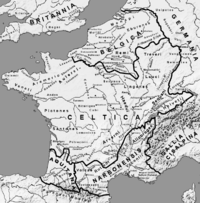
In the pre-Roman era, all of Gaul (an area of Western Europe that encompassed all of what is known today as France, Belgium, part of Germany and Switzerland, and Northern Italy) was inhabited by a variety of peoples who were known collectively as the Gaulish tribes. Their ancestors were Celtic immigrants who came from Central Europe in the 7th century BCE
(and even before, according to new researchs), and dominated native peoples (which can't be clearly identified except the Ligures
in south Provence, the Iberians
at the eastern bottom of the Pyrenees and Aquitanic people (among them, the Basques) in Aquitaine. Some, particularly in the northern and eastern areas, had Germanic admixture. Many of these peoples had already spoken Celtic by the time of the Roman conquest, but others seem to have spoken a Celto-Germanic creole.
Gaul was military conquered in 58-51 BCE by the Roman legions under the command of General Julius Caesar
(except the south-east which had already been conquered about one century earlier and which became the only place with Roman settlements). The area then became part of the Roman Empire
. Over the next five centuries the two cultures intermingled, creating a hybridized Gallo-Roman culture
. The Gaulish language came to be supplanted by Vulgar Latin
, which would later split into dialects that would develop into the French language
. Today, the last redoubt of Celtic culture and language in France can be found in the northwestern region of Brittany
, although this is not the result of a survival of Gaulish language but of a 5th century A.D. migration of Brythonic speaking Celts from Britain
.
, from which the word "French" derives. The Franks were Germanic pagans who began to settle in northern Gaul as laeti
, already during the Roman era. They continued to filter across the Rhine River from present-day Netherlands
and Germany
between the third to the 7th century. At the beginning, they served in the Roman army and reached high commands. Their language is still spoken as a kind of Dutch (Flemish
- Low Frankish) in northern France and Frankish (Central Franconian
) in German speaking Lorraine. Another Germanic people immigrated massively to Alsace
: the Alamans, which explains the Alemannic German
spoken there. They were competitors of the Franks, that's why it became the word for German in French: Allemand.
By the early 6th century the Franks, led by the Merovingian king Clovis I
and his sons, had consolidated their hold on much of modern-day France, the country to which they gave their name. The other major Germanic people to arrive in France (after the Franks and the Visigoths) were the Norsemen
or Northmen, (which was shortened to Norman in France), Viking
raiders from modern Denmark
and Norway
, who settled with Anglo-Scandinavians and Anglo-Saxons from the Danelaw
in the northern region known today as Normandy
but also in western France in the 9th and 10th century. The Vikings eventually intermarried with the local people, converting to Christianity
in the process. It was the Normans who, two centuries later, would go on to conquer England.
Eventually, though, the independent duchy of Normandy
was incorporated back into the French kingdom in the Middle Ages
. In the crusader Kingdom of Jerusalem
, founded in 1099, at most 120 000 Franks (predominantly French
-speaking Western Christians) ruled over 350,000 Muslims, Jews, and native Eastern Christians.
 In the roughly 900 years after the Norman invasions
France had a fairly settled population . Unlike elsewhere in Europe, France experienced relatively low levels of emigration to the Americas
, with the exception of the Huguenots. However, significant emigration of mainly Roman Catholic French populations led to the settlement of the Province of Acadia
, Canada (New France) and Louisiana
, all (at the time) French possessions, as well as colonies in the West Indies, Mascarene islands and Africa
.
On 31 December 1687 a community of French Huguenots
settled in South Africa
. Most of these originally settled in the Cape Colony
, but have since been quickly absorbed into the Afrikaner
population. After Champlain's founding of Quebec City in 1608, it became the capital of New France
. Encouraging settlement was difficult, and while some immigration did occur, by 1763 New France only had a population of some 65,000. From 1713 to 1787, 30,000 colonists immigrated from France to the St. Domingue. In 1805, when the French were forced out of St. Domingue (Haiti
) 35,000 French settlers were given lands in Cuba
.
By the beginning of the 17th century, some 20% of the total male population of Catalonia
was made up of French immigrants. For the most part, the French were assimilated with relative ease into Catalan society.
In the 18th century and early 19th century, a small migration of French emigrated by official invitation of the Habsburgs to the Austro-Hungarian Empire, now the nations of Austria
, Hungary
, Slovakia
, Serbia
and Romania
. Some of them, coming from French-speaking communes in Lorraine
and another wave are French Swiss Walsers from the Valais
canton in Switzerland
, they maintained for some generations the French language, and a specific ethnic identity, later labelled as Banat
French, Français du Banat. By 1788 there were 8 villages populated by French colonists.
appeared following the 1789 French Revolution
and Napoleon's empire. It replaced the ancient kingdom of France, ruled by the divine right of kings
.
Hobsbawm highlighted the role of conscription
, invented by Napoleon, and of the 1880s public instruction laws, which allowed mixing of the various groups of France into a nationalist mold which created the French citizen and his consciousness of membership to a common nation, while the various regional languages of France were progressively eradicated.
The 1870 Franco-Prussian War
, which led to the short-lived Paris Commune
of 1871, was instrumental in bolstering patriotic feelings; until World War I
(1914–1918), French politicians never completely lost sight of the disputed Alsace-Lorraine
region, which played a major role in the definition of the French nation, and therefore of the French people. During the Dreyfus Affair
, anti-semitism
became apparent. Charles Maurras
, a royalist intellectual member of the far-right anti-parliamentarist Action Française
party, invented the neologism of the anti-France, which was one of the first attempts at contesting the republican definition of the French people as composed of all French citizens regardless of their ethnic origins or religious beliefs. Charles Maurras' expression of the anti-France opposed the Catholic French people to four "confederate states" incarning the Other
: Jews
, Freemasons
, Protestants and, last but not least, the métèques
("metics").
estimated that 11.8 million foreign-born immigrants and their direct descendants (born in France) lived in France representing 19% of the country's population. More than 5 million are of European origin and about 4 million of Maghrebi origin (20% of Algeria
n origin and 15% of Moroccan
or Tunisia
n origin). Immigrants aged 18-50 count for 2.7 millions (10% of population aged 18-50) and 5 millions for all ages (8% of population). 2nd Generation aged 18-50 make up 3.1 millions (12% of 18-50) and 6.5 millions for all ages (11% of population)
Legally, the sovereign
people of France are composed of all French citizens, regardless of ethnicity or religion. Citizens of any ethnicity are included in that definition. Successive waves of immigrants during the 19th and 20th centuries were thus rapidly assimilated into French culture.
The INSEE
does not collect data about language, religion, or ethnicity – on the principle of the secular and unitary nature of the French Republic.
Nevertheless, there are some sources dealing with just such distinctions:
It is said by some that France adheres to the ideal of a single, homogeneous national culture, supported by the absence of hyphenated identities and by avoidance of the very term "ethnicity" in French discourse.
The discussion about social discrimination
has become more important, in particular concerning the so-called "second-generation immigrants"; that is, French citizens born in France to immigrant parents.
France has undergone a high rate of immigration from Europe, Africa, and Asia throughout the 20th century. Michèle Tribalat, researcher at INED, found it difficult to estimate the number of French immigrants or those born to immigrants because of the absence of official statistics. Only three previous attempts had been made: in 1927, 1942, and 1986. According to the 2004 Tribalat study, among about 14 million people of foreign ascendancy (immigrants or people with at least one parent or grandparent who was an immigrant) living in France in 1999, 5.2 million were from Southern Europe
an ascendancy (Italy, Spain, Portugal), and 3 million from the Maghreb
. Thus it was found that 23 percent of French citizens had at least one immigrant parent or grandparent.
According to a recent genetic study in 2008, 28.45% of all newborns in mainland France in 2007 had at least one parent of immigrant origin from the following regions (Overseas departments and territories of France
, Africa, America, Southern Europe : Portugal, Greece and South Italy, Near and Middle East and the Indian sub-continent). The Paris metropolitan district (Île-de-France
) is the region that accounts for the largest number with nearly 56% of all newborns in this area in 2007 having at least one parent of immigrant origin. The second largest number is in Provence-Alpes-Côte d'Azur
at nearly 42% and the lowest number is in Brittany
at 4.40%.
France's population dynamics began to change in the middle of the 19th century, as France joined the Industrial Revolution
. The pace of industrial growth attracted millions of European immigrants over the next century, with especially large numbers arriving from Poland
, Belgium
, Portugal
, Italy
, and Spain
. In the period from 1915 to 1950, just as many immigrants came from Czechoslovakia
, Hungary
, Russia
, Scandinavia
and Yugoslavia
. A small French descent group also subsequently arrived from Latin America
(Argentina
, Chile
and Uruguay
) in the 1970s. Small but significant numbers of Frenchmen in the North and Northeast regions have relatives in Germany
and Great Britain
. French law made it easy for thousands of colons, ethnic or national French from former colonies of North and East Africa
, India
and Indochina
to live in mainland France. It is estimated that 20,000 colons were living in Saigon in 1945. 1.6 million European pieds noirs migrated from Algeria
, Tunisia
and Morocco
. In just a few months in 1962, 900,000 French Algerians
left Algeria
in the most massive relocation of population in Europe since the World War II
. In the 1970s, over 30,000 French colons left Cambodia
during the Khmer Rouge
regime as the Pol Pot
government confiscated their farms and land properties.
In the 1960s, a second wave of immigration came to France, which was needed for reconstruction purposes and for cheaper labour after the devastation brought on by World War II
. French entrepreneurs went to Maghreb
countries looking for cheap labour, thus encouraging work-immigration to France. Their settlement was officialized with Jacques Chirac
's family regrouping act of 1976 (regroupement familial). Since then, immigration has become more varied, although France stopped being a major immigration country compared to other European countries. The large impact of North African and Arab
immigration is the greatest and has brought racial, socio-cultural and religious questions to a country seen as homogenously European, French and Christian
for thousands of years. Nevertherless, according to Justin Vaïsse, professor at Sciences Po Paris, in spite of obstacles and spectacular failures like the riots in November 2005
, integration of Muslim immigrants is happening as part of a background evolution and recent studies confirmed the results of their assimilation, showing that "North Africans seem to be characterized by a high degree of cultural integration reflected in a relatively high propensity to exogamy
" with rates ranging from 20% to 50%. According to Emmanuel Todd
the relatively high exogamy among French Algerians can be explained by the colonial link between France and Algeria.
Between 1956 and 1967, about 235.000 North African Jews from Algeria, Tunisia and Morocco also immigrated to France due to the decline of the French empire and following the Six-Day War. Hence, by 1968, North African Jews were the majority in France. As these new immigrants were already culturally French they needed little time to adjust to French society.
In 2004, a total of 140,033 people immigrated to France. Of them, 90,250 were from Africa
and 13,710 from Europe
. In 2005, immigration level fell slightly to 135,890. The European Union
allows free movement between the member states. While the UK and Ireland
did not impose restrictions, France put in place controls to curb Central
and Eastern European migration.
In November 2004, several thousand of the estimated 14,000 French nationals in Ivory Coast left the country after days of anti-white violence. There are 2.2 million French citizens, about 4 percent of the population, outside France.
According to Michel Tribalat, a researcher at INED
, there were 3.5 million people of Maghrebi origin (with at least one grandparent from Algeria, Morocco or Tunisia) living in France
in 2005 corresponding to 5.8% of the total French metropolitan population (60.7 millions in 2005). Maghrebis have settled mainly in the industrial regions in France, especially in the Paris region
. Many famous French people like Edith Piaf
, Isabelle Adjani
, Arnaud Montebourg
, Alain Bashung
, Dany Boon
and many others have Maghrebi ancestry.
Below is a table of population of Maghrebi origin in France, numbers are in thousands:
In 2005, the percentage of young people under 18 of maghrebi origin (at least one immigrant parent) was about 7% in Metropolitan France
, 12% in Greater Paris
and above 20% in French département of Seine-Saint-Denis
.
According to other sources, between 5 and 6 million people of Maghrebin origin live in France corresponding to about 7-9% of the total French metropolitan population.
, Occitan, Corsican
, Basque
, French Flemish and Breton
remain spoken in certain regions (see Language policy in France
). There have also been periods of history when a majority of French people had other first languages (local languages such as Occitan, Catalan
, Alsatian
, West Flemish
, Lorraine Franconian
, Gallo
, Picard
or Ch'timi and Arpitan). Today, many immigrants speak another tongue at home.
According to historian Eric Hobsbawm
, "the French language has been essential to the concept of 'France'", although in 1789, 50 percent of the French people did not speak it at all, and only 12 to 13 percent spoke it fairly well; even in oïl language zones, it was not usually used except in cities, and even there not always in the outlying districts.
is spoken in many different countries – in particular the former French colonies
. Nevertheless, speaking French is distinct from being a French citizen. Thus, francophonie, or the speaking of French, must not be confused with French citizenship or ethnicity. For example, French speakers in Switzerland
are not "French citizens".
Native English-speaking Blacks on the island of Saint-Martin hold French nationality even though they do not speak French as a first language, while their neighbouring French-speaking Haitian immigrants speak French créole yet remain foreigners. Large numbers of people of French ancestry outside Europe speak other first languages, particularly English, throughout most of North America (except French Canada), Spanish or Portuguese in southern South America
, and Afrikaans
in South Africa
.
The adjective "French" can be used to mean either "French citizen" or "French-speaker", and usage varies depending on the context, with the former being common in France. The latter meaning is sometimes used in Canada, when discussing matters internal to Canada.
, Ligurians
and Greeks
in southern France, mixed with Germanic peoples
arriving at the end of the Roman Empire
such as the Franks
and the Burgundians
, some Moors
and Saracens, and some Vikings who mixed with the Normans
and settled mostly in Normandy
in the 9th century.
According to Dominique Schnapper
, "The classical conception of the nation is that of an entity which, opposed to the ethnic group, affirms itself as an open community, the will to live together expressing itself by the acceptation of the rules of a unified public domain which transcends all particularisms". This conception of the nation as being composed by a "will to live together", supported by the classic lecture
of Ernest Renan
in 1882, has been opposed by the French far-right, in particular the nationalist
Front National ("National Front" - FN) party, which claims that there is such a thing as a "French ethnic group". The discourse of ethno-nationalist groups such as the Front National (FN), however, forwards the concept of Français de souche or "indigenous" French.
Since the beginning of the Third Republic
(1871–1940), the state has not categorized people according to their alleged ethnic origins. Hence, in contrast to the United States Census
, French people are not asked to define their ethnic appartenance, whichever it may be. The usage of ethnic and racial categorization is avoided to prevent any case of discrimination, the same regulations apply to religious membership data that cannot be compiled under the French Census. This classic French republican non-essentialist conception of nationality is officialized by the French Constitution, according to which "French" is a nationality
, and not a specific ethnicity.
France was one of the first countries to implement denaturalization laws. Philosopher Giorgio Agamben
has pointed out this fact that the 1915 French law which permitted denaturalization with regard to naturalized citizens of "enemy" origins was one of the first example of such legislation, which Nazi Germany
later implemented with the 1935 Nuremberg Laws
.
Furthermore, some authors who have insisted on the "crisis of the nation-state" allege that nationality and citizenship are becoming separate concepts. They show as example "international
", "supranational citizenship" or "world citizenship" (membership to international nongovernmental organization
s such as Amnesty International
or Greenpeace
). This would indicate a path toward a "postnational citizenship".
Beside this, modern citizenship is linked to civic participation (also called positive freedom), which implies voting, demonstrations
, petition
s, activism
, etc. Therefore, social exclusion
may lead to deprivation of citizenship. This has led various authors (Philippe Van Parijs
, Jean-Marc Ferry
, Alain Caillé, André Gorz
) to theorize a guaranteed minimum income
which would impede exclusion from citizenship.
and multiculturalism
, especially in recent years. French citizenship has been defined for a long time by three factors: integration, individual adherence
, and the primacy of the soil (jus soli
). Political integration (which includes but is not limited to racial integration
) is based on voluntary policies which aims at creating a common identity, and the interiorization by each individual of a common cultural and historic legacy. Since in France, the state preceded the nation, voluntary policies have taken an important place in the creation of this common cultural identity
.
On the other hand, the interiorization of a common legacy is a slow process, which B. Villalba compares to acculturation
. According to him, "integration is therefore the result of a double will: the nation's will to create a common culture for all members of the nation, and the communities' will living in the nation to recognize the legitimacy of this common culture". Villalba warns against confusing recent processes of integration (related to the so-called "second generation immigrants", who are subject to discrimination
), with older processes which have made modern France. Villalba thus shows that any democratic nation characterize itself by its project of transcending all forms of particular memberships (whether biological - or seen as such, ethnic, historic, economic, social, religious or cultural). The citizen thus emancipates himself from the particularisms of identity which characterize himself to attain a more "universal" dimension. He is a citizen, before being member of a community or of a social class
Therefore, according to Villalba, "a democratic nation is, by definition, multicultural as it gathers various populations, which differs by their regional origins (Bretons, Corsicans or Lorrains...), their national origins (immigrant, son or grandson of an immigrant), or religious origins (Catholics, Protestants, Jews, Muslims, Agnostics or Atheists...)."
described this republican conception in his famous 11 March 1882 conference at the Sorbonne
, Qu'est-ce qu'une nation? ("What is a Nation?
"). According to him, to belong to a nation
is a subjective
act which always has to be repeated, as it is not assured by objective
criteria. A nation-state
is not composed of a single homogeneous ethnic group (a community), but of a variety of individuals willing to live together.
Renan's non-essentialist definition, which forms the basis of the French Republic, is diametrically opposed to the German ethnic conception of a nation, first formulated by Fichte. The German conception is usually qualified in France as an "exclusive" view of nationality, as it includes only the members of the corresponding ethnic group, while the Republican conception thinks itself as universalist, following the Enlightenment
's ideals officialized by the 1789 Declaration of the Rights of Man and of the Citizen
. While Ernest Renan's arguments were also concerned by the debate about the disputed Alsace-Lorraine
region, he said that not only one referendum
had to be made in order to ask the opinions of the Alsatian people, but a "daily referendum" should be made concerning all those citizens wanting to live in the French nation-state. This plébiscite de tous les jours might be compared to a social contract
or even to the classic definition of consciousness
as an act which repeats itself endlessly.
Henceforth, contrary to the German definition of a nation based on objective criteria, such as the "race" or the "ethnic group", which may be defined by the existence of a common language
, among others criteria, the people of France are defined by all the people living in the French nation-state and willing to do so, i.e. by its citizenship. This definition of the French nation-state contradicts the common opinion
according to which the concept of the French people would identify themselves with the concept of one particular ethnic group, and thus explains the paradox to which is confronted by some attempts in identifying the "French ethnic group": the French conception of the nation is radically opposed (and was thought in opposition to) the German conception of the Volk ("ethnic group").
This universalist conception of citizenship and of the nation has influenced the French model of colonization
. While the British empire
preferred an indirect rule
system, which did not mix together the colonized people with the colons, the French Republic theoretically chose an integration system and considered parts of its colonial empire
as France itself, and its population as French people. The ruthless conquest of Algeria
thus led to the integration of the territory as a Département of the French territory.
This ideal also led to the ironic sentence which opened up history textbooks in France as in its colonies: "Our ancestors the Gauls...". However, this universal ideal, rooted in the 1789 French Revolution ("bringing liberty to the people"), suffered from the racism
that impregnated colonialism. Thus, in Algeria, the Crémieux decrees
at the end of the 19th century gave French citizenship to north African Jews, while Muslims were regulated by the 1881 Indigenous Code. Liberal author Tocqueville
himself considered that the British model was better adapted than the French one, and did not balk before the cruelties of General Bugeaud
's conquest. He went as far as advocating racial segregation
there.
This paradoxical tension between the universalist conception of the French nation and the racism inherent in colonization is most obvious in Ernest Renan himself, who goes as far as advocating a kind of eugenics
. In a 26 June 1856 letter to Arthur de Gobineau
, author of An Essay on the Inequality of the Human Races
(1853–55) and one of the first theoreticians of "scientific racism
", he thus wrote:
(or "right of territory") was predominant. Feudal law recognized personal allegeance to the sovereign
, but the subjects of the sovereign were defined by their birthland. According to the 3 September 1791 Constitution, those who are born in France from a foreign father and have fixed their residency in France, or those who, after being born in foreign country from a French father, have come to France and have sworn their civil oath, become French citizens. Because of the war, distrust toward foreigners led to the obligation on the part of this last category to swear a civil oath in order to gain French nationality.
However, the Napoleonic Code
would insist on jus sanguinis
("right of blood"). Paternity
, against Napoléon Bonaparte's wish, became the principal criterion of nationality, and therefore broke for the first time with the ancient tradition of jus soli, by breaking any residency condition toward children born abroad from French parents. However, according to Patrick Weil
, it was not "ethnically motivated" but "only meant that family links transmitted by the pater familias had become more important than subjecthood".
With the 7 February 1851 law, voted during the Second Republic
(1848–1852), "double jus soli" was introduced in French legislation, combining birth origin with paternity. Thus, it gave French nationality to the child of a foreigner, if both are born in France, except if the year following his coming of age he reclaims a foreign nationality (thus prohibiting dual nationality). This 1851 law was in part passed because of conscription
concerns. This system more or less remained the same until the 1993 reform of the Nationality Code, created by the 9 January 1973 law.
The 1993 reform, which defines the Nationality law
, is deemed controversial by some. It commits young people born in France to foreign parents to solicit French nationality between the ages of 16 and 21. This has been criticized, some arguing that the principle of equality before the law was not complied with, since French nationality was no longer given automatically at birth, as in the classic "double jus soli" law, but was to be requested when approaching adulthood. Henceforth, children born in France from French parents were differentiated from children born in France from foreign parents, creating a hiatus between these two categories.
The 1993 reform was prepared by the Pasqua laws
. The first Pasqua law, in 1986, restricts residence conditions in France and facilitates expulsion
s. With this 1986 law, a child born in France from foreign parents can only acquire French nationality if he or she demonstrates his or her will to do so, at age 16, by proving that he or she has been schooled in France and has a sufficient command of the French language. This new policy is symbolized by the expulsion of 101 Mali
ans by charter.
The second Pasqua law on "immigration control" makes regularisation of illegal aliens more difficult and, in general, residence conditions for foreigners much harder. Charles Pasqua, who said on 11 May 1987: "Some have reproached me of having used a plane, but, if necessary, I will use trains", declared to Le Monde
on 2 June 1993: "France has been a country of immigration, it doesn't want to be one anymore. Our aim, taking into account the difficulties of the economic situation, is to tend toward 'zero immigration' ("immigration zéro")".
Therefore, modern French nationality law combines four factors: paternality or 'right of blood', birth origin, residency and the will expressed by a foreigner, or a person born in France to foreign parents, to become French.
introduced the concept of European citizenship
, which comes in addition to national citizenships.
" is someone who does not have French nationality. Therefore, it is not a synonym of "immigrant
", as a foreigner may be born in France. On the other hand, a Frenchman born abroad may be considered an immigrant (e.g. former prime minister Dominique de Villepin
who lived the majority of his life abroad). In most of the cases, however, a foreigner is an immigrant, and vice-versa. They either benefit from legal sojourn in France, which, after a residency of ten years, makes it possible to ask for naturalisation. If they do not, they are considered "illegal aliens
". Some argue that this privation of nationality and citizenship does not square with their contribution to the national economic efforts, and thus to economic growth
.
In any cases, rights of foreigners in France have improved over the last half-century:
conception of the French nation-state
has been challenged since the 1980s by the Front National 's nationalist
discourse
of La France aux Français ("France to the French") or Les Français d'abord ("French first"). Their claims of an "ethnic French" group (Français de souche, which literally translated as "French with roots") have been adamantly refused by many other groups, which widely considered this Party as racist. Alain de Benoist
's Nouvelle Droite
movement, quite famous in the 1980s but which has since lost influence, has embraced a kind of European "white supremacy
" ideology
. It should be noted that the expression Français de souche has no official validity in France although it is used in everyday language, something which has been designed as lepénisation
des esprits ("LePen-isation of the minds").
Indeed, the inflow of populations from other continents, who still can be physically and/or culturally distinguished from Europeans, sparked much controversies in France since the early 1980s, even though immigration inflow precisely began to decrease at this time. The rise of this racist discourse
led to the creation of anti-racist
NGOs, such as SOS Racisme
, more or less founded on the model of anti-fascist
organisations in the 1930s. However, while those earlier anti-fascists organisations were often anarchists
or communists
, SOS Racisme was supported in its growth by the Socialist Party. Demonstrations gathering large crowds against the National Front took place. The last such demonstration took place in a dramatic situation, after Jean-Marie Le Pen
's relative victory at the first turn of the 2002 presidential election
. Shocked and stunned, large crowds, including many young people, demonstrated every day in between the two turns, starting from 21 April 2002, which remains a dramatic date in popular consciousness.
Now, the interracial
blending of some native French and newcomers is an attribute of French culture, from popular music to movies and literature. Therefore, alongside mixing of populations, there exists a cultural blending (le métissage culturel) in France. It may be compared to the traditional US conception of the melting-pot. There are historical instances of blending from other races and ethnicities in France. Biographical research has determined a possibility of African ancestry on a small number of famous French citizens. For example, author Alexandre Dumas, père
possessed one-fourth black Haitian descent,. We can mention as well, the most famous French singer Edith Piaf
whose grandmother was a North African from Morocco
or Jacques Derrida
, a North African Jew from Algeria, who is known as the founder of deconstruction
.
For a long time, the only objection to such outcomes predictably came from the far-right schools of thought. In the past few years, other unexpected voices are however beginning to question what they interpret, as the new philosopher
Alain Finkielkraut
coined the term, as an "ideology of miscegenation" (une idéologie du métissage) that may come from what one other philosopher, Pascal Bruckner
, defined as the "sob of the White man" (le sanglot de l'homme blanc). These critics have been dismissed by the mainstream and their propagators have been labelled as new reactionaries (les nouveaux réactionnaires), even if racist and anti-immigration sentiment has recently been documented to be increasing in France at least according to one poll. Such critics, including Nicolas Sarkozy
, the current President of France
, take example on the United States' conception of multiculturalism
to claim that France has consistently denied the existence of ethnic groups within their borders and has refused to grant them specific rights.
President Jacques Chirac
as well as the Socialist Party and other organizations have condemned these views, arguing that this refusal of the traditional universalist republican conception only favorizes communitarianism
, which the Republic does not recognize since the dissolving of intermediate associations of persons during the Estates-General of 1789
(the population of the kingdom of France was then divided into the First Estate (clergy), the Second Estate (nobles), and the Third Estate (people)). For this reason, associations were forbidden until the Waldeck-Rousseau 1884 labor laws which permitted the creation of trade unions and the famous 1901 law on non-profit associations, which has been largely used by civil society
in order to organizes itself. Hervé Le Bras, head of the INED demographic institute, also insists that "ethnicisation of social relations is not a 'natural' phenomenon, but an ideological
one"
. The Canadian province of Quebec
(2006 census population of 7,546,131), where more than 95 percent of the people speak French as either their first, second or even third language, is the center of French life on the Western side of the Atlantic; however, French settlement began further east, in Acadia
. Quebec is home to vibrant French-language arts, media, and learning. There are sizable French-Canadian communities scattered throughout the other provinces of Canada, particularly in Ontario
, which has about 1 million francophones, and New Brunswick
, which is the only fully bilingual province and is 33 percent Acadian
.
, or 4 to 5 percent of the US population, particularly in Louisiana
, New England
and parts of the Midwest. The French community in Louisiana consists of the Creoles
, the descendants of the French settlers who arrived when Louisiana was a French colony, and the Cajuns, the descendants of Acadia
n refugees from the Great Upheaval
. Very few creoles remain in New Orleans in present times. In New England, the vast majority of French immigration in the 19th and early 20th centuries came not from France, but from over the border in Quebec, the Quebec diaspora
. These French Canadians arrived to work in the timber mills and textile plants that appeared throughout the region as it industrialized. Today, nearly 25 percent of the population of New Hampshire
is of French ancestry, the highest of any state.
English and Dutch colonies of pre-Revolutionary America attracted large numbers of French Huguenots fleeing religious persecution in France. In the Dutch colony of New Netherland
that later became New York, northern New Jersey, and western Connecticut
, these French Huguenots, nearly identical in religion to the Dutch Reformed Church
, assimilated almost completely into the Dutch community. However, large it may have been at one time, it has lost all identity of its French origin, often with the translation of names (examples: de la Montagne > Vandenberg by translation; de Vaux > DeVos or Devoe by phonetic respelling). Huguenots appeared in all of the English colonies and likewise assimilated. Even though this mass settlement approached the size of the settlement of the French settlement of Quebec, it has assimilated into the English-speaking mainstream to a much greater extent than other French colonial groups, and has left few traces of cultural influence. New Rochelle, New York
is named after La Rochelle
, France, one of the sources of Huguenot emigration to the Dutch colony; and New Paltz, New York
, is one of the few non-urban settlements of Huguenots that did not undergo massive recycling of buildings in the usual redevelopment of such older, larger cities as New York City or New Rochelle.
, a sizeable population can trace its ancestry to France, which was the second largest European contributor, after Spain. The bulk of French immigrants arrived in Mexico during the 19th and early 20th centuries.
From 1814 to 1955, inhabitants of Barcelonnette
and the surrounding Ubaye valley emigrated to Mexico by the dozens. Many established textile businesses between Mexico and France. At the turn of the 20th century, there were 5000 French families from the Barcelonnette region registered with the French Consulate in Mexico. While 90% stayed in Mexico, some returned, and from 1880 to 1930, built grand mansions called Maisons Mexicaines and left a mark upon the city.
In the 1860s, during the Second Mexican Empire
ruled by Emperor Maximilian I of Mexico
-- which was part of Napoleon III's scheme to create a Latin empire in the New World (indeed responsible for coining the term or Amérique latine, or 'Latin America')-- many French soldiers, merchants, and families set foot upon Mexican soil. Emperor Maximilian's consort, Carlota of Mexico
, a Belgian princess, was a granddaughter of Louis-Philippe of France.
Many Mexicans of French descent live in cities such as San Luis Potosí
, Sinaloa
, Monterrey
, Puebla
, Guadalajara
, and the capital, Mexico City
, where French surnames such as Derbez, Pierres, Michel, Zatarain, Betancourt, Alaniz, Blanc, Jurado (Jure), Colo (Coleau), Dumas, Tresmontrels, and Moussier can be found.
, after Italian and Spanish Argentines. Most of French immigrants came to Argentina between 1871 and 1890, though considerable immigration continued until the late 1940s. At least half of these immigrants came from Southwestern France, especially from the Basque Country, Béarn (Basses-Pyrénées accounted for more than 20% of immigrants), Bigorre and Rouergue but also from Savoy and the Paris region. Today around 6.8 million Argentines have some degree of French descent (up to 17% of the total population). French Argentines had a considerable influence over the country, particularly on its architectural styles and literary traditions, as well as on the scientific field. Some notable Argentines of French descent include writer Julio Cortázar
, physiologist and Nobel Prize
winner Bernardo Houssay
or activist Alicia Moreau de Justo
.
With akin Latin culture, the French immigrants quickly assimilated into mainstream Argentine society.
as merchants, and in the mid-19th century to cultivate vines in the haciendas of the Central Valley, the homebase of world-famous Chilean wine
. The Araucanía Region
also has an important number of people of French ancestry, as the area hosted settlers arrived by the second half of the 19th century as farmers and shopkeepers. With akin Latin culture
, the French immigrants quickly assimilated into mainstream Chilean society.
From 1840 to 1940, around 25,000 Frenchmen immigrated to Chile. 80% of them were coming from Southwestern France, especially from Basses-Pyrénées
(Basque country
and Béarn
), Gironde
, Charente-Inférieure
and Charente
and regions situated between Gers
and Dordogne
.
Most of French immigrants settled in the country between 1875 and 1895. Between October 1882 and December 1897, 8,413 Frenchmen settled in Chile, making up 23% of immigrants (second only after Spaniards) from this period. In 1863, 1,650 French citizens were registered in Chile. At the end of the century they were almost 30,000. According to the census of 1865, out of 23,220 foreigners established in Chile, 2,483 were French, the third largest European community in the country after Germans and Englishmen. In 1875, the community reached 3,000 members, 12% of the almost 25,000 foreigners established in the country. It was estimated that 10,000 Frenchmen were living in Chile in 1912, 7% of the 149,400 Frenchmen living in Latin America.
In World War II, a group of over 10,000 Chileans of French descent, the majority have French relatives joined the Free French Forces
and fought the Nazi occupation of France
.
Today it is estimated that 500,000 Chileans are of French descent.
Former president of Chile, Michelle Bachelet
is of French origin. Former president Augusto Pinochet
was another Chilean of French descent. A large percentage of politicians, businessmen, professionals and entertainers in the country are of French ancestry.
From 1819 to 1940, 40,383 Frenchmen immigrated to Brazil
. Most of them settled in the country between 1884 and 1925 (8,008 from 1819 to 1883, 25,727 from 1884 to 1925, 6,648 from 1926 to 1940). Another source estimates that around 100,000 French people immigrated to Brazil between 1850 and 1965.
The French community in Brazil numbered 592 in 1888 and 5,000 in 1915. It was estimated that 14,000 Frenchmen were living in Brazil in 1912, 9% of the 149,400 Frenchmen living in Latin America
, the second largest community after Argentina (100,000).
The Brazilian Imperial Family originates of House of Orléans
, the French Royal Family. Two examples are the Emperor
s, Pedro I and Pedro II
.
, Cuba
(refugees from the Haitian Revolution
) and Uruguay
. The Betancourt political families whom influenced Colombia
, Venezuela
, Ecuador
, Puerto Rico
, Bolivia
and Panama
have some French ancestry.
, in Protestant areas of Germany
(especially the city of Berlin
), in the Netherlands
, in South Africa
and in North America
. Many people in these countries still bear French names, even though their culture and identity are now completely assimilated.
A small proportion of people with mixed French and Khmer descent can be found in Cambodia. These people number approximately 16,000 in Cambodia, among this number, approximately 3,000 are of pure French descent.
An unknown number with mixed French and Lao ancestry can be found throughout Laos.
In addition to these Countries, small minorities can be found elsewhere in Asia; the majority of these living as expatriates.
s of New Caledonia
, Louisiana Creole people
of the United States, the so-called Zoreilles and Petits-blancs of various Indian Ocean islands, as well as populations of the former French colonial empire
in Africa. There are currently an estimated 400,000 French people in the United Kingdom, most of them in London
.
(particularly R1b1b2) was found to be the most dominant Y chromosomal lineage in France, covering about 60% of the Y chromosomal lineages. The high frequency of this haplogroup is typical in all West European populations. Haplogroups I
and G
are also characteristic markers for many different West European populations. Haplogroups J
and E1b1b (M35, M78, M81 and M34) consist of lineages with differential distribution within Middle East, North Africa and Europe. Only adults with French surname were analyzed by the study.
Nation
A nation may refer to a community of people who share a common language, culture, ethnicity, descent, and/or history. In this definition, a nation has no physical borders. However, it can also refer to people who share a common territory and government irrespective of their ethnic make-up...
that share a common French culture and speak the French language
French language
French is a Romance language spoken as a first language in France, the Romandy region in Switzerland, Wallonia and Brussels in Belgium, Monaco, the regions of Quebec and Acadia in Canada, and by various communities elsewhere. Second-language speakers of French are distributed throughout many parts...
as a mother tongue. Historically, the French population are descended from peoples of Celtic, Latin
Latins
"Latins" refers to different groups of people and the meaning of the word changes for where and when it is used.The original Latins were an Italian tribe inhabiting central and south-central Italy. Through conquest by their most populous city-state, Rome, the original Latins culturally "Romanized"...
and Germanic
Germanic peoples
The Germanic peoples are an Indo-European ethno-linguistic group of Northern European origin, identified by their use of the Indo-European Germanic languages which diversified out of Proto-Germanic during the Pre-Roman Iron Age.Originating about 1800 BCE from the Corded Ware Culture on the North...
origin, and are today a mixture of several ethnic group
Ethnic group
An ethnic group is a group of people whose members identify with each other, through a common heritage, often consisting of a common language, a common culture and/or an ideology that stresses common ancestry or endogamy...
s. Within France, the French are defined by citizenship
Citizenship
Citizenship is the state of being a citizen of a particular social, political, national, or human resource community. Citizenship status, under social contract theory, carries with it both rights and responsibilities...
, regardless of ancestry or country of residence.
However, the word can also refer to people of French descent who are found in other countries, with significant French-speaking population groups or not, such as Argentina
Argentina
Argentina , officially the Argentine Republic , is the second largest country in South America by land area, after Brazil. It is constituted as a federation of 23 provinces and an autonomous city, Buenos Aires...
(French Argentine
French Argentine
A French Argentine is an Argentine citizen of full or partial French ancestry. French Argentines form the third or fourth largest ancestry group after Italian Argentines, Spanish Argentines, and perhaps German Argentines...
s), Brazil
Brazil
Brazil , officially the Federative Republic of Brazil , is the largest country in South America. It is the world's fifth largest country, both by geographical area and by population with over 192 million people...
(French Brazilian
French Brazilian
A French Brazilian is a Brazilian citizen of full, partial, or predominantly French ancestry, or a French-born person residing in Brazil. Between 1850 and 1965 around 100,000 French people immigrated to Brazil. The country received the second largest number of French immigrants to South America...
s), French West Indies
French West Indies
The term French West Indies or French Antilles refers to the seven territories currently under French sovereignty in the Antilles islands of the Caribbean: the two overseas departments of Guadeloupe and Martinique, the two overseas collectivities of Saint Martin and Saint Barthélemy, plus...
(the French Caribbean
French Caribbean
The term French Caribbean varies in meaning with its usage and frame of reference. This ambiguity makes it very different from the term French West Indies, which refers to the specific, formal French possessions in the Caribbean region...
people),Canada
Canada
Canada is a North American country consisting of ten provinces and three territories. Located in the northern part of the continent, it extends from the Atlantic Ocean in the east to the Pacific Ocean in the west, and northward into the Arctic Ocean...
(French Canadian
French Canadian
French Canadian or Francophone Canadian, , generally refers to the descendents of French colonists who arrived in New France in the 17th and 18th centuries...
s) and the United States
United States
The United States of America is a federal constitutional republic comprising fifty states and a federal district...
(French American
French American
French Americans or Franco-Americans are Americans of French or French Canadian descent. About 11.8 million U.S. residents are of this descent, and about 1.6 million speak French at home.An additional 450,000 U.S...
s), and some of them have a French cultural identity.
Citizenship and legal residence
To be French, according to the first article of the Constitution, is to be a citizen of France, regardless of one's origin, race, or religion (sans distinction d'origine, de race ou de religion). According to its principles, France has devoted herself to the destiny of a proposition nation, a generic territory where people are bounded only by the French languageFrench language
French is a Romance language spoken as a first language in France, the Romandy region in Switzerland, Wallonia and Brussels in Belgium, Monaco, the regions of Quebec and Acadia in Canada, and by various communities elsewhere. Second-language speakers of French are distributed throughout many parts...
and the assumed willingness to live together, as defined by Ernest Renan
Ernest Renan
Ernest Renan was a French expert of Middle East ancient languages and civilizations, philosopher and writer, devoted to his native province of Brittany...
's "plébiscite de tous les jours" ("daily referendum" on the willingness to live together, in Renan's 1882 essay "Qu'est-ce qu'une nation?").
The debate concerning the integration of this view with the principles underlying the European Community remains open.
A large number of foreigners have traditionally been permitted to live in France and succeeded in doing so. Indeed, the country has long valued its openness
Openness
Openness is the quality of being open. It sometimes refers to a very general philosophical position from which some individuals and organizations operate, often highlighted by a decision-making process recognizing communal management by distributed stakeholders rather than a centralized authority...
, tolerance
Toleration
Toleration is "the practice of deliberately allowing or permitting a thing of which one disapproves. One can meaningfully speak of tolerating, ie of allowing or permitting, only if one is in a position to disallow”. It has also been defined as "to bear or endure" or "to nourish, sustain or preserve"...
and the quality of services available. Application for French citizenship is often interpreted as a renouncement of previous state allegiance
Allegiance
An allegiance is a duty of fidelity said to be owed by a subject or a citizen to his/her state or sovereign.-Etymology:From Middle English ligeaunce . The al- prefix was probably added through confusion with another legal term, allegeance, an "allegation"...
unless a dual citizenship agreement exists between the two countries (for instance, this is the case with Switzerland
Switzerland
Switzerland name of one of the Swiss cantons. ; ; ; or ), in its full name the Swiss Confederation , is a federal republic consisting of 26 cantons, with Bern as the seat of the federal authorities. The country is situated in Western Europe,Or Central Europe depending on the definition....
: one can be both French and Swiss). The European treaties have formally permitted movement and European citizens enjoy formal rights to employment in the state sector (though not as trainees in reserved branches (e.g. as magistrates).
Seeing itself as an inclusive nation with universal values, France has always valued and strongly advocated assimilation. However, the success of such assimilation has recently been called into question. There is increasing dissatisfaction with, and within, growing ethno-cultural enclaves (communautarisme
Communitarianism
Communitarianism is an ideology that emphasizes the connection between the individual and the community. That community may be the family unit, but it can also be understood in a far wider sense of personal interaction, of geographical location, or of shared history.-Terminology:Though the term...
). The 2005 French riots in some troubled and impoverished suburbs (les quartiers sensibles) were an example of such tensions. However they should not be interpreted as ethnic conflicts (as appeared before in other countries like the USA and the UK) but as social conflicts born out of socioeconomic problems endangering proper integration.
History
Most French people are the descendants of GaulsGauls
The Gauls were a Celtic people living in Gaul, the region roughly corresponding to what is now France, Belgium, Switzerland and Northern Italy, from the Iron Age through the Roman period. They mostly spoke the Continental Celtic language called Gaulish....
(a western European Celtic people), as well as Italic people, Sarmatian peoples
Sarmatians
The Iron Age Sarmatians were an Iranian people in Classical Antiquity, flourishing from about the 5th century BC to the 4th century AD....
(Alans
Alans
The Alans, or the Alani, occasionally termed Alauni or Halani, were a group of Sarmatian tribes, nomadic pastoralists of the 1st millennium AD who spoke an Eastern Iranian language which derived from Scytho-Sarmatian and which in turn evolved into modern Ossetian.-Name:The various forms of Alan —...
, Taifals
Taifals
The Taifals, Taifali, Taifalae, Tayfals, or Theifali were a people settled by the late Roman Empire in Poitou in the fourth century. They served as dediticii and laeti in the Roman and subsequently Merovingian militaries...
), Bretons, Belgae
Belgae
The Belgae were a group of tribes living in northern Gaul, on the west bank of the Rhine, in the 3rd century BC, and later also in Britain, and possibly even Ireland...
, Aquitani
Aquitani
The Aquitani were a people living in what is now Aquitaine, France, in the region between the Pyrenees, the Atlantic ocean and the Garonne...
ans (Basques
Basque people
The Basques as an ethnic group, primarily inhabit an area traditionally known as the Basque Country , a region that is located around the western end of the Pyrenees on the coast of the Bay of Biscay and straddles parts of north-central Spain and south-western France.The Basques are known in the...
), Iberians
Iberians
The Iberians were a set of peoples that Greek and Roman sources identified with that name in the eastern and southern coasts of the Iberian peninsula at least from the 6th century BC...
, Ligurians
Ligures
The Ligures were an ancient people who gave their name to Liguria, a region of north-western Italy.-Classical sources:...
, Suebi
Suebi
The Suebi or Suevi were a group of Germanic peoples who were first mentioned by Julius Caesar in connection with Ariovistus' campaign, c...
, Saxons
Saxons
The Saxons were a confederation of Germanic tribes originating on the North German plain. The Saxons earliest known area of settlement is Northern Albingia, an area approximately that of modern Holstein...
and Greeks
Greeks
The Greeks, also known as the Hellenes , are a nation and ethnic group native to Greece, Cyprus and neighboring regions. They also form a significant diaspora, with Greek communities established around the world....
in southern France, mixed with the Germanic people arriving at the end of the Roman Empire
Roman Empire
The Roman Empire was the post-Republican period of the ancient Roman civilization, characterised by an autocratic form of government and large territorial holdings in Europe and around the Mediterranean....
such as the Franks
Franks
The Franks were a confederation of Germanic tribes first attested in the third century AD as living north and east of the Lower Rhine River. From the third to fifth centuries some Franks raided Roman territory while other Franks joined the Roman troops in Gaul. Only the Salian Franks formed a...
, the Visigoths and the Burgundians
Burgundians
The Burgundians were an East Germanic tribe which may have emigrated from mainland Scandinavia to the island of Bornholm, whose old form in Old Norse still was Burgundarholmr , and from there to mainland Europe...
, and Vikings known as Normans
Normans
The Normans were the people who gave their name to Normandy, a region in northern France. They were descended from Norse Viking conquerors of the territory and the native population of Frankish and Gallo-Roman stock...
, who settled mostly in Normandy
Normandy
Normandy is a geographical region corresponding to the former Duchy of Normandy. It is in France.The continental territory covers 30,627 km² and forms the preponderant part of Normandy and roughly 5% of the territory of France. It is divided for administrative purposes into two régions:...
in the 9th century.
The name "France" etymologically derives from the word Francia, the territory of the Franks
Franks
The Franks were a confederation of Germanic tribes first attested in the third century AD as living north and east of the Lower Rhine River. From the third to fifth centuries some Franks raided Roman territory while other Franks joined the Roman troops in Gaul. Only the Salian Franks formed a...
. The Franks were a Germanic tribe that overran Roman Gaul at the end of the Roman Empire
Roman Empire
The Roman Empire was the post-Republican period of the ancient Roman civilization, characterised by an autocratic form of government and large territorial holdings in Europe and around the Mediterranean....
.
Some regions were immensely affected by mass migrations of different peoples: Celtics in Brittany
Brittany
Brittany is a cultural and administrative region in the north-west of France. Previously a kingdom and then a duchy, Brittany was united to the Kingdom of France in 1532 as a province. Brittany has also been referred to as Less, Lesser or Little Britain...
, and Germanics in Alsatia
Alsace
Alsace is the fifth-smallest of the 27 regions of France in land area , and the smallest in metropolitan France. It is also the seventh-most densely populated region in France and third most densely populated region in metropolitan France, with ca. 220 inhabitants per km²...
(Alemanni) before the existence of the Frankish kingdoms, and the languages and culture of these regions continue through self-perpetuation until this day.
Gaul
In the pre-Roman era, all of Gaul (an area of Western Europe that encompassed all of what is known today as France, Belgium, part of Germany and Switzerland, and Northern Italy) was inhabited by a variety of peoples who were known collectively as the Gaulish tribes. Their ancestors were Celtic immigrants who came from Central Europe in the 7th century BCE
Common Era
Common Era ,abbreviated as CE, is an alternative designation for the calendar era originally introduced by Dionysius Exiguus in the 6th century, traditionally identified with Anno Domini .Dates before the year 1 CE are indicated by the usage of BCE, short for Before the Common Era Common Era...
(and even before, according to new researchs), and dominated native peoples (which can't be clearly identified except the Ligures
Ligures
The Ligures were an ancient people who gave their name to Liguria, a region of north-western Italy.-Classical sources:...
in south Provence, the Iberians
Iberians
The Iberians were a set of peoples that Greek and Roman sources identified with that name in the eastern and southern coasts of the Iberian peninsula at least from the 6th century BC...
at the eastern bottom of the Pyrenees and Aquitanic people (among them, the Basques) in Aquitaine. Some, particularly in the northern and eastern areas, had Germanic admixture. Many of these peoples had already spoken Celtic by the time of the Roman conquest, but others seem to have spoken a Celto-Germanic creole.
Gaul was military conquered in 58-51 BCE by the Roman legions under the command of General Julius Caesar
Julius Caesar
Gaius Julius Caesar was a Roman general and statesman and a distinguished writer of Latin prose. He played a critical role in the gradual transformation of the Roman Republic into the Roman Empire....
(except the south-east which had already been conquered about one century earlier and which became the only place with Roman settlements). The area then became part of the Roman Empire
Roman Empire
The Roman Empire was the post-Republican period of the ancient Roman civilization, characterised by an autocratic form of government and large territorial holdings in Europe and around the Mediterranean....
. Over the next five centuries the two cultures intermingled, creating a hybridized Gallo-Roman culture
Gallo-Roman culture
The term Gallo-Roman describes the Romanized culture of Gaul under the rule of the Roman Empire. This was characterized by the Gaulish adoption or adaptation of Roman mores and way of life in a uniquely Gaulish context...
. The Gaulish language came to be supplanted by Vulgar Latin
Vulgar Latin
Vulgar Latin is any of the nonstandard forms of Latin from which the Romance languages developed. Because of its nonstandard nature, it had no official orthography. All written works used Classical Latin, with very few exceptions...
, which would later split into dialects that would develop into the French language
French language
French is a Romance language spoken as a first language in France, the Romandy region in Switzerland, Wallonia and Brussels in Belgium, Monaco, the regions of Quebec and Acadia in Canada, and by various communities elsewhere. Second-language speakers of French are distributed throughout many parts...
. Today, the last redoubt of Celtic culture and language in France can be found in the northwestern region of Brittany
Brittany
Brittany is a cultural and administrative region in the north-west of France. Previously a kingdom and then a duchy, Brittany was united to the Kingdom of France in 1532 as a province. Brittany has also been referred to as Less, Lesser or Little Britain...
, although this is not the result of a survival of Gaulish language but of a 5th century A.D. migration of Brythonic speaking Celts from Britain
Great Britain
Great Britain or Britain is an island situated to the northwest of Continental Europe. It is the ninth largest island in the world, and the largest European island, as well as the largest of the British Isles...
.
The Franks
With the decline of the Roman Empire in Western Europe, a federation of Germanic peoples entered the picture: the FranksFranks
The Franks were a confederation of Germanic tribes first attested in the third century AD as living north and east of the Lower Rhine River. From the third to fifth centuries some Franks raided Roman territory while other Franks joined the Roman troops in Gaul. Only the Salian Franks formed a...
, from which the word "French" derives. The Franks were Germanic pagans who began to settle in northern Gaul as laeti
Laeti
Laeti, the plural form of laetus, was a term used in the late Roman Empire to denote communities of barbari permitted to, and granted land to, settle on imperial territory on condition that they provide recruits for the Roman military...
, already during the Roman era. They continued to filter across the Rhine River from present-day Netherlands
Netherlands
The Netherlands is a constituent country of the Kingdom of the Netherlands, located mainly in North-West Europe and with several islands in the Caribbean. Mainland Netherlands borders the North Sea to the north and west, Belgium to the south, and Germany to the east, and shares maritime borders...
and Germany
Germany
Germany , officially the Federal Republic of Germany , is a federal parliamentary republic in Europe. The country consists of 16 states while the capital and largest city is Berlin. Germany covers an area of 357,021 km2 and has a largely temperate seasonal climate...
between the third to the 7th century. At the beginning, they served in the Roman army and reached high commands. Their language is still spoken as a kind of Dutch (Flemish
Flemish
Flemish can refer to anything related to Flanders, and may refer directly to the following articles:*Flemish, an informal, though linguistically incorrect, name of any kind of the Dutch language as spoken in Belgium....
- Low Frankish) in northern France and Frankish (Central Franconian
Central Franconian
Central Franconian is a name for the following set of West Central German dialect groups:* Ripuarian...
) in German speaking Lorraine. Another Germanic people immigrated massively to Alsace
Alsace
Alsace is the fifth-smallest of the 27 regions of France in land area , and the smallest in metropolitan France. It is also the seventh-most densely populated region in France and third most densely populated region in metropolitan France, with ca. 220 inhabitants per km²...
: the Alamans, which explains the Alemannic German
Alemannic German
Alemannic is a group of dialects of the Upper German branch of the Germanic language family. It is spoken by approximately ten million people in six countries: Switzerland, Germany, Austria, Liechtenstein, France and Italy...
spoken there. They were competitors of the Franks, that's why it became the word for German in French: Allemand.
By the early 6th century the Franks, led by the Merovingian king Clovis I
Clovis I
Clovis Leuthwig was the first King of the Franks to unite all the Frankish tribes under one ruler, changing the leadership from a group of royal chieftains, to rule by kings, ensuring that the kingship was held by his heirs. He was also the first Catholic King to rule over Gaul . He was the son...
and his sons, had consolidated their hold on much of modern-day France, the country to which they gave their name. The other major Germanic people to arrive in France (after the Franks and the Visigoths) were the Norsemen
Norsemen
Norsemen is used to refer to the group of people as a whole who spoke what is now called the Old Norse language belonging to the North Germanic branch of Indo-European languages, especially Norwegian, Icelandic, Faroese, Swedish and Danish in their earlier forms.The meaning of Norseman was "people...
or Northmen, (which was shortened to Norman in France), Viking
Viking
The term Viking is customarily used to refer to the Norse explorers, warriors, merchants, and pirates who raided, traded, explored and settled in wide areas of Europe, Asia and the North Atlantic islands from the late 8th to the mid-11th century.These Norsemen used their famed longships to...
raiders from modern Denmark
Denmark
Denmark is a Scandinavian country in Northern Europe. The countries of Denmark and Greenland, as well as the Faroe Islands, constitute the Kingdom of Denmark . It is the southernmost of the Nordic countries, southwest of Sweden and south of Norway, and bordered to the south by Germany. Denmark...
and Norway
Norway
Norway , officially the Kingdom of Norway, is a Nordic unitary constitutional monarchy whose territory comprises the western portion of the Scandinavian Peninsula, Jan Mayen, and the Arctic archipelago of Svalbard and Bouvet Island. Norway has a total area of and a population of about 4.9 million...
, who settled with Anglo-Scandinavians and Anglo-Saxons from the Danelaw
Danelaw
The Danelaw, as recorded in the Anglo-Saxon Chronicle , is a historical name given to the part of England in which the laws of the "Danes" held sway and dominated those of the Anglo-Saxons. It is contrasted with "West Saxon law" and "Mercian law". The term has been extended by modern historians to...
in the northern region known today as Normandy
Normandy
Normandy is a geographical region corresponding to the former Duchy of Normandy. It is in France.The continental territory covers 30,627 km² and forms the preponderant part of Normandy and roughly 5% of the territory of France. It is divided for administrative purposes into two régions:...
but also in western France in the 9th and 10th century. The Vikings eventually intermarried with the local people, converting to Christianity
Christianity
Christianity is a monotheistic religion based on the life and teachings of Jesus as presented in canonical gospels and other New Testament writings...
in the process. It was the Normans who, two centuries later, would go on to conquer England.
Eventually, though, the independent duchy of Normandy
Duchy of Normandy
The Duchy of Normandy stems from various Danish, Norwegian, Hiberno-Norse, Orkney Viking and Anglo-Danish invasions of France in the 9th century...
was incorporated back into the French kingdom in the Middle Ages
France in the Middle Ages
France in the Middle Ages covers an area roughly corresponding to modern day France, from the death of Louis the Pious in 840 to the middle of the 15th century...
. In the crusader Kingdom of Jerusalem
Kingdom of Jerusalem
The Kingdom of Jerusalem was a Catholic kingdom established in the Levant in 1099 after the First Crusade. The kingdom lasted nearly two hundred years, from 1099 until 1291 when the last remaining possession, Acre, was destroyed by the Mamluks, but its history is divided into two distinct periods....
, founded in 1099, at most 120 000 Franks (predominantly French
French language
French is a Romance language spoken as a first language in France, the Romandy region in Switzerland, Wallonia and Brussels in Belgium, Monaco, the regions of Quebec and Acadia in Canada, and by various communities elsewhere. Second-language speakers of French are distributed throughout many parts...
-speaking Western Christians) ruled over 350,000 Muslims, Jews, and native Eastern Christians.
15th to 18th century: the kingdom of France
Normans
The Normans were the people who gave their name to Normandy, a region in northern France. They were descended from Norse Viking conquerors of the territory and the native population of Frankish and Gallo-Roman stock...
France had a fairly settled population . Unlike elsewhere in Europe, France experienced relatively low levels of emigration to the Americas
Americas
The Americas, or America , are lands in the Western hemisphere, also known as the New World. In English, the plural form the Americas is often used to refer to the landmasses of North America and South America with their associated islands and regions, while the singular form America is primarily...
, with the exception of the Huguenots. However, significant emigration of mainly Roman Catholic French populations led to the settlement of the Province of Acadia
Acadia
Acadia was the name given to lands in a portion of the French colonial empire of New France, in northeastern North America that included parts of eastern Quebec, the Maritime provinces, and modern-day Maine. At the end of the 16th century, France claimed territory stretching as far south as...
, Canada (New France) and Louisiana
Louisiana
Louisiana is a state located in the southern region of the United States of America. Its capital is Baton Rouge and largest city is New Orleans. Louisiana is the only state in the U.S. with political subdivisions termed parishes, which are local governments equivalent to counties...
, all (at the time) French possessions, as well as colonies in the West Indies, Mascarene islands and Africa
Africa
Africa is the world's second largest and second most populous continent, after Asia. At about 30.2 million km² including adjacent islands, it covers 6% of the Earth's total surface area and 20.4% of the total land area...
.
On 31 December 1687 a community of French Huguenots
Huguenots in South Africa
A large number of people in South Africa are descended from Huguenots. Most of these originally settled in the Cape Colony, but have since been quickly absorbed into the Afrikaner and Afrikaans population, thanks to sharing a similar religion to the Dutch colonists.-History:Even before the large...
settled in South Africa
South Africa
The Republic of South Africa is a country in southern Africa. Located at the southern tip of Africa, it is divided into nine provinces, with of coastline on the Atlantic and Indian oceans...
. Most of these originally settled in the Cape Colony
Cape Colony
The Cape Colony, part of modern South Africa, was established by the Dutch East India Company in 1652, with the founding of Cape Town. It was subsequently occupied by the British in 1795 when the Netherlands were occupied by revolutionary France, so that the French revolutionaries could not take...
, but have since been quickly absorbed into the Afrikaner
Afrikaner
Afrikaners are an ethnic group in Southern Africa descended from almost equal numbers of Dutch, French and German settlers whose native tongue is Afrikaans: a Germanic language which derives primarily from 17th century Dutch, and a variety of other languages.-Related ethno-linguistic groups:The...
population. After Champlain's founding of Quebec City in 1608, it became the capital of New France
New France
New France was the area colonized by France in North America during a period beginning with the exploration of the Saint Lawrence River by Jacques Cartier in 1534 and ending with the cession of New France to Spain and Great Britain in 1763...
. Encouraging settlement was difficult, and while some immigration did occur, by 1763 New France only had a population of some 65,000. From 1713 to 1787, 30,000 colonists immigrated from France to the St. Domingue. In 1805, when the French were forced out of St. Domingue (Haiti
Haiti
Haiti , officially the Republic of Haiti , is a Caribbean country. It occupies the western, smaller portion of the island of Hispaniola, in the Greater Antillean archipelago, which it shares with the Dominican Republic. Ayiti was the indigenous Taíno or Amerindian name for the island...
) 35,000 French settlers were given lands in Cuba
Cuba
The Republic of Cuba is an island nation in the Caribbean. The nation of Cuba consists of the main island of Cuba, the Isla de la Juventud, and several archipelagos. Havana is the largest city in Cuba and the country's capital. Santiago de Cuba is the second largest city...
.
By the beginning of the 17th century, some 20% of the total male population of Catalonia
Catalonia
Catalonia is an autonomous community in northeastern Spain, with the official status of a "nationality" of Spain. Catalonia comprises four provinces: Barcelona, Girona, Lleida, and Tarragona. Its capital and largest city is Barcelona. Catalonia covers an area of 32,114 km² and has an...
was made up of French immigrants. For the most part, the French were assimilated with relative ease into Catalan society.
In the 18th century and early 19th century, a small migration of French emigrated by official invitation of the Habsburgs to the Austro-Hungarian Empire, now the nations of Austria
Austria
Austria , officially the Republic of Austria , is a landlocked country of roughly 8.4 million people in Central Europe. It is bordered by the Czech Republic and Germany to the north, Slovakia and Hungary to the east, Slovenia and Italy to the south, and Switzerland and Liechtenstein to the...
, Hungary
Hungary
Hungary , officially the Republic of Hungary , is a landlocked country in Central Europe. It is situated in the Carpathian Basin and is bordered by Slovakia to the north, Ukraine and Romania to the east, Serbia and Croatia to the south, Slovenia to the southwest and Austria to the west. The...
, Slovakia
Slovakia
The Slovak Republic is a landlocked state in Central Europe. It has a population of over five million and an area of about . Slovakia is bordered by the Czech Republic and Austria to the west, Poland to the north, Ukraine to the east and Hungary to the south...
, Serbia
Serbia
Serbia , officially the Republic of Serbia , is a landlocked country located at the crossroads of Central and Southeast Europe, covering the southern part of the Carpathian basin and the central part of the Balkans...
and Romania
Romania
Romania is a country located at the crossroads of Central and Southeastern Europe, on the Lower Danube, within and outside the Carpathian arch, bordering on the Black Sea...
. Some of them, coming from French-speaking communes in Lorraine
Lorraine (province)
The Duchy of Upper Lorraine was an historical duchy roughly corresponding with the present-day northeastern Lorraine region of France, including parts of modern Luxembourg and Germany. The main cities were Metz, Verdun, and the historic capital Nancy....
and another wave are French Swiss Walsers from the Valais
Valais
The Valais is one of the 26 cantons of Switzerland in the southwestern part of the country, around the valley of the Rhône from its headwaters to Lake Geneva, separating the Pennine Alps from the Bernese Alps. The canton is one of the drier parts of Switzerland in its central Rhône valley...
canton in Switzerland
Switzerland
Switzerland name of one of the Swiss cantons. ; ; ; or ), in its full name the Swiss Confederation , is a federal republic consisting of 26 cantons, with Bern as the seat of the federal authorities. The country is situated in Western Europe,Or Central Europe depending on the definition....
, they maintained for some generations the French language, and a specific ethnic identity, later labelled as Banat
Banat
The Banat is a geographical and historical region in Central Europe currently divided between three countries: the eastern part lies in western Romania , the western part in northeastern Serbia , and a small...
French, Français du Banat. By 1788 there were 8 villages populated by French colonists.
Creation of the French nation-state
The French nation-stateNation-state
The nation state is a state that self-identifies as deriving its political legitimacy from serving as a sovereign entity for a nation as a sovereign territorial unit. The state is a political and geopolitical entity; the nation is a cultural and/or ethnic entity...
appeared following the 1789 French Revolution
French Revolution
The French Revolution , sometimes distinguished as the 'Great French Revolution' , was a period of radical social and political upheaval in France and Europe. The absolute monarchy that had ruled France for centuries collapsed in three years...
and Napoleon's empire. It replaced the ancient kingdom of France, ruled by the divine right of kings
Divine Right of Kings
The divine right of kings or divine-right theory of kingship is a political and religious doctrine of royal and political legitimacy. It asserts that a monarch is subject to no earthly authority, deriving his right to rule directly from the will of God...
.
Hobsbawm highlighted the role of conscription
Conscription
Conscription is the compulsory enlistment of people in some sort of national service, most often military service. Conscription dates back to antiquity and continues in some countries to the present day under various names...
, invented by Napoleon, and of the 1880s public instruction laws, which allowed mixing of the various groups of France into a nationalist mold which created the French citizen and his consciousness of membership to a common nation, while the various regional languages of France were progressively eradicated.
The 1870 Franco-Prussian War
Franco-Prussian War
The Franco-Prussian War or Franco-German War, often referred to in France as the 1870 War was a conflict between the Second French Empire and the Kingdom of Prussia. Prussia was aided by the North German Confederation, of which it was a member, and the South German states of Baden, Württemberg and...
, which led to the short-lived Paris Commune
Paris Commune
The Paris Commune was a government that briefly ruled Paris from March 18 to May 28, 1871. It existed before the split between anarchists and Marxists had taken place, and it is hailed by both groups as the first assumption of power by the working class during the Industrial Revolution...
of 1871, was instrumental in bolstering patriotic feelings; until World War I
World War I
World War I , which was predominantly called the World War or the Great War from its occurrence until 1939, and the First World War or World War I thereafter, was a major war centred in Europe that began on 28 July 1914 and lasted until 11 November 1918...
(1914–1918), French politicians never completely lost sight of the disputed Alsace-Lorraine
Alsace-Lorraine
The Imperial Territory of Alsace-Lorraine was a territory created by the German Empire in 1871 after it annexed most of Alsace and the Moselle region of Lorraine following its victory in the Franco-Prussian War. The Alsatian part lay in the Rhine Valley on the west bank of the Rhine River and east...
region, which played a major role in the definition of the French nation, and therefore of the French people. During the Dreyfus Affair
Dreyfus Affair
The Dreyfus affair was a political scandal that divided France in the 1890s and the early 1900s. It involved the conviction for treason in November 1894 of Captain Alfred Dreyfus, a young French artillery officer of Alsatian Jewish descent...
, anti-semitism
Anti-Semitism
Antisemitism is suspicion of, hatred toward, or discrimination against Jews for reasons connected to their Jewish heritage. According to a 2005 U.S...
became apparent. Charles Maurras
Charles Maurras
Charles-Marie-Photius Maurras was a French author, poet, and critic. He was a leader and principal thinker of Action Française, a political movement that was monarchist, anti-parliamentarist, and counter-revolutionary. Maurras' ideas greatly influenced National Catholicism and "nationalisme...
, a royalist intellectual member of the far-right anti-parliamentarist Action Française
Action Française
The Action Française , founded in 1898, is a French Monarchist counter-revolutionary movement and periodical founded by Maurice Pujo and Henri Vaugeois and whose principal ideologist was Charles Maurras...
party, invented the neologism of the anti-France, which was one of the first attempts at contesting the republican definition of the French people as composed of all French citizens regardless of their ethnic origins or religious beliefs. Charles Maurras' expression of the anti-France opposed the Catholic French people to four "confederate states" incarning the Other
Other
The Other or Constitutive Other is a key concept in continental philosophy; it opposes the Same. The Other refers, or attempts to refer, to that which is Other than the initial concept being considered...
: Jews
Jews
The Jews , also known as the Jewish people, are a nation and ethnoreligious group originating in the Israelites or Hebrews of the Ancient Near East. The Jewish ethnicity, nationality, and religion are strongly interrelated, as Judaism is the traditional faith of the Jewish nation...
, Freemasons
Freemasonry
Freemasonry is a fraternal organisation that arose from obscure origins in the late 16th to early 17th century. Freemasonry now exists in various forms all over the world, with a membership estimated at around six million, including approximately 150,000 under the jurisdictions of the Grand Lodge...
, Protestants and, last but not least, the métèques
Metic
In ancient Greece, the term metic referred to a resident alien, one who did not have citizen rights in his or her Greek city-state of residence....
("metics").
Later immigration
As of 2008, the French national institute of statistics INSEEINSEE
INSEE is the French National Institute for Statistics and Economic Studies. It collects and publishes information on the French economy and society, carrying out the periodic national census. Located in Paris, it is the French branch of Eurostat, European Statistical System...
estimated that 11.8 million foreign-born immigrants and their direct descendants (born in France) lived in France representing 19% of the country's population. More than 5 million are of European origin and about 4 million of Maghrebi origin (20% of Algeria
Algeria
Algeria , officially the People's Democratic Republic of Algeria , also formally referred to as the Democratic and Popular Republic of Algeria, is a country in the Maghreb region of Northwest Africa with Algiers as its capital.In terms of land area, it is the largest country in Africa and the Arab...
n origin and 15% of Moroccan
Morocco
Morocco , officially the Kingdom of Morocco , is a country located in North Africa. It has a population of more than 32 million and an area of 710,850 km², and also primarily administers the disputed region of the Western Sahara...
or Tunisia
Tunisia
Tunisia , officially the Tunisian RepublicThe long name of Tunisia in other languages used in the country is: , is the northernmost country in Africa. It is a Maghreb country and is bordered by Algeria to the west, Libya to the southeast, and the Mediterranean Sea to the north and east. Its area...
n origin). Immigrants aged 18-50 count for 2.7 millions (10% of population aged 18-50) and 5 millions for all ages (8% of population). 2nd Generation aged 18-50 make up 3.1 millions (12% of 18-50) and 6.5 millions for all ages (11% of population)
Legally, the sovereign
Sovereignty
Sovereignty is the quality of having supreme, independent authority over a geographic area, such as a territory. It can be found in a power to rule and make law that rests on a political fact for which no purely legal explanation can be provided...
people of France are composed of all French citizens, regardless of ethnicity or religion. Citizens of any ethnicity are included in that definition. Successive waves of immigrants during the 19th and 20th centuries were thus rapidly assimilated into French culture.
The INSEE
INSEE
INSEE is the French National Institute for Statistics and Economic Studies. It collects and publishes information on the French economy and society, carrying out the periodic national census. Located in Paris, it is the French branch of Eurostat, European Statistical System...
does not collect data about language, religion, or ethnicity – on the principle of the secular and unitary nature of the French Republic.
Nevertheless, there are some sources dealing with just such distinctions:
- The CIA World Factbook defines the ethnic groups of France as being "Celtic and Latin with Teutonic, Slavic, North African, Sub-Saharan African, Indochinese, and Basque minorities. Overseas departments: black, white, mulatto, East Indian, Chinese, Amerindian". Its definition is reproduced on several Web sites collecting or reporting demographic data.
- The U.S. Department of State goes into further detail: "Since prehistoric times, France has been a crossroads of trade, travel, and invasion. Three basic European ethnic stocks – Celtic, Latin, and Teutonic (Frankish) – have blended over the centuries to make up its present population. . . . Traditionally, France has had a high level of immigration. . . . In 2004, there were over 6 million Muslims, largely of North African descent, living in France. France is home to both the largest Muslim and Jewish populations in Europe."
- The Encyclopædia BritannicaEncyclopædia BritannicaThe Encyclopædia Britannica , published by Encyclopædia Britannica, Inc., is a general knowledge English-language encyclopaedia that is available in print, as a DVD, and on the Internet. It is written and continuously updated by about 100 full-time editors and more than 4,000 expert...
says that "the French . . . hardly constitute a unified ethnic group by any scientific gauge", and it mentions as part of the population of France, the Basques, the Celts (called GaulsGaulsThe Gauls were a Celtic people living in Gaul, the region roughly corresponding to what is now France, Belgium, Switzerland and Northern Italy, from the Iron Age through the Roman period. They mostly spoke the Continental Celtic language called Gaulish....
by Romans) and the GermanicGermanic peoplesThe Germanic peoples are an Indo-European ethno-linguistic group of Northern European origin, identified by their use of the Indo-European Germanic languages which diversified out of Proto-Germanic during the Pre-Roman Iron Age.Originating about 1800 BCE from the Corded Ware Culture on the North...
(Teutonic) peoples (including the NorsemenNorsemenNorsemen is used to refer to the group of people as a whole who spoke what is now called the Old Norse language belonging to the North Germanic branch of Indo-European languages, especially Norwegian, Icelandic, Faroese, Swedish and Danish in their earlier forms.The meaning of Norseman was "people...
or Vikings). France also became "in the 19th and especially in the 20th century, the prime recipient of foreign immigration into Europe. . . ."
It is said by some that France adheres to the ideal of a single, homogeneous national culture, supported by the absence of hyphenated identities and by avoidance of the very term "ethnicity" in French discourse.
The discussion about social discrimination
Discrimination
Discrimination is the prejudicial treatment of an individual based on their membership in a certain group or category. It involves the actual behaviors towards groups such as excluding or restricting members of one group from opportunities that are available to another group. The term began to be...
has become more important, in particular concerning the so-called "second-generation immigrants"; that is, French citizens born in France to immigrant parents.
France has undergone a high rate of immigration from Europe, Africa, and Asia throughout the 20th century. Michèle Tribalat, researcher at INED, found it difficult to estimate the number of French immigrants or those born to immigrants because of the absence of official statistics. Only three previous attempts had been made: in 1927, 1942, and 1986. According to the 2004 Tribalat study, among about 14 million people of foreign ascendancy (immigrants or people with at least one parent or grandparent who was an immigrant) living in France in 1999, 5.2 million were from Southern Europe
Southern Europe
The term Southern Europe, at its most general definition, is used to mean "all countries in the south of Europe". However, the concept, at different times, has had different meanings, providing additional political, linguistic and cultural context to the definition in addition to the typical...
an ascendancy (Italy, Spain, Portugal), and 3 million from the Maghreb
Maghreb
The Maghreb is the region of Northwest Africa, west of Egypt. It includes five countries: Morocco, Algeria, Tunisia, Libya, and Mauritania and the disputed territory of Western Sahara...
. Thus it was found that 23 percent of French citizens had at least one immigrant parent or grandparent.
According to a recent genetic study in 2008, 28.45% of all newborns in mainland France in 2007 had at least one parent of immigrant origin from the following regions (Overseas departments and territories of France
Overseas departments and territories of France
The French Overseas Departments and Territories consist broadly of French-administered territories outside of the European continent. These territories have varying legal status and different levels of autonomy, although all have representation in the Parliament of France , and consequently the...
, Africa, America, Southern Europe : Portugal, Greece and South Italy, Near and Middle East and the Indian sub-continent). The Paris metropolitan district (Île-de-France
Île-de-France (région)
Île-de-France is the wealthiest and most populated of the twenty-two administrative regions of France, composed mostly of the Paris metropolitan area....
) is the region that accounts for the largest number with nearly 56% of all newborns in this area in 2007 having at least one parent of immigrant origin. The second largest number is in Provence-Alpes-Côte d'Azur
Provence-Alpes-Côte d'Azur
Provence-Alpes-Côte d'Azur or PACA is one of the 27 regions of France.It is made up of:* the former French province of Provence* the former papal territory of Avignon, known as Comtat Venaissin...
at nearly 42% and the lowest number is in Brittany
Brittany
Brittany is a cultural and administrative region in the north-west of France. Previously a kingdom and then a duchy, Brittany was united to the Kingdom of France in 1532 as a province. Brittany has also been referred to as Less, Lesser or Little Britain...
at 4.40%.
France's population dynamics began to change in the middle of the 19th century, as France joined the Industrial Revolution
Industrial Revolution
The Industrial Revolution was a period from the 18th to the 19th century where major changes in agriculture, manufacturing, mining, transportation, and technology had a profound effect on the social, economic and cultural conditions of the times...
. The pace of industrial growth attracted millions of European immigrants over the next century, with especially large numbers arriving from Poland
Poland
Poland , officially the Republic of Poland , is a country in Central Europe bordered by Germany to the west; the Czech Republic and Slovakia to the south; Ukraine, Belarus and Lithuania to the east; and the Baltic Sea and Kaliningrad Oblast, a Russian exclave, to the north...
, Belgium
Belgium
Belgium , officially the Kingdom of Belgium, is a federal state in Western Europe. It is a founding member of the European Union and hosts the EU's headquarters, and those of several other major international organisations such as NATO.Belgium is also a member of, or affiliated to, many...
, Portugal
Portugal
Portugal , officially the Portuguese Republic is a country situated in southwestern Europe on the Iberian Peninsula. Portugal is the westernmost country of Europe, and is bordered by the Atlantic Ocean to the West and South and by Spain to the North and East. The Atlantic archipelagos of the...
, Italy
Italy
Italy , officially the Italian Republic languages]] under the European Charter for Regional or Minority Languages. In each of these, Italy's official name is as follows:;;;;;;;;), is a unitary parliamentary republic in South-Central Europe. To the north it borders France, Switzerland, Austria and...
, and Spain
Spain
Spain , officially the Kingdom of Spain languages]] under the European Charter for Regional or Minority Languages. In each of these, Spain's official name is as follows:;;;;;;), is a country and member state of the European Union located in southwestern Europe on the Iberian Peninsula...
. In the period from 1915 to 1950, just as many immigrants came from Czechoslovakia
Czechoslovakia
Czechoslovakia or Czecho-Slovakia was a sovereign state in Central Europe which existed from October 1918, when it declared its independence from the Austro-Hungarian Empire, until 1992...
, Hungary
Hungary
Hungary , officially the Republic of Hungary , is a landlocked country in Central Europe. It is situated in the Carpathian Basin and is bordered by Slovakia to the north, Ukraine and Romania to the east, Serbia and Croatia to the south, Slovenia to the southwest and Austria to the west. The...
, Russia
Russia
Russia or , officially known as both Russia and the Russian Federation , is a country in northern Eurasia. It is a federal semi-presidential republic, comprising 83 federal subjects...
, Scandinavia
Scandinavia
Scandinavia is a cultural, historical and ethno-linguistic region in northern Europe that includes the three kingdoms of Denmark, Norway and Sweden, characterized by their common ethno-cultural heritage and language. Modern Norway and Sweden proper are situated on the Scandinavian Peninsula,...
and Yugoslavia
Yugoslavia
Yugoslavia refers to three political entities that existed successively on the western part of the Balkans during most of the 20th century....
. A small French descent group also subsequently arrived from Latin America
Latin America
Latin America is a region of the Americas where Romance languages – particularly Spanish and Portuguese, and variably French – are primarily spoken. Latin America has an area of approximately 21,069,500 km² , almost 3.9% of the Earth's surface or 14.1% of its land surface area...
(Argentina
Argentina
Argentina , officially the Argentine Republic , is the second largest country in South America by land area, after Brazil. It is constituted as a federation of 23 provinces and an autonomous city, Buenos Aires...
, Chile
Chile
Chile ,officially the Republic of Chile , is a country in South America occupying a long, narrow coastal strip between the Andes mountains to the east and the Pacific Ocean to the west. It borders Peru to the north, Bolivia to the northeast, Argentina to the east, and the Drake Passage in the far...
and Uruguay
Uruguay
Uruguay ,officially the Oriental Republic of Uruguay,sometimes the Eastern Republic of Uruguay; ) is a country in the southeastern part of South America. It is home to some 3.5 million people, of whom 1.8 million live in the capital Montevideo and its metropolitan area...
) in the 1970s. Small but significant numbers of Frenchmen in the North and Northeast regions have relatives in Germany
Germany
Germany , officially the Federal Republic of Germany , is a federal parliamentary republic in Europe. The country consists of 16 states while the capital and largest city is Berlin. Germany covers an area of 357,021 km2 and has a largely temperate seasonal climate...
and Great Britain
Great Britain
Great Britain or Britain is an island situated to the northwest of Continental Europe. It is the ninth largest island in the world, and the largest European island, as well as the largest of the British Isles...
. French law made it easy for thousands of colons, ethnic or national French from former colonies of North and East Africa
Africa
Africa is the world's second largest and second most populous continent, after Asia. At about 30.2 million km² including adjacent islands, it covers 6% of the Earth's total surface area and 20.4% of the total land area...
, India
India
India , officially the Republic of India , is a country in South Asia. It is the seventh-largest country by geographical area, the second-most populous country with over 1.2 billion people, and the most populous democracy in the world...
and Indochina
Indochina
The Indochinese peninsula, is a region in Southeast Asia. It lies roughly southwest of China, and east of India. The name has its origins in the French, Indochine, as a combination of the names of "China" and "India", and was adopted when French colonizers in Vietnam began expanding their territory...
to live in mainland France. It is estimated that 20,000 colons were living in Saigon in 1945. 1.6 million European pieds noirs migrated from Algeria
Algeria
Algeria , officially the People's Democratic Republic of Algeria , also formally referred to as the Democratic and Popular Republic of Algeria, is a country in the Maghreb region of Northwest Africa with Algiers as its capital.In terms of land area, it is the largest country in Africa and the Arab...
, Tunisia
Tunisia
Tunisia , officially the Tunisian RepublicThe long name of Tunisia in other languages used in the country is: , is the northernmost country in Africa. It is a Maghreb country and is bordered by Algeria to the west, Libya to the southeast, and the Mediterranean Sea to the north and east. Its area...
and Morocco
Morocco
Morocco , officially the Kingdom of Morocco , is a country located in North Africa. It has a population of more than 32 million and an area of 710,850 km², and also primarily administers the disputed region of the Western Sahara...
. In just a few months in 1962, 900,000 French Algerians
Pied-noir
Pied-Noir , plural Pieds-Noirs, pronounced , is a term referring to French citizens of various origins who lived in French Algeria before independence....
left Algeria
Algeria
Algeria , officially the People's Democratic Republic of Algeria , also formally referred to as the Democratic and Popular Republic of Algeria, is a country in the Maghreb region of Northwest Africa with Algiers as its capital.In terms of land area, it is the largest country in Africa and the Arab...
in the most massive relocation of population in Europe since the World War II
World War II
World War II, or the Second World War , was a global conflict lasting from 1939 to 1945, involving most of the world's nations—including all of the great powers—eventually forming two opposing military alliances: the Allies and the Axis...
. In the 1970s, over 30,000 French colons left Cambodia
Cambodia
Cambodia , officially known as the Kingdom of Cambodia, is a country located in the southern portion of the Indochina Peninsula in Southeast Asia...
during the Khmer Rouge
Khmer Rouge
The Khmer Rouge literally translated as Red Cambodians was the name given to the followers of the Communist Party of Kampuchea, who were the ruling party in Cambodia from 1975 to 1979, led by Pol Pot, Nuon Chea, Ieng Sary, Son Sen and Khieu Samphan...
regime as the Pol Pot
Pol Pot
Saloth Sar , better known as Pol Pot, , was a Cambodian Maoist revolutionary who led the Khmer Rouge from 1963 until his death in 1998. From 1976 to 1979, he served as the Prime Minister of Democratic Kampuchea....
government confiscated their farms and land properties.
In the 1960s, a second wave of immigration came to France, which was needed for reconstruction purposes and for cheaper labour after the devastation brought on by World War II
World War II
World War II, or the Second World War , was a global conflict lasting from 1939 to 1945, involving most of the world's nations—including all of the great powers—eventually forming two opposing military alliances: the Allies and the Axis...
. French entrepreneurs went to Maghreb
Maghreb
The Maghreb is the region of Northwest Africa, west of Egypt. It includes five countries: Morocco, Algeria, Tunisia, Libya, and Mauritania and the disputed territory of Western Sahara...
countries looking for cheap labour, thus encouraging work-immigration to France. Their settlement was officialized with Jacques Chirac
Jacques Chirac
Jacques René Chirac is a French politician who served as President of France from 1995 to 2007. He previously served as Prime Minister of France from 1974 to 1976 and from 1986 to 1988 , and as Mayor of Paris from 1977 to 1995.After completing his studies of the DEA's degree at the...
's family regrouping act of 1976 (regroupement familial). Since then, immigration has become more varied, although France stopped being a major immigration country compared to other European countries. The large impact of North African and Arab
Arab
Arab people, also known as Arabs , are a panethnicity primarily living in the Arab world, which is located in Western Asia and North Africa. They are identified as such on one or more of genealogical, linguistic, or cultural grounds, with tribal affiliations, and intra-tribal relationships playing...
immigration is the greatest and has brought racial, socio-cultural and religious questions to a country seen as homogenously European, French and Christian
Christian
A Christian is a person who adheres to Christianity, an Abrahamic, monotheistic religion based on the life and teachings of Jesus of Nazareth as recorded in the Canonical gospels and the letters of the New Testament...
for thousands of years. Nevertherless, according to Justin Vaïsse, professor at Sciences Po Paris, in spite of obstacles and spectacular failures like the riots in November 2005
2005 civil unrest in France
The 2005 civil unrest in France of October and November was a series of riots by mostly Muslim North African youths in Paris and other French cities, involving mainly the burning of cars and public buildings at night starting on 27 October 2005 in Clichy-sous-Bois...
, integration of Muslim immigrants is happening as part of a background evolution and recent studies confirmed the results of their assimilation, showing that "North Africans seem to be characterized by a high degree of cultural integration reflected in a relatively high propensity to exogamy
Exogamy
Exogamy is a social arrangement where marriage is allowed only outside of a social group. The social groups define the scope and extent of exogamy, and the rules and enforcement mechanisms that ensure its continuity. In social studies, exogamy is viewed as a combination of two related aspects:...
" with rates ranging from 20% to 50%. According to Emmanuel Todd
Emmanuel Todd
Emmanuel Todd is a French historian, anthropologist, demographer, sociologist and political scientist at the National Institute of Demographic Studies , in Paris...
the relatively high exogamy among French Algerians can be explained by the colonial link between France and Algeria.
Between 1956 and 1967, about 235.000 North African Jews from Algeria, Tunisia and Morocco also immigrated to France due to the decline of the French empire and following the Six-Day War. Hence, by 1968, North African Jews were the majority in France. As these new immigrants were already culturally French they needed little time to adjust to French society.
In 2004, a total of 140,033 people immigrated to France. Of them, 90,250 were from Africa
Africa
Africa is the world's second largest and second most populous continent, after Asia. At about 30.2 million km² including adjacent islands, it covers 6% of the Earth's total surface area and 20.4% of the total land area...
and 13,710 from Europe
Europe
Europe is, by convention, one of the world's seven continents. Comprising the westernmost peninsula of Eurasia, Europe is generally 'divided' from Asia to its east by the watershed divides of the Ural and Caucasus Mountains, the Ural River, the Caspian and Black Seas, and the waterways connecting...
. In 2005, immigration level fell slightly to 135,890. The European Union
European Union
The European Union is an economic and political union of 27 independent member states which are located primarily in Europe. The EU traces its origins from the European Coal and Steel Community and the European Economic Community , formed by six countries in 1958...
allows free movement between the member states. While the UK and Ireland
Ireland
Ireland is an island to the northwest of continental Europe. It is the third-largest island in Europe and the twentieth-largest island on Earth...
did not impose restrictions, France put in place controls to curb Central
Central Europe
Central Europe or alternatively Middle Europe is a region of the European continent lying between the variously defined areas of Eastern and Western Europe...
and Eastern European migration.
In November 2004, several thousand of the estimated 14,000 French nationals in Ivory Coast left the country after days of anti-white violence. There are 2.2 million French citizens, about 4 percent of the population, outside France.
Maghrebis in France
French of Maghrebi origin in France form the largest ethnic group after French of European origin.According to Michel Tribalat, a researcher at INED
Institut national d'études démographiques
The Institut national d'études démographiques is a French research institute specialized in demography and population studies in general.-A research institute founded in 1945:...
, there were 3.5 million people of Maghrebi origin (with at least one grandparent from Algeria, Morocco or Tunisia) living in France
France
The French Republic , The French Republic , The French Republic , (commonly known as France , is a unitary semi-presidential republic in Western Europe with several overseas territories and islands located on other continents and in the Indian, Pacific, and Atlantic oceans. Metropolitan France...
in 2005 corresponding to 5.8% of the total French metropolitan population (60.7 millions in 2005). Maghrebis have settled mainly in the industrial regions in France, especially in the Paris region
Île-de-France (région)
Île-de-France is the wealthiest and most populated of the twenty-two administrative regions of France, composed mostly of the Paris metropolitan area....
. Many famous French people like Edith Piaf
Édith Piaf
Édith Piaf , born Édith Giovanna Gassion, was a French singer and cultural icon who became widely regarded as France's greatest popular singer. Her singing reflected her life, with her specialty being ballads...
, Isabelle Adjani
Isabelle Adjani
Isabelle Yasmine Adjani is a French film actress and singer. Adjani has appeared in 30 films since 1970. She holds the record for most César Awards for Best Actress with five, for Possession , One Deadly Summer , Camille Claudel , Queen Margot and Skirt Day...
, Arnaud Montebourg
Arnaud Montebourg
Arnaud Montebourg is a French politician, and a deputy of the fifth district of Saône-et-Loire to the French National Assembly for the Socialist Party. He has also been elected president of the local assembly of Saône et Loire after local elections in 2008...
, Alain Bashung
Alain Bashung
Alain Bashung was a French singer, songwriter and actor.- Youth :Alain Bashung was the son of a Breton factory worker and French Kabyle father, whom he never knew. His mother remarried, and at the age of one, Bashung was sent to Strasbourg to live with his new stepfather's parents...
, Dany Boon
Dany Boon
Dany Boon is a French comedian who has acted both on the stage and the screen. He takes his stage name from the television show Daniel Boone.-Life and career:...
and many others have Maghrebi ancestry.
Below is a table of population of Maghrebi origin in France, numbers are in thousands:
| Country | 1999 | 2005 | % 1999/2005 | % French population (60.7 millions in 2005) |
| Algeria | 1,577 | 1,865 | +18.3% | 3.1% |
| Immigrants | 574 | 679 | ||
| Born in France | 1,003 | 1,186 | ||
| Morocco | 1,005 | 1,201 | +19.5% | 2.0% |
| Immigrants | 523 | 625 | ||
| Born in France | 482 | 576 | ||
| Tunisia | 417 | 458 | +9.8% | 0.8% |
| Immigrants | 202 | 222 | ||
| Born in France | 215 | 236 | ||
| Total Maghreb | 2,999 | 3,524 | +17.5% | 5.8% |
| Immigrants | 1 299 | 1 526 | 2.5% | |
| Born in France | 1 700 | 1 998 | 3.3% |
In 2005, the percentage of young people under 18 of maghrebi origin (at least one immigrant parent) was about 7% in Metropolitan France
Metropolitan France
Metropolitan France is the part of France located in Europe. It can also be described as mainland France or as the French mainland and the island of Corsica...
, 12% in Greater Paris
Île-de-France (région)
Île-de-France is the wealthiest and most populated of the twenty-two administrative regions of France, composed mostly of the Paris metropolitan area....
and above 20% in French département of Seine-Saint-Denis
Seine-Saint-Denis
- Culture :A number of hip hop artists come from the Seine-Saint-Denis, including one of the first major hip-hop groups in France, NTM, as well as Lord Kossity, or more recent acts such as Tandem or Sefyu.- Miscellaneous topics :...
.
| 2005 % | Seine-Saint-Denis Seine-Saint-Denis - Culture :A number of hip hop artists come from the Seine-Saint-Denis, including one of the first major hip-hop groups in France, NTM, as well as Lord Kossity, or more recent acts such as Tandem or Sefyu.- Miscellaneous topics :... |
Val-de-Marne Val-de-Marne Val-de-Marne is a French department, named after the Marne River, located in the Île-de-France region. The department is situated to the southeast of the city of Paris.- Geography :... |
Val-d'Oise Val-d'Oise Val-d'Oise is a French department, created in 1968 after the split of the Seine-et-Oise department and located in the Île-de-France region. In local slang, it is known as "quatre-vingt quinze" or "neuf cinq"... |
Lyon Lyon Lyon , is a city in east-central France in the Rhône-Alpes region, situated between Paris and Marseille. Lyon is located at from Paris, from Marseille, from Geneva, from Turin, and from Barcelona. The residents of the city are called Lyonnais.... |
Paris Paris Paris is the capital and largest city in France, situated on the river Seine, in northern France, at the heart of the Île-de-France region... |
France France The French Republic , The French Republic , The French Republic , (commonly known as France , is a unitary semi-presidential republic in Western Europe with several overseas territories and islands located on other continents and in the Indian, Pacific, and Atlantic oceans. Metropolitan France... |
|---|---|---|---|---|---|---|
| Total Maghreb | 22.0% | 13.2% | 13.0% | 13.0% | 12.1% | 6.9% |
According to other sources, between 5 and 6 million people of Maghrebin origin live in France corresponding to about 7-9% of the total French metropolitan population.
In France
Most French people speak the French language as their mother tongue, but certain languages like NormanNorman language
Norman is a Romance language and one of the Oïl languages. Norman can be classified as one of the northern Oïl languages along with Picard and Walloon...
, Occitan, Corsican
Corsican language
Corsican is a Italo-Dalmatian Romance language spoken and written on the islands of Corsica and northern Sardinia . Corsican is the traditional native language of the Corsican people, and was long the vernacular language alongside the Italian, official language in Corsica until 1859, which was...
, Basque
Basque language
Basque is the ancestral language of the Basque people, who inhabit the Basque Country, a region spanning an area in northeastern Spain and southwestern France. It is spoken by 25.7% of Basques in all territories...
, French Flemish and Breton
Breton language
Breton is a Celtic language spoken in Brittany , France. Breton is a Brythonic language, descended from the Celtic British language brought from Great Britain to Armorica by migrating Britons during the Early Middle Ages. Like the other Brythonic languages, Welsh and Cornish, it is classified as...
remain spoken in certain regions (see Language policy in France
Language policy in France
France has one official language, the French language. The French government does not regulate the choice of language in publications by individuals but the use of French is required by law in commercial and workplace communications...
). There have also been periods of history when a majority of French people had other first languages (local languages such as Occitan, Catalan
Catalan language
Catalan is a Romance language, the national and only official language of Andorra and a co-official language in the Spanish autonomous communities of Catalonia, the Balearic Islands and Valencian Community, where it is known as Valencian , as well as in the city of Alghero, on the Italian island...
, Alsatian
Alsatian language
Alsatian is a Low Alemannic German dialect spoken in most of Alsace, a region in eastern France which has passed between French and German control many times.-Language family:...
, West Flemish
West Flemish
West Flemish , , , Fransch vlaemsch in French Flemish) is a group of dialects or regional language related to Dutch spoken in parts of the Netherlands, Belgium, and France....
, Lorraine Franconian
Lorraine Franconian
Lorraine Franconian is a designation, in practice ambiguous, for dialects of West Central German , a group of High German dialects spoken in the Moselle département in the north-eastern French region of Lorraine.The term Lorraine Franconian has multiple denotations...
, Gallo
Gallo language
Gallo is a regional language of France. Gallo is a Romance language, one of the Oïl languages. It is the historic language of the region of Upper Brittany and some neighboring portions of Normandy, but today is spoken by only a small minority of the population, having been largely superseded by...
, Picard
Picard language
Picard is a language closely related to French, and as such is one of the larger group of Romance languages. It is spoken in two regions in the far north of France – Nord-Pas-de-Calais and Picardy – and in parts of the Belgian region of Wallonia, the district of Tournai and a part of...
or Ch'timi and Arpitan). Today, many immigrants speak another tongue at home.
According to historian Eric Hobsbawm
Eric Hobsbawm
Eric John Ernest Hobsbawm , CH, FBA, is a British Marxist historian, public intellectual, and author...
, "the French language has been essential to the concept of 'France'", although in 1789, 50 percent of the French people did not speak it at all, and only 12 to 13 percent spoke it fairly well; even in oïl language zones, it was not usually used except in cities, and even there not always in the outlying districts.
Abroad
Abroad, the French languageFrench language
French is a Romance language spoken as a first language in France, the Romandy region in Switzerland, Wallonia and Brussels in Belgium, Monaco, the regions of Quebec and Acadia in Canada, and by various communities elsewhere. Second-language speakers of French are distributed throughout many parts...
is spoken in many different countries – in particular the former French colonies
French colonial empires
The French colonial empire was the set of territories outside Europe that were under French rule primarily from the 17th century to the late 1960s. In the 19th and 20th centuries, the colonial empire of France was the second-largest in the world behind the British Empire. The French colonial empire...
. Nevertheless, speaking French is distinct from being a French citizen. Thus, francophonie, or the speaking of French, must not be confused with French citizenship or ethnicity. For example, French speakers in Switzerland
Switzerland
Switzerland name of one of the Swiss cantons. ; ; ; or ), in its full name the Swiss Confederation , is a federal republic consisting of 26 cantons, with Bern as the seat of the federal authorities. The country is situated in Western Europe,Or Central Europe depending on the definition....
are not "French citizens".
Native English-speaking Blacks on the island of Saint-Martin hold French nationality even though they do not speak French as a first language, while their neighbouring French-speaking Haitian immigrants speak French créole yet remain foreigners. Large numbers of people of French ancestry outside Europe speak other first languages, particularly English, throughout most of North America (except French Canada), Spanish or Portuguese in southern South America
South America
South America is a continent situated in the Western Hemisphere, mostly in the Southern Hemisphere, with a relatively small portion in the Northern Hemisphere. The continent is also considered a subcontinent of the Americas. It is bordered on the west by the Pacific Ocean and on the north and east...
, and Afrikaans
Afrikaans
Afrikaans is a West Germanic language, spoken natively in South Africa and Namibia. It is a daughter language of Dutch, originating in its 17th century dialects, collectively referred to as Cape Dutch .Afrikaans is a daughter language of Dutch; see , , , , , .Afrikaans was historically called Cape...
in South Africa
South Africa
The Republic of South Africa is a country in southern Africa. Located at the southern tip of Africa, it is divided into nine provinces, with of coastline on the Atlantic and Indian oceans...
.
The adjective "French" can be used to mean either "French citizen" or "French-speaker", and usage varies depending on the context, with the former being common in France. The latter meaning is sometimes used in Canada, when discussing matters internal to Canada.
Nationality, citizenship, ethnicity
The modern ethnic French are the descendants of Celts, IberiansIberians
The Iberians were a set of peoples that Greek and Roman sources identified with that name in the eastern and southern coasts of the Iberian peninsula at least from the 6th century BC...
, Ligurians
Ligures
The Ligures were an ancient people who gave their name to Liguria, a region of north-western Italy.-Classical sources:...
and Greeks
Greeks
The Greeks, also known as the Hellenes , are a nation and ethnic group native to Greece, Cyprus and neighboring regions. They also form a significant diaspora, with Greek communities established around the world....
in southern France, mixed with Germanic peoples
Germanic peoples
The Germanic peoples are an Indo-European ethno-linguistic group of Northern European origin, identified by their use of the Indo-European Germanic languages which diversified out of Proto-Germanic during the Pre-Roman Iron Age.Originating about 1800 BCE from the Corded Ware Culture on the North...
arriving at the end of the Roman Empire
Roman Empire
The Roman Empire was the post-Republican period of the ancient Roman civilization, characterised by an autocratic form of government and large territorial holdings in Europe and around the Mediterranean....
such as the Franks
Franks
The Franks were a confederation of Germanic tribes first attested in the third century AD as living north and east of the Lower Rhine River. From the third to fifth centuries some Franks raided Roman territory while other Franks joined the Roman troops in Gaul. Only the Salian Franks formed a...
and the Burgundians
Burgundians
The Burgundians were an East Germanic tribe which may have emigrated from mainland Scandinavia to the island of Bornholm, whose old form in Old Norse still was Burgundarholmr , and from there to mainland Europe...
, some Moors
Moors
The description Moors has referred to several historic and modern populations of the Maghreb region who are predominately of Berber and Arab descent. They came to conquer and rule the Iberian Peninsula for nearly 800 years. At that time they were Muslim, although earlier the people had followed...
and Saracens, and some Vikings who mixed with the Normans
Normans
The Normans were the people who gave their name to Normandy, a region in northern France. They were descended from Norse Viking conquerors of the territory and the native population of Frankish and Gallo-Roman stock...
and settled mostly in Normandy
Normandy
Normandy is a geographical region corresponding to the former Duchy of Normandy. It is in France.The continental territory covers 30,627 km² and forms the preponderant part of Normandy and roughly 5% of the territory of France. It is divided for administrative purposes into two régions:...
in the 9th century.
According to Dominique Schnapper
Dominique Schnapper
Dominique Schnapper was a member of the Constitutional Council of France from 2001 to 2010. She is also a scholar and professor of sociology. She has been named a Chevalier of the Legion of Honour, and an Officer of the Ordre des Arts et des Lettres.She is the daughter of the French intellectual...
, "The classical conception of the nation is that of an entity which, opposed to the ethnic group, affirms itself as an open community, the will to live together expressing itself by the acceptation of the rules of a unified public domain which transcends all particularisms". This conception of the nation as being composed by a "will to live together", supported by the classic lecture
What is a Nation?
What is a Nation? is a 1882 essay by French historian Ernst Renan , known for the statements that a nation is "a daily referendum", and that nations are based as much on what the people jointly forget, as what they remember...
of Ernest Renan
Ernest Renan
Ernest Renan was a French expert of Middle East ancient languages and civilizations, philosopher and writer, devoted to his native province of Brittany...
in 1882, has been opposed by the French far-right, in particular the nationalist
Nationalism
Nationalism is a political ideology that involves a strong identification of a group of individuals with a political entity defined in national terms, i.e. a nation. In the 'modernist' image of the nation, it is nationalism that creates national identity. There are various definitions for what...
Front National ("National Front" - FN) party, which claims that there is such a thing as a "French ethnic group". The discourse of ethno-nationalist groups such as the Front National (FN), however, forwards the concept of Français de souche or "indigenous" French.
Since the beginning of the Third Republic
French Third Republic
The French Third Republic was the republican government of France from 1870, when the Second French Empire collapsed due to the French defeat in the Franco-Prussian War, to 1940, when France was overrun by Nazi Germany during World War II, resulting in the German and Italian occupations of France...
(1871–1940), the state has not categorized people according to their alleged ethnic origins. Hence, in contrast to the United States Census
United States Census
The United States Census is a decennial census mandated by the United States Constitution. The population is enumerated every 10 years and the results are used to allocate Congressional seats , electoral votes, and government program funding. The United States Census Bureau The United States Census...
, French people are not asked to define their ethnic appartenance, whichever it may be. The usage of ethnic and racial categorization is avoided to prevent any case of discrimination, the same regulations apply to religious membership data that cannot be compiled under the French Census. This classic French republican non-essentialist conception of nationality is officialized by the French Constitution, according to which "French" is a nationality
French nationality law
French nationality law is historically based on the principles of jus soli , according to Ernest Renan's definition, in opposition to the German's definition of nationality, Jus sanguinis , formalized by Fichte.The 1993 Méhaignerie Law required children born in France of foreign parents to request...
, and not a specific ethnicity.
Nationality and citizenship
Despite this official discourse of universality, French nationality has not meant automatic citizenship. Some categories of French people have been excluded, throughout the years, from full citizenship:- WomenWomen's suffrageWomen's suffrage or woman suffrage is the right of women to vote and to run for office. The expression is also used for the economic and political reform movement aimed at extending these rights to women and without any restrictions or qualifications such as property ownership, payment of tax, or...
: until the Liberation, they were deprived of the right to vote. The provisional governmentProvisional Government of the French RepublicThe Provisional Government of the French Republic was an interim government which governed France from 1944 to 1946, following the fall of Vichy France and prior to the Fourth French Republic....
of General de GaulleCharles de GaulleCharles André Joseph Marie de Gaulle was a French general and statesman who led the Free French Forces during World War II. He later founded the French Fifth Republic in 1958 and served as its first President from 1959 to 1969....
accorded them this right by the 21 April 1944 prescription. However, women still suffer from under-representation in the political class and from lesser wages at equal functions. The 6 June 2000 law on parity attempted to address this question. - MilitaryFrench ArmyThe French Army, officially the Armée de Terre , is the land-based and largest component of the French Armed Forces.As of 2010, the army employs 123,100 regulars, 18,350 part-time reservists and 7,700 Legionnaires. All soldiers are professionals, following the suspension of conscription, voted in...
: for a long time, it was called "la grande muette" ("the great mute") in reference to its prohibition from interfering in political life. During a large part of the Third RepublicFrench Third RepublicThe French Third Republic was the republican government of France from 1870, when the Second French Empire collapsed due to the French defeat in the Franco-Prussian War, to 1940, when France was overrun by Nazi Germany during World War II, resulting in the German and Italian occupations of France...
(1871–1940), the Army was in its majority anti-republicanRepublicanismRepublicanism is the ideology of governing a nation as a republic, where the head of state is appointed by means other than heredity, often elections. The exact meaning of republicanism varies depending on the cultural and historical context...
(and thus counterrevolutionaryCounterrevolutionaryA counter-revolutionary is anyone who opposes a revolution, particularly those who act after a revolution to try to overturn or reverse it, in full or in part...
). The Dreyfus AffairDreyfus AffairThe Dreyfus affair was a political scandal that divided France in the 1890s and the early 1900s. It involved the conviction for treason in November 1894 of Captain Alfred Dreyfus, a young French artillery officer of Alsatian Jewish descent...
and the 16 May 1877 crisis, which almost led to a monarchist coup d'étatCoup d'étatA coup d'état state, literally: strike/blow of state)—also known as a coup, putsch, and overthrow—is the sudden, extrajudicial deposition of a government, usually by a small group of the existing state establishment—typically the military—to replace the deposed government with another body; either...
by MacMahonPatrice MacMahon, duc de MagentaMarie Edme Patrice Maurice de Mac-Mahon, 1st Duke of Magenta was a French general and politician with the distinction Marshal of France. He served as Chief of State of France from 1873 to 1875 and as the first president of the Third Republic, from 1875 to 1879.-Early life:Born in Sully , in the...
, are examples of this anti-republican spirit. Therefore, they would only gain the right to vote with the 17 August 1945 prescription: the contribution of De Gaulle to the interior French ResistanceFrench ResistanceThe French Resistance is the name used to denote the collection of French resistance movements that fought against the Nazi German occupation of France and against the collaborationist Vichy régime during World War II...
reconciled the Army with the Republic. Nevertheless, militaries do not benefit from the whole of public liberties, as the 13 July 1972 law on the general statute of militaries specify. - Young people: the July 1974 law, voted at the instigation of president Valéry Giscard d'EstaingValéry Giscard d'EstaingValéry Marie René Georges Giscard d'Estaing is a French centre-right politician who was President of the French Republic from 1974 until 1981...
, reduced from 21 to 18 the age of majorityAge of majorityThe age of majority is the threshold of adulthood as it is conceptualized in law. It is the chronological moment when minors cease to legally be considered children and assume control over their persons, actions, and decisions, thereby terminating the legal control and legal responsibilities of...
. - Naturalized foreignersNaturalizationNaturalization is the acquisition of citizenship and nationality by somebody who was not a citizen of that country at the time of birth....
: since the 9 January 1973 law, foreigners who have acquired French nationality do not have to wait five years after their naturalization to be able to vote anymore. - Inhabitants of the coloniesFrench colonial empiresThe French colonial empire was the set of territories outside Europe that were under French rule primarily from the 17th century to the late 1960s. In the 19th and 20th centuries, the colonial empire of France was the second-largest in the world behind the British Empire. The French colonial empire...
: the 7 May 1946 law meant that soldiers from the "Empire" (such as the tirailleurs) killed during World War IWorld War IWorld War I , which was predominantly called the World War or the Great War from its occurrence until 1939, and the First World War or World War I thereafter, was a major war centred in Europe that began on 28 July 1914 and lasted until 11 November 1918...
and World War IIWorld War IIWorld War II, or the Second World War , was a global conflict lasting from 1939 to 1945, involving most of the world's nations—including all of the great powers—eventually forming two opposing military alliances: the Allies and the Axis...
were not citizens. - the special case of foreign citizens of a EU member state who, even if not French, are allowed to vote in French local elections and may turn to any French consular or diplomatic mission.
France was one of the first countries to implement denaturalization laws. Philosopher Giorgio Agamben
Giorgio Agamben
Giorgio Agamben is an Italian political philosopher best known for his work investigating the concepts of the state of exception and homo sacer....
has pointed out this fact that the 1915 French law which permitted denaturalization with regard to naturalized citizens of "enemy" origins was one of the first example of such legislation, which Nazi Germany
Nazi Germany
Nazi Germany , also known as the Third Reich , but officially called German Reich from 1933 to 1943 and Greater German Reich from 26 June 1943 onward, is the name commonly used to refer to the state of Germany from 1933 to 1945, when it was a totalitarian dictatorship ruled by...
later implemented with the 1935 Nuremberg Laws
Nuremberg Laws
The Nuremberg Laws of 1935 were antisemitic laws in Nazi Germany introduced at the annual Nuremberg Rally of the Nazi Party. After the takeover of power in 1933 by Hitler, Nazism became an official ideology incorporating scientific racism and antisemitism...
.
Furthermore, some authors who have insisted on the "crisis of the nation-state" allege that nationality and citizenship are becoming separate concepts. They show as example "international
International
----International mostly means something that involves more than one country. The term international as a word means involvement of, interaction between or encompassing more than one nation, or generally beyond national boundaries...
", "supranational citizenship" or "world citizenship" (membership to international nongovernmental organization
International nongovernmental organization
The World Bank defines a non-governmental organization as "private organizations that pursue activities to relieve suffering, promote the interests of the poor, protect the environment, provide basic social services, or undertake community development"...
s such as Amnesty International
Amnesty International
Amnesty International is an international non-governmental organisation whose stated mission is "to conduct research and generate action to prevent and end grave abuses of human rights, and to demand justice for those whose rights have been violated."Following a publication of Peter Benenson's...
or Greenpeace
Greenpeace
Greenpeace is a non-governmental environmental organization with offices in over forty countries and with an international coordinating body in Amsterdam, The Netherlands...
). This would indicate a path toward a "postnational citizenship".
Beside this, modern citizenship is linked to civic participation (also called positive freedom), which implies voting, demonstrations
Demonstration (people)
A demonstration or street protest is action by a mass group or collection of groups of people in favor of a political or other cause; it normally consists of walking in a mass march formation and either beginning with or meeting at a designated endpoint, or rally, to hear speakers.Actions such as...
, petition
Petition
A petition is a request to do something, most commonly addressed to a government official or public entity. Petitions to a deity are a form of prayer....
s, activism
Activism
Activism consists of intentional efforts to bring about social, political, economic, or environmental change. Activism can take a wide range of forms from writing letters to newspapers or politicians, political campaigning, economic activism such as boycotts or preferentially patronizing...
, etc. Therefore, social exclusion
Social exclusion
Social exclusion is a concept used in many parts of the world to characterise contemporary forms of social disadvantage. Dr. Lynn Todman, director of the Institute on Social Exclusion at the Adler School of Professional Psychology, suggests that social exclusion refers to processes in which...
may lead to deprivation of citizenship. This has led various authors (Philippe Van Parijs
Philippe Van Parijs
Philippe Van Parijs is a Belgian philosopher and political economist, mainly known as a proponent and main defender of the basic income concept.-Education:...
, Jean-Marc Ferry
Jean-Marc Ferry
Jean-Marc Ferry is a French philosopher who is best known for his book Les puissances de l'expérience , described by Paul Ricoeur as "one of the most important works recently published in the field of social and political philosophy"...
, Alain Caillé, André Gorz
André Gorz
André Gorz , pen name of Gérard Horst, born Gerhard Hirsch, also known by his pen name Michel Bosquet, was an Austrian and French social philosopher. Also a journalist, he co-founded Le Nouvel Observateur weekly in 1964...
) to theorize a guaranteed minimum income
Guaranteed minimum income
Guaranteed minimum income is a system of social welfare provision that guarantees that all citizens or families have an income sufficient to live on, provided they meet certain conditions. Eligibility is typically determined by citizenship, a means test and either availability for the labour...
which would impede exclusion from citizenship.
Multiculturalism versus universalism
In France, the conception of citizenship teeters between universalismMoral universalism
Moral universalism is the meta-ethical position that some system of ethics, or a universal ethic, applies universally, that is, for "all similarly situated individuals", regardless of culture, race, sex, religion, nationality, sexuality, or any other distinguishing feature...
and multiculturalism
Multiculturalism
Multiculturalism is the appreciation, acceptance or promotion of multiple cultures, applied to the demographic make-up of a specific place, usually at the organizational level, e.g...
, especially in recent years. French citizenship has been defined for a long time by three factors: integration, individual adherence
Individualism
Individualism is the moral stance, political philosophy, ideology, or social outlook that stresses "the moral worth of the individual". Individualists promote the exercise of one's goals and desires and so value independence and self-reliance while opposing most external interference upon one's own...
, and the primacy of the soil (jus soli
Jus soli
Jus soli , also known as birthright citizenship, is a right by which nationality or citizenship can be recognized to any individual born in the territory of the related state...
). Political integration (which includes but is not limited to racial integration
Racial integration
Racial integration, or simply integration includes desegregation . In addition to desegregation, integration includes goals such as leveling barriers to association, creating equal opportunity regardless of race, and the development of a culture that draws on diverse traditions, rather than merely...
) is based on voluntary policies which aims at creating a common identity, and the interiorization by each individual of a common cultural and historic legacy. Since in France, the state preceded the nation, voluntary policies have taken an important place in the creation of this common cultural identity
Cultural identity
Cultural identity is the identity of a group or culture, or of an individual as far as one is influenced by one's belonging to a group or culture. Cultural identity is similar to and has overlaps with, but is not synonymous with, identity politics....
.
On the other hand, the interiorization of a common legacy is a slow process, which B. Villalba compares to acculturation
Acculturation
Acculturation explains the process of cultural and psychological change that results following meeting between cultures. The effects of acculturation can be seen at multiple levels in both interacting cultures. At the group level, acculturation often results in changes to culture, customs, and...
. According to him, "integration is therefore the result of a double will: the nation's will to create a common culture for all members of the nation, and the communities' will living in the nation to recognize the legitimacy of this common culture". Villalba warns against confusing recent processes of integration (related to the so-called "second generation immigrants", who are subject to discrimination
Discrimination
Discrimination is the prejudicial treatment of an individual based on their membership in a certain group or category. It involves the actual behaviors towards groups such as excluding or restricting members of one group from opportunities that are available to another group. The term began to be...
), with older processes which have made modern France. Villalba thus shows that any democratic nation characterize itself by its project of transcending all forms of particular memberships (whether biological - or seen as such, ethnic, historic, economic, social, religious or cultural). The citizen thus emancipates himself from the particularisms of identity which characterize himself to attain a more "universal" dimension. He is a citizen, before being member of a community or of a social class
Social class
Social classes are economic or cultural arrangements of groups in society. Class is an essential object of analysis for sociologists, political scientists, economists, anthropologists and social historians. In the social sciences, social class is often discussed in terms of 'social stratification'...
Therefore, according to Villalba, "a democratic nation is, by definition, multicultural as it gathers various populations, which differs by their regional origins (Bretons, Corsicans or Lorrains...), their national origins (immigrant, son or grandson of an immigrant), or religious origins (Catholics, Protestants, Jews, Muslims, Agnostics or Atheists...)."
Ernest Renan's What is a Nation? (1882)
Ernest RenanErnest Renan
Ernest Renan was a French expert of Middle East ancient languages and civilizations, philosopher and writer, devoted to his native province of Brittany...
described this republican conception in his famous 11 March 1882 conference at the Sorbonne
Sorbonne
The Sorbonne is an edifice of the Latin Quarter, in Paris, France, which has been the historical house of the former University of Paris...
, Qu'est-ce qu'une nation? ("What is a Nation?
What is a Nation?
What is a Nation? is a 1882 essay by French historian Ernst Renan , known for the statements that a nation is "a daily referendum", and that nations are based as much on what the people jointly forget, as what they remember...
"). According to him, to belong to a nation
Nation
A nation may refer to a community of people who share a common language, culture, ethnicity, descent, and/or history. In this definition, a nation has no physical borders. However, it can also refer to people who share a common territory and government irrespective of their ethnic make-up...
is a subjective
Subjectivity
Subjectivity refers to the subject and his or her perspective, feelings, beliefs, and desires. In philosophy, the term is usually contrasted with objectivity.-Qualia:...
act which always has to be repeated, as it is not assured by objective
Objectivity (philosophy)
Objectivity is a central philosophical concept which has been variously defined by sources. A proposition is generally considered to be objectively true when its truth conditions are met and are "mind-independent"—that is, not met by the judgment of a conscious entity or subject.- Objectivism...
criteria. A nation-state
Nation-state
The nation state is a state that self-identifies as deriving its political legitimacy from serving as a sovereign entity for a nation as a sovereign territorial unit. The state is a political and geopolitical entity; the nation is a cultural and/or ethnic entity...
is not composed of a single homogeneous ethnic group (a community), but of a variety of individuals willing to live together.
Renan's non-essentialist definition, which forms the basis of the French Republic, is diametrically opposed to the German ethnic conception of a nation, first formulated by Fichte. The German conception is usually qualified in France as an "exclusive" view of nationality, as it includes only the members of the corresponding ethnic group, while the Republican conception thinks itself as universalist, following the Enlightenment
Age of Enlightenment
The Age of Enlightenment was an elite cultural movement of intellectuals in 18th century Europe that sought to mobilize the power of reason in order to reform society and advance knowledge. It promoted intellectual interchange and opposed intolerance and abuses in church and state...
's ideals officialized by the 1789 Declaration of the Rights of Man and of the Citizen
Declaration of the Rights of Man and of the Citizen
The Declaration of the Rights of Man and of the Citizen is a fundamental document of the French Revolution, defining the individual and collective rights of all the estates of the realm as universal. Influenced by the doctrine of "natural right", the rights of man are held to be universal: valid...
. While Ernest Renan's arguments were also concerned by the debate about the disputed Alsace-Lorraine
Alsace-Lorraine
The Imperial Territory of Alsace-Lorraine was a territory created by the German Empire in 1871 after it annexed most of Alsace and the Moselle region of Lorraine following its victory in the Franco-Prussian War. The Alsatian part lay in the Rhine Valley on the west bank of the Rhine River and east...
region, he said that not only one referendum
Referendum
A referendum is a direct vote in which an entire electorate is asked to either accept or reject a particular proposal. This may result in the adoption of a new constitution, a constitutional amendment, a law, the recall of an elected official or simply a specific government policy. It is a form of...
had to be made in order to ask the opinions of the Alsatian people, but a "daily referendum" should be made concerning all those citizens wanting to live in the French nation-state. This plébiscite de tous les jours might be compared to a social contract
Social contract
The social contract is an intellectual device intended to explain the appropriate relationship between individuals and their governments. Social contract arguments assert that individuals unite into political societies by a process of mutual consent, agreeing to abide by common rules and accept...
or even to the classic definition of consciousness
Consciousness
Consciousness is a term that refers to the relationship between the mind and the world with which it interacts. It has been defined as: subjectivity, awareness, the ability to experience or to feel, wakefulness, having a sense of selfhood, and the executive control system of the mind...
as an act which repeats itself endlessly.
Henceforth, contrary to the German definition of a nation based on objective criteria, such as the "race" or the "ethnic group", which may be defined by the existence of a common language
Language
Language may refer either to the specifically human capacity for acquiring and using complex systems of communication, or to a specific instance of such a system of complex communication...
, among others criteria, the people of France are defined by all the people living in the French nation-state and willing to do so, i.e. by its citizenship. This definition of the French nation-state contradicts the common opinion
Doxa
Doxa is a Greek word meaning common belief or popular opinion, from which are derived the modern terms of orthodoxy and heterodoxy.Used by the Greek rhetoricians as a tool for the formation of argument by using common opinions, the doxa was often manipulated by sophists to persuade the people,...
according to which the concept of the French people would identify themselves with the concept of one particular ethnic group, and thus explains the paradox to which is confronted by some attempts in identifying the "French ethnic group": the French conception of the nation is radically opposed (and was thought in opposition to) the German conception of the Volk ("ethnic group").
This universalist conception of citizenship and of the nation has influenced the French model of colonization
Colonialism
Colonialism is the establishment, maintenance, acquisition and expansion of colonies in one territory by people from another territory. It is a process whereby the metropole claims sovereignty over the colony and the social structure, government, and economics of the colony are changed by...
. While the British empire
British Empire
The British Empire comprised the dominions, colonies, protectorates, mandates and other territories ruled or administered by the United Kingdom. It originated with the overseas colonies and trading posts established by England in the late 16th and early 17th centuries. At its height, it was the...
preferred an indirect rule
Indirect rule
Indirect rule was a system of government that was developed in certain British colonial dependencies...
system, which did not mix together the colonized people with the colons, the French Republic theoretically chose an integration system and considered parts of its colonial empire
French colonial empires
The French colonial empire was the set of territories outside Europe that were under French rule primarily from the 17th century to the late 1960s. In the 19th and 20th centuries, the colonial empire of France was the second-largest in the world behind the British Empire. The French colonial empire...
as France itself, and its population as French people. The ruthless conquest of Algeria
French rule in Algeria
French Algeria lasted from 1830 to 1962, under a variety of governmental systems. From 1848 until independence, the whole Mediterranean region of Algeria was administered as an integral part of France, much like Corsica and Réunion are to this day. The vast arid interior of Algeria, like the rest...
thus led to the integration of the territory as a Département of the French territory.
This ideal also led to the ironic sentence which opened up history textbooks in France as in its colonies: "Our ancestors the Gauls...". However, this universal ideal, rooted in the 1789 French Revolution ("bringing liberty to the people"), suffered from the racism
Racism
Racism is the belief that inherent different traits in human racial groups justify discrimination. In the modern English language, the term "racism" is used predominantly as a pejorative epithet. It is applied especially to the practice or advocacy of racial discrimination of a pernicious nature...
that impregnated colonialism. Thus, in Algeria, the Crémieux decrees
Adolphe Crémieux
Adolphe Crémieux was a French-Jewish lawyer and statesman, and a staunch defender of the human rights of the Jews of France. - Biography :...
at the end of the 19th century gave French citizenship to north African Jews, while Muslims were regulated by the 1881 Indigenous Code. Liberal author Tocqueville
Alexis de Tocqueville
Alexis-Charles-Henri Clérel de Tocqueville was a French political thinker and historian best known for his Democracy in America and The Old Regime and the Revolution . In both of these works, he explored the effects of the rising equality of social conditions on the individual and the state in...
himself considered that the British model was better adapted than the French one, and did not balk before the cruelties of General Bugeaud
Thomas Robert Bugeaud de la Piconnerie
Thomas Robert Bugeaud, marquis de la Piconnerie, duc d'Isly was a Marshal of France and Governor-General of Algeria.-Early life:...
's conquest. He went as far as advocating racial segregation
Racial segregation
Racial segregation is the separation of humans into racial groups in daily life. It may apply to activities such as eating in a restaurant, drinking from a water fountain, using a public toilet, attending school, going to the movies, or in the rental or purchase of a home...
there.
This paradoxical tension between the universalist conception of the French nation and the racism inherent in colonization is most obvious in Ernest Renan himself, who goes as far as advocating a kind of eugenics
Eugenics
Eugenics is the "applied science or the bio-social movement which advocates the use of practices aimed at improving the genetic composition of a population", usually referring to human populations. The origins of the concept of eugenics began with certain interpretations of Mendelian inheritance,...
. In a 26 June 1856 letter to Arthur de Gobineau
Arthur de Gobineau
Joseph Arthur Comte de Gobineau was a French aristocrat, novelist and man of letters who became famous for developing the theory of the Aryan master race in his book An Essay on the Inequality of the Human Races...
, author of An Essay on the Inequality of the Human Races
An Essay on the Inequality of the Human Races
Essai sur l'inégalité des races humaines by Joseph Arthur Comte de Gobineau was intended as a work of philosophical enquiry into decline and degeneration...
(1853–55) and one of the first theoreticians of "scientific racism
Scientific racism
Scientific racism is the use of scientific techniques and hypotheses to sanction the belief in racial superiority or racism.This is not the same as using scientific findings and the scientific method to investigate differences among the humans and argue that there are races...
", he thus wrote:
You have done here one of the most noteworthy book, full of vigour and spiritfull originality, but it is not made to be understood in France or rather it is to be misunderstood. The French spirit pays no attention to ethnographic considerations: France hardly believes to race... The fact of race is huge in its origins; but it always goes losing importance, and sometimes, as in France, it finally erases itself completely. Is that, in absolute, talking about decadenceDecadenceDecadence can refer to a personal trait, or to the state of a society . Used to describe a person's lifestyle. Concise Oxford Dictionary: "a luxurious self-indulgence"...
? Yes, surely if considering the stability of institutions, the originality of characters, a definite nobility which I, for my part, considers with the utmost importance in the whole of human things. But also how much compensations!
Doubtlessly, if the noble elements blended in a people's blood would erase themselves completely, then it would be a vilifying equalityRacial equalityRacial equality means different things in different contexts. It mostly deals with an equal regard to all races.It can refer to a belief in biological equality of all human races....
, analogous as in certain states of OrientOrientThe Orient means "the East." It is a traditional designation for anything that belongs to the Eastern world or the Far East, in relation to Europe. In English it is a metonym that means various parts of Asia.- Derivation :...
and, in some respects, China. But in reality a very little quantity of noble blood put in circulation in a people is enough to nobilize it, at least as to historical effects: this is how France, a nation so completely fell in commonless [roture], plays in reality in the world the role of a gentleman. By setting apart the utterly inferior races whose interference with the great races would lead only to poison the human species, I plan for the future a homogeneous humanity"
Jus soli and jus sanguinis
During the Ancien Régime (before the 1789 French revolution), jus soliJus soli
Jus soli , also known as birthright citizenship, is a right by which nationality or citizenship can be recognized to any individual born in the territory of the related state...
(or "right of territory") was predominant. Feudal law recognized personal allegeance to the sovereign
Monarch
A monarch is the person who heads a monarchy. This is a form of government in which a state or polity is ruled or controlled by an individual who typically inherits the throne by birth and occasionally rules for life or until abdication...
, but the subjects of the sovereign were defined by their birthland. According to the 3 September 1791 Constitution, those who are born in France from a foreign father and have fixed their residency in France, or those who, after being born in foreign country from a French father, have come to France and have sworn their civil oath, become French citizens. Because of the war, distrust toward foreigners led to the obligation on the part of this last category to swear a civil oath in order to gain French nationality.
However, the Napoleonic Code
Napoleonic code
The Napoleonic Code — or Code Napoléon — is the French civil code, established under Napoléon I in 1804. The code forbade privileges based on birth, allowed freedom of religion, and specified that government jobs go to the most qualified...
would insist on jus sanguinis
Jus sanguinis
Ius sanguinis is a social policy by which citizenship is not determined by place of birth, but by having a parent who are citizens of the nation...
("right of blood"). Paternity
Paternity (law)
In law, paternity is the legal acknowledgment of the parental relationship between a man and a child usually based on several factors.At common law, a child born to the wife during a marriage is the husband's child under the "presumption of legitimacy", and the husband is assigned complete rights,...
, against Napoléon Bonaparte's wish, became the principal criterion of nationality, and therefore broke for the first time with the ancient tradition of jus soli, by breaking any residency condition toward children born abroad from French parents. However, according to Patrick Weil
Patrick Weil
Patrick Weil is a French historian and political scientist. He is a research fellow at CNRS, at the Centre for the social history of the 20th century at the University of Paris 1. He studies the history of immigration in France...
, it was not "ethnically motivated" but "only meant that family links transmitted by the pater familias had become more important than subjecthood".
With the 7 February 1851 law, voted during the Second Republic
French Second Republic
The French Second Republic was the republican government of France between the 1848 Revolution and the coup by Louis-Napoléon Bonaparte which initiated the Second Empire. It officially adopted the motto Liberté, Égalité, Fraternité...
(1848–1852), "double jus soli" was introduced in French legislation, combining birth origin with paternity. Thus, it gave French nationality to the child of a foreigner, if both are born in France, except if the year following his coming of age he reclaims a foreign nationality (thus prohibiting dual nationality). This 1851 law was in part passed because of conscription
Conscription
Conscription is the compulsory enlistment of people in some sort of national service, most often military service. Conscription dates back to antiquity and continues in some countries to the present day under various names...
concerns. This system more or less remained the same until the 1993 reform of the Nationality Code, created by the 9 January 1973 law.
The 1993 reform, which defines the Nationality law
French nationality law
French nationality law is historically based on the principles of jus soli , according to Ernest Renan's definition, in opposition to the German's definition of nationality, Jus sanguinis , formalized by Fichte.The 1993 Méhaignerie Law required children born in France of foreign parents to request...
, is deemed controversial by some. It commits young people born in France to foreign parents to solicit French nationality between the ages of 16 and 21. This has been criticized, some arguing that the principle of equality before the law was not complied with, since French nationality was no longer given automatically at birth, as in the classic "double jus soli" law, but was to be requested when approaching adulthood. Henceforth, children born in France from French parents were differentiated from children born in France from foreign parents, creating a hiatus between these two categories.
The 1993 reform was prepared by the Pasqua laws
Charles Pasqua
Charles Pasqua is a French businessman and Gaullist politician. He was Interior Minister from 1986 to 1988, under Jacques Chirac's cohabitation government, and also from 1993 to 1995, under the government of Edouard Balladur...
. The first Pasqua law, in 1986, restricts residence conditions in France and facilitates expulsion
Deportation
Deportation means the expulsion of a person or group of people from a place or country. Today it often refers to the expulsion of foreign nationals whereas the expulsion of nationals is called banishment, exile, or penal transportation...
s. With this 1986 law, a child born in France from foreign parents can only acquire French nationality if he or she demonstrates his or her will to do so, at age 16, by proving that he or she has been schooled in France and has a sufficient command of the French language. This new policy is symbolized by the expulsion of 101 Mali
Mali
Mali , officially the Republic of Mali , is a landlocked country in Western Africa. Mali borders Algeria on the north, Niger on the east, Burkina Faso and the Côte d'Ivoire on the south, Guinea on the south-west, and Senegal and Mauritania on the west. Its size is just over 1,240,000 km² with...
ans by charter.
The second Pasqua law on "immigration control" makes regularisation of illegal aliens more difficult and, in general, residence conditions for foreigners much harder. Charles Pasqua, who said on 11 May 1987: "Some have reproached me of having used a plane, but, if necessary, I will use trains", declared to Le Monde
Le Monde
Le Monde is a French daily evening newspaper owned by La Vie-Le Monde Group and edited in Paris. It is one of two French newspapers of record, and has generally been well respected since its first edition under founder Hubert Beuve-Méry on 19 December 1944...
on 2 June 1993: "France has been a country of immigration, it doesn't want to be one anymore. Our aim, taking into account the difficulties of the economic situation, is to tend toward 'zero immigration' ("immigration zéro")".
Therefore, modern French nationality law combines four factors: paternality or 'right of blood', birth origin, residency and the will expressed by a foreigner, or a person born in France to foreign parents, to become French.
European citizenship
The 1993 Maastricht TreatyMaastricht Treaty
The Maastricht Treaty was signed on 7 February 1992 by the members of the European Community in Maastricht, Netherlands. On 9–10 December 1991, the same city hosted the European Council which drafted the treaty...
introduced the concept of European citizenship
Citizenship of the European Union
Citizenship of the European Union was introduced by the Maastricht Treaty . European citizenship is supplementary to national citizenship and affords rights such as the right to vote in European elections, the right to free movement and the right to consular protection from other EU states'...
, which comes in addition to national citizenships.
Citizenship of foreigners
By definition, a "foreignerAlien (law)
In law, an alien is a person in a country who is not a citizen of that country.-Categorization:Types of "alien" persons are:*An alien who is legally permitted to remain in a country which is foreign to him or her. On specified terms, this kind of alien may be called a legal alien of that country...
" is someone who does not have French nationality. Therefore, it is not a synonym of "immigrant
Immigration
Immigration is the act of foreigners passing or coming into a country for the purpose of permanent residence...
", as a foreigner may be born in France. On the other hand, a Frenchman born abroad may be considered an immigrant (e.g. former prime minister Dominique de Villepin
Dominique de Villepin
Dominique Marie François René Galouzeau de Villepin is a French politician who served as the Prime Minister of France from 31 May 2005 to 17 May 2007....
who lived the majority of his life abroad). In most of the cases, however, a foreigner is an immigrant, and vice-versa. They either benefit from legal sojourn in France, which, after a residency of ten years, makes it possible to ask for naturalisation. If they do not, they are considered "illegal aliens
Alien (law)
In law, an alien is a person in a country who is not a citizen of that country.-Categorization:Types of "alien" persons are:*An alien who is legally permitted to remain in a country which is foreign to him or her. On specified terms, this kind of alien may be called a legal alien of that country...
". Some argue that this privation of nationality and citizenship does not square with their contribution to the national economic efforts, and thus to economic growth
Economic growth
In economics, economic growth is defined as the increasing capacity of the economy to satisfy the wants of goods and services of the members of society. Economic growth is enabled by increases in productivity, which lowers the inputs for a given amount of output. Lowered costs increase demand...
.
In any cases, rights of foreigners in France have improved over the last half-century:
- 1946: right to elect trade unionTrade unionA trade union, trades union or labor union is an organization of workers that have banded together to achieve common goals such as better working conditions. The trade union, through its leadership, bargains with the employer on behalf of union members and negotiates labour contracts with...
representative (but not to be elected as a representative) - 1968: right to become a trade-union delegate
- 1972: right to sit in works councilWorks councilA works council is a "shop-floor" organization representing workers, which functions as local/firm-level complement to national labour negotiations...
and to be a delegate of the workers at the condition of "knowing how to read and write French" - 1975: additional condition: "to be able to express oneself in French"; they may vote at prud'hommes elections ("industrial tribunal elections") but may not be elected; foreigners may also have administrative or leadership positions in tradeunions but under various conditions
- 1982: those conditions are suppressed, only the function of conseiller prud'hommal is reserved to those who have acquired French nationality. They may be elected in workers' representation functions (Auroux laws). They also may become administrators in public structures such as Social securitySocial securitySocial security is primarily a social insurance program providing social protection or protection against socially recognized conditions, including poverty, old age, disability, unemployment and others. Social security may refer to:...
banks (caisses de sécurité sociale), OPAC (which administrates HLMHLMHLM , French for "housing at moderated rents" or "rent-controlled housing", is a form of subsidised housing in France. There are approximately four million such residences, housing an estimated 12 million people — nearly one-fifth of the population of France...
s), Ophlm... - 1992: for European Union citizens, right to vote at the European elections, first exercised during the 1994 European electionsEuropean Parliament election, 1994The 1994 European Parliamentary Election was a European election held across the 12 European Union member states in June 1994.This election saw the merge of the European People's Party and European Democrats, an increase in the overall number of seats and a fall in overall turnout to...
, and at municipal elections (first exercised during the 2001 municipal elections).
The National Front, multiculturalism and métissage culturel
This republicanRepublicanism
Republicanism is the ideology of governing a nation as a republic, where the head of state is appointed by means other than heredity, often elections. The exact meaning of republicanism varies depending on the cultural and historical context...
conception of the French nation-state
Nation-state
The nation state is a state that self-identifies as deriving its political legitimacy from serving as a sovereign entity for a nation as a sovereign territorial unit. The state is a political and geopolitical entity; the nation is a cultural and/or ethnic entity...
has been challenged since the 1980s by the Front National 's nationalist
Nationalism
Nationalism is a political ideology that involves a strong identification of a group of individuals with a political entity defined in national terms, i.e. a nation. In the 'modernist' image of the nation, it is nationalism that creates national identity. There are various definitions for what...
discourse
Discourse
Discourse generally refers to "written or spoken communication". The following are three more specific definitions:...
of La France aux Français ("France to the French") or Les Français d'abord ("French first"). Their claims of an "ethnic French" group (Français de souche, which literally translated as "French with roots") have been adamantly refused by many other groups, which widely considered this Party as racist. Alain de Benoist
Alain de Benoist
Alain de Benoist is a French academic, philosopher, a founder of the Nouvelle Droite and head of the French think tank GRECE. Benoist is a critic of liberalism, free markets and egalitarianism.-Biography:...
's Nouvelle Droite
Nouvelle Droite
Nouvelle Droite is a school of political thought founded largely on the works of Alain de Benoist and GRECE .-Etymology and history:...
movement, quite famous in the 1980s but which has since lost influence, has embraced a kind of European "white supremacy
White supremacy
White supremacy is the belief, and promotion of the belief, that white people are superior to people of other racial backgrounds. The term is sometimes used specifically to describe a political ideology that advocates the social and political dominance by whites.White supremacy, as with racial...
" ideology
Ideology
An ideology is a set of ideas that constitutes one's goals, expectations, and actions. An ideology can be thought of as a comprehensive vision, as a way of looking at things , as in common sense and several philosophical tendencies , or a set of ideas proposed by the dominant class of a society to...
. It should be noted that the expression Français de souche has no official validity in France although it is used in everyday language, something which has been designed as lepénisation
Jean-Marie Le Pen
Jean-Marie Le Pen is a French far right-wing and nationalist politician who is founder and former president of the Front National party. Le Pen has run for the French presidency five times, most notably in 2002, when in a surprise upset he came second, polling more votes in the first round than...
des esprits ("LePen-isation of the minds").
Indeed, the inflow of populations from other continents, who still can be physically and/or culturally distinguished from Europeans, sparked much controversies in France since the early 1980s, even though immigration inflow precisely began to decrease at this time. The rise of this racist discourse
Discourse
Discourse generally refers to "written or spoken communication". The following are three more specific definitions:...
led to the creation of anti-racist
Anti-racism
Anti-racism includes beliefs, actions, movements, and policies adopted or developed to oppose racism. In general, anti-racism is intended to promote an egalitarian society in which people do not face discrimination on the basis of their race, however defined...
NGOs, such as SOS Racisme
SOS Racisme
SOS Racisme is a French anti-racist NGO, founded in 1984. Its Spanish counterpart, SOS Racismo, is based in Barcelona.-Activities:SOS Racisme's main goal is to fight racial discrimination. Often the plaintiff in discrimination trials, the organization also offers support to immigrants and racial...
, more or less founded on the model of anti-fascist
Anti-fascism
Anti-fascism is the opposition to fascist ideologies, groups and individuals, such as that of the resistance movements during World War II. The related term antifa derives from Antifaschismus, which is German for anti-fascism; it refers to individuals and groups on the left of the political...
organisations in the 1930s. However, while those earlier anti-fascists organisations were often anarchists
Anarchism
Anarchism is generally defined as the political philosophy which holds the state to be undesirable, unnecessary, and harmful, or alternatively as opposing authority in the conduct of human relations...
or communists
Communism
Communism is a social, political and economic ideology that aims at the establishment of a classless, moneyless, revolutionary and stateless socialist society structured upon common ownership of the means of production...
, SOS Racisme was supported in its growth by the Socialist Party. Demonstrations gathering large crowds against the National Front took place. The last such demonstration took place in a dramatic situation, after Jean-Marie Le Pen
Jean-Marie Le Pen
Jean-Marie Le Pen is a French far right-wing and nationalist politician who is founder and former president of the Front National party. Le Pen has run for the French presidency five times, most notably in 2002, when in a surprise upset he came second, polling more votes in the first round than...
's relative victory at the first turn of the 2002 presidential election
French presidential election, 2002
The 2002 French presidential election consisted of a first round election on 21 April 2002, and a runoff election between the top two candidates on 5 May 2002. This presidential contest attracted a greater than usual amount of international attention because of Le Pen's unexpected appearance in...
. Shocked and stunned, large crowds, including many young people, demonstrated every day in between the two turns, starting from 21 April 2002, which remains a dramatic date in popular consciousness.
Now, the interracial
Racial integration
Racial integration, or simply integration includes desegregation . In addition to desegregation, integration includes goals such as leveling barriers to association, creating equal opportunity regardless of race, and the development of a culture that draws on diverse traditions, rather than merely...
blending of some native French and newcomers is an attribute of French culture, from popular music to movies and literature. Therefore, alongside mixing of populations, there exists a cultural blending (le métissage culturel) in France. It may be compared to the traditional US conception of the melting-pot. There are historical instances of blending from other races and ethnicities in France. Biographical research has determined a possibility of African ancestry on a small number of famous French citizens. For example, author Alexandre Dumas, père
Alexandre Dumas, père
Alexandre Dumas, , born Dumas Davy de la Pailleterie was a French writer, best known for his historical novels of high adventure which have made him one of the most widely read French authors in the world...
possessed one-fourth black Haitian descent,. We can mention as well, the most famous French singer Edith Piaf
Édith Piaf
Édith Piaf , born Édith Giovanna Gassion, was a French singer and cultural icon who became widely regarded as France's greatest popular singer. Her singing reflected her life, with her specialty being ballads...
whose grandmother was a North African from Morocco
Morocco
Morocco , officially the Kingdom of Morocco , is a country located in North Africa. It has a population of more than 32 million and an area of 710,850 km², and also primarily administers the disputed region of the Western Sahara...
or Jacques Derrida
Jacques Derrida
Jacques Derrida was a French philosopher, born in French Algeria. He developed the critical theory known as deconstruction and his work has been labeled as post-structuralism and associated with postmodern philosophy...
, a North African Jew from Algeria, who is known as the founder of deconstruction
Deconstruction
Deconstruction is a term introduced by French philosopher Jacques Derrida in his 1967 book Of Grammatology. Although he carefully avoided defining the term directly, he sought to apply Martin Heidegger's concept of Destruktion or Abbau, to textual reading...
.
For a long time, the only objection to such outcomes predictably came from the far-right schools of thought. In the past few years, other unexpected voices are however beginning to question what they interpret, as the new philosopher
New Philosophers
The New Philosophers is a term which refers to a generation of French philosophers who broke with Marxism in the early 1970s. They include André Glucksmann, Alain Finkielkraut, Pascal Bruckner, Bernard-Henri Lévy, Jean-Marie Benoist, Christian Jambet, Guy Lardreau and Jean-Paul Dollé...
Alain Finkielkraut
Alain Finkielkraut
Alain Finkielkraut is a French essayist, and son of a Jewish-Polish manufacturer of fine leather goods who had been deported to Auschwitz and survived. He currently teaches at the École polytechnique as professor of the "history of ideas and modernity" in the department of humanities and social...
coined the term, as an "ideology of miscegenation" (une idéologie du métissage) that may come from what one other philosopher, Pascal Bruckner
Pascal Bruckner
Pascal Bruckner is a French writer.-Biography:After studies at the university Paris I and Paris VII Diderot, and then at the École Pratique des Hautes Études, Bruckner became maître de conférences at the Institut d’Études Politiques de Paris, and collaborator at the Nouvel Observateur.Bruckner...
, defined as the "sob of the White man" (le sanglot de l'homme blanc). These critics have been dismissed by the mainstream and their propagators have been labelled as new reactionaries (les nouveaux réactionnaires), even if racist and anti-immigration sentiment has recently been documented to be increasing in France at least according to one poll. Such critics, including Nicolas Sarkozy
Nicolas Sarkozy
Nicolas Sarkozy is the 23rd and current President of the French Republic and ex officio Co-Prince of Andorra. He assumed the office on 16 May 2007 after defeating the Socialist Party candidate Ségolène Royal 10 days earlier....
, the current President of France
President of the French Republic
The President of the French Republic colloquially referred to in English as the President of France, is France's elected Head of State....
, take example on the United States' conception of multiculturalism
Multiculturalism
Multiculturalism is the appreciation, acceptance or promotion of multiple cultures, applied to the demographic make-up of a specific place, usually at the organizational level, e.g...
to claim that France has consistently denied the existence of ethnic groups within their borders and has refused to grant them specific rights.
President Jacques Chirac
Jacques Chirac
Jacques René Chirac is a French politician who served as President of France from 1995 to 2007. He previously served as Prime Minister of France from 1974 to 1976 and from 1986 to 1988 , and as Mayor of Paris from 1977 to 1995.After completing his studies of the DEA's degree at the...
as well as the Socialist Party and other organizations have condemned these views, arguing that this refusal of the traditional universalist republican conception only favorizes communitarianism
Communitarianism
Communitarianism is an ideology that emphasizes the connection between the individual and the community. That community may be the family unit, but it can also be understood in a far wider sense of personal interaction, of geographical location, or of shared history.-Terminology:Though the term...
, which the Republic does not recognize since the dissolving of intermediate associations of persons during the Estates-General of 1789
Estates-General of 1789
The Estates-General of 1789 was the first meeting since 1614 of the French Estates-General, a general assembly representing the French estates of the realm: the nobility, the Church, and the common people...
(the population of the kingdom of France was then divided into the First Estate (clergy), the Second Estate (nobles), and the Third Estate (people)). For this reason, associations were forbidden until the Waldeck-Rousseau 1884 labor laws which permitted the creation of trade unions and the famous 1901 law on non-profit associations, which has been largely used by civil society
Civil society
Civil society is composed of the totality of many voluntary social relationships, civic and social organizations, and institutions that form the basis of a functioning society, as distinct from the force-backed structures of a state , the commercial institutions of the market, and private criminal...
in order to organizes itself. Hervé Le Bras, head of the INED demographic institute, also insists that "ethnicisation of social relations is not a 'natural' phenomenon, but an ideological
Ideology
An ideology is a set of ideas that constitutes one's goals, expectations, and actions. An ideology can be thought of as a comprehensive vision, as a way of looking at things , as in common sense and several philosophical tendencies , or a set of ideas proposed by the dominant class of a society to...
one"
Notable expatriates
Many people have resided in France while maintaining citizenship elsewhere.- Fernando Henrique CardosoFernando Henrique CardosoFernando Henrique Cardoso – also known by his initials FHC – was the 34th President of the Federative Republic of Brazil for two terms from January 1, 1995 to December 31, 2002. He is an accomplished sociologist, professor and politician...
, former President of Brazil - Belinda CarlisleBelinda CarlisleBelinda Jo Carlisle is an American singer who gained worldwide fame as the lead vocalist of the Go-Go's, one of the most successful all-female bands and the first such group whose members wrote their own songs and played their own instruments...
, American singer - Robert CrumbRobert CrumbRobert Dennis Crumb —known as Robert Crumb and R. Crumb—is an American artist, illustrator, and musician recognized for the distinctive style of his drawings and his critical, satirical, subversive view of the American mainstream.Crumb was a founder of the underground comix movement and is regarded...
, American cartoonist - Miles DavisMiles DavisMiles Dewey Davis III was an American jazz musician, trumpeter, bandleader, and composer. Widely considered one of the most influential musicians of the 20th century, Miles Davis was, with his musical groups, at the forefront of several major developments in jazz music, including bebop, cool jazz,...
, American musician - Johnny DeppJohnny DeppJohn Christopher "Johnny" Depp II is an American actor, producer and musician. He has won the Golden Globe Award and Screen Actors Guild award for Best Actor. Depp rose to prominence on the 1980s television series 21 Jump Street, becoming a teen idol...
, American actor - John MalkovichJohn MalkovichJohn Gavin Malkovich is an American actor, producer, director and fashion designer with his label Technobohemian. Over the last 25 years of his career, Malkovich has appeared in more than 70 motion pictures. For his roles in Places in the Heart and In the Line of Fire, he received Academy Award...
, American actor - T. S. EliotT. S. EliotThomas Stearns "T. S." Eliot OM was a playwright, literary critic, and arguably the most important English-language poet of the 20th century. Although he was born an American he moved to the United Kingdom in 1914 and was naturalised as a British subject in 1927 at age 39.The poem that made his...
, American writer - Benjamin FranklinBenjamin FranklinDr. Benjamin Franklin was one of the Founding Fathers of the United States. A noted polymath, Franklin was a leading author, printer, political theorist, politician, postmaster, scientist, musician, inventor, satirist, civic activist, statesman, and diplomat...
, American politician - Gabriel García MárquezGabriel García MárquezGabriel José de la Concordia García Márquez is a Colombian novelist, short-story writer, screenwriter and journalist, known affectionately as Gabo throughout Latin America. He is considered one of the most significant authors of the 20th century. He was awarded the Nobel Prize in Literature in...
, Colombian writer - Ernest HemingwayErnest HemingwayErnest Miller Hemingway was an American author and journalist. His economic and understated style had a strong influence on 20th-century fiction, while his life of adventure and his public image influenced later generations. Hemingway produced most of his work between the mid-1920s and the...
, American writer - Marc JacobsMarc JacobsMarc Jacobs is an American fashion designer. He is the head designer for Marc Jacobs, as well as Marc by Marc Jacobs, a diffusion line, with more than 200 retail stores in 60 countries. He has been the creative director of the French design house Louis Vuitton since 1997...
, American fashion designer - Ayatollah Khomeini, Iranian politician and religious leader
- Jim MorrisonJim MorrisonJames Douglas "Jim" Morrison was an American musician, singer, and poet, best known as the lead singer and lyricist of the rock band The Doors...
, American musician - Charlie ParkerCharlie ParkerCharles Parker, Jr. , famously called Bird or Yardbird, was an American jazz saxophonist and composer....
, American musician - Josephine BakerJosephine BakerJosephine Baker was an American dancer, singer, and actress who found fame in her adopted homeland of France. She was given such nicknames as the "Bronze Venus", the "Black Pearl", and the "Créole Goddess"....
, American dancer - Pablo PicassoPablo PicassoPablo Diego José Francisco de Paula Juan Nepomuceno María de los Remedios Cipriano de la Santísima Trinidad Ruiz y Picasso known as Pablo Ruiz Picasso was a Spanish expatriate painter, sculptor, printmaker, ceramicist, and stage designer, one of the greatest and most influential artists of the...
, Spanish painter - Ezra PoundEzra PoundEzra Weston Loomis Pound was an American expatriate poet and critic and a major figure in the early modernist movement in poetry...
, American writer - Molly RingwaldMolly RingwaldMolly Kathleen Ringwald is an American actress, singer and dancer. Having appeared in the John Hughes movies Sixteen Candles , The Breakfast Club , and Pretty in Pink , Ringwald has been frequently named the greatest teen star of all time...
, American actress - Kristin Scott ThomasKristin Scott ThomasKristin A. Scott Thomas, OBE is an English actress who has also acquired French nationality. She gained international recognition in the 1990s for her roles in Bitter Moon, Four Weddings and a Funeral and The English Patient....
, British actress - Gertrude SteinGertrude SteinGertrude Stein was an American writer, poet and art collector who spent most of her life in France.-Early life:...
, American writer - Cesar VallejoCésar VallejoCésar Abraham Vallejo Mendoza was a Peruvian poet. Although he published only three books of poetry during his lifetime, he is considered one of the great poetic innovators of the 20th century in any language. Thomas Merton called him "the greatest universal poet since Dante"...
, Peruvian writer - Vincent van GoghVincent van GoghVincent Willem van Gogh , and used Brabant dialect in his writing; it is therefore likely that he himself pronounced his name with a Brabant accent: , with a voiced V and palatalized G and gh. In France, where much of his work was produced, it is...
, Dutch painter - Oscar WildeOscar WildeOscar Fingal O'Flahertie Wills Wilde was an Irish writer and poet. After writing in different forms throughout the 1880s, he became one of London's most popular playwrights in the early 1890s...
, Irish writer
Populations with French ancestry
Between 1848 and 1939, 1 million people with French passports emigrated to other countries. The main communities of French ancestry in the New World are found in the United States, Canada and Argentina while sizeable groups are also found in Brazil, Chile, Uruguay and Australia.Canada
There are nearly seven million French speakers out of nine to ten million people of French and partial French ancestry in CanadaCanada
Canada is a North American country consisting of ten provinces and three territories. Located in the northern part of the continent, it extends from the Atlantic Ocean in the east to the Pacific Ocean in the west, and northward into the Arctic Ocean...
. The Canadian province of Quebec
Quebec
Quebec or is a province in east-central Canada. It is the only Canadian province with a predominantly French-speaking population and the only one whose sole official language is French at the provincial level....
(2006 census population of 7,546,131), where more than 95 percent of the people speak French as either their first, second or even third language, is the center of French life on the Western side of the Atlantic; however, French settlement began further east, in Acadia
Acadia
Acadia was the name given to lands in a portion of the French colonial empire of New France, in northeastern North America that included parts of eastern Quebec, the Maritime provinces, and modern-day Maine. At the end of the 16th century, France claimed territory stretching as far south as...
. Quebec is home to vibrant French-language arts, media, and learning. There are sizable French-Canadian communities scattered throughout the other provinces of Canada, particularly in Ontario
Ontario
Ontario is a province of Canada, located in east-central Canada. It is Canada's most populous province and second largest in total area. It is home to the nation's most populous city, Toronto, and the nation's capital, Ottawa....
, which has about 1 million francophones, and New Brunswick
New Brunswick
New Brunswick is one of Canada's three Maritime provinces and is the only province in the federation that is constitutionally bilingual . The provincial capital is Fredericton and Saint John is the most populous city. Greater Moncton is the largest Census Metropolitan Area...
, which is the only fully bilingual province and is 33 percent Acadian
Acadian
The Acadians are the descendants of the 17th-century French colonists who settled in Acadia . Acadia was a colony of New France...
.
United States
The United States is home to an estimated 13 to 16 million people of French descentFrench American
French Americans or Franco-Americans are Americans of French or French Canadian descent. About 11.8 million U.S. residents are of this descent, and about 1.6 million speak French at home.An additional 450,000 U.S...
, or 4 to 5 percent of the US population, particularly in Louisiana
Louisiana
Louisiana is a state located in the southern region of the United States of America. Its capital is Baton Rouge and largest city is New Orleans. Louisiana is the only state in the U.S. with political subdivisions termed parishes, which are local governments equivalent to counties...
, New England
New England
New England is a region in the northeastern corner of the United States consisting of the six states of Maine, New Hampshire, Vermont, Massachusetts, Rhode Island, and Connecticut...
and parts of the Midwest. The French community in Louisiana consists of the Creoles
Louisiana Creole people
Louisiana Creole people refers to those who are descended from the colonial settlers in Louisiana, especially those of French and Spanish descent. The term was first used during colonial times by the settlers to refer to those who were born in the colony, as opposed to those born in the Old World...
, the descendants of the French settlers who arrived when Louisiana was a French colony, and the Cajuns, the descendants of Acadia
Acadia
Acadia was the name given to lands in a portion of the French colonial empire of New France, in northeastern North America that included parts of eastern Quebec, the Maritime provinces, and modern-day Maine. At the end of the 16th century, France claimed territory stretching as far south as...
n refugees from the Great Upheaval
Great Upheaval
The Expulsion of the Acadians was the forced removal by the British of the Acadian people from present day Canadian Maritime provinces: Nova Scotia, New Brunswick, and Prince Edward Island...
. Very few creoles remain in New Orleans in present times. In New England, the vast majority of French immigration in the 19th and early 20th centuries came not from France, but from over the border in Quebec, the Quebec diaspora
Quebec diaspora
The Quebec diaspora consists of Quebec emigrants and their descendants dispersed over the North American continent and historically concentrated in the New England region of the United States, Ontario, and the Canadian Prairies...
. These French Canadians arrived to work in the timber mills and textile plants that appeared throughout the region as it industrialized. Today, nearly 25 percent of the population of New Hampshire
New Hampshire
New Hampshire is a state in the New England region of the northeastern United States of America. The state was named after the southern English county of Hampshire. It is bordered by Massachusetts to the south, Vermont to the west, Maine and the Atlantic Ocean to the east, and the Canadian...
is of French ancestry, the highest of any state.
English and Dutch colonies of pre-Revolutionary America attracted large numbers of French Huguenots fleeing religious persecution in France. In the Dutch colony of New Netherland
New Netherland
New Netherland, or Nieuw-Nederland in Dutch, was the 17th-century colonial province of the Republic of the Seven United Netherlands on the East Coast of North America. The claimed territories were the lands from the Delmarva Peninsula to extreme southwestern Cape Cod...
that later became New York, northern New Jersey, and western Connecticut
Connecticut
Connecticut is a state in the New England region of the northeastern United States. It is bordered by Rhode Island to the east, Massachusetts to the north, and the state of New York to the west and the south .Connecticut is named for the Connecticut River, the major U.S. river that approximately...
, these French Huguenots, nearly identical in religion to the Dutch Reformed Church
Dutch Reformed Church
The Dutch Reformed Church was a Reformed Christian denomination in the Netherlands. It existed from the 1570s to 2004, the year it merged with the Reformed Churches in the Netherlands and the Evangelical Lutheran Church in the Kingdom of the Netherlands to form the Protestant Church in the...
, assimilated almost completely into the Dutch community. However, large it may have been at one time, it has lost all identity of its French origin, often with the translation of names (examples: de la Montagne > Vandenberg by translation; de Vaux > DeVos or Devoe by phonetic respelling). Huguenots appeared in all of the English colonies and likewise assimilated. Even though this mass settlement approached the size of the settlement of the French settlement of Quebec, it has assimilated into the English-speaking mainstream to a much greater extent than other French colonial groups, and has left few traces of cultural influence. New Rochelle, New York
New Rochelle, New York
New Rochelle is a city in Westchester County, New York, United States, in the southeastern portion of the state.The town was settled by refugee Huguenots in 1688 who were fleeing persecution in France...
is named after La Rochelle
La Rochelle
La Rochelle is a city in western France and a seaport on the Bay of Biscay, a part of the Atlantic Ocean. It is the capital of the Charente-Maritime department.The city is connected to the Île de Ré by a bridge completed on 19 May 1988...
, France, one of the sources of Huguenot emigration to the Dutch colony; and New Paltz, New York
New Paltz (village), New York
New Paltz is a village in Ulster County in the U.S. state of New York. It is about north of New York City and south of Albany. The population was 6,818 at the 2010 census.The Village of New Paltz is located within the Town of New Paltz...
, is one of the few non-urban settlements of Huguenots that did not undergo massive recycling of buildings in the usual redevelopment of such older, larger cities as New York City or New Rochelle.
Mexico
In MexicoMexico
The United Mexican States , commonly known as Mexico , is a federal constitutional republic in North America. It is bordered on the north by the United States; on the south and west by the Pacific Ocean; on the southeast by Guatemala, Belize, and the Caribbean Sea; and on the east by the Gulf of...
, a sizeable population can trace its ancestry to France, which was the second largest European contributor, after Spain. The bulk of French immigrants arrived in Mexico during the 19th and early 20th centuries.
From 1814 to 1955, inhabitants of Barcelonnette
Barcelonnette
Barcelonnette is a commune in the Ubaye Valley, in the southern French Alps, in Alpes-de-Haute-Provence department, of which it is a subprefecture.-History:...
and the surrounding Ubaye valley emigrated to Mexico by the dozens. Many established textile businesses between Mexico and France. At the turn of the 20th century, there were 5000 French families from the Barcelonnette region registered with the French Consulate in Mexico. While 90% stayed in Mexico, some returned, and from 1880 to 1930, built grand mansions called Maisons Mexicaines and left a mark upon the city.
In the 1860s, during the Second Mexican Empire
Second Mexican Empire
The Second Mexican Empire was the name of Mexico under the regime established from 1864 to 1867. It was created by Napoleon III of France, who attempted to use the Mexican adventure to recapture some of the grandeur of earlier Napoleonic times...
ruled by Emperor Maximilian I of Mexico
Maximilian I of Mexico
Maximilian I was the only monarch of the Second Mexican Empire.After a distinguished career in the Austrian Navy, he was proclaimed Emperor of Mexico on April 10, 1864, with the backing of Napoleon III of France and a group of Mexican monarchists who sought to revive the Mexican monarchy...
-- which was part of Napoleon III's scheme to create a Latin empire in the New World (indeed responsible for coining the term or Amérique latine, or 'Latin America')-- many French soldiers, merchants, and families set foot upon Mexican soil. Emperor Maximilian's consort, Carlota of Mexico
Charlotte of Belgium
Charlotte of Belgium is remembered today as Carlota of Mexico as empress consort of Emperor Maximilian I of Mexico, ex-Archduke of Austria.-Princess of Belgium:The only daughter of Leopold I, King of the Belgians by his second wife,...
, a Belgian princess, was a granddaughter of Louis-Philippe of France.
Many Mexicans of French descent live in cities such as San Luis Potosí
San Luis Potosí
San Luis Potosí officially Estado Libre y Soberano de San Luis Potosí is one of the 31 states which, with the Federal District, comprise the 32 Federal Entities of Mexico. It is divided in 58 municipalities and its capital city is San Luis Potosí....
, Sinaloa
Sinaloa
Sinaloa officially Estado Libre y Soberano de Sinaloa is one of the 31 states which, with the Federal District, comprise the 32 Federal Entities of Mexico. It is divided in 18 municipalities and its capital city is Culiacán Rosales....
, Monterrey
Monterrey
Monterrey , is the capital city of the northeastern state of Nuevo León in the country of Mexico. The city is anchor to the third-largest metropolitan area in Mexico and is ranked as the ninth-largest city in the nation. Monterrey serves as a commercial center in the north of the country and is the...
, Puebla
Puebla, Puebla
The city and municipality of Puebla is the capital of the state of Puebla, and one of the five most important colonial cities in Mexico. Being a planned city, it is located to the east of Mexico City and west of Mexico's main port, Veracruz, on the main route between the two.The city was founded...
, Guadalajara
Guadalajara, Jalisco
Guadalajara is the capital of the Mexican state of Jalisco, and the seat of the municipality of Guadalajara. The city is located in the central region of Jalisco in the western-pacific area of Mexico. With a population of 1,564,514 it is Mexico's second most populous municipality...
, and the capital, Mexico City
Mexico City
Mexico City is the Federal District , capital of Mexico and seat of the federal powers of the Mexican Union. It is a federal entity within Mexico which is not part of any one of the 31 Mexican states but belongs to the federation as a whole...
, where French surnames such as Derbez, Pierres, Michel, Zatarain, Betancourt, Alaniz, Blanc, Jurado (Jure), Colo (Coleau), Dumas, Tresmontrels, and Moussier can be found.
Argentina
French Argentines form the third largest ancestry group in ArgentinaArgentina
Argentina , officially the Argentine Republic , is the second largest country in South America by land area, after Brazil. It is constituted as a federation of 23 provinces and an autonomous city, Buenos Aires...
, after Italian and Spanish Argentines. Most of French immigrants came to Argentina between 1871 and 1890, though considerable immigration continued until the late 1940s. At least half of these immigrants came from Southwestern France, especially from the Basque Country, Béarn (Basses-Pyrénées accounted for more than 20% of immigrants), Bigorre and Rouergue but also from Savoy and the Paris region. Today around 6.8 million Argentines have some degree of French descent (up to 17% of the total population). French Argentines had a considerable influence over the country, particularly on its architectural styles and literary traditions, as well as on the scientific field. Some notable Argentines of French descent include writer Julio Cortázar
Julio Cortázar
Julio Cortázar, born Jules Florencio Cortázar, was an Argentine writer. Cortázar, known as one of the founders of the Latin American Boom, influenced an entire generation of Spanish speaking readers and writers in the Americas and Europe.-Early life:Cortázar's parents, Julio José Cortázar and...
, physiologist and Nobel Prize
Nobel Prize
The Nobel Prizes are annual international awards bestowed by Scandinavian committees in recognition of cultural and scientific advances. The will of the Swedish chemist Alfred Nobel, the inventor of dynamite, established the prizes in 1895...
winner Bernardo Houssay
Bernardo Houssay
-External links:* * . WhoNamedIt.* . Nobel Foundation....
or activist Alicia Moreau de Justo
Alicia Moreau de Justo
Alicia Moreau de Justo was an Argentine physician, politician, pacifist and human rights activist.Born to French parents in London, United Kingdom, the Moreau family moved to Argentina while Alicia was still a child....
.
With akin Latin culture, the French immigrants quickly assimilated into mainstream Argentine society.
Chile
The French came to Chile in the 18th century, arriving at ConcepciónConcepción, Chile
Concepción is a city in Chile, capital of Concepción Province and of the Biobío Region or Region VIII. Greater Concepción is the second-largest conurbation in the country, with 889,725 inhabitants...
as merchants, and in the mid-19th century to cultivate vines in the haciendas of the Central Valley, the homebase of world-famous Chilean wine
Chilean wine
Chilean wine is wine made in the South American country of Chile. The region has a long viticultural history for a New World wine region dating to the 16th century when the Spanish conquistadors brought Vitis vinifera vines with them as they colonized the region. In the mid-19th century, French...
. The Araucanía Region
Araucanía Region
The IX Araucanía Region is one of Chile's 15 first order administrative divisions and comprises two provinces: Malleco in the north and Cautín in the south....
also has an important number of people of French ancestry, as the area hosted settlers arrived by the second half of the 19th century as farmers and shopkeepers. With akin Latin culture
Latin Europe
Latin Europe is a loose term for the region of Europe with an especially strong Latin cultural heritage inherited from the Roman Empire.-Application:...
, the French immigrants quickly assimilated into mainstream Chilean society.
From 1840 to 1940, around 25,000 Frenchmen immigrated to Chile. 80% of them were coming from Southwestern France, especially from Basses-Pyrénées
Pyrénées-Atlantiques
Pyrénées-Atlantiques is a department in the southwest of France which takes its name from the Pyrenees mountains and the Atlantic Ocean.- History :...
(Basque country
Northern Basque Country
The French Basque Country or Northern Basque Country situated within the western part of the French department of the Pyrénées-Atlantiques constitutes the north-eastern part of the Basque Country....
and Béarn
Béarn
Béarn is one of the traditional provinces of France, located in the Pyrenees mountains and in the plain at their feet, in southwest France. Along with the three Basque provinces of Soule, Lower Navarre, and Labourd, the principality of Bidache, as well as small parts of Gascony, it forms in the...
), Gironde
Gironde
For the Revolutionary party, see Girondists.Gironde is a common name for the Gironde estuary, where the mouths of the Garonne and Dordogne rivers merge, and for a department in the Aquitaine region situated in southwest France.-History:...
, Charente-Inférieure
Charente-Maritime
Charente-Maritime is a department on the west coast of France named after the Charente River.- History :Previously a part of Saintonge, Charente-Inférieure was one of the 83 original departments created during the French Revolution on 4 March 1790...
and Charente
Charente
Charente is a department in southwestern France, in the Poitou-Charentes region, named after the Charente River, the most important river in the department, and also the river beside which the department's two largest towns, Angoulême and Cognac, are sited.-History:Charente is one of the original...
and regions situated between Gers
Gers
The Gers is a department in the Midi-Pyrénées region in the southwest of France named after the Gers River.Inhabitants are called les Gersois or Gersoises.-History:...
and Dordogne
Dordogne
Dordogne is a départment in south-west France. The départment is located in the region of Aquitaine, between the Loire valley and the High Pyrénées named after the great river Dordogne that runs through it...
.
Most of French immigrants settled in the country between 1875 and 1895. Between October 1882 and December 1897, 8,413 Frenchmen settled in Chile, making up 23% of immigrants (second only after Spaniards) from this period. In 1863, 1,650 French citizens were registered in Chile. At the end of the century they were almost 30,000. According to the census of 1865, out of 23,220 foreigners established in Chile, 2,483 were French, the third largest European community in the country after Germans and Englishmen. In 1875, the community reached 3,000 members, 12% of the almost 25,000 foreigners established in the country. It was estimated that 10,000 Frenchmen were living in Chile in 1912, 7% of the 149,400 Frenchmen living in Latin America.
In World War II, a group of over 10,000 Chileans of French descent, the majority have French relatives joined the Free French Forces
Free French Forces
The Free French Forces were French partisans in World War II who decided to continue fighting against the forces of the Axis powers after the surrender of France and subsequent German occupation and, in the case of Vichy France, collaboration with the Germans.-Definition:In many sources, Free...
and fought the Nazi occupation of France
France
The French Republic , The French Republic , The French Republic , (commonly known as France , is a unitary semi-presidential republic in Western Europe with several overseas territories and islands located on other continents and in the Indian, Pacific, and Atlantic oceans. Metropolitan France...
.
Today it is estimated that 500,000 Chileans are of French descent.
Former president of Chile, Michelle Bachelet
Michelle Bachelet
Verónica Michelle Bachelet Jeria is a Social Democrat politician who was President of Chile from 11 March 2006 to 11 March 2010. She was the first woman president of her country...
is of French origin. Former president Augusto Pinochet
Augusto Pinochet
Augusto José Ramón Pinochet Ugarte, more commonly known as Augusto Pinochet , was a Chilean army general and dictator who assumed power in a coup d'état on 11 September 1973...
was another Chilean of French descent. A large percentage of politicians, businessmen, professionals and entertainers in the country are of French ancestry.
Brazil
It is estimated that in Brazil are from 500,000 to 1 million Brazilians of French descent today, the greater French community in South America.From 1819 to 1940, 40,383 Frenchmen immigrated to Brazil
Brazil
Brazil , officially the Federative Republic of Brazil , is the largest country in South America. It is the world's fifth largest country, both by geographical area and by population with over 192 million people...
. Most of them settled in the country between 1884 and 1925 (8,008 from 1819 to 1883, 25,727 from 1884 to 1925, 6,648 from 1926 to 1940). Another source estimates that around 100,000 French people immigrated to Brazil between 1850 and 1965.
The French community in Brazil numbered 592 in 1888 and 5,000 in 1915. It was estimated that 14,000 Frenchmen were living in Brazil in 1912, 9% of the 149,400 Frenchmen living in Latin America
Latin America
Latin America is a region of the Americas where Romance languages – particularly Spanish and Portuguese, and variably French – are primarily spoken. Latin America has an area of approximately 21,069,500 km² , almost 3.9% of the Earth's surface or 14.1% of its land surface area...
, the second largest community after Argentina (100,000).
The Brazilian Imperial Family originates of House of Orléans
House of Orleans
Orléans is the name used by several branches of the Royal House of France, all descended in the legitimate male line from the dynasty's founder, Hugh Capet. It became a tradition during France's ancien régime for the duchy of Orléans to be granted as an appanage to a younger son of the king...
, the French Royal Family. Two examples are the Emperor
Emperor
An emperor is a monarch, usually the sovereign ruler of an empire or another type of imperial realm. Empress, the female equivalent, may indicate an emperor's wife or a woman who rules in her own right...
s, Pedro I and Pedro II
Pedro II of Brazil
Dom Pedro II , nicknamed "the Magnanimous", was the second and last ruler of the Empire of Brazil, reigning for over 58 years. Born in Rio de Janeiro, he was the seventh child of Emperor Dom Pedro I of Brazil and Empress Dona Maria Leopoldina and thus a member of the Brazilian branch of...
.
| French immigrants to Brazil from 1913 to 1924 | ||||
|---|---|---|---|---|
| Year | French immigrants | |||
| 1913 | 1,532 | |||
| 1914 | 696 | |||
| 1915 | 410 | |||
| 1916 | 292 | |||
| 1917 | 273 | |||
| 1918 | 226 | |||
| 1919 | 690 | |||
| 1920 | 838 | |||
| 1921 | 633 | |||
| 1922 | 725 | |||
| 1923 | 609 | |||
| 1924 | 634 | |||
| Total | 7,558 | |||
Latin America
Elsewhere in the Americas, French settlement has taken place in the 16th to 20th centuries. They can be found in HaitiHaiti
Haiti , officially the Republic of Haiti , is a Caribbean country. It occupies the western, smaller portion of the island of Hispaniola, in the Greater Antillean archipelago, which it shares with the Dominican Republic. Ayiti was the indigenous Taíno or Amerindian name for the island...
, Cuba
Cuba
The Republic of Cuba is an island nation in the Caribbean. The nation of Cuba consists of the main island of Cuba, the Isla de la Juventud, and several archipelagos. Havana is the largest city in Cuba and the country's capital. Santiago de Cuba is the second largest city...
(refugees from the Haitian Revolution
Haitian Revolution
The Haitian Revolution was a period of conflict in the French colony of Saint-Domingue, which culminated in the elimination of slavery there and the founding of the Haitian republic...
) and Uruguay
Uruguay
Uruguay ,officially the Oriental Republic of Uruguay,sometimes the Eastern Republic of Uruguay; ) is a country in the southeastern part of South America. It is home to some 3.5 million people, of whom 1.8 million live in the capital Montevideo and its metropolitan area...
. The Betancourt political families whom influenced Colombia
Colombia
Colombia, officially the Republic of Colombia , is a unitary constitutional republic comprising thirty-two departments. The country is located in northwestern South America, bordered to the east by Venezuela and Brazil; to the south by Ecuador and Peru; to the north by the Caribbean Sea; to the...
, Venezuela
Venezuela
Venezuela , officially called the Bolivarian Republic of Venezuela , is a tropical country on the northern coast of South America. It borders Colombia to the west, Guyana to the east, and Brazil to the south...
, Ecuador
Ecuador
Ecuador , officially the Republic of Ecuador is a representative democratic republic in South America, bordered by Colombia on the north, Peru on the east and south, and by the Pacific Ocean to the west. It is one of only two countries in South America, along with Chile, that do not have a border...
, Puerto Rico
Puerto Rico
Puerto Rico , officially the Commonwealth of Puerto Rico , is an unincorporated territory of the United States, located in the northeastern Caribbean, east of the Dominican Republic and west of both the United States Virgin Islands and the British Virgin Islands.Puerto Rico comprises an...
, Bolivia
Bolivia
Bolivia officially known as Plurinational State of Bolivia , is a landlocked country in central South America. It is the poorest country in South America...
and Panama
Panama
Panama , officially the Republic of Panama , is the southernmost country of Central America. Situated on the isthmus connecting North and South America, it is bordered by Costa Rica to the northwest, Colombia to the southeast, the Caribbean Sea to the north and the Pacific Ocean to the south. The...
have some French ancestry.
Huguenots
Large numbers of Huguenots are known to have settled in the United KingdomUnited Kingdom
The United Kingdom of Great Britain and Northern IrelandIn the United Kingdom and Dependencies, other languages have been officially recognised as legitimate autochthonous languages under the European Charter for Regional or Minority Languages...
, in Protestant areas of Germany
Germany
Germany , officially the Federal Republic of Germany , is a federal parliamentary republic in Europe. The country consists of 16 states while the capital and largest city is Berlin. Germany covers an area of 357,021 km2 and has a largely temperate seasonal climate...
(especially the city of Berlin
Berlin
Berlin is the capital city of Germany and is one of the 16 states of Germany. With a population of 3.45 million people, Berlin is Germany's largest city. It is the second most populous city proper and the seventh most populous urban area in the European Union...
), in the Netherlands
Netherlands
The Netherlands is a constituent country of the Kingdom of the Netherlands, located mainly in North-West Europe and with several islands in the Caribbean. Mainland Netherlands borders the North Sea to the north and west, Belgium to the south, and Germany to the east, and shares maritime borders...
, in South Africa
Huguenots in South Africa
A large number of people in South Africa are descended from Huguenots. Most of these originally settled in the Cape Colony, but have since been quickly absorbed into the Afrikaner and Afrikaans population, thanks to sharing a similar religion to the Dutch colonists.-History:Even before the large...
and in North America
North America
North America is a continent wholly within the Northern Hemisphere and almost wholly within the Western Hemisphere. It is also considered a northern subcontinent of the Americas...
. Many people in these countries still bear French names, even though their culture and identity are now completely assimilated.
Asia
In Asia, a significant proportion of people with mixed French and Vietnamese descent can be found in Vietnam. Including the number of persons of pure French descent, this total numbers approximately 450,000. Many are descendants of French settlers who intermarried with local Vietnamese people. Approximately 5,000 in Vietnam are of pure French descent, however, this number is disputed.A small proportion of people with mixed French and Khmer descent can be found in Cambodia. These people number approximately 16,000 in Cambodia, among this number, approximately 3,000 are of pure French descent.
An unknown number with mixed French and Lao ancestry can be found throughout Laos.
In addition to these Countries, small minorities can be found elsewhere in Asia; the majority of these living as expatriates.
Elsewhere
Apart from Québécois, Acadians, Cajuns, and Métis, other populations with some French ancestry outside metropolitan France include the CaldocheCaldoche
Caldoche is the name given to European inhabitants of the French territory of New Caledonia, mostly native-born French settlers. The formal name to refer to this particular population is Calédoniens, short for the very formal Néo-Calédoniens, however this self-appellation technically includes all...
s of New Caledonia
New Caledonia
New Caledonia is a special collectivity of France located in the southwest Pacific Ocean, east of Australia and about from Metropolitan France. The archipelago, part of the Melanesia subregion, includes the main island of Grande Terre, the Loyalty Islands, the Belep archipelago, the Isle of...
, Louisiana Creole people
Louisiana Creole people
Louisiana Creole people refers to those who are descended from the colonial settlers in Louisiana, especially those of French and Spanish descent. The term was first used during colonial times by the settlers to refer to those who were born in the colony, as opposed to those born in the Old World...
of the United States, the so-called Zoreilles and Petits-blancs of various Indian Ocean islands, as well as populations of the former French colonial empire
French colonial empire
The French colonial empire was the set of territories outside Europe that were under French rule primarily from the 17th century to the late 1960s. In the 19th and 20th centuries, the colonial empire of France was the second-largest in the world behind the British Empire. The French colonial empire...
in Africa. There are currently an estimated 400,000 French people in the United Kingdom, most of them in London
London
London is the capital city of :England and the :United Kingdom, the largest metropolitan area in the United Kingdom, and the largest urban zone in the European Union by most measures. Located on the River Thames, London has been a major settlement for two millennia, its history going back to its...
.
Genetics
France has been influenced by the different human migrations that wide-crossed Europe all over the time. Prehistoric and Neolithic population movements could have influenced the genetic diversity of this country. A recent study in 2009 analysed 555 French individuals from 7 different regions in mainland France and found the following Y-DNA Haplogroups. The five main haplogroups are R1 (63.41%), E (11.41%), I (8.88%), J (7.97%) and G (5.16%). R1bHaplogroup R1b (Y-DNA)
The point of origin of R1b is thought to lie in Eurasia, most likely in Western Asia. T. Karafet et al. estimated the age of R1, the parent of R1b, as 18,500 years before present....
(particularly R1b1b2) was found to be the most dominant Y chromosomal lineage in France, covering about 60% of the Y chromosomal lineages. The high frequency of this haplogroup is typical in all West European populations. Haplogroups I
Haplogroup I (Y-DNA)
In human genetics, Haplogroup I is a Y-chromosome DNA haplogroup, a subgroup of haplogroup IJ, itself a derivative of Haplogroup IJK....
and G
Haplogroup G (Y-DNA)
In human genetics, Haplogroup G is a Y-chromosome haplogroup. It is a branch of Haplogroup F . Haplogroup G has an overall low frequency in most populations but is widely distributed within many ethnic groups of the Old World in Europe, northern and western Asia, northern Africa, the Middle East,...
are also characteristic markers for many different West European populations. Haplogroups J
Haplogroup J (Y-DNA)
In human genetics, Haplogroup J is a Y-chromosome DNA haplogroup. It is one of the major male lines of all living men...
and E1b1b (M35, M78, M81 and M34) consist of lineages with differential distribution within Middle East, North Africa and Europe. Only adults with French surname were analyzed by the study.
| Region | Nb | BD | E* | E-M35* | E-M78 | E-M81 | E-M34 | G | I | J1 | J2 | K | N1c | P* | R1a | R1b1 | T |
| 1 Alsace Alsace Alsace is the fifth-smallest of the 27 regions of France in land area , and the smallest in metropolitan France. It is also the seventh-most densely populated region in France and third most densely populated region in metropolitan France, with ca. 220 inhabitants per km²... |
80 | 0 | 0 | 0 | 6.25 | 0 | 3.75 | 2.50 | 8.75 | 1.25 | 8.75 | 1.25 | 0 | 0 | 3.75 | 58.75 | 5 |
| 2 Auvergne Auvergne (région) Auvergne is one of the 27 administrative regions of France. It comprises the 4 departments of Allier, Puy de Dome, Cantal and Haute Loire.The current administrative region of Auvergne is larger than the historical province of Auvergne, and includes provinces and areas that historically were not... |
89 | 0 | 2.25 | 0 | 3.37 | 5.62 | 1.12 | 8.99 | 4.49 | 3.37 | 7.87 | 1.12 | 0 | 0 | 5.62 | 52.80 | 3.37 |
| 3 Brittany | 115 | 0 | 0 | 0 | 0 | 0 | 0 | 1.74 | 13.04 | 0.87 | 2.61 | 0 | 0 | 0 | 0.87 | 80.88 | 0 |
| 4 Île-de-France Île-de-France (région) Île-de-France is the wealthiest and most populated of the twenty-two administrative regions of France, composed mostly of the Paris metropolitan area.... |
91 | 0 | 10.99 | 0 | 4.40 | 5.49 | 1.10 | 4.40 | 7.69 | 1.10 | 5.49 | 0 | 1.10 | 0 | 2.20 | 56.05 | 0 |
| 5 Midi-Pyrénées Midi-Pyrénées Midi-Pyrénées is the largest region of metropolitan France by area, larger than the Netherlands or Denmark.Midi-Pyrénées has no historical or geographical unity... |
67 | 0 | 1.49 | 1.49 | 2.99 | 1.49 | 1.49 | 4.48 | 10.45 | 4.48 | 7.46 | 0 | 0 | 0 | 2.99 | 59.69 | 1.49 |
| 6 Nord-Pas-de-Calais | 68 | 0 | 1.47 | 1.47 | 5.88 | 4.41 | 0 | 7.35 | 8.82 | 0 | 5.88 | 0 | 0 | 0 | 2.94 | 61.76 | 0 |
| 7 Provence-Alpes-Côte d'Azur Provence-Alpes-Côte d'Azur Provence-Alpes-Côte d'Azur or PACA is one of the 27 regions of France.It is made up of:* the former French province of Provence* the former papal territory of Avignon, known as Comtat Venaissin... |
45 | 2.22 | 0 | 2.22 | 8.89 | 2.22 | 0 | 6.67 | 8.89 | 0 | 6.67 | 0 | 0 | 4.44 | 0 | 55.55 | 2.22 |
| Mainland France | 555 | 0.32 | 2.31 | 0.74 | 4.54 | 2.75 | 1.07 | 5.16 | 8.88 | 1.58 | 6.39 | 0.34 | 0.16 | 0.63 | 2.62 | 60.78 | 1.73 |
See also
- African Americans in FranceAfrican Americans in FranceAfrican Americans in France are a subgroup of the larger American population in France, it may include people of African American heritage or black people from the United States who are or have become residents or citizens of France as well as students and temporary workers...
- Armenians in FranceArmenians in FranceArmenians in France are ethnic Armenians living within the modern republic of France. Like much of the Armenian Diaspora, most Armenians immigrated to France after the Armenian Genocide of 1915–1923. Others came later, fleeing conflicts in places like Lebanon, Syria, Egypt and Iran...
- Ethnic groups in Europe
- Franco-MauritianFranco-MauritianFranco-Mauritians are people of mainly French origin who reside in Mauritius. They number more than 24,000.-Origins:The first French settlers arrived in Mauritius in 1722, after the previous attempts of settlement by the Dutch had failed, and the island had once again become abandoned...
- French PeruvianFrench PeruvianA French-Peruvian may be a Peruvian of French descent; a French of Peruvian descent or a person of both French and Peruvian descent. The French were the fourth largest group of immigrants to settle in the country after the Spanish, Italians, and the Germans...
- French people in MadagascarFrench people in MadagascarThere is a small but recognizable community of French people in Madagascar, of whom the vast majority are born in Madagascar and are descended from former French settlers and colonists who settled in Madagascar during the 19th and 20th centuries brought by Francois Delouche...
- French migration to the United KingdomFrench migration to the United KingdomFrench migration to the United Kingdom is a phenomenon that has occurred at various points in history. Today, many British people have French ancestry...
- Genetic history of EuropeGenetic history of EuropeThe genetic history of Europe can be inferred from the patterns of genetic diversity across continents and time. The primary data to develop historical scenarios coming from sequences of mitochondrial, Y-chromosome and autosomal DNA from modern populations and if available from ancient DNA...
- List of French people
- List of French people of immigrant origin
- List of French Jews
- Pied-NoirPied-noirPied-Noir , plural Pieds-Noirs, pronounced , is a term referring to French citizens of various origins who lived in French Algeria before independence....
(French citizens in French AlgeriaFrench AlgeriaFrench Algeria lasted from 1830 to 1962, under a variety of governmental systems. From 1848 until independence, the whole Mediterranean region of Algeria was administered as an integral part of France, much like Corsica and Réunion are to this day. The vast arid interior of Algeria, like the rest...
)
External links
- Discover France
- The Rude French Myth
- French Culture
- INSEE - Institut National de la Statistique et des Études Économiques - French official statistics from INSEEINSEEINSEE is the French National Institute for Statistics and Economic Studies. It collects and publishes information on the French economy and society, carrying out the periodic national census. Located in Paris, it is the French branch of Eurostat, European Statistical System...
- CIA World Fact Book. 2005
- US Department of State. 2005