

Norse colonization of the Americas

Encyclopedia
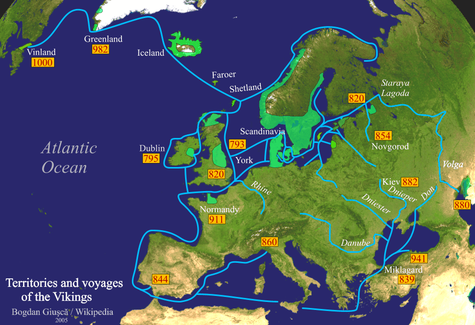
The Norse colonization of the Americas began as early as the 10th century, when Norse
sailors (usually referred to as Viking
s) explored and settled areas of the North Atlantic, including the northeastern fringes of North America
.
While the Norse colony in Greenland
lasted for almost 500 years, the continental North American settlements were small and did not develop into permanent colonies. While voyages, for example to fetch timber, are likely to have occurred for some time, there is no evidence of enduring Norse settlements on mainland North America.
 According to the Sagas of Icelanders, Norsemen from Iceland
first settled Greenland in the 980s. There is no special reason to doubt the authority of the information that the sagas supply regarding the very beginning of the settlement, but they cannot be treated as primary evidence for the history of Norse Greenland because they embody the literary preoccupations of writers and audiences in medieval Iceland that are not always reliable. Erik the Red
(Old Norse: Eiríkr rauði), having been banished from Iceland for manslaughter
, is said to have explored the uninhabited southwestern coast of Greenland during the three years of his banishment. He made plans to entice settlers to the area, even purposefully choosing the name Greenland to attract potential colonists, saying "that people would be more eager to go there because the land had a good name". The inner reaches of one long fjord
, named Eiriksfjord after him, was where he eventually established his estate Brattahlid. He issued tracts of land to his followers.
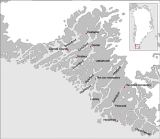
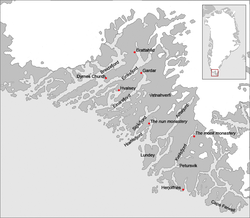
At its peak, the colony consisted of two settlements, the Eastern
and the Western Settlement
, with a population of 3,000-5,000; at least 400 farms have been identified by archaeologists. Norse Greenland had a bishopric (at Garðar) and exported walrus ivory
, furs, rope, sheep, whale or seal blubber
, live animals such as polar bear
s, and cattle hides. In 1261, the population accepted the overlordship of the Norwegian
King although it continued to have its own law. In 1380, the Norwegian Kingdom entered into a personal union
with the Kingdom of Denmark
.
The colony began to decline in the 14th century. The Western Settlement was abandoned around 1350, and by 1378 there was no longer a bishop at Garðar. After a marriage was recorded in 1408, no written records mention the settlers. It is probable that the Eastern Settlement was defunct by the late 15th century. The most recent radiocarbon date found in Norse settlements as of 2002 was 1430 A.D. (+/- 15 years). Several theories have been advanced to explain the decline. The Little Ice Age
of this period would have made travel between Greenland and Europe
more difficult, and it would have made farming more difficult; in addition, Greenlandic ivory may have been supplanted in European markets by cheaper ivory from Africa
. Despite the loss of contact with the Greenlanders, the Norwegian-Danish crown
continued to consider Greenland a possession.
Not knowing whether the old Norse civilization remained in Greenland or not—and worried that if it did, it would still be Catholic
200 years after the Scandinavia
n homelands had experienced the Reformation
—a joint merchant-clerical expedition led by the Norwegian missionary Hans Egede
was sent to Greenland in 1721. Though this expedition found no surviving Europeans, it marked the beginning of Denmark's assertion of sovereignty
over the island.
 According to the Icelandic sagas ("Eirik the Red's Saga" and the "Saga of the Greenlanders"—chapters of the Hauksbók
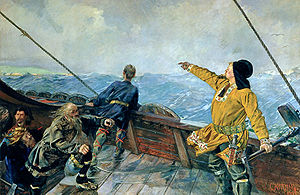
and the Flatey Book), the Norse started to explore lands to the west of Greenland only a few years after the Greenland settlements were established. In 985 while sailing from Iceland to Greenland with a migration fleet consisting of 400-700 settlers and 25 other ships (14 of which completed the journey), a merchant named Bjarni Herjólfsson
was blown off course, and after three days' sailing he sighted land west of the fleet. Bjarni was only interested in finding his father's farm, but he described his discovery to Leif Ericson
who explored the area in more detail and planted a small settlement fifteen years later.
The sagas describe three separate areas discovered during this exploration: Helluland
, which means "land of the flat stones"; Markland
, "the land of forests", definitely of interest to settlers in Greenland where there were few trees; and Vinland
, "the land of wine" (or as suggested by modern linguists "the land of meadows"), found somewhere south of Markland. It was in Vinland that the settlement described in the sagas was founded.
All four of Erik the Red's children visited the North American continent: his sons Leif, Thorvald and Thorstein and their sister Freydis. Thorvald died there.
 Using the routes, landmarks, currents
, rocks, and winds that Bjarni had described to him, Leif sailed some 1,800 miles to the New World
with a crew of 35—sailing the same knarr
Bjarni had used to make the voyage. He described Helluland as "level and wooded, with broad white beaches wherever they went and a gently sloping shoreline." Leif and others had wanted his father, Erik the Red, to lead this expedition and talked him into it. However, as Erik attempted to join his son Leif on the voyage towards these new lands, he fell off his horse as it slipped on the wet rocks near the shore, thus he was injured and stayed behind.
Leif wintered in 1001, probably near Cape Bauld
on the northern tip of Newfoundland, where one day his German foster father Tyrker
was found drunk, on what the saga describes as "wine-berries." Squashberries
, gooseberries, and cranberries
all grew wild in the area. There are varying explanations for Leif apparently describing fermented berries
as "wine."
Moreover, in Old Norse, there are different meanings for the word "vin" depending on whether a short i or long í is used. A long í in the word "vin" usually refers to "wine," whereas a short i could mean "pasture" or "meadow land." The debate is ongoing, but recent linguistic research may indicate that the pasture or meadow land argument is the more appropriate interpretation of the term Vinland.
Leif spent another winter at "Leifsbodarna" without conflict, and sailed back to Brattahlid in Greenland to assume filial duties for his father.
s. The ninth victim escaped and soon came back to the Norse camp with a force. Thorvald was killed by an arrow that succeeded in passing through the barricade
. Although brief hostilities ensued, the Norse explorers stayed another winter and left the following spring. Subsequently another of Leif's brothers, Thorstein, sailed to the New World to retrieve his dead brother's body, but he only stayed for one summer.
, also known as "Thorfinn the Valiant", supplied three ships
with livestock and 160 men and women (although another source sets the number of settlers at 250). After a cruel winter, he headed south and landed at Straumfjord but later moved to Straumsöy, possibly because the current was stronger there. A sign of peaceful relations between the indigenous peoples
and the Norsemen is noted here; the two sides barter
ed with furs and gray squirrel
skins for milk
and red cloth, which the natives tied around their heads as a sort of headdress.
There are conflicting stories but one account states that a bull belonging to Karlsefni came storming out of the wood, so frightening the natives that they ran to their skin-boats and rowed away. They returned three days later, in force. The natives used catapults, hoisting "a large sphere on a pole; it was dark blue in color" and about the size of a sheep's belly, which flew over the heads of the men and made an ugly din. The Norsemen retreated. Leif Ericson's half-sister Freydís Eiríksdóttir
was pregnant and unable to keep up with the retreating Norsemen. She called out to them to stop fleeing from "such pitiful wretches", adding that if she had weapons, she could do better than that. Freydís seized the sword belonging to a man who had been killed by the natives. She pulled one of her breasts out of her bodice and struck it with the sword, frightening the natives, who fled.
Evidence of continuing trips includes the Maine Penny
, a Norwegian coin from King Olaf Kyrre
's reign (1067–1093) allegedly found in a Native American archaeological site in the U.S. state of Maine
, suggesting an exchange between the Norse and the Native Americans late in or after the 11th century; and an entry in the Icelandic Annals from 1347 which refers to a small Greenlandic vessel with a crew of eighteen that arrived in Iceland while attempting to return to Greenland from Markland with a load of timber.
 For some centuries after Christopher Columbus
' voyages opened the Americas
to large-scale colonization by Europeans, it was unclear whether these stories represented real voyages by the Norse to North America. The sagas were first taken seriously when in 1837 the Danish antiquarian Carl Christian Rafn
pointed out the possibility for a Norse settlement in or voyages to North America.
North America, by the name Winland, was first mentioned in written sources in a work by Adam of Bremen
from approximately 1075. It was not until the 13th and 14th centuries that the most important works about North America and the early Norse activities there, namely the Sagas of Icelanders, were put into writing.
The question was definitively settled in the 1960s when a Norse settlement was excavated at L'Anse aux Meadows
in Newfoundland by archaeologist Anne Stine Ingstad
and her husband, outdoorsman and author Helge Ingstad
. The location of the various lands described in the sagas is still unclear however. Many historians identify Helluland with Baffin Island
and Markland with Labrador
. The location of Vinland is a thornier question. Most believe that the L'Anse aux Meadows settlement is the Vinland settlement described in the sagas; others argue that the sagas depict Vinland as being warmer than Newfoundland and that it therefore lay farther south.
Purported runestones have been found in North America, most famously the Kensington Runestone
, that are thought by some to be artifacts from further Norse exploration, although they are typically considered to be hoaxes. There are two maps depicting North America, the "Vinland map
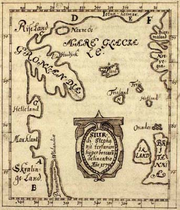
", that some believe is related to Norse exploration, although it is considered to be a modern forgery, and the Skálholt Map, made by an Icelandic teacher in 1570.
Norsemen
Norsemen is used to refer to the group of people as a whole who spoke what is now called the Old Norse language belonging to the North Germanic branch of Indo-European languages, especially Norwegian, Icelandic, Faroese, Swedish and Danish in their earlier forms.The meaning of Norseman was "people...
sailors (usually referred to as Viking
Viking
The term Viking is customarily used to refer to the Norse explorers, warriors, merchants, and pirates who raided, traded, explored and settled in wide areas of Europe, Asia and the North Atlantic islands from the late 8th to the mid-11th century.These Norsemen used their famed longships to...
s) explored and settled areas of the North Atlantic, including the northeastern fringes of North America
North America
North America is a continent wholly within the Northern Hemisphere and almost wholly within the Western Hemisphere. It is also considered a northern subcontinent of the Americas...
.
While the Norse colony in Greenland
Greenland
Greenland is an autonomous country within the Kingdom of Denmark, located between the Arctic and Atlantic Oceans, east of the Canadian Arctic Archipelago. Though physiographically a part of the continent of North America, Greenland has been politically and culturally associated with Europe for...
lasted for almost 500 years, the continental North American settlements were small and did not develop into permanent colonies. While voyages, for example to fetch timber, are likely to have occurred for some time, there is no evidence of enduring Norse settlements on mainland North America.
Greenland
Iceland
Iceland , described as the Republic of Iceland, is a Nordic and European island country in the North Atlantic Ocean, on the Mid-Atlantic Ridge. Iceland also refers to the main island of the country, which contains almost all the population and almost all the land area. The country has a population...
first settled Greenland in the 980s. There is no special reason to doubt the authority of the information that the sagas supply regarding the very beginning of the settlement, but they cannot be treated as primary evidence for the history of Norse Greenland because they embody the literary preoccupations of writers and audiences in medieval Iceland that are not always reliable. Erik the Red
Erik the Red
Erik Thorvaldsson , known as Erik the Red , is remembered in medieval and Icelandic saga sources as having founded the first Nordic settlement in Greenland. The Icelandic tradition indicates that he was born in the Jæren district of Rogaland, Norway, as the son of Thorvald Asvaldsson, he therefore...
(Old Norse: Eiríkr rauði), having been banished from Iceland for manslaughter
Manslaughter
Manslaughter is a legal term for the killing of a human being, in a manner considered by law as less culpable than murder. The distinction between murder and manslaughter is said to have first been made by the Ancient Athenian lawmaker Dracon in the 7th century BC.The law generally differentiates...
, is said to have explored the uninhabited southwestern coast of Greenland during the three years of his banishment. He made plans to entice settlers to the area, even purposefully choosing the name Greenland to attract potential colonists, saying "that people would be more eager to go there because the land had a good name". The inner reaches of one long fjord
Fjord
Geologically, a fjord is a long, narrow inlet with steep sides or cliffs, created in a valley carved by glacial activity.-Formation:A fjord is formed when a glacier cuts a U-shaped valley by abrasion of the surrounding bedrock. Glacial melting is accompanied by rebound of Earth's crust as the ice...
, named Eiriksfjord after him, was where he eventually established his estate Brattahlid. He issued tracts of land to his followers.
At its peak, the colony consisted of two settlements, the Eastern
Eastern Settlement
The Eastern Settlement was the largest and first of the three areas of Greenland, settled in approximately 985 AD by Norse farmers from Iceland . At its peak it contained approximately 4,000 inhabitants...
and the Western Settlement
Western Settlement
The Western Settlement was the smaller of the two main areas of Greenland settled in around 985 AD by Norse farmers from Iceland ....
, with a population of 3,000-5,000; at least 400 farms have been identified by archaeologists. Norse Greenland had a bishopric (at Garðar) and exported walrus ivory
Ivory
Ivory is a term for dentine, which constitutes the bulk of the teeth and tusks of animals, when used as a material for art or manufacturing. Ivory has been important since ancient times for making a range of items, from ivory carvings to false teeth, fans, dominoes, joint tubes, piano keys and...
, furs, rope, sheep, whale or seal blubber
Blubber
Blubber is a thick layer of vascularized adipose tissue found under the skin of all cetaceans, pinnipeds and sirenians.-Description:Lipid-rich, collagen fiber–laced blubber comprises the hypodermis and covers the whole body, except for parts of the appendages, strongly attached to the musculature...
, live animals such as polar bear
Polar Bear
The polar bear is a bear native largely within the Arctic Circle encompassing the Arctic Ocean, its surrounding seas and surrounding land masses. It is the world's largest land carnivore and also the largest bear, together with the omnivorous Kodiak Bear, which is approximately the same size...
s, and cattle hides. In 1261, the population accepted the overlordship of the Norwegian
Norway
Norway , officially the Kingdom of Norway, is a Nordic unitary constitutional monarchy whose territory comprises the western portion of the Scandinavian Peninsula, Jan Mayen, and the Arctic archipelago of Svalbard and Bouvet Island. Norway has a total area of and a population of about 4.9 million...
King although it continued to have its own law. In 1380, the Norwegian Kingdom entered into a personal union
Kalmar Union
The Kalmar Union is a historiographical term meaning a series of personal unions that united the three kingdoms of Denmark, Norway , and Sweden under a single monarch, though intermittently and with a population...
with the Kingdom of Denmark
Denmark
Denmark is a Scandinavian country in Northern Europe. The countries of Denmark and Greenland, as well as the Faroe Islands, constitute the Kingdom of Denmark . It is the southernmost of the Nordic countries, southwest of Sweden and south of Norway, and bordered to the south by Germany. Denmark...
.
The colony began to decline in the 14th century. The Western Settlement was abandoned around 1350, and by 1378 there was no longer a bishop at Garðar. After a marriage was recorded in 1408, no written records mention the settlers. It is probable that the Eastern Settlement was defunct by the late 15th century. The most recent radiocarbon date found in Norse settlements as of 2002 was 1430 A.D. (+/- 15 years). Several theories have been advanced to explain the decline. The Little Ice Age
Little Ice Age
The Little Ice Age was a period of cooling that occurred after the Medieval Warm Period . While not a true ice age, the term was introduced into the scientific literature by François E. Matthes in 1939...
of this period would have made travel between Greenland and Europe
Europe
Europe is, by convention, one of the world's seven continents. Comprising the westernmost peninsula of Eurasia, Europe is generally 'divided' from Asia to its east by the watershed divides of the Ural and Caucasus Mountains, the Ural River, the Caspian and Black Seas, and the waterways connecting...
more difficult, and it would have made farming more difficult; in addition, Greenlandic ivory may have been supplanted in European markets by cheaper ivory from Africa
Africa
Africa is the world's second largest and second most populous continent, after Asia. At about 30.2 million km² including adjacent islands, it covers 6% of the Earth's total surface area and 20.4% of the total land area...
. Despite the loss of contact with the Greenlanders, the Norwegian-Danish crown
Monarchy
A monarchy is a form of government in which the office of head of state is usually held until death or abdication and is often hereditary and includes a royal house. In some cases, the monarch is elected...
continued to consider Greenland a possession.
Not knowing whether the old Norse civilization remained in Greenland or not—and worried that if it did, it would still be Catholic
Catholic
The word catholic comes from the Greek phrase , meaning "on the whole," "according to the whole" or "in general", and is a combination of the Greek words meaning "about" and meaning "whole"...
200 years after the Scandinavia
Scandinavia
Scandinavia is a cultural, historical and ethno-linguistic region in northern Europe that includes the three kingdoms of Denmark, Norway and Sweden, characterized by their common ethno-cultural heritage and language. Modern Norway and Sweden proper are situated on the Scandinavian Peninsula,...
n homelands had experienced the Reformation
Protestant Reformation
The Protestant Reformation was a 16th-century split within Western Christianity initiated by Martin Luther, John Calvin and other early Protestants. The efforts of the self-described "reformers", who objected to the doctrines, rituals and ecclesiastical structure of the Roman Catholic Church, led...
—a joint merchant-clerical expedition led by the Norwegian missionary Hans Egede
Hans Egede
Hans Poulsen Egede was a Norwegian-Danish Lutheran missionary who launched mission efforts to Greenland, which led him to be styled the Apostle of Greenland. He established a successful mission among the Inuit and is credited with revitalizing Dano-Norwegian interest in the island after contact...
was sent to Greenland in 1721. Though this expedition found no surviving Europeans, it marked the beginning of Denmark's assertion of sovereignty
Danish colonization of the Americas
Denmark and the former political union of Denmark–Norway had a colonial empire from the 17th through the 20th centuries, large portions of which were found in the Americas...
over the island.
Vinland and L'Anse aux Meadows
Hauksbók
The Hauksbók is one of the few medieval Norse manuscripts of which the author is known. His name was Haukr Erlendsson , and as long back as it is possible to trace the manuscript it has been called the Hauksbók after its author. It was partly written by Haukr himself, partly by assistants...
and the Flatey Book), the Norse started to explore lands to the west of Greenland only a few years after the Greenland settlements were established. In 985 while sailing from Iceland to Greenland with a migration fleet consisting of 400-700 settlers and 25 other ships (14 of which completed the journey), a merchant named Bjarni Herjólfsson
Bjarni Herjólfsson
Bjarni Herjólfsson was a Norwegian explorer who is the first known European discoverer of the mainland of the Americas, which he sighted in 985 or 986.-Life:...
was blown off course, and after three days' sailing he sighted land west of the fleet. Bjarni was only interested in finding his father's farm, but he described his discovery to Leif Ericson
Leif Ericson
Leif Ericson was a Norse explorer who is regarded as the first European to land in North America , nearly 500 years before Christopher Columbus...
who explored the area in more detail and planted a small settlement fifteen years later.
The sagas describe three separate areas discovered during this exploration: Helluland
Helluland
Helluland is the name given to one of the three lands discovered by Leif Eriksson around 1000 AD on the North Atlantic coast of North America....
, which means "land of the flat stones"; Markland
Markland
Markland is the name given to a part of shoreline in Labrador, Canada, named by Leif Eriksson when he landed in North America. The word Markland is from the Old Norse language for "forestland" or "borderland". It is described as being north of Vinland and south of Helluland...
, "the land of forests", definitely of interest to settlers in Greenland where there were few trees; and Vinland
Vinland
Vinland was the name given to an area of North America by the Norsemen, about the year 1000 CE.There is a consensus among scholars that the Vikings reached North America approximately five centuries prior to the voyages of Christopher Columbus...
, "the land of wine" (or as suggested by modern linguists "the land of meadows"), found somewhere south of Markland. It was in Vinland that the settlement described in the sagas was founded.
All four of Erik the Red's children visited the North American continent: his sons Leif, Thorvald and Thorstein and their sister Freydis. Thorvald died there.
Leif's winter camp
Ocean current
An ocean current is a continuous, directed movement of ocean water generated by the forces acting upon this mean flow, such as breaking waves, wind, Coriolis effect, cabbeling, temperature and salinity differences and tides caused by the gravitational pull of the Moon and the Sun...
, rocks, and winds that Bjarni had described to him, Leif sailed some 1,800 miles to the New World
New World
The New World is one of the names used for the Western Hemisphere, specifically America and sometimes Oceania . The term originated in the late 15th century, when America had been recently discovered by European explorers, expanding the geographical horizon of the people of the European middle...
with a crew of 35—sailing the same knarr
Knarr
The Knarr is a Bermuda rigged, long keeled, sailing yacht designed in 1943 by Norwegian Erling L. Kristofersen. Knarrer were traditionally built in wood, with the hull upside down on a fixed frame, then attaching the iron keel after the hull was completed. The hull planks were manufactured with...
Bjarni had used to make the voyage. He described Helluland as "level and wooded, with broad white beaches wherever they went and a gently sloping shoreline." Leif and others had wanted his father, Erik the Red, to lead this expedition and talked him into it. However, as Erik attempted to join his son Leif on the voyage towards these new lands, he fell off his horse as it slipped on the wet rocks near the shore, thus he was injured and stayed behind.
Leif wintered in 1001, probably near Cape Bauld
Cape Bauld
Cape Bauld is a headland located at the northeasternmost point of Great Northern Peninsula on the island of Newfoundland in the Canadian province of Newfoundland and Labrador....
on the northern tip of Newfoundland, where one day his German foster father Tyrker
Tyrker
Tyrker is a character mentioned in the Norse Saga of the Greenlanders and German historical legend He accompanied Leif on his voyage of discovery around the year 1000, and is portrayed as an older German or Hungarian male servant...
was found drunk, on what the saga describes as "wine-berries." Squashberries
Viburnum edule
Viburnum edule, the squashberry, mooseberry, pembina, pimbina, highbush cranberry, lowbush cranberry or moosomin in Cree language, is a small shrub species.-See also:* Trees of Canada* List of Canadian plants by family C...
, gooseberries, and cranberries
Cranberry
Cranberries are a group of evergreen dwarf shrubs or trailing vines in the subgenus Oxycoccus of the genus Vaccinium. In some methods of classification, Oxycoccus is regarded as a genus in its own right...
all grew wild in the area. There are varying explanations for Leif apparently describing fermented berries
Fermentation (wine)
The process of fermentation in wine turns grape juice into an alcoholic beverage. During fermentation, yeast interact with sugars in the juice to create ethanol, commonly known as ethyl alcohol, and carbon dioxide...
as "wine."
Moreover, in Old Norse, there are different meanings for the word "vin" depending on whether a short i or long í is used. A long í in the word "vin" usually refers to "wine," whereas a short i could mean "pasture" or "meadow land." The debate is ongoing, but recent linguistic research may indicate that the pasture or meadow land argument is the more appropriate interpretation of the term Vinland.
Leif spent another winter at "Leifsbodarna" without conflict, and sailed back to Brattahlid in Greenland to assume filial duties for his father.
Thorvald's voyage
In 1004, Leif's brother Thorvald Ericson sailed with a crew of 30 men to Newfoundland and spent the following winter at Leif's camp. In the spring, Thorvald attacked nine of the local people who were sleeping under three skin-covered canoeCanoe
A canoe or Canadian canoe is a small narrow boat, typically human-powered, though it may also be powered by sails or small electric or gas motors. Canoes are usually pointed at both bow and stern and are normally open on top, but can be decked over A canoe (North American English) or Canadian...
s. The ninth victim escaped and soon came back to the Norse camp with a force. Thorvald was killed by an arrow that succeeded in passing through the barricade
Barricade
Barricade, from the French barrique , is any object or structure that creates a barrier or obstacle to control, block passage or force the flow of traffic in the desired direction...
. Although brief hostilities ensued, the Norse explorers stayed another winter and left the following spring. Subsequently another of Leif's brothers, Thorstein, sailed to the New World to retrieve his dead brother's body, but he only stayed for one summer.
Karlsefni's expedition
In 1009 Thorfinn KarlsefniThorfinn Karlsefni
Thorfinn Karlsefni was an Icelandic explorer who circa 1010 AD led an attempt to settle Vínland with three ships and 160 settlers. Among the settlers was Freydís Eiríksdóttir, according to Grœnlendinga saga and Eiríks saga rauða, sister or half-sister of Leif Eriksson...
, also known as "Thorfinn the Valiant", supplied three ships
Knarr
The Knarr is a Bermuda rigged, long keeled, sailing yacht designed in 1943 by Norwegian Erling L. Kristofersen. Knarrer were traditionally built in wood, with the hull upside down on a fixed frame, then attaching the iron keel after the hull was completed. The hull planks were manufactured with...
with livestock and 160 men and women (although another source sets the number of settlers at 250). After a cruel winter, he headed south and landed at Straumfjord but later moved to Straumsöy, possibly because the current was stronger there. A sign of peaceful relations between the indigenous peoples
Indigenous peoples of the Americas
The indigenous peoples of the Americas are the pre-Columbian inhabitants of North and South America, their descendants and other ethnic groups who are identified with those peoples. Indigenous peoples are known in Canada as Aboriginal peoples, and in the United States as Native Americans...
and the Norsemen is noted here; the two sides barter
Barter
Barter is a method of exchange by which goods or services are directly exchanged for other goods or services without using a medium of exchange, such as money. It is usually bilateral, but may be multilateral, and usually exists parallel to monetary systems in most developed countries, though to a...
ed with furs and gray squirrel
Eastern Gray Squirrel
The eastern gray squirrel is a tree squirrel in the genus Sciurus native to the eastern and midwestern United States, and to the southerly portions of the eastern provinces of Canada...
skins for milk
Milk
Milk is a white liquid produced by the mammary glands of mammals. It is the primary source of nutrition for young mammals before they are able to digest other types of food. Early-lactation milk contains colostrum, which carries the mother's antibodies to the baby and can reduce the risk of many...
and red cloth, which the natives tied around their heads as a sort of headdress.
There are conflicting stories but one account states that a bull belonging to Karlsefni came storming out of the wood, so frightening the natives that they ran to their skin-boats and rowed away. They returned three days later, in force. The natives used catapults, hoisting "a large sphere on a pole; it was dark blue in color" and about the size of a sheep's belly, which flew over the heads of the men and made an ugly din. The Norsemen retreated. Leif Ericson's half-sister Freydís Eiríksdóttir
Freydís Eiríksdóttir
Freydís Eiríksdóttir was a daughter of Erik the Red who was associated with the Norse exploration of North America. The only medieval sources which mention Freydís are the two Vinland sagas, believed to be composed in the 13th century but purporting to describe events around 1000...
was pregnant and unable to keep up with the retreating Norsemen. She called out to them to stop fleeing from "such pitiful wretches", adding that if she had weapons, she could do better than that. Freydís seized the sword belonging to a man who had been killed by the natives. She pulled one of her breasts out of her bodice and struck it with the sword, frightening the natives, who fled.
No permanent colonies
Settlements in continental North America aimed to exploit natural resources such as furs and in particular lumber, which was in short supply in Greenland. It is unclear why the short-term settlements did not become permanent, though it was in part because of hostile relations with the indigenous peoples, referred to as Skrælings by the Norse. Nevertheless, it appears that sporadic voyages to Markland for forages, timber, and trade with the locals could have lasted as long as 400 years.Evidence of continuing trips includes the Maine Penny
Maine Penny
The Maine penny, also referred to as the Goddard coin, is a Norwegian silver penny dating to the reign of Olaf Kyrre . The Maine State Museum describes it as "the only pre-Columbian Norse artifact generally regarded as genuine found within the United States"...
, a Norwegian coin from King Olaf Kyrre
Olaf III of Norway
Olaf Kyrre , or Olaf III Haraldsson, was King of Norway from 1067 to 1093. He was present at the Battle of Stamford Bridge in England in 1066 where his father, Harald Hardrada, saw defeat and was killed in action...
's reign (1067–1093) allegedly found in a Native American archaeological site in the U.S. state of Maine
Maine
Maine is a state in the New England region of the northeastern United States, bordered by the Atlantic Ocean to the east and south, New Hampshire to the west, and the Canadian provinces of Quebec to the northwest and New Brunswick to the northeast. Maine is both the northernmost and easternmost...
, suggesting an exchange between the Norse and the Native Americans late in or after the 11th century; and an entry in the Icelandic Annals from 1347 which refers to a small Greenlandic vessel with a crew of eighteen that arrived in Iceland while attempting to return to Greenland from Markland with a load of timber.
Aftermath
Christopher Columbus
Christopher Columbus was an explorer, colonizer, and navigator, born in the Republic of Genoa, in northwestern Italy. Under the auspices of the Catholic Monarchs of Spain, he completed four voyages across the Atlantic Ocean that led to general European awareness of the American continents in the...
' voyages opened the Americas
Americas
The Americas, or America , are lands in the Western hemisphere, also known as the New World. In English, the plural form the Americas is often used to refer to the landmasses of North America and South America with their associated islands and regions, while the singular form America is primarily...
to large-scale colonization by Europeans, it was unclear whether these stories represented real voyages by the Norse to North America. The sagas were first taken seriously when in 1837 the Danish antiquarian Carl Christian Rafn
Carl Christian Rafn
Carl Christian Rafn was a Danish historian, translator and antiquarian. His scholarship to a large extent focused on translation of Old Norse literature and related Northern European ancient history...
pointed out the possibility for a Norse settlement in or voyages to North America.
North America, by the name Winland, was first mentioned in written sources in a work by Adam of Bremen
Adam of Bremen
Adam of Bremen was a German medieval chronicler. He lived and worked in the second half of the eleventh century. He is most famous for his chronicle Gesta Hammaburgensis Ecclesiae Pontificum .-Background:Little is known of his life other than hints from his own chronicles...
from approximately 1075. It was not until the 13th and 14th centuries that the most important works about North America and the early Norse activities there, namely the Sagas of Icelanders, were put into writing.
The question was definitively settled in the 1960s when a Norse settlement was excavated at L'Anse aux Meadows
L'Anse aux Meadows
L'Anse aux Meadows is an archaeological site on the northernmost tip of the island of Newfoundland in the Canadian province of Newfoundland and Labrador. Discovered in 1960, it is the only known site of a Norse or Viking village in Canada, and in North America outside of Greenland...
in Newfoundland by archaeologist Anne Stine Ingstad
Anne Stine Ingstad
Dr. Anne Stine Ingstad was a Norwegian archaeologist who, along with her husband Dr. Helge Ingstad, discovered the remains of a Viking settlement at L'Anse aux Meadows in the Canadian province of Newfoundland and Labrador in 1960.-Biography:Anne Stine Moe was born and raised in Lillehammer, in...
and her husband, outdoorsman and author Helge Ingstad
Helge Ingstad
Helge Marcus Ingstad was a Norwegian explorer. After mapping some Norse settlements, Ingstad and his wife Anne Stine, an archaeologist, in 1960 found remnants of a Viking settlement in L'Anse aux Meadows in the Province of Newfoundland in Canada...
. The location of the various lands described in the sagas is still unclear however. Many historians identify Helluland with Baffin Island
Baffin Island
Baffin Island in the Canadian territory of Nunavut is the largest island in the Canadian Arctic Archipelago, the largest island in Canada and the fifth largest island in the world. Its area is and its population is about 11,000...
and Markland with Labrador
Labrador
Labrador is the distinct, northerly region of the Canadian province of Newfoundland and Labrador. It comprises the mainland portion of the province, separated from the island of Newfoundland by the Strait of Belle Isle...
. The location of Vinland is a thornier question. Most believe that the L'Anse aux Meadows settlement is the Vinland settlement described in the sagas; others argue that the sagas depict Vinland as being warmer than Newfoundland and that it therefore lay farther south.
Purported runestones have been found in North America, most famously the Kensington Runestone
Kensington Runestone
The Kensington Runestone is a 200-pound slab of greywacke covered in runes on its face and side which, if genuine, would suggest that Scandinavian explorers reached the middle of North America in the 14th century. It was found in 1898 in the largely rural township of Solem, Douglas County,...
, that are thought by some to be artifacts from further Norse exploration, although they are typically considered to be hoaxes. There are two maps depicting North America, the "Vinland map
Vinland map
The Vinland map is claimed to be a 15th century mappa mundi with unique information about Norse exploration of America. It is very well known because of the publicity campaign which accompanied its revelation to the public as a "genuine" pre-Columbian map in 1965...
", that some believe is related to Norse exploration, although it is considered to be a modern forgery, and the Skálholt Map, made by an Icelandic teacher in 1570.