
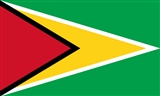
Guyana officially the
Co-operative Republic of Guyana and previously known as
British GuianaBritish Guiana was the name of the British colony on the northern coast of South America, now the independent nation of Guyana.The area was originally settled by the Dutch as the colonies of Essequibo, Demerara, and Berbice...
, is a state on the northern coast of
South AmericaSouth America is the southern continent of the Americas, situated entirely in the Western Hemisphere and mostly in the Southern Hemisphere, with a relatively small portion in the Northern Hemisphere...
that is culturally part of the
Anglophone CaribbeanThe term Anglophone Caribbean is used to refer to the independent English-speaking countries of the Caribbean region. Upon a country's full independence from the United Kingdom, Anglophone Caribbean traditionally becomes the preferred sub-regional term as a replacement to British West Indies.The...
.Guyana was discovered in 1498 by the Europeans,Guyana's past is punctuated by battles fought and won, possessions lost and regained as the Spanish, French, Dutch and British wrangled for centuries to own this land. It is the only state of the
Commonwealth of NationsThe Commonwealth of Nations, often referred to as the Commonwealth and previously as the British Commonwealth, is an intergovernmental organisation of fifty-three independent member states. Most of them were formerly part of the British Empire. They co-operate within a framework of common values...
on mainland South America. Guyana is bordered to the east by
SurinameSuriname , officially the Republic of Suriname, is a country in northern South America....
, to the south and southwest by
BrazilBrazil , officially the Federative Republic of Brazil , is a country in South America. It is the fifth largest country by geographical area, occupying nearly half of South America, the fifth most populous country, and the fourth most populous democracy in the world. Bounded by the Atlantic Ocean...
, to the west by
VenezuelaVenezuela , officially titled Bolivarian Republic of Venezuela , is a tropical country on the northern coast of South America. It is a continental mainland with numerous islands located off its coastline in the Caribbean Sea...
, and on the north by the
Atlantic OceanThe Atlantic Ocean is the second-largest of the world's oceanic divisions. With a total area of about 106.4 million square kilometres , it covers approximately one-fifth of the Earth's surface and about one-quarter of its water surface area. The first part of its name refers to the Atlas of Greek...
.
Historically, the region known as "Guiana" (Land of Many Waters) was comprised of the large shield landmass north of the Amazon River and East of the Orinoco River. Five sub-regions were carved out of the landmass by colonial powers in the late 17th and early 18th century; Spanish Guiana (now eastern Venezuela), Portuguese Guiana (now northern Brazil), British Guiana (Guyana), Dutch Guiana (Suriname) and the present French overseas department of
French GuianaFrench Guiana is an overseas department of France, located on the northern coast of South America. It has borders with two nations, Brazil and Suriname. Like the other DOMs, French Guiana is also an overseas region of France, one of the 26 regions of France. Its currency is the euro...
. Guyana achieved independence from the UK in 1966, and since then it has been ruled mostly by socialist-oriented governments. In 1992, Cheddi JAGAN was elected president in what is considered the country's first free and fair election since independence. After his death five years later, his wife, Janet JAGAN, became president but resigned in 1999 due to poor health. Her successor, Bharrat JAGDEO, was reelected in 2001 and again in 2006.
At 215,000 km
2, Guyana is the third-smallest independent state on the mainland of South America (after
UruguayUruguay , is a country located in the southeastern part of South America. It is home to 3.46 million people, of whom 1.1 million live in the capital Montevideo and its metropolitan area. An estimated 88–94% of the population are of mostly European and/or mixed descent.Uruguay's only land border is...
, Suriname). Its population is approximately 770,000. It is one of the five non-
Spanish-speakingSpanish or Castilian is a Romance language in the Ibero-Romance group that originated in northern Spain and gradually spread in the Kingdom of Castile, evolving into the principal language of government and trade in the Iberian peninsula...
territories on the continent, along with the countries of
BrazilBrazil , officially the Federative Republic of Brazil , is a country in South America. It is the fifth largest country by geographical area, occupying nearly half of South America, the fifth most populous country, and the fourth most populous democracy in the world. Bounded by the Atlantic Ocean...
(
PortuguesePortuguese is a Romance language that originated in what is now Galicia and northern Portugal. It is derived from the Latin spoken by the romanized Pre-Roman peoples of the Iberian Peninsula around 2000 years ago...
),
SurinameSuriname , officially the Republic of Suriname, is a country in northern South America....
(
DutchDutch is a West Germanic language spoken by over 22 million people as a native language, and over 5 million people as a second language.
"1% of the EU population claims to speak Dutch well enough in order to have a conversation." Outside the European Union the number of second language...
),
French GuianaFrench Guiana is an overseas department of France, located on the northern coast of South America. It has borders with two nations, Brazil and Suriname. Like the other DOMs, French Guiana is also an overseas region of France, one of the 26 regions of France. Its currency is the euro...
(
FrenchFrench is a Romance language globally spoken by about 65 million people as a first language , by 50 million as a second language, and by about another 200 million people as an acquired foreign language, with significant speakers in 57 countries. Most native speakers of the language live in France,...
) and the British Overseas Territory of the
Falkland IslandsThe Falkland Islands are an archipelago in the South Atlantic Ocean, located approximately from the coast of mainland South America, from mainland Antarctica, and from Africa. There are two main islands, East Falkland and West Falkland, as well as 776 smaller islands...
(
EnglishEnglish is a West Germanic language that developed in England during the Anglo-Saxon era. As a result of the military, economic, scientific, political, and cultural influence of the British Empire during the 18th, 19th, and early 20th centuries, and of the United States since the mid 20th century,...
).
Geography
Guyana can be divided into five natural regions: a narrow and fertile marshy plain along the Atlantic coast (low coastal plain) where most of the population lives; a white sand belt more inland (hilly sand and clay region), containing most of Guyana's mineral deposits; the dense rain forests (Forested Highland Region) in the middle of the country; the grassy flat
savannahSavannah or savanna is a type of grassland.It can also mean:-Software:* GNU Savannah, an aggregation of software development projects affiliated with the GNU project-Places in the USA:...
in the south; and the larger interior highlands (interior savannah) consisting mostly of mountains that gradually rise to the Brazilian border.
Guyana's main mountains are
Mount AyangannaMount Ayanganna is a sandstone tepui in the Pakaraima Mountains of western Guyana, 85 kilometres east of Mount Roraima at . With a height of 2,041 metres it is the easternmost tepui taller than 2,000 metres...
(6,699 ft (2,042 m),
Monte CaburaíMonte Caburaí is a mountain located on the border between the South American countries of Brazil and Guyana standing at above sea level. The source of the Uailã or Ailã river, located on the mountain, is the northernmost point of Brazil....
(4,806 ft (1,465 m) and
Monte RoraimaMount Roraima , is the highest of the Pakaraima chain of plateaux in South America. First described by the English explorer Sir Walter Raleigh in 1596, its summit area is defended by 400-metre-tall cliffs on all sides...
(9,301 ft (2,835 m) — the highest mountain in Guyana) on the Brazil-Guyana-Venezuela
tripointA tripoint is a geographical point at which the borders of three countries or subnational entities meet. There are currently 157 international tripoints. Usually such a place is a site of special border markings and memorials.Usually, the more neighbours a country has, the more international...
, part of the Pakaraima range. Roraima and Guyana's table-top mountains (
tepuiA tepui is a table-top mountain found only in the Guiana Highlands of South America, especially in Venezuela. The word tepui means "house of the gods" in the native tongue of the Pemon, the indigenous people who inhabit the Gran Sabana...
s) are said to have been the inspiration for Sir Arthur Conan Doyle's 1912 novel
The Lost WorldThe Lost World is a novel released in 1912 by Sir Arthur Conan Doyle concerning an expedition to a plateau in the Amazon basin of South America where prehistoric animals still survive. The character of Professor Challenger was introduced in this book...
. There are also many steep escarpments and waterfalls, including
Kaieteur FallsKaieteur Falls is a magnificent, high-volume waterfall on the Potaro River in central Guyana. It is located inKaieteur National Park. It is 226 meters when measured from its plunge over a sandstone cliff to the first break. It then flows over a series of steep cascades that, when included in the...
. Between the
Rupununi RiverThe Rupununi River is a river in southern Guyana, originating in the Kanuku Mountains. The Rupununi River drains into the Essequibo River but is also part of the Amazon River watershed. During the rainy season it is connected to the Takutu River by the flooded Pirara Creek, draining the vast swamps...
and the border with Brazil lies the
Rupununi savannahThe Rupununi savannah is a savanna plain in Guyana located between the Rupununi River and the Brazilian border, in the Upper Takutu-Upper Essequibo region. It is dissected by the Kanuku Mountains....
, south of which lie the
Kanuku MountainsThe Kanuku Mountains are a group of mountains in Guyana, located in the Upper Takutu-Upper Essequibo region. The name means 'rich forest' in the Macushi language, a reference to the rich diversity of wildlife found there....
.
The three main rivers are the
EssequiboThe Essequibo River is the longest river in Guyana, and the largest river between the Orinoco and Amazon. Rising in the Acarai Mountains near the Brazil-Guyana border, the Essequibo flows to the north for 1,010 km through forest and savanna into the Atlantic Ocean.-Geography:There are countless...
, the
DemeraraThe Demerara River is a river in eastern Guyana that rises in the central rainforests of the country and flows to the north for 346 kilometres until it reaches the Atlantic Ocean. Georgetown, Guyana's largest seaport and capital, is situated on the east bank of the river's mouth. The Demerara's...
, and the
BerbiceThe Berbice River, located in eastern Guyana, rises in the highlands of the Rupununi region. The Berbice flows northward for 370 miles through dense forests to the coastal plain...
. The Corentyne River forms the border with Suriname. At the mouth of the Essequibo are several large islands. The 90-mile (145 km)
Shell BeachShell Beach, located on the Atlantic coast of Guyana in the Barima-Waini Region, near the Venezuelan border, is a nesting site for four of the eight sea turtle species - the Olive Ridley, Hawksbill, Green and Leatherback. Shell Beach extends for approximately 140km....
lies along the northwest coast. Guyana is a major breeding area for
sea turtleSea Turtles inhabit all the world's oceans except the Arctic.-Distribution:The superfamily Chelonioidea has a worldwide distribution; sea turtles can be found in all oceans except for the polar regions. Some species travel between oceans...
s (mainly
LeatherbacksThe leatherback turtle is the largest of all living sea turtles and the fourth largest modern reptile behind three crocodilians. It is the only living species in the genus Dermochelys. It can easily be differentiated from other modern sea turtles by its lack of a bony shell. Instead, its carapace...
) and other wildlife.
The local
climateClimate encompasses the statistics of temperature, humidity, atmospheric pressure, wind, rainfall, atmospheric particle count and numerous other meteorological elements in a given region over long periods of time...
is
tropicalA tropical climate is a kind of climate typical in the tropics. Köppen's widely-recognized scheme of climate classification defines it as a non-arid climate in which all twelve months have mean temperatures above .- Examples of tropical climates :...
and generally hot and humid, though moderated by northeast trade winds along the coast. There are two rainy seasons, the first from May to mid-August, the second from mid-November to mid-January.
It has one of the largest unspoiled
rainforestRainforests are forests characterized by high rainfall, with definitions setting minimum normal annual rainfall between 1750–2000 mm . The monsoon trough, alternately known as the intertropical convergence zone, plays a significant role in creating Earth's tropical rain forests.From 40 to 75%...
s in South America, some parts of which are almost inaccessible by humans. The rich natural history of Guyana was described by early explorers
Sir Walter RaleighSir Walter Raleigh, Lord Lieutenant of Cornwall was a English aristocrat, writer, poet, soldier, courtier, and explorer.Raleigh was born to a Protestant family in Devon, the son of Walter Raleigh and Catherine Champernowne...
and
Charles WatertonCharles Waterton was an English naturalist and explorer.-Life:"Squire" Waterton was born at Walton Hall, Wakefield, Yorkshire to Thomas Waterton and Anne Bedingfield. He was of a Roman Catholic landed gentry family descended from Reiner de Waterton...
and later by naturalists Sir
David AttenboroughSir David Frederick Attenborough OM, CH, CVO, CBE, FRS, FZS is a broadcaster and naturalist. His career as the respected face and voice of natural history programmes has endured for more than 50 years...
and
Gerald DurrellGerald Malcolm Durrell, OBE was a naturalist, zookeeper, conservationist, author, and television presenter...
. In 2008, the
BBCThe British Broadcasting Corporation, usually referred to by its abbreviation as the "BBC", is the longest established and largest broadcaster in the world...
ran a three-part programme called
Lost Land of the Jaguar which highlighted the huge diversity of wildlife, including undiscovered species and rare species such as the
giant otterThe Giant Otter is a South American carnivorous mammal. It is the longest member of the Mustelidae, or weasel family, a globally successful group of predators. Unusually for a mustelid, the Giant Otter is a social species, with family groups typically supporting three to eight members...
and harpy eagle.
Regions and Neighbourhood Councils
Guyana is divided into 10 regions:
| No |
Region |
Area km² |
Population |
Population per km² |
| 1 |
Barima-WainiBarima-Waini is a region of Essequibo, Guyana, a territory in dispute by Guyana and Venezuela, located in the northwest of the country. It covers an area of 20,339 km²... |
20,339 |
24,275 |
1.2 |
| 2 |
Pomeroon-Supenaam Pomeroon-Supenaam is a region in Guyana, bordering the Atlantic Ocean to the north, the region of Essequibo Islands-West Demerara to the east, the region of Cuyuni-Mazaruni to the south and the region of Barima-Waini to the west... |
6,195 |
49,253 |
8.0 |
| 3 |
Essequibo Islands-West DemeraraEssequibo Islands-West Demerara is a region of Guyana, split in two by the Essequibo River. It is bordered by the Atlantic Ocean to the north, the region of Demerara-Mahaica to the east, the region of Upper Demerara-Berbice to the south and the regions of Cuyuni-Mazaruni and Pomeroon-Supenaam to... |
2,232 |
103,061 |
46.2 |
| 4 |
Demerara-Mahaica Demerara-Mahaica is a region of Guyana, bordering the Atlantic Ocean to the north, the region of Mahaica-Berbice to the east, the region of Upper Demerara-Berbice to the south and the region of Essequibo Islands-West Demerara to the west.... |
1,843 |
310,320 |
168.4 |
| 5 |
Mahaica-Berbice Mahaica-Berbice is a region of Guyana, bordering the Atlantic Ocean to the north, the region of East Berbice-Corentyne to the east, the region of Upper Demerara-Berbice to the south and the region of Demerara-Mahaica to the west.... |
3,755 |
52,428 |
14.0 |
| 6 |
East Berbice-Corentyne East Berbice-Corentyne is one of ten regions in Guyana covering the whole of the east of the country. It borders the Atlantic Ocean to the north, Suriname to the east, Brazil to the south and the regions of Mahaica-Berbice, Upper Demerara-Berbice, Potaro-Siparuni and Upper Takutu-Upper Essequibo... |
36,234 |
123,695 |
3.4 |
| 7 |
Cuyuni-Mazaruni Cuyuni-Mazaruni is a region of Esequiban Guyana, a territory in dispute by Guyana and Venezuela, bordering the regions of Barima-Waini, Essequibo Islands-West Demerara and Pomeroon-Supenaam to the north, the region of Upper Demerara-Berbice to the east, the region of Potaro-Siparuni and Brazil to... |
47,213 |
17,597 |
0.3 |
| 8 |
Potaro-Siparuni Potaro-Siparuni is a region in Guyana, bordering the region of Cuyuni-Mazaruni to the north, the regions of Upper Demerara-Berbice and East Berbice-Corentyne to the east, the region of Upper Takutu-Upper Essequibo to the south and Brazil to the west.... |
20,051 |
10,095 |
0.5 |
| 9 |
Upper Takutu-Upper Essequibo Upper Takutu-Upper Essequibo is a region of Guyana, bordering the region of Potaro-Siparuni to the north, the region of East Berbice-Corentyne to the east and Brazil to the south and west. It contains the towns Lethem, Isherton, Good Hope and Surama. It is also the largest region of Guyana... |
57,750 |
19,387 |
1.3 |
| 10 |
Upper Demerara-Berbice Upper Demerara-Berbice is a region of Guyana, bordering the regions of Essequibo Islands-West Demerara, Demerara-Mahaica and Mahaica-Berbice to the north, the region of East Berbice-Corentyne to the east, and the regions of Potaro-Siparuni and Cuyuni-Mazaruni to the west.It contains Guyana's... |
19,387 |
41,112 |
2.1 |
| |
Guyana |
214,999 |
751,223 |
3.49 |
The regions are divided into 27 neighbourhood councils.
Boundary disputes
thumb
Guyana was in
border disputeA territorial dispute is a disagreement over the possession/control of land between two or more states, or over the possession or control of land by one state after it has conquered it from a former state no longer currently recognized by the occupying power....
s with both Suriname, which claimed the land east of the Corentyne River in southeastern Guyana, and Venezuela which claims the land west of the Essequibo River as part of
Guayana EsequibaGuayana Esequiba is the territory of Guyana claimed by Venezuela. The name Guayana Esequiba is a term only used by Venezuela. It consists of six administrative regions of Guyana: Barima-Waini, Cuyuni-Mazaruni, Pomeroon-Supenaam, Potaro-Siparuni, Upper Takutu-Upper Essequibo and Essequibo...
. A part of the territorial dispute with Suriname was arbitrated by the United Nations Convention on Law of the Sea, and a ruling was announced in September 21, 2007. The ruling concerning the
Caribbean SeaThe Caribbean Sea is a sea of the Atlantic Ocean situated in the tropics of the Western hemisphere, bounded to the south and west by the American landmass, with the North Atlantic Ocean proper to the northeast and the Gulf of Mexico to the northwest...
north of both nations found both parties violated treaty obligations and declined to order any compensation to either party.
When the British surveyed British Guiana in 1840, they included the entire
Cuyuni RiverThe Cuyuni River is a river in northern Guyana and eastern Venezuela. It rises in the Guiana Highlands of Venezuela. It descends northward to El Dorado, Venezuela, where it turns eastward and meanders through the tropical rain forests of Guyana, forming the international boundary for approximately...
basin within the colony. Venezuela did not agree with this as it claimed all lands west of the Essequibo River. In 1898, at Venezuela's request, an international
arbitration tribunalAn arbitral tribunal is a panel of one or more adjudicators which is convened and sits to resolve a dispute by way of arbitration. The tribunal may consist of a sole arbitrator, or there may be two or more arbitrators, which might include either a chairman or an umpire...
was convened, and in 1899 they issued an award giving about 94% of the disputed territory to British Guiana.
Venezuela and
Great BritainGreat Britain is an island lying to the northwest of Continental Europe. It is the ninth largest island in the world, and the largest European island. With a population of about 59.6 million people, it is the third most populated island on Earth. Great Britain is surrounded by over 1000 smaller...
accepted the award by treaty in 1905, but Venezuela raised the issue again at the time of Guyana's independence and continues to claim Guayana Esequiba.
Venezuela calls this region "Zona en Reclamación" (Reclamation Zone), and Venezuelan maps of the national territory routinely include it, drawing it in with dashed lines.
Specific small disputed areas involving Guyana are
Ankoko IslandAnkoko Island is located at the confluence of the Cuyuni River and Wenamu River, at , on the border between Guyana and Venezuela....
with Venezuela; Corentyne River with Suriname; and
New River TriangleEast Berbice-Corentyne is one of ten regions in Guyana covering the whole of the east of the country. It borders the Atlantic Ocean to the north, Suriname to the east, Brazil to the south and the regions of Mahaica-Berbice, Upper Demerara-Berbice, Potaro-Siparuni and Upper Takutu-Upper Essequibo...
with Suriname.
Environment and biodiversity
The following habitats have been categorised for Guyana: coastal, marine, littoral, estuarine palustrine, mangrove, riverine, lacustrine, swamp, savanna, white sand forest, brown sand forest, montane, cloud forest, moist lowland and dry evergreen scrub forests (NBAP, 1999). About 14 areas of biological interest have been identified as possible hotspots for a National Protected Area System.
More than 80% of Guyana is still covered by forests, ranging from dry evergreen and seasonal forests to montane and lowland evergreen rain forests. These forests are home to more than a thousand species of trees. Guyana's tropical climate, unique geology, and relatively pristine ecosystems support extensive areas of species-rich rain forests and natural habitats with high levels of endemism. Approximately eight thousand species of plants occur in Guyana, half of which are found nowhere else.
Guyana is one of the countries with the highest
biodiversityBiodiversity is the variation of life forms within a given ecosystem, biome, or for the entire Earth. Biodiversity is often used as a measure of the health of biological systems...
in the world. Guyana, with 1,168
vertebrateVertebrates are members of the subphylum Vertebrata, chordates with backbones or spinal columns. About 58,000 species of vertebrates have been described. Vertebrata is the largest subphylum of chordates, and contains many familiar groups of large land animals. Vertebrates comprise cyclostomes, bony...
species, 1,600
birdBirds are winged, bipedal, endothermic , vertebrate animals that lay eggs. There are around 10,000 living species, making them the most numerous tetrapod vertebrates. They inhabit ecosystems across the globe, from the Arctic to the Antarctic. Birds range in size from the Bee Hummingbird to the ...
species, boasts one of the richest mammalian fauna assemblages of any comparably sized area in the world. The Guiana Shield region is little known and extremely rich biologically. Unlike other areas of South America, over 70% of the natural habitat remains pristine.
The rich natural history of British Guiana was described by early explorers
Sir Walter RaleighSir Walter Raleigh, Lord Lieutenant of Cornwall was a English aristocrat, writer, poet, soldier, courtier, and explorer.Raleigh was born to a Protestant family in Devon, the son of Walter Raleigh and Catherine Champernowne...
and
Charles WatertonCharles Waterton was an English naturalist and explorer.-Life:"Squire" Waterton was born at Walton Hall, Wakefield, Yorkshire to Thomas Waterton and Anne Bedingfield. He was of a Roman Catholic landed gentry family descended from Reiner de Waterton...
and later by naturalists Sir
David AttenboroughSir David Frederick Attenborough OM, CH, CVO, CBE, FRS, FZS is a broadcaster and naturalist. His career as the respected face and voice of natural history programmes has endured for more than 50 years...
and
Gerald DurrellGerald Malcolm Durrell, OBE was a naturalist, zookeeper, conservationist, author, and television presenter...
.
In February 2004, the Government of Guyana issued a title to more than 1 million acres of land in the Konashen Indigenous District declaring this land as the Konashen Community-Owned Conservation Area (COCA), to be managed by the Wai Wai. In doing so Guyana created the world's largest Community-Owned Conservation Area.
This important event followed a request made by the Wai Wai community to the government of Guyana and Conservation International Guyana (CIG) for assistance in developing a sustainable plan for their lands in Konashen. The three parties signed a Memorandum of Cooperation which outlines a plan for sustainable use of the Konashen COCA’s biological resources, identifies threats to the area’s biodiversity, and helps develop projects to increase awareness of the COCA as well as generate the income necessary to maintain its protected status.
The Konashen Indigenous District of Southern Guyana houses the headwaters of the Essequibo River, Guyana’s principal water source, and drains the Kassikaityu, Kamoa, Sipu and Chodikar rivers. Southern Guyana is host to some of the most pristine expanses of evergreen forests in the northern part of South America. Most of the forests found here are tall, evergreen hill-land and lower montane forests, with large expanses of flooded forest along major rivers. Thanks to the very low human population density of the area, most of these forests are still intact. The Smithsonian Institution has identified nearly 2,700 species of plants from this region, representing 239 distinct families, and there are certainly additional species still to be recorded.
Such incredible diversity of plants supports even more impressive diversity of animal life, recently documented by a biological survey organised by Conservation International. The clean, unpolluted waters of the
EssequiboEssequibo may refer to:* The Essequibo River between Venezuela and Guyana.* The former Dutch colony of Essequibo, in the region of the river...
watershed support a remarkable diversity of fish and aquatic invertebrates, and are home to giant river otters, capybaras, and several species of caimans.
On land, large mammals, such as jaguars, tapirs, bush dogs, giant anteaters, and saki monkeys are still common. Over 400 species of birds have been reported from the region, and the reptile and amphibian faunas are similarly rich. The Konashen COCA forests are also home to countless species of insects, arachnids, and other invertebrates, many of which are still undiscovered and unnamed.
The Konashen COCA is relatively unique in that it contains a high level of biological diversity and richness that remains in nearly pristine condition; such places have become rare on earth. This fact has given rise to various non-exploitative, environmentally sustainable industries such as ecotourism, successfully capitalizing on the biological wealth of the Konashen COCA with comparatively little enduring impact.
World Heritage Site status
Many countries interested in the conservation and protection of natural and cultural heritage sites of the world accede to the Convention Concerning the Protection of the World Cultural and Natural Heritage that was adopted by
UNESCOThe United Nations Educational, Scientific and Cultural Organization is a specialized agency of the United Nations established on 16 November 1945...
in 1972. Guyana signed the treaty in 1977, the first Caribbean State Party to do so. In the mid-1990s, Guyana seriously began the process of selecting sites for World Heritage nomination, and three sites were considered:
Kaieteur National ParkKaieteur National Park is a National Park located in the Potaro-Siparuni Region of Guyana. The Park's boundaries and purpose are defined in the Kaieteur National Park Act, and was created to preserve the natural scenery , and its fauna and flora...
,
Shell BeachShell Beach, located on the Atlantic coast of Guyana in the Barima-Waini Region, near the Venezuelan border, is a nesting site for four of the eight sea turtle species - the Olive Ridley, Hawksbill, Green and Leatherback. Shell Beach extends for approximately 140km....
and Historic Georgetown. By 1997, work on Kaieteur National Park was started, and in 1998 work on Historic Georgetown was begun. To date, however, Guyana has not made a successful nomination.
Guyana submitted the Kaieteur National Park, including the
Kaieteur FallsKaieteur Falls is a magnificent, high-volume waterfall on the Potaro River in central Guyana. It is located inKaieteur National Park. It is 226 meters when measured from its plunge over a sandstone cliff to the first break. It then flows over a series of steep cascades that, when included in the...
, to UNESCO as its first World Heritage Site nomination. The proposed area and surrounds have some of Guyana's most diversified life zones with one of the highest levels of endemic species found anywhere in South America. The Kaieteur Falls is the most spectacular feature of the park, falling a distance of 226 metres. The nomination of Kaieteur Park as a World Heritage Site was not successful, primarily because the area was seen by the evaluators as being too small, especially when compared with the Central Suriname Nature Reserve that had just been nominated as a World Heritage Site (2000). The dossier was thus returned to Guyana for revision.
Guyana continues in its bid for a World Heritage Site. Work continues, after a period of hiatus, on the nomination dossier for Historic Georgetown. A Tentative List indicating an intention to nominate Historic Georgetown was submitted to UNESCO in December 2004. There is now a small committee put together by the Guyana National Commission for UNESCO to complete the nomination dossier and the management plan for the site. In April 2005, two Dutch experts in conservation spent two weeks in Georgetown supervising architecture staff and students of the
University of GuyanaThe University of Guyana, in Georgetown, Guyana, was established in 1963 by the Guyanese government. Cheddi Jagan, then Premier of British Guiana considered that the University of the West Indies, to which his government had contributed since 1948, was not meeting the demand of his countrymen for...
in a historic building survey of the selected area. This is part of the data collection for the nomination dossier.
Meanwhile, as a result of the Kaieteur National Park being considered too small, there is a proposal to prepare a nomination for a Cluster Site that will include the Kaieteur National Park, the
Iwokrama ForestThe Iwokrama Forest is nearly 3710 square kilometres of central Guyana located in the heart of the Guiana Shield, one of the four last pristine tropical forests in the world,...
and the
Kanuku MountainsThe Kanuku Mountains are a group of mountains in Guyana, located in the Upper Takutu-Upper Essequibo region. The name means 'rich forest' in the Macushi language, a reference to the rich diversity of wildlife found there....
. The Iwokrama Rain Forest, an area rich in biological diversity, has been described by Major General (Retired) Joseph Singh as “a flagship project for conservation.” The Kanuku Mountains area is in a pristine state and is home to more than four hundred species of birds and other animals.
There is much work to be done for the successful nomination of these sites to the World Heritage List. The state, the private sector and the ordinary Guyanese citizens each have a role to play in this process and in the later protection of the sites. Inscription on the UNESCO World Heritage will open Guyana to more serious tourists thereby assisting in its economic development.
Guyana exhibits two of the World Wildlife Fund's
Global 200The Global 200 is the list of ecoregions identified by the World Wildlife Fund as priorities for conservation. According to the WWF, an ecoregion is defined as a "relatively large unit of land or water containing a characteristic set of natural communities that share a large majority of their...
eco-regions most crucial to the conservation of global biodiversity, Guianan moist forests and Guiana Highlands moist forests and is home to several endemic species including the tropical hardwood
GreenheartChlorocardium rodiei is a member of the family Lauraceae. It is the sole species of the genus Chlorocardium, formerly classified in either of the genera Nectandra or Ocotea, as Nectandra rodiei or Ocotea rodiei. Other local names include sipiri, bebeeru and bibiru...
(
Chlorocardium rodiei).
Landmarks
St. George's Anglican CathedralSt. George's Anglican Cathedral in Georgetown, Guyana is one of the tallest wooden churches in the world, at a height of 43.5 metres . It was mistakenly considered the tallest wooden church in the world .St. George's was designed by Sir Arthur Blomfield and opened on 24 August, 1892...
: One of the tallest wooden structures in the world and the second tallest wooden house of worship after the Todaiji Temple in Japan.
Demerara Harbour BridgeThe Demerara Harbour Bridge is a long floating toll bridge. It was commissioned on 2 July 1978. The bridge crosses the Demerara River south of the Guyanese capital Georgetown, from Peter's Hall, East Bank Demerara to Schoon Ord, West Bank Demerara. There is a pedestrian footwalk. A raised...
: The world's fourth-longest floating bridge.
Kaieteur FallsKaieteur Falls is a magnificent, high-volume waterfall on the Potaro River in central Guyana. It is located inKaieteur National Park. It is 226 meters when measured from its plunge over a sandstone cliff to the first break. It then flows over a series of steep cascades that, when included in the...
.
Caribbean Community (CARICOM) BuildingThe Secretariat of the Caribbean Community is the principal administrative organ for the Caribbean Community and is headed by the Secretary General who is the Chief Executive Officer of the Community....
: Houses the largest and most powerful economic union in the Caribbean.
Providence StadiumThe Providence Stadium is a sports stadium in Guyana, replacing Bourda as the national stadium. The stadium was built specifically to host Super Eight matches in the 2007 Cricket World Cup, held in March and April 2007...
: Situated in Providence on the east bank of the
Demerara RiverThe Demerara River is a river in eastern Guyana that rises in the central rainforests of the country and flows to the north for 346 kilometres until it reaches the Atlantic Ocean. Georgetown, Guyana's largest seaport and capital, is situated on the east bank of the river's mouth. The Demerara's...
and built in time for the ICC World Cup 2007, it is the largest sports stadium in the country. It is also near the Providence Mall, forming a major spot for leisure in Guyana.
Guyana International Conference Centre: Presented as a gift from the People's Republic of China to the Government of Guyana. It is the only one of its kind in the country.
Stabroek Market: A large cast-iron colonial structure that looked like a statue was located next to the Demerara River.
The City Hall: A beautiful wooden structure also from the colonial era.
Queen's College: Top educational institution in Guyana
Etymology
The name "Guyana" is derived from
guiana the original name for the region which now includes Guyana, Suriname, French Guiana and parts of Venezuela and Brazil. It is believed the original term came from a
TainoThe Taínos are pre-Columbian inhabitants of the Bahamas, Greater Antilles, and the northern Lesser Antilles. It is believed that the seafaring Taínos are relatives of the Arawakan people of South America...
word meaning either "land of fast-flowing water" (a reference to the numerous rivers of the territory) or "respectable".
History
Guyana was inhabited by the
ArawakThe term Arawak , was used to designate some of the peoples encountered by the Spanish in the West Indies in 1492 and thereafter...
and
CaribCarib, Island Carib or Kalinago people, after whom the Caribbean Sea was named, live in the Lesser Antilles islands. They are an Amerindian people whose origins lie in the southern West Indies and the northern coast of South America....
tribes of
AmerindiansThe indigenous peoples of the Americas are the pre-Columbian inhabitants of the Americas, their descendants, and many ethnic groups who identify with those peoples...
. Although
Christopher ColumbusChristopher Columbus was a navigator, colonizer and explorer whose voyages across the Atlantic Ocean led to general European awareness of the American continents in the Western Hemisphere...
sighted Guyana during his third voyage (in 1498), the
DutchThe Netherlands is a country in Northwestern Europe, constituting the major portion of the Kingdom of the Netherlands. It is a parliamentary democratic constitutional monarchy. The Netherlands borders the North Sea to the north and west, Belgium to the south, and Germany to the east...
were first to establish colonies:
EssequiboEssequibo is the name of a Dutch colony founded in 1616 and located in the region of the Essequibo River. There was a brief English occupation from 1665 to 1666...
(1616),
Berbiceright|thumb|400px|Map of the Dutch [[Essequibo |Essequebo]], [[Demerara]] and Berbice colonies around 1800.Berbice is a region in Guyana, South American, sometimes known as the "ancient county". The Berbice River runs through it...
(1627), and
DemeraraDemerara is a region in South America that began as a Dutch colony, then was captured by the British in 1796. It was located about the lower courses of the Demerara River, and its main town was Georgetown....
(1752). The
BritishThe United Kingdom of Great Britain and Northern Ireland is a sovereign state located off the northwestern coast of continental Europe. It is an island country, spanning an archipelago including Great Britain, the northeastern part of Ireland, and many small islands...
assumed control in the late 18th century, and the Dutch formally ceded the area in 1814. In 1831 the three separate colonies became a single British colony known as
British GuianaBritish Guiana was the name of the British colony on the northern coast of South America, now the independent nation of Guyana.The area was originally settled by the Dutch as the colonies of Essequibo, Demerara, and Berbice...
.
Escaped slaves formed their own settlements known as
MaroonMaroons were runaway slaves in the West Indies, Central America, South America, and North America, who formed independent settlements together.-History:In the New World, as early as 1512, black slaves had escaped from Spanish and...
communities. With the abolition of
slaverySlavery is a form of forced labor in which people are considered to be the property of others. Slaves can be held against their will from the time of their capture, purchase or birth, and deprived of the right to leave, to refuse to work, or to receive compensation...
in 1834, many of the former slaves began to settle in urban areas. Indentured labourers from modern-day
PortugalMadeira is a Portuguese archipelago in the mid Atlantic Ocean that lies between and . It is one of the Autonomous regions of Portugal, with Madeira Island and Porto Santo Island being the only inhabited islands...
(1834),
GermanyGermany , officially the Federal Republic of Germany , is a country in Central Europe. It is bordered to the north by the North Sea, Denmark, and the Baltic Sea; to the east by Poland and the Czech Republic; to the south by Austria and Switzerland; and to the west by France, Luxembourg, Belgium,...
(first in 1835),
IrelandIreland is the third-largest island in Europe and the twentieth-largest island in the world. It lies to the north-west of continental Europe and is surrounded by hundreds of islands and islets. To the east of Ireland, separated by the Irish Sea, is the island of Great Britain...
(1836),
ScotlandScotland is a country that is part of the United Kingdom. Occupying the northern third of the island of Great Britain, it shares a border with England to the south and is bounded by the North Sea to the east, the Atlantic Ocean to the north and west, and the North Channel and Irish Sea to the...
(1837),
MaltaMalta , officially the Republic of Malta , is a densely populated developed European country in the European Union. The Southern European island nation is an archipelago that includes the inhabited islands of Malta, Gozo and Comino, along with a number of smaller, uninhabited islands...
(1839),
ChinaChina is a cultural region, an ancient civilization, and, depending on perspective, a national or multinational entity extending over a large area in East Asia....
and eastern
IndiaIndia, officially the Republic of India , is a country in South Asia. It is the seventh-largest country by geographical area, the second-most populous country, and the most populous democracy in the world. Bounded by the Indian Ocean on the south, the Arabian Sea on the west, and the Bay of Bengal...
(
Bengal Bengal , is a historical and geographical region in the northeast region of the Indian Subcontinent...
and
BiharBihar is a state in eastern India. Bihar is the 12th largest state in terms of geographical size at 38,202 sq mi , and 3rd largest by population. Close to 85 percent of the population lives in villages...
primarily, beginning in 1838) were imported to work on the
sugar plantationsA plantation is a large farm or estate, usually in a tropical or subtropical country, where crops are grown for sale in distant markets, rather than for local consumption. The term plantation is informal and not precisely defined....
.
In 1889, Venezuela claimed the land up to the Essequibo. But ten years later, an international tribunal ruled the land belonged to British Guyana.
Guyana achieved independence from the United Kingdom on 26 May 1966 and became a
republicA republic is a form of government in which the head of state is not a monarch and the people have an impact on its government. The word 'republic' is derived from the Latin phrase res publica which can be translated as "a public affair".Both modern and ancient republics vary widely in their...
on 23 February 1970, remaining a member of the
CommonwealthThe Commonwealth of Nations, often referred to as the Commonwealth and previously as the British Commonwealth, is an intergovernmental organisation of fifty-three independent member states. Most of them were formerly part of the British Empire. They co-operate within a framework of common values...
. The
United States State DepartmentThe United States Department of State, often referred to as the State Department, is the Cabinet-level foreign affairs agency of the United States government, similar to foreign ministries, foreign offices, ministries of external relations, etc. in other countries...
and the US
Central Intelligence AgencyThe Central Intelligence Agency is a civilian intelligence agency of the United States government.It is an independent agency responsible for providing national security intelligence to senior United States policymakers....
(CIA), along with the British government, played a strong role in influencing who would politically control Guyana during this time. They provided secret financial support and political campaign advice to Guyanese of African descent, especially
Forbes BurnhamLinden Forbes Sampson Burnham was the leader of Guyana from 1964 until his death, as the Prime Minister from 1964 to 1980 and as President from 1980 to 1985...
's
People's National CongressThe People's National Congress is a socialist political party in Guyana.At the last elections, in August 2006, the party won 34% of the vote and 22 of the 65 seats in Parliament....
to the detriment of the
Cheddi JaganCheddi Bharat Jagan was a Guyanese politician who was Chief Minister of British Guiana from 1961 to 1964, prior to independence, and later President of Guyana from 1992 to 1997....
-led
People's Progressive PartyThe People's Progressive Party is a political party in Guyana which has governed continuously since 1992. Its publication is Thunder and its General Secretary is Donald Ramotar...
, mostly supported by Guyanese of Indian descent.
In 1978, Guyana received considerable international attention when 918 almost entirely American members(more than 300 of which were children) of the
Jim JonesJames Warren "Jim" Jones was the founder and leader of the Peoples Temple, which is best known for the November 18, 1978 death of more than 900 Temple members in Jonestown, Guyana along with the deaths of nine other people at a nearby airstrip and in Georgetown.Jones was born in Indiana and...
-led
Peoples TemplePeoples Temple was a pseudo-religious organization founded in 1955 by Jim Jones that, by the mid-1970s, included over a dozen locations in California including its headquarters in San Francisco...
died in a mass murder/suicide in
JonestownJonestown was the informal name for the "Peoples Temple Agricultural Project", an intentional community in northwestern Guyana formed by the Peoples Temple, an American cult led by Jim Jones. It became internationally notorious when, on November 18, 1978, 918 people died in the settlement as well...
— a settlement created by the Peoples Temple. An attack by Jim Jones' body guards at a small remote airstrip close to Jonestown resulted in the murder of five people, including
Leo RyanLeo Joseph Ryan, Jr. was an American politician of the Democratic Party. He served as a U.S. Representative from the 11th Congressional District of California from 1973 until he was murdered in Guyana by members of the Peoples Temple shortly before the Jonestown Massacre in 1978.After the Watts...
, the only
CongressmanThe United States House of Representatives, commonly referred to as the "House," is the lower house of the bicameral United States Congress, the upper house being the United States Senate. The composition and powers of the House and the Senate are established in Article One of the Constitution...
murdered in the line of duty in US history.
Economy
The main economic activities in Guyana are
agricultureAgriculture is the production of food and goods through farming and forestry. Agriculture was the key development that led to the rise of human civilization, with the husbandry of domesticated animals and plants creating food surpluses that enabled the development of more densely populated and...
(production of rice and
Demerara sugarDemerara is used as the generic name of a type of specialty raw cane sugar often used in home baking and in sweetening coffee and tea. Demerara is normally brown in color—the natural color of cane sugar. Demerara has a coarse texture due to its large crystals...
),
bauxiteBauxite is the most important aluminium ore. It consists largely of the minerals gibbsite Al
3, boehmite γ-AlO, and diaspore α-AlO, together with the iron oxides goethite and hematite, the clay mineral kaolinite and small amounts of anatase TiO
2...
mining,
goldGold is a chemical element with the symbol Au and an atomic number of 79. It has been a highly sought-after precious metal for coinage, jewelry, and other arts since the beginning of recorded history. The metal occurs as nuggets or grains in rocks, in veins and in alluvial deposits. Gold is...
mining, timber, shrimp fishing and minerals. Chronic problems include a shortage of skilled labour and a deficient
infrastructureInfrastructure can be defined as the basic physical and organizational structures needed for the operation of a society or enterprise, or the services and facilities necessary for an economy to function....
. In 2008, the economy witnessed a 3% increase in growth amid the global
economic crisis- Overview :In Marxian economics, crisis refers to what is called, even currently and outside Marxian theory in many European countries a "conjuncture" or especially sharp bust cycle of the regular boom and bust pattern of what Marxists term "chaotic" capitalist development, which will if no...
and is expected to grow further in 2009.
Until recently, the government was juggling a sizable external debt against the urgent need for expanded public investment. Low prices for key
miningMining is the extraction of valuable minerals or other geological materials from the earth, usually from an ore body, vein or seam. Materials recovered by mining include base metals, precious metals, iron, uranium, coal, diamonds, limestone, oil shale, rock salt and potash...
and agricultural commodities combined with troubles in the
bauxiteBauxite is the most important aluminium ore. It consists largely of the minerals gibbsite Al
3, boehmite γ-AlO, and diaspore α-AlO, together with the iron oxides goethite and hematite, the clay mineral kaolinite and small amounts of anatase TiO
2...
and
sugarSugar is a class of edible crystalline substances, mainly sucrose, lactose, and fructose. Human taste buds interpret its flavor as sweet. Sugar as a basic food carbohydrate primarily comes from sugar cane and from sugar beet, but also appears in fruit, honey, sorghum, sugar maple , and in many...
industries had threatened the government's tenuous fiscal position and dimmed prospects for the future. However, the Guyanese economy has rebounded slightly and exhibited moderate economic growth since 1999, thanks to an expansion in the
agriculturalAgriculture is the production of food and goods through farming and forestry. Agriculture was the key development that led to the rise of human civilization, with the husbandry of domesticated animals and plants creating food surpluses that enabled the development of more densely populated and...
and
miningMining is the extraction of valuable minerals or other geological materials from the earth, usually from an ore body, vein or seam. Materials recovered by mining include base metals, precious metals, iron, uranium, coal, diamonds, limestone, oil shale, rock salt and potash...
sectors, a more favorable atmosphere for business initiatives, a more realistic exchange rate, fairly low
inflationIn economics, inflation is a rise in the general level of prices of goods and services in an economy over a period of time.When the price level rises, each unit of currency buys fewer goods and services; consequently, inflation is also an erosion in the purchasing power of money – a loss of real...
, and the continued support of international organizations.
The sugar industry, which accounts for 28% of all export earnings, is largely run by the company Guysuco, which employs more people than any other industry. Many industries have a large foreign investment. For example, the mineral industry is heavily invested in by the American company
Reynolds MetalsReynolds Metals Company was the second largest aluminum company in the United States, and the third largest in the world. The company became well-known for the consumer product Reynolds Wrap as well as being a leader in developing and promoting new uses for aluminum; its RV Aluminaut submarine was...
and the Canadian Rio Tinto Alcan; the Korean/Malaysian Barama Company has a large stake in the logging industry.
The production of
balatáBalatá , also known as Ausubo, Massaranduba, or "cow-tree", is a species of Manilkara native to a large area of northern South America, Central America and the Caribbean. It is also the natural latex made from its sap.Balatá is a large tree growing to 30-45 m tall...
(natural
latexLatex refers generically to a stable dispersion of polymer microparticles in an aqueous medium. Latexes may be natural or synthetic. Latex as found in nature is a milky sap-like fluid within many plants that coagulates on exposure to air. It is a complex emulsion in which proteins, alkaloids,...
) was once big business in Guyana. Most of the balata bleeding in Guyana took place in the foothills of the Kanuku Mountains in the Rupununi. Early exploitation also took place in the North West District, but most of the trees in the area were destroyed by illicit bleeding methods that involved cutting down the trees rather than making incisions in them. Folk uses of balatá included the making of
cricketCricket is a bat-and-ball team sport that is first documented as being played in southern England in the 16th century. By the end of the 18th century, cricket had developed to the point where it had become the national sport of England. The expansion of the British Empire led to cricket being...
balls, the temporary filling of troublesome tooth cavities, and the crafting of figurines and other decorative items (particularly by the Macushi people of the Kanuku mountains).
Major
private sectorIn economics, the private sector is that part of the economy which is both run for private profit and is not controlled by the state. By contrast, enterprises that are part of the state are part of the public sector; private, non-profit organizations are regarded as part of the voluntary...
organizations include the Private Sector Commission (PSC) and the Georgetown Chamber of Commerce & Industry (GCCI);
The government initiated a major overhaul of the tax code in early 2007. The
Value Added TaxValue added tax , or goods and services tax is a consumption tax levied on any value that is added to a product...
(VAT) was brought into effect, replacing six different taxes. Prior to the implementation of the VAT, it had been relatively easy to evade sales tax, and many businesses were in violation of tax code. Many businesses were very opposed to VAT introduction because of the extra paperwork required; however, the Government has remained firm on the VAT. By replacing several taxes with one flat tax rate, it will also be easier for government auditors to spot
embezzlementEmbezzlement is the act of dishonestly appropriating or secreting assets, usually financial in nature, by one or more individuals to whom such assets have been entrusted. It is a kind of financial fraud...
. While the adjustment to VAT has been difficult, it may improve day-to-day life because of the significant additional funds the government will have available for public spending.
President
Bharrat JagdeoBharrat Jagdeo has been the President of Guyana since 11 August 1999. Prior to his presidency he was Minister of Finance and became President after Janet Jagan resigned for health reasons; he has since won two elections, in 2001 and 2006. He is the youngest head of state of the Caricom countries...
has made
debt reliefDebt relief is the partial or total forgiveness of debt, or the slowing or stopping of debt growth, owed by individuals, corporations, or nations...
a foremost priority of his administration. He has been quite successful, getting US$800 million of debt written off by the
International Monetary FundThe International Monetary Fund is an international organization that oversees the global financial system by following the macroeconomic policies of its member countries, in particular those with an impact on exchange rates and the balance of payments...
(IMF),
the World BankThe World Bank Group is a family of five international organizations that makes leveraged loans, generally to poor countries. The Bank came into formal existence on 27 December 1945 following international ratification of the Bretton Woods agreements, which emerged from the United Nations Monetary...
and the
Inter-American Development BankThe Inter-American Development Bank is an international organization established and headquartered in Washington, D.C., United States, in 1959 to support Latin American and Caribbean economic and social development and regional integration by lending mainly to governments and...
(IDB), in addition to millions more from other industrial nations. Mr. Jagdeo was lauded by IDB President Moreno for his strong leadership and negotiating skills in pursuing debt relief for Guyana and several other regional countries.
Summary
Demographics
The population of Guyana is approximately 770,000, of which 90% reside on the narrow
coastal strip (approximately 10% of the total land area of Guyana). Guyana's coastal strip ranges from between 10 to 40 miles in width.
The present population of Guyana is racially and ethnically heterogeneous, composed chiefly of the descendants of immigrants who came to the country either as enslaved or indentured labourers. The population therefore comprises groups of persons with nationality backgrounds from
IndiaIndia, officially the Republic of India , is a country in South Asia. It is the seventh-largest country by geographical area, the second-most populous country, and the most populous democracy in the world. Bounded by the Indian Ocean on the south, the Arabian Sea on the west, and the Bay of Bengal...
,
AfricaAfrica is the world's second-largest and second most-populous continent, after Asia. At about 30.2 million km² including adjacent islands, it covers 6% of the Earth's total surface area and 20.4% of the total land area. With a billion people in 61 territories, it accounts for about 14.8% of the...
,
ChinaChina is a cultural region, an ancient civilization, and, depending on perspective, a national or multinational entity extending over a large area in East Asia....
,
EuropeEurope is, by convention, one of the world's seven continents. Comprising the westernmost peninsula of Eurasia, Europe is generally divided from Asia to its east by the water divide of the Ural Mountains, the Ural River, the Caspian Sea, the Caucasus Mountains , and the Black Sea to the southeast...
(especially the
United KingdomThe United Kingdom of Great Britain and Northern Ireland is a sovereign state located off the northwestern coast of continental Europe. It is an island country, spanning an archipelago including Great Britain, the northeastern part of Ireland, and many small islands...
, the
NetherlandsThe Netherlands is a country in Northwestern Europe, constituting the major portion of the Kingdom of the Netherlands. It is a parliamentary democratic constitutional monarchy. The Netherlands borders the North Sea to the north and west, Belgium to the south, and Germany to the east...
, and
PortugalPortugal , officially the Portuguese Republic , is a country located in southwestern Europe on the Iberian Peninsula. Portugal is the westernmost country of mainland Europe and is bordered by the Atlantic Ocean to the west and south and by Spain to the north and east...
), with several
AboriginalThe term indigenous peoples can be used to describe any ethnic group of people who inhabit a geographic region with which they have the earliest known historical connection, alongside more recent immigrants who have populated the region and may be greater in number...
groups as the indigenous population. These groups of diverse nationality backgrounds have been fused together by a common language, i.e.,
EnglishEnglish is a West Germanic language that developed in England during the Anglo-Saxon era. As a result of the military, economic, scientific, political, and cultural influence of the British Empire during the 18th, 19th, and early 20th centuries, and of the United States since the mid 20th century,...
and Creole.
The largest ethnic sub-group is that of the descendants of immigrants from
IndiaIndia, officially the Republic of India , is a country in South Asia. It is the seventh-largest country by geographical area, the second-most populous country, and the most populous democracy in the world. Bounded by the Indian Ocean on the south, the Arabian Sea on the west, and the Bay of Bengal...
also known as
East IndiansIndo-Guyanese are mostly descendants of indentured labourers from India who are citizens or nationals of Guyana. They are often referred to as Indians or East Indians...
(Indo-Guyanese), comprising 43.5% of the population in 2002. They are followed by people of
AfricanAfro-Guyanese people are the inhabitants of Guyana of Black African origin. When planters made land available to East Indians in the late 19th century when they had denied land to the Africans several decades earlier, Afro-Guyanese resentment of other colonial ethnic groups was reinforced...
heritage (Afro-Guyanese) (30.2%). The third in number are those of mixed heritage (16.7%), while Aboriginals (
ArawakThe term Arawak , was used to designate some of the peoples encountered by the Spanish in the West Indies in 1492 and thereafter...
, Wai Wai,
CaribCarib, Island Carib or Kalinago people, after whom the Caribbean Sea was named, live in the Lesser Antilles islands. They are an Amerindian people whose origins lie in the southern West Indies and the northern coast of South America....
, Akawaio, Arecuna, Patamona, Wapixana,
MacushiThe Macushi are an ethnic group of Guyana and northern Brazil. There are approximately 15,000 Macushi speakers in Brazil and 9,000 in Guyana.-Origins:...
and
WaraoThe Warao are an indigenous people inhabiting northeastern Venezuela and western Guyana. Alternate common spellings of Warao are Waroa, Guarauno, Guarao, and Warrau. The term Warao translates as "the boat people," after the Warao's lifelong and intimate connection to the water...
) are fourth making up close to 10% of the population. The smallest groups are European, including
PortugueseThe history of Portuguese community in Guyana is directly in relation to the end of slavery.After the abolition of slavery in 1807, the planters of the then-British Guiana sought alternative sources of labour. They were eager to recruit white labourers in order to bolster the proportion of white to...
who number at 1,500 individuals and the
ChineseThe term Chinese people may refer to any of the following:*People who reside in and hold citizenship of the People's Republic of China or the Republic of China . This definition stems from a legal perspective...
who number at 1,400 persons, and Middle Easterners of Arabic and Jewish extraction. A small group (112 persons) did not identify their racial and ethnic background.
The population distribution in 2002 was determined by ethnic background. The distribution pattern has been similar to those of the 1980 and 1991
censusA "census" is the procedure of systematically acquiring and recording information about the members of a given population. It is a regularly occurring and official count of a particular population.In other words every 10 years...next one would be in 2010 The term is used mostly in connection with...
es, but the share of the two main groups has declined. The East Indians made up 51.9% of the total population in 1980, but by 1991 this had fallen to 48.6%, and then to 43.5% in the 2002 census. Those of African descent increased slightly from 30.8% to 32.3% during the first period (1980 and 1991) before falling to 30.2% in the 2002 census. With small growth in the population, the decline in the shares of the two larger groups has resulted in the relative shares of the multiracial and Amerindian groups.
The Amerindian population rose by 22,097 people between 1991 and 2002. This represents an increase of 47.3% or annual growth of 3.5%. Similarly, the multiracial population increased by 37,788 persons, representing a 43.0% increase or annual growth rate of 3.2% from the base period of 1991 census. The European and Chinese populations which declined between 1980 and 1991 regained in numbers by the 2002 census by 54.4% (168 persons) and 8.1% (105 persons) respectively. However, because of their relatively small sizes, the increase has little effect on the overall change. The number of Portuguese has been declining constantly over the decades.
Most Indo-Guyanese are descended from Bhojpuri-speaking
BihariThe Biharis are an ethnic group originating from the state of Bihar in India with a history going back three millennia. Biharis speak Bihari languages such as Magahi, Bhojpuri, Maithili, amongst other local dialects, as well as Hindi or Urdu...
migrants.
Language
EnglishEnglish is a West Germanic language that developed in England during the Anglo-Saxon era. As a result of the military, economic, scientific, political, and cultural influence of the British Empire during the 18th, 19th, and early 20th centuries, and of the United States since the mid 20th century,...
is the official language of Guyana and used, for example, in its schools. In addition,
Cariban languagesThe Cariban languages are an indigenous language family of South America. Carib languages are widespread across northern South America, from the mouth of the Amazon River to the Colombian Andes and from Maracaibo to Central Brazil...
(
AkawaioAkawaio is a Cariban language spoken mainly in Guyana, most commonly in the region of the Upper Mazaruni. Though many speakers don't live in villages, there are a number of population centers, notably Kamarang, Jawalla, Waramadong, and Kako. Some 6,000 people speak Akawaio. It is also spoken to a...
, Wai-Wai,
ArawakThe term Arawak , was used to designate some of the peoples encountered by the Spanish in the West Indies in 1492 and thereafter...
and
MacushiThe Macushi are an ethnic group of Guyana and northern Brazil. There are approximately 15,000 Macushi speakers in Brazil and 9,000 in Guyana.-Origins:...
) are spoken by a small minority, while Guyanese Creole (an English-based creole with African syntax whose grammar is not standardised.) is widely spoken.
Religion
According to the 2002 Census, Guyana's religions breakdown is 57%
ChristianChristianity is a monotheistic religion based on the life and teachings of Jesus of Nazareth as presented by the revelations in the New Testament....
(of which 16.9%
PentecostalPentecostalism is a renewal movement within Christianity that places special emphasis on a direct personal experience of God through the baptism in the Holy Spirit which is evidenced by speaking in tongues. The term Pentecostal is derived from Pentecost, a Greek term describing the Jewish Feast of...
, 8.1%
Roman CatholicThe Catholic Church, also known as the Roman Catholic Church, is the world's largest Christian church. With more than a billion members, over half of all Christians and more than one-sixth of the world's population, the Catholic Church is a communion of the Western, or Latin Rite Church, and...
, 6.9%
AnglicanAnglicanism is a tradition within Christianity comprising churches with historical connections to the Church of England or similar beliefs, worship and church structures...
, 5%
Seventh-day AdventistThe Seventh-day Adventist Church is a Christian denomination which is distinguished by its observance of Saturday, the original seventh day of the Judeo-Christian week, as the Sabbath, and by its emphasis on the imminent second coming of Jesus Christ. It is the eighth largest international body of...
and 20% other Christian denominations), 23.4%
HinduHinduism is the predominant religion of the Indian subcontinent. Hinduism is often referred to as ', a Sanskrit phrase meaning "the eternal law", by its adherents. Generic "types" of Hinduism that attempt to accommodate a variety of complex views span folk and Vedic Hinduism to bhakti tradition, as...
, 7.3%
MuslimIslam Islam Islam ( al-’islām,
[There are ten pronunciations of Islam in English, differing in whether the first or second syllable has the stress, whether the s is or , and whether the a is pronounced as in father, as in cat, or (when the stress is on the i) as in the a of sofa...]
, 0.5%
RastafarianThe Rastafari movement is a monotheistic, Abrahamic, new religious movement that accepts Haile Selassie I, the former, and final, Emperor of Ethiopia, as the incarnation of God, called Jah or Jah Rastafari....
, 0.1%
Bahá'íThe Bahá'í Faith is a monotheistic religion founded by Bahá'u'lláh in nineteenth-century Persia, emphasizing the spiritual unity of all humankind. There are an estimated five to six million Bahá'ís around the world in more than 200 countries and territories.The Bahá'í Faith teaches a doctrine of...
, 2.2% other faiths including
JudaismJudaism is a set of beliefs and practices originating in the Hebrew Bible , as later further explored and explained in the Talmud and other texts...
, and 4.3% no religion.
Most Guyanese Christians are either Protestants or Roman Catholics and include a mix of all races.
HinduismHinduism is the predominant religion of the Indian subcontinent. Hinduism is often referred to as ', a Sanskrit phrase meaning "the eternal law", by its adherents. Generic "types" of Hinduism that attempt to accommodate a variety of complex views span folk and Vedic Hinduism to bhakti tradition, as...
is dominated by the Indians who came to the country in the early 19th century, while
IslamIslam Islam Islam ( al-’islām,
[There are ten pronunciations of Islam in English, differing in whether the first or second syllable has the stress, whether the s is or , and whether the a is pronounced as in father, as in cat, or (when the stress is on the i) as in the a of sofa...]
varies between the Afro-Guyanese, and Indian-Guyanese.
Government and politics
Politics of GuyanaPolitics of Guyana takes place in a framework of a semi-presidential representative democratic republic, whereby the President of Guyana is the head of government, and of a multi-party system. Executive power is exercised by the government. Legislative power is vested in both the government and...
takes place in a framework of a
semi-presidentialThe semi-presidential system, also known as the presidential-parliamentary system, or premier-presidential system, is a system of government in which a president and a prime minister are both active participants in the day-to-day administration of the state...
representative democraticElectoral democracies require a majority of the votes cast. Many representative democracies are constitutional republics in which majority rule is tempered by minority rights protected by law".- Criticisms :...
republicA republic is a form of government in which the head of state is not a monarch and the people have an impact on its government. The word 'republic' is derived from the Latin phrase res publica which can be translated as "a public affair".Both modern and ancient republics vary widely in their...
, whereby the President of Guyana is the
head of governmentHead of government is the chief officer of the executive branch of a government, often presiding over a cabinet. In a parliamentary system, the head of government is often styled Prime Minister, President of the Government, Premier, etc...
, and of a
multi-party systemA multi-party system is a system in which three or more political parties have the capacity to gain control of government separately or in coalition....
.
Executive powerExecutive Power is Vince Flynn's fifth novel, and the fourth to feature Mitch Rapp, an American agent that works for the CIA as an operative for a covert counterterrorism unit called the "Orion Team."-Plot summary:...
is exercised by the government. Legislative power is vested in both the
governmentA government is the body within a community, political entity or organization which has the authority to make and enforce rules, laws and regulations.....
and the
National Assembly of GuyanaThe National Assembly is the parliament of Guyana. It has 65 members, 53 members elected for a five-year term by proportional representation and 12 members delegated by local government councils...
.
Historically, politics is a source of tension in the country, and violent riots have often broken out during elections. During the 1970s and 1980s, the political landscape was dominated by the People's National Congress.
In 1992, the first "free and fair" elections were overseen by former United States President
Jimmy CarterJames Earl "Jimmy" Carter, Jr. served as the 39th President of the United States from 1977 to 1981 and was the recipient of the 2002 Nobel Peace Prize, the only U.S. President to have received the Prize after leaving office...
, and the People's Progressive Party has led the country since. The two parties are principally organised along ethnic lines and as a result often clash on issues related to the allocation of resources.
Military
The military of Guyana consists of the
Guyana Defence Force-History:The GDF was formed on November 1, 1965. Members of the new Defence Force were drawn from the British Guiana Volunteer Force , Special Service Unit , British Guiana Police Force BGPF and civilians. Training assistance was provided by British instructors.The GDF is an integral part of the...
(GDF), which includes Ground Forces, Coast Guard, and Air Corps. 155,058 males are fit for service (2002 estimates) The Guyana People's Militia and the Guyana National Service are defunct.
Transport
There are a total of 116 miles (187 km) of railway, all dedicated to ore transport. There are 4,952 miles (7,970 km) of highway, of which 367 miles (590 km) is paved. Navigable waterways include 669 miles (1,077 km), including the Berbice, Demerara, and Essequibo rivers.
There are ports at Georgetown, Port Kaituma, and
New AmsterdamNew Amsterdam , located in the East Berbice-Corentyne Region, 62 miles from the capital, Georgetown, is one of the largest towns in Guyana. It is located four miles upriver from the Atlantic Ocean mouth of the Berbice River, on its eastern bank, immediately south of the Canje River...
. There is 1 international airport (
Cheddi Jagan International AirportCheddi Jagan International Airport , formerly Timehri International Airport, is the national airport of Guyana. The airport is located on the right bank of the Demerara River in the city of timehri, 41 kilometres south of Guyana's capital, Georgetown....
, Timehri); 1 regional airport (
Ogle AirportOgle Airport is located on the Atlantic Ocean coast of Guyana, 6 miles east of the capital, Georgetown.In 2003 the airport was a local hub shuttling some 50,000 passengers and 1,800 tons of cargo annually. Construction began that year to expand the facility to an international airport with...
); and about 90 airstrips, 9 of which have paved runways.
GuyanaGuyana officially the Co-operative Republic of Guyana and previously known as British Guiana, is a state on the northern coast of South America that is culturally part of the Anglophone Caribbean.Guyana was discovered in 1498 by the Europeans,Guyana's past is punctuated by battles fought and won,...
&
SurinameSuriname , officially the Republic of Suriname, is a country in northern South America....
are the only 2 countries on the (in-land) American continent who still drive on the left.
Water supply and sanitation
Key issues in the
waterWater supply is the process of self-provision or provision by third parties in the water industry, commonly a public utility, of water resources of various qualities to different users. Irrigation is covered separately.- Global access to water:...
and
sanitationSanitation is the hygienic means of promoting health through prevention of human contact with the hazards of wastes. Hazards can be either physical, microbiological, biological or chemical agents of disease. Wastes that can cause health problems are human and animal feces, solid wastes, domestic...
sector in Guyana are poor service quality, a low level of cost recovery and low levels of access. A high-profile management contract with the British company
Severn TrentSevern Trent plc is a British public utility. It is traded on the London Stock Exchange and is a constituent of the FTSE 100 Index.Severn Trent is a group of companies employing more than 15,000 people across the UK, US and mainland Europe....
was cancelled by the government in February 2007. In 2008 the public utility Guyana Water Inc implemented a Turnaround Plan (TAP) to reduce
non-revenue waterNon revenue water is water that has been produced and is “lost” before it reaches the customer. Losses can be real losses or apparent losses . High levels of NRW are detrimental to the financial viability of water utilities, as well to the quality of water itself...
and to financially consolidate the utility. NRW reduction is expected to be 5% per annum for the three-year period of the plan, A mid term review is now due to examine the success of the TAP.
Education
Guyana's educational system was at one time considered to be among the best in the Caribbean, but it significantly deteriorated in the 1980s because of the emigration of highly educated citizens and the lack of appropriate funding. Although the education system has recovered somewhat in the 1990s, it still does not produce the quality of educated students necessary for Guyana to modernise its workforce. The country lacks a critical mass of expertise in many of the disciplines and activities on which it depends.
The educational system does not sufficiently focus on the training of Guyanese in science and technology, technical and vocational subjects, business management, nor
computer scienceComputer science is the study of the theoretical foundations of information and computation, and of practical techniques for their implementation and application in computer systems. It is frequently described as the systematic study of algorithmic processes that create, describe and transform...
s. The Guyanese education system is modeled after the former British education system. Students are expected to write SSEE (secondary school entrance exam) by grade 6 for entrance into High School in grade 7. They write CXC at the end of high school. Recently they have introduced the
CAPECape can be used to describe any sleeveless outer garment, such as a poncho, but usually it is a long garment that covers only the back half of the wearer, fastening about the neck. They were common in medieval Europe, especially when combined with a hood in the chaperon, and have had periodic...
exams which all other Caribbean countries have introduced. The A-level system left over from the British era has all but disappeared and is offered only in a few schools.
Further adding to the problems of the educational system, many of the better-educated professional teachers have emigrated to other countries over the past two decades, mainly because of low pay, lack of opportunities and crime. As a result, there is a lack of trained teachers at every level of Guyana's educational system.
There are however several very good Private schools that have sprung up over the last fifteen years. Those schools offer a varied and balanced curriculum. However, the top government schools have nonetheless continued their dominance in academic performance outshining these private schools over the years.
Telephone System
- Telephones : 110,100 main telephone lines (2005)
- Telephones - mobile cellular: 281,400 (2005)
- General Assessment: fair system for long-distance service
- Domestic: microwave radio relay network for trunk lines; fixed-line teledensity is about 15 per 100 persons; many areas still lack fixed-line telephone services; mobile-cellular teledensity reached 37 per 100 persons in 2005
- international: country code - 592; tropospheric scatter to Trinidad; satellite earth station - 1 Intelsat (Atlantic Ocean)
Television broadcast stations
- 15 (1 public station (channel 11); 14 private stations which relay on US satellite services) (1997)
Internet System
- Internet country code: .gy
- Internet hosts: 6,218 (2008)
- Internet users: 190,000 (2007)
Service delivery
The delivery of health services is provided at five different levels in the public sector:
- Level I: Local Health Posts (166 in total) that provide preventive and simple curative care for common diseases and attempt to promote proper health practices. Community health workers staff them.
- Level II: Health Centres (109 in total) that provide preventive and rehabilitative care and promotion activities. These are ideally staffed with a medical extension worker or public health nurse, along with a nursing assistant, a dental nurse and a midwife.
- Level III: Nineteen District Hospitals (with 473 beds) that provide basic in-patient and outpatient care (although more the latter than the former) and selected diagnostic services. They are also meant to be equipped to provide simple radiological and laboratory services, and to be capable of gynecology, providing preventive and curative dental care. They are designed to serve geographical areas with populations of 10,000 or more.
- Level IV: Four Regional Hospitals (with 620 beds) that provide emergency services, routine surgery and obstetrical and gynecological care, dental services, diagnostic services and specialist services in general medicine and pediatrics. They are designed to include the necessary support for this level of medical service in terms of laboratory and X-ray facilities, pharmacies and dietetic expertise. These hospitals are located in Regions 2, 3, 6 and 10.
- Level V: The National Referral Hospital (937 beds) in Georgetown that provides a wider range of diagnostic and specialist services, on both an in-patient and out-patient basis; the Psychiatric Hospital in Canje; and the Geriatric Hospital in Georgetown. There is also one children’s rehabilitation centre.
This system is structured so that its proper functioning depends intimately on a process of referrals. Except for serious emergencies, patients are to be seen first at the lower levels, and those with problems that cannot be treated at those levels are referred to higher levels in the system. However, in practice, many patients by-pass the lower levels.
The health sector is currently unable to offer certain sophisticated tertiary services and specialised medical services, the technology for which is unaffordable in Guyana, or for which the required medical specialists are not available. Even with substantial improvements in the health sector, the need for overseas treatment for some services might remain. The Ministry of Health provides financial assistance to patients requiring such treatment, priority being given to children whose condition can be rehabilitated with significant improvements to their quality of life.
There are 10 hospitals belonging to the private sector and to public corporations, plus diagnostic facilities, clinics and dispensaries in those sectors. These ten hospitals provide for 548 beds.
Eighteen clinics and dispensaries are owned by GUYSUCO.
The Ministry of Health and Labour is responsible for the funding of the National Referral Hospital in Georgetown, which has recently been made a public corporation managed by an independent Board. Region 6 is responsible for the management of the National Psychiatric Hospital. The Geriatric Hospital, previously administered by the Ministry of Labour, became the responsibility of the Ministry of Human Resources and Social Security in December 1997.
Health conditions
One of the most unfortunate consequences of Guyana's economic decline in the 1970s and 1980s was that it led to very poor health conditions for a large part of the population. Basic health services in the interior are primitive to non-existent, and some procedures are not available at all. The
US State DepartmentThe United States Department of State, often referred to as the State Department, is the Cabinet-level foreign affairs agency of the United States government, similar to foreign ministries, foreign offices, ministries of external relations, etc. in other countries...
Consular Information Sheet warns "Medical care is available for minor medical conditions. Emergency care and hospitalization for major medical illnesses or surgery is limited, because of a lack of appropriately trained specialists, below standard in-hospital care, and poor sanitation. Ambulance service is substandard and may not routinely be available for emergencies." Many Guyanese seek medical care in the United States,
Trinidad and TobagoThe Republic of Trinidad and Tobago is an archipelagic state in the southern Caribbean, lying northeast of the South American country of Venezuela and south of Grenada in the Lesser Antilles. It shares maritime boundaries with other nations including Barbados to the northeast, Guyana to the...
or
CubaThe Republic of Cuba is an island country in the Caribbean. It consists of the island of Cuba, the Isla de la Juventud, and several archipelagos. Havana is the largest city in Cuba and the country's capital. Santiago de Cuba is the second largest city. Cuba is home to over 11 million people and is...
.
Compared with other neighbouring countries, Guyana ranks poorly in regard to basic health indicators. In 1998, life expectancy at birth was estimated at 66.0 years for Guyana, which is much less than surrounding countries. The
infant mortalityInfant mortality is defined as the number of infant deaths per 1000 live births. The most common cause worldwide has traditionally been due to dehydration from diarrhea...
rate in 1998 was 24.2. Maternal mortality rates in Guyana are also relatively high, being estimated at 124.6/1000 for 1998.
Although Guyana's health profile falls short in comparison with many of its Caribbean neighbours, there has been remarkable progress since 1988, and the Ministry of Health is working to upgrade conditions, procedures, and facilities.
The leading causes of mortality for all age groups are cerebrovascular diseases (11.6%); ischemic heart disease (9.9%); immunity disorders (7.1%); diseases of the respiratory system (6.8%); diseases of pulmonary circulation and other forms of heart disease (6.6%); endocrine and metabolic diseases (5.5%); diseases of other parts of the Digestive System (5.2%); violence (5.1%); certain condition originating in the prenatal period (4.3%); and hypertensive diseases (3.9%).
The ten leading causes of morbidity for all age groups are, in decreasing order: malaria; acute respiratory infections; symptoms, signs and ill defined or unknown conditions; hypertension; accident and injuries; acute diarrhoeal disease; diabetes mellitus; worm infestation; rheumatic arthritis; and mental and nervous disorders.
This morbidity profile indicates that it can be improved substantially through enhanced preventive health care, better education on health issues, more widespread access to potable water and sanitation services, and increased access to basic health care of good quality. A number of non-governmental organisations, including Health and Educational Relief for Guyana (HERG, INC) and Guyana Medical Relief (GMR, INC) are currently working to address these issues by improving healthcare access and educational infrastructure.
Guyana has experienced an upswing in violent crime and homicide in 2008 while the numbers of murders reported actually dropped in 2007 over the previous few years, with a murder rate of 15.1 people for each 100,000, in contrast to 2008 (up to the end of July) that number has risen to 26 per 100,000 similar to the rate experienced in 2003.
Guyana suffers from the highest suicide rate of any South American country. Guyana Health Minister Leslie Ramsammy estimates that at least 200 people commit suicide each year in Guyana, or 27.2 people for each 100,000 people each year.
Culture
Holidays
| Date | New Year's DayNew Year's Day is the first day of the new year. On the modern Gregorian calendar, it is celebrated on January 1, as it was also in ancient Rome . In all countries using the Gregorian calendar as their main calendar, except for Israel, it is a public holiday, often celebrated with fireworks at the... |
23 February |
Mashramani-Republic Day |
March/April |
Phagwah |
February/March |
Eid-ul-Fitr |
March/April |
Youman Nabi |
March/April |
Good Friday Good Friday, also called Holy Friday, Black Friday, or Great Friday, is a holiday observed primarily by adherents to Christianity commemorating the crucifixion of Jesus and his death at Calvary... |
March/April |
Easter Monday Easter Monday is the day after Easter Sunday and is celebrated as a holiday in some largely Christian cultures, especially Roman Catholic cultures. Easter Monday in the Roman Catholic liturgical calendar is the second day of the octave of Easter Week.... |
1 May |
Labour DayLabour Day or Labor Day is an annual holiday celebrated all over the world that resulted from the labour union movement, to celebrate the economic and social achievements of workers... |
5 May |
Indian Arrival Day Indian Arrival Day is a holiday celebrated on various days around the world, usually commemorating the arrival of people from the Indian subcontinent to that nation...
|
26 May |
Independence Day An Independence Day is an annual celebration commemorating the anniversary of a nation's assumption of independent statehood, usually after ceasing to be a colony or part of another state, more rarely after the end of a military occupation. Most countries honor their respective independence day as... |
First Monday in July |
CARICOM Day |
1 August |
Emancipation Day Emancipation Day is celebrated in various locations throughout the Americas on various dates in observation of the emancipation of slaves of African origin. It is also observed in other areas in regard to the abolition of serfdom or other forms of servitude.... |
October/November |
DiwaliDiwali or ' is a significant festival in Hinduism, Buddhism, Sikhism, and Jainism, and an official holiday in India and Nepal. Adherents of these religions celebrate Diwali as the Festival of Lights... |
25 December |
ChristmasChristmas , also referred to as Christmas Day, is an annual holiday celebrated on December 25 that commemorates the birth of Jesus of Nazareth. The day marks the beginning of the larger season of Christmastide, which lasts twelve days. The nativity of Jesus, which is the basis for the anno Domini... |
| Boxing Day Boxing Day is a bank holiday or a public holiday in the United Kingdom, Australia, Canada, New Zealand, Hong Kong, and countries in the Commonwealth of Nations with a mainly Christian population...
|
Guyana, along with
SurinameSuriname , officially the Republic of Suriname, is a country in northern South America....
,
French GuianaFrench Guiana is an overseas department of France, located on the northern coast of South America. It has borders with two nations, Brazil and Suriname. Like the other DOMs, French Guiana is also an overseas region of France, one of the 26 regions of France. Its currency is the euro...
, and
BrazilBrazil , officially the Federative Republic of Brazil , is a country in South America. It is the fifth largest country by geographical area, occupying nearly half of South America, the fifth most populous country, and the fourth most populous democracy in the world. Bounded by the Atlantic Ocean...
, is one of the four non-Hispanic nations in South America. Guyana's culture is very similar to that of the English-speaking Caribbean, and has historically been tied to the English speaking Caribbean as part of the British Empire when it became a possession in the nineteenth century. Guyana is a founding member of the Caricom (Caribbean Community) economic bloc and also the home of the Bloc's Headquarters, the CARICOM Secretariat.
Its geographical location, its sparsely populated rain forest regions, and its substantial Amerindian population differentiate it from English-speaking Caribbean countries. Its blend of Indo-Guyanese (East Indian) and Afro-Guyanese (African) cultures gives it similarities to Trinidad and distinguishes it from other parts of the Americas. Guyana shares similar interests with the islands in the West Indies, such as food, festive events, music, sports, etc.
Guyana plays international cricket as a part of the
West Indies cricket teamThe West Indian cricket team, also known colloquially as The Windies or The West Indies, is a multi-national cricket team representing a sporting confederation of a dozen English-speaking Caribbean countries and British dependencies that form the British West Indies.From the mid 1970s to the early...
, and the Guyana team plays first class cricket against other nations of the Caribbean. In March and April 2007 Guyana co-hosted the Cricket World Cup 2007. In addition to its CARICOM membership, Guyana is a member of
CONCACAFCONCACAF is the continent-wide governing body for football in North America, Central America and the Caribbean...
, the international football federation for North and
Central AmericaManagua
Guatemala City
San Salvador
San Pedro Sula
Panama City
San José, Costa Rica
Santa Ana, El Salvador
León
San Miguel|-|}...
and the Caribbean.
Events include
MashramaniMashramani, often abbreviated to "Mash", is an annual festival that celebrates Guyana becoming a Republic in 1970. The festival, usually held on 23 February – Guyanese Republic Day – includes a parade, music, games and cooking and is intended to commemorate the "Birth of the...
(Mash), Phagwah (
HoliHoli, also called the Festival of Colors, is a popular Hindu spring festival observed in India, Nepal, Bangladesh, Pakistan, Srilanka, and countries with large Hindu diaspora populations, such as Suriname, Guyana, South Africa, Trinidad, the UK, USA, Mauritius, and Fiji...
), and Deepavali (
DiwaliDiwali or ' is a significant festival in Hinduism, Buddhism, Sikhism, and Jainism, and an official holiday in India and Nepal. Adherents of these religions celebrate Diwali as the Festival of Lights...
).
Notable people
- David Case
Air Commodore David Case is the highest ranking black officer in the Royal Air Force of the United Kingdom, and as of 2000, at the age of 47, he became the highest ranking black officer ever to serve in Britain's armed forces. He was born in Guyana, and immigrated to Britain at the age of 5...
, Highest Ranking Black Officer in the British Armed Forces.
- Valerie Amos, British Peer and member of the House of Lords
The House of Lords is the upper house of the Parliament of the United Kingdom and is also commonly referred to as "the Lords". Parliament comprises the Sovereign, the House of Commons , and the Lords...
in the United Kingdom in 69.
- Eddy Grant
Edmond Montague "Eddy" Grant is a British-Guyanese world-music singer-songwriter.-Childhood:When he was still a young boy, his parents relocated to London, UK, where he settled...
, musician
- Neil Fraser
Neil Fraser is a former Canadian civil servant who came to prominence for his crusade against the Metric system of weights and measures in the early 1980s. To promote his campaign, he ran as a candidate for the leadership of the Progressive Conservative Party of Canada at the 1983 leadership...
aka Mad ProfessorMad Professor is a dub music producer and engineer known for his original productions and remix work. He is considered one of the leading producers of dub music’s second generation and was instrumental in transitioning dub into the digital age. He is a prolific producer, contributing to or...
, musician, reggae, dubDub is an instrumental subgenre of reggae music, that involves revisions of existing songs. The dub sound consists predominantly of instrumental remixes of existing recordings and is achieved by significantly manipulating and reshaping the recordings, usually by removing the vocals from an existing...
, electronics
- Clive Lloyd
Clive Hubert Lloyd CBE born 31 August 1944 in Georgetown, British Guiana , is a former West Indies cricketer. He captained the West Indies between 1974 and 1985 and oversaw their rise to become the dominant Test-playing nation, a position that was only relinquished in the latter half of the 1990s...
, former professional cricketer
- Martin Carter
Martin Wylde Carter was a Guyanese poet. Of mixed European, East Indian, and African descent, he began publishing in 1950 in Thunder Martin Wylde Carter (June 7 1927-December 13 1997) was a Guyanese poet. Of mixed European, East Indian, and African descent, he began publishing in 1950 in Thunder...
, writer and poet
- Shakira Caine
Shakira Caine , is a British former fashion model and actress of Indian descent....
, former Miss Guyana and wife of actor Michael CaineSir Michael Caine, CBE is an English film actor. Caine has appeared in more than 100 films, and is one of only two actors to have been nominated for an Academy Award for acting in every decade since the 1960s Sir Michael Caine, CBE (born Maurice Joseph Micklewhite, Jr.; 14 March 1933) is an...
- Shivnarine Chanderpaul
Shivnarine 'Shiv' Chanderpaul is a cricketer, and former captain of the West Indies cricket team. He is the first Indo-Caribbean in the West Indies team to play 100 Tests for the West Indies and has captained them in 14 Tests and 16 One Day Internationals...
, Professional Cricketer for the West Indies Cricket Team
- E. R. Braithwaite
Edward Ricardo Braithwaite is a Guyanese novelist, writer, teacher, and diplomat, best known for his stories of social conditions and racial discrimination against black people....
, writer of the novel To Sir, With Love
- Natural Black
Natural Black is a reggae singer from Guyana, birthname Mortimer Softley. He moved to Jamaica to pursue his dream of being a reggae singer, after a period of service in the army. He has had several hits in Jamaica, including "Far From Reality" and "Nice It Nice".He is currently signed to 5th...
, musician; ReggaeReggae is a music genre first developed in Jamaica in the late 1960s.While sometimes used in a broader sense to refer to most types of Jamaican music, the term reggae more properly denotes a particular music style that originated following on the development of ska and rocksteady. Reggae is based...
singer with several hits
- Ivan Van Sertima
Ivan Gladstone Van Sertima was a British historian, linguist and anthropologist at Rutgers University in the United States. He was noted for his controversial Afrocentric theory of pre-Columbian contact between Africa and the Americas.-Early life:He was born in Kitty Village, Guyana, when Guyana...
, Historian, author, and professor of Africana Studies, Rutgers University, NJ
- CCH Pounder
Carol Christine Hilaria Pounder , known professionally as C. C. H. Pounder , is a Guyanese-American film and television actress. She has appeared in numerous films, made-for-television films, television miniseries and plays, and has made guest appearances on notable television shows...
, Emmy nominated actress and activist
- Laura Creavalle
Laura Cordelia Creavalle is an IFBB professional female bodybuilder, originally from Guyana.-Background:Creavalle was born on January 25, 1959 in Essequibo, Guyana. Laura was one of the most successful female bodybuilders of the 1990s. Creavalle earned her pro card by winning the heavyweight...
, IFBBThe International Federation of BodyBuilders is a bodybuilding organization founded in 1946 by brothers Ben and Joe Weider. The IFBB is responsible for the Mr. Olympia, World Amateur Bodybuilding Championships, and Ms. International competitions...
pro female bodybuilder
- David Nizaam Baksh, Musician, guitarist for the Brown Brigade and the Organ Thieves, former lead guitarist for the band SUM 41 (although born in Canada, is of Indo-Guyanese descent).
See also
Further reading
- Stanley E. Brock, All the Cowboys Were Indians and Jungle Cowboy
- Donald Haack, Bush Pilot In Diamond Country
- Hamish McInnes, Climb To The Lost World (1974)
- Andrew Salkey, Georgetown Journal (1970)
- Marion Morrison, Guyana (Enchantment of the World Series)
- Bob Temple, Guyana
- Noel C. Bacchus, Guyana Farewell: A Recollection of Childhood in a Faraway Place
- Marcus Colchester, Guyana: Fragile Frontier
- Matthew French Young, Guyana: My Fifty Years in the Guyanese Wilds
- Margaret Bacon, Journey to Guyana
- Father Andrew Morrison SJ, Justice: The Struggle For Democracy in Guyana 1952-1992
- Vere T. Daly, The Making of Guyana
- D. Graham Burnett, Masters of All They Surveyed: Exploration, Geography and a British El Dorado
- Ovid Abrams, Metegee: The History and Culture of Guyana
- Evelyn Waugh
Arthur Evelyn St. John Waugh was an English writer, best known for such darkly humorous and satirical novels as Decline and Fall, Vile Bodies, Scoop, A Handful of Dust, and The Loved One, as well as for serious works, such as Brideshead Revisited and the Sword of Honour trilogy that clearly...
, Ninety-Two Days
- Gerald Durrell
Gerald Malcolm Durrell, OBE was a naturalist, zookeeper, conservationist, author, and television presenter...
, Three Singles To Adventure
- Colin Henfrey, Through Indian Eyes: A Journey Among the Indian Tribes of Guiana
- Stephen G. Rabe, US Intervention in British Guiana: A Cold War Story
- Charles Waterton
Charles Waterton was an English naturalist and explorer.-Life:"Squire" Waterton was born at Walton Hall, Wakefield, Yorkshire to Thomas Waterton and Anne Bedingfield. He was of a Roman Catholic landed gentry family descended from Reiner de Waterton...
, Wanderings in South America
- David Attenborough
Sir David Frederick Attenborough OM, CH, CVO, CBE, FRS, FZS is a broadcaster and naturalist. His career as the respected face and voice of natural history programmes has endured for more than 50 years...
, Zoo Quest to Guiana (Lutterworth Press, London: 1956)
External links