

Upper Paleolithic

Encyclopedia
The Upper Paleolithic is the third and last subdivision of the Paleolithic
or Old Stone Age
as it is understood in Europe
, Africa
and Asia
. Very broadly it dates to between 40,000 and 10,000
years ago, roughly coinciding with the appearance of behavioral modernity
and before the advent of agriculture
. The terms "Late Stone Age
" and "Upper Paleolithic" refer to the same periods. For historical reasons, "Stone Age" usually refers to the period in Africa, whereas "Upper Paleolithic" is generally used when referring to the period in Europe.
(i.e. Homo sapiens) are believed to have emerged about 195,000 years ago in Africa. Though these humans were modern in anatomy, their lifestyle changed very little from their contemporaries, such as Homo erectus
and the Neanderthal
s. They used the same crude stone tools. Archaeologist Richard G. Klein
, who has worked extensively on ancient stone tools, describes the stone tool kit of archaic hominids as impossible to categorize. It was as if the Neanderthals made stone tools, and were not much concerned about their final forms. He argues that almost everywhere, whether Asia or Africa or Europe, before 50,000 years ago all the stone tools are much alike and unsophisticated.
About 50,000 years ago, there was a marked increase in the diversity of artifacts
. For the first time in Africa, bone artifacts and the first art appear in the archeological record. The first evidence of human fishing is also noted, from artifacts in places such as Blombos cave
in South Africa
. Firstly among the artifacts of Africa, archeologists found they could differentiate and classify those of less than 50,000 years into many different categories, such as projectile points, engraving tools, knife blades, and drilling and piercing tools. These new stone-tool types have been described as being distinctly differentiated from each other, as if each tool had a specific purpose. 3,000 to 4,000 years later, this tool technology spread with people migrating to Europe. The new technology generated a population explosion of modern humans which is believed to have led to the extinction
of the Neanderthals. The invaders, commonly referred to as the Cro-Magnon
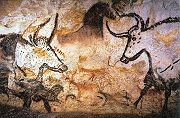
s, left many sophisticated stone tools, carved and engraved pieces on bone, ivory and antler, cave painting
s and Venus figurines
.
This shift from Middle to Upper Paleolithic is called the Upper Paleolithic Revolution. The Neanderthal
s continued to use Mousterian
stone tool
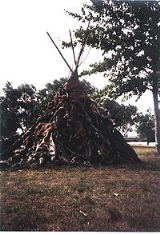
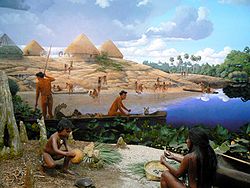
technology, but were probably extinct by about 22,000 BCE. This period has the earliest remains of organized settlements in the form of campsite
s, some with storage pits. These were often located in narrow valley bottoms, possibly to make hunting of passing herd
s of animals easier. Some sites may have been occupied year round, though more generally, they seem to have been used seasonally; peoples moved between them to exploit different food
sources at different times of the year. Hunting was important, and caribou/wild reindeer
"may well be the species of single greatest importance in the entire anthropological literature on hunting."
Technological advance
s included significant developments in flint tool manufacturing, with industries
based on fine blade
s rather than simpler and shorter flake
s. Burin
s and racloir
s were used to work bone
, antler
and hides
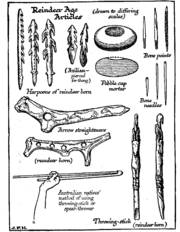
. Advanced dart
s and harpoon
s also appear in this period, along with the fish hook, the oil lamp, rope, and the eyed needle
.
Artistic work
blossomed, with Venus figurines, cave painting, carvings and engravings on bone or ivory (such as the Swimming Reindeer
), petroglyph
s and exotic raw materials found far from their sources, which suggests emergent trading links. More complex social grouping
s emerged, supported by more varied and reliable food sources and specialized tool
types. This probably contributed to increasing group identification or ethnicity. These group identities produced distinctive symbols and rituals which are an important part of modern human behavior.
The changes in human behavior have been attributed to the changes in climate
during the period, which encompasses a number of global temperature
drops. This meant a worsening of the already bitter climate of what is popularly (but incorrectly) called the last ice age. Such changes may have reduced the supply of usable timber
and forced people to look at other materials. In addition, flint becomes brittle at low temperatures and may not have functioned as a tool.
Some scholars have argued that the appearance of complex or abstract language
made these behavior changes possible. The complexity of the new human capabilities hints that humans were less capable of planning or foresight before 40,000 years, while the emergence of cooperative and coherent communication marked a new era of cultural development. This theory is not widely accepted, since human phylogenetic separation dates to the Middle Palaeolithic (see Pre-language). While the latter view is better supported by phylogenetic inference, the material "evidence" is ambiguous.
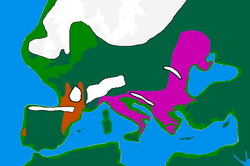 The climate of the period in Europe saw dramatic changes, and included the Last Glacial Maximum
, the coldest phase of the last glacial period, which lasted from about 24,500 to 18,000–17,000 BCE, being coldest at the end, before a relatively rapid warming (all dates vary somewhat for different areas, and in different studies). During the Maximum, most of Northern Europe was covered by an ice-sheet, forcing human populations into the areas known as Last Glacial Maximum refugia
, including modern Italy and the Balkans
, parts of Iberia
and areas around the Black Sea
. This period saw cultures such as the Solutrean
in France and Spain. Human life may have continued on top of the ice sheet, but we know next to nothing about it, and very little about the human life that preceded the European glaciers. In the early part of the period, up to about 30,000 BCE, the Mousterian Pluvial
made northern Africa, including the Sahara
, well-watered and with lower temperatures than today; after the end of the Pluvial the Sahara became arid.
The Last Glacial Maximum was followed by the Allerød oscillation
, a warm and moist global interstadial that occurred around 11,500 to 10,800 BCE. Then there was a very rapid onset, perhaps within as little as a decade, of the cold and dry Younger Dryas
climate period, giving sub-arctic conditions
to much of northern Europe. The Pre-Boreal rise in temperatures also began sharply around 9600 BCE, and by its end around 8500 BCE had brought temperatures nearly to present day levels, though the climate was wetter. This period saw the Upper Paleolithic give way to the start of the following Mesolithic
cultural period.
As the glaciers receded sea levels rose; the English Channel
, Irish Sea
and North Sea
were land at this time, and the Black Sea a fresh-water lake. In particular the Atlantic coastline was initially far out to sea in modern terms in most areas, though the Mediterranean coastline has retreated far less, except in the north of the Adreatic
and the Aegean
. The rise in sea levels continued until at least 5,500 BCE, so evidence of most of the no doubt busy human activity along Europe's coasts in the Upper Paleolithic is therefore lost, though some traces are recovered by fishing boats and marine archaeology, especially from Doggerland
, the lost area beneath the North Sea.
43,000—41,000
35,000 BCE
32,000 BCE
30,000 BCE
30,000 BCE—26,000 BCE
28,000 BCE
25,000 BCE—17,000 BCE
24,000 BCE
23,000 BCE
22,000 BCE
20,000 BCE
 18,000 BCE—15,000 BCE
18,000 BCE
18,000 BCE—11,000 BCE
18,000 BCE—12,000 BCE
17,000 BCE
17,000 BCE—15,000 BCE
16,500 BCE
15,000 BCE
14,000 BCE
13,000 BCE
11,000 BCE
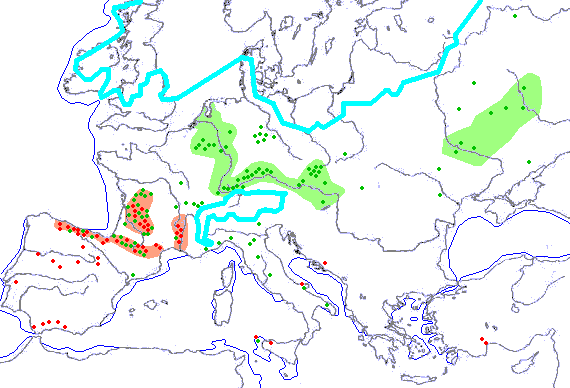
 The Upper Paleolithic in the Franco-Cantabrian region:
From the Synoptic table of the principal old world prehistoric cultures
:
Paleolithic
The Paleolithic Age, Era or Period, is a prehistoric period of human history distinguished by the development of the most primitive stone tools discovered , and covers roughly 99% of human technological prehistory...
or Old Stone Age
Stone Age
The Stone Age is a broad prehistoric period, lasting about 2.5 million years , during which humans and their predecessor species in the genus Homo, as well as the earlier partly contemporary genera Australopithecus and Paranthropus, widely used exclusively stone as their hard material in the...
as it is understood in Europe
Europe
Europe is, by convention, one of the world's seven continents. Comprising the westernmost peninsula of Eurasia, Europe is generally 'divided' from Asia to its east by the watershed divides of the Ural and Caucasus Mountains, the Ural River, the Caspian and Black Seas, and the waterways connecting...
, Africa
Africa
Africa is the world's second largest and second most populous continent, after Asia. At about 30.2 million km² including adjacent islands, it covers 6% of the Earth's total surface area and 20.4% of the total land area...
and Asia
Asia
Asia is the world's largest and most populous continent, located primarily in the eastern and northern hemispheres. It covers 8.7% of the Earth's total surface area and with approximately 3.879 billion people, it hosts 60% of the world's current human population...
. Very broadly it dates to between 40,000 and 10,000
9th millennium BC
The 9th millennium BC marks the beginning of the Neolithic period.Agriculture spread throughout the Fertile Crescent and use of pottery became more widespread. Larger settlements like Jericho arose along salt and flint trade routes. Northern Eurasia was resettled as the glaciers of the last glacial...
years ago, roughly coinciding with the appearance of behavioral modernity
Behavioral modernity
Behavioral modernity is a term used in anthropology, archeology and sociology to refer to a set of traits that distinguish present day humans and their recent ancestors from both living primates and other extinct hominid lineages. It is the point at which Homo sapiens began to demonstrate a...
and before the advent of agriculture
Agriculture
Agriculture is the cultivation of animals, plants, fungi and other life forms for food, fiber, and other products used to sustain life. Agriculture was the key implement in the rise of sedentary human civilization, whereby farming of domesticated species created food surpluses that nurtured the...
. The terms "Late Stone Age
Late Stone Age
The Later Stone Age refers to a period in African prehistory. Its beginnings are roughly contemporaneous with the European Upper Paleolithic...
" and "Upper Paleolithic" refer to the same periods. For historical reasons, "Stone Age" usually refers to the period in Africa, whereas "Upper Paleolithic" is generally used when referring to the period in Europe.
Overview
Modern humansAnatomically modern humans
The term anatomically modern humans in paleoanthropology refers to early individuals of Homo sapiens with an appearance consistent with the range of phenotypes in modern humans....
(i.e. Homo sapiens) are believed to have emerged about 195,000 years ago in Africa. Though these humans were modern in anatomy, their lifestyle changed very little from their contemporaries, such as Homo erectus
Homo erectus
Homo erectus is an extinct species of hominid that lived from the end of the Pliocene epoch to the later Pleistocene, about . The species originated in Africa and spread as far as India, China and Java. There is still disagreement on the subject of the classification, ancestry, and progeny of H...
and the Neanderthal
Neanderthal
The Neanderthal is an extinct member of the Homo genus known from Pleistocene specimens found in Europe and parts of western and central Asia...
s. They used the same crude stone tools. Archaeologist Richard G. Klein
Richard G. Klein
Richard G. Klein is a Professor of Biology and Anthropology at Stanford University. He is the Anne T. and Robert M. Bass Professor in the School of Humanities and Sciences. He earned his Ph.D. at the University of Chicago in 1966, and was elected to the National Academy of Sciences in April 2003....
, who has worked extensively on ancient stone tools, describes the stone tool kit of archaic hominids as impossible to categorize. It was as if the Neanderthals made stone tools, and were not much concerned about their final forms. He argues that almost everywhere, whether Asia or Africa or Europe, before 50,000 years ago all the stone tools are much alike and unsophisticated.
About 50,000 years ago, there was a marked increase in the diversity of artifacts
Artifact (archaeology)
An artifact or artefact is "something made or given shape by man, such as a tool or a work of art, esp an object of archaeological interest"...
. For the first time in Africa, bone artifacts and the first art appear in the archeological record. The first evidence of human fishing is also noted, from artifacts in places such as Blombos cave
Blombos Cave
Blombos Cave is a cave in a calcarenite limestone cliff on the Southern Cape coast in South Africa. It is an archaeological site made famous by the discovery of 75,000-year-old pieces of ochre engraved with abstract designs and beads made from Nassarius shells, and c. 80,000-year-old bone tools...
in South Africa
South Africa
The Republic of South Africa is a country in southern Africa. Located at the southern tip of Africa, it is divided into nine provinces, with of coastline on the Atlantic and Indian oceans...
. Firstly among the artifacts of Africa, archeologists found they could differentiate and classify those of less than 50,000 years into many different categories, such as projectile points, engraving tools, knife blades, and drilling and piercing tools. These new stone-tool types have been described as being distinctly differentiated from each other, as if each tool had a specific purpose. 3,000 to 4,000 years later, this tool technology spread with people migrating to Europe. The new technology generated a population explosion of modern humans which is believed to have led to the extinction
Extinction
In biology and ecology, extinction is the end of an organism or of a group of organisms , normally a species. The moment of extinction is generally considered to be the death of the last individual of the species, although the capacity to breed and recover may have been lost before this point...
of the Neanderthals. The invaders, commonly referred to as the Cro-Magnon
Cro-Magnon
The Cro-Magnon were the first early modern humans of the European Upper Paleolithic. The earliest known remains of Cro-Magnon-like humans are radiometrically dated to 35,000 years before present....
s, left many sophisticated stone tools, carved and engraved pieces on bone, ivory and antler, cave painting
Cave painting
Cave paintings are paintings on cave walls and ceilings, and the term is used especially for those dating to prehistoric times. The earliest European cave paintings date to the Aurignacian, some 32,000 years ago. The purpose of the paleolithic cave paintings is not known...
s and Venus figurines
Venus figurines
Venus figurines is an umbrella term for a number of prehistoric statuettes of women portrayed with similar physical attributes from the Upper Palaeolithic, mostly found in Europe, but with finds as far east as Irkutsk Oblast, Siberia, extending their distribution to much of Eurasia, from the...
.
This shift from Middle to Upper Paleolithic is called the Upper Paleolithic Revolution. The Neanderthal
Neanderthal
The Neanderthal is an extinct member of the Homo genus known from Pleistocene specimens found in Europe and parts of western and central Asia...
s continued to use Mousterian
Mousterian
Mousterian is a name given by archaeologists to a style of predominantly flint tools associated primarily with Homo neanderthalensis and dating to the Middle Paleolithic, the middle part of the Old Stone Age.-Naming:...
stone tool
Stone tool
A stone tool is, in the most general sense, any tool made either partially or entirely out of stone. Although stone tool-dependent societies and cultures still exist today, most stone tools are associated with prehistoric, particularly Stone Age cultures that have become extinct...
technology, but were probably extinct by about 22,000 BCE. This period has the earliest remains of organized settlements in the form of campsite
Campsite
A campsite or camping pitch is a place used for overnight stay in the outdoors. In British English a campsite is an area, usually divided into a number of pitches, where people can camp overnight using tents or camper vans or caravans; this British English use of the word is synonymous with the...
s, some with storage pits. These were often located in narrow valley bottoms, possibly to make hunting of passing herd
Herd
Herd refers to a social grouping of certain animals of the same species, either wild or domestic, and also to the form of collective animal behavior associated with this or as a verb, to herd, to its control by another species such as humans or dogs.The term herd is generally applied to mammals,...
s of animals easier. Some sites may have been occupied year round, though more generally, they seem to have been used seasonally; peoples moved between them to exploit different food
Food
Food is any substance consumed to provide nutritional support for the body. It is usually of plant or animal origin, and contains essential nutrients, such as carbohydrates, fats, proteins, vitamins, or minerals...
sources at different times of the year. Hunting was important, and caribou/wild reindeer
Reindeer
The reindeer , also known as the caribou in North America, is a deer from the Arctic and Subarctic, including both resident and migratory populations. While overall widespread and numerous, some of its subspecies are rare and one has already gone extinct.Reindeer vary considerably in color and size...
"may well be the species of single greatest importance in the entire anthropological literature on hunting."
Technological advance
Technology
Technology is the making, usage, and knowledge of tools, machines, techniques, crafts, systems or methods of organization in order to solve a problem or perform a specific function. It can also refer to the collection of such tools, machinery, and procedures. The word technology comes ;...
s included significant developments in flint tool manufacturing, with industries
Archaeological industry
An archaeological industry, normally just "industry", is the name given in the study of prehistory to a consistent range of assemblages connected with a single product, such as the Langdale axe industry...
based on fine blade
Prismatic blade
In archaeology, a prismatic blade is a long, narrow, specialized lithic flake with parallel margins. Prismatic blades are removed from polyhedral blade cores through pressure reduction. This process results in a very standardized finished tool and waste assemblage...
s rather than simpler and shorter flake
Lithic flake
In archaeology, a lithic flake is a "portion of rock removed from an objective piece by percussion or pressure," and may also be referred to as a chip or spall, or collectively as debitage. The objective piece, or the rock being reduced by the removal of flakes, is known as a core. Once the proper...
s. Burin
Burin
Burin from the French burin meaning "cold chisel" has two specialised meanings for types of tools in English, one meaning a steel cutting tool which is the essential tool of engraving, and the other, in archaeology, meaning a special type of lithic flake with a chisel-like edge which was probably...
s and racloir
Racloir
A racloir is a name given by archaeologists to a certain type of flint tool made by prehistoric peoples.It is created from a flint flake and looks like a large scraper. As well as being used for scraping hides and bark, it may also have been used as a knife. Racloirs are most associated with the...
s were used to work bone
Bone
Bones are rigid organs that constitute part of the endoskeleton of vertebrates. They support, and protect the various organs of the body, produce red and white blood cells and store minerals. Bone tissue is a type of dense connective tissue...
, antler
Antler
Antlers are the usually large, branching bony appendages on the heads of most deer species.-Etymology:Antler originally meant the lowest tine, the "brow tine"...
and hides
Hides
A hide is an animal skin treated for human use. Hides include leather from cattle and other livestock animals, alligator skins, snake skins for shoes and fashion accessories and furs from wild cats, mink and bears. In some areas, leather is produced on a domestic or small industrial scale, but most...
. Advanced dart
Dart (missile)
Darts are missile weapons, designed to fly such that a sharp, often weighted point will strike first. They can be distinguished from javelins by fletching and a shaft that is shorter and/or more flexible, and from arrows by the fact that they are not of the right length to use with a normal...
s and harpoon
Harpoon
A harpoon is a long spear-like instrument used in fishing to catch fish or large marine mammals such as whales. It accomplishes this task by impaling the target animal, allowing the fishermen to use a rope or chain attached to the butt of the projectile to catch the animal...
s also appear in this period, along with the fish hook, the oil lamp, rope, and the eyed needle
Sewing needle
A sewing needle is a long slender tool with a pointed tip. The first needles were made of bone or wood; modern ones are manufactured from high carbon steel wire, nickel- or 18K gold plated for corrosion resistance. The highest quality embroidery needles are plated with two-thirds platinum and...
.
Artistic work
Art of the Upper Paleolithic
The art of the Upper Paleolithic is the oldest undisputed prehistoric art, originating in the Aurignacian archaeological culture of Europe and the Levant some 40,000 years ago, and continues to the Mesolithic about 12,000 years ago...
blossomed, with Venus figurines, cave painting, carvings and engravings on bone or ivory (such as the Swimming Reindeer
Swimming Reindeer
The Swimming Reindeer is the name given to a 13,000 year old sculpture of two swimming reindeer conserved in the British Museum. The sculpture was made in France by carving the tip of a mammoth tusk...
), petroglyph
Petroglyph
Petroglyphs are pictogram and logogram images created by removing part of a rock surface by incising, picking, carving, and abrading. Outside North America, scholars often use terms such as "carving", "engraving", or other descriptions of the technique to refer to such images...
s and exotic raw materials found far from their sources, which suggests emergent trading links. More complex social grouping
Society
A society, or a human society, is a group of people related to each other through persistent relations, or a large social grouping sharing the same geographical or virtual territory, subject to the same political authority and dominant cultural expectations...
s emerged, supported by more varied and reliable food sources and specialized tool
Tool
A tool is a device that can be used to produce an item or achieve a task, but that is not consumed in the process. Informally the word is also used to describe a procedure or process with a specific purpose. Tools that are used in particular fields or activities may have different designations such...
types. This probably contributed to increasing group identification or ethnicity. These group identities produced distinctive symbols and rituals which are an important part of modern human behavior.
The changes in human behavior have been attributed to the changes in climate
Climate
Climate encompasses the statistics of temperature, humidity, atmospheric pressure, wind, rainfall, atmospheric particle count and other meteorological elemental measurements in a given region over long periods...
during the period, which encompasses a number of global temperature
Temperature
Temperature is a physical property of matter that quantitatively expresses the common notions of hot and cold. Objects of low temperature are cold, while various degrees of higher temperatures are referred to as warm or hot...
drops. This meant a worsening of the already bitter climate of what is popularly (but incorrectly) called the last ice age. Such changes may have reduced the supply of usable timber
Timber
Timber may refer to:* Timber, a term common in the United Kingdom and Australia for wood materials * Timber, Oregon, an unincorporated community in the U.S...
and forced people to look at other materials. In addition, flint becomes brittle at low temperatures and may not have functioned as a tool.
Some scholars have argued that the appearance of complex or abstract language
Language
Language may refer either to the specifically human capacity for acquiring and using complex systems of communication, or to a specific instance of such a system of complex communication...
made these behavior changes possible. The complexity of the new human capabilities hints that humans were less capable of planning or foresight before 40,000 years, while the emergence of cooperative and coherent communication marked a new era of cultural development. This theory is not widely accepted, since human phylogenetic separation dates to the Middle Palaeolithic (see Pre-language). While the latter view is better supported by phylogenetic inference, the material "evidence" is ambiguous.
Changes in climate and geography
Last Glacial Maximum
The Last Glacial Maximum refers to a period in the Earth's climate history when ice sheets were at their maximum extension, between 26,500 and 19,000–20,000 years ago, marking the peak of the last glacial period. During this time, vast ice sheets covered much of North America, northern Europe and...
, the coldest phase of the last glacial period, which lasted from about 24,500 to 18,000–17,000 BCE, being coldest at the end, before a relatively rapid warming (all dates vary somewhat for different areas, and in different studies). During the Maximum, most of Northern Europe was covered by an ice-sheet, forcing human populations into the areas known as Last Glacial Maximum refugia
Last Glacial Maximum refugia
Last Glacial Maximum refugia were places where people survived during the last glacial period in the northern hemisphere.Sub-Saharan Africa and Australia were not affected by the glaciation and the Americas and New Zealand had no humans at that time...
, including modern Italy and the Balkans
Balkans
The Balkans is a geopolitical and cultural region of southeastern Europe...
, parts of Iberia
Iberia
The name Iberia refers to three historical regions of the old world:* Iberian Peninsula, in Southwest Europe, location of modern-day Portugal and Spain** Prehistoric Iberia...
and areas around the Black Sea
Black Sea
The Black Sea is bounded by Europe, Anatolia and the Caucasus and is ultimately connected to the Atlantic Ocean via the Mediterranean and the Aegean seas and various straits. The Bosphorus strait connects it to the Sea of Marmara, and the strait of the Dardanelles connects that sea to the Aegean...
. This period saw cultures such as the Solutrean
Solutrean
The Solutrean industry is a relatively advanced flint tool-making style of the Upper Palaeolithic, from around 22,000 to 17,000 BP.-Details:...
in France and Spain. Human life may have continued on top of the ice sheet, but we know next to nothing about it, and very little about the human life that preceded the European glaciers. In the early part of the period, up to about 30,000 BCE, the Mousterian Pluvial
Mousterian Pluvial
The Mousterian Pluvial was an extended wet and rainy period in the climate history of North Africa. It occurred during the Upper Paleolithic era, beginning around 50,000 years before the present , lasting 20,000 years, and ending around 30,000 ybp .During the Mousterian Pluvial, the now-desiccated...
made northern Africa, including the Sahara
Sahara
The Sahara is the world's second largest desert, after Antarctica. At over , it covers most of Northern Africa, making it almost as large as Europe or the United States. The Sahara stretches from the Red Sea, including parts of the Mediterranean coasts, to the outskirts of the Atlantic Ocean...
, well-watered and with lower temperatures than today; after the end of the Pluvial the Sahara became arid.
The Last Glacial Maximum was followed by the Allerød oscillation
Allerød Oscillation
The Allerød period was a warm and moist global interstadial that occurred at the end of the last glacial period. The Allerød oscillation raised temperatures , before they declined again in the succeeding Younger Dryas period, which was followed by the present interglacial period.In some regions,...
, a warm and moist global interstadial that occurred around 11,500 to 10,800 BCE. Then there was a very rapid onset, perhaps within as little as a decade, of the cold and dry Younger Dryas
Younger Dryas
The Younger Dryas stadial, also referred to as the Big Freeze, was a geologically brief period of cold climatic conditions and drought between approximately 12.8 and 11.5 ka BP, or 12,800 and 11,500 years before present...
climate period, giving sub-arctic conditions
Subarctic climate
The subarctic climate is a climate characterized by long, usually very cold winters, and short, cool to mild summers. It is found on large landmasses, away from the moderating effects of an ocean, generally at latitudes from 50° to 70°N poleward of the humid continental climates...
to much of northern Europe. The Pre-Boreal rise in temperatures also began sharply around 9600 BCE, and by its end around 8500 BCE had brought temperatures nearly to present day levels, though the climate was wetter. This period saw the Upper Paleolithic give way to the start of the following Mesolithic
Mesolithic
The Mesolithic is an archaeological concept used to refer to certain groups of archaeological cultures defined as falling between the Paleolithic and the Neolithic....
cultural period.
As the glaciers receded sea levels rose; the English Channel
English Channel
The English Channel , often referred to simply as the Channel, is an arm of the Atlantic Ocean that separates southern England from northern France, and joins the North Sea to the Atlantic. It is about long and varies in width from at its widest to in the Strait of Dover...
, Irish Sea
Irish Sea
The Irish Sea separates the islands of Ireland and Great Britain. It is connected to the Celtic Sea in the south by St George's Channel, and to the Atlantic Ocean in the north by the North Channel. Anglesey is the largest island within the Irish Sea, followed by the Isle of Man...
and North Sea
North Sea
In the southwest, beyond the Straits of Dover, the North Sea becomes the English Channel connecting to the Atlantic Ocean. In the east, it connects to the Baltic Sea via the Skagerrak and Kattegat, narrow straits that separate Denmark from Norway and Sweden respectively...
were land at this time, and the Black Sea a fresh-water lake. In particular the Atlantic coastline was initially far out to sea in modern terms in most areas, though the Mediterranean coastline has retreated far less, except in the north of the Adreatic
Adriatic Sea
The Adriatic Sea is a body of water separating the Italian Peninsula from the Balkan peninsula, and the system of the Apennine Mountains from that of the Dinaric Alps and adjacent ranges...
and the Aegean
Aegean Sea
The Aegean Sea[p] is an elongated embayment of the Mediterranean Sea located between the southern Balkan and Anatolian peninsulas, i.e., between the mainlands of Greece and Turkey. In the north, it is connected to the Marmara Sea and Black Sea by the Dardanelles and Bosporus...
. The rise in sea levels continued until at least 5,500 BCE, so evidence of most of the no doubt busy human activity along Europe's coasts in the Upper Paleolithic is therefore lost, though some traces are recovered by fishing boats and marine archaeology, especially from Doggerland
Doggerland
Doggerland is a name given by archaeologists and geologists to a former landmass in the southern North Sea that connected the island of Great Britain to mainland Europe during and after the last Ice Age, surviving until about 6,500 or 6,200 BCE, though gradually being swallowed by rising sea levels...
, the lost area beneath the North Sea.
Events
50 000 BCE
50,000 BCE- start of the Mousterian PluvialMousterian PluvialThe Mousterian Pluvial was an extended wet and rainy period in the climate history of North Africa. It occurred during the Upper Paleolithic era, beginning around 50,000 years before the present , lasting 20,000 years, and ending around 30,000 ybp .During the Mousterian Pluvial, the now-desiccated...
in North AfricaNorth AfricaNorth Africa or Northern Africa is the northernmost region of the African continent, linked by the Sahara to Sub-Saharan Africa. Geopolitically, the United Nations definition of Northern Africa includes eight countries or territories; Algeria, Egypt, Libya, Morocco, South Sudan, Sudan, Tunisia, and...
43,000—41,000
- At Ksar AkilKsar AkilKsar Akil is an archeological site 10 km northeast of Beirut in Lebanon. It is located about west of Antelias spring on the north bank of the northern tributary of the Wadi Antelias. It is a large rock shelter below a steep limestone cliff....
in Lebanon, ornaments and skeletal remains of modern humans are dated to this period.
40 000 BCE
40,000—35,000 BCE- Cro-MagnonCro-MagnonThe Cro-Magnon were the first early modern humans of the European Upper Paleolithic. The earliest known remains of Cro-Magnon-like humans are radiometrically dated to 35,000 years before present....
appear in Europe, early cultural center in the Swabian Alps, earliest figurative art (Venus of Schelklingen), beginning AurignacianAurignacianThe Aurignacian culture is an archaeological culture of the Upper Palaeolithic, located in Europe and southwest Asia. It lasted broadly within the period from ca. 45,000 to 35,000 years ago in terms of conventional radiocarbon dating, or between ca. 47,000 and 41,000 years ago in terms of the most...
35,000 BCE
- Zar, Yataghyeri, Damjili and Taghlar caves in AzerbaijanAzerbaijanAzerbaijan , officially the Republic of Azerbaijan is the largest country in the Caucasus region of Eurasia. Located at the crossroads of Western Asia and Eastern Europe, it is bounded by the Caspian Sea to the east, Russia to the north, Georgia to the northwest, Armenia to the west, and Iran to...
.
32,000 BCE
- Europeans understand how to harden clay figures by firing them in an oven at high temperatures.
30,000 BCE
- Invention of the bowBow (weapon)The bow and arrow is a projectile weapon system that predates recorded history and is common to most cultures.-Description:A bow is a flexible arc that shoots aerodynamic projectiles by means of elastic energy. Essentially, the bow is a form of spring powered by a string or cord...
and arrowArrowAn arrow is a shafted projectile that is shot with a bow. It predates recorded history and is common to most cultures.An arrow usually consists of a shaft with an arrowhead attached to the front end, with fletchings and a nock at the other.- History:...
. - end of the Mousterian Pluvial in North Africa
30,000 BCE—26,000 BCE
- Lion-Human, from Hohlenstein-StadelHohlenstein-StadelHohlenstein-Stadel is a cave located at N 48° 32' 57.57" and E 10° 10' 20.75" in the Hohlenstein cliff at the southern rim of the Lonetal in Swabian Alb, Germany. While first excavations were started after the second half of the 19th century, it was not until 1969 that the significance of some of...
, GermanyGermanyGermany , officially the Federal Republic of Germany , is a federal parliamentary republic in Europe. The country consists of 16 states while the capital and largest city is Berlin. Germany covers an area of 357,021 km2 and has a largely temperate seasonal climate...
created. It is now in Ulmer Museum, UlmUlmUlm is a city in the federal German state of Baden-Württemberg, situated on the River Danube. The city, whose population is estimated at 120,000 , forms an urban district of its own and is the administrative seat of the Alb-Donau district. Ulm, founded around 850, is rich in history and...
, GermanyGermanyGermany , officially the Federal Republic of Germany , is a federal parliamentary republic in Europe. The country consists of 16 states while the capital and largest city is Berlin. Germany covers an area of 357,021 km2 and has a largely temperate seasonal climate...
.
30 000 BCE
29,000—25,000 BCE- Venus of Dolní VestoniceVenus of Dolní VestoniceThe Venus of Dolní Věstonice is a Venus figurine, a ceramic statuette of a nude female figure dated to 29,000–25,000 BCE , which was found at a Paleolithic site in the Moravian basin south of Brno.-Description:...
. It is the oldest known ceramic in the world. The Red Lady of PavilandRed Lady of PavilandThe Red Lady of Paviland is a fairly complete Upper Paleolithic-era human male skeleton dyed in red ochre. It was the first human fossil to have been found anywhere in the world and is also the oldest ceremonial burial anywhere in Western Europe so far discovered. The bones were discovered between...
lived around 29-26,000 years ago. Recent evidence has come to light that he was a tribal chiefTribal chiefA tribal chief is the leader of a tribal society or chiefdom. Tribal societies with social stratification under a single leader emerged in the Neolithic period out of earlier tribal structures with little stratification, and they remained prevalent throughout the Iron Age.In the case of ...
.
28,000 BCE
- People start to live in JapanJapanJapan is an island nation in East Asia. Located in the Pacific Ocean, it lies to the east of the Sea of Japan, China, North Korea, South Korea and Russia, stretching from the Sea of Okhotsk in the north to the East China Sea and Taiwan in the south...
.
25,000 BCE—17,000 BCE
- Wall painting with horses, rhinoceroses and aurochs, Chauvet CaveChauvet CaveThe Chauvet-Pont-d'Arc Cave is a cave in the Ardèche department of southern France that contains the earliest known cave paintings, as well as other evidence of Upper Paleolithic life. It is located near the commune of Vallon-Pont-d'Arc on a limestone cliff above the former bed of the Ardèche River...
, Vallon-Pont-d'ArcVallon-Pont-d'ArcVallon-Pont-d'Arc is a commune in the Ardèche department in southern France.Vallon-Pont-d'Arc is a capital of prehistoric and cultural tourism. This small village, peaceful in wintertime, sees its population expand ten-fold in summer...
, Ardéche gorge, FranceFranceThe French Republic , The French Republic , The French Republic , (commonly known as France , is a unitary semi-presidential republic in Western Europe with several overseas territories and islands located on other continents and in the Indian, Pacific, and Atlantic oceans. Metropolitan France...
, is made. Discovered in December 1994.
24,000 BCE
- start of the second Mousterian PluvialMousterian PluvialThe Mousterian Pluvial was an extended wet and rainy period in the climate history of North Africa. It occurred during the Upper Paleolithic era, beginning around 50,000 years before the present , lasting 20,000 years, and ending around 30,000 ybp .During the Mousterian Pluvial, the now-desiccated...
in North Africa.
23,000 BCE
- Venus of Petrkovice (Petrkovická venuše in Czech) from Petrkovice in OstravaOstravaOstrava is the third largest city in the Czech Republic and the second largest urban agglomeration after Prague. Located close to the Polish border, it is also the administrative center of the Moravian-Silesian Region and of the Municipality with Extended Competence. Ostrava was candidate for the...
, Czech RepublicCzech RepublicThe Czech Republic is a landlocked country in Central Europe. The country is bordered by Poland to the northeast, Slovakia to the east, Austria to the south, and Germany to the west and northwest....
, was made. It is now in Archeological Institute, BrnoBrnoBrno by population and area is the second largest city in the Czech Republic, the largest Moravian city, and the historical capital city of the Margraviate of Moravia. Brno is the administrative centre of the South Moravian Region where it forms a separate district Brno-City District...
.
22,000 BCE
- Neanderthals believed to have become extinct in Europe.
- Last Glacial MaximumLast Glacial MaximumThe Last Glacial Maximum refers to a period in the Earth's climate history when ice sheets were at their maximum extension, between 26,500 and 19,000–20,000 years ago, marking the peak of the last glacial period. During this time, vast ice sheets covered much of North America, northern Europe and...
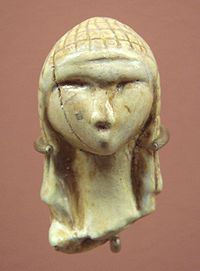
: Venus of BrassempouyVenus of BrassempouyThe Venus of Brassempouy is a fragmentary ivory figurine from the Upper Palaeolithic. It was discovered in a cave at Brassempouy, France in 1892...
, Grotte du Pape, BrassempouyBrassempouyBrassempouy is a commune in the Landes department in Aquitaine in south-western France.The settlement is on the route between Mont-de-Marsan and Orthez...
, Landes, FranceFranceThe French Republic , The French Republic , The French Republic , (commonly known as France , is a unitary semi-presidential republic in Western Europe with several overseas territories and islands located on other continents and in the Indian, Pacific, and Atlantic oceans. Metropolitan France...
, was made. It is now at Musee des Antiquites Nationales, St.-Germain-en-Laye. - Venus of WillendorfVenus of WillendorfThe Venus of Willendorf, also known as the Woman of Willendorf, is an high statuette of a female figure estimated to have been made between 24,000 and 22,000 BCE. It was discovered in 1908 by archaeologist Josef Szombathy at a paleolithic site near Willendorf, a village in Lower Austria near the...
, AustriaAustriaAustria , officially the Republic of Austria , is a landlocked country of roughly 8.4 million people in Central Europe. It is bordered by the Czech Republic and Germany to the north, Slovakia and Hungary to the east, Slovenia and Italy to the south, and Switzerland and Liechtenstein to the...
, was made. It is now at Naturhistorisches MuseumNaturhistorisches MuseumThe Naturhistorisches Museum Wien or NHMW is a large museum located in Vienna, Austria.The collections displayed cover , and the museum has a website providing an overview as a video virtual tour....
, ViennaViennaVienna is the capital and largest city of the Republic of Austria and one of the nine states of Austria. Vienna is Austria's primary city, with a population of about 1.723 million , and is by far the largest city in Austria, as well as its cultural, economic, and political centre...
.
20,000 BCE
- end of the second Mousterian Pluvial in North Africa.
20 000 BCE
- Last Glacial MaximumLast Glacial MaximumThe Last Glacial Maximum refers to a period in the Earth's climate history when ice sheets were at their maximum extension, between 26,500 and 19,000–20,000 years ago, marking the peak of the last glacial period. During this time, vast ice sheets covered much of North America, northern Europe and...
. Mean Sea Levels are believed to be 110 to 120 meters (361 to 394 ft) lower than present, with the direct implication that many coastal and lower riverine valley archaeological sites of interest are today under water.
18,000 BCE
- Spotted Horses, Pech MerlePech MerlePech Merle is a cave which opens onto a hillside at Cabrerets in the Lot département of the Midi-Pyrénées region in France, about 35 minutes by road east of Cahors. It is the home of one of the few prehistoric cave painting sites in France which remain open to the general public...
cave, DordogneDordogneDordogne is a départment in south-west France. The départment is located in the region of Aquitaine, between the Loire valley and the High Pyrénées named after the great river Dordogne that runs through it...
, FranceFranceThe French Republic , The French Republic , The French Republic , (commonly known as France , is a unitary semi-presidential republic in Western Europe with several overseas territories and islands located on other continents and in the Indian, Pacific, and Atlantic oceans. Metropolitan France...
are painted. Discovered in December 1994.
18,000 BCE—11,000 BCE
- Ibex-headed spear thrower, from Le Mas d'Azil, AriegeAriègeAriège is a department in southwestern France named after the Ariège River.- History :Ariège is one of the original 83 departments created during the French Revolution on 4 March 1790. It was created from the counties of Foix and Couserans....
, FranceFranceThe French Republic , The French Republic , The French Republic , (commonly known as France , is a unitary semi-presidential republic in Western Europe with several overseas territories and islands located on other continents and in the Indian, Pacific, and Atlantic oceans. Metropolitan France...
, is made. It is now at Musee de la Prehistoire, Le Mas d'Azil.
18,000 BCE—12,000 BCE
- MammothMammothA mammoth is any species of the extinct genus Mammuthus. These proboscideans are members of Elephantidae, the family of elephants and mammoths, and close relatives of modern elephants. They were often equipped with long curved tusks and, in northern species, a covering of long hair...
-bone village in MezhirichMezhirichMezhyrich is a village in central Ukraine. It is located in the Kanivskyi Raion of the Cherkasy Oblast , approximately 22 km from the region's administrative center, Kaniv, near the point where the Rosava River flows into the Ros'.-Pre-historic finds:In 1965, a farmer dug up the lower jawbone of...
, UkraineUkraineUkraine is a country in Eastern Europe. It has an area of 603,628 km², making it the second largest contiguous country on the European continent, after Russia...
is inhabited.
17,000 BCE
- Spotted human hands, Pech MerlePech MerlePech Merle is a cave which opens onto a hillside at Cabrerets in the Lot département of the Midi-Pyrénées region in France, about 35 minutes by road east of Cahors. It is the home of one of the few prehistoric cave painting sites in France which remain open to the general public...
cave, DordogneDordogneDordogne is a départment in south-west France. The départment is located in the region of Aquitaine, between the Loire valley and the High Pyrénées named after the great river Dordogne that runs through it...
, FranceFranceThe French Republic , The French Republic , The French Republic , (commonly known as France , is a unitary semi-presidential republic in Western Europe with several overseas territories and islands located on other continents and in the Indian, Pacific, and Atlantic oceans. Metropolitan France...
are painted. Discovered in December 1994.
17,000 BCE—15,000 BCE
- Hall of Bulls, LascauxLascauxLascaux is the setting of a complex of caves in southwestern France famous for its Paleolithic cave paintings. The original caves are located near the village of Montignac, in the department of Dordogne. They contain some of the best-known Upper Paleolithic art. These paintings are estimated to be...
caves, is painted. Discovered in 1940. Closed to the public in 1963. - Bird-Headed man with bison and Rhinoceros, LascauxLascauxLascaux is the setting of a complex of caves in southwestern France famous for its Paleolithic cave paintings. The original caves are located near the village of Montignac, in the department of Dordogne. They contain some of the best-known Upper Paleolithic art. These paintings are estimated to be...
caves, is painted. - Lamp with ibex design, from La Mouthe cave, DordogneDordogneDordogne is a départment in south-west France. The départment is located in the region of Aquitaine, between the Loire valley and the High Pyrénées named after the great river Dordogne that runs through it...
, FranceFranceThe French Republic , The French Republic , The French Republic , (commonly known as France , is a unitary semi-presidential republic in Western Europe with several overseas territories and islands located on other continents and in the Indian, Pacific, and Atlantic oceans. Metropolitan France...
, is made. It is now at Musee des Antiquites Nationales, St.-Germain-en-Laye.
16,500 BCE
- Paintings in Cosquer caveCosquer CaveThe Cosquer cave is located in the Calanque de Morgiou near Marseille, France, not very far from Cap Morgiou. The entrance to the cave is located 37 meters underwater, due to the rise of the Mediterranean in Paleolithic times. It was discovered by diver Henri Cosquer in 1985, but its...
, where the cave mouth is now under water at Cap Margiou, FranceFranceThe French Republic , The French Republic , The French Republic , (commonly known as France , is a unitary semi-presidential republic in Western Europe with several overseas territories and islands located on other continents and in the Indian, Pacific, and Atlantic oceans. Metropolitan France...
were made.
15,000 BCE
- Bison, Le Tuc d'Audoubert, AriegeAriègeAriège is a department in southwestern France named after the Ariège River.- History :Ariège is one of the original 83 departments created during the French Revolution on 4 March 1790. It was created from the counties of Foix and Couserans....
, FranceFranceThe French Republic , The French Republic , The French Republic , (commonly known as France , is a unitary semi-presidential republic in Western Europe with several overseas territories and islands located on other continents and in the Indian, Pacific, and Atlantic oceans. Metropolitan France...
.
16 000 BCE
15,000 BCE-12,000 BCE- Paleo-Indians move across North AmericaNorth AmericaNorth America is a continent wholly within the Northern Hemisphere and almost wholly within the Western Hemisphere. It is also considered a northern subcontinent of the Americas...
, then southward through Central AmericaCentral AmericaCentral America is the central geographic region of the Americas. It is the southernmost, isthmian portion of the North American continent, which connects with South America on the southeast. When considered part of the unified continental model, it is considered a subcontinent...
. - Pregnant woman and deer (?), from Laugerie-Basse, FranceFranceThe French Republic , The French Republic , The French Republic , (commonly known as France , is a unitary semi-presidential republic in Western Europe with several overseas territories and islands located on other continents and in the Indian, Pacific, and Atlantic oceans. Metropolitan France...
was made. It is now at Musee des Antiquites Nationales, St.-Germain-en-Laye.
14,000 BCE
- Paleo-Indians searched for big game near what is now the Hovenweep National MonumentHovenweep National MonumentHovenweep National Monument is located on land in southwestern Colorado and southeastern Utah, located between Cortez, Colorado and Blanding, Utah on the Cajon Mesa of the Great Sage Plain...
. - Bison, on the ceiling of a cave at AltamiraAltamira-Places:*Cave of Altamira, a cave in Cantabria, Spain famous for its paintings and carving*Altamira, Brazil, a city in the state of Pará*Altamira, Huila, a town and municipality in Colombia*Altamira, Puerto Plata, a town in the Dominican Republic...
, SpainSpainSpain , officially the Kingdom of Spain languages]] under the European Charter for Regional or Minority Languages. In each of these, Spain's official name is as follows:;;;;;;), is a country and member state of the European Union located in southwestern Europe on the Iberian Peninsula...
, is painted. Discovered in 1879. Accepted as authentic in 1902. - DomesticationDomesticationDomestication or taming is the process whereby a population of animals or plants, through a process of selection, becomes accustomed to human provision and control. In the Convention on Biological Diversity a domesticated species is defined as a 'species in which the evolutionary process has been...
of ReindeerReindeerThe reindeer , also known as the caribou in North America, is a deer from the Arctic and Subarctic, including both resident and migratory populations. While overall widespread and numerous, some of its subspecies are rare and one has already gone extinct.Reindeer vary considerably in color and size...
.
13,000 BCE
- Beginning of the Holocene extinction.
- earliest evidence of warfare
12 000 BCE
11,500 BCE—10,000 BCE- Wooden buildings in South America (ChileChileChile ,officially the Republic of Chile , is a country in South America occupying a long, narrow coastal strip between the Andes mountains to the east and the Pacific Ocean to the west. It borders Peru to the north, Bolivia to the northeast, Argentina to the east, and the Drake Passage in the far...
), first potteryPotteryPottery is the material from which the potteryware is made, of which major types include earthenware, stoneware and porcelain. The place where such wares are made is also called a pottery . Pottery also refers to the art or craft of the potter or the manufacture of pottery...
vessels (JapanJapanJapan is an island nation in East Asia. Located in the Pacific Ocean, it lies to the east of the Sea of Japan, China, North Korea, South Korea and Russia, stretching from the Sea of Okhotsk in the north to the East China Sea and Taiwan in the south...
).
11,000 BCE
- First evidence of human settlement in ArgentinaCueva de las ManosCueva de las Manos is a cave or a series of caves located in the province of Santa Cruz, Argentina, 163 km south of the town of Perito Moreno. It is famous for the paintings of hands, made by the indigenous inhabitants some 9,000 years ago...
. - The Arlington Springs Man dies on the island of Santa Rosa, off the coast of California.
- Human remains deposited in caves which are now located off the coast of Yucatán.
Cultures
- The ChâtelperronianChâtelperronianChâtelperronian was the earliest industry of the Upper Palaeolithic in central and south western France, extending also into Northern Spain. It derives its name from the site of la Grotte des Fées, in Châtelperron, Allier, France....
culture was located around central and south western France, and northern Spain. It appears to be derived from the earlier MousterianMousterianMousterian is a name given by archaeologists to a style of predominantly flint tools associated primarily with Homo neanderthalensis and dating to the Middle Paleolithic, the middle part of the Old Stone Age.-Naming:...
culture, and represents the period of overlap between NeanderthalNeanderthalThe Neanderthal is an extinct member of the Homo genus known from Pleistocene specimens found in Europe and parts of western and central Asia...
s and Homo sapiensHumanHumans are the only living species in the Homo genus...
. This culture lasted from approximately 33,000 BCE to 27,000 BCE. - The AurignacianAurignacianThe Aurignacian culture is an archaeological culture of the Upper Palaeolithic, located in Europe and southwest Asia. It lasted broadly within the period from ca. 45,000 to 35,000 years ago in terms of conventional radiocarbon dating, or between ca. 47,000 and 41,000 years ago in terms of the most...
culture was located in Europe and south west Asia, and flourished between 32000 BCE and 21,000 BCE. It may have been contemporary with the PérigordianPérigordianPérigordian is a term for several distinct but related Upper Upper Palaeolithic cultures which are thought by some archaeologists to represent a contiguous tradition. It existed between c.35,000 BP and c.20,000 BP....
(a contested grouping of the earlier Châtelperronian and later Gravettian cultures). - The GravettianGravettianthumb|right|Burins to the Gravettian culture.The Gravettian toolmaking culture was a specific archaeological industry of the European Upper Palaeolithic era prevalent before the last glacial epoch. It is named after the type site of La Gravette in the Dordogne region of France where its...
culture was located across Europe. Gravettian sites generally date between 26,000 BCE to 20,000 BCE. - The SolutreanSolutreanThe Solutrean industry is a relatively advanced flint tool-making style of the Upper Palaeolithic, from around 22,000 to 17,000 BP.-Details:...
culture was located in eastern France, Spain, and England. Solutrean artifacts have been dated to around 19000 BCE before mysteriously disappearing around 15,000 BCE. - The MagdalenianMagdalenianThe Magdalenian , refers to one of the later cultures of the Upper Paleolithic in western Europe, dating from around 17,000 BP to 9,000 BP...
culture left evidence from Portugal to Poland during the period from 16,000 BCE to 8000 BCE.
From the Synoptic table of the principal old world prehistoric cultures
Synoptic table of the principal old world prehistoric cultures
The synoptic table of the principal old world prehistoric cultures gives a rough picture of the relationships between the various principal cultures of prehistory outside the Americas, Antarctica, Australia and Oceania...
:
- central and east Europe:
- 32,000 BCE, GravettianGravettianthumb|right|Burins to the Gravettian culture.The Gravettian toolmaking culture was a specific archaeological industry of the European Upper Palaeolithic era prevalent before the last glacial epoch. It is named after the type site of La Gravette in the Dordogne region of France where its...
culture in southern Ukraine. - 30,000 BCE, Szeletian culture
- 20,000 BCE, Pavlovian, AurignacianAurignacianThe Aurignacian culture is an archaeological culture of the Upper Palaeolithic, located in Europe and southwest Asia. It lasted broadly within the period from ca. 45,000 to 35,000 years ago in terms of conventional radiocarbon dating, or between ca. 47,000 and 41,000 years ago in terms of the most...
cultures - 11,000 BCE, Ahrensburg cultureAhrensburg cultureThe Ahrensburg culture was a late Upper Paleolithic culture during the Younger Dryas, the last spell of cold at the end of the Weichsel glaciation. The culture is named after village of Ahrensburg, northeast of Hamburg in the German state of Schleswig-Holstein where wooden arrow shafts and clubs...
- 10,000 BCE, Epigravettian culture
- 32,000 BCE, Gravettian
- north and west Africa, and Sahara:
- 30,000 BCE, AterianAterianThe Aterian industry is a name given by archaeologists to a type of stone tool manufacturing dating to the Middle Stone Age in the region around the Atlas Mountains and the northern Sahara, it refers the site of Bir el Ater, south of Annaba.The industry was probably created by modern humans ,...
culture - 10,000 BCE, Ibero-Maurusian (a.k.a. Oranian, Ouchtatian), and Sebilian cultures
- 8000 BCE, Capsian culture
- 30,000 BCE, Aterian
- central, south, and east Africa:
- 50,000 BCE, Fauresmithian culture
- 30,000 BCE, Stillbayan culture
- 10,000 BCE, Lupembian culture
- 9000 BCE, MagosianMagosianThe Magosian is the name given by archaeologists to an industry found in southern and eastern Africa. It dates to between 10,000 and 6,000 years BC and is distinguished from its predecessors by the use of microliths and small blades.In 1953, J...
culture - 7000 BCE, Wiltonian culture
- 3000 BCE, beginning of hunter-gatherer art in southern Africa
- West Asia (including Middle East):
- 50,000 BCE, JabroudianJabroudianThe Jabroudian culture is a cultural phase of the Middle Paleolithic of the Levant. It broadly belongs to the Mousterian culture, and shows connections with the European facies La Quina....
culture - 40,000 BCE, Amoudian culture
- 30,000 BCE, EmirianEmirianThe Emirian culture represents the transition between the Middle Paleolithic and the Upper Paleolithic in the Levant ....
culture - 20,000 BCE, AurignacianAurignacianThe Aurignacian culture is an archaeological culture of the Upper Palaeolithic, located in Europe and southwest Asia. It lasted broadly within the period from ca. 45,000 to 35,000 years ago in terms of conventional radiocarbon dating, or between ca. 47,000 and 41,000 years ago in terms of the most...
culture - 10,000 BCE, Kebarian, Athlitian cultures
- 50,000 BCE, Jabroudian
- south, central and northern Asia:
- 30,000 BCE, AngaraAngaraThe Angara River is a long river in Irkutsk Oblast and Krasnoyarsk Krai, south-east Siberia, Russia. It is the only river flowing out of Lake Baikal, and is the headwater tributary of the Yenisei River....
culture - 9000 BCE, Khandivili culture
- 30,000 BCE, Angara
- east and southeast Asia:
- 80,000 BCE, Ordos cultureOrdos cultureThe Ordos culture comprises the period from Upper Paleolithic to the late Bronze age at the Ordos Desert, in the south of the Inner Mongolian Autonomous Region of the People's Republic of China...
- 50,000 BCE, Ngandong culture
- 30,000 BCE, Sen-Doki culture
- c. 14,000 BCE — Jomon periodJomon periodThe is the time in Japanese prehistory from about 14,000 BC to 300 BC.The term jōmon means "cord-patterned" in Japanese. This refers to the pottery style characteristic of the Jōmon culture, and which has markings made using sticks with cords wrapped around them...
starts in Ancient Japan. - 10,000 BCE, pre-Jomon ceramic culture
- 8000 BCE, HoabinhianHoabinhianThe term Hoabinhian was first used by French archaeologists working in Northern Vietnam to describe Holocene period archaeological assemblages excavated from rock shelters. It has become a common term in the English based literature to describe stone artifact assemblages in Southeast Asia that...
culture - 7000 BCE, Jomon culture
- 80,000 BCE, Ordos culture
See also
- Late Glacial Maximum
- NeolithicNeolithicThe Neolithic Age, Era, or Period, or New Stone Age, was a period in the development of human technology, beginning about 9500 BC in some parts of the Middle East, and later in other parts of the world. It is traditionally considered as the last part of the Stone Age...
- Neolithic EuropeNeolithic EuropeNeolithic Europe refers to a prehistoric period in which Neolithic technology was present in Europe. This corresponds roughly to a time between 7000 BC and c. 1700 BC...
- Behavioral modernityBehavioral modernityBehavioral modernity is a term used in anthropology, archeology and sociology to refer to a set of traits that distinguish present day humans and their recent ancestors from both living primates and other extinct hominid lineages. It is the point at which Homo sapiens began to demonstrate a...
- Cro-Magnon 1Cro-Magnon 1Cro-Magnon 1 is a fossilized human skull of the sub-species Homo sapiens sapiens. It was discovered, with other Cro-Magnon specimens, in Les Eyzies, France by Louis Lartet in 1868.It is dated to 27.680±270 Before Present...
- SungirSungirSungir is an Upper Paleolithic archaeological site in Russia, about 200 km east of Moscow. The site is approximately 28,000 to 30,000 years old and serves as a grave to an older man and two children. They were all adorned with elaborate grave goods that included ivory-beaded jewelry, clothing, and...
External links
- The Upper Paleolithic Revolution
- Picture Gallery of the Paleolithic (reconstructional palaeoethnology), Libor Balák at the Czech Academy of Sciences, the Institute of Archaeology in Brno, The Center for Paleolithic and Paleoethnological Research