

Organization of Ibero-American States

Encyclopedia
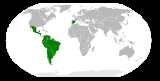
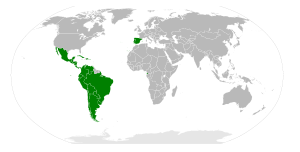
The Organization of Ibero-American States is an intergovernmental organization, comprising the Portuguese
- and Spanish
-speaking nations of America
and Europe
, plus Equatorial Guinea
in Africa
.
The Organization of Ibero-American States for the Education, Science and Culture (OEI) is an international organization for inter-governmental cooperation between the Latin American countries in the field of education, science, technology and culture in the context of the integral development, democracy and regional integration.
The Members of plenary session and observers are all American, European and African: Argentina, Bolivia, Brazil, Colombia, Costa Rica, Cuba, Chile, Dominican Republic, Ecuador, El Salvador, Guatemala, Equatorial Guinea, Honduras, Mexico, Nicaragua, Panama, Paraguay, Peru, Portugal, Puerto Rico, Spain, Uruguay and Venezuela.
The seat
of its General Secretariat is in Madrid
, Spain, and it maintains regional offices in Argentina, Brazil, Colombia, El Salvador, Spain, Mexico and Peru, with field offices in Chile, Honduras, Nicaragua and Paraguay.
The financing of the OEI and its programs are covered by obligatory quotas and voluntary contributions by the governments of the member states and by the contributions by institutions, foundations and other organizations interested in improvement of the educational quality and in scientific and cultural development.
It is presided in honour by the King of Spain.
, and it was decided to transform the OEI into an intergovernmental organization, integrated by sovereign States, and it was so constituted on the 15 of March 1957 at the 3rd Latin American Congress of Education celebrated in Santo Domingo
; they subscribed the first Statutes of the OEI, effective until 1985.
In 1979 the Congress met for the 4th Latin American of Education in Madrid; in 1983 the 5th took place in Lima
, and in May 1985 it held an Extraordinary Meeting of the Congress in Bogotá
, in that it was decided to change the old name of the OEI to the present one, keeping the abbreviations and extending its objectives. This modification affected only the name of its organ of Government, the Latin American Congress of Education, became the General Assembly. In December 1985, during the Meeting of the Directive Council in Panama, its members acted as plenipotentiaries of their respective States and in plenary sessions, powers of the General Assembly, subscribed the present Statutes of the OEI, which replaced the statutory text of 1957 and they approved the Organization Regulations.
Since the I Latin American Conference of Government and Chiefs of State
(Guadalajara
, 1991), the OEI has promoted the Conferences of Ministers of Education, as instances of preparation for the summits, and for the execution of the educative, scientific and cultural programs delegated to it.
It is, also the legislative instance that it establishes the general policies of the OEI, studies, it evaluates and it approves the Plan of Activities of the Organization, the Program and Global budget and fixes the quotas annual, and meets to choose to Secretary General by the corresponding period.
Its main mission is the one to consider and to approve the report of activities, the Program and Budget biennial and financial statement of the Organization.
The General Secretariat is structured internally by a system of flexible organization, adapted to the policies, the strategies and the Plan of Activities.
Portuguese language
Portuguese is a Romance language that arose in the medieval Kingdom of Galicia, nowadays Galicia and Northern Portugal. The southern part of the Kingdom of Galicia became independent as the County of Portugal in 1095...
- and Spanish
Spanish language
Spanish , also known as Castilian , is a Romance language in the Ibero-Romance group that evolved from several languages and dialects in central-northern Iberia around the 9th century and gradually spread with the expansion of the Kingdom of Castile into central and southern Iberia during the...
-speaking nations of America
Americas
The Americas, or America , are lands in the Western hemisphere, also known as the New World. In English, the plural form the Americas is often used to refer to the landmasses of North America and South America with their associated islands and regions, while the singular form America is primarily...
and Europe
Europe
Europe is, by convention, one of the world's seven continents. Comprising the westernmost peninsula of Eurasia, Europe is generally 'divided' from Asia to its east by the watershed divides of the Ural and Caucasus Mountains, the Ural River, the Caspian and Black Seas, and the waterways connecting...
, plus Equatorial Guinea
Equatorial Guinea
Equatorial Guinea, officially the Republic of Equatorial Guinea where the capital Malabo is situated.Annobón is the southernmost island of Equatorial Guinea and is situated just south of the equator. Bioko island is the northernmost point of Equatorial Guinea. Between the two islands and to the...
in Africa
Africa
Africa is the world's second largest and second most populous continent, after Asia. At about 30.2 million km² including adjacent islands, it covers 6% of the Earth's total surface area and 20.4% of the total land area...
.
The Organization of Ibero-American States for the Education, Science and Culture (OEI) is an international organization for inter-governmental cooperation between the Latin American countries in the field of education, science, technology and culture in the context of the integral development, democracy and regional integration.
The Members of plenary session and observers are all American, European and African: Argentina, Bolivia, Brazil, Colombia, Costa Rica, Cuba, Chile, Dominican Republic, Ecuador, El Salvador, Guatemala, Equatorial Guinea, Honduras, Mexico, Nicaragua, Panama, Paraguay, Peru, Portugal, Puerto Rico, Spain, Uruguay and Venezuela.
The seat
Seat (legal entity)
In strict legal language, the term seat defines the seat of a corporation or organisation as a legal entity, indicating where the headquarters of this entity are located...
of its General Secretariat is in Madrid
Madrid
Madrid is the capital and largest city of Spain. The population of the city is roughly 3.3 million and the entire population of the Madrid metropolitan area is calculated to be 6.271 million. It is the third largest city in the European Union, after London and Berlin, and its metropolitan...
, Spain, and it maintains regional offices in Argentina, Brazil, Colombia, El Salvador, Spain, Mexico and Peru, with field offices in Chile, Honduras, Nicaragua and Paraguay.
The financing of the OEI and its programs are covered by obligatory quotas and voluntary contributions by the governments of the member states and by the contributions by institutions, foundations and other organizations interested in improvement of the educational quality and in scientific and cultural development.
It is presided in honour by the King of Spain.
History
The OEI was founded in 1949 under the title of the Office of Latin American Education and with the character of an international agency, as a result of the 1st Latin American Education Congress in Madrid. In 1954, the 2nd Latin American Congress of Education took place in QuitoQuito
San Francisco de Quito, most often called Quito , is the capital city of Ecuador in northwestern South America. It is located in north-central Ecuador in the Guayllabamba river basin, on the eastern slopes of Pichincha, an active stratovolcano in the Andes mountains...
, and it was decided to transform the OEI into an intergovernmental organization, integrated by sovereign States, and it was so constituted on the 15 of March 1957 at the 3rd Latin American Congress of Education celebrated in Santo Domingo
Santo Domingo
Santo Domingo, known officially as Santo Domingo de Guzmán, is the capital and largest city in the Dominican Republic. Its metropolitan population was 2,084,852 in 2003, and estimated at 3,294,385 in 2010. The city is located on the Caribbean Sea, at the mouth of the Ozama River...
; they subscribed the first Statutes of the OEI, effective until 1985.
In 1979 the Congress met for the 4th Latin American of Education in Madrid; in 1983 the 5th took place in Lima
Lima
Lima is the capital and the largest city of Peru. It is located in the valleys of the Chillón, Rímac and Lurín rivers, in the central part of the country, on a desert coast overlooking the Pacific Ocean. Together with the seaport of Callao, it forms a contiguous urban area known as the Lima...
, and in May 1985 it held an Extraordinary Meeting of the Congress in Bogotá
Bogotá
Bogotá, Distrito Capital , from 1991 to 2000 called Santa Fé de Bogotá, is the capital, and largest city, of Colombia. It is also designated by the national constitution as the capital of the department of Cundinamarca, even though the city of Bogotá now comprises an independent Capital district...
, in that it was decided to change the old name of the OEI to the present one, keeping the abbreviations and extending its objectives. This modification affected only the name of its organ of Government, the Latin American Congress of Education, became the General Assembly. In December 1985, during the Meeting of the Directive Council in Panama, its members acted as plenipotentiaries of their respective States and in plenary sessions, powers of the General Assembly, subscribed the present Statutes of the OEI, which replaced the statutory text of 1957 and they approved the Organization Regulations.
Since the I Latin American Conference of Government and Chiefs of State
Ibero-American Summit
The Ibero-American Summit , is a yearly meeting of the heads of government and state of the Spanish-...
(Guadalajara
Guadalajara, Jalisco
Guadalajara is the capital of the Mexican state of Jalisco, and the seat of the municipality of Guadalajara. The city is located in the central region of Jalisco in the western-pacific area of Mexico. With a population of 1,564,514 it is Mexico's second most populous municipality...
, 1991), the OEI has promoted the Conferences of Ministers of Education, as instances of preparation for the summits, and for the execution of the educative, scientific and cultural programs delegated to it.
Aims and objectives
The Organization of Ibero- American States for the Education, Science and the Culture, make the principles that are based on and fulfilling its obligations in agreement with the Statutes, it established the following general aims:- To contribute to fortify the knowledge, mutual understanding, integration, solidarity and peace between the Latin American peoples to spread education, science, technology and culture.
- To foment the development of education and the culture like vélida and viable alternative for construction of peace, by means of the preparation of the human being for the exercise responsible for the freedom, the solidarity and the defense of the human rights, as well as to support the changes that they make possible a right society month for Iberoamé rich.
- To collaborate permanently in transmission and interchange of the integration experiences economic, political and cultural produced in the countries European and Latin American, that constitutes the two areas of influence of the Organization, as well as in any other aspect susceptible to serve for the development of the countries.
- To collaborate with the Members in objective to obtain that the educative systems fulfill a triple approach: humane, developing the formation é tica, integrate and harmonize the new generations; of democratization, assuring the equality educative opportunities and the social fairness; and productive, preparing for the life of the work and favoring labor insertion.
- To collaborate in the diffusion of one culture that, without forgetting the idiosyncrasies and the peculiarities of the different countries, incorporate the codes of modernity to allow assimilation of global advances in science and the technology, revaluing the own cultural identity and taking advantage of the answers that they arise from his accumulation.
- To facilitate the relations between science, technology and society in the Latin American countries, analyzing the implications of the development scientist-knowledge from one social perspective and increasing to its valuation and the understanding of its effects by all the citizens.
- To promote the entailment of the plans of education, science, technology and culture and the plans and socioeconomic processes that persecute a development to the service of man, as well as an equitable distribution of products cultural, technological and scientific.
- To make and promote programs of lateral cooperation between the Member States and of between the States and of other regional institutions.
- To contribute to the diffusion of languages Spanish and Portuguese and to the improvement of all and techniques of its education, as well as to his conservation and preservation in the cultural minorities residents in other countries. To foment the education at the same time bilingual to preserve the multicultural identity of the communities of Ibero-America, expressed in the multilingualisms of its culture.
General Assembly
The General Assembly, that is the supreme authority of the Organization; be integrated by Representatives or Official delegations the Member States.It is, also the legislative instance that it establishes the general policies of the OEI, studies, it evaluates and it approves the Plan of Activities of the Organization, the Program and Global budget and fixes the quotas annual, and meets to choose to Secretary General by the corresponding period.
Directive Council
The Directive Council is the organ delegated by the General Assembly for the control of the government and of Administration of the OEI. Be integrated by the Ministers of Education of the States Members or by their representatives and is presided over by the Minister of Education of the country in which there is of to hold the next meeting of the General Assembly.Its main mission is the one to consider and to approve the report of activities, the Program and Budget biennial and financial statement of the Organization.
General Secretariat
The General Secretariat is delegated organ permanent of the General Assembly for executive direction of the OEI and shows its presentation in relations with the Governments, the international organizations and with other institutions. Té has to its position the direction; cnica and administrative of the Organization and the execution of the programs and projects.The General Secretariat is structured internally by a system of flexible organization, adapted to the policies, the strategies and the Plan of Activities.
Member states
-
 AndorraAndorraAndorra , officially the Principality of Andorra , also called the Principality of the Valleys of Andorra, , is a small landlocked country in southwestern Europe, located in the eastern Pyrenees mountains and bordered by Spain and France. It is the sixth smallest nation in Europe having an area of...
 -
 ArgentinaArgentinaArgentina , officially the Argentine Republic , is the second largest country in South America by land area, after Brazil. It is constituted as a federation of 23 provinces and an autonomous city, Buenos Aires...
 -
 BoliviaBoliviaBolivia officially known as Plurinational State of Bolivia , is a landlocked country in central South America. It is the poorest country in South America...
 -
 BrazilBrazilBrazil , officially the Federative Republic of Brazil , is the largest country in South America. It is the world's fifth largest country, both by geographical area and by population with over 192 million people...
 -
 ChileChileChile ,officially the Republic of Chile , is a country in South America occupying a long, narrow coastal strip between the Andes mountains to the east and the Pacific Ocean to the west. It borders Peru to the north, Bolivia to the northeast, Argentina to the east, and the Drake Passage in the far...
 -
 ColombiaColombiaColombia, officially the Republic of Colombia , is a unitary constitutional republic comprising thirty-two departments. The country is located in northwestern South America, bordered to the east by Venezuela and Brazil; to the south by Ecuador and Peru; to the north by the Caribbean Sea; to the...
 -
 Costa RicaCosta RicaCosta Rica , officially the Republic of Costa Rica is a multilingual, multiethnic and multicultural country in Central America, bordered by Nicaragua to the north, Panama to the southeast, the Pacific Ocean to the west and the Caribbean Sea to the east....
 -
 CubaCubaThe Republic of Cuba is an island nation in the Caribbean. The nation of Cuba consists of the main island of Cuba, the Isla de la Juventud, and several archipelagos. Havana is the largest city in Cuba and the country's capital. Santiago de Cuba is the second largest city...
 -
 Dominican RepublicDominican RepublicThe Dominican Republic is a nation on the island of La Hispaniola, part of the Greater Antilles archipelago in the Caribbean region. The western third of the island is occupied by the nation of Haiti, making Hispaniola one of two Caribbean islands that are shared by two countries...
 -
 EcuadorEcuadorEcuador , officially the Republic of Ecuador is a representative democratic republic in South America, bordered by Colombia on the north, Peru on the east and south, and by the Pacific Ocean to the west. It is one of only two countries in South America, along with Chile, that do not have a border...
 -
 El SalvadorEl SalvadorEl Salvador or simply Salvador is the smallest and the most densely populated country in Central America. The country's capital city and largest city is San Salvador; Santa Ana and San Miguel are also important cultural and commercial centers in the country and in all of Central America...
 -
 Equatorial GuineaEquatorial GuineaEquatorial Guinea, officially the Republic of Equatorial Guinea where the capital Malabo is situated.Annobón is the southernmost island of Equatorial Guinea and is situated just south of the equator. Bioko island is the northernmost point of Equatorial Guinea. Between the two islands and to the...
 -
 GuatemalaGuatemalaGuatemala is a country in Central America bordered by Mexico to the north and west, the Pacific Ocean to the southwest, Belize to the northeast, the Caribbean to the east, and Honduras and El Salvador to the southeast...
 -
 HondurasHondurasHonduras is a republic in Central America. It was previously known as Spanish Honduras to differentiate it from British Honduras, which became the modern-day state of Belize...
 -
 MexicoMexicoThe United Mexican States , commonly known as Mexico , is a federal constitutional republic in North America. It is bordered on the north by the United States; on the south and west by the Pacific Ocean; on the southeast by Guatemala, Belize, and the Caribbean Sea; and on the east by the Gulf of...
 -
 NicaraguaNicaraguaNicaragua is the largest country in the Central American American isthmus, bordered by Honduras to the north and Costa Rica to the south. The country is situated between 11 and 14 degrees north of the Equator in the Northern Hemisphere, which places it entirely within the tropics. The Pacific Ocean...
 -
 PanamaPanamaPanama , officially the Republic of Panama , is the southernmost country of Central America. Situated on the isthmus connecting North and South America, it is bordered by Costa Rica to the northwest, Colombia to the southeast, the Caribbean Sea to the north and the Pacific Ocean to the south. The...
 -
 ParaguayParaguayParaguay , officially the Republic of Paraguay , is a landlocked country in South America. It is bordered by Argentina to the south and southwest, Brazil to the east and northeast, and Bolivia to the northwest. Paraguay lies on both banks of the Paraguay River, which runs through the center of the...
 -
 PeruPeruPeru , officially the Republic of Peru , is a country in western South America. It is bordered on the north by Ecuador and Colombia, on the east by Brazil, on the southeast by Bolivia, on the south by Chile, and on the west by the Pacific Ocean....
 -
 PortugalPortugalPortugal , officially the Portuguese Republic is a country situated in southwestern Europe on the Iberian Peninsula. Portugal is the westernmost country of Europe, and is bordered by the Atlantic Ocean to the West and South and by Spain to the North and East. The Atlantic archipelagos of the...
 -
 Puerto RicoPuerto RicoPuerto Rico , officially the Commonwealth of Puerto Rico , is an unincorporated territory of the United States, located in the northeastern Caribbean, east of the Dominican Republic and west of both the United States Virgin Islands and the British Virgin Islands.Puerto Rico comprises an...
 -
 SpainSpainSpain , officially the Kingdom of Spain languages]] under the European Charter for Regional or Minority Languages. In each of these, Spain's official name is as follows:;;;;;;), is a country and member state of the European Union located in southwestern Europe on the Iberian Peninsula...
 -
 UruguayUruguayUruguay ,officially the Oriental Republic of Uruguay,sometimes the Eastern Republic of Uruguay; ) is a country in the southeastern part of South America. It is home to some 3.5 million people, of whom 1.8 million live in the capital Montevideo and its metropolitan area...
 -
 VenezuelaVenezuelaVenezuela , officially called the Bolivarian Republic of Venezuela , is a tropical country on the northern coast of South America. It borders Colombia to the west, Guyana to the east, and Brazil to the south...
See also
- Organization of American StatesOrganization of American StatesThe Organization of American States is a regional international organization, headquartered in Washington, D.C., United States...
- Ibero-American SummitIbero-American SummitThe Ibero-American Summit , is a yearly meeting of the heads of government and state of the Spanish-...
- Rio GroupRio Group- List of Summit meetings :- See also :* Community of Latin American and Caribbean States, possible successor of the Rio Group* Union of South American Nations...
- List of current heads of state and government of Ibero-america
- Latin AmericaLatin AmericaLatin America is a region of the Americas where Romance languages – particularly Spanish and Portuguese, and variably French – are primarily spoken. Latin America has an area of approximately 21,069,500 km² , almost 3.9% of the Earth's surface or 14.1% of its land surface area...
- AmericasAmericasThe Americas, or America , are lands in the Western hemisphere, also known as the New World. In English, the plural form the Americas is often used to refer to the landmasses of North America and South America with their associated islands and regions, while the singular form America is primarily...
- Commonwealth of Independent StatesCommonwealth of Independent StatesThe Commonwealth of Independent States is a regional organization whose participating countries are former Soviet Republics, formed during the breakup of the Soviet Union....
- Commonwealth of NationsCommonwealth of NationsThe Commonwealth of Nations, normally referred to as the Commonwealth and formerly known as the British Commonwealth, is an intergovernmental organisation of fifty-four independent member states...
- CPLP