

Belize

Encyclopedia
Belize is a constitutional monarchy
and the northernmost country in Central America
. Belize has a diverse society, comprising many cultures and languages. Even though Kriol
and Spanish
are spoken among the population, Belize is the only country in Central America where English is the official language. Belize is bordered to the north by Mexico
, south and west by Guatemala
, and to the east by the Caribbean Sea
. Belize’s mainland is about 290 kilometres (180.2 mi) long and 110 kilometres (68.4 mi) wide.
With 22960 square kilometres (8,864.9 sq mi) of land and a population of only 333,200 people (2010 est.), Belize possesses the lowest population density in Central America. The country's population growth rate of 2.21% (2008 est.), however, is the highest in the region and one of the highest in the western hemisphere. Belize's abundance of terrestrial and marine species, and its diversity of ecosystems give it a key place within the globally significant Mesoamerican Biological Corridor.
Belize is culturally unique among its Central American neighbours; it is the only nation in the region with a British colonial heritage
. As a part of the Western Caribbean Zone
, however, it also shares a common heritage with the Caribbean portions of other Central American countries. In general, Belize is considered to be a Central American nation with strong ties to both the Caribbean and Latin America
. Belize is a member of the Caribbean Community
(CARICOM), and Sistema de la Integración Centroamericana
(SICA).
. Others have suggested that it is derived from a Spanish pronunciation of the name of the Scottish buccaneer Peter Wallace, which was applied to an early settlement along the Belize River and to the river itself. Belize has a sizeable proportion of Africans from the ancient Kingdom of Kongo
, who could have brought the name with them, as there is a Belize in Angola
as well.
, where the inscriptions on their monuments were, as elsewhere, in the Lowland Maya aristocratic tongue Classic Ch'olti'an. North of the Maya Mountains
, the inscriptional language at Lamanai
was Yucatecan as of A.D. 625.
In the late classic period of Maya civilisation (before A.D. 1000), as many as 400,000 people may have lived in the area that is now Belize. Some lowland Maya still occupied the area when Europeans arrived in the 16th century. By then the primary inhabitants were the Mopan
branch of the Yucatec Maya.
Spanish colonists tried to settle the inland areas of Belize, but Maya rebellions and attacks forced them to abandon these efforts.
English and Scottish buccaneers known as the Baymen
first settled on the coast of Belize in 1638, seeking a sheltered region from which they could attack Spanish ships (see English settlement in Belize). The settlers turned to cutting logwood
during the 18th century. The wood yielded a fixing agent for clothing dyes that was vital to the European woollen industry. The Spanish granted the British settlers the right to occupy the area and cut logwood in exchange for an end to piracy.
attack. The delay in government oversight allowed the settlers to establish their own laws and forms of government. During this time a few wealthy settlers gained control of the local legislature, known as the Public Meeting, as well as of most of the settlement's land and timber.
The battle took place between an invading force from what would become Mexico, attempting to wrest Belize for Spain
, and a small force of resident woodcutters called Baymen, who fought for their livelihood assisted by black slaves.
The Spanish repeatedly tried to gain control over Belize by force, but were unsuccessful. Spain's last effort occurred on 10 September 1798, when the British repelled the Spanish fleet in a short engagement with no known casualties on either side known as the Battle of St. George's Caye
. The anniversary of the battle is now a national holiday in Belize.
in 1838, but this did little to change working conditions for labourers in the Belize settlement. Slaves of the colony were valued for their potentially superior abilities in the work of mahogany extraction. As a result, former slave owners in British Honduras earned £53.6.9 on average per slave, the highest amount paid in any British territory.
Soon after, a series of institutions were put in place to ensure the continued presence of a viable labour force. Some of these greatly restricted the ability of individuals to obtain land, in a debt-peonage system to organise the newly "free." The position of being "extra special" mahogany and logwood cutters undergirded the early ascriptions of the capacities (and consequently the limitations) of people of African descent in the colony. Because a small elite controlled the settlement's land and commerce, former slaves had no choice but to continue to work in timber cutting.
In 1836, after the emancipation of Central America from Spanish rule, the British claimed the right to administer the region. In 1862, Great Britain formally declared it a British Crown Colony, subordinate to Jamaica, and named it British Honduras. As a colony, Belize began to attract British investors. Among the British firms that dominated the colony in the late 19th century was the Belize Estate and Produce Company, which eventually acquired half of all the privately held land in the colony. Belize Estate's influence accounts in part for the colony's reliance on the mahogany trade throughout the rest of the 19th century and the first half of the 20th century.
The Great Depression
of the 1930s caused a near-collapse of the colonial economy as British demand for timber plummeted. The effects of widespread unemployment were worsened by a devastating hurricane
that struck the colony in 1931. Perceptions of the government's relief effort as inadequate were aggravated by its refusal to legalize labour unions or introduce a minimum wage. Demonstrations and riots in 1934 marked the beginning of an independence movement. In response, the government repealed criminal penalties for workers who violated the terms of their labour contracts regarding unions and granted workers the right to join unions.
Economic conditions improved during World War II (1939–1945) when many Belizean men entered the armed forces or otherwise contributed labour to the war effort. Following the war, the colony's economy again stagnated due to the pressures caused by its damaging effect. Britain's decision to devalue the British Honduras dollar in 1949 worsened economic conditions and led to the creation of the People's Committee, which demanded independence. The People's Committee's successor, the People's United Party
(PUP), sought constitutional reforms that would expand voting rights to all adults.
—became the colony's prime minister. British Honduras was officially renamed Belize in 1973. Progress toward independence, however, was hampered by a Guatemalan claim to sovereignty over the territory of Belize
. When Belize finally attained full independence on 21 September 1981, Guatemala
refused to recognise the new nation. About 1,500 British troops remained to protect Belize from the Guatemalan threat.
With Price at the helm, the PUP won all elections until 1984. In that election, the first national election after independence, the PUP was defeated by the United Democratic Party (UDP
), and UDP leader Manuel Esquivel
replaced Price as prime minister. Price returned to power after elections in 1989. Guatemala's president formally recognised Belize's independence in 1992. The following year the United Kingdom announced that it would end its military involvement in Belize. British soldiers were withdrawn in 1994, but the United Kingdom left behind a military training unit to assist with the newly formed Belize Defence Force.
The UDP regained power in the 1993 national election, and Esquivel became prime minister for a second time. Soon afterwards Esquivel announced the suspension of a pact reached with Guatemala during Price's tenure, claiming Price had made too many concessions in order to gain Guatemalan recognition. The pact may have curtailed the 130-year-old border dispute between the two countries. Border tensions continued into the early 2000s, although the two countries cooperated in other areas.
The PUP won a landslide victory in the 1998 national elections, and PUP leader Said Musa
was sworn in as prime minister. In the 2003 elections the PUP maintained its majority, and Musa continued as prime minister. He pledged to improve conditions in the underdeveloped and largely inaccessible southern part of Belize.
In 2005, Belize was the site of unrest
caused by discontent with the People's United Party
government, including tax increases in the national budget. On 8 February 2008, Dean Barrow was sworn in as prime minister after his UDP
won a landslide victory in general elections.
Throughout Belize's history, Guatemala
has claimed ownership of all or part of the territory. This claim is occasionally reflected in maps showing Belize as Guatemala's twenty-third department
. As of March 2007, the border dispute with Guatemala remains unresolved and quite contentious. Guatemala's claim to Belizean territory rests, in part, on the terms Clause VII of the Anglo-Guatemalan Treaty of 1859 which (supposedly) obligated the British to build a road between Belize City and Guatemala. At various times the issue has required mediation by the United Kingdom, Caribbean Community
heads of Government, the Organization of American States
, Mexico, and the United States. Notably, both Guatemala and Belize are participating in confidence-building measures approved by the OAS, including the Guatemala-Belize Language Exchange Project.
Since independence, a British garrison has been retained in Belize at the request of the Belizean government including, at times, Harrier jets.
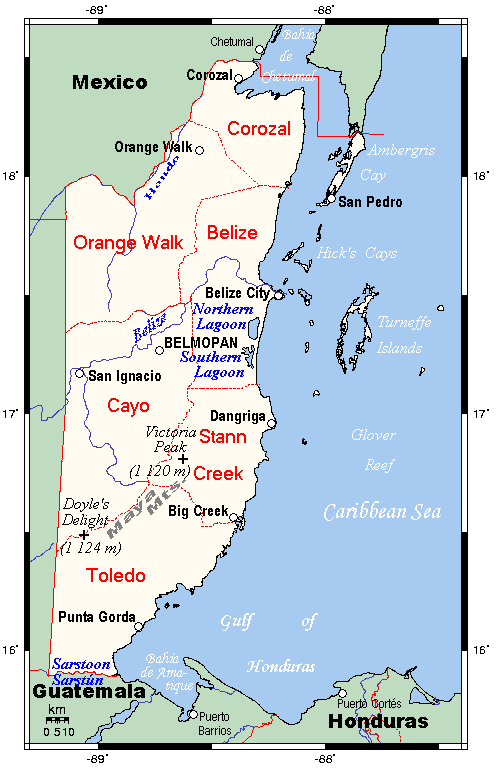
 Belize is located on the Caribbean coast of northern Central America. It shares a border on the north with the Mexican state of Quintana Roo
, on the west with the Guatemalan department of Petén
, and on the south with the Guatemalan department of Izabal. To the east in the Caribbean Sea, the second-longest barrier reef
in the world flanks much of the 386 kilometres (239.8 mi) of predominantly marsh
y coastline. The area of the country totals 22960 square kilometres (8,865 sq mi), an area slightly larger than El Salvador
or Massachusetts. The abundance of lagoons along the coasts and in the northern interior reduces the actual land area to 21400 square kilometres (8,263 sq mi).
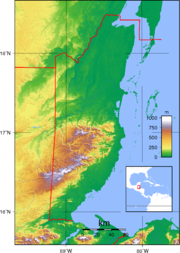
Belize is shaped like a rectangle that extends about 280 kilometres (174 mi) north-south and about 100 kilometres (62.1 mi) east-west, with a total land boundary length of 516 kilometres (321 mi). The undulating courses of two rivers, the Hondo and the Sarstoon River
, define much of the course of the country's northern and southern boundaries. The western border follows no natural features and runs north-south through lowland forest and highland plateau. The north of Belize consists mostly of flat, swampy coastal plains, in places heavily forested. The flora
is highly diverse considering the small geographical area. The south contains the low mountain range
of the Maya Mountains. The highest point in Belize is Doyle's Delight
at 1124 m (3,687.7 ft).
The Caribbean coast is lined with a coral reef
and some 450 islets and islands known locally as cayes . They total about 690 square kilometres (266 sq mi), and form the approximately 320 kilometres (199 mi) long Belize Barrier Reef
, the longest in the Western Hemisphere and the second longest in the world after the Great Barrier Reef
. Three of merely four coral atoll
s in the Western Hemisphere are located off the coast of Belize.
with pronounced wet
and dry season
s, although there are significant variations in weather patterns by region. Temperatures vary according to elevation, proximity to the coast, and the moderating effects of the northeast trade winds off the Caribbean. Average temperatures in the coastal regions range from 24 °C (75.2 °F) in January to 27 °C (80.6 °F) in July. Temperatures are slightly higher inland, except for the southern highland plateaus, such as the Mountain Pine Ridge, where it is noticeably cooler year round. Overall, the seasons are marked more by differences in humidity and rainfall than in temperature.
Average rainfall varies considerably, ranging from 1350 mm (53.1 in) in the north and west to over 4500 mm (177.2 in) in the extreme south. Seasonal differences in rainfall are greatest in the northern and central regions of the country where, between January and April or May, fewer than 100 mm (3.9 in) of rain fall per month. The dry season is shorter in the south, normally only lasting from February to April. A shorter, less rainy period, known locally as the "little dry," usually occurs in late July or August, after the initial onset of the rainy season.
Hurricanes have played key—and devastating—roles in Belizean history. In 1931 an unnamed hurricane destroyed over two-thirds of the buildings in Belize City and killed more than 1,000 people. In 1955 Hurricane Janet
levelled the northern town of Corozal
. Only six years later, Hurricane Hattie
struck the central coastal area of the country, with winds in excess of 300 km/h (186 mph) and 4 m (13.1 ft) storm tides. The devastation of Belize City for the second time in thirty years prompted the relocation of the capital some 80 kilometres (50 mi) inland to the planned city of Belmopan. Hurricane Greta
caused more than US$25 million in damages along the southern coast in 1978. On 9 October 2001, Hurricane Iris
made landfall at Monkey River Town as a 145 mph (233 km/h) Category Four storm. The storm demolished most of the homes in the village, and destroyed the banana crop. In 2007 Hurricane Dean
made landfall as a Category 5 storm only 25 miles north of the Belize/Mexico border. Dean caused extensive damage in northern Belize.
The most recent hurricane to affect Belize directly was the Category 2 Hurricane Richard, making landfall approximately 20 miles south-southeast of Belize City at around 0045 UTC on 25 October 2010. The storm moved inland towards Belmopan
, causing estimated damage of BZ$
33.8 million ($17.4 million 2010 USD), primarily from damage to crops and housing.
, scrubland and wetland
constitute the remainder of Belize's land cover. Important mangrove
ecosystems are also represented across Belize's landscape. As a part of the globally significant Mesoamerican Biological Corridor which stretches from southern Mexico to Panama, Belize's biodiversity – both marine
and terrestrial – is rich, with abundant flora
and fauna
. Belize is also a leader where it comes to protecting its biodiversity and natural resources. Recent (July 2010) information from the Association of Protected Areas Management Organizations of Belize (APAMO) indicates that some 36% of Belize's land territory falls under some form of official protected status, giving Belize one of the most extensive systems of terrestrial protected areas in the Americas. Nearby Costa Rica, by contrast, only has 25.8% of its land territory protected. Some 13% of Belize's territorial waters – home to the Belize Barrier Reef System – are also protected. The Belize Barrier Reef System both constitutes a UNESCO-recognised World Heritage Site and the second largest barrier reef in the world, second only to Australia's Great Barrier Reef.
study conducted by the Water Center for the Humid Tropics of Latin America and the Caribbean (CATHALAC) and NASA, in collaboration with the Forest Department and the Land Information Centre (LIC) of the Government of Belize's Ministry of Natural Resources and the Environment (MNRE), and published in August 2010 revealed that Belize's forest cover in early 2010 was approximately 62.7%, down from 75.9% in late 1980. A similar study by Belize Tropical Forest Studies and Conservation International revealed similar trends in terms of Belize's forest cover. Both studies indicate that each year, 0.6% of Belize's forest cover is lost, translating to the clearing of an average of 24835 acres (10,050.4 ha) each year. The USAID-supported SERVIR study by CATHALAC, NASA, and the MNRE also showed that Belize's protected areas have been extremely effective in protecting the country's forests. While only some 6.4% of forests inside of legally declared protected areas were cleared between 1980 and 2010, over a quarter of forests outside of protected areas had been lost between 1980 and 2010. As a country with a relatively high forest cover and a low deforestation rate, Belize has significant potential for participation in initiatives such as REDD
. Significantly, the SERVIR study on Belize's deforestation was also recognised by the intergovernmental Group on Earth Observations (GEO), of which Belize is a member nation.
, barite
(source of barium
), bauxite
(source of aluminium), cassiterite
(source of tin), and gold. In 1990 limestone
, used in road-building, was the only mineral resource being exploited for either domestic or export use.
The similarity of Belizean geology to that of oil-producing areas of Mexico and Guatemala prompted oil companies, principally from the United States, to explore for petroleum at both offshore and on-land sites in the early 1980s. Initial results were promising, but the pace of exploration slowed later in the decade, and production operations had been halted. As a result, Belize remains almost totally dependent on imported petroleum for its energy needs. In 2006, the cultivation of newly discovered crude oil in the town of Spanish Lookout
has presented new prospects and problems for this developing nation. The country also possess considerable potential for hydroelectric and other renewable energy
resources, such as solar
and biomass
. In the mid-1980s, one Belizean businessman even proposed the construction of a wood-burning power station for the production of electricity, but the idea foundered in the wake of ecological concerns and economic constraints.
has presented new prospects and problems for this developing nation. It has yet to be seen if significant economic expansion will be made by this. To date, oil production equal 3000 oilbbl/d (2007 est.) and oil exports equal 1960 oilbbl/d (2006 est.). The country is a producer of industrial minerals. Sugar, the chief crop, accounts for nearly half of exports, while the banana industry is the country's largest employer.
The new government faces important challenges to economic stability. Rapid action to improve tax collection has been promised, but a lack of progress in reining in spending could bring the exchange rate under pressure. The tourist and construction sectors strengthened in early 1999, leading to a preliminary estimate of revived growth at 4%. Infrastructure continues to be a major challenge for the economic development of Belize. Belize has the most expensive electricity in the region. Trade is important and the major trading partners are the United States, Mexico, the European Union
, and Central America.
. The other four banks are Heritage Bank, Atlantic Bank, FirstCaribbean International Bank
, and Scotiabank
(Belize).
In 2008 the Public Utilities Commission of Belize issued an order that has had a significant negative impact on the financial condition and operations of BEL. The order effectively disallowed the recovery of costs via customer rates and set rates at a level that does not allow BEL to earn a reasonable return. This has led to a deterioration of facilities and service. BEL appealed the rate order, but the court dismissed BEL's application, finding that various accepted concepts of good management shall not be applicable in Belize. BEL appealed this judgment to the Court of Appeal; however, a hearing is not expected until 2012. In May 2011, the Supreme Court of Belize granted BEL's application to prevent the PUC from taking any enforcement action against BEL pending the appeal. BEL has been in default of financial covenants under its long-term lending agreements since 2008.
, and snorkeling
, numerous rivers for rafting
, and kayaking
, various jungle and wildlife reserves of fauna and flora, for hiking, bird watching, and helicopter touring, as well as many Maya ruins—support the thriving tourism and ecotourism
industry. Of the hundreds of cave systems, it also has the largest cave system in Central America. Development costs are high, but the Government of Belize has designated tourism as its second development priority after agriculture. In 2007, tourist arrivals totalled 251,655 (with more than 210,000 from the U.S.) and tourist receipts amounted to $183.3 million.
 There are a number of kindergartens and secondary and tertiary schools in Belize. They provide quality education for students which is mostly funded by the government. Belize possess about 5 tertiary level institutions offering associates, bachelors, and undergraduate degrees. The biggest university is the University of Belize
. The university has 6 campuses throughout the country and it offers accounting, management, education, science, agriculture and other degrees.
democracy, a Commonwealth realm
, and therefore a member of the Commonwealth of Nations
.
The structure of government is based on the British parliamentary system, and the legal system is modelled on the Common Law
of England. The current head of state is Elizabeth II, Queen of Belize
. Since the Queen primarily resides in the United Kingdom, she is represented in Belize by the Governor-General. However, the cabinet, led by the Prime Minister of Belize, who is head of government
, acting as advisors to the Governor-General, in practice exercise executive authority. Cabinet ministers are members of the majority political party in parliament and usually hold elected seats within it concurrent with their cabinet positions.
The bicameral National Assembly of Belize
is composed of a House of Representatives
and a Senate
. The 31 members of the House are popularly elected to a maximum five-year term and introduce legislation affecting the development of Belize. The Governor-General appoints the 12 members of the Senate, with a Senate president selected by the members. The Senate is responsible for debating and approving bills passed by the House.
Belize is a full participating member of the Caribbean Community (CARICOM), the Central American Integration System (SICA), The United Nations, and the Organization of American States. It is still in the process of acceding to Caricom and SICA treaties, including trade and single market treaties.
:
These districts are further divided into 31 constituencies
.
; the BDF itself is commanded by Brigadier General Dario Tapia. In 1997, the regular army numbered over 900, the reserve army 381, the air wing 45 and the maritime wing 36, amounting to an overall strength of approximately 1400. In 2005, the maritime wing became part of the Belizean Coast Guard. In the same year, the government spent $1.2 million on the military, constituting 1.87% of the country's gross domestic product (GDP).
After Belize achieved independence in 1981 the United Kingdom maintained a deterrent force in the country to protect it from invasion by Guatemala (see Guatemalan claim to Belizean territory
). The main British force left in 1994, three years after Guatemala recognised Belizean independence, but the United Kingdom maintains a training presence via the British Army Training and Support Unit Belize (BATSUB) and 25 Flight Army Air Corps
.
Colonisation
, slavery
, and immigration have played major roles in affecting the ethnic composition of the population and as a result, Belize is a country with numerous cultures
, languages
, and ethnic group
s. The country's population is currently estimated to be a little over 333,000. Mestizos comprise about 34% of the population, Kriols
25%, Spanish 15%, Maya
11%, and Garinagu 6%.
The homeless population was amounted to 118 total of which 113 were males and 5 were females. The institutional population were discovered to be 1,957; 1,665 being male and 292 being females.
The total population in urban Belize was 139,069; 68,020 males and 71,049 females. 39,104 total households in 2010 and a 3.6 average household size.
The total population in rural Belize was 171,827; 88,261 males and 83,566 females. 40,494 total households in 2010 and a 4.2 average household size.
region since the second millennium BC; however, much of Belize's original Maya population was wiped out by disease and conflicts between tribe
s and with Europeans. Three Maya groups now inhabit the country: The Yucatec (who came from Yucatán, Mexico to escape the Caste War of the 1840s), the Mopan
(indigenous to Belize but were forced out by the British; they returned from Guatemala to evade slavery in the 19th century), and Kekchi
(also fled from slavery in Guatemala in the 19th century). The later groups are chiefly found in the Toledo District.
White, initially Spanish conquistadors explored and declared the land a Spanish colony but chose not to settle due to the lack of resources such as gold and the strong defence of the Yucatán by the Maya. Later English and Scottish settlers and pirates known as the "Baymen" entered the area in the 16th and 17th century respectively and established a logwood trade colony in what would become the Belize District.
. They are descendants of the Baymen slave owners, and slaves
brought to Belize for the purpose of the logging industry. These slaves were mostly Black (many also of Miskito ancestry) from Nicaragua
and born Africans who had spent very brief periods in Jamaica. Bay Island
ers and more Jamaicans came in the late-19th century, further adding these all ready varied peoples, creating this ethnic group.
For all intents and purposes, Kriol is an ethnic and linguistic denomination, but some natives, even those blonde and blue-eyed, may call themselves Kriol, defining it as more a cultural attribute and not limited to physical appearance. Kriol
was historically only spoken by them, but this ethnicity has become synonymous with the Belizean national identity, and as a result it is now spoken by about 75% of Belizeans. Kriols are found all over Belize, but predominantly in urban areas such as Belize City, coastal towns and villages, and in the Belize River Valley.
Throughout history they have been incorrectly labelled as Black Caribs. When the British took over Saint Vincent
after the Treaty of Paris
in 1763, they were opposed by French settlers and their Carib allies. The Caribs eventually surrendered to the British in 1796. The British separated the more African-looking Caribs from the more indigenous looking ones. 5,000 Garinagu were exiled, but only about 2,500 of them survived the voyage to Roatán
, an island off the coast of Honduras
.
Because Roatán
was too small and infertile to support their population, the Garinagu petitioned the Spanish authorities of Honduras to be allowed to settle on the mainland coast. The Spanish employed them as soldiers, and they spread along the Caribbean coast of Central America. The Garinagu settled in Seine Bight, Punta Gorda and Punta Negra, Belize by way of Honduras as early as 1802. However, in Belize 19 November 1832 is the date officially recognised as "Garifuna Settlement Day" in Dangriga.
, Spanish, and Yucatec settlers from Mexico began to settle in the north due to the Caste War of Yucatán
. Currently, the Mestizos are the largest ethnic group in Belize, making up 34% of the population in 2000, and Spanish make up 15%. They predominate in the Corozal, Orange Walk, and much of the Cayo district, as well as San Pedro town in Ambergris Caye.
The Mestizo culture was originated from a mixture of Spanish and Maya. The Mestizo towns of Belize have much more in common with neighbouring Yucatán
and most of Guatemala and Central America than central, southern or coastal Belize. Towns centre on a main square, and social life focuses on the Catholic Church built on one side of it. Most Mestizos and Spanish speak Spanish, English and Kriol fluently.
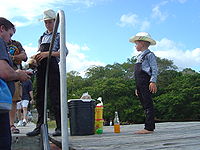 The remaining 9% is a mix of Mennonite farmers, Indians
, Chinese
, whites from the United States and Canada, and many other foreign groups brought to assist the country's development. During the 1860s, a large influx of East Indians who spent brief periods in Jamaica and American Civil War veterans from Louisiana
and other Southern states established Confederate settlements in British Honduras
and introduced commercial sugar cane production to the colony, establishing 11 settlements in the interior. The 20th century saw the arrival of Asian
settlers from mainland China, South Korea, India, Syria
, and Lebanon
. Central American immigrants and expatriate Americans and Africans also began to settle in the country.
Due to conflicts in neighbouring Central American nations, Mestizo refugee
s from El Salvador, Guatemala, and Honduras have fled to Belize in significant numbers during the 1980s, and have been significantly adding to this group. These two events have been changing the demographics of the nation for the last 30 years.
According to estimates by the CIA
in 2009, Belize's total fertility rate
currently stands at approximately 3.6 children per woman. Its birth rate is 27.33 births/1,000 population, and the death rate is 5.8 deaths/1,000 population.
of English, as the two are mutually intelligible. About 75 to 80 percent of the population speak some Kriol and English.
Spanish is the first language of 46 percent, and is spoken very well by a majority of Belizeans.
Mayan languages
and Garifuna
are the first languages of about 12 percent of the population. The Germanic Plautdietsch
dialect, Chinese
, Hindustani and other languages are mother tongues of about 5 percent of the population.
English is the primary language of public education, with Spanish taught in primary and secondary school as well. Bilingualism is very common. Literacy currently stands at nearly 80%.
has a presence in Santa Elena. Jehovah's Witnesses have experienced a significant increase in membership in recent years. According to the Witnesses, around 3% of the population attended at least one religious meeting in 2007. The Church of Jesus Christ of Latter-day Saints claims 3,300 members in the country
Other non-Christian minorities include: Hinduism
, followed by most Indian immigrants, and Islam, common among Middle Eastern immigrants and has gained a following among some Kriols.
s are added to the dishes to create a truly tropical taste. Exotic ingredients include armadillo meat, venison and fried paca (called Gibnut in Kriol). Conch soup is a traditional dish which has a characteristic taste and thick consistency due to added okra, potatoes, yams, cassava flour and a touch of toasted habanero. Immigration has brought Garifuna dishes based on fish and plantains, and among the best known are Hudut, Darasa, Ereba, Bundiga, and so on. Belizean food is almost always accompanied by white rice in coconut milk.
, track & field, softball
and cricket
. Fishing is also popular in areas of Belize. The Cross Country Cycling Classic
, also known as the "cross country" race or the Holy Saturday Cross Country Cycling Classic, is considered to be one of the most important Belize sports events. This one-day sports event is meant for amateur cyclists but has also gained a worldwide popularity.
This cycling event in Belize has seven rider categories based on rider rating, age, and gender. Action-packed and thrilling, this most interesting sporting event allows for the participation of tourists and visitors alike from all over the world. The cycling routes offer views across the resplendent greenery of the forest areas and the meandering rivers. This makes the event even more popular among the tourists.
The history of Cross Country Cycling Classic in Belize dates back to the period when Monrad Metzgen
picked up the idea from a small village on the Northern highway. The people from this village used to cover long distances on their bicycles to attend the weekly game of cricket. He improvised on this observation and added thrill by sowing the idea of a sporting event in the difficult terrain of western highways, which were then poorly built.
On Easter day, citizens of Dangriga participate in a yearly fishing tournament. First, second, and third prize are awarded based on a scoring combination of size, species, and number. The tournament is broadcast over local radio stations, and prize money is awarded to the winners.
Belize's National Basketball Team is the only National Team that has achieved major victories internationally. During the 1998 Caricom Men's Basketball Championship, held at the Civic Center in Belize City. Belize went on to win the championship and proceeded to participate in the 1999 Centrobasquet Tournament in Havana. The National Team finished seventh of eight teams after winning only 1 game despite playing close all the way. In a return engagement at the 2000 CARICOM championship in Barbados, Belize placed fourth. Shortly thereafter, Belize moved to the Central American region and won the Central American Games championship in 2001. The team has failed to duplicate this success, most recently finishing with a 2 and 4 record in the 2006 COCABA championship. The team finished second in the 2009 COCABA tournament in Cancun, Mexico where it went 3–0 in group play. Belize won its opening match in the Centrobasquet Tournament, 2010, defeating Trinidad and Tobago, but lost badly to Mexico in a rematch of the COCABA final. A tough win over Cuba set Belize in position to advance, but they fell to Puerto Rico in their final match and failed to qualify.
, La Sucia, Luguchu Ellis, Tata Duende
, Chatona, X'tabai, and Anansi
.

The National Flower of Belize is the Black Orchid (Prosthechea cochleata
), also known as Encyclia cochleata).
), one of the magnificent giants of the Belize rain forest. Rising straight and tall to over a hundred feet from great buttresses at the roots, it emerges above the canopy of the surrounding trees with a crown of large, shining green leaves. In the early months of the year, when the leaves fall and new red-brown growth appears, the tree can be spotted from a great distance. The tree puts out a great flush of small whitish flowers – the blossom for dark fruits, which are pear-shaped capsules about six inches long. When the fruits mature they split into five valves, freeing large winged seeds which are carried away by the wind. They fall on the shaded protection of the forest floor and germinate to begin a new life cycle. The mahogany tree matures in 60 to 80 years.
British settlers exploited the Belizean forest for mahogany, beginning around the middle of the 17th century. It was originally exported to the United Kingdom in the form of squared logs, but shipments now consist mainly of sawn lumber.
The motto "Sub Umbra Florero" means: Under the shade (of the mahogany tree) I flourish.
, the largest land mammal of the American tropics. It is also known as the mountain cow, although it is actually related to the horse and the rhinoceros. It is protected under Belizean law.
, are:
Constitutional monarchy
Constitutional monarchy is a form of government in which a monarch acts as head of state within the parameters of a constitution, whether it be a written, uncodified or blended constitution...
and the northernmost country in Central America
Central America
Central America is the central geographic region of the Americas. It is the southernmost, isthmian portion of the North American continent, which connects with South America on the southeast. When considered part of the unified continental model, it is considered a subcontinent...
. Belize has a diverse society, comprising many cultures and languages. Even though Kriol
Belizean Kriol language
Belizean Creole English, known as Kriol by its speakers, is an English-based creole language most closely related to Miskito Coastal Creole, Limón Coastal Creole, Colón Creole, San Andrés and Providencia Creole, Guyanese Creole, Jamaican Patois and English creoles of the Caribbean show similarity...
and Spanish
Spanish language
Spanish , also known as Castilian , is a Romance language in the Ibero-Romance group that evolved from several languages and dialects in central-northern Iberia around the 9th century and gradually spread with the expansion of the Kingdom of Castile into central and southern Iberia during the...
are spoken among the population, Belize is the only country in Central America where English is the official language. Belize is bordered to the north by Mexico
Mexico
The United Mexican States , commonly known as Mexico , is a federal constitutional republic in North America. It is bordered on the north by the United States; on the south and west by the Pacific Ocean; on the southeast by Guatemala, Belize, and the Caribbean Sea; and on the east by the Gulf of...
, south and west by Guatemala
Guatemala
Guatemala is a country in Central America bordered by Mexico to the north and west, the Pacific Ocean to the southwest, Belize to the northeast, the Caribbean to the east, and Honduras and El Salvador to the southeast...
, and to the east by the Caribbean Sea
Caribbean Sea
The Caribbean Sea is a sea of the Atlantic Ocean located in the tropics of the Western hemisphere. It is bounded by Mexico and Central America to the west and southwest, to the north by the Greater Antilles, and to the east by the Lesser Antilles....
. Belize’s mainland is about 290 kilometres (180.2 mi) long and 110 kilometres (68.4 mi) wide.
With 22960 square kilometres (8,864.9 sq mi) of land and a population of only 333,200 people (2010 est.), Belize possesses the lowest population density in Central America. The country's population growth rate of 2.21% (2008 est.), however, is the highest in the region and one of the highest in the western hemisphere. Belize's abundance of terrestrial and marine species, and its diversity of ecosystems give it a key place within the globally significant Mesoamerican Biological Corridor.
Belize is culturally unique among its Central American neighbours; it is the only nation in the region with a British colonial heritage
British Empire
The British Empire comprised the dominions, colonies, protectorates, mandates and other territories ruled or administered by the United Kingdom. It originated with the overseas colonies and trading posts established by England in the late 16th and early 17th centuries. At its height, it was the...
. As a part of the Western Caribbean Zone
Western Caribbean Zone
The Western Caribbean Zone is a historic region that formed in the late sixteenth century and includes the Caribbean coasts of Central America, from Yucatán in Mexico to northern Colombia, and also the islands west of Jamaica...
, however, it also shares a common heritage with the Caribbean portions of other Central American countries. In general, Belize is considered to be a Central American nation with strong ties to both the Caribbean and Latin America
Latin America
Latin America is a region of the Americas where Romance languages – particularly Spanish and Portuguese, and variably French – are primarily spoken. Latin America has an area of approximately 21,069,500 km² , almost 3.9% of the Earth's surface or 14.1% of its land surface area...
. Belize is a member of the Caribbean Community
Caribbean Community
The Caribbean Community is an organisation of 15 Caribbean nations and dependencies. CARICOM's main purposes are to promote economic integration and cooperation among its members, to ensure that the benefits of integration are equitably shared, and to coordinate foreign policy...
(CARICOM), and Sistema de la Integración Centroamericana
Central American Integration System
Central American Integration System is the economic, cultural and political organization of Central American states since February 1, 1993. It was on December 13, 1991, however, when all the countries of the ODECA signed the Protocol of Tegucigalpa which extended the earlier cooperation in search...
(SICA).
Etymology
The origin of the name Belize is unclear, but one idea is that the name is from the native Maya word belix, meaning "muddy water", applied to the Belize RiverBelize River
Belize River is a 180-mile river in Belize that drains more than one-quarter of the country as it winds along the northern edge of the Maya Mountains across the center of the country to the sea just north of Belize City . However, the Belize River/Mopan River Catchment contains over 45 percent of...
. Others have suggested that it is derived from a Spanish pronunciation of the name of the Scottish buccaneer Peter Wallace, which was applied to an early settlement along the Belize River and to the river itself. Belize has a sizeable proportion of Africans from the ancient Kingdom of Kongo
Kingdom of Kongo
The Kingdom of Kongo was an African kingdom located in west central Africa in what are now northern Angola, Cabinda, the Republic of the Congo, and the western portion of the Democratic Republic of the Congo...
, who could have brought the name with them, as there is a Belize in Angola
Angola
Angola, officially the Republic of Angola , is a country in south-central Africa bordered by Namibia on the south, the Democratic Republic of the Congo on the north, and Zambia on the east; its west coast is on the Atlantic Ocean with Luanda as its capital city...
as well.
Early history
The Maya civilisation spread itself over the area which is today Belize beginning in around 1500 BC and flourished there until about A.D. 800. The recorded history of the centre and south is dominated by CaracolCaracol
Caracol is the name given to a large ancient Maya archaeological site, located in what is now the Cayo District of Belize. It is situated approximately 40 kilometres south of Xunantunich and the town of San Ignacio Cayo, and 15 kilometers away from the Macal River. It rests on the Vaca Plateau at...
, where the inscriptions on their monuments were, as elsewhere, in the Lowland Maya aristocratic tongue Classic Ch'olti'an. North of the Maya Mountains
Maya Mountains
The Maya Mountains are a mountain range in Belize and eastern Guatemala. The highest peaks are Doyle's Delight at and Victoria Peak at . The Maya Mountains and associated foothills contain a number of important Mayan ruins including the sites of Lubaantun, Nim Li Punit, Cahal Pech, and Chaa Creek;...
, the inscriptional language at Lamanai
Lamanai
Lamanai is a Mesoamerican archaeological site, and was once a considerably sized city of the Maya civilization, located in the north of Belize, in Orange Walk District...
was Yucatecan as of A.D. 625.
In the late classic period of Maya civilisation (before A.D. 1000), as many as 400,000 people may have lived in the area that is now Belize. Some lowland Maya still occupied the area when Europeans arrived in the 16th century. By then the primary inhabitants were the Mopan
Mopan people
Mopan are one of the Maya peoples in Belize and Guatemala. Their indigenous language is also called Mopan and is one of the Yucatec Maya languages....
branch of the Yucatec Maya.
Spanish colonists tried to settle the inland areas of Belize, but Maya rebellions and attacks forced them to abandon these efforts.
English and Scottish buccaneers known as the Baymen
Baymen
The Baymen are the earliest European settlers of the eventual colony of British Honduras, modern day Belize.- Settlement :The first Baymen settled in the Belize City area in the 1650s. They were buccaneers and pirates trying to outrun the Spanish rulers in Mexico and Central America. They found...
first settled on the coast of Belize in 1638, seeking a sheltered region from which they could attack Spanish ships (see English settlement in Belize). The settlers turned to cutting logwood
Logwood
Haematoxylum campechianum is a species of flowering tree in the legume family, Fabaceae, that is native to southern Mexico and northern Central America. It has been and to a lesser extent remains of great economic importance. The modern nation of Belize grew from 17th century English logwood...
during the 18th century. The wood yielded a fixing agent for clothing dyes that was vital to the European woollen industry. The Spanish granted the British settlers the right to occupy the area and cut logwood in exchange for an end to piracy.
Battle of St. George's Caye
The Battle of St. George's Caye was a short military engagement that lasted from 3–10 September 1798, undertaken off the coast of what is now Belize. The name, however, is typically reserved for the final battle that occurred on 10 September. The British first appointed a superintendent over the Belize area in 1786. Prior to that time, the British government did not initially recognize the settlement in Belize as a colony for fear of provoking SpanishSpanish Empire
The Spanish Empire comprised territories and colonies administered directly by Spain in Europe, in America, Africa, Asia and Oceania. It originated during the Age of Exploration and was therefore one of the first global empires. At the time of Habsburgs, Spain reached the peak of its world power....
attack. The delay in government oversight allowed the settlers to establish their own laws and forms of government. During this time a few wealthy settlers gained control of the local legislature, known as the Public Meeting, as well as of most of the settlement's land and timber.
The battle took place between an invading force from what would become Mexico, attempting to wrest Belize for Spain
Spain
Spain , officially the Kingdom of Spain languages]] under the European Charter for Regional or Minority Languages. In each of these, Spain's official name is as follows:;;;;;;), is a country and member state of the European Union located in southwestern Europe on the Iberian Peninsula...
, and a small force of resident woodcutters called Baymen, who fought for their livelihood assisted by black slaves.
The Spanish repeatedly tried to gain control over Belize by force, but were unsuccessful. Spain's last effort occurred on 10 September 1798, when the British repelled the Spanish fleet in a short engagement with no known casualties on either side known as the Battle of St. George's Caye
Battle of St. George's Caye
The Battle of St. George's Caye was a short military engagement that lasted from 3 to 10 September 1798, off the coast of what is now Belize...
. The anniversary of the battle is now a national holiday in Belize.
As part of the British Empire
In the early 19th century, the British sought greater control over the settlers, threatening to suspend the Public Meeting unless it observed the government's instructions to eliminate slavery in whole. Slavery was abolished in the British EmpireBritish Empire
The British Empire comprised the dominions, colonies, protectorates, mandates and other territories ruled or administered by the United Kingdom. It originated with the overseas colonies and trading posts established by England in the late 16th and early 17th centuries. At its height, it was the...
in 1838, but this did little to change working conditions for labourers in the Belize settlement. Slaves of the colony were valued for their potentially superior abilities in the work of mahogany extraction. As a result, former slave owners in British Honduras earned £53.6.9 on average per slave, the highest amount paid in any British territory.
Soon after, a series of institutions were put in place to ensure the continued presence of a viable labour force. Some of these greatly restricted the ability of individuals to obtain land, in a debt-peonage system to organise the newly "free." The position of being "extra special" mahogany and logwood cutters undergirded the early ascriptions of the capacities (and consequently the limitations) of people of African descent in the colony. Because a small elite controlled the settlement's land and commerce, former slaves had no choice but to continue to work in timber cutting.
In 1836, after the emancipation of Central America from Spanish rule, the British claimed the right to administer the region. In 1862, Great Britain formally declared it a British Crown Colony, subordinate to Jamaica, and named it British Honduras. As a colony, Belize began to attract British investors. Among the British firms that dominated the colony in the late 19th century was the Belize Estate and Produce Company, which eventually acquired half of all the privately held land in the colony. Belize Estate's influence accounts in part for the colony's reliance on the mahogany trade throughout the rest of the 19th century and the first half of the 20th century.
The Great Depression
Great Depression
The Great Depression was a severe worldwide economic depression in the decade preceding World War II. The timing of the Great Depression varied across nations, but in most countries it started in about 1929 and lasted until the late 1930s or early 1940s...
of the 1930s caused a near-collapse of the colonial economy as British demand for timber plummeted. The effects of widespread unemployment were worsened by a devastating hurricane
1931 Belize hurricane
The 1931 Belize hurricane was a devastating Category 3 hurricane that hit Belize City on September 10, 1931, killing an estimated 2,500 people. Although much weaker than Hurricane Hattie of 1961, it remains the deadliest hurricane, and natural disaster, in Belize's history...
that struck the colony in 1931. Perceptions of the government's relief effort as inadequate were aggravated by its refusal to legalize labour unions or introduce a minimum wage. Demonstrations and riots in 1934 marked the beginning of an independence movement. In response, the government repealed criminal penalties for workers who violated the terms of their labour contracts regarding unions and granted workers the right to join unions.
Economic conditions improved during World War II (1939–1945) when many Belizean men entered the armed forces or otherwise contributed labour to the war effort. Following the war, the colony's economy again stagnated due to the pressures caused by its damaging effect. Britain's decision to devalue the British Honduras dollar in 1949 worsened economic conditions and led to the creation of the People's Committee, which demanded independence. The People's Committee's successor, the People's United Party
People's United Party
The People's United Party is one of two major political parties in Belize, and currently the main opposition party. It is a Christian Democratic party; the current Party Leader is Francis Fonseca....
(PUP), sought constitutional reforms that would expand voting rights to all adults.
Independence
Constitutional reforms were initiated in 1954 and resulted in a new constitution ten years later. Britain granted British Honduras self-government in 1964, and the head of the PUP—independence leader George PriceGeorge Cadle Price
George Cadle Price PC was the first Prime Minister of Belize and is considered to have been one of the principal architects of the country's independence, and is today referred to by many as "the Father of the Nation"....
—became the colony's prime minister. British Honduras was officially renamed Belize in 1973. Progress toward independence, however, was hampered by a Guatemalan claim to sovereignty over the territory of Belize
Guatemalan claim to Belizean territory
The Belizean-Guatemalan territorial dispute is an unresolved binational territorial dispute between the states of Belize and Guatemala, neighbours in Central America...
. When Belize finally attained full independence on 21 September 1981, Guatemala
Guatemala
Guatemala is a country in Central America bordered by Mexico to the north and west, the Pacific Ocean to the southwest, Belize to the northeast, the Caribbean to the east, and Honduras and El Salvador to the southeast...
refused to recognise the new nation. About 1,500 British troops remained to protect Belize from the Guatemalan threat.
With Price at the helm, the PUP won all elections until 1984. In that election, the first national election after independence, the PUP was defeated by the United Democratic Party (UDP
United Democratic Party (Belize)
The United Democratic Party is one of the two major political parties in Belize, and currently the ruling party, having won the 2008 general elections. A centre-right conservative party, it is currently led by Dean Barrow.-Founding:...
), and UDP leader Manuel Esquivel
Manuel Esquivel
Sir Manuel Esquivel, KCMG, PC is a Belizean politician. As leader of the United Democratic Party, he served as Prime Minister from 1984 to 1989, and then again from 1993 to 1998.-Biography:...
replaced Price as prime minister. Price returned to power after elections in 1989. Guatemala's president formally recognised Belize's independence in 1992. The following year the United Kingdom announced that it would end its military involvement in Belize. British soldiers were withdrawn in 1994, but the United Kingdom left behind a military training unit to assist with the newly formed Belize Defence Force.
The UDP regained power in the 1993 national election, and Esquivel became prime minister for a second time. Soon afterwards Esquivel announced the suspension of a pact reached with Guatemala during Price's tenure, claiming Price had made too many concessions in order to gain Guatemalan recognition. The pact may have curtailed the 130-year-old border dispute between the two countries. Border tensions continued into the early 2000s, although the two countries cooperated in other areas.
The PUP won a landslide victory in the 1998 national elections, and PUP leader Said Musa
Said Musa
Said Wilbert Musa is a Belizean lawyer and politician. He was the Prime Minister of Belize from August 28, 1998 to February 8, 2008.-Early life and education:Said Musa was born in San Ignacio, Cayo District, Belize...
was sworn in as prime minister. In the 2003 elections the PUP maintained its majority, and Musa continued as prime minister. He pledged to improve conditions in the underdeveloped and largely inaccessible southern part of Belize.
In 2005, Belize was the site of unrest
2005 Belize unrest
The 2005 protests in Belize are two separate but related incidents of civil unrest in the Central American nation, occurring in January and April.- January 2005 budget protests :...
caused by discontent with the People's United Party
People's United Party
The People's United Party is one of two major political parties in Belize, and currently the main opposition party. It is a Christian Democratic party; the current Party Leader is Francis Fonseca....
government, including tax increases in the national budget. On 8 February 2008, Dean Barrow was sworn in as prime minister after his UDP
United Democratic Party (Belize)
The United Democratic Party is one of the two major political parties in Belize, and currently the ruling party, having won the 2008 general elections. A centre-right conservative party, it is currently led by Dean Barrow.-Founding:...
won a landslide victory in general elections.
Throughout Belize's history, Guatemala
Guatemala
Guatemala is a country in Central America bordered by Mexico to the north and west, the Pacific Ocean to the southwest, Belize to the northeast, the Caribbean to the east, and Honduras and El Salvador to the southeast...
has claimed ownership of all or part of the territory. This claim is occasionally reflected in maps showing Belize as Guatemala's twenty-third department
Departments of Guatemala
||Guatemala is divided into 22 departments :#Alta Verapaz#Baja Verapaz#Chimaltenango#Chiquimula#Petén#El Progreso#El Quiché#Escuintla#Guatemala#Huehuetenango#Izabal#Jalapa#Jutiapa#Quetzaltenango#Retalhuleu#Sacatepéquez...
. As of March 2007, the border dispute with Guatemala remains unresolved and quite contentious. Guatemala's claim to Belizean territory rests, in part, on the terms Clause VII of the Anglo-Guatemalan Treaty of 1859 which (supposedly) obligated the British to build a road between Belize City and Guatemala. At various times the issue has required mediation by the United Kingdom, Caribbean Community
Caribbean Community
The Caribbean Community is an organisation of 15 Caribbean nations and dependencies. CARICOM's main purposes are to promote economic integration and cooperation among its members, to ensure that the benefits of integration are equitably shared, and to coordinate foreign policy...
heads of Government, the Organization of American States
Organization of American States
The Organization of American States is a regional international organization, headquartered in Washington, D.C., United States...
, Mexico, and the United States. Notably, both Guatemala and Belize are participating in confidence-building measures approved by the OAS, including the Guatemala-Belize Language Exchange Project.
Since independence, a British garrison has been retained in Belize at the request of the Belizean government including, at times, Harrier jets.
Geography
Quintana Roo
Quintana Roo officially Estado Libre y Soberano de Quintana Roo is one of the 31 states which, with the Federal District, comprise the 32 Federal Entities of Mexico. It is divided in 10 municipalities and its capital city is Chetumal....
, on the west with the Guatemalan department of Petén
Petén (department)
Petén is a department of the nation of Guatemala. It is geographically the northernmost department of Guatemala, as well as the largest in size — at it accounts for about one third of Guatemala's area. The capital is Flores...
, and on the south with the Guatemalan department of Izabal. To the east in the Caribbean Sea, the second-longest barrier reef
Belize Barrier Reef
The Belize Barrier Reef is a series of coral reefs straddling the coast of Belize, roughly offshore in the north and in the south within the country limits...
in the world flanks much of the 386 kilometres (239.8 mi) of predominantly marsh
Marsh
In geography, a marsh, or morass, is a type of wetland that is subject to frequent or continuous flood. Typically the water is shallow and features grasses, rushes, reeds, typhas, sedges, other herbaceous plants, and moss....
y coastline. The area of the country totals 22960 square kilometres (8,865 sq mi), an area slightly larger than El Salvador
El Salvador
El Salvador or simply Salvador is the smallest and the most densely populated country in Central America. The country's capital city and largest city is San Salvador; Santa Ana and San Miguel are also important cultural and commercial centers in the country and in all of Central America...
or Massachusetts. The abundance of lagoons along the coasts and in the northern interior reduces the actual land area to 21400 square kilometres (8,263 sq mi).
Belize is shaped like a rectangle that extends about 280 kilometres (174 mi) north-south and about 100 kilometres (62.1 mi) east-west, with a total land boundary length of 516 kilometres (321 mi). The undulating courses of two rivers, the Hondo and the Sarstoon River
Sarstoon River
Sarstoon River is a river in the Toledo District of Belize. It forms the country's southern boundary with Guatemala.The river's sources are located in neighbouring Guatemala, where it is known by its Spanish name, Río Sarstún. It flows through the Guatemalan departments of Alta Verapaz and Izabal...
, define much of the course of the country's northern and southern boundaries. The western border follows no natural features and runs north-south through lowland forest and highland plateau. The north of Belize consists mostly of flat, swampy coastal plains, in places heavily forested. The flora
Flora and vegetation of Belize
The flora of Belize is highly diverse by regional standards, given the country's small geographical extent. Situated on the Caribbean coast of northern Central America the flora and vegetation have been intimately intertwined with Belize's history...
is highly diverse considering the small geographical area. The south contains the low mountain range
Mountain range
A mountain range is a single, large mass consisting of a succession of mountains or narrowly spaced mountain ridges, with or without peaks, closely related in position, direction, formation, and age; a component part of a mountain system or of a mountain chain...
of the Maya Mountains. The highest point in Belize is Doyle's Delight
Doyle's Delight
Doyle's Delight is the highest peak in Belize . It lies in the Cockscomb Range, a spur of the Maya Mountains in Western Belize.The name Doyle's Delight was first coined in by Sharon Matola in 1989 and based on Sir Arthur Conan Doyle's book "The Lost World" , which contains the quote "there must...
at 1124 m (3,687.7 ft).
The Caribbean coast is lined with a coral reef
Coral reef
Coral reefs are underwater structures made from calcium carbonate secreted by corals. Coral reefs are colonies of tiny living animals found in marine waters that contain few nutrients. Most coral reefs are built from stony corals, which in turn consist of polyps that cluster in groups. The polyps...
and some 450 islets and islands known locally as cayes . They total about 690 square kilometres (266 sq mi), and form the approximately 320 kilometres (199 mi) long Belize Barrier Reef
Belize Barrier Reef
The Belize Barrier Reef is a series of coral reefs straddling the coast of Belize, roughly offshore in the north and in the south within the country limits...
, the longest in the Western Hemisphere and the second longest in the world after the Great Barrier Reef
Great Barrier Reef
The Great Barrier Reef is the world'slargest reef system composed of over 2,900 individual reefs and 900 islands stretching for over 2,600 kilometres over an area of approximately...
. Three of merely four coral atoll
Atoll
An atoll is a coral island that encircles a lagoon partially or completely.- Usage :The word atoll comes from the Dhivehi word atholhu OED...
s in the Western Hemisphere are located off the coast of Belize.
Climate
Belize has a tropical climateTropical climate
A tropical climate is a climate of the tropics. In the Köppen climate classification it is a non-arid climate in which all twelve months have mean temperatures above...
with pronounced wet
Wet season
The the wet season, or rainy season, is the time of year, covering one or more months, when most of the average annual rainfall in a region occurs. The term green season is also sometimes used as a euphemism by tourist authorities. Areas with wet seasons are dispersed across portions of the...
and dry season
Dry season
The dry season is a term commonly used when describing the weather in the tropics. The weather in the tropics is dominated by the tropical rain belt, which oscillates from the northern to the southern tropics over the course of the year...
s, although there are significant variations in weather patterns by region. Temperatures vary according to elevation, proximity to the coast, and the moderating effects of the northeast trade winds off the Caribbean. Average temperatures in the coastal regions range from 24 °C (75.2 °F) in January to 27 °C (80.6 °F) in July. Temperatures are slightly higher inland, except for the southern highland plateaus, such as the Mountain Pine Ridge, where it is noticeably cooler year round. Overall, the seasons are marked more by differences in humidity and rainfall than in temperature.
Average rainfall varies considerably, ranging from 1350 mm (53.1 in) in the north and west to over 4500 mm (177.2 in) in the extreme south. Seasonal differences in rainfall are greatest in the northern and central regions of the country where, between January and April or May, fewer than 100 mm (3.9 in) of rain fall per month. The dry season is shorter in the south, normally only lasting from February to April. A shorter, less rainy period, known locally as the "little dry," usually occurs in late July or August, after the initial onset of the rainy season.
Hurricanes have played key—and devastating—roles in Belizean history. In 1931 an unnamed hurricane destroyed over two-thirds of the buildings in Belize City and killed more than 1,000 people. In 1955 Hurricane Janet
Hurricane Janet
Hurricane Janet was the most powerful hurricane of the 1955 Atlantic hurricane season and one of the strongest Atlantic hurricanes on record. It made landfall as a Category 5 hurricane on the Saffir-Simpson Hurricane Scale, causing catastrophic damage and at least 687 deaths in the Lesser...
levelled the northern town of Corozal
Corozal Town
Corozal Town is a town in the nation of Belize, capital of Corozal District. Corozal Town is located about 84 miles north of Belize City, and 9 miles from the border with Mexico. The population of Corozal Town, according to the main results of the 2010 census, it is 9,871...
. Only six years later, Hurricane Hattie
Hurricane Hattie
Hurricane Hattie was the deadliest tropical cyclone of the 1961 Atlantic hurricane season, as well as the strongest, reaching a peak intensity equivalent to Category 5 hurricane intensity...
struck the central coastal area of the country, with winds in excess of 300 km/h (186 mph) and 4 m (13.1 ft) storm tides. The devastation of Belize City for the second time in thirty years prompted the relocation of the capital some 80 kilometres (50 mi) inland to the planned city of Belmopan. Hurricane Greta
Hurricane Greta-Olivia
Hurricane Greta–Olivia was a Category 4 hurricane that crossed over Central America, changing names upon reaching the Eastern Pacific during the 1978 Atlantic hurricane season and 1978 Pacific hurricane season. Striking Honduras on the fourth anniversary of Hurricane Fifi, the Greta threatened to...
caused more than US$25 million in damages along the southern coast in 1978. On 9 October 2001, Hurricane Iris
Hurricane Iris
Hurricane Iris was a Category 4 hurricane that devastated Belize in October 2001. It was the eleventh tropical cyclone, ninth named storm, fifth hurricane, and third major hurricane of the 2001 Atlantic hurricane season. It was the second strongest storm of the season behind Hurricane...
made landfall at Monkey River Town as a 145 mph (233 km/h) Category Four storm. The storm demolished most of the homes in the village, and destroyed the banana crop. In 2007 Hurricane Dean
Hurricane Dean
The name Dean was used for five tropical cyclones in the Northern Atlantic Ocean:*1983's Tropical Storm Dean, which struck the coast of Virginia, causing minor erosion and flooding...
made landfall as a Category 5 storm only 25 miles north of the Belize/Mexico border. Dean caused extensive damage in northern Belize.
The most recent hurricane to affect Belize directly was the Category 2 Hurricane Richard, making landfall approximately 20 miles south-southeast of Belize City at around 0045 UTC on 25 October 2010. The storm moved inland towards Belmopan
Belmopan
Belmopan , estimated population 20,000 is the capital city of Belize.Belmopan is located at , at an altitude of 76 metres above sea level. Belmopan was constructed just to the east of Belize River, inland from the former capital, the port of Belize City, after that city's near destruction by...
, causing estimated damage of BZ$
Belize dollar
The Belize dollar is the official currency in Belize, formerly known as British Honduras; is normally abbreviated with the dollar sign $, or alternatively BZ$ to distinguish it from other dollar-denominated currencies. It is divided into 100 cents...
33.8 million ($17.4 million 2010 USD), primarily from damage to crops and housing.
Vegetation
While over 60% of Belize's land surface is covered by forest, recent studies indicate that some 20% of the country's land is covered by cultivated land (agriculture) and human settlements. SavannahSavannah
Savannah or savanna is a type of grassland.It can also mean:-People:* Savannah King, a Canadian freestyle swimmer* Savannah Outen, a singer who gained popularity on You Tube...
, scrubland and wetland
Wetland
A wetland is an area of land whose soil is saturated with water either permanently or seasonally. Wetlands are categorised by their characteristic vegetation, which is adapted to these unique soil conditions....
constitute the remainder of Belize's land cover. Important mangrove
Mangrove
Mangroves are various kinds of trees up to medium height and shrubs that grow in saline coastal sediment habitats in the tropics and subtropics – mainly between latitudes N and S...
ecosystems are also represented across Belize's landscape. As a part of the globally significant Mesoamerican Biological Corridor which stretches from southern Mexico to Panama, Belize's biodiversity – both marine
Marine (ocean)
Marine is an umbrella term. As an adjective it is usually applicable to things relating to the sea or ocean, such as marine biology, marine ecology and marine geology...
and terrestrial – is rich, with abundant flora
Flora
Flora is the plant life occurring in a particular region or time, generally the naturally occurring or indigenous—native plant life. The corresponding term for animals is fauna.-Etymology:...
and fauna
Fauna
Fauna or faunæ is all of the animal life of any particular region or time. The corresponding term for plants is flora.Zoologists and paleontologists use fauna to refer to a typical collection of animals found in a specific time or place, e.g. the "Sonoran Desert fauna" or the "Burgess shale fauna"...
. Belize is also a leader where it comes to protecting its biodiversity and natural resources. Recent (July 2010) information from the Association of Protected Areas Management Organizations of Belize (APAMO) indicates that some 36% of Belize's land territory falls under some form of official protected status, giving Belize one of the most extensive systems of terrestrial protected areas in the Americas. Nearby Costa Rica, by contrast, only has 25.8% of its land territory protected. Some 13% of Belize's territorial waters – home to the Belize Barrier Reef System – are also protected. The Belize Barrier Reef System both constitutes a UNESCO-recognised World Heritage Site and the second largest barrier reef in the world, second only to Australia's Great Barrier Reef.
Forests and deforestation
A remote sensingRemote sensing
Remote sensing is the acquisition of information about an object or phenomenon, without making physical contact with the object. In modern usage, the term generally refers to the use of aerial sensor technologies to detect and classify objects on Earth by means of propagated signals Remote sensing...
study conducted by the Water Center for the Humid Tropics of Latin America and the Caribbean (CATHALAC) and NASA, in collaboration with the Forest Department and the Land Information Centre (LIC) of the Government of Belize's Ministry of Natural Resources and the Environment (MNRE), and published in August 2010 revealed that Belize's forest cover in early 2010 was approximately 62.7%, down from 75.9% in late 1980. A similar study by Belize Tropical Forest Studies and Conservation International revealed similar trends in terms of Belize's forest cover. Both studies indicate that each year, 0.6% of Belize's forest cover is lost, translating to the clearing of an average of 24835 acres (10,050.4 ha) each year. The USAID-supported SERVIR study by CATHALAC, NASA, and the MNRE also showed that Belize's protected areas have been extremely effective in protecting the country's forests. While only some 6.4% of forests inside of legally declared protected areas were cleared between 1980 and 2010, over a quarter of forests outside of protected areas had been lost between 1980 and 2010. As a country with a relatively high forest cover and a low deforestation rate, Belize has significant potential for participation in initiatives such as REDD
Redd
Redd is a Turkish rock band established in 1996 by tenor opera singer Doğan Duru and guitarist Berke Hatipoğlu under the name Ten. They used to play at bars until they set up their own studio in 2004. Their first album, entitled "50/50", produced by Levent Büyük was published a year later by...
. Significantly, the SERVIR study on Belize's deforestation was also recognised by the intergovernmental Group on Earth Observations (GEO), of which Belize is a member nation.
Geology, mineral potential, and energy
Although a number of economically important minerals exist in Belize, none has been found in quantities large enough to warrant their mining. These minerals include dolomiteDolomite
Dolomite is a carbonate mineral composed of calcium magnesium carbonate CaMg2. The term is also used to describe the sedimentary carbonate rock dolostone....
, barite
Barite
Baryte, or barite, is a mineral consisting of barium sulfate. The baryte group consists of baryte, celestine, anglesite and anhydrite. Baryte itself is generally white or colorless, and is the main source of barium...
(source of barium
Barium
Barium is a chemical element with the symbol Ba and atomic number 56. It is the fifth element in Group 2, a soft silvery metallic alkaline earth metal. Barium is never found in nature in its pure form due to its reactivity with air. Its oxide is historically known as baryta but it reacts with...
), bauxite
Bauxite
Bauxite is an aluminium ore and is the main source of aluminium. This form of rock consists mostly of the minerals gibbsite Al3, boehmite γ-AlO, and diaspore α-AlO, in a mixture with the two iron oxides goethite and hematite, the clay mineral kaolinite, and small amounts of anatase TiO2...
(source of aluminium), cassiterite
Cassiterite
Cassiterite is a tin oxide mineral, SnO2. It is generally opaque, but it is translucent in thin crystals. Its luster and multiple crystal faces produce a desirable gem...
(source of tin), and gold. In 1990 limestone
Limestone
Limestone is a sedimentary rock composed largely of the minerals calcite and aragonite, which are different crystal forms of calcium carbonate . Many limestones are composed from skeletal fragments of marine organisms such as coral or foraminifera....
, used in road-building, was the only mineral resource being exploited for either domestic or export use.
The similarity of Belizean geology to that of oil-producing areas of Mexico and Guatemala prompted oil companies, principally from the United States, to explore for petroleum at both offshore and on-land sites in the early 1980s. Initial results were promising, but the pace of exploration slowed later in the decade, and production operations had been halted. As a result, Belize remains almost totally dependent on imported petroleum for its energy needs. In 2006, the cultivation of newly discovered crude oil in the town of Spanish Lookout
Spanish Lookout
Spanish Lookout is a town in the Cayo District of Belize, Central America. In 2000, Spanish Lookout had a population of 1,786 people. Spanish Lookout is a community of Mennonites in Belize....
has presented new prospects and problems for this developing nation. The country also possess considerable potential for hydroelectric and other renewable energy
Renewable energy
Renewable energy is energy which comes from natural resources such as sunlight, wind, rain, tides, and geothermal heat, which are renewable . About 16% of global final energy consumption comes from renewables, with 10% coming from traditional biomass, which is mainly used for heating, and 3.4% from...
resources, such as solar
Solar power
Solar energy, radiant light and heat from the sun, has been harnessed by humans since ancient times using a range of ever-evolving technologies. Solar radiation, along with secondary solar-powered resources such as wind and wave power, hydroelectricity and biomass, account for most of the available...
and biomass
Biomass
Biomass, as a renewable energy source, is biological material from living, or recently living organisms. As an energy source, biomass can either be used directly, or converted into other energy products such as biofuel....
. In the mid-1980s, one Belizean businessman even proposed the construction of a wood-burning power station for the production of electricity, but the idea foundered in the wake of ecological concerns and economic constraints.
Economy
Belize has a small, essentially private enterprise economy that is based primarily on agriculture, agro-based industry, and merchandising, with tourism and construction recently assuming greater importance. In 2006, the exploitation of a newly discovered crude oil field near the town of Spanish LookoutSpanish Lookout
Spanish Lookout is a town in the Cayo District of Belize, Central America. In 2000, Spanish Lookout had a population of 1,786 people. Spanish Lookout is a community of Mennonites in Belize....
has presented new prospects and problems for this developing nation. It has yet to be seen if significant economic expansion will be made by this. To date, oil production equal 3000 oilbbl/d (2007 est.) and oil exports equal 1960 oilbbl/d (2006 est.). The country is a producer of industrial minerals. Sugar, the chief crop, accounts for nearly half of exports, while the banana industry is the country's largest employer.
The new government faces important challenges to economic stability. Rapid action to improve tax collection has been promised, but a lack of progress in reining in spending could bring the exchange rate under pressure. The tourist and construction sectors strengthened in early 1999, leading to a preliminary estimate of revived growth at 4%. Infrastructure continues to be a major challenge for the economic development of Belize. Belize has the most expensive electricity in the region. Trade is important and the major trading partners are the United States, Mexico, the European Union
European Union
The European Union is an economic and political union of 27 independent member states which are located primarily in Europe. The EU traces its origins from the European Coal and Steel Community and the European Economic Community , formed by six countries in 1958...
, and Central America.
Banking
Belize has five commercial banks, of which the largest and oldest is Belize BankBelize Bank
Belize Bank is the first, oldest continuing, and largest bank in Belize. It has over BZ$825 million in assets and BZ$182 million of capital reserves . Its network of 13 branches covers the entire country. BB has a 44% market share in loans and 38% market share in deposits...
. The other four banks are Heritage Bank, Atlantic Bank, FirstCaribbean International Bank
FirstCaribbean International Bank
CIBC FirstCaribbean International Bank , is a publicly held Caribbean financial services company based in Barbados. Formed in 2002 as a merge the Caribbean operations of Barclays Bank PLC and Canadian Imperial Bank of Commerce , in March 2006 both CIBC and Barclays announced that Barclays wished...
, and Scotiabank
Scotiabank
The Bank of Nova Scotia , commonly known as Scotiabank , is the third largest bank in Canada by deposits and market capitalization. It serves some 18.6 million customers in more than 50 countries around the world and offers a broad range of products and services including personal, commercial,...
(Belize).
Industrial Infrastructure
The largest integrated electric utility and the principal distributor in Belize is BEL, an integrated electric utility and distributor. BEL is approximately 70% owned by Fortis Inc., a Canadian investor-owned distribution utility. Fortis took over the management of BEL in 1999, at the invitation of the Government of Belize in an attempt to mitigate prior financial problems within the locally managed utility. In addition to its regulated investment in BEL, Fortis owns Belize Electric Company Limited ("BECOL"), a non-regulated hydroelectric generation business that operates three hydroelectric generating facilities on the Macal River in Belize.In 2008 the Public Utilities Commission of Belize issued an order that has had a significant negative impact on the financial condition and operations of BEL. The order effectively disallowed the recovery of costs via customer rates and set rates at a level that does not allow BEL to earn a reasonable return. This has led to a deterioration of facilities and service. BEL appealed the rate order, but the court dismissed BEL's application, finding that various accepted concepts of good management shall not be applicable in Belize. BEL appealed this judgment to the Court of Appeal; however, a hearing is not expected until 2012. In May 2011, the Supreme Court of Belize granted BEL's application to prevent the PUC from taking any enforcement action against BEL pending the appeal. BEL has been in default of financial covenants under its long-term lending agreements since 2008.
Tourism
A combination of natural factors—climate, the Belize Barrier Reef, over 1,000 offshore Cayes (islands), excellent fishing, safe waters for boating, scuba divingScuba diving
Scuba diving is a form of underwater diving in which a diver uses a scuba set to breathe underwater....
, and snorkeling
Snorkeling
Snorkeling is the practice of swimming on or through a body of water while equipped with a diving mask, a shaped tube called a snorkel, and usually swimfins. In cooler waters, a wetsuit may also be worn...
, numerous rivers for rafting
Rafting
Rafting or white water rafting is a challenging recreational outdoor activity using an inflatable raft to navigate a river or other bodies of water. This is usually done on white water or different degrees of rough water, in order to thrill and excite the raft passengers. The development of this...
, and kayaking
Kayaking
Kayaking is the use of a kayak for moving across water. Kayaking and canoeing are also known as paddling. Kayaking is distinguished from canoeing by the sitting position of the paddler and the number of blades on the paddle...
, various jungle and wildlife reserves of fauna and flora, for hiking, bird watching, and helicopter touring, as well as many Maya ruins—support the thriving tourism and ecotourism
Ecotourism
Ecotourism is a form of tourism visiting fragile, pristine, and usually protected areas, intended as a low impact and often small scale alternative to standard commercial tourism...
industry. Of the hundreds of cave systems, it also has the largest cave system in Central America. Development costs are high, but the Government of Belize has designated tourism as its second development priority after agriculture. In 2007, tourist arrivals totalled 251,655 (with more than 210,000 from the U.S.) and tourist receipts amounted to $183.3 million.
Education
University of Belize
The University of Belize ' is an English-speaking multi-locational institute for higher education, and the National University of the Central American country of Belize...
. The university has 6 campuses throughout the country and it offers accounting, management, education, science, agriculture and other degrees.
Politics
Belize is a parliamentaryParliamentary system
A parliamentary system is a system of government in which the ministers of the executive branch get their democratic legitimacy from the legislature and are accountable to that body, such that the executive and legislative branches are intertwined....
democracy, a Commonwealth realm
Commonwealth Realm
A Commonwealth realm is a sovereign state within the Commonwealth of Nations that has Elizabeth II as its monarch and head of state. The sixteen current realms have a combined land area of 18.8 million km² , and a population of 134 million, of which all, except about two million, live in the six...
, and therefore a member of the Commonwealth of Nations
Commonwealth of Nations
The Commonwealth of Nations, normally referred to as the Commonwealth and formerly known as the British Commonwealth, is an intergovernmental organisation of fifty-four independent member states...
.
The structure of government is based on the British parliamentary system, and the legal system is modelled on the Common Law
Common law
Common law is law developed by judges through decisions of courts and similar tribunals rather than through legislative statutes or executive branch action...
of England. The current head of state is Elizabeth II, Queen of Belize
Monarchy of Belize
The monarchy of Belize is a system of government in which a hereditary monarch is the sovereign of Belize, holding the position of head of state; the incumbent is Elizabeth II, officially called Queen of Belize, who has reigned since September 21, 1981...
. Since the Queen primarily resides in the United Kingdom, she is represented in Belize by the Governor-General. However, the cabinet, led by the Prime Minister of Belize, who is head of government
Head of government
Head of government is the chief officer of the executive branch of a government, often presiding over a cabinet. In a parliamentary system, the head of government is often styled prime minister, chief minister, premier, etc...
, acting as advisors to the Governor-General, in practice exercise executive authority. Cabinet ministers are members of the majority political party in parliament and usually hold elected seats within it concurrent with their cabinet positions.
The bicameral National Assembly of Belize
National Assembly of Belize
The National Assembly of is the bicameral legislature of Belize. It is divided into the House of Representatives, with 29 members, and the Senate, with 13 members.- History :...
is composed of a House of Representatives
House of Representatives of Belize
The House of Representatives of Belize is one of two chambers of the National Assembly, the other being the Senate. It was created under the 1981 constitution....
and a Senate
Senate of Belize
The Senate is one of the chambers of the National Assembly. It has 12 members appointed for a five year term by the Governor General.- Establishment and appointment :Senators are appointed by the Governor General in the following manner:...
. The 31 members of the House are popularly elected to a maximum five-year term and introduce legislation affecting the development of Belize. The Governor-General appoints the 12 members of the Senate, with a Senate president selected by the members. The Senate is responsible for debating and approving bills passed by the House.
Belize is a full participating member of the Caribbean Community (CARICOM), the Central American Integration System (SICA), The United Nations, and the Organization of American States. It is still in the process of acceding to Caricom and SICA treaties, including trade and single market treaties.
Districts and constituencies
Belize is divided into 6 districtsDistricts of Belize
Belize is divided into 6 districts. The districts are listed below, with the capital city and some statistics:-List:-Largest cities and towns by population:Based on 2005 estimate:#Belize City, BZ 70,800#Orange Walk, OW 17,300#San Ignacio, CY 16,800...
:
- Belize DistrictBelize DistrictThe Belize District is a district of the nation of Belize, with its district capital being the nation's largest city, Belize City.- Settlements :...
- Cayo DistrictCayo DistrictCayo District is a district in the west of the nation of Belize. The District capital is the town of San Ignacio.- Geography :The Cayo District is the largest district in Belize. It is located on the western side of the country which borders Guatemala. The nation's capital, Belmopan, is...
- Corozal DistrictCorozal DistrictCorozal District is the northernmost district of the nation of Belize. The population was 33,335 as of 2000. The district capital is Corozal Town.-The Villages of Corozal District:...
- Orange Walk DistrictOrange Walk DistrictOrange Walk District is a district in the northwest of the nation of Belize, with its district capital in Orange Walk Town.- Main settlements :...
- Stann Creek DistrictStann Creek DistrictStann Creek District is a district in the south east region of Belize. According to the 2010 census, the district had a population of 32,166 people...
- Toledo DistrictToledo DistrictToledo District is the southernmost district in Belize, and Punta Gorda the District capital. Although the least developed region in the country, it features some of the most pristine rainforests, extensive cave networks, coastal lowland plains, and offshore cays...
These districts are further divided into 31 constituencies
Constituencies of Belize
||Belize's 6 districts are politically divided into 31 constituencies. Each constituency sends one representative to Belize's House of Representatives for 5-year terms. This election is known as the General Election. Each person votes for the candidate they would want to represent their...
.
Armed Forces
The Belize Defence Force (BDF) is the Military of Belize, and is responsible for protecting the sovereignty of Belize. The BDF, along with the Belize National Coast Guard, and the Immigration Department, is a department of the Ministry of Defence and Immigration, which is headed by Carlos PerdomoCarlos Perdomo
Carlos Perdomo is a Belizean politician. He is the Minister of National Security in Belize.-References:...
; the BDF itself is commanded by Brigadier General Dario Tapia. In 1997, the regular army numbered over 900, the reserve army 381, the air wing 45 and the maritime wing 36, amounting to an overall strength of approximately 1400. In 2005, the maritime wing became part of the Belizean Coast Guard. In the same year, the government spent $1.2 million on the military, constituting 1.87% of the country's gross domestic product (GDP).
After Belize achieved independence in 1981 the United Kingdom maintained a deterrent force in the country to protect it from invasion by Guatemala (see Guatemalan claim to Belizean territory
Guatemalan claim to Belizean territory
The Belizean-Guatemalan territorial dispute is an unresolved binational territorial dispute between the states of Belize and Guatemala, neighbours in Central America...
). The main British force left in 1994, three years after Guatemala recognised Belizean independence, but the United Kingdom maintains a training presence via the British Army Training and Support Unit Belize (BATSUB) and 25 Flight Army Air Corps
25 Flight Army Air Corps
25 Flight Army Air Corps is one of the Independent Flights within the British Army's Army Air Corps.Based in Belize, it supports the British Army Training and Support Unit, Belize which facilitates jungle warfare training and infantry training exercises...
.
Demographics
| Ethnic group Ethnic group An ethnic group is a group of people whose members identify with each other, through a common heritage, often consisting of a common language, a common culture and/or an ideology that stresses common ancestry or endogamy... | Population | % of total* |
|---|---|---|
| Mestizos | 121,275 | 34% |
| Kriols | 98,695 | 25% |
| Spanish | 59,153 | 15% |
| Maya | 37,819 | 11% |
| Garifuna | 18,909 | 6% |
| Others | 31,335 | 9% |
Colonisation
Colonisation
Colonization occurs whenever any one or more species populate an area. The term, which is derived from the Latin colere, "to inhabit, cultivate, frequent, practice, tend, guard, respect", originally related to humans. However, 19th century biogeographers dominated the term to describe the...
, slavery
Slavery
Slavery is a system under which people are treated as property to be bought and sold, and are forced to work. Slaves can be held against their will from the time of their capture, purchase or birth, and deprived of the right to leave, to refuse to work, or to demand compensation...
, and immigration have played major roles in affecting the ethnic composition of the population and as a result, Belize is a country with numerous cultures
Multiculturalism
Multiculturalism is the appreciation, acceptance or promotion of multiple cultures, applied to the demographic make-up of a specific place, usually at the organizational level, e.g...
, languages
Multilingualism
Multilingualism is the act of using, or promoting the use of, multiple languages, either by an individual speaker or by a community of speakers. Multilingual speakers outnumber monolingual speakers in the world's population. Multilingualism is becoming a social phenomenon governed by the needs of...
, and ethnic group
Ethnic group
An ethnic group is a group of people whose members identify with each other, through a common heritage, often consisting of a common language, a common culture and/or an ideology that stresses common ancestry or endogamy...
s. The country's population is currently estimated to be a little over 333,000. Mestizos comprise about 34% of the population, Kriols
Belizean Kriol people
The Belizean Creoles, locally known as Kriols, are Creole descendants of English and Scottish log cutters, as well as Black African slaves brought to Belize. Other small minorities include Creoles and the Miskito from Nicaragua, Jamaicans, and other West Indians who assisted in the logging...
25%, Spanish 15%, Maya
Maya peoples
The Maya people constitute a diverse range of the Native American people of southern Mexico and northern Central America. The overarching term "Maya" is a collective designation to include the peoples of the region who share some degree of cultural and linguistic heritage; however, the term...
11%, and Garinagu 6%.
Population and Housing
According to the 2010 Housing and Population Census, the total population of Belize is 312,971. The total number of households in Belize was 79,598 and the average household size was 3.9.The homeless population was amounted to 118 total of which 113 were males and 5 were females. The institutional population were discovered to be 1,957; 1,665 being male and 292 being females.
The total population in urban Belize was 139,069; 68,020 males and 71,049 females. 39,104 total households in 2010 and a 3.6 average household size.
The total population in rural Belize was 171,827; 88,261 males and 83,566 females. 40,494 total households in 2010 and a 4.2 average household size.
Maya and early settlers
The Maya are thought to have been in Belize and the YucatánYucatán
Yucatán officially Estado Libre y Soberano de Yucatán is one of the 31 states which, with the Federal District, comprise the 32 Federal Entities of Mexico. It is divided in 106 municipalities and its capital city is Mérida....
region since the second millennium BC; however, much of Belize's original Maya population was wiped out by disease and conflicts between tribe
Tribe
A tribe, viewed historically or developmentally, consists of a social group existing before the development of, or outside of, states.Many anthropologists use the term tribal society to refer to societies organized largely on the basis of kinship, especially corporate descent groups .Some theorists...
s and with Europeans. Three Maya groups now inhabit the country: The Yucatec (who came from Yucatán, Mexico to escape the Caste War of the 1840s), the Mopan
Mopan people
Mopan are one of the Maya peoples in Belize and Guatemala. Their indigenous language is also called Mopan and is one of the Yucatec Maya languages....
(indigenous to Belize but were forced out by the British; they returned from Guatemala to evade slavery in the 19th century), and Kekchi
Q'eqchi' people
Q'eqchi are one of the Maya peoples in Guatemala and Belize, whose indigenous language is also called Q'eqchi'....
(also fled from slavery in Guatemala in the 19th century). The later groups are chiefly found in the Toledo District.
White, initially Spanish conquistadors explored and declared the land a Spanish colony but chose not to settle due to the lack of resources such as gold and the strong defence of the Yucatán by the Maya. Later English and Scottish settlers and pirates known as the "Baymen" entered the area in the 16th and 17th century respectively and established a logwood trade colony in what would become the Belize District.
Kriols
Kriols make up roughly 25% of the Belizean population and about 75% percent of the DiasporaBelizean American
Belizeans are people originating in the Central American nation of Belize whether they live there or in the Belizean diaspora.-Diaspora:About 1 out of every 3 Belizeans now live overseas and outside of Belize; the majority have migrated to Anglophone countries, especially the United States, where...
. They are descendants of the Baymen slave owners, and slaves
Slavery
Slavery is a system under which people are treated as property to be bought and sold, and are forced to work. Slaves can be held against their will from the time of their capture, purchase or birth, and deprived of the right to leave, to refuse to work, or to demand compensation...
brought to Belize for the purpose of the logging industry. These slaves were mostly Black (many also of Miskito ancestry) from Nicaragua
Nicaragua
Nicaragua is the largest country in the Central American American isthmus, bordered by Honduras to the north and Costa Rica to the south. The country is situated between 11 and 14 degrees north of the Equator in the Northern Hemisphere, which places it entirely within the tropics. The Pacific Ocean...
and born Africans who had spent very brief periods in Jamaica. Bay Island
Caracoles
The Caracol people are an English-based creole speaking people who have been established in Northern Honduras since the early 19th century and are mainly of European British-Caribbean descent...
ers and more Jamaicans came in the late-19th century, further adding these all ready varied peoples, creating this ethnic group.
For all intents and purposes, Kriol is an ethnic and linguistic denomination, but some natives, even those blonde and blue-eyed, may call themselves Kriol, defining it as more a cultural attribute and not limited to physical appearance. Kriol
Belizean Kriol language
Belizean Creole English, known as Kriol by its speakers, is an English-based creole language most closely related to Miskito Coastal Creole, Limón Coastal Creole, Colón Creole, San Andrés and Providencia Creole, Guyanese Creole, Jamaican Patois and English creoles of the Caribbean show similarity...
was historically only spoken by them, but this ethnicity has become synonymous with the Belizean national identity, and as a result it is now spoken by about 75% of Belizeans. Kriols are found all over Belize, but predominantly in urban areas such as Belize City, coastal towns and villages, and in the Belize River Valley.
Garinagu
The Garinagu (singular Garifuna) are a mix of African, Arawak, and Carib ancestry. More precisely, the average Garifuna is 76% Sub Saharan African, 20% Arawak/Carib and 4% European.Throughout history they have been incorrectly labelled as Black Caribs. When the British took over Saint Vincent
Saint Vincent (island)
Saint Vincent is a volcanic island in the Caribbean. It is the largest island of the chain called Saint Vincent and the Grenadines. It is located in the Caribbean Sea, between Saint Lucia and Grenada. It is composed of partially submerged volcanic mountains...
after the Treaty of Paris
Treaty of Paris (1763)
The Treaty of Paris, often called the Peace of Paris, or the Treaty of 1763, was signed on 10 February 1763, by the kingdoms of Great Britain, France and Spain, with Portugal in agreement. It ended the French and Indian War/Seven Years' War...
in 1763, they were opposed by French settlers and their Carib allies. The Caribs eventually surrendered to the British in 1796. The British separated the more African-looking Caribs from the more indigenous looking ones. 5,000 Garinagu were exiled, but only about 2,500 of them survived the voyage to Roatán
Roatán
Roatán, located between the islands of Útila and Guanaja, is the largest of Honduras' Bay Islands. The island was formerly known as Ruatan and Rattan...
, an island off the coast of Honduras
Honduras
Honduras is a republic in Central America. It was previously known as Spanish Honduras to differentiate it from British Honduras, which became the modern-day state of Belize...
.
Because Roatán
Roatán
Roatán, located between the islands of Útila and Guanaja, is the largest of Honduras' Bay Islands. The island was formerly known as Ruatan and Rattan...
was too small and infertile to support their population, the Garinagu petitioned the Spanish authorities of Honduras to be allowed to settle on the mainland coast. The Spanish employed them as soldiers, and they spread along the Caribbean coast of Central America. The Garinagu settled in Seine Bight, Punta Gorda and Punta Negra, Belize by way of Honduras as early as 1802. However, in Belize 19 November 1832 is the date officially recognised as "Garifuna Settlement Day" in Dangriga.
Mestizos and Spanish
Around the 1840s, MestizoMestizo
Mestizo is a term traditionally used in Latin America, Philippines and Spain for people of mixed European and Native American heritage or descent...
, Spanish, and Yucatec settlers from Mexico began to settle in the north due to the Caste War of Yucatán
Caste War of Yucatán
The Caste War of Yucatán began with the revolt of native Maya people of Yucatán, Mexico against the population of European descent, called Yucatecos, who held political and economic control of the region. A lengthy war ensued between the Yucateco forces in the north-west of the Yucatán and the...
. Currently, the Mestizos are the largest ethnic group in Belize, making up 34% of the population in 2000, and Spanish make up 15%. They predominate in the Corozal, Orange Walk, and much of the Cayo district, as well as San Pedro town in Ambergris Caye.
The Mestizo culture was originated from a mixture of Spanish and Maya. The Mestizo towns of Belize have much more in common with neighbouring Yucatán
Yucatán
Yucatán officially Estado Libre y Soberano de Yucatán is one of the 31 states which, with the Federal District, comprise the 32 Federal Entities of Mexico. It is divided in 106 municipalities and its capital city is Mérida....
and most of Guatemala and Central America than central, southern or coastal Belize. Towns centre on a main square, and social life focuses on the Catholic Church built on one side of it. Most Mestizos and Spanish speak Spanish, English and Kriol fluently.
Other groups
Indian people
Indian people or Indisians constitute the Asian nation and pan-ethnic group native to India, which forms the south of Asia, containing 17.31% of the world's population. The Indian nationality is in essence made up of regional nationalities, reflecting the rich and complex history of India...
, Chinese
Han Chinese
Han Chinese are an ethnic group native to China and are the largest single ethnic group in the world.Han Chinese constitute about 92% of the population of the People's Republic of China , 98% of the population of the Republic of China , 78% of the population of Singapore, and about 20% of the...
, whites from the United States and Canada, and many other foreign groups brought to assist the country's development. During the 1860s, a large influx of East Indians who spent brief periods in Jamaica and American Civil War veterans from Louisiana
Louisiana
Louisiana is a state located in the southern region of the United States of America. Its capital is Baton Rouge and largest city is New Orleans. Louisiana is the only state in the U.S. with political subdivisions termed parishes, which are local governments equivalent to counties...
and other Southern states established Confederate settlements in British Honduras
Confederate settlements in British Honduras
The Confederate Settlements in British Honduras are a cultural and ethnic sub-group in Belize, formerly known as the colony of British Honduras. They are the descendants of Confederates who fled to British Honduras with their families during and after the American Civil War.As the American Civil...
and introduced commercial sugar cane production to the colony, establishing 11 settlements in the interior. The 20th century saw the arrival of Asian
Asian people
Asian people or Asiatic people is a term with multiple meanings that refers to people who descend from a portion of Asia's population.- Central Asia :...
settlers from mainland China, South Korea, India, Syria
Syria
Syria , officially the Syrian Arab Republic , is a country in Western Asia, bordering Lebanon and the Mediterranean Sea to the West, Turkey to the north, Iraq to the east, Jordan to the south, and Israel to the southwest....
, and Lebanon
Lebanon
Lebanon , officially the Republic of LebanonRepublic of Lebanon is the most common term used by Lebanese government agencies. The term Lebanese Republic, a literal translation of the official Arabic and French names that is not used in today's world. Arabic is the most common language spoken among...
. Central American immigrants and expatriate Americans and Africans also began to settle in the country.
Emigration, immigration, and demographic shifts
Kriols and other ethnic groups are emigrating mostly to the United States, but also to the United Kingdom and other developed nations for better opportunities. Based on the latest U.S. Census, the number of Belizeans in the United States is approximately 160,000 (including 70,000 legal residents and naturalised citizens), consisting mainly of Kriols and Garinagu.Due to conflicts in neighbouring Central American nations, Mestizo refugee
Refugee
A refugee is a person who outside her country of origin or habitual residence because she has suffered persecution on account of race, religion, nationality, political opinion, or because she is a member of a persecuted 'social group'. Such a person may be referred to as an 'asylum seeker' until...
s from El Salvador, Guatemala, and Honduras have fled to Belize in significant numbers during the 1980s, and have been significantly adding to this group. These two events have been changing the demographics of the nation for the last 30 years.
According to estimates by the CIA
The World Factbook
The World Factbook is a reference resource produced by the Central Intelligence Agency of the United States with almanac-style information about the countries of the world. The official paper copy version is available from the National Technical Information Service and the Government Printing Office...
in 2009, Belize's total fertility rate
Total Fertility Rate
The total fertility rate of a population is the average number of children that would be born to a woman over her lifetime if she were to experience the exact current age-specific fertility rates through her lifetime, and she...
currently stands at approximately 3.6 children per woman. Its birth rate is 27.33 births/1,000 population, and the death rate is 5.8 deaths/1,000 population.
Language
English is the official language of Belize, a former British colony. Although only 4 percent of the population speaks it as their first language, a majority speak English very well. Kriol is spoken as the first language of 33 percent of Belizeans. It is considered by some linguists to be a dialectDialect
The term dialect is used in two distinct ways, even by linguists. One usage refers to a variety of a language that is a characteristic of a particular group of the language's speakers. The term is applied most often to regional speech patterns, but a dialect may also be defined by other factors,...
of English, as the two are mutually intelligible. About 75 to 80 percent of the population speak some Kriol and English.
Spanish is the first language of 46 percent, and is spoken very well by a majority of Belizeans.
Mayan languages
Mayan languages
The Mayan languages form a language family spoken in Mesoamerica and northern Central America. Mayan languages are spoken by at least 6 million indigenous Maya, primarily in Guatemala, Mexico, Belize and Honduras...
and Garifuna
Garifuna language
Garifuna is an Arawakan language spoken in Honduras, Guatemala, and Belize by the Garifuna people. The language is also spoken to a lesser extent in Nicaragua's Mosquito Coast. Historically it was referred to as Carib or Black Carib and Igñeri by Europeans. Garifuna has a vocabulary split between...
are the first languages of about 12 percent of the population. The Germanic Plautdietsch
Plautdietsch
Plautdietsch, or Mennonite Low German, was originally a Low Prussian variety of East Low German, with Dutch influence, that developed in the 16th and 17th centuries in the Vistula delta area of Royal Prussia, today Polish territory. The word is another pronunciation of Plattdeutsch, or Low German...
dialect, Chinese
Sinitic languages
The Sinitic languages, often called the Chinese languages or the Chinese language, are a language family frequently postulated as one of two primary branches of Sino-Tibetan...
, Hindustani and other languages are mother tongues of about 5 percent of the population.
English is the primary language of public education, with Spanish taught in primary and secondary school as well. Bilingualism is very common. Literacy currently stands at nearly 80%.
Religion
Religious freedom is guaranteed in Belize. Nearly 80% of the inhabitants are Christian, with 49.6% of Belizeans being Roman Catholics and 29% Protestants. Foreign Catholics frequently visit the country for special gospel revivals. The Greek Orthodox ChurchGreek Orthodox Church
The Greek Orthodox Church is the body of several churches within the larger communion of Eastern Orthodox Christianity sharing a common cultural tradition whose liturgy is also traditionally conducted in Koine Greek, the original language of the New Testament...
has a presence in Santa Elena. Jehovah's Witnesses have experienced a significant increase in membership in recent years. According to the Witnesses, around 3% of the population attended at least one religious meeting in 2007. The Church of Jesus Christ of Latter-day Saints claims 3,300 members in the country
Other non-Christian minorities include: Hinduism
Hinduism
Hinduism is the predominant and indigenous religious tradition of the Indian Subcontinent. Hinduism is known to its followers as , amongst many other expressions...
, followed by most Indian immigrants, and Islam, common among Middle Eastern immigrants and has gained a following among some Kriols.
Culture
Cuisine
Belizean cuisine is inspired by British, Mexican and Western Caribbean cooking. The basic ingredients are rice and beans, which are often eaten with chicken, pork, veal, fish or vegetables. Coconut milk and fried plantainPlantain
Plantain is the common name for herbaceous plants of the genus Musa. The fruit they produce is generally used for cooking, in contrast to the soft, sweet banana...
s are added to the dishes to create a truly tropical taste. Exotic ingredients include armadillo meat, venison and fried paca (called Gibnut in Kriol). Conch soup is a traditional dish which has a characteristic taste and thick consistency due to added okra, potatoes, yams, cassava flour and a touch of toasted habanero. Immigration has brought Garifuna dishes based on fish and plantains, and among the best known are Hudut, Darasa, Ereba, Bundiga, and so on. Belizean food is almost always accompanied by white rice in coconut milk.
Sports
The major sports in Belize are football, basketball, volleyball and cycling, with smaller followings of boat racingBoat racing
-Types:* Canoe racing, competitive forms of canoeing and kayaking* Drag boat racing, a form of drag racing which takes place on water rather than land* Dragon boat racing, a type of human-powered watercraft racing...
, track & field, softball
Softball
Softball is a bat-and-ball sport played between two teams of 10 to 14 players. It is a direct descendant of baseball although there are some key differences: softballs are larger than baseballs, and the pitches are thrown underhand rather than overhand...
and cricket
Cricket
Cricket is a bat-and-ball game played between two teams of 11 players on an oval-shaped field, at the centre of which is a rectangular 22-yard long pitch. One team bats, trying to score as many runs as possible while the other team bowls and fields, trying to dismiss the batsmen and thus limit the...
. Fishing is also popular in areas of Belize. The Cross Country Cycling Classic
Cross Country Cycling Classic
The Holy Saturday Cross Country Cycling Classic, usually shortened to the Cross Country Cycling Classic or "Cross Country" for short, is a one-day amateur cycling race held in Belize every year during the Easter holidays...
, also known as the "cross country" race or the Holy Saturday Cross Country Cycling Classic, is considered to be one of the most important Belize sports events. This one-day sports event is meant for amateur cyclists but has also gained a worldwide popularity.
This cycling event in Belize has seven rider categories based on rider rating, age, and gender. Action-packed and thrilling, this most interesting sporting event allows for the participation of tourists and visitors alike from all over the world. The cycling routes offer views across the resplendent greenery of the forest areas and the meandering rivers. This makes the event even more popular among the tourists.
The history of Cross Country Cycling Classic in Belize dates back to the period when Monrad Metzgen
Monrad Metzgen
Monrad Siegfried Metzgen was a well known national hero of Belize having been a leading citizen in the Colony of British Honduras.-Family:...
picked up the idea from a small village on the Northern highway. The people from this village used to cover long distances on their bicycles to attend the weekly game of cricket. He improvised on this observation and added thrill by sowing the idea of a sporting event in the difficult terrain of western highways, which were then poorly built.
On Easter day, citizens of Dangriga participate in a yearly fishing tournament. First, second, and third prize are awarded based on a scoring combination of size, species, and number. The tournament is broadcast over local radio stations, and prize money is awarded to the winners.
Belize's National Basketball Team is the only National Team that has achieved major victories internationally. During the 1998 Caricom Men's Basketball Championship, held at the Civic Center in Belize City. Belize went on to win the championship and proceeded to participate in the 1999 Centrobasquet Tournament in Havana. The National Team finished seventh of eight teams after winning only 1 game despite playing close all the way. In a return engagement at the 2000 CARICOM championship in Barbados, Belize placed fourth. Shortly thereafter, Belize moved to the Central American region and won the Central American Games championship in 2001. The team has failed to duplicate this success, most recently finishing with a 2 and 4 record in the 2006 COCABA championship. The team finished second in the 2009 COCABA tournament in Cancun, Mexico where it went 3–0 in group play. Belize won its opening match in the Centrobasquet Tournament, 2010, defeating Trinidad and Tobago, but lost badly to Mexico in a rematch of the COCABA final. A tough win over Cuba set Belize in position to advance, but they fell to Puerto Rico in their final match and failed to qualify.
Folklore
In their folklore, we find the legends of Lang Bobi Suzi, La Llorona, CadejoCadejo
The cadejo is a character from Salvadoran, Belizean, Nicaraguan, Costa Rican, Honduran, Guatemalan and southern Mexican folklore. There is a good, white cadejo and an evil, black cadejo. Both are spirits that appear at night to travelers: the white to protect them from harm during their journey,...
, La Sucia, Luguchu Ellis, Tata Duende
Tata Duende
The Tata Duende is a mythical goblin of folklore of Belize, considered as a powerful spirit that protects animals and the jungle. This creature has appeared on a postage stamp of Belize as part of a series on the folklore....
, Chatona, X'tabai, and Anansi
Anansi
Anansi the trickster is a spider, and is one of the most important characters of West African and Caribbean folklore.He is also known as Ananse, Kwaku Ananse, and Anancy; and in the Southern United States he has evolved into Aunt Nancy. He is a spider, but often acts and appears as a man...
.
Holidays
The following holidays are observed in Belize.| Date | English Name | Remarks |
|---|---|---|
| 1 January | New Year's Day | |
| 9 March | Baron Bliss Day | Henry Edward Ernest Victor Bliss, commonly known as Baron Bliss Baron Bliss Henry Edward Ernest Victor Bliss, commonly known as Baron Bliss , was a British-born traveller who willed some two million U.S... (16 February 1869 – 9 March 1926), was a British-born traveller who willed some two million U.S. dollars to a trust fund for the benefit of the citizens of what was then the colony of British Honduras, now Belize. |
| variable | Easter | Good Friday Good Friday Good Friday , is a religious holiday observed primarily by Christians commemorating the crucifixion of Jesus Christ and his death at Calvary. The holiday is observed during Holy Week as part of the Paschal Triduum on the Friday preceding Easter Sunday, and may coincide with the Jewish observance of... and Easter Sunday (both Christian days marking the death and resurrection of Jesus Christ respectively) are both public holidays. When holidays fall on a Sunday, the Monday is given as a public holiday. Therefore "Easter Monday", the Monday following Easter Sunday, is a public holiday. In Dangriga, Easter marks the community's annual fishing tournament, which is broadcast via local radio and offers prize money to the first, second, and third place. |
| 1 May | Labour Day | Address by the Minister of Labour or a representative, followed by parades and rallies held throughout the country. Kite contests, cycle races, harbour regatta, and horse races are also held. |
| 24 May | Commonwealth Day Commonwealth Day Commonwealth Day is the annual celebration of the Commonwealth of Nations held on the second Monday in March, and marked by a multi-faith service in Westminster Abbey, normally attended by HM Elizabeth II, Head of the Commonwealth, with the Commonwealth Secretary-General and Commonwealth High... |
Celebrated nationwide as the Queen's birthday. National Sports Council holds horse races in Belize City at the National Stadium and in Orange Walk Town Orange Walk Town Orange Walk Town is the second largest town in the nation of Belize, with a population of about 13,400 . It is the capital of the Orange Walk District... at the People's Stadium. Cycle races are held between Cayo and Belmopan. The three-day Toledo Cacao Festival is held in the Toledo District Toledo District Toledo District is the southernmost district in Belize, and Punta Gorda the District capital. Although the least developed region in the country, it features some of the most pristine rainforests, extensive cave networks, coastal lowland plains, and offshore cays... over the Commonwealth Day Holiday Weekend. |
| First Monday in July | CARICOM Day | Celebrated Throughout the Caricom region. Not celebrated in Belize as a holiday. |
| 10 September | St. George's Caye Day | The Battle of St. George's Caye was a short military engagement that lasted from 3 to 10 September 1798, fought off the coast of what is now Belize. However, the name is typically reserved for the final battle that occurred on 10 September. |
| 21 September | Independence Day | The day Belize declared independence from the United Kingdom in 1981. |
| 12 October | Pan American Day Pan-Americanism -History:The struggle for independence after 1810 by the Latin American nations evoked a sense of unity, especially in South America where, under Simón Bolívar in the north and José de San Martín in the south, there were cooperative efforts. Francisco Morazán briefly headed a Federal Republic of... |
Celebrated mainly in Orange Walk, Cayo and Corozal where the Mestizo culture is predominant. Fiestas and beauty contests are held to celebrate Mestizo culture. Horse and cycle races countrywide. Tourism Week: Activities include silent and Dutch auction Dutch auction A Dutch auction is a type of auction where the auctioneer begins with a high asking price which is lowered until some participant is willing to accept the auctioneer's price, or a predetermined reserve price is reached. The winning participant pays the last announced price... , grand vacation raffle drawing and fair. |
| 19 November | Garifuna Settlement Day | Festivals, parades, and re-enactments, marking the first arrival of the Garifuna in 1832 in Dangriga. The annual Battle of the Drums competition is held in Punta Gorda Town on the Saturday preceding Garifuna Settlement Day. |
| 25 December | Christmas | The Christian celebration of the birth of Jesus Christ. |
| 26 December | Boxing Day Boxing Day Boxing Day is a bank or public holiday that occurs on 26 December, or the first or second weekday after Christmas Day, depending on national or regional laws. It is observed in Australia, Canada, New Zealand, the United Kingdom and some other Commonwealth nations. In Ireland, it is recognized as... |
A Commonwealth gift-giving traditional holiday. |
Black Orchid
The National Flower of Belize is the Black Orchid (Prosthechea cochleata
Prosthechea cochleata
Prosthechea cochleata, formerly known as Encyclia cochleata, Anacheilium cochleatum, and Epidendrum cochleatum and commonly referred to as the Cockleshell Orchid or Clamshell Orchid, is an epiphytic, sympodial New World orchid native to Central America, the West Indies, Colombia, Venezuela, and...
), also known as Encyclia cochleata).
Mahogany Tree
The National Tree of Belize is the Mahogany Tree (Swietenia macrophyllaSwietenia macrophylla
Swietenia macrophylla, commonly known as big leaf mahogany, is a species of plant in the Meliaceae family. It is one of two species that yields genuine mahogany timber, the other being Swietenia mahagoni....
), one of the magnificent giants of the Belize rain forest. Rising straight and tall to over a hundred feet from great buttresses at the roots, it emerges above the canopy of the surrounding trees with a crown of large, shining green leaves. In the early months of the year, when the leaves fall and new red-brown growth appears, the tree can be spotted from a great distance. The tree puts out a great flush of small whitish flowers – the blossom for dark fruits, which are pear-shaped capsules about six inches long. When the fruits mature they split into five valves, freeing large winged seeds which are carried away by the wind. They fall on the shaded protection of the forest floor and germinate to begin a new life cycle. The mahogany tree matures in 60 to 80 years.
British settlers exploited the Belizean forest for mahogany, beginning around the middle of the 17th century. It was originally exported to the United Kingdom in the form of squared logs, but shipments now consist mainly of sawn lumber.
The motto "Sub Umbra Florero" means: Under the shade (of the mahogany tree) I flourish.
Keel Billed Toucan
The Keel Billed Toucan (Ramphastos sulfuratus) is the National Bird of Belize. It is noted for its great, canoe-shaped bill and its brightly coloured green, blue, red and orange feathers. Toucans are found in open areas of the country with large trees. It is mostly black with bright yellow cheeks and chest, red under the tail and a distinctive white patch at the base of the tail.They make a monotonous frog-like croak. Toucans like fruits, and eat by cutting with the serrated edge of their bills. Toucans nest in holes in trees, using natural holes or holes made by woodpeckers, often enlarging the cavity by removing soft, rotten wood. They lay two to four eggs which are incubated by both parents. The nesting stage lasts from six to seven weeks.Tapir
Belize's National Animal is the Baird's TapirBaird's Tapir
Baird’s Tapir is a species of tapir that is native to Central America and northern South America. It is one of three Latin American species of tapir.-Names:...
, the largest land mammal of the American tropics. It is also known as the mountain cow, although it is actually related to the horse and the rhinoceros. It is protected under Belizean law.
National heroes
The three people who have received Belize's highest honours, Order of National Hero and Order of BelizeOrder of the National Hero (Belize)
The Order of the National Hero is an honour awarded by the government of Belize. The Order of the National Hero is given only to Belizean citizens for "Extraordinary and outstanding achievement and merit in service to Belize or to humanity at large"....
, are:
- Phillip GoldsonPhillip GoldsonPhilip Stanley Wilberforce Goldson was a Belizean newspaper editor, activist and politician. He served in the House of Representatives of Belize as member for the Albert Division from 1961 to 1998 and twice as a Minister...
- Monrad MetzgenMonrad MetzgenMonrad Siegfried Metzgen was a well known national hero of Belize having been a leading citizen in the Colony of British Honduras.-Family:...
- George Cadle PriceGeorge Cadle PriceGeorge Cadle Price PC was the first Prime Minister of Belize and is considered to have been one of the principal architects of the country's independence, and is today referred to by many as "the Father of the Nation"....
See also
- The Forgotten DistrictThe Forgotten DistrictThe Forgotten District is a 2008 documentary film directed by Oliver Dickinson.Between the Caribbean Sea and the Maya Mountains lies Toledo, known as The Forgotten District of Belize, Central America. For the last 20 years, the Maya have been promoting their own ecotourism programme in order to...
– A Documentary on Maya ecotourism in southern Belize - List of Belizeans
- List of international rankings
Further reading
- Belize In Focus: A Guide to the People, Politics and Culture Ian Peedle
- Belize: A Concise History P. A. B. Thomson
- Belize: Land of the Free By The Carib Sea Thor Janson
- Belize: Reefs, Rain Forests, and Mayan Ruins Dick Lutz
- Confederate Settlements in British Honduras Donald C.Simmons, Jr.
- Education and Multi-cultural Cohesion in Belize, 1931–1981 Peter Ronald Hitchen Unpublished PhD Thesis. University of Central Lancashire, England. April 2002.
- Escaping the Rat Race – Freedom in Paradise: Real-life Stories About Living, Working, Investing, and Retiring in Belize by Dr. Helga Peham, 2007.
- Fodor's Guide: Belize and Guatemala
- Forest Cover and Deforestation in Belize: 1980–2010 CATHALAC / NASA / Belize Ministry of Natural Resources and the Environment / SERVIR. August 2010.
- Formerly British Honduras: A Profile of a New Nation of Belize William David Stetzekorn
- Insight Guide: Belize Huw Hennessy
- Lonely Planet World Guide: Belize Carolyn Miller Caelstrom and Debra Miller
- The Making of Belize Anne Sutherland
- Monrad MetzgenMonrad MetzgenMonrad Siegfried Metzgen was a well known national hero of Belize having been a leading citizen in the Colony of British Honduras.-Family:...
: Notes on British Honduras. - Monrad Metzgen, Henry Edney and Conrad Cain Handbook of British Honduras:
- Monrad Metzgen: Shoulder to Shoulder or the Battle of St George's Caye, 1798.
- Moon Handbooks: Belize Chicki Mallan and Joshua Berman
- Our Man in Belize: A Memoir Richard Timothy Conroy
- The Belize Debt-for-Nature Swap: Foundations of a Framework for Program Evaluation Emil A. Cherrington. Unpublished Master of Science thesis, College of Forest Resources, University of Washington, Seattle, Washington. June 2004. 96 pp.
- The Guatemalan Claim to Belize: A Handbook on the Negotiations James S. Murphy
- The Rough Guide: Belize Peter Eltringham
- Time Among the Maya: Travels in Belize, Guatemala and Mexico Ronald Wright
- Thirteen Chapters of A History of Belize Assad Shoman
- Traveller's Wildlife Guide: Belize and Northern Guatemala Les Beletsky
External links
- Government of Belize – Official governmental site
- Chief of State and Cabinet Members
- Belize National Emergency Management Organization – Official governmental site
- Belize Wildlife Conservation Network – Belize Wildlife Conservation Network
- CATHALAC – Water Center for the Humid Tropics of Latin America and the Caribbean
- SERVIR – Regional Visualization & Monitoring System for Mesoamerica
- Belize information on globalEDGE
- LANIC Belize page
- Belize at UCB Libraries GovPubs