

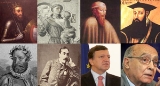
Portuguese people

Encyclopedia
The Portuguese are a nation
and ethnic group
native to the country of Portugal
, in the west of the Iberian peninsula
of south
-west
Europe
. Their language is Portuguese
, and Roman Catholicism is the predominant religion.
Due to the large historical extent of the Portuguese Empire
and the colonization of territories in Africa
, Asia
and the Americas
, as well as historical and recent emigration
, Portuguese communities can be found in many diverse regions, and a large Portuguese diaspora exists.
population, with origins predominantly from Atlantic Europe
, Western Europe
and the Western Mediterranean.
The earliest modern humans
inhabiting Portugal are believed to have been Paleolithic
peoples that may have arrived in the Iberian Peninsula
as early as 35,000 to 40,000 years ago. Current interpretation of Y-chromosome and mtDNA data suggests that modern-day Portuguese traces largely a significant amount of these lineages to the paleolithic
peoples which began arriving to the European continent between the end of the last glaciation
around 45,000 years ago.
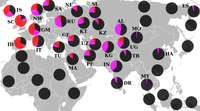 Northern Iberia is believed to have been a major Ice-age refuge from which Paleolithic humans later colonized Europe. Migrations from what is now Northern Iberia during the Paleolithic and Mesolithic
, links modern Iberians
to the populations of much of Western Europe
and particularly the British Isles
and Atlantic Europe
. Recent books published by geneticists Bryan Sykes
, Stephen Oppenheimer
and Spencer Wells
have argued the large Paleolithic and Mesolithic Iberian influence in the modern day Irish
, Welsh
and Scottish
gene-pool as well as parts of the English
. Indeed, Y-chromosome haplogroup
R1b (of Paleolithic origin) is the most common haplogroup in practically all of the Iberian peninsula and western Europe. Within the R1b haplogroup there are modal haplotypes. One of the best-characterized of these haplotypes is the Atlantic Modal Haplotype
(AMH). This haplotype reaches the highest frequencies in the Iberian Peninsula and in the British Isles. In Portugal it reaches 33% generally and higher than 90% in some of the northern regions of the country.
The Neolithic
colonization of Europe from Western Asia and the Middle East
beginning around 10,000 years ago reached Iberia, as most of the rest of the continent although, according to the demic diffusion
model, its impact was most in the southern and eastern regions of the European continent.
Starting in the 3rd millennium BC
as well as in the Bronze Age
, the first wave of migrations into Iberia of speakers of Indo-European languages
occurred. These were later (7th and 5th Centuries BC) followed by others that can be identified as Celt
s.
Eventually, urban cultures developed in southern Iberia, such as Tartessos
, influenced by the Phoenicia
n colonization of coastal Mediterranean Iberia, with strong competition from the Greek
colonization.
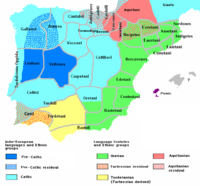 These two processes defined Iberia's, and Portugal's, cultural landscape - Mediterranean towards the southeast and a Continental in the northwest, as historian José Mattoso describes it.
Given the origins from Paleolithic and Neolithic settlers as well as Indo-European
migrations, one can say that the Portuguese ethnic origin
is mainly a mixture of pre-Roman Pre-Indo-Europeans (such as, in other parts of Iberia, the Iberians
, Tartessians
and Aquitanians
), Pre-Celtic, Proto-Celtic and Celtic peoples, producing peoples such as the Lusitanians
of Lusitania
, the Calaicians or Gallaeci
of Gallaecia
, the Celtici
and the Cynetes
of the Alentejo and the Algarve.
The Romans
were an important influence on Portuguese culture
, considering the Portuguese language
itself derives from Latin
.
Other influences included the Phoenicians/Carthaginians (small semi-permanent commercial coastal establishments in the south before 200 BC), the Vandals
(Silingi
and Hasdingi
) and the Sarmatian Alans
(both migrated to North Africa
, while some were partially integrated by the Visigoths and Suevi), and the Visigoths and Suevi (including the Buri
, permanently established in the early 5th century), along with, in the period of the Al-Andalus
, numbers of Arab
s and Berbers
, Saqaliba
(people of Slavic origin) and Jews who also settled in what is today Portuguese territory
.
The ancestry of modern Portuguese has been influenced by the many people which have passed on its territory throughout history. Overall, these people include the Pre-Roman People of the Iberian Peninsula (such as the Lusitanians
, Calaicians
, Celtici
, Cynetes
and other minor local tribes as the Bracari
, Coelerni
, Equaesi
, Grovii
, Interamici
, Leuni
, Luanqui
, Limici
, Narbasi
, Nemetati
, Paesuri
, Quaquerni
, Seurbi
, Tamagani
, Tapoli
, Turduli
, Turduli Veteres
, Turdulorum Oppida
, Turodi
and Zoelae
), Romans
, Vandals
, Suebi
and Buri
, Visigoths, Alans
, Vikings, Saqaliba
(Slavs), Moors
(Berbers
and, Arabs), and Jews
(Sephardim or Marranos).
Most Berber/Arab people and the Jews were expelled from the Iberian Peninsula
during the Reconquista
, by the repression of the Inquisition
and the repopulation by Christians.
During the Reconquista
many crusaders settled in Portugal, settlers also came from Burgundy and Flanders, set in mainland Portugal and later in the Azores and Madeira (Descobrimentos
).
For the Y-chromosome and MtDNA lineages of the Portuguese and other peoples see this map and this one.
) were an Indo-European people
living in the Western Iberian Peninsula
long before it became the Roman
province of Lusitania
(modern Portugal
, Extremadura
and a small part of Salamanca
). They spoke the Lusitanian language
which possessed many Celtic characteristics. Culturally, the Lusitanians had many similarities to the Celtic tribes of neighboring Gallaecia. The modern Portuguese people
see the Celtic Lusitanians living in the western Iberian peninsula as their ancestors. The most notable Lusitanian was Viriathus
.
Ethnological speculations abound on the origin Lusitanians and whether they had some sort of connection with the Lusones or that the similarity in their tribal names was accidental.
The first area settled by the Lusitanians was probably the Douro valley and the region of Beira Alta
; then they moved south, and expanded on both sides of the Tagus river, before being conquered by the Romans.
The original Roman province of Lusitania briefly included the territories of Asturia and Gallaecia
, but these were soon ceded to the jurisdiction of the Provincia Tarraconensis in the north, while the south remained the Provincia Lusitania et Vettones
. After this, Lusitania's northern border was along the Douro river, while its eastern border passed through Salmantica and Caesarobriga to the Anas (Guadiana
) river.
and settled in the region in the 6th century BC. Some modern authors consider them to be indigenous and initially dominated by the Celt
s, before gaining full independence from them. The archeologist Scarlat Lambrino proposed that they were originally a tribal group of Celtic origin related to the Lusones
.
The first area settled by the Lusitanians was probably the Douro valley and the region of Beira Alta
; then they moved south, and expanded on both sides of the Tagus river, before being conquered by the Romans.
The original Roman province of Lusitania briefly included the territories of Asturia and Gallaecia
, but these were soon ceded to the jurisdiction of the Provincia Tarraconensis in the north, while the south remained the Provincia Lusitania et Vettones
. After this, Lusitania's northern border was along the Douro river, while its eastern border passed through Salmantica and Caesarobriga to the Anas (Guadiana
) river.
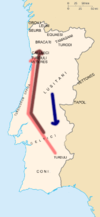 The Lusitanians were a single large tribe
that lived between the rivers Douro and Tagus
. As the Lusitanians fought fiercely against the Romans for independence, the name Lusitania was adopted by the Gallaeci, tribes living north of the Douro, and other closely surrounding tribes, eventually spreading as a label to all the nearby peoples fighting Roman rule in the west of Iberia. It was for this reason that the Romans came to name their original province in the area, that initially covered the entire western side of the Iberian peninsula, Lusitania.
Tribes, often known by their Latin names, living in the area of modern Portugal, prior to Roman rule:
(modern France
). Three years later (147 BC), Viriathus
became the leader of the Lusitanians and severely damaged the Roman rule in Lusitania and beyond. In 139 BC Viriathus was betrayed and killed in his sleep by his companions (who had been sent as emissaries to the Romans), Audax, Ditalcus and Minurus
, bribed by Marcus Popillius Laenas
. However, when Audax, Ditalcus and Minurus returned to receive their reward by the Romans, the Consul Servilius Caepio
ordered their execution, declaring, "Rome does not pay traitors".
After Viriathus' rule, the Lusitanians became largely romanised and more interbred with them, acquiring Roman culture and language; the Lusitanian cities, in a manner similar to those of the rest of the romanised Iberian peninsula, eventually gained the status of "Citizens of Rome". The Portuguese language
itself is a local evolution of the Roman language, Latin
.
and southern
European peoples, particularly from Spain
, with whom they share ancestry and have some cultural proximity. It is largely consistent with the geographic position of the western part of the Iberian peninsula, located on the extreme southwest of continental Europe. There are clear connections with Atlantic Europe
and Western Europe
as well as parts of the Western Mediterranean. Dark to medium brown hair
and brown and hazel eyes predominate in a majority of Portuguese people. However, light brown and blond
hair and blue or green eye
s are also found with some regular frequency. Chestnut
and auburn-colored hair types occur generally. Light, true red hair
(meaning red shades that are non-auburn) is seen on occasion.
Well designed field pigmentation studies by Tamagnini (1916, 1936), Correa (1919) and others recorded national average fair hair ("blondism") frequencies of between 18 and 20%. Approximately 11% are legitimate blond shades, mainly medium to ash blond, and the remainder (7-9%) light brown. True red hair (ginger) amounts to approximately 3%. However, there are higher percentages of individuals with auburn and dark red-brown shades. Light eyes run between 25-30% for the Portuguese, according to recently published pigmentation maps of Europe (see P. Frost, 2006).
, close to Leonese
in the municipalities
of Miranda do Douro
, Vimioso
and Mogadouro
- even if all of the speakers are bilingual with Portuguese
.
An even smaller minority of no more than 2,000 people speak Barranquenho
, a dialect of Portuguese heavily influenced by Extremaduran
, spoken in the Portuguese town of Barrancos
(in the border between Extremadura
and Andalusia
, in Spain
, and Portugal).
(namely Brazil
, Africa - Afro-Portuguese
, and parts of India
) have, in the last two to three decades, migrated to Portugal. More recently, a great number of Slavs, especially Ukrainians
(now the third biggest ethnic minority ), are also migrating to Portugal. There is also a small Chinese
minority.
In addition, there is a small minority of Gypsies (Ciganos) of about 40,000 people and an even smaller minority of Jews
of about 5,000 persons (some Ashkenazi
, the majority Sephardi
, such as the Belmonte Jews
).
In the whole world there are easily more than one hundred million people with recognizable Portuguese ancestors, due to the colonial expansion
and worldwide immigration
of Portuguese from the 16th century onwards to India
, the Americas
, Macau
and East-Timor, Malaysia, Indonesia
and Africa
. Between 1886 and 1966, Portugal lost to emigration more than any West European country except Ireland
. From the middle of the 19th century to the late 1950s, nearly two million Portuguese left Europe to live in Brazil
and the United States
. About 40 million Brazilians have relatively recent Portuguese background, due to massive immigration in the late 19th and early 20th centuries. About 1.2 million Brazilian citizens are native Portuguese. Significant verified Portuguese minorities exist in: (see table)
Portuguese Sephardic Jews
(mostly descendants) are also important in Israel
, the Netherlands
, the United States
, France
, Venezuela
, Brazil
and Turkey
.
In the United States
, there are Portuguese communities in New Jersey
, the New England
states, and California
. In the Pacific, Hawaii
has a sizable Portuguese element that goes back 150 years (see Portuguese American
s and Luso American
s), Australia
and New Zealand
also have Portuguese communities (see Portuguese Australian
, Portuguese New Zealander
). Canada
, particularly Ontario
, Quebec
and British Columbia
, has developed a significant Portuguese community since 1940 (see Portuguese Canadians
). Argentina
(See Portuguese Argentine
and Cape Verdean Argentine) and Uruguay
had Portuguese immigration in the early 20th century. So has Chile
where an estimated 50,000 descendants live, as the country's maritime industries attracted a small number of Portuguese as well. . Portuguese fishermen, farmers and laborers dispersed across the Caribbean
, especially Bermuda
(3.75% to 10% of the population), Guyana
(4.3% of the population in 1891), Trinidad
, St. Vincent and the Grenadines, and the island of Barbados
where there is high influence from the Portuguese community.
In the early twentieth century the Portuguese government encouraged white emigration to Angola and Mozambique, and by the 1970s, there were up to 1 million Portuguese settlers living in their overseas African provinces. An estimated 800,000 Portuguese returned to Portugal as the country's African possessions gained independence in 1975, after the Carnation Revolution
, while others moved to Brazil
and south to South Africa
.
As of 1989, some 4,000,000 Portuguese were living abroad, mainly in France, Germany, Brazil, the United Kingdom, South Africa, Canada, Venezuela, and the United States.
Portuguese
constitute 13% of the population of Luxembourg
. In 2006 there were estimates to be over half a million people of Portuguese origin in the United Kingdom
(see Portuguese in the United Kingdom), this is considerably larger than the around 88,000 Portuguese born people alone residing in the country in 2009 (estimation) (however this figure doesn't include British born people of Portuguese descent). In areas such as Thetford
and the crown dependencies of Jersey
and Guernsey
, the Portuguese form the largest ethnic minority groups at 30% of the population, 20% and 3% respectively. The British capital London
is home to the largest number of Portuguese people in the UK, with the majority being found in the borough's of Kensington and Chelsea
, Lambeth
and Westminster
.
As a result of interracial marriage and cultural influence, there are Portuguese influenced people with their own culture and Portuguese based dialects in parts of the world other than former Portuguese colonies, most notably in Malaysia, Singapore
and Indonesia
(see Kristang people
), Barbados
, Aruba
, Curaçao
, St. Vincent and the Grenadines, Trinidad and Tobago
, Guyana
(see Portuguese immigrants in Guyana
), Equatorial Guinea
and Sri Lanka
(see Burgher people
and Portuguese Burghers
).
In colonial times
, over 700,000 Portuguese settled in Brazil, and most of them went there during the gold rush of the 18th century. They managed to be the only significant European population to populate the country during colonization. The Portuguese migration was strongly marked by the predominance of men (colonial reports from the 16th and 17th centuries almost always report the absence or rarity of Portuguese women). The multiplication of descendant
s of Portuguese settlers happened through miscegenation
with black
and amerindian women. In fact, in colonial Brazil the Portuguese men competed for the women, because even among the African slaves
the female component was a minority. This explains why the Portuguese men left more descendants in Brazil than the Amerindian or African men did. The Indian and African women were "dominated" by the Portuguese men, preventing men of color to find partners with whom they could have children. Added to this, White people had a better quality of life
and therefore a lower mortality rate
than the black and indigenous population. Then, even though the Portuguese migration during colonial Brazil was small (5 million Indians estimated at the beginning of colonization and 3 to 6 million Africans brought since then, compared to the descendants of the over 700,000 Portuguese immigrants) the "white" population (whose ancestry was predominantly Portuguese) was as large as the Black population in the early 19th century, just before independence from POrtugal.
After independence from Portugal in 1822, around 1.7 million Portuguese immigrants settled in Brazil.
Portuguese immigration to Brazil in the 19th and 20th centuries was marked by its concentration in the states of São Paulo
and Rio de Janeiro
. The immigrants went mostly to urban center
s (which made them different from other immigrants in Brazil, who were attracted to rural areas of the country). Portuguese women appeared with some regularity among immigrants, with percentage variation in different decades and regions of the country. However, even among the more recent influx of Portuguese immigrants in the turn of the 19th to 20th century, there were 319 men to each 100 women among them. The Portuguese were different from other immigrants in Brazil, like the Germans, or Italians who brought many women along with them (even though the proportion of men was higher in any immigrant community). Despite the small female proportion, Portuguese men married mainly Portuguese women. Female immigrants rarely married Brazilian men. In this context, the Portuguese had a rate of endogamy
which was higher than any other European immigrant community, and behind only the Japanese among all immigrants.
Even with Portuguese heritage, many Portuguese-Brazilians identify themselves as being simply Brazilians, since Portuguese culture was a dominant cultural influence in the formation of Brazil (like many British American
s in the United States
, who will never describe themselves as of British extraction, but only as "Americans").
In 1872, there were 3.7 million Whites in Brazil (the vast majority of them of Portuguese ancestry), 4.1 million mixed-race people (mostly of Portuguese-African
-Native American
ancestry) and 1.9 million Blacks
. These numbers give the percentage of 80% of people with total or partial Portuguese ancestry in Brazil in the 1870s.
In the late 19th and early 20th centuries, a new large wave of immigrants from Portugal arrived. From 1881 to 1991, over 1.5 million Portuguese immigrated to Brazil. In 1906, for example, there were 133,393 Portuguese-born people living in Rio de Janeiro
, comprising 16% of the city's population. Rio is, still today, considered the largest "Portuguese city" outside of Portugal itself,with 1% Portuguese-born people.
Genetic studies also confirm the strong Portuguese genetic influence in Brazilians. According to a study, at least half of the Brazilian population's Y Chromosome
comes from Portugal. Black Brazilians
have an average of 48% non-African genes, most of them may come from Portuguese ancestors. On the other hand, 33% Amerindian and 28% African contribution to the total mtDNA of white Brazilians was found
It was estimated that around five million or more Brazilians can acquire Portuguese citizenship, due to the last Portuguese nationality law
that grants citizenship to grandchildren of Portuguese nationals.
Nation
A nation may refer to a community of people who share a common language, culture, ethnicity, descent, and/or history. In this definition, a nation has no physical borders. However, it can also refer to people who share a common territory and government irrespective of their ethnic make-up...
and ethnic group
Ethnic group
An ethnic group is a group of people whose members identify with each other, through a common heritage, often consisting of a common language, a common culture and/or an ideology that stresses common ancestry or endogamy...
native to the country of Portugal
Portugal
Portugal , officially the Portuguese Republic is a country situated in southwestern Europe on the Iberian Peninsula. Portugal is the westernmost country of Europe, and is bordered by the Atlantic Ocean to the West and South and by Spain to the North and East. The Atlantic archipelagos of the...
, in the west of the Iberian peninsula
Iberian Peninsula
The Iberian Peninsula , sometimes called Iberia, is located in the extreme southwest of Europe and includes the modern-day sovereign states of Spain, Portugal and Andorra, as well as the British Overseas Territory of Gibraltar...
of south
Southern Europe
The term Southern Europe, at its most general definition, is used to mean "all countries in the south of Europe". However, the concept, at different times, has had different meanings, providing additional political, linguistic and cultural context to the definition in addition to the typical...
-west
Western Europe
Western Europe is a loose term for the collection of countries in the western most region of the European continents, though this definition is context-dependent and carries cultural and political connotations. One definition describes Western Europe as a geographic entity—the region lying in the...
Europe
Europe
Europe is, by convention, one of the world's seven continents. Comprising the westernmost peninsula of Eurasia, Europe is generally 'divided' from Asia to its east by the watershed divides of the Ural and Caucasus Mountains, the Ural River, the Caspian and Black Seas, and the waterways connecting...
. Their language is Portuguese
Portuguese language
Portuguese is a Romance language that arose in the medieval Kingdom of Galicia, nowadays Galicia and Northern Portugal. The southern part of the Kingdom of Galicia became independent as the County of Portugal in 1095...
, and Roman Catholicism is the predominant religion.
Due to the large historical extent of the Portuguese Empire
Portuguese Empire
The Portuguese Empire , also known as the Portuguese Overseas Empire or the Portuguese Colonial Empire , was the first global empire in history...
and the colonization of territories in Africa
Africa
Africa is the world's second largest and second most populous continent, after Asia. At about 30.2 million km² including adjacent islands, it covers 6% of the Earth's total surface area and 20.4% of the total land area...
, Asia
Asia
Asia is the world's largest and most populous continent, located primarily in the eastern and northern hemispheres. It covers 8.7% of the Earth's total surface area and with approximately 3.879 billion people, it hosts 60% of the world's current human population...
and the Americas
Americas
The Americas, or America , are lands in the Western hemisphere, also known as the New World. In English, the plural form the Americas is often used to refer to the landmasses of North America and South America with their associated islands and regions, while the singular form America is primarily...
, as well as historical and recent emigration
Emigration
Emigration is the act of leaving one's country or region to settle in another. It is the same as immigration but from the perspective of the country of origin. Human movement before the establishment of political boundaries or within one state is termed migration. There are many reasons why people...
, Portuguese communities can be found in many diverse regions, and a large Portuguese diaspora exists.
Historical origins
The Portuguese are a southwestern EuropeanEuropean ethnic groups
The ethnic groups in Europe are the various ethnic groups that reside in the nations of Europe. European ethnology is the field of anthropology focusing on Europe....
population, with origins predominantly from Atlantic Europe
Atlantic Europe
Atlantic Europe is a geographical and anthropological term for the western portion of Europe which borders the Atlantic Ocean. The term may refer to the idea of Atlantic Europe as a cultural unit and/or as an biogeographical region....
, Western Europe
Western Europe
Western Europe is a loose term for the collection of countries in the western most region of the European continents, though this definition is context-dependent and carries cultural and political connotations. One definition describes Western Europe as a geographic entity—the region lying in the...
and the Western Mediterranean.
The earliest modern humans
Human
Humans are the only living species in the Homo genus...
inhabiting Portugal are believed to have been Paleolithic
Paleolithic
The Paleolithic Age, Era or Period, is a prehistoric period of human history distinguished by the development of the most primitive stone tools discovered , and covers roughly 99% of human technological prehistory...
peoples that may have arrived in the Iberian Peninsula
Iberian Peninsula
The Iberian Peninsula , sometimes called Iberia, is located in the extreme southwest of Europe and includes the modern-day sovereign states of Spain, Portugal and Andorra, as well as the British Overseas Territory of Gibraltar...
as early as 35,000 to 40,000 years ago. Current interpretation of Y-chromosome and mtDNA data suggests that modern-day Portuguese traces largely a significant amount of these lineages to the paleolithic
Paleolithic
The Paleolithic Age, Era or Period, is a prehistoric period of human history distinguished by the development of the most primitive stone tools discovered , and covers roughly 99% of human technological prehistory...
peoples which began arriving to the European continent between the end of the last glaciation
Wisconsin glaciation
The last glacial period was the most recent glacial period within the current ice age occurring during the last years of the Pleistocene, from approximately 110,000 to 10,000 years ago....
around 45,000 years ago.
Mesolithic
The Mesolithic is an archaeological concept used to refer to certain groups of archaeological cultures defined as falling between the Paleolithic and the Neolithic....
, links modern Iberians
Iberian Peninsula
The Iberian Peninsula , sometimes called Iberia, is located in the extreme southwest of Europe and includes the modern-day sovereign states of Spain, Portugal and Andorra, as well as the British Overseas Territory of Gibraltar...
to the populations of much of Western Europe
Western Europe
Western Europe is a loose term for the collection of countries in the western most region of the European continents, though this definition is context-dependent and carries cultural and political connotations. One definition describes Western Europe as a geographic entity—the region lying in the...
and particularly the British Isles
British Isles
The British Isles are a group of islands off the northwest coast of continental Europe that include the islands of Great Britain and Ireland and over six thousand smaller isles. There are two sovereign states located on the islands: the United Kingdom of Great Britain and Northern Ireland and...
and Atlantic Europe
Atlantic Europe
Atlantic Europe is a geographical and anthropological term for the western portion of Europe which borders the Atlantic Ocean. The term may refer to the idea of Atlantic Europe as a cultural unit and/or as an biogeographical region....
. Recent books published by geneticists Bryan Sykes
Bryan Sykes
Bryan Sykes is a former Professor of Human Genetics at the University of Oxford and a current Fellow of Wolfson College.Sykes published the first report on retrieving DNA from ancient bone...
, Stephen Oppenheimer
Stephen Oppenheimer
Stephen Oppenheimer is a British paediatrician, geneticist, and writer. He is a member of Green Templeton College, Oxford and an honorary fellow of Liverpool School of Tropical Medicine, and carries out and publishes research in the fields of genetics and human prehistory.-Career:Oppenheimer...
and Spencer Wells
Spencer Wells
Spencer Wells is a geneticist and anthropologist, an at the National Geographic Society, and Frank H.T. Rhodes Class of '56 Professor at Cornell University. He leads The Genographic Project.-Education:...
have argued the large Paleolithic and Mesolithic Iberian influence in the modern day Irish
Irish people
The Irish people are an ethnic group who originate in Ireland, an island in northwestern Europe. Ireland has been populated for around 9,000 years , with the Irish people's earliest ancestors recorded having legends of being descended from groups such as the Nemedians, Fomorians, Fir Bolg, Tuatha...
, Welsh
Welsh people
The Welsh people are an ethnic group and nation associated with Wales and the Welsh language.John Davies argues that the origin of the "Welsh nation" can be traced to the late 4th and early 5th centuries, following the Roman departure from Britain, although Brythonic Celtic languages seem to have...
and Scottish
Scottish people
The Scottish people , or Scots, are a nation and ethnic group native to Scotland. Historically they emerged from an amalgamation of the Picts and Gaels, incorporating neighbouring Britons to the south as well as invading Germanic peoples such as the Anglo-Saxons and the Norse.In modern use,...
gene-pool as well as parts of the English
English people
The English are a nation and ethnic group native to England, who speak English. The English identity is of early mediaeval origin, when they were known in Old English as the Anglecynn. England is now a country of the United Kingdom, and the majority of English people in England are British Citizens...
. Indeed, Y-chromosome haplogroup
Haplogroup
In the study of molecular evolution, a haplogroup is a group of similar haplotypes that share a common ancestor having the same single nucleotide polymorphism mutation in both haplotypes. Because a haplogroup consists of similar haplotypes, this is what makes it possible to predict a haplogroup...
R1b (of Paleolithic origin) is the most common haplogroup in practically all of the Iberian peninsula and western Europe. Within the R1b haplogroup there are modal haplotypes. One of the best-characterized of these haplotypes is the Atlantic Modal Haplotype
Atlantic Modal Haplotype
In human genetics, the Atlantic Modal Haplotype or haplotype 15 is a Y chromosome haplotype of Y-STR microsatellite variations, associated with the Haplogroup R1b. It was discovered prior to many of the SNPs now used to identify subclades of R1b and references to it can be found in some of the...
(AMH). This haplotype reaches the highest frequencies in the Iberian Peninsula and in the British Isles. In Portugal it reaches 33% generally and higher than 90% in some of the northern regions of the country.
The Neolithic
Neolithic
The Neolithic Age, Era, or Period, or New Stone Age, was a period in the development of human technology, beginning about 9500 BC in some parts of the Middle East, and later in other parts of the world. It is traditionally considered as the last part of the Stone Age...
colonization of Europe from Western Asia and the Middle East
Middle East
The Middle East is a region that encompasses Western Asia and Northern Africa. It is often used as a synonym for Near East, in opposition to Far East...
beginning around 10,000 years ago reached Iberia, as most of the rest of the continent although, according to the demic diffusion
Demic diffusion
Demic diffusion is a demographic term referring to a migratory model developed by Cavalli-Sforza, that consists of population diffusion into and across an area previously uninhabited by that group, possibly, but not necessarily, displacing, replacing, or intermixing with a pre-existing population...
model, its impact was most in the southern and eastern regions of the European continent.
Starting in the 3rd millennium BC
3rd millennium BC
The 3rd millennium BC spans the Early to Middle Bronze Age.It represents a period of time in which imperialism, or the desire to conquer, grew to prominence, in the city states of the Middle East, but also throughout Eurasia, with Indo-European expansion to Anatolia, Europe and Central Asia. The...
as well as in the Bronze Age
Bronze Age
The Bronze Age is a period characterized by the use of copper and its alloy bronze as the chief hard materials in the manufacture of some implements and weapons. Chronologically, it stands between the Stone Age and Iron Age...
, the first wave of migrations into Iberia of speakers of Indo-European languages
Indo-European languages
The Indo-European languages are a family of several hundred related languages and dialects, including most major current languages of Europe, the Iranian plateau, and South Asia and also historically predominant in Anatolia...
occurred. These were later (7th and 5th Centuries BC) followed by others that can be identified as Celt
Celt
The Celts were a diverse group of tribal societies in Iron Age and Roman-era Europe who spoke Celtic languages.The earliest archaeological culture commonly accepted as Celtic, or rather Proto-Celtic, was the central European Hallstatt culture , named for the rich grave finds in Hallstatt, Austria....
s.
Eventually, urban cultures developed in southern Iberia, such as Tartessos
Tartessos
Tartessos or Tartessus was a harbor city and surrounding culture on the south coast of the Iberian peninsula , at the mouth of the Guadalquivir River. It appears in sources from Greece and the Near East starting in the middle of the first millennium BC, for example Herodotus, who describes it as...
, influenced by the Phoenicia
Phoenicia
Phoenicia , was an ancient civilization in Canaan which covered most of the western, coastal part of the Fertile Crescent. Several major Phoenician cities were built on the coastline of the Mediterranean. It was an enterprising maritime trading culture that spread across the Mediterranean from 1550...
n colonization of coastal Mediterranean Iberia, with strong competition from the Greek
Ancient Greece
Ancient Greece is a civilization belonging to a period of Greek history that lasted from the Archaic period of the 8th to 6th centuries BC to the end of antiquity. Immediately following this period was the beginning of the Early Middle Ages and the Byzantine era. Included in Ancient Greece is the...
colonization.
Given the origins from Paleolithic and Neolithic settlers as well as Indo-European
Proto-Indo-Europeans
The Proto-Indo-Europeans were the speakers of the Proto-Indo-European language , a reconstructed prehistoric language of Eurasia.Knowledge of them comes chiefly from the linguistic reconstruction, along with material evidence from archaeology and archaeogenetics...
migrations, one can say that the Portuguese ethnic origin
Ethnic origin
The concept of ethnic origin is an attempt to classify people, not according to their current nationality, but according to where their ancestors came from...
is mainly a mixture of pre-Roman Pre-Indo-Europeans (such as, in other parts of Iberia, the Iberians
Iberians
The Iberians were a set of peoples that Greek and Roman sources identified with that name in the eastern and southern coasts of the Iberian peninsula at least from the 6th century BC...
, Tartessians
Tartessos
Tartessos or Tartessus was a harbor city and surrounding culture on the south coast of the Iberian peninsula , at the mouth of the Guadalquivir River. It appears in sources from Greece and the Near East starting in the middle of the first millennium BC, for example Herodotus, who describes it as...
and Aquitanians
Aquitanian language
The Aquitanian language was spoken in ancient Aquitaine before the Roman conquest and, probably much later, until the Early Middle Ages....
), Pre-Celtic, Proto-Celtic and Celtic peoples, producing peoples such as the Lusitanians
Lusitanians
The Lusitanians were an Indo-European people living in the Western Iberian Peninsula long before it became the Roman province of Lusitania . They spoke the Lusitanian language which might have been Celtic. The modern Portuguese people see the Lusitanians as their ancestors...
of Lusitania
Lusitania
Lusitania or Hispania Lusitania was an ancient Roman province including approximately all of modern Portugal south of the Douro river and part of modern Spain . It was named after the Lusitani or Lusitanian people...
, the Calaicians or Gallaeci
Callaici
The Gallaeci or Callaeci were a Celtic people who inhabited Gallaecia, the region roughly corresponding to what is now Galicia, North of Portugal and Western Asturias, through the Roman period...
of Gallaecia
Gallaecia
Gallaecia or Callaecia, also known as Hispania Gallaecia, was the name of a Roman province and an early Mediaeval kingdom that comprised a territory in the north-west of Hispania...
, the Celtici
Celtici
]The Celtici were a Celtic tribe or group of tribes of the Iberian peninsula, inhabiting three definite areas: in what today are the provinces of Alentejo and the Algarve in Portugal; in the Province of Badajoz and north of Province of Huelva in Spain, in the ancient Baeturia; and along the...
and the Cynetes
Cynetes
The Cynetes or Conii were one of the pre-Roman peoples of the Iberian Peninsula, living in today's Algarve and Low Alentejo regions of southern Portugal before the 6th century BCE .They are often mentioned in the ancient sources under various designations, mostly Greek or Latin derivatives of their...
of the Alentejo and the Algarve.
The Romans
Ancient Rome
Ancient Rome was a thriving civilization that grew on the Italian Peninsula as early as the 8th century BC. Located along the Mediterranean Sea and centered on the city of Rome, it expanded to one of the largest empires in the ancient world....
were an important influence on Portuguese culture
Culture of Portugal
The culture of Portugal is the result of a complex flow of different civilizations during the past Millennia. From prehistoric cultures, to its Pre-Roman civilizations , passing through its contacts with the Phoenician-Carthaginian world, the Roman period , the...
, considering the Portuguese language
Portuguese language
Portuguese is a Romance language that arose in the medieval Kingdom of Galicia, nowadays Galicia and Northern Portugal. The southern part of the Kingdom of Galicia became independent as the County of Portugal in 1095...
itself derives from Latin
Latin
Latin is an Italic language originally spoken in Latium and Ancient Rome. It, along with most European languages, is a descendant of the ancient Proto-Indo-European language. Although it is considered a dead language, a number of scholars and members of the Christian clergy speak it fluently, and...
.
Other influences included the Phoenicians/Carthaginians (small semi-permanent commercial coastal establishments in the south before 200 BC), the Vandals
Vandals
The Vandals were an East Germanic tribe that entered the late Roman Empire during the 5th century. The Vandals under king Genseric entered Africa in 429 and by 439 established a kingdom which included the Roman Africa province, besides the islands of Sicily, Corsica, Sardinia and the Balearics....
(Silingi
Silingi
The Silings or Silingi supposedly were an East Germanic tribe, probably part of the larger Vandal group. According to most scholars, examples Jerzy Strzelczyk, Norman Davies, Jerzy Krasuski, Andrzej Kokowski, Henryk Łowmiański, the Silingi may have lived in Silesia...
and Hasdingi
Hasdingi
The Hasdingi were the southern tribes of the Vandals, an East Germanic tribe. They lived in areas of today's southern Poland, Slovakia and Hungary...
) and the Sarmatian Alans
Alans
The Alans, or the Alani, occasionally termed Alauni or Halani, were a group of Sarmatian tribes, nomadic pastoralists of the 1st millennium AD who spoke an Eastern Iranian language which derived from Scytho-Sarmatian and which in turn evolved into modern Ossetian.-Name:The various forms of Alan —...
(both migrated to North Africa
North Africa
North Africa or Northern Africa is the northernmost region of the African continent, linked by the Sahara to Sub-Saharan Africa. Geopolitically, the United Nations definition of Northern Africa includes eight countries or territories; Algeria, Egypt, Libya, Morocco, South Sudan, Sudan, Tunisia, and...
, while some were partially integrated by the Visigoths and Suevi), and the Visigoths and Suevi (including the Buri
Buri (Germanic tribe)
The Buri were a Germanic tribe mentioned in the Germania of Tacitus, where they initially "close the back" of the Marcomanni and Quadi of Bohemia and Moravia. It is said that their speech and customs were like those of the Suebi...
, permanently established in the early 5th century), along with, in the period of the Al-Andalus
Al-Andalus
Al-Andalus was the Arabic name given to a nation and territorial region also commonly referred to as Moorish Iberia. The name describes parts of the Iberian Peninsula and Septimania governed by Muslims , at various times in the period between 711 and 1492, although the territorial boundaries...
, numbers of Arab
Arab
Arab people, also known as Arabs , are a panethnicity primarily living in the Arab world, which is located in Western Asia and North Africa. They are identified as such on one or more of genealogical, linguistic, or cultural grounds, with tribal affiliations, and intra-tribal relationships playing...
s and Berbers
Berber people
Berbers are the indigenous peoples of North Africa west of the Nile Valley. They are continuously distributed from the Atlantic to the Siwa oasis, in Egypt, and from the Mediterranean to the Niger River. Historically they spoke the Berber language or varieties of it, which together form a branch...
, Saqaliba
Saqaliba
Saqaliba refers to the Slavs, particularly Slavic slaves and mercenaries in the medieval Arab world, in the Middle East, North Africa, Sicily and Al-Andalus. It is generally thought that the Arabic term is a Byzantine loanword: saqlab, siklab, saqlabi etc. is a corruption of Greek Sklavinoi for...
(people of Slavic origin) and Jews who also settled in what is today Portuguese territory
Geography of Portugal
Portugal is a coastal nation in southwestern Europe, located at the western end of the Iberian Peninsula, bordering Spain...
.
The ancestry of modern Portuguese has been influenced by the many people which have passed on its territory throughout history. Overall, these people include the Pre-Roman People of the Iberian Peninsula (such as the Lusitanians
Lusitanians
The Lusitanians were an Indo-European people living in the Western Iberian Peninsula long before it became the Roman province of Lusitania . They spoke the Lusitanian language which might have been Celtic. The modern Portuguese people see the Lusitanians as their ancestors...
, Calaicians
Callaici
The Gallaeci or Callaeci were a Celtic people who inhabited Gallaecia, the region roughly corresponding to what is now Galicia, North of Portugal and Western Asturias, through the Roman period...
, Celtici
Celtici
]The Celtici were a Celtic tribe or group of tribes of the Iberian peninsula, inhabiting three definite areas: in what today are the provinces of Alentejo and the Algarve in Portugal; in the Province of Badajoz and north of Province of Huelva in Spain, in the ancient Baeturia; and along the...
, Cynetes
Cynetes
The Cynetes or Conii were one of the pre-Roman peoples of the Iberian Peninsula, living in today's Algarve and Low Alentejo regions of southern Portugal before the 6th century BCE .They are often mentioned in the ancient sources under various designations, mostly Greek or Latin derivatives of their...
and other minor local tribes as the Bracari
Bracari
The Bracari were an ancient Celtic tribe of Gallaecia, akin to the Calaicians or Gallaeci, living in the northwest of modern Portugal, in the province of Minho, between the rivers Tâmega and Cávado, around the area of the modern city of Braga .Appian wrote they were a very warlike people...
, Coelerni
Coelerni
The Coelerni were an ancient Celtic tribe of Gallaecia in Hispania , part of Calaician or Gallaeci people , living in what was to become the Roman Province of Hispania Citerior, convent of Bracara Augusta , in what is now the southern part of the province of Ourense .Some sources, like Alarcão,...
, Equaesi
Equaesi
The Equaesi were an ancient Celtic tribe of Gallaecia, living in the north of modern Portugal, between the provinces of Minho and Trás-os-Montes, near the border of modern Galicia .-External links:*...
, Grovii
Grovii
The Grovii were an ancient Celtic tribe of Gallaecia, living in the north of modern Portugal, in the province of Minho, around the Minho river, and spreading into modern day Galicia . One of their main gods was Turiacus.-External links:*...
, Interamici
Interamici
The Interamici were an ancient Celtic tribe of Gallaecia, living in the north of modern Portugal, in the province of Trás-os-Montes, near the border with Galicia .-External links:*...
, Leuni
Leuni
The Leuni were an ancient Celtic tribe of Gallaecia, living in the north of modern Portugal, in the province of Minho, between the rivers Lima and Minho.-External links:*...
, Luanqui
Luanqui
The Luanqvi were an ancient Celtic tribe of Gallaecia, living in the north of modern Portugal, in the province of Trás-os-Montes, between the rivers Tâmega and Tua.-External links:*...
, Limici
Limici
The Limici were an ancient Celtic tribe of Gallaecia, living in the swamps of the river Lima, in the border region between Minho and Galicia .-External links:*...
, Narbasi
Narbasi
The Narbasi were an ancient Celtic tribe of Gallaecia, living in the province of Minho and nearby areas of modern Galicia .-External links:*...
, Nemetati
Nemetati
The Nemetati were an ancient Celtic tribe of Gallaecia, living in the north of modern Portugal between the Cávado and Ave Rivers, in the province of Minho, north of the Douro.They lived near the valley of the Ave River and may have some link with inscriptions to the war god Cosus Nemedecus. The...
, Paesuri
Paesuri
The Paesuri were an ancient Celtic tribe of Lusitania, akin to the Lusitanians, to whom they were a dependent tribe. Located between the rivers Douro and Vouga, in the modern northern central Portugal, the Paesures comprised four tribes - Ireucoutiori, Aravoni, Seareas and Paisicaicoi, which...
, Quaquerni
Quaquerni
The Quaquerni were an ancient Celtic tribe of Gallaecia, living in the north of modern Portugal, province of Minho, in the mountains at the mouths of the rivers Tâmega and Cávado.-External links:*...
, Seurbi
Seurbi
The Seurbi were an ancient Celtic tribe of Gallaecia, living in the north of modern Portugal, in the province of Minho, between the rivers Cávado and Lima .-External links:*...
, Tamagani
Tamagani
The Tamagani were an ancient Celtic tribe of Gallaecia, living in the north of modern Portugal, in the province of Trás-os-Montes, from the area of Chaves, near the river Tâmega.-External links:*...
, Tapoli
Tapoli
The Tapoli were an ancient Celtic tribe of Lusitania, akin to the Lusitanians, to whom they were a dependent tribe, living just north of the river Tagus, around the border area of modern day Portugal and Spain.-External links:*...
, Turduli
Turduli
The Turduli were an ancient Celtiberian tribe of Lusitania, akin to the Lusitanians. They lived in the south of modern Portugal, in the east of the province of Alentejo, along the Guadiana valley , and Extremadura proper...
, Turduli Veteres
Turduli Veteres
The Turduli Veteres, also known as "Ancient Turduli" or "Old Turduli" were an ancient Celtic tribe of Lusitania, akin to the Lusitanians and Calaicians or Gallaeci, living south of the estuary of the river Douro, in the north of modern Portugal...
, Turdulorum Oppida
Turdulorum Oppida
The Turdulorum Oppida , or Turduli Oppidani, living in the Portuguese region of Estremadura , were an ancient Celtic tribe of Lusitania, akin to the Lusitanians. They held the fortified towns of Aeminium , Conimbriga , Coniumbriga , Collipo The Turdulorum Oppida (Latin - oppidums of the Turduli),...
, Turodi
Turodi
The Turodi were an ancient Celtic tribe of Gallaecia, living in the north of modern Portugal, in the province of Trás-os-Montes and border areas in Galicia .-External links:*...
and Zoelae
Zoelae
The Zoelae were an ancient Celtic tribe of Gallaecia, living in the north of modern Portugal, in the province of Trás-os-Montes, between the mountains of Serra da Nogueira and the mountains of Mogadouro.-External links:*...
), Romans
Ancient Rome
Ancient Rome was a thriving civilization that grew on the Italian Peninsula as early as the 8th century BC. Located along the Mediterranean Sea and centered on the city of Rome, it expanded to one of the largest empires in the ancient world....
, Vandals
Vandals
The Vandals were an East Germanic tribe that entered the late Roman Empire during the 5th century. The Vandals under king Genseric entered Africa in 429 and by 439 established a kingdom which included the Roman Africa province, besides the islands of Sicily, Corsica, Sardinia and the Balearics....
, Suebi
Suebi
The Suebi or Suevi were a group of Germanic peoples who were first mentioned by Julius Caesar in connection with Ariovistus' campaign, c...
and Buri
Buri (Germanic tribe)
The Buri were a Germanic tribe mentioned in the Germania of Tacitus, where they initially "close the back" of the Marcomanni and Quadi of Bohemia and Moravia. It is said that their speech and customs were like those of the Suebi...
, Visigoths, Alans
Alans
The Alans, or the Alani, occasionally termed Alauni or Halani, were a group of Sarmatian tribes, nomadic pastoralists of the 1st millennium AD who spoke an Eastern Iranian language which derived from Scytho-Sarmatian and which in turn evolved into modern Ossetian.-Name:The various forms of Alan —...
, Vikings, Saqaliba
Saqaliba
Saqaliba refers to the Slavs, particularly Slavic slaves and mercenaries in the medieval Arab world, in the Middle East, North Africa, Sicily and Al-Andalus. It is generally thought that the Arabic term is a Byzantine loanword: saqlab, siklab, saqlabi etc. is a corruption of Greek Sklavinoi for...
(Slavs), Moors
Moors
The description Moors has referred to several historic and modern populations of the Maghreb region who are predominately of Berber and Arab descent. They came to conquer and rule the Iberian Peninsula for nearly 800 years. At that time they were Muslim, although earlier the people had followed...
(Berbers
Berber people
Berbers are the indigenous peoples of North Africa west of the Nile Valley. They are continuously distributed from the Atlantic to the Siwa oasis, in Egypt, and from the Mediterranean to the Niger River. Historically they spoke the Berber language or varieties of it, which together form a branch...
and, Arabs), and Jews
Jews
The Jews , also known as the Jewish people, are a nation and ethnoreligious group originating in the Israelites or Hebrews of the Ancient Near East. The Jewish ethnicity, nationality, and religion are strongly interrelated, as Judaism is the traditional faith of the Jewish nation...
(Sephardim or Marranos).
Most Berber/Arab people and the Jews were expelled from the Iberian Peninsula
Iberian Peninsula
The Iberian Peninsula , sometimes called Iberia, is located in the extreme southwest of Europe and includes the modern-day sovereign states of Spain, Portugal and Andorra, as well as the British Overseas Territory of Gibraltar...
during the Reconquista
Reconquista
The Reconquista was a period of almost 800 years in the Middle Ages during which several Christian kingdoms succeeded in retaking the Muslim-controlled areas of the Iberian Peninsula broadly known as Al-Andalus...
, by the repression of the Inquisition
Inquisition
The Inquisition, Inquisitio Haereticae Pravitatis , was the "fight against heretics" by several institutions within the justice-system of the Roman Catholic Church. It started in the 12th century, with the introduction of torture in the persecution of heresy...
and the repopulation by Christians.
During the Reconquista
Reconquista
The Reconquista was a period of almost 800 years in the Middle Ages during which several Christian kingdoms succeeded in retaking the Muslim-controlled areas of the Iberian Peninsula broadly known as Al-Andalus...
many crusaders settled in Portugal, settlers also came from Burgundy and Flanders, set in mainland Portugal and later in the Azores and Madeira (Descobrimentos
Age of Discovery
The Age of Discovery, also known as the Age of Exploration and the Great Navigations , was a period in history starting in the early 15th century and continuing into the early 17th century during which Europeans engaged in intensive exploration of the world, establishing direct contacts with...
).
For the Y-chromosome and MtDNA lineages of the Portuguese and other peoples see this map and this one.
The Lusitanians
The Lusitanians (or Lusitani in LatinLatin
Latin is an Italic language originally spoken in Latium and Ancient Rome. It, along with most European languages, is a descendant of the ancient Proto-Indo-European language. Although it is considered a dead language, a number of scholars and members of the Christian clergy speak it fluently, and...
) were an Indo-European people
Proto-Indo-Europeans
The Proto-Indo-Europeans were the speakers of the Proto-Indo-European language , a reconstructed prehistoric language of Eurasia.Knowledge of them comes chiefly from the linguistic reconstruction, along with material evidence from archaeology and archaeogenetics...
living in the Western Iberian Peninsula
Iberian Peninsula
The Iberian Peninsula , sometimes called Iberia, is located in the extreme southwest of Europe and includes the modern-day sovereign states of Spain, Portugal and Andorra, as well as the British Overseas Territory of Gibraltar...
long before it became the Roman
Ancient Rome
Ancient Rome was a thriving civilization that grew on the Italian Peninsula as early as the 8th century BC. Located along the Mediterranean Sea and centered on the city of Rome, it expanded to one of the largest empires in the ancient world....
province of Lusitania
Lusitania
Lusitania or Hispania Lusitania was an ancient Roman province including approximately all of modern Portugal south of the Douro river and part of modern Spain . It was named after the Lusitani or Lusitanian people...
(modern Portugal
Portugal
Portugal , officially the Portuguese Republic is a country situated in southwestern Europe on the Iberian Peninsula. Portugal is the westernmost country of Europe, and is bordered by the Atlantic Ocean to the West and South and by Spain to the North and East. The Atlantic archipelagos of the...
, Extremadura
Extremadura
Extremadura is an autonomous community of western Spain whose capital city is Mérida. Its component provinces are Cáceres and Badajoz. It is bordered by Portugal to the west...
and a small part of Salamanca
Salamanca
Salamanca is a city in western Spain, in the community of Castile and León. Because it is known for its beautiful buildings and urban environment, the Old City was declared a UNESCO World Heritage Site in 1988. It is the most important university city in Spain and is known for its contributions to...
). They spoke the Lusitanian language
Lusitanian language
Lusitanian was a paleohispanic language that apparently belonged to the Indo-European family. Its relationship to the Celtic languages of the Iberian Peninsula, either as a member, a cousin , or as a different branch of Indo-European, is debated. It is known from only five inscriptions, dated from...
which possessed many Celtic characteristics. Culturally, the Lusitanians had many similarities to the Celtic tribes of neighboring Gallaecia. The modern Portuguese people
Portuguese people
The Portuguese are a nation and ethnic group native to the country of Portugal, in the west of the Iberian peninsula of south-west Europe. Their language is Portuguese, and Roman Catholicism is the predominant religion....
see the Celtic Lusitanians living in the western Iberian peninsula as their ancestors. The most notable Lusitanian was Viriathus
Viriathus
Viriathus was the most important leader of the Lusitanian people that resisted Roman expansion into the regions of Western Hispania , where the Roman province of Lusitania would be established...
.
Ethnological speculations abound on the origin Lusitanians and whether they had some sort of connection with the Lusones or that the similarity in their tribal names was accidental.
The first area settled by the Lusitanians was probably the Douro valley and the region of Beira Alta
Beira Alta
Beira Alta Province was a Portuguese province in the north of Portugal.Vast plateaus, river valleys, mountains, and castles abound in Beira Alta.Formerly it was part of the Beira Province.The two main cities were Guarda and Viseu...
; then they moved south, and expanded on both sides of the Tagus river, before being conquered by the Romans.
The original Roman province of Lusitania briefly included the territories of Asturia and Gallaecia
Gallaecia
Gallaecia or Callaecia, also known as Hispania Gallaecia, was the name of a Roman province and an early Mediaeval kingdom that comprised a territory in the north-west of Hispania...
, but these were soon ceded to the jurisdiction of the Provincia Tarraconensis in the north, while the south remained the Provincia Lusitania et Vettones
Vettones
The Vettones were one of the pre-Roman Celtic peoples of the Iberian Peninsula .- Origins :...
. After this, Lusitania's northern border was along the Douro river, while its eastern border passed through Salmantica and Caesarobriga to the Anas (Guadiana
Guadiana
The Guadiana , or Odiana, is an international river located on the Portuguese–Spanish border, separating Extremadura and Andalucia from Alentejo and Algarve...
) river.
Origins
It has been suggested that the Lusitanians may have originated in the AlpsAlps
The Alps is one of the great mountain range systems of Europe, stretching from Austria and Slovenia in the east through Italy, Switzerland, Liechtenstein and Germany to France in the west....
and settled in the region in the 6th century BC. Some modern authors consider them to be indigenous and initially dominated by the Celt
Celt
The Celts were a diverse group of tribal societies in Iron Age and Roman-era Europe who spoke Celtic languages.The earliest archaeological culture commonly accepted as Celtic, or rather Proto-Celtic, was the central European Hallstatt culture , named for the rich grave finds in Hallstatt, Austria....
s, before gaining full independence from them. The archeologist Scarlat Lambrino proposed that they were originally a tribal group of Celtic origin related to the Lusones
Lusones
The Lusones were an ancient Celtic Celtiberian people of the Iberian peninsula , who lived in the high Tajuña River valley, northeast of Guadalajara...
.
The first area settled by the Lusitanians was probably the Douro valley and the region of Beira Alta
Beira Alta
Beira Alta Province was a Portuguese province in the north of Portugal.Vast plateaus, river valleys, mountains, and castles abound in Beira Alta.Formerly it was part of the Beira Province.The two main cities were Guarda and Viseu...
; then they moved south, and expanded on both sides of the Tagus river, before being conquered by the Romans.
The original Roman province of Lusitania briefly included the territories of Asturia and Gallaecia
Gallaecia
Gallaecia or Callaecia, also known as Hispania Gallaecia, was the name of a Roman province and an early Mediaeval kingdom that comprised a territory in the north-west of Hispania...
, but these were soon ceded to the jurisdiction of the Provincia Tarraconensis in the north, while the south remained the Provincia Lusitania et Vettones
Vettones
The Vettones were one of the pre-Roman Celtic peoples of the Iberian Peninsula .- Origins :...
. After this, Lusitania's northern border was along the Douro river, while its eastern border passed through Salmantica and Caesarobriga to the Anas (Guadiana
Guadiana
The Guadiana , or Odiana, is an international river located on the Portuguese–Spanish border, separating Extremadura and Andalucia from Alentejo and Algarve...
) river.
Lusitanic Tribe
Tribe
A tribe, viewed historically or developmentally, consists of a social group existing before the development of, or outside of, states.Many anthropologists use the term tribal society to refer to societies organized largely on the basis of kinship, especially corporate descent groups .Some theorists...
that lived between the rivers Douro and Tagus
Tagus
The Tagus is the longest river on the Iberian Peninsula. It is long, in Spain, along the border between Portugal and Spain and in Portugal, where it empties into the Atlantic Ocean at Lisbon. It drains an area of . The Tagus is highly utilized for most of its course...
. As the Lusitanians fought fiercely against the Romans for independence, the name Lusitania was adopted by the Gallaeci, tribes living north of the Douro, and other closely surrounding tribes, eventually spreading as a label to all the nearby peoples fighting Roman rule in the west of Iberia. It was for this reason that the Romans came to name their original province in the area, that initially covered the entire western side of the Iberian peninsula, Lusitania.
Tribes, often known by their Latin names, living in the area of modern Portugal, prior to Roman rule:
- Bardili (Turduli)Bardili (Turduli)The Bardili were a small, pre-Roman people of Iberia and an offshoot of the widespread Turduli people, who lived in what is now southwestern Portugal in the 5th-1st Centuries BC.- Location :...
- living in the Setúbal peninsula; - BracariBracariThe Bracari were an ancient Celtic tribe of Gallaecia, akin to the Calaicians or Gallaeci, living in the northwest of modern Portugal, in the province of Minho, between the rivers Tâmega and Cávado, around the area of the modern city of Braga .Appian wrote they were a very warlike people...
- living between the rivers Tâmega and CávadoCávado RiverThe Cávado River is a river located in north Portugal.It has its source in Serra do Larouco at 1520 meters. It runs 135 km from Gouveia to its mouth into the Atlantic Ocean next to the city of Esposende...
, in the area of the modern city of BragaBragaBraga , a city in the Braga Municipality in northwestern Portugal, is the capital of the Braga District, the oldest archdiocese and the third major city of the country. Braga is the oldest Portuguese city and one of the oldest Christian cities in the World...
; - CallaiciCallaiciThe Gallaeci or Callaeci were a Celtic people who inhabited Gallaecia, the region roughly corresponding to what is now Galicia, North of Portugal and Western Asturias, through the Roman period...
-living north of the River Douro; - CelticiCeltici]The Celtici were a Celtic tribe or group of tribes of the Iberian peninsula, inhabiting three definite areas: in what today are the provinces of Alentejo and the Algarve in Portugal; in the Province of Badajoz and north of Province of Huelva in Spain, in the ancient Baeturia; and along the...
- Celts living in Alentejo; - CoelerniCoelerniThe Coelerni were an ancient Celtic tribe of Gallaecia in Hispania , part of Calaician or Gallaeci people , living in what was to become the Roman Province of Hispania Citerior, convent of Bracara Augusta , in what is now the southern part of the province of Ourense .Some sources, like Alarcão,...
- living in the mountains between the rivers Tua and Sabor; - Cynetes or ConiiCynetesThe Cynetes or Conii were one of the pre-Roman peoples of the Iberian Peninsula, living in today's Algarve and Low Alentejo regions of southern Portugal before the 6th century BCE .They are often mentioned in the ancient sources under various designations, mostly Greek or Latin derivatives of their...
- living in the Algarve and the south of Alentejo; - EquaesiEquaesiThe Equaesi were an ancient Celtic tribe of Gallaecia, living in the north of modern Portugal, between the provinces of Minho and Trás-os-Montes, near the border of modern Galicia .-External links:*...
- living in the most mountainous region of modern PortugalPortugalPortugal , officially the Portuguese Republic is a country situated in southwestern Europe on the Iberian Peninsula. Portugal is the westernmost country of Europe, and is bordered by the Atlantic Ocean to the West and South and by Spain to the North and East. The Atlantic archipelagos of the...
; - GroviiGroviiThe Grovii were an ancient Celtic tribe of Gallaecia, living in the north of modern Portugal, in the province of Minho, around the Minho river, and spreading into modern day Galicia . One of their main gods was Turiacus.-External links:*...
- a mysterious tribe living in the Minho valley; - InteramiciInteramiciThe Interamici were an ancient Celtic tribe of Gallaecia, living in the north of modern Portugal, in the province of Trás-os-Montes, near the border with Galicia .-External links:*...
- living in Trás-os-MontesTrás-os-Montes (region)Trás-os-Montes was one of the 13 regions of continental Portugal identified by geographer Amorim Girão, in a study published between 1927 and 1930.Together with Alto Douro it formed Trás-os-Montes e Alto Douro Province.- See also :...
and in the border areas with Galicia (in modern SpainSpainSpain , officially the Kingdom of Spain languages]] under the European Charter for Regional or Minority Languages. In each of these, Spain's official name is as follows:;;;;;;), is a country and member state of the European Union located in southwestern Europe on the Iberian Peninsula...
); - LeuniLeuniThe Leuni were an ancient Celtic tribe of Gallaecia, living in the north of modern Portugal, in the province of Minho, between the rivers Lima and Minho.-External links:*...
- living between the rivers Lima and Minho; - LuanquiLuanquiThe Luanqvi were an ancient Celtic tribe of Gallaecia, living in the north of modern Portugal, in the province of Trás-os-Montes, between the rivers Tâmega and Tua.-External links:*...
- living between the rivers Tâmega and Tua; - Lusitani - being the most numerous and dominant of the region;
- LimiciLimiciThe Limici were an ancient Celtic tribe of Gallaecia, living in the swamps of the river Lima, in the border region between Minho and Galicia .-External links:*...
- living in the swamps of the river Lima, on the border between Portugal and Galicia); - NarbasiNarbasiThe Narbasi were an ancient Celtic tribe of Gallaecia, living in the province of Minho and nearby areas of modern Galicia .-External links:*...
- living in the north of modern Portugal (interior) and nearby area of southern Galicia; - NemetatiNemetatiThe Nemetati were an ancient Celtic tribe of Gallaecia, living in the north of modern Portugal between the Cávado and Ave Rivers, in the province of Minho, north of the Douro.They lived near the valley of the Ave River and may have some link with inscriptions to the war god Cosus Nemedecus. The...
- living north of the Douro Valley in the area of Mondim; - PaesuriPaesuriThe Paesuri were an ancient Celtic tribe of Lusitania, akin to the Lusitanians, to whom they were a dependent tribe. Located between the rivers Douro and Vouga, in the modern northern central Portugal, the Paesures comprised four tribes - Ireucoutiori, Aravoni, Seareas and Paisicaicoi, which...
- a dependent tribe of the Lusitanians, living between the rivers Douro and Vouga; - QuaquerniQuaquerniThe Quaquerni were an ancient Celtic tribe of Gallaecia, living in the north of modern Portugal, province of Minho, in the mountains at the mouths of the rivers Tâmega and Cávado.-External links:*...
- living in the mountains at the mouths of rivers Cavado and Tâmega; - SeurbiSeurbiThe Seurbi were an ancient Celtic tribe of Gallaecia, living in the north of modern Portugal, in the province of Minho, between the rivers Cávado and Lima .-External links:*...
- living between the rivers CávadoCávado RiverThe Cávado River is a river located in north Portugal.It has its source in Serra do Larouco at 1520 meters. It runs 135 km from Gouveia to its mouth into the Atlantic Ocean next to the city of Esposende...
and Lima (or even reaching the river Minho); - TamaganiTamaganiThe Tamagani were an ancient Celtic tribe of Gallaecia, living in the north of modern Portugal, in the province of Trás-os-Montes, from the area of Chaves, near the river Tâmega.-External links:*...
- from the area of Chaves, near the river Tâmega; - TapoliTapoliThe Tapoli were an ancient Celtic tribe of Lusitania, akin to the Lusitanians, to whom they were a dependent tribe, living just north of the river Tagus, around the border area of modern day Portugal and Spain.-External links:*...
- another dependent tribe of the Lusitanians, living north of the river Tagus, on the border between modern Portugal and Spain; - TurduliTurduliThe Turduli were an ancient Celtiberian tribe of Lusitania, akin to the Lusitanians. They lived in the south of modern Portugal, in the east of the province of Alentejo, along the Guadiana valley , and Extremadura proper...
- in the east of Alentejo (Guadiana Valley); - Turduli VeteresTurduli VeteresThe Turduli Veteres, also known as "Ancient Turduli" or "Old Turduli" were an ancient Celtic tribe of Lusitania, akin to the Lusitanians and Calaicians or Gallaeci, living south of the estuary of the river Douro, in the north of modern Portugal...
- the "ancient Turduli" living south of the estuary of the river Douro; - Turdulorum OppidaTurdulorum OppidaThe Turdulorum Oppida , or Turduli Oppidani, living in the Portuguese region of Estremadura , were an ancient Celtic tribe of Lusitania, akin to the Lusitanians. They held the fortified towns of Aeminium , Conimbriga , Coniumbriga , Collipo The Turdulorum Oppida (Latin - oppidums of the Turduli),...
- Turduli living in the Portuguese region of EstremaduraEstremadura Province (historical)Estremadura Province is one of the six historical provinces of Portugal....
; - TurodiTurodiThe Turodi were an ancient Celtic tribe of Gallaecia, living in the north of modern Portugal, in the province of Trás-os-Montes and border areas in Galicia .-External links:*...
- living in Trás-os-MontesTrás-os-Montes (region)Trás-os-Montes was one of the 13 regions of continental Portugal identified by geographer Amorim Girão, in a study published between 1927 and 1930.Together with Alto Douro it formed Trás-os-Montes e Alto Douro Province.- See also :...
and bordering areas of Galicia; - VettonesVettonesThe Vettones were one of the pre-Roman Celtic peoples of the Iberian Peninsula .- Origins :...
- living in the Spanish provinces of ÁvilaÁvila (province)Ávila is a province of central-western Spain, in the southern part of the autonomous community of Castile and León. It is bordered on the south by the provinces of Toledo and Cáceres, on the west by Salamanca, on the north by Valladolid, and on the east by Segovia and Madrid. Ávila has a...
and SalamancaSalamanca (province)Salamanca is a province of western Spain, in the western part of the autonomous community of Castile and León. It is bordered by the provinces of Zamora, Valladolid, Ávila, and Cáceres; and by Portugal....
, as well as parts of ZamoraZamora (province)Zamora is a Spanish province of western Spain, in the western part of the autonomous community of Castile and León.The present-day province of Zamora province was one of three provinces formed from the former Kingdom of León in 1833, when Spain was re-organised into 49 provinces.It is bordered by...
, ToledoToledo (province)Toledo is a province of central Spain, in the western part of the autonomous community of Castile-La Mancha. It is bordered by the provinces of Madrid, Cuenca, Ciudad Real, Badajoz, Cáceres, and Ávila....
and CáceresCáceres (province)The province of Cáceres is a province of western Spain, in the northern part of the autonomous community of Extremadura. It is bordered by the provinces of Salamanca, Ávila, Toledo, and Badajoz, and by Portugal....
; - ZoelaeZoelaeThe Zoelae were an ancient Celtic tribe of Gallaecia, living in the north of modern Portugal, in the province of Trás-os-Montes, between the mountains of Serra da Nogueira and the mountains of Mogadouro.-External links:*...
- living in the mountains of Serra da Nogueira, Sanabria and Culebra, up to the mountains of MogadouroMogadouroMogadouro is a municipality in Portugal with a total area of 760.65 km² and a total population of 10,792 inhabitants. The seat is the town of Mogadouro.-History:...
in northern Portugal and adjacent areas of Galicia.
Romanization
Since 193 BC, the Lusitanians had been fighting the Romans. In 150 BC, they were defeated by Praetor Servius Galba: springing a clever trap, he killed 9,000 Lusitanians and later sold 20,000 more as slaves in GaulGaul
Gaul was a region of Western Europe during the Iron Age and Roman era, encompassing present day France, Luxembourg and Belgium, most of Switzerland, the western part of Northern Italy, as well as the parts of the Netherlands and Germany on the left bank of the Rhine. The Gauls were the speakers of...
(modern France
France
The French Republic , The French Republic , The French Republic , (commonly known as France , is a unitary semi-presidential republic in Western Europe with several overseas territories and islands located on other continents and in the Indian, Pacific, and Atlantic oceans. Metropolitan France...
). Three years later (147 BC), Viriathus
Viriathus
Viriathus was the most important leader of the Lusitanian people that resisted Roman expansion into the regions of Western Hispania , where the Roman province of Lusitania would be established...
became the leader of the Lusitanians and severely damaged the Roman rule in Lusitania and beyond. In 139 BC Viriathus was betrayed and killed in his sleep by his companions (who had been sent as emissaries to the Romans), Audax, Ditalcus and Minurus
Audax, Ditalcus and Minurus
Audax, Ditalcus and Minurus were the supposed assassins of the Lusitanian leader Viriathus.In 139 BC, after a long war against the Romans, Viriathus was killed in his sleep by Audax , Ditalcus and Minurus , who had been sent as emissaries to the Romans and had been bribed by Marcus Popillius Lenas...
, bribed by Marcus Popillius Laenas
Marcus Popillius Laenas
M. Popillius M.f. Laenas was a consul of the Roman Republic in the year 359 BC. While consul, he defeated a Gallic army....
. However, when Audax, Ditalcus and Minurus returned to receive their reward by the Romans, the Consul Servilius Caepio
Quintus Servilius Caepio
Quintus Servilius Caepio the Elder was a Roman statesman and general, consul in 106 BC, and proconsul of Cisalpine Gaul in 105 BC. He was the father of Quintus Servilius Caepio the Younger and the grandfather of Servilia Caepionis....
ordered their execution, declaring, "Rome does not pay traitors".
After Viriathus' rule, the Lusitanians became largely romanised and more interbred with them, acquiring Roman culture and language; the Lusitanian cities, in a manner similar to those of the rest of the romanised Iberian peninsula, eventually gained the status of "Citizens of Rome". The Portuguese language
Portuguese language
Portuguese is a Romance language that arose in the medieval Kingdom of Galicia, nowadays Galicia and Northern Portugal. The southern part of the Kingdom of Galicia became independent as the County of Portugal in 1095...
itself is a local evolution of the Roman language, Latin
Latin
Latin is an Italic language originally spoken in Latium and Ancient Rome. It, along with most European languages, is a descendant of the ancient Proto-Indo-European language. Although it is considered a dead language, a number of scholars and members of the Christian clergy speak it fluently, and...
.
General traits
Modern Portuguese are an Iberian ethnic group and their ancestry is very similar to other westernWestern Europe
Western Europe is a loose term for the collection of countries in the western most region of the European continents, though this definition is context-dependent and carries cultural and political connotations. One definition describes Western Europe as a geographic entity—the region lying in the...
and southern
Southern Europe
The term Southern Europe, at its most general definition, is used to mean "all countries in the south of Europe". However, the concept, at different times, has had different meanings, providing additional political, linguistic and cultural context to the definition in addition to the typical...
European peoples, particularly from Spain
Spain
Spain , officially the Kingdom of Spain languages]] under the European Charter for Regional or Minority Languages. In each of these, Spain's official name is as follows:;;;;;;), is a country and member state of the European Union located in southwestern Europe on the Iberian Peninsula...
, with whom they share ancestry and have some cultural proximity. It is largely consistent with the geographic position of the western part of the Iberian peninsula, located on the extreme southwest of continental Europe. There are clear connections with Atlantic Europe
Atlantic Europe
Atlantic Europe is a geographical and anthropological term for the western portion of Europe which borders the Atlantic Ocean. The term may refer to the idea of Atlantic Europe as a cultural unit and/or as an biogeographical region....
and Western Europe
Western Europe
Western Europe is a loose term for the collection of countries in the western most region of the European continents, though this definition is context-dependent and carries cultural and political connotations. One definition describes Western Europe as a geographic entity—the region lying in the...
as well as parts of the Western Mediterranean. Dark to medium brown hair
Brown hair
Brown hair is the second most common human hair color.Brown hair varies from light brown to almost black hair. It is characterized by higher levels of the dark pigment eumelanin and lower levels of the pale pigment pheomelanin. Its strands are thicker than those of fair hair but not as much as...
and brown and hazel eyes predominate in a majority of Portuguese people. However, light brown and blond
Blond
Blond or blonde or fair-hair is a hair color characterized by low levels of the dark pigment eumelanin. The resultant visible hue depends on various factors, but always has some sort of yellowish color...
hair and blue or green eye
Human eye
The human eye is an organ which reacts to light for several purposes. As a conscious sense organ, the eye allows vision. Rod and cone cells in the retina allow conscious light perception and vision including color differentiation and the perception of depth...
s are also found with some regular frequency. Chestnut
Chestnut hair
Chestnut hair is a hair color which is a reddish shade of brown hair. In contrast to auburn hair, the reddish shade of chestnut is darker. The chemical pigments that cause the coloration of chestnut hair are frequently brown eumelanin with stronger levels of pheomelanin....
and auburn-colored hair types occur generally. Light, true red hair
Red hair
Red hair occurs on approximately 1–2% of the human population. It occurs more frequently in people of northern or western European ancestry, and less frequently in other populations...
(meaning red shades that are non-auburn) is seen on occasion.
Well designed field pigmentation studies by Tamagnini (1916, 1936), Correa (1919) and others recorded national average fair hair ("blondism") frequencies of between 18 and 20%. Approximately 11% are legitimate blond shades, mainly medium to ash blond, and the remainder (7-9%) light brown. True red hair (ginger) amounts to approximately 3%. However, there are higher percentages of individuals with auburn and dark red-brown shades. Light eyes run between 25-30% for the Portuguese, according to recently published pigmentation maps of Europe (see P. Frost, 2006).
Demographics of Portugal
There are around 10.2 million native Portuguese in Portugal, out of a total population of 10.75 million (estimate).Native minority languages in Portugal
A small minority of about 15,000 speak the Mirandese languageMirandese language
The Mirandese language is a Romance language belonging to the Astur-Leonese linguistic group, sparsely spoken in a small area of northeastern Portugal, in the municipalities of Miranda do Douro, Mogadouro and Vimioso...
, close to Leonese
Leonese language
The Leonese language is the endonym term used to refer to all vernacular Romance dialects of the Astur-Leonese linguistic group in the Spanish provinces of León and Zamora; Astur-Leonese also includes the dialects...
in the municipalities
Municipality
A municipality is essentially an urban administrative division having corporate status and usually powers of self-government. It can also be used to mean the governing body of a municipality. A municipality is a general-purpose administrative subdivision, as opposed to a special-purpose district...
of Miranda do Douro
Miranda do Douro
Miranda do Douro or Miranda de l Douro , is a city in Miranda do Douro Municipality, district of Bragança, Portugal.The city has a population of 1,960.-General information:...
, Vimioso
Vimioso
Vimioso is a municipality in the northern part of Portugal with an area of approximately 481.6 km² and population of 5105 inhabitants.-Geography:The municipality is composed of 14 parishes and is located in the district of Bragança....
and Mogadouro
Mogadouro
Mogadouro is a municipality in Portugal with a total area of 760.65 km² and a total population of 10,792 inhabitants. The seat is the town of Mogadouro.-History:...
- even if all of the speakers are bilingual with Portuguese
Portuguese language
Portuguese is a Romance language that arose in the medieval Kingdom of Galicia, nowadays Galicia and Northern Portugal. The southern part of the Kingdom of Galicia became independent as the County of Portugal in 1095...
.
An even smaller minority of no more than 2,000 people speak Barranquenho
Barranquenho
Barranquenho , is a Romance linguistic variety spoken in the Portuguese town of Barrancos, near the Spanish border. It can be considered a variety of Portuguese heavily influenced by the Spanish dialects of neighbouring areas in Extremadura and Andalusia , or a Spanish dialect heavily influenced by...
, a dialect of Portuguese heavily influenced by Extremaduran
Extremaduran language
Extremaduran is a Romance language, spoken by several hundred thousand people in Spain, in an area covering the north-western part of the autonomous community of Extremadura and adjoining areas in the province of Salamanca....
, spoken in the Portuguese town of Barrancos
Barrancos
Barrancos is a municipality in Portugal with a total area of 168.3 km² and a total population of 1,825 inhabitants.The municipality is composed of one parish, being one of the six Portuguese municipalities composed of only one parish, and is located in Beja District, close to the Spanish...
(in the border between Extremadura
Extremadura
Extremadura is an autonomous community of western Spain whose capital city is Mérida. Its component provinces are Cáceres and Badajoz. It is bordered by Portugal to the west...
and Andalusia
Andalusia
Andalusia is the most populous and the second largest in area of the autonomous communities of Spain. The Andalusian autonomous community is officially recognised as a nationality of Spain. The territory is divided into eight provinces: Huelva, Seville, Cádiz, Córdoba, Málaga, Jaén, Granada and...
, in Spain
Spain
Spain , officially the Kingdom of Spain languages]] under the European Charter for Regional or Minority Languages. In each of these, Spain's official name is as follows:;;;;;;), is a country and member state of the European Union located in southwestern Europe on the Iberian Peninsula...
, and Portugal).
Ethnic minorities in Portugal
People from the former coloniesPortuguese Empire
The Portuguese Empire , also known as the Portuguese Overseas Empire or the Portuguese Colonial Empire , was the first global empire in history...
(namely Brazil
Brazil
Brazil , officially the Federative Republic of Brazil , is the largest country in South America. It is the world's fifth largest country, both by geographical area and by population with over 192 million people...
, Africa - Afro-Portuguese
Afro-Portuguese
Afro-Portuguese are residents or citizens of Portugal of Black-African descent. They should not confused with Africans of Portuguese descent or Portuguese Africans.- Overview :...
, and parts of India
Portuguese India
The Portuguese Viceroyalty of India , later the Portuguese State of India , was the aggregate of Portugal's colonial holdings in India.The government started in 1505, six years after the discovery of a sea route to India by Vasco da Gama, with the nomination of the first Viceroy Francisco de...
) have, in the last two to three decades, migrated to Portugal. More recently, a great number of Slavs, especially Ukrainians
Ukrainians
Ukrainians are an East Slavic ethnic group native to Ukraine, which is the sixth-largest nation in Europe. The Constitution of Ukraine applies the term 'Ukrainians' to all its citizens...
(now the third biggest ethnic minority ), are also migrating to Portugal. There is also a small Chinese
Han Chinese
Han Chinese are an ethnic group native to China and are the largest single ethnic group in the world.Han Chinese constitute about 92% of the population of the People's Republic of China , 98% of the population of the Republic of China , 78% of the population of Singapore, and about 20% of the...
minority.
In addition, there is a small minority of Gypsies (Ciganos) of about 40,000 people and an even smaller minority of Jews
History of the Jews in Portugal
The history of the Jews in Portugal reaches back over two thousand years and is directly related to Sephardi history, a Jewish ethnic division that represents communities who have originated in the Iberian Peninsula .-Before Portugal:...
of about 5,000 persons (some Ashkenazi
Ashkenazi Jews
Ashkenazi Jews, also known as Ashkenazic Jews or Ashkenazim , are the Jews descended from the medieval Jewish communities along the Rhine in Germany from Alsace in the south to the Rhineland in the north. Ashkenaz is the medieval Hebrew name for this region and thus for Germany...
, the majority Sephardi
Sephardi Jews
Sephardi Jews is a general term referring to the descendants of the Jews who lived in the Iberian Peninsula before their expulsion in the Spanish Inquisition. It can also refer to those who use a Sephardic style of liturgy or would otherwise define themselves in terms of the Jewish customs and...
, such as the Belmonte Jews
Belmonte Jews
The history of the Jews in Belmonte, Portugal, reaches back over six hundred years.-Belmonte marranos:The marranos that have been living in Belmonte are sometimes referred to as the "Belmonte Jews." They are a community that has survived in secrecy for hundreds of years by maintaining a tradition...
).
The Portuguese diaspora
| Country | Total |
|---|---|
| Total | 5,485,373 |
| Europe Europe Europe is, by convention, one of the world's seven continents. Comprising the westernmost peninsula of Eurasia, Europe is generally 'divided' from Asia to its east by the watershed divides of the Ural and Caucasus Mountains, the Ural River, the Caspian and Black Seas, and the waterways connecting... |
1,806,292 |
| France France The French Republic , The French Republic , The French Republic , (commonly known as France , is a unitary semi-presidential republic in Western Europe with several overseas territories and islands located on other continents and in the Indian, Pacific, and Atlantic oceans. Metropolitan France... |
798,837 |
| United Kingdom United Kingdom The United Kingdom of Great Britain and Northern IrelandIn the United Kingdom and Dependencies, other languages have been officially recognised as legitimate autochthonous languages under the European Charter for Regional or Minority Languages... |
500,000 |
| Germany Germany Germany , officially the Federal Republic of Germany , is a federal parliamentary republic in Europe. The country consists of 16 states while the capital and largest city is Berlin. Germany covers an area of 357,021 km2 and has a largely temperate seasonal climate... |
170,000 |
| Switzerland Switzerland Switzerland name of one of the Swiss cantons. ; ; ; or ), in its full name the Swiss Confederation , is a federal republic consisting of 26 cantons, with Bern as the seat of the federal authorities. The country is situated in Western Europe,Or Central Europe depending on the definition.... |
152,826 |
| Spain Spain Spain , officially the Kingdom of Spain languages]] under the European Charter for Regional or Minority Languages. In each of these, Spain's official name is as follows:;;;;;;), is a country and member state of the European Union located in southwestern Europe on the Iberian Peninsula... |
126,651 |
| Luxembourg Luxembourg Luxembourg , officially the Grand Duchy of Luxembourg , is a landlocked country in western Europe, bordered by Belgium, France, and Germany. It has two principal regions: the Oesling in the North as part of the Ardennes massif, and the Gutland in the south... |
54,490 |
| Belgium Belgium Belgium , officially the Kingdom of Belgium, is a federal state in Western Europe. It is a founding member of the European Union and hosts the EU's headquarters, and those of several other major international organisations such as NATO.Belgium is also a member of, or affiliated to, many... |
38,000 |
| Rest of Europe | 28,422 |
| Americas Americas The Americas, or America , are lands in the Western hemisphere, also known as the New World. In English, the plural form the Americas is often used to refer to the landmasses of North America and South America with their associated islands and regions, while the singular form America is primarily... |
3,281,853 |
| United States United States The United States of America is a federal constitutional republic comprising fifty states and a federal district... |
1,471,549 |
| Brazil Brazil Brazil , officially the Federative Republic of Brazil , is the largest country in South America. It is the world's fifth largest country, both by geographical area and by population with over 192 million people... |
1,000,000 |
| Venezuela Venezuela Venezuela , officially called the Bolivarian Republic of Venezuela , is a tropical country on the northern coast of South America. It borders Colombia to the west, Guyana to the east, and Brazil to the south... |
550,000 |
| Canada Canada Canada is a North American country consisting of ten provinces and three territories. Located in the northern part of the continent, it extends from the Atlantic Ocean in the east to the Pacific Ocean in the west, and northward into the Arctic Ocean... |
415,000 |
| Guyana Guyana Guyana , officially the Co-operative Republic of Guyana, previously the colony of British Guiana, is a sovereign state on the northern coast of South America that is culturally part of the Anglophone Caribbean. Guyana was a former colony of the Dutch and of the British... |
50,000 |
| Bermuda Bermuda Bermuda is a British overseas territory in the North Atlantic Ocean. Located off the east coast of the United States, its nearest landmass is Cape Hatteras, North Carolina, about to the west-northwest. It is about south of Halifax, Nova Scotia, Canada, and northeast of Miami, Florida... |
2,400 |
| Rest of the Americas | 24,776 |
| Africa Africa Africa is the world's second largest and second most populous continent, after Asia. At about 30.2 million km² including adjacent islands, it covers 6% of the Earth's total surface area and 20.4% of the total land area... |
731,228 |
| South Africa South Africa The Republic of South Africa is a country in southern Africa. Located at the southern tip of Africa, it is divided into nine provinces, with of coastline on the Atlantic and Indian oceans... |
300,000 |
| Angola Angola Angola, officially the Republic of Angola , is a country in south-central Africa bordered by Namibia on the south, the Democratic Republic of the Congo on the north, and Zambia on the east; its west coast is on the Atlantic Ocean with Luanda as its capital city... |
367,908 |
| Mozambique Mozambique Mozambique, officially the Republic of Mozambique , is a country in southeastern Africa bordered by the Indian Ocean to the east, Tanzania to the north, Malawi and Zambia to the northwest, Zimbabwe to the west and Swaziland and South Africa to the southwest... |
54,355 |
| Rest of Africa | 8,965 |
| Asia Asia Asia is the world's largest and most populous continent, located primarily in the eastern and northern hemispheres. It covers 8.7% of the Earth's total surface area and with approximately 3.879 billion people, it hosts 60% of the world's current human population... |
30,000 |
| Oceania Oceania Oceania is a region centered on the islands of the tropical Pacific Ocean. Conceptions of what constitutes Oceania range from the coral atolls and volcanic islands of the South Pacific to the entire insular region between Asia and the Americas, including Australasia and the Malay Archipelago... |
56,000 |
In the whole world there are easily more than one hundred million people with recognizable Portuguese ancestors, due to the colonial expansion
Portuguese Empire
The Portuguese Empire , also known as the Portuguese Overseas Empire or the Portuguese Colonial Empire , was the first global empire in history...
and worldwide immigration
Immigration
Immigration is the act of foreigners passing or coming into a country for the purpose of permanent residence...
of Portuguese from the 16th century onwards to India
India
India , officially the Republic of India , is a country in South Asia. It is the seventh-largest country by geographical area, the second-most populous country with over 1.2 billion people, and the most populous democracy in the world...
, the Americas
Americas
The Americas, or America , are lands in the Western hemisphere, also known as the New World. In English, the plural form the Americas is often used to refer to the landmasses of North America and South America with their associated islands and regions, while the singular form America is primarily...
, Macau
Macau
Macau , also spelled Macao , is, along with Hong Kong, one of the two special administrative regions of the People's Republic of China...
and East-Timor, Malaysia, Indonesia
Indonesia
Indonesia , officially the Republic of Indonesia , is a country in Southeast Asia and Oceania. Indonesia is an archipelago comprising approximately 13,000 islands. It has 33 provinces with over 238 million people, and is the world's fourth most populous country. Indonesia is a republic, with an...
and Africa
Africa
Africa is the world's second largest and second most populous continent, after Asia. At about 30.2 million km² including adjacent islands, it covers 6% of the Earth's total surface area and 20.4% of the total land area...
. Between 1886 and 1966, Portugal lost to emigration more than any West European country except Ireland
Ireland
Ireland is an island to the northwest of continental Europe. It is the third-largest island in Europe and the twentieth-largest island on Earth...
. From the middle of the 19th century to the late 1950s, nearly two million Portuguese left Europe to live in Brazil
Brazil
Brazil , officially the Federative Republic of Brazil , is the largest country in South America. It is the world's fifth largest country, both by geographical area and by population with over 192 million people...
and the United States
United States
The United States of America is a federal constitutional republic comprising fifty states and a federal district...
. About 40 million Brazilians have relatively recent Portuguese background, due to massive immigration in the late 19th and early 20th centuries. About 1.2 million Brazilian citizens are native Portuguese. Significant verified Portuguese minorities exist in: (see table)
Portuguese Sephardic Jews
Jews
The Jews , also known as the Jewish people, are a nation and ethnoreligious group originating in the Israelites or Hebrews of the Ancient Near East. The Jewish ethnicity, nationality, and religion are strongly interrelated, as Judaism is the traditional faith of the Jewish nation...
(mostly descendants) are also important in Israel
Israel
The State of Israel is a parliamentary republic located in the Middle East, along the eastern shore of the Mediterranean Sea...
, the Netherlands
Netherlands
The Netherlands is a constituent country of the Kingdom of the Netherlands, located mainly in North-West Europe and with several islands in the Caribbean. Mainland Netherlands borders the North Sea to the north and west, Belgium to the south, and Germany to the east, and shares maritime borders...
, the United States
United States
The United States of America is a federal constitutional republic comprising fifty states and a federal district...
, France
France
The French Republic , The French Republic , The French Republic , (commonly known as France , is a unitary semi-presidential republic in Western Europe with several overseas territories and islands located on other continents and in the Indian, Pacific, and Atlantic oceans. Metropolitan France...
, Venezuela
Venezuela
Venezuela , officially called the Bolivarian Republic of Venezuela , is a tropical country on the northern coast of South America. It borders Colombia to the west, Guyana to the east, and Brazil to the south...
, Brazil
Brazil
Brazil , officially the Federative Republic of Brazil , is the largest country in South America. It is the world's fifth largest country, both by geographical area and by population with over 192 million people...
and Turkey
Turkey
Turkey , known officially as the Republic of Turkey , is a Eurasian country located in Western Asia and in East Thrace in Southeastern Europe...
.
In the United States
United States
The United States of America is a federal constitutional republic comprising fifty states and a federal district...
, there are Portuguese communities in New Jersey
New Jersey
New Jersey is a state in the Northeastern and Middle Atlantic regions of the United States. , its population was 8,791,894. It is bordered on the north and east by the state of New York, on the southeast and south by the Atlantic Ocean, on the west by Pennsylvania and on the southwest by Delaware...
, the New England
New England
New England is a region in the northeastern corner of the United States consisting of the six states of Maine, New Hampshire, Vermont, Massachusetts, Rhode Island, and Connecticut...
states, and California
California
California is a state located on the West Coast of the United States. It is by far the most populous U.S. state, and the third-largest by land area...
. In the Pacific, Hawaii
Hawaii
Hawaii is the newest of the 50 U.S. states , and is the only U.S. state made up entirely of islands. It is the northernmost island group in Polynesia, occupying most of an archipelago in the central Pacific Ocean, southwest of the continental United States, southeast of Japan, and northeast of...
has a sizable Portuguese element that goes back 150 years (see Portuguese American
Portuguese American
Portuguese Americans are citizens of the United States whose ancestry originates in the southwest European nation of Portugal, including the offshore island groups of the Azores and Madeira....
s and Luso American
Luso American
The prefix Luso- indicates a relation to the Lusitania, Portugal or the Portuguese people, as in the terms Portuguese American, Luso- Brasileiros, Luso-Africans, Luso-Asian. It is often used alone, somewhat loosely, to refer to people of Portugal descent in United States, South America, Africa,...
s), Australia
Australia
Australia , officially the Commonwealth of Australia, is a country in the Southern Hemisphere comprising the mainland of the Australian continent, the island of Tasmania, and numerous smaller islands in the Indian and Pacific Oceans. It is the world's sixth-largest country by total area...
and New Zealand
New Zealand
New Zealand is an island country in the south-western Pacific Ocean comprising two main landmasses and numerous smaller islands. The country is situated some east of Australia across the Tasman Sea, and roughly south of the Pacific island nations of New Caledonia, Fiji, and Tonga...
also have Portuguese communities (see Portuguese Australian
Portuguese Australian
Portuguese Australians are either Portuguese emigrated to or living in Australia, or native Australians with Portuguese ancestry.Despite their rather modest number compared to the Greek and Italian communities, Portuguese Australians form a very organized, self-conscious and active community in...
, Portuguese New Zealander
Portuguese New Zealander
Portuguese New Zealanders are either Portuguese who migrated to New Zealand, or New Zealanders of Portuguese descent. According to the latest 2006 New Zealand census, 195 residents of the country declared Portugal to be the place of their birth, and it is estimated that Portuguese migrants and...
). Canada
Canada
Canada is a North American country consisting of ten provinces and three territories. Located in the northern part of the continent, it extends from the Atlantic Ocean in the east to the Pacific Ocean in the west, and northward into the Arctic Ocean...
, particularly Ontario
Ontario
Ontario is a province of Canada, located in east-central Canada. It is Canada's most populous province and second largest in total area. It is home to the nation's most populous city, Toronto, and the nation's capital, Ottawa....
, Quebec
Quebec
Quebec or is a province in east-central Canada. It is the only Canadian province with a predominantly French-speaking population and the only one whose sole official language is French at the provincial level....
and British Columbia
British Columbia
British Columbia is the westernmost of Canada's provinces and is known for its natural beauty, as reflected in its Latin motto, Splendor sine occasu . Its name was chosen by Queen Victoria in 1858...
, has developed a significant Portuguese community since 1940 (see Portuguese Canadians
Portuguese Canadians
Portuguese Canadians are both Canadians born with Portuguese descent or citizenship or Portuguese born with Canadian descent or citizenship . According to StatCan, in 2006, there were 410,850 persons of Portuguese descent living in Canada, or 1.3% of the nation's total population...
). Argentina
Argentina
Argentina , officially the Argentine Republic , is the second largest country in South America by land area, after Brazil. It is constituted as a federation of 23 provinces and an autonomous city, Buenos Aires...
(See Portuguese Argentine
Portuguese Argentine
The Portuguese Argentine has always been a small group in Argentina, but they were the main group of immigration when that country was a Spanish colony.- History :...
and Cape Verdean Argentine) and Uruguay
Uruguay
Uruguay ,officially the Oriental Republic of Uruguay,sometimes the Eastern Republic of Uruguay; ) is a country in the southeastern part of South America. It is home to some 3.5 million people, of whom 1.8 million live in the capital Montevideo and its metropolitan area...
had Portuguese immigration in the early 20th century. So has Chile
Chile
Chile ,officially the Republic of Chile , is a country in South America occupying a long, narrow coastal strip between the Andes mountains to the east and the Pacific Ocean to the west. It borders Peru to the north, Bolivia to the northeast, Argentina to the east, and the Drake Passage in the far...
where an estimated 50,000 descendants live, as the country's maritime industries attracted a small number of Portuguese as well. . Portuguese fishermen, farmers and laborers dispersed across the Caribbean
Caribbean
The Caribbean is a crescent-shaped group of islands more than 2,000 miles long separating the Gulf of Mexico and the Caribbean Sea, to the west and south, from the Atlantic Ocean, to the east and north...
, especially Bermuda
Bermuda
Bermuda is a British overseas territory in the North Atlantic Ocean. Located off the east coast of the United States, its nearest landmass is Cape Hatteras, North Carolina, about to the west-northwest. It is about south of Halifax, Nova Scotia, Canada, and northeast of Miami, Florida...
(3.75% to 10% of the population), Guyana
Guyana
Guyana , officially the Co-operative Republic of Guyana, previously the colony of British Guiana, is a sovereign state on the northern coast of South America that is culturally part of the Anglophone Caribbean. Guyana was a former colony of the Dutch and of the British...
(4.3% of the population in 1891), Trinidad
Trinidad
Trinidad is the larger and more populous of the two major islands and numerous landforms which make up the island nation of Trinidad and Tobago. It is the southernmost island in the Caribbean and lies just off the northeastern coast of Venezuela. With an area of it is also the fifth largest in...
, St. Vincent and the Grenadines, and the island of Barbados
Barbados
Barbados is an island country in the Lesser Antilles. It is in length and as much as in width, amounting to . It is situated in the western area of the North Atlantic and 100 kilometres east of the Windward Islands and the Caribbean Sea; therein, it is about east of the islands of Saint...
where there is high influence from the Portuguese community.
In the early twentieth century the Portuguese government encouraged white emigration to Angola and Mozambique, and by the 1970s, there were up to 1 million Portuguese settlers living in their overseas African provinces. An estimated 800,000 Portuguese returned to Portugal as the country's African possessions gained independence in 1975, after the Carnation Revolution
Carnation Revolution
The Carnation Revolution , also referred to as the 25 de Abril , was a military coup started on 25 April 1974, in Lisbon, Portugal, coupled with an unanticipated and extensive campaign of civil resistance...
, while others moved to Brazil
Brazil
Brazil , officially the Federative Republic of Brazil , is the largest country in South America. It is the world's fifth largest country, both by geographical area and by population with over 192 million people...
and south to South Africa
South Africa
The Republic of South Africa is a country in southern Africa. Located at the southern tip of Africa, it is divided into nine provinces, with of coastline on the Atlantic and Indian oceans...
.
As of 1989, some 4,000,000 Portuguese were living abroad, mainly in France, Germany, Brazil, the United Kingdom, South Africa, Canada, Venezuela, and the United States.
Portuguese
Portuguese Luxembourger
A Portuguese Luxembourger or Lusoburguês is a person in Luxembourg that either was born in Portugal or is of Portuguese ancestry. Although estimates of the total Portuguese Luxembourg population vary, there are 59,000 people in Luxembourg with Portuguese nationality...
constitute 13% of the population of Luxembourg
Luxembourg
Luxembourg , officially the Grand Duchy of Luxembourg , is a landlocked country in western Europe, bordered by Belgium, France, and Germany. It has two principal regions: the Oesling in the North as part of the Ardennes massif, and the Gutland in the south...
. In 2006 there were estimates to be over half a million people of Portuguese origin in the United Kingdom
United Kingdom
The United Kingdom of Great Britain and Northern IrelandIn the United Kingdom and Dependencies, other languages have been officially recognised as legitimate autochthonous languages under the European Charter for Regional or Minority Languages...
(see Portuguese in the United Kingdom), this is considerably larger than the around 88,000 Portuguese born people alone residing in the country in 2009 (estimation) (however this figure doesn't include British born people of Portuguese descent). In areas such as Thetford
Thetford
Thetford is a market town and civil parish in the Breckland district of Norfolk, England. It is on the A11 road between Norwich and London, just south of Thetford Forest. The civil parish, covering an area of , has a population of 21,588.-History:...
and the crown dependencies of Jersey
Jersey
Jersey, officially the Bailiwick of Jersey is a British Crown Dependency off the coast of Normandy, France. As well as the island of Jersey itself, the bailiwick includes two groups of small islands that are no longer permanently inhabited, the Minquiers and Écréhous, and the Pierres de Lecq and...
and Guernsey
Guernsey
Guernsey, officially the Bailiwick of Guernsey is a British Crown dependency in the English Channel off the coast of Normandy.The Bailiwick, as a governing entity, embraces not only all 10 parishes on the Island of Guernsey, but also the islands of Herm, Jethou, Burhou, and Lihou and their islet...
, the Portuguese form the largest ethnic minority groups at 30% of the population, 20% and 3% respectively. The British capital London
London
London is the capital city of :England and the :United Kingdom, the largest metropolitan area in the United Kingdom, and the largest urban zone in the European Union by most measures. Located on the River Thames, London has been a major settlement for two millennia, its history going back to its...
is home to the largest number of Portuguese people in the UK, with the majority being found in the borough's of Kensington and Chelsea
Royal Borough of Kensington and Chelsea
The Royal Borough of Kensington and Chelsea is a central London borough of Royal borough status. After the City of Westminster, it is the wealthiest borough in England....
, Lambeth
Lambeth
Lambeth is a district of south London, England, and part of the London Borough of Lambeth. It is situated southeast of Charing Cross.-Toponymy:...
and Westminster
City of Westminster
The City of Westminster is a London borough occupying much of the central area of London, England, including most of the West End. It is located to the west of and adjoining the ancient City of London, directly to the east of the Royal Borough of Kensington and Chelsea, and its southern boundary...
.
As a result of interracial marriage and cultural influence, there are Portuguese influenced people with their own culture and Portuguese based dialects in parts of the world other than former Portuguese colonies, most notably in Malaysia, Singapore
Singapore
Singapore , officially the Republic of Singapore, is a Southeast Asian city-state off the southern tip of the Malay Peninsula, north of the equator. An island country made up of 63 islands, it is separated from Malaysia by the Straits of Johor to its north and from Indonesia's Riau Islands by the...
and Indonesia
Indonesia
Indonesia , officially the Republic of Indonesia , is a country in Southeast Asia and Oceania. Indonesia is an archipelago comprising approximately 13,000 islands. It has 33 provinces with over 238 million people, and is the world's fourth most populous country. Indonesia is a republic, with an...
(see Kristang people
Kristang people
The Kristang are a creole ethnic group of people of mixed Portuguese and Malaccan descent based in Malaysia and Singapore. People of this ethnicity have strong Dutch heritage, some British as well as Chinese and Indian heritage due to intermarriage, which was common among the Kristang...
), Barbados
Barbados
Barbados is an island country in the Lesser Antilles. It is in length and as much as in width, amounting to . It is situated in the western area of the North Atlantic and 100 kilometres east of the Windward Islands and the Caribbean Sea; therein, it is about east of the islands of Saint...
, Aruba
Aruba
Aruba is a 33 km-long island of the Lesser Antilles in the southern Caribbean Sea, located 27 km north of the coast of Venezuela and 130 km east of Guajira Peninsula...
, Curaçao
Curaçao
Curaçao is an island in the southern Caribbean Sea, off the Venezuelan coast. The Country of Curaçao , which includes the main island plus the small, uninhabited island of Klein Curaçao , is a constituent country of the Kingdom of the Netherlands...
, St. Vincent and the Grenadines, Trinidad and Tobago
Trinidad and Tobago
Trinidad and Tobago officially the Republic of Trinidad and Tobago is an archipelagic state in the southern Caribbean, lying just off the coast of northeastern Venezuela and south of Grenada in the Lesser Antilles...
, Guyana
Guyana
Guyana , officially the Co-operative Republic of Guyana, previously the colony of British Guiana, is a sovereign state on the northern coast of South America that is culturally part of the Anglophone Caribbean. Guyana was a former colony of the Dutch and of the British...
(see Portuguese immigrants in Guyana
Portuguese immigrants in Guyana
The history of Portuguese Guyanese community is relates directly with the end of slavery. After the abolition of slavery in 1807, the planters of British Guiana sought alternative sources of labour...
), Equatorial Guinea
Equatorial Guinea
Equatorial Guinea, officially the Republic of Equatorial Guinea where the capital Malabo is situated.Annobón is the southernmost island of Equatorial Guinea and is situated just south of the equator. Bioko island is the northernmost point of Equatorial Guinea. Between the two islands and to the...
and Sri Lanka
Sri Lanka
Sri Lanka, officially the Democratic Socialist Republic of Sri Lanka is a country off the southern coast of the Indian subcontinent. Known until 1972 as Ceylon , Sri Lanka is an island surrounded by the Indian Ocean, the Gulf of Mannar and the Palk Strait, and lies in the vicinity of India and the...
(see Burgher people
Burgher people
The Burghers are a Eurasian ethnic group, historically from Sri Lanka, consisting for the most part of male-line descendants of European colonists from the 16th to 20th centuries and local women, with some minorities of Swedish, Norwegian, French and Irish.Today the mother tongue of the Burghers...
and Portuguese Burghers
Portuguese Burghers
The Portuguese Burghers are an ethnic group in Sri Lanka, of mixed Portuguese and Sri Lankan descent. They are Roman Catholic and spoke the Sri Lanka Indo-Portuguese language, a creole based on Portuguese. In modern times, English has become the common language while Sinhalese is taught in school...
).
Portuguese ancestry in the Brazilian population
| Portuguese immigration to Brazil from the beginning of colonization, in 1500, until present day in 1990 Source: Brazilian Institute for Geography and Statistics (IBGE IBGE The Brazilian Institute of Geography and Statistics or IBGE , is the agency responsible for statistical, geographic, cartographic, geodetic and environmental information in Brazil... ) | |||||||||||||||
| Nationality | 1500-1700 | 1701-1760 | 1808-1817 | 1827-1829 | 1837-1841 | 1856-1857 | 1881-1900 | 1901-1930 | 1931-1950 | 1951-1960 | 1961-1967 | 1981-1991 | |||
| Portuguese | 100,000 | 600,000 | 24,000 | 2,004 | 629 | 16,108 | 316,204 | 754,147 | 148,699 | 235,635 | 54,767 | 4,605 | |||
In colonial times
Colonial Brazil
In the history of Brazil, Colonial Brazil, officially the Viceroyalty of Brazil comprises the period from 1500, with the arrival of the Portuguese, until 1815, when Brazil was elevated to kingdom alongside Portugal as the United Kingdom of Portugal, Brazil and the Algarves.During the over 300 years...
, over 700,000 Portuguese settled in Brazil, and most of them went there during the gold rush of the 18th century. They managed to be the only significant European population to populate the country during colonization. The Portuguese migration was strongly marked by the predominance of men (colonial reports from the 16th and 17th centuries almost always report the absence or rarity of Portuguese women). The multiplication of descendant
Lineal descendant
A lineal descendant, in legal usage, refers to a blood relative in the direct line of descent. The children, grandchildren, great-grandchildren, etc...
s of Portuguese settlers happened through miscegenation
Miscegenation
Miscegenation is the mixing of different racial groups through marriage, cohabitation, sexual relations, and procreation....
with black
Black people
The term black people is used in systems of racial classification for humans of a dark skinned phenotype, relative to other racial groups.Different societies apply different criteria regarding who is classified as "black", and often social variables such as class, socio-economic status also plays a...
and amerindian women. In fact, in colonial Brazil the Portuguese men competed for the women, because even among the African slaves
Afro-Brazilian
In Brazil, the term "preto" is one of the five categories used by the Brazilian Census, along with "branco" , "pardo" , "amarelo" and "indígena"...
the female component was a minority. This explains why the Portuguese men left more descendants in Brazil than the Amerindian or African men did. The Indian and African women were "dominated" by the Portuguese men, preventing men of color to find partners with whom they could have children. Added to this, White people had a better quality of life
Quality of life
The term quality of life is used to evaluate the general well-being of individuals and societies. The term is used in a wide range of contexts, including the fields of international development, healthcare, and politics. Quality of life should not be confused with the concept of standard of...
and therefore a lower mortality rate
Mortality rate
Mortality rate is a measure of the number of deaths in a population, scaled to the size of that population, per unit time...
than the black and indigenous population. Then, even though the Portuguese migration during colonial Brazil was small (5 million Indians estimated at the beginning of colonization and 3 to 6 million Africans brought since then, compared to the descendants of the over 700,000 Portuguese immigrants) the "white" population (whose ancestry was predominantly Portuguese) was as large as the Black population in the early 19th century, just before independence from POrtugal.
After independence from Portugal in 1822, around 1.7 million Portuguese immigrants settled in Brazil.
Portuguese immigration to Brazil in the 19th and 20th centuries was marked by its concentration in the states of São Paulo
São Paulo (state)
São Paulo is a state in Brazil. It is the major industrial and economic powerhouse of the Brazilian economy. Named after Saint Paul, São Paulo has the largest population, industrial complex, and economic production in the country. It is the richest state in Brazil...
and Rio de Janeiro
Rio de Janeiro (state)
Rio de Janeiro is one of the 27 states of Brazil.Rio de Janeiro has the second largest economy of Brazil behind only São Paulo state.The state of Rio de Janeiro is located within the Brazilian geopolitical region classified as the Southeast...
. The immigrants went mostly to urban center
Urban Center
The Urban Center is a gallery on Madison Avenue in New York City , which is run by the Municipal Art Society . The gallery serves to champion the fields of urban planning and design in New York, and is also the site of MAS' community development workshops, seminars, lectures, and other educational...
s (which made them different from other immigrants in Brazil, who were attracted to rural areas of the country). Portuguese women appeared with some regularity among immigrants, with percentage variation in different decades and regions of the country. However, even among the more recent influx of Portuguese immigrants in the turn of the 19th to 20th century, there were 319 men to each 100 women among them. The Portuguese were different from other immigrants in Brazil, like the Germans, or Italians who brought many women along with them (even though the proportion of men was higher in any immigrant community). Despite the small female proportion, Portuguese men married mainly Portuguese women. Female immigrants rarely married Brazilian men. In this context, the Portuguese had a rate of endogamy
Endogamy
Endogamy is the practice of marrying within a specific ethnic group, class, or social group, rejecting others on such basis as being unsuitable for marriage or other close personal relationships. A Greek Orthodox Christian endogamist, for example, would require that a marriage be only with another...
which was higher than any other European immigrant community, and behind only the Japanese among all immigrants.
Even with Portuguese heritage, many Portuguese-Brazilians identify themselves as being simply Brazilians, since Portuguese culture was a dominant cultural influence in the formation of Brazil (like many British American
British American
British Americans are citizens of the United States whose ancestry originates wholly or partly in the United Kingdom . The term is seldom used by people to refer to themselves and is used primarily as a demographic or historical research term...
s in the United States
United States
The United States of America is a federal constitutional republic comprising fifty states and a federal district...
, who will never describe themselves as of British extraction, but only as "Americans").
In 1872, there were 3.7 million Whites in Brazil (the vast majority of them of Portuguese ancestry), 4.1 million mixed-race people (mostly of Portuguese-African
Afro-Brazilian
In Brazil, the term "preto" is one of the five categories used by the Brazilian Census, along with "branco" , "pardo" , "amarelo" and "indígena"...
-Native American
Indigenous peoples in Brazil
The Indigenous peoples in Brazil comprise a large number of distinct ethnic groups who inhabited the country prior to the European invasion around 1500...
ancestry) and 1.9 million Blacks
Black people
The term black people is used in systems of racial classification for humans of a dark skinned phenotype, relative to other racial groups.Different societies apply different criteria regarding who is classified as "black", and often social variables such as class, socio-economic status also plays a...
. These numbers give the percentage of 80% of people with total or partial Portuguese ancestry in Brazil in the 1870s.
In the late 19th and early 20th centuries, a new large wave of immigrants from Portugal arrived. From 1881 to 1991, over 1.5 million Portuguese immigrated to Brazil. In 1906, for example, there were 133,393 Portuguese-born people living in Rio de Janeiro
Rio de Janeiro
Rio de Janeiro , commonly referred to simply as Rio, is the capital city of the State of Rio de Janeiro, the second largest city of Brazil, and the third largest metropolitan area and agglomeration in South America, boasting approximately 6.3 million people within the city proper, making it the 6th...
, comprising 16% of the city's population. Rio is, still today, considered the largest "Portuguese city" outside of Portugal itself,with 1% Portuguese-born people.
Genetic studies also confirm the strong Portuguese genetic influence in Brazilians. According to a study, at least half of the Brazilian population's Y Chromosome
Y chromosome
The Y chromosome is one of the two sex-determining chromosomes in most mammals, including humans. In mammals, it contains the gene SRY, which triggers testis development if present. The human Y chromosome is composed of about 60 million base pairs...
comes from Portugal. Black Brazilians
Afro-Brazilian
In Brazil, the term "preto" is one of the five categories used by the Brazilian Census, along with "branco" , "pardo" , "amarelo" and "indígena"...
have an average of 48% non-African genes, most of them may come from Portuguese ancestors. On the other hand, 33% Amerindian and 28% African contribution to the total mtDNA of white Brazilians was found
It was estimated that around five million or more Brazilians can acquire Portuguese citizenship, due to the last Portuguese nationality law
Portuguese nationality law
Portuguese nationality law is the legal set of rules that regulate access to Portuguese citizenship, which is acquired mainly through descent from a Portuguese parent, naturalisation in Portugal or marriage to a Portuguese citizen....
that grants citizenship to grandchildren of Portuguese nationals.
See also
- Genetic history of EuropeGenetic history of EuropeThe genetic history of Europe can be inferred from the patterns of genetic diversity across continents and time. The primary data to develop historical scenarios coming from sequences of mitochondrial, Y-chromosome and autosomal DNA from modern populations and if available from ancient DNA...
- Genetic history of the Iberian PeninsulaGenetic history of the Iberian PeninsulaThe ancestry of modern Iberians is consistent with the geographical situation of the Iberian Peninsula in the south-west of Europe: there are strong connections with both Mediterranean Europe and Atlantic Europe....
- European ethnic groupsEuropean ethnic groupsThe ethnic groups in Europe are the various ethnic groups that reside in the nations of Europe. European ethnology is the field of anthropology focusing on Europe....
- Romance languagesRomance languagesThe Romance languages are a branch of the Indo-European language family, more precisely of the Italic languages subfamily, comprising all the languages that descend from Vulgar Latin, the language of ancient Rome...
- Portuguese AfricansPortuguese AfricansPortuguese Africans are Portuguese people born or permanently settled in Africa .The largest Portuguese African population lives in South Africa , while there are important minorities living in Namibia and the Portuguese-speaking African countries Portuguese Africans are Portuguese people born or...
- Portuguese AngolansPortuguese AngolansPortuguese Angolan is a person of Portuguese descent born or permanently living in Angola.-History:The first Portuguese settlements in Angola were established in the 16th century. Some Portuguese settlers married native Africans resulting in a mixed-race population...
- Portuguese MozambicansPortuguese MozambicansPortuguese Mozambicans are Mozambican-born descendants of Portuguese settlers.-History:Portuguese explorers turned to present-day Mozambique and two other PALOP nations to bring black slaves to Portugal before bringing them to work for their plantations in their Latin American province, the...
- Portuguese South Africans
- Portuguese Angolans
- Portuguese-BrazilianPortuguese-BrazilianPortuguese Brazilians are Brazilian citizens whose ancestry originates wholly or partly in Portugal. Most of the Portuguese arrived throughout the centuries to Brazil, sought economic opportunities...
s - Portuguese LuxembourgerPortuguese LuxembourgerA Portuguese Luxembourger or Lusoburguês is a person in Luxembourg that either was born in Portugal or is of Portuguese ancestry. Although estimates of the total Portuguese Luxembourg population vary, there are 59,000 people in Luxembourg with Portuguese nationality...
- Portuguese of Black African ancestry
- Portuguese British
- Portuguese AmericanPortuguese AmericanPortuguese Americans are citizens of the United States whose ancestry originates in the southwest European nation of Portugal, including the offshore island groups of the Azores and Madeira....
s - Portuguese AustralianPortuguese AustralianPortuguese Australians are either Portuguese emigrated to or living in Australia, or native Australians with Portuguese ancestry.Despite their rather modest number compared to the Greek and Italian communities, Portuguese Australians form a very organized, self-conscious and active community in...
s - Portuguese CanadiansPortuguese CanadiansPortuguese Canadians are both Canadians born with Portuguese descent or citizenship or Portuguese born with Canadian descent or citizenship . According to StatCan, in 2006, there were 410,850 persons of Portuguese descent living in Canada, or 1.3% of the nation's total population...