

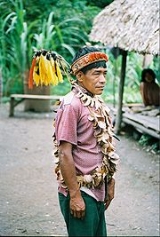
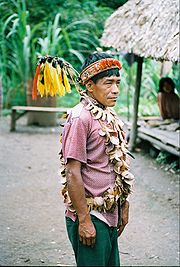
Indigenous languages of the Americas

Encyclopedia
Indigenous languages of the Americas are spoken by indigenous peoples
from Alaska
and Greenland
to the southern tip of South America, encompassing the land masses which constitute the Americas
. These indigenous languages consist of dozens of distinct language families
as well as many language isolate
s and unclassified language
s. Many proposals to group these into higher-level families have been made, such as in three macrofamilies of Eskimo–Aleut, Na-Dene, and Amerind
, though this scheme is rejected by nearly all specialists. According to UNESCO
, most of the indigenous American languages in North America are critically endangered, and many of them are already extinct.
). Several indigenous cultures of the Americas had also developed their own writing system
s, including the Mayan
and Nahuatl
. The indigenous languages of the Americas had widely varying demographics, from the Quechua languages
, Aymara
, Guarani
, and Nahuatl, which had millions of active speakers, to many languages with only several hundred speakers. After pre-Columbian times, several indigenous creole language
s also developed in the Americas from European, indigenous and African languages.
The European colonizers and their successor states had widely varying attitudes towards Native American languages. In Brazil, friars actively learned and promoted the Tupi language. In many Latin American colonies, Spanish missionaries often learned local languages in order to preach to the natives in their own tongue. In the American colonies, John Eliot
of Massachusetts
translated the Bible
into the Massachusett language
, also called Wampanoag, Massachusett or Natick (1661–1663; he published the first Bible printed in North America). The Europeans also actively suppressed indigenous American languages. As a result, indigenous American languages suffered from cultural suppression and loss of speakers. By the 18th and 19th centuries, the Spanish, English, Portuguese, French, and Dutch, brought to the Americas by European settlers and administrators, had become the official or national languages of modern nation-states of the Americas.
Today, although many indigenous languages have become critically endangered, others are now rigorously spoken. Several even have official status, such as Guaraní in Paraguay
. In other cases official status is limited to certain regions where the languages are spoken, and even if enshrined in constitutions, they may have infrequent de facto official use: examples of this are the status of Quechua
in Peru
and Aymara
in Bolivia
, where in practice, Spanish is dominant in all formal contexts. In the Arctic region, Greenland
in 2009 adopted Kalaallisut as its sole official language. In the United States, the Navajo language
is the most spoken Native American language, with over 200,000 speakers in the Southwestern United States
. The language was used by the Navajo Code Talkers during World War II to transmit secret US military messages, which neither the Germans and Japanese ever deciphered. Today, governments, universities, and indigenous peoples are continuing to work for the preservation and revitalization of indigenous American languages.
lists several hypotheses for the historical origins of Amerindian languages.
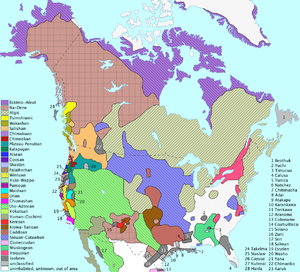 There are approximately 296 spoken (or formerly spoken) indigenous languages north of Mexico, 269 of which are grouped into 29 families (the remaining 27 languages are either isolates or unclassified). The Na–Dené, Algic, and Uto-Aztecan families are the largest in terms of number of languages. Uto-Aztecan has the most speakers (1.95 million) if the languages in Mexico are considered (mostly due to 1.5 million speakers of Nahuatl
); Na–Dene comes in second with approximately 200,000 speakers (nearly 180,000 of these are speakers of Navajo
), and Algic in third with about 180,000 speakers (mainly Cree
and Ojibwe
). Na–Dené and Algic have the widest geographic distributions: Algic currently spans from northeastern Canada across much of the continent down to northeastern Mexico (due to later migrations of the Kickapoo) with two outliers in California
(Yurok
and Wiyot
); Na–Dené spans from Alaska and western Canada through Washington, Oregon
, and California to the U.S. Southwest
and northern Mexico (with one outlier in the Plains). Several families consist of only 2 or 3 languages. Demonstrating genetic relationships has proved difficult due to the great linguistic diversity present in North America. Two large (super-) family proposals, Penutian and Hokan, look particularly promising. However, even after decades of research, a large number of families and isolates remain.
North America is notable for its linguistic diversity, especially in California. California alone has 18 genetic units consisting of 74 languages (compared to the mere 4 genetic units in all of Europe: Basque
, Indo-European
, Uralic
, Afroasiatic). Another area of considerable diversity appears to have been the Southeast
; however, many of these languages became extinct from European contact and as a result they are, for the most part, absent from the historical record. This diversity has been and continues to be very influential in the development of linguistic thought in the U.S.
Due to the diversity of this area, it is difficult to make generalizations that adequately characterize the entire region. Most North American languages have a relatively small number of vowels (i.e. four or five vowels). Languages of the western half of North America often have relatively large consonant inventories. The languages of the Pacific Northwest
are notable for their complex phonotactics
(for example, some languages have words that lack vowel
s entirely). The languages of the Plateau
area have relatively rare pharyngeals
and epiglottals
(they are otherwise restricted to Afro-Asiatic and Caucasian languages). Ejective consonant
s are also common in North America, although they are rare elsewhere (except, again, for the Caucasus
region, parts of Africa, and the Mayan
family).
Head-marking is found in many languages of North America (as well as in Central and South America), but outside of the Americas it is rare. Many languages throughout North America are polysynthetic (Eskimo–Aleut languages are extreme examples), although this is not characteristic of all North American languages (contrary to what was believed by 19th-century linguists). Several families have unique traits, such as the inverse number marking of Tanoan, the lexical affix
es of Wakashan, Salishan and Chimakuan, and the unusual verb structure of Nadene.
The classification below is a composite of Goddard (1996), Campbell (1997), and Mithun (1999).
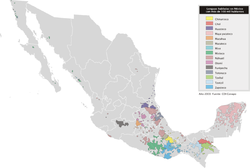
 Although both North and Central America
are very diverse areas, South America has a linguistic diversity rivalled by only a few other places in the world with approximately 350 languages still spoken and an estimated 1,500 languages at first European contact. The situation of language documentation and classification into genetic families is not as advanced as in North America (which is relatively well-studied in many areas). Kaufman (1994: 46) gives the following appraisal:
As a result, many relationships between languages and language families have not been determined and some of those relationships that have been proposed are on somewhat shaky ground.
The list of language families and isolates below is a rather conservative one based on Campbell (1997). Many of the proposed (and often speculative) groupings of families can be seen in Campbell (1997), Gordon (2005), Kaufman (1990, 1994), Key (1979), Loukotka (1968), and in the Language stock proposals section below.
* There is little to say about these almost unattested languages. See Pijao
.
stock). Other proposals are more controversial with many linguists believing that some genetic relationships of a proposal may be demonstrated but much of it undemonstrated (for example, Hokan–Siouan, which, incidentally, Edward Sapir
called his "wastepaper basket stock"). Still other proposals are almost unanimously rejected by specialists (for example, Amerind
). Below is a (partial) list of some such proposals:
Good discussions of past proposals can be found in Campbell (1997) and Campbell & Mithun (1979).
Amerindian linguist Lyle Campbell
also assigned different percentage values of probability and confidence for various proposals of macro-families and language relationships, depending on his views of the proposals' strengths. For example, the Germanic language family
would receive probability and confidence percentage values of +100% and 100%, respectively. However, if Turkish and Quechua were compared, the probability value might be -95%, while the confidence value might be 95%. 0% probability or confidence would mean complete uncertainty.
s (also known as convergence areas). The linguistic areas identified so far deserve more research to determine their validity. Knowing about Sprachbunds helps historical linguists differentiate between shared areal traits and true genetic relationship. The pioneering work on American areal linguistics was a dissertation by Joel Sherzer, which was published as Sherzer (1976).
In American Indian Languages: the Historical Linguistics of Native America, Lyle Campbell
also lists over 20 Sprachbund
s or linguistic areas, many of which are still hypothetical.
Note: Some linguistic areas may overlap with others.
Loukotka (1968) reports the names of hundreds of South American languages which do not have any linguistic documentation.
s, mixed language
s, trade languages, and sign language
s are given below in alphabetical order.
Indigenous peoples of the Americas
The indigenous peoples of the Americas are the pre-Columbian inhabitants of North and South America, their descendants and other ethnic groups who are identified with those peoples. Indigenous peoples are known in Canada as Aboriginal peoples, and in the United States as Native Americans...
from Alaska
Alaska
Alaska is the largest state in the United States by area. It is situated in the northwest extremity of the North American continent, with Canada to the east, the Arctic Ocean to the north, and the Pacific Ocean to the west and south, with Russia further west across the Bering Strait...
and Greenland
Greenland
Greenland is an autonomous country within the Kingdom of Denmark, located between the Arctic and Atlantic Oceans, east of the Canadian Arctic Archipelago. Though physiographically a part of the continent of North America, Greenland has been politically and culturally associated with Europe for...
to the southern tip of South America, encompassing the land masses which constitute the Americas
Americas
The Americas, or America , are lands in the Western hemisphere, also known as the New World. In English, the plural form the Americas is often used to refer to the landmasses of North America and South America with their associated islands and regions, while the singular form America is primarily...
. These indigenous languages consist of dozens of distinct language families
Language family
A language family is a group of languages related through descent from a common ancestor, called the proto-language of that family. The term 'family' comes from the tree model of language origination in historical linguistics, which makes use of a metaphor comparing languages to people in a...
as well as many language isolate
Language isolate
A language isolate, in the absolute sense, is a natural language with no demonstrable genealogical relationship with other languages; that is, one that has not been demonstrated to descend from an ancestor common with any other language. They are in effect language families consisting of a single...
s and unclassified language
Unclassified language
Unclassified languages are languages whose genetic affiliation has not been established by means of historical linguistics. If this state of affairs continues after significant study of the language and efforts to relate it to other languages, as in the case of Basque, it is termed a language...
s. Many proposals to group these into higher-level families have been made, such as in three macrofamilies of Eskimo–Aleut, Na-Dene, and Amerind
Amerind languages
Amerind is a higher-level language family proposed by Joseph Greenberg in 1960. Greenberg proposed that all of the indigenous languages of the Americas belong to one of three language families, the previously established Eskimo–Aleut and Na–Dene, and with everything else—almost universally believed...
, though this scheme is rejected by nearly all specialists. According to UNESCO
UNESCO
The United Nations Educational, Scientific and Cultural Organization is a specialized agency of the United Nations...
, most of the indigenous American languages in North America are critically endangered, and many of them are already extinct.
Background
Thousands of languages were spoken in North and South America prior to first contact with Europeans between the beginning of the 11th century (Norwegian settlement of Greenland and attempted settlement of Labrador and Newfoundland) and the end of the 15th century (the voyages of Christopher ColumbusChristopher Columbus
Christopher Columbus was an explorer, colonizer, and navigator, born in the Republic of Genoa, in northwestern Italy. Under the auspices of the Catholic Monarchs of Spain, he completed four voyages across the Atlantic Ocean that led to general European awareness of the American continents in the...
). Several indigenous cultures of the Americas had also developed their own writing system
Writing system
A writing system is a symbolic system used to represent elements or statements expressible in language.-General properties:Writing systems are distinguished from other possible symbolic communication systems in that the reader must usually understand something of the associated spoken language to...
s, including the Mayan
Mayan languages
The Mayan languages form a language family spoken in Mesoamerica and northern Central America. Mayan languages are spoken by at least 6 million indigenous Maya, primarily in Guatemala, Mexico, Belize and Honduras...
and Nahuatl
Nahuatl
Nahuatl is thought to mean "a good, clear sound" This language name has several spellings, among them náhuatl , Naoatl, Nauatl, Nahuatl, Nawatl. In a back formation from the name of the language, the ethnic group of Nahuatl speakers are called Nahua...
. The indigenous languages of the Americas had widely varying demographics, from the Quechua languages
Quechua languages
Quechua is a Native South American language family and dialect cluster spoken primarily in the Andes of South America, derived from an original common ancestor language, Proto-Quechua. It is the most widely spoken language family of the indigenous peoples of the Americas, with a total of probably...
, Aymara
Aymara language
Aymara is an Aymaran language spoken by the Aymara people of the Andes. It is one of only a handful of Native American languages with over three million speakers. Aymara, along with Quechua and Spanish, is an official language of Peru and Bolivia...
, Guarani
Guaraní language
Guaraní, specifically the primary variety known as Paraguayan Guaraní , is an indigenous language of South America that belongs to the Tupí–Guaraní subfamily of the Tupian languages. It is one of the official languages of Paraguay , where it is spoken by the majority of the population, and half of...
, and Nahuatl, which had millions of active speakers, to many languages with only several hundred speakers. After pre-Columbian times, several indigenous creole language
Creole language
A creole language, or simply a creole, is a stable natural language developed from the mixing of parent languages; creoles differ from pidgins in that they have been nativized by children as their primary language, making them have features of natural languages that are normally missing from...
s also developed in the Americas from European, indigenous and African languages.
The European colonizers and their successor states had widely varying attitudes towards Native American languages. In Brazil, friars actively learned and promoted the Tupi language. In many Latin American colonies, Spanish missionaries often learned local languages in order to preach to the natives in their own tongue. In the American colonies, John Eliot
John Eliot
John Eliot may refer to:*Sir John Eliot , English politician*John Eliot , English Puritan minister and missionary*John Eliot, 1st Earl of St Germans , British politician...
of Massachusetts
Massachusetts Bay Colony
The Massachusetts Bay Colony was an English settlement on the east coast of North America in the 17th century, in New England, situated around the present-day cities of Salem and Boston. The territory administered by the colony included much of present-day central New England, including portions...
translated the Bible
Bible translations
The Bible has been translated into many languages from the biblical languages of Hebrew, Aramaic and Greek. Indeed, the full Bible has been translated into over 450 languages, although sections of the Bible have been translated into over 2,000 languages....
into the Massachusett language
Massachusett language
The Massachusett language was a Native American language, a member of the Algonquian language family. It is also known as Wôpanâak , Natick, and Pokanoket....
, also called Wampanoag, Massachusett or Natick (1661–1663; he published the first Bible printed in North America). The Europeans also actively suppressed indigenous American languages. As a result, indigenous American languages suffered from cultural suppression and loss of speakers. By the 18th and 19th centuries, the Spanish, English, Portuguese, French, and Dutch, brought to the Americas by European settlers and administrators, had become the official or national languages of modern nation-states of the Americas.
Today, although many indigenous languages have become critically endangered, others are now rigorously spoken. Several even have official status, such as Guaraní in Paraguay
Paraguay
Paraguay , officially the Republic of Paraguay , is a landlocked country in South America. It is bordered by Argentina to the south and southwest, Brazil to the east and northeast, and Bolivia to the northwest. Paraguay lies on both banks of the Paraguay River, which runs through the center of the...
. In other cases official status is limited to certain regions where the languages are spoken, and even if enshrined in constitutions, they may have infrequent de facto official use: examples of this are the status of Quechua
Quechua
Quechua is a Native South American language family and dialect cluster spoken primarily in the Andes of South America, derived from an original common ancestor language, Proto-Quechua. It is the most widely spoken language family of the indigenous peoples of the Americas, with a total of probably...
in Peru
Peru
Peru , officially the Republic of Peru , is a country in western South America. It is bordered on the north by Ecuador and Colombia, on the east by Brazil, on the southeast by Bolivia, on the south by Chile, and on the west by the Pacific Ocean....
and Aymara
Aymara
The Aymara or Aimara are an indigenous ethnic group in the Andes and Altiplano regions of South America; about 2 million live in Bolivia, Peru and Chile...
in Bolivia
Bolivia
Bolivia officially known as Plurinational State of Bolivia , is a landlocked country in central South America. It is the poorest country in South America...
, where in practice, Spanish is dominant in all formal contexts. In the Arctic region, Greenland
Greenland
Greenland is an autonomous country within the Kingdom of Denmark, located between the Arctic and Atlantic Oceans, east of the Canadian Arctic Archipelago. Though physiographically a part of the continent of North America, Greenland has been politically and culturally associated with Europe for...
in 2009 adopted Kalaallisut as its sole official language. In the United States, the Navajo language
Navajo language
Navajo or Navaho is an Athabaskan language spoken in the southwestern United States. It is geographically and linguistically one of the Southern Athabaskan languages .Navajo has more speakers than any other Native American language north of the...
is the most spoken Native American language, with over 200,000 speakers in the Southwestern United States
Southwestern United States
The Southwestern United States is a region defined in different ways by different sources. Broad definitions include nearly a quarter of the United States, including Arizona, California, Colorado, Nevada, New Mexico, Oklahoma, Texas and Utah...
. The language was used by the Navajo Code Talkers during World War II to transmit secret US military messages, which neither the Germans and Japanese ever deciphered. Today, governments, universities, and indigenous peoples are continuing to work for the preservation and revitalization of indigenous American languages.
Origins
In American Indian Languages: The Historical Linguistics of Native America, Lyle CampbellLyle Campbell
Lyle Richard Campbell is a linguist and leading expert on indigenous American languages—especially those of Mesoamerica—and on historical linguistics in general. He also has expertise in Uralic languages. He is presently Professor of Linguistics at the University of Hawaii at Manoa.-Life and...
lists several hypotheses for the historical origins of Amerindian languages.
- A single, one-language migration (currently not widely accepted)
- A few linguistically distinct migrations (favored by Edward SapirEdward SapirEdward Sapir was an American anthropologist-linguist, widely considered to be one of the most important figures in the early development of the discipline of linguistics....
) - Multiple migrations
- Multilingual migrations (single migration with multiple languages)
- The influx of already diversified but related languages from the Old WorldOld WorldThe Old World consists of those parts of the world known to classical antiquity and the European Middle Ages. It is used in the context of, and contrast with, the "New World" ....
- Extinction of Old WorldOld WorldThe Old World consists of those parts of the world known to classical antiquity and the European Middle Ages. It is used in the context of, and contrast with, the "New World" ....
linguistic relatives (while the New World ones survived) - Migration along the Pacific coast instead of the Bering StraitBering StraitThe Bering Strait , known to natives as Imakpik, is a sea strait between Cape Dezhnev, Chukotka Autonomous Okrug, Russia, the easternmost point of the Asian continent and Cape Prince of Wales, Alaska, USA, the westernmost point of the North American continent, with latitude of about 65°40'N,...
Language families and isolates
Notes:- Extinct languageExtinct languageAn extinct language is a language that no longer has any speakers., or that is no longer in current use. Extinct languages are sometimes contrasted with dead languages, which are still known and used in special contexts in written form, but not as ordinary spoken languages for everyday communication...
s or families are indicated by: †. - The number of family members is indicated in parentheses (for example, Arauan (9) means the Arauan family consists of nine languages).
- Out of convenience, the following list of language families is divided in 3 sections based on political boundaries of countries. These sections correspond roughly with the geographic regions (North, Central, and South America) but are not equivalent. This division also does not cleanly delineate indigenous culture areas.
North America
Nahuatl
Nahuatl is thought to mean "a good, clear sound" This language name has several spellings, among them náhuatl , Naoatl, Nauatl, Nahuatl, Nawatl. In a back formation from the name of the language, the ethnic group of Nahuatl speakers are called Nahua...
); Na–Dene comes in second with approximately 200,000 speakers (nearly 180,000 of these are speakers of Navajo
Navajo language
Navajo or Navaho is an Athabaskan language spoken in the southwestern United States. It is geographically and linguistically one of the Southern Athabaskan languages .Navajo has more speakers than any other Native American language north of the...
), and Algic in third with about 180,000 speakers (mainly Cree
Cree language
Cree is an Algonquian language spoken by approximately 117,000 people across Canada, from the Northwest Territories and Alberta to Labrador, making it the aboriginal language with the highest number of speakers in Canada. It is also spoken in the U.S. state of Montana...
and Ojibwe
Ojibwe language
Ojibwe , also called Anishinaabemowin, is an indigenous language of the Algonquian language family. Ojibwe is characterized by a series of dialects that have local names and frequently local writing systems...
). Na–Dené and Algic have the widest geographic distributions: Algic currently spans from northeastern Canada across much of the continent down to northeastern Mexico (due to later migrations of the Kickapoo) with two outliers in California
California
California is a state located on the West Coast of the United States. It is by far the most populous U.S. state, and the third-largest by land area...
(Yurok
Yurok language
Yurok is a moribund Algic language. It is the traditional language of the Yurok tribe of Del Norte County and Humboldt County on the far North Coast of California, U.S., most of whom now speak English...
and Wiyot
Wiyot language
Wiyot is an extinct Algic language, formerly spoken by the Wiyot people of Humboldt Bay, California. The language's last native speaker, Della Prince, died in 1962...
); Na–Dené spans from Alaska and western Canada through Washington, Oregon
Oregon
Oregon is a state in the Pacific Northwest region of the United States. It is located on the Pacific coast, with Washington to the north, California to the south, Nevada on the southeast and Idaho to the east. The Columbia and Snake rivers delineate much of Oregon's northern and eastern...
, and California to the U.S. Southwest
Southwestern United States
The Southwestern United States is a region defined in different ways by different sources. Broad definitions include nearly a quarter of the United States, including Arizona, California, Colorado, Nevada, New Mexico, Oklahoma, Texas and Utah...
and northern Mexico (with one outlier in the Plains). Several families consist of only 2 or 3 languages. Demonstrating genetic relationships has proved difficult due to the great linguistic diversity present in North America. Two large (super-) family proposals, Penutian and Hokan, look particularly promising. However, even after decades of research, a large number of families and isolates remain.
North America is notable for its linguistic diversity, especially in California. California alone has 18 genetic units consisting of 74 languages (compared to the mere 4 genetic units in all of Europe: Basque
Basque language
Basque is the ancestral language of the Basque people, who inhabit the Basque Country, a region spanning an area in northeastern Spain and southwestern France. It is spoken by 25.7% of Basques in all territories...
, Indo-European
Indo-European languages
The Indo-European languages are a family of several hundred related languages and dialects, including most major current languages of Europe, the Iranian plateau, and South Asia and also historically predominant in Anatolia...
, Uralic
Uralic languages
The Uralic languages constitute a language family of some three dozen languages spoken by approximately 25 million people. The healthiest Uralic languages in terms of the number of native speakers are Hungarian, Finnish, Estonian, Mari and Udmurt...
, Afroasiatic). Another area of considerable diversity appears to have been the Southeast
Southeastern United States
The Southeastern United States, colloquially referred to as the Southeast, is the eastern portion of the Southern United States. It is one of the most populous regions in the United States of America....
; however, many of these languages became extinct from European contact and as a result they are, for the most part, absent from the historical record. This diversity has been and continues to be very influential in the development of linguistic thought in the U.S.
Due to the diversity of this area, it is difficult to make generalizations that adequately characterize the entire region. Most North American languages have a relatively small number of vowels (i.e. four or five vowels). Languages of the western half of North America often have relatively large consonant inventories. The languages of the Pacific Northwest
Pacific Northwest
The Pacific Northwest is a region in northwestern North America, bounded by the Pacific Ocean to the west and, loosely, by the Rocky Mountains on the east. Definitions of the region vary and there is no commonly agreed upon boundary, even among Pacific Northwesterners. A common concept of the...
are notable for their complex phonotactics
Phonotactics
Phonotactics is a branch of phonology that deals with restrictions in a language on the permissible combinations of phonemes...
(for example, some languages have words that lack vowel
Vowel
In phonetics, a vowel is a sound in spoken language, such as English ah! or oh! , pronounced with an open vocal tract so that there is no build-up of air pressure at any point above the glottis. This contrasts with consonants, such as English sh! , where there is a constriction or closure at some...
s entirely). The languages of the Plateau
Interior Plateau
The Interior Plateau comprises a large region of central British Columbia, and lies between the Cariboo and Monashee Mountains on the east, and the Hazelton Mountains, Coast Mountains and Cascade Range on the west. The continuation of the plateau into the United States is known there as the...
area have relatively rare pharyngeals
Pharyngeal consonant
A pharyngeal consonant is a type of consonant which is articulated with the root of the tongue against the pharynx.-Pharyngeal consonants in the IPA:Pharyngeal consonants in the International Phonetic Alphabet :...
and epiglottals
Epiglottal consonant
An epiglottal consonant is a consonant that is articulated with the aryepiglottic folds against the epiglottis. They are occasionally called aryepiglottal consonants.-Epiglottal consonants in the IPA:...
(they are otherwise restricted to Afro-Asiatic and Caucasian languages). Ejective consonant
Ejective consonant
In phonetics, ejective consonants are voiceless consonants that are pronounced with simultaneous closure of the glottis. In the phonology of a particular language, ejectives may contrast with aspirated or tenuis consonants...
s are also common in North America, although they are rare elsewhere (except, again, for the Caucasus
Caucasus
The Caucasus, also Caucas or Caucasia , is a geopolitical region at the border of Europe and Asia, and situated between the Black and the Caspian sea...
region, parts of Africa, and the Mayan
Mayan languages
The Mayan languages form a language family spoken in Mesoamerica and northern Central America. Mayan languages are spoken by at least 6 million indigenous Maya, primarily in Guatemala, Mexico, Belize and Honduras...
family).
Head-marking is found in many languages of North America (as well as in Central and South America), but outside of the Americas it is rare. Many languages throughout North America are polysynthetic (Eskimo–Aleut languages are extreme examples), although this is not characteristic of all North American languages (contrary to what was believed by 19th-century linguists). Several families have unique traits, such as the inverse number marking of Tanoan, the lexical affix
Affix
An affix is a morpheme that is attached to a word stem to form a new word. Affixes may be derivational, like English -ness and pre-, or inflectional, like English plural -s and past tense -ed. They are bound morphemes by definition; prefixes and suffixes may be separable affixes...
es of Wakashan, Salishan and Chimakuan, and the unusual verb structure of Nadene.
The classification below is a composite of Goddard (1996), Campbell (1997), and Mithun (1999).
Central America and Mexico
South America
Central America
Central America is the central geographic region of the Americas. It is the southernmost, isthmian portion of the North American continent, which connects with South America on the southeast. When considered part of the unified continental model, it is considered a subcontinent...
are very diverse areas, South America has a linguistic diversity rivalled by only a few other places in the world with approximately 350 languages still spoken and an estimated 1,500 languages at first European contact. The situation of language documentation and classification into genetic families is not as advanced as in North America (which is relatively well-studied in many areas). Kaufman (1994: 46) gives the following appraisal:
- Since the mid 1950s, the amount of published material on SA [South America] has been gradually growing, but even so, the number of researchers is far smaller than the growing number of linguistic communities whose speech should be documented. Given the current employment opportunities, it is not likely that the number of specialists in SA Indian languages will increase fast enough to document most of the surviving SA languages before they go out of use, as most of them unavoidably will. More work languishes in personal files than is published, but this is a standard problem.
- It is fair to say that SA and New GuineaNew GuineaNew Guinea is the world's second largest island, after Greenland, covering a land area of 786,000 km2. Located in the southwest Pacific Ocean, it lies geographically to the east of the Malay Archipelago, with which it is sometimes included as part of a greater Indo-Australian Archipelago...
are linguistically the poorest documented parts of the world. However, in the early 1960s fairly systematic efforts were launched in Papua New GuineaPapua New GuineaPapua New Guinea , officially the Independent State of Papua New Guinea, is a country in Oceania, occupying the eastern half of the island of New Guinea and numerous offshore islands...
, and that area much smaller than SA, to be sure is in general much better documented than any part of indigenous SA of comparable size.
As a result, many relationships between languages and language families have not been determined and some of those relationships that have been proposed are on somewhat shaky ground.
The list of language families and isolates below is a rather conservative one based on Campbell (1997). Many of the proposed (and often speculative) groupings of families can be seen in Campbell (1997), Gordon (2005), Kaufman (1990, 1994), Key (1979), Loukotka (1968), and in the Language stock proposals section below.
Pijao language
Pijao is an unclassified indigenous American language that was spoken in the Magdalena River Valley in Colombia until the 1950s....
.
Language stock proposals
Many hypothetical language phylum proposals concerning American languages are often cited as uncontroversially demonstrated in more popular writings. However, many of these proposals have, in fact, not been fully demonstrated if even at all. Some proposals are viewed by specialists in a favorable light, believing that genetic relationships are very likely to be established in the future (for example, the PenutianPenutian languages
Penutian is a proposed grouping of language families that includes many Native American languages of western North America, predominantly spoken at one time in Washington, Oregon, and California. The existence of a Penutian stock or phylum has been the subject of debate among specialists. Even the...
stock). Other proposals are more controversial with many linguists believing that some genetic relationships of a proposal may be demonstrated but much of it undemonstrated (for example, Hokan–Siouan, which, incidentally, Edward Sapir
Edward Sapir
Edward Sapir was an American anthropologist-linguist, widely considered to be one of the most important figures in the early development of the discipline of linguistics....
called his "wastepaper basket stock"). Still other proposals are almost unanimously rejected by specialists (for example, Amerind
Amerind languages
Amerind is a higher-level language family proposed by Joseph Greenberg in 1960. Greenberg proposed that all of the indigenous languages of the Americas belong to one of three language families, the previously established Eskimo–Aleut and Na–Dene, and with everything else—almost universally believed...
). Below is a (partial) list of some such proposals:
Good discussions of past proposals can be found in Campbell (1997) and Campbell & Mithun (1979).
Amerindian linguist Lyle Campbell
Lyle Campbell
Lyle Richard Campbell is a linguist and leading expert on indigenous American languages—especially those of Mesoamerica—and on historical linguistics in general. He also has expertise in Uralic languages. He is presently Professor of Linguistics at the University of Hawaii at Manoa.-Life and...
also assigned different percentage values of probability and confidence for various proposals of macro-families and language relationships, depending on his views of the proposals' strengths. For example, the Germanic language family
Germanic languages
The Germanic languages constitute a sub-branch of the Indo-European language family. The common ancestor of all of the languages in this branch is called Proto-Germanic , which was spoken in approximately the mid-1st millennium BC in Iron Age northern Europe...
would receive probability and confidence percentage values of +100% and 100%, respectively. However, if Turkish and Quechua were compared, the probability value might be -95%, while the confidence value might be 95%. 0% probability or confidence would mean complete uncertainty.
| Language Family | Probability | Confidence |
|---|---|---|
| Macro-Siouan | −20% | 75% |
| Aztec–Tanoan | 0% | 50% |
| Quechumaran | +50% | 50% |
| Eskimo–Aleut, Chukotan |
−25% | 20% |
| Na–Dene | 0% | 25% |
| Tlingit–Eyak–Athabaskan | +75% | 40% |
| Mosan | −60% | 65% |
| Wakashan and Chimakuan | 0% | 25% |
| Almosan (and beyond) | −75% | 50% |
| Hokan–Subtiaba | −90% | 75% |
| Coahuiltecan | −85% | 80% |
| Guaicurian–Hokan | 0% | 10% |
| Quechua as Hokan | −85% | 80% |
| Tunican | 0% | 20% |
| Natchez–Muskogean | +40% | 20% |
| Atakapa–Chitimacha | −50% | 60% |
| Gulf | −25% | 40% |
| Algonkian–Gulf | −50% | 50% |
| Mexican Penutian | −40% | 60% |
| Sahaptian–Klamath–(Molala) | +75% | 50% |
| Sahaptian–Klamath–Tsimshian | +10% | 10% |
| Takelman | +80% | 60% |
| Zuni–Penutian | −80% | 50% |
| Yukian–Siouan | −60% | 75% |
| Yukian–Gulf | −85% | 70% |
| Keresan and Zuni | −40% | 40% |
| Keresan and Uto-Aztecan | 0% | 60% |
| Macro-Mayan | +30% | 25% |
| Maya–Chipaya | −80% | 95% |
| Maya–Chipaya–Yunga | −90% | 95% |
| Otomanguean–Huave | +25% | 25% |
| Tlapanec–Subtiaba as Otomanguean | +95% | 90% |
| Jicaque–Subtiaba | −60% | 80% |
| Jicaque–Tequistlatecan | +65% | 50% |
| Jicaque–Hokan | −30% | 25% |
| Xinca–Lenca | 0% | 50% |
| Tarascan–Quechua | −90% | 80% |
| Misumalpan–Chibchan | +20% | 50% |
| Nostratic–Amerind | −90% | 75% |
Linguistic areas
The languages of the Americas often can be grouped together into linguistic areas or SprachbundSprachbund
A Sprachbund – also known as a linguistic area, convergence area, diffusion area or language crossroads – is a group of languages that have become similar in some way because of geographical proximity and language contact. They may be genetically unrelated, or only distantly related...
s (also known as convergence areas). The linguistic areas identified so far deserve more research to determine their validity. Knowing about Sprachbunds helps historical linguists differentiate between shared areal traits and true genetic relationship. The pioneering work on American areal linguistics was a dissertation by Joel Sherzer, which was published as Sherzer (1976).
In American Indian Languages: the Historical Linguistics of Native America, Lyle Campbell
Lyle Campbell
Lyle Richard Campbell is a linguist and leading expert on indigenous American languages—especially those of Mesoamerica—and on historical linguistics in general. He also has expertise in Uralic languages. He is presently Professor of Linguistics at the University of Hawaii at Manoa.-Life and...
also lists over 20 Sprachbund
Sprachbund
A Sprachbund – also known as a linguistic area, convergence area, diffusion area or language crossroads – is a group of languages that have become similar in some way because of geographical proximity and language contact. They may be genetically unrelated, or only distantly related...
s or linguistic areas, many of which are still hypothetical.
Note: Some linguistic areas may overlap with others.
| Linguistic Area (Sprachbund Sprachbund A Sprachbund – also known as a linguistic area, convergence area, diffusion area or language crossroads – is a group of languages that have become similar in some way because of geographical proximity and language contact. They may be genetically unrelated, or only distantly related... ) |
Included families, branches, and languages |
|---|---|
| Northern Northwest Coast | Aleut, Haida, Eyak, Tlingit |
| Northwest Coast | Eyak, Tlingit, Athabaskan, Tsimshian, Wakashan, Chimakuan, Salishan, Alsea, Coosan, Kalapuyan, Takelma, Lower Chinook |
| Plateau | Sahaptian, Upper Chinook, Nicola, Cayuse, Molala, Klamath, Kutenai, Interior Salishan |
| Northern California | Algic, Athabaskan, Yukian, Miwokan, Wintuan, Naiduan, Klamath-Modoc, Pomo, Chimariko, Achomawi, Atsugewi, Karuk, Shasta, Yana, (Washo) |
| Clear Lake | Lake Miwok, Patwin, East and Southeastern Pomo, Wappo |
| South Coast Range | Chumash, Esselen, Salinan |
| Southern California-Western Arizona | Yuman, Cupan (Uto-Aztecan), less extensively Takic (Uto-Aztecan) |
| Great Basin | Numic (Uto-Aztecan), Washo |
| Pueblo Pueblo linguistic area The Pueblo linguistic area is a Sprachbund consisting of the language spoken in and near North American Pueblo locations.... |
Keresan, Tanoan, Zuni, Hopi, some Apachean branches |
| Plains | Athabaskan, Algonquian, Siouan, Tanoan, Uto-Aztecan, Tonkawa |
| Northeast | Winnebago (Siouan), Northern Iroquian, Eastern Algonquian |
| Southeast ("Gulf") | Muskogean family, Chitimacha, Atapaka, Tunica, Natchez, Yuchi, Ofo (Siouan), Biloxi (Siouan) – sometimes also Tutelo, Catawban, Quapaw, Dhegiha (all Siouan); Tuscarora, Cherokee, Shawnee |
| Mesoamerican Mesoamerican Linguistic Area The Mesoamerican Linguistic Area is a sprachbund containing many of the languages natively spoken in the cultural area of Mesoamerica. This sprachbund is defined by an array of syntactic, lexical and phonological traits as well as a number of ethnolinguistic traits found in the languages of... |
Aztecan (Nahua branch of Uto-Aztecan), Mixe–Zoquean, Mayan, Xincan, Otomanguean (except Chichimeco–Jonaz and some Pame varieties, Totonacan), Tarascan, Cuitlatec, Tequistlatecan, Huave |
| Mayan | Mayan, Xincan, Lencan, Jicaquean |
| Colombian–Central American | Chibchan, Misumalpan, Mangue, Subtiaba; sometimes Lencan, Jicaquean, Chochoan, Betoi |
| Venezuelan–Antillean | Arawakan, Cariban, Guamo, Otomaco, Yaruro, Warao |
| Andean | Quechuan, Aymaran, Callahuaya, Chipaya |
| Ecuadorian–Colombian (subarea of Andean) |
Páez, Guambiano (Paezan), Cuaiquer, Cayapa, Colorado (Barbacoan), Camsá, Cofán, Esmeralda, Ecuadorian Quechua |
| Orinoco–Amazon | Yanomaman, Piaroa (Sálivan), Arawakan/Maipurean, Cariban, Jotí, Uruak/Ahuaqué, Sapé (Kaliana), Makú |
| Amazon | Arawakan/Maipurean, Arauan/Arawan, Cariban, Chapacuran, Ge/Je, Panoan, Puinavean, Tacanan, Tucanoan, Tupian |
| Southern Cone | Mapudungu (Araucanian), Guaycuruan, Chon |
Unattested languages
Several languages are only known by mention in historical documents or from only a few names or words. It cannot be determined that these languages actually existed or that the few recorded words are actually of known or unknown languages. Some may simply be from a historian's errors. Others are of known people with no linguistic record (sometimes due to lost records). A short list is below.Loukotka (1968) reports the names of hundreds of South American languages which do not have any linguistic documentation.
Pidgins and mixed languages
Various miscellaneous languages such as pidginPidgin
A pidgin , or pidgin language, is a simplified language that develops as a means of communication between two or more groups that do not have a language in common. It is most commonly employed in situations such as trade, or where both groups speak languages different from the language of the...
s, mixed language
Mixed language
A mixed language is a language that arises through the fusion of two source languages, normally in situations of thorough bilingualism, so that it is not possible to classify the resulting language as belonging to either of the language families that were its source...
s, trade languages, and sign language
Sign language
A sign language is a language which, instead of acoustically conveyed sound patterns, uses visually transmitted sign patterns to convey meaning—simultaneously combining hand shapes, orientation and movement of the hands, arms or body, and facial expressions to fluidly express a speaker's...
s are given below in alphabetical order.
See also
- Archive of the Indigenous Languages of Latin AmericaArchive of the Indigenous Languages of Latin AmericaThe Archive of the Indigenous Languages of Latin America is a project housed in the University of Texas which records Latin American indigenous languages to preserve them, and makes them available in digital forms on the Internet when privacy and intellectual property concerns are met. It further...
- Classification schemes for indigenous languages of the AmericasClassification schemes for indigenous languages of the AmericasThis article is a list of different language classification proposals developed for indigenous languages of the Americas. The article is divided into North, Central, and South America sections; however, the classifications do not always neatly correspond to these continent divisions.-Gallatin...
- Mesoamerican languagesMesoamerican languagesMesoamerican languages are the languages indigenous to the Mesoamerican cultural area, which covers southern Mexico, all of Guatemala and Belize and parts of Honduras and El Salvador. The area is characterized by extensive linguistic diversity containing several hundred different languages and...
- Amerind languagesAmerind languagesAmerind is a higher-level language family proposed by Joseph Greenberg in 1960. Greenberg proposed that all of the indigenous languages of the Americas belong to one of three language families, the previously established Eskimo–Aleut and Na–Dene, and with everything else—almost universally believed...
- Language families and languages
- Classification of indigenous peoples of the AmericasClassification of indigenous peoples of the AmericasClassification of indigenous peoples of the Americas is based upon cultural regions, geography, and linguistics. Anthropologists have named various cultural regions, with fluid boundaries, that are generally agreed upon with some variation...
- Haplogroup Q (Y-DNA)Haplogroup Q (Y-DNA)In human genetics, Haplogroup Q is a Y-chromosome DNA haplogroup.-Origins:Haplogroup Q is one of the two branches of haplogroup P . Haplogroup Q is believed to have arisen in Central Asia approximately 15,000 to 20,000 years ago. It has had multiple origins proposed...
- Indigenous peoples of the AmericasIndigenous peoples of the AmericasThe indigenous peoples of the Americas are the pre-Columbian inhabitants of North and South America, their descendants and other ethnic groups who are identified with those peoples. Indigenous peoples are known in Canada as Aboriginal peoples, and in the United States as Native Americans...
- List of indigenous languages in Argentina
- Languages of PeruLanguages of PeruPeru is a multilingual nation. Its official language is Spanish and, in the zones where they are predominant, Quechua, Aymara, and other aboriginal languages. Peru is a multilingual nation. Its official language is Spanish and, in the zones where they are predominant, Quechua, Aymara, and other...
- Native American Languages Act of 1990Native American Languages Act of 1990The Native American Languages Act of 1990 is the short cited title for executive order PUBLIC LAW 101-477 enacted by Congress on October 30, 1990. Public Law 101-477 of 1990 gave historical importance as repudiating past policies of eradicating Indian Languages by declaring as policy that Native...
South America
External links
- Catálogo de línguas indígenas sul-americanas
- Diccionario etnolingüístico y guía bibliográfica de los pueblos indígenas sudamericanos
- Towards a general typology of South American indigenous languages. A bibliographical database
- South American Languages
- Society to Advance Indigenous Vernaculars of the United States (SAIVUS)
- Indigenous Peoples Languages: Articles, News, Videos
- Documentation Center of the Linguistic Minorities of Panama
- The Archive of the Indigenous Languages of Latin America
- Indigenous Language Institute
- The Society for the Study of the Indigenous Languages of the Americas (SSILA)
- Southern Oregon Digital Archives First Nations Tribal Collection (collection of ethnographic, linguistic, & historical material)
- Center for the Study of the Native Languages of the Plains and Southwest
- Project for the Documentation of the Languages of Mesoamerica
- Programa de Formación en Educación Intercultural Bilingüe para los Países Andinos
- Native American Language Center (University of California at Davis)
- Native Languages of the Americas
- International Journal of American Linguistics
- Our Languages (Saskatchewan Indian Cultural Centre)
- Swadesh Lists of Brazilian Native Languages