


Acadia

Encyclopedia
Acadia was the name
given to lands in a portion of the French colonial empire
of New France
, in northeastern North America
that included parts of eastern Quebec
, the Maritime provinces
, and modern-day Maine
. At the end of the 16th century, France claimed (but never successfully occupied) territory stretching as far south as Philadelphia. During much of the 17th century, Castine
(now in Maine) was the southern-most settlement of Acadia. The actual specification by the French government for the territory refers to lands bordering the Atlantic
coast, roughly between the 40th
and 46th parallels
. Later, the territory was divided into the British
colonies which became Canadian provinces
and American
states
.
The first capital of Acadia, established in 1605, was Port-Royal
. A British force from Virginia attacked and burned the town in 1613 but it was later rebuilt nearby, where it remained the capital of French Acadia until the British conquest of Acadia
in 1710.
Today, Acadia is used to refer to regions of North America
that are historically associated with the lands, descendants, and/or culture of the former French region. It particularly refers to regions of The Maritimes with French roots, language, and culture, primarily in New Brunswick
, Nova Scotia
, the Magdalen Islands
and Prince Edward Island
, as well as in Maine
. It can also be used to refer to the Acadian diaspora
in southern Louisiana
, a region also referred to as Acadiana
. In the abstract, Acadia refers to the existence of a French culture in any of these regions.
People living in Acadia, and sometimes former residents and their descendants, are called Acadians, also later known as Cajuns after resettlement in Louisiana
.
(note the inclusion of the 'r' of the original Greek name). "Arcadia
" derives from the Arcadia district
in Greece which since Classical antiquity
had the extended meanings of "refuge" or "idyllic place". The Dictionary of Canadian Biography says: "Arcadia, the name Verrazzano gave to Maryland or Virginia 'on account of the beauty of the trees,' made its first cartographical appearance in the 1548 Gastaldo map and is the only name on that map to survive in Canadian usage. . . . In the 17th century Champlain
fixed its present orthography, with the 'r' omitted, and Ganong
has shown its gradual progress northwards, in a succession of maps, to its resting place in the Atlantic Provinces."
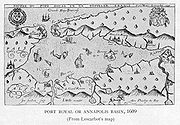 The history of Acadia was significantly influenced by the warfare that took place on its soil during the 17th and 18th century. Prior to that time period, the Mi’kmaq lived in Acadia for centuries. The French arrived in 1604, and Catholic Mi’kmaq and Acadians were the predominant populations in the colony for the next 150 years.
Early European colonists, who would later become known as Acadians, were French subjects primarily from the Pleumartin
to Poitiers
in the Vienne
département of west-central France
. The first French settlement was established by Pierre Dugua Des Monts
, Governor of Acadia, under the authority of King Henry IV
, on Saint Croix Island in 1604. The following year, the settlement was moved across the Bay of Fundy
to Port Royal
after a difficult winter on the island and deaths from scurvy
. In 1607 the colony received bad news: King Henry had revoked Sieur de Monts' royal fur monopoly, citing that the income was insufficient to justify supplying the colony further. Thus recalled, the last of the Acadians left Port Royal in August of 1607. Their allies, the native Mi'kmaq nation, kept careful watch over their possessions, though. When the former Lieutenant Governor, Jean de Biencourt de Poutrincourt et de Saint-Just
, returned in 1610, he found Port Royal just as it was left.
A number of years later, Acadia was plunged into what some historians have described as a civil war
in Acadia (1640–1645). The war was between Port Royal, where Governor of Acadia Charles de Menou d'Aulnay
de Charnisay was stationed, and present-day Saint John, New Brunswick
, where Governor of Acadia. Charles de Saint-Étienne de la Tour
was stationed. In the war, there were four major battles. D'Aulnay ultimately won the war against La Tour.
During the first 80 years the French and Acadians were in Acadia, there were ten significant battles as the English, Scottish, Dutch
and French fought for possession of the colony. These battles happened at Port Royal
, Saint John
, Cap de Sable (present-day Port La Tour, Nova Scotia
), Jemseg
, Castine
and Baleine
.
Beginning with King William's War
in 1689, there were six wars in Acadia and Nova Scotia before the British defeated the French, Acadians, and Mi’kmaq in the entire region:
The battles during these wars were primarily fought at Port Royal
, Saint John
, Canso
, Chignecto
, Dartmouth
, Lunenburg, Castine
and Grand Pre
.
British colonists captured Acadia in the course of King William's War
(1690–1697), but Britain returned it to France at the peace settlement. After two attempts during Queen Anne's War
(1702–1713), the Conquest of Acadia
by Britain happened in 1710 and was confirmed in the Treaty of Utrecht (1713). The British named their captured territory Nova Scotia, and renamed its capital Annapolis Royal. The treaty, however, used vague language to define the boundaries of Acadia, and although the British nominally gained all of present-day peninsular Nova Scotia, France continued to claim the mainland (present-day New Brunswick and eastern Maine) as well as present-day Prince Edward Island and Cape Breton Island.
On June 23, 1713, the French residents of Nova Scotia were given one year to declare allegiance to Britain or leave the region. In the meantime, the French signalled their preparedness for future hostilities by beginning the construction of Fortress Louisbourg on Île Royale, now Cape Breton Island
. The British grew increasingly alarmed by the prospect of disloyalty in wartime of the Acadians now under their rule. French missionaries worked to maintain the loyalty of Acadians, and to maintain a hold on the mainland part of Acadia.
Despite the British conquest in 1710, Nova Scotia and Acadia remained primarily occupied by Catholic Acadians and Mi'kmaq. A generation later, Father Le Loutre's War
began when Edward Cornwallis
arrived to establish Halifax with 13 transports on June 21, 1749. Cornwallis's policies, which required unconditional allegiance to the British crown, sparked an exodus of Acadians
to neighbouring territories. They also led to a hardening of borders, with the construction of fortifications on the Isthmus of Chignecto, along what is now the New Brunswick-Nova Scotia border, in the 1750s.
, the British sought to neutralize any military threat Acadians posed and to interrupt the vital supply lines Acadians provided to Louisbourg by deporting them.
This process began in 1755, after the British captured Fort Beauséjour
and began the expulsion of the Acadians with the Bay of Fundy Campaign
. Between six and seven thousand Acadians were expelled from Nova Scotia to the lower British American colonies. Some Acadians eluded capture by fleeing deep into the wilderness or into French-controlled Canada
. The Quebec town of L'Acadie (now a sector of Saint-Jean-sur-Richelieu) was founded by expelled Acadians. After the Siege of Louisbourg (1758)
, a second wave of the expulsion began with the St. John River Campaign
, Petitcodiac River Campaign
, Gulf of Saint Lawrence Campaign
and the Île Saint-Jean Campaign
.
Any pretense that France might maintain or regain control over the remnants of Acadia came to an end with the fall of Montreal in 1760 and the 1763 Treaty of Paris
, which permanently ceded almost all of eastern New France to Britain. After 1764, many exiled Acadians finally settled in Louisiana, which had been transferred by France to Spain
at the end of the French and Indian War. The name Acadian was corrupted to Cajun
, which was first used as a pejorative term until its later mainstream acceptance. Britain eventually moderated its policies and allowed Acadians to return to Nova Scotia.
, in 1713. Although France controlled the territory in the remaining periods, French monarchs consistently neglected Acadia, failing to contribute much, if at all, to its defence, development, colonization, or administration, leaving the colonists to rely on themselves. The government of New France was located in Quebec, but it had only nominal authority over the Acadians. Landlords owned wide swaths of the land, and while they sometimes collected dues from the settlers, they exercised no other legal powers.
With no strong royal authority, the Acadians implemented village self-rule. Even after Canada had given up its elected spokesmen, the Acadians continued to demand a say in their own government, as late as 1706 petitioning the monarchy to allow them to elect spokesmen each year by a plurality of voices. In a sign of his indifference to the colony, Louis XV agreed to their demand. Male elders of the community settled internal disputes and spoke to the government on behalf of their neighbours, sometimes with the help of the priests.
Most of the immigrants to Acadia were French peasants whose oppression by the noble landholders had left them with a deep suspicion of those in authority. This suspicion was transplanted to those in authority in Acadia as well, be they French or English. Acadians regularly protested the actions of local administrators and clergymen to higher authorities in Quebec and France. If their appeals failed, which they usually did, the Acadians would procrastinate or resort to passive resistance techniques, including subterfuge, to continue defying the authorities. Administrators complained of constant in-fighting among the population, which filed many petty civil suits with colonial magistrates. Most of these were over boundary lines, as the Acadians were very quick to protect their new lands.
, described the Acadian men as "'well-built, of good height, and they would be accepted without difficulty as soldiers in a guards' regiment. [They are] well-proportioned and their hair is usually blond. [They are] robust, and will endure great fatigue; [they] are fine subjects of the king, passionately loving the French of Europe'". Most Acadians were illiterate, and many of the records, including notarial deeds, were destroyed or scattered during the Great Expulsion. For a time, Port Royal did have schools, but these were closed when the British excluded Roman Catholic religious orders from operating in Acadia. While Acadia was under French rule, all settlers were required to be baptised in the Roman Catholic faith. Despite their nominal faith, Acadians often worked on Sundays and religious holidays.
Before 1654, trading companies and patent holders concerned with fishing recruited men in France to come to Acadia to work at the commercial outposts. The original Acadian population was a small number of indentured servant
s and soldiers brought by the fur-trading companies. Gradually, fishermen began settling in the area as well, rather than return to France with the seasonal fishing fleet. The majority of the recruiting took place at La Rochelle
. Between 1653 and 1654, 104 men were recruited at La Rochelle. Of these, 31% were builders, 15% were soldiers and sailors, 8% were food preparers, 6.7% were farm workers, and an additional 6.7% worked in the clothing trades. Fifty-five percent of Acadia's first families came from the Centre-Ouest region of France
, primarily from Poitou
, Aunis
, Angoumois
, and Saintonge
. Over 85% of these (47% of the total), were former residents of the La Chaussée area of Poitou. Many of the families who arrived in 1632 with Razilly shared some blood ties; those not related by blood shared cultural ties with the others. The number of original immigrants was very small, and only about 100 surnames existed within the Acadian community.
Some of the earliest settlers married women of the local Mi'kmaq tribe who had converted to Roman Catholicism. A Parisian lawyer, Marc Lescarbot, who spent several months in Acadia in 1606, described the Micmac as having "courage, fidelity, generosity, and humanity, and their hospitality is so innate and praiseworthy that they receive among them every man who is not an enemy. They are not simpletons. ... So that if we commonly call them Savages, the word is abusive and unmerited."
Most of the immigrants to Acadia were peasants in Europe, making them social equals in the New World
. The colony had limited economic support or cultural contacts with France, leaving a "social vacuum" that allowed "individual talents and industry ... [to supplant] inherited social position as the measure of a man's worth." Acadians lived as social equals, with the elderly and priests considered slightly superior. Unlike the French colonists in Canada and the early English colonies in Plymouth
and Jamestown
, Acadians maintained an extended kinship system, and the large extended families assisted in building homes and barns, as well as cultivating and harvesting crops. They also relied on interfamily cooperation to accomplish community goals, such as building dikes or reclaiming tidal marshes.
Marriages were generally not love matches but were arranged for economic or social reasons. Parental consent was required for anyone under 25 who wished to marry, and both the mother's and father's consent was recorded in the marriage deed. Divorce was not permitted in New France, and annulments were almost impossible to get. Legal separation was offered as an option but was seldom used.
The Acadians were suspicious of outsiders and did not readily cooperate with census takers. The first reliable population figures for the area came with the census of 1671, which noted fewer than 450 people. By 1714, the Acadian population had expanded to 2,528 individuals, mostly from natural increase rather than immigration. Most Acadian women in the 18th century gave birth to living children an average of eleven times. Although these numbers are identical to those in Canada, 75% of Acadian children reached adulthood, many more than in other parts of New France. The isolation of the Acadian communities meant the people were not exposed to many of the imported epidemics, allowing the children to remain healthier.
In the 18th century, some Acadians migrated to nearby Île Saint-Jean (now Prince Edward Island) to take advantage of the fertile cropland. In 1732, the island had 347 settlers but with 25 years its population had expanded to 5000 Europeans.
as a secondary crop. Barley, oats, and potatoes were also planted as feed for the livestock, including cattle, pigs, and poultry. These animals provided a steady supply of meat to the Acadians, which they supplemented with fish.
After 1630, the Acadians began to build dikes and drain the sea marsh above Port Royal. The high salinity of the reclaimed coastal marshland meant that the land would need to sit for three years after it was drained before it could be cultivated. The land reclamation techniques that were used closely resembled the enclosures near La Rochelle that helped make solar salt.
As time progressed, the Acadian agriculture improved, and Acadians traded with the British colonies in New England
to gain ironware, fine cloth, rum, and salt. During the French administration of Acadia, this trade was illegal, but it did not stop some English traders from establishing small stores in Port Royal. Under English rule, the Acadians often smuggled their excess food to Boston merchants at Baie Verte and to the French at Louisbourg on Cape Breton Island.
Many adult sons who did not inherit land from their parents settled on adjacent vacant lands to remain close to their families. As the best land was taken, some moved further north of Port Royal, into the Upper Bay of Fundy
settlements, including Mines, Pisiquid, and Beaubassin
. Many of the pioneers into that area persuaded some of their relatives to accompany them, and most of the frontier settlements contained only five to ten interrelated family units.
Name
A name is a word or term used for identification. Names can identify a class or category of things, or a single thing, either uniquely, or within a given context. A personal name identifies a specific unique and identifiable individual person, and may or may not include a middle name...
given to lands in a portion of the French colonial empire
French colonial empires
The French colonial empire was the set of territories outside Europe that were under French rule primarily from the 17th century to the late 1960s. In the 19th and 20th centuries, the colonial empire of France was the second-largest in the world behind the British Empire. The French colonial empire...
of New France
New France
New France was the area colonized by France in North America during a period beginning with the exploration of the Saint Lawrence River by Jacques Cartier in 1534 and ending with the cession of New France to Spain and Great Britain in 1763...
, in northeastern North America
North America
North America is a continent wholly within the Northern Hemisphere and almost wholly within the Western Hemisphere. It is also considered a northern subcontinent of the Americas...
that included parts of eastern Quebec
Quebec
Quebec or is a province in east-central Canada. It is the only Canadian province with a predominantly French-speaking population and the only one whose sole official language is French at the provincial level....
, the Maritime provinces
Maritimes
The Maritime provinces, also called the Maritimes or the Canadian Maritimes, is a region of Eastern Canada consisting of three provinces, New Brunswick, Nova Scotia, and Prince Edward Island. On the Atlantic coast, the Maritimes are a subregion of Atlantic Canada, which also includes the...
, and modern-day Maine
Maine
Maine is a state in the New England region of the northeastern United States, bordered by the Atlantic Ocean to the east and south, New Hampshire to the west, and the Canadian provinces of Quebec to the northwest and New Brunswick to the northeast. Maine is both the northernmost and easternmost...
. At the end of the 16th century, France claimed (but never successfully occupied) territory stretching as far south as Philadelphia. During much of the 17th century, Castine
Castine, Maine
Castine is a town in Hancock County, Maine, United States and was once the capital of Acadia . The population was 1,343 at the 2000 census. Castine is the home of Maine Maritime Academy, a four-year institution that graduates officers and engineers for the United States Merchant Marine and marine...
(now in Maine) was the southern-most settlement of Acadia. The actual specification by the French government for the territory refers to lands bordering the Atlantic
Atlantic Ocean
The Atlantic Ocean is the second-largest of the world's oceanic divisions. With a total area of about , it covers approximately 20% of the Earth's surface and about 26% of its water surface area...
coast, roughly between the 40th
40th parallel north
The 40th parallel north is a circle of latitude that is 40 degrees north of the Earth's equatorial plane. It crosses Europe, the Mediterranean Sea, Asia, the Pacific Ocean, North America, and the Atlantic Ocean....
and 46th parallels
46th parallel north
The 46th parallel north is a circle of latitude that is 46 degrees north of the Earth's equatorial plane. It crosses Europe, Asia, the Pacific Ocean, North America, and the Atlantic Ocean....
. Later, the territory was divided into the British
United Kingdom
The United Kingdom of Great Britain and Northern IrelandIn the United Kingdom and Dependencies, other languages have been officially recognised as legitimate autochthonous languages under the European Charter for Regional or Minority Languages...
colonies which became Canadian provinces
Provinces and territories of Canada
The provinces and territories of Canada combine to make up the world's second-largest country by area. There are ten provinces and three territories...
and American
United States
The United States of America is a federal constitutional republic comprising fifty states and a federal district...
states
U.S. state
A U.S. state is any one of the 50 federated states of the United States of America that share sovereignty with the federal government. Because of this shared sovereignty, an American is a citizen both of the federal entity and of his or her state of domicile. Four states use the official title of...
.
The first capital of Acadia, established in 1605, was Port-Royal
Habitation at Port-Royal
The Habitation at Port-Royal was the first successful French settlement of New France in North America, and is presently known as Port-Royal National Historic Site, a National Historic Site located on the northern side of the Annapolis Basin, Nova Scotia, Canada...
. A British force from Virginia attacked and burned the town in 1613 but it was later rebuilt nearby, where it remained the capital of French Acadia until the British conquest of Acadia
Siege of Port Royal (1710)
The Siege of Port Royal , also known as the Conquest of Acadia, was conducted by British regular and provincial forces under the command of Francis Nicholson against a French Acadian garrison under the command of Daniel d'Auger de Subercase, at the Acadian capital, Port Royal...
in 1710.
Today, Acadia is used to refer to regions of North America
North America
North America is a continent wholly within the Northern Hemisphere and almost wholly within the Western Hemisphere. It is also considered a northern subcontinent of the Americas...
that are historically associated with the lands, descendants, and/or culture of the former French region. It particularly refers to regions of The Maritimes with French roots, language, and culture, primarily in New Brunswick
New Brunswick
New Brunswick is one of Canada's three Maritime provinces and is the only province in the federation that is constitutionally bilingual . The provincial capital is Fredericton and Saint John is the most populous city. Greater Moncton is the largest Census Metropolitan Area...
, Nova Scotia
Nova Scotia
Nova Scotia is one of Canada's three Maritime provinces and is the most populous province in Atlantic Canada. The name of the province is Latin for "New Scotland," but "Nova Scotia" is the recognized, English-language name of the province. The provincial capital is Halifax. Nova Scotia is the...
, the Magdalen Islands
Magdalen Islands
The Magdalen Islands form a small archipelago in the Gulf of Saint Lawrence with a land area of . Though closer to Prince Edward Island and Nova Scotia, the islands form part of the Canadian province of Quebec....
and Prince Edward Island
Prince Edward Island
Prince Edward Island is a Canadian province consisting of an island of the same name, as well as other islands. The maritime province is the smallest in the nation in both land area and population...
, as well as in Maine
Maine
Maine is a state in the New England region of the northeastern United States, bordered by the Atlantic Ocean to the east and south, New Hampshire to the west, and the Canadian provinces of Quebec to the northwest and New Brunswick to the northeast. Maine is both the northernmost and easternmost...
. It can also be used to refer to the Acadian diaspora
Cajun
Cajuns are an ethnic group mainly living in the U.S. state of Louisiana, consisting of the descendants of Acadian exiles...
in southern Louisiana
Louisiana
Louisiana is a state located in the southern region of the United States of America. Its capital is Baton Rouge and largest city is New Orleans. Louisiana is the only state in the U.S. with political subdivisions termed parishes, which are local governments equivalent to counties...
, a region also referred to as Acadiana
Acadiana
Acadiana, or The Heart of Acadiana, is the official name given to the French Louisiana region that is home to a large Francophone population. Of the 64 parishes that make up Louisiana, 22 named parishes and other parishes of similar cultural environment, make up the intrastate...
. In the abstract, Acadia refers to the existence of a French culture in any of these regions.
People living in Acadia, and sometimes former residents and their descendants, are called Acadians, also later known as Cajuns after resettlement in Louisiana
Louisiana
Louisiana is a state located in the southern region of the United States of America. Its capital is Baton Rouge and largest city is New Orleans. Louisiana is the only state in the U.S. with political subdivisions termed parishes, which are local governments equivalent to counties...
.
Etymology
The origin of the designation Acadia is credited to the explorer Giovanni da Verrazzano, who on his sixteenth century map applied the ancient Greek name "Arcadia" to the entire Atlantic coast north of VirginiaVirginia
The Commonwealth of Virginia , is a U.S. state on the Atlantic Coast of the Southern United States. Virginia is nicknamed the "Old Dominion" and sometimes the "Mother of Presidents" after the eight U.S. presidents born there...
(note the inclusion of the 'r' of the original Greek name). "Arcadia
Arcadia (utopia)
Arcadia refers to a vision of pastoralism and harmony with nature. The term is derived from the Greek province of the same name which dates to antiquity; the province's mountainous topography and sparse population of pastoralists later caused the word Arcadia to develop into a poetic byword for an...
" derives from the Arcadia district
Arcadia
Arcadia is one of the regional units of Greece. It is part of the administrative region of Peloponnese. It is situated in the central and eastern part of the Peloponnese peninsula. It takes its name from the mythological character Arcas. In Greek mythology, it was the home of the god Pan...
in Greece which since Classical antiquity
Classical antiquity
Classical antiquity is a broad term for a long period of cultural history centered on the Mediterranean Sea, comprising the interlocking civilizations of ancient Greece and ancient Rome, collectively known as the Greco-Roman world...
had the extended meanings of "refuge" or "idyllic place". The Dictionary of Canadian Biography says: "Arcadia, the name Verrazzano gave to Maryland or Virginia 'on account of the beauty of the trees,' made its first cartographical appearance in the 1548 Gastaldo map and is the only name on that map to survive in Canadian usage. . . . In the 17th century Champlain
Samuel de Champlain
Samuel de Champlain , "The Father of New France", was a French navigator, cartographer, draughtsman, soldier, explorer, geographer, ethnologist, diplomat, and chronicler. He founded New France and Quebec City on July 3, 1608....
fixed its present orthography, with the 'r' omitted, and Ganong
William Francis Ganong
William Francis Ganong, M.A., Ph.D., LL.D., F.R.S.C., was a Canadian botanist, historian and cartographer. His botany career was spent mainly as a professor at Smith College in Northampton, Massachusetts...
has shown its gradual progress northwards, in a succession of maps, to its resting place in the Atlantic Provinces."
History
Early European colonists, who would later become known as Acadians, were French subjects primarily from the Pleumartin
Pleumartin
Pleumartin is a commune in the Vienne department in the Poitou-Charentes region in western France.-Demographics:...
to Poitiers
Poitiers
Poitiers is a city on the Clain river in west central France. It is a commune and the capital of the Vienne department and of the Poitou-Charentes region. The centre is picturesque and its streets are interesting for predominant remains of historical architecture, especially from the Romanesque...
in the Vienne
Vienne
Vienne is the northernmost département of the Poitou-Charentes region of France, named after the river Vienne.- Viennese history :Vienne is one of the original 83 departments, established on March 4, 1790 during the French Revolution. It was created from parts of the former provinces of Poitou,...
département of west-central France
France
The French Republic , The French Republic , The French Republic , (commonly known as France , is a unitary semi-presidential republic in Western Europe with several overseas territories and islands located on other continents and in the Indian, Pacific, and Atlantic oceans. Metropolitan France...
. The first French settlement was established by Pierre Dugua Des Monts
Pierre Dugua, Sieur de Monts
Pierre Du Gua de Monts, was a French merchant, explorer and colonizer. A Protestant, he was born in Royan, France and had a great influence over the first two decades of the 17th century...
, Governor of Acadia, under the authority of King Henry IV
Henry IV of France
Henry IV , Henri-Quatre, was King of France from 1589 to 1610 and King of Navarre from 1572 to 1610. He was the first monarch of the Bourbon branch of the Capetian dynasty in France....
, on Saint Croix Island in 1604. The following year, the settlement was moved across the Bay of Fundy
Bay of Fundy
The Bay of Fundy is a bay on the Atlantic coast of North America, on the northeast end of the Gulf of Maine between the Canadian provinces of New Brunswick and Nova Scotia, with a small portion touching the U.S. state of Maine...
to Port Royal
Port Royal, Nova Scotia
Port Royal was the capital of Acadia from 1605 to 1710 and is now a town called Annapolis Royal in the western part of the Canadian province of Nova Scotia. Initially Port Royal was located on the north shore of the Annapolis Basin, Nova Scotia, at the site of the present reconstruction of the...
after a difficult winter on the island and deaths from scurvy
Scurvy
Scurvy is a disease resulting from a deficiency of vitamin C, which is required for the synthesis of collagen in humans. The chemical name for vitamin C, ascorbic acid, is derived from the Latin name of scurvy, scorbutus, which also provides the adjective scorbutic...
. In 1607 the colony received bad news: King Henry had revoked Sieur de Monts' royal fur monopoly, citing that the income was insufficient to justify supplying the colony further. Thus recalled, the last of the Acadians left Port Royal in August of 1607. Their allies, the native Mi'kmaq nation, kept careful watch over their possessions, though. When the former Lieutenant Governor, Jean de Biencourt de Poutrincourt et de Saint-Just
Jean de Biencourt de Poutrincourt et de Saint-Just
Jean de Biencourt de Poutrincourt et de Saint-Just was a member of the French nobility best remembered as a commander of the French colonial empire, one of those responsible for establishing the most successful among early attempts to establish a permanent settlement in the North American...
, returned in 1610, he found Port Royal just as it was left.
A number of years later, Acadia was plunged into what some historians have described as a civil war
Civil war
A civil war is a war between organized groups within the same nation state or republic, or, less commonly, between two countries created from a formerly-united nation state....
in Acadia (1640–1645). The war was between Port Royal, where Governor of Acadia Charles de Menou d'Aulnay
Charles de Menou d'Aulnay
Charles de Menou d'Aulnay was a pioneer of European settlement in North America and Governor of Acadia .-Biography:D'Aulnay was a member of the French nobility who was at various times a sea captain, a lieutenant in the French navy to his cousin Isaac de Razilly, and Governor of Acadia...
de Charnisay was stationed, and present-day Saint John, New Brunswick
Saint John, New Brunswick
City of Saint John , or commonly Saint John, is the largest city in the province of New Brunswick, and the first incorporated city in Canada. The city is situated along the north shore of the Bay of Fundy at the mouth of the Saint John River. In 2006 the city proper had a population of 74,043...
, where Governor of Acadia. Charles de Saint-Étienne de la Tour
Charles de Saint-Étienne de la Tour
Charles de Saint-Étienne de la Tour, the French King's appointed Governor of Acadia from 1631–1642 and again from 1653–1657, was born in France in 1593 and died at Cap de Sable in 1666...
was stationed. In the war, there were four major battles. D'Aulnay ultimately won the war against La Tour.
During the first 80 years the French and Acadians were in Acadia, there were ten significant battles as the English, Scottish, Dutch
Jurriaen Aernoutsz
Jurriaen Aernoutsz was a Dutch colonial navy captain, who briefly captured a section of the French colony of Acadia in 1674 AD, establishing the brief Dutch Occupation of Acadia....
and French fought for possession of the colony. These battles happened at Port Royal
Port Royal, Nova Scotia
Port Royal was the capital of Acadia from 1605 to 1710 and is now a town called Annapolis Royal in the western part of the Canadian province of Nova Scotia. Initially Port Royal was located on the north shore of the Annapolis Basin, Nova Scotia, at the site of the present reconstruction of the...
, Saint John
Saint John, New Brunswick
City of Saint John , or commonly Saint John, is the largest city in the province of New Brunswick, and the first incorporated city in Canada. The city is situated along the north shore of the Bay of Fundy at the mouth of the Saint John River. In 2006 the city proper had a population of 74,043...
, Cap de Sable (present-day Port La Tour, Nova Scotia
Port La Tour, Nova Scotia
Port La Tour is a community in the Canadian province of Nova Scotia, located in the Barrington Municipal District of Shelburne County.The Historic Sites and Monuments Board of Canada erroneously assert that Fort Saint Louis is located at Port La Tour. The fort at Port La Tour was Fort Lomeron . ...
), Jemseg
Jemseg, New Brunswick
Jemseg is a Canadian rural community in Queens County, New Brunswick. It is located on the east bank of the Jemseg River along its short run from Grand Lake to the Saint John River...
, Castine
Castine, Maine
Castine is a town in Hancock County, Maine, United States and was once the capital of Acadia . The population was 1,343 at the 2000 census. Castine is the home of Maine Maritime Academy, a four-year institution that graduates officers and engineers for the United States Merchant Marine and marine...
and Baleine
Baleine, Nova Scotia
Baleine is a community in the Canadian province of Nova Scotia, located in the Cape Breton Regional Municipality on Cape Breton Island...
.
Beginning with King William's War
King William's War
The first of the French and Indian Wars, King William's War was the name used in the English colonies in America to refer to the North American theater of the Nine Years' War...
in 1689, there were six wars in Acadia and Nova Scotia before the British defeated the French, Acadians, and Mi’kmaq in the entire region:
- King William's WarKing William's WarThe first of the French and Indian Wars, King William's War was the name used in the English colonies in America to refer to the North American theater of the Nine Years' War...
(1689–1697), - Queen Anne's WarQueen Anne's WarQueen Anne's War , as the North American theater of the War of the Spanish Succession was known in the British colonies, was the second in a series of French and Indian Wars fought between France and England, later Great Britain, in North America for control of the continent. The War of the...
(1702–1713), - Dummer's WarDummer's WarDummer's War , also known as Lovewell's War, Father Rale's War, Greylock's War, the Three Years War, the 4th Indian War or the Wabanaki-New England War of 1722–1725, was a series of battles between British settlers of the three northernmost British colonies of North America of the time and the...
(1722–1725), - King George's WarKing George's WarKing George's War is the name given to the operations in North America that formed part of the War of the Austrian Succession . It was the third of the four French and Indian Wars. It took place primarily in the British provinces of New York, Massachusetts Bay, New Hampshire, and Nova Scotia...
(1744–1748), - Father Le Loutre's WarFather Le Loutre's WarFather Le Loutre’s War , also known as the Indian War, the Micmac War and the Anglo-Micmac War, took place between King George's War and the French and Indian War in Acadia and Nova Scotia. On one side of the conflict, the British and New England colonists were led by British Officer Charles...
(1749–1755) - French and Indian WarFrench and Indian WarThe French and Indian War is the common American name for the war between Great Britain and France in North America from 1754 to 1763. In 1756, the war erupted into the world-wide conflict known as the Seven Years' War and thus came to be regarded as the North American theater of that war...
(1754–1763)
The battles during these wars were primarily fought at Port Royal
Port Royal, Nova Scotia
Port Royal was the capital of Acadia from 1605 to 1710 and is now a town called Annapolis Royal in the western part of the Canadian province of Nova Scotia. Initially Port Royal was located on the north shore of the Annapolis Basin, Nova Scotia, at the site of the present reconstruction of the...
, Saint John
Saint John, New Brunswick
City of Saint John , or commonly Saint John, is the largest city in the province of New Brunswick, and the first incorporated city in Canada. The city is situated along the north shore of the Bay of Fundy at the mouth of the Saint John River. In 2006 the city proper had a population of 74,043...
, Canso
Canso, Nova Scotia
For the headland, see Cape Canso.Canso is a small Canadian town in Guysborough County, on the north-eastern tip of mainland Nova Scotia, next to Chedabucto Bay. The area was established in 1604, along with Port Royal, Nova Scotia. The British construction of a fort in the village , was instrumental...
, Chignecto
Isthmus of Chignecto
The Isthmus of Chignecto is an isthmus bordering the Maritime provinces of New Brunswick and Nova Scotia which connects the Nova Scotia peninsula with North America....
, Dartmouth
Raid on Dartmouth (1751)
The Raid on Dartmouth occurred during Father Le Loutre’s War on May 13, 1751 when an Acadian and Mi’kmaq militia from Chignecto, under the command of Acadian Joseph Broussard, raided Dartmouth, Nova Scotia, destroying the town and killing twenty British villagers...
, Lunenburg, Castine
Castine, Maine
Castine is a town in Hancock County, Maine, United States and was once the capital of Acadia . The population was 1,343 at the 2000 census. Castine is the home of Maine Maritime Academy, a four-year institution that graduates officers and engineers for the United States Merchant Marine and marine...
and Grand Pre
Grand Pre, Nova Scotia
Grand-Pré is a Canadian rural community in Kings County, Nova Scotia. Its French name translates to "Great Meadow" and the community lies at the eastern edge of the Annapolis Valley several kilometres east of the town of Wolfville on a peninsula jutting into the Minas Basin, framed by the Gaspereau...
.
British colonists captured Acadia in the course of King William's War
King William's War
The first of the French and Indian Wars, King William's War was the name used in the English colonies in America to refer to the North American theater of the Nine Years' War...
(1690–1697), but Britain returned it to France at the peace settlement. After two attempts during Queen Anne's War
Queen Anne's War
Queen Anne's War , as the North American theater of the War of the Spanish Succession was known in the British colonies, was the second in a series of French and Indian Wars fought between France and England, later Great Britain, in North America for control of the continent. The War of the...
(1702–1713), the Conquest of Acadia
Siege of Port Royal (1710)
The Siege of Port Royal , also known as the Conquest of Acadia, was conducted by British regular and provincial forces under the command of Francis Nicholson against a French Acadian garrison under the command of Daniel d'Auger de Subercase, at the Acadian capital, Port Royal...
by Britain happened in 1710 and was confirmed in the Treaty of Utrecht (1713). The British named their captured territory Nova Scotia, and renamed its capital Annapolis Royal. The treaty, however, used vague language to define the boundaries of Acadia, and although the British nominally gained all of present-day peninsular Nova Scotia, France continued to claim the mainland (present-day New Brunswick and eastern Maine) as well as present-day Prince Edward Island and Cape Breton Island.
On June 23, 1713, the French residents of Nova Scotia were given one year to declare allegiance to Britain or leave the region. In the meantime, the French signalled their preparedness for future hostilities by beginning the construction of Fortress Louisbourg on Île Royale, now Cape Breton Island
Cape Breton Island
Cape Breton Island is an island on the Atlantic coast of North America. It likely corresponds to the word Breton, the French demonym for Brittany....
. The British grew increasingly alarmed by the prospect of disloyalty in wartime of the Acadians now under their rule. French missionaries worked to maintain the loyalty of Acadians, and to maintain a hold on the mainland part of Acadia.
Despite the British conquest in 1710, Nova Scotia and Acadia remained primarily occupied by Catholic Acadians and Mi'kmaq. A generation later, Father Le Loutre's War
Father Le Loutre's War
Father Le Loutre’s War , also known as the Indian War, the Micmac War and the Anglo-Micmac War, took place between King George's War and the French and Indian War in Acadia and Nova Scotia. On one side of the conflict, the British and New England colonists were led by British Officer Charles...
began when Edward Cornwallis
Edward Cornwallis
Lieutenant General Edward Cornwallis was a British military officer who founded Halifax, Nova Scotia with 2500 settlers and later served as the Governor of Gibraltar.-Early life:...
arrived to establish Halifax with 13 transports on June 21, 1749. Cornwallis's policies, which required unconditional allegiance to the British crown, sparked an exodus of Acadians
Acadian Exodus
The Acadian Exodus happened during Father Le Loutre’s War and involved almost half of the total Acadian population of Nova Scotia deciding to relocate to French controlled territories...
to neighbouring territories. They also led to a hardening of borders, with the construction of fortifications on the Isthmus of Chignecto, along what is now the New Brunswick-Nova Scotia border, in the 1750s.
The Deportation
In the years after the British conquest, the Acadians refused to swear unconditional oaths of allegiance to the British crown. During this time period some Acadians participated in militia operations against the British and maintained vital supply lines to Fortress Louisbourg and Fort Beausejour. During the French and Indian WarFrench and Indian War
The French and Indian War is the common American name for the war between Great Britain and France in North America from 1754 to 1763. In 1756, the war erupted into the world-wide conflict known as the Seven Years' War and thus came to be regarded as the North American theater of that war...
, the British sought to neutralize any military threat Acadians posed and to interrupt the vital supply lines Acadians provided to Louisbourg by deporting them.
This process began in 1755, after the British captured Fort Beauséjour
Battle of Fort Beauséjour
The Battle of Fort Beauséjour was fought on the Isthmus of Chignecto and marked the end of Father Le Loutre’s War andthe opening of a British offensive in the French and Indian War, which would eventually lead to the end the French Empire in North America...
and began the expulsion of the Acadians with the Bay of Fundy Campaign
Bay of Fundy Campaign (1755)
The Bay of Fundy Campaign occurred during the French and Indian War when the British ordered the Expulsion of the Acadians from Acadia after the Battle of Beausejour . The Campaign started at Chignecto and then quickly moved to Grand Pré, Rivière-aux-Canards, Pisiguit, Cobequid, and finally Port...
. Between six and seven thousand Acadians were expelled from Nova Scotia to the lower British American colonies. Some Acadians eluded capture by fleeing deep into the wilderness or into French-controlled Canada
Canada, New France
Canada was the name of the French colony that once stretched along the St. Lawrence River; the other colonies of New France were Acadia, Louisiana and Newfoundland. Canada, the most developed colony of New France, was divided into three districts, each with its own government: Quebec,...
. The Quebec town of L'Acadie (now a sector of Saint-Jean-sur-Richelieu) was founded by expelled Acadians. After the Siege of Louisbourg (1758)
Siege of Louisbourg (1758)
The Siege of Louisbourg was a pivotal battle of the Seven Years' War in 1758 which ended the French colonial era in Atlantic Canada and led directly to the loss of Quebec in 1759 and the remainder of French North America the following year.-Background:The British government realized that with the...
, a second wave of the expulsion began with the St. John River Campaign
St. John River Campaign
The St. John River Campaign occurred during the French and Indian War when Colonel Robert Monckton led a force of 1150 British soldiers to destroy the Acadian settlements along the banks of the Saint John River until they reached the largest village of Sainte-Anne des Pays-Bas in February 1759...
, Petitcodiac River Campaign
Petitcodiac River Campaign
The Petitcodiac River Campaign was a series of British military operations from June to November 1758, during the French and Indian War, to deport the Acadians that either lived along the Petitcodiac River or had taken refuge there from earlier deportation operations, such as the Ile Saint-Jean...
, Gulf of Saint Lawrence Campaign
Gulf of St. Lawrence Campaign (1758)
The Gulf of St. Lawrence Campaign occurred during the French and Indian War when British forces raided villages along present-day New Brunswick and the Gaspé Peninsula coast of the Gulf of Saint Lawrence. Sir Charles Hardy and Brigadier-General James Wolfe were in command of the naval and...
and the Île Saint-Jean Campaign
Ile Saint-Jean Campaign
The Ile Saint-Jean Campaign was a series of military operations in fall 1758, during the French and Indian War, to deport the Acadians that either lived on Ile Saint-Jean or had taken refuge there from earlier deportation operations...
.
Any pretense that France might maintain or regain control over the remnants of Acadia came to an end with the fall of Montreal in 1760 and the 1763 Treaty of Paris
Treaty of Paris (1763)
The Treaty of Paris, often called the Peace of Paris, or the Treaty of 1763, was signed on 10 February 1763, by the kingdoms of Great Britain, France and Spain, with Portugal in agreement. It ended the French and Indian War/Seven Years' War...
, which permanently ceded almost all of eastern New France to Britain. After 1764, many exiled Acadians finally settled in Louisiana, which had been transferred by France to Spain
Spain
Spain , officially the Kingdom of Spain languages]] under the European Charter for Regional or Minority Languages. In each of these, Spain's official name is as follows:;;;;;;), is a country and member state of the European Union located in southwestern Europe on the Iberian Peninsula...
at the end of the French and Indian War. The name Acadian was corrupted to Cajun
Cajun
Cajuns are an ethnic group mainly living in the U.S. state of Louisiana, consisting of the descendants of Acadian exiles...
, which was first used as a pejorative term until its later mainstream acceptance. Britain eventually moderated its policies and allowed Acadians to return to Nova Scotia.
Government
Acadia was located in territory disputed between France and Great Britain. England controlled the area from 1654 until 1670 and control was permanently regained by its successor state, the Kingdom of Great BritainKingdom of Great Britain
The former Kingdom of Great Britain, sometimes described as the 'United Kingdom of Great Britain', That the Two Kingdoms of Scotland and England, shall upon the 1st May next ensuing the date hereof, and forever after, be United into One Kingdom by the Name of GREAT BRITAIN. was a sovereign...
, in 1713. Although France controlled the territory in the remaining periods, French monarchs consistently neglected Acadia, failing to contribute much, if at all, to its defence, development, colonization, or administration, leaving the colonists to rely on themselves. The government of New France was located in Quebec, but it had only nominal authority over the Acadians. Landlords owned wide swaths of the land, and while they sometimes collected dues from the settlers, they exercised no other legal powers.
With no strong royal authority, the Acadians implemented village self-rule. Even after Canada had given up its elected spokesmen, the Acadians continued to demand a say in their own government, as late as 1706 petitioning the monarchy to allow them to elect spokesmen each year by a plurality of voices. In a sign of his indifference to the colony, Louis XV agreed to their demand. Male elders of the community settled internal disputes and spoke to the government on behalf of their neighbours, sometimes with the help of the priests.
Most of the immigrants to Acadia were French peasants whose oppression by the noble landholders had left them with a deep suspicion of those in authority. This suspicion was transplanted to those in authority in Acadia as well, be they French or English. Acadians regularly protested the actions of local administrators and clergymen to higher authorities in Quebec and France. If their appeals failed, which they usually did, the Acadians would procrastinate or resort to passive resistance techniques, including subterfuge, to continue defying the authorities. Administrators complained of constant in-fighting among the population, which filed many petty civil suits with colonial magistrates. Most of these were over boundary lines, as the Acadians were very quick to protect their new lands.
Demographics
After a 1692 visit, Antoine Laumet de La Mothe, sieur de CadillacAntoine Laumet de La Mothe, sieur de Cadillac
Antoine Laumet de La Mothe, sieur de Cadillac was a French explorer and adventurer in New France, now an area of North America stretching from Eastern Canada in the north to Louisiana in the south. Rising from a modest beginning in Acadia in 1683 as an explorer, trapper, and a trader of alcohol...
, described the Acadian men as "'well-built, of good height, and they would be accepted without difficulty as soldiers in a guards' regiment. [They are] well-proportioned and their hair is usually blond. [They are] robust, and will endure great fatigue; [they] are fine subjects of the king, passionately loving the French of Europe'". Most Acadians were illiterate, and many of the records, including notarial deeds, were destroyed or scattered during the Great Expulsion. For a time, Port Royal did have schools, but these were closed when the British excluded Roman Catholic religious orders from operating in Acadia. While Acadia was under French rule, all settlers were required to be baptised in the Roman Catholic faith. Despite their nominal faith, Acadians often worked on Sundays and religious holidays.
Before 1654, trading companies and patent holders concerned with fishing recruited men in France to come to Acadia to work at the commercial outposts. The original Acadian population was a small number of indentured servant
Indentured servant
Indentured servitude refers to the historical practice of contracting to work for a fixed period of time, typically three to seven years, in exchange for transportation, food, clothing, lodging and other necessities during the term of indenture. Usually the father made the arrangements and signed...
s and soldiers brought by the fur-trading companies. Gradually, fishermen began settling in the area as well, rather than return to France with the seasonal fishing fleet. The majority of the recruiting took place at La Rochelle
La Rochelle
La Rochelle is a city in western France and a seaport on the Bay of Biscay, a part of the Atlantic Ocean. It is the capital of the Charente-Maritime department.The city is connected to the Île de Ré by a bridge completed on 19 May 1988...
. Between 1653 and 1654, 104 men were recruited at La Rochelle. Of these, 31% were builders, 15% were soldiers and sailors, 8% were food preparers, 6.7% were farm workers, and an additional 6.7% worked in the clothing trades. Fifty-five percent of Acadia's first families came from the Centre-Ouest region of France
France
The French Republic , The French Republic , The French Republic , (commonly known as France , is a unitary semi-presidential republic in Western Europe with several overseas territories and islands located on other continents and in the Indian, Pacific, and Atlantic oceans. Metropolitan France...
, primarily from Poitou
Poitou
Poitou was a province of west-central France whose capital city was Poitiers.The region of Poitou was called Thifalia in the sixth century....
, Aunis
Aunis
Aunis is a historical province of France, situated in the north-west of the department of Charente-Maritime. Its historic capital is La Rochelle, which took over from Castrum Allionis the historic capital which gives its name to the province....
, Angoumois
Angoumois
Angoumois was a county and province of France, nearly corresponding today to the Charente département. Its capital was Angoulême....
, and Saintonge
Saintonge
Saintonge is a small region on the Atlantic coast of France within the département Charente-Maritime, west and south of Charente in the administrative region of Poitou-Charentes....
. Over 85% of these (47% of the total), were former residents of the La Chaussée area of Poitou. Many of the families who arrived in 1632 with Razilly shared some blood ties; those not related by blood shared cultural ties with the others. The number of original immigrants was very small, and only about 100 surnames existed within the Acadian community.
Some of the earliest settlers married women of the local Mi'kmaq tribe who had converted to Roman Catholicism. A Parisian lawyer, Marc Lescarbot, who spent several months in Acadia in 1606, described the Micmac as having "courage, fidelity, generosity, and humanity, and their hospitality is so innate and praiseworthy that they receive among them every man who is not an enemy. They are not simpletons. ... So that if we commonly call them Savages, the word is abusive and unmerited."
Most of the immigrants to Acadia were peasants in Europe, making them social equals in the New World
New World
The New World is one of the names used for the Western Hemisphere, specifically America and sometimes Oceania . The term originated in the late 15th century, when America had been recently discovered by European explorers, expanding the geographical horizon of the people of the European middle...
. The colony had limited economic support or cultural contacts with France, leaving a "social vacuum" that allowed "individual talents and industry ... [to supplant] inherited social position as the measure of a man's worth." Acadians lived as social equals, with the elderly and priests considered slightly superior. Unlike the French colonists in Canada and the early English colonies in Plymouth
Plymouth Colony
Plymouth Colony was an English colonial venture in North America from 1620 to 1691. The first settlement of the Plymouth Colony was at New Plymouth, a location previously surveyed and named by Captain John Smith. The settlement, which served as the capital of the colony, is today the modern town...
and Jamestown
Jamestown, Virginia
Jamestown was a settlement in the Colony of Virginia. Established by the Virginia Company of London as "James Fort" on May 14, 1607 , it was the first permanent English settlement in what is now the United States, following several earlier failed attempts, including the Lost Colony of Roanoke...
, Acadians maintained an extended kinship system, and the large extended families assisted in building homes and barns, as well as cultivating and harvesting crops. They also relied on interfamily cooperation to accomplish community goals, such as building dikes or reclaiming tidal marshes.
Marriages were generally not love matches but were arranged for economic or social reasons. Parental consent was required for anyone under 25 who wished to marry, and both the mother's and father's consent was recorded in the marriage deed. Divorce was not permitted in New France, and annulments were almost impossible to get. Legal separation was offered as an option but was seldom used.
The Acadians were suspicious of outsiders and did not readily cooperate with census takers. The first reliable population figures for the area came with the census of 1671, which noted fewer than 450 people. By 1714, the Acadian population had expanded to 2,528 individuals, mostly from natural increase rather than immigration. Most Acadian women in the 18th century gave birth to living children an average of eleven times. Although these numbers are identical to those in Canada, 75% of Acadian children reached adulthood, many more than in other parts of New France. The isolation of the Acadian communities meant the people were not exposed to many of the imported epidemics, allowing the children to remain healthier.
In the 18th century, some Acadians migrated to nearby Île Saint-Jean (now Prince Edward Island) to take advantage of the fertile cropland. In 1732, the island had 347 settlers but with 25 years its population had expanded to 5000 Europeans.
Economy
Most Acadian households were self-sufficient, with families engaged in subsistence farming supplemented by means of fishing and hunting. In the early days of the colony, Acadia was an "economic backwater", with few trade goods and little money to attract merchants. Acadia was not near the sea lanes which brought ships to Quebec and Boston, and transportation within the peninsula was difficult. Farms tended to remain small plots of land worked by individual families rather than slave labor. Farmers grew wheat, peas, cabbage, turnips, and apples, and raised maizeMaize
Maize known in many English-speaking countries as corn or mielie/mealie, is a grain domesticated by indigenous peoples in Mesoamerica in prehistoric times. The leafy stalk produces ears which contain seeds called kernels. Though technically a grain, maize kernels are used in cooking as a vegetable...
as a secondary crop. Barley, oats, and potatoes were also planted as feed for the livestock, including cattle, pigs, and poultry. These animals provided a steady supply of meat to the Acadians, which they supplemented with fish.
After 1630, the Acadians began to build dikes and drain the sea marsh above Port Royal. The high salinity of the reclaimed coastal marshland meant that the land would need to sit for three years after it was drained before it could be cultivated. The land reclamation techniques that were used closely resembled the enclosures near La Rochelle that helped make solar salt.
As time progressed, the Acadian agriculture improved, and Acadians traded with the British colonies in New England
New England
New England is a region in the northeastern corner of the United States consisting of the six states of Maine, New Hampshire, Vermont, Massachusetts, Rhode Island, and Connecticut...
to gain ironware, fine cloth, rum, and salt. During the French administration of Acadia, this trade was illegal, but it did not stop some English traders from establishing small stores in Port Royal. Under English rule, the Acadians often smuggled their excess food to Boston merchants at Baie Verte and to the French at Louisbourg on Cape Breton Island.
Many adult sons who did not inherit land from their parents settled on adjacent vacant lands to remain close to their families. As the best land was taken, some moved further north of Port Royal, into the Upper Bay of Fundy
Bay of Fundy
The Bay of Fundy is a bay on the Atlantic coast of North America, on the northeast end of the Gulf of Maine between the Canadian provinces of New Brunswick and Nova Scotia, with a small portion touching the U.S. state of Maine...
settlements, including Mines, Pisiquid, and Beaubassin
Beaubassin
Beaubassin was the first settlement on the Isthmus of Chignecto, Nova Scotia, which was Acadian. The area is now known as the Tantramar Marshes. Beaubassin was settled in 1672, the second Acadian village to be established after Port Royal. The village was one of the largest and most prosperous in...
. Many of the pioneers into that area persuaded some of their relatives to accompany them, and most of the frontier settlements contained only five to ten interrelated family units.
See also
- Acadian FrenchAcadian FrenchAcadian French , is a regionalized dialect of Canadian French. It is spoken by the francophone population of the Canadian province of New Brunswick, by small minorities in areas in the Gaspé region of eastern Quebec, by small groups of francophones in Prince Edward Island, in several tiny pockets...
- Acadians
- CajunCajunCajuns are an ethnic group mainly living in the U.S. state of Louisiana, consisting of the descendants of Acadian exiles...
- Former colonies and territories in CanadaFormer colonies and territories in CanadaFormer colonies, territories, boundaries, and claims in Canada prior to the current classification of provinces and territories. In North America, ethnographers commonly classify Aboriginals into ten geographical regions with shared cultural traits and by related linguistic dialects...
- List of governors of Acadia
- List of Acadians
Further reading
- Plank, (2001), An Unsettled Conquest: The British Campaign against the Peoples of Acadia, University of Pennsylvania Press ISBN 0812218698
- Dean Jobb, ( 2005) The Acadians: A People's Story of Exile and Triumph. John Wiley & Sons, (published in the United States as The Cajuns: A People's Story of Exile and Triumph)
- Philip Henry Smith (1884) Acadia: A lost chapter in American history Oxford University
External links
- Congres Mondial Acadien 2009
- Acadian Tourism Commission
- Acadian Heritage Portal – Acadian history, & genealogy and folklore
- Visit l'Acadie of New Brunswick (Tourism New Brunswick.ca)
- National Society of Acadia (French Only)
- Acadian Ancestral Home by Lucie LeBlanc Consentino - a repository for Acadian history & genealogy