


British people

Encyclopedia
The British are citizens
of the United Kingdom
, of the Isle of Man
, any of the Channel Islands
, or of any of the British overseas territories
, and their descendants. British nationality law
governs modern British citizenship and nationality, which are acquired, for instance, by birth in the UK or by descent from British nationals. When used in a historical context, the term British people refers to the ancient Britons
, the indigenous
inhabitants of Great Britain
south of the Forth
.
Although early assertions of being British date from the Late Middle Ages
, the creation of the united kingdom of Great Britain
in 1707 triggered a sense of British national identity. The notion of Britishness
was forged during the Napoleonic Wars
between Britain and the First French Empire
, and developed further during the Victorian era
. The complex history of the formation of the United Kingdom
created a "particular sense of nationhood and belonging" in Britain; Britishness became "superimposed on much older identities", of English
, Scots
and Welsh
cultures, whose distinctiveness still resist notions of a homogenised British identity. Because of longstanding ethno-sectarian divisions, British identity in Northern Ireland
is controversial, but it is held with strong conviction by unionists
.
Contemporary Britons are descended mainly from the varied ethnic stocks that settled in Great Britain before the 11th century. Prehistoric
, Celt
ic, Roman
, Anglo-Saxon
, and Norse
influences were blended in Britain under the Normans
, Scandinavian Vikings from northern France. Conquest and union facilitated migration, cultural and linguistic exchange, and intermarriage between the peoples of England, Scotland and Wales during the Middle Ages, Early Modern period
and beyond. Since the 19th century, and particularly since the mid-20th century, there has been immigration to the United Kingdom
by people from the Republic of Ireland
, the Commonwealth
, other parts of Europe and elsewhere; they and their descendants are mostly British citizens with some assuming a British, dual or hyphenated identity.
The British are a diverse, multi-national and multicultural society, with "strong regional accents, expressions and identities". The social structure of Britain
has changed radically since the 19th century, with the decline in religious observance, enlargement of the middle class
, and increased ethnic diversity. The population of the United Kingdom stands at around 62.5 million, with a British diaspora
concentrated in Australia
, Canada
, New Zealand
and the United States
.
and Roman
writers between the 1st century BC and the 1st century AD name the inhabitants of Great Britain
and Ireland
as the Priteni, the origin of the Latin
word Britannic. Parthenius
, a 1st century Ancient Greek grammarian, and the Etymologicum Genuinum
, a 9th century lexical encyclopaedia, describe Bretannus (the Latinised form of the Ancient Greek
Βρεττανός) as the Celtic national forefather of the Britons. It has been suggested that this name derives from a Gaullish
description translated as "people of the forms", referring to the custom of tattooing or painting their bodies with blue woad
.
By 50 BC Greek geographers were using equivalents of Prettanikē as a collective name for the British Isles
. However, with the Roman conquest of Britain
the Latin term Britannia
was used for the island of Great Britain, and later Roman occupied Britain
south of Caledonia
. Following the Roman departure from Britain, the island of Great Britain was left open to invasion by pagan
, seafaring warriors such as Saxons
and Jutes
who gained control in areas around the south east.
In this post-Roman period
, as the Anglo-Saxons
advanced, territory controlled by the Britons became confined to what would later be Wales
, Cornwall
and North West England
. However, the term Britannia persisted as the Latin name for the island. The Historia Brittonum claimed legendary origins as a prestigious genealogy
for Brittonic kings
, followed by the Historia Regum Britanniae
which popularised this pseudo-history to support the claims of the Kings of England.
During the Middle Ages
, and particularly in the Tudor period
, the term British was applied to the Welsh people
. At this time, it was "the long held belief that the Welsh were descendants of the ancient Britons
and that they spoke 'the British tongue. This notion was supported by texts such as the Historia Regum Britanniae
, a pseudohistorical
account of ancient British history, written in the mid-12th century by Geoffrey of Monmouth
. The Historia Regum Britanniae chronicled the lives of legendary kings of the Britons in a narrative spanning a time of two thousand years, beginning with the Trojans
founding the ancient British nation and continuing until the Anglo-Saxon invasion of Britain in the 7th century forced the Celtic Britons to the west coast, namely Wales
and Cornwall
. This legendary Celtic history of Great Britain is known as the Matter of Britain
. The Matter of Britain, a national myth, was retold or reinterpreted in works by Gerald of Wales, a Cambro-Norman
chronicler who in the 12th and 13th centuries used the term British to refer to what were later known as the Welsh.
, Welsh
, Cornish
and Irish
from the Celts, and the English
from the Anglo-Saxons
, who invaded from northern Europe
and drove the Celts to Great Britain
's western and northern fringes; each are also thought to have a small portion of Viking
heritage. However, geneticist Stephen Oppenheimer
suggests that DNA
analysis attests that three quarters of Britons share a common ancestry with the hunter-gatherer
s who settled in Atlantic Europe
during the Paleolithic
era, "after the melting of the ice caps but before the land broke away from the mainland and divided into islands".
Despite the separation of the British Isles
from continental Europe
as a consequence of the last ice age
, the genetic record indicates the British and Irish broadly share a closest common ancestry with the Basque people
who live in the Basque Country by the Pyrenees
. Oppenheimer continues that the majority of the people of the British Isles share genetic commonalities with the Basques, ranging from highs of 90% in Wales
to lows of 66% in East Anglia
.
The difference between western Britain and the East of England
is thought to have its origins to two divergent prehistoric routes of immigration — one up the Atlantic coast, the other from continental Europe. Major immigrant settlement of the British Isles occurred during the Neolithic
period, interpreted by Bryan Sykes
—professor of human genetics
at the University of Oxford
—as the arrival of the Celts from the Iberian Peninsula
, and the origin of Britain's and Ireland's Celtic tribes.
Oppenheimer's opinion is that "..by far the majority of male gene types in the British Isles derive from Iberia (modern Spain and Portugal), ranging from a low of 59% in Fakenham
, Norfolk to highs of 96% in Llangefni
, north Wales". The National Museum Wales
state that "it is possible that future genetic studies of ancient and modern human DNA may help to inform our understanding of the subject" but "early studies have, so far, tended to produce implausible conclusions from very small numbers of people and using outdated assumptions about linguistics and archaeology."
Between the 8th and 11th centuries, "three major cultural divisions" had emerged in Britain; the English, Scottish and Welsh. The English had unified under a single nation state in 937 by King Athelstan of Wessex
after the Battle of Brunanburh
. Before then, the English (known then in Old English as the Anglecynn) were under the governance of independent Anglo-Saxon petty kingdom
s which gradually coalesced into a Heptarchy
of seven powerful states, the most powerful of which were Mercia
and Wessex
. Scottish historian and archaeologist Neil Oliver
said that the Battle of Brunanburh would "define the shape of Britain into the modern era", it was a "showdown for two very different ethnic identities – a Norse Celtic alliance versus Anglo Saxon. It aimed to settle once and for all whether Britain would be controlled by a single imperial power or remain several separate independent kingdoms, a split in perceptions which is still very much with us today". However, historian Simon Schama
suggested that it was King Edward I of England
who was solely "responsible for provoking the peoples of Britain into an awareness of their nationhood" in the 13th century. Scottish national identity
, "a complex amalgam" of Gael, Pict, Norsemen and Anglo-Norman
, was not finally forged until the Wars of Scottish Independence
against the Kingdom of England
in the late 13th and early 14th centuries.
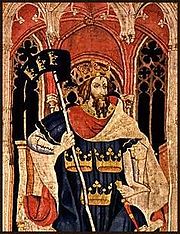 Though Wales was conquered by England, and its legal system annexed into that of the Kingdom of England
by the Laws in Wales Acts 1535–1542, the Welsh people endured as a nation
distinct from that of the English people
. Later, with both an English Reformation
and a Scottish Reformation
, Edward VI of England
under the council of Edward Seymour, 1st Duke of Somerset
, advocated the Kingdom of Scotland
joining England and Wales in a united Protestant Britain. The Duke of Somerset supported the unification of the English, Welsh and Scottish people
under the "indifferent old name of Britons" on the basis that their monarchies "both derived from a Pre-Roman British monarchy".
Following the death of Queen Elizabeth I of England
in 1603, the throne of England was inherited by James VI of Scotland which resulted in the Kingdom of England
and the Kingdom of Scotland
being united by a personal union
under King James I of England and VI of Scotland
; an event referred to as the Union of the Crowns
. King James advocated full political union
between England and Scotland, and on 20 October 1604 proclaimed his assumption of the style
"King of Great Britain" though this title was rejected by both the Parliament of England
and the Parliament of Scotland
and so had no basis in either English law
or Scots law
.
.svg.png) Despite centuries of military and religious conflict, the Kingdoms of England and Scotland had been "drawing increasingly together" since the Protestant Reformation
Despite centuries of military and religious conflict, the Kingdoms of England and Scotland had been "drawing increasingly together" since the Protestant Reformation
of the 16th century and the Union of the Crowns in 1603. A broadly shared language, island, monarch, religion and Bible (the Authorized King James Version) further contributed to a growing cultural alliance between the two sovereign realms and their peoples. The Glorious Revolution
of 1688 resulted in a pair of Acts of Parliament by the English and Scottish legislatures—the Bill of Rights 1689
and Claim of Right Act 1689
respectively—which ensured that the shared constitutional monarchy
of England and Scotland was held only by Protestants. Despite this, although popular with the monarchy and much of the aristocracy, attempts to unite the two states by Acts of Parliament, in 1606, 1667, and 1689 were unsuccessful; increased political management of Scottish affairs from England had led to "criticism", and strained Anglo-Scottish relations.
While English maritime explorations during the Age of Discovery
provided new found imperial power and wealth for the English and Welsh at the end of the 17th century, Scotland suffered from a long-standing weak economy. In response, the Scottish kingdom, in opposition to King William II of Scotland and III of England
, commenced the Darien Scheme
, an attempt to establish a Scottish imperial outlet—the colony
of New Caledonia—on the isthmus of Panama
. However, through a combination of Scottish mismanagement and English sabotage, this imperial venture ended in "catastrophic failure" with an estimated "25% of Scotland's total liquid capital" lost.
The events of the Darien Scheme coupled with the English Parliament passing the Act of Settlement 1701
giving them the right to chose the order of succession
for English, Scottish and Irish thrones escalated political hostilities between England and Scotland, and neutralised calls for a united British people. The Parliament of Scotland responded by passing the Act of Security 1704
, allowing it to appoint a different monarch to succeed to the Scottish crown from that of England, if it so wished. The English political perspective was that the appointment of a Jacobite
monarchy in Scotland opened up the possibility of a Franco-Scottish military conquest of England during the Second Hundred Years' War
and War of the Spanish Succession
. The Alien Act 1705 was passed by the Parliament of England which provided that Scottish nationals in England were to be treated as aliens
and estates held by Scots would be treated as alien property, whilst also restricting the import
of Scottish products into England and its colonies (about half of Scotland's trade). However, the act contained a provision that it would be suspended if the Parliament of Scotland entered into negotiations regarding the creation of a unified Parliament of Great Britain
, which in turn would refund Scottish financial losses on the Darien Scheme.
Despite opposition from much of the Scottish, and English populations, a Treaty of Union
was agreed in 1706 that was then ratified by each parliament passing Acts of Union 1707
. With effect from 1 May 1707, this created a new sovereign state called Great Britain
. This kingdom "began as a hostile merger", but led to a "full partnership in the most powerful going concern
in the world"; historian Simon Schama
stated "it was one of the most astonishing transformations in European history."
After 1707, a British national identity began to develop though initially resisted—particularly by the English—the peoples of Great Britain had by the 1750s begun to assume a "layered identity", to think of themselves as simultaneously British and also Scottish, English, or Welsh.
.jpg) The terms North Briton
The terms North Briton
and South Briton were devised for the Scottish and English, with the former gaining some preference in Scotland, particularly by the economists and philosophers of the Scottish Enlightenment
. Indeed, it was the "Scots [who] played key roles in shaping the contours of British identity"; "their scepticism about the Union allowed the Scots the space and time in which
to dominate the construction of Britishness in its early crucial years", drawing upon the notion of a shared "spirit of liberty common to both Saxon and Celt ... against the usurpation of the Church of Rome". James Thomson was a poet and playwright born to a Church of Scotland
minister in the Scottish Lowlands
in 1700 who was interested in forging a common British culture and national identity in this way. In collaboration with Thomas Arne, they wrote Alfred, an opera about Alfred the Great
's victory against the Viking
s performed to Frederick, Prince of Wales
in 1740 to commemorate the accession of King George I of Great Britain
and the birthday of Princess Augusta. "Rule, Britannia!
" was the climatic piece of the opera and quickly became a "jingoistic
" British patriotic song celebrating "Britain's supremacy offshore". An island country with a series of victories for the Royal Navy
associated empire and naval warfare
"inextricably with ideals of Britishness and Britain's place in the world".
Britannia
, the new national personification
of Great Britain, was established in the 1750s as a representation of "nation and empire rather than any single national hero". On Britannia and British identity, historian Peter Borsay wrote:
From the Union of 1707 through to the Battle of Waterloo
in 1815, Great Britain was "involved in successive, very dangerous wars with Catholic France", but which "all brought enough military and naval victories ... to flatter British pride". As the Napoleonic Wars
with the First French Empire
advanced, "the English and Scottish learned to define themselves as similar primarily by virtue of not being French or Catholic". In combination with sea power and empire, the notion of Britishness became more "closely bound up with Protestantism", a cultural commonality through which the English, Scots and Welsh became "fused together, and remain[ed] so, despite their many cultural divergences".
The proliferation of neo-classical monuments at the end of the 18th century and start of the 19th, such as The Kymin
at Monmouth
, were attempts to meld the concepts of Britishness with the Greco-Roman empires
of classical antiquity
. The new and expanding British Empire
provided "unprecedented opportunities for upward mobility and the accumulations of wealth", and so the "Scottish, Welsh and Irish populations were prepared to suppress nationalist issues on pragmatic grounds". The British Empire was "crucial to the idea of a British identity and to the self-image of Britishness". Indeed, the Scottish welcomed Britishness during the 19th century "for it offered a context within which they could hold on to their own identity whilst participating in, and benefiting from, the expansion of the [British] Empire". Similarly, the "new emphasis of Britishness was broadly welcomed by the Welsh who considered themselves to be the lineal descendants of the ancient Britons – a word that was still used to refer exclusively to the Welsh". For the English however, by the Victorian era
their enthusiastic adoption of Britishness meant that for them it "meant the same as 'Englishness'", so much so that "Englishness and Britishness" and "'England' and 'Britain' were used interchangably in a variety of contexts". Britishness came to borrow heavily upon English political history because England had "always been the dominant component of the British Isles in terms of size, population and power"; Magna Carta
, common law
and hostility to continental Europe
were English factors that influenced British sensibilities.
The political union of the predominantly Catholic Kingdom of Ireland
with Great Britain in 1800 coupled with outbreak of peace with France in the early 19th century, challenged the previous century's concept of militant Protestant Britishness. The new, expanded United Kingdom of Great Britain and Ireland
meant that the state had to re-evaulate its position on the civil rights of Catholics, and extend its definition of Britishness to the Irish people
. Like terms that had been invented around the of the Acts of Union 1707, West Briton was introduced for the Irish after 1800. In 1832 Daniel O'Connell
, an Irish politician who campaigned for Catholic Emancipation
, stated in Britain's House of Commons:
Ireland 1801–1922 was marked by a succession of economic and political mismanagement and neglect, which marginalised the Irish, and advanced Irish nationalism
. In the forty years that followed the union, successive British governments grappled with the problems of governing a country which had, as Benjamin Disraeli put it in 1844, "a starving population, an absentee aristocracy, and an alien Church, and in addition the weakest executive in the world". Although the vast majority of Unionists in Ireland
proclaimed themselves "simultaneously Irish and British", even for them there was a strain upon the adoption of Britishness after the Great Famine.
War continued to be a unifying factor for the people of Great Britain; British jingoism re-emerged during the Boer Wars in southern Africa
. The experience of military, political and economic power from the rise of the British Empire led to a very specific drive in artistic technique, taste and sensibility for Britishness. In 1887, Frederic Harrison
wrote:
The Catholic Relief Act 1829
reflected a "marked change in attitudes" in Great Britain towards Catholics and Catholicism. A "significant" example of this was the collaboration between Augustus Welby Pugin, an "ardent Roman Catholic" and son of a Frenchman
, and Sir Charles Barry
, "a confirmed Protestant", in redesigning the Palace of Westminster
—"the building that most enshrines ... Britain's national and imperial pre-tensions". Protestantism gave way to imperialism
as the leading element of British national identity during the Victorian and Edwardian eras, and as such, a series of Royal, imperial and national celebrations were introduced to the British people to assert imperial British culture and give themselves a sense of uniqueness, superiority and national consciousness. Empire Day and jubilees of Queen Victoria of the United Kingdom
were introduced to the British middle class
, but quickly "merged into a national 'tradition'".
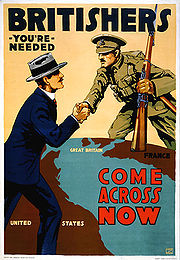 The First World War
"reinforced the sense of Britishness" and patriotism in the early 20th century. Through war service (including conscription in Great Britain), "the English, Welsh, Scots and Irish fought as British". The aftermath of the war institutionalised British national commemoration through Remembrance Sunday
and the Poppy Appeal. The Second World War
had a similar unifying effect upon the British people, however, its outcome was to recondition Britishness on a basis of democratic values
and its marked contrast to Europeanism
. Notions that the British "constituted an Island race, and that it stood for democracy were reinforced during the war and they were circulated in the country through Winston Churchill
's speeches, history books and newspapers".
At its international zenith, "Britishness joined peoples around the world in shared traditions and common loyalities that were strenuously maintained". But following the two world wars, the British Empire experienced rapid decolonisation. The secession of the Irish Free State
from the United Kingdom meant that Britishness had lost "its Irish dimension" in 1922, and the shrinking empire supplanted by independence movements dwindled the appeal of British identity in the Commonwealth of Nations
during the mid-20th century. Since the mass immigration to the United Kingdom since 1922
from the Commonwealth and elsewhere in the world, and the British Nationality Act 1948
, "the expression and experience of cultural life in Britain has become fragmented and reshaped by the influences of gender, ethnicity, class and region". Furthermore, the effect of the United Kingdom's membership of the European Economic Community
in 1973 eroded the concept of Britishness as distinct from continental Europe
. As such, since the 1970s "there has been a sense of crisis about what it has meant to be British", exacerbated by growing demands for greater political autonomy for Northern Ireland
, Scotland
, and Wales
.
The late-20th century saw major changes to the politics of the United Kingdom
with the establishment of devolved
national administrations for Northern Ireland, Scotland, and Wales following pre-legislative referendums
. Calls for greater autonomy for the four countries of the United Kingdom
had existed since their original union with each other, but gathered pace in the 1960s and 1970s. Devolution has led to "increasingly assertive Scottish, Welsh and Irish national identities", resulting in more diverse cultural expressions of Britishness, or else its outright rejection; Gwynfor Evans
, a Welsh nationalist
politician active in the late-20th century, rebuffed Britishness as "a political synonym for Englishness which extends English culture over the Scots, Welsh and the Irish".
In 2004 Sir Bernard Crick
, political theorist and democratic socialist
tasked with developing the life in the United Kingdom test
said:
Gordon Brown
, Prime Minister of the United Kingdom
, initiated a debate on British identity in 2006. Brown's speech to the Fabian Society
's Britishness Conference proposed that British values demand a new constitutional settlement and symbols to represent a modern patriotism, including a new youth community service scheme and a British Day
to celebrate. One of the central issues identified at the Fabian Society conference was how the English identity fits within the framework of a devolved United Kingdom. An expression of Her Majesty's Government's initiative to promote Britishness was the inaugural Veterans' Day which was first held on 27 June 2006. As well as celebrating the achievements of armed forces veterans, Brown's speech at the first event for the celebration said:
 British people - people with British citizenship or of British descent - have a significant presence in a number of countries other than the United Kingdom, and in particular in those with historic connections to the British Empire
. After the Age of Discovery
the British were one of the earliest and largest communities to emigrate out of Europe
, and the British Empire's expansion during the first half of the 19th century triggered an "extraordinary dispersion of the British people", resulting in particular concentrations "in Australasia
and North America
".
The British Empire was "built on waves of migration overseas by British people", who left the United Kingdom and "reached across the globe and permanently affected population structures in three continents". As a result of the British colonisation of the Americas, what became the United States
was "easily the greatest single destination of emigrant British", but in Australia
the British experienced a birth rate
higher than "anything seen before" resulting in the displacement of indigenous Australians
.
In colonies such as Southern Rhodesia
, British East Africa and Cape Colony
, permanently resident British communities were established and whilst never more than a numerical minority these Britons "exercised a dominant influence" upon the culture and politics of those lands. In Australia, Canada
and New Zealand
"people of British origin came to constitute the majority of the population" contributing to these states becoming integral to the Anglosphere
.
The United Kingdom Census 1861
estimated the size of the overseas British to be around 2.5 million, but concluded that most of these were "not conventional settlers" but rather "travellers, merchants, professionals, and military personnel". By 1890, there were over 1.5 million further British-born people living in Australia, Canada, New Zealand and South Africa
. A 2006 publication from the Institute for Public Policy Research
estimated 5.6 million Britons lived outside of the United Kingdom.
 From the beginning of Australia's colonial period until after the Second World War, people from the United Kingdom made up a large majority of people coming to Australia, meaning that many Australian-born people can trace their origins to Britain. The colony of New South Wales
, founded on 26 January 1788, was part of the eastern half of Australia claimed by the Kingdom of Great Britain in 1770, and initially settled by Britons through penal transportation
. Together with another five largely self-governing Crown Colonies, the federation of Australia
was achieved on 1 January 1901.
Its history of British dominance, meant that Australia was "grounded in British culture and political traditions that had been transported to the Australian colonies in the nineteenth century and become part of colonial culture and politics". Australia maintains the Westminster system
of Parliamentary Government and Queen Elizabeth II as Queen of Australia. Until 1987, the national status of Australian citizens was formally described as "British Subject: Citizen of Australia". Britons continue to make up a substantial proportion of immigrants.
are British by citizenship
, via origins or naturalisation. Along with aspects of common British identity, each of them has their own distinct identity shaped in the respective particular circumstances of political, economic, ethnic, social and cultural history. For instance, in the case of the Falkland Islanders
, Lewis Clifton the Speaker
of the Legislative Council of the Falkland Islands
, explains:
In contrast, for the majority of the Gibraltarian people
, who live in Gibraltar
, there is an "insistence on their Britishness" which "carries excessive loyalty" to Britain. The sovereignty of Gibraltar has been a point of contention in Spain–United Kingdom relations, but an overwhelming number of Gibraltarians embrace Britishness with strong conviction, in direct opposition to Spanish territorial claims
.
in 1763 after the Seven Years' War
, and so after the United States Declaration of Independence
in 1776, Quebec and Nova Scotia
formed "the nucleus of the colonies that constituted Britain's remaining stake on the North American continent". British North America
attracted the United Empire Loyalists, British people who migrated out of what they considered the "rebellious" United States
, increasing the size of British communities in what was to become Canada.
In 1867 there was a union of three colonies with British North America which together formed the Canadian Confederation
, a federal
dominion
. This began an accretion of additional provinces and territories
and a process of increasing autonomy from the United Kingdom, highlighted by the Statute of Westminster 1931
and culminating in the Canada Act 1982
, which severed the vestiges of legal dependence on the parliament of the United Kingdom
. Nevertheless, it is recognised that there is a "continuing importance of Canada's long and close relationship with Britain"; large parts of Canada's modern population claim "British origins" and the cultural impact of the British upon Canada's institutions is profound.
It was not until 1977 that the phrase "A Canadian citizen is a British subject" ceased to be used in Canadian passports. The politics of Canada
are strongly influenced by British political culture. Although significant modifications have been made, Canada is governed by a democratic parliamentary framework comparable to the Westminster system
, and retains Queen Elizabeth II as Queen of Canada and Head of State. English is an official language used in Canada.
Chile currently has the largest population descendants of British in Latin America. Over 700,000 Chileans may have British (English, Scottish
and Welsh
) origin, amounting to 4,5% of Chile's population.
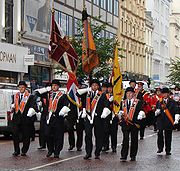 Plantations of Ireland
introduced large numbers of English, Scottish and Welsh people to Ireland throughout the Middle Ages and early modern period
. The resulting Protestant Ascendancy
, the aristocratic class of the Lordship of Ireland
, broadly identified themselves as Anglo-Irish
. In the 16th and 17th centuries, Protestant British settlers subjugated Catholic, Gaelic inhabitants in the north of Ireland during the Plantation of Ulster
and the Williamite War in Ireland
; it was "an explicit attempt to control Ireland strategically by introducing ethnic and religious elements loyal to the British interest in Ireland".
The Ulster Scots people are a British ethnic group in Ireland, broadly descended from Lowland Scots
who settled in large numbers in the Province of Ulster
during the planned process of colonisation
s of Ireland which took place in the reign of King James I of England and VI of Scotland. Together with English and Welsh settlers, these Scots introduced Protestantism (particularly the Presbyterianism
of the Church of Scotland
) and the Ulster Scots and English language
s to, mainly, northeastern Ireland. With the partition of Ireland and independence from the UK for all of Ireland except Northern Ireland
, some of these people found themselves no longer living within the United Kingdom.
Northern Ireland itself was, for many years, the site of a violent and bitter ethno-sectarian conflict—The Troubles
—between those claiming to represent Irish nationalism
, who are predominantly Roman Catholic, and those claiming to represent British unionism
, who are predominantly Protestant. Unionists want Northern Ireland to remain part of the United Kingdom, while nationalists desire a united Ireland
. Since the signing of the Good Friday Agreement in 1998, most of the paramilitary groups involved in the Troubles have ceased their armed campaigns, and constitutionally, the people of Northern Ireland
have been recognised as "all persons born in Northern Ireland and having, at the time of their birth, at least one parent who is a British citizen, an Irish citizen or is otherwise entitled to reside in Northern Ireland without any restriction on their period of residence". The Good Friday Agreement guarantees the "recognition of the birthright of all the people of Northern Ireland to identify themselves and be accepted as Irish or British, or both, as they may so choose". Nevertheless, community divisions are still strong, and the unique situation of Britons in Northern Ireland has produced a strong and distinctive British identity which at the extreme is linked with Ulster loyalism
and the Orange Institution
, but more commonly is "civic in nature", tied with the Protestant work ethic
of an "industrious, assertive, self-reliant" people.
's voyage of 1768–71, a significant number of New Zealanders are of British descent, whom a sense of Britishness has contributed to their identity. As late as the 1950s, it was common for British New Zealanders to refer to themselves as British, such as when Prime Minister Keith Holyoake
described Sir Edmund Hillary
's successful ascent of Mount Everest
as putting "the British race and New Zealand on top of the world". New Zealand passport
s described nationals as "British Subject: Citizen of New Zealand" until 1974, when this was changed to "New Zealand citizen".
In an interview with the New Zealand Listener
in 2006, Don Brash
, the then Leader of the Opposition
, said:
The politics of New Zealand
are strongly influenced by British political culture. Although significant modifications have been made, New Zealand is governed by a democratic parliamentary framework comparable to the Westminster system
, and retains Queen Elizabeth II of the United Kingdom
as the head of the monarchy of New Zealand. English is the dominant official language used in New Zealand.
and Colony of Virginia in the late-16th century, but the first successful English settlement was established in 1607, on the James River
at Jamestown
. By the 1610s an estimated 1,300 English people had travelled to North America, the "first of many millions from the British Isles". In 1620 the Pilgrims established the English imperial venture of Plymouth Colony
, beginning "a remarkable acceleration of permanent emigration from England" with over 60% of trans-Atlantic English migrants settling in the New England Colonies
. During the 17th century an estimated 350,000 English and Welsh migrants arrived in North America, which in the century after the Acts of Union 1707
was surpassed in rate and number by Scottish and Irish migrants.
The British policy of salutary neglect
for its North American colonies intended to minimise trade restrictions as a way of ensuring they stayed loyal to British interests. This permitted the development of the American Dream
, a cultural spirit distinct from that of its European founders. The Thirteen Colonies
of British America
began an armed rebellion against British rule in 1775 when they rejected the right
of the Parliament of Great Britain
to govern them without representation
; they proclaimed their independence in 1776, and subsequently constituted the first thirteen states of the United States of America, which became a sovereign state
in 1781 with the ratification of the Articles of Confederation
. The 1783 Treaty of Paris
represented Great Britain's formal acknowledgement of the United States' sovereignty at the end of the American Revolutionary War
.
Nevertheless, longstanding cultural and historical ties have, in more modern times, resulted in the Special Relationship
, a term used to describe the exceptionally close political, diplomatic and military co-operation of United Kingdom – United States relations. Linda Colley
, a professor of history at Princeton University
and specialist in Britishness, suggested that because of their colonial influence on the United States, the British find Americans a "mysterious and paradoxical people, physically distant but culturally close, engagingly similar yet irritatingly different".
, British cultural influence can be observed in the language and culture of a geographically wide assortment of countries such as Canada
, Australia
, New Zealand
, South Africa
, India
, Pakistan
, the United States
, and the British overseas territories. These states are sometimes collectively known as the Anglosphere
. As well as the British influence on its empire, the empire also influenced British culture, particularly British cuisine
. Innovations and movements within the wider-culture of Europe
have also changed the United Kingdom; Humanism
, Protestantism
, and representative democracy
have developed from broader Western culture
.
As a result of the history of the formation of the United Kingdom
, the cultures of England
, Scotland
, Wales
, and Northern Ireland
are diverse and have varying degrees of overlap and distinctiveness.
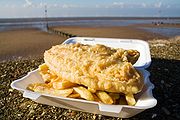 Historically, British cuisine
has meant "unfussy dishes made with quality local ingredients, matched with simple sauces to accentuate flavour, rather than disguise it". It has been "vilified as unimaginative and heavy", and traditionally been limited in its international recognition to the full breakfast
and the Christmas dinner
. This is despite British cuisine having absorbed the culinary influences of those who have settled in Britain
, resulting in hybrid dishes such as the British Asian
Chicken tikka masala
, hailed by some as "Britain's true national dish".
Celtic agriculture
and animal breeding produced a wide variety of foodstuffs for Celts and Britons. The Anglo-Saxons developed meat and savoury herb stewing techniques before the practice became common in Europe. The Norman conquest of England
introduced exotic spices into Britain in the Middle Ages. The British Empire facilitated a knowledge of India's food tradition
of "strong, penetrating spices and herbs". Food rationing policies, imposed by the British government during wartime periods of the 20th century, are said to have been the stimulus for British cuisine's poor international reputation.
British dishes include fish and chips
, the Sunday roast
, and bangers and mash
. British cuisine has several national and regional varieties, including English, Scottish
and Welsh cuisine
, each of which has developed its own regional or local dishes, many of which are geographically indicated foods
such as Cheshire cheese
, the Yorkshire pudding
, Arbroath Smokie
, Cornish pasty and Welsh cake
s.
The British are the second largest per capita tea
consumers in the world, consuming an average of 2.1 kilograms (4.6 lb) per person each year. British tea culture
dates back to the 19th century, when India
was part of the British Empire
and British interests controlled tea production in the subcontinent.
official language of the United Kingdom. However, under the European Charter for Regional or Minority Languages
, the Welsh
, Scottish Gaelic, Cornish
, Irish
, Ulster Scots and Scots (or Lowland Scots) languages are officially recognised as Regional or Minority languages by the UK Government. As indigenous language
s which continue to be spoken as a first language by native inhabitants, Welsh and Scottish Gaelic have a different legal status to other minority languages. In some parts of the UK, some of these languages are commonly spoken as a first language; in wider areas, their use in a bilingual context is sometimes supported and/or promoted by central and/or local government policy. For naturalisation purposes, a competence standard of English, Scottish Gaelic or Welsh is required to pass the life in the United Kingdom test
. However, English is used routinely, and although considered culturally important, Scottish Gaelic and Welsh are seldom used and are effectively restricted in practice to remote rural areas.
Throughout the United Kingdom there are strong and distinctive spoken expressions and regional accents of English, which are seen to be symptomatic of a locality's culture and identity. An awareness and knowledge of accents in the United Kingdom can "place, within a few miles, the locality in which a man or woman has grown up".
is "one of the leading literatures in the world". The overwhelming part is written in the English language
, but there are also literatures written in Scots
, Scottish Gaelic and Welsh
languages amongst others.
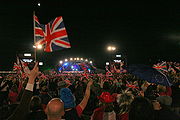 Although cinema, theatre, dance and live music are popular, the favourite pastime of the British is watching television
. Public broadcast television in the United Kingdom began in 1936, with the launch of the BBC Television Service (now BBC One
). In the United Kingdom and the Crown dependencies, one must have a television licence
to legally receive any broadcast television service, from any source. This includes the commercial channels, cable and satellite transmissions, and the Internet
. Revenue generated from the television licence is used to provide radio, television and Internet content for the British Broadcasting Corporation
, and Welsh language television programmes for S4C
. The BBC, the common abbreviation of the British Broadcasting Corporation, is the world's largest broadcaster
. Unlike other broadcasters in the UK, it is a public service based
, quasi-autonomous
, statutory corporation
run by the BBC Trust
. Free-to-air
terrestrial television channels available on a national basis are BBC One
, BBC Two
, ITV
, Channel 4
(S4C
in Wales), and Five.
100 Greatest British Television Programmes
was a list compiled by the British Film Institute
in 2000, chosen by a poll of industry professionals, to determine what were the greatest British television programmes of any genre ever to have been screened. Topping the list was Fawlty Towers
, a British sitcom
set in a fictional Torquay
hotel starring John Cleese
.
"British musical tradition is essentially vocal", dominated by the music of England
and Germanic culture
, most greatly influenced by hymns and Anglican church music
. However, the specific, traditional music of Wales
and music of Scotland
is distinct, and of the Celtic musical tradition
. In the United Kingdom, more people attend live music performances than football matches. British rock
was born in the mid-20th century out of the influence of rock and roll
and rhythm and blues
from the United States. Major early exports were The Beatles
, The Rolling Stones
, The Who
and The Kinks
. Together with other bands from the United Kingdom, these constituted the British Invasion
, a popularisation of British pop and rock music in the United States. Into the 1970s and 1980s there was a diversification of British musical genres; Progressive rock
, Glam rock
, Heavy Metal
, New Wave
, and 2 Tone
. Britpop
is a subgenre of alternative rock
that emerged from the British independent music scene of the early 1990s and was characterised by bands reviving British guitar pop music of the 1960s and 1970s. Leading exponents of Britpop were Blur
, Oasis
and Pulp
. Also popularised in the United Kingdom during the 1990s were several domestically produced varieties of electronic dance music
; Acid house
, UK hard house
, Jungle
, UK garage
which in turn have influenced Grime
and British hip hop
in the 2000s. The BRIT Awards are the British Phonographic Industry
's annual awards for both international and British popular music
.
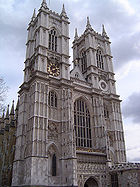 Historically, Christianity
"has been the most influential and important religion in Britain", and it remains the declared faith of the majority of the British people. The influence of Christianity on British culture has been "widespread, extending beyond the spheres of prayer and worship. Churches and cathedrals make a significant contribution to the architectural landscape of the nation's cities and towns" whilst "many schools and hospitals were founded by men and women who were strongly influenced by Christian motives". Throughout the United Kingdom, Easter
and Christmas
, the "two most important events in the Christian calendar", are recognised as public holidays
. Christianity remains the major religion of the population of the United Kingdom in the 21st century, followed by Islam
, Hinduism
, Sikhism
and then Judaism
in terms of number of adherents. The 2007 Tearfund
Survey revealed 53% identified themselves as Christian which was similar to the 2004 British Social Attitudes Survey
, and to the United Kingdom Census 2001
in which 71.6% said that Christianity was their religion, However, the Tearfund Survey showed only one in ten Britons attend church weekly. Secularism
was advanced in Britain during the Age of Enlightenment
, and modern British organisations such as the British Humanist Association
and the National Secular Society
offer the opportunity for their members to "debate and explore the moral and philosophical issues in a non-religious setting".
The Treaty of Union
that led to the formation of the Kingdom of Great Britain ensured that there would be a protestant succession as well as a link between church and state
that still remains. The Church of England
(Anglican) is legally recognised as the established church, and so retains representation in the parliament of the United Kingdom
through the Lords Spiritual
, whilst the British monarch
is a member of the church as well as its Supreme Governor
. The Church of England also retains the right to draft legislative measures (related to religious administration) through the General Synod
that can then be passed into law by Parliament. The Roman Catholic Church in England and Wales is the second largest Christian church with around five million members, mainly in England. There are also growing Orthodox
, Evangelical
and Pentecostal
churches, with Pentecostal churches in England now third after the Church of England and the Roman Catholic Church in terms of church attendance. Other large Christian groups include Methodists
and Baptists.
The presbyterian
Church of Scotland
(known informally as The Kirk), is recognised as the national church
of Scotland and not subject to state control. The British monarch is an ordinary member and is required to swear an oath to "defend the security" of the church upon his or her accession. The Roman Catholic Church in Scotland
is Scotland's second largest Christian church, with followers representing a sixth of the population of Scotland. The Scottish Episcopal Church
, which is part of the Anglican Communion, dates from the final establishment of Presbyterianism in Scotland in 1690, when it split from the Church of Scotland over matters of theology and ritual. Further splits in the Church of Scotland, especially in the 19th century, led to the creation of other Presbyterian churches in Scotland, including the Free Church of Scotland. In the 1920s, the Church in Wales
became independent from the Church of England and became 'disestablished'
but remains in the Anglican Communion
. Methodism and other protestant churches have had a major presence in Wales. The main religious groups in Northern Ireland
are organised on an all-Ireland basis. Though collectively Protestants constitute the overall majority, the Roman Catholic Church of Ireland
is the largest single church. The Presbyterian Church in Ireland
, closely linked to the Church of Scotland in terms of theology and history, is the second largest church followed by the Church of Ireland
(Anglican) which was disestablished in the 19th century.
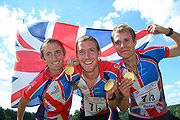 Sport
Sport
is an important element of British culture, and is one of the most popular leisure activities of British people. Within the United Kingdom, nearly half of all adults partake in one or more sporting activity each week. Some of the major sports in the United Kingdom "were invented by the British", including football, rugby
and cricket
, and "exported various other games" including tennis
, badminton
, boxing
, golf
, snooker
and squash
.
In most sports, separate organisations, teams and clubs represent the individual countries of the United Kingdom
at international level, though in some sports, like Rugby Union, an all-Ireland team represents both Northern Ireland and the Republic. The UK is represented by a single team at the Olympic Games
and at the 2008 Summer Olympics
, the Great Britain team won 47 medals: 19 gold (the most since the 1908 Summer Olympics
), 13 silver and 15 bronze, ranking them 4th. In total, sportsmen and women from the UK "hold over 50 world titles in a variety of sports, such as professional boxing, rowing, snooker, squash and motorcycle sports".
A 2006 poll found that association football was the most popular sport in the UK. In England 320 football clubs are affiliated to The Football Association
(FA) and more than 42,000 clubs to regional or district associations. The FA, founded in 1863, and the Football League, founded in 1888, were both the first of their kind in the world. In Scotland there are 78 full and associate clubs and nearly 6,000 registered clubs under the jurisdiction of the Scottish Football Association
. Two Welsh clubs play in England's Football League, and others at non-league level, whilst the Welsh Football League
contains 20 semi-professional clubs. In Northern Ireland, 12 semi-professional clubs play in the IFA Premiership
, the second oldest league in the world.
Recreational fishing
, particularly angling
, is one of the most popular participation activities in the United Kingdom, with an estimated 3—4 million anglers in the country. The most widely practised form of angling in England and Wales
is for coarse fish
while in Scotland angling is usually for salmon
and trout
.
. Amongst the first visual artists credited for developing a distinctly British aesthetic and artistic style is William Hogarth
. The experience of military, political and economic power from the rise of the British Empire
, led to a very specific drive in artistic technique, taste and sensibility in the United Kingdom. Britons used their art "to illustrate their knowledge and command of the natural world", whilst the permanent settlers in British North America, Australasia, and South Africa "embarked upon a search for distinctive artistic expression appropriate to their sense of national identity". The empire has been "at the centre, rather than in the margins, of the history of British art", and imperial British visual arts have been fundamental to the construction, celebration and expression of Britishness.
British attitudes to modern art
were "polarised" at the end of the 19th century. Modernist movements were both cherished and vilified by artists and critics; Impressionism
was initially regarded by "many conservative critics" as a "subversive foreign influence", but became "fully assimilated" into British art during the early-20th century. Representational art
was described by Herbert Read
during the interwar period
as "necessarily... revolutionary", and was studied and produced to such an extent that by the 1950s, Classicism
was effectively void in British visual art. Post-modern
, contemporary British art, particularly that of the Young British Artists
, has been pre-occupied with postcolonialism
, and "characterised by a fundamental concern with material culture ... perceived as a post-imperial cultural anxiety".
The architecture of the United Kingdom
is diverse; most influential developments have usually taken place in England, but Ireland, Scotland, and Wales have at various times played leading roles in architectural history. Although there are prehistoric and classical structures in the British Isles, British architecture effectively begins with the first Anglo-Saxon Christian churches, built soon after Augustine of Canterbury
arrived in Great Britain in 597. Norman architecture
was built on a vast scale from the 11th century onwards in the form of castles and churches to help impose Norman authority upon their dominion. English Gothic architecture
, which flourished between 1180 until around 1520, was initially imported from France, but quickly developed its own unique qualities. Secular medieval architecture
throughout Britain has left a legacy of large stone castle
s, with the "finest examples" being found lining both sides of the Anglo-Scottish border
, dating from the Wars of Scottish Independence
of the 14th century. The invention of gunpowder and canons made castles redundant, and the English Renaissance
which followed facilitiated the development of new artistic styles for domestic architecture: Tudor style
, English Baroque
, Queen Anne Style
and Palladian
. Georgian
and Neoclassical architecture
advanced after the Scottish Enlightenment
. Outwith the United Kingdom, the influence of British architecture is particularly strong in South India
, the result of British rule in India
in the 19th century. The Indian cities of Bangalore
, Chennai
, and Mumbai
each have courts, hotels and train station
s designed in British architectural styles of Gothic Revivalism
and neoclassicism
.
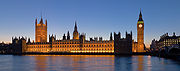 British culture is tied closely with its institutions and civics
, and a "subtle fusion of new and old values". The principle of constitutional monarchy
, with its notions of stable parliamentary government and political liberalism, "have come to dominate British culture". These views have been reinforced by Sir Bernard Crick
who said:
British political institutions include the Westminster system
, the Commonwealth of Nations
and Her Majesty's Most Honourable Privy Council. Although the Privy Council is primarily a British institution, officials from other Commonwealth realms are also appointed to the body. The most notable continuing instance is the Prime Minister of New Zealand
, its senior politicians, Chief Justice and Court of Appeal judges are conventionally made Privy Counsellors, as formerly were the prime ministers and chief justices of Canada and Australia. Prime Ministers of Commonwealth countries which retain the British monarch as their sovereign continue to be sworn as Privy Counsellors.
Universal suffrage
for all adult males was granted in 1918 and for adult women in 1930 after the Suffragette movement
. Politics in the United Kingdom is multi-party
, with two dominant political parties: the Conservative Party
and the Labour Party
. The social structure of Britain
, specifically social class
, has "long been pre-eminent among the factors used to explain party allegiance", and still persists as "the dominant basis" of party political allegiance for British people. The Conservative Party is descended from the historic Tory Party (founded in England in 1678), and is a centre-right
conservative political party, which traditionally draws support from the middle class
es. The Labour Party grew out of the trade union
movement and socialist political parties of the 19th century, and continues to describe itself as a "democratic socialist party". Labour states that it stands for the representation of the low-paid working class
, whom have traditionally been its members and voters. The Liberal Democrats
are a liberalist
political party, and third largest in the United Kingdom. It is descended from the Liberal Party
, a major ruling party
of late-19th century Britain through to the First World War, when it was supplanted by the Labour Party. The Liberal Democrats have historically drawn support from wide and "differing social backgrounds". There are over 300 other, smaller political parties in the United Kingdom registered to the Electoral Commission
.
, there are broadly two interpretations of British identity, with ethnic and civic dimensions:
 Of the two perspectives of British identity, the civic definition has become "the dominant idea ... by far", and in this capacity, Britishness is sometimes considered an institutional or overarching state
identity. This has been used to explain why first-, second- and third-generation immigrants are more likely to describe themselves as British, rather than English, Scottish or Welsh, because it is an "institutional, inclusive" identity, that can be acquired through naturalisation and British nationality law
; the vast majority of people in the United Kingdom who are from an ethnic minority feel British.
However, this attitude is more common in England than in Scotland or Wales; "white English people perceived themselves as English first and as British second, and most people from ethnic minority backgrounds perceived themselves as British, but none identified as English, a label they associated exclusively with white people". Contrawise, in Scotland and Wales, White British
and ethnic minority people both identified more strongly with Scotland and Wales than with Britain.
Studies and surveys have "reported that the majority of the Scots and Welsh see themselves as both Scottish/Welsh and British though with some differences in emphasis". The Commission for Racial Equality
found that with respect to notions of nationality
in Britain, "the most basic, objective and uncontroversial conception of the British people is one that includes the English, the Scots and the Welsh". However, "English participants tended to think of themselves as indistinguishably English or British, while both Scottish and Welsh participants identified themselves much more readily as Scottish or Welsh than as British".
Some persons opted "to combine both identities" as "they felt Scottish or Welsh, but held a British passport
and were therefore British", whereas others saw themselves as exclusively Scottish or exclusively Welsh and "felt quite divorced from the British, whom they saw as the English". Commentators have described this latter phenomenon as "nationalism
", a rejection of British identity because some Scots and Welsh interpret it as "cultural imperialism imposed" upon the United Kingdom by "English ruling elites", or else a response to a historical misappropriation of equating the word "English" with "British", which has "brought about a desire among Scots, Welsh and Irish to learn more about their heritage and distinguish themselves from the broader British identity".
Citizenship
Citizenship is the state of being a citizen of a particular social, political, national, or human resource community. Citizenship status, under social contract theory, carries with it both rights and responsibilities...
of the United Kingdom
United Kingdom
The United Kingdom of Great Britain and Northern IrelandIn the United Kingdom and Dependencies, other languages have been officially recognised as legitimate autochthonous languages under the European Charter for Regional or Minority Languages...
, of the Isle of Man
Isle of Man
The Isle of Man , otherwise known simply as Mann , is a self-governing British Crown Dependency, located in the Irish Sea between the islands of Great Britain and Ireland, within the British Isles. The head of state is Queen Elizabeth II, who holds the title of Lord of Mann. The Lord of Mann is...
, any of the Channel Islands
Channel Islands
The Channel Islands are an archipelago of British Crown Dependencies in the English Channel, off the French coast of Normandy. They include two separate bailiwicks: the Bailiwick of Guernsey and the Bailiwick of Jersey...
, or of any of the British overseas territories
British overseas territories
The British Overseas Territories are fourteen territories of the United Kingdom which, although they do not form part of the United Kingdom itself, fall under its jurisdiction. They are remnants of the British Empire that have not acquired independence or have voted to remain British territories...
, and their descendants. British nationality law
British nationality law
British nationality law is the law of the United Kingdom that concerns citizenship and other categories of British nationality. The law is complex because of the United Kingdom's former status as an imperial power.-History:...
governs modern British citizenship and nationality, which are acquired, for instance, by birth in the UK or by descent from British nationals. When used in a historical context, the term British people refers to the ancient Britons
Britons (historical)
The Britons were the Celtic people culturally dominating Great Britain from the Iron Age through the Early Middle Ages. They spoke the Insular Celtic language known as British or Brythonic...
, the indigenous
Indigenous peoples
Indigenous peoples are ethnic groups that are defined as indigenous according to one of the various definitions of the term, there is no universally accepted definition but most of which carry connotations of being the "original inhabitants" of a territory....
inhabitants of Great Britain
Great Britain
Great Britain or Britain is an island situated to the northwest of Continental Europe. It is the ninth largest island in the world, and the largest European island, as well as the largest of the British Isles...
south of the Forth
Firth of Forth
The Firth of Forth is the estuary or firth of Scotland's River Forth, where it flows into the North Sea, between Fife to the north, and West Lothian, the City of Edinburgh and East Lothian to the south...
.
Although early assertions of being British date from the Late Middle Ages
Late Middle Ages
The Late Middle Ages was the period of European history generally comprising the 14th to the 16th century . The Late Middle Ages followed the High Middle Ages and preceded the onset of the early modern era ....
, the creation of the united kingdom of Great Britain
Kingdom of Great Britain
The former Kingdom of Great Britain, sometimes described as the 'United Kingdom of Great Britain', That the Two Kingdoms of Scotland and England, shall upon the 1st May next ensuing the date hereof, and forever after, be United into One Kingdom by the Name of GREAT BRITAIN. was a sovereign...
in 1707 triggered a sense of British national identity. The notion of Britishness
Britishness
Britishness is the state or quality of being British, or of embodying British characteristics, and is used to refer to that which binds and distinguishes the British people and forms the basis of their unity and identity, or else to explain expressions of British culture—such as habits, behaviours...
was forged during the Napoleonic Wars
Napoleonic Wars
The Napoleonic Wars were a series of wars declared against Napoleon's French Empire by opposing coalitions that ran from 1803 to 1815. As a continuation of the wars sparked by the French Revolution of 1789, they revolutionised European armies and played out on an unprecedented scale, mainly due to...
between Britain and the First French Empire
First French Empire
The First French Empire , also known as the Greater French Empire or Napoleonic Empire, was the empire of Napoleon I of France...
, and developed further during the Victorian era
Victorian era
The Victorian era of British history was the period of Queen Victoria's reign from 20 June 1837 until her death on 22 January 1901. It was a long period of peace, prosperity, refined sensibilities and national self-confidence...
. The complex history of the formation of the United Kingdom
History of the formation of the United Kingdom
The history of the formation of the United Kingdom has involved personal and political union across Great Britain and the wider British Isles. The United Kingdom is the most recent of a number of sovereign states that have been established in Great Britain at different periods in history, in...
created a "particular sense of nationhood and belonging" in Britain; Britishness became "superimposed on much older identities", of English
English people
The English are a nation and ethnic group native to England, who speak English. The English identity is of early mediaeval origin, when they were known in Old English as the Anglecynn. England is now a country of the United Kingdom, and the majority of English people in England are British Citizens...
, Scots
Scottish people
The Scottish people , or Scots, are a nation and ethnic group native to Scotland. Historically they emerged from an amalgamation of the Picts and Gaels, incorporating neighbouring Britons to the south as well as invading Germanic peoples such as the Anglo-Saxons and the Norse.In modern use,...
and Welsh
Welsh people
The Welsh people are an ethnic group and nation associated with Wales and the Welsh language.John Davies argues that the origin of the "Welsh nation" can be traced to the late 4th and early 5th centuries, following the Roman departure from Britain, although Brythonic Celtic languages seem to have...
cultures, whose distinctiveness still resist notions of a homogenised British identity. Because of longstanding ethno-sectarian divisions, British identity in Northern Ireland
Northern Ireland
Northern Ireland is one of the four countries of the United Kingdom. Situated in the north-east of the island of Ireland, it shares a border with the Republic of Ireland to the south and west...
is controversial, but it is held with strong conviction by unionists
Unionism in Ireland
Unionism in Ireland is an ideology that favours the continuation of some form of political union between the islands of Ireland and Great Britain...
.
Contemporary Britons are descended mainly from the varied ethnic stocks that settled in Great Britain before the 11th century. Prehistoric
Prehistoric Britain
For the purposes of this article, Prehistoric Britain is that period of time between the first arrival of humans on the land mass now known as Great Britain and the start of recorded British history...
, Celt
Celt
The Celts were a diverse group of tribal societies in Iron Age and Roman-era Europe who spoke Celtic languages.The earliest archaeological culture commonly accepted as Celtic, or rather Proto-Celtic, was the central European Hallstatt culture , named for the rich grave finds in Hallstatt, Austria....
ic, Roman
Roman Britain
Roman Britain was the part of the island of Great Britain controlled by the Roman Empire from AD 43 until ca. AD 410.The Romans referred to the imperial province as Britannia, which eventually comprised all of the island of Great Britain south of the fluid frontier with Caledonia...
, Anglo-Saxon
Anglo-Saxons
Anglo-Saxon is a term used by historians to designate the Germanic tribes who invaded and settled the south and east of Great Britain beginning in the early 5th century AD, and the period from their creation of the English nation to the Norman conquest. The Anglo-Saxon Era denotes the period of...
, and Norse
Norsemen
Norsemen is used to refer to the group of people as a whole who spoke what is now called the Old Norse language belonging to the North Germanic branch of Indo-European languages, especially Norwegian, Icelandic, Faroese, Swedish and Danish in their earlier forms.The meaning of Norseman was "people...
influences were blended in Britain under the Normans
Normans
The Normans were the people who gave their name to Normandy, a region in northern France. They were descended from Norse Viking conquerors of the territory and the native population of Frankish and Gallo-Roman stock...
, Scandinavian Vikings from northern France. Conquest and union facilitated migration, cultural and linguistic exchange, and intermarriage between the peoples of England, Scotland and Wales during the Middle Ages, Early Modern period
Early Modern Britain
Early modern Britain is the history of the island of Great Britain, roughly corresponding to the 16th, 17th, and 18th centuries. Major historical events in Early Modern British history include the English Renaissance, the English Reformation and Scottish Reformation, the English Civil War, the...
and beyond. Since the 19th century, and particularly since the mid-20th century, there has been immigration to the United Kingdom
Immigration to the United Kingdom since 1922
Immigration to the United Kingdom of Great Britain and Northern Ireland since 1922 has been substantial, in particular from Ireland and the former colonies and other territories of the British Empire - such as India, Bangladesh, Pakistan, the Caribbean, South Africa, Kenya and Hong Kong - under...
by people from the Republic of Ireland
Republic of Ireland
Ireland , described as the Republic of Ireland , is a sovereign state in Europe occupying approximately five-sixths of the island of the same name. Its capital is Dublin. Ireland, which had a population of 4.58 million in 2011, is a constitutional republic governed as a parliamentary democracy,...
, the Commonwealth
Commonwealth of Nations
The Commonwealth of Nations, normally referred to as the Commonwealth and formerly known as the British Commonwealth, is an intergovernmental organisation of fifty-four independent member states...
, other parts of Europe and elsewhere; they and their descendants are mostly British citizens with some assuming a British, dual or hyphenated identity.
The British are a diverse, multi-national and multicultural society, with "strong regional accents, expressions and identities". The social structure of Britain
Social structure of Britain
The social structure of the United Kingdom has historically been highly influenced by the concept of social class, with the concept still affecting British society in the early-21st century. Although definitions of social class in the United Kingdom vary and are highly controversial, most are...
has changed radically since the 19th century, with the decline in religious observance, enlargement of the middle class
Middle class
The middle class is any class of people in the middle of a societal hierarchy. In Weberian socio-economic terms, the middle class is the broad group of people in contemporary society who fall socio-economically between the working class and upper class....
, and increased ethnic diversity. The population of the United Kingdom stands at around 62.5 million, with a British diaspora
British diaspora
[File:British expats countrymap.svg|thumb|350px|right|A world map showing the distribution and concentration of Britons by country.Legend:...
concentrated in Australia
Australia
Australia , officially the Commonwealth of Australia, is a country in the Southern Hemisphere comprising the mainland of the Australian continent, the island of Tasmania, and numerous smaller islands in the Indian and Pacific Oceans. It is the world's sixth-largest country by total area...
, Canada
Canada
Canada is a North American country consisting of ten provinces and three territories. Located in the northern part of the continent, it extends from the Atlantic Ocean in the east to the Pacific Ocean in the west, and northward into the Arctic Ocean...
, New Zealand
New Zealand
New Zealand is an island country in the south-western Pacific Ocean comprising two main landmasses and numerous smaller islands. The country is situated some east of Australia across the Tasman Sea, and roughly south of the Pacific island nations of New Caledonia, Fiji, and Tonga...
and the United States
United States
The United States of America is a federal constitutional republic comprising fifty states and a federal district...
.
History of the term
GreekAncient Greece
Ancient Greece is a civilization belonging to a period of Greek history that lasted from the Archaic period of the 8th to 6th centuries BC to the end of antiquity. Immediately following this period was the beginning of the Early Middle Ages and the Byzantine era. Included in Ancient Greece is the...
and Roman
Ancient Rome
Ancient Rome was a thriving civilization that grew on the Italian Peninsula as early as the 8th century BC. Located along the Mediterranean Sea and centered on the city of Rome, it expanded to one of the largest empires in the ancient world....
writers between the 1st century BC and the 1st century AD name the inhabitants of Great Britain
Great Britain
Great Britain or Britain is an island situated to the northwest of Continental Europe. It is the ninth largest island in the world, and the largest European island, as well as the largest of the British Isles...
and Ireland
Ireland
Ireland is an island to the northwest of continental Europe. It is the third-largest island in Europe and the twentieth-largest island on Earth...
as the Priteni, the origin of the Latin
Latin
Latin is an Italic language originally spoken in Latium and Ancient Rome. It, along with most European languages, is a descendant of the ancient Proto-Indo-European language. Although it is considered a dead language, a number of scholars and members of the Christian clergy speak it fluently, and...
word Britannic. Parthenius
Parthenius of Nicaea
Parthenius of Nicaea or Myrlea in Bithynia was a Greek grammarian and poet. According to the Suda, he was the son of Heraclides and Eudora, or according to Hermippus of Berytus, his mother's name was Tetha. He was taken prisoner by Cinna in the Mithridatic Wars and carried to Rome in 72 BC. He...
, a 1st century Ancient Greek grammarian, and the Etymologicum Genuinum
Etymologicum Genuinum
The Etymologicum Genuinum is the conventional modern title given to a lexical encyclopedia compiled at Constantinople in the mid ninth century. The anonymous compilator drew on the works of numerous earlier lexicographers and scholiasts, both ancient and recent, including Herodian, George...
, a 9th century lexical encyclopaedia, describe Bretannus (the Latinised form of the Ancient Greek
Ancient Greek
Ancient Greek is the stage of the Greek language in the periods spanning the times c. 9th–6th centuries BC, , c. 5th–4th centuries BC , and the c. 3rd century BC – 6th century AD of ancient Greece and the ancient world; being predated in the 2nd millennium BC by Mycenaean Greek...
Βρεττανός) as the Celtic national forefather of the Britons. It has been suggested that this name derives from a Gaullish
Gaulish language
The Gaulish language is an extinct Celtic language that was spoken by the Gauls, a people who inhabited the region known as Gaul from the Iron Age through the Roman period...
description translated as "people of the forms", referring to the custom of tattooing or painting their bodies with blue woad
Woad
Isatis tinctoria, with Woad as the common name, is a flowering plant in the family Brassicaceae. It is commonly called dyer's woad, and sometimes incorrectly listed as Isatis indigotica . It is occasionally known as Asp of Jerusalem...
.
By 50 BC Greek geographers were using equivalents of Prettanikē as a collective name for the British Isles
British Isles
The British Isles are a group of islands off the northwest coast of continental Europe that include the islands of Great Britain and Ireland and over six thousand smaller isles. There are two sovereign states located on the islands: the United Kingdom of Great Britain and Northern Ireland and...
. However, with the Roman conquest of Britain
Roman conquest of Britain
The Roman conquest of Britain was a gradual process, beginning effectively in AD 43 under Emperor Claudius, whose general Aulus Plautius served as first governor of Britannia. Great Britain had already frequently been the target of invasions, planned and actual, by forces of the Roman Republic and...
the Latin term Britannia
Britannia
Britannia is an ancient term for Great Britain, and also a female personification of the island. The name is Latin, and derives from the Greek form Prettanike or Brettaniai, which originally designated a collection of islands with individual names, including Albion or Great Britain. However, by the...
was used for the island of Great Britain, and later Roman occupied Britain
Roman Britain
Roman Britain was the part of the island of Great Britain controlled by the Roman Empire from AD 43 until ca. AD 410.The Romans referred to the imperial province as Britannia, which eventually comprised all of the island of Great Britain south of the fluid frontier with Caledonia...
south of Caledonia
Caledonia
Caledonia is the Latinised form and name given by the Romans to the land in today's Scotland north of their province of Britannia, beyond the frontier of their empire...
. Following the Roman departure from Britain, the island of Great Britain was left open to invasion by pagan
Paganism
Paganism is a blanket term, typically used to refer to non-Abrahamic, indigenous polytheistic religious traditions....
, seafaring warriors such as Saxons
Saxons
The Saxons were a confederation of Germanic tribes originating on the North German plain. The Saxons earliest known area of settlement is Northern Albingia, an area approximately that of modern Holstein...
and Jutes
Jutes
The Jutes, Iuti, or Iutæ were a Germanic people who, according to Bede, were one of the three most powerful Germanic peoples of their time, the other two being the Saxons and the Angles...
who gained control in areas around the south east.
In this post-Roman period
Sub-Roman Britain
Sub-Roman Britain is a term derived from an archaeological label for the material culture of Britain in Late Antiquity: the term "Sub-Roman" was invented to describe the potsherds in sites of the 5th century and the 6th century, initially with an implication of decay of locally-made wares from a...
, as the Anglo-Saxons
Anglo-Saxons
Anglo-Saxon is a term used by historians to designate the Germanic tribes who invaded and settled the south and east of Great Britain beginning in the early 5th century AD, and the period from their creation of the English nation to the Norman conquest. The Anglo-Saxon Era denotes the period of...
advanced, territory controlled by the Britons became confined to what would later be Wales
Wales
Wales is a country that is part of the United Kingdom and the island of Great Britain, bordered by England to its east and the Atlantic Ocean and Irish Sea to its west. It has a population of three million, and a total area of 20,779 km²...
, Cornwall
Cornwall
Cornwall is a unitary authority and ceremonial county of England, within the United Kingdom. It is bordered to the north and west by the Celtic Sea, to the south by the English Channel, and to the east by the county of Devon, over the River Tamar. Cornwall has a population of , and covers an area of...
and North West England
North West England
North West England, informally known as The North West, is one of the nine official regions of England.North West England had a 2006 estimated population of 6,853,201 the third most populated region after London and the South East...
. However, the term Britannia persisted as the Latin name for the island. The Historia Brittonum claimed legendary origins as a prestigious genealogy
Genealogy
Genealogy is the study of families and the tracing of their lineages and history. Genealogists use oral traditions, historical records, genetic analysis, and other records to obtain information about a family and to demonstrate kinship and pedigrees of its members...
for Brittonic kings
King of the Britons
The Britons or Brythons were the Celtic-speaking people of what is now England, Wales and southern Scotland, whose ethnic identity is today maintained by the Welsh, Cornish and Bretons...
, followed by the Historia Regum Britanniae
Historia Regum Britanniae
The Historia Regum Britanniae is a pseudohistorical account of British history, written c. 1136 by Geoffrey of Monmouth. It chronicles the lives of the kings of the Britons in a chronological narrative spanning a time of two thousand years, beginning with the Trojans founding the British nation...
which popularised this pseudo-history to support the claims of the Kings of England.
During the Middle Ages
Middle Ages
The Middle Ages is a periodization of European history from the 5th century to the 15th century. The Middle Ages follows the fall of the Western Roman Empire in 476 and precedes the Early Modern Era. It is the middle period of a three-period division of Western history: Classic, Medieval and Modern...
, and particularly in the Tudor period
Tudor period
The Tudor period usually refers to the period between 1485 and 1603, specifically in relation to the history of England. This coincides with the rule of the Tudor dynasty in England whose first monarch was Henry VII...
, the term British was applied to the Welsh people
Welsh people
The Welsh people are an ethnic group and nation associated with Wales and the Welsh language.John Davies argues that the origin of the "Welsh nation" can be traced to the late 4th and early 5th centuries, following the Roman departure from Britain, although Brythonic Celtic languages seem to have...
. At this time, it was "the long held belief that the Welsh were descendants of the ancient Britons
Britons (historical)
The Britons were the Celtic people culturally dominating Great Britain from the Iron Age through the Early Middle Ages. They spoke the Insular Celtic language known as British or Brythonic...
and that they spoke 'the British tongue. This notion was supported by texts such as the Historia Regum Britanniae
Historia Regum Britanniae
The Historia Regum Britanniae is a pseudohistorical account of British history, written c. 1136 by Geoffrey of Monmouth. It chronicles the lives of the kings of the Britons in a chronological narrative spanning a time of two thousand years, beginning with the Trojans founding the British nation...
, a pseudohistorical
Pseudohistory
Pseudohistory is a pejorative term applied to a type of historical revisionism, often involving sensational claims whose acceptance would require rewriting a significant amount of commonly accepted history, and based on methods that depart from standard historiographical conventions.Cryptohistory...
account of ancient British history, written in the mid-12th century by Geoffrey of Monmouth
Geoffrey of Monmouth
Geoffrey of Monmouth was a cleric and one of the major figures in the development of British historiography and the popularity of tales of King Arthur...
. The Historia Regum Britanniae chronicled the lives of legendary kings of the Britons in a narrative spanning a time of two thousand years, beginning with the Trojans
Troy
Troy was a city, both factual and legendary, located in northwest Anatolia in what is now Turkey, southeast of the Dardanelles and beside Mount Ida...
founding the ancient British nation and continuing until the Anglo-Saxon invasion of Britain in the 7th century forced the Celtic Britons to the west coast, namely Wales
Wales
Wales is a country that is part of the United Kingdom and the island of Great Britain, bordered by England to its east and the Atlantic Ocean and Irish Sea to its west. It has a population of three million, and a total area of 20,779 km²...
and Cornwall
Cornwall
Cornwall is a unitary authority and ceremonial county of England, within the United Kingdom. It is bordered to the north and west by the Celtic Sea, to the south by the English Channel, and to the east by the county of Devon, over the River Tamar. Cornwall has a population of , and covers an area of...
. This legendary Celtic history of Great Britain is known as the Matter of Britain
Matter of Britain
The Matter of Britain is a name given collectively to the body of literature and legendary material associated with Great Britain and its legendary kings, particularly King Arthur...
. The Matter of Britain, a national myth, was retold or reinterpreted in works by Gerald of Wales, a Cambro-Norman
Cambro-Norman
Cambro-Norman is a term used for Norman knights who settled in southern Wales after the Norman conquest of England in 1066. Some historians suggest that the term is to be preferred to Anglo-Norman for the Normans who invaded Ireland after 1170 — many of whom originated in Wales. However, the term...
chronicler who in the 12th and 13th centuries used the term British to refer to what were later known as the Welsh.
Ancestral roots
Traditional accounts of the ancestral roots of the British have taught that they are descended from diverse populations: the ScotsScottish people
The Scottish people , or Scots, are a nation and ethnic group native to Scotland. Historically they emerged from an amalgamation of the Picts and Gaels, incorporating neighbouring Britons to the south as well as invading Germanic peoples such as the Anglo-Saxons and the Norse.In modern use,...
, Welsh
Welsh people
The Welsh people are an ethnic group and nation associated with Wales and the Welsh language.John Davies argues that the origin of the "Welsh nation" can be traced to the late 4th and early 5th centuries, following the Roman departure from Britain, although Brythonic Celtic languages seem to have...
, Cornish
Cornish people
The Cornish are a people associated with Cornwall, a county and Duchy in the south-west of the United Kingdom that is seen in some respects as distinct from England, having more in common with the other Celtic parts of the United Kingdom such as Wales, as well as with other Celtic nations in Europe...
and Irish
Irish people
The Irish people are an ethnic group who originate in Ireland, an island in northwestern Europe. Ireland has been populated for around 9,000 years , with the Irish people's earliest ancestors recorded having legends of being descended from groups such as the Nemedians, Fomorians, Fir Bolg, Tuatha...
from the Celts, and the English
English people
The English are a nation and ethnic group native to England, who speak English. The English identity is of early mediaeval origin, when they were known in Old English as the Anglecynn. England is now a country of the United Kingdom, and the majority of English people in England are British Citizens...
from the Anglo-Saxons
Anglo-Saxons
Anglo-Saxon is a term used by historians to designate the Germanic tribes who invaded and settled the south and east of Great Britain beginning in the early 5th century AD, and the period from their creation of the English nation to the Norman conquest. The Anglo-Saxon Era denotes the period of...
, who invaded from northern Europe
Northern Europe
Northern Europe is the northern part or region of Europe. Northern Europe typically refers to the seven countries in the northern part of the European subcontinent which includes Denmark, Estonia, Latvia, Lithuania, Norway, Finland and Sweden...
and drove the Celts to Great Britain
Great Britain
Great Britain or Britain is an island situated to the northwest of Continental Europe. It is the ninth largest island in the world, and the largest European island, as well as the largest of the British Isles...
's western and northern fringes; each are also thought to have a small portion of Viking
Viking
The term Viking is customarily used to refer to the Norse explorers, warriors, merchants, and pirates who raided, traded, explored and settled in wide areas of Europe, Asia and the North Atlantic islands from the late 8th to the mid-11th century.These Norsemen used their famed longships to...
heritage. However, geneticist Stephen Oppenheimer
Stephen Oppenheimer
Stephen Oppenheimer is a British paediatrician, geneticist, and writer. He is a member of Green Templeton College, Oxford and an honorary fellow of Liverpool School of Tropical Medicine, and carries out and publishes research in the fields of genetics and human prehistory.-Career:Oppenheimer...
suggests that DNA
DNA
Deoxyribonucleic acid is a nucleic acid that contains the genetic instructions used in the development and functioning of all known living organisms . The DNA segments that carry this genetic information are called genes, but other DNA sequences have structural purposes, or are involved in...
analysis attests that three quarters of Britons share a common ancestry with the hunter-gatherer
Hunter-gatherer
A hunter-gatherer or forage society is one in which most or all food is obtained from wild plants and animals, in contrast to agricultural societies which rely mainly on domesticated species. Hunting and gathering was the ancestral subsistence mode of Homo, and all modern humans were...
s who settled in Atlantic Europe
Atlantic Europe
Atlantic Europe is a geographical and anthropological term for the western portion of Europe which borders the Atlantic Ocean. The term may refer to the idea of Atlantic Europe as a cultural unit and/or as an biogeographical region....
during the Paleolithic
Paleolithic
The Paleolithic Age, Era or Period, is a prehistoric period of human history distinguished by the development of the most primitive stone tools discovered , and covers roughly 99% of human technological prehistory...
era, "after the melting of the ice caps but before the land broke away from the mainland and divided into islands".
Despite the separation of the British Isles
British Isles
The British Isles are a group of islands off the northwest coast of continental Europe that include the islands of Great Britain and Ireland and over six thousand smaller isles. There are two sovereign states located on the islands: the United Kingdom of Great Britain and Northern Ireland and...
from continental Europe
Continental Europe
Continental Europe, also referred to as mainland Europe or simply the Continent, is the continent of Europe, explicitly excluding European islands....
as a consequence of the last ice age
Ice age
An ice age or, more precisely, glacial age, is a generic geological period of long-term reduction in the temperature of the Earth's surface and atmosphere, resulting in the presence or expansion of continental ice sheets, polar ice sheets and alpine glaciers...
, the genetic record indicates the British and Irish broadly share a closest common ancestry with the Basque people
Basque people
The Basques as an ethnic group, primarily inhabit an area traditionally known as the Basque Country , a region that is located around the western end of the Pyrenees on the coast of the Bay of Biscay and straddles parts of north-central Spain and south-western France.The Basques are known in the...
who live in the Basque Country by the Pyrenees
Pyrenees
The Pyrenees is a range of mountains in southwest Europe that forms a natural border between France and Spain...
. Oppenheimer continues that the majority of the people of the British Isles share genetic commonalities with the Basques, ranging from highs of 90% in Wales
Wales
Wales is a country that is part of the United Kingdom and the island of Great Britain, bordered by England to its east and the Atlantic Ocean and Irish Sea to its west. It has a population of three million, and a total area of 20,779 km²...
to lows of 66% in East Anglia
East Anglia
East Anglia is a traditional name for a region of eastern England, named after an ancient Anglo-Saxon kingdom, the Kingdom of the East Angles. The Angles took their name from their homeland Angeln, in northern Germany. East Anglia initially consisted of Norfolk and Suffolk, but upon the marriage of...
.
The difference between western Britain and the East of England
East of England
The East of England is one of the nine official regions of England. It was created in 1994 and was adopted for statistics from 1999. It includes the ceremonial counties of Essex, Hertfordshire, Bedfordshire, Cambridgeshire, Norfolk and Suffolk. Essex has the highest population in the region.Its...
is thought to have its origins to two divergent prehistoric routes of immigration — one up the Atlantic coast, the other from continental Europe. Major immigrant settlement of the British Isles occurred during the Neolithic
Neolithic
The Neolithic Age, Era, or Period, or New Stone Age, was a period in the development of human technology, beginning about 9500 BC in some parts of the Middle East, and later in other parts of the world. It is traditionally considered as the last part of the Stone Age...
period, interpreted by Bryan Sykes
Bryan Sykes
Bryan Sykes is a former Professor of Human Genetics at the University of Oxford and a current Fellow of Wolfson College.Sykes published the first report on retrieving DNA from ancient bone...
—professor of human genetics
Human genetics
Human genetics describes the study of inheritance as it occurs in human beings. Human genetics encompasses a variety of overlapping fields including: classical genetics, cytogenetics, molecular genetics, biochemical genetics, genomics, population genetics, developmental genetics, clinical genetics,...
at the University of Oxford
University of Oxford
The University of Oxford is a university located in Oxford, United Kingdom. It is the second-oldest surviving university in the world and the oldest in the English-speaking world. Although its exact date of foundation is unclear, there is evidence of teaching as far back as 1096...
—as the arrival of the Celts from the Iberian Peninsula
Iberian Peninsula
The Iberian Peninsula , sometimes called Iberia, is located in the extreme southwest of Europe and includes the modern-day sovereign states of Spain, Portugal and Andorra, as well as the British Overseas Territory of Gibraltar...
, and the origin of Britain's and Ireland's Celtic tribes.
Oppenheimer's opinion is that "..by far the majority of male gene types in the British Isles derive from Iberia (modern Spain and Portugal), ranging from a low of 59% in Fakenham
Fakenham
Fakenham is a town and civil parish in Norfolk, England. It is situated on the River Wensum, some north east of King's Lynn, south west of Cromer, and north west of Norwich....
, Norfolk to highs of 96% in Llangefni
Llangefni
Llangefni is the county town of Anglesey in Wales and contains the principal offices of the Isle of Anglesey County Council. According to the United Kingdom Census 2001, the population of Llangefni was 4,662 people and it is the second largest settlement on the island...
, north Wales". The National Museum Wales
National Museum Wales
Amgueddfa Cymru – National Museum Wales, formerly the National Museums and Galleries of Wales, comprises eight museums in Wales:* National Museum Cardiff* St Fagans: National History Museum, Cardiff* Big Pit National Coal Museum, Blaenavon...
state that "it is possible that future genetic studies of ancient and modern human DNA may help to inform our understanding of the subject" but "early studies have, so far, tended to produce implausible conclusions from very small numbers of people and using outdated assumptions about linguistics and archaeology."
Between the 8th and 11th centuries, "three major cultural divisions" had emerged in Britain; the English, Scottish and Welsh. The English had unified under a single nation state in 937 by King Athelstan of Wessex
Athelstan of England
Athelstan , called the Glorious, was the King of England from 924 or 925 to 939. He was the son of King Edward the Elder, grandson of Alfred the Great and nephew of Æthelflæd of Mercia...
after the Battle of Brunanburh
Battle of Brunanburh
The Battle of Brunanburh was an English victory in 937 by the army of Æthelstan, King of England, and his brother Edmund over the combined armies of Olaf III Guthfrithson, the Norse-Gael King of Dublin, Constantine II, King of Scots, and Owen I, King of Strathclyde...
. Before then, the English (known then in Old English as the Anglecynn) were under the governance of independent Anglo-Saxon petty kingdom
Petty kingdom
A petty kingdom is one of a number of small kingdoms, described as minor or "petty" by contrast to an empire or unified kingdom that either preceded or succeeded it...
s which gradually coalesced into a Heptarchy
Heptarchy
The Heptarchy is a collective name applied to the Anglo-Saxon kingdoms of south, east, and central Great Britain during late antiquity and the early Middle Ages, conventionally identified as seven: Northumbria, Mercia, East Anglia, Essex, Kent, Sussex and Wessex...
of seven powerful states, the most powerful of which were Mercia
Mercia
Mercia was one of the kingdoms of the Anglo-Saxon Heptarchy. It was centred on the valley of the River Trent and its tributaries in the region now known as the English Midlands...
and Wessex
Wessex
The Kingdom of Wessex or Kingdom of the West Saxons was an Anglo-Saxon kingdom of the West Saxons, in South West England, from the 6th century, until the emergence of a united English state in the 10th century, under the Wessex dynasty. It was to be an earldom after Canute the Great's conquest...
. Scottish historian and archaeologist Neil Oliver
Neil Oliver
Neil Oliver is a Scottish broadcaster and author. He grew up in Ayr and Dumfries before attending Glasgow University to study archaeology...
said that the Battle of Brunanburh would "define the shape of Britain into the modern era", it was a "showdown for two very different ethnic identities – a Norse Celtic alliance versus Anglo Saxon. It aimed to settle once and for all whether Britain would be controlled by a single imperial power or remain several separate independent kingdoms, a split in perceptions which is still very much with us today". However, historian Simon Schama
Simon Schama
Simon Michael Schama, CBE is a British historian and art historian. He is a University Professor of History and Art History at Columbia University. He is best known for writing and hosting the 15-part BBC documentary series A History of Britain...
suggested that it was King Edward I of England
Edward I of England
Edward I , also known as Edward Longshanks and the Hammer of the Scots, was King of England from 1272 to 1307. The first son of Henry III, Edward was involved early in the political intrigues of his father's reign, which included an outright rebellion by the English barons...
who was solely "responsible for provoking the peoples of Britain into an awareness of their nationhood" in the 13th century. Scottish national identity
Scottish national identity
Scottish national identity is a term referring to the sense of national identity and common culture of Scottish people and is shared by a considerable majority of the people of Scotland....
, "a complex amalgam" of Gael, Pict, Norsemen and Anglo-Norman
Anglo-Norman
The Anglo-Normans were mainly the descendants of the Normans who ruled England following the Norman conquest by William the Conqueror in 1066. A small number of Normans were already settled in England prior to the conquest...
, was not finally forged until the Wars of Scottish Independence
Wars of Scottish Independence
The Wars of Scottish Independence were a series of military campaigns fought between the independent Kingdom of Scotland and the Kingdom of England in the late 13th and early 14th centuries....
against the Kingdom of England
Kingdom of England
The Kingdom of England was, from 927 to 1707, a sovereign state to the northwest of continental Europe. At its height, the Kingdom of England spanned the southern two-thirds of the island of Great Britain and several smaller outlying islands; what today comprises the legal jurisdiction of England...
in the late 13th and early 14th centuries.
Kingdom of England
The Kingdom of England was, from 927 to 1707, a sovereign state to the northwest of continental Europe. At its height, the Kingdom of England spanned the southern two-thirds of the island of Great Britain and several smaller outlying islands; what today comprises the legal jurisdiction of England...
by the Laws in Wales Acts 1535–1542, the Welsh people endured as a nation
Nation
A nation may refer to a community of people who share a common language, culture, ethnicity, descent, and/or history. In this definition, a nation has no physical borders. However, it can also refer to people who share a common territory and government irrespective of their ethnic make-up...
distinct from that of the English people
English people
The English are a nation and ethnic group native to England, who speak English. The English identity is of early mediaeval origin, when they were known in Old English as the Anglecynn. England is now a country of the United Kingdom, and the majority of English people in England are British Citizens...
. Later, with both an English Reformation
English Reformation
The English Reformation was the series of events in 16th-century England by which the Church of England broke away from the authority of the Pope and the Roman Catholic Church....
and a Scottish Reformation
Scottish Reformation
The Scottish Reformation was Scotland's formal break with the Papacy in 1560, and the events surrounding this. It was part of the wider European Protestant Reformation; and in Scotland's case culminated ecclesiastically in the re-establishment of the church along Reformed lines, and politically in...
, Edward VI of England
Edward VI of England
Edward VI was the King of England and Ireland from 28 January 1547 until his death. He was crowned on 20 February at the age of nine. The son of Henry VIII and Jane Seymour, Edward was the third monarch of the Tudor dynasty and England's first monarch who was raised as a Protestant...
under the council of Edward Seymour, 1st Duke of Somerset
Edward Seymour, 1st Duke of Somerset
Edward Seymour, 1st Duke of Somerset, 1st Earl of Hertford, 1st Viscount Beauchamp of Hache, KG, Earl Marshal was Lord Protector of England in the period between the death of Henry VIII in 1547 and his own indictment in 1549....
, advocated the Kingdom of Scotland
Kingdom of Scotland
The Kingdom of Scotland was a Sovereign state in North-West Europe that existed from 843 until 1707. It occupied the northern third of the island of Great Britain and shared a land border to the south with the Kingdom of England...
joining England and Wales in a united Protestant Britain. The Duke of Somerset supported the unification of the English, Welsh and Scottish people
Scottish people
The Scottish people , or Scots, are a nation and ethnic group native to Scotland. Historically they emerged from an amalgamation of the Picts and Gaels, incorporating neighbouring Britons to the south as well as invading Germanic peoples such as the Anglo-Saxons and the Norse.In modern use,...
under the "indifferent old name of Britons" on the basis that their monarchies "both derived from a Pre-Roman British monarchy".
Following the death of Queen Elizabeth I of England
Elizabeth I of England
Elizabeth I was queen regnant of England and Ireland from 17 November 1558 until her death. Sometimes called The Virgin Queen, Gloriana, or Good Queen Bess, Elizabeth was the fifth and last monarch of the Tudor dynasty...
in 1603, the throne of England was inherited by James VI of Scotland which resulted in the Kingdom of England
Kingdom of England
The Kingdom of England was, from 927 to 1707, a sovereign state to the northwest of continental Europe. At its height, the Kingdom of England spanned the southern two-thirds of the island of Great Britain and several smaller outlying islands; what today comprises the legal jurisdiction of England...
and the Kingdom of Scotland
Kingdom of Scotland
The Kingdom of Scotland was a Sovereign state in North-West Europe that existed from 843 until 1707. It occupied the northern third of the island of Great Britain and shared a land border to the south with the Kingdom of England...
being united by a personal union
Personal union
A personal union is the combination by which two or more different states have the same monarch while their boundaries, their laws and their interests remain distinct. It should not be confused with a federation which is internationally considered a single state...
under King James I of England and VI of Scotland
James I of England
James VI and I was King of Scots as James VI from 24 July 1567 and King of England and Ireland as James I from the union of the English and Scottish crowns on 24 March 1603...
; an event referred to as the Union of the Crowns
Union of the Crowns
The Union of the Crowns was the accession of James VI, King of Scots, to the throne of England, and the consequential unification of Scotland and England under one monarch. The Union of Crowns followed the death of James' unmarried and childless first cousin twice removed, Queen Elizabeth I of...
. King James advocated full political union
Political union
A political union is a type of state which is composed of or created out of smaller states. Unlike a personal union, the individual states share a common government and the union is recognized internationally as a single political entity...
between England and Scotland, and on 20 October 1604 proclaimed his assumption of the style
Style (manner of address)
A style of office, or honorific, is a legal, official, or recognized title. A style, by tradition or law, precedes a reference to a person who holds a post or political office, and is sometimes used to refer to the office itself. An honorific can also be awarded to an individual in a personal...
"King of Great Britain" though this title was rejected by both the Parliament of England
Parliament of England
The Parliament of England was the legislature of the Kingdom of England. In 1066, William of Normandy introduced a feudal system, by which he sought the advice of a council of tenants-in-chief and ecclesiastics before making laws...
and the Parliament of Scotland
Parliament of Scotland
The Parliament of Scotland, officially the Estates of Parliament, was the legislature of the Kingdom of Scotland. The unicameral parliament of Scotland is first found on record during the early 13th century, with the first meeting for which a primary source survives at...
and so had no basis in either English law
English law
English law is the legal system of England and Wales, and is the basis of common law legal systems used in most Commonwealth countries and the United States except Louisiana...
or Scots law
Scots law
Scots law is the legal system of Scotland. It is considered a hybrid or mixed legal system as it traces its roots to a number of different historical sources. With English law and Northern Irish law it forms the legal system of the United Kingdom; it shares with the two other systems some...
.
Union and the development of Britishness
Protestant Reformation
The Protestant Reformation was a 16th-century split within Western Christianity initiated by Martin Luther, John Calvin and other early Protestants. The efforts of the self-described "reformers", who objected to the doctrines, rituals and ecclesiastical structure of the Roman Catholic Church, led...
of the 16th century and the Union of the Crowns in 1603. A broadly shared language, island, monarch, religion and Bible (the Authorized King James Version) further contributed to a growing cultural alliance between the two sovereign realms and their peoples. The Glorious Revolution
Glorious Revolution
The Glorious Revolution, also called the Revolution of 1688, is the overthrow of King James II of England by a union of English Parliamentarians with the Dutch stadtholder William III of Orange-Nassau...
of 1688 resulted in a pair of Acts of Parliament by the English and Scottish legislatures—the Bill of Rights 1689
Bill of Rights 1689
The Bill of Rights or the Bill of Rights 1688 is an Act of the Parliament of England.The Bill of Rights was passed by Parliament on 16 December 1689. It was a re-statement in statutory form of the Declaration of Right presented by the Convention Parliament to William and Mary in March 1689 ,...
and Claim of Right Act 1689
Claim of Right Act 1689
The Claim of Right is an Act passed by the Parliament of Scotland in April 1689. It is one of the key documents of Scottish constitutional law.-Background:...
respectively—which ensured that the shared constitutional monarchy
Constitutional monarchy
Constitutional monarchy is a form of government in which a monarch acts as head of state within the parameters of a constitution, whether it be a written, uncodified or blended constitution...
of England and Scotland was held only by Protestants. Despite this, although popular with the monarchy and much of the aristocracy, attempts to unite the two states by Acts of Parliament, in 1606, 1667, and 1689 were unsuccessful; increased political management of Scottish affairs from England had led to "criticism", and strained Anglo-Scottish relations.
While English maritime explorations during the Age of Discovery
Age of Discovery
The Age of Discovery, also known as the Age of Exploration and the Great Navigations , was a period in history starting in the early 15th century and continuing into the early 17th century during which Europeans engaged in intensive exploration of the world, establishing direct contacts with...
provided new found imperial power and wealth for the English and Welsh at the end of the 17th century, Scotland suffered from a long-standing weak economy. In response, the Scottish kingdom, in opposition to King William II of Scotland and III of England
William III of England
William III & II was a sovereign Prince of Orange of the House of Orange-Nassau by birth. From 1672 he governed as Stadtholder William III of Orange over Holland, Zeeland, Utrecht, Guelders, and Overijssel of the Dutch Republic. From 1689 he reigned as William III over England and Ireland...
, commenced the Darien Scheme
Darién scheme
The Darién scheme was an unsuccessful attempt by the Kingdom of Scotland to become a world trading nation by establishing a colony called "New Caledonia" on the Isthmus of Panama in the late 1690s...
, an attempt to establish a Scottish imperial outlet—the colony
Colony
In politics and history, a colony is a territory under the immediate political control of a state. For colonies in antiquity, city-states would often found their own colonies. Some colonies were historically countries, while others were territories without definite statehood from their inception....
of New Caledonia—on the isthmus of Panama
Isthmus of Panama
The Isthmus of Panama, also historically known as the Isthmus of Darien, is the narrow strip of land that lies between the Caribbean Sea and the Pacific Ocean, linking North and South America. It contains the country of Panama and the Panama Canal...
. However, through a combination of Scottish mismanagement and English sabotage, this imperial venture ended in "catastrophic failure" with an estimated "25% of Scotland's total liquid capital" lost.
The events of the Darien Scheme coupled with the English Parliament passing the Act of Settlement 1701
Act of Settlement 1701
The Act of Settlement is an act of the Parliament of England that was passed in 1701 to settle the succession to the English throne on the Electress Sophia of Hanover and her Protestant heirs. The act was later extended to Scotland, as a result of the Treaty of Union , enacted in the Acts of Union...
giving them the right to chose the order of succession
Order of succession
An order of succession is a formula or algorithm that determines who inherits an office upon the death, resignation, or removal of its current occupant.-Monarchies and nobility:...
for English, Scottish and Irish thrones escalated political hostilities between England and Scotland, and neutralised calls for a united British people. The Parliament of Scotland responded by passing the Act of Security 1704
Act of Security 1704
The Act of Security 1704 was a response by the Parliament of Scotland to the Parliament of England's Act of Settlement 1701. Queen Anne's last surviving child, William, Duke of Gloucester had died in 1700, and both parliaments needed to find a Protestant successor...
, allowing it to appoint a different monarch to succeed to the Scottish crown from that of England, if it so wished. The English political perspective was that the appointment of a Jacobite
Jacobitism
Jacobitism was the political movement in Britain dedicated to the restoration of the Stuart kings to the thrones of England, Scotland, later the Kingdom of Great Britain, and the Kingdom of Ireland...
monarchy in Scotland opened up the possibility of a Franco-Scottish military conquest of England during the Second Hundred Years' War
Second Hundred Years' War
The Second Hundred Years' War is a periodization used by some historians to describe the series of military conflicts between the Kingdom of England and France that occurred from about 1689 to 1815. The term appears to have been coined by J. R...
and War of the Spanish Succession
War of the Spanish Succession
The War of the Spanish Succession was fought among several European powers, including a divided Spain, over the possible unification of the Kingdoms of Spain and France under one Bourbon monarch. As France and Spain were among the most powerful states of Europe, such a unification would have...
. The Alien Act 1705 was passed by the Parliament of England which provided that Scottish nationals in England were to be treated as aliens
Alien (law)
In law, an alien is a person in a country who is not a citizen of that country.-Categorization:Types of "alien" persons are:*An alien who is legally permitted to remain in a country which is foreign to him or her. On specified terms, this kind of alien may be called a legal alien of that country...
and estates held by Scots would be treated as alien property, whilst also restricting the import
Import
The term import is derived from the conceptual meaning as to bring in the goods and services into the port of a country. The buyer of such goods and services is referred to an "importer" who is based in the country of import whereas the overseas based seller is referred to as an "exporter". Thus...
of Scottish products into England and its colonies (about half of Scotland's trade). However, the act contained a provision that it would be suspended if the Parliament of Scotland entered into negotiations regarding the creation of a unified Parliament of Great Britain
Parliament of Great Britain
The Parliament of Great Britain was formed in 1707 following the ratification of the Acts of Union by both the Parliament of England and Parliament of Scotland...
, which in turn would refund Scottish financial losses on the Darien Scheme.
Despite opposition from much of the Scottish, and English populations, a Treaty of Union
Treaty of Union
The Treaty of Union is the name given to the agreement that led to the creation of the united kingdom of Great Britain, the political union of the Kingdom of England and the Kingdom of Scotland, which took effect on 1 May 1707...
was agreed in 1706 that was then ratified by each parliament passing Acts of Union 1707
Acts of Union 1707
The Acts of Union were two Parliamentary Acts - the Union with Scotland Act passed in 1706 by the Parliament of England, and the Union with England Act passed in 1707 by the Parliament of Scotland - which put into effect the terms of the Treaty of Union that had been agreed on 22 July 1706,...
. With effect from 1 May 1707, this created a new sovereign state called Great Britain
Kingdom of Great Britain
The former Kingdom of Great Britain, sometimes described as the 'United Kingdom of Great Britain', That the Two Kingdoms of Scotland and England, shall upon the 1st May next ensuing the date hereof, and forever after, be United into One Kingdom by the Name of GREAT BRITAIN. was a sovereign...
. This kingdom "began as a hostile merger", but led to a "full partnership in the most powerful going concern
Going concern
A going concern is a business that functions without the threat of liquidation for the foreseeable future, usually regarded as at least within 12 months.-Definition of the 'going concern' concept:...
in the world"; historian Simon Schama
Simon Schama
Simon Michael Schama, CBE is a British historian and art historian. He is a University Professor of History and Art History at Columbia University. He is best known for writing and hosting the 15-part BBC documentary series A History of Britain...
stated "it was one of the most astonishing transformations in European history."
After 1707, a British national identity began to develop though initially resisted—particularly by the English—the peoples of Great Britain had by the 1750s begun to assume a "layered identity", to think of themselves as simultaneously British and also Scottish, English, or Welsh.
North Briton
A North Briton is a term used for a person from North Britain, the northern parts of the islands of Great Britain. The adjective form of the name is North British....
and South Briton were devised for the Scottish and English, with the former gaining some preference in Scotland, particularly by the economists and philosophers of the Scottish Enlightenment
Scottish Enlightenment
The Scottish Enlightenment was the period in 18th century Scotland characterised by an outpouring of intellectual and scientific accomplishments. By 1750, Scots were among the most literate citizens of Europe, with an estimated 75% level of literacy...
. Indeed, it was the "Scots [who] played key roles in shaping the contours of British identity"; "their scepticism about the Union allowed the Scots the space and time in which
to dominate the construction of Britishness in its early crucial years", drawing upon the notion of a shared "spirit of liberty common to both Saxon and Celt ... against the usurpation of the Church of Rome". James Thomson was a poet and playwright born to a Church of Scotland
Church of Scotland
The Church of Scotland, known informally by its Scots language name, the Kirk, is a Presbyterian church, decisively shaped by the Scottish Reformation....
minister in the Scottish Lowlands
Scottish Lowlands
The Scottish Lowlands is a name given to the Southern half of Scotland.The area is called a' Ghalldachd in Scottish Gaelic, and the Lawlands ....
in 1700 who was interested in forging a common British culture and national identity in this way. In collaboration with Thomas Arne, they wrote Alfred, an opera about Alfred the Great
Alfred the Great
Alfred the Great was King of Wessex from 871 to 899.Alfred is noted for his defence of the Anglo-Saxon kingdoms of southern England against the Vikings, becoming the only English monarch still to be accorded the epithet "the Great". Alfred was the first King of the West Saxons to style himself...
's victory against the Viking
Viking
The term Viking is customarily used to refer to the Norse explorers, warriors, merchants, and pirates who raided, traded, explored and settled in wide areas of Europe, Asia and the North Atlantic islands from the late 8th to the mid-11th century.These Norsemen used their famed longships to...
s performed to Frederick, Prince of Wales
Frederick, Prince of Wales
Frederick, Prince of Wales was a member of the House of Hanover and therefore of the Hanoverian and later British Royal Family, the eldest son of George II and father of George III, as well as the great-grandfather of Queen Victoria...
in 1740 to commemorate the accession of King George I of Great Britain
George I of Great Britain
George I was King of Great Britain and Ireland from 1 August 1714 until his death, and ruler of the Duchy and Electorate of Brunswick-Lüneburg in the Holy Roman Empire from 1698....
and the birthday of Princess Augusta. "Rule, Britannia!
Rule, Britannia!
"Rule, Britannia!" is a British patriotic song, originating from the poem "Rule, Britannia" by James Thomson and set to music by Thomas Arne in 1740...
" was the climatic piece of the opera and quickly became a "jingoistic
Jingoism
Jingoism is defined in the Oxford English Dictionary as extreme patriotism in the form of aggressive foreign policy. In practice, it is a country's advocation of the use of threats or actual force against other countries in order to safeguard what it perceives as its national interests...
" British patriotic song celebrating "Britain's supremacy offshore". An island country with a series of victories for the Royal Navy
Royal Navy
The Royal Navy is the naval warfare service branch of the British Armed Forces. Founded in the 16th century, it is the oldest service branch and is known as the Senior Service...
associated empire and naval warfare
Naval warfare
Naval warfare is combat in and on seas, oceans, or any other major bodies of water such as large lakes and wide rivers.-History:Mankind has fought battles on the sea for more than 3,000 years. Land warfare would seem, initially, to be irrelevant and entirely removed from warfare on the open ocean,...
"inextricably with ideals of Britishness and Britain's place in the world".
Britannia
Britannia
Britannia is an ancient term for Great Britain, and also a female personification of the island. The name is Latin, and derives from the Greek form Prettanike or Brettaniai, which originally designated a collection of islands with individual names, including Albion or Great Britain. However, by the...
, the new national personification
National personification
A national personification is an anthropomorphization of a nation or its people; it can appear in both editorial cartoons and propaganda.Some early personifications in the Western world tended to be national manifestations of the majestic wisdom and war goddess Minerva/Athena, and often took the...
of Great Britain, was established in the 1750s as a representation of "nation and empire rather than any single national hero". On Britannia and British identity, historian Peter Borsay wrote:
From the Union of 1707 through to the Battle of Waterloo
Battle of Waterloo
The Battle of Waterloo was fought on Sunday 18 June 1815 near Waterloo in present-day Belgium, then part of the United Kingdom of the Netherlands...
in 1815, Great Britain was "involved in successive, very dangerous wars with Catholic France", but which "all brought enough military and naval victories ... to flatter British pride". As the Napoleonic Wars
Napoleonic Wars
The Napoleonic Wars were a series of wars declared against Napoleon's French Empire by opposing coalitions that ran from 1803 to 1815. As a continuation of the wars sparked by the French Revolution of 1789, they revolutionised European armies and played out on an unprecedented scale, mainly due to...
with the First French Empire
First French Empire
The First French Empire , also known as the Greater French Empire or Napoleonic Empire, was the empire of Napoleon I of France...
advanced, "the English and Scottish learned to define themselves as similar primarily by virtue of not being French or Catholic". In combination with sea power and empire, the notion of Britishness became more "closely bound up with Protestantism", a cultural commonality through which the English, Scots and Welsh became "fused together, and remain[ed] so, despite their many cultural divergences".
The proliferation of neo-classical monuments at the end of the 18th century and start of the 19th, such as The Kymin
The Kymin
The Kymin, or Kymin Hill, is a hill overlooking Monmouth, in Monmouthshire, Wales. It is located approximately one mile east of Monmouth, on the eastern side of the River Wye and its AONB and adjacent to the border with Gloucestershire's Forest of Dean and England...
at Monmouth
Monmouth
Monmouth is a town in southeast Wales and traditional county town of the historic county of Monmouthshire. It is situated close to the border with England, where the River Monnow meets the River Wye with bridges over both....
, were attempts to meld the concepts of Britishness with the Greco-Roman empires
Greco-Roman world
The Greco-Roman world, Greco-Roman culture, or the term Greco-Roman , when used as an adjective, as understood by modern scholars and writers, refers to those geographical regions and countries that culturally were directly, protractedly and intimately influenced by the language, culture,...
of classical antiquity
Classical antiquity
Classical antiquity is a broad term for a long period of cultural history centered on the Mediterranean Sea, comprising the interlocking civilizations of ancient Greece and ancient Rome, collectively known as the Greco-Roman world...
. The new and expanding British Empire
British Empire
The British Empire comprised the dominions, colonies, protectorates, mandates and other territories ruled or administered by the United Kingdom. It originated with the overseas colonies and trading posts established by England in the late 16th and early 17th centuries. At its height, it was the...
provided "unprecedented opportunities for upward mobility and the accumulations of wealth", and so the "Scottish, Welsh and Irish populations were prepared to suppress nationalist issues on pragmatic grounds". The British Empire was "crucial to the idea of a British identity and to the self-image of Britishness". Indeed, the Scottish welcomed Britishness during the 19th century "for it offered a context within which they could hold on to their own identity whilst participating in, and benefiting from, the expansion of the [British] Empire". Similarly, the "new emphasis of Britishness was broadly welcomed by the Welsh who considered themselves to be the lineal descendants of the ancient Britons – a word that was still used to refer exclusively to the Welsh". For the English however, by the Victorian era
Victorian era
The Victorian era of British history was the period of Queen Victoria's reign from 20 June 1837 until her death on 22 January 1901. It was a long period of peace, prosperity, refined sensibilities and national self-confidence...
their enthusiastic adoption of Britishness meant that for them it "meant the same as 'Englishness'", so much so that "Englishness and Britishness" and "'England' and 'Britain' were used interchangably in a variety of contexts". Britishness came to borrow heavily upon English political history because England had "always been the dominant component of the British Isles in terms of size, population and power"; Magna Carta
Magna Carta
Magna Carta is an English charter, originally issued in the year 1215 and reissued later in the 13th century in modified versions, which included the most direct challenges to the monarch's authority to date. The charter first passed into law in 1225...
, common law
Common law
Common law is law developed by judges through decisions of courts and similar tribunals rather than through legislative statutes or executive branch action...
and hostility to continental Europe
Continental Europe
Continental Europe, also referred to as mainland Europe or simply the Continent, is the continent of Europe, explicitly excluding European islands....
were English factors that influenced British sensibilities.
The political union of the predominantly Catholic Kingdom of Ireland
Kingdom of Ireland
The Kingdom of Ireland refers to the country of Ireland in the period between the proclamation of Henry VIII as King of Ireland by the Crown of Ireland Act 1542 and the Act of Union in 1800. It replaced the Lordship of Ireland, which had been created in 1171...
with Great Britain in 1800 coupled with outbreak of peace with France in the early 19th century, challenged the previous century's concept of militant Protestant Britishness. The new, expanded United Kingdom of Great Britain and Ireland
United Kingdom of Great Britain and Ireland
The United Kingdom of Great Britain and Ireland was the formal name of the United Kingdom during the period when what is now the Republic of Ireland formed a part of it....
meant that the state had to re-evaulate its position on the civil rights of Catholics, and extend its definition of Britishness to the Irish people
Irish people
The Irish people are an ethnic group who originate in Ireland, an island in northwestern Europe. Ireland has been populated for around 9,000 years , with the Irish people's earliest ancestors recorded having legends of being descended from groups such as the Nemedians, Fomorians, Fir Bolg, Tuatha...
. Like terms that had been invented around the of the Acts of Union 1707, West Briton was introduced for the Irish after 1800. In 1832 Daniel O'Connell
Daniel O'Connell
Daniel O'Connell Daniel O'Connell Daniel O'Connell (6 August 1775 – 15 May 1847; often referred to as The Liberator, or The Emancipator, was an Irish political leader in the first half of the 19th century...
, an Irish politician who campaigned for Catholic Emancipation
Catholic Emancipation
Catholic emancipation or Catholic relief was a process in Great Britain and Ireland in the late 18th century and early 19th century which involved reducing and removing many of the restrictions on Roman Catholics which had been introduced by the Act of Uniformity, the Test Acts and the penal laws...
, stated in Britain's House of Commons:
Ireland 1801–1922 was marked by a succession of economic and political mismanagement and neglect, which marginalised the Irish, and advanced Irish nationalism
Irish nationalism
Irish nationalism manifests itself in political and social movements and in sentiment inspired by a love for Irish culture, language and history, and as a sense of pride in Ireland and in the Irish people...
. In the forty years that followed the union, successive British governments grappled with the problems of governing a country which had, as Benjamin Disraeli put it in 1844, "a starving population, an absentee aristocracy, and an alien Church, and in addition the weakest executive in the world". Although the vast majority of Unionists in Ireland
Unionism in Ireland
Unionism in Ireland is an ideology that favours the continuation of some form of political union between the islands of Ireland and Great Britain...
proclaimed themselves "simultaneously Irish and British", even for them there was a strain upon the adoption of Britishness after the Great Famine.
War continued to be a unifying factor for the people of Great Britain; British jingoism re-emerged during the Boer Wars in southern Africa
Southern Africa
Southern Africa is the southernmost region of the African continent, variably defined by geography or geopolitics. Within the region are numerous territories, including the Republic of South Africa ; nowadays, the simpler term South Africa is generally reserved for the country in English.-UN...
. The experience of military, political and economic power from the rise of the British Empire led to a very specific drive in artistic technique, taste and sensibility for Britishness. In 1887, Frederic Harrison
Frederic Harrison
Frederic Harrison was a British jurist and historian.Born at 17 Euston Square, London, he was the son of Frederick Harrison, a stockbroker and his wife Jane, daughter of Alexander Brice, a Belfast granite merchant. He was baptised at St...
wrote:
The Catholic Relief Act 1829
Catholic Relief Act 1829
The Roman Catholic Relief Act 1829 was passed by the Parliament of the United Kingdom on 24 March 1829, and received Royal Assent on 13 April. It was the culmination of the process of Catholic Emancipation throughout the nation...
reflected a "marked change in attitudes" in Great Britain towards Catholics and Catholicism. A "significant" example of this was the collaboration between Augustus Welby Pugin, an "ardent Roman Catholic" and son of a Frenchman
French people
The French are a nation that share a common French culture and speak the French language as a mother tongue. Historically, the French population are descended from peoples of Celtic, Latin and Germanic origin, and are today a mixture of several ethnic groups...
, and Sir Charles Barry
Charles Barry
Sir Charles Barry FRS was an English architect, best known for his role in the rebuilding of the Palace of Westminster in London during the mid-19th century, but also responsible for numerous other buildings and gardens.- Background and training :Born on 23 May 1795 in Bridge Street, Westminster...
, "a confirmed Protestant", in redesigning the Palace of Westminster
Palace of Westminster
The Palace of Westminster, also known as the Houses of Parliament or Westminster Palace, is the meeting place of the two houses of the Parliament of the United Kingdom—the House of Lords and the House of Commons...
—"the building that most enshrines ... Britain's national and imperial pre-tensions". Protestantism gave way to imperialism
Imperialism
Imperialism, as defined by Dictionary of Human Geography, is "the creation and/or maintenance of an unequal economic, cultural, and territorial relationships, usually between states and often in the form of an empire, based on domination and subordination." The imperialism of the last 500 years,...
as the leading element of British national identity during the Victorian and Edwardian eras, and as such, a series of Royal, imperial and national celebrations were introduced to the British people to assert imperial British culture and give themselves a sense of uniqueness, superiority and national consciousness. Empire Day and jubilees of Queen Victoria of the United Kingdom
Victoria of the United Kingdom
Victoria was the monarch of the United Kingdom of Great Britain and Ireland from 20 June 1837 until her death. From 1 May 1876, she used the additional title of Empress of India....
were introduced to the British middle class
Middle class
The middle class is any class of people in the middle of a societal hierarchy. In Weberian socio-economic terms, the middle class is the broad group of people in contemporary society who fall socio-economically between the working class and upper class....
, but quickly "merged into a national 'tradition'".
Modern period
World War I
World War I , which was predominantly called the World War or the Great War from its occurrence until 1939, and the First World War or World War I thereafter, was a major war centred in Europe that began on 28 July 1914 and lasted until 11 November 1918...
"reinforced the sense of Britishness" and patriotism in the early 20th century. Through war service (including conscription in Great Britain), "the English, Welsh, Scots and Irish fought as British". The aftermath of the war institutionalised British national commemoration through Remembrance Sunday
Remembrance Sunday
In the United Kingdom, 'Remembrance Sunday' is held on the second Sunday in November, which is the Sunday nearest to 11 November Armistice Day. It is the anniversary of the end of hostilities in the First World War at 11 a.m...
and the Poppy Appeal. The Second World War
World War II
World War II, or the Second World War , was a global conflict lasting from 1939 to 1945, involving most of the world's nations—including all of the great powers—eventually forming two opposing military alliances: the Allies and the Axis...
had a similar unifying effect upon the British people, however, its outcome was to recondition Britishness on a basis of democratic values
Democracy
Democracy is generally defined as a form of government in which all adult citizens have an equal say in the decisions that affect their lives. Ideally, this includes equal participation in the proposal, development and passage of legislation into law...
and its marked contrast to Europeanism
Europeanism
Although this term is occasionally used to describe support for European integration , it is more commonly used in relation to the idea that Europeans have common norms and values that transcend national or state identity, that have been promoted most actively...
. Notions that the British "constituted an Island race, and that it stood for democracy were reinforced during the war and they were circulated in the country through Winston Churchill
Winston Churchill
Sir Winston Leonard Spencer-Churchill, was a predominantly Conservative British politician and statesman known for his leadership of the United Kingdom during the Second World War. He is widely regarded as one of the greatest wartime leaders of the century and served as Prime Minister twice...
's speeches, history books and newspapers".
At its international zenith, "Britishness joined peoples around the world in shared traditions and common loyalities that were strenuously maintained". But following the two world wars, the British Empire experienced rapid decolonisation. The secession of the Irish Free State
Irish Free State
The Irish Free State was the state established as a Dominion on 6 December 1922 under the Anglo-Irish Treaty, signed by the British government and Irish representatives exactly twelve months beforehand...
from the United Kingdom meant that Britishness had lost "its Irish dimension" in 1922, and the shrinking empire supplanted by independence movements dwindled the appeal of British identity in the Commonwealth of Nations
Commonwealth of Nations
The Commonwealth of Nations, normally referred to as the Commonwealth and formerly known as the British Commonwealth, is an intergovernmental organisation of fifty-four independent member states...
during the mid-20th century. Since the mass immigration to the United Kingdom since 1922
Immigration to the United Kingdom since 1922
Immigration to the United Kingdom of Great Britain and Northern Ireland since 1922 has been substantial, in particular from Ireland and the former colonies and other territories of the British Empire - such as India, Bangladesh, Pakistan, the Caribbean, South Africa, Kenya and Hong Kong - under...
from the Commonwealth and elsewhere in the world, and the British Nationality Act 1948
British Nationality Act 1948
The British Nationality Act 1948 was an Act of the Parliament of the United Kingdom that created the status of "Citizen of the United Kingdom and Colonies" as the national citizenship of the United Kingdom and its colonies....
, "the expression and experience of cultural life in Britain has become fragmented and reshaped by the influences of gender, ethnicity, class and region". Furthermore, the effect of the United Kingdom's membership of the European Economic Community
European Economic Community
The European Economic Community The European Economic Community (EEC) The European Economic Community (EEC) (also known as the Common Market in the English-speaking world, renamed the European Community (EC) in 1993The information in this article primarily covers the EEC's time as an independent...
in 1973 eroded the concept of Britishness as distinct from continental Europe
Continental Europe
Continental Europe, also referred to as mainland Europe or simply the Continent, is the continent of Europe, explicitly excluding European islands....
. As such, since the 1970s "there has been a sense of crisis about what it has meant to be British", exacerbated by growing demands for greater political autonomy for Northern Ireland
Northern Ireland
Northern Ireland is one of the four countries of the United Kingdom. Situated in the north-east of the island of Ireland, it shares a border with the Republic of Ireland to the south and west...
, Scotland
Scotland
Scotland is a country that is part of the United Kingdom. Occupying the northern third of the island of Great Britain, it shares a border with England to the south and is bounded by the North Sea to the east, the Atlantic Ocean to the north and west, and the North Channel and Irish Sea to the...
, and Wales
Wales
Wales is a country that is part of the United Kingdom and the island of Great Britain, bordered by England to its east and the Atlantic Ocean and Irish Sea to its west. It has a population of three million, and a total area of 20,779 km²...
.
The late-20th century saw major changes to the politics of the United Kingdom
Politics of the United Kingdom
The politics of the United Kingdom takes place within the framework of a constitutional monarchy, in which the Monarch is the head of state and the Prime Minister of the United Kingdom is the head of government...
with the establishment of devolved
Devolution
Devolution is the statutory granting of powers from the central government of a sovereign state to government at a subnational level, such as a regional, local, or state level. Devolution can be mainly financial, e.g. giving areas a budget which was formerly administered by central government...
national administrations for Northern Ireland, Scotland, and Wales following pre-legislative referendums
Referendums in the United Kingdom
Referendums are only occasionally held by the government of the United Kingdom. Eleven referendums have been held so far , the first in 1973; only two of these covered the whole UK...
. Calls for greater autonomy for the four countries of the United Kingdom
Countries of the United Kingdom
Countries of the United Kingdom is a term used to describe England, Northern Ireland, Scotland and Wales. These four countries together form the sovereign state of the United Kingdom of Great Britain and Northern Ireland, which is also described as a country. The alternative terms, constituent...
had existed since their original union with each other, but gathered pace in the 1960s and 1970s. Devolution has led to "increasingly assertive Scottish, Welsh and Irish national identities", resulting in more diverse cultural expressions of Britishness, or else its outright rejection; Gwynfor Evans
Gwynfor Evans
Dr Richard Gwynfor Evans , was a Welsh politician, lawyer and author. President of Plaid Cymru for thirty six years, he was the first Member of Parliament to represent Plaid Cymru at Westminster ....
, a Welsh nationalist
Welsh nationalism
Welsh nationalism emphasises the distinctiveness of Welsh language, culture, and history, and calls for more self-determination for Wales, which may include more Devolved powers for the Welsh Assembly or full independence from the United Kingdom.-Conquest:...
politician active in the late-20th century, rebuffed Britishness as "a political synonym for Englishness which extends English culture over the Scots, Welsh and the Irish".
In 2004 Sir Bernard Crick
Bernard Crick
Sir Bernard Rowland Crick was a British political theorist and democratic socialist whose views were often summarised as "politics is ethics done in public"...
, political theorist and democratic socialist
Democratic socialism
Democratic socialism is a description used by various socialist movements and organizations to emphasize the democratic character of their political orientation...
tasked with developing the life in the United Kingdom test
Life in the United Kingdom test
The Life in the United Kingdom test is a computer-based test for individuals seeking Indefinite Leave to Remain in the UK or naturalisation as a British citizen...
said:
Gordon Brown
Gordon Brown
James Gordon Brown is a British Labour Party politician who was the Prime Minister of the United Kingdom and Leader of the Labour Party from 2007 until 2010. He previously served as Chancellor of the Exchequer in the Labour Government from 1997 to 2007...
, Prime Minister of the United Kingdom
Prime Minister of the United Kingdom
The Prime Minister of the United Kingdom of Great Britain and Northern Ireland is the Head of Her Majesty's Government in the United Kingdom. The Prime Minister and Cabinet are collectively accountable for their policies and actions to the Sovereign, to Parliament, to their political party and...
, initiated a debate on British identity in 2006. Brown's speech to the Fabian Society
Fabian Society
The Fabian Society is a British socialist movement, whose purpose is to advance the principles of democratic socialism via gradualist and reformist, rather than revolutionary, means. It is best known for its initial ground-breaking work beginning late in the 19th century and continuing up to World...
's Britishness Conference proposed that British values demand a new constitutional settlement and symbols to represent a modern patriotism, including a new youth community service scheme and a British Day
British Day
A proposed British national day would be a national day for the United Kingdom and a celebration of Britishness. Currently the UK has no single official national day, although the Queen's Official Birthday is used for this purpose in some contexts....
to celebrate. One of the central issues identified at the Fabian Society conference was how the English identity fits within the framework of a devolved United Kingdom. An expression of Her Majesty's Government's initiative to promote Britishness was the inaugural Veterans' Day which was first held on 27 June 2006. As well as celebrating the achievements of armed forces veterans, Brown's speech at the first event for the celebration said:
Geographic distribution
British Empire
The British Empire comprised the dominions, colonies, protectorates, mandates and other territories ruled or administered by the United Kingdom. It originated with the overseas colonies and trading posts established by England in the late 16th and early 17th centuries. At its height, it was the...
. After the Age of Discovery
Age of Discovery
The Age of Discovery, also known as the Age of Exploration and the Great Navigations , was a period in history starting in the early 15th century and continuing into the early 17th century during which Europeans engaged in intensive exploration of the world, establishing direct contacts with...
the British were one of the earliest and largest communities to emigrate out of Europe
Europe
Europe is, by convention, one of the world's seven continents. Comprising the westernmost peninsula of Eurasia, Europe is generally 'divided' from Asia to its east by the watershed divides of the Ural and Caucasus Mountains, the Ural River, the Caspian and Black Seas, and the waterways connecting...
, and the British Empire's expansion during the first half of the 19th century triggered an "extraordinary dispersion of the British people", resulting in particular concentrations "in Australasia
Australasia
Australasia is a region of Oceania comprising Australia, New Zealand, the island of New Guinea, and neighbouring islands in the Pacific Ocean. The term was coined by Charles de Brosses in Histoire des navigations aux terres australes...
and North America
North America
North America is a continent wholly within the Northern Hemisphere and almost wholly within the Western Hemisphere. It is also considered a northern subcontinent of the Americas...
".
The British Empire was "built on waves of migration overseas by British people", who left the United Kingdom and "reached across the globe and permanently affected population structures in three continents". As a result of the British colonisation of the Americas, what became the United States
United States
The United States of America is a federal constitutional republic comprising fifty states and a federal district...
was "easily the greatest single destination of emigrant British", but in Australia
Australia
Australia , officially the Commonwealth of Australia, is a country in the Southern Hemisphere comprising the mainland of the Australian continent, the island of Tasmania, and numerous smaller islands in the Indian and Pacific Oceans. It is the world's sixth-largest country by total area...
the British experienced a birth rate
Birth rate
Crude birth rate is the nativity or childbirths per 1,000 people per year . Another word used interchangeably with "birth rate" is "natality". When the crude birth rate is subtracted from the crude death rate, it reveals the rate of natural increase...
higher than "anything seen before" resulting in the displacement of indigenous Australians
Indigenous Australians
Indigenous Australians are the original inhabitants of the Australian continent and nearby islands. The Aboriginal Indigenous Australians migrated from the Indian continent around 75,000 to 100,000 years ago....
.
In colonies such as Southern Rhodesia
Southern Rhodesia
Southern Rhodesia was the name of the British colony situated north of the Limpopo River and the Union of South Africa. From its independence in 1965 until its extinction in 1980, it was known as Rhodesia...
, British East Africa and Cape Colony
Cape Colony
The Cape Colony, part of modern South Africa, was established by the Dutch East India Company in 1652, with the founding of Cape Town. It was subsequently occupied by the British in 1795 when the Netherlands were occupied by revolutionary France, so that the French revolutionaries could not take...
, permanently resident British communities were established and whilst never more than a numerical minority these Britons "exercised a dominant influence" upon the culture and politics of those lands. In Australia, Canada
Canada
Canada is a North American country consisting of ten provinces and three territories. Located in the northern part of the continent, it extends from the Atlantic Ocean in the east to the Pacific Ocean in the west, and northward into the Arctic Ocean...
and New Zealand
New Zealand
New Zealand is an island country in the south-western Pacific Ocean comprising two main landmasses and numerous smaller islands. The country is situated some east of Australia across the Tasman Sea, and roughly south of the Pacific island nations of New Caledonia, Fiji, and Tonga...
"people of British origin came to constitute the majority of the population" contributing to these states becoming integral to the Anglosphere
Anglosphere
Anglosphere is a neologism which refers to those nations with English as the most common language. The term can be used more specifically to refer to those nations which share certain characteristics within their cultures based on a linguistic heritage, through being former British colonies...
.
The United Kingdom Census 1861
United Kingdom Census 1861
The United Kingdom Census of 1861 recorded the people residing in every household on the night of 7 April 1861, and was the third of the UK censuses to include details of household members.-See also:*Census in the United Kingdom...
estimated the size of the overseas British to be around 2.5 million, but concluded that most of these were "not conventional settlers" but rather "travellers, merchants, professionals, and military personnel". By 1890, there were over 1.5 million further British-born people living in Australia, Canada, New Zealand and South Africa
South Africa
The Republic of South Africa is a country in southern Africa. Located at the southern tip of Africa, it is divided into nine provinces, with of coastline on the Atlantic and Indian oceans...
. A 2006 publication from the Institute for Public Policy Research
Institute for Public Policy Research
The IPPR is the leading progressive think-tank in the UK. It produces research and policy ideas committed to upholding values of social justice, democratic reform and environmental sustainability. IPPR is based in London and IPPR North has branches in Newcastle and Manchester.It was founded in...
estimated 5.6 million Britons lived outside of the United Kingdom.
Australia
New South Wales
New South Wales is a state of :Australia, located in the east of the country. It is bordered by Queensland, Victoria and South Australia to the north, south and west respectively. To the east, the state is bordered by the Tasman Sea, which forms part of the Pacific Ocean. New South Wales...
, founded on 26 January 1788, was part of the eastern half of Australia claimed by the Kingdom of Great Britain in 1770, and initially settled by Britons through penal transportation
Penal transportation
Transportation or penal transportation is the deporting of convicted criminals to a penal colony. Examples include transportation by France to Devil's Island and by the UK to its colonies in the Americas, from the 1610s through the American Revolution in the 1770s, and then to Australia between...
. Together with another five largely self-governing Crown Colonies, the federation of Australia
Federation of Australia
The Federation of Australia was the process by which the six separate British self-governing colonies of New South Wales, Queensland, South Australia, Tasmania, Victoria and Western Australia formed one nation...
was achieved on 1 January 1901.
Its history of British dominance, meant that Australia was "grounded in British culture and political traditions that had been transported to the Australian colonies in the nineteenth century and become part of colonial culture and politics". Australia maintains the Westminster system
Westminster System
The Westminster system is a democratic parliamentary system of government modelled after the politics of the United Kingdom. This term comes from the Palace of Westminster, the seat of the Parliament of the United Kingdom....
of Parliamentary Government and Queen Elizabeth II as Queen of Australia. Until 1987, the national status of Australian citizens was formally described as "British Subject: Citizen of Australia". Britons continue to make up a substantial proportion of immigrants.
British overseas territories
The people of the British overseas territoriesBritish overseas territories
The British Overseas Territories are fourteen territories of the United Kingdom which, although they do not form part of the United Kingdom itself, fall under its jurisdiction. They are remnants of the British Empire that have not acquired independence or have voted to remain British territories...
are British by citizenship
Citizenship
Citizenship is the state of being a citizen of a particular social, political, national, or human resource community. Citizenship status, under social contract theory, carries with it both rights and responsibilities...
, via origins or naturalisation. Along with aspects of common British identity, each of them has their own distinct identity shaped in the respective particular circumstances of political, economic, ethnic, social and cultural history. For instance, in the case of the Falkland Islanders
Falkland Islanders
The 2006 census returns gave the population of the Falkland Islands, excluding military personnel and their families, but including staff working at the Mount Pleasant military base to be 2955. There were 1569 males and 1386 females giving a male to female ration of 1.13...
, Lewis Clifton the Speaker
Speaker (politics)
The term speaker is a title often given to the presiding officer of a deliberative assembly, especially a legislative body. The speaker's official role is to moderate debate, make rulings on procedure, announce the results of votes, and the like. The speaker decides who may speak and has the...
of the Legislative Council of the Falkland Islands
Legislative Council of the Falkland Islands
The Legislative Assembly of the Falkland Islands is the unicameral legislature of the British Overseas Territory of the Falkland Islands. The Legislative Assembly replaced the Legislative Council when the new Constitution of the Falklands came into force in 2009 and laid out the composition,...
, explains:
In contrast, for the majority of the Gibraltarian people
Gibraltarian people
The Gibraltarians are a cultural group native to Gibraltar, a British overseas territory located near the southernmost tip of the Iberian Peninsula at the entrance to the Mediterranean sea.- Origins :...
, who live in Gibraltar
Gibraltar
Gibraltar is a British overseas territory located on the southern end of the Iberian Peninsula at the entrance of the Mediterranean. A peninsula with an area of , it has a northern border with Andalusia, Spain. The Rock of Gibraltar is the major landmark of the region...
, there is an "insistence on their Britishness" which "carries excessive loyalty" to Britain. The sovereignty of Gibraltar has been a point of contention in Spain–United Kingdom relations, but an overwhelming number of Gibraltarians embrace Britishness with strong conviction, in direct opposition to Spanish territorial claims
Disputed status of Gibraltar
Gibraltar is a British overseas territory, near the southernmost tip of the Iberian peninsula, which is the subject of a disputed irredentist claim by Spain....
.
Canada
Canada traces its statehood to the French, English and Scottish expeditions of North America from the late-15th century. France ceded nearly all of New FranceNew France
New France was the area colonized by France in North America during a period beginning with the exploration of the Saint Lawrence River by Jacques Cartier in 1534 and ending with the cession of New France to Spain and Great Britain in 1763...
in 1763 after the Seven Years' War
Seven Years' War
The Seven Years' War was a global military war between 1756 and 1763, involving most of the great powers of the time and affecting Europe, North America, Central America, the West African coast, India, and the Philippines...
, and so after the United States Declaration of Independence
United States Declaration of Independence
The Declaration of Independence was a statement adopted by the Continental Congress on July 4, 1776, which announced that the thirteen American colonies then at war with Great Britain regarded themselves as independent states, and no longer a part of the British Empire. John Adams put forth a...
in 1776, Quebec and Nova Scotia
Nova Scotia
Nova Scotia is one of Canada's three Maritime provinces and is the most populous province in Atlantic Canada. The name of the province is Latin for "New Scotland," but "Nova Scotia" is the recognized, English-language name of the province. The provincial capital is Halifax. Nova Scotia is the...
formed "the nucleus of the colonies that constituted Britain's remaining stake on the North American continent". British North America
British North America
British North America is a historical term. It consisted of the colonies and territories of the British Empire in continental North America after the end of the American Revolutionary War and the recognition of American independence in 1783.At the start of the Revolutionary War in 1775 the British...
attracted the United Empire Loyalists, British people who migrated out of what they considered the "rebellious" United States
United States
The United States of America is a federal constitutional republic comprising fifty states and a federal district...
, increasing the size of British communities in what was to become Canada.
In 1867 there was a union of three colonies with British North America which together formed the Canadian Confederation
Canadian Confederation
Canadian Confederation was the process by which the federal Dominion of Canada was formed on July 1, 1867. On that day, three British colonies were formed into four Canadian provinces...
, a federal
Federalism
Federalism is a political concept in which a group of members are bound together by covenant with a governing representative head. The term "federalism" is also used to describe a system of the government in which sovereignty is constitutionally divided between a central governing authority and...
dominion
Dominion
A dominion, often Dominion, refers to one of a group of autonomous polities that were nominally under British sovereignty, constituting the British Empire and British Commonwealth, beginning in the latter part of the 19th century. They have included Canada, Australia, New Zealand, Newfoundland,...
. This began an accretion of additional provinces and territories
Territorial evolution of Canada
The federation of Canada was created in 1867 when three colonies of British North America were united. One of these colonies split into two new provinces, three other colonies joined later...
and a process of increasing autonomy from the United Kingdom, highlighted by the Statute of Westminster 1931
Statute of Westminster 1931
The Statute of Westminster 1931 is an Act of the Parliament of the United Kingdom. Passed on 11 December 1931, the Act established legislative equality for the self-governing dominions of the British Empire with the United Kingdom...
and culminating in the Canada Act 1982
Canada Act 1982
The Canada Act 1982 is an Act of the Parliament of the United Kingdom that was passed at the request of the Canadian federal government to "patriate" Canada's constitution, ending the necessity for the country to request certain types of amendment to the Constitution of Canada to be made by the...
, which severed the vestiges of legal dependence on the parliament of the United Kingdom
Parliament of the United Kingdom
The Parliament of the United Kingdom of Great Britain and Northern Ireland is the supreme legislative body in the United Kingdom, British Crown dependencies and British overseas territories, located in London...
. Nevertheless, it is recognised that there is a "continuing importance of Canada's long and close relationship with Britain"; large parts of Canada's modern population claim "British origins" and the cultural impact of the British upon Canada's institutions is profound.
It was not until 1977 that the phrase "A Canadian citizen is a British subject" ceased to be used in Canadian passports. The politics of Canada
Politics of Canada
The politics of Canada function within a framework of parliamentary democracy and a federal system of parliamentary government with strong democratic traditions. Canada is a constitutional monarchy, in which the Monarch is head of state...
are strongly influenced by British political culture. Although significant modifications have been made, Canada is governed by a democratic parliamentary framework comparable to the Westminster system
Westminster System
The Westminster system is a democratic parliamentary system of government modelled after the politics of the United Kingdom. This term comes from the Palace of Westminster, the seat of the Parliament of the United Kingdom....
, and retains Queen Elizabeth II as Queen of Canada and Head of State. English is an official language used in Canada.
Chile
The cultural legacy of the British in Chile is notable and has spread beyond the British Chilean community onto society at large. One custom taken from the British is afternoon tea, called onces by Chileans. Another interesting, although peculiar, legacy is the sheer amount of use of British first surname by Chileans.Chile currently has the largest population descendants of British in Latin America. Over 700,000 Chileans may have British (English, Scottish
Scottish people
The Scottish people , or Scots, are a nation and ethnic group native to Scotland. Historically they emerged from an amalgamation of the Picts and Gaels, incorporating neighbouring Britons to the south as well as invading Germanic peoples such as the Anglo-Saxons and the Norse.In modern use,...
and Welsh
Welsh people
The Welsh people are an ethnic group and nation associated with Wales and the Welsh language.John Davies argues that the origin of the "Welsh nation" can be traced to the late 4th and early 5th centuries, following the Roman departure from Britain, although Brythonic Celtic languages seem to have...
) origin, amounting to 4,5% of Chile's population.
Ireland
Plantations of Ireland
Plantations in 16th and 17th century Ireland were the confiscation of land by the English crown and the colonisation of this land with settlers from England and the Scottish Lowlands....
introduced large numbers of English, Scottish and Welsh people to Ireland throughout the Middle Ages and early modern period
Early modern period
In history, the early modern period of modern history follows the late Middle Ages. Although the chronological limits of the period are open to debate, the timeframe spans the period after the late portion of the Middle Ages through the beginning of the Age of Revolutions...
. The resulting Protestant Ascendancy
Protestant Ascendancy
The Protestant Ascendancy, usually known in Ireland simply as the Ascendancy, is a phrase used when referring to the political, economic, and social domination of Ireland by a minority of great landowners, Protestant clergy, and professionals, all members of the Established Church during the 17th...
, the aristocratic class of the Lordship of Ireland
Lordship of Ireland
The Lordship of Ireland refers to that part of Ireland that was under the rule of the king of England, styled Lord of Ireland, between 1177 and 1541. It was created in the wake of the Norman invasion of Ireland in 1169–71 and was succeeded by the Kingdom of Ireland...
, broadly identified themselves as Anglo-Irish
Anglo-Irish
Anglo-Irish was a term used primarily in the 19th and early 20th centuries to identify a privileged social class in Ireland, whose members were the descendants and successors of the Protestant Ascendancy, mostly belonging to the Church of Ireland, which was the established church of Ireland until...
. In the 16th and 17th centuries, Protestant British settlers subjugated Catholic, Gaelic inhabitants in the north of Ireland during the Plantation of Ulster
Plantation of Ulster
The Plantation of Ulster was the organised colonisation of Ulster—a province of Ireland—by people from Great Britain. Private plantation by wealthy landowners began in 1606, while official plantation controlled by King James I of England and VI of Scotland began in 1609...
and the Williamite War in Ireland
Williamite war in Ireland
The Williamite War in Ireland—also called the Jacobite War in Ireland, the Williamite-Jacobite War in Ireland and in Irish as Cogadh an Dá Rí —was a conflict between Catholic King James II and Protestant King William of Orange over who would be King of England, Scotland and Ireland...
; it was "an explicit attempt to control Ireland strategically by introducing ethnic and religious elements loyal to the British interest in Ireland".
The Ulster Scots people are a British ethnic group in Ireland, broadly descended from Lowland Scots
Scottish Lowlands
The Scottish Lowlands is a name given to the Southern half of Scotland.The area is called a' Ghalldachd in Scottish Gaelic, and the Lawlands ....
who settled in large numbers in the Province of Ulster
Ulster
Ulster is one of the four provinces of Ireland, located in the north of the island. In ancient Ireland, it was one of the fifths ruled by a "king of over-kings" . Following the Norman invasion of Ireland, the ancient kingdoms were shired into a number of counties for administrative and judicial...
during the planned process of colonisation
Colonisation
Colonization occurs whenever any one or more species populate an area. The term, which is derived from the Latin colere, "to inhabit, cultivate, frequent, practice, tend, guard, respect", originally related to humans. However, 19th century biogeographers dominated the term to describe the...
s of Ireland which took place in the reign of King James I of England and VI of Scotland. Together with English and Welsh settlers, these Scots introduced Protestantism (particularly the Presbyterianism
Presbyterianism
Presbyterianism refers to a number of Christian churches adhering to the Calvinist theological tradition within Protestantism, which are organized according to a characteristic Presbyterian polity. Presbyterian theology typically emphasizes the sovereignty of God, the authority of the Scriptures,...
of the Church of Scotland
Church of Scotland
The Church of Scotland, known informally by its Scots language name, the Kirk, is a Presbyterian church, decisively shaped by the Scottish Reformation....
) and the Ulster Scots and English language
English language
English is a West Germanic language that arose in the Anglo-Saxon kingdoms of England and spread into what was to become south-east Scotland under the influence of the Anglian medieval kingdom of Northumbria...
s to, mainly, northeastern Ireland. With the partition of Ireland and independence from the UK for all of Ireland except Northern Ireland
Northern Ireland
Northern Ireland is one of the four countries of the United Kingdom. Situated in the north-east of the island of Ireland, it shares a border with the Republic of Ireland to the south and west...
, some of these people found themselves no longer living within the United Kingdom.
Northern Ireland itself was, for many years, the site of a violent and bitter ethno-sectarian conflict—The Troubles
The Troubles
The Troubles was a period of ethno-political conflict in Northern Ireland which spilled over at various times into England, the Republic of Ireland, and mainland Europe. The duration of the Troubles is conventionally dated from the late 1960s and considered by many to have ended with the Belfast...
—between those claiming to represent Irish nationalism
Irish nationalism
Irish nationalism manifests itself in political and social movements and in sentiment inspired by a love for Irish culture, language and history, and as a sense of pride in Ireland and in the Irish people...
, who are predominantly Roman Catholic, and those claiming to represent British unionism
Unionism in Ireland
Unionism in Ireland is an ideology that favours the continuation of some form of political union between the islands of Ireland and Great Britain...
, who are predominantly Protestant. Unionists want Northern Ireland to remain part of the United Kingdom, while nationalists desire a united Ireland
United Ireland
A united Ireland is the term used to refer to the idea of a sovereign state which covers all of the thirty-two traditional counties of Ireland. The island of Ireland includes the territory of two independent sovereign states: the Republic of Ireland, which covers 26 counties of the island, and the...
. Since the signing of the Good Friday Agreement in 1998, most of the paramilitary groups involved in the Troubles have ceased their armed campaigns, and constitutionally, the people of Northern Ireland
People of Northern Ireland
Northern Irish people or people of Northern Ireland are "all persons born in Northern Ireland and having, at the time of their birth, at least one parent who is a British citizen, an Irish citizen or is otherwise entitled to reside in Northern Ireland without any restriction on their period of...
have been recognised as "all persons born in Northern Ireland and having, at the time of their birth, at least one parent who is a British citizen, an Irish citizen or is otherwise entitled to reside in Northern Ireland without any restriction on their period of residence". The Good Friday Agreement guarantees the "recognition of the birthright of all the people of Northern Ireland to identify themselves and be accepted as Irish or British, or both, as they may so choose". Nevertheless, community divisions are still strong, and the unique situation of Britons in Northern Ireland has produced a strong and distinctive British identity which at the extreme is linked with Ulster loyalism
Ulster loyalism
Ulster loyalism is an ideology that is opposed to a united Ireland. It can mean either support for upholding Northern Ireland's status as a constituent part of the United Kingdom , support for Northern Ireland independence, or support for loyalist paramilitaries...
and the Orange Institution
Orange Institution
The Orange Institution is a Protestant fraternal organisation based mainly in Northern Ireland and Scotland, though it has lodges throughout the Commonwealth and United States. The Institution was founded in 1796 near the village of Loughgall in County Armagh, Ireland...
, but more commonly is "civic in nature", tied with the Protestant work ethic
Protestant work ethic
The Protestant work ethic is a concept in sociology, economics and history, attributable to the work of Max Weber...
of an "industrious, assertive, self-reliant" people.
New Zealand
A long-term result of James CookJames Cook
Captain James Cook, FRS, RN was a British explorer, navigator and cartographer who ultimately rose to the rank of captain in the Royal Navy...
's voyage of 1768–71, a significant number of New Zealanders are of British descent, whom a sense of Britishness has contributed to their identity. As late as the 1950s, it was common for British New Zealanders to refer to themselves as British, such as when Prime Minister Keith Holyoake
Keith Holyoake
Sir Keith Jacka Holyoake, KG, GCMG, CH, QSO, KStJ was a New Zealand politician. The only person to have been both Prime Minister and Governor-General of New Zealand, Holyoake was National Party Prime Minister from 20 September 1957 to 12 December 1957, then again from 12 December 1960 to 7...
described Sir Edmund Hillary
Edmund Hillary
Sir Edmund Percival Hillary, KG, ONZ, KBE , was a New Zealand mountaineer, explorer and philanthropist. On 29 May 1953 at the age of 33, he and Sherpa mountaineer Tenzing Norgay became the first climbers known to have reached the summit of Mount Everest – see Timeline of climbing Mount Everest...
's successful ascent of Mount Everest
Mount Everest
Mount Everest is the world's highest mountain, with a peak at above sea level. It is located in the Mahalangur section of the Himalayas. The international boundary runs across the precise summit point...
as putting "the British race and New Zealand on top of the world". New Zealand passport
New Zealand passport
New Zealand passports are issued to New Zealand citizens for the purpose of international travel. The Department of Internal Affairs is responsible for issuing New Zealand passports.-History:...
s described nationals as "British Subject: Citizen of New Zealand" until 1974, when this was changed to "New Zealand citizen".
In an interview with the New Zealand Listener
New Zealand Listener
The New Zealand Listener is a New Zealand magazine. First published in 1939 and edited by Oliver Duff and the Monte Holcroft it originally had a monopoly on the publication of of upcoming television and radio programmes. In the 1980s it lost its monopoly on the publication of upcoming television...
in 2006, Don Brash
Don Brash
Donald "Don" Thomas Brash , a New Zealand politician, was Leader of the Opposition, parliamentary leader of the National Party from 28 October 2003 to 27 November 2006 and the leader of the ACT Party for 28th April 2011 - 26 November 2011...
, the then Leader of the Opposition
Leader of the Opposition (New Zealand)
The Leader of the Opposition in New Zealand is the politician who, at least in theory, commands the support of the non-government bloc of members in the New Zealand Parliament. In the debating chamber the Leader of the Opposition sits directly opposite the Prime Minister...
, said:
The politics of New Zealand
Politics of New Zealand
The politics of New Zealand take place in a framework of a parliamentary representative democratic monarchy. The basic system is closely patterned on that of the Westminster System, although a number of significant modifications have been made...
are strongly influenced by British political culture. Although significant modifications have been made, New Zealand is governed by a democratic parliamentary framework comparable to the Westminster system
Westminster System
The Westminster system is a democratic parliamentary system of government modelled after the politics of the United Kingdom. This term comes from the Palace of Westminster, the seat of the Parliament of the United Kingdom....
, and retains Queen Elizabeth II of the United Kingdom
Elizabeth II of the United Kingdom
Elizabeth II is the constitutional monarch of 16 sovereign states known as the Commonwealth realms: the United Kingdom, Canada, Australia, New Zealand, Jamaica, Barbados, the Bahamas, Grenada, Papua New Guinea, the Solomon Islands, Tuvalu, Saint Lucia, Saint Vincent and the Grenadines, Belize,...
as the head of the monarchy of New Zealand. English is the dominant official language used in New Zealand.
United States
An English presence in North America began with the Roanoke ColonyRoanoke Colony
The Roanoke Colony on Roanoke Island in Dare County, present-day North Carolina, United States was a late 16th-century attempt to establish a permanent English settlement in what later became the Virginia Colony. The enterprise was financed and organized by Sir Walter Raleigh and carried out by...
and Colony of Virginia in the late-16th century, but the first successful English settlement was established in 1607, on the James River
James River (Virginia)
The James River is a river in the U.S. state of Virginia. It is long, extending to if one includes the Jackson River, the longer of its two source tributaries. The James River drains a catchment comprising . The watershed includes about 4% open water and an area with a population of 2.5 million...
at Jamestown
Jamestown, Virginia
Jamestown was a settlement in the Colony of Virginia. Established by the Virginia Company of London as "James Fort" on May 14, 1607 , it was the first permanent English settlement in what is now the United States, following several earlier failed attempts, including the Lost Colony of Roanoke...
. By the 1610s an estimated 1,300 English people had travelled to North America, the "first of many millions from the British Isles". In 1620 the Pilgrims established the English imperial venture of Plymouth Colony
Plymouth Colony
Plymouth Colony was an English colonial venture in North America from 1620 to 1691. The first settlement of the Plymouth Colony was at New Plymouth, a location previously surveyed and named by Captain John Smith. The settlement, which served as the capital of the colony, is today the modern town...
, beginning "a remarkable acceleration of permanent emigration from England" with over 60% of trans-Atlantic English migrants settling in the New England Colonies
New England Colonies
The New England Colonies of British America included the colonies of Massachusetts Bay Colony, Connecticut Colony, Colony of Rhode Island and Providence Plantations and Province of New Hampshire. They were part of the Thirteen Colonies including the Middle Colonies and the Southern Colonies. These...
. During the 17th century an estimated 350,000 English and Welsh migrants arrived in North America, which in the century after the Acts of Union 1707
Acts of Union 1707
The Acts of Union were two Parliamentary Acts - the Union with Scotland Act passed in 1706 by the Parliament of England, and the Union with England Act passed in 1707 by the Parliament of Scotland - which put into effect the terms of the Treaty of Union that had been agreed on 22 July 1706,...
was surpassed in rate and number by Scottish and Irish migrants.
The British policy of salutary neglect
Salutary neglect
Salutary neglect was an undocumented, though long-lasting, British policy of avoiding strict enforcement of parliamentary laws, meant to keep the American colonies obedient to Great Britain. Prime Minister Robert Walpole stated that "If no restrictions were placed on the colonies, they would...
for its North American colonies intended to minimise trade restrictions as a way of ensuring they stayed loyal to British interests. This permitted the development of the American Dream
American Dream
The American Dream is a national ethos of the United States in which freedom includes a promise of the possibility of prosperity and success. In the definition of the American Dream by James Truslow Adams in 1931, "life should be better and richer and fuller for everyone, with opportunity for each...
, a cultural spirit distinct from that of its European founders. The Thirteen Colonies
Thirteen Colonies
The Thirteen Colonies were English and later British colonies established on the Atlantic coast of North America between 1607 and 1733. They declared their independence in the American Revolution and formed the United States of America...
of British America
British America
For American people of British descent, see British American.British America is the anachronistic term used to refer to the territories under the control of the Crown or Parliament in present day North America , Central America, the Caribbean, and Guyana...
began an armed rebellion against British rule in 1775 when they rejected the right
Rights of Englishmen
The rights of Englishmen are the perceived traditional rights of British subjects. The notion refers to various constitutional documents that were created throughout various stages of English history, such as Magna Carta, the Declaration of Right , and others...
of the Parliament of Great Britain
Parliament of Great Britain
The Parliament of Great Britain was formed in 1707 following the ratification of the Acts of Union by both the Parliament of England and Parliament of Scotland...
to govern them without representation
No taxation without representation
"No taxation without representation" is a slogan originating during the 1750s and 1760s that summarized a primary grievance of the British colonists in the Thirteen Colonies, which was one of the major causes of the American Revolution...
; they proclaimed their independence in 1776, and subsequently constituted the first thirteen states of the United States of America, which became a sovereign state
Sovereign state
A sovereign state, or simply, state, is a state with a defined territory on which it exercises internal and external sovereignty, a permanent population, a government, and the capacity to enter into relations with other sovereign states. It is also normally understood to be a state which is neither...
in 1781 with the ratification of the Articles of Confederation
Articles of Confederation
The Articles of Confederation, formally the Articles of Confederation and Perpetual Union, was an agreement among the 13 founding states that legally established the United States of America as a confederation of sovereign states and served as its first constitution...
. The 1783 Treaty of Paris
Treaty of Paris (1783)
The Treaty of Paris, signed on September 3, 1783, ended the American Revolutionary War between Great Britain on the one hand and the United States of America and its allies on the other. The other combatant nations, France, Spain and the Dutch Republic had separate agreements; for details of...
represented Great Britain's formal acknowledgement of the United States' sovereignty at the end of the American Revolutionary War
American Revolutionary War
The American Revolutionary War , the American War of Independence, or simply the Revolutionary War, began as a war between the Kingdom of Great Britain and thirteen British colonies in North America, and ended in a global war between several European great powers.The war was the result of the...
.
Nevertheless, longstanding cultural and historical ties have, in more modern times, resulted in the Special Relationship
Special relationship
The Special Relationship is a phrase used to describe the exceptionally close political, diplomatic, cultural, economic, military and historical relations between the United Kingdom and the United States, following its use in a 1946 speech by British statesman Winston Churchill...
, a term used to describe the exceptionally close political, diplomatic and military co-operation of United Kingdom – United States relations. Linda Colley
Linda Colley
Linda Colley, CBE, FBA, FRSL, FRHistS is a historian of Britain, empire and nationalism. She is Shelby M. C. Davis 1958 Professor of History at Princeton University in the United States.-Early life and education:...
, a professor of history at Princeton University
Princeton University
Princeton University is a private research university located in Princeton, New Jersey, United States. The school is one of the eight universities of the Ivy League, and is one of the nine Colonial Colleges founded before the American Revolution....
and specialist in Britishness, suggested that because of their colonial influence on the United States, the British find Americans a "mysterious and paradoxical people, physically distant but culturally close, engagingly similar yet irritatingly different".
Culture
Result from the expansion of the British EmpireBritish Empire
The British Empire comprised the dominions, colonies, protectorates, mandates and other territories ruled or administered by the United Kingdom. It originated with the overseas colonies and trading posts established by England in the late 16th and early 17th centuries. At its height, it was the...
, British cultural influence can be observed in the language and culture of a geographically wide assortment of countries such as Canada
Canada
Canada is a North American country consisting of ten provinces and three territories. Located in the northern part of the continent, it extends from the Atlantic Ocean in the east to the Pacific Ocean in the west, and northward into the Arctic Ocean...
, Australia
Australia
Australia , officially the Commonwealth of Australia, is a country in the Southern Hemisphere comprising the mainland of the Australian continent, the island of Tasmania, and numerous smaller islands in the Indian and Pacific Oceans. It is the world's sixth-largest country by total area...
, New Zealand
New Zealand
New Zealand is an island country in the south-western Pacific Ocean comprising two main landmasses and numerous smaller islands. The country is situated some east of Australia across the Tasman Sea, and roughly south of the Pacific island nations of New Caledonia, Fiji, and Tonga...
, South Africa
South Africa
The Republic of South Africa is a country in southern Africa. Located at the southern tip of Africa, it is divided into nine provinces, with of coastline on the Atlantic and Indian oceans...
, India
India
India , officially the Republic of India , is a country in South Asia. It is the seventh-largest country by geographical area, the second-most populous country with over 1.2 billion people, and the most populous democracy in the world...
, Pakistan
Pakistan
Pakistan , officially the Islamic Republic of Pakistan is a sovereign state in South Asia. It has a coastline along the Arabian Sea and the Gulf of Oman in the south and is bordered by Afghanistan and Iran in the west, India in the east and China in the far northeast. In the north, Tajikistan...
, the United States
United States
The United States of America is a federal constitutional republic comprising fifty states and a federal district...
, and the British overseas territories. These states are sometimes collectively known as the Anglosphere
Anglosphere
Anglosphere is a neologism which refers to those nations with English as the most common language. The term can be used more specifically to refer to those nations which share certain characteristics within their cultures based on a linguistic heritage, through being former British colonies...
. As well as the British influence on its empire, the empire also influenced British culture, particularly British cuisine
British cuisine
English cuisine encompasses the cooking styles, traditions and recipes associated with England. It has distinctive attributes of its own, but also shares much with wider British cuisine, largely due to the importation of ingredients and ideas from places such as North America, China, and India...
. Innovations and movements within the wider-culture of Europe
Culture of Europe
The culture of Europe might better be described as a series of overlapping cultures. Whether it is a question of North as opposed to South; West as opposed to East; Orthodoxism as opposed to Protestantism as opposed to Catholicism as opposed to Secularism; many have claimed to identify cultural...
have also changed the United Kingdom; Humanism
Humanism
Humanism is an approach in study, philosophy, world view or practice that focuses on human values and concerns. In philosophy and social science, humanism is a perspective which affirms some notion of human nature, and is contrasted with anti-humanism....
, Protestantism
Protestantism
Protestantism is one of the three major groupings within Christianity. It is a movement that began in Germany in the early 16th century as a reaction against medieval Roman Catholic doctrines and practices, especially in regards to salvation, justification, and ecclesiology.The doctrines of the...
, and representative democracy
Representative democracy
Representative democracy is a form of government founded on the principle of elected individuals representing the people, as opposed to autocracy and direct democracy...
have developed from broader Western culture
Western culture
Western culture, sometimes equated with Western civilization or European civilization, refers to cultures of European origin and is used very broadly to refer to a heritage of social norms, ethical values, traditional customs, religious beliefs, political systems, and specific artifacts and...
.
As a result of the history of the formation of the United Kingdom
History of the formation of the United Kingdom
The history of the formation of the United Kingdom has involved personal and political union across Great Britain and the wider British Isles. The United Kingdom is the most recent of a number of sovereign states that have been established in Great Britain at different periods in history, in...
, the cultures of England
Culture of England
The culture of England refers to the idiosyncratic cultural norms of England and the English people. Because of England's dominant position within the United Kingdom in terms of population, English culture is often difficult to differentiate from the culture of the United Kingdom as a whole...
, Scotland
Culture of Scotland
The culture of Scotland refers to the patterns of human activity and symbolism associated with Scotland and the Scottish people. Some elements of Scottish culture, such as its separate national church, are protected in law as agreed in the Treaty of Union, and other instruments...
, Wales
Culture of Wales
Wales has a distinctive culture including its own language, customs, holidays and music.Wales is primarily represented by the symbol of the red Welsh Dragon, but other national emblems include the leek and daffodil. The Welsh words for leeks and daffodils Wales has a distinctive culture including...
, and Northern Ireland
Culture of Northern Ireland
The culture of Northern Ireland relates to the traditions of Northern Ireland and its resident communities.Elements of the culture of Ireland, the culture of Ulster and the culture of the United Kingdom are to be found.-Heritage:...
are diverse and have varying degrees of overlap and distinctiveness.
Cuisine
British cuisine
English cuisine encompasses the cooking styles, traditions and recipes associated with England. It has distinctive attributes of its own, but also shares much with wider British cuisine, largely due to the importation of ingredients and ideas from places such as North America, China, and India...
has meant "unfussy dishes made with quality local ingredients, matched with simple sauces to accentuate flavour, rather than disguise it". It has been "vilified as unimaginative and heavy", and traditionally been limited in its international recognition to the full breakfast
Full breakfast
A full breakfast is a meal that consists of several courses, traditionally a starter , a main course, tea with milk, toast and marmalade or other preserves. Many variations are possible....
and the Christmas dinner
Christmas dinner
Christmas dinner is the primary meal traditionally eaten on Christmas Eve or Christmas Day. In many ways the meal is similar to a standard Sunday dinner. Christmas feasts have traditionally been luxurious and abundant...
. This is despite British cuisine having absorbed the culinary influences of those who have settled in Britain
Immigration to the United Kingdom since 1922
Immigration to the United Kingdom of Great Britain and Northern Ireland since 1922 has been substantial, in particular from Ireland and the former colonies and other territories of the British Empire - such as India, Bangladesh, Pakistan, the Caribbean, South Africa, Kenya and Hong Kong - under...
, resulting in hybrid dishes such as the British Asian
British Asian
British Asian is a term used to describe British citizens who descended from mainly South Asia, also known as South Asians in the United Kingdom...
Chicken tikka masala
Chicken Tikka Masala
Chicken tikka masala is a curry dish of roasted chicken chunks in a spicy sauce. The sauce is usually creamy, spiced and orange-coloured...
, hailed by some as "Britain's true national dish".
Celtic agriculture
Celtic fields
Celtic field is a popular name for the traces of early agricultural field systems found in North-West Europe, e.g. Belgium, Britain, Germany, Ireland and the Netherlands. The name was given by O.G.S. Crawford. They are sometimes preserved in areas where industrial farming has not been adopted and...
and animal breeding produced a wide variety of foodstuffs for Celts and Britons. The Anglo-Saxons developed meat and savoury herb stewing techniques before the practice became common in Europe. The Norman conquest of England
Norman conquest of England
The Norman conquest of England began on 28 September 1066 with the invasion of England by William, Duke of Normandy. William became known as William the Conqueror after his victory at the Battle of Hastings on 14 October 1066, defeating King Harold II of England...
introduced exotic spices into Britain in the Middle Ages. The British Empire facilitated a knowledge of India's food tradition
Indian cuisine
Indian cuisine consists of thousands of regional cuisines which date back thousands of years. The dishes of India are characterised by the extensive use of various Indian spices, herbs, vegetables and fruit. Indian cuisine is also known for the widespread practice of vegetarianism in Indian society...
of "strong, penetrating spices and herbs". Food rationing policies, imposed by the British government during wartime periods of the 20th century, are said to have been the stimulus for British cuisine's poor international reputation.
British dishes include fish and chips
Fish and chips
Fish and chips is a popular take-away food in the United Kingdom, Australia, New Zealand and Canada...
, the Sunday roast
Sunday roast
The Sunday roast is a traditional British main meal served on Sundays , consisting of roasted meat, roast potato or mashed potato, with accompaniments such as Yorkshire pudding, stuffing, vegetables and gravy....
, and bangers and mash
Bangers and mash
Bangers and mash, also known as sausages and mash, is a traditional English dish made of mashed potatoes and sausages, the latter of which may be one of a variety of flavoured sausage made of pork or beef or a Cumberland sausage....
. British cuisine has several national and regional varieties, including English, Scottish
Scottish cuisine
Scottish cuisine is the specific set of cooking traditions and practices associated with Scotland. It has distinctive attributes and recipes of its own, but shares much with wider European cuisine as a result of foreign and local influences both ancient and modern...
and Welsh cuisine
Welsh cuisine
Welsh cuisine is the cuisine of Wales. It has influenced, and been influenced by, other British cuisine. Beef and dairy cattle are raised widely. Sheep farming is extensive in the country and lamb is the meat traditionally associated with Welsh cooking, particularly in dishes such as roast lamb...
, each of which has developed its own regional or local dishes, many of which are geographically indicated foods
Geographically indicated foods of the United Kingdom
There are many geographically indicated foods of the United Kingdom. In British cuisine, there is a custom of naming foodstuffs with reference to their place of origin...
such as Cheshire cheese
Cheshire cheese
Cheshire cheese is a dense and crumbly cheese produced in the English county of Cheshire, and four neighbouring counties, two in Wales and two in England .-History:...
, the Yorkshire pudding
Yorkshire pudding
Yorkshire Pudding is a dish that originated in Yorkshire, England. It is made from batter and usually served with roast meat and gravy.-History:...
, Arbroath Smokie
Arbroath Smokie
Arbroath Smokies are a type of smoked haddock – a speciality of the town of Arbroath in Angus, Scotland.-History:The Arbroath Smokie originated in the small fishing village of Auchmithie, three miles northeast of Arbroath. Local legend has it a store caught fire one night, destroying barrels...
, Cornish pasty and Welsh cake
Welsh cake
Welsh cakes are traditional Welsh snacks.The cakes are also known as bakestones within Wales because they are traditionally cooked on a bakestone , a cast iron griddle about 1.5 cm or more thick which is placed on the fire or cooker; on rare occasions, people may refer to them as griddle...
s.
The British are the second largest per capita tea
Tea
Tea is an aromatic beverage prepared by adding cured leaves of the Camellia sinensis plant to hot water. The term also refers to the plant itself. After water, tea is the most widely consumed beverage in the world...
consumers in the world, consuming an average of 2.1 kilograms (4.6 lb) per person each year. British tea culture
British tea culture
Since the 18th century the British have been the largest per capita tea consumers in the world, with each person consuming on average 2.5 kg per year. The popularity of tea occasioned the furtive export of slips to tea plants from China to British India and its commercial culture there,...
dates back to the 19th century, when India
India
India , officially the Republic of India , is a country in South Asia. It is the seventh-largest country by geographical area, the second-most populous country with over 1.2 billion people, and the most populous democracy in the world...
was part of the British Empire
British Empire
The British Empire comprised the dominions, colonies, protectorates, mandates and other territories ruled or administered by the United Kingdom. It originated with the overseas colonies and trading posts established by England in the late 16th and early 17th centuries. At its height, it was the...
and British interests controlled tea production in the subcontinent.
Language
There is no single British language though English is by far the main language spoken by British citizens, being spoken monolingually by more than 70% of the UK population. English is therefore the de factoDe facto
De facto is a Latin expression that means "concerning fact." In law, it often means "in practice but not necessarily ordained by law" or "in practice or actuality, but not officially established." It is commonly used in contrast to de jure when referring to matters of law, governance, or...
official language of the United Kingdom. However, under the European Charter for Regional or Minority Languages
European Charter for Regional or Minority Languages
The European Charter for Regional or Minority Languages is a European treaty adopted in 1992 under the auspices of the Council of Europe to protect and promote historical regional and minority languages in Europe...
, the Welsh
Welsh language
Welsh is a member of the Brythonic branch of the Celtic languages spoken natively in Wales, by some along the Welsh border in England, and in Y Wladfa...
, Scottish Gaelic, Cornish
Cornish language
Cornish is a Brythonic Celtic language and a recognised minority language of the United Kingdom. Along with Welsh and Breton, it is directly descended from the ancient British language spoken throughout much of Britain before the English language came to dominate...
, Irish
Irish language
Irish , also known as Irish Gaelic, is a Goidelic language of the Indo-European language family, originating in Ireland and historically spoken by the Irish people. Irish is now spoken as a first language by a minority of Irish people, as well as being a second language of a larger proportion of...
, Ulster Scots and Scots (or Lowland Scots) languages are officially recognised as Regional or Minority languages by the UK Government. As indigenous language
Indigenous language
An indigenous language or autochthonous language is a language that is native to a region and spoken by indigenous peoples but has been reduced to the status of a minority language. This language would be from a linguistically distinct community that has been settled in the area for many generations...
s which continue to be spoken as a first language by native inhabitants, Welsh and Scottish Gaelic have a different legal status to other minority languages. In some parts of the UK, some of these languages are commonly spoken as a first language; in wider areas, their use in a bilingual context is sometimes supported and/or promoted by central and/or local government policy. For naturalisation purposes, a competence standard of English, Scottish Gaelic or Welsh is required to pass the life in the United Kingdom test
Life in the United Kingdom test
The Life in the United Kingdom test is a computer-based test for individuals seeking Indefinite Leave to Remain in the UK or naturalisation as a British citizen...
. However, English is used routinely, and although considered culturally important, Scottish Gaelic and Welsh are seldom used and are effectively restricted in practice to remote rural areas.
Throughout the United Kingdom there are strong and distinctive spoken expressions and regional accents of English, which are seen to be symptomatic of a locality's culture and identity. An awareness and knowledge of accents in the United Kingdom can "place, within a few miles, the locality in which a man or woman has grown up".
Literature
British literatureBritish literature
British Literature refers to literature associated with the United Kingdom, Isle of Man and Channel Islands. By far the largest part of British literature is written in the English language, but there are bodies of written works in Latin, Welsh, Scottish Gaelic, Scots, Cornish, Manx, Jèrriais,...
is "one of the leading literatures in the world". The overwhelming part is written in the English language
English language
English is a West Germanic language that arose in the Anglo-Saxon kingdoms of England and spread into what was to become south-east Scotland under the influence of the Anglian medieval kingdom of Northumbria...
, but there are also literatures written in Scots
Scots language
Scots is the Germanic language variety spoken in Lowland Scotland and parts of Ulster . It is sometimes called Lowland Scots to distinguish it from Scottish Gaelic, the Celtic language variety spoken in most of the western Highlands and in the Hebrides.Since there are no universally accepted...
, Scottish Gaelic and Welsh
Welsh language
Welsh is a member of the Brythonic branch of the Celtic languages spoken natively in Wales, by some along the Welsh border in England, and in Y Wladfa...
languages amongst others.
Media and music
Television
Television is a telecommunication medium for transmitting and receiving moving images that can be monochrome or colored, with accompanying sound...
. Public broadcast television in the United Kingdom began in 1936, with the launch of the BBC Television Service (now BBC One
BBC One
BBC One is the flagship television channel of the British Broadcasting Corporation in the United Kingdom. It was launched on 2 November 1936 as the BBC Television Service, and was the world's first regular television service with a high level of image resolution...
). In the United Kingdom and the Crown dependencies, one must have a television licence
Television licensing in the United Kingdom
In the United Kingdom and the Crown Dependencies, any household watching or recording live television transmissions is required to purchase a television licence every year. As of 2010, this costs £145.50 for colour and £49.00 for black and white. The licence is required to receive any live...
to legally receive any broadcast television service, from any source. This includes the commercial channels, cable and satellite transmissions, and the Internet
Internet
The Internet is a global system of interconnected computer networks that use the standard Internet protocol suite to serve billions of users worldwide...
. Revenue generated from the television licence is used to provide radio, television and Internet content for the British Broadcasting Corporation
BBC
The British Broadcasting Corporation is a British public service broadcaster. Its headquarters is at Broadcasting House in the City of Westminster, London. It is the largest broadcaster in the world, with about 23,000 staff...
, and Welsh language television programmes for S4C
S4C
S4C , currently branded as S4/C, is a Welsh television channel broadcast from the capital, Cardiff. The first television channel to be aimed specifically at a Welsh-speaking audience, it is the fifth oldest British television channel .The channel - initially broadcast on...
. The BBC, the common abbreviation of the British Broadcasting Corporation, is the world's largest broadcaster
Broadcasting
Broadcasting is the distribution of audio and video content to a dispersed audience via any audio visual medium. Receiving parties may include the general public or a relatively large subset of thereof...
. Unlike other broadcasters in the UK, it is a public service based
Public service broadcasting in the United Kingdom
In the United Kingdom the term "public service broadcasting" refers to broadcasting intended for the public benefit rather than for purely commercial concerns. The communications regulator Ofcom, requires that certain television and radio broadcasters fulfil certain requirements as part of their...
, quasi-autonomous
Autonomy
Autonomy is a concept found in moral, political and bioethical philosophy. Within these contexts, it is the capacity of a rational individual to make an informed, un-coerced decision...
, statutory corporation
Statutory Corporation
A statutory corporation or public body is a corporation created by statute. While artificial legal personality is almost always the result of statutory intervention, a statutory corporation does not include corporations owned by shareholders whose legal personality derives from being registered...
run by the BBC Trust
BBC Trust
The BBC Trust is the governing body of the British Broadcasting Corporation. It is operationally independent of BBC management and external bodies, and aims to act in the best interests of licence fee payers....
. Free-to-air
Free-to-air
Free-to-air describes television and radio services broadcast in clear form, allowing any person with the appropriate receiving equipment to receive the signal and view or listen to the content without requiring a subscription or one-off fee...
terrestrial television channels available on a national basis are BBC One
BBC One
BBC One is the flagship television channel of the British Broadcasting Corporation in the United Kingdom. It was launched on 2 November 1936 as the BBC Television Service, and was the world's first regular television service with a high level of image resolution...
, BBC Two
BBC Two
BBC Two is the second television channel operated by the British Broadcasting Corporation in the United Kingdom. It covers a wide range of subject matter, but tending towards more 'highbrow' programmes than the more mainstream and popular BBC One. Like the BBC's other domestic TV and radio...
, ITV
ITV
ITV is the major commercial public service TV network in the United Kingdom. Launched in 1955 under the auspices of the Independent Television Authority to provide competition to the BBC, it is also the oldest commercial network in the UK...
, Channel 4
Channel 4
Channel 4 is a British public-service television broadcaster which began working on 2 November 1982. Although largely commercially self-funded, it is ultimately publicly owned; originally a subsidiary of the Independent Broadcasting Authority , the station is now owned and operated by the Channel...
(S4C
S4C
S4C , currently branded as S4/C, is a Welsh television channel broadcast from the capital, Cardiff. The first television channel to be aimed specifically at a Welsh-speaking audience, it is the fifth oldest British television channel .The channel - initially broadcast on...
in Wales), and Five.
100 Greatest British Television Programmes
100 Greatest British Television Programmes
The BFI TV 100 is a list compiled in 2000 by the British Film Institute , chosen by a poll of industry professionals, to determine what were the greatest British television programmes of any genre ever to have been screened....
was a list compiled by the British Film Institute
British Film Institute
The British Film Institute is a charitable organisation established by Royal Charter to:-Cinemas:The BFI runs the BFI Southbank and IMAX theatre, both located on the south bank of the River Thames in London...
in 2000, chosen by a poll of industry professionals, to determine what were the greatest British television programmes of any genre ever to have been screened. Topping the list was Fawlty Towers
Fawlty Towers
Fawlty Towers is a British sitcom produced by BBC Television and first broadcast on BBC2 in 1975. Twelve television program episodes were produced . The show was written by John Cleese and his then wife Connie Booth, both of whom played major characters...
, a British sitcom
British sitcom
A British sitcom tends, as it does in most other countries, to be based on a family, workplace or other institution, where the same group of contrasting characters is brought together in each episode. Unlike American sitcoms, where twenty or more episodes in a season is the norm, British sitcoms...
set in a fictional Torquay
Torquay
Torquay is a town in the unitary authority area of Torbay and ceremonial county of Devon, England. It lies south of Exeter along the A380 on the north of Torbay, north-east of Plymouth and adjoins the neighbouring town of Paignton on the west of the bay. Torquay’s population of 63,998 during the...
hotel starring John Cleese
John Cleese
John Marwood Cleese is an English actor, comedian, writer, and film producer. He achieved success at the Edinburgh Festival Fringe and as a scriptwriter and performer on The Frost Report...
.
"British musical tradition is essentially vocal", dominated by the music of England
Music of England
Folk music of England refers to various types of traditionally based music, often contrasted with courtly, classical and later commercial music, for which evidence exists from the later medieval period. It has been preserved and transmitted orally, through print and later through recordings...
and Germanic culture
Germanic languages
The Germanic languages constitute a sub-branch of the Indo-European language family. The common ancestor of all of the languages in this branch is called Proto-Germanic , which was spoken in approximately the mid-1st millennium BC in Iron Age northern Europe...
, most greatly influenced by hymns and Anglican church music
Anglican church music
Anglican church music is music that is written for liturgical performance in Anglican church services.Almost all of it is written for choir with or without organ accompaniment...
. However, the specific, traditional music of Wales
Music of Wales
Wales has a strong and distinctive link with music. The country is traditionally referred to as "the land of song". This is a modern stereotype based on 19th century conceptions of Nonconformist choral music and 20th century male voice choirs, Eisteddfodau and arena singing, such as sporting...
and music of Scotland
Music of Scotland
Scotland is internationally known for its traditional music, which has remained vibrant throughout the 20th century, when many traditional forms worldwide lost popularity to pop music...
is distinct, and of the Celtic musical tradition
Celtic music
Celtic music is a term utilised by artists, record companies, music stores and music magazines to describe a broad grouping of musical genres that evolved out of the folk musical traditions of the Celtic people of Western Europe...
. In the United Kingdom, more people attend live music performances than football matches. British rock
British rock
British rock describes a wide variety of forms of music made in the United Kingdom. Since around 1964, with the "British Invasion" of the United States spearheaded by The Beatles, British rock music has had a considerable impact on the development of American music and rock music across the...
was born in the mid-20th century out of the influence of rock and roll
Rock and roll
Rock and roll is a genre of popular music that originated and evolved in the United States during the late 1940s and early 1950s, primarily from a combination of African American blues, country, jazz, and gospel music...
and rhythm and blues
Rhythm and blues
Rhythm and blues, often abbreviated to R&B, is a genre of popular African American music that originated in the 1940s. The term was originally used by record companies to describe recordings marketed predominantly to urban African Americans, at a time when "urbane, rocking, jazz based music with a...
from the United States. Major early exports were The Beatles
The Beatles
The Beatles were an English rock band, active throughout the 1960s and one of the most commercially successful and critically acclaimed acts in the history of popular music. Formed in Liverpool, by 1962 the group consisted of John Lennon , Paul McCartney , George Harrison and Ringo Starr...
, The Rolling Stones
The Rolling Stones
The Rolling Stones are an English rock band, formed in London in April 1962 by Brian Jones , Ian Stewart , Mick Jagger , and Keith Richards . Bassist Bill Wyman and drummer Charlie Watts completed the early line-up...
, The Who
The Who
The Who are an English rock band formed in 1964 by Roger Daltrey , Pete Townshend , John Entwistle and Keith Moon . They became known for energetic live performances which often included instrument destruction...
and The Kinks
The Kinks
The Kinks were an English rock band formed in Muswell Hill, North London, by brothers Ray and Dave Davies in 1964. Categorised in the United States as a British Invasion band, The Kinks are recognised as one of the most important and influential rock acts of the era. Their music was influenced by a...
. Together with other bands from the United Kingdom, these constituted the British Invasion
British Invasion
The British Invasion is a term used to describe the large number of rock and roll, beat, rock, and pop performers from the United Kingdom who became popular in the United States during the time period from 1964 through 1966.- Background :...
, a popularisation of British pop and rock music in the United States. Into the 1970s and 1980s there was a diversification of British musical genres; Progressive rock
Progressive rock
Progressive rock is a subgenre of rock music that developed in the late 1960s and early 1970s as part of a "mostly British attempt to elevate rock music to new levels of artistic credibility." John Covach, in Contemporary Music Review, says that many thought it would not just "succeed the pop of...
, Glam rock
Glam rock
Glam rock is a style of rock and pop music that developed in the UK in the early 1970s, which was performed by singers and musicians who wore outrageous clothes, makeup and hairstyles, particularly platform-soled boots and glitter...
, Heavy Metal
New Wave of British Heavy Metal
The New Wave of British Heavy Metal was a heavy metal movement that started in the late 1970s, in Britain, and achieved international attention by the early 1980s. The movement developed as a reaction in part to the decline of early heavy metal bands such as Deep Purple, Led Zeppelin and Black...
, New Wave
New Wave music
New Wave is a subgenre of :rock music that emerged in the mid to late 1970s alongside punk rock. The term at first generally was synonymous with punk rock before being considered a genre in its own right that incorporated aspects of electronic and experimental music, mod subculture, disco and 1960s...
, and 2 Tone
2 Tone
2 Tone is a music genre created in the United Kingdom in the late 1970s by fusing elements of ska, punk rock, rocksteady, reggae, and New Wave. It was called 2 Tone because most of the bands were signed to 2 Tone Records at some point. Other labels associated with the 2 Tone sound were Stiff...
. Britpop
Britpop
Britpop is a subgenre of alternative rock that originated in the United Kingdom. Britpop emerged from the British independent music scene of the early 1990s and was characterised by bands influenced by British guitar pop music of the 1960s and 1970s...
is a subgenre of alternative rock
Alternative rock
Alternative rock is a genre of rock music and a term used to describe a diverse musical movement that emerged from the independent music underground of the 1980s and became widely popular by the 1990s...
that emerged from the British independent music scene of the early 1990s and was characterised by bands reviving British guitar pop music of the 1960s and 1970s. Leading exponents of Britpop were Blur
Blur (band)
Blur is an English alternative rock band. Formed in London in 1989 as Seymour, the group consists of singer Damon Albarn, guitarist Graham Coxon, bassist Alex James and drummer Dave Rowntree. Blur's debut album Leisure incorporated the sounds of Madchester and shoegazing...
, Oasis
Oasis (band)
Oasis were an English rock band formed in Manchester in 1991. Originally known as The Rain, the group was formed by Liam Gallagher , Paul "Bonehead" Arthurs , Paul "Guigsy" McGuigan and Tony McCarroll , who were soon joined by Liam's older brother Noel Gallagher...
and Pulp
Pulp (band)
Pulp are an English alternative rock band formed in Sheffield in 1978. Their lineup consists of Jarvis Cocker , Russell Senior , Candida Doyle , Mark Webber , Steve Mackey and Nick Banks ....
. Also popularised in the United Kingdom during the 1990s were several domestically produced varieties of electronic dance music
Electronic dance music
Electronic dance music is electronic music produced primarily for the purposes of use within a nightclub setting, or in an environment that is centered upon dance-based entertainment...
; Acid house
Acid house
Acid house is a sub-genre of house music that emphasizes a repetitive, hypnotic and trance-like style, often with samples or spoken lines rather than sung lyrics. Acid house's core electronic squelch sounds were developed around the mid-1980s, particularly by DJs from Chicago who experimented with...
, UK hard house
UK Hard house
UK Hard House or simply Hard House is a style of Hard Dance music that emerged in the 1990s.-Sound:Proper hard house is typified by a set formula of up-tempo house music compressed kick drums, signature style off-beat basslines and the use of 'hoover' type sounds...
, Jungle
Jungle
A Jungle is an area of land in the tropics overgrown with dense vegetation.The word jungle originates from the Sanskrit word jangala which referred to uncultivated land. Although the Sanskrit word refers to "dry land", it has been suggested that an Anglo-Indian interpretation led to its...
, UK garage
UK garage
UK garage is a genre of electronic dance music originating from the United Kingdom in the early-1990s. UK garage is a descendant of house music which originated in Chicago and New York, United States. UK garage usually features a distinctive syncopated 4/4 percussive rhythm with 'shuffling'...
which in turn have influenced Grime
Grime (music)
Grime is a style of music that emerged from Bow, East London, England in the early 2000s, primarily as a development of UK garage, dancehall, and hip hop...
and British hip hop
British hip hop
British hip hop is a genre of music, and a culture that covers a variety of styles of hip hop music made in the United Kingdom. It is generally classified as one of a number of styles of urban music...
in the 2000s. The BRIT Awards are the British Phonographic Industry
British Phonographic Industry
The British Phonographic Industry is the British record industry's trade association.-Structure:Its membership comprises hundreds of music companies including all four "major" record companies , associate members such as manufacturers and distributors, and hundreds of independent music companies...
's annual awards for both international and British popular music
British popular music
British popular music and popular music in general, can be defined in a number of ways, but is used here to describe music which is not part of the art/classical music or Church music traditions, including folk music, jazz, pop and rock music...
.
Religion
Christianity
Christianity is a monotheistic religion based on the life and teachings of Jesus as presented in canonical gospels and other New Testament writings...
"has been the most influential and important religion in Britain", and it remains the declared faith of the majority of the British people. The influence of Christianity on British culture has been "widespread, extending beyond the spheres of prayer and worship. Churches and cathedrals make a significant contribution to the architectural landscape of the nation's cities and towns" whilst "many schools and hospitals were founded by men and women who were strongly influenced by Christian motives". Throughout the United Kingdom, Easter
Easter
Easter is the central feast in the Christian liturgical year. According to the Canonical gospels, Jesus rose from the dead on the third day after his crucifixion. His resurrection is celebrated on Easter Day or Easter Sunday...
and Christmas
Christmas
Christmas or Christmas Day is an annual holiday generally celebrated on December 25 by billions of people around the world. It is a Christian feast that commemorates the birth of Jesus Christ, liturgically closing the Advent season and initiating the season of Christmastide, which lasts twelve days...
, the "two most important events in the Christian calendar", are recognised as public holidays
Holiday
A Holiday is a day designated as having special significance for which individuals, a government, or a religious group have deemed that observance is warranted. It is generally an official or unofficial observance of religious, national, or cultural significance, often accompanied by celebrations...
. Christianity remains the major religion of the population of the United Kingdom in the 21st century, followed by Islam
Islam
Islam . The most common are and . : Arabic pronunciation varies regionally. The first vowel ranges from ~~. The second vowel ranges from ~~~...
, Hinduism
Hinduism
Hinduism is the predominant and indigenous religious tradition of the Indian Subcontinent. Hinduism is known to its followers as , amongst many other expressions...
, Sikhism
Sikhism
Sikhism is a monotheistic religion founded during the 15th century in the Punjab region, by Guru Nanak Dev and continued to progress with ten successive Sikh Gurus . It is the fifth-largest organized religion in the world and one of the fastest-growing...
and then Judaism
Judaism
Judaism ) is the "religion, philosophy, and way of life" of the Jewish people...
in terms of number of adherents. The 2007 Tearfund
Tearfund
Tearfund is a UK Christian relief and development agency which works in over 50 countries. It is a founding member of both the Micah Network and the Disasters Emergency Committee.-History:...
Survey revealed 53% identified themselves as Christian which was similar to the 2004 British Social Attitudes Survey
British Social Attitudes Survey
The British Social Attitudes Survey is an annual statistical survey conducted in Great Britain by the since 1983. The BSA involves in-depth interviews with over 3,000 respondents, selected using random probability sampling, focused on topics including newspaper readership, political parties and...
, and to the United Kingdom Census 2001
United Kingdom Census 2001
A nationwide census, known as Census 2001, was conducted in the United Kingdom on Sunday, 29 April 2001. This was the 20th UK Census and recorded a resident population of 58,789,194....
in which 71.6% said that Christianity was their religion, However, the Tearfund Survey showed only one in ten Britons attend church weekly. Secularism
Secularism
Secularism is the principle of separation between government institutions and the persons mandated to represent the State from religious institutions and religious dignitaries...
was advanced in Britain during the Age of Enlightenment
Age of Enlightenment
The Age of Enlightenment was an elite cultural movement of intellectuals in 18th century Europe that sought to mobilize the power of reason in order to reform society and advance knowledge. It promoted intellectual interchange and opposed intolerance and abuses in church and state...
, and modern British organisations such as the British Humanist Association
British Humanist Association
The British Humanist Association is an organisation of the United Kingdom which promotes Humanism and represents "people who seek to live good lives without religious or superstitious beliefs." The BHA is committed to secularism, human rights, democracy, egalitarianism and mutual respect...
and the National Secular Society
National Secular Society
The National Secular Society is a British campaigning organisation that promotes secularism and the separation of church and state. It holds that no-one should gain advantage or disadvantage because of their religion or lack of religion. It was founded by Charles Bradlaugh in 1866...
offer the opportunity for their members to "debate and explore the moral and philosophical issues in a non-religious setting".
The Treaty of Union
Treaty of Union
The Treaty of Union is the name given to the agreement that led to the creation of the united kingdom of Great Britain, the political union of the Kingdom of England and the Kingdom of Scotland, which took effect on 1 May 1707...
that led to the formation of the Kingdom of Great Britain ensured that there would be a protestant succession as well as a link between church and state
Separation of church and state
The concept of the separation of church and state refers to the distance in the relationship between organized religion and the nation state....
that still remains. The Church of England
Church of England
The Church of England is the officially established Christian church in England and the Mother Church of the worldwide Anglican Communion. The church considers itself within the tradition of Western Christianity and dates its formal establishment principally to the mission to England by St...
(Anglican) is legally recognised as the established church, and so retains representation in the parliament of the United Kingdom
Parliament of the United Kingdom
The Parliament of the United Kingdom of Great Britain and Northern Ireland is the supreme legislative body in the United Kingdom, British Crown dependencies and British overseas territories, located in London...
through the Lords Spiritual
Lords Spiritual
The Lords Spiritual of the United Kingdom, also called Spiritual Peers, are the 26 bishops of the established Church of England who serve in the House of Lords along with the Lords Temporal. The Church of Scotland, which is Presbyterian, is not represented by spiritual peers...
, whilst the British monarch
Monarchy of the United Kingdom
The monarchy of the United Kingdom is the constitutional monarchy of the United Kingdom and its overseas territories. The present monarch, Queen Elizabeth II, has reigned since 6 February 1952. She and her immediate family undertake various official, ceremonial and representational duties...
is a member of the church as well as its Supreme Governor
Supreme Governor of the Church of England
The Supreme Governor of the Church of England is a title held by the British monarchs which signifies their titular leadership over the Church of England. Although the monarch's authority over the Church of England is not strong, the position is still very relevant to the church and is mostly...
. The Church of England also retains the right to draft legislative measures (related to religious administration) through the General Synod
General Synod of the Church of England
The General Synod is the deliberative and legislative body of the Church of England. The synod was instituted in 1970, replacing the Church Assembly, and is the culmination of a process of rediscovering self-government for the Church of England that had started in the 1850s.- Church Assembly: 1919...
that can then be passed into law by Parliament. The Roman Catholic Church in England and Wales is the second largest Christian church with around five million members, mainly in England. There are also growing Orthodox
Orthodoxy
The word orthodox, from Greek orthos + doxa , is generally used to mean the adherence to accepted norms, more specifically to creeds, especially in religion...
, Evangelical
Evangelicalism
Evangelicalism is a Protestant Christian movement which began in Great Britain in the 1730s and gained popularity in the United States during the series of Great Awakenings of the 18th and 19th century.Its key commitments are:...
and Pentecostal
Pentecostalism
Pentecostalism is a diverse and complex movement within Christianity that places special emphasis on a direct personal experience of God through the baptism in the Holy Spirit, has an eschatological focus, and is an experiential religion. The term Pentecostal is derived from Pentecost, the Greek...
churches, with Pentecostal churches in England now third after the Church of England and the Roman Catholic Church in terms of church attendance. Other large Christian groups include Methodists
Methodism
Methodism is a movement of Protestant Christianity represented by a number of denominations and organizations, claiming a total of approximately seventy million adherents worldwide. The movement traces its roots to John Wesley's evangelistic revival movement within Anglicanism. His younger brother...
and Baptists.
The presbyterian
Presbyterianism
Presbyterianism refers to a number of Christian churches adhering to the Calvinist theological tradition within Protestantism, which are organized according to a characteristic Presbyterian polity. Presbyterian theology typically emphasizes the sovereignty of God, the authority of the Scriptures,...
Church of Scotland
Church of Scotland
The Church of Scotland, known informally by its Scots language name, the Kirk, is a Presbyterian church, decisively shaped by the Scottish Reformation....
(known informally as The Kirk), is recognised as the national church
National church
National church is a concept of a Christian church associated with a specific ethnic group or nation state. The idea was notably discussed during the 19th century, during the emergence of modern nationalism....
of Scotland and not subject to state control. The British monarch is an ordinary member and is required to swear an oath to "defend the security" of the church upon his or her accession. The Roman Catholic Church in Scotland
Roman Catholicism in Scotland
Roman Catholicism in Scotland , overseen by the Scottish Bishops' Conference, is part of the worldwide Catholic Church, the Christian Church in full communion with the Pope, currently Pope Benedict XVI. After being firmly established in Scotland for a millennium, Catholicism was outlawed following...
is Scotland's second largest Christian church, with followers representing a sixth of the population of Scotland. The Scottish Episcopal Church
Scottish Episcopal Church
The Scottish Episcopal Church is a Christian church in Scotland, consisting of seven dioceses. Since the 17th century, it has had an identity distinct from the presbyterian Church of Scotland....
, which is part of the Anglican Communion, dates from the final establishment of Presbyterianism in Scotland in 1690, when it split from the Church of Scotland over matters of theology and ritual. Further splits in the Church of Scotland, especially in the 19th century, led to the creation of other Presbyterian churches in Scotland, including the Free Church of Scotland. In the 1920s, the Church in Wales
Church in Wales
The Church in Wales is the Anglican church in Wales, composed of six dioceses.As with the primus of the Scottish Episcopal Church, the Archbishop of Wales serves concurrently as one of the six diocesan bishops. The current archbishop is Barry Morgan, the Bishop of Llandaff.In contrast to the...
became independent from the Church of England and became 'disestablished'
Disestablishmentarianism
Disestablishmentarianism today relates to the Church of England in the United Kingdom and related views on its establishment as an established church....
but remains in the Anglican Communion
Anglican Communion
The Anglican Communion is an international association of national and regional Anglican churches in full communion with the Church of England and specifically with its principal primate, the Archbishop of Canterbury...
. Methodism and other protestant churches have had a major presence in Wales. The main religious groups in Northern Ireland
Religion in Northern Ireland
Christianity is the largest religion in Northern Ireland. According to a 2007 Tearfund survey, Northern Ireland is the most religious part of the UK, with 45% regularly attending church....
are organised on an all-Ireland basis. Though collectively Protestants constitute the overall majority, the Roman Catholic Church of Ireland
Roman Catholicism in Ireland
The Catholic Church in Ireland is part of the worldwide Catholic Church, the Christian Church with full communion with the Pope, currently Benedict XVI...
is the largest single church. The Presbyterian Church in Ireland
Presbyterian Church in Ireland
The Presbyterian Church in Ireland , is the largest Presbyterian denomination in Ireland, and the largest Protestant denomination in Northern Ireland...
, closely linked to the Church of Scotland in terms of theology and history, is the second largest church followed by the Church of Ireland
Church of Ireland
The Church of Ireland is an autonomous province of the Anglican Communion. The church operates in all parts of Ireland and is the second largest religious body on the island after the Roman Catholic Church...
(Anglican) which was disestablished in the 19th century.
Sport
Sport
A Sport is all forms of physical activity which, through casual or organised participation, aim to use, maintain or improve physical fitness and provide entertainment to participants. Sport may be competitive, where a winner or winners can be identified by objective means, and may require a degree...
is an important element of British culture, and is one of the most popular leisure activities of British people. Within the United Kingdom, nearly half of all adults partake in one or more sporting activity each week. Some of the major sports in the United Kingdom "were invented by the British", including football, rugby
Rugby football
Rugby football is a style of football named after Rugby School in the United Kingdom. It is seen most prominently in two current sports, rugby league and rugby union.-History:...
and cricket
Cricket
Cricket is a bat-and-ball game played between two teams of 11 players on an oval-shaped field, at the centre of which is a rectangular 22-yard long pitch. One team bats, trying to score as many runs as possible while the other team bowls and fields, trying to dismiss the batsmen and thus limit the...
, and "exported various other games" including tennis
Tennis
Tennis is a sport usually played between two players or between two teams of two players each . Each player uses a racket that is strung to strike a hollow rubber ball covered with felt over a net into the opponent's court. Tennis is an Olympic sport and is played at all levels of society at all...
, badminton
Badminton
Badminton is a racquet sport played by either two opposing players or two opposing pairs , who take positions on opposite halves of a rectangular court that is divided by a net. Players score points by striking a shuttlecock with their racquet so that it passes over the net and lands in their...
, boxing
Boxing
Boxing, also called pugilism, is a combat sport in which two people fight each other using their fists. Boxing is supervised by a referee over a series of between one to three minute intervals called rounds...
, golf
Golf
Golf is a precision club and ball sport, in which competing players use many types of clubs to hit balls into a series of holes on a golf course using the fewest number of strokes....
, snooker
Snooker
Snooker is a cue sport that is played on a green baize-covered table with pockets in each of the four corners and in the middle of each of the long side cushions. A regular table is . It is played using a cue and snooker balls: one white , 15 worth one point each, and six balls of different :...
and squash
Squash (sport)
Squash is a high-speed racquet sport played by two players in a four-walled court with a small, hollow rubber ball...
.
In most sports, separate organisations, teams and clubs represent the individual countries of the United Kingdom
Countries of the United Kingdom
Countries of the United Kingdom is a term used to describe England, Northern Ireland, Scotland and Wales. These four countries together form the sovereign state of the United Kingdom of Great Britain and Northern Ireland, which is also described as a country. The alternative terms, constituent...
at international level, though in some sports, like Rugby Union, an all-Ireland team represents both Northern Ireland and the Republic. The UK is represented by a single team at the Olympic Games
Olympic Games
The Olympic Games is a major international event featuring summer and winter sports, in which thousands of athletes participate in a variety of competitions. The Olympic Games have come to be regarded as the world’s foremost sports competition where more than 200 nations participate...
and at the 2008 Summer Olympics
2008 Summer Olympics
The 2008 Summer Olympics, officially known as the Games of the XXIX Olympiad, was a major international multi-sport event that took place in Beijing, China, from August 8 to August 24, 2008. A total of 11,028 athletes from 204 National Olympic Committees competed in 28 sports and 302 events...
, the Great Britain team won 47 medals: 19 gold (the most since the 1908 Summer Olympics
1908 Summer Olympics
The 1908 Summer Olympics, officially the Games of the IV Olympiad, were an international multi-sport event which was held in 1908 in London, England, United Kingdom. These games were originally scheduled to be held in Rome. At the time they were the fifth modern Olympic games...
), 13 silver and 15 bronze, ranking them 4th. In total, sportsmen and women from the UK "hold over 50 world titles in a variety of sports, such as professional boxing, rowing, snooker, squash and motorcycle sports".
A 2006 poll found that association football was the most popular sport in the UK. In England 320 football clubs are affiliated to The Football Association
The Football Association
The Football Association, also known as simply The FA, is the governing body of football in England, and the Crown Dependencies of Jersey, Guernsey and the Isle of Man. It was formed in 1863, and is the oldest national football association...
(FA) and more than 42,000 clubs to regional or district associations. The FA, founded in 1863, and the Football League, founded in 1888, were both the first of their kind in the world. In Scotland there are 78 full and associate clubs and nearly 6,000 registered clubs under the jurisdiction of the Scottish Football Association
Scottish Football Association
The Scottish Football Association is the governing body of football in Scotland and has the ultimate responsibility for the control and development of football in Scotland. Members of the SFA include clubs in Scotland, affiliated national associations as well as local associations...
. Two Welsh clubs play in England's Football League, and others at non-league level, whilst the Welsh Football League
Welsh Football League
The Welsh Football League is a club football league in Wales. Division One of the Welsh Football League is at Level 2 of the Welsh football league system, immediately below the national Welsh Premier League.The Welsh Football League's history stretches back to 1904 when the competition was first...
contains 20 semi-professional clubs. In Northern Ireland, 12 semi-professional clubs play in the IFA Premiership
IFA Premiership
The IFA Premiership – formerly the Irish Premier League, and before that the Irish Football League–and still known in popular parlance simply as the Irish League, is the national football league in Northern Ireland, and was historically the league for the whole of Ireland. Clubs in the league are...
, the second oldest league in the world.
Recreational fishing
Recreational fishing
Recreational fishing, also called sport fishing, is fishing for pleasure or competition. It can be contrasted with commercial fishing, which is fishing for profit, or subsistence fishing, which is fishing for survival....
, particularly angling
Angling
Angling is a method of fishing by means of an "angle" . The hook is usually attached to a fishing line and the line is often attached to a fishing rod. Fishing rods are usually fitted with a fishing reel that functions as a mechanism for storing, retrieving and paying out the line. The hook itself...
, is one of the most popular participation activities in the United Kingdom, with an estimated 3—4 million anglers in the country. The most widely practised form of angling in England and Wales
England and Wales
England and Wales is a jurisdiction within the United Kingdom. It consists of England and Wales, two of the four countries of the United Kingdom...
is for coarse fish
Coarse fishing
Coarse fishing is a term used in the United Kingdom and Ireland for angling for coarse fish, which are those types of freshwater fish other than game fish . The sport and the techniques used are particularly popular in the United Kingdom and mainland Europe.-History:The term "coarse fishing"...
while in Scotland angling is usually for salmon
Salmon
Salmon is the common name for several species of fish in the family Salmonidae. Several other fish in the same family are called trout; the difference is often said to be that salmon migrate and trout are resident, but this distinction does not strictly hold true...
and trout
Trout
Trout is the name for a number of species of freshwater and saltwater fish belonging to the Salmoninae subfamily of the family Salmonidae. Salmon belong to the same family as trout. Most salmon species spend almost all their lives in salt water...
.
Visual art and architecture
For centuries, artists and architects in Britain were overwhelmingly influenced by Western art historyWestern art history
Western art is the art of the North American and European countries, and art created in the forms accepted by those countries.Written histories of Western art often begin with the art of the Ancient Middle East, Ancient Egypt and the Ancient Aegean civilisations, dating from the 3rd millennium BC...
. Amongst the first visual artists credited for developing a distinctly British aesthetic and artistic style is William Hogarth
William Hogarth
William Hogarth was an English painter, printmaker, pictorial satirist, social critic and editorial cartoonist who has been credited with pioneering western sequential art. His work ranged from realistic portraiture to comic strip-like series of pictures called "modern moral subjects"...
. The experience of military, political and economic power from the rise of the British Empire
British Empire
The British Empire comprised the dominions, colonies, protectorates, mandates and other territories ruled or administered by the United Kingdom. It originated with the overseas colonies and trading posts established by England in the late 16th and early 17th centuries. At its height, it was the...
, led to a very specific drive in artistic technique, taste and sensibility in the United Kingdom. Britons used their art "to illustrate their knowledge and command of the natural world", whilst the permanent settlers in British North America, Australasia, and South Africa "embarked upon a search for distinctive artistic expression appropriate to their sense of national identity". The empire has been "at the centre, rather than in the margins, of the history of British art", and imperial British visual arts have been fundamental to the construction, celebration and expression of Britishness.
British attitudes to modern art
Modern art
Modern art includes artistic works produced during the period extending roughly from the 1860s to the 1970s, and denotes the style and philosophy of the art produced during that era. The term is usually associated with art in which the traditions of the past have been thrown aside in a spirit of...
were "polarised" at the end of the 19th century. Modernist movements were both cherished and vilified by artists and critics; Impressionism
Impressionism
Impressionism was a 19th-century art movement that originated with a group of Paris-based artists whose independent exhibitions brought them to prominence during the 1870s and 1880s...
was initially regarded by "many conservative critics" as a "subversive foreign influence", but became "fully assimilated" into British art during the early-20th century. Representational art
Representation (arts)
Representation is the use of signs that stand in for and take the place of something else. It is through representation that people organize the world and reality through the act of naming its elements...
was described by Herbert Read
Herbert Read
Sir Herbert Edward Read, DSO, MC was an English anarchist, poet, and critic of literature and art. He was one of the earliest English writers to take notice of existentialism, and was strongly influenced by proto-existentialist thinker Max Stirner....
during the interwar period
Interwar period
Interwar period can refer to any period between two wars. The Interbellum is understood to be the period between the end of the Great War or First World War and the beginning of the Second World War in Europe....
as "necessarily... revolutionary", and was studied and produced to such an extent that by the 1950s, Classicism
Classicism
Classicism, in the arts, refers generally to a high regard for classical antiquity, as setting standards for taste which the classicists seek to emulate. The art of classicism typically seeks to be formal and restrained: of the Discobolus Sir Kenneth Clark observed, "if we object to his restraint...
was effectively void in British visual art. Post-modern
Postmodern art
Postmodern art is a term used to describe an art movement which was thought to be in contradiction to some aspect of modernism, or to have emerged or developed in its aftermath...
, contemporary British art, particularly that of the Young British Artists
Young British Artists
Young British Artists or YBAs is the name given to a loose group of visual artists who first began to exhibit together in London, in 1988...
, has been pre-occupied with postcolonialism
Postcolonialism
Post-colonialism is a specifically post-modern intellectual discourse that consists of reactions to, and analysis of, the cultural legacy of colonialism...
, and "characterised by a fundamental concern with material culture ... perceived as a post-imperial cultural anxiety".
The architecture of the United Kingdom
Architecture of the United Kingdom
The Architecture of England refers to the architecture practised in the territory of the present-day country of England, and in the historic Kingdom of England...
is diverse; most influential developments have usually taken place in England, but Ireland, Scotland, and Wales have at various times played leading roles in architectural history. Although there are prehistoric and classical structures in the British Isles, British architecture effectively begins with the first Anglo-Saxon Christian churches, built soon after Augustine of Canterbury
Augustine of Canterbury
Augustine of Canterbury was a Benedictine monk who became the first Archbishop of Canterbury in the year 597...
arrived in Great Britain in 597. Norman architecture
Norman architecture
About|Romanesque architecture, primarily English|other buildings in Normandy|Architecture of Normandy.File:Durham Cathedral. Nave by James Valentine c.1890.jpg|thumb|200px|The nave of Durham Cathedral demonstrates the characteristic round arched style, though use of shallow pointed arches above the...
was built on a vast scale from the 11th century onwards in the form of castles and churches to help impose Norman authority upon their dominion. English Gothic architecture
English Gothic architecture
English Gothic is the name of the architectural style that flourished in England from about 1180 until about 1520.-Introduction:As with the Gothic architecture of other parts of Europe, English Gothic is defined by its pointed arches, vaulted roofs, buttresses, large windows, and spires...
, which flourished between 1180 until around 1520, was initially imported from France, but quickly developed its own unique qualities. Secular medieval architecture
Medieval architecture
Medieval architecture is a term used to represent various forms of architecture common in Medieval Europe.-Characteristics:-Religious architecture:...
throughout Britain has left a legacy of large stone castle
Castle
A castle is a type of fortified structure built in Europe and the Middle East during the Middle Ages by European nobility. Scholars debate the scope of the word castle, but usually consider it to be the private fortified residence of a lord or noble...
s, with the "finest examples" being found lining both sides of the Anglo-Scottish border
Anglo-Scottish border
The Anglo-Scottish border is the official border and mark of entry between Scotland and England. It runs for 154 km between the River Tweed on the east coast and the Solway Firth in the west. It is Scotland's only land border...
, dating from the Wars of Scottish Independence
Wars of Scottish Independence
The Wars of Scottish Independence were a series of military campaigns fought between the independent Kingdom of Scotland and the Kingdom of England in the late 13th and early 14th centuries....
of the 14th century. The invention of gunpowder and canons made castles redundant, and the English Renaissance
English Renaissance
The English Renaissance was a cultural and artistic movement in England dating from the late 15th and early 16th centuries to the early 17th century. It is associated with the pan-European Renaissance that is usually regarded as beginning in Italy in the late 14th century; like most of northern...
which followed facilitiated the development of new artistic styles for domestic architecture: Tudor style
Tudor style architecture
The Tudor architectural style is the final development of medieval architecture during the Tudor period and even beyond, for conservative college patrons...
, English Baroque
English Baroque
English Baroque is a term sometimes used to refer to the developments in English architecture that were parallel to the evolution of Baroque architecture in continental Europe between the Great Fire of London and the Treaty of Utrecht ....
, Queen Anne Style
Queen Anne Style architecture
The Queen Anne Style in Britain means either the English Baroque architectural style roughly of the reign of Queen Anne , or a revived form that was popular in the last quarter of the 19th century and the early decades of the 20th century...
and Palladian
Palladian architecture
Palladian architecture is a European style of architecture derived from the designs of the Venetian architect Andrea Palladio . The term "Palladian" normally refers to buildings in a style inspired by Palladio's own work; that which is recognised as Palladian architecture today is an evolution of...
. Georgian
Georgian architecture
Georgian architecture is the name given in most English-speaking countries to the set of architectural styles current between 1720 and 1840. It is eponymous for the first four British monarchs of the House of Hanover—George I of Great Britain, George II of Great Britain, George III of the United...
and Neoclassical architecture
Neoclassical architecture
Neoclassical architecture was an architectural style produced by the neoclassical movement that began in the mid-18th century, manifested both in its details as a reaction against the Rococo style of naturalistic ornament, and in its architectural formulas as an outgrowth of some classicizing...
advanced after the Scottish Enlightenment
Scottish Enlightenment
The Scottish Enlightenment was the period in 18th century Scotland characterised by an outpouring of intellectual and scientific accomplishments. By 1750, Scots were among the most literate citizens of Europe, with an estimated 75% level of literacy...
. Outwith the United Kingdom, the influence of British architecture is particularly strong in South India
South India
South India is the area encompassing India's states of Andhra Pradesh, Karnataka, Kerala and Tamil Nadu as well as the union territories of Lakshadweep and Pondicherry, occupying 19.31% of India's area...
, the result of British rule in India
British Raj
British Raj was the British rule in the Indian subcontinent between 1858 and 1947; The term can also refer to the period of dominion...
in the 19th century. The Indian cities of Bangalore
Bangalore
Bengaluru , formerly called Bengaluru is the capital of the Indian state of Karnataka. Bangalore is nicknamed the Garden City and was once called a pensioner's paradise. Located on the Deccan Plateau in the south-eastern part of Karnataka, Bangalore is India's third most populous city and...
, Chennai
Chennai
Chennai , formerly known as Madras or Madarasapatinam , is the capital city of the Indian state of Tamil Nadu, located on the Coromandel Coast off the Bay of Bengal. Chennai is the fourth most populous metropolitan area and the sixth most populous city in India...
, and Mumbai
Mumbai
Mumbai , formerly known as Bombay in English, is the capital of the Indian state of Maharashtra. It is the most populous city in India, and the fourth most populous city in the world, with a total metropolitan area population of approximately 20.5 million...
each have courts, hotels and train station
Train station
A train station, also called a railroad station or railway station and often shortened to just station,"Station" is commonly understood to mean "train station" unless otherwise qualified. This is evident from dictionary entries e.g...
s designed in British architectural styles of Gothic Revivalism
Gothic Revival architecture
The Gothic Revival is an architectural movement that began in the 1740s in England...
and neoclassicism
Neoclassical architecture
Neoclassical architecture was an architectural style produced by the neoclassical movement that began in the mid-18th century, manifested both in its details as a reaction against the Rococo style of naturalistic ornament, and in its architectural formulas as an outgrowth of some classicizing...
.
Political culture
Civics
Civics is the study of rights and duties of citizenship. In other words, it is the study of government with attention to the role of citizens ― as opposed to external factors ― in the operation and oversight of government....
, and a "subtle fusion of new and old values". The principle of constitutional monarchy
Constitutional monarchy
Constitutional monarchy is a form of government in which a monarch acts as head of state within the parameters of a constitution, whether it be a written, uncodified or blended constitution...
, with its notions of stable parliamentary government and political liberalism, "have come to dominate British culture". These views have been reinforced by Sir Bernard Crick
Bernard Crick
Sir Bernard Rowland Crick was a British political theorist and democratic socialist whose views were often summarised as "politics is ethics done in public"...
who said:
British political institutions include the Westminster system
Westminster System
The Westminster system is a democratic parliamentary system of government modelled after the politics of the United Kingdom. This term comes from the Palace of Westminster, the seat of the Parliament of the United Kingdom....
, the Commonwealth of Nations
Commonwealth of Nations
The Commonwealth of Nations, normally referred to as the Commonwealth and formerly known as the British Commonwealth, is an intergovernmental organisation of fifty-four independent member states...
and Her Majesty's Most Honourable Privy Council. Although the Privy Council is primarily a British institution, officials from other Commonwealth realms are also appointed to the body. The most notable continuing instance is the Prime Minister of New Zealand
Prime Minister of New Zealand
The Prime Minister of New Zealand is New Zealand's head of government consequent on being the leader of the party or coalition with majority support in the Parliament of New Zealand...
, its senior politicians, Chief Justice and Court of Appeal judges are conventionally made Privy Counsellors, as formerly were the prime ministers and chief justices of Canada and Australia. Prime Ministers of Commonwealth countries which retain the British monarch as their sovereign continue to be sworn as Privy Counsellors.
Universal suffrage
Universal suffrage
Universal suffrage consists of the extension of the right to vote to adult citizens as a whole, though it may also mean extending said right to minors and non-citizens...
for all adult males was granted in 1918 and for adult women in 1930 after the Suffragette movement
Women's suffrage in the United Kingdom
Women's suffrage in the United Kingdom as a national movement began in 1872. Women were not prohibited from voting in the United Kingdom until the 1832 Reform Act and the 1835 Municipal Corporations Act...
. Politics in the United Kingdom is multi-party
Multi-party system
A multi-party system is a system in which multiple political parties have the capacity to gain control of government separately or in coalition, e.g.The Conservative-Liberal Democrat coalition in the United Kingdom formed in 2010. The effective number of parties in a multi-party system is normally...
, with two dominant political parties: the Conservative Party
Conservative Party (UK)
The Conservative Party, formally the Conservative and Unionist Party, is a centre-right political party in the United Kingdom that adheres to the philosophies of conservatism and British unionism. It is the largest political party in the UK, and is currently the largest single party in the House...
and the Labour Party
Labour Party (UK)
The Labour Party is a centre-left democratic socialist party in the United Kingdom. It surpassed the Liberal Party in general elections during the early 1920s, forming minority governments under Ramsay MacDonald in 1924 and 1929-1931. The party was in a wartime coalition from 1940 to 1945, after...
. The social structure of Britain
Social structure of Britain
The social structure of the United Kingdom has historically been highly influenced by the concept of social class, with the concept still affecting British society in the early-21st century. Although definitions of social class in the United Kingdom vary and are highly controversial, most are...
, specifically social class
Social class
Social classes are economic or cultural arrangements of groups in society. Class is an essential object of analysis for sociologists, political scientists, economists, anthropologists and social historians. In the social sciences, social class is often discussed in terms of 'social stratification'...
, has "long been pre-eminent among the factors used to explain party allegiance", and still persists as "the dominant basis" of party political allegiance for British people. The Conservative Party is descended from the historic Tory Party (founded in England in 1678), and is a centre-right
Centre-right
The centre-right or center-right is a political term commonly used to describe or denote individuals, political parties, or organizations whose views stretch from the centre to the right on the left-right spectrum, excluding far right stances. Centre-right can also describe a coalition of centrist...
conservative political party, which traditionally draws support from the middle class
Middle class
The middle class is any class of people in the middle of a societal hierarchy. In Weberian socio-economic terms, the middle class is the broad group of people in contemporary society who fall socio-economically between the working class and upper class....
es. The Labour Party grew out of the trade union
Trade union
A trade union, trades union or labor union is an organization of workers that have banded together to achieve common goals such as better working conditions. The trade union, through its leadership, bargains with the employer on behalf of union members and negotiates labour contracts with...
movement and socialist political parties of the 19th century, and continues to describe itself as a "democratic socialist party". Labour states that it stands for the representation of the low-paid working class
Working class
Working class is a term used in the social sciences and in ordinary conversation to describe those employed in lower tier jobs , often extending to those in unemployment or otherwise possessing below-average incomes...
, whom have traditionally been its members and voters. The Liberal Democrats
Liberal Democrats
The Liberal Democrats are a social liberal political party in the United Kingdom which supports constitutional and electoral reform, progressive taxation, wealth taxation, human rights laws, cultural liberalism, banking reform and civil liberties .The party was formed in 1988 by a merger of the...
are a liberalist
Liberalism
Liberalism is the belief in the importance of liberty and equal rights. Liberals espouse a wide array of views depending on their understanding of these principles, but generally, liberals support ideas such as constitutionalism, liberal democracy, free and fair elections, human rights,...
political party, and third largest in the United Kingdom. It is descended from the Liberal Party
Liberal Party (UK)
The Liberal Party was one of the two major political parties of the United Kingdom during the 19th and early 20th centuries. It was a third party of negligible importance throughout the latter half of the 20th Century, before merging with the Social Democratic Party in 1988 to form the present day...
, a major ruling party
Ruling party
The ruling party or governing party in a parliamentary system is the political party or coalition of the majority in parliament. Within a parliamentary system, the majority in the legislature also controls the executive branch of government, thus leaving no possibility of dueling parties...
of late-19th century Britain through to the First World War, when it was supplanted by the Labour Party. The Liberal Democrats have historically drawn support from wide and "differing social backgrounds". There are over 300 other, smaller political parties in the United Kingdom registered to the Electoral Commission
Electoral Commission (United Kingdom)
The Electoral Commission is an independent body set up by the UK Parliament. It regulates party and election finance and sets standards for well-run elections...
.
Classification
According to the British Social Attitudes SurveyBritish Social Attitudes Survey
The British Social Attitudes Survey is an annual statistical survey conducted in Great Britain by the since 1983. The BSA involves in-depth interviews with over 3,000 respondents, selected using random probability sampling, focused on topics including newspaper readership, political parties and...
, there are broadly two interpretations of British identity, with ethnic and civic dimensions:
Sovereign state
A sovereign state, or simply, state, is a state with a defined territory on which it exercises internal and external sovereignty, a permanent population, a government, and the capacity to enter into relations with other sovereign states. It is also normally understood to be a state which is neither...
identity. This has been used to explain why first-, second- and third-generation immigrants are more likely to describe themselves as British, rather than English, Scottish or Welsh, because it is an "institutional, inclusive" identity, that can be acquired through naturalisation and British nationality law
British nationality law
British nationality law is the law of the United Kingdom that concerns citizenship and other categories of British nationality. The law is complex because of the United Kingdom's former status as an imperial power.-History:...
; the vast majority of people in the United Kingdom who are from an ethnic minority feel British.
However, this attitude is more common in England than in Scotland or Wales; "white English people perceived themselves as English first and as British second, and most people from ethnic minority backgrounds perceived themselves as British, but none identified as English, a label they associated exclusively with white people". Contrawise, in Scotland and Wales, White British
White British
White British was an ethnicity classification used in the 2001 United Kingdom Census. As a result of the census, 50,366,497 people in the United Kingdom were classified as White British. In Scotland the classification was broken down into two different categories: White Scottish and Other White...
and ethnic minority people both identified more strongly with Scotland and Wales than with Britain.
Studies and surveys have "reported that the majority of the Scots and Welsh see themselves as both Scottish/Welsh and British though with some differences in emphasis". The Commission for Racial Equality
Commission for Racial Equality
The Commission for Racial Equality was a non-departmental public body in the United Kingdom which aimed to tackle racial discrimination and promote racial equality. Its work has been merged into the new Equality and Human Rights Commission.-History:...
found that with respect to notions of nationality
Nationality
Nationality is membership of a nation or sovereign state, usually determined by their citizenship, but sometimes by ethnicity or place of residence, or based on their sense of national identity....
in Britain, "the most basic, objective and uncontroversial conception of the British people is one that includes the English, the Scots and the Welsh". However, "English participants tended to think of themselves as indistinguishably English or British, while both Scottish and Welsh participants identified themselves much more readily as Scottish or Welsh than as British".
Some persons opted "to combine both identities" as "they felt Scottish or Welsh, but held a British passport
British passport
British passports may be issued to people holding any of the various forms of British nationality, and are used as evidence of the bearer's nationality and immigration status within the United Kingdom or the issuing state/territory.-Issuing:...
and were therefore British", whereas others saw themselves as exclusively Scottish or exclusively Welsh and "felt quite divorced from the British, whom they saw as the English". Commentators have described this latter phenomenon as "nationalism
Nationalism
Nationalism is a political ideology that involves a strong identification of a group of individuals with a political entity defined in national terms, i.e. a nation. In the 'modernist' image of the nation, it is nationalism that creates national identity. There are various definitions for what...
", a rejection of British identity because some Scots and Welsh interpret it as "cultural imperialism imposed" upon the United Kingdom by "English ruling elites", or else a response to a historical misappropriation of equating the word "English" with "British", which has "brought about a desire among Scots, Welsh and Irish to learn more about their heritage and distinguish themselves from the broader British identity".
See also
- 100 Greatest Britons100 Greatest Britons100 Greatest Britons was broadcast in 2002 by the BBC. The programme was the result of a vote conducted to determine whom the United Kingdom public considers the greatest British people in history. The series, Great Britons, included individual programmes on the top ten, with viewers having further...
- Anti-British sentimentAnti-British sentimentAnti-British sentiment is prejudice, fear or hatred against the British Government, the culture or the people of the United Kingdom, or its Overseas territories.-Argentina:...
- Britons in Hong KongBritons in Hong KongBritons never made up more than a small portion of the population in Hong Kong, despite the fact that Hong Kong was under British rule for more than 150 years. However, they did leave their mark on institutions, culture and Architecture of Hong Kong...
- Lists of Britons