


African languages

Encyclopedia
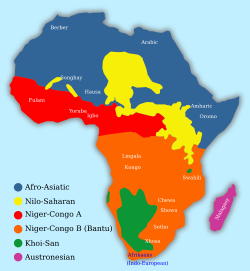
Language
Language may refer either to the specifically human capacity for acquiring and using complex systems of communication, or to a specific instance of such a system of complex communication...
s spoken natively in Africa
Africa
Africa is the world's second largest and second most populous continent, after Asia. At about 30.2 million km² including adjacent islands, it covers 6% of the Earth's total surface area and 20.4% of the total land area...
in several major language families
Language family
A language family is a group of languages related through descent from a common ancestor, called the proto-language of that family. The term 'family' comes from the tree model of language origination in historical linguistics, which makes use of a metaphor comparing languages to people in a...
:
- Afro-Asiatic spread throughout the Middle EastMiddle EastThe Middle East is a region that encompasses Western Asia and Northern Africa. It is often used as a synonym for Near East, in opposition to Far East...
, North AfricaNorth AfricaNorth Africa or Northern Africa is the northernmost region of the African continent, linked by the Sahara to Sub-Saharan Africa. Geopolitically, the United Nations definition of Northern Africa includes eight countries or territories; Algeria, Egypt, Libya, Morocco, South Sudan, Sudan, Tunisia, and...
, the Horn of AfricaHorn of AfricaThe Horn of Africa is a peninsula in East Africa that juts hundreds of kilometers into the Arabian Sea and lies along the southern side of the Gulf of Aden. It is the easternmost projection of the African continent...
, and parts of the SahelSahelThe Sahel is the ecoclimatic and biogeographic zone of transition between the Sahara desert in the North and the Sudanian Savannas in the south.It stretches across the North African continent between the Atlantic Ocean and the Red Sea.... - Nilo-SaharanNilo-Saharan languagesThe Nilo-Saharan languages are a proposed family of African languages spoken by some 50 million people, mainly in the upper parts of the Chari and Nile rivers , including historic Nubia, north of where the two tributaries of Nile meet...
is centered on SudanSudanSudan , officially the Republic of the Sudan , is a country in North Africa, sometimes considered part of the Middle East politically. It is bordered by Egypt to the north, the Red Sea to the northeast, Eritrea and Ethiopia to the east, South Sudan to the south, the Central African Republic to the...
and ChadChadChad , officially known as the Republic of Chad, is a landlocked country in Central Africa. It is bordered by Libya to the north, Sudan to the east, the Central African Republic to the south, Cameroon and Nigeria to the southwest, and Niger to the west...
(disputed validity) - Niger–CongoNiger–Congo languagesThe Niger–Congo languages constitute one of the world's major language families, and Africa's largest in terms of geographical area, number of speakers, and number of distinct languages. They may constitute the world's largest language family in terms of distinct languages, although this question...
covers WestWest AfricaWest Africa or Western Africa is the westernmost region of the African continent. Geopolitically, the UN definition of Western Africa includes the following 16 countries and an area of approximately 5 million square km:-Flags of West Africa:...
, CentralCentral AfricaCentral Africa is a core region of the African continent which includes Burundi, the Central African Republic, Chad, the Democratic Republic of the Congo, and Rwanda....
, and Southeast AfricaEast AfricaEast Africa or Eastern Africa is the easterly region of the African continent, variably defined by geography or geopolitics. In the UN scheme of geographic regions, 19 territories constitute Eastern Africa:... - KhoeKhoe languagesThe Khoe languages are the largest of the non-Bantu language families indigenous to southern Africa. They are often considered to be a branch of a suspected Khoisan language family, and are known as Central Khoisan in that scenario. The nearest relative of the Khoe family is the extinct and poorly...
is concentrated in the deserts of NamibiaNamibiaNamibia, officially the Republic of Namibia , is a country in southern Africa whose western border is the Atlantic Ocean. It shares land borders with Angola and Zambia to the north, Botswana to the east and South Africa to the south and east. It gained independence from South Africa on 21 March...
and BotswanaBotswanaBotswana, officially the Republic of Botswana , is a landlocked country located in Southern Africa. The citizens are referred to as "Batswana" . Formerly the British protectorate of Bechuanaland, Botswana adopted its new name after becoming independent within the Commonwealth on 30 September 1966... - AustronesianAustronesian languagesThe Austronesian languages are a language family widely dispersed throughout the islands of Southeast Asia and the Pacific, with a few members spoken on continental Asia that are spoken by about 386 million people. It is on par with Indo-European, Niger-Congo, Afroasiatic and Uralic as one of the...
on MadagascarMadagascarThe Republic of Madagascar is an island country located in the Indian Ocean off the southeastern coast of Africa...
. - Indo-EuropeanIndo-European languagesThe Indo-European languages are a family of several hundred related languages and dialects, including most major current languages of Europe, the Iranian plateau, and South Asia and also historically predominant in Anatolia...
on the southern tip of the continent.
There are several other small families and language isolate
Language isolate
A language isolate, in the absolute sense, is a natural language with no demonstrable genealogical relationship with other languages; that is, one that has not been demonstrated to descend from an ancestor common with any other language. They are in effect language families consisting of a single...
s, as well as obscure languages that have yet to be classified. In addition, Africa has a wide variety of sign language
Sign language
A sign language is a language which, instead of acoustically conveyed sound patterns, uses visually transmitted sign patterns to convey meaning—simultaneously combining hand shapes, orientation and movement of the hands, arms or body, and facial expressions to fluidly express a speaker's...
s, many of which are language isolates.
Several African languages are whistled
Whistled language
Whistled languages use whistling to emulate speech and facilitate communication. A whistled language is a system of whistled communication which allows fluent whistlers to transmit and comprehend a potentially unlimited number of messages over long distances...
or drummed to communicate over long distances.
About a hundred of the languages of Africa are widely used for inter-ethnic communication. Arabic
Arabic language
Arabic is a name applied to the descendants of the Classical Arabic language of the 6th century AD, used most prominently in the Quran, the Islamic Holy Book...
, Berber
Berber languages
The Berber languages are a family of languages indigenous to North Africa, spoken from Siwa Oasis in Egypt to Morocco , and south to the countries of the Sahara Desert...
, Igbo
Igbo language
Igbo , or Igbo proper, is a native language of the Igbo people, an ethnic group primarily located in southeastern Nigeria. There are approximately 20 million speakers that are mostly in Nigeria and are primarily of Igbo descent. Igbo is a national language of Nigeria. It is written in the Latin...
, Somali
Somali language
The Somali language is a member of the East Cushitic branch of the Afro-Asiatic language family. Its nearest relatives are Afar and Oromo. Somali is the best documented of the Cushitic languages, with academic studies beginning before 1900....
Swahili
Swahili language
Swahili or Kiswahili is a Bantu language spoken by various ethnic groups that inhabit several large stretches of the Mozambique Channel coastline from northern Kenya to northern Mozambique, including the Comoro Islands. It is also spoken by ethnic minority groups in Somalia...
, Hausa
Hausa language
Hausa is the Chadic language with the largest number of speakers, spoken as a first language by about 25 million people, and as a second language by about 18 million more, an approximate total of 43 million people...
, Amharic
Amharic language
Amharic is a Semitic language spoken in Ethiopia. It is the second most-spoken Semitic language in the world, after Arabic, and the official working language of the Federal Democratic Republic of Ethiopia. Thus, it has official status and is used nationwide. Amharic is also the official or working...
, Oromo
Oromo language
Oromo, also known as Afaan Oromo, Oromiffa, Afan Boran, Afan Orma, and sometimes in other languages by variant spellings of these names , is an Afro-Asiatic language, and the most widely spoken of the Cushitic family. Forms of Oromo are spoken as a first language by more than 25 million Oromo and...
, and Yoruba
Yoruba language
Yorùbá is a Niger–Congo language spoken in West Africa by approximately 20 million speakers. The native tongue of the Yoruba people, it is spoken, among other languages, in Nigeria, Benin, and Togo and in communities in other parts of Africa, Europe and the Americas...
are spoken by tens of millions of people. If clusters of up to a hundred similar languages are counted together, twelve are spoken by 75 percent, and fifteen by 85 percent, of Africans as a first or additional language.
The high linguistic diversity of many African countries (Nigeria alone has over 500 languages, one of the greatest concentrations of linguistic diversity in the world) has made language policy
Language policy
Many countries have a language policy designed to favour or discourage the use of a particular language or set of languages. Although nations historically have used language policies most often to promote one official language at the expense of others, many countries now have policies designed to...
a vital issue in the post-colonial era. In recent years, African countries have become increasingly aware of the value of their linguistic inheritance. Language policies being developed nowadays are mostly aimed at multilingualism
Multilingualism
Multilingualism is the act of using, or promoting the use of, multiple languages, either by an individual speaker or by a community of speakers. Multilingual speakers outnumber monolingual speakers in the world's population. Multilingualism is becoming a social phenomenon governed by the needs of...
. For example, all African languages are considered official languages of the African Union
Languages of the African Union
The languages of the African Union are languages used by citizens within the member states of the AU. The Union has defined all languages of Africa as official, and currently uses Arabic, English, French, Portuguese, Spanish and Swahili...
(AU). 2006 was declared by the African Union
African Union
The African Union is a union consisting of 54 African states. The only all-African state not in the AU is Morocco. Established on 9 July 2002, the AU was formed as a successor to the Organisation of African Unity...
as the "Year of African Languages". However, although many mid-sized languages are used on the radio, in newspapers, and in primary-school education, and some of the larger ones are considered national language
National language
A national language is a language which has some connection—de facto or de jure—with a people and perhaps by extension the territory they occupy. The term is used variously. A national language may for instance represent the national identity of a nation or country...
s, only a few are official
Official language
An official language is a language that is given a special legal status in a particular country, state, or other jurisdiction. Typically a nation's official language will be the one used in that nation's courts, parliament and administration. However, official status can also be used to give a...
at the national level.
Language groups
Most languages spoken in Africa belong to one of three large language familiesLanguage family
A language family is a group of languages related through descent from a common ancestor, called the proto-language of that family. The term 'family' comes from the tree model of language origination in historical linguistics, which makes use of a metaphor comparing languages to people in a...
: Afroasiatic, Nilo-Saharan
Nilo-Saharan languages
The Nilo-Saharan languages are a proposed family of African languages spoken by some 50 million people, mainly in the upper parts of the Chari and Nile rivers , including historic Nubia, north of where the two tributaries of Nile meet...
, and Niger–Congo
Niger–Congo languages
The Niger–Congo languages constitute one of the world's major language families, and Africa's largest in terms of geographical area, number of speakers, and number of distinct languages. They may constitute the world's largest language family in terms of distinct languages, although this question...
. Another hundred belong to small families such as Ubangian
Ubangian languages
The Ubangian languages form a fairly close-knit language family of some seventy languages centered on the Central African Republic. They are the predominant languages of the CAR, spoken by 2–3 million people, and include the national language, Sango....
and the various families called Khoisan
Khoisan languages
The Khoisan languages are the click languages of Africa which do not belong to other language families. They include languages indigenous to southern and eastern Africa, though some, such as the Khoi languages, appear to have moved to their current locations not long before the Bantu expansion...
, or the Indo-European
Indo-European languages
The Indo-European languages are a family of several hundred related languages and dialects, including most major current languages of Europe, the Iranian plateau, and South Asia and also historically predominant in Anatolia...
and Austronesian
Austronesian languages
The Austronesian languages are a language family widely dispersed throughout the islands of Southeast Asia and the Pacific, with a few members spoken on continental Asia that are spoken by about 386 million people. It is on par with Indo-European, Niger-Congo, Afroasiatic and Uralic as one of the...
language families which originated outside Africa; the presence of the latter two dates to 2,600 and 1,000 years ago, respectively. In addition, African languages include several unclassified languages and sign languages.
Afroasiatic languages
Afro-Asiatic languagesAfro-Asiatic languages
The Afroasiatic languages , also known as Hamito-Semitic, constitute one of the world's largest language families, with about 375 living languages...
are spoken throughout the Middle East
Middle East
The Middle East is a region that encompasses Western Asia and Northern Africa. It is often used as a synonym for Near East, in opposition to Far East...
, North Africa
North Africa
North Africa or Northern Africa is the northernmost region of the African continent, linked by the Sahara to Sub-Saharan Africa. Geopolitically, the United Nations definition of Northern Africa includes eight countries or territories; Algeria, Egypt, Libya, Morocco, South Sudan, Sudan, Tunisia, and...
, the Horn of Africa
Horn of Africa
The Horn of Africa is a peninsula in East Africa that juts hundreds of kilometers into the Arabian Sea and lies along the southern side of the Gulf of Aden. It is the easternmost projection of the African continent...
, and parts of the Sahel
Sahel
The Sahel is the ecoclimatic and biogeographic zone of transition between the Sahara desert in the North and the Sudanian Savannas in the south.It stretches across the North African continent between the Atlantic Ocean and the Red Sea....
. There are approximately 375 Afro-Asiatic languages spoken by over 350 million people. The main subfamilies of Afro-Asiatic are the Berber languages
Berber languages
The Berber languages are a family of languages indigenous to North Africa, spoken from Siwa Oasis in Egypt to Morocco , and south to the countries of the Sahara Desert...
, Semitic languages
Semitic languages
The Semitic languages are a group of related languages whose living representatives are spoken by more than 270 million people across much of the Middle East, North Africa and the Horn of Africa...
, Chadic languages
Chadic languages
The Chadic languages constitute a language family of perhaps 200 languages spoken across northern Nigeria, Niger, Chad, Central African Republic and Cameroon, belonging to the Afroasiatic phylum...
and the Cushitic languages
Cushitic languages
The Cushitic languages are a branch of the Afroasiatic language family spoken in the Horn of Africa, Tanzania, Kenya, Sudan and Egypt. They are named after the Biblical character Cush, who was identified as an ancestor of the speakers of these specific languages as early as AD 947...
. The Afro-Asiatic Urheimat is uncertain. However, its most extensive sub-branch, the Semitic languages (including Arabic, Amharic and Hebrew among others), seems to have developed in the Arabian peninsula. The Semitic languages are the only branch of the Afro-Asiatic family of languages that is spoken outside of Africa.
Some of the most widely spoken Afro-Asiatic languages include Arabic
Arabic language
Arabic is a name applied to the descendants of the Classical Arabic language of the 6th century AD, used most prominently in the Quran, the Islamic Holy Book...
(a Semitic language, and a recent arrival from West Asia), Berber
Berber languages
The Berber languages are a family of languages indigenous to North Africa, spoken from Siwa Oasis in Egypt to Morocco , and south to the countries of the Sahara Desert...
(Berber), Hausa
Hausa language
Hausa is the Chadic language with the largest number of speakers, spoken as a first language by about 25 million people, and as a second language by about 18 million more, an approximate total of 43 million people...
(Chadic), Amharic (Semitic), and Oromo
Oromo language
Oromo, also known as Afaan Oromo, Oromiffa, Afan Boran, Afan Orma, and sometimes in other languages by variant spellings of these names , is an Afro-Asiatic language, and the most widely spoken of the Cushitic family. Forms of Oromo are spoken as a first language by more than 25 million Oromo and...
and Somali
Somali language
The Somali language is a member of the East Cushitic branch of the Afro-Asiatic language family. Its nearest relatives are Afar and Oromo. Somali is the best documented of the Cushitic languages, with academic studies beginning before 1900....
(Cushitic). Of the world's surviving language families, Afro-Asiatic has the longest written history, as both the Akkadian language
Akkadian language
Akkadian is an extinct Semitic language that was spoken in ancient Mesopotamia. The earliest attested Semitic language, it used the cuneiform writing system derived ultimately from ancient Sumerian, an unrelated language isolate...
of Mesopotamia and Ancient Egyptian
Egyptian language
Egyptian is the oldest known indigenous language of Egypt and a branch of the Afroasiatic language family. Written records of the Egyptian language have been dated from about 3400 BC, making it one of the oldest recorded languages known. Egyptian was spoken until the late 17th century AD in the...
are members.
Nilo-Saharan languages
Nilo-Saharan is extremely diverse and thus a somewhat controversial grouping uniting over a hundred languages from southern EgyptEgypt
Egypt , officially the Arab Republic of Egypt, Arabic: , is a country mainly in North Africa, with the Sinai Peninsula forming a land bridge in Southwest Asia. Egypt is thus a transcontinental country, and a major power in Africa, the Mediterranean Basin, the Middle East and the Muslim world...
to northern Tanzania
Tanzania
The United Republic of Tanzania is a country in East Africa bordered by Kenya and Uganda to the north, Rwanda, Burundi, and the Democratic Republic of the Congo to the west, and Zambia, Malawi, and Mozambique to the south. The country's eastern borders lie on the Indian Ocean.Tanzania is a state...
and into Nigeria
Nigeria
Nigeria , officially the Federal Republic of Nigeria, is a federal constitutional republic comprising 36 states and its Federal Capital Territory, Abuja. The country is located in West Africa and shares land borders with the Republic of Benin in the west, Chad and Cameroon in the east, and Niger in...
and DR Congo
Democratic Republic of the Congo
The Democratic Republic of the Congo is a state located in Central Africa. It is the second largest country in Africa by area and the eleventh largest in the world...
, with the Songhay languages
Songhay languages
The Songhay, Songhai, or Songai languages are a group of closely related languages/dialects centered on the middle stretches of the Niger River in the west African states of Mali, Niger, Benin, Burkina Faso, and Nigeria. They have been widely used as a lingua franca in that region ever since the...
along the middle reaches of the Niger River
Niger River
The Niger River is the principal river of western Africa, extending about . Its drainage basin is in area. Its source is in the Guinea Highlands in southeastern Guinea...
as a geographic outlier. The languages share some unusual morphology
Morphology (linguistics)
In linguistics, morphology is the identification, analysis and description, in a language, of the structure of morphemes and other linguistic units, such as words, affixes, parts of speech, intonation/stress, or implied context...
, but if they are related, most of the branches must have undergone major restructuring since diverging from their common ancestor. The inclusion of the Songhay languages
Songhay languages
The Songhay, Songhai, or Songai languages are a group of closely related languages/dialects centered on the middle stretches of the Niger River in the west African states of Mali, Niger, Benin, Burkina Faso, and Nigeria. They have been widely used as a lingua franca in that region ever since the...
is questionable, and doubts have been raised over the Koman, Gumuz
Gumuz language
Gumuz is a dialect cluster spoken along the border of Ethiopia and Sudan. Most Ethiopian speakers live in the Metekel Zone of the Benishangul-Gumuz Region, although a group of 1,000 live outside the town of Welkite...
, and Kadu
Kadu languages
The Kadu, Kadugli–Krongo, or Tumtum languages are a small language family, once included in Kordofanian but since Thilo Schadeberg widely seen as Nilo-Saharan. However, there is little evidence, and a conservative classification would treat them as an independent family. There are three...
branches.
Some of the more better known Nilo-Saharan languages are Kanuri
Kanuri language
Kanuri is a dialect continuum spoken by some four million people, as of 1987, in Nigeria, Niger, Chad and Cameroon, as well as small minorities in southern Libya and by a diaspora in Sudan. It belongs to the Western Saharan subphylum of Nilo-Saharan...
, Songhay, Nubian
Nubian languages
The Nubian language group, according to the most recent research by Bechhaus-Gerst comprises the following varieties:# Nobiin ....
, and the widespread Nilotic family
Nilotic languages
The Nilotic languages are a group of Eastern Sudanic languages spoken across a wide area between southern Sudan and Tanzania by the Nilotic peoples, particularly associated with cattle-herding...
, which includes Luo
Luo languages
The Nilotic Luo languages, or Lwoian, are a dozen languages spoken by the Luo peoples in an area ranging from southern Sudan via Uganda to southern Kenya, with Dholuo extending into northern Tanzania and Alur into the Democratic Republic of the Congo. They form one of the two branches of Western...
, Dinka
Dinka language
This article is about the language, for the ethnic group see Dinka.Dinka, or , is a Nilotic dialect cluster spoken by the Dinka people, the major ethnic group of South Sudan. There are five main varieties, Ngok, Rek, Agaar, Twic / Tuic East, and Bor, which are distinct enough to require separate...
, and Maasai
Maasai language
The Maasai language is an Eastern Nilotic language spoken in Southern Kenya and Northern Tanzania by the Maasai people, numbering about 800,000...
. The Nilo-Saharan languages are tonal
Tone (linguistics)
Tone is the use of pitch in language to distinguish lexical or grammatical meaning—that is, to distinguish or inflect words. All verbal languages use pitch to express emotional and other paralinguistic information, and to convey emphasis, contrast, and other such features in what is called...
.
Niger–Congo languages
The Niger–Congo language family is the largest group of Africa (and probably of the world) in terms of the number of languages. One of its salient features is an elaborate noun classNoun class
In linguistics, the term noun class refers to a system of categorizing nouns. A noun may belong to a given class because of characteristic features of its referent, such as sex, animacy, shape, but counting a given noun among nouns of such or another class is often clearly conventional...
system with grammatical concord
Agreement (linguistics)
In languages, agreement or concord is a form of cross-reference between different parts of a sentence or phrase. Agreement happens when a word changes form depending on the other words to which it relates....
. The vast majority of languages of this family are tonal such as Yoruba
Yoruba language
Yorùbá is a Niger–Congo language spoken in West Africa by approximately 20 million speakers. The native tongue of the Yoruba people, it is spoken, among other languages, in Nigeria, Benin, and Togo and in communities in other parts of Africa, Europe and the Americas...
and Igbo
Igbo language
Igbo , or Igbo proper, is a native language of the Igbo people, an ethnic group primarily located in southeastern Nigeria. There are approximately 20 million speakers that are mostly in Nigeria and are primarily of Igbo descent. Igbo is a national language of Nigeria. It is written in the Latin...
. A major branch of Niger–Congo languages is the Bantu family
Bantu languages
The Bantu languages constitute a traditional sub-branch of the Niger–Congo languages. There are about 250 Bantu languages by the criterion of mutual intelligibility, though the distinction between language and dialect is often unclear, and Ethnologue counts 535 languages...
, which covers a greater geographic area than the rest of the family put together (see Niger–Congo B (Bantu) in the map above).
The Niger–Kordofanian language family, joining Niger–Congo with the Kordofanian languages
Kordofanian languages
The Kordofanian languages are a geographic grouping of three to five language families spoken in the Nuba Mountains of Kordofan Province, Sudan. In 1963 Joseph Greenberg added them to the Niger–Congo family, creating his Niger–Kordofanian proposal...
of south-central Sudan
Sudan
Sudan , officially the Republic of the Sudan , is a country in North Africa, sometimes considered part of the Middle East politically. It is bordered by Egypt to the north, the Red Sea to the northeast, Eritrea and Ethiopia to the east, South Sudan to the south, the Central African Republic to the...
, was proposed in 1950s by Joseph Greenberg
Joseph Greenberg
Joseph Harold Greenberg was a prominent and controversial American linguist, principally known for his work in two areas, linguistic typology and the genetic classification of languages.- Early life and career :...
. Today, linguists often use "Niger–Congo" to refer to this entire family, including Kordofanian as a subfamily. One reason for this is that it is not clear whether Kordofanian was the first branch to diverge from rest of Niger–Congo. Mande
Mande languages
The Mande languages are spoken in several countries in West Africa by the Mandé people and include Mandinka, Soninke, Bambara, Bissa, Dioula, Kagoro, Bozo, Mende, Susu, Yacouba, Vai, and Ligbi...
has been claimed to be equally or more divergent. Niger–Congo is generally accepted by linguists, though a few question the inclusion of Mande and Dogon
Dogon languages
The Dogon languages are spoken by the Dogon of Mali. There are about 600,000 speakers of a dozen languages. They are tonal languages, most like Dogul having two tones, some like Donno So having three....
, and there is no real evidence for the inclusion of Ubangian
Ubangian languages
The Ubangian languages form a fairly close-knit language family of some seventy languages centered on the Central African Republic. They are the predominant languages of the CAR, spoken by 2–3 million people, and include the national language, Sango....
.
Austronesian
Several languages spoken in Africa belong to language families concentrated or originating outside of the African continent: for example, MalagasyMalagasy language
Malagasy is the national language of Madagascar, a member of the Austronesian family of languages. Most people in Madagascar speak it as a first language as do some people of Malagasy descent elsewhere.-History:...
, the language of Madagascar
Madagascar
The Republic of Madagascar is an island country located in the Indian Ocean off the southeastern coast of Africa...
, is an Austronesian
Austronesian languages
The Austronesian languages are a language family widely dispersed throughout the islands of Southeast Asia and the Pacific, with a few members spoken on continental Asia that are spoken by about 386 million people. It is on par with Indo-European, Niger-Congo, Afroasiatic and Uralic as one of the...
language.
Indo-European
AfrikaansAfrikaans
Afrikaans is a West Germanic language, spoken natively in South Africa and Namibia. It is a daughter language of Dutch, originating in its 17th century dialects, collectively referred to as Cape Dutch .Afrikaans is a daughter language of Dutch; see , , , , , .Afrikaans was historically called Cape...
is Indo-European
Indo-European languages
The Indo-European languages are a family of several hundred related languages and dialects, including most major current languages of Europe, the Iranian plateau, and South Asia and also historically predominant in Anatolia...
, as are the lexifiers of most African creoles
Creole language
A creole language, or simply a creole, is a stable natural language developed from the mixing of parent languages; creoles differ from pidgins in that they have been nativized by children as their primary language, making them have features of natural languages that are normally missing from...
. Afrikaans is the only Indo-European language known to have developed in Africa.
Since the colonial era, Indo-European languages such as Afrikaans
Afrikaans
Afrikaans is a West Germanic language, spoken natively in South Africa and Namibia. It is a daughter language of Dutch, originating in its 17th century dialects, collectively referred to as Cape Dutch .Afrikaans is a daughter language of Dutch; see , , , , , .Afrikaans was historically called Cape...
, English
English language
English is a West Germanic language that arose in the Anglo-Saxon kingdoms of England and spread into what was to become south-east Scotland under the influence of the Anglian medieval kingdom of Northumbria...
, French
French language
French is a Romance language spoken as a first language in France, the Romandy region in Switzerland, Wallonia and Brussels in Belgium, Monaco, the regions of Quebec and Acadia in Canada, and by various communities elsewhere. Second-language speakers of French are distributed throughout many parts...
, Italian
Italian language
Italian is a Romance language spoken mainly in Europe: Italy, Switzerland, San Marino, Vatican City, by minorities in Malta, Monaco, Croatia, Slovenia, France, Libya, Eritrea, and Somalia, and by immigrant communities in the Americas and Australia...
, Portuguese
Portuguese language
Portuguese is a Romance language that arose in the medieval Kingdom of Galicia, nowadays Galicia and Northern Portugal. The southern part of the Kingdom of Galicia became independent as the County of Portugal in 1095...
and Spanish
Spanish language
Spanish , also known as Castilian , is a Romance language in the Ibero-Romance group that evolved from several languages and dialects in central-northern Iberia around the 9th century and gradually spread with the expansion of the Kingdom of Castile into central and southern Iberia during the...
have held official status in many countries, and are widely spoken, generally as lingua franca
Lingua franca
A lingua franca is a language systematically used to make communication possible between people not sharing a mother tongue, in particular when it is a third language, distinct from both mother tongues.-Characteristics:"Lingua franca" is a functionally defined term, independent of the linguistic...
s. (See African French
African French
African French is the generic name of the varieties of French spoken by an estimated 115 million African people spread across 31 francophone African countries...
and African Portuguese.) Indian languages
Languages of India
The languages of India belong to several language families, the major ones being the Indo-European languages—Indo-Aryan and the Dravidian languages...
such as Gujarati
Gujarati language
Gujarati is an Indo-Aryan language, and part of the greater Indo-European language family. It is derived from a language called Old Gujarati which is the ancestor language of the modern Gujarati and Rajasthani languages...
are spoken by South Asia
South Asia
South Asia, also known as Southern Asia, is the southern region of the Asian continent, which comprises the sub-Himalayan countries and, for some authorities , also includes the adjoining countries to the west and the east...
n expatriates exclusively. In earlier historical times, other Indo-European languages could be found in various parts of the continent, such as Old Persian
Old Persian language
The Old Persian language is one of the two directly attested Old Iranian languages . Old Persian appears primarily in the inscriptions, clay tablets, and seals of the Achaemenid era...
and Greek
Koine Greek
Koine Greek is the universal dialect of the Greek language spoken throughout post-Classical antiquity , developing from the Attic dialect, with admixture of elements especially from Ionic....
in Egypt, Latin
Latin
Latin is an Italic language originally spoken in Latium and Ancient Rome. It, along with most European languages, is a descendant of the ancient Proto-Indo-European language. Although it is considered a dead language, a number of scholars and members of the Christian clergy speak it fluently, and...
and Vandalic in North Africa, and Modern Persian
Persian language
Persian is an Iranian language within the Indo-Iranian branch of the Indo-European languages. It is primarily spoken in Iran, Afghanistan, Tajikistan and countries which historically came under Persian influence...
in the Horn of Africa
Horn of Africa
The Horn of Africa is a peninsula in East Africa that juts hundreds of kilometers into the Arabian Sea and lies along the southern side of the Gulf of Aden. It is the easternmost projection of the African continent...
.
Small families
Besides the three small Khoisan families of southern Africa, the following have not been shown to be related to the major families of Africa:- MandeMande languagesThe Mande languages are spoken in several countries in West Africa by the Mandé people and include Mandinka, Soninke, Bambara, Bissa, Dioula, Kagoro, Bozo, Mende, Susu, Yacouba, Vai, and Ligbi...
, some 70 languages, including the major languages of MaliMaliMali , officially the Republic of Mali , is a landlocked country in Western Africa. Mali borders Algeria on the north, Niger on the east, Burkina Faso and the Côte d'Ivoire on the south, Guinea on the south-west, and Senegal and Mauritania on the west. Its size is just over 1,240,000 km² with...
and GuineaGuineaGuinea , officially the Republic of Guinea , is a country in West Africa. Formerly known as French Guinea , it is today sometimes called Guinea-Conakry to distinguish it from its neighbour Guinea-Bissau. Guinea is divided into eight administrative regions and subdivided into thirty-three prefectures...
. These are generally thought to be divergent Niger–Congo. - UbangianUbangian languagesThe Ubangian languages form a fairly close-knit language family of some seventy languages centered on the Central African Republic. They are the predominant languages of the CAR, spoken by 2–3 million people, and include the national language, Sango....
, some 70 languages, including the languages of the Central African RepublicCentral African RepublicThe Central African Republic , is a landlocked country in Central Africa. It borders Chad in the north, Sudan in the north east, South Sudan in the east, the Democratic Republic of the Congo and the Republic of the Congo in the south, and Cameroon in the west. The CAR covers a land area of about ,... - KhoeKhoe languagesThe Khoe languages are the largest of the non-Bantu language families indigenous to southern Africa. They are often considered to be a branch of a suspected Khoisan language family, and are known as Central Khoisan in that scenario. The nearest relative of the Khoe family is the extinct and poorly...
, about 10 languages, the primary family of Khoisan languagesKhoisan languagesThe Khoisan languages are the click languages of Africa which do not belong to other language families. They include languages indigenous to southern and eastern Africa, though some, such as the Khoi languages, appear to have moved to their current locations not long before the Bantu expansion...
of NamibiaNamibiaNamibia, officially the Republic of Namibia , is a country in southern Africa whose western border is the Atlantic Ocean. It shares land borders with Angola and Zambia to the north, Botswana to the east and South Africa to the south and east. It gained independence from South Africa on 21 March...
and BotswanaBotswanaBotswana, officially the Republic of Botswana , is a landlocked country located in Southern Africa. The citizens are referred to as "Batswana" . Formerly the British protectorate of Bechuanaland, Botswana adopted its new name after becoming independent within the Commonwealth on 30 September 1966... - SandaweSandawe languageSandawe or Sandawi is a tonal language spoken by about 40,000 Sandawe people in the Dodoma region of Tanzania. Language use is vigorous among both adults and children, with people in some areas monolingual. Sandawe had generally been classified as a member of the defunct Khoisan family since Albert...
, an isolate of Tanzania, possibly related to Khoe - SonghaiSonghay languagesThe Songhay, Songhai, or Songai languages are a group of closely related languages/dialects centered on the middle stretches of the Niger River in the west African states of Mali, Niger, Benin, Burkina Faso, and Nigeria. They have been widely used as a lingua franca in that region ever since the...
along the middle Niger RiverNiger RiverThe Niger River is the principal river of western Africa, extending about . Its drainage basin is in area. Its source is in the Guinea Highlands in southeastern Guinea... - Kx'a of southern Africa
- TuuTuu languagesThe Tuu or Taa–ǃKwi languages are a language family consisting of two language clusters spoken in Botswana and South Africa. The relationship between the two clusters is not doubted, but is not close. The name Tuu comes from a word for person common to both branches of the family...
, or Taa-Ui, two surviving languages - KaduKadu languagesThe Kadu, Kadugli–Krongo, or Tumtum languages are a small language family, once included in Kordofanian but since Thilo Schadeberg widely seen as Nilo-Saharan. However, there is little evidence, and a conservative classification would treat them as an independent family. There are three...
, half a dozen poorly attested languages of the Nuba Hills in Sudan - Koman, half a dozen poorly attested languages of Sudan-Ethiopia (possibly Nilo-Saharan)
- HadzaHadza languageHadza is a language isolate spoken by fewer than a thousand Hadza people along the shores of Lake Eyasi in Tanzania, the last full-time hunter-gatherers in Africa. Despite the small number of speakers, language use is vigorous, with most children learning it...
, and isolate of Tanzania - Bangi-meBangi-meThe Bangime language, or in full , is spoken by some 1500 ethnic Dogon in seven villages in southern Mali, who call themselves the . Long known to be highly divergent from Dogon languages, it was first proposed as a possible isolate by Blench...
, a likely isolate of Mali
Khoisan
Khoisan languages
The Khoisan languages are the click languages of Africa which do not belong to other language families. They include languages indigenous to southern and eastern Africa, though some, such as the Khoi languages, appear to have moved to their current locations not long before the Bantu expansion...
is a term of convenience covering some 30 languages spoken by about 300 000–400 000 people. There are five Khoisan families which have not been shown to be related to each other, Khoe
Khoe languages
The Khoe languages are the largest of the non-Bantu language families indigenous to southern Africa. They are often considered to be a branch of a suspected Khoisan language family, and are known as Central Khoisan in that scenario. The nearest relative of the Khoe family is the extinct and poorly...
, Tuu
Tuu languages
The Tuu or Taa–ǃKwi languages are a language family consisting of two language clusters spoken in Botswana and South Africa. The relationship between the two clusters is not doubted, but is not close. The name Tuu comes from a word for person common to both branches of the family...
, and Kx'a (these are found mainly in Namibia
Namibia
Namibia, officially the Republic of Namibia , is a country in southern Africa whose western border is the Atlantic Ocean. It shares land borders with Angola and Zambia to the north, Botswana to the east and South Africa to the south and east. It gained independence from South Africa on 21 March...
and Botswana
Botswana
Botswana, officially the Republic of Botswana , is a landlocked country located in Southern Africa. The citizens are referred to as "Batswana" . Formerly the British protectorate of Bechuanaland, Botswana adopted its new name after becoming independent within the Commonwealth on 30 September 1966...
) and Sandawe
Sandawe language
Sandawe or Sandawi is a tonal language spoken by about 40,000 Sandawe people in the Dodoma region of Tanzania. Language use is vigorous among both adults and children, with people in some areas monolingual. Sandawe had generally been classified as a member of the defunct Khoisan family since Albert...
and Hadza
Hadza language
Hadza is a language isolate spoken by fewer than a thousand Hadza people along the shores of Lake Eyasi in Tanzania, the last full-time hunter-gatherers in Africa. Despite the small number of speakers, language use is vigorous, with most children learning it...
of Tanzania
Tanzania
The United Republic of Tanzania is a country in East Africa bordered by Kenya and Uganda to the north, Rwanda, Burundi, and the Democratic Republic of the Congo to the west, and Zambia, Malawi, and Mozambique to the south. The country's eastern borders lie on the Indian Ocean.Tanzania is a state...
, which are language isolate
Language isolate
A language isolate, in the absolute sense, is a natural language with no demonstrable genealogical relationship with other languages; that is, one that has not been demonstrated to descend from an ancestor common with any other language. They are in effect language families consisting of a single...
s. A striking feature of Khoisan languages, and the reason they are often counted together, is their use of click consonant
Click consonant
Clicks are speech sounds found as consonants in many languages of southern Africa, and in three languages of East Africa. Examples of these sounds familiar to English speakers are the tsk! tsk! or tut-tut used to express disapproval or pity, the tchick! used to spur on a horse, and the...
s. Some neighbouring Bantu languages (notably Xhosa
Xhosa language
Xhosa is one of the official languages of South Africa. Xhosa is spoken by approximately 7.9 million people, or about 18% of the South African population. Like most Bantu languages, Xhosa is a tonal language, that is, the same sequence of consonants and vowels can have different meanings when said...
and Zulu
Zulu language
Zulu is the language of the Zulu people with about 10 million speakers, the vast majority of whom live in South Africa. Zulu is the most widely spoken home language in South Africa as well as being understood by over 50% of the population...
) have clicks as well, but these were adopted from Khoisan languages. The Khoisan languages are also tonal.
Creole languages
Due partly to its multilingualism and its colonial past, a substantial proportion of the world's creole languageCreole language
A creole language, or simply a creole, is a stable natural language developed from the mixing of parent languages; creoles differ from pidgins in that they have been nativized by children as their primary language, making them have features of natural languages that are normally missing from...
s are to be found in Africa. Some are based on Indo-European languages (e.g. Krio from English in Sierra Leone
Sierra Leone
Sierra Leone , officially the Republic of Sierra Leone, is a country in West Africa. It is bordered by Guinea to the north and east, Liberia to the southeast, and the Atlantic Ocean to the west and southwest. Sierra Leone covers a total area of and has an estimated population between 5.4 and 6.4...
and the very similar Pidgin
West African Pidgin English
West African Pidgin English, also called Guinea Coast Creole English, was the lingua franca, or language of commerce, spoken along the West African coast during the period of the Atlantic slave trade...
in Cameroon
Cameroon
Cameroon, officially the Republic of Cameroon , is a country in west Central Africa. It is bordered by Nigeria to the west; Chad to the northeast; the Central African Republic to the east; and Equatorial Guinea, Gabon, and the Republic of the Congo to the south. Cameroon's coastline lies on the...
and Nigeria
Nigeria
Nigeria , officially the Federal Republic of Nigeria, is a federal constitutional republic comprising 36 states and its Federal Capital Territory, Abuja. The country is located in West Africa and shares land borders with the Republic of Benin in the west, Chad and Cameroon in the east, and Niger in...
, Cape Verdean Creole in Cape Verde
Cape Verde
The Republic of Cape Verde is an island country, spanning an archipelago of 10 islands located in the central Atlantic Ocean, 570 kilometres off the coast of Western Africa...
and Guinea-Bissau Creole in Guinea-Bissau
Guinea-Bissau
The Republic of Guinea-Bissau is a country in West Africa. It is bordered by Senegal to the north, and Guinea to the south and east, with the Atlantic Ocean to its west....
and Senegal
Senegal
Senegal , officially the Republic of Senegal , is a country in western Africa. It owes its name to the Sénégal River that borders it to the east and north...
both from Portuguese, Seychellois Creole
Seychellois Creole
Seychellois Creole, also known as Kreol or Seselwa, is the French-based creole language of the Seychelles. It shares official language status with English and French ....
from French in the Seychelles
Seychelles
Seychelles , officially the Republic of Seychelles , is an island country spanning an archipelago of 115 islands in the Indian Ocean, some east of mainland Africa, northeast of the island of Madagascar....
, or Mauritian Creole
Mauritian Creole
Mauritian Creole is a French-based creole language spoken in Mauritius. In addition to the French base of the language, there are also some words from English and from the many African and Asian languages that have been spoken on the island.- Sociolinguistic Situation :Mauritian Creole is the...
in Mauritius
Mauritius
Mauritius , officially the Republic of Mauritius is an island nation off the southeast coast of the African continent in the southwest Indian Ocean, about east of Madagascar...
); some are based on Arabic (e.g., Juba Arabic in the southern Sudan
Sudan
Sudan , officially the Republic of the Sudan , is a country in North Africa, sometimes considered part of the Middle East politically. It is bordered by Egypt to the north, the Red Sea to the northeast, Eritrea and Ethiopia to the east, South Sudan to the south, the Central African Republic to the...
, or Nubi
Nubi language
The Nubi language is a Sudanese Arabic-based creole language spoken in Uganda around Bombo, and in Kenya around Kibera, by the descendants of Emin Pasha's Sudanese soldiers who were settled there by the British colonial administration...
in parts of Uganda
Uganda
Uganda , officially the Republic of Uganda, is a landlocked country in East Africa. Uganda is also known as the "Pearl of Africa". It is bordered on the east by Kenya, on the north by South Sudan, on the west by the Democratic Republic of the Congo, on the southwest by Rwanda, and on the south by...
and Kenya
Kenya
Kenya , officially known as the Republic of Kenya, is a country in East Africa that lies on the equator, with the Indian Ocean to its south-east...
); some are based on local languages (e.g., Sango
Sango language
Sango is the primary language spoken in the Central African Republic: it has approximately 1,600,000 second-language speakers, but only about 404,000 native speakers, mainly in the towns.- Classification :...
, the main language of the Central African Republic
Central African Republic
The Central African Republic , is a landlocked country in Central Africa. It borders Chad in the north, Sudan in the north east, South Sudan in the east, the Democratic Republic of the Congo and the Republic of the Congo in the south, and Cameroon in the west. The CAR covers a land area of about ,...
.)
Unclassified languages
A fair number of unclassified languages are reported in Africa; many remain unclassified simply for lack of data, but among the better-investigated ones may be listed:- possibly Afroasiatic: OngotaOngota languageOngota is a moribund language of southwest Ethiopia. In 2008, it was said to be in a state of decline with only 6 elderly native speakers, the rest of their small village on the west bank of the Weito River having adopted the Tsamai language instead. The grammar follows a Subject Object Verb word...
, GombaGomba language-References:* , Linguistic Contribution to the History of Sub-Saharan Africa, University of Lyons... - possibly Nilo-Saharan: ShaboShabo languageShabo is an endangered language spoken by about 600 hunter-gatherers in southwestern Ethiopia, in the westernmost part of the Southern Nations, Nationalities, and People's Region. They live in three places in the Keficho Shekicho Zone: Anderaccha, Gecha, and Kaabo...
- possibly Niger–Congo: JalaaJalaa languageJalaa Centúúm or Cen Tuum is an endangered language of northeastern Nigeria , of uncertain origins...
, MbreMbre languageMbre, also spelled Bre, Bεrε, Pre, is a endangered language spoken not far from the city of Bouaké, Ivory Coast. It had 200 speakers out of an ethnic population of 700 in the year 2000, in two villages, down from 15 villages some years earlier... - possibly Khoe: KwadiKwadi languageKwadi is a "click language" of uncertain classification once spoken in the southwest corner of Angola. It is believed to be extinct. There were only fifty Kwadi in the 1950s, of which only 4–5 were competent speakers of the language...
- unknown: LaalLaal languageLaal is an unclassified language spoken by 749 people in three villages in the Moyen-Chari prefecture of Chad on opposite banks of the Chari River,...
, MpreMpre languageMpre Mpra is a language once spoken in the village of Butie in Ghana, near the confluence of the Black and White Voltas, that has been difficult to classify...
Less-well investigated ones include Irimba
Rimba language
Rimba is the speech variety of the Babongo-Rimba pygmies of Gabon. Generally considered a dialect of Punu, it may preserve a core of non-Bantu vocabulary, and so to be conservative should be considered unclassified.-References:...
, Luo, Mawa
Mawa language (Nigeria)
Mawa is an extinct language of Nigeria. It was apparently different from a language of Chad also known as Mawa, and so is unclassified....
, Rer Bare
Rer Bare
The Rer Bare are a tribe in Ethiopia's eastern Ogaden region on the Shabele River, near Somalia, who currently speak Somali...
(possibly Bantu), Bete
Bete language
The Bete language of Nigeria is a nearly extinct language spoken by a small minority of the 3,000 inhabitants of Bete Town, Takum Local Government Authority, Taraba State; its speakers have mostly shifted to Jukun Takum. It is reported to have been close to Lufu and Bibi...
(evidently Jukunoid), Bung
Bung language
The Bung language is a nearly extinct language of Cameroon spoken by 3 people at the village of Boung on the Adamawa Plateau. A wordlist collected for it shows its strongest resemblance to be with the Ndung dialect of Mambiloid language Kwanja, although that may simply be because this has become...
(unclear), Kujarge
Kujargé language
The Kujargé language is spoken in seven villages in Chad near Jebel Mirra and in Sudan in villages scattered along the lower Wadi Salih and Wadi Azum. It is estimated to have about 1000 speakers . The name is derived from Sudanese Arabic kujur "sorcerer", because of their reputation for witchcraft...
(evidently Chadic), Lufu
Lufu language
The Lufu language of Nigeria is a language still spoken mostly by older adults among the Lufu people of the Takum Local Government Authority, Taraba State; its speakers have mostly shifted to Jukun. It is reported to have been close to Bete and Bibi...
(Jukunoid), Oropom
Oropom language
Oropom is a dubious and, if real, almost certainly extinct African language, purportedly once spoken in northeastern Uganda and northwestern Kenya between the Turkwel River, Chemorongit Mountains, and Mount Elgon, by the Oropom people...
(possibly spurious), and Weyto
Weyto language
The Weyto language is believed to be an extinct language formerly spoken in the Lake Tana region of Ethiopia by the Weyto, a small group of hippopotamus hunters who now speak Amharic....
(evidently Cushitic). Several of these are extinct, and adequate comparative data is thus unlikely to be forthcoming.
Sign languages
Many African countries have national sign languages, such as Algerian Sign LanguageAlgerian Sign Language
Algerian Sign Language Algerian Sign Language Algerian Sign Language (French: Langue des signes algérienne (LSA),Tamazight: Tamslayt Tadugamt n Lezzayer, Arabic: لغة الإشارة الجزائر...
, Tunisian Sign Language, Ethiopian Sign Language, while other sign languages are restricted to small areas or single villages, such as Adamorobe Sign Language
Adamorobe Sign Language
Adamorobe Sign Language is an indigenous sign language used in Adamorobe, an Akan village in eastern Ghana. It is used by about 30 deaf and 1370 hearing people.”...
in Ghana
Ghana
Ghana , officially the Republic of Ghana, is a country located in West Africa. It is bordered by Côte d'Ivoire to the west, Burkina Faso to the north, Togo to the east, and the Gulf of Guinea to the south...
. Tanzania has seven, one for each of its schools for the Deaf, all of which are discouraged. Not much is known, since little has been published on these languages.
Language in Africa
Throughout the long multilingual history of the African continent, African languages have been subject to phenomena like language contact, language expansion, language shift, and language death. A case in point is the Bantu expansionBantu expansion
The Bantu expansion or the Bantu Migration was a millennia-long series of migrations of speakers of the original proto-Bantu language group...
, in which Bantu-speaking peoples expanded over most of Sub-Saharan Africa
Sub-Saharan Africa
Sub-Saharan Africa as a geographical term refers to the area of the African continent which lies south of the Sahara. A political definition of Sub-Saharan Africa, instead, covers all African countries which are fully or partially located south of the Sahara...
, displacing Khoi-San speaking peoples from much of East Africa
East Africa
East Africa or Eastern Africa is the easterly region of the African continent, variably defined by geography or geopolitics. In the UN scheme of geographic regions, 19 territories constitute Eastern Africa:...
and Southern Africa
Southern Africa
Southern Africa is the southernmost region of the African continent, variably defined by geography or geopolitics. Within the region are numerous territories, including the Republic of South Africa ; nowadays, the simpler term South Africa is generally reserved for the country in English.-UN...
. Another example is the Arab expansion in the 7th century, which led to the extension of Arabic
Arabic language
Arabic is a name applied to the descendants of the Classical Arabic language of the 6th century AD, used most prominently in the Quran, the Islamic Holy Book...
from its homeland in Asia, into much of North Africa.
Trade languages are another age-old phenomenon in the African linguistic landscape. Cultural and linguistic innovations spread along trade routes and languages of peoples dominant in trade developed into languages of wider communication (linguae francae
Lingua franca
A lingua franca is a language systematically used to make communication possible between people not sharing a mother tongue, in particular when it is a third language, distinct from both mother tongues.-Characteristics:"Lingua franca" is a functionally defined term, independent of the linguistic...
). Of particular importance in this respect are Berber (North and West Africa), Jula
Dioula language
Jula is a Mande language spoken in Burkina Faso, Côte d'Ivoire and Mali. It is one of the Manding languages, and is most closely related to Bambara, being mutually intelligible with Bambara as well as Malinke. It is a trade language in West Africa and is spoken by millions of people, either as a...
(western West Africa), Fulfulde
Fula language
The Fula or Fulani language is a language of West Africa. It is spoken as a first language by the and related groups from Senegambia and Guinea to Cameroon and Sudan...
(West Africa), Hausa
Hausa language
Hausa is the Chadic language with the largest number of speakers, spoken as a first language by about 25 million people, and as a second language by about 18 million more, an approximate total of 43 million people...
(West Africa), Lingala
Lingala language
Lingala, or Ngala, is a Bantu language spoken throughout the northwestern part of the Democratic Republic of the Congo and a large part of the Republic of the Congo , as well as to some degree in Angola and the Central African Republic. It has over 10 million speakers...
(Congo), Somali
Somali language
The Somali language is a member of the East Cushitic branch of the Afro-Asiatic language family. Its nearest relatives are Afar and Oromo. Somali is the best documented of the Cushitic languages, with academic studies beginning before 1900....
(Horn of Africa), Swahili
Swahili language
Swahili or Kiswahili is a Bantu language spoken by various ethnic groups that inhabit several large stretches of the Mozambique Channel coastline from northern Kenya to northern Mozambique, including the Comoro Islands. It is also spoken by ethnic minority groups in Somalia...
(East Africa) and Arabic
Arabic language
Arabic is a name applied to the descendants of the Classical Arabic language of the 6th century AD, used most prominently in the Quran, the Islamic Holy Book...
(North Africa, West Africa, and East Africa).
After gaining independence, many African countries, in the search for national unity, selected one language, generally the former colonial language, to be used in government and education. However, in recent years, African countries have become increasingly supportive of maintaining linguistic diversity. Language policies that are being developed nowadays are mostly aimed at multilingualism.
Official languages
Besides the former colonial languages of English, French, Portuguese, and Spanish, the following languages are official at the national level in Africa:- ArabicArabic languageArabic is a name applied to the descendants of the Classical Arabic language of the 6th century AD, used most prominently in the Quran, the Islamic Holy Book...
in AlgeriaAlgeriaAlgeria , officially the People's Democratic Republic of Algeria , also formally referred to as the Democratic and Popular Republic of Algeria, is a country in the Maghreb region of Northwest Africa with Algiers as its capital.In terms of land area, it is the largest country in Africa and the Arab...
, ComorosComorosThe Comoros , officially the Union of the Comoros is an archipelago island nation in the Indian Ocean, located off the eastern coast of Africa, on the northern end of the Mozambique Channel, between northeastern Mozambique and northwestern Madagascar...
, ChadChadChad , officially known as the Republic of Chad, is a landlocked country in Central Africa. It is bordered by Libya to the north, Sudan to the east, the Central African Republic to the south, Cameroon and Nigeria to the southwest, and Niger to the west...
, DjiboutiDjiboutiDjibouti , officially the Republic of Djibouti , is a country in the Horn of Africa. It is bordered by Eritrea in the north, Ethiopia in the west and south, and Somalia in the southeast. The remainder of the border is formed by the Red Sea and the Gulf of Aden at the east...
, EgyptEgyptEgypt , officially the Arab Republic of Egypt, Arabic: , is a country mainly in North Africa, with the Sinai Peninsula forming a land bridge in Southwest Asia. Egypt is thus a transcontinental country, and a major power in Africa, the Mediterranean Basin, the Middle East and the Muslim world...
, EritreaEritreaEritrea , officially the State of Eritrea, is a country in the Horn of Africa. Eritrea derives it's name from the Greek word Erethria, meaning 'red land'. The capital is Asmara. It is bordered by Sudan in the west, Ethiopia in the south, and Djibouti in the southeast...
, LibyaLibyaLibya is an African country in the Maghreb region of North Africa bordered by the Mediterranean Sea to the north, Egypt to the east, Sudan to the southeast, Chad and Niger to the south, and Algeria and Tunisia to the west....
, MauritaniaMauritaniaMauritania is a country in the Maghreb and West Africa. It is bordered by the Atlantic Ocean in the west, by Western Sahara in the north, by Algeria in the northeast, by Mali in the east and southeast, and by Senegal in the southwest...
, MoroccoMoroccoMorocco , officially the Kingdom of Morocco , is a country located in North Africa. It has a population of more than 32 million and an area of 710,850 km², and also primarily administers the disputed region of the Western Sahara...
, SomaliaSomaliaSomalia , officially the Somali Republic and formerly known as the Somali Democratic Republic under Socialist rule, is a country located in the Horn of Africa. Since the outbreak of the Somali Civil War in 1991 there has been no central government control over most of the country's territory...
, SudanSudanSudan , officially the Republic of the Sudan , is a country in North Africa, sometimes considered part of the Middle East politically. It is bordered by Egypt to the north, the Red Sea to the northeast, Eritrea and Ethiopia to the east, South Sudan to the south, the Central African Republic to the...
, and TunisiaTunisiaTunisia , officially the Tunisian RepublicThe long name of Tunisia in other languages used in the country is: , is the northernmost country in Africa. It is a Maghreb country and is bordered by Algeria to the west, Libya to the southeast, and the Mediterranean Sea to the north and east. Its area... - BerberBerber languagesThe Berber languages are a family of languages indigenous to North Africa, spoken from Siwa Oasis in Egypt to Morocco , and south to the countries of the Sahara Desert...
in MoroccoMoroccoMorocco , officially the Kingdom of Morocco , is a country located in North Africa. It has a population of more than 32 million and an area of 710,850 km², and also primarily administers the disputed region of the Western Sahara...
and AlgeriaAlgeriaAlgeria , officially the People's Democratic Republic of Algeria , also formally referred to as the Democratic and Popular Republic of Algeria, is a country in the Maghreb region of Northwest Africa with Algiers as its capital.In terms of land area, it is the largest country in Africa and the Arab... - SwahiliSwahili languageSwahili or Kiswahili is a Bantu language spoken by various ethnic groups that inhabit several large stretches of the Mozambique Channel coastline from northern Kenya to northern Mozambique, including the Comoro Islands. It is also spoken by ethnic minority groups in Somalia...
in TanzaniaTanzaniaThe United Republic of Tanzania is a country in East Africa bordered by Kenya and Uganda to the north, Rwanda, Burundi, and the Democratic Republic of the Congo to the west, and Zambia, Malawi, and Mozambique to the south. The country's eastern borders lie on the Indian Ocean.Tanzania is a state...
, KenyaKenyaKenya , officially known as the Republic of Kenya, is a country in East Africa that lies on the equator, with the Indian Ocean to its south-east...
, UgandaUgandaUganda , officially the Republic of Uganda, is a landlocked country in East Africa. Uganda is also known as the "Pearl of Africa". It is bordered on the east by Kenya, on the north by South Sudan, on the west by the Democratic Republic of the Congo, on the southwest by Rwanda, and on the south by...
, BurundiBurundiBurundi , officially the Republic of Burundi , is a landlocked country in the Great Lakes region of Eastern Africa bordered by Rwanda to the north, Tanzania to the east and south, and the Democratic Republic of the Congo to the west. Its capital is Bujumbura...
, and RwandaRwandaRwanda or , officially the Republic of Rwanda , is a country in central and eastern Africa with a population of approximately 11.4 million . Rwanda is located a few degrees south of the Equator, and is bordered by Uganda, Tanzania, Burundi and the Democratic Republic of the Congo... - ChichewaChichewa languageChewa, also known as Nyanja, is a language of the Bantu language family. The gender prefix chi- is used for languages, so the language is also known as Chichewa and Chinyanja.-Distribution:...
in MalawiMalawiThe Republic of Malawi is a landlocked country in southeast Africa that was formerly known as Nyasaland. It is bordered by Zambia to the northwest, Tanzania to the northeast, and Mozambique on the east, south and west. The country is separated from Tanzania and Mozambique by Lake Malawi. Its size... - AmharicAmharic languageAmharic is a Semitic language spoken in Ethiopia. It is the second most-spoken Semitic language in the world, after Arabic, and the official working language of the Federal Democratic Republic of Ethiopia. Thus, it has official status and is used nationwide. Amharic is also the official or working...
in EthiopiaEthiopiaEthiopia , officially known as the Federal Democratic Republic of Ethiopia, is a country located in the Horn of Africa. It is the second-most populous nation in Africa, with over 82 million inhabitants, and the tenth-largest by area, occupying 1,100,000 km2... - SomaliSomali languageThe Somali language is a member of the East Cushitic branch of the Afro-Asiatic language family. Its nearest relatives are Afar and Oromo. Somali is the best documented of the Cushitic languages, with academic studies beginning before 1900....
in Greater SomaliaGreater SomaliaGreater Somalia refers to those regions in the Horn of Africa in which ethnic Somalis are and have historically represented the predominant population. Greater Somalia encompasses Somalia, Djibouti, the Ogaden of Ethiopia and the North Eastern Province of Kenya. Pan-Somalism refers to the vision... - Kinyarwanda in RwandaRwandaRwanda or , officially the Republic of Rwanda , is a country in central and eastern Africa with a population of approximately 11.4 million . Rwanda is located a few degrees south of the Equator, and is bordered by Uganda, Tanzania, Burundi and the Democratic Republic of the Congo...
and the closely related KirundiKirundiKirundi, also known as Rundi, is a dialect of the Rwanda-Rundi language spoken by some 8.7 million people in Burundi and adjacent parts of Tanzania and Congo-Kinshasa, as well as in Uganda. It is the official language of Burundi...
in BurundiBurundiBurundi , officially the Republic of Burundi , is a landlocked country in the Great Lakes region of Eastern Africa bordered by Rwanda to the north, Tanzania to the east and south, and the Democratic Republic of the Congo to the west. Its capital is Bujumbura... - SangoSango languageSango is the primary language spoken in the Central African Republic: it has approximately 1,600,000 second-language speakers, but only about 404,000 native speakers, mainly in the towns.- Classification :...
in the CARCentral African RepublicThe Central African Republic , is a landlocked country in Central Africa. It borders Chad in the north, Sudan in the north east, South Sudan in the east, the Democratic Republic of the Congo and the Republic of the Congo in the south, and Cameroon in the west. The CAR covers a land area of about ,... - Swazi in SwazilandSwazilandSwaziland, officially the Kingdom of Swaziland , and sometimes called Ngwane or Swatini, is a landlocked country in Southern Africa, bordered to the north, south and west by South Africa, and to the east by Mozambique...
and South AfricaSouth AfricaThe Republic of South Africa is a country in southern Africa. Located at the southern tip of Africa, it is divided into nine provinces, with of coastline on the Atlantic and Indian oceans... - MalagasyMalagasy languageMalagasy is the national language of Madagascar, a member of the Austronesian family of languages. Most people in Madagascar speak it as a first language as do some people of Malagasy descent elsewhere.-History:...
in MadagascarMadagascarThe Republic of Madagascar is an island country located in the Indian Ocean off the southeastern coast of Africa... - Seychellois CreoleSeychellois CreoleSeychellois Creole, also known as Kreol or Seselwa, is the French-based creole language of the Seychelles. It shares official language status with English and French ....
in the SeychellesSeychellesSeychelles , officially the Republic of Seychelles , is an island country spanning an archipelago of 115 islands in the Indian Ocean, some east of mainland Africa, northeast of the island of Madagascar.... - ShonaShona languageShona is a Bantu language, native to the Shona people of Zimbabwe and southern Zambia; the term is also used to identify peoples who speak one of the Shona language dialects: Zezuru, Karanga, Manyika, Ndau and Korekore...
in ZimbabweZimbabweZimbabwe is a landlocked country located in the southern part of the African continent, between the Zambezi and Limpopo rivers. It is bordered by South Africa to the south, Botswana to the southwest, Zambia and a tip of Namibia to the northwest and Mozambique to the east. Zimbabwe has three... - AfrikaansAfrikaansAfrikaans is a West Germanic language, spoken natively in South Africa and Namibia. It is a daughter language of Dutch, originating in its 17th century dialects, collectively referred to as Cape Dutch .Afrikaans is a daughter language of Dutch; see , , , , , .Afrikaans was historically called Cape...
, NdebeleNorthern Ndebele languageThe Northern Ndebele language, isiNdebele, or Ndebele is an African language belonging to the Nguni group of Bantu languages, and spoken by the Ndebele or Matabele people of Zimbabwe. It is commonly known as Sindebele....
, XhosaXhosa languageXhosa is one of the official languages of South Africa. Xhosa is spoken by approximately 7.9 million people, or about 18% of the South African population. Like most Bantu languages, Xhosa is a tonal language, that is, the same sequence of consonants and vowels can have different meanings when said...
, ZuluZulu languageZulu is the language of the Zulu people with about 10 million speakers, the vast majority of whom live in South Africa. Zulu is the most widely spoken home language in South Africa as well as being understood by over 50% of the population...
, Pedi, Sotho, Tswana, Swazi, Venda, and Tsonga in South AfricaSouth AfricaThe Republic of South Africa is a country in southern Africa. Located at the southern tip of Africa, it is divided into nine provinces, with of coastline on the Atlantic and Indian oceans...
Cross-border languages
The colonial borders established by European powers following the Berlin Conference in 1884-1885 divided a great many ethnic groups and African language speaking communities. In a sense, then, "cross-border languages" is a misnomer - the speakers did not divide themselves. Nevertheless it describes the reality of many African languages, which has implications for divergence of language on either side of a border (especially when the official languages are different), standards for writing the language, etc. Some notable cross-border languages include BerberBerber languages
The Berber languages are a family of languages indigenous to North Africa, spoken from Siwa Oasis in Egypt to Morocco , and south to the countries of the Sahara Desert...
(which stretches across much of North Africa and some parts of West Africa), Swahili and Fula
Fula language
The Fula or Fulani language is a language of West Africa. It is spoken as a first language by the and related groups from Senegambia and Guinea to Cameroon and Sudan...
.
Some prominent Africans such as former Mali
Mali
Mali , officially the Republic of Mali , is a landlocked country in Western Africa. Mali borders Algeria on the north, Niger on the east, Burkina Faso and the Côte d'Ivoire on the south, Guinea on the south-west, and Senegal and Mauritania on the west. Its size is just over 1,240,000 km² with...
an president and current Chairman of the African Commission, Alpha Oumar Konaré
Alpha Oumar Konaré
Alpha Oumar Konaré was the President of Mali for two five-year terms , and was Chairperson of the African Union Commission from 2003 to 2008.-Scholarly career:...
, have referred to cross-border languages as a factor that can promote African unity.
Language change and planning
Language is not static in Africa any more than in other world regions. In addition to the (probably modest) impact of borders, there are also cases of dialect levellingDialect levelling
Dialect levelling is the means by which dialect differences decrease. For example, in rural areas of Britain, although English is widely spoken, the pronunciation and grammar have historically varied. During the 20th century people have been moving into towns and cities, standardizing the English...
(such as in Igbo
Igbo language
Igbo , or Igbo proper, is a native language of the Igbo people, an ethnic group primarily located in southeastern Nigeria. There are approximately 20 million speakers that are mostly in Nigeria and are primarily of Igbo descent. Igbo is a national language of Nigeria. It is written in the Latin...
and probably many others), koinés
Koine language
In linguistics, a koiné language is a standard language or dialect that has arisen as a result of contact between two mutually intelligible varieties of the same language. Since the speakers have understood one another from before the advent of the koiné, the koineization process is not as rapid...
(such as N'Ko
N'Ko
N'Ko is both a script devised by Solomana Kante in 1949 as a writing system for the Mande languages of West Africa, and the name of the literary language itself written in the script. The term N'Ko means 'I say' in all Manding languages....
and possibly Runyakitara
Runyakitara language
The Kitara language, commonly known as Runyakitara, is a recent standardized form of four linguistically closely related languages of western Uganda:*Nyoro or Runyoro*Kiga or Rukiga...
), and emergence of new dialects (such as Sheng
Sheng (linguistics)
Sheng is a Swahili-based patois or slang-based language, originating in Nairobi, Kenya, and influenced by the many languages spoken there. The word is coined from the two words - wahili and lish....
). In some countries there are official efforts to develop standardized language
Standard language
A standard language is a language variety used by a group of people in their public discourse. Alternatively, varieties become standard by undergoing a process of standardization, during which it is organized for description in grammars and dictionaries and encoded in such reference works...
versions.
There are also many less widely spoken languages that may be considered endangered language
Endangered language
An endangered language is a language that is at risk of falling out of use. If it loses all its native speakers, it becomes a dead language. If eventually no one speaks the language at all it becomes an "extinct language"....
s.
Demographics
Of the 890 million Africans (as of 2005), about 17 percent speak an Arabic dialectVarieties of Arabic
The Arabic language is a Semitic language characterized by a wide number of linguistic varieties within its five regional forms. The largest divisions occur between the spoken languages of different regions. The Arabic of North Africa, for example, is often incomprehensible to an Arabic speaker...
. About 10 percent speak Swahili
Swahili language
Swahili or Kiswahili is a Bantu language spoken by various ethnic groups that inhabit several large stretches of the Mozambique Channel coastline from northern Kenya to northern Mozambique, including the Comoro Islands. It is also spoken by ethnic minority groups in Somalia...
, the lingua franca of East Africa; about 5 percent speak a Berber
Berber languages
The Berber languages are a family of languages indigenous to North Africa, spoken from Siwa Oasis in Egypt to Morocco , and south to the countries of the Sahara Desert...
dialect; and about 5 percent speak Hausa
Hausa language
Hausa is the Chadic language with the largest number of speakers, spoken as a first language by about 25 million people, and as a second language by about 18 million more, an approximate total of 43 million people...
, the lingua franca of West Africa. Other important West African languages are Yoruba
Yoruba language
Yorùbá is a Niger–Congo language spoken in West Africa by approximately 20 million speakers. The native tongue of the Yoruba people, it is spoken, among other languages, in Nigeria, Benin, and Togo and in communities in other parts of Africa, Europe and the Americas...
, Igbo
Igbo language
Igbo , or Igbo proper, is a native language of the Igbo people, an ethnic group primarily located in southeastern Nigeria. There are approximately 20 million speakers that are mostly in Nigeria and are primarily of Igbo descent. Igbo is a national language of Nigeria. It is written in the Latin...
and Fula
Fula language
The Fula or Fulani language is a language of West Africa. It is spoken as a first language by the and related groups from Senegambia and Guinea to Cameroon and Sudan...
. Major Horn of Africa languages are Amharic and Oromo
Oromo language
Oromo, also known as Afaan Oromo, Oromiffa, Afan Boran, Afan Orma, and sometimes in other languages by variant spellings of these names , is an Afro-Asiatic language, and the most widely spoken of the Cushitic family. Forms of Oromo are spoken as a first language by more than 25 million Oromo and...
. Important South African languages are Zulu
Zulu language
Zulu is the language of the Zulu people with about 10 million speakers, the vast majority of whom live in South Africa. Zulu is the most widely spoken home language in South Africa as well as being understood by over 50% of the population...
and Afrikaans
Afrikaans
Afrikaans is a West Germanic language, spoken natively in South Africa and Namibia. It is a daughter language of Dutch, originating in its 17th century dialects, collectively referred to as Cape Dutch .Afrikaans is a daughter language of Dutch; see , , , , , .Afrikaans was historically called Cape...
.
English, French, Portuguese and Spanish are important languages in Africa: 130, 115, 20, 10 million Africans speak them as either native or secondary languages. Through (among other factors) sheer demographic weight, Africans are increasingly taking ownership of these four world languages and having an ever greater influence on their development and growth.
List of major African languages (by total number of speakers in millions):
| Name | Number of native speakers (millions) | Number of secondary speakers (millions) |
|---|---|---|
| Arabic dialects Varieties of Arabic The Arabic language is a Semitic language characterized by a wide number of linguistic varieties within its five regional forms. The largest divisions occur between the spoken languages of different regions. The Arabic of North Africa, for example, is often incomprehensible to an Arabic speaker... (North Africa and other parts of Africa) |
116 | 30 |
| Swahili Swahili language Swahili or Kiswahili is a Bantu language spoken by various ethnic groups that inhabit several large stretches of the Mozambique Channel coastline from northern Kenya to northern Mozambique, including the Comoro Islands. It is also spoken by ethnic minority groups in Somalia... (East Africa) |
10 | 80 |
| Berber Berber languages The Berber languages are a family of languages indigenous to North Africa, spoken from Siwa Oasis in Egypt to Morocco , and south to the countries of the Sahara Desert... (North Africa and West Africa) |
35–55 | 15 |
| Hausa Hausa language Hausa is the Chadic language with the largest number of speakers, spoken as a first language by about 25 million people, and as a second language by about 18 million more, an approximate total of 43 million people... (West Africa) |
24 | 15 |
| Yoruba Yoruba language Yorùbá is a Niger–Congo language spoken in West Africa by approximately 20 million speakers. The native tongue of the Yoruba people, it is spoken, among other languages, in Nigeria, Benin, and Togo and in communities in other parts of Africa, Europe and the Americas... (West Africa) |
21 | 5 |
| Oromo Oromo language Oromo, also known as Afaan Oromo, Oromiffa, Afan Boran, Afan Orma, and sometimes in other languages by variant spellings of these names , is an Afro-Asiatic language, and the most widely spoken of the Cushitic family. Forms of Oromo are spoken as a first language by more than 25 million Oromo and... (Horn of Africa) |
25 | |
| Zulu Zulu language Zulu is the language of the Zulu people with about 10 million speakers, the vast majority of whom live in South Africa. Zulu is the most widely spoken home language in South Africa as well as being understood by over 50% of the population... (South Africa) |
9 | 16 |
| Igbo Igbo language Igbo , or Igbo proper, is a native language of the Igbo people, an ethnic group primarily located in southeastern Nigeria. There are approximately 20 million speakers that are mostly in Nigeria and are primarily of Igbo descent. Igbo is a national language of Nigeria. It is written in the Latin... (West Africa) |
20 | 5 |
| Afrikaans Afrikaans Afrikaans is a West Germanic language, spoken natively in South Africa and Namibia. It is a daughter language of Dutch, originating in its 17th century dialects, collectively referred to as Cape Dutch .Afrikaans is a daughter language of Dutch; see , , , , , .Afrikaans was historically called Cape... (South Africa and Namibia) |
6–7 | 16 |
| Amharic (Horn of Africa) | 18 | 3 |
| Malagasy Malagasy language Malagasy is the national language of Madagascar, a member of the Austronesian family of languages. Most people in Madagascar speak it as a first language as do some people of Malagasy descent elsewhere.-History:... (Madagascar) |
21 | |
| Somali Somali language The Somali language is a member of the East Cushitic branch of the Afro-Asiatic language family. Its nearest relatives are Afar and Oromo. Somali is the best documented of the Cushitic languages, with academic studies beginning before 1900.... (Horn of Africa) |
14 | 3–4.5 |
| Fula Fula language The Fula or Fulani language is a language of West Africa. It is spoken as a first language by the and related groups from Senegambia and Guinea to Cameroon and Sudan... (West Africa) |
16–20 | |
| Rwanda-Rundi Rwanda-Rundi Rwanda-Rundi or Ruanda-Rundi is a Bantu language, actually a dialect continuum, of Central Africa. Neighboring dialects are mutually intelligible, but more distant ones may not be. Two dialects, Kirundi and Kinyarwanda, have been standardized as official languages, of Burundi and Rwanda... (Rwanda, Burundi) |
18 | |
| Shona Shona language Shona is a Bantu language, native to the Shona people of Zimbabwe and southern Zambia; the term is also used to identify peoples who speak one of the Shona language dialects: Zezuru, Karanga, Manyika, Ndau and Korekore... (Zimbabwe, Zambia and Mozambique) |
15 | 2 |
| Luo Luo languages The Nilotic Luo languages, or Lwoian, are a dozen languages spoken by the Luo peoples in an area ranging from southern Sudan via Uganda to southern Kenya, with Dholuo extending into northern Tanzania and Alur into the Democratic Republic of the Congo. They form one of the two branches of Western... (Sudan, Ethiopia, Chad, Democratic Republic of Congo, Kenya, Uganda, Tanzania) |
12–16 | |
| Malinke (West Africa) | 5 | 9 |
| Bambara Bambara language Bambara, more correctly known as Bamanankan , its designation in the language itself , is a language spoken in Mali by as many as six million people... (West Africa) |
3 | 10 |
| Ibibio-Efik Ibibio language Ibibio-Efik, also known as Ibibio and Efik, is the major dialect cluster of the Benue–Congo language family called Cross River. Efik proper has national status in Nigeria and is the literary standard of the Efik languages, though Ibibio proper has more native speakers.-Varieties:Efik is a dialect... (Nigeria) |
8–12 | |
| Lingala Lingala language Lingala, or Ngala, is a Bantu language spoken throughout the northwestern part of the Democratic Republic of the Congo and a large part of the Republic of the Congo , as well as to some degree in Angola and the Central African Republic. It has over 10 million speakers... (Democratic Republic of the Congo) |
2 | 10 |
| Twi Akan language Akan, also known as Twi and Fante, is an Akan language that is the principal native language of Ghana, spoken over much of the southern half of that country, by about 52% of the population, and to a lesser extent across the border in eastern Côte d'Ivoire... (Ghana) |
8 | 2 |
| Chichewa Chichewa language Chewa, also known as Nyanja, is a language of the Bantu language family. The gender prefix chi- is used for languages, so the language is also known as Chichewa and Chinyanja.-Distribution:... (Zambia, Malawi, Mozambique, Zimbabwe) |
10 | |
| Xhosa Xhosa language Xhosa is one of the official languages of South Africa. Xhosa is spoken by approximately 7.9 million people, or about 18% of the South African population. Like most Bantu languages, Xhosa is a tonal language, that is, the same sequence of consonants and vowels can have different meanings when said... (South Africa) |
7 | |
| Kongo Kongo language The Kongo language, or Kikongo, is the Bantu language spoken by the Bakongo and Bandundu people living in the tropical forests of the Democratic Republic of the Congo, the Republic of the Congo and Angola. It is a tonal language and formed the base for Kituba, a Bantu creole and lingua franca... (Democratic Republic of Congo, Republic of Congo, Angola) |
7 | |
| Tigrinya Tigrinya language Tigrinya , also spelled Tigrigna, Tigrnia, Tigrina, Tigriña, less commonly Tigrinian, Tigrinyan, is a Semitic language spoken by the Tigrinya people in central Eritrea , where it is one of the two main languages of Eritrea, and in the Tigray Region of Ethiopia , where it... (Eritrea) |
7 | |
| Gbe Gbe languages The Gbe languages form a cluster of about twenty related languages stretching across the area between eastern Ghana and western Nigeria. The total number of speakers of Gbe languages is between four and eight million. The most widely spoken Gbe language is Ewe , followed by Fon... (West Africa) |
8 | |
| Tshiluba Tshiluba language Luba-Kasai is a Bantu language spoken in the Democratic Republic of the Congo, where it is a national language, along with Lingala, Swahili, and Kikongo. It is one of two major Congolese languages called "Luba"... (Democratic Republic of the Congo) |
6 | |
| Wolof Wolof language Wolof is a language spoken in Senegal, The Gambia, and Mauritania, and is the native language of the Wolof people. Like the neighbouring languages Serer and Fula, it belongs to the Atlantic branch of the Niger–Congo language family... (Senegal) |
3 | 3 |
| Gikuyu Gikuyu language Gikuyu or Kikuyu is a language of the Bantu family spoken primarily by the Kikuyu people of Kenya. Numbering about 6 million , they are the largest ethnic group in Kenya. Gikuyu is spoken in the area between Nyeri and Nairobi. Gikuyu is one of the five languages of the Thagichu subgroup of the... (Kenya) |
5 | |
| Mòoré (West Africa) | 5 | |
| Sotho (South Africa) | 5 | |
| Luhya (Kenya) | 4 | |
| Tswana Tswana language Tswana or Setswana is a language spoken in Southern Africa by about 4.5 million people. It is a Bantu language belonging to the Niger–Congo language family within the Sotho languages branch of Zone S , and is closely related to the Northern- and Southern Sotho languages, as well as the Kgalagadi... (Botswana, South Africa, Zimbabwe, Namibia) |
4 | |
| Kanuri Kanuri language Kanuri is a dialect continuum spoken by some four million people, as of 1987, in Nigeria, Niger, Chad and Cameroon, as well as small minorities in southern Libya and by a diaspora in Sudan. It belongs to the Western Saharan subphylum of Nilo-Saharan... (West Africa) |
4 | |
| Umbundu (Angola) | 4 | |
| Northern Sotho Northern Sotho language Northern Sotho , also inaccurately known by the name of a major dialect, Pedi or sePedi, is one of the official languages of South Africa, and is spoken by 4,208,980 people — in the South African provinces of Gauteng,... (South Africa) |
4 |
Linguistic features
Some linguistic features are particularly common among languages spoken in Africa, whereas others are less common. Such shared traits probably are not due to a common origin of all African languages. Instead, some may be due to language contactLanguage contact
Language contact occurs when two or more languages or varieties interact. The study of language contact is called contact linguistics.Multilingualism has likely been common throughout much of human history, and today most people in the world are multilingual...
(resulting in borrowing) and specific idioms and phrases may be due to a similar cultural background.
Phonological
Some widespread phonetic features include:- certain types of consonants, such as implosivesImplosive consonantImplosive consonants are stops with a mixed glottalic ingressive and pulmonic egressive airstream mechanism. That is, the airstream is controlled by moving the glottis downward in addition to expelling air from the lungs. Therefore, unlike the purely glottalic ejective consonants, implosives can...
(/ɓa/), ejectives (/kʼa/), the labiodental flapLabiodental flap-External links:* * *...
, and in southern Africa, clicksClick consonantClicks are speech sounds found as consonants in many languages of southern Africa, and in three languages of East Africa. Examples of these sounds familiar to English speakers are the tsk! tsk! or tut-tut used to express disapproval or pity, the tchick! used to spur on a horse, and the...
(/ǂa/, /ᵑǃa/). True implosives are rare outside Africa, and clicks and the flap almost unheard of. - doubly articulated labial-velar stopsLabial-velar consonantLabial–velar consonants are doubly articulated at the velum and the lips. They are sometimes called "labiovelar consonants", a term that can also refer to labialized velars, such as and the approximant ....
like /k͡pa/ and /ɡ͡ba/ are found it a wide belt south of the Sahara. - prenasalized consonantPrenasalized consonantPrenasalized consonants are phonetic sequences of a nasal and an obstruent that behave phonologically like single consonants. The reasons for considering these sequences to be single consonants is in their behavior, not in their actual composition...
s, like /mpa/ and /ŋɡa/, are widespread in Africa but not common outside it. - sequences of stops and fricatives at the beginnings of words, such as /fsa/, /pta/, and /dt͡sk͡xʼa/, are notable throughout the continent.
- nasal stops which only occur with nasal vowels, such as [ba] vs. [mã] (but both [pa] and [pã]), especially in West Africa.
- vowels contrasting a advanced or retracted tongueAdvanced tongue rootIn phonetics, advanced tongue root and retracted tongue root, abbreviated ATR or RTR, are contrasting states of the root of the tongue during the pronunciation of vowels in some languages, especially in West Africa, but also in Kazakh and Mongolian...
, commonly called "tense" and "lax". - simple toneTone (linguistics)Tone is the use of pitch in language to distinguish lexical or grammatical meaning—that is, to distinguish or inflect words. All verbal languages use pitch to express emotional and other paralinguistic information, and to convey emphasis, contrast, and other such features in what is called...
systems which are used for grammatical purposes.
Sounds that are relatively uncommon in African languages include uvular consonant
Uvular consonant
Uvulars are consonants articulated with the back of the tongue against or near the uvula, that is, further back in the mouth than velar consonants. Uvulars may be plosives, fricatives, nasal stops, trills, or approximants, though the IPA does not provide a separate symbol for the approximant, and...
s, diphthong
Diphthong
A diphthong , also known as a gliding vowel, refers to two adjacent vowel sounds occurring within the same syllable. Technically, a diphthong is a vowel with two different targets: That is, the tongue moves during the pronunciation of the vowel...
s, and front rounded vowels
Front vowel
A front vowel is a type of vowel sound used in some spoken languages. The defining characteristic of a front vowel is that the tongue is positioned as far in front as possible in the mouth without creating a constriction that would be classified as a consonant. Front vowels are sometimes also...
.
Tonal languages are found throughout the world but are especially numerous in Africa. Both the Nilo-Saharan and the Khoi-San phyla are fully tonal. The large majority of the Niger–Congo languages is also tonal. Tonal languages are also found in the Omotic, Chadic, and South & East Cushitic branches of Afroasiatic. The most common type of tonal system opposes two tone levels, High (H) and Low (L). Contour tone
Tone contour
A tone contour is a tone in a tonal language which shifts from one pitch to another over the course of the syllable or word. Tone contours are especially common in East and Southeast Asia, but occur elsewhere, such as the Kru languages of Liberia and the Ju languages of Namibia.-Themes:When the...
s do occur, and can often be analysed as two or more tones in succession on a single syllable. Tone melodies play an important role, meaning that it is often possible to state significant generalizations by separating tone sequences ("melodies") from the segments that bear them. Tonal sandhi processes like tone spread, tone shift, and downstep and downdrift are common in African languages.
Syntactic
Widespread syntactical structures include the common use of adjectival verbs and the expression of comparison by means of a verb 'to surpass'. The Niger–Congo languages are famous for having very large numbers of genders (noun classNoun class
In linguistics, the term noun class refers to a system of categorizing nouns. A noun may belong to a given class because of characteristic features of its referent, such as sex, animacy, shape, but counting a given noun among nouns of such or another class is often clearly conventional...
es) which cause agreement in verbs and other words. Case
Grammatical case
In grammar, the case of a noun or pronoun is an inflectional form that indicates its grammatical function in a phrase, clause, or sentence. For example, a pronoun may play the role of subject , of direct object , or of possessor...
, tense
Grammatical tense
A tense is a grammatical category that locates a situation in time, to indicate when the situation takes place.Bernard Comrie, Aspect, 1976:6:...
, and other categories may be distinguished only by tone.
Semantic
Quite often, only one term is used for both animal and meat; the word nama or nyama for animal/meat is particularly widespread in otherwise widely divergent African languages.General
- Languages of the African UnionLanguages of the African UnionThe languages of the African Union are languages used by citizens within the member states of the AU. The Union has defined all languages of Africa as official, and currently uses Arabic, English, French, Portuguese, Spanish and Swahili...
- Writing systems of AfricaWriting systems of AfricaThe writing systems of Africa refer to the current and historical practice of writing systems on the African continent, both indigenous and those introduced....
- Journal of West African LanguagesJournal of West African LanguagesThe Journal of West African Languages is a peer-reviewed academic journal dedicated to the study of West African languages. It is the official publication of the West African Linguistic Society.- History :...
Classifiers
- Karl LepsiusKarl Richard LepsiusKarl Richard Lepsius was a pioneering Prussian Egyptologist and linguist and pioneer of modern archaeology.-Background:...
- Wilhelm BleekWilhelm BleekWilhelm Heinrich Immanuel Bleek was a German linguist. His work included A Comparative Grammar of South African Languages and his great project jointly executed with Lucy Lloyd: The Bleek and Lloyd Archive of ǀxam and !kun texts.-Biography:Wilhelm Heinrich Immanuel Bleek was born in Berlin on 8...
- Carl MeinhofCarl MeinhofCarl Friedrich Michael Meinhof was a German linguist and one of the first linguists to study African languages.-Early years and career:...
- Diedrich WestermannDiedrich Hermann WestermannDiedrich Hermann Westermann was a German missionary, Africanist, and linguist. He substantially extended and revised the work of Carl Meinhof, his teacher, although he rejected some of Meinhof's theories only implicitly...
- Joseph GreenbergJoseph GreenbergJoseph Harold Greenberg was a prominent and controversial American linguist, principally known for his work in two areas, linguistic typology and the genetic classification of languages.- Early life and career :...
External links
- Web resources for African languages
- Linguistic maps of Africa from Muturzikin.com
- Online Dictionaries, e-books, and other online fulltexts in or on African languages