
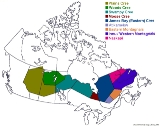
Cree is an
Algonquian languageThe Algonquian languages also Algonkian) are a subfamily of Native American languages which includes most of the languages in the Algic language family. The name of the Algonquian language family is distinguished from the orthographically similar Algonquin dialect of the Ojibwe language, which is a...
spoken by approximately 117,000 people across
CanadaCanada is a North American country consisting of ten provinces and three territories. Located in the northern part of the continent, it extends from the Atlantic Ocean in the east to the Pacific Ocean in the west, and northward into the Arctic Ocean...
, from the Northwest Territories and
AlbertaAlberta is a province of Canada. It had an estimated population of 3.7 million in 2010 making it the most populous of Canada's three prairie provinces...
to
LabradorLabrador is the distinct, northerly region of the Canadian province of Newfoundland and Labrador. It comprises the mainland portion of the province, separated from the island of Newfoundland by the Strait of Belle Isle...
, making it the aboriginal language with the highest number of speakers in Canada. It is also spoken in the
U.S. stateA U.S. state is any one of the 50 federated states of the United States of America that share sovereignty with the federal government. Because of this shared sovereignty, an American is a citizen both of the federal entity and of his or her state of domicile. Four states use the official title of...
of
MontanaMontana is a state in the Western United States. The western third of Montana contains numerous mountain ranges. Smaller, "island ranges" are found in the central third of the state, for a total of 77 named ranges of the Rocky Mountains. This geographical fact is reflected in the state's name,...
. Despite numerous speakers within this wide-ranging area, the only region where Cree has any
official statusAn official language is a language that is given a special legal status in a particular country, state, or other jurisdiction. Typically a nation's official language will be the one used in that nation's courts, parliament and administration. However, official status can also be used to give a...
is in the Northwest Territories, alongside eight other aboriginal languages.
Names
Endonyms are
Nēhiyawēwin ᓀᐦᐃᔭᐍᐏᐣ (Plains Cree),
Nīhithawīwin (Woods Cree),
Nēhinawēwin and
Nehirâmowin (Atikamekw),
Nehilawewin (Western Montagnais, Piyekwâkamî dialect),
Leluwewn (Western Montagnais, Betsiamites dialect),
Innu-Aimûn (Eastern Montagnais),
Iynu-Ayamûn (Southern Inland East Cree),
Iyiyiw-Iyimiwin (Northern East Cree).
Dialect criteria
The Cree
dialect continuumA dialect continuum, or dialect area, was defined by Leonard Bloomfield as a range of dialects spoken across some geographical area that differ only slightly between neighboring areas, but as one travels in any direction, these differences accumulate such that speakers from opposite ends of the...
can be divided by many criteria. Dialects spoken in northern
OntarioOntario is a province of Canada, located in east-central Canada. It is Canada's most populous province and second largest in total area. It is home to the nation's most populous city, Toronto, and the nation's capital, Ottawa....
and the southern James Bay, Lanaudière, and Mauricie regions of
QuebecQuebec or is a province in east-central Canada. It is the only Canadian province with a predominantly French-speaking population and the only one whose sole official language is French at the provincial level....
make a distinct difference between /ʃ/ (
sh as in
she) and /s/, while those to the west (where both are pronounced /s/) and east (where both are pronounced either /ʃ/ or /h/) do not. In several dialects, including northern
Plains CreePlains Cree is a dialect of the Algonquian language, Cree, which is the most common Canadian indigenous language. Plains Cree is sometimes considered a dialect of the Cree-Montagnais language, or sometimes a dialect of the Cree language, distinct from the Montagnais language...
and Woods Cree, the long vowels /eː/ and /iː/ have merged into a single vowel, /iː/. In the Québec communities of
ChisasibiChisasibi is a village on the eastern shore of James Bay, in the Eeyou Istchee territory in northern Quebec, Canada. It is situated on the south shore of La Grande River , less than from the river's mouth...
,
WhapmagoostuiWhapmagoostui |beluga]]") is the northernmost Cree village in Quebec, located at the mouth of the Great Whale River on the coast of Hudson Bay in Nunavik, Quebec, Canada. About 500 people, mostly Inuit, live in the neighbouring northern village of Kuujjuarapik. The community is only accessible by...
, and
KawawachikamachKawawachikamach is an Naskapi/Iyiyiw First Nations reserve and community at the south end of Lake Matemace , approximately northeast of Schefferville, Quebec, Canada. It belongs to the Naskapi Nation of Kawawachikamach. The village was built by the Naskapi/Iyiyiw from 1980 to 1983...
, the long vowel /eː/ has merged with /aː/.
However, the most transparent phonological variation between different Cree dialects are the reflexes of
Proto-AlgonquianProto-Algonquian is the name given to the proto-language from which the various languages of the Algonquian family are descended. It is generally estimated to have been spoken around 2,500 to 3,000 years ago, but on the question of where it was spoken there is less agreement...
*r in the modern dialects, as shown below:
| Dialect |
Location |
Reflex of *n |
Word for "Native person" ← *elenyiwa |
Word for "You" ← *kīla |
Plains CreePlains Cree is a dialect of the Algonquian language, Cree, which is the most common Canadian indigenous language. Plains Cree is sometimes considered a dialect of the Cree-Montagnais language, or sometimes a dialect of the Cree language, distinct from the Montagnais language... |
SK, AB, BC, NT |
y |
iyiniw |
kiya |
| Woods Cree Woods Cree is an Algonquian language spoken in Manitoba and Saskatchewan, Canada.It only has 14 letters in the alphabet. There are marked and unmarked letters... |
MB, SK |
ð/th |
iðiniw/ithiniw |
kīða/kītha |
| Swampy Cree Swampy Cree is a dialect of the Cree language complex. Swampy Cree is spoken in a series of communities in northern Manitoba, central northeast of Saskatchewan along the Saskatchewan River and along the Hudson Bay coast and adjacent inland areas to the south and west, and Ontario along the coast... |
ON, MB, SK |
n |
ininiw |
kīna |
| Moose Cree Moose Cree is an Algonquian language spoken in Ontario, Canada around the southern tip of James Bay.-References:*... |
ON |
l |
ililiw |
kīla |
| Northern East Cree East Cree, also known as Eastern James Bay Cree, and East Main Cree, refers to a group of Cree dialects spoken in Quebec, Canada on the east coast of lower Hudson Bay and James Bay, and inland southeastward from James Bay... |
QC |
y |
īyiyū |
čīy ᒌ |
| Southern East Cree |
QC |
y |
iynū |
čīy ᒌ |
| Kawawachikamach Naskapi Naskapi is an Algonquian language spoken by the Naskapi in Quebec and Labrador, Canada. It is written in Eastern Cree syllabics.... |
QC |
y |
iyyū |
čīy |
| Atikamekw The Atikamekw language , a dialect of Cree, is the language of the Atikamekw people of southwestern Quebec. It is spoken by nearly all the Atikamekw, and therefore it is among the indigenous languages least threatened with extinction according to some studies... |
QC |
r |
iriniw |
kīr |
| Western Innu |
QC |
l |
ilnū |
čīl |
| Eastern Innu |
QC, NL |
n |
innū |
čīn |
The Plains Cree, speakers of the
y dialect, refer to their language as
nēhiyawēwin, whereas Woods Cree speakers say
nīhithawīwin, and Swampy Cree speakers say
nēhinawēwin. This is similar to the
alternationIn linguistics, an alternation is the phenomenon of a phoneme or morpheme exhibiting variation in its phonological realization. Each of the various realizations is called an alternant...
in the
Siouan languagesThe Western Siouan languages, also called Siouan proper or simply Siouan, are a Native American language family of North America, and the second largest indigenous language family in North America, after Algonquian...
Dakota,
Nakota, and
Lakota.
Another important phonological variation among the Cree dialects involves the palatalisation of Proto-Algonquian
*k: East of the Ontario-Quebec border (except for Atikamekw), Proto-Algonquian *k has changed into /tʃ/ or /ts/ (
ch as in
cheese and
ts as in Wa
tson) before front vowels. See the table above for examples in the *kīla column.
Very often the Cree dialect continuum is divided into two languages: Cree and Montagnais. Cree includes all dialects which have not undergone the *k -> /tʃ/ sound change (BC–QC) while Montagnais encompasses the territory where this sound change has occurred (QC–NL). These labels are very useful from a linguistic perspective but are confusing as
East Cree then qualifies as Montagnais. For practical purposes, Cree usually covers the dialects which use syllabics as their orthography (including Atikamekw but excluding Kawawachikamach Naskapi), the term Montagais then applies to those dialects using the Latin script (excluding Atikamekw and including Kawawachikamach Naskapi). The term Naskapi typically refers to
KawawachikamachKawawachikamach is an Naskapi/Iyiyiw First Nations reserve and community at the south end of Lake Matemace , approximately northeast of Schefferville, Quebec, Canada. It belongs to the Naskapi Nation of Kawawachikamach. The village was built by the Naskapi/Iyiyiw from 1980 to 1983...
(y-dialect) and Natuashish (n-dialect).
Dialect groups
The Cree dialects can be broadly classified into nine groups. From west to east:
| ISO-3 |
ISO-3 name |
Linguasphere |
Linguasphere name |
dialect type |
additional comments |
| cre |
Cree (generic) |
62-ADA-a |
Cree |
|
|
| cwd |
Woods Cree Woods Cree is an Algonquian language spoken in Manitoba and Saskatchewan, Canada.It only has 14 letters in the alphabet. There are marked and unmarked letters...
(Nīhithawīwin) |
62-ADA-ab |
Woods Cree |
th / k / s / ī |
Also known as "Woods/Rocky Cree". In this dialect ē has merged into ī. |
| crk |
Plains CreePlains Cree is a dialect of the Algonquian language, Cree, which is the most common Canadian indigenous language. Plains Cree is sometimes considered a dialect of the Cree-Montagnais language, or sometimes a dialect of the Cree language, distinct from the Montagnais language... |
62-ADA-aa |
Plains Cree |
y / k / s / ī (northern) y / k / s / e (southern) |
Divided to Southern Plains Cree (Nēhiyawēwin) and Northern Plains Cree (Nēhiyawēmowin). In the Northern dialect, ē has merged into ī. |
| crw |
Swampy Cree Swampy Cree is a dialect of the Cree language complex. Swampy Cree is spoken in a series of communities in northern Manitoba, central northeast of Saskatchewan along the Saskatchewan River and along the Hudson Bay coast and adjacent inland areas to the south and west, and Ontario along the coast...
(Nēhinawēwin) |
62-ADA-ac |
Swampy Cree, West (Ininīmowin) |
n / k / s / e (western) n / k / s\š / e (eastern) |
Also known as "West Main Cree." In the western dialect, š has merged with s. |
| 62-ADA-ad |
Swampy Cree, East (Ininiwi-Išikišwēwin) |
| crm |
Moose Cree Moose Cree is an Algonquian language spoken in Ontario, Canada around the southern tip of James Bay.-References:*...
(Ililīmowin) |
62-ADA-ae |
Moose Cree |
l / k / s\š / e |
Also known as "West Main Cree." "Central Main Cree," "West Shore Cree," or "York Cree." |
| crl |
Northern East Cree East Cree, also known as Eastern James Bay Cree, and East Main Cree, refers to a group of Cree dialects spoken in Quebec, Canada on the east coast of lower Hudson Bay and James Bay, and inland southeastward from James Bay...
(Īyiyū Ayimūn) |
62-ADA-af |
Cree, East |
y / č / s\š / ā (northern) y / č / s\š / e (southern-coastal) y / č / š~s / e (southern-inland) |
Also known as "James Bay Cree" or "East Main Cree". The long vowels ē and ā have merged in the northern dialect but are distinct in the southern. Southern East Cree is divided between coastal (southwestern) and inland (southeastern) varieties. Also, the inland southern dialect has lost the distinction between s and š. Here, the inland southern dialect falls in line with the rest of the Naskapi groups where both phonemes have become š. Nonetheless, the people from the two areas easily communicate. |
| crj |
Southern East Cree (Īnū Ayimūn) |
62-ADA-ag |
Cree, Southeast |
| |
|
62-ADA-b |
Innu |
|
|
| nsk |
Naskapi Naskapi is an Algonquian language spoken by the Naskapi in Quebec and Labrador, Canada. It is written in Eastern Cree syllabics.... |
62-ADA-ba |
Mushau Innuts |
|
|
| 62-ADA-baa |
Koksoak |
y / č / š~s / ā |
Western Naskapi (Kawawachikamach) |
| 62-ADA-bab |
Davis Inlet |
n / č / š~s / ā |
Eastern Naskapi (Mushuau Innu or Natuashish) |
| moe |
Montagnais |
62-ADA-bb |
Uashau Innuts + Bersimis |
|
|
| 62-ADA-bbe |
Pointe Bleue |
l / č / s\š / e |
Western Montagnais (Leluwewn); also known as the "Betsiamites dialect" |
| 62-ADA-bbd |
Escoumains |
| 62-ADA-bbc |
Bersimis |
| 62-ADA-bbb |
Uashaui Innuts |
n / č / s\š / e |
Western Montagnais (Nehilawewin), but sometimes called "Central Montagnais" or "Piyekwâkamî dialect" |
| 62-ADA-bba |
Mingan |
n / č / s\š / e |
Eastern Montagnais (Innu-aimûn) |
| |
|
62-ADA-c |
Atikamekw |
|
|
| atj |
Atikamekw The Atikamekw language , a dialect of Cree, is the language of the Atikamekw people of southwestern Quebec. It is spoken by nearly all the Atikamekw, and therefore it is among the indigenous languages least threatened with extinction according to some studies...
(Nehirâmowin) |
62-ADA-ca |
Manawan |
r / k / s\š / e |
|
| 62-ADA-cb |
Wemotaci |
| 62-ADA-cc |
Opitciwan |
Phonology
This table is made to show all possible consonant phonemes that may be included in a Cree language.
Consonant phonemes
|
BilabialIn phonetics, a bilabial consonant is a consonant articulated with both lips. The bilabial consonants identified by the International Phonetic Alphabet are:...
|
Dental |
AlveolarAlveolar consonants are articulated with the tongue against or close to the superior alveolar ridge, which is called that because it contains the alveoli of the superior teeth...
|
Post- alveolarPostalveolar consonants are consonants articulated with the tongue near or touching the back of the alveolar ridge, further back in the mouth than the alveolar consonants, which are at the ridge itself, but not as far back as the hard palate...
|
PalatalPalatal consonants are consonants articulated with the body of the tongue raised against the hard palate...
|
VelarVelars are consonants articulated with the back part of the tongue against the soft palate, the back part of the roof of the mouth, known also as the velum)....
|
GlottalGlottal consonants, also called laryngeal consonants, are consonants articulated with the glottis. Many phoneticians consider them, or at least the so-called fricative, to be transitional states of the glottis without a point of articulation as other consonants have; in fact, some do not consider...
|
| Nasal A nasal consonant is a type of consonant produced with a lowered velum in the mouth, allowing air to escape freely through the nose. Examples of nasal consonants in English are and , in words such as nose and mouth.- Definition :...
|
m |
|
n |
|
|
|
|
| Stop In phonetics, a plosive, also known as an occlusive or an oral stop, is a stop consonant in which the vocal tract is blocked so that all airflow ceases. The occlusion may be done with the tongue , lips , and &...
|
p |
t |
t͡s |
t͡ʃ |
|
k |
|
| Fricative Fricatives are consonants produced by forcing air through a narrow channel made by placing two articulators close together. These may be the lower lip against the upper teeth, in the case of ; the back of the tongue against the soft palate, in the case of German , the final consonant of Bach; or...
|
|
ð |
s |
ʃ |
|
|
h |
| Approximant Approximants are speech sounds that involve the articulators approaching each other but not narrowly enough or with enough articulatory precision to create turbulent airflow. Therefore, approximants fall between fricatives, which do produce a turbulent airstream, and vowels, which produce no...
|
|
|
ɹ |
|
j |
w |
|
LateralA lateral is an el-like consonant, in which airstream proceeds along the sides of the tongue, but is blocked by the tongue from going through the middle of the mouth....
|
|
|
l |
|
|
|
|
Syntax
Like many Native American languages, Cree features a complex polysynthetic morphology and syntax. A Cree word can be very long, and express something that takes a series of words in English. For example, the Plains Cree word for "school" is
kiskinohamātowikamikw, "know.
CAUS.
APPLICATIVE.
RECIPROCAL.place" or the "knowing-it-together-by-example place".
Written Cree
Cree dialects, except for those spoken in eastern
QuebecQuebec or is a province in east-central Canada. It is the only Canadian province with a predominantly French-speaking population and the only one whose sole official language is French at the provincial level....
and
LabradorLabrador is the distinct, northerly region of the Canadian province of Newfoundland and Labrador. It comprises the mainland portion of the province, separated from the island of Newfoundland by the Strait of Belle Isle...
, are traditionally written using
Cree syllabicsCree syllabics, found in two primary variants, are the versions of Canadian Aboriginal syllabics used to write Cree dialects, including the original syllabics system created for Cree and Ojibwe. Syllabics were later adapted to several other languages...
, a variant of
Canadian Aboriginal syllabicsCanadian Aboriginal syllabic writing, or simply syllabics, is a family of abugidas used to write a number of Aboriginal Canadian languages of the Algonquian, Inuit, and Athabaskan language families....
, but can be written with the Roman alphabet as well. The easternmost dialects are written using the Roman alphabet exclusively. Cree dialects for the James Bay Cree are written using Cree syllabics.
Various Cree dialects have begun creating dictionaries to serve their communities. Some projects, such as the Cree Language Resource Project (CLRP) is developing an online bilingual Cree dictionary for the Cree language.
Contact languages
Cree is also a component language in two contact languages, Michif and Bungi. Both languages were spoken by members of the
MétisA Métis is a person born to parents who belong to different groups defined by visible physical differences, regarded as racial, or the descendant of such persons. The term is of French origin, and also is a cognate of mestizo in Spanish, mestiço in Portuguese, and mestee in English...
, the
VoyageursThe Voyageurs were the persons who engaged in the transportation of furs by canoe during the fur trade era. Voyageur is a French word which literally translates to "traveler"...
, and European settlers of Western
CanadaCanada is a North American country consisting of ten provinces and three territories. Located in the northern part of the continent, it extends from the Atlantic Ocean in the east to the Pacific Ocean in the west, and northward into the Arctic Ocean...
and parts of the Northern
United StatesThe United States of America is a federal constitutional republic comprising fifty states and a federal district...
.
MichifMichif is the language of the Métis people of Canada and the United States, who are the descendants of First Nations women and fur trade workers of European ancestry...
is a
mixed languageA mixed language is a language that arises through the fusion of two source languages, normally in situations of thorough bilingualism, so that it is not possible to classify the resulting language as belonging to either of the language families that were its source...
which combines Cree with
FrenchFrench is the adjective form of France and usually refers to:* Something of, from, or related to the nation of France** French culture** French cuisine** French people, inhabitants of France or people having family origins in France...
. For the most part, Michif uses Cree verbs, question words, and
demonstrativesIn linguistics, demonstratives are deictic words that indicate which entities a speaker refers to and distinguishes those entities from others...
while using French nouns. Michif is unique to the Canadian prairie provinces as well as to
North DakotaNorth Dakota is a state located in the Midwestern region of the United States of America, along the Canadian border. The state is bordered by Canada to the north, Minnesota to the east, South Dakota to the south and Montana to the west. North Dakota is the 19th-largest state by area in the U.S....
and
MontanaMontana is a state in the Western United States. The western third of Montana contains numerous mountain ranges. Smaller, "island ranges" are found in the central third of the state, for a total of 77 named ranges of the Rocky Mountains. This geographical fact is reflected in the state's name,...
in the United States. Michif is still spoken in central Canada and in North Dakota.
Bungi is a dialect of Scottish English with
substrateIn linguistics, a stratum or strate is a language that influences, or is influenced by another through contact. A substratum is a language which has lower power or prestige than another, while a superstratum is the language that has higher power or prestige. Both substratum and superstratum...
influences from Cree and
OjibweOjibwe , also called Anishinaabemowin, is an indigenous language of the Algonquian language family. Ojibwe is characterized by a series of dialects that have local names and frequently local writing systems...
. Some
FrenchFrench is the adjective form of France and usually refers to:* Something of, from, or related to the nation of France** French culture** French cuisine** French people, inhabitants of France or people having family origins in France...
words have also been incorporated into its
lexiconIn linguistics, the lexicon of a language is its vocabulary, including its words and expressions. A lexicon is also a synonym of the word thesaurus. More formally, it is a language's inventory of lexemes. Coined in English 1603, the word "lexicon" derives from the Greek "λεξικόν" , neut...
. This language flourished at and around the
Red River SettlementThe Red River Colony was a colonization project set up by Thomas Douglas, 5th Earl of Selkirk in 1811 on of land granted to him by the Hudson's Bay Company under what is referred to as the Selkirk Concession. The colony along the Red River of the North was never very successful...
(modern day location of
WinnipegWinnipeg is the capital and largest city of Manitoba, Canada, and is the primary municipality of the Winnipeg Capital Region, with more than half of Manitoba's population. It is located near the longitudinal centre of North America, at the confluence of the Red and Assiniboine Rivers .The name...
,
ManitobaManitoba is a Canadian prairie province with an area of . The province has over 110,000 lakes and has a largely continental climate because of its flat topography. Agriculture, mostly concentrated in the fertile southern and western parts of the province, is vital to the province's economy; other...
) by the mid to late 1900s. Bungi is now virtually extinct.
Many Cree words also became the basis for words in the
Chinook JargonChinook Jargon originated as a pidgin trade language of the Pacific Northwest, and spread during the 19th century from the lower Columbia River, first to other areas in modern Oregon and Washington, then British Columbia and as far as Alaska, sometimes taking on characteristics of a creole language...
trade language used until some point after contact with Europeans.
Cree has also been incorporated into two other mixed languages within Canada. The
Oji-Cree languageThe Severn Ojibwa or the Oji-Cree language is the indigenous name for a dialect of the Ojibwe language spoken in a series of Oji-Cree communities in northern Ontario and at Island Lake, Manitoba, Canada...
(also Severn Ojibwe), spoken in parts of Manitoba and western
OntarioOntario is a province of Canada, located in east-central Canada. It is Canada's most populous province and second largest in total area. It is home to the nation's most populous city, Toronto, and the nation's capital, Ottawa....
, is a mixed language of Cree and Ojibwe, and the Nehipwat language, which is a blending of Cree with
AssiniboineThe Assiniboine language is a Nakotan Siouan language of the Northern Plains, spoken by around 200 Assiniboine people, most of them elderly. The name Asiniibwaan is an Ojibwe term meaning "Stone Siouans"...
. Nehipwat is found only in a few southern
SaskatchewanSaskatchewan is a prairie province in Canada, which has an area of . Saskatchewan is bordered on the west by Alberta, on the north by the Northwest Territories, on the east by Manitoba, and on the south by the U.S. states of Montana and North Dakota....
reserves and is now nearing extinction. Nothing is known of its structure.
Legal status
The social and legal status of Cree varies across Canada. Cree is one of the eleven official languages of the
Northwest TerritoriesThe Northwest Territories is a federal territory of Canada.Located in northern Canada, the territory borders Canada's two other territories, Yukon to the west and Nunavut to the east, and three provinces: British Columbia to the southwest, and Alberta and Saskatchewan to the south...
, but is only spoken by a small number of people there in the area around the town of
Fort SmithFort Smith is a town in the South Slave Region of the Northwest Territories, Canada. It is located in the southeastern portion of the Northwest Territories, on the Slave River and adjacent to the NWT/Alberta border.-History:Fort Smith's history began because of the Slave River and the vital link...
.
In many areas, it is a vibrant community language spoken by large majorities and taught in schools through immersion and second-language programmes. In other areas, its use has declined dramatically. Cree is one of the least endangered aboriginal languages in North America, but is nonetheless at risk since it possesses little institutional support in most areas.
External links